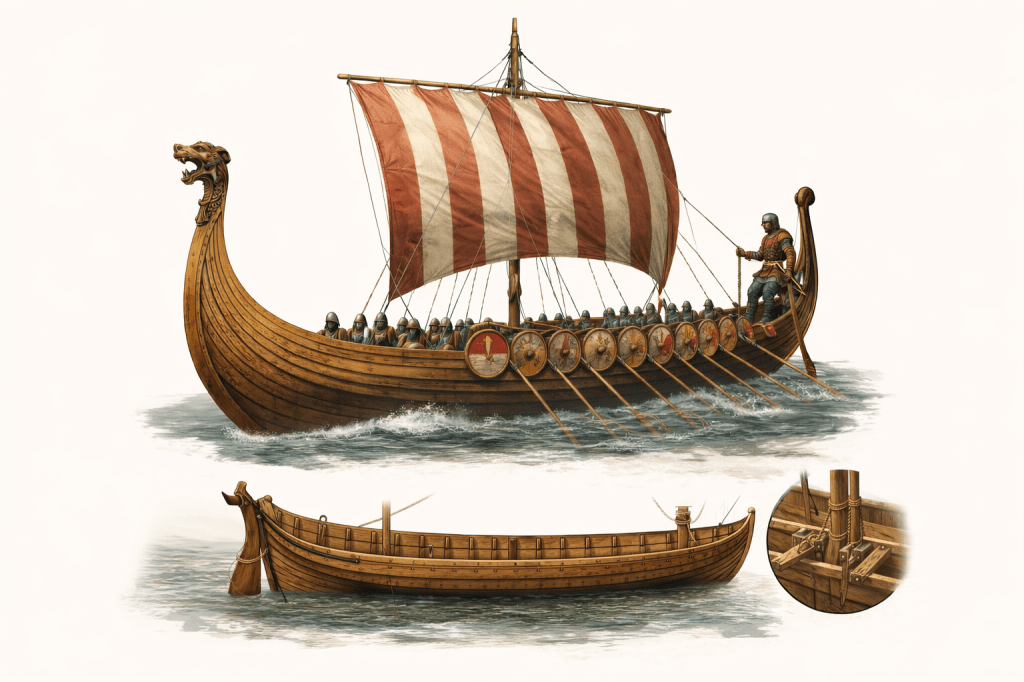
The remarkable ship that turned the North Sea into a highway and allowed Viking sailors to strike the shores of Europe with speed and precision.
Northern Seas of Scandinavia: Early Viking Age
Along the windswept coasts of Britain, where narrow rivers met the restless waters of the North Sea and stone monasteries stood watching the long grey horizon, the monks who kept the written memory of the age had begun to record troubling reports carried slowly across the maritime world that connected the scattered shores of northern Europe.
Messages travelled gradually between the monasteries and trading settlements of the coasts, arriving with merchants who followed the sea lanes between England and the lands of the continent, with wandering pilgrims seeking distant houses of learning, and sometimes with fishermen who spoke of unfamiliar vessels sighted far beyond the shallows where the known trading ships usually sailed.
For generations the waters of the North Sea had served as a broad corridor linking distant communities, a place where commerce and travel moved with the rhythm of tide and weather as traders exchanged wool, timber, and crafted goods between the ports of Britain, Francia, and the Low Countries, while scholars and pilgrims crossed the same uncertain waters in search of devotion, learning, and sanctuary within the quiet walls of the monasteries that lined the northern coasts.
Yet beyond that familiar maritime world, along the broken coastlines and deep fjords of Scandinavia, a very different relationship with the sea had long shaped the lives of the people who lived among the mountains and narrow valleys of Norway and Denmark, where limited farmland and harsh winters had encouraged generations of seafarers to look outward across the northern waters in search of opportunity, trade, and sometimes plunder.
Within those northern communities, the craft of shipbuilding had developed steadily over many generations, as skilled builders shaped flexible oak planks along slender frames to produce vessels capable of moving with the motion of the sea itself while still remaining swift beneath both sail and oar, creating ships whose narrow hulls and shallow draught allowed them to travel across coastal waters, beaches, estuaries, and winding rivers that larger vessels could never approach.
The ship that emerged from this long tradition of experimentation and refinement would soon become known across the chronicles of Europe, for the vessel combined speed, balance, and adaptability in ways that made it uniquely suited to the restless northern seas, enabling its crews to cross the wide expanse of the North Sea with surprising speed before appearing suddenly along distant shores that had long believed themselves secure behind the uncertain barrier of the open water.
This vessel, which later generations would simply call the longship, represented far more than a tool of travel or trade, since its design embodied the accumulated knowledge of communities whose survival depended upon mastering the changing winds, tides, and currents of the northern seas, allowing its crews to approach almost any shoreline before withdrawing again into the wide waters from which they had emerged.
By the closing years of the eighth century, ships of this kind had begun to appear with increasing frequency along the coasts of Britain, sometimes arriving first as traders or explorers whose intentions remained uncertain, though the visits gradually became more troubling as small coastal settlements and isolated monasteries reported sudden attacks carried out by raiders who arrived swiftly from the sea before vanishing again beyond the horizon.
Word of these encounters moved slowly across the maritime world of the North Sea, recorded in fragments within monastic chronicles and carried through rumour and testimony between the scattered communities that depended upon the sea for travel and trade, while few at the time could yet recognise that these early attacks marked the beginning of a transformation that would soon reshape the balance of power along the northern coasts of Europe.
The quiet raids of the early Viking Age had begun.
Timeline of Events
793 AD — The attack upon the monastery of Lindisfarne sends shock across the Christian world, marking the beginning of what later generations would recognise as the Viking Age in Britain.
795 AD — Norse raiders strike the monasteries of Ireland, revealing that the northern seafarers have begun to range widely across the waters of the Irish Sea.
802 AD — Viking forces descend upon the sacred island monastery of Iona, destroying buildings that had stood for generations and demonstrating the growing reach of the northern fleets.
806 AD — A second attack upon Iona results in the killing of sixty-eight monks, an event recorded with deep sorrow in the surviving chronicles of the age.
820s AD — Raiding fleets begin appearing with greater regularity along the coasts of Francia and the Low Countries, extending the sphere of Norse activity beyond the shores of Britain.
830s AD — Viking expeditions increasingly follow the great river systems of Europe, travelling inland along waterways that lead deep into the heart of powerful kingdoms.
About the Creator
This Chronicle is written by Simon Phillips, author of several historical and speculative fiction works exploring forgotten worlds, myth, and the turning points of history.
You can explore his books here::
Books by Simon Phillips
You can watch his YouTube channel here:
Author Simon Phillips

Subscribe to continue reading
Subscribe to get access to the rest of this post and other subscriber-only content.
