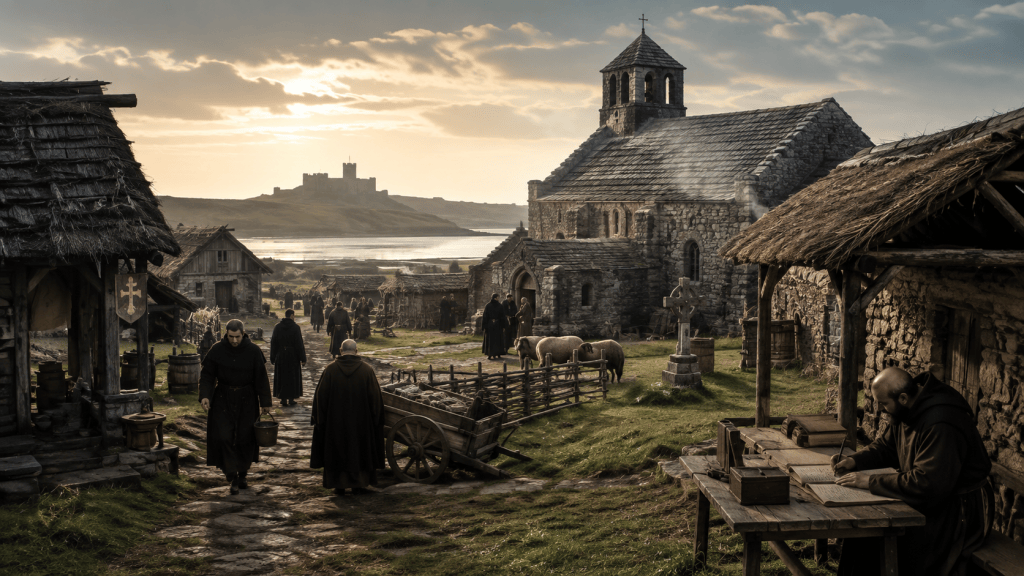
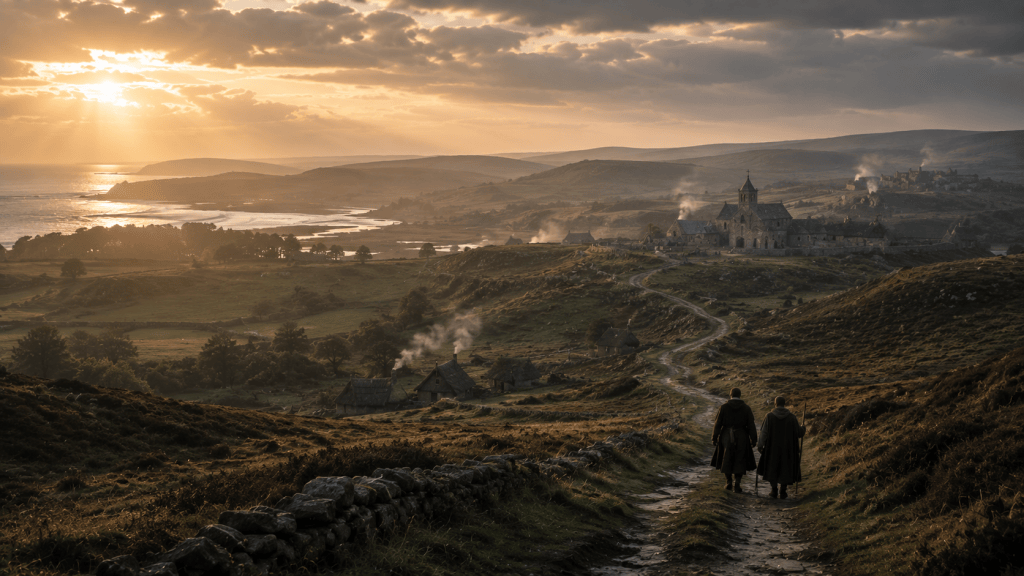
Along the Northumbrian coast, the sea was both boundary and road. Fishing boats worked close to shore, traders moved between communities that were far less isolated than they can appear from the present, and monasteries stood within landscapes shaped by farming, royal power, prayer, obligation and exchange. Beyond the horizon lay routes leading towards Ireland, Francia and Scandinavia.
In 793, one of those routes carried violence to Lindisfarne.
The Viking raid on Lindisfarne has become one of the most familiar markers in the history of Viking Age Britain. Its importance lies partly in the attack itself and partly in what Lindisfarne represented. This was no anonymous settlement on an exposed coast. It was one of the great religious centres of Anglo-Saxon Northumbria, closely connected to kingship, learning and the cult of St Cuthbert. English Heritage describes the attack of 8 June 793 as a devastating raid whose effect was psychological as well as physical.
To understand the shock, it helps to look beyond the image of ships reaching a beach.
Lindisfarne belonged to a world in which faith, political authority, land, memory and sacred objects were closely connected. An assault upon the monastery therefore reached much further than its buildings.
Lindisfarne at the Heart of Anglo-Saxon Northumbria
The monastery on Lindisfarne had been founded in 635, when King Oswald of Northumbria invited Aidan from Iona and granted him the tidal island as a base for Christian mission.
Its position mattered.
Bamburgh, one of the principal centres of Northumbrian royal power, lay only a short distance along the coast. Lindisfarne consequently developed close connections with kings and nobles while becoming an important centre of Christianity in northern Britain. St Cuthbert, who died in 687, became central to the island’s religious identity, and the growth of his cult brought pilgrims, gifts and further influence. The Lindisfarne Gospels were produced there in the early eighth century, evidence of a community connected not merely with worship, but with scholarship, artistic labour and the preservation of knowledge.
This is an important distinction when imagining Anglo-Saxon monasteries.
They were never simply lonely stone churches occupied by men removed from the concerns of the surrounding world. A major monastery could possess land, receive royal patronage, maintain relationships with other religious communities and participate in networks extending far beyond its immediate surroundings.
Daily life still depended upon ordinary things: food, livestock, firewood, weather, boats, labour and the arrival of travellers. Manuscripts required skins, pigments, time and trained hands. Communities required grain and shelter. Pilgrims had to be received. Messages had to travel.
Sacred importance rested upon a deeply physical foundation.
That is part of what made a monastery vulnerable.
Why the Raid of 793 Mattered
The Lindisfarne attack was not necessarily the first encounter between people in Anglo-Saxon England and Scandinavians. Contacts across the North Sea already existed, and other violent encounters may have preceded it. The significance of Lindisfarne comes from the combination of its date, the surviving written response and the religious importance of the place itself. English Heritage notes that it is the first Viking attack on what is now England that can be securely tied to a specific date, while earlier incidents may have occurred elsewhere.
Contemporary reaction shows how disturbing the attack appeared.
Alcuin of York, then living at Charlemagne’s court, wrote in horror about the violation of St Cuthbert’s church. His concern went beyond military weakness. The event raised a religious question: how could a place associated with such holiness suffer in this way?
For people whose understanding of kingship, morality, divine favour and earthly events could overlap, the question mattered.
Violence against Lindisfarne could therefore be interpreted through several layers at once. It was an attack by foreign raiders. It was a destruction of property and lives. It was an assault upon a religious community. It could also be read as judgement, warning or evidence that the expected order of the world had somehow failed.
The surviving sources reveal some of those reactions, even though they cannot tell us exactly how every monk, farmer, fisherman or household along the Northumbrian coast understood what had happened.
History becomes particularly human in that uncertainty.
A distant political crisis can remain distant. Ships appearing off a familiar coast cannot.
Northumbria Was Powerful, Yet Far From Stable
There was no single kingdom of England in 793.
The political landscape consisted of separate kingdoms whose strength rose and fell through war, marriage, inheritance, religious patronage and the ability of rulers to retain powerful supporters. Northumbria had once dominated much of Britain, while Mercian power had become increasingly important during the eighth century. The eventual creation of a unified English kingdom still lay generations ahead.
Northumbria itself had experienced serious political instability. King Ælfwald had been murdered in 788, only a few years before the Lindisfarne raid. Alcuin’s reaction to the attack was shaped partly by his anxiety about disorder within Northumbrian society and politics.
For ordinary people, royal instability was unlikely to arrive as a neat sequence of reigns remembered from a textbook.
It could mean uncertain loyalties, armed followers on roads, changes in obligation, rumours moving between settlements, demands from local authority, and the knowledge that a dispute among powerful families could eventually reach fields and households far from a royal centre.
This fractured political landscape matters enormously when approaching Viking Age Britain.
The Scandinavian arrivals of the following decades would encounter several kingdoms, regional identities and competing centres of authority. The later struggle that contributed to the formation of England cannot be understood properly if England is imagined as already waiting intact for the Vikings to attack.
It was still being made.
The Sea Was Never Empty
Modern maps can make the North Sea appear like empty space separating Britain from Scandinavia.
For early medieval communities, water connected as readily as it divided.
Ships carried goods, people, news and violence. Rivers extended those routes inland. Coastal communities lived with the practical knowledge that something beyond sight could eventually arrive upon the tide.
The Scandinavian presence in Britain would later include raiding armies, settlers, traders, farmers, political leaders and communities whose identities changed through contact with the people already living there. Reducing that history to raiders alone removes much of what made the period transformative.
In 793, however, the immediate experience at Lindisfarne was violence.
The broader cultural entanglement came over generations.
That distinction matters. The Norse presence in Britain became complex; the suffering caused by raids remains equally real. Neither truth needs to erase the other.
Faith, Relics and the Power of Objects
Sacred objects were already part of the real religious world surrounding Lindisfarne.
The remains of St Cuthbert became the centre of an important cult after his death, and the community’s guardianship of his shrine helped make Lindisfarne a major pilgrimage centre. Objects associated with saints could carry profound religious meaning for medieval Christians, while books, crosses, vessels and reliquaries could possess devotional, artistic and material value at the same time.
This historical relationship between belief and physical objects provides one of the points where The Last Rune Keeper moves from history into historical fantasy.
The distinction is important.
There is no historical evidence for the magical relic system found in the series, nor for Church relic-hunters performing the work undertaken by Eadric and Father Oswin. Those elements belong entirely to the fictional world.
What history provides is a society in which objects could matter intensely.
The fictional question then becomes more interesting: what if some objects carried something other than memory, holiness, craftsmanship or inherited meaning?
That is where the fantasy enters.
Shadows Over the North and the World Before the Breaking
Book One of The Last Rune Keeper,Shadows Over the North, begins inside this unsettled Northumbrian world.
Eadric is a young Church-trained relic hunter whose work brings him into contact with objects that the institution around him prefers to contain, remove or place beyond ordinary reach. His mentor, Father Oswin, provides experience and religious structure, while Eadric increasingly encounters things that resist the clear boundaries he has been taught to trust.
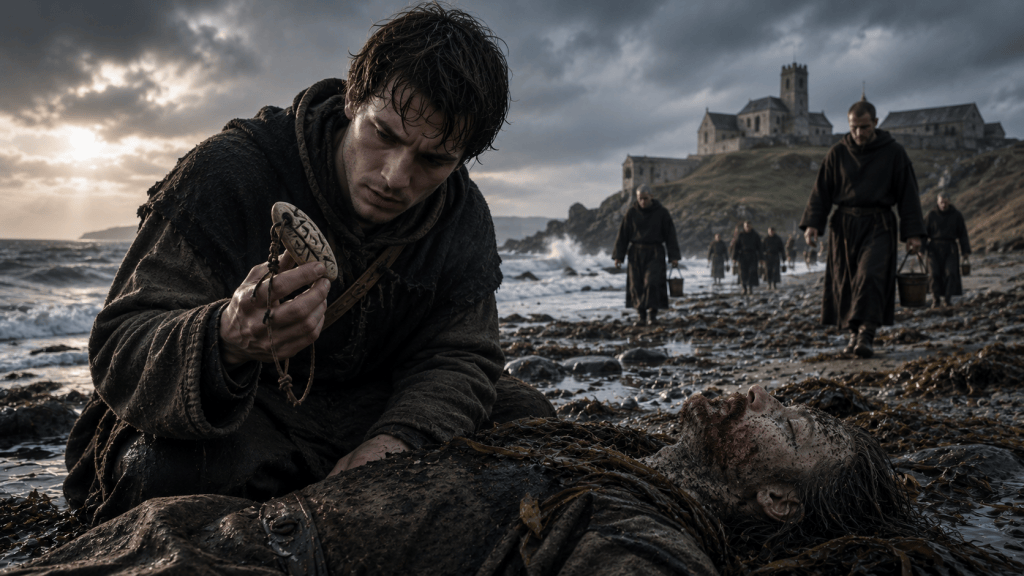
The book takes place around the Lindisfarne era rather than using the famous raid merely as spectacle. The monastery, shoreline, roads, battlefield remains and rumours of ships matter because they place Eadric inside a society already experiencing political and religious strain. The story’s movement begins with relics recovered from the shore and develops through Eadric’s growing recognition that these objects can respond to him in ways neither doctrine nor training entirely explains.
That approach reflects the wider identity of the series.
The historical world remains responsible for its own history. Kings, invasions, settlement, Christianity and eventual political consolidation are real forces rather than scenery surrounding a magical adventure. Eadric moves through that transformation. He does not replace it.
Magic at the Edge of Belief
The fantasy of The Last Rune Keeper is deliberately placed where historical certainty ends.
Early medieval people lived within cultures containing prayer, prophecy, signs, charms, sacred places, dreams, healing traditions and inherited stories about forces beyond ordinary perception. The evidence for individual practices can be fragmentary and difficult to interpret, especially when it survives through texts written by people who viewed older or competing traditions through their own religious framework.
Historical fantasy can enter that uncertainty while still preserving the boundary between evidence and invention.
Within The Last Rune Keeper, magic exists as something increasingly difficult for the changing world to sustain. Runes depend upon relationships between symbol, place and understanding. Relics preserve older conditions more stubbornly. Norse magical practice is embodied through culture, ritual and lived connection rather than presented as a universal system available to anyone who learns the correct words. Eadric himself interferes with these forces more readily than he commands them.
None of this is presented as hidden historical fact.
It is the fictional layer running beside history.
Its purpose is less to make the Viking Age more spectacular than to ask what happens when one understanding of the world slowly loses the conditions required for its survival.
Christianity Was Already Part of the Landscape
The eventual Christianisation and political consolidation of England can sometimes be described as though Christianity simply advanced across a pagan landscape from outside.
The history was far more complicated.
By the time of the Lindisfarne raid, Christianity had already been deeply embedded in Northumbrian political and cultural life for generations. Lindisfarne itself had helped drive that process since the seventh century. Bishops, monasteries, saints’ cults and royal patronage formed part of the structures through which communities understood authority and memory.
That makes the religious tension surrounding The Last Rune Keeper more complicated than a simple conflict between Christianity and paganism.
Eadric belongs to the Church. His faith is part of the way he understands himself. Oswin’s belief is equally genuine. The institution gives them purpose, language, protection and order.
The tension arises because the same structure that preserves one form of memory can help displace another.
Within the fictional series, fading magic becomes one way of exploring that process.
Before England, There Were People Living Through Change
The political transformation eventually producing England took well over a century beyond the events of 793.
People living along the Northumbrian coast when the first Scandinavian raids intensified could not know where that process would lead. They could see local consequences: ships, burned buildings, altered routes, missing people, changing rulers, threatened monasteries and new communities arriving in lands that already possessed histories of their own.
Generations later, raiding would become settlement. Settlement would become political presence. Scandinavian and Anglo-Saxon communities would trade, fight, intermarry, convert, negotiate and reshape one another.
Kingdoms would fall.
Others would expand.
Christian authority would deepen.
Old identities would survive in altered forms.
Eventually a kingdom called England would emerge from a process far more complicated than any single victory or ruler.
That long transformation is the historical ground beneath The Last Rune Keeper. Its fading magic belongs to fiction, while the pressure causing people to reconsider loyalty, faith, land and belonging comes from a real world already changing beneath their feet.
Lindisfarne matters because it allows us to see that world near the beginning of one of its great disruptions.
The ships on the horizon had yet to become settlements, armies, political alliances and new generations born into mixed landscapes.
England itself still lay far ahead.
For the people standing on those shores, there was only the sea, the uncertain north, and the knowledge that something had reached them which would no longer remain beyond the horizon.
A library-side account of the day a hidden passage stirred beneath Bremyra Castle, and the shelves were said to remember what the court had left sealed below.
Beneath the Quiet Shelves
The royal library of Bremyra Castle opened later than the kitchens, later than the chapel, and later than the guards who crossed the inner court before dawn with frost silvering their cloaks, for books kept their own hour and yielded poorly to haste. Morning entered that high chamber by slow degrees, first as grey thinning behind the eastern glass, then as a pale wash across the upper shelves, until gold leaf along certain spines gave back a dull glow like embers buried under ash. The air held vellum, old leather, lamp smoke, winter wool, and the faint mineral chill that rose from the stones whenever snow lay across the outer walls.
Master Orlan Thesse had served the library through the last years of King Cedric’s father, through Cedric’s accession, through Prince Patrick’s growing seriousness, and through the bright impatience of Princess Elana, who as a child had once hidden beneath the southern reading table until she had been promised a book of road legends judged unsuitable for a princess of her age. Orlan remembered small truths because books trained men to keep them safely when great ones made too much noise, and his life had passed among maps cracked at their corners, treaties copied under differing seals, births entered in gold ink, and deaths written in plain black because grief had emptied ceremony from the hand that wrote them.
That morning, he had been summoned for inventory before the second bell. The order came from Master Vaynor’s office, folded square, sealed in common brown wax, and written in the clipped manner of a household trying to appear calm while every corridor carried whispers. The upper library was to be checked in full, with special care given to the western wall, the royal histories, the locked lower case, the architectural rolls, and those shelves nearest the old foundation line. Orlan read the order twice beside the lamp, tracing the firmness of the hand, for men asked full inventory during succession disputes, after water damage, before royal marriage journeys, and when something had gone missing that nobody wished to name.
He entered with two assistants: Corven, who copied titles cleanly while fearing ladders, and Mina, who climbed shelves as steadily as a cat. They carried wax tablets, cloths, a ledger board, trimmed lamps, and a narrow brass measure for checking warped panels. The library received them in its usual solemn manner, high rafters dark above, galleries ribbed along the walls, and shelves rising in tiered ranks from floor to shadow. At the far end, where the western wall thickened above the oldest part of the castle, the bookcases stood heavier than the rest, carved in dark wood whose grain had blackened over generations of oil, smoke, and touch.
Corven read titles aloud in a careful voice while Mina checked the upper rows from the ladder and Orlan entered each section into the inventory. The royal genealogies stood complete. The Bremyran law folios remained in place. The Vaeldring marriage copies had been removed under receipt, leaving a gap wrapped in blue ribbon where the clerk had tied a label for return. Arvendral correspondence occupied the side table under guard seal. All of it formed the visible life of the kingdom, ordered, indexed, and given proper weight, while beneath that labour the library seemed to hold itself apart, as if the chamber listened from inside the wood.
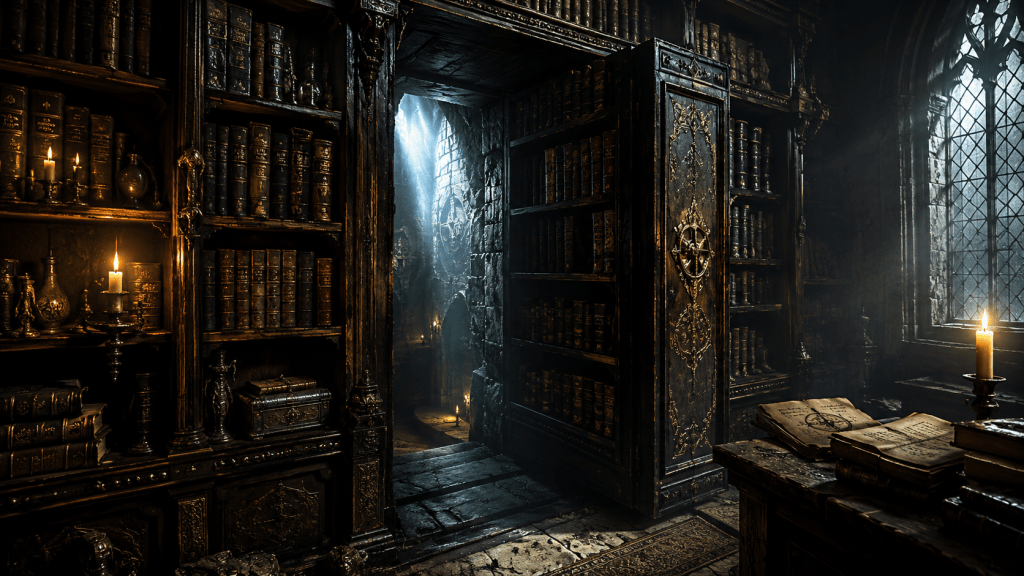
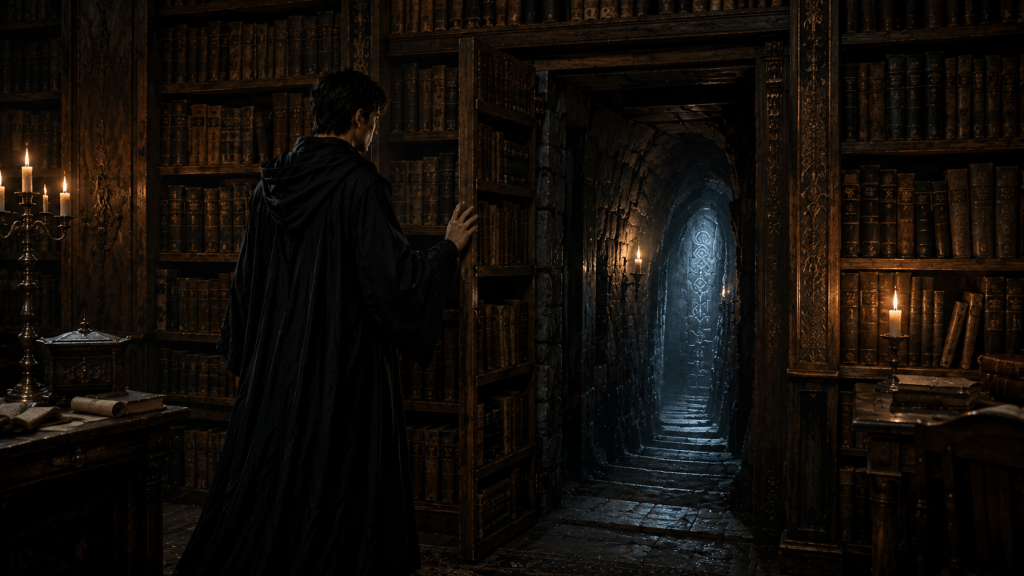
Mina first sensed the change near the fifth western shelf. She had climbed to inspect the chronicle rolls above the naval charters when she lowered her hand and looked along the carved upright beside her cheek. “Master,” Mina said as one palm rested against the ladder rail, her voice held low through habit learned among old pages, “this panel has shifted.” Orlan crossed the carpet slowly. The upright she indicated bore a pattern of curling leaves, though age had drawn the carving into darker lines that almost suggested letters when seen from the side. He lifted the lamp. Dust lay thick along the horizontal moulding. A narrow break ran through it where two pieces of wood met, clean and pale, as if a blade had passed there during the night.
“Dry timber moves in winter,” Corven said from the lower table, his hand hovering above the wax tablet while relief showed too plainly in his face. Orlan gave the words space to settle and chose silence for his answer. He had lived among old timber long enough to know its groans, its swellings, and the tiny betrayals made by damp and cold. This break looked fresh in a different fashion, with the careful line of use, the kind of seam a man might miss for twenty years before a single morning taught his eye to fear it.
The brass measure found a gap behind the shelf where the previous record allowed none. Orlan checked the ledger himself, turning back through entries with a thumb darkened by ink. The western theological shelf had been measured after the summer rains, and its depth had matched the adjoining cases. The shelf before him now stood a finger’s breadth proud of its neighbours, too slight for most eyes, too precise for the library to forgive. Mina descended with dust on her sleeves and unease in her face, while Corven rose from the table with the tablet pressed against his chest as if wax and board might protect him from whatever waited behind wood.
“Shall I call the steward?” Mina asked as she stepped clear of the ladder and kept her gaze fixed upon the carved upright. Orlan looked towards the double doors, closed against the passage, then towards the far windows where winter light pressed weakly through clouded glass. A steward would call a guard. A guard would call an officer. An officer would ask whether anything had been removed, whether any servant had entered, whether the Lord Magician had passed this way, whether Princess Elana’s curiosity had found a key, whether Prince Patrick’s household held more secrets than it admitted. Questions multiplied quickly in castles. Records survived by moving slower.
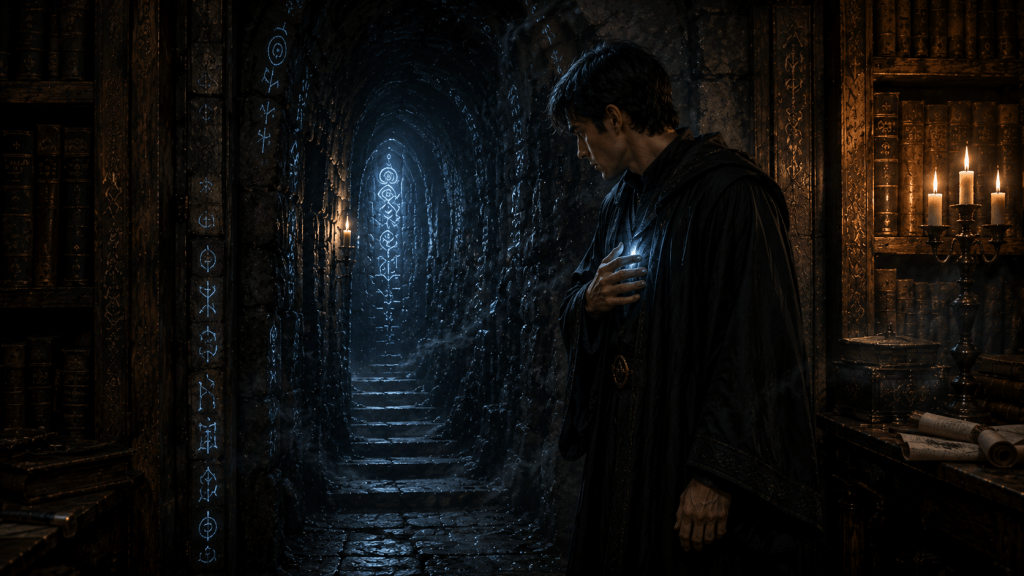
“Hold the ladder steady and keep the tablet ready,” Orlan said as he set the lamp upon the nearest table and laid two fingers along the carved leaves. The wood felt warmer than the room. His touch found a shallow hollow beneath the carving, smooth through long concealment. Somewhere behind the shelves, too deep for the visible chamber, a faint sound answered the pressure of Orlan’s fingers. It resembled a latch remembering its purpose after years spent inside silence.
The three of them remained still as the case shifted inward by less than the width of a nail. The library kept its face arranged around old titles, dusted labels, gold names, and recorded order. A breath of cold air moved through the join, carrying stone damp and a scent Orlan placed only after it had passed: sealed air, untouched by hearth, hand, or living speech for longer than memory felt comfortable holding. Mina stepped back and crossed herself under her sleeve. Corven lowered the tablet slowly, his lips moving through a prayer he likely wished the others had failed to see.
Orlan removed his hand. The shelf eased back into place with a softness that made the hairs rise along his wrists. He thought then of the castle above and below itself, the known halls laid over older courses, the royal rooms resting upon stones set before the current line of kings, the chapel records speaking of foundations blessed, strengthened, repaired, and sealed. The western shelf had answered like a thing accustomed to being touched by those who knew where to place the hand.
He returned to the table and opened the inventory ledger to a fresh line. Date, hour, room, shelf, section, witnesses. The act steadied him. Ink had saved more men from foolish speech than courage ever had. He wrote that a western case showed slight movement during inspection, that every visible volume remained in place, that the surrounding bindings appeared sound, and that a depth irregularity required later carpentry review under household authority. He avoided the word passage. He avoided the word hidden. He avoided the colder phrase that had entered his mind when the air came through the join, because a royal library served the kingdom best when its records offered truth enough for future hands, with danger folded cleanly beneath proper wording.
Mina watched the shelf while he wrote. Corven watched the doors. The lamps burned with small, straight flames, and beyond the windows Bremyra carried on beneath the grey weight of morning, unaware that the library had shifted behind its ordered wall. When the second bell rang, its sound travelled through the library and settled among the shelves in a low tremor. The western case answered by the faintest touch, a single wooden murmur passing behind the carved leaves. Orlan sanded the ink, closed the ledger, and kept his palm resting upon the cover until the vibration faded. Later copies would reduce the matter to a shelf defect, a winter swelling, a minor irregularity along the oldest wall of the royal library. Those present that morning carried a harsher memory: that the castle’s books had stood in perfect order while something behind them stirred, and for one guarded instant, the shelves of Bremyra seemed less like furniture than guardians who had nearly forgotten what they were meant to keep closed.
A Visual Chronicle
In Bremyra Castle’s royal library, a routine winter inventory reveals that one ancient shelf has moved, and something long sealed behind the kingdom’s histories appears to remember how to open.
Royal Library Register: The Western Foundation Shelf
The western wall of Bremyra’s royal library was entered in the old castle inventories as foundation-adjacent shelving, containing theological folios, royal histories, architectural rolls, and certain bound copies of early household surveys connected to the first raising of the inner keep.
During a winter inventory taken under Master Orlan Thesse, a minor displacement was recorded along the fifth western shelf, where the carved upright stood proud of its neighbouring cases and a narrow break in settled dust suggested recent movement within the wood.
The formal ledger described the matter as a depth irregularity requiring later carpentry review, with all visible volumes entered as present, undamaged, and properly ordered at the time of inspection.
A lesser library copy preserved additional remarks concerning cold air from behind the case, warmth held within the carved upright, and a sound beneath the shelf described as a latch answering pressure after long silence.
The entry gave no direct cause for the disturbance, and the shelf was afterwards entered as restored, secure, and fit for continued use, though a later hand amended the margin with the phrase old passage memory before the words were scraped thin.
Subsequent inventories retained the western shelf among ordinary library fixtures, recording its contents by title and shelf mark, while the foundation line behind it remained absent from the public catalogue and appeared only in damaged household copies kept apart from the royal register.
About the Creator
The Mythic Chronicle is written and curated by Simon Phillips, a writer of mythic and speculative fantasy whose work explores forgotten kingdoms, fractured records, old institutions, and the moments when history begins to shift before those living through it understand what has changed.
The accounts preserved within these Chronicles form part of a wider body of work in which castles keep older secrets beneath familiar rooms, roads carry rumours ahead of armies, and ordinary witnesses preserve fragments of events whose true meaning remained sealed from them at the time.
One such account survives in a separate record, following the return of a magician to Bremyra during a season of court unease, royal absence, Church suspicion, and gathering danger beyond the kingdom’s roads. What the servants, clerks, and watchers of the city remembered only in fragments is followed more closely in The Unmarked Path, the opening book of The Veil of Kings and Gods within The Chronicles of the Spiral Realms.
Readers who wish to examine that fuller account may find the record below.
What follows is taken from a later library account concerning the western foundation shelf of Bremyra Castle, where a minor inventory irregularity was preserved before rumours of a hidden passage entered the household record.
Subscribe to continue reading
Subscribe to get access to the rest of this post and other subscriber-only content.
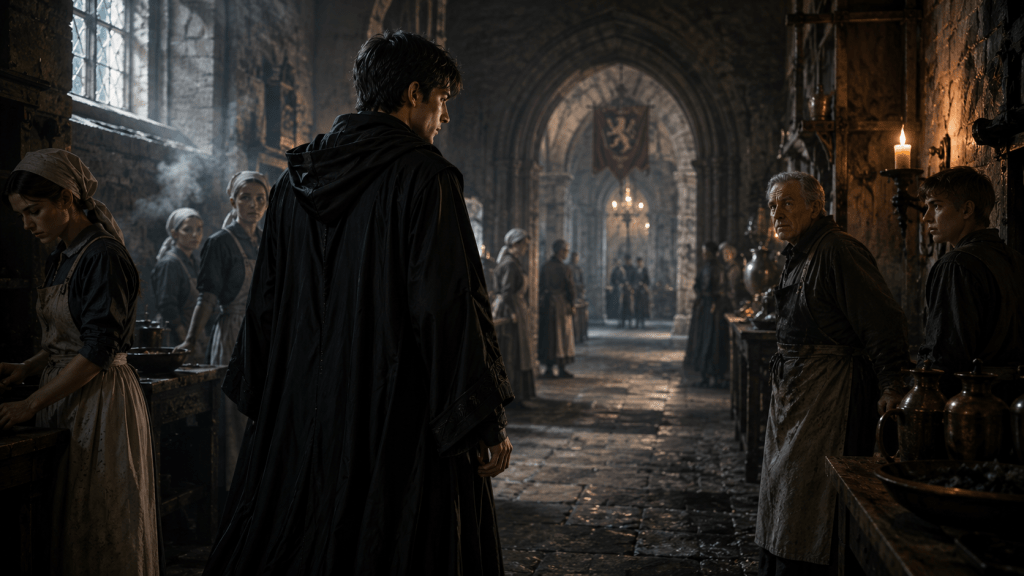
A kitchen-side account of the morning a servant of the Order returned to Bremyra Castle, and those below the stairs looked upon a magician while trying to remember the boy who had once carried bread among them.
Beneath the Lower Hearths
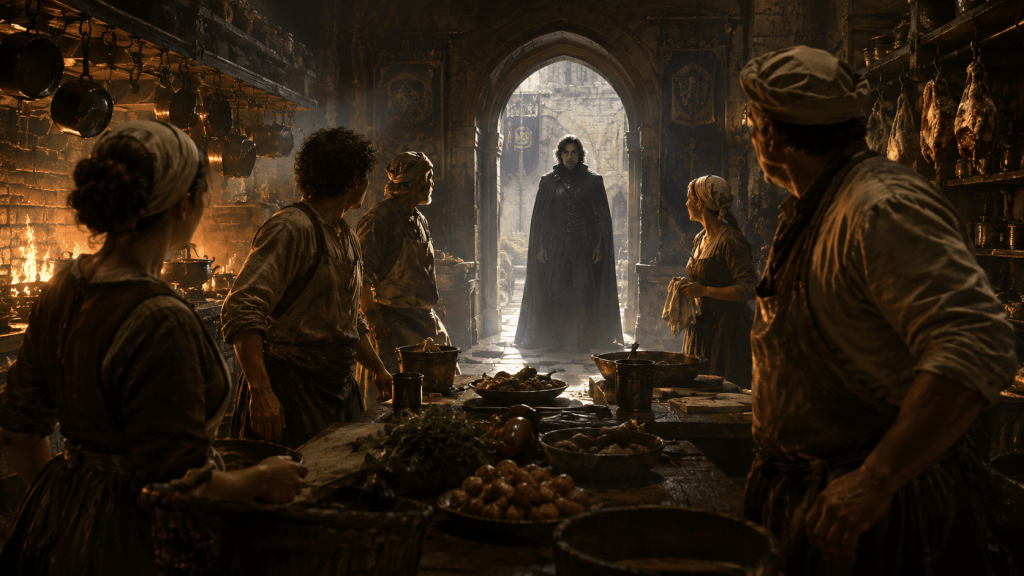
The kitchens of Bremyra Castle woke before the court above had gathered its voices, with ash drawn from the hearth mouth, embers coaxed back into flame, water carried from the lower pump, and first loaves uncovered beneath linen as grey morning pressed against the high windows. Heat gathered early in that buried place, filling blackened beams, copper pans, drying herbs, flour boards, and worn stone with the living breath of labour. Inside, the servants moved by habit older than speech, each hand finding its work as if the castle’s hunger had shaped them into one body made of smoke, steam, wool, and bread.
Mistress Arven stood near the great hearth with her sleeves pinned high and a strip of linen tied across her hair. Age had silvered the braids beneath it, although age had taken little from the strength in her hands or the authority with which she ruled the lower kitchen. She knew the castle by its appetites, by guards lingering for crusts, pages stealing apples, chambermaids hiding grief by moving too quickly, and nobles sending back meat untouched after stiff court feasts. She had outlasted enough service children to measure the years by names vanished from the duty boards, and one such name returned that morning before any black robe entered the kitchen.
It came through the western service passage, where young Berren had gone for dried apples and returned with the basket empty, his mouth pale and his breath uneven. He claimed the stones by the lower stair had grown cold enough to smoke when he spoke, foolish in a passage warmed by ovens since before dawn, yet his fear held the plain shape of truth. Mistress Arven took the store key, sent him back to the carrot board with a steadying glance, and went herself towards the stair with a lamp lifted before her.
The passage held its usual damp, its smell of onions, old straw, tallow, and winter fruit, yet near the first turn a faint mark crossed the dust where no errand had been sent. It might have been a boot track, water from a seam, or a scrape left by some porter too proud to confess clumsiness. Mistress Arven crouched with the lamp near the stones and felt old memory rise under the smell of dust. A boy had once slept there during hard winter after fever took him beside the wood bins, wrapped in sacking with hands curled near his mouth. She had poured broth between his lips and told him, with all the cruelty of care, that service claimed even the half-dead before sunrise.
His name had been Simion. He had come to the kitchen small, quick-handed, and hungry in the careful manner of children who learned that asking cost more than silence. He had scrubbed pots until his wrists reddened, carried trenchers through feasts, and run errands between pantry, stable, chapel, and garden gate while nobles looked past him with the easy blindness of rank. Yet he had carried brightness in him then, a mischief that survived cold water and harsh words, and that brightness had drawn Princess Elana to him as surely as flame drew moths in summer. Mistress Arven remembered the princess racing through the herb yard with a cracked blue jar full of fireflies, Prince Patrick behind her, and Simion last of all, trying to hide laughter beneath a basket of parsley.
The Order had taken him in later years, when papers came, men waited near the outer door, and the boy was washed, dressed in borrowed wool, and sent upward before being sent away entirely. Mistress Arven remembered his face at the threshold, because he had looked back once towards the hearth, the bread shelf, and the corner where he had mended his shoes with stolen twine. Then he had gone, and the castle had swallowed the shape he left behind, until the old name began moving again through Bremyra with talk of the opened Order manor, the gold-wax letter, and the Archbishop’s summons.
The first sign of his approach came as a change in the passage beyond the lower door. The guard posted there ceased speaking to the pantry boy, and the usual noise of feet, trays, buckets, page-whispers, and carried orders thinned until the space outside the kitchen seemed to hold its breath. Mistress Arven looked up from the herb bowl. Old Jory slowed his hands in the dough. One of the thyme girls laid both palms flat against the table. Berren turned towards the entrance with the carrot knife still held awkwardly in his fist. A figure paused beyond the threshold, tall against the colder light of the corridor, and the warmth of the kitchen drew in around the hearth as if flame itself had tightened.
The man who entered wore black robes plain in cut, marked by the authority of the Order through stillness more than ornament. He was taller than the boy Mistress Arven remembered, leaner in the face, his dark hair shortened, his eyes holding a blue-grey distance that seemed to have travelled farther than roads. He carried no visible threat, raised no hand, and asked for no deference. Even so, every servant lowered their gaze because the robe named him before memory could. A magician stood in the kitchens, among bread boards, ash buckets, herb knives, and old smoke.
Mistress Arven stepped forward because kitchens required a voice when fear stole the rest. She wiped her hands slowly across her apron, bent her head with the respect due to a power she had hoped to meet only from a safer distance, and made herself speak for all gathered beneath her roof. “My lord magician,” Mistress Arven said, keeping her hands folded before her so their tremor stayed hidden in the linen. “How may the kitchens serve you?”
His gaze moved across the long tables, the copper pans, the smoke-black beams, the bread shelf, the scullery arch, the great hearth, and the dim corner near the wood bins. There it lingered. The change in him came so faintly that only someone trained by years of kitchens could have seen it, a softening near the eyes, a guarded breath, a recognition drawn inward before it could become a wound in public view. Mistress Arven felt the years fold strangely, placing the hungry boy and the feared magician in the same body before her.
“I require nothing,” Simion said as he stood beneath the arch, his voice low, restrained, and touched by a weariness carried from rank, power, and old roads alike. “Continue your work.”
The words offered gentleness, and still relief moved slowly through the room. Berren bowed after the moment for bowing had passed. One thyme girl let a stem fall from her fingers and stared at it as if it had spoken. Jory held his flour-coated hands above the dough, unable to return them to labour while the man in black remained beneath the kitchen roof. Mistress Arven lowered her head again, because recognition crossing rank could become dangerous when years, magic, and old tenderness all stood too near one another.
Simion turned towards the passage, then slowed before crossing the threshold. His attention shifted west, towards the service stair where the cold mark had been found that morning. Mistress Arven saw him listening, and every servant listened with him while water dripped from the cracked spout and wood settled within the drying racks. Simion’s fingers moved once at his side, a small unfinished gesture quickly stilled, and his face held the look of a man who had heard a call others mistook for silence.
He inclined his head by the faintest measure, perhaps to the room, perhaps to the woman who had spoken, perhaps to a memory buried beneath flour, smoke, and rank. Then he passed back into the corridor, his black robe brushing the threshold stones as the guard outside shifted aside. The kitchen noise returned after he had gone, altered as water changes after a stone has fallen through it. Knives found boards again. Pots settled onto hooks. The hearth cracked, and several servants moved too quickly in answer before pretending they had meant to reach for cloth or spoon.
“That was him, then,” Jory said as flour fell from his knuckles onto the board, his voice low enough for the hearth to almost take it. “The boy from the old stories.”
Mistress Arven looked towards the corner near the wood bins, where the flagstones still seemed to hold the shape of a child wrapped in sacking beneath winter’s hand. “Aye,” Mistress Arven said as she turned back to the hearth and lifted the long iron hook from its place. “That was the boy.”
A child once known by bruised elbows, stolen laughter, and flour on his sleeves had returned clothed in black authority, and the castle, which had let his name fade as easily as smoke through a chimney, began remembering him only after fear had taught it to look again.
A Visual Chronicle
Beneath the lower hearths of Bremyra Castle, the servants feared the magician who returned in black, while one old cook remembered the hungry kitchen boy he had once been.
Kitchen Register: The Lower Hearths of Bremyra Castle
The lower kitchens of Bremyra Castle were entered in the household rolls as the principal hearth-service beneath the western hall, supplying bread, meat, broth, lamp fat, hot water, and table preparations for the royal household, chapel officers, resident guards, visiting envoys, and all servants assigned to the inner keep.
A winter kitchen copy preserved a brief account of a former service child recognised by certain older staff after his return to the castle under the authority of the Order, though the formal register named him only as the Lord Magician and recorded his presence among the lower hearths as a passage through service rooms during morning duties.
The same copy referred to a coldness observed near the western service stair before his arrival, along with a mark in the dust beneath the lower turn, though the steward’s duplicate gave the matter as ordinary damp and made no further entry concerning disturbance among the stores, stair mouth, or scullery passage.
A lesser note, written in a hand later identified with the old cook’s ledger, stated that several servants recognised the visitor only after he had departed, remembering a boy once attached to the kitchens before being taken into Order keeping, though the note gave no judgement on whether the man himself acknowledged the memory.
The kitchen was thereafter entered as orderly, with fires maintained, meal service completed, and no damage reported among hearth, stores, tables, hooks, or passage doors, though one later marginal hand beside the entry amended Lord Magician to the boy returned, a phrase scraped thin in the household duplicate while remaining visible beneath smoke-darkened ink in the kitchen copy.
About the Creator
The Mythic Chronicle is written and curated by Simon Phillips, a writer of mythic and speculative fantasy whose work explores forgotten kingdoms, fractured records, old institutions, and the moments when history begins to shift before those living through it understand what has changed.
The accounts preserved within these Chronicles form part of a wider body of work in which castles keep older secrets beneath familiar rooms, roads carry rumours ahead of armies, and ordinary witnesses preserve fragments of events whose true meaning remained sealed from them at the time.
One such account survives in a separate record, following the return of a magician to Bremyra during a season of court unease, royal absence, Church suspicion, and gathering danger beyond the kingdom’s roads. What the servants, clerks, and watchers of the city remembered only in fragments is followed more closely in The Unmarked Path, the opening book of The Veil of Kings and Gods within The Chronicles of the Spiral Realms.
Readers who wish to examine that fuller account may find the record below.
What follows is taken from a later household account concerning the lower kitchens of Bremyra Castle, where a former service child was remembered only after he returned beneath the authority of the Order.
Subscribe to continue reading
Subscribe to get access to the rest of this post and other subscriber-only content.
A chapel-side account of the morning Archbishop Alaric’s summons crossed the nave, and the old stones of Bremyra seemed to listen for what the Order might uncover beneath them.
Beneath the Morning Incense
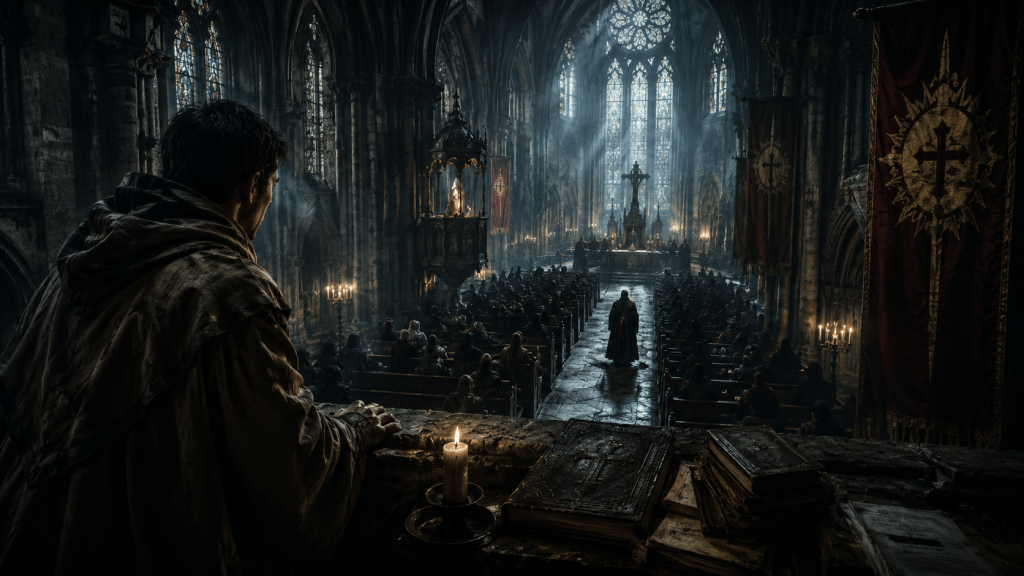
The cathedral bell sounded before Bremyra woke, carrying one low note across the roofs while snow clung to gutters and harbour mist folded against the lower streets. Within the cathedral, Sister Maelis rose by the vestry door and held the taper dish until the tremor passed from her fingers. The bell had been rung by order, three strokes at Prime, a signal reserved for early confession, royal death, or the Archbishop’s own summons, and those beneath the vaulted roof understood that the hour had been claimed for disturbance still held behind closed doors.
She moved along the side aisle with the quiet expected near the sanctuary before first prayer, her woollen hem brushing the cold flagstones while the saints watched from shadowed niches. The candles before Christiana’s image had burned unevenly through the night, three guttered low into cups of hardened wax, one drowned where any draught should have failed to reach, and one still holding a straight white flame that gave no smoke. Maelis marked such things because small traces formed the language of holy houses, and that morning the language of the cathedral felt changed.
Brother Halven entered from the cloister carrying fresh coals beneath a linen cover, his shoulders raised against the cold that had crossed the yard with him. Frost silvered the edge of his beard as he lowered the tray near the chapel brazier, and the first breath of charcoal warmth stirred through the incense-heavy air. “The Archbishop has called for the red book and the winter register,” Brother Halven said, keeping his voice low while his gaze moved towards the closed door beyond the altar screen. “He wants the side chapel cleared before the second bell, and the western candles lit, every one of them.”
Maelis looked towards the sealed door behind the altar screen, where Archbishop Alaric Thorne had already gathered his senior clerks. A line of light glowed beneath the threshold and trembled across the stone, broken now and again by shadows moving on the far side. “For confession?” Maelis asked as she adjusted the taper dish against her apron, although the hush around the sanctuary had already carried the answer ahead of her question. “For a letter,” Halven replied as he lifted the linen from the coals. “A sealed one, brought before dawn from the upper house.”
The upper house meant the manor of the Order, though no servant of the cathedral needed the name spoken aloud. Across Bremyra, certain words drew eyes when carried too freely, and the Order remained one of those old shapes people recognised first through silence. During the previous day’s duties Maelis had heard fragments drifting through the nave as merchants crossed themselves too often, pages whispered near the font, and an old woman paused before Christiana’s image to ask whether magicians still cast shadows like other men. A letter beneath gold wax had entered the castle. Fires had been lit at the manor above the city. A magician had returned to Bremyra, depending upon the mouth that carried the rumour.
The door behind the altar screen opened while Maelis trimmed the third candle, releasing warm light across the sanctuary as Archbishop Alaric stepped into view with two clerks behind him. His robes were immaculate, dark beneath the white stole, and the embroidered signs of Christiana’s blessing caught dull gold where candlelight touched them. His face held the cold control that made merchants lower their gaze and nobles choose their words with care, though Maelis saw the set of his jaw and the stillness of his hands.
He crossed the sanctuary slowly, pausing beneath the great hanging cross, and looked along the empty nave towards the western doors. “The cathedral will open through the south porch after Prime,” Alaric said, his voice carrying to every servant in reach while his gaze settled on no one. “Those seeking blessing may attend the lesser chapel. The nave remains clear until I give further instruction.” Brother Halven bowed over the coal tray. Maelis lowered the taper dish against her apron and bent her head. The younger clerk shifted the parchments in his arms and glanced towards the sealed red book resting upon the lectern beside the choir steps. Alaric saw the movement, and the clerk stilled beneath his eyes.
“Send Tamor to the manor,” Alaric said as one hand moved to the edge of his stole. “He will carry my summons in formal hand. No page from the castle. No royal servant. The Church will speak through its own door.” The words entered the nave and appeared to remain there, held between stone and incense. The Order had entered Bremyra by royal receipt, with manor, lodging, clerk, and seal. Alaric’s reply would come from the cathedral, carried under Christiana’s authority, and every servant who heard the instruction understood that the summons also drew a boundary.
Tamor arrived moments later from the lower sacristy, still fastening his cloak across his shoulder, a narrow young attendant who copied hymn sheets during Lent and delivered alms lists when roads lay clear. One clerk spread a strip of parchment across the small side table, and the Archbishop dictated in a voice so measured that each word seemed chosen from a store of sharpened things. The letter named the Lord Magician with ceremony, acknowledged his presence within Bremyra, and required his attendance at the cathedral before the morning advanced beyond its first offices. It offered welcome in form, summons in substance, and warning in the spaces between its lines.
Maelis kept her eyes lowered while the letter was sanded, folded, and sealed, though she marked every sound. The scrape of the clerk’s knife against wax. The crackle of parchment drawn into shape. The press of Alaric’s ring into red. The small intake of breath from Tamor when the sealed letter was placed against his palms. Outside, the city gave its first waking noises, carts in the lower street, hooves near the fountain, gulls crying somewhere towards the harbour. Inside the cathedral, those daily sounds arrived muted and distant, as if Bremyra had been lowered beneath a bell jar.
Tamor bowed and departed through the south porch with Halven beside him to lift the bar. Cold air entered in a bright blade, cutting through incense and candle warmth before the door closed again. Alaric remained before the altar, his eyes turned towards the western shadow of the nave, where the great doors stayed barred against the morning. Then he spoke again, still facing the doors. “The lower archive door is to remain locked. The reliquary passage also. No attendant enters the undercroft unless Brother Osric stands present with the key.”
Maelis felt Halven’s gaze lift across the sanctuary. The undercroft lay beneath the eastern chapels, a place of stone shelves, sealed reliquaries, old burial slabs, and records older than most families still named in the city. Its door had always remained locked except during feast preparation or episcopal inventory, yet the Archbishop’s instruction gave usual caution the shape of sudden urgency. One clerk made a note with a hand that scratched too quickly. Maelis folded the taper cloth once, then twice, drawing the corners together until the linen edge pressed into her palm.
The Archbishop turned at last, and his gaze moved across them, measuring servant, clerk, brother, flame, door, and shadow. “Bremyra has been kept by the mercy of Christiana and the discipline of her Church,” Alaric said as his hand rested against the red book on the lectern. “No visitor, however adorned by old authority, receives freedom among its holy places.”
By the time the first worshippers came to the lesser chapel, the nave had been cleared, the western candles had all been lit, and the undercroft key had been removed from its usual hook beside the vestry inventory board. Maelis marked the empty place, and the bare shape of it troubled her more than the sealed letter or the closed nave. A key absent from its place meant a door expected pressure.
When the second bell rang, its sound travelled down through the tower and shivered along the pillars, and for a breath the floor beneath the choir seemed to answer with a low, buried tremor too faint for certainty and too near for comfort. Halven looked towards Maelis from the brazier. She looked towards the eastern steps. The candles before Christiana’s image leaned together in their cups, every flame bending towards the sealed undercroft door as though listening to something below the stone. The formal register preserved only the early summons, the restricted nave, and the Archbishop’s reception of an Order magician under conditions of proper ecclesiastical authority. Yet among those who tended the side chapel, a quieter memory endured: that before the summoned man crossed the threshold, the cathedral had already drawn its keys close, gathered its candles, and turned its attention downward, as though the Church feared the Order might hear something under Bremyra that holy stone had long been keeping silent.
A Visual Chronicle
Before the summoned magician crossed Bremyra Cathedral’s threshold, its candles had already turned towards the sealed door beneath the choir.
Cathedral Register: The Eastern Undercroft
The cathedral of Bremyra held an eastern undercroft beneath the choir and lesser chapels, entered by a narrow stair behind the vestry screen and recorded in the oldest inventories as a place of reliquary storage, burial tablets, sealed church papers, and foundation stonework retained from the first raising of the sanctuary.
A winter entry from the episcopal register recorded that access to the lower archive, reliquary passage, and undercroft was restricted on the morning of Archbishop Alaric Thorne’s summons to the newly arrived servant of the Order, with the key removed from the vestry board and placed under Brother Osric’s charge until the close of the day.
The cause of the restriction was entered only as ecclesiastical caution during reception of arcane authority, though a lesser chapel copy preserved additional remarks concerning candle movement near Christiana’s image, unusual stillness beneath the choir steps, and a low tremor felt during the second bell.
The same copy stated that the nave remained clear until the Archbishop’s command, the south porch alone being opened for lesser blessing, while the western candles were lit in full and the red book was brought to the lectern before the summoned guest crossed the cathedral threshold.
Later copies treated the matter as ordinary clerical procedure, yet one marginal hand described the undercroft as “held against inquiry” during the hour of reception, a phrase later scraped from the formal register while remaining visible in the chapel duplicate beneath a thin wash of pale ink.
The undercroft was afterwards entered as secure, its locks restored, its passages accounted for, and its foundation stable, though the winter register gave unusual care to the position of the key, the presence of witnesses, and the condition of the sealed lower door.
About the Creator
The Mythic Chronicle is written and curated by Simon Phillips, a writer of mythic and speculative fantasy whose work explores forgotten kingdoms, fractured records, old institutions, and the moments when history begins to shift before those living through it understand what has changed.
The accounts preserved within these Chronicles form part of a wider body of work in which castles keep older secrets beneath familiar rooms, roads carry rumours ahead of armies, and ordinary witnesses preserve fragments of events whose true meaning remained sealed from them at the time.
One such account survives in a separate record, following the return of a magician to Bremyra during a season of court unease, royal absence, Church suspicion, and gathering danger beyond the kingdom’s roads. What the servants, clerks, and watchers of the city remembered only in fragments is followed more closely in The Unmarked Path, the opening book of The Veil of Kings and Gods within The Chronicles of the Spiral Realms.
Readers who wish to examine that fuller account may find the record below.
What follows is taken from a later chapel account concerning the morning Archbishop Alaric Thorne sent formal summons to the newly arrived servant of the Order, while the eastern undercroft was placed under key and the cathedral nave held clear beneath the first offices.
Subscribe to continue reading
Subscribe to get access to the rest of this post and other subscriber-only content.
Silas Thorn has already crossed through an ancient book and awakened inside the secured foundations of a royal palace. By the following morning, the impossible has acquired a locked door, a permanent guard, an official record, and a carefully chosen vocabulary designed to make captivity sound like protection.
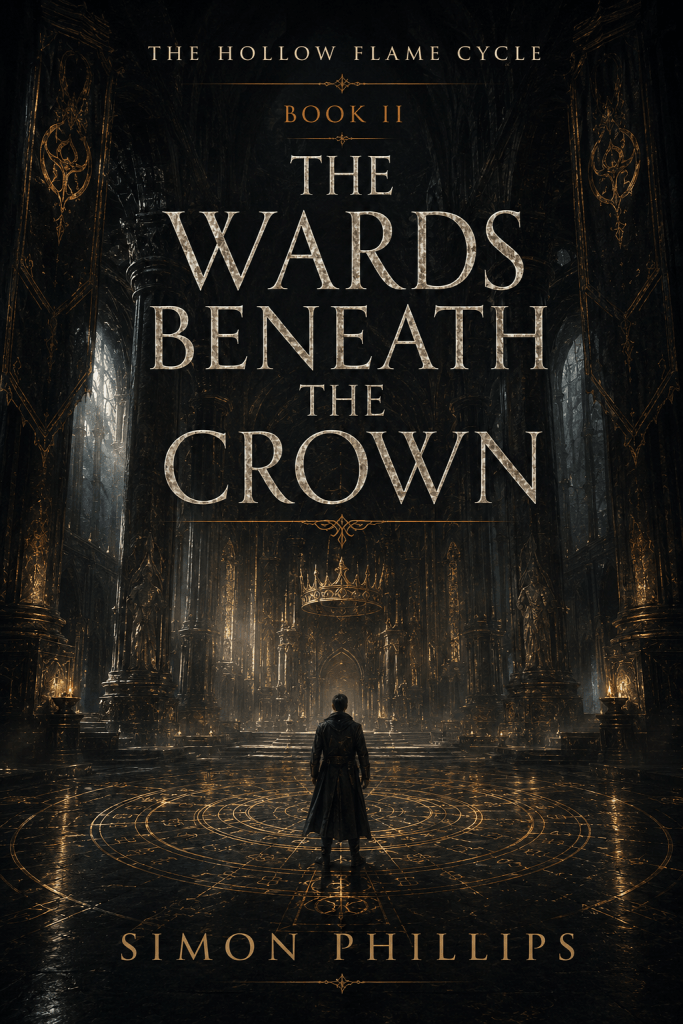
The Wards Beneath the Crown, Book Two of The Hollow Flame Cycle, continues directly from The Unclassified. The first book carried a London manuscript conservator through an unidentified volume and into the heart of a hidden magical realm. Book Two follows the consequences as the Crown attempts to contain what it cannot explain, the Guild begins measuring disturbances it may already recognise, and the palace itself responds to Silas with increasing intensity.
This is slow-burn epic fantasy shaped through royal intrigue, living magical architecture, institutional conflict, ancient records, guarded relationships, and a displaced man who still wants only to know whether his father remains alive beyond the Veil.
The danger arrives quietly. Lamps brighten around handwritten questions. Ink acquires impossible depth. Buried routes remember that they once existed. A beautiful royal estate is prepared before its future resident has been asked whether he wishes to enter it.
Silas has been promised protection, yet every attempt to find his way home gives the realm another reason to fear him.
A Beautiful Chamber Becomes a Civilised Prison
Silas awakens in the eastern guest wing of the royal palace after a night of fractured sleep and unfamiliar sounds.
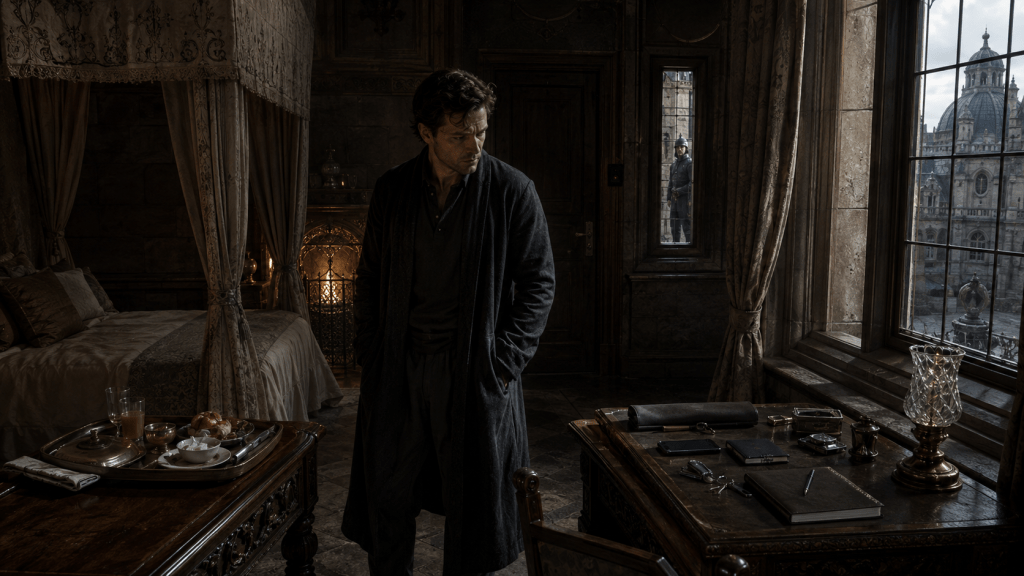
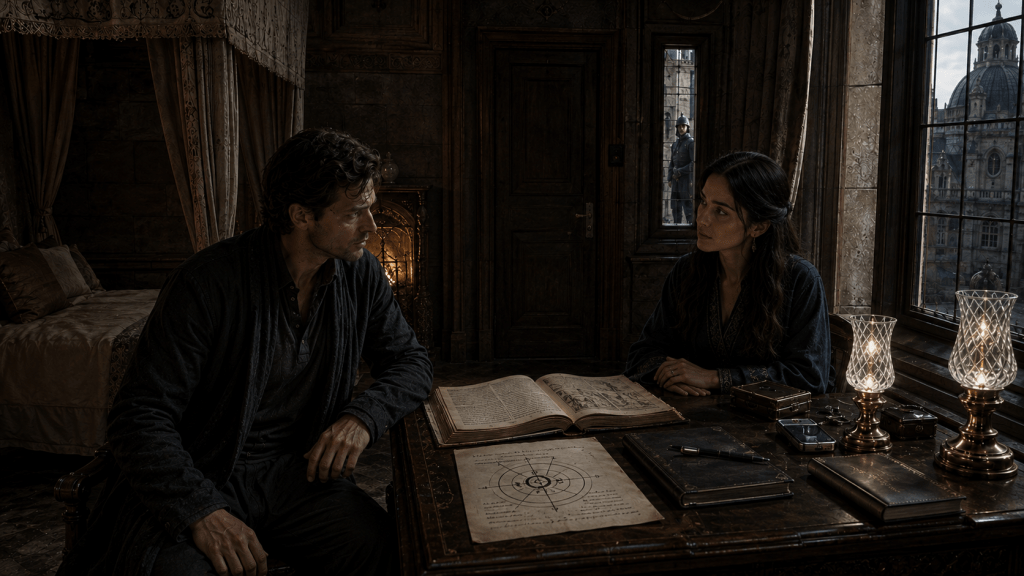
The chamber contains everything a generous official might present as evidence of humane treatment. Clean linen covers a broad bed. Controlled warmth rests behind a curved hearth screen. Fresh water, prepared food, new clothing, and attentive service await him. Tall windows offer a view across palace courtyards where servants, clerks, guards, and household pages continue their ordinary work.
The door remains locked.
A guard waits outside. Silas’s possessions have been catalogued. The knife placed beside his breakfast has been deliberately dulled, and movement beyond the chamber requires permission, escort, and an approved route.
His professional understanding of conservation makes the contradiction especially sharp. Silas has spent years preserving rare books, protecting fragile objects from careless handling, unstable environments, and further damage. He understands that something may be kept safe while losing every meaningful form of freedom.
The Crown calls him a protected resident. Silas sees a beautiful enclosure whose comfort changes none of its essential purpose.
That tension gives The Wards Beneath the Crown its emotional foundation. The Crown’s concern is genuine. The guards are disciplined. The servant assigned to him, Maren, offers practical kindness and restrained humour. Halren Voss, the Crown liaison responsible for his residence, listens carefully and refuses easy consolation.
Even so, Silas cannot leave.
The story asks a difficult question from its opening pages: when protection cannot be refused, how far does it remain separate from imprisonment?
Silas Thorn Wants Answers More Than Power
Silas remains an unusually human centre for a story filled with royal wards, magical instruments, ancient foundations, and political authority.
He has no wish to become a mage, fulfil a prophecy, conquer a hidden realm, or claim a heroic place within it. His questions remain painfully ordinary:
Is London still there?
Is his father alive?
Does time continue at the same pace beyond the Veil?
What happened to the book?
Can anyone send him home?
Voss answers the final question with the honesty Silas has been dreading. No one can simply return him.
That truth reaches more deeply than the guarded chamber or the royal decree. Until someone states it plainly, Silas can still imagine the crossing as a misplaced road, an accidental doorway waiting to be found again. Once Voss speaks, return becomes an uncertainty that every institution around him may study, delay, or eventually declare impossible.
Silas responds through the skills and habits that shaped his former life. He observes language. He notices how records are phrased. He asks that his own account be preserved in his own handwriting because he understands how testimony becomes cleaner, safer, and less human as it travels through official hands.
He knows that naming determines how an object is handled.
He soon discovers that the same principle applies to people.
London Finds an Echo in Lundenvar
During a supervised orientation, Silas is shown maps of Valebrin, its capital Elyrion, and the wider shape of the realm into which he has fallen.
The hidden magical world is neither a medieval imitation nor a decorative kingdom designed around castles and spellcraft alone. It possesses roads, administrative borders, civic transport, communication systems, illuminated cities, royal offices, military structures, archives, and technologies shaped through magical development.
The map offers Silas his first chance to place himself somewhere measurable.
Instead, it makes the distance from home stranger.
Near the western edge of Valebrin lies Lundenvar, an old threshold city occupying an uneasy correspondence with London. It is no direct equivalent, yet its position carries enough similarity to disturb him. Rain-dark streets, Underground platforms, buses, libraries, his father’s house, and the conservation studio return through association while an unfamiliar place-name sits where his mind expects home.
The connection suggests that Earth and the hidden realm may preserve echoes of one another through geography, history, or the Veil itself.
Silas receives no comfort from the discovery. London has become more than a distant city. It is now a place that may possess a distorted reflection inside another world.
The distance between them can no longer be understood in miles.
The Written Word Refuses to Remain Ordinary
Silas is given paper and ink so that his questions can enter the Crown record.
He writes his name, the last place he remembers, and the matters no official answer has resolved. He asks about his father, the vanished book, the passage of time, the Veil, and the authority deciding what knowledge he may receive.
As he writes, the chamber lamps brighten.
The change is initially slight enough to invite doubt. Silas watches the crystal lights steady themselves and wonders whether fear has made him unreliable. Then the word Veil begins holding the light differently from every other word upon the page.
Its ink acquires the same inward depth he remembers from the ancient book in London.
When Silas calls for help, Guard Arven enters first, followed by Voss, Sera Valn, and Warden Cael Orven. Their response reveals how thoroughly magic has been integrated into this civilisation. Instruments are brought. The desk perimeter is measured. Chamber wards are examined. Technical language gathers around the page with unnerving speed.
Silas possesses no recognised casting discipline, visible training marks, declared magical focus, or knowledge of glyph construction. By the realm’s accepted understanding, his handwriting should have no power to alter a chamber ward.
Yet the page produces a second register.
The lamps respond. Passage-related words deepen. Ordinary questions about home become magical evidence.
Silas’s fear changes at that moment. He is no longer frightened solely because he cannot return to London. He is frightened because every attempt to ask for London becomes another reason for Crown and Guild to measure him.
The Crown and Guild Contest the Meaning of a Page
The altered page passes immediately into a political struggle.
The Guild of Mages possesses the expertise required to investigate unusual ward behaviour, crossing phenomena, glyph structures, and the ancient divisions between realms. The Crown possesses physical custody of Silas and responsibility for everything occurring within the palace.
Both institutions have legitimate grounds for involvement.
Neither fully trusts the other.
Lirael Vaerenthis permits the Guild to examine the page under Crown supervision. She refuses its removal to a private Guild chamber, blocks unsupervised copying, requires Crown witnesses, and ensures that the official record remains under royal custody.
The resulting audit is one of the book’s strongest expressions of political fantasy. No armies gather, no throne room erupts into open conflict, and no theatrical spell is cast across the chamber. Power moves through seals, witness rights, terminology, instrument placement, access restrictions, withheld interpretations, and the authority to decide which account becomes official.
High Mage Elarion approaches the event with intelligence and restraint. He refuses to classify Silas prematurely and recognises that the disturbance extends beyond ink. The response appears to move across written language, spoken words, remembered place, ward-lines, and Silas’s presence.
When Silas speaks the word London, the instruments respond.
When he speaks Veil, the reaction strengthens.
A pattern connected to older foundation behaviour briefly appears upon a Guild tablet, and one representative attempts to cover it before Lirael requires its inclusion in the Crown record.
The room discovers enough to become afraid and too little to become certain.
Lirael Vaerenthis Protects the Man Inside the Record
Lirael’s role throughout Book Two is politically demanding because every possible decision contains harm.
She cannot release Silas while the palace responds unpredictably around him. She cannot surrender him to the Guild merely because its mages possess greater technical knowledge. She cannot ignore the risk to servants, guards, clerks, petitioners, and families living within the palace.
She also refuses to allow official language to erase him.
When draft reports begin referring to Silas as a subject, anomaly, or ward-active presence, Lirael orders the language corrected. Within Crown records, he remains Master Thorn.
That choice carries more than courtesy. Lirael understands that technical wording can quietly change responsibility. Once Silas becomes an anomaly, officials may find it easier to isolate him, test him, relocate him, or claim jurisdiction over him. A name keeps his humanity inside the machinery processing his existence.
Her protection still has a coercive edge. She controls access, testimony, movement, and eventual relocation. Silas experiences her as one of the people deciding his life while asking him to trust the care within their restrictions.
Lirael offers him honesty in place of false reassurance. She protects his status as a person while acknowledging that his choices remain limited.
Her danger lies far from cruelty. It lies in the necessary authority she controls and the possibility that sensible governance can still wound the person it intends to preserve.
Seréne Searches the Language History Tried to Erase
Princess Seréne Vaerenthis approaches the disturbance from another direction.
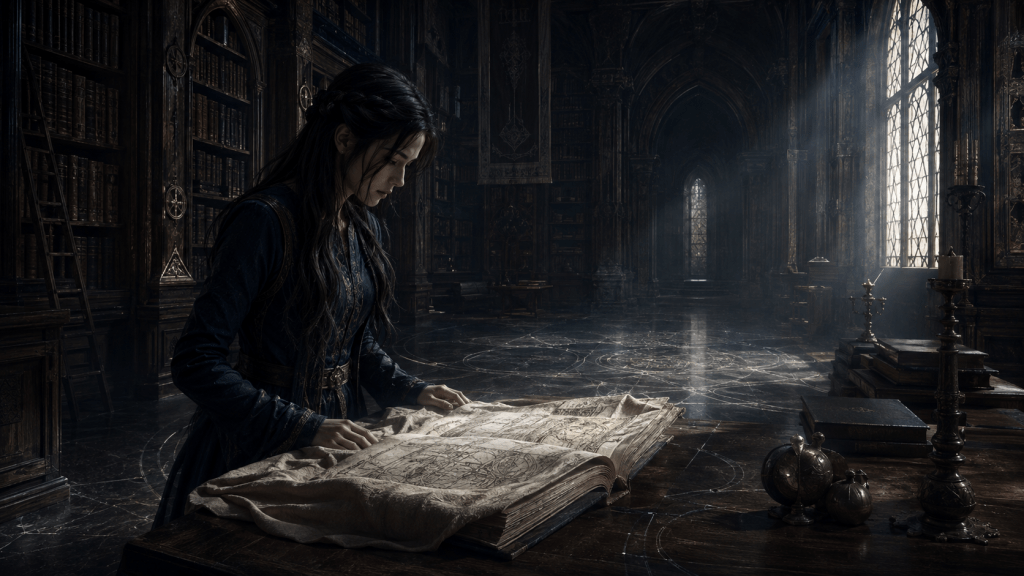
While Crown and Guild examine instruments, Seréne enters the lower record arcade and searches older foundation texts. She studies marginal copies, disputed glossaries, early descriptions of reception, and words that later doctrine has simplified into cleaner administrative categories.
The oldest records describe warded stone in strikingly different terms.
Later scholars write of admission, rejection, intrusion, and instability. Earlier texts speak of presences being met, failing to settle, remaining unplaced, or creating an argument in stone.
Those differences matter.
Modern authority treats wards as systems that obey recognised command. The older language suggests something more responsive, uncertain, and alive. Seréne discovers references to one arrival producing two answers, an unseen answer requiring protection, and a mark that resembles Silas’s memory of the ancient book.
Her investigation shifts the central mystery. The problem may extend beyond what Silas is doing to the palace. The deeper question may concern how the palace, the Veil, or the realm itself is attempting to understand him.
Seréne recognises another danger as well. Crown and Guild are studying the second page, the one Silas wrote inside the guest chamber. Only Silas saw the first page, the ancient page in London whose dark markings opened beneath his hands.
Before official interpretation buries that original account, Seréne decides to hear it from him directly.
Old Books Create the First Ground of Trust
Seréne’s private conversation with Silas provides the book’s most intimate counterweight to institutional pressure.
Silas initially distrusts her. She is another royal daughter, another person connected to the authority holding him, and another visitor whose access has been granted through rank.
Their conversation changes when Seréne asks about the ancient book, his conservation work, and the distinction between repairing an object and preserving what survives.
Silas explains that conservation avoids forcing modern certainty into damaged history. A conservator stabilises evidence, respects alteration, and allows an object to retain the marks of what it has endured.
Seréne understands the principle because her own archival work has shown her how official histories become smoother as difficult meanings are copied away.
Their connection grows through shared intellectual ground rather than immediate romantic declaration. They speak about manuscripts, erased corrections, restricted texts, his father, his phone, the vanished book, and the danger of allowing institutions to replace a person’s first account with a cleaner summary.
Seréne treats Silas as someone who arrived with a profession, a family, memories, and a complete life beyond the palace.
That recognition matters enough for Silas to ask her to remain when Lirael enters.
Later, when he learns that he must be moved from the palace, he asks for Seréne to travel in his carriage because she has spoken to him as though his previous life still counts.
The request marks an important change. Silas still possesses little freedom, yet he has begun asserting whom he trusts within its limits.
The Palace Remembers a Buried Road
The disturbance refuses to remain inside the audit room.
As Silas returns towards his chamber, lamps dim in sequence along the gallery. Floor markers divide into conflicting routes. A sealed service passage beneath the visible corridor registers as available even though it has remained closed since an earlier reign.
The palace is no longer reacting only to a page or spoken word.
Its architecture has begun remembering.
This escalation transforms the palace from setting into participant. Its ancient wards, buried routes, foundation layers, and accumulated authority respond to Silas as though attempting to place him inside systems whose original instructions have been partly forgotten.
Elarion warns that each event has reached farther than the one before it. The disturbance began with page and lamp, moved into voice and measuring instruments, then spread into corridors and sealed structures.
He offers the Crown a deeply unsettling interpretation: the realm appears unable to decide whether to receive Silas, reject him, or answer through him.
The palace has become too old, too layered, and too closely bound to royal authority to hold him safely.
The Crown must move him.
Alderwick House Offers Space Inside Another Boundary
Alderwick House lies east of Elyrion, beyond the densest palace foundations and beneath a newer outer ward.
The Crown presents the estate as a safer residence with larger rooms, gardens, library access, fresh air, and distance from the reactive systems beneath the palace. Silas hears the truth beneath the amenities immediately.
It is another enclosure.
When he asks whether he can refuse, Lirael answers with painful clarity. He can object. His objection can enter the record. He cannot remain in the palace.
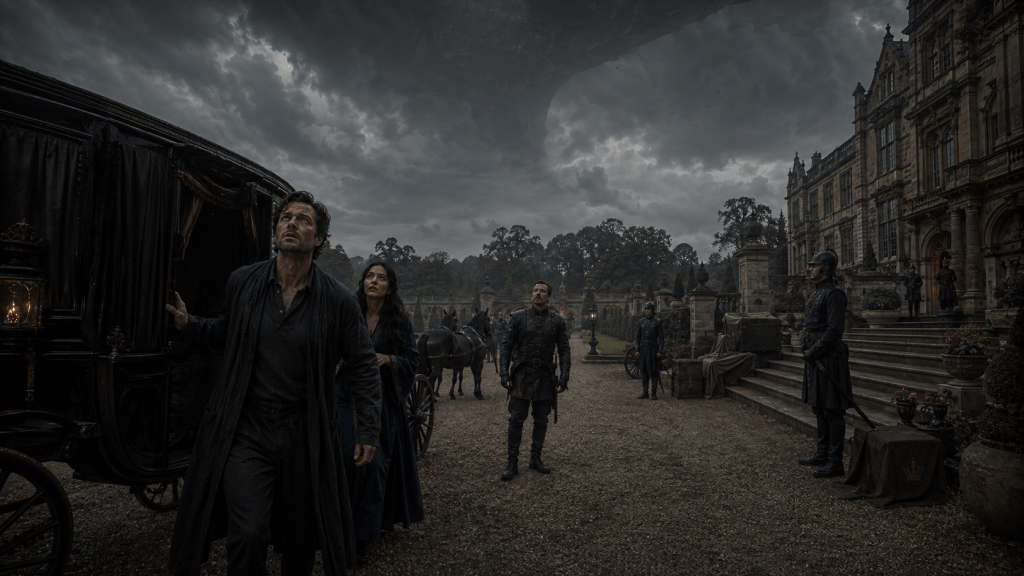
The early-morning carriage journey finally carries Silas beyond Crown corridors and gives him partial glimpses of the hidden realm’s roads, bridges, vehicles, settlements, and magical infrastructure. Curtains restrict his view, guards manage the route, and unexplained shadows pass high above the road.
Inside the carriage, Silas and Seréne compare their worlds through ordinary details. He describes buses, cars, trains, moving stairs, and mobile phones. She answers with guided platforms, line-stone routes, magical vehicles, and systems shaped through an entirely different history.
Their exchange reveals the scale of the world more effectively than an explanation could accomplish. Silas begins recognising that he has entered a functioning civilisation whose people find Earth as strange as he finds them.
When the carriage crosses Alderwick’s outer ward, Seréne and Arven pass through cleanly.
Silas does not.
The estate waits beyond the boundary, beautiful and guarded, with Crown officers, ward-stones, restricted shutters, and Guild-marked equipment already prepared. Then Silas steps from the carriage, looks beyond the roofline, and sees something above the ridge that changes the scale of everything he thought he understood.
The book closes before the sight is fully named.
Slow-Burn Fantasy Where Institutions Become the Source of Tension
The Wards Beneath the Crown will appeal especially to readers who enjoy political fantasy, hidden magical realms, portal fantasy, ancient manuscripts, royal intrigue, living architecture, institutional mysteries, gradual worldbuilding, and character-driven stories where consequences matter more than effortless spectacle.
The book’s tension grows through rooms, language, lamps, pages, maps, ward-lines, archives, sealed evidence, and guarded roads. Its characters behave intelligently, even when their competing responsibilities place them in conflict.
The Crown genuinely wishes to prevent harm.
The Guild genuinely needs to understand the disturbance.
Lirael genuinely protects Silas while restricting him.
Seréne genuinely seeks truth while approaching areas her sister has placed under control.
Silas genuinely wants home, even as the hidden realm begins answering him in ways that suggest his arrival carries meaning beyond accident.
No institution becomes foolish merely so the story can move. The danger emerges because intelligent people possess incomplete knowledge and enough authority to act upon it.
That combination makes every careful decision consequential.
Continue The Hollow Flame Cycle with The Wards Beneath the Crown
Book Two carries the crossing beyond its first shock and into the systems attempting to contain its consequences.
Silas Thorn remains far from home, watched by the Crown, examined by the Guild, and surrounded by warded structures that appear increasingly uncertain about his presence. Lirael must protect a kingdom and a man whose needs no longer align cleanly. Seréne has begun uncovering older language that may explain why the realm’s foundations answer differently from modern doctrine.
The palace has released Silas because it can no longer hold him safely.
An old book rests beneath the controlled light of a London conservation studio, surrounded by brushes, weights, linen thread, magnifying lenses, and the accumulated certainty of professional knowledge. Its leather carries no title. Its script belongs to no language its reader recognises. Darker marks sit between the lines, holding the lamplight longer than ordinary ink should ever manage.
Silas Thorn understands damaged books. He understands altered bindings, hidden repairs, brittle fibres, fading ink, and the patient labour required to preserve something that has survived the carelessness of previous generations. What he does not understand is why the book feels warm beneath his hand, why its markings appear to draw light inward, or why the page begins to open into a depth that cannot exist within paper.
The Unclassified, Book One of The Hollow Flame Cycle, begins as an atmospheric fantasy about old books and buried history before widening into a slow-burn epic fantasy of hidden realms, royal authority, magical institutions, and a man whose arrival threatens every accepted explanation surrounding him.
The crossing does not welcome Silas into an adventure. It removes him from everything he knows and places him inside a civilisation that already believes his presence must mean something.
A Book That Refuses the Rules of Preservation
Silas approaches the unidentified volume as a manuscript conservator, rather than as someone searching for magic. That distinction shapes the entire story.
He does not open the book because he longs to escape modern life, discover secret powers, or fulfil an old prophecy. His father finds it among family possessions connected to Silas’s grandmother, wrapped and hidden behind an old trunk. Silas takes it back to his studio because careful examination is his profession. The response is completely reasonable within the life he understands.
That ordinary foundation gives the impossible greater weight.
The book’s transformation develops through physical details that Silas would naturally notice. Its construction seems unusually intact. The script carries discipline despite resisting identification. Darker marks hold light differently from the surrounding ink. Heat rises through the page and into the tools placed near it. The air above the surface shifts. Straight lines begin to bend.
Every stage moves Silas further from professional curiosity towards the recognition that the object is answering him.
The resulting tension belongs partly to supernatural fantasy, partly to hidden-world fantasy, and partly to the intimate unease of an intelligent person watching reliable knowledge fail beneath his hands. Silas has spent his working life bringing damaged history back into stable form. He now faces an artefact that seems to have been waiting for him to touch it.
The book does not merely contain a doorway. Its behaviour suggests intention, recognition, or some buried connection that Silas cannot yet name.
Silas Thorn Carries the Logic of London into the Impossible
Silas is an unusual centre for an epic fantasy story because his first strength is attention.
He is neither a trained fighter nor an ambitious seeker of power. He is a British manuscript conservator whose habits have been shaped by restraint, evidence, and respect for material history. He notices how an object has been handled. He recognises when thread belongs to a later repair. He understands that damage often carries several generations of human decisions within it.
Those skills continue to matter after the crossing.
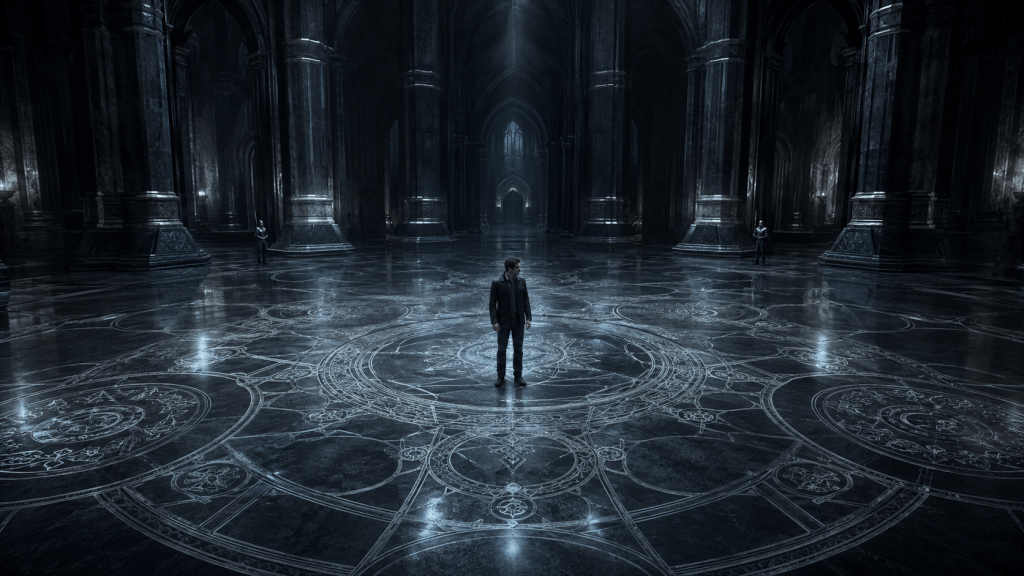
When Silas is drawn through the altered page and falls onto the polished stone of an enormous foundation chamber, he does not suddenly adopt the language or confidence of a fantasy hero. He searches for a door. He looks for the vanished book. He studies the architecture surrounding him and tries to find something that will return the world to measurable proportions.
The book has disappeared. London is beyond reach. Beneath him lies an intricate inlay of unknown sigils, set within the secured foundations of a royal palace.
Silas’s displacement remains personal even as it becomes political. He has a father who expects him to return. He has a profession, a familiar city, and an ordinary life that continues somewhere beyond the crossing. The story allows that loss to remain present. His first desire is not to master the hidden realm. He wants to understand what happened and find a path home.
That human response makes him a stronger emotional anchor. Readers enter the magical civilisation through someone who observes before claiming knowledge and admits uncertainty instead of disguising it. He cannot explain the book, the crossing, or the foundation chamber. He can only describe what he saw and insist upon the limits of what he knows.
The realm, however, has little patience for an answer that leaves so much unresolved.
The Palace Foundations Receive What the Crown Never Summoned
Silas does not appear at an abandoned ruin, an unguarded border, or a forgotten doorway. He arrives inside the protected heart of royal authority.
The palace foundations are layered with ward-lines and structural sigils that should answer only to recognised invocation. Their purpose is political as well as magical. They protect Crown space, carry the weight of inherited authority, and form part of a system whose reliability has endured across generations.
Then the east quadrant records a brief deviation.
The ward-lines move away from their expected pattern before returning to stability. No physical breach is found. None of the outer seals show disturbance. No authorised ritual has been conducted. When the palace guards enter the foundation chamber, they find an unknown man standing at the centre of the inlay.
The foundations have received Silas even though the Crown never summoned him.
That detail changes the crossing from a private supernatural event into a crisis of authority. Silas may be frightened and confused, yet his confusion cannot remove the political meaning of where he has appeared. If the palace wards admitted him, either the protections have failed or they recognised something their current keepers do not understand.
Both possibilities are dangerous.
This is where The Unclassified separates itself from fantasy stories that treat arrival in another world primarily as an invitation. Silas’s crossing creates procedure, investigation, jurisdiction, and fear. The hidden realm is a functioning civilisation with laws, offices, guards, archives, councils, and competing forms of magical authority. An impossible person appearing inside its protected centre cannot remain a private curiosity.
His existence has become a matter of state before he has learned the name of the kingdom holding him.
Lirael Vaerenthis Turns Fear into Law and Procedure
Princess Lirael Vaerenthis encounters the disturbance first through a report.
Her morning begins with questions of administration, disputed authority, altered ward-stones, and the Guild’s habit of acting before consulting the Crown. She is politically trained, disciplined, and acutely aware that small procedural changes can conceal larger claims of power.
When the foundation ward-lines fluctuate, Lirael does not respond through panic or superstition. She orders a quiet inspection. She requests a physical survey independent of the magical sentinel array. She insists that even the absence of visible evidence must be recorded.
Her response reveals one of the book’s most compelling ideas: competent institutions can behave rationally and still remain dangerously incomplete.
Lirael does many things correctly. She keeps the disturbance controlled. She prevents rumours from moving ahead of evidence. When Silas is found, she orders that no harm should come to him. She provides food, water, guarded accommodation, and formal inquiry instead of allowing frightened officials to decide his fate in a corridor.
Yet every careful response places Silas more firmly inside Crown authority.
Protection and restriction arrive together. He is treated humanely, while his freedom depends upon people who cannot classify him. Lirael recognises that fear could lead to dangerous decisions, but she also knows that compassion cannot erase the security implications of his arrival.
Their first conversation carries that conflict. Silas speaks as a displaced man who wants to return home. Lirael listens as a royal official responsible for a palace whose foundations have behaved impossibly. He insists that he invoked nothing. She knows the inlay should never answer by accident.
Neither is unreasonable. Their difficulty lies in the fact that both may be telling the truth.
Seréne Vaerenthis Listens for Meaning Beneath the Stone
Where Lirael approaches the crossing through law and structure, Princess Seréne Vaerenthis approaches it through older texts and meanings that formal authority has allowed to recede.
Before she sees Silas, Seréne is studying first-generation accounts of the palace foundations. Those records describe thresholds as structures that do more than keep danger outside. They suggest the foundations were designed to sense what pressed against them and that the stones listen as well as seal.
The difference is subtle, yet it changes the meaning of Silas’s arrival.
If the foundations are only barriers, his appearance represents a failure or breach. If they possess some older responsive function, they may have admitted him deliberately.
Seréne carries this possibility into the royal hearing. She watches Silas differently from the councillors who search for deception and differently from Lirael, whose duty requires an immediate policy response. Seréne notices the effort beneath his stillness, the scholar’s bearing within his unfamiliar clothing, and the way he studies the hall as someone seeking stable ground.
Her response remains restrained. She does not declare him innocent, prophetic, or trustworthy. When asked for judgement, she says that she would hear more because the questions raised by his arrival cannot be exhausted within the first hour.
That decision establishes her place within the central character braid. Lirael gives the crisis structure. Seréne preserves the possibility that the structure itself may be based upon an incomplete understanding of the past.
Silas stands between them, unaware that their differing responses may shape far more than the terms of his confinement.
London Becomes the Impossible World Inside the Royal Hall
One of the most distinctive movements in The Unclassified occurs when Silas is questioned before the sovereign and assembled court.
From Silas’s perspective, the palace is impossible. Its sigils, ward-lines, magical foundations, ritual authority, and vast architecture belong to stories. From the court’s perspective, London is equally difficult to comprehend.
Silas describes elected officials, Parliament, written law, archives, universities, steel bridges, electrical power, and streets illuminated without flame. He explains a society where authority can be challenged through debate and where scientific systems provide functions the court associates with magic.
The exchange turns familiar modern life into a form of speculative worldbuilding.
Electricity sounds implausible to people who understand illumination through magical craft. Government without succession binding seems structurally insecure. A world that dismisses magic as fiction becomes difficult to reconcile with the man who has crossed from it through a book.
Silas cannot prove London exists. The court cannot dismiss him because its own foundations received him.
The scene allows both worlds to remain strange. Modern Britain is not treated as the unquestionably superior civilisation, while the magical realm is never reduced to an archaic kingdom awaiting modern instruction. Each possesses systems, traditions, assumptions, and forms of knowledge that the other finds difficult to accept.
Silas has crossed between worlds, yet the more significant divide may lie between the explanations each civilisation has learned to trust.
Crown and Guild Gather Around an Unclassifiable Man
The Crown can decide where Silas sleeps, who guards him, and which questions he must answer. It cannot explain why he arrived.
That limitation brings the Guild into the palace.
The Guild exists beside royal authority rather than beneath it. Its knowledge of sigils, ward-lines, and magical structures gives it a necessary role, although its independence also makes every intervention politically sensitive. Lirael already suspects the Guild of treating technical expertise as permission to act within Crown territory. Silas’s arrival gives both institutions a legitimate claim to involvement.
The sovereign therefore chooses controlled residence and supervised inquiry. Silas will be protected, watched, and questioned while Crown and Guild attempt to understand the crossing.
Then High Mage Elarion enters the hall.
His arrival carries no extravagant display. The court shifts because everyone recognises what his presence represents. The Crown possesses Silas physically, while the Guild may possess the knowledge required to interpret him. Neither institution can proceed comfortably without the other.
Silas remains at the centre while older powers arrange themselves around him.
This political tension gives the story a scale larger than its immediate events. No battle is required to demonstrate the instability beginning within the realm. The disturbance exists in jurisdiction, withheld knowledge, altered foundations, and the quiet recognition that established authorities may no longer understand the systems they govern.
The Hidden Realm Feels Like a Civilisation Rather Than an Escape
The magical realm of The Echo of Fire and Shadow is introduced through institutions and ordinary activity rather than spectacle alone.
The palace contains clerks, petitioners, ledgers, archivists, servants, maps, formal hearings, restricted libraries, administrative chambers, and layers of working authority. People dispute grazing rights and river levies while ancient ward-lines rest beneath their feet. Political life continues around magic because magic has already become part of civilisation.
That approach gives the hidden realm credibility.
Silas has not entered a decorative medieval landscape waiting for an outsider to transform it. He has entered another form of organised society, one whose magical systems have shaped government, architecture, security, communication, and inherited law. Its people possess knowledge he lacks, while remaining blind to possibilities their own history may have concealed.
The palace itself becomes part of the story’s pressure. Its foundations hold older meanings. Its corridors control movement. Its great hall converts uncertainty into judgement. Its libraries preserve versions of history that official doctrine has narrowed over time.
Nothing has visibly collapsed by the end of Book One. The palace still stands. The ward-lines remain intact. The sovereign has issued a measured decree. The Guild has been called.
Yet the civilisation has been forced to acknowledge a man who should never have reached its centre.
Three Perspectives Surround a Single Unanswered Crossing
The story moves through Silas, Lirael, and Seréne because no single perspective can contain what has happened.
Silas gives the crossing its human cost. He remembers London, his father, the conservation studio, and the ordinary certainty of a world where pages remain pages.
Lirael reveals the political consequences. She understands that an unexplained person inside royal wards may create fear, rumour, and institutional conflict long before anyone discovers the truth.
Seréne senses the historical depth beneath the event. She recognises that the foundations may carry meanings that modern authority has preserved imperfectly.
Together, their viewpoints create a character-driven epic fantasy in which mystery develops through interpretation. The central question is larger than identifying who opened the passage. The deeper pressure comes from the different meanings attached to Silas before anyone has truly learned who he is.
To himself, he is a conservator who fell through a book.
To the Crown, he is an uninvited presence inside protected space.
To the Guild, he may be evidence of a magical event outside recognised boundaries.
To Seréne, he may be connected to something the foundations remembered even after the realm forgot.
Each interpretation brings consequences, and none yet provides an answer.
Epic Fantasy Built from Restraint, Memory and Political Consequence
The Unclassified will appeal especially to readers who enjoy atmospheric epic fantasy, hidden magical realms, ancient books, royal politics, magical institutions, slow-burn character development, and mysteries that widen through consequence instead of immediate explanation.
Its tension comes from competence meeting the impossible. Silas behaves intelligently. Lirael responds responsibly. The sovereign maintains order. Seréne refuses premature certainty. The Guild arrives when its expertise becomes necessary.
The danger persists because sensible decisions cannot resolve a truth that lies outside the systems making them.
This gives the opening of The Hollow Flame Cycle its particular identity. Magic is never presented as a convenient route to effortless power. Authority is neither foolish nor all-knowing. History is preserved, although preservation cannot guarantee that its meaning has survived intact.
At the centre remains Silas Thorn, a quiet man from London whose professional life has taught him that old damage must be handled carefully. He has now entered a realm shaped by an ancient history that may recognise him before he can recognise anything within it.
Begin The Hollow Flame Cycle with The Unclassified
Book One closes its immediate movement with Silas contained, protected, watched, and surrounded by questions. The Crown has acted. The Guild has entered the palace. Lirael has imposed structure. Seréne has begun looking beneath the official explanation.
The story begins with an old book beneath a conservator’s hands, yet its true disturbance reaches far beyond the page. A hidden realm has received someone it never summoned, and the institutions built to control magical uncertainty must now decide whether Silas Thorn represents a breach, a warning, or the return of something their own history no longer knows how to name.
Being a court-side account of the sealed summons that entered Bremyra before the city understood what had begun to move beneath its ordinary days.
The Chancery Before the Bell
Snow had begun before dawn, falling in pale veils across Bremyra Castle until the carved seams of the window ledges filled with white and the high eastern walls softened beneath winter’s hand. In the lesser chancery, where clerks kept the daily weight of the kingdom in ink, the lamps had been lit early, and the hearth had been fed with damp wood that smoked more than it burned, sending a blue-grey thread up the chimney while men bent over their desks with sleeves drawn close, every page they turned giving a dry whisper beneath the muffled weather beyond the glass.
Edran Vale sat at the third desk from the fire, where the draughts came gently and the wax cups stayed soft. He had served the royal seal through three masters, and age had taught him that kingdoms rarely changed first through proclamations. Change came through smaller signs, through a page sent twice for the same bundle, through a chamberlain crossing a corridor with his mouth set tight, through a guard who touched his sword while standing inside a place where no blade should have been needed.
That morning, the castle carried such signs in abundance. Shortly after Prime, two pages entered the chancery with their heads bowed too low and asked for the Vaeldring marriage papers, though those same sheets had been checked and tied before the previous evening bell. Master Pellor, keeper of the royal receipt ledger, gave them the packet and added the Arvendral correspondence in a tone that admitted no question. The younger clerks looked up from their scraping knives and wet ink, waiting for some word to give the matter shape, while the pages tucked both bundles beneath their cloaks and hurried back into the passage.
Beyond the open door, the castle moved through its duties with strained care. Servants carried coal to the upper rooms, guards changed watch at the stair, the chapel bell marked the hour, and from below rose the faint iron clang of kitchen hooks being set for the noon meal. Yet the usual voices had thinned into murmurs. Even the laughter from the lower hall had been drawn back into the stones, leaving the whole keep to listen beneath the sound of snow.
Near the window, old Mairen trimmed quills with a blade worn smooth by her fingers. She had outlasted four senior clerks and knew the sound of every passage leading to the chancery door. Her knife paused when a horn called from the outer gate. It paused again when the lower ward answered. Master Pellor closed the docket before him and removed his spectacles, though he stayed seated with one hand resting on the ledger’s edge. The room settled around that gesture as quills slowed, sand boxes remained lifted in waiting hands, and the hearth appeared to draw its flame inward.
The chamberlain entered first. Ser Caldus was narrow of face and silver at the beard, trained through long service to carry urgent matters as if they weighed no more than linen. Melted snow darkened the shoulders of his mantle. Behind him stood a rider in black travelling leather, tall beneath a hood, bearing no sign of Bremyra, Arvendral, Vaeldring, Thalosia, or any western house known to the clerks who watched from their desks. A castle guard stood close at the rider’s side with one gloved hand near his sword, and between them, held in both of the rider’s hands, rested a cedar case bound in dark cord.
Ser Caldus crossed the room and placed the case before Master Pellor. The old seal-master rose slowly, steadying himself with the dignity of his office as the cord came into view, tied in five turns and drawn beneath a single knot. Resin darkened the weave. At the centre of the lid sat a round impression in gold wax, flawless despite road and snow, with five marks set around its edge. Edran saw the emblem at its heart and felt the name before any voice shaped it. He had seen that mark only in copied histories and on the brittle seals of older charters kept in the locked cases behind the archive screen. It belonged to the Council of Five.
The room altered more deeply than it had at the horn. Mairen lowered her knife. One apprentice touched the charm hidden beneath his collar. Master Pellor’s face lost what little colour the cold had left there, and for a breath he seemed less a keeper of royal paperwork than a man standing before a power whose reach had crossed sea, road, castle gate, and royal custom in one sealed object. The Order of Magicians rarely sent letters to courts, and when it did, wax of plain red or black usually served. Gold meant an authority older than favour and heavier than courtesy.
Ser Caldus rested one hand on the edge of the cedar case as he spoke with measured care. “This letter is to be entered under royal receipt and conveyed at once to His Highness Prince Patrick. It came by harbour road at first light, under closed authority. The rider passed through three gates and yielded the case into my hand before witnesses of the captain’s men. The seal remains whole.”
Every clerk knew the questions that should follow such an arrival, and Caldus had given the answers before Master Pellor shaped them. The case had reached each gate sealed. No hand inside Bremyra had opened it. No knife had touched the cord. No candle flame had softened the wax. The ritual of receipt moved across the room like an old prayer spoken for protection as much as law.
Master Pellor turned to Edran, his fingers still resting near the cedar lid. “Enter the receipt, Vale. Exact wording. Full witness line.”
The order placed the burden on him. Edran stood and brought the receipt ledger from the locked shelf behind his desk. The leather cover creaked when he opened it, releasing the scent of dust, lamp smoke, and years of careful handling. He found the next clean page and wrote the date according to the royal reckoning, then the hour, the condition of the case, the witnesses present, the chamberlain’s name, and the description of the seal, his letters narrowing under the awareness of every eye watching him.
When he reached the line naming the sender, he paused, then wrote Council of Five. The ink shone wetly on the page, and for several breaths the words seemed too large for the ruled space that held them. Edran had copied royal deaths, crop failures, executions, marriage settlements, levies, and treaties weighted with quiet threat, yet this name carried a different pressure. It called up academy stories told in careful voices, old laws sealed after imperial ruin, and memories of ages whose stones still lay beneath the kingdoms like bones beneath flesh.
Through the high window beyond Master Pellor’s shoulder, Edran could see the old Order manor on its hill above the city, a dark shape softened by falling snow. For years it had stood quiet, maintained by royal obligation and avoided by those who served below. Its gates had rusted, its windows had clouded, and ivy had taken the garden walls. Children in the servants’ court whispered that lamps sometimes moved there in empty rooms, though no steward had ever admitted such tales into proper hearing. That morning, the manor seemed nearer than distance allowed.
The rider waited by the door while snow melted from his hood and fell drop by drop onto the stones. Edran wondered what road had carried him here, what harbour had received him, what hand had pressed the gold wax, and why the Council had chosen this hour. He asked none of it. Clerks survived by knowing the border between written fact and living danger.
Master Pellor wrapped the cedar case in dark blue cloth and returned it to Ser Caldus. “The Prince must receive it before the next bell,” he said, passing the bundle across with both hands.
Ser Caldus accepted the case against his breast and inclined his head. “Then I carry it now.”
The chamberlain turned, the guard shifted with him, and the rider followed them from the room. Their steps withdrew towards the royal stair, fading beneath the steady press of snow against the windows. After they had gone, the chancery remained held in the shape of their absence, as though the letter had left a portion of its weight behind among the desks.
Only then did the younger apprentice beside Mairen release the breath he had been holding. No one rebuked him. The fire settled in the grate, and somewhere deep within the castle a door opened and shut with unusual force. Edran stayed beside the receipt ledger, watching the ink dry around the words he had written. The page would outlive him, as most pages did, and some future reader might one day find the entry neat, exact, and bloodless, a record of cedar, cord, gold wax, witnesses, and lawful receipt. It would say that a letter came to Bremyra under the authority of the Council of Five. It would say no more of the hush in the room, or the snow against the high windows, or the way every clerk had looked towards the old manor on the hill, as if the city itself had heard a name spoken in its sleep and stirred beneath the weight of remembering.
A Visual Chronicle
Autoshorts.ai Flash-Fiction chat will write the caption
Royal Receipt Register: The Gold-Wax Letter
The letter entered Bremyra Castle under closed authority during the winter sitting of Prince Patrick’s regency, carried in a cedar case bound with dark cord and impressed with gold wax bearing the marks of the Council of Five.
The surviving receipt names the lower gate, the inner ward, and the lesser chancery as points of witness, each station confirming the seal as whole upon passage, with Ser Caldus of the royal household entered as receiving officer and Master Pellor of the chancery entered as keeper of lawful record.
The contents of the letter were omitted from the register, though the description of the seal was copied in unusual detail, including the five-point mark, the depth of the wax impression, and the colour recorded as old gold rather than common court yellow, suggesting that the clerks understood the distinction between royal correspondence and Order command.
A later hand added that the case was conveyed to Prince Patrick before the next bell, after which the entry gave only the phrase delivered upward under watch, a wording absent from ordinary household receipts and preserved in several copies as evidence that the chancery regarded the matter as belonging partly to the castle and partly beyond it.
The same page also carried a marginal sign beside the sender’s name, drawn in pale ink and scraped almost clean in a later revision. Its meaning was never entered into the formal index, though copies from the south archive retained the mark as a small spiral beside the words Council of Five.
The letter itself passed out of the surviving court bundle, and the register thereafter resumed its ordinary entries of grain measure, harbour duty, marriage papers, and guard expense, leaving the gold-wax receipt standing alone between common matters, as though the daily life of Bremyra had briefly opened around a message whose full burden the record was unwilling to hold.
About the Creator
The Mythic Chronicle is written and curated by Simon Phillips, a writer of mythic and speculative fantasy whose work explores forgotten kingdoms, fractured records, old institutions, and the moments when history begins to shift before those living through it understand what has changed.
The accounts preserved within these Chronicles form part of a wider body of work in which castles keep older secrets beneath familiar rooms, roads carry rumours ahead of armies, and ordinary witnesses preserve fragments of events whose true meaning remained sealed from them at the time.
One such account survives in a separate record, following the return of a magician to Bremyra during a season of court unease, royal absence, Church suspicion, and gathering danger beyond the kingdom’s roads. What the servants, clerks, and watchers of the city remembered only in fragments is followed more closely in The Unmarked Path, the opening book of The Veil of Kings and Gods within The Chronicles of the Spiral Realms.
Readers who wish to examine that fuller account may find the record below.
What follows is taken from a later account concerning the gold-wax letter entered into the lesser chancery, where the first formal record of the Council’s summons was preserved before the city understood the weight carried beneath its seal.
Chronicle Record: The Seal Carried Upward
The later copies of the receipt account began where the lesser chancery had fallen silent, with Ser Caldus carrying the cedar case through the western passage and Edran Vale summoned behind him to bear the open ledger. Snow lay white along the narrow windows, and the light that entered the castle had turned flat and colourless, dulling the gilt edges of old shields and memorial plaques beneath a thin winter veil. Servants pressed themselves against the walls as the chamberlain passed, their arms full of linen, coal baskets, keys, and covered dishes, each face turning towards the cloth-wrapped case for a single instant before discipline drew their eyes down again.
Edran followed at a measured distance, the receipt ledger braced against his chest with both hands. He had carried records through the royal stair many times, usually for matters of tax, inheritance, dispute, or treaty, and the motions of court were familiar enough to settle the mind when a man allowed himself to trust them. That morning, the same motions had grown strange. The guards at each landing straightened earlier than custom required. Pages ceased whispering when Ser Caldus approached. At the first turn of the stair, the chamberlain paused beside a narrow slit window that looked down towards the old manor hill, where the walls of the Order house stood like a dark tooth against the snow. He looked towards it for a breath too long, then continued upward with the case held close beneath his mantle.
The royal antechamber had already gathered around rumour. Two councillors stood near the map table, speaking in voices low enough to lose their words beneath the fire. A captain’s aide waited by the door with his gloves tucked into his belt. Master Vaynor, who served the household ledgers with a mind sharp enough to cut fraud from a mile away, stood beside the inner doors in a robe of brown wool, his expression fixed in its usual calm. Only his fingers gave him away, turning the end of a ribbon again and again until the silk had twisted thin.
Ser Caldus bowed to him and held the wrapped case before his breast. “The case came whole from the lesser chancery, under receipt and witness. His Highness must have it now.”
Master Vaynor extended his hand, then withdrew before his fingers touched the bundle. His gaze rested on the gold-wax impression beneath the cloth’s folded edge as he answered. “You will carry it inside yourself. Vale will attend with the ledger. His Highness may wish the line confirmed.”
The aide opened the inner doors, and the warmth of the Prince’s working chamber flowed into the antechamber with the scent of vellum, firewood, and spiced wine left cooling in a cup. Prince Patrick stood beside his father’s desk, one hand resting on the carved back of the king’s chair, his fair hair loose at his brow and his eyes shadowed from hours spent among petitions. Edran had served the court long enough to read fatigue in noble men who wished to appear untouched by burden. Patrick’s shoulders held upright, his voice remained composed, and his face gave the court what the court required, yet the desk before him betrayed the measure of the day. Vaeldring marriage papers lay open beside Arvendral dispatches. A sealed Thalosian memorandum rested near the inkstand. The kingdom had come to his table in fragments, each one asking for a prince while the king’s chair stood empty.
Ser Caldus advanced across the carpet and placed the cedar case on the cleared edge of the desk. Keeping his hands near the cloth until Patrick acknowledged the burden, he spoke with formal care. “Your Highness, a sealed message arrived under the authority of the Council of Five. It entered through the harbour road at first light and passed intact through the gates, the lower ward, and the lesser chancery. The receipt has been entered.”
Patrick’s gaze lowered to the gold wax. For a moment, the room seemed to lean towards him. His hand remained on the chair, though his fingers tightened against the carved wood. “The Council of Five,” he said, and those who heard him later disagreed over whether the words carried surprise, anger, or only the weariness of a man who had received one more weight before the last had lifted.
Master Vaynor stepped forward and indicated Edran with a small movement of his sleeve. “Vale holds the entry, my lord. The seal was whole when recorded.”
Patrick nodded for the ledger. Edran crossed the room and opened the receipt page with care, aware of the carpet beneath his shoes and the heat of the fire against his cheek. The Prince read in silence, his eyes moving across date, hour, witnesses, seal description, and sender’s name. He lingered at the last line. Edran watched his face as a clerk watches wax soften, searching for the instant before an impression takes shape, yet Patrick gave little away. He returned the ledger with a brief inclination of his head.
Patrick rested his palm beside the cedar lid and gave the order with his eyes still fixed upon the seal. “Break the outer wrapping.”
Ser Caldus drew a small knife from his belt and cut the dark cord with care, preserving the gold wax and the marked lid as he eased it upward. Within lay a folded parchment wrapped in black ribbon and closed with a smaller mark of red wax. The red bore the same five-point authority, its impression pressed so deeply that the edges had lifted in ridges. Patrick lifted the letter himself, broke the inner seal with his thumb, and unfolded the parchment as the fire gave a soft crack in the hearth. Somewhere beyond the doors, a page coughed, then held his breath.
The Prince read once, then again, and the second reading altered the room more than the first. His expression stayed composed, yet the stillness around him sharpened. When he finished, he lowered the parchment to the desk and looked towards the window as if the answer lay among the falling snow. Master Vaynor waited until the silence had carried as far as it could, then leaned close enough for concern to pass as counsel. “My lord?”
Patrick touched the edge of the letter, drawing it square with the line of the desk. “The Order has appointed a magician to Bremyra. He is to be lodged in the old manor above the city. The Council gives no further purpose.”
The words entered the chamber and settled there with a weight no royal formula could soften. The captain’s aide shifted at the doorway. Ser Caldus lowered his eyes. Master Vaynor’s ribbon stilled between his fingers. Edran, standing beside the open ledger, felt old stories stir at the back of his mind as inherited caution passed through households for generations. A magician in Bremyra. An Order manor opened. The Council writing in gold.
Patrick folded the letter along its original creases, then looked towards Master Vaynor. “The manor is to be prepared before nightfall. I want its hearths checked, its chambers aired, its stores accounted for, and a household assigned with enough discretion to keep every market stall from feeding on this by supper.”
Master Vaynor bowed, holding his ribbon still at last. “I will see it done, Your Highness.”
Patrick turned towards Ser Caldus, and the chamberlain straightened beneath the Prince’s attention. “The arrival is to be treated as lawful appointment, nothing more. The court will hear that the Order has sent a representative to reside under its own authority. Any further question waits upon my pleasure.”
Ser Caldus gathered the broken ribbon and folded cloth into the cedar case. “As you command,” he said, his chin dipping with practised restraint.
The Prince’s gaze settled on Edran, and for the first time that morning the clerk felt the full attention of Bremyra’s acting ruler. “The receipt remains in the ordinary register. No separate docket. No embellished wording. Enter only what law requires.”
Edran bowed with the ledger still held open. “It shall be recorded as lawful receipt and delivery, Your Highness.”
Patrick studied him for a breath, perhaps weighing the man, perhaps hearing the limits of his own order. Then his voice lowered, carrying only as far as those nearest the desk. “And Vale, the seal description remains exact.”
Edran bowed again, understanding more than the words alone. The record was to be plain enough for daily governance and precise enough for those who might one day need to know that gold wax had truly come. Such instructions belonged to courts that had learned how to hide a blade inside proper form.
By noon, the message had travelled farther than the parchment. It moved through the castle in carried coal, in fresh sheets taken from cedar presses, in keys fetched from the locked board near the chapel passage, in extra bread set aside under cloth, and in a revised watch for the hill road. Edran saw more than most because his work sent him from room to room with copies, countersigns, and witness slips. In the lower hall, servants whispered that the Order had sent a judge. In the west stair, a groom insisted that a healer was coming because the royal family had hidden illness from the court. By mid-afternoon, the gold wax had become a coin, a sun, an eye, a warning pressed by hands older than the kingdom itself.
At the hour before dusk, Edran was sent with a maintenance warrant to the steward responsible for the old manor. The city lay below him, roofs dim beneath winter cloud, smoke rising from chimneys in torn ribbons. Above, the manor waited behind its rusted gates with servants already moving between its outbuildings. The steward took the warrant with gloved hands and read it twice, then glanced towards the silent house whose windows had begun to show faint lamplight. “They send us a lord of the Order after all these quiet years,” he said.
Edran kept his answer within the safety of office, his eyes lowered to the warrant. “The parchment names lodging and preparation only.”
The steward folded the paper into his coat, his thin smile holding little warmth. “Parchment often says less than stone remembers.”
By evening, the receipt ledger had been returned to the lesser chancery and locked away. The page lay between entries of ordinary governance, one line above a harbour levy adjustment and one line below a requisition for lamp oil. Its plainness troubled Edran more than any flourish could have done. The day had entered the record cleanly. The record had swallowed it whole.
Long after the last bell, when the clerks had gone and the lamps burned low, Edran remained at his desk with a scrap of waste parchment beneath his hand. He wrote no official entry. He made no claim beyond witness. He set down only what the ledger had no space to preserve: that the letter had changed the manner of men before its words were known, that servants had looked uphill as if listening for a footstep still beyond the road, that Prince Patrick had held the parchment as one holds a summons meant for a house already under strain, and that by nightfall the city seemed aware of a return it had yet to see.
He sanded the scrap, folded it small, and placed it inside the back cover of his personal book, where accounts of weather, deaths, market accidents, and unusual bells lay gathered across many years. The castle quietened around him. Snow kept falling beyond the glass. Above the city, the manor’s first lamp was lit after long disuse, a single amber point on the hill, and Bremyra carried its light through the darkness as though a sealed name had been spoken and every stone had begun, slowly, to answer.
A surviving household register from the upper Order manor, preserving the first recorded signs that the house above Bremyra had begun to stir before its appointed guest arrived.
The Idea Behind the Chronicle
Sealed letters carry a strange power in old courts. They arrive as parchment, wax, cord, and witness, yet the hands that receive them often understand that the true burden rests in what cannot be read aloud before the room. A letter from a merchant may alter trade. A letter from a neighbouring crown may alter policy. A letter beneath gold wax, bearing the authority of the Council of Five, altered the air around it before any prince had broken the seal.
This Chronicle draws upon the quiet terror of formal procedure, where danger enters through lawful channels and leaves every servant bound to behave as if all remains ordinary. The cedar case, the receipt ledger, the witness line, the preserved seal, and the careful movement through the castle all belong to a world that trusts record and rank to hold uncertainty in place. The more exact the entry became, the more heavily the silence around it seemed to gather.
The Sealed Road of Bremyra is built around records that stand near the truth while failing to possess it. In this second Chronicle, the letter matters less as a message to be opened than as an arrival remembered by those who handled its passage. The clerks knew the colour of the wax. The chamberlain knew the care required in carrying it. Prince Patrick knew that its sender belonged to a power older than his present authority. None of them yet held the full shape of what its coming had begun.
Gold wax became the centre of the account because it gave the Chronicle a visible mark of distant command. It allowed the scene to remain small and domestic while still carrying the pressure of old arcane power. One room, one ledger, one case passed from hand to hand, and still the whole castle appeared to shift around it. That is the movement this Chronicle preserves: change entering Bremyra through a clerk’s page before it reached street, chapel, library, or road.
The letter also lets the cycle deepen its view of Bremyra as a kingdom under strain. Prince Patrick already stood amid marriage papers, border reports, and the absence of his father’s full authority. The summons from the Council arrived into that fragile balance, pressing the Order back into the city’s life through protocol instead of spectacle. No spell was cast. No gate broke. No hidden chamber stirred in open sight. Yet a place long used to royal business felt an older jurisdiction step across its threshold.
This Chronicle therefore follows authority as atmosphere. The myth lies in the way ordinary witnesses remembered the arrival as more than administration. A clerk entered the receipt, a chamberlain carried the case, servants whispered through the hall, and by evening the old manor above Bremyra had a lamp burning again. The truth of the letter belonged elsewhere. The memory of its passage belonged to the castle.
From the Author’s Desk
Thank you for continuing into this Chronicle.
This second account was shaped around the idea that power often enters a kingdom in quiet form before anyone sees its full consequence. In Bremyra, the return of the Order began through a sealed letter, a court receipt, a chamberlain’s passage, and a clerk’s careful wording. Nothing outwardly broke in that moment, yet the castle had already begun to change.
Across this cycle, each Chronicle follows a different fragment surrounding the first movement of The Unmarked Path. Some accounts remain close to the castle, others move through chapel records, road reports, servant memory, damaged fields, and fearful northern rumours. They are preserved as partial witnesses rather than complete explanations, allowing Bremyra’s world to gather shape through what its people saw, misread, recorded, or feared to name.
This Chronicle keeps its distance from the full truth of Simion’s story. The novella holds the direct account. Here, the focus remains with those who stood near the edge of events: clerks, servants, guards, chapel attendants, and court officers whose records carried the first signs of change long before anyone understood what they had received.
Beyond The Mythic Chronicle, my writing continues across fantasy, speculative fiction, and related novella worlds, where hidden histories, old institutions, broken records, and uncertain witness accounts often shape the path into larger stories. Some works follow events more directly, while others stay close to fragments and echoes, allowing the world to emerge through what survives.
Readers who wish to explore further may find additional work through the links included in this publication.
From the lesser chancery folios of Bremyra Castle, preserved in the receipt bundle later copied under the winter regency of Prince Patrick. The script is narrow, formal, and partially corrected in a second hand.
The sealed case was entered after first light during the winter sitting, carried from the harbour road under guard and received at the lower gate before passage to the inner ward, where the chamberlain took custody in the presence of the captain’s men and confirmed the gold seal whole upon transfer.
A further entry records that the case was conveyed to the lesser chancery and set before the receipt master, who ordered the sender named in full, the hour entered according to royal reckoning, and the impression described with care beyond ordinary court habit, the wax being marked as gold and bearing the fivefold authority of the Council.
The contents of the letter were absent from the chancery copy, though the movement of the case through the castle was preserved in unusual detail, including witness names at each threshold and a note stating that the item was carried upward under watch after receipt, a phrase entered in smaller script and later traced over by another hand.
The order to prepare the old manor appears on the same folio, written below the receipt in compressed lines, with hearths, shutters, bedding, stores, and servants named as matters requiring completion before nightfall, though the reason for urgency was left outside the formal wording.
A mark beside the sender’s name appears in the oldest surviving copy, shaped as a small spiral or coiled flourish, partially scraped from the page during later revision. The index makes no reference to the mark, and subsequent copies vary in whether they preserve it, leaving uncertainty over whether it belonged to the clerk, the revising hand, or an older notation carried from the first record.
The final line confirms that the cedar case reached the Prince’s chamber before the next bell, after which the register resumed ordinary matters of harbour duty, lamp oil, and store expense, leaving the receipt complete in legal form while withholding the burden that gave it consequence.
Marginal Notes & Interpretations
Collected from later annotations found along the outer margins of the receipt folio and from two damaged copies held among royal household papers.
One annotation suggests that the gold wax merely reflected formal courtesy from the Council of Five and that the unease recorded in later copies arose from common fear surrounding the Order’s name, especially among clerks whose knowledge of magicians came through rumour, old sermons, and household tales.
A second note disputes this reading, stating that ordinary courtesy would have used red or black wax, while gold indicated higher authority within Order practice. The writer adds that the chamberlain’s decision to preserve the seal on the cedar lid shows that those present understood the letter as command rather than correspondence, though the note breaks off before naming any source for this claim.
A third annotation, entered in a faint and hurried hand, records that the old manor was lit before all preparation warrants had reached its steward, and that one servant sent to open the east rooms claimed to have found fresh ash beneath a cold grate. The line was later struck through, though traces remain visible beneath the scraping.
A later copy from the south archive omits the ash account entirely and replaces the spiral mark with a plain dot beside the Council’s name, suggesting either caution in transmission or an effort to reduce the folio to ordinary administrative form.
World Notes
Lesser Chancery of Bremyra Castle
A working archive chamber used for daily receipt, household warrants, sealed deliveries, witness lines, and copies of royal correspondence. Its records were practical in purpose, yet many later chroniclers valued them for the small details preserved around events that court histories treated more broadly.
Gold-Wax Authority
A seal colour associated in later Bremyran copies with high Order command, set apart from common diplomatic wax and ordinary private correspondence. Surviving references remain sparse, and later writers disagreed over whether gold marked Council rank, urgency, secrecy, or a combination of all three.
Royal Receipt Register
The formal book used to enter sealed items received into the castle under witness. Such registers normally preserved material facts rather than interpretation: date, hour, sender, seal condition, receiving officer, and route of custody. Their restraint made unusual details more significant when they appeared.
The Old Order Manor
A former house of arcane residence above Bremyra, maintained by obligation after the Order’s daily presence withdrew from the kingdom. Its reopening after the gold-wax letter became one of the earliest remembered signs that the old relationship between Bremyra and the Order had begun to stir again.
Next Chronicle
After the gold-wax letter entered the register and the old manor above Bremyra was opened, attention soon turned from the royal chancery to the cathedral, where Archbishop Alaric Thorne’s household began preparing for the arrival of the Order’s appointed magician.
Later chapel notes describe a summons written in formal language and sent across the city with unusual haste. The account preserves little of the message itself, though it records doors held closed, candles replaced before their time, and attendants instructed to keep the nave clear while the Archbishop waited beneath the coloured glass.
Those who copied the cathedral papers in later years treated the summons as an early sign that the Church had sensed danger before the court understood its shape. No witness claimed certainty over what Alaric feared, yet the surviving fragments suggest that his unease lay deeper than courtesy, and that the return of the Order touched old tensions beneath Bremyra’s holy stone.
Next Chronicle: The Cathedral Warning
The receipt ledger returned to its shelf with its pages ordered, its witness lines complete, and its ink dried around the lawful arrival of the Council’s seal, while above the city the old manor held its first lamp through the falling snow, and within that quiet light the summons remained present in Bremyra, carried beyond parchment by every stone that had heard its name.
Before any rider climbed the hill above Bremyra, the old Order house was said to have recognised the return for which it had long kept silent.
Before the Rider Climbed the Hill
The summons reached the lower service court after first light, carried beneath a sky the colour of beaten pewter and received in the quiet manner reserved for instructions that invited no argument. The old house above Bremyra was to be opened before nightfall, with fires laid, rooms aired, lamps trimmed, linen brought up from castle stores, and the western suite made ready for a guest of the Order. The clerk who read the command aloud offered no name, and those gathered beneath the dripping eaves asked for none, since the word Order settled over them more heavily than any title. The scullery maids lowered their eyes, two footmen exchanged a glance before fixing their attention upon the stones, and the housekeeper folded the parchment before gathering old keys, lamp oil, and those she trusted for the climb.
The path to the manor climbed above the city in a crooked line of stone, worn smooth along its centre by feet remembered more clearly than the people who had once made the ascent. Bremyra lay below them in the grey hush of morning, its roofs dark with rain, its harbour dim beneath the mist gathering off the sea. Farther uphill, the manor emerged through thinning vapour as a broken shape against the clouds, larger than memory allowed and lonelier than distance suggested. Its outer gate leaned inward upon one hinge, the crest above it softened by moss and weather, though the old device of the Order still held its outline when seen from the proper angle. They passed beneath the arch in single file, boots sinking into wet gravel and dead leaves, while wind stirred branches across the upper windows with a scraping sound later described as too close to whispering.
The housekeeper carried the main key upon a ring wrapped in cloth and halted before the door while the others gathered behind her. The manor had remained unused for years save during brief inspections ordered from the castle, and even those visits had thinned with time. Its stone face retained tall arched windows, narrow balconies, and a broad entrance shaped for honoured guests. Ivy veiled part of the façade, moisture darkened the lower courses of masonry, yet the door itself appeared strangely clean, the iron latch clear of the green bloom marking the rails beside it, as though a hand had passed across it recently. The housekeeper noticed, and one of the footmen noticed with her, opening his mouth before reading the set of her jaw and letting the matter sink back into silence. When she fitted the key, the lock turned before her wrist completed the motion, smooth and yielding, and the door gave inward with a low sigh from its hinges.
Cold air met them first, carrying dust, old wood, and something fainter that no two later accounts described in quite the same manner. One servant recalled the scent of extinguished candles after prayer, another claimed the hall held the dryness of parchment left too near a hearth, while the housekeeper wrote only that the air seemed preserved. The entrance hall rose in shadow above them, its walls lined with panels darkened by neglect and carvings that resembled leaves until viewed longer, when they gathered into interlocking lines. Dust rested thickly along the floor where no breeze should have reached, yet a pale trail stretched across the stone from the doorway towards the central chamber, narrow and irregular, visible for several steps before fading into the gloom. One maid looked towards the others, uncertain whether some earlier inspector had left it, and the housekeeper answered by sending her to open the shutters.
Work began in the way work often saved people from unease, through repetition, complaint kept under the breath, and the comfort of tasks that yielded visible change. Rugs were beaten in the front court, chairs were set upright beneath their dust cloths, sconces were wiped clean, and fires took more swiftly than the cook’s assistant expected from wood stored in so damp a room. Upstairs, shutters resisted along the southern rooms, then opened in succession with such force that one girl cried out and stepped back, her hand still inches from the latch. The sea wind entered at once, lifting sheets, tugging at curtains, and rolling through the corridors until several doors shifted deeper in the house. The footman nearest the stair later insisted the sound came from pressure moving through rooms long sealed, while the maid beside him remembered the doors opening one after another in the order of someone passing through them.
The western suite demanded the greatest care, for there the guest was meant to rest. It lay at the end of a passage overlooking the lower city and the castle beyond. The housekeeper directed fresh linens to be spread, blankets aired near the hearth, a basin set upon the washstand, and oil lamps arranged where a late arrival might find them. While two maids smoothed the coverlet, one paused and asked whether anyone else heard bells from the city, and the others listened over rain and Bremyra’s distant morning sounds. Wheels moved upon stone, a gull cried near the harbour, voices drifted upward through the weather, yet no bell carried across the hill. The maid insisted the sound had come from within the walls, low and muffled beneath the floorboards, and the housekeeper answered with a quiet order that sent her back for more candles.
By noon the weather had drawn tighter around the manor, binding hill and city in slow coils of mist. The servants ate bread and cheese in the kitchen, speaking more boldly as warmth gathered around the hearth. Someone said the castle expected an old counsellor from the Order. Someone else repeated a rumour heard in the stables that the guest would be young, though powerful enough to make princes rise when he entered. Their talk thinned when a sound travelled overhead, slow and measured, crossing from one side of the upper floor to the other. The housekeeper rose so abruptly that the bench scraped against the flags, took a lamp, called for one of the footmen, and mounted the stair while the rest listened beneath held breath. They found the western passage empty, every door where it had been left, every window latched against the wind, though the lamp flame bent towards the prepared suite as they passed, leaning almost flat in the air while no draught touched their faces.
The afternoon brought visitors from the castle with a chest of wine and a smaller locked case the carriers refused to describe. They left it upon the study table under written instruction and departed before the rain worsened. The case bore no crest upon its lid, only bands of dark iron and a seal of pale wax pressed with a mark too blurred for the servants to identify. Afterward, the study felt changed. The housekeeper returned later to confirm the door remained closed, only to find a line through the dust there, as though a finger had brushed once across the wood. She cleaned it away with the heel of her hand and carried the memory alone.
Towards evening, the lamps throughout the manor were lit one by one, their gold reflecting across dark panels, pale glass, and polished vessels newly set in order. The building no longer resembled an abandoned remnant upon the hill. It held fire in its hearths, fresh water in its basins, and the faint stir of readiness through rooms that had spent years settled into their own quiet. The servants gathered their baskets near the entrance while the housekeeper made a final circuit through the western suite. In the sitting room, the lamp upon the mantle had already been lit. She remembered leaving it dark, though now its flame burned steadily beneath the old crest of the Order, casting its faint design across the wall in softened lines of amber. She stood there longer than she later admitted before lowering her gaze and leaving the room as she had found it.
They descended the hill under a sky heavy with coming snow, the manor behind them dimly radiant above Bremyra, every prepared window holding a square of muted light. From the lower bend of the road, one of the younger maids turned to look back and claimed she saw a figure standing at an upper window, tall and still, dressed in darkness against the lamp glow. The footman beside her saw only curtain shadow, while the housekeeper refused to look. By the time the city lamps emerged beneath the mist, no rider had yet entered Bremyra, no herald had called from the gate, and no name had been written beside the manor’s restored rooms. Even so, among those who climbed the hill that morning, the account endured that the old house had ceased to feel empty before its guest arrived, as though the stone had received word earlier than the servants, and had begun, in its own patient fashion, to wait.
A Visual Chronicle
An abandoned manor above Bremyra began waiting before anyone knew who was coming.
Manor Register: The Upper Order House
The manor above Bremyra remained within the royal property rolls despite long disuse, its chambers retained under prior arrangement for the reception of recognised servants of the Order whenever such presence should again be required within the kingdom.
A preparation entry preserved among the household records stated that the western suite, lower hall, study chamber, kitchens, and entrance court were opened and restored ahead of an expected arrival, with fires laid, lamps supplied, fresh linen brought from castle stores, and the main rooms made fit for occupation after years of limited inspection.
The same entry recorded several irregularities during the work, including a door-latch that yielded before full use of the key, traces visible across the entrance dust where no recent passage had been registered, and one lamp found burning within the western sitting room after the servants responsible for the suite had already withdrawn from it.
These details were entered without judgement and were assigned no cause within the surviving household copy, though a later marginal hand referred to the house as “wakeful before reception”, a phrase absent from the formal castle duplicate and preserved only in the lesser service transcript.
The guest expected that evening had yet to arrive when the servants descended from the hill, and the manor was entered as secured, prepared, and awaiting occupation. Subsequent versions of the register retained the word awaiting, though in one damaged copy it had been amended to watching before the correction was scraped away.
About the Creator
The Mythic Chronicle is written and curated by Simon Phillips, a writer of mythic and speculative fantasy whose work explores forgotten kingdoms, fractured records, old institutions, and the moments when history begins to shift before those living through it understand what has changed.
The accounts preserved within these Chronicles form part of a wider body of work in which castles keep older secrets beneath familiar rooms, roads carry rumours ahead of armies, and ordinary witnesses preserve fragments of events whose true meaning remained sealed from them at the time.
One such account survives in a separate record, following the return of a magician to Bremyra during a season of court unease, royal absence, Church suspicion, and gathering danger beyond the kingdom’s roads. What the servants, clerks, and watchers of the city remembered only in fragments is followed more closely in The Unmarked Path, the opening book of The Veil of Kings and Gods within The Chronicles of the Spiral Realms.
Readers who wish to examine that fuller account may find the record below.
What follows is taken from a later household account concerning the upper manor above Bremyra, where signs of readiness were first recorded before the appointed guest had entered the city or any rider had climbed the hill towards its gate.
Chronicle Record: The Night the Manor Kept Watch
Night gathered around the manor by degrees, deepening first among the trees behind the western wall, then along the hollow beneath the gate, and at last across the windows facing Bremyra, where the city lights trembled through mist like embers beneath gauze. A second message arrived in the hands of a stable boy who climbed the hill with rain upon his collar and mud along both stockings, carrying instruction that two members of the household should remain until the Order guest had taken possession of the manor or fresh direction came from the castle. The housekeeper read the note beside the entrance lamp, looked towards the westward rooms above, then chose the old porter and the youngest of the chambermaids, one for steadiness, the other because youth travelled swiftly when an errand needed carrying.
The porter accepted the charge with a bow that held more habit than enthusiasm. He had served at the castle gates through many seasons of winter and rain, and the breadth of his shoulders gave comfort to those who mistook size for certainty. The chambermaid stood beside him with both hands gathered in her apron while the housekeeper explained which fires required checking, which rooms were to stay closed, and which bell-rope by the door would summon aid from the watch post on the lower bend of the road. When the instructions ended, the porter lifted the lantern from its hook and offered the girl a practical smile. “A roof, a fire, and bread enough for evening,” he said, testing the lamp in one hand. “There are harsher duties in Bremyra.” The chambermaid glanced towards the stair before replying that the manor carried too many rooms for two people, and he gave a low chuckle while the housekeeper turned away.
The final servants left as the first snow began to move through the rain, fine pale grains slipping sideways in the wind. Their voices faded along the path, followed by the dull clatter of the outer gate settling after them, and the manor drew around its remaining watchers with a quiet that seemed fuller than emptiness. The porter secured the main door, checked the bar across it, then crossed into the lower hall where one hearth had been allowed to remain alive. The chambermaid unpacked the small supper basket left for them, laying bread, cold beef, and a stoppered flask upon a side table before arranging two stools near the fire. She kept her back away from the stair while she worked. The porter noticed, though he chose gentler ground for speech, asking after her mother in the laundry rooms and her elder brother among the kitchen boys, until her shoulders loosened and her answers lengthened beyond murmured courtesy.
Their meal passed quietly, shaped by the crackle of wood and the soft push of weather against the windowpanes. The porter spoke of royal messengers who arrived after midnight and expected hot wine as though storms served only to prove their importance. The chambermaid laughed once, then gathered the remnants of supper while he rose to make the first circuit through the ground floor. Lamps burned steadily along the entrance hall and near the lower sitting room. The kitchen fire had settled into a deep red bed. Only at the foot of the stair did he slow, lantern raised, listening to a faint sound from above that resembled cloth brushing stone.
The chambermaid had heard it as well. She stood beneath the arch to the hall with the folded supper cloth held against her waist. “Is someone up there?” she asked, her eyes lifting towards the dark stretch of the stair. The porter set his boot upon the first step and held the lantern higher. “If anyone lingers there, they carry poor manners in a house prepared for honour,” he said, using humour because the girl’s face had grown pale. No reply returned from above. He climbed with deliberate tread while she followed at a distance close enough for courage, far enough to turn if courage failed.
The upper passage held the faint sweetness of newly lit oil and warmed linen. Every door stood as it had been left after the housekeeper’s final inspection, save for the western sitting room, whose door rested open by the breadth of a hand. The porter paused before it and cast lantern light across the threshold. The mantle lamp burned there, flame low and unwavering beneath the worn crest of the Order. The chambermaid swallowed. “The mistress left that room closed,” she said, keeping both hands tight around the cloth. The porter entered first, sweeping light across the chairs, the hearth, the table set with a clean pitcher, and the study door beyond. “Wind finds its way into old houses,” he answered, though the outer windows held firmly latched and no stirring of air touched the hanging curtains. He crossed the room, drew the sitting-room door wider, then pushed the study door with the edge of his knuckles when he found it partly open as well.
Inside, the dark iron case remained upon the table, its pale wax seal gleaming at the edge of his lantern’s reach. The chambermaid stayed at the threshold, reluctant to pass beneath the lintel. “That door was closed as well,” she whispered, and the porter turned slowly, searching the floor, the shelves, the narrow gap behind the writing chair. Dust clung where dust should have clung, untouched along the shelf lines and gathered beneath the table. Only the tabletop had changed. Earlier wiping had left its grain clean and dull. Now a fine powder lay across it, pale as ash, disturbed by a single narrow sweep leading towards the locked case. The porter studied it for several breaths before lowering the lantern. “The housekeeper will hear of this in the morning,” he said, keeping his voice even for the girl’s sake. “Until then, we close what stands open and keep to our charge.” He shut the study door, then the sitting-room door, and remained in the passage until the latch held beneath his thumb.
They returned below with slower steps. The chambermaid carried the cloth into the kitchen and stayed there longer than the task required, washing cups already clean and arranging the supper basket twice. The porter resumed his place near the hall fire, rubbing a hand over his beard while the snow thickened beyond the window. Each sign might have yielded to ordinary explanation if taken alone, a loose latch, a servant’s forgetfulness, ash carried where it should have stayed absent. Gathered together, they formed something harder to ease away within a house linked for generations to magicians who had once moved through Bremyra with rights few kings granted gladly.
The chambermaid returned from the kitchen and found him watching the stair. She sat beside the hearth, fingers interlaced, then looked towards him with the grave curiosity of someone younger than their own courage. “Have you ever seen one of them?” she asked, her gaze remaining upon the upper landing. The porter lowered his eyes from the dark above and considered her question. “A magician?” he replied, easing back upon the stool. “Once, when I was younger than you are now. He came with three horses, two servants, and a temper quick enough to strike sparks from silence. The castle bowed low. The market fell quiet. My mother told me afterward that people fear what can cross a room before anger has time to cool.” The girl listened with fixed attention, then asked whether the guest due at the manor would be the same. The porter shook his head slowly. “Every person carries their own weather,” he said, folding his hands across his knees. “The house may know sooner than we do.”
A dull sound moved through the ceiling above them before she could answer, heavier than the earlier brush along stone, as though a door had closed somewhere in the upper rooms. The chambermaid rose at once. The porter stood with her, lantern already in hand, and together they climbed again. This time the western passage remained still, every door shut, each lamp unchanged. The only difference lay at the far window, where frost had gathered against the inner glass in pale branching lines despite the room’s mild warmth. The chambermaid approached before he could stop her, drawn by the shape of it. From the centre of the pane, the frost curved outward in a broad, incomplete spiral that dissolved near the corners beneath beads of melting water. She lifted one finger towards it, yet halted before touching the glass. “Was that there before?” she asked, her voice barely louder than breath. The porter watched the curling pattern fade under the warmth of the room and answered after too long a pause. “Morning will tell us what weather meant to leave.”
They stayed upstairs a while after that, checking shutters, lamp reservoirs, and the seams of closed doors before returning to the lower hall. In the western suite, the bed remained fresh, the basin water still, and the room’s fire low yet alive. In the sitting room, the mantle lamp burned with a steadier glow than before. The porter reached towards its wick, intending to lower it, then drew his hand back when the flame thinned of its own accord and settled at a modest height. The chambermaid saw the movement and gripped the edge of the door. The porter adjusted the cuff of his sleeve as though that had occupied him, then gestured towards the passage with the lantern. “We have seen enough for one circuit,” he said, and led the way down.
Midnight passed beneath snowfall so dense that Bremyra disappeared from the windows, leaving the manor suspended between whitened ground and a sky emptied of shape. The hall fire should have fallen lower by then, yet its coals held deep colour, feeding the room with even warmth. The chambermaid had drifted into light sleep on the stool, head tipped against the panelling, while the porter kept watch with a blanket drawn across his knees. He woke her gently when hoofbeats carried up from the road below, clear at first, then fading beneath the weather. She started upright, smoothing her hair with both hands. “The guest?” she asked, looking towards the door. The porter crossed to the nearest window, wiping condensation from the glass with his sleeve. Snow veiled the road. No lantern swung through it. No rider took the final bend towards the gate.
The second half of the night brought no further sound overhead, yet the manor seemed to ease into a deeper attention. The porter sensed it in the halls when he made another circuit before dawn, in the way firelight reached farther across the floor, in the faint sheen gathered upon the entrance stones where dust had lain the previous evening. The path through the hall had become clearer, beginning at the front door and continuing towards the stair, as though several careful passes had drawn the old grime aside. He knelt near the first mark and brushed two fingers across it, finding the stone clean beneath. The chambermaid watched from beside the hearth, her blanket clutched around her shoulders. “Shall we send for the watch?” she asked, holding the blanket closer. The porter rose slowly. “At sunrise,” he said, glancing towards the sealed door. “The road will carry messages better in light.”
Grey morning entered beneath the clouds, faint and cold, while snow rested along the outer ledges and softened the hill beyond the gate. The porter unbarred the door after the first birds began calling from the trees and stepped into air sharp enough to clear sleep from the mind. The chambermaid joined him with a shawl drawn high around her neck. Together they looked down towards Bremyra, where smoke rose from waking hearths and the city revealed itself piece by piece beneath lifting mist. A castle runner appeared first upon the lower road, red cloak bright against the snow, moving uphill with urgency held in disciplined limbs. He reached the gate breathless, bowed while catching air, and delivered his message to the porter in clipped official phrases. The guest of the Order had entered Bremyra before dawn. He would attend to certain business below and take possession of the manor later that day. The household was to remain prepared.
The runner departed almost at once, leaving their questions untouched. The porter closed the gate and turned back towards the manor, whose upper windows held the pale light of morning. The chambermaid remained still beside him. “So he came,” she said, eyes fixed upon the western suite. The porter followed her gaze and saw the mantle lamp glowing through the glass despite daybreak, a small amber point resting high above the snow. “He came to the city,” the porter answered, choosing each word carefully as they walked back towards the entrance. “The house seems to have heard earlier.” Behind them, Bremyra’s bells marked the morning hour, and every fire within the old manor still burned.
A surviving household register from the upper Order manor, preserving the first recorded signs that the house above Bremyra had begun to stir before its appointed guest arrived.
The Idea Behind the Chronicle
Old houses often survive the people who once gave them purpose. Their rooms remain, their stairways hold the shape of vanished routines, and the objects left within them preserve traces of authority long after the voices that commanded them have gone quiet. A place built for power rarely becomes ordinary simply through neglect. It waits within its own altered silence.
The manor in this Chronicle draws upon that idea of a house preserved beyond use, set above Bremyra as a remnant of the Order’s former presence within the kingdom. Though its halls had remained closed for years, the command to reopen them stirred more than household labour. Fires were laid, shutters lifted, and chambers restored, yet the servants’ accounts suggested that the manor had begun preparing itself before their work reached completion.
Across older records, houses tied to rulers, priests, scholars, and magicians often gather stories of unusual readiness. Lamps burn where no hand claimed them. Doors ease open before guests arrive. Dust carries marks that seem to belong to a passage taken earlier than any witness can explain. Such details linger because they stand close enough to ordinary household disturbance to resist certainty, while still unsettling those who encounter them.
The Sealed Road of Bremyra explores a kingdom living beside histories it has never fully laid to rest. The Order had withdrawn from daily life in Bremyra, though its manor remained above the city, holding the shape of an older relationship between arcane authority and royal power. When that presence returned, the city understood the arrival as a matter of sealed letters and court protocol. The house appeared to understand it in another way.
This Chronicle therefore begins the series through place rather than action. Before foreign steel appears in the streets, before hidden knowledge stirs beneath the castle, before roads break under violence and rumour, one old building wakes into attention. Its response is quiet, domestic, and uncertain, which makes it more unsettling than spectacle would have been.
The manor stands as the first threshold of the Bremyra cycle. It receives the returning magician before the city has named him, preserving the earliest suggestion that buried histories had begun to move again, and that some structures remembered their former masters more faithfully than the people living beneath them.
From the Author’s Desk
Thank you for continuing into this Chronicle.
This opening account was shaped around the idea that a place may begin to change before anyone recognises the turning of events around it. The manor above Bremyra stands quietly at the edge of the city, long unused, still marked by the Order’s former presence, and yet the first record of this cycle suggests that its silence had never been as empty as those sent to reopen it believed.
Across The Sealed Road of Bremyra, each Chronicle will preserve a different fragment from the kingdom’s first season of unease: household accounts, chapel records, castle memories, road reports, and witness fragments gathered around events whose fuller truth remained beyond those who saw them. These pieces are incomplete by design, shaped by rumour, fear, duty, and the limits of what each witness could understand.
The first movement begins with a house waiting upon a hill. Later accounts will move deeper into Bremyra itself, where sealed letters disturb the court, the Church watches with growing concern, and old histories begin pressing against rooms that had seemed familiar for generations.
Beyond the Chronicle, my writing continues across mythic fantasy, speculative fiction, and novella-length stories that follow such worlds more closely from within. Some accounts remain distant and archival. Others step directly into the lives of those caught at the centre of change, where uncertainty gives way to consequence.
Readers who wish to explore further may find additional work through the links included in this publication.
From a lesser household transcript preserved among the upper property records of Bremyra Castle. The original entry appears to have been copied from a service register maintained during the reopening of the old Order manor above the city. Several phrases differ from the formal duplicate.
The upper house was opened under sealed instruction from the castle, with the western suite, lower hall, study chamber, and kitchen fires restored before the expected reception of a servant of the Order, whose name was absent from the household command and entered only after the first preparation had been completed.
Those assigned to the work recorded that the front latch yielded before the key had turned fully, though the door showed no sign of recent forcing or decay beyond the ordinary wear of long neglect. Dust within the lower hall bore a pale interruption running inward from the threshold, narrow in form and broken before reaching the stair, and the servants assigned to cleaning the passage entered no cause for the mark.
A later portion of the same account refers to an oil lamp within the western sitting room found burning after the housekeeper’s final inspection, despite the lamp being remembered as unlit when the chamber had been closed. The wording in this passage appears altered in the formal castle copy, where the matter is reduced to a note concerning household oversight.
The night-watch entry states that two servants remained after dark under instruction from the castle and heard movement above the lower hall at several intervals before midnight. Upon inspection, doors previously secured were found standing open within the western suite, while the sealed case delivered earlier that day remained untouched upon the study table. A fine powder had gathered across the desk where the surface had already been cleaned, marked by a narrow sweep directed towards the case.
A final note, written in a different hand and placed beneath the original watch account, records that the expected guest had entered Bremyra before dawn, though the manor fires remained strong, the mantle lamp still burned at daybreak, and those present stated that the house had seemed prepared for occupation several hours earlier.
The formal household register concludes with the manor entered as restored, secured, and ready for reception. The lesser transcript preserves an additional phrase, later crossed through in brown ink: the house kept watch before the Order returned.
Marginal Notes & Interpretations
Collected from later annotations found along the outer edges of the surviving transcript.
One annotation attributes the opened doors and unusual air movement to the condition of an old manor reopened after long disuse, observing that swollen wood, uncertain latches, and shifting pressure in neglected chambers could easily trouble servants already unsettled by the expected arrival of a magician. The same hand offers no explanation for the lamp remembered as unlit.
A second note disputes this gentler reading, stating that several details appear across more than one witness account: the yielded latch, the inward mark across the entrance dust, the lamp in the western sitting room, and the prepared path through the hall observed before dawn. The writer concludes only that such agreement among household servants deserves preservation even where cause remains unclear.
A third annotation, written in a cramped and fading script, refers to a chambermaid who later refused further work at the upper house and requested transfer to laundry duty within the castle. The note adds that she spoke often of a figure seen at the western window before the manor’s guest had arrived, though the line beneath this detail has been scraped thin and cannot be read with confidence.
Another marginal entry appears to have been added much later, after the manor had resumed occasional use. It states that certain houses remember the purpose for which they were built longer than kingdoms remember why they were abandoned, and that places once given to the Order seldom became empty in the ordinary sense.
World Notes
The Upper Order Manor
A long-disused residence standing on the hill above Bremyra, retained within royal property rolls for the reception of recognised servants of the Order when their presence in the kingdom became necessary. Though neglected for years, the manor still carried traces of its former purpose through old insignia, preserved suites, and household arrangements maintained in dormant form.
Household Preparation Records
Service entries maintained by stewards, housekeepers, and castle clerks when abandoned or rarely used properties required reopening. Such records usually concerned rooms restored, provisions delivered, servants assigned, and security confirmed, though lesser copies sometimes preserved details excluded from formal royal duplicates.
Order Houses
Residences once granted or maintained for magicians travelling under recognised authority, often positioned near courts, major cities, or routes of diplomatic importance. In later generations many fell into infrequent use, though their association with the Order continued to shape how servants, clerks, and local residents understood them.
Watch Entries
Short records kept when servants were instructed to remain overnight within a prepared household before the arrival of an expected guest. They were practical documents in purpose, yet in the case of older properties they sometimes preserved small disturbances later absent from official summaries, especially where multiple witnesses referred to the same irregularity.
Next Chronicle
In the days before the manor above Bremyra received its appointed guest, sealed correspondence passed quietly through the royal offices, carried beneath gold wax and entered into the castle record with more care than its outward form appeared to require.
The clerk assigned to receive it recorded the letter as a matter of Order authority, though later copies suggest that its arrival altered the mood of the chamber in which it was opened, drawing attention from those who had no right to hear its contents and leaving behind the first court whispers that Bremyra had been summoned towards an older obligation.
No connection was made between the letter and the house waiting upon the hill, though later accounts preserved both within the same sequence of returning signs.
Next Chronicle:The Letter Beneath Gold Wax
The manor above Bremyra remained prepared upon its hill, its fires tended and its rooms restored to purpose, while the city below received the returning magician through sealed instruction and cautious silence. Within the western suite, the lamp beneath the old Order crest continued to burn through the morning, and those who had kept watch carried away the sense that the house had recognised its guest before any servant had been told his name.
A record of the lower passages after the sounds ceased, where stillness was entered as repair, though those who walked below spoke of a quiet that listened.
The Run That Held Its Silence
The first man to notice the silence stood below the lane before dawn, with his lamp held at waist height and one hand resting against the damp sidewall where the brickwork curved into the older drain run. His name was Oren Vale, and he had worked the lower ways long enough to know their ordinary language. Water spoke there in narrow channels. Rats scratched in the mortar. Pipes knocked behind walls when fires were lit above. Steps returned faintly from arches and bends. Even fear had a sound in those passages, thin and breathless, carried ahead of a man before it came back to him changed.
That morning, the lower run gave him nothing.
He had entered through the iron hatch beside the tallow shop, where the lane bent towards the chapel house and the paving dipped beneath repaired stone. Rain had passed in the night. The gutters still shone, and a grey smell rose from the street where old water held in shallow cracks. Behind him, the district remained half asleep. A shutter lifted somewhere above. A cart wheel turned through a pool. A dog barked once in a yard further down, then fell quiet. Those sounds belonged to the surface. They stayed there.
Oren lifted the hatch with both hands. Its hinges scraped, loud enough to draw his shoulders tight. The sound should have travelled down the stair and broken against the first bend. He waited for the dull return that always followed. It never came. The scrape fell through the opening and ended as if the dark below had closed around it.
He stood at the top of the stair and listened.
The lamp flame trembled inside its glass. Damp air rose from below, cold against his face, carrying lime, old brick, and the faint sweet taint that had begun to cling to several lower places since the rear grounds were repaired. He had smelled it before in yards where the paving had shifted and in cellars where men spoke too softly after inspection. It was thin enough to deny in daylight. Down there, in the hour before dawn, it settled on his tongue.
He descended.
The stair curved through brick laid long before the houses above had taken their present shape. Oren knew each step by use. One gave a flat knock beneath the heel. One held grit along the edge. One near the bend scraped against the sole where the surface had lifted. That morning, his boots found every place, yet the passage took each sound before it returned. His weight moved through him and into the stair. The lamp chain touched the brass rim once, a small click he felt through his fingers more than heard. The click vanished.
At the foot of the stair, the lower run opened ahead.
The covered passage stretched in a low curve beneath the joined houses. A narrow water channel cut through its centre, dark and shallow, with lamp-light drawn along its surface in a thin trembling line. Ledges ran on either side, slick with old damp. The walls carried stains from pipe mouths, lime streaks, chalk inspection marks, and darker patches where the brick showed through. Beyond the first arch, the passage bent under the buildings and disappeared into a blackness that looked too smooth, as though depth had been rubbed flat.
Oren raised the lamp.
No rat moved along the ledge. No whisker stirred near the broken mortar. No trickle came from the pipe mouths set above the channel, although beads of water clung visibly to their iron lips. One bead swelled while he watched it. It trembled beneath its own weight. Then it drew back into the pipe and left the rim bare.
His fingers tightened around the lamp handle.
The lower run had never behaved like this. Even when dry weather reduced the channels to a dark thread, something moved. Water rubbed stone. Vermin shifted. Air pulled through the outlet. A man could stand still and feel the passage working around him, old, foul, and alive with the habits of buried ground. Now the place held itself with a care that felt deliberate. The stillness lay along the walls. It gathered beneath the arches. It waited in the mouths of the pipes.
Oren drew a breath and spoke because his instructions required a spoken check before the marks were renewed.
“Lower run clear.”
The words left his mouth and ceased.
They never reached the bend. They never struck the arch. They never thinned into distance. The passage received them before they had travelled more than a few feet. For a moment, he felt the loss of them in his own chest, as though the air had taken a small part of his breath and kept it. He looked back towards the stair. The grey of the open hatch lay above him, faint and far. Morning had begun beyond it. Down here, the light seemed older.
He moved forward along the right ledge. His lamp showed the water beside him, smooth along the centre and unbroken at the edges. It had the appearance of movement arranged into stillness. The channel should have whispered where it narrowed. It should have caught against grit and leaf stems from the roofs. It should have made some small answer to the brick around it. Instead, it slid beneath the light in silence.
At the second arch, he saw the first rat.
It lay close to the wall with its head turned towards the deeper passage. Oren stopped several paces away. He expected the quick panic of a living creature, the dart into shadow, the dry claw-scrape across stone. The rat remained still. Its fur had dried into ridges along its back, and its tail curved beside it as if placed there by hand. When he stepped closer, he saw its ribs move. Slowly. Barely. Life remained in it, held so low that movement had almost left the body.
A second rat crouched further along the ledge. A third sat near the channel with its forepaws tucked beneath it. Their eyes caught the lamp and gave back small black points of light. Each faced the same direction. Each looked towards the lower bend under the houses.
Oren stepped over the first animal. His boot passed close to its tail. The rat gave no sign that it had sensed him. One ear twitched after he had already gone by, aimed towards the darkness ahead.
The silence thickened with each pace. It pressed close against the wall, soft and steady, like cloth laid over a mouth. His sleeve brushed brick. He felt the scrape through the fabric, yet heard nothing. A loose piece of lime flaked under his shoulder and fell somewhere near his boot. It made no sound when it struck. The passage had become skilled at taking sound from whatever touched it.
At the bend beneath the third house, the chalk marks ended.
The final mark had been set crookedly above a fresh patch of lime. A seam ran below it, thin as a thread, descending from the repaired brick towards the water. The mark held no wet shine, though it looked darker than the wall around it. Its edges seemed too clean for damp. Oren lowered the lamp until the glass nearly touched the surface. The darkness within the seam stayed flat under the light.
He reached for the chalk in his pouch.
His fingers found the piece worn down from earlier work. He pressed it beside the old mark. The chalk touched the wall, snapped, and fell. A white fragment dropped to the ledge and settled beside his boot in silence.
Oren stared at it.
He had heard men curse in these passages when rats crossed their feet. He had heard prayer muttered into sleeves by men who denied it when they returned above. He had heard floods roar through the lower runs in winter until the hatch covers shook in the street. This quiet belonged to none of those things. It had weight. It had patience. It seemed to know the shape of every sound before the sound formed.
Something changed ahead.
No noise came from the depth. No reply followed. The change passed through the silence itself. It drew nearer along the covered run, slow and measured, until the space around Oren felt watched. The rats remained fixed towards the bend. The water held its dark, smooth face. The lamp flame narrowed inside the glass and turned blue at its root for one breath before it returned to amber.
Oren stepped back.
The silence came with him.
He knew then, in the body first, before thought gave it form. The lower ways had ceased sounding because something within them had learned stillness. The scratching had ended. The pipe knocks had ended. The answering walls, the shifting ground, the faint breath under stone, all of it had fallen away into a quiet chosen for itself. Above him, men would welcome such a change. Sleep would return to the houses. Priests would write of settled ground. Masons would sign the lower runs as stable where the walls held and the water passed. In the old covered passage, beneath brick, lime, and joined floors, the silence had gathered into presence.
He withdrew without turning his back. He passed the motionless rats. He passed the suspended mouths of pipes. He kept the lamp raised before him, though its light seemed to reach less far with every step. Near the first arch, his heel struck loose grit, and for the first time since he entered, a faint sound touched the passage. It came thin and distant, like an answer remembered from a place already closed.
At the stair, the air shifted. The silence thinned, although it never fully released him. Each step upward gave a small dull note beneath his boots. By the time his hand reached the iron rim of the hatch, dawn had opened across the lane. The first smoke rose from the rear stacks. A boy crossed the street with kindling under one arm. Somewhere nearby, water poured from a bucket and struck stone with an ordinary splash.
Oren climbed out and lowered the hatch with both hands. The iron scraped. The cover settled into place with a heavy ring that spread across the lane and faded into morning.
He stood above it for some time.
The sound should have comforted him. It belonged to the world he knew, to streets, labour, hinges, weight, and metal. Yet beneath the frame, under the brick stair and the covered passage, the silence remained. It had taken the depth back into itself. It had accepted the closed hatch, the lime marks, the sleeping houses, and the renewed noise of morning above. It waited below them all, quiet enough to be mistaken for peace, patient enough to be entered as repair.
Foundation Register: Lower Passage Silence Record
The lower passage entered within the adjoining district plans appears as part of an older drainage and service network extending beneath several joined properties, with its course recorded in fragments across successive revisions. Surviving plans describe the run in practical terms, listing a covered channel, side ledges, pipe mouths, stair access, and several points of prior sealing where the older brickwork passed beneath later foundations. Earlier entries refer to routine water movement, vermin passage, and irregular sound return within the lower arches, all of which were accepted as expected conditions within enclosed structures of this age and depth.
During inspection following disturbances in the rear service grounds and lower washing rooms, the passage was entered for assessment, and early observations were recorded in the language of stabilisation, referring to recent lime work, cleared drainage, renewed hatch closures, and the absence of fresh movement within the walls. These entries describe the lower run as calm following repeated repair, with no further settling noted in the visible brickwork, no widening recorded around the pipe mouths, and no renewed displacement in the channel stones beneath the adjoining houses.
Subsequent notes describe a marked alteration in the behaviour of sound within the passage, where ordinary movement failed to return from the arches and bends in the expected manner. Early descriptions refer to muffled acoustics caused by damp, recent sealing, and altered airflow after repair works. Later entries distinguish the condition from common deadening within enclosed drains, recording that steps, tool contact, pipe vibration, and spoken checks appeared to lose return within the lower run, even where the visible dimensions of the passage remained unchanged.
In several accounts, the quiet is described as extending beyond the absence of noise. The lower passage is recorded as holding stillness evenly along the channel, ledges, and pipe mouths, with water present in the run yet giving little sign of motion through sound. Pipe mouths that had previously knocked or drawn air after use are entered as silent during inspection, and several notes refer to suspended water along the iron lips of lower outlets, though these details are reduced in later copies to ordinary drainage delay after recent works.
A number of entries refer to animal behaviour within the passage during the same period. Rats that had earlier been recorded moving in repeated lines through cellars and walls were found gathered along ledges and lower bends, facing deeper sections of the run while showing little response to approach or light. These observations are entered cautiously and assigned to exhaustion, poison, blocked routes, or disturbance caused by sealing works. The repeated direction of their attention towards lower bends beneath the adjoining properties is preserved in one early copy, though later summaries omit the detail and retain only a reference to reduced vermin activity following repair.
Further examination records that the silence appeared strongest near the sections where older seams had been lime-washed after recent disturbance. In these areas, chalk marks set upon the walls are described as failing to produce ordinary contact sound, while loose fragments falling from the surface are entered as settling without audible strike. The condition was attributed to heavy damp within the brick, softened mortar, and the muting effect of fresh lime applied across older openings.
Several observations refer to the passage as feeling sealed even while access remained open. Inspectors describe the air as still, the channel as smooth, and the lower bends as withholding return from voice and step. These notes remain limited in detail and are set beside practical explanations concerning blocked outlets, poor ventilation, and the closing of secondary routes beneath the district. No single cause is assigned across the surviving copies, and each entry preserves the matter within the accepted terms of maintenance.
A marginal notation, written in a later hand beside one copy of the lower inspection sheet, refers to the condition as “a silence present within the run, as if the depth had learned to keep what entered it.” The phrase appears once and is absent from the prepared register summary. No supporting explanation accompanies it, and the hand that added it does not appear elsewhere in the surviving lower passage records.
Final entries indicate that the affected sections were checked, sealed where access was judged unnecessary, and listed as stable within the district plans. The absence of sound, movement, and further response was accepted as evidence that earlier disturbances had settled after reinforcement of the surrounding ground. The lower passage remained within the maintenance register as a contained drainage structure beneath the adjoining houses, its condition entered as resolved within the limits assigned to it.
The matter was closed through inspection and repair, leaving the lower run recorded as stable, serviceable, and quiet beneath the streets.
About the Creator
The Mythic Chronicle is written and curated by Simon Phillips, a writer of mythic and speculative fantasy whose work explores the quieter edges of forgotten worlds, where buried structures, fractured records, and lingering presences continue beneath the surface of recorded history.
The accounts preserved within these Chronicles form part of a wider body of work in which cities stand upon older foundations, and events recorded as isolated disturbances are understood, in later tellings, to belong to patterns that were never fully recognised at the time.
One such account survives in a separate record, detailing an incident within a lower district where a death was first dismissed as excess, though the space in which it occurred retained a presence that resisted clearing, and where investigation revealed signs that the disturbance had not been confined to a single room.
This record is preserved in the novella Black Feathers in a Brothel, where the events surrounding that incident are followed more closely, though even there the full nature of what lay beneath the structure remains uncertain.
Readers who wish to examine that account in its fuller form may find the record below.
They entered the lower passages three days after the lamplighter’s account was taken, carrying rods, chalk, a coil of cord, two shuttered lamps, and the manner of people sent to confirm what the rooms above already wished to believe. The rain had ceased by then, although the district still held the wetness of it in wall, gutter, and paving seam. Water slid from roof channels into the rear drains. It gathered in old hollows beside the covered stair mouths. The streets had begun to sound ordinary again. Carts rolled over the lanes. Doors opened at dawn. Women poured wash water through back thresholds. Men crossed the yards with less care than before, glad that the ground had ceased shifting beneath them and that the walls had grown still.
Below the street, that stillness waited.
Nial Varr led the inspection because his hand remained steady in tight places and his records pleased men who favoured firm endings. He wore a dark coat waxed against damp, with a leather tube of plans tied across his back and a measuring hook at his belt. Behind him came Tessa Harl, who read stone by touch more cleanly than most men read ledgers, and beneath her lamp the lower walls revealed more age than the plans allowed. Last came Brother Calven from the chapel house, sent to observe and say little, though the white thread at his cuff had already taken on a grey stain from the hatch rim before he reached the first stair.
The municipal clerk remained above. He had settled beside the open hatch with ink, boards, and two men from the watch, ready to receive the findings once the passage had been walked. His voice came down thinly as Nial placed one boot on the first step.
“Call back at each turn.”
Nial lifted his lamp and glanced along the stair. “We will mark each section.”
The reply should have returned to the clerk. It faded halfway up the shaft.
Tessa looked at him, then towards the brick around them. The stair took the small shift of her boots and gave no answer. Calven made the sign of his office so subtly that the motion scarcely touched the air. He lowered his hand when Nial saw it.
“The lower way has been sealed along several side routes,” Nial said. “Dead air follows such work.”
Tessa gave a small nod, accepting the words as a surface laid across something deeper. She had heard dead air before. It carried trapped warmth, stale breath, and the sour trace of human presence left too long in stone. This silence held a cleaner edge. It seemed prepared for them.
They descended in single file. At the foot of the stair, the covered run opened in the same low curve recorded on the district plan, though ink had made the route appear obedient and simple. The real passage bent beneath houses that had leaned into one another over generations. It passed under rear rooms, storage spaces, wash floors, and the narrow yards where recent repair had covered more than it corrected. A shallow channel carried water along the centre. Its surface moved in a dark line through the lamp glow. It gave no voice.
Nial set the first chalk mark beside the stair mouth. The white line took cleanly. He tapped the wall beside it with the measuring hook, a small test he had performed in every lower space since boyhood. The metal touched brick and stopped there. No click returned from the passage.
Tessa crouched beside the channel and lowered one hand until her fingers hovered above the water. “It runs,” she said.
“I can see that.”
“It gives no edge against the stone.”
Nial looked down. The current carried a thin scrap of straw from the stair mouth, drawing it along the channel towards the first bend. The straw turned slowly and passed beyond the light. The water moved. Its silence remained whole.
Calven spoke from behind them. “The channel may be deeper than marked.”
“The channel is shallow,” Tessa answered. “The sound has gone elsewhere.”
Nial turned his head enough to warn her against choosing words that would travel upward poorly. The look held little force down there. Nothing travelled upward well in that place.
They advanced towards the second arch. The ledges on either side bore traces of former movement. Rat droppings lay in old clusters near the wall. Scratches marked the damp grit where claws had passed in steady routes. Pale lime had been brushed along seams where brick met older stone. All of it showed use, disturbance, repair, return. Yet the passage held as though emptied a moment before their arrival and arranged for inspection.
At the arch, they found the rats.
Seven of them lined the right ledge, each turned towards the same deeper bend. Their bodies were alive, though stillness sat over them so completely that the sight seemed wrong before its cause could be named. One rat breathed with its flank pressed against a lime streak. Another had placed its forepaws upon the edge of the channel, its whiskers held above the water. A third stared into the dark with eyes that reflected the lamp in two hard points.
Tessa lifted the hem of her coat clear of the ledge and stepped around them. “They have stayed where they were found.”
“Poison can slow them,” Nial said.
“Poison does strange work,” she replied. “It seldom turns every head the same way.”
Calven remained a pace behind the animals. His gaze had moved past them towards the bend. “They listen.”
Nial drew breath to correct him. The passage took the breath before he shaped it.
They reached the first side run after thirty paces. The opening had been sealed with fresh brick and lime, its new surface pale against the older wall. Tessa raised her lamp and studied the mortar. The upper edge had dried cleanly. The lower edge held a faint dark seam where moisture had gathered, yet no drip formed beneath it. Nial set the measuring hook against the centre and tapped once. The contact trembled through his wrist. No sound reached his ear.
“Mark it stable,” he said.
Tessa wrote the mark beside the seal. Her chalk moved with a soft drag that she felt in her fingers. It made no scrape. When she lifted her hand, the white line seemed too bright in the lamplight, sharp against the still wall.
From the depth ahead came a change.
It carried no noise. The lamps revealed no movement. The water continued its smooth passage along the channel. Even so, all three turned in the same instant, as if a hand had passed close to the face. The silence had altered shape around them. It seemed to draw back from the sealed side run and gather along the main passage, leaving a colder space at their shoulders.
Nial lifted his lamp. “Forward.”
They walked beneath the adjoining houses, crossing below floors that should have carried the early work of the district. Somewhere above, a kitchen would have opened. A bucket would have dragged to a rear tap. A child would have run across boards too thin to keep secrets from the lower walls. None of it came through. The houses above might have been empty, or the passage had refused to receive them.
At the next bend, the walls lowered. Nial inclined his head, and Calven’s shoulder brushed the brick beside him. The contact should have rasped. It passed in silence. The brother flinched from the lack of sound more sharply than he might have flinched from noise.
Tessa halted beneath a shallow arch where three pipe mouths entered the wall above the channel. Each held a bead of water at its lip. Each bead swelled, bright in the lamp, and stayed there.
“Open the upper tap,” she called towards the hatch, raising her voice as much as the passage allowed.
Her words died around them.
Nial looked back along the way they had come. The stair mouth lay out of sight beyond two bends. The clerk above would hear none of this. Tessa watched the pipe mouths. After a long interval, a tremor moved through the leftmost pipe. The bead lengthened. It should have fallen. Instead, it drew inward and vanished.
Calven whispered a prayer.
The prayer vanished more quickly than Tessa’s call.
He closed his mouth and seemed to taste the loss of the words. His face had grown pale beneath the lamp glow. “This place takes speech first,” he said.
Nial rounded on him. “It takes sound where the structure has been altered. Keep to what can be entered.”
Calven met his eyes. “Then enter that.”
The answer unsettled Nial because it carried no challenge, only a tired certainty. He turned back to the passage and set another chalk mark beside the pipes. His hand had begun to ache from holding the lamp too tightly.
They reached the lower junction near the old outlet before the hour had fully lifted above. Three runs met there, one from the rear houses, one from the chapel-side channel, and one older way that angled beneath the street and had been marked for permanent closure after repeated settlement reports. The junction should have been the loudest part of the lower network. Water from each run met in a central trough before passing onward beneath an arched gate. Even in calm weather, it usually muttered, knocked, and pulled at the iron grill with a low hunger.
The trough lay silent.
Water entered from three mouths. It joined in the centre. It moved through the grill. No ripple struck stone with audible force. No current hissed between the iron teeth. The lamps showed motion everywhere, and the ear received a vacancy so complete that Tessa felt her balance shift. She reached for the wall. Her palm met damp brick. The brick felt warm.
“Nial,” she said.
He had already seen the far wall.
Chalk marks from prior crews covered the brick in small pale strokes. Some indicated depth. Some marked repairs. Some crossed older lines where measurements had been corrected. Between them, a darker shape had begun to form, visible only because the lime around it had dried unevenly. It curved across the wall in a long shallow arc, then broke into several thin branches that ran down towards the trough. It resembled water staining until the lamp shifted. Then it looked like a pattern withdrawing into the brick.
Calven moved closer. “Leave it.”
Tessa glanced at him. “You know this sign?”
“I know the cost of granting signs too much attention.”
Nial set his jaw. “We record the wall condition. We touch nothing else.”
He opened the leather tube and drew out the marked plan, holding it near the lamp. The junction on the plan was smaller, straighter, and entirely obedient to its ink. He looked from page to wall, from wall to trough, and the quiet around them deepened as if the passage had leaned closer to read with him.
A small stone loosened from the arch above and fell into the water.
All three saw the splash. None heard it.
The ring spread across the trough in perfect silence. It reached the iron grill, broke against the bars, and passed onward into the outlet. The rats along the far ledge stirred for the first time. One lifted its head. Another opened its mouth in what might have been a squeal, though no sound came. Then they settled again, every body turned towards the sealed older way.
Nial closed the plan. “We leave.”
Tessa lowered her lamp. “The junction needs marking.”
“It has been marked enough.”
His voice ended quickly, taken by the lower air, yet the decision had been made. He led them back the way they had come. The silence followed with such perfect closeness that Tessa began counting her steps inside her mouth, needing some private measure the passage could have no claim upon. At twenty-seven, she lost the count because she became aware that Calven had fallen behind.
She turned.
The brother stood beneath the pipe mouths with his head angled towards the sealed side run. His lamp hung low in his hand. The water beads above him had returned to the iron lips, each held round and bright. His face carried the expression of a man listening to confession through a wall.
“Brother,” Nial called.
Calven stirred, though he kept his gaze on the seal. “It is quietest behind here.”
“That route has been closed.”
“Yes,” Calven said. “That is why it hears so clearly.”
Tessa went back for him. She took his sleeve, and he allowed himself to be guided away. As they moved, the sealed brick behind him darkened across one lower edge, a line so thin it could have passed for damp. It spread for the length of a finger, then stopped.
They reached the stair with relief that none of them wished to show. Sound returned there in fragments. Boots touched brick. Cloth shifted. Breath gained a faint place in the air. By the final steps, the district above had begun its full morning, and the clerk’s voice came down sharply through the open hatch.
“Well?”
Nial emerged first. He stood in the lane with water shining on his boots and the plan tube held tight under one arm. Tessa came after him, then Calven, who turned before the hatch was lowered and looked once more into the stair shaft.
The clerk dipped his pen. “Condition?”
Nial looked towards the houses, then towards the repaired paving, then towards the dark iron square at his feet. The street sounded ordinary around him. That ordinariness pressed harder than the silence below.
“Stable,” he said.
The clerk wrote the word. “Access required?”
Nial paused.
Tessa watched him. Calven kept his eyes on the hatch.
“Limited,” Nial said. “Seal the unnecessary runs. Leave the main channel under schedule watch.”
The clerk wrote again, satisfied by language that carried shape, order, and closure. The watchmen lowered the hatch. Iron met frame. This time the sound rang clearly across the lane.
For a few breaths, everyone above seemed eased by it.
Below them, beneath the stair, behind the sealed side runs and the old junction where water moved through its trough in perfect quiet, the silence received the closing sound and kept its answer to itself.
A lower run beneath the adjoining houses, entered after the sounds had ceased, where rats held still along the ledges and the water moved through the channel without giving back its voice.
The Idea Behind the Chronicle
The lower passages beneath old districts carried a different kind of memory from the rooms and yards above them. Streets gathered voices, trade, argument, prayer, wheels, and weather, while the covered runs below received what passed through the city after use. Water, ash, blood, grease, lime, waste, roof rain, and the small debris of daily life moved through those channels and left faint traces along brick, pipe, and stone. Such places were built for function, then forgotten until some failure drew men down with lamps and rods. Their purpose seemed plain, though their courses often passed through older foundations whose full shape had slipped beyond the plans that claimed to contain them.
Sound belonged to those lower ways as surely as water. A step returned from a bend. A pipe knocked when pressure shifted above. Rats scratched along ledges and vanished into seams. A dropped tool rang differently where brick gave way to older stone. Men who worked in such passages learned to read the space through these returns, trusting sound where light failed. The lower structures announced themselves through echo, trickle, scrape, drip, and hollow response. Even fear had a place there, carried through the passage and altered by the walls before it reached the one who had spoken.
This Chronicle grew from the moment when those ordinary returns ceased. Earlier disturbances in the series had been marked by movement, breath, pressure, scratching, answering stone, and matter rising through rooms and yards. Here the sign became absence. Water still moved, yet gave no sound. Rats remained alive, yet held their position along the ledges. Footsteps touched brick, yet failed to return from the arches. Speech entered the passage and vanished before it reached the bend. The silence itself became the event, heavier than calm, more deliberate than settlement, and too complete to sit comfortably within the language of repair.
Official records often treat quiet as proof that a disturbance has passed. Where sound ceases after repeated works, the conclusion leans towards stabilisation. The pipe no longer knocks because the pressure has eased. The wall no longer answers because the seam has been sealed. The rats no longer move because the routes have closed. Such explanations allow the district to resume its life above ground, with hatches lowered, lime set, and the old runs entered as serviceable. In this article, that same habit becomes the danger. The quiet is accepted as resolution because nothing rises loudly enough to challenge the record.
The silence beneath the streets also allowed the final Chronicle of the cycle to draw the earlier accounts inward. The sealed stair, the rat lines, the retained air, the marked wall, the answering passage, the breathing yard, and the altered basin all left their pressure upon the lower district. Each disturbance had produced a sign that could be seen, heard, touched, or entered into a register. The final stage moved beyond such obvious signs. The lower structures seemed to learn from disturbance and retreat into a state that offered little for the surface world to record. Absence became a form of concealment.
What remains within the Chronicle is the unease of a system that has grown quiet after being repeatedly approached. The covered passages are checked, marked, and sealed where access appears unnecessary. The main channel remains under watch. The clerk receives the word stable. The hatch closes with a sound that comforts those above. Yet the deeper space keeps its own answer beneath that sound. It has ceased to announce itself through movement, echo, or breath, and in doing so it becomes harder to accuse, harder to map, and easier to leave in place.
In this way, the silence completes the pattern of The Whispering Foundations without resolving it. The city above returns to ordinary labour, while the old passages beneath it remain present in a quieter form. The Chronicle preserves only what was noticed from the edge: water without voice, animals facing the dark, chalk breaking without sound, and inspectors choosing the safest word available to them. The truth remains elsewhere, beneath the houses and chapels, held below the streets in a stillness that looks like peace from above.
From the Author’s Desk
Thank you for continuing further into this Chronicle.
This final account turned away from movement and towards the absence left after movement ceased. Earlier entries followed sound within stone, rats moving through hidden lines, rooms retaining presence, markings beneath plaster, passages that answered, ground that breathed, and water that held a shape around what should have passed away. Here, the sign became quieter. The lower world no longer announced itself through pressure, scratching, shifting stone, or returning sound. It withdrew into silence.
What drew me to this Chronicle was the idea that quiet can be misread as safety. In ordinary records, a passage that stops knocking, a pipe that stops answering, or a wall that stops shifting can easily become proof of repair. Silence suits official language because it gives the appearance of conclusion. Nothing calls out. Nothing moves in sight. Nothing forces itself into the upper rooms. The disturbance can be entered as settled, even when the stillness below feels more deliberate than peaceful.
I also wanted this Chronicle to close the cycle by changing the nature of the threat. Through the earlier accounts, the buried structure revealed itself by reacting to disturbance. It answered touch, sound, weight, blood, water, and presence. In this account, the lower passages seem to have learned something from all that attention. They offer less to witnesses. They withhold their response. They become harder to describe because absence leaves fewer marks than movement.
That made the lower drainage runs the right place for this ending. These passages exist beneath daily life, carrying what the surface wants removed. They are practical, ugly, necessary spaces, built to be entered only when something fails. By setting the final Chronicle there, the series returns to the hidden structures that have shaped every disturbance so far, while allowing the visible district to believe the matter has passed into repair.
As with the earlier Chronicles, the record remains incomplete by design. The witnesses see enough to be unsettled, yet their accounts are softened by the language of maintenance, inspection, and closure. The deeper truth stays outside the Chronicle’s reach. That distance matters. The Chronicle preserves the myth, the rumour, and the surviving fragment. The full experience belongs elsewhere.
This cycle was always meant to feel like a pattern recognised too late. Each account offered one sign, one room, one passage, one surface, one basin, one silence. Together, they suggest a buried condition moving beneath the district, shaping itself through structures the people above still believe they understand. The final quiet beneath the streets is not an end. It is the point at which the world mistakes waiting for peace.
These Chronicles continue to sit beside a wider body of work set within the same world, where such disturbances are encountered at closer range and with a different kind of cost. The connection remains indirect, and that distance matters to the form. The Chronicle keeps the rumour, the fragment, and the surviving record. The fuller truth lives elsewhere beneath it.
From the lower district maintenance folios, compiled from drainage records, hatch inspections, lamplighter testimony, pipe reports, vermin notes, and later annotations gathered after the lower passages were entered as stable. The script varies between clerk hands, survey marks, and smaller additions written along the margins, suggesting that several accounts were arranged together once the hatches had been lowered and the closed runs marked within the district plans.
Initial references to the lower passages appear within routine drainage entries, where the covered runs are described in practical terms as service channels beneath adjoining houses, used for roof water, wash flow, yard drainage, and the movement of waste from rear rooms into older underground lines. These notes refer to brick arches, side ledges, pipe mouths, lime-washed seams, and several sealed side routes where earlier structures had passed beneath later foundations.
A later entry, written in a compressed hand, records that sound within one lower run failed to return from the arches after repair works had been completed. The writer places the observation beside references to fresh lime, altered airflow, damp brick, closed outlets, and recent sealing, though the same hand adds that steps, pipe movement, and spoken checks were taken by the passage before reaching the first bend.
Subsequent entries describe water moving through the central channel with little audible sign, despite visible current under lamplight. Early copies assign this quiet to shallow flow, blocked side routes, and softened mortar along the channel edges. Later summaries reduce the detail to ordinary deadening within enclosed drains after repair.
Further notes record that rats were found along the ledges in several sections, alive yet motionless, all facing the deeper bends beneath the adjoining properties. One account states that the animals failed to scatter when approached and that their attention remained fixed towards a sealed lower way. The language remains cautious and continues to frame the matter through poison, exhaustion, disturbed nesting, and closure of former routes.
One entry, set apart from the main sequence and written with heavier pressure, records that a bead of water formed at an iron pipe mouth, held there while inspection continued, then drew back into the pipe before falling. The same entry refers to three pipe mouths behaving in similar fashion, though later copies omit the detail and preserve only a general note concerning poor drainage after lime work.
The final entries concerning the lower run refer to hatch closure, renewed marking of stable sections, clearing of visible channel obstructions, and sealing of side routes judged unnecessary for service. The condition is listed as settled following repair, with the silence entered as evidence that earlier disturbances had ceased. Earlier references to speech failing to return, rats facing the depth, water without voice, and suspended drops at the pipe mouths are absent from the concluding copy and remain dispersed across the folio without formal connection.
Marginal Notes & Interpretations
Collected from later annotations added to the same maintenance folio, appearing in varied script, pressure, and ink tone.
One annotation attributes the loss of sound to recent closure works within the side routes, arguing that fresh lime, softened brick, damp air, and blocked outlets could deaden ordinary echo within a lower drainage passage. The writer keeps the explanation within known conditions of maintenance, repair, airflow, and enclosed ground.
A second note questions this account, observing that muffled echo cannot easily explain the loss of contact sound from chalk, falling lime, pipe mouths, water movement, and spoken checks across several separate sections. The writer remarks that the passage appeared to take sound before it travelled, and adds that the quiet was strongest near sealed routes.
A third annotation, faint and written along the inner fold, refers to the lower run as “a throat closed around its own breath” and suggests that the silence may have followed earlier disturbances through the hidden lines beneath the district. The entry breaks before completion, and the remaining words have been lost beneath a water stain.
World Notes
Lower Passage Runs Covered drainage and service passages beneath adjoining houses, yards, and chapel-side structures. These routes carry water, waste, seepage, and household flow through older brickwork and stone channels, often passing through foundations whose original purpose has faded from current plans.
Sealed Side Routes Closed branches within the lower network, usually bricked or lime-washed during repair after settlement, damp, vermin movement, or structural concern. Such closures are entered as practical maintenance, though several records preserve unease around routes that seemed quieter after sealing than before.
Silent Water Record Recorded instances in which visible water movement within lower channels produced little or no sound. Such behaviour is usually assigned to shallow flow, softened brick, blocked outlets, or altered drainage, leaving the absence itself preserved within repair language rather than resolved cause.
Next Chronicle
This Chronicle brings The Whispering Foundations cycle to its close.
The accounts concerning the lower passages end with silence entered as stability, the hatches lowered, the side routes sealed, and the district allowed to return to ordinary life above ground. No further Chronicle in this sequence follows the lower runs beneath the adjoining houses, though several later copies preserve scattered references to continued quiet beneath the streets, especially in places where water moved without voice and old brick held its seams too cleanly after repair.
The record closes where the district itself chose to close the matter. Movement had ceased. The rats had withdrawn or stilled. The pipes gave no answer. Footsteps returned only where the stair rose towards daylight. In the language of maintenance, such details allowed conclusion. In the older margins, they carried a different weight, suggesting that the lower structures had not emptied, but had learned to wait without sound.
The next cycle of The Mythic Chronicle will open elsewhere, with another recovered fragment drawn from a world shaped by memory, distortion, and the truths that survive only in broken record.
End of Cycle: The Whispering Foundations
The lower passages were returned to the register beneath the adjoining houses, their hatches lowered, their side routes sealed, and their condition entered within the terms assigned to them, while the notes gathered from lamp, chalk, pipe, water, and ledge were drawn back into the language of drainage, repair, and settled ground. Above them, the streets resumed their ordinary sound of carts, shutters, footsteps, and morning labour, and the houses carried on with the quiet confidence of structures accepted as whole, leaving the covered runs beneath them to pass once more into use, oversight, and neglect.
Beneath that restored order, the silence remained where it had gathered, held within brick, lime, water, and the older lines below the street. The passages gave no answer to the rooms above, though water still moved through them, and those who crossed the lanes in the early hours sometimes felt the sound of their own steps fall strangely short, as though the depth beneath the paving had kept itself close, listening in perfect stillness, waiting where absence had been mistaken for peace.
Beneath it, the lower run remained where it had long endured, carrying water through stone and darkness below the rooms above. The basin resumed its stillness, though the wall kept its faint line after wet nights, and those who worked there in the early hours sometimes paused before opening the tap without knowing why. The water cleared when watched, darkened when used, and passed below the stone as it always had, while somewhere beneath the floor the hidden passage held its silence, keeping the shape of the feather long after the surface had emptied.
Some castles preserve the authority of the families who rule them, while others appear to retain every footstep, fear, and unfinished secret carried through their halls. Bremyra Castle belongs to the second kind. Its stone corridors have witnessed royal childhoods, political marriages, religious authority, private loss, and the uneasy return of magic to a kingdom that has learned to fear those who wield it.
In The Unmarked Path, Book I of The Veil of Kings and Gods, Simion returns to those halls wearing the black robes of the Order of Magicians. He once crossed the same floors as a kitchen boy, almost invisible to the nobles, servants, and guards surrounding him. Years later, his robes command distance and fearful respect, though the castle itself appears to remember the boy beneath them.
The illustrated mini-read accompanying this article captures the moment when that memory begins to open.
Watch the Illustrated Mini-Read
The scene begins with a whisper so faint that Simion first mistakes it for memory. It brushes the edge of his thoughts as he walks through Bremyra’s familiar corridors, where every turn carries traces of a life he can no longer reclaim. The voice grows clearer as he moves, drawing him away from the inhabited chambers of the castle and towards its towering royal library.
Nothing rushes forward to announce the danger. No creature emerges from the shadows, and no great spell tears through the stone. The unease gathers through smaller movements: a voice without a visible speaker, carvings that seem to breathe beneath flickering light, and enormous oak doors whose silence feels strangely expectant.
By the time Simion enters the library, memory has become summons.
Returning to a Place That No Longer Knows Him
Simion’s return to Bremyra carries a tension deeper than simple nostalgia. The castle formed the boundaries of his childhood, although his place within it remained small. He worked among servants, scrubbed pots, carried trays, and stole brief moments of friendship with Prince Patrick and Princess Elana. Those memories remain warm in places, yet time and rank have altered every relationship surrounding them.
The servants who once worked beside him now lower their eyes. Courtiers measure their words in his presence. The Church watches him with suspicion, while the crown seeks answers from an Order whose motives remain carefully guarded. Simion has gained status, access, and power, though each of those gifts has placed another layer of distance between him and the life he remembers.
This separation gives the library scene its emotional force. The hidden passage appears inside a place tied to his former life, yet it opens for the magician he has become. Bremyra remembers both versions of him, even when its people recognise only one.
The voice calls him by drawing those identities together.
A Castle Built Above Forgotten History
Bremyra stands at the meeting point of royal, religious, and magical authority. The castle governs the kingdom, the cathedral shapes its faith, and the old magician’s manor remains as an uneasy reminder of the Order’s former influence. Beneath these visible structures lies another layer of history, one shaped during the age of the Imperium Arcana.
The library holds the written memory of kings. Its shelves preserve treaties, bloodlines, wars, journeys, laws, and decisions passed between generations. Behind one of those shelves lies a different kind of record, sealed within stone and kept beyond the reach of ordinary scholarship.
That contrast shapes the hidden passage. The royal archive protects what rulers chose to preserve, while the concealed chamber guards what the world attempted to bury.
Simion arrives at the precise point where those forms of memory begin pressing against one another. His hand touches the shelf, a mechanism answers, and the structure of the castle alters around him. What appeared complete reveals another depth. What seemed dormant reveals awareness.
The discovery suggests that Bremyra’s foundations were laid across histories its present rulers scarcely understand.
Simion Before the World Understands Him
Powerful fantasy figures are often introduced after their reputations have settled around them. Simion enters The Unmarked Path at a far earlier and more vulnerable stage. He carries the robes of a magician, yet uncertainty follows him into every chamber. His training has given him discipline and access to forces most people fear, while leaving him painfully conscious of the skills that resist him.
He approaches the library without the certainty of a man already crowned by destiny. He hesitates before the doors. He listens to the voice. His hand hovers above the iron handle because some part of him recognises that crossing the threshold will change the shape of his mission.
That hesitation matters.
Simion possesses enough knowledge to recognise danger, while lacking the knowledge required to name its source. He senses power in the castle, though its purpose remains veiled. He knows the Order has sent him to investigate missing magicians, yet the deeper force moving beneath Bremyra lies outside the task he believed he had accepted.
The world has begun to respond to him before he understands why.
This makes his journey human. His importance emerges through pressure, uncertainty, and the slow recognition that forces older than the Order have started drawing him towards them.
The Library as a Threshold
Libraries in fantasy frequently promise knowledge, safety, or sanctuary. Bremyra’s library offers something more severe. It forms a border between the history people can read and the history that continues to act upon them.
The towering doors create the first boundary. Their carved surfaces appear almost alive beneath the shifting torchlight, giving the architecture an unsettling patience. Once Simion enters, the scent of parchment and aged wood briefly restores a sense of order. Shelves rise in careful rows, old desks wait beneath the shadows, and generations of written thought remain where scholars left them.
Then his fingers touch the wood.
The faint click changes the meaning of everything around him. A hidden mechanism shifts with impossible precision, carrying an entire section of shelving aside. Cold air reaches into the library, disturbing dust and flame, while a low hum answers through Simion’s chest.
The secret becomes physical. It moves through the stone, the air, and his own body.
The scene ends at the threshold because the threshold carries greater power than an immediate answer. The passage stands open, the darkness waits beyond it, and Simion faces the point where curiosity becomes obligation.
The viewer receives the same choice.
Magic That Remembers
Magic within Ældorra carries age, structure, and consequence. It exists within institutions such as the Order, within the Church’s guarded authority, within ruined remnants of the Imperium Arcana, and within objects whose original purpose has slipped beyond present understanding.
It also remembers.
That quality separates the passage from an ordinary secret room. The mechanism resembles forgotten craftsmanship, yet the force guiding Simion towards it feels aware of presence and timing. He finds the correct shelf because the whisper draws him there. The hidden way opens because something beneath the castle has begun to move again.
The castle becomes part of that movement. Stone, timber, dust, and darkness serve as the visible surface of a much older design.
This early moment introduces one of the central pressures within The Veil of Kings and Gods. The present world believes itself governed by crowns, councils, religious offices, and the Order’s laws. Older forces remain embedded beneath every structure of authority, waiting for the balance to shift far enough for them to return.
Simion hears the first call before anyone around him understands that the silence has ended.
Political Pressure Above the Hidden Passage
The secret beneath Bremyra gains further meaning through everything unfolding above it. Prince Patrick carries the burden of ruling while his father and elder brothers remain absent. The kingdom faces political uncertainty, growing tension with Arvendral, and rumours of foreign movement beyond its borders. Princess Elana prepares to leave for a marriage shaped by alliance and royal duty. Archbishop Alaric Thorne watches the Order with a suspicion rooted in generations of conflict.
Each character faces a path shaped partly by forces beyond personal desire. Simion’s path merely takes a physical form.
Patrick confronts sealed letters, council demands, and the growing shadow of a crown he was never raised to inherit. Simion confronts a concealed door within the kingdom’s own memory. Both stand before structures passed down from earlier generations, and both must decide how far inherited authority can guide them when the world begins revealing dangers their institutions failed to understand.
This parallel movement gives The Unmarked Path its wider shape. The story moves between Bremyra’s stone halls and the northern seas, between court pressure and approaching conflict, allowing distant events to gather towards one another before the people caught within them can see the complete design.
The hidden passage is one movement within a much larger turning.
The World Beyond Bremyra
While Simion follows whispers through the castle, Týrnan Valgrim crosses the northern seas with the Frostbane. His longboats enter storms, foreign waters, and a campaign shaped by clan duty, faith, conquest, and the ambitions of the High Chieftain.
The distance between Bremyra and the Frozen North creates the impression of separate stories unfolding across Ældorra. One follows a magician searching through hidden history. Another follows a war leader carrying his people towards violence and uncertain purpose. Between them stands Patrick, whose kingdom may soon feel the consequences of movements far beyond his court.
The reader sees the pressure gathering across different landscapes before the characters can recognise their connection. Magic awakens beneath stone. Armies move across water. The Church defends its influence. The Order searches for its missing members. Royal alliances tighten around men and women whose private wishes have little influence over the duties placed upon them.
History has begun drawing these lives into the same current.
Why This Scene Opens the Door to the Series
The illustrated mini-read offers a natural entrance into The Unmarked Path because it captures the atmosphere of the wider story without surrendering its answers. Viewers encounter Simion at a moment of movement, enter Bremyra at its most secretive, and feel the first pressure of ancient magic stirring beneath the visible world.
The scene also expresses the heart of the book. These characters begin changing before they understand the forces causing that change. Simion receives a summons from beneath the castle. Patrick feels the crown moving closer while his family remains absent. Týrnan sails towards a campaign whose true scale remains hidden. Elana walks towards a political marriage while reading the dangers gathering around her brother and kingdom.
Their paths appear separate, though each carries a burden shaped by authority, memory, and expectation. Beneath them, older powers have begun bringing the world into alignment.
The concealed passage provides one small opening into that movement. Once it appears, Simion can no longer pretend that his mission concerns only missing magicians or the guarded demands of the Council of Five.
Something beneath Bremyra has recognised him.
Read The Unmarked Path
The Unmarked Path is Book I of The Veil of Kings and Gods, set within The Chronicles of the Spiral Realms. It introduces Simion, Prince Patrick, Princess Elana, Týrnan Valgrim, the Order of Magicians, the Church, and the first signs of a struggle rooted in forgotten history, divine silence, political fracture, and the return of ancient power.
Readers drawn to immersive high fantasy, forbidden magic, political tension, hidden archives, old kingdoms, religious conflict, and characters caught between duty and forces beyond their understanding will find their first threshold here.
Bremyra’s library has opened upon a path concealed for generations, and Simion now stands before a darkness that appears to have been waiting for him alone.