Salvage Culture and Crystal Technology in the Mythic Science Fantasy of Zone Thirteen

Where Survival Begins with What Others Left Behind

Aeloria began each morning with an empty pack and a clear understanding of how much attention an ordinary journey could attract. He moved along the broken edge of the roadway, tested fractured concrete before trusting his weight to it, and kept away from the open centre where other people might remember seeing him. Around him, leaning pylons carried loose wires above habitation shells patched with fabric, old pipe, and salvaged metal, while the faint hum of failing systems travelled through a settlement that had learned to survive on partial function. This was daily life in Zone Thirteen, where advanced technology remained everywhere and reliable technology had become a scarce resource.

That distinction gives the setting its place within mythic science fantasy. Zone Thirteen belongs to a technologically advanced human civilisation, even though its inhabitants live among damaged infrastructure and neglected systems. Scanners, relay units, heat assemblies, surveillance machines, conduits, crystal nodes, and engineered structures form part of ordinary experience. The hardship comes from abandonment, uneven maintenance, and the knowledge that stability elsewhere has never reached this edge of human territory with the same strength.

The people of the Zone have therefore built a culture around recovery. Almost every useful object carries the marks of an earlier purpose, followed by removal, repair, resale, and adaptation. A housing panel may become a windbreak, a discarded door may become a trader’s table, and mismatched power units may be joined into a working domestic system. Survival depends upon seeing continued use inside apparent failure, which makes salvage far more than a convenient element of science fantasy worldbuilding.

Salvage as Labour, Knowledge, and Risk
Aeloria’s work required patience before strength. When he opened a damaged service unit, he judged the condition of the seal, the remaining wiring, the likelihood of charge, the time required for removal, and the trace his presence might leave behind. A coil of reusable wire could still be abandoned when the effort carried too much exposure for too little return. Every choice placed value beside danger, and skill lay in recognising when an object deserved the minutes it would cost.

This practical intelligence shaped the way he moved through the Zone. Existing footprints offered a route across fine dust, shallow channels provided cover from open ground, and the edges of busy spaces allowed passage with less notice. Aeloria read structures through wear, vibration, resistance, and sound. His knowledge came from repeated contact with systems whose failures could injure him long before they offered anything worth carrying home.

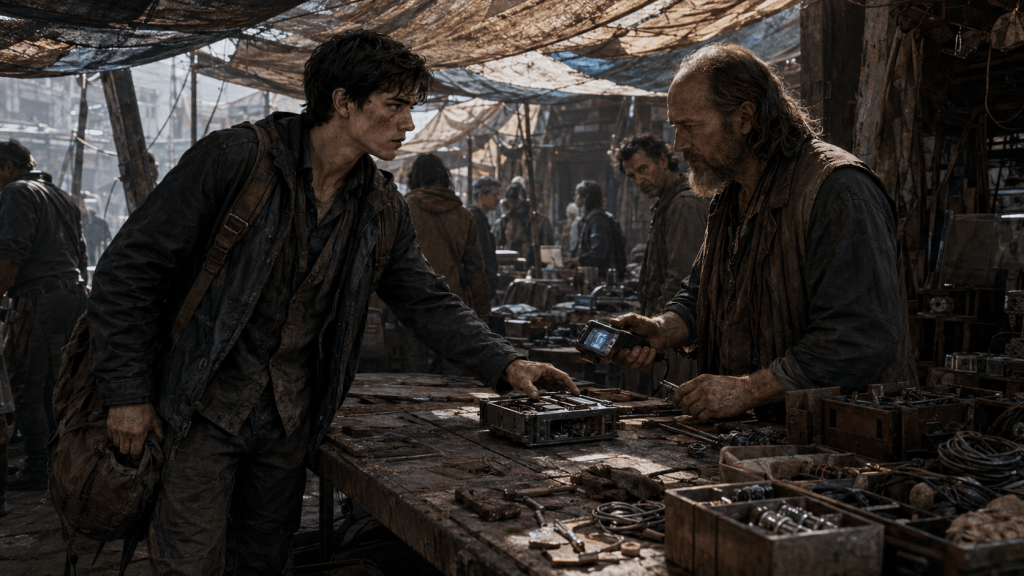
Salvage also supported a local economy built around tokens, uncertain prices, and guarded information. At Merrow’s trade station, stripped wiring sat beside cracked housings, wrapped glass tubes, worn tools, and components whose value depended upon function more than appearance. A clean assembly drew interest because cleanliness suggested rarity, while rarity changed the behaviour of everyone close enough to see it. Negotiation became part valuation, part concealment, with both trader and scavenger aware that curiosity could carry its own cost.

Merrow understood the social pressure surrounding valuable material. His stall offered Aeloria a familiar place to trade, yet familiarity never removed calculation from the exchange. A damaged seam lowered the offered price, an intact internal assembly raised it again, and a prolonged argument risked revealing how much the object mattered. In this part of the fractured world, economic survival depended upon reading faces as carefully as machinery.


Advanced Human Technology at the Edge of Order
The degradation of Zone Thirteen never makes humanity primitive. Its roads, pylons, scanning devices, powered tools, surveillance systems, and engineered dwellings reveal a civilisation capable of sophisticated construction and control. The Zone receives the remains of that capability in uneven condition, which creates a sharper tension than complete technological collapse could provide. People live close enough to advanced systems to understand their practical use, while access to dependable infrastructure remains limited by geography, neglect, and power.

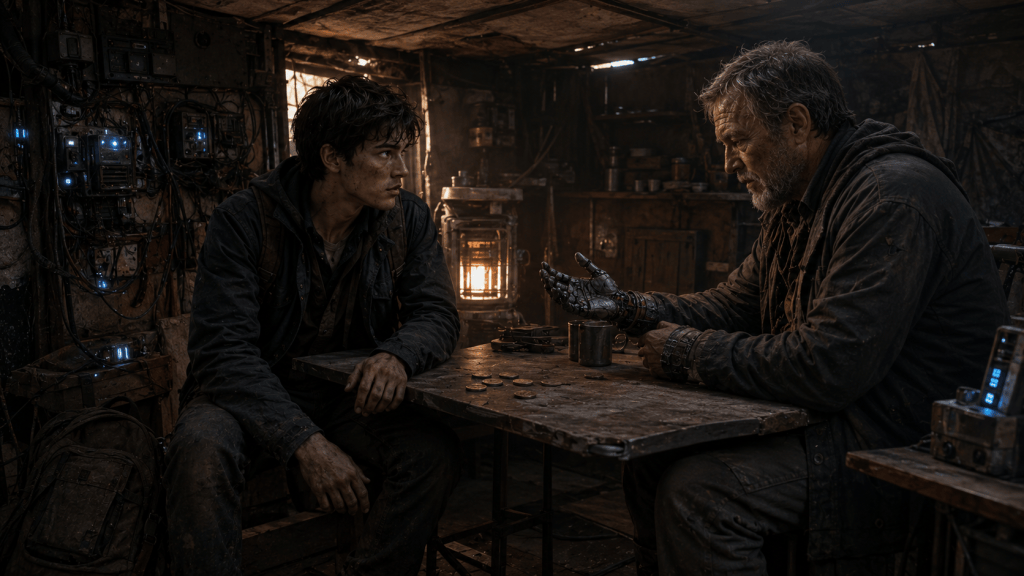
Larn’s shack shows this tension at its most intimate. Sections of the floor carry visible replacement lines, the roof consists of layered repairs, and old parts fill the room in ordered groups. Along one wall, salvaged units have been integrated into a working system through a lattice of cables and small crystal nodes, allowing heat and power to move through components that were never designed to serve together. The result feels improvised and sophisticated in equal measure, shaped by knowledge accumulated through necessity.

Larn himself carries the same relationship between body and machinery. His ageing mechanical hand continues to function through care, adjustment, and an acceptance that every repair has limits. Tokens earned through Aeloria’s scavenging may become food, a filter frame, a pack strap, or another attempt to keep that hand working. Technology remains personal here because its condition enters the body, the home, and the decisions made around a worn table.

This approach allows fantasy with advanced technology to remain materially grounded. Machines possess weight, heat, seals, damaged relays, delayed responses, and repair histories. Crystal-powered technology belongs beside those physical realities, serving ordinary needs before its deeper possibilities emerge. The world gains its science fantasy identity through the way machinery and crystal systems share the same lived environment, each carrying layers of knowledge beyond the reach of the people currently using them.


When Familiar Systems Begin to Behave Differently
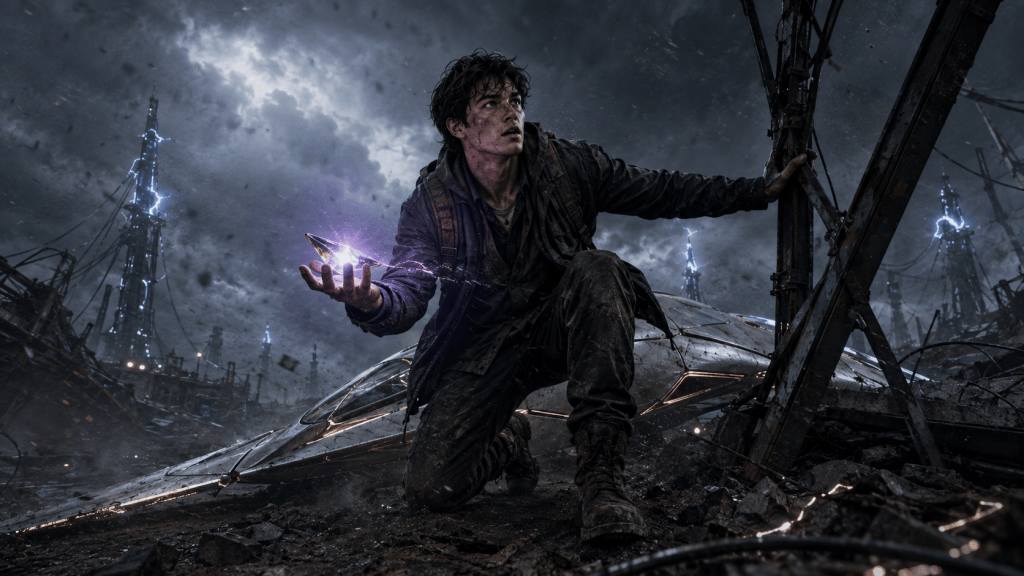
Aeloria’s ability to recognise danger depended upon knowing how the Zone usually behaved. Pylons hummed irregularly, old metal carried vibration, structures settled, and the ground shifted where buried spaces had weakened. These conditions belonged to familiar risk. The true disturbance began when familiar failures changed their pattern, allowing a hum to fall out of alignment, a surface to answer a fraction too late, or a distant pylon to flare where no working connection should have carried power.

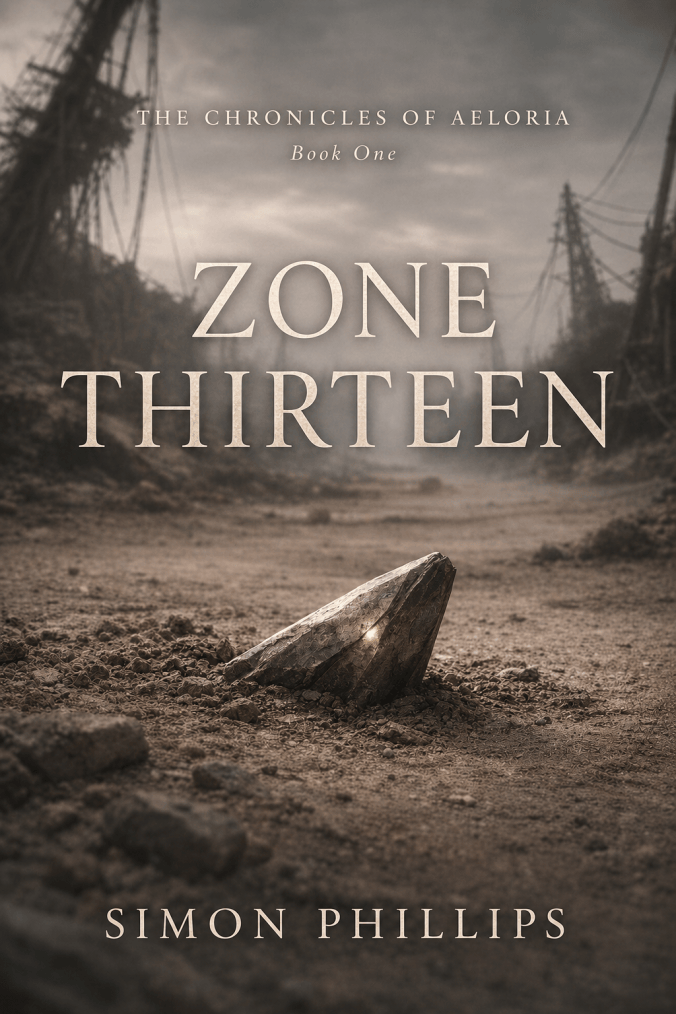
This is where the story’s crystal technology gains weight. Aeloria encounters the impossible through differences in systems he already understands, which means wonder arrives through recognition before explanation. The fallen glider appears too clean for its surroundings, with precise panels, deliberate curves, and an intact structure that holds steady while the ground around it slips. The shard within carries the same unsettling precision, placing an object beyond known human salvage into the hand of someone trained to judge value through touch.

His first contact with the shard offers no easy mastery. Heat moves through his palm, buried systems respond, and dormant pylons awaken across distances their damaged network should never bridge. The crystal’s resonance reaches through body, machinery, and environment as one connected event, turning an act of salvage into a signal that extends far beyond the Zone. Aeloria survives the response before he gains any language capable of containing it.

The strength of this moment grows from everything that came earlier. A boy who has spent years opening casings, testing conduits, and listening to the condition of old systems knows when machinery has crossed into unfamiliar behaviour. He carries no scholarly theory of crystal resonance, though his body recognises the change as pressure, resistance, heat, and altered balance. Myth and technology meet through lived consequence, preserving mystery while keeping the experience physically clear.


The Human Cost of Living Through Repair

Salvage culture keeps Zone Thirteen alive, yet it also reveals how completely the settlement has been left to manage its own decline. Repairs preserve heat, shelter, movement, and trade while offering little sense of lasting improvement. Each successful recovery buys time for a household or replaces one failing part, and the wider infrastructure continues to lean, split, and lose function around the people depending upon it. Survival becomes an ongoing negotiation with systems already moving towards another failure.

That pressure shapes relationships as deeply as it shapes buildings. Aeloria and Larn speak through practical concerns because practical concerns carry affection inside the shack. The state of Larn’s hand, the price of a filter, the number of tokens on the table, and the condition of Aeloria’s pack strap express the care they rarely state directly. Their home endures through attention, shared labour, and an understanding that every small choice affects how long the other person can continue.

The wider community carries its own forms of connection. Traders remember families, warnings pass beneath casual speech, and familiar exchanges provide brief stability inside watched spaces. Scarcity can sharpen suspicion, yet it also creates networks of recognition among people who understand the same limits. Zone Thirteen feels inhabited because its residents have routines, judgements, skills, and loyalties that extend beyond the damaged landscape surrounding them.


Why Zone Thirteen Matters to The Chronicles of Aeloria
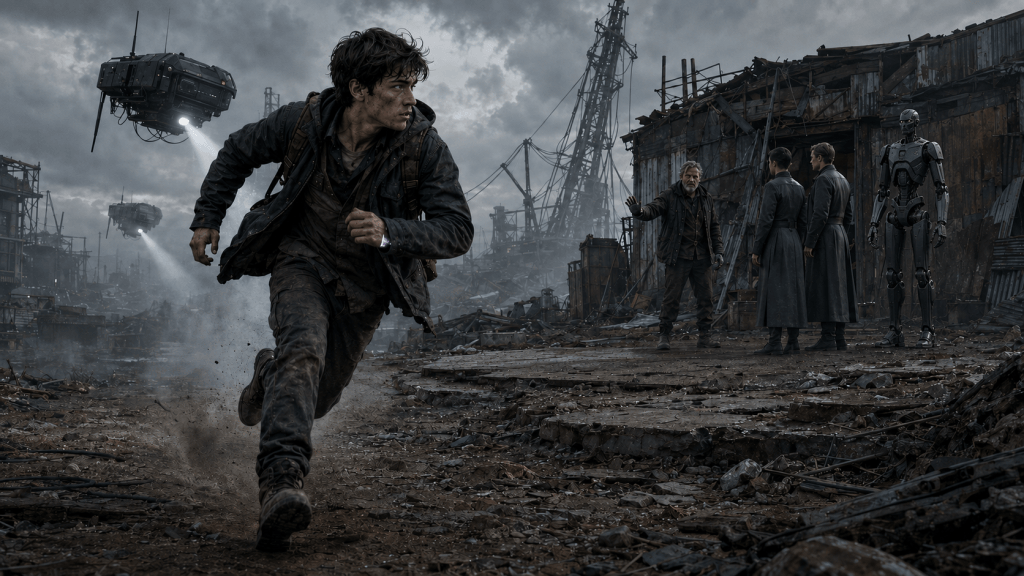
Zone Thirteen, Book One of The Chronicles of Aeloria, begins with a scavenger whose greatest ability appears to be remaining useful while escaping notice. Aeloria possesses no public importance within his settlement, and his ambitions remain tied to food, repairs, safe routes, and the person waiting for him at home. The story allows that ordinary pressure to settle fully before crystal resonance widens the scale of his life.

His scavenger experience gives the larger mythic science fantasy story a human foundation. Aeloria approaches strange systems through observation before theory, and he judges power by what it changes around him. A crystal reaction matters because pylons awaken, ground loses alignment, machines begin searching, and the safety of home collapses under outside attention. The world grows larger through consequences that reach the life already established on the page.

This foundation also protects the fractured realms from becoming a collection of decorative locations. Zone Thirteen teaches the reader that culture emerges through the way people travel, work, trade, repair, fear, and remember. As the wider world opens, every civilisation will carry its own relationship with crystal systems, technology, inheritance, and separation. Aeloria enters that pressure with habits learned among broken roads and stripped machines, carrying the knowledge of a place accustomed to surviving with incomplete answers.


What Broken Technology Preserves

Salvage begins with the belief that failure has left something usable behind. In Zone Thirteen, that belief keeps homes warm, machinery active, trade moving, and people connected to a human civilisation whose stability has passed them by. It also mirrors the deeper condition of the world, where current cultures continue to live through systems inherited from an older order whose full purpose has slipped beyond memory.

The danger begins when those systems cease behaving like passive remains. A dormant connection may still carry power, an abandoned structure may retain a purpose, and a crystal may respond to a person whom every visible authority has learned to overlook. Zone Thirteen gives those possibilities material weight through dust, tokens, patched walls, worn mechanisms, and the careful hands of a scavenger measuring what the day has left him.

The world of The Chronicles of Aeloria grows from that meeting between survival and inheritance. Technology carries memory through continued use, crystals carry forces that resist easy classification, and forgotten structures retain connections across fractures that present civilisations only partly understand. Before Aeloria can face any larger meaning, he must survive the moment when the broken world around him begins to answer again, and the skills that once kept him unseen become the only means he has of recognising how much has changed.
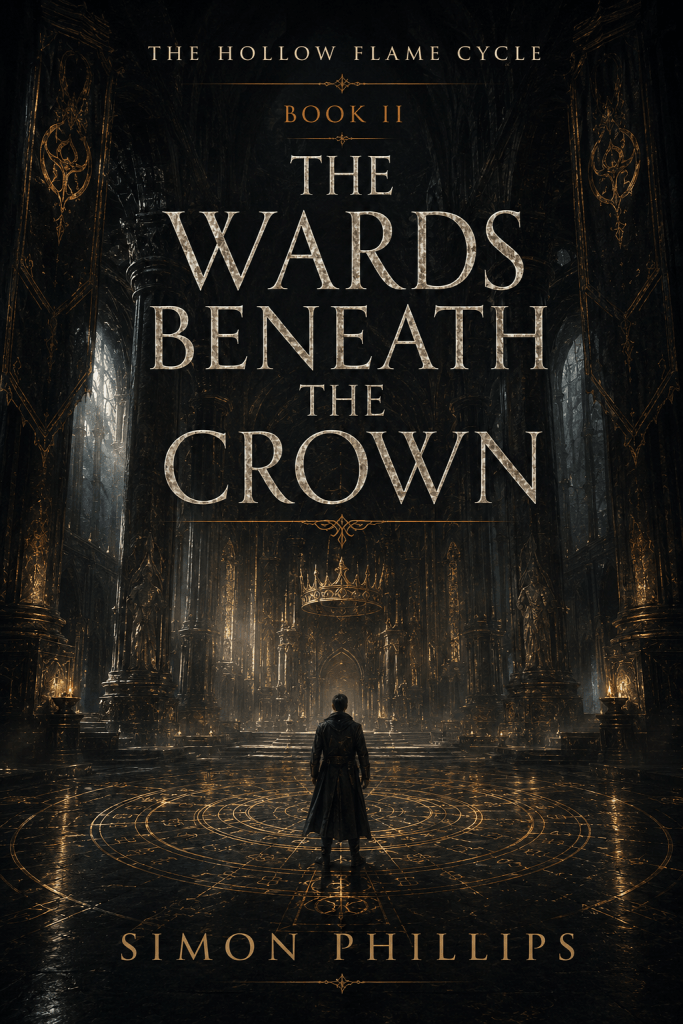
The Wards Beneath the Crown: Slow-Burn Epic Fantasy of Living Wards, Royal Power and a Realm That Refuses Its Stranger

Silas Thorn has already crossed through an ancient book and awakened inside the secured foundations of a royal palace. By the following morning, the impossible has acquired a locked door, a permanent guard, an official record, and a carefully chosen vocabulary designed to make captivity sound like protection.

The Wards Beneath the Crown, Book Two of The Hollow Flame Cycle, continues directly from The Unclassified. The first book carried a London manuscript conservator through an unidentified volume and into the heart of a hidden magical realm. Book Two follows the consequences as the Crown attempts to contain what it cannot explain, the Guild begins measuring disturbances it may already recognise, and the palace itself responds to Silas with increasing intensity.

This is slow-burn epic fantasy shaped through royal intrigue, living magical architecture, institutional conflict, ancient records, guarded relationships, and a displaced man who still wants only to know whether his father remains alive beyond the Veil.

The danger arrives quietly. Lamps brighten around handwritten questions. Ink acquires impossible depth. Buried routes remember that they once existed. A beautiful royal estate is prepared before its future resident has been asked whether he wishes to enter it.

Silas has been promised protection, yet every attempt to find his way home gives the realm another reason to fear him.


A Beautiful Chamber Becomes a Civilised Prison

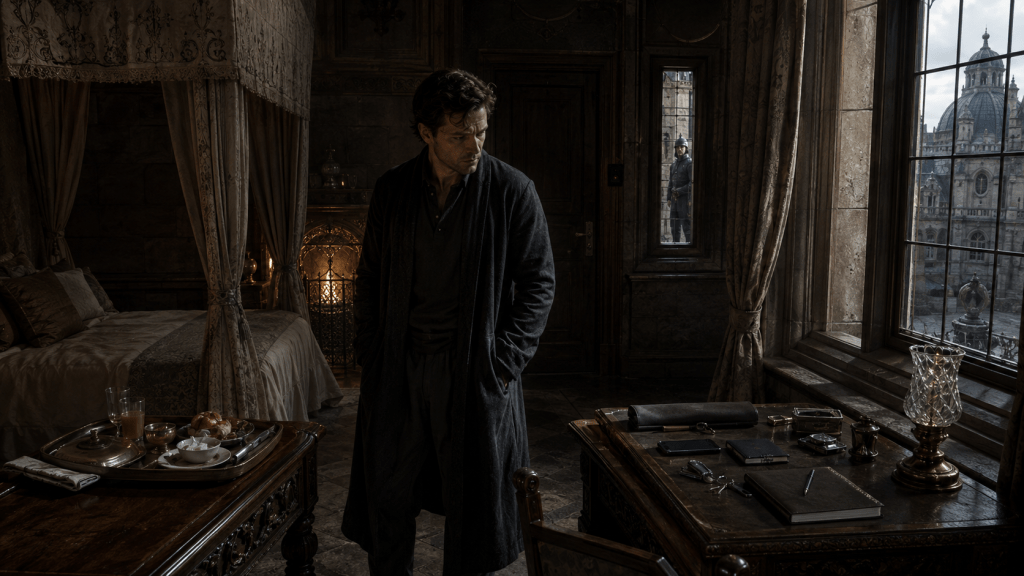
Silas awakens in the eastern guest wing of the royal palace after a night of fractured sleep and unfamiliar sounds.

The chamber contains everything a generous official might present as evidence of humane treatment. Clean linen covers a broad bed. Controlled warmth rests behind a curved hearth screen. Fresh water, prepared food, new clothing, and attentive service await him. Tall windows offer a view across palace courtyards where servants, clerks, guards, and household pages continue their ordinary work.

The door remains locked.

A guard waits outside. Silas’s possessions have been catalogued. The knife placed beside his breakfast has been deliberately dulled, and movement beyond the chamber requires permission, escort, and an approved route.

His professional understanding of conservation makes the contradiction especially sharp. Silas has spent years preserving rare books, protecting fragile objects from careless handling, unstable environments, and further damage. He understands that something may be kept safe while losing every meaningful form of freedom.

The Crown calls him a protected resident. Silas sees a beautiful enclosure whose comfort changes none of its essential purpose.

That tension gives The Wards Beneath the Crown its emotional foundation. The Crown’s concern is genuine. The guards are disciplined. The servant assigned to him, Maren, offers practical kindness and restrained humour. Halren Voss, the Crown liaison responsible for his residence, listens carefully and refuses easy consolation.

Even so, Silas cannot leave.

The story asks a difficult question from its opening pages: when protection cannot be refused, how far does it remain separate from imprisonment?


Silas Thorn Wants Answers More Than Power

Silas remains an unusually human centre for a story filled with royal wards, magical instruments, ancient foundations, and political authority.

He has no wish to become a mage, fulfil a prophecy, conquer a hidden realm, or claim a heroic place within it. His questions remain painfully ordinary:

Is London still there?

Is his father alive?

Does time continue at the same pace beyond the Veil?

What happened to the book?

Can anyone send him home?

Voss answers the final question with the honesty Silas has been dreading. No one can simply return him.

That truth reaches more deeply than the guarded chamber or the royal decree. Until someone states it plainly, Silas can still imagine the crossing as a misplaced road, an accidental doorway waiting to be found again. Once Voss speaks, return becomes an uncertainty that every institution around him may study, delay, or eventually declare impossible.

Silas responds through the skills and habits that shaped his former life. He observes language. He notices how records are phrased. He asks that his own account be preserved in his own handwriting because he understands how testimony becomes cleaner, safer, and less human as it travels through official hands.

He knows that naming determines how an object is handled.

He soon discovers that the same principle applies to people.


London Finds an Echo in Lundenvar

During a supervised orientation, Silas is shown maps of Valebrin, its capital Elyrion, and the wider shape of the realm into which he has fallen.

The hidden magical world is neither a medieval imitation nor a decorative kingdom designed around castles and spellcraft alone. It possesses roads, administrative borders, civic transport, communication systems, illuminated cities, royal offices, military structures, archives, and technologies shaped through magical development.

The map offers Silas his first chance to place himself somewhere measurable.

Instead, it makes the distance from home stranger.

Near the western edge of Valebrin lies Lundenvar, an old threshold city occupying an uneasy correspondence with London. It is no direct equivalent, yet its position carries enough similarity to disturb him. Rain-dark streets, Underground platforms, buses, libraries, his father’s house, and the conservation studio return through association while an unfamiliar place-name sits where his mind expects home.

The connection suggests that Earth and the hidden realm may preserve echoes of one another through geography, history, or the Veil itself.

Silas receives no comfort from the discovery. London has become more than a distant city. It is now a place that may possess a distorted reflection inside another world.

The distance between them can no longer be understood in miles.


The Written Word Refuses to Remain Ordinary

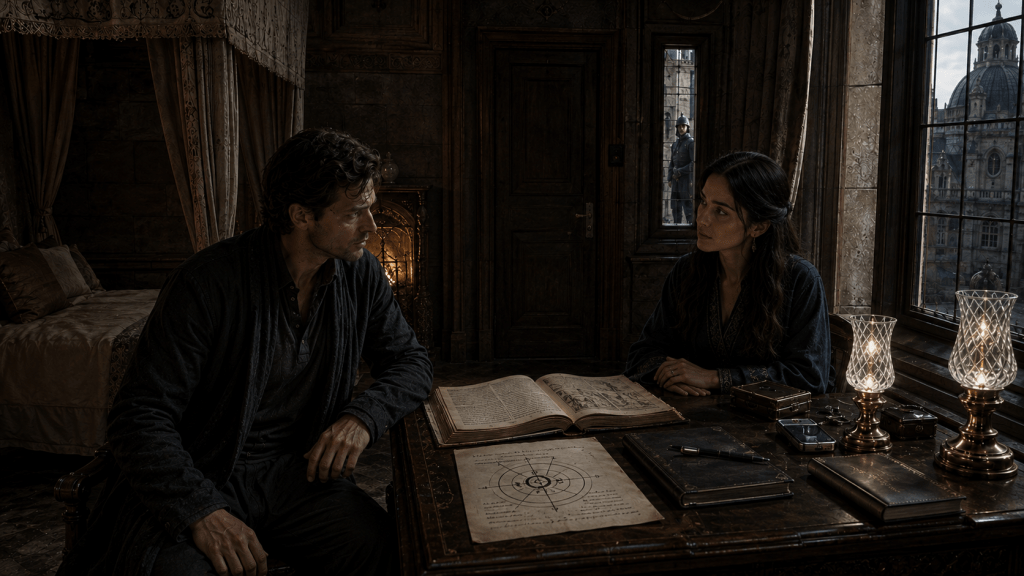
Silas is given paper and ink so that his questions can enter the Crown record.

He writes his name, the last place he remembers, and the matters no official answer has resolved. He asks about his father, the vanished book, the passage of time, the Veil, and the authority deciding what knowledge he may receive.

As he writes, the chamber lamps brighten.

The change is initially slight enough to invite doubt. Silas watches the crystal lights steady themselves and wonders whether fear has made him unreliable. Then the word Veil begins holding the light differently from every other word upon the page.

Its ink acquires the same inward depth he remembers from the ancient book in London.

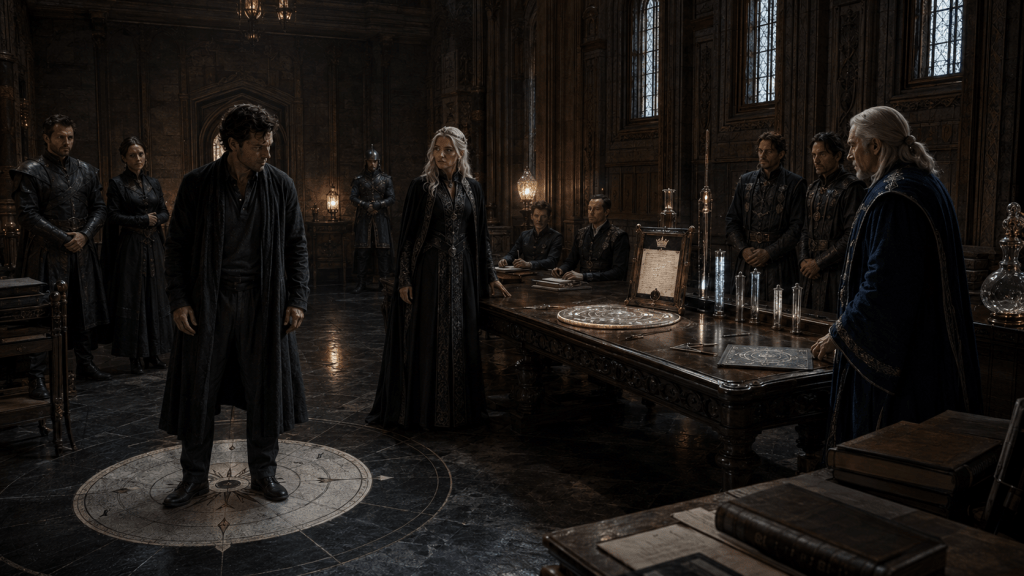
When Silas calls for help, Guard Arven enters first, followed by Voss, Sera Valn, and Warden Cael Orven. Their response reveals how thoroughly magic has been integrated into this civilisation. Instruments are brought. The desk perimeter is measured. Chamber wards are examined. Technical language gathers around the page with unnerving speed.

Silas possesses no recognised casting discipline, visible training marks, declared magical focus, or knowledge of glyph construction. By the realm’s accepted understanding, his handwriting should have no power to alter a chamber ward.

Yet the page produces a second register.

The lamps respond. Passage-related words deepen. Ordinary questions about home become magical evidence.

Silas’s fear changes at that moment. He is no longer frightened solely because he cannot return to London. He is frightened because every attempt to ask for London becomes another reason for Crown and Guild to measure him.


The Crown and Guild Contest the Meaning of a Page

The altered page passes immediately into a political struggle.

The Guild of Mages possesses the expertise required to investigate unusual ward behaviour, crossing phenomena, glyph structures, and the ancient divisions between realms. The Crown possesses physical custody of Silas and responsibility for everything occurring within the palace.

Both institutions have legitimate grounds for involvement.

Neither fully trusts the other.

Lirael Vaerenthis permits the Guild to examine the page under Crown supervision. She refuses its removal to a private Guild chamber, blocks unsupervised copying, requires Crown witnesses, and ensures that the official record remains under royal custody.

The resulting audit is one of the book’s strongest expressions of political fantasy. No armies gather, no throne room erupts into open conflict, and no theatrical spell is cast across the chamber. Power moves through seals, witness rights, terminology, instrument placement, access restrictions, withheld interpretations, and the authority to decide which account becomes official.

High Mage Elarion approaches the event with intelligence and restraint. He refuses to classify Silas prematurely and recognises that the disturbance extends beyond ink. The response appears to move across written language, spoken words, remembered place, ward-lines, and Silas’s presence.

When Silas speaks the word London, the instruments respond.

When he speaks Veil, the reaction strengthens.

A pattern connected to older foundation behaviour briefly appears upon a Guild tablet, and one representative attempts to cover it before Lirael requires its inclusion in the Crown record.

The room discovers enough to become afraid and too little to become certain.


Lirael Vaerenthis Protects the Man Inside the Record

Lirael’s role throughout Book Two is politically demanding because every possible decision contains harm.

She cannot release Silas while the palace responds unpredictably around him. She cannot surrender him to the Guild merely because its mages possess greater technical knowledge. She cannot ignore the risk to servants, guards, clerks, petitioners, and families living within the palace.

She also refuses to allow official language to erase him.

When draft reports begin referring to Silas as a subject, anomaly, or ward-active presence, Lirael orders the language corrected. Within Crown records, he remains Master Thorn.

That choice carries more than courtesy. Lirael understands that technical wording can quietly change responsibility. Once Silas becomes an anomaly, officials may find it easier to isolate him, test him, relocate him, or claim jurisdiction over him. A name keeps his humanity inside the machinery processing his existence.

Her protection still has a coercive edge. She controls access, testimony, movement, and eventual relocation. Silas experiences her as one of the people deciding his life while asking him to trust the care within their restrictions.

Lirael offers him honesty in place of false reassurance. She protects his status as a person while acknowledging that his choices remain limited.

Her danger lies far from cruelty. It lies in the necessary authority she controls and the possibility that sensible governance can still wound the person it intends to preserve.


Seréne Searches the Language History Tried to Erase

Princess Seréne Vaerenthis approaches the disturbance from another direction.

While Crown and Guild examine instruments, Seréne enters the lower record arcade and searches older foundation texts. She studies marginal copies, disputed glossaries, early descriptions of reception, and words that later doctrine has simplified into cleaner administrative categories.

The oldest records describe warded stone in strikingly different terms.

Later scholars write of admission, rejection, intrusion, and instability. Earlier texts speak of presences being met, failing to settle, remaining unplaced, or creating an argument in stone.

Those differences matter.

Modern authority treats wards as systems that obey recognised command. The older language suggests something more responsive, uncertain, and alive. Seréne discovers references to one arrival producing two answers, an unseen answer requiring protection, and a mark that resembles Silas’s memory of the ancient book.

Her investigation shifts the central mystery. The problem may extend beyond what Silas is doing to the palace. The deeper question may concern how the palace, the Veil, or the realm itself is attempting to understand him.

Seréne recognises another danger as well. Crown and Guild are studying the second page, the one Silas wrote inside the guest chamber. Only Silas saw the first page, the ancient page in London whose dark markings opened beneath his hands.

Before official interpretation buries that original account, Seréne decides to hear it from him directly.


Old Books Create the First Ground of Trust

Seréne’s private conversation with Silas provides the book’s most intimate counterweight to institutional pressure.

Silas initially distrusts her. She is another royal daughter, another person connected to the authority holding him, and another visitor whose access has been granted through rank.

Their conversation changes when Seréne asks about the ancient book, his conservation work, and the distinction between repairing an object and preserving what survives.

Silas explains that conservation avoids forcing modern certainty into damaged history. A conservator stabilises evidence, respects alteration, and allows an object to retain the marks of what it has endured.

Seréne understands the principle because her own archival work has shown her how official histories become smoother as difficult meanings are copied away.

Their connection grows through shared intellectual ground rather than immediate romantic declaration. They speak about manuscripts, erased corrections, restricted texts, his father, his phone, the vanished book, and the danger of allowing institutions to replace a person’s first account with a cleaner summary.

Seréne treats Silas as someone who arrived with a profession, a family, memories, and a complete life beyond the palace.

That recognition matters enough for Silas to ask her to remain when Lirael enters.

Later, when he learns that he must be moved from the palace, he asks for Seréne to travel in his carriage because she has spoken to him as though his previous life still counts.

The request marks an important change. Silas still possesses little freedom, yet he has begun asserting whom he trusts within its limits.


The Palace Remembers a Buried Road

The disturbance refuses to remain inside the audit room.

As Silas returns towards his chamber, lamps dim in sequence along the gallery. Floor markers divide into conflicting routes. A sealed service passage beneath the visible corridor registers as available even though it has remained closed since an earlier reign.

The palace is no longer reacting only to a page or spoken word.

Its architecture has begun remembering.

This escalation transforms the palace from setting into participant. Its ancient wards, buried routes, foundation layers, and accumulated authority respond to Silas as though attempting to place him inside systems whose original instructions have been partly forgotten.

Elarion warns that each event has reached farther than the one before it. The disturbance began with page and lamp, moved into voice and measuring instruments, then spread into corridors and sealed structures.

He offers the Crown a deeply unsettling interpretation: the realm appears unable to decide whether to receive Silas, reject him, or answer through him.

The palace has become too old, too layered, and too closely bound to royal authority to hold him safely.

The Crown must move him.


Alderwick House Offers Space Inside Another Boundary

Alderwick House lies east of Elyrion, beyond the densest palace foundations and beneath a newer outer ward.

The Crown presents the estate as a safer residence with larger rooms, gardens, library access, fresh air, and distance from the reactive systems beneath the palace. Silas hears the truth beneath the amenities immediately.

It is another enclosure.

When he asks whether he can refuse, Lirael answers with painful clarity. He can object. His objection can enter the record. He cannot remain in the palace.

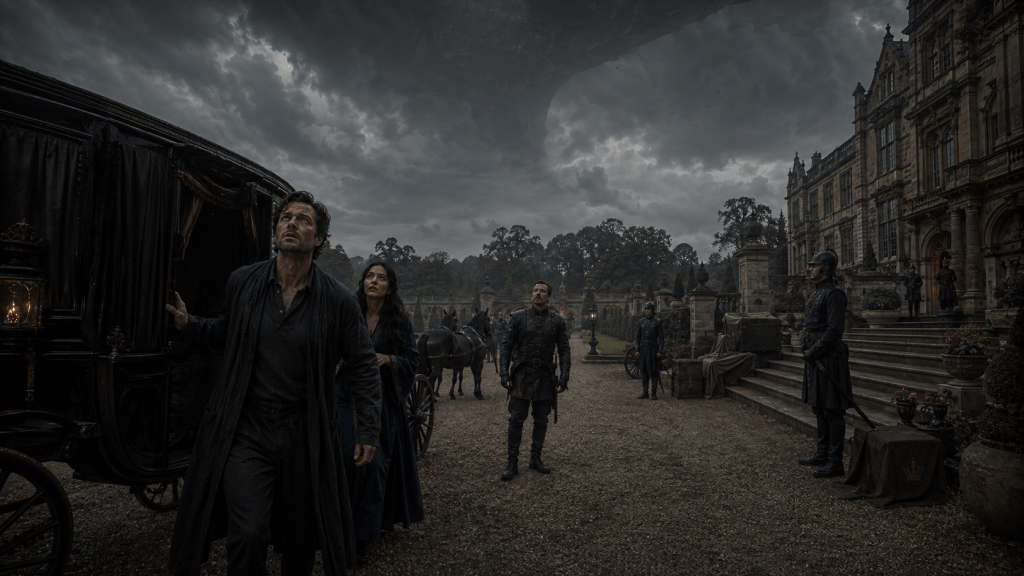
The early-morning carriage journey finally carries Silas beyond Crown corridors and gives him partial glimpses of the hidden realm’s roads, bridges, vehicles, settlements, and magical infrastructure. Curtains restrict his view, guards manage the route, and unexplained shadows pass high above the road.

Inside the carriage, Silas and Seréne compare their worlds through ordinary details. He describes buses, cars, trains, moving stairs, and mobile phones. She answers with guided platforms, line-stone routes, magical vehicles, and systems shaped through an entirely different history.

Their exchange reveals the scale of the world more effectively than an explanation could accomplish. Silas begins recognising that he has entered a functioning civilisation whose people find Earth as strange as he finds them.

When the carriage crosses Alderwick’s outer ward, Seréne and Arven pass through cleanly.

Silas does not.

The estate waits beyond the boundary, beautiful and guarded, with Crown officers, ward-stones, restricted shutters, and Guild-marked equipment already prepared. Then Silas steps from the carriage, looks beyond the roofline, and sees something above the ridge that changes the scale of everything he thought he understood.

The book closes before the sight is fully named.


Slow-Burn Fantasy Where Institutions Become the Source of Tension

The Wards Beneath the Crown will appeal especially to readers who enjoy political fantasy, hidden magical realms, portal fantasy, ancient manuscripts, royal intrigue, living architecture, institutional mysteries, gradual worldbuilding, and character-driven stories where consequences matter more than effortless spectacle.

The book’s tension grows through rooms, language, lamps, pages, maps, ward-lines, archives, sealed evidence, and guarded roads. Its characters behave intelligently, even when their competing responsibilities place them in conflict.

The Crown genuinely wishes to prevent harm.

The Guild genuinely needs to understand the disturbance.

Lirael genuinely protects Silas while restricting him.

Seréne genuinely seeks truth while approaching areas her sister has placed under control.

Silas genuinely wants home, even as the hidden realm begins answering him in ways that suggest his arrival carries meaning beyond accident.

No institution becomes foolish merely so the story can move. The danger emerges because intelligent people possess incomplete knowledge and enough authority to act upon it.

That combination makes every careful decision consequential.


Continue The Hollow Flame Cycle with The Wards Beneath the Crown

Book Two carries the crossing beyond its first shock and into the systems attempting to contain its consequences.

Silas Thorn remains far from home, watched by the Crown, examined by the Guild, and surrounded by warded structures that appear increasingly uncertain about his presence. Lirael must protect a kingdom and a man whose needs no longer align cleanly. Seréne has begun uncovering older language that may explain why the realm’s foundations answer differently from modern doctrine.

The palace has released Silas because it can no longer hold him safely.

Alderwick House has received him imperfectly.

Something impossible is waiting in the sky.

Readers who have completed The Unclassified can continue Silas Thorn’s journey in The Wards Beneath the Crown, Book Two of The Hollow Flame Cycle.

Elana’s Hidden Magic in The Unmarked Path

A Princess Standing at the Edge of Power

In The Unmarked Path, Elana enters the story as a princess shaped by duty, family expectation, and the cold machinery of royal alliance. She is not introduced as a warrior, a ruler, or a magician. She stands beside the burdens of others, close enough to see what they hide, yet bound by a role that expects silence, obedience, and grace.

That is what makes her so important.

Elana begins in Bremyra as Prince Patrick’s sister, a sharp and thoughtful presence within a court already strained by absence. King Cedric is gone. Patrick’s brothers are gone. The kingdom continues to function, but the foundations beneath it feel uncertain. Elana understands this more clearly than most. She sees Patrick’s exhaustion, his isolation, and the pressure gathering around him before the wider court fully recognises it.

She is preparing to leave for Vaeldring and an arranged marriage, yet she is not written as a passive royal figure being moved from one kingdom to another. Her duty is real, but so is her mind. Her compassion is real, but so is her judgement. Elana carries warmth, intelligence, and restraint, and those qualities make her one of the quietest forces in the opening movement of the story.


The Bond Between Elana and Patrick

Elana’s relationship with Patrick gives the reader a softer entry into the political weight of Bremyra. Patrick is acting in his father’s place, but he is not yet settled inside authority. He works through petitions, letters, border concerns, marriage arrangements, and the silence left by his missing family. Elana is one of the few people who can speak to him without ceremony.

Their conversations show the human cost of royal duty. Patrick must think like a ruler before he is ready to become one. Elana must leave her home because marriage is part of the kingdom’s strategy. Neither of them is free, yet they still try to comfort one another within the limits their world allows.

This matters because The Unmarked Path is not only about magic and ancient danger. It is about institutions pressing down on people before they understand the shape of the storm around them. Elana’s presence beside Patrick reveals the emotional life beneath the politics. She reminds the reader that kingdoms are not held together by banners and titles alone. They are held together by people trying not to break under the weight of what is expected from them.


The Return of Simion

Elana’s importance deepens when Simion returns to Bremyra.

To the court, Simion is a magician of the Order, a figure of authority and unease. To the Church, he is a threat. To Patrick, he is both a possible ally and a mystery. Yet to Elana, he is also a memory.

She remembers him from childhood, before black robes and formal titles stood between them. She remembers the boy from the kitchens, the fireflies, the warmth of a life that no longer exists. That recognition cuts through the distance Simion tries to maintain. For a moment, he is not only Lord Magician. He is someone who once belonged to the halls of Bremyra in a far more human way.

This is one of Elana’s strengths. She sees through the surface of people. She sees Patrick’s burden. She sees Simion’s guarded sorrow. She sees that something weighs on him even when he tries to hide it behind silence.

Her questions are gentle, but they are not weak. She does not force the truth from him, yet she lets him know she has noticed. In a world of court suspicion, Church authority, and Order secrecy, Elana’s insight feels dangerous precisely because it is so human.


More Than a Royal Daughter

Elana’s arranged marriage to Vaeldring could easily make her seem like a political piece. The story refuses to leave her there.

She is part of Bremyra’s diplomacy, but she is not defined by diplomacy. She is Patrick’s sister, but not only Patrick’s sister. She is linked to Simion’s past, but not only through memory. Her role grows through small moments of perception before it becomes something impossible to ignore.

When Elana leaves Bremyra, the road itself becomes a threshold. The journey that should carry her towards marriage instead carries her into violence. Her escort is attacked. The carriage is destroyed. Guards fall. The world that expected her to travel quietly between kingdoms is suddenly stripped of its formal order.

That is when the hidden truth within Elana begins to surface.


The Road, the Poison, and the Golden Light

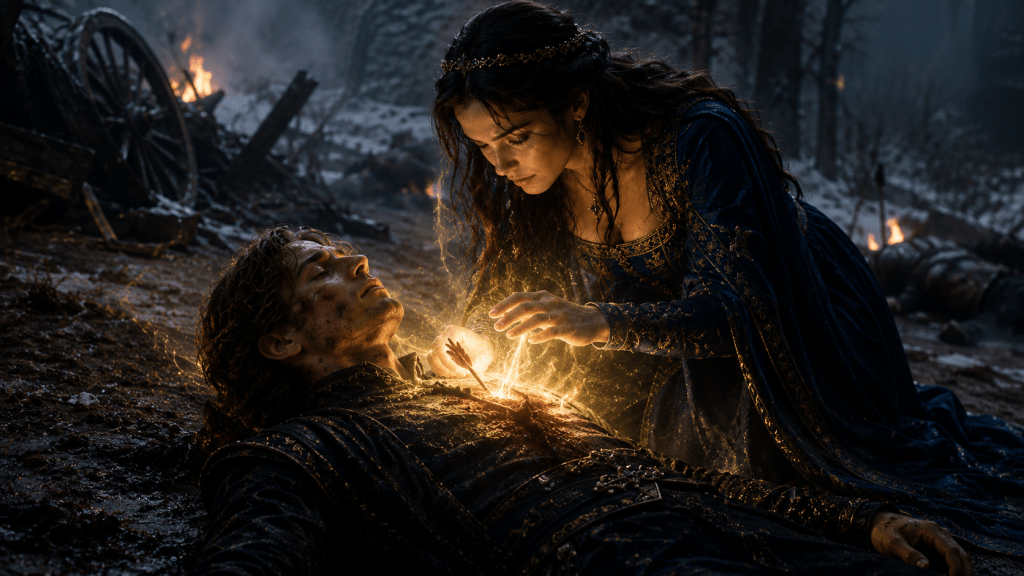
Simion reaches Elana after the ambush and destroys the attackers, but victory does not save him. A poisoned arrow has already struck him. The danger becomes intimate and immediate. This is not a distant battle or a council debate. It is Elana kneeling beside him on scorched earth, watching death move through his body.

What follows is one of the most important moments in Book 1.

Elana does not call for someone else to save him. She does not collapse into helplessness. She acts. Golden healing light answers her fear, her will, and her refusal to let him die.

The scene matters because it changes what the reader understands about Elana. Until this point, her strength has been emotional, political, and perceptive. In this moment, that strength becomes magical. The story does not pause to explain everything. It does not flatten the mystery into a rulebook. It simply shows that something powerful has been living beneath the surface of a princess the world underestimated.

Elana’s magic is not presented as spectacle. It is urgent, costly, and deeply personal. It rises because someone she cares for is dying in front of her, and she refuses to accept that outcome.


What the World Failed to Notice

By the end of The Unmarked Path, Elana has become far more than she first appeared to be. She has supported Patrick in a court shaped by uncertainty. She has recognised the humanity still buried inside Simion. She has walked towards a political future she did not choose. She has survived violence on the road. Most importantly, she has revealed a hidden power that the world around her had not seen.

That is the heart of Elana’s role in Book 1.

She is not explained. She is revealed.

Her story draws readers into one of the central tensions of The Veil of Kings and Gods: power is often present before anyone understands it. Magic does not always arrive through titles, institutions, or formal permission. Sometimes it appears in a moment of fear, love, and refusal. Sometimes the person who changes everything is the one others thought they had already understood.


Watch the Elana Lore Short

I have also created a short lore video exploring Elana’s hidden magic and her role in The Unmarked Path. Rather than retelling the entire story, it introduces one of Book One’s most intriguing characters and the quiet mystery surrounding her. From her life as a princess bound by duty to the unexpected awakening of her healing magic, the video offers a glimpse into the emotional and mythic foundations of her journey without revealing the wider story.

Whether you have already begun reading The Veil of Kings and Gods or are discovering the world of Ældorra for the first time, it serves as a short introduction to the atmosphere, characters, and hidden threads that shape the opening of the series.


Read The Unmarked Path

The Unmarked Path opens the world of The Veil of Kings and Gods, a high fantasy story of forbidden magic, royal pressure, ancient divine history, political unrest, and the first stirrings of a power long buried beneath Ældorra.

Within its opening pages, a magician returns to a kingdom that fears his Order, a prince struggles beneath the weight of a throne he was never meant to inherit, a northern war leader crosses the sea under a shadowed cause, and a princess begins to reveal a power the world has not yet noticed.

If you enjoy character-driven epic fantasy, hidden magic, ancient gods, royal intrigue, dangerous journeys, and slow-burning mythic tension, this is where the path begins.

What I’m Polishing Right Now And Why It Matters

I’ve reached Chapter 36 in the proofreading and editing phase of The Veil of Kings and Gods, and the pattern has become clear: this is no longer about fixing mistakes. It’s about tone. Rhythm. Weight. The spaces between words.

When I began this second draft, I thought I’d be reshaping large sections, reordering scenes, reworking arcs, perhaps cutting full paragraphs. And in truth, some chapters needed that. Yet here, in the later stages, the work has become quieter. More precise. Less like carving, more like tuning.

I’m refining sentence flow. Ensuring no paragraph ends with a stumble. Trimming where the language slows the momentum or where an image tries too hard to impress. Dialogue has taken centre stage again too. In Simion’s chapters especially, I’ve been paying attention to how he thinks, how he observes. His voice must remain grounded, measured, introspective, often solemn, but never flat. He is not a man who wastes words. So neither should I.

There’s also the matter of emotional pacing. Certain scenes strike harder now than they did in the first draft, and I’ve begun to see where quiet moments need to linger longer, or where a single line can carry the echo of something far greater if allowed room to breathe. Chapter 36, for instance, held a moment that was previously brushed over, just a line or two. This time, I let it unfold. Let it weigh down the silence.

None of these changes are structural. You won’t find a new character or a rewritten ending here. What’s happening is deeper: it’s the voice of the book aligning with its soul. And I know I’m close. There’s something sacred about this part of the process, where the raw story becomes refined enough to stand on its own, without commentary or apology.

So, that’s where I am. Nearing the final arc. Reading aloud. Listening for false notes. Letting the book breathe.

Thank you for walking alongside me.

Writing The Veil of Kings and Gods: Where the Story Began

There was no single spark. The story came slowly, like a breath remembered from long ago, or a half-formed thought whispered through stone. A world shaped by old powers. A realm where kings fear magic, and magicians serve at the edge of thrones.

In the beginning, there was only a boy. He worked the castle kitchens in Bremyra, sweeping floors and scrubbing pans beneath the gaze of guards who barely noticed him. One day, something stirred. It broke through him, unseen, instinctive, and changed the course of his life. The Order of Magicians arrived, and the boy was taken.

He did not shine. While others rose through the ranks with ease, he struggled. There were no accolades, no whispered praises in candlelit halls. His tutors pushed him hard, and he endured. The hours were long. The silence longer. He studied while others excelled, remembered spells long after others had passed their trials.

In time, he left the Academy. There were no citadels calling his name. No grand appointments. His master in the Council intervened, and so he returned, back to the same castle where he once carried bread and carved meat. This time, he came as Advisor. The halls had changed. The faces had not.

That was where the story found its voice.

The world around him unfolded slowly. Whispered tensions in the council chamber. Glances that carried more weight than words. A kingdom balanced on memory and suspicion. Within those stone walls, something deeper began to stir, an echo, perhaps, or a remnant of something long buried.

As I wrote, I did not seek grand battles or sweeping prophecy. I sought something quieter. A man who carried more than others saw. A world that remembered what others had forgotten. Magic that did not burn with spectacle, but pulsed through the earth like a second heartbeat.

The Veil, once unseen, began to lift.

What lies beyond that veil remains hidden, for now. This story, like the world it inhabits, is still becoming. Yet its heart remains the same: a kitchen boy, a crown too close, and a voice that waits beneath the silence.