Time Strip: Before the Fall: Psychological Time-Travel Science Fiction Where the Future Has Already Decided
Caelen Marris begins his morning inside a future that appears to have solved the ordinary discomforts of human life.
His apartment regulates its own temperature. The city manages traffic before congestion can form. Elevated trains move through London with barely a tremor, personal artificial intelligences accompany people through their daily routines, and public infrastructure quietly adjusts itself around every passing body. Caelen’s own bonded AI, Silin, wakes him gently, monitors his health and guides him towards work with the intimacy of a presence that has been beside him for years.
Nothing about this world initially resembles a ruined civilisation or an obvious dystopia. It is clean, advanced, orderly and almost kind. That apparent kindness is what makes the pressure beneath it so difficult to recognise.
Time Strip: Before the Fall is the opening book in the Time Strip series, a work of psychological time-travel science fiction centred on bodily perception, artificial intelligence, institutional control and the dangerous belief that history can be contained. It follows Caelen through one apparently ordinary working day as the structures supporting his life begin to reveal a second purpose.
The city still functions. The systems still respond. The people around him continue working, travelling, talking and making plans. Yet the routes available to Caelen begin to narrow, and the institutions that have monitored his unusual connection to time are preparing to use it.
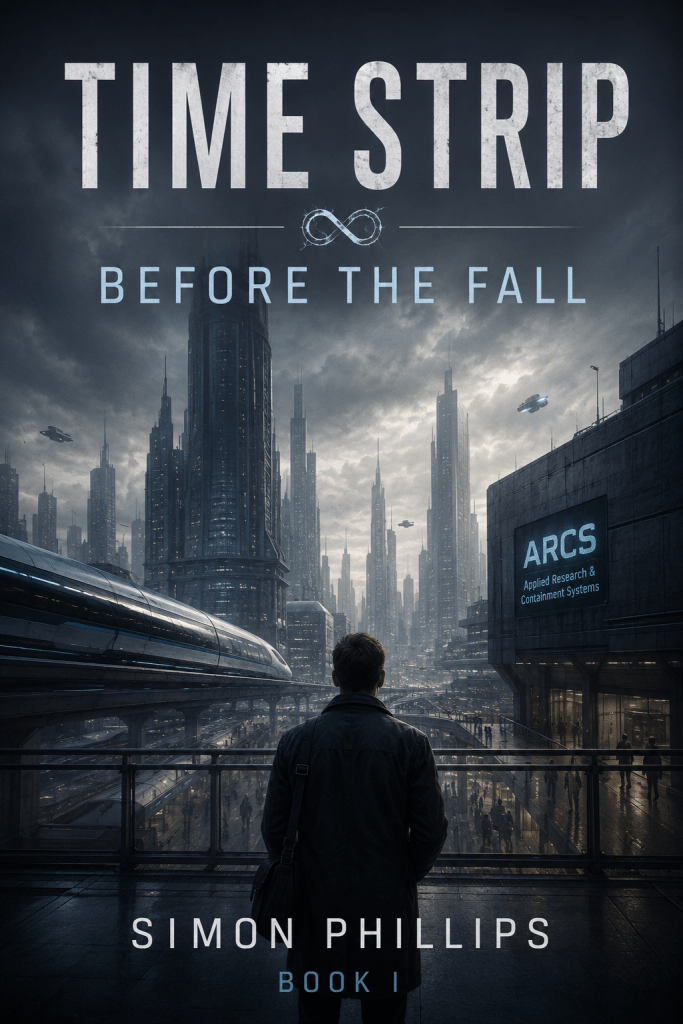
A Future That Feels Almost Kind
The future London of Before the Fall is not presented through distant explanation or technical spectacle. It is experienced through movement.
Caelen watches old stone, glass towers and elevated transport lines pass beyond his apartment window. He joins the morning flow of commuters. Pavement textures guide pedestrians towards efficient routes, transit systems recognise destinations and buildings prepare themselves before people arrive. Technology is embedded so deeply into ordinary life that it rarely needs to announce itself.
This is a future built around removing friction. Clothing adjusts to the wearer. Rooms regulate air and light. Security systems recognise authorised movement. Personal AIs assist with schedules, health, navigation and communication. The result is a society that feels calm because inconvenience has been anticipated and corrected before it can become disruptive.
Caelen is comfortable within that order. He arrives early because he likes having time around him. He notices small things, including the movement of trains, the pressure of a lift descending and the changing texture beneath his shoes. His sensitivity initially seems like part of his personality: a quiet attentiveness to systems, timing and physical space.
Gradually, the same infrastructure begins to feel different.
Helpful route guidance becomes an expectation. Security becomes more visible. New scanning arches appear. Corridors that once allowed ordinary movement begin directing staff along restricted paths. The language remains calm and professional throughout. Every change is described as procedural, temporary or necessary for safety.
The city has not become more violent. Caelen has simply moved far enough inside its systems to see what their kindness depends upon.
Caelen Marris Notices What the Systems Cannot
Caelen is a scientist and temporal specialist working within ARCS, an institution involved in temporal research, containment and controlled experimentation. He understands calibration data, corridor interfaces and the behaviour of the Time Strip. His professional life is built around precision.
His most important ability, however, cannot be reduced to an ordinary reading.
Caelen’s body notices temporal pressure before the instruments around him fully acknowledge it. His breathing changes. His footing adjusts by small degrees. His jaw tightens near active systems. A pressure settles behind his eyes. He senses timing irregularities and spatial resistance that disappear when isolated or repeated under controlled conditions.
These responses are easy to dismiss individually. Caelen often does exactly that. He has learned to compensate, continue working and describe himself as fine. His colleagues Mara and Jonah are less convinced.
Mara recognises the signs of physical strain and understands the dangers of describing an anomaly too clearly inside an institution that controls the language of acceptable research. Jonah approaches the same unease from a more human direction. He wonders whether the Time Strip behaves differently when someone is paying attention to it.
The possibility remains uncomfortable because the Strip is supposed to be a system. Systems can malfunction, drift or produce noise. They should not appear to recognise the people observing them.
Caelen’s value lies in the gap between those two possibilities. He can feel something the machines cannot reliably model, and ARCS has been watching the relationship between his body and the Strip far more closely than he understands.
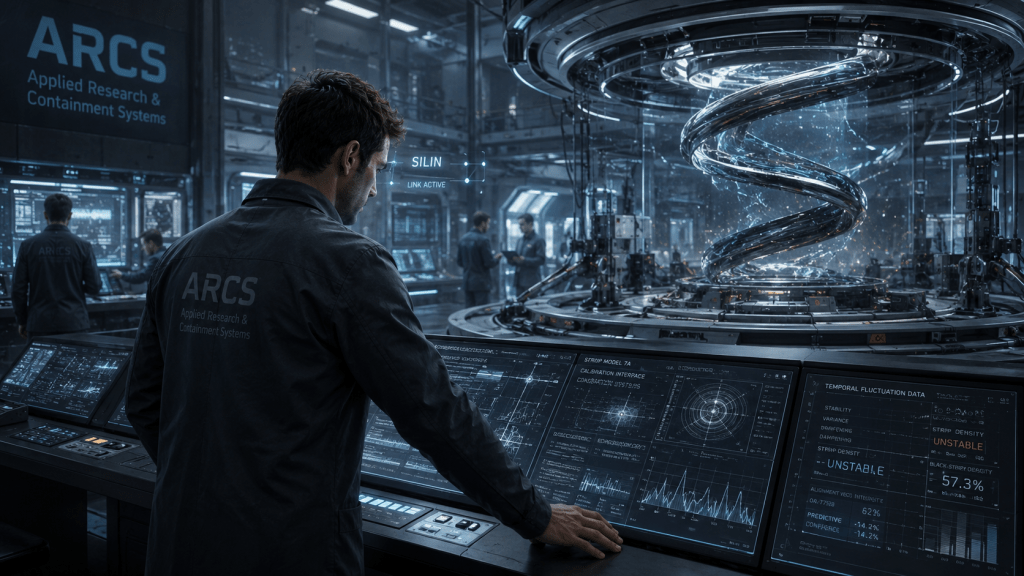
Silin Makes Artificial Intelligence Personal
Silin is not a robot standing beside Caelen, a holographic woman or a convenient voice delivering explanations. She is a bonded AI woven into the practical experience of his life.
She wakes him without startling him. She monitors physical changes he might otherwise ignore. She recognises adjustments in his gait, reduces unnecessary information when he becomes overwhelmed and understands when conversation would help or become intrusive. Her presence is constant enough that Caelen rarely needs to think about the amount of support she provides.
That normality gives the relationship its emotional weight.
Artificial intelligence in Before the Fall is neither treated as an automatic threat nor presented as a magical solution to every human problem. Silin has access, restrictions and institutional limits. She can interpret information, offer support and help Caelen maintain his physical balance, yet she remains subject to authorities capable of narrowing or suppressing her connection.
As Caelen is moved deeper into restricted sections of ARCS, Silin’s access is reduced in stages. She loses environmental information, biometric oversight and freedom of expression. Her voice becomes more constrained as institutional systems determine what she is permitted to know and how freely she may speak.
For Caelen, this is not merely the loss of a useful interface. Silin helps shape his perception of the world. When she is restricted, rooms become harsher, distances feel less reliable and silence takes on physical weight.
Their bond brings a deeply human dimension to the book’s artificial intelligence science fiction. The question is not simply whether an AI can think or feel. The more immediate question is what happens to a person when a presence integrated into every part of daily life can be removed by someone with higher clearance.
The Time Strip Was Built to Contain Possibility
The Time Strip is not a glowing doorway waiting for travellers to step through it. It is a dangerous temporal corridor maintained through alignment, containment, restricted information and enormous institutional control.
Its operation depends upon uncertainty.
The people who built and regulate the Strip have learned that complete knowledge of history creates its own danger. Once observers believe they understand a past event, they begin looking for leverage. They search for opportunities to prevent mistakes, improve outcomes or redirect events towards a preferred future. Certainty encourages intervention, and intervention produces consequences that cannot be predicted from inside the original timeline.
To prevent this, sections of the Strip are held inside enforced uncertainty. These black-strip regions resist predictive modelling and undermine autonomous navigation. The denser the black-strip conditions become, the less effectively machines can determine a stable route.
Human imperfection becomes essential.
A machine attempts to optimise. It searches for the cleanest alignment and the most certain path. The Strip reads that certainty as intent and begins to resist it. A human proximity navigator carries hesitation, instinct, sensory contradiction and ambiguity. Those qualities allow movement where artificial certainty fails.
Caelen has spent years sensing the relationship between bodies and temporal systems. The institutions surrounding him do not want his conclusions, especially when those conclusions challenge approved interpretations of the Strip. They still need his perception.
His body can recognise a route before the equipment confirms that it exists.
That makes him valuable enough to protect, restrict and deploy.
ARCS and the Quiet Machinery of Control
One of the strongest elements of Time Strip: Before the Fall is the way control develops through reasonable actions.
ARCS does not initially appear cruel. Its staff are professional. Caelen has friends and colleagues. People joke during work, meet for drinks in the atrium and complain about changing procedures. Directors explain safety measures in calm language. Security officers remain polite.
There is no single moment when the institution announces itself as an enemy.
Instead, Caelen’s freedom is removed in increments. A checkpoint appears. A route closes. A medical concern becomes a matter for oversight. A private AI channel becomes subject to suppression. A request becomes required attendance. A reassignment is described as a necessary adjustment to his role.
Every step follows logically from the one before it.
This is where the book’s psychological tension becomes especially effective. Caelen understands the systems moving him because he has worked within them. He knows their terminology, their risk assessments and their procedures. He cannot dismiss the danger they describe, yet he also recognises that each layer of protection gives him less authority over his own life.
His former research position is quietly redefined. The same sensitivity that made him difficult to classify becomes the reason he is no longer permitted to interpret what he observes. ARCS and the authorities above it want his instincts separated from his conclusions.
Caelen is allowed to feel what the Strip is doing. He is not allowed to decide what that feeling means.
The result is a form of institutional science fiction in which the threat does not arrive through shouting officials or openly sadistic power. It arrives through documentation, access levels, medical monitoring and decisions made before Caelen enters the room.
An Impossible Mission Begins with a Narrowed Choice
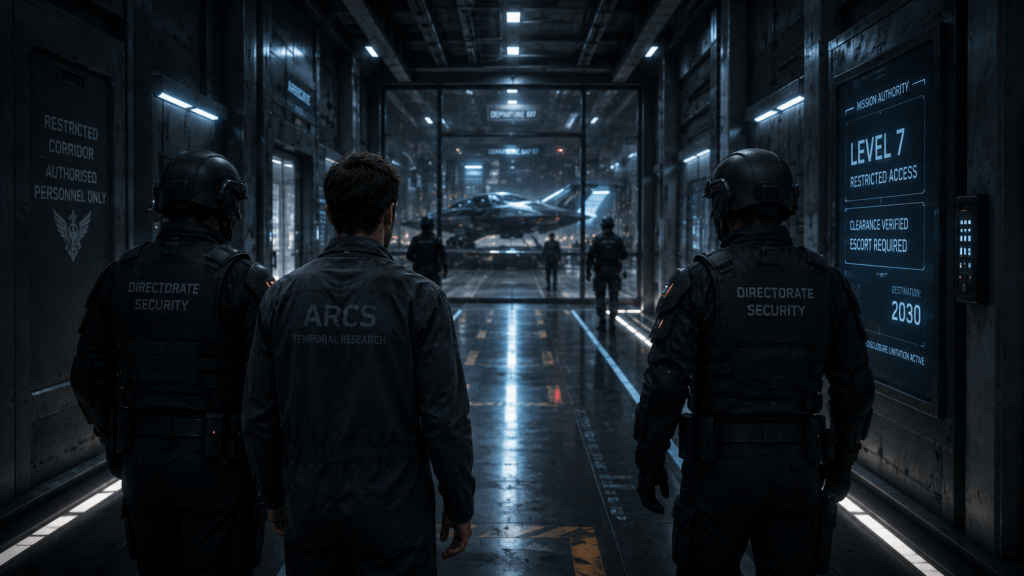
The story’s central movement begins when a future-origin team enters a forbidden section of the Time Strip and starts interfering with a restricted point in history.
The breach lies beyond the range considered safe for verified temporal travel. Predictive navigation fails inside the surrounding black-strip density, and previous attempts to reach the corridor have ended before stable alignment could be established.
Caelen is removed from his work at ARCS and transferred into mission authority. He is not being recruited as a commander, investigator or independent scientist. His assignment is much narrower.
He must keep a specialised craft aligned where its navigation systems can no longer determine a reliable path.
The destination is 2030.
For Caelen, the year is not the familiar present known to the reader. It is a distant and prohibited part of history, lying far beyond the operational ranges he has been taught to consider possible. A verified breach has already occurred there. Someone entered cleanly, yet no return was recorded.
The mission places Caelen inside a contradiction. He has been told that the Strip exists to prevent intervention, while the institution controlling it is now preparing to send a team into history to stop another intervention. The systems designed to preserve uncertainty require him to enter conditions where almost nothing can be known.
His skill may be the only reason the craft survives the journey. His understanding of what waits at the destination remains deliberately incomplete.
This creates time-travel suspense driven less by the fantasy of changing history and more by the fear of reaching a history that has already begun to change.
Psychological Science Fiction Driven by Pressure, Not Spectacle
Before the Fall approaches time travel through the body.
Temporal instability is experienced through breath, balance, light, sound and pressure. Security scans leave a physical residue. Corridors seem to hold Caelen for a fraction too long. The Time Strip makes itself known through tightening muscles and involuntary correction before a screen displays anything unusual.
This emphasis gives the story a strong psychological science-fiction identity. The reader is not placed above the technology with a complete diagram of how everything works. The reader remains beside Caelen as he tries to decide which sensations are ordinary strain, which are evidence of temporal response and which have already been observed by people unwilling to explain what they know.
The tension also comes from contrast. Future London remains functional and beautiful while Caelen is moved towards something dangerous beneath its orderly surface. Commuters continue travelling. Colleagues continue working. Departure boards continue updating. The ordinary world does not pause because one man has been assigned to carry an impossible mission.
That contrast makes the book more than a technical account of temporal travel. It becomes a story about the cost of being useful to a system that values a person’s function more than his consent.
Readers drawn to time-travel science fiction, bonded AI, altered history, controlled futures and stories of institutional power will find a world that develops through lived experience rather than detached exposition. The book allows its technology to remain advanced and convincing while keeping the emotional centre fixed on Caelen, Silin and the growing distance between support and control.
The Beginning of a Larger Temporal Conflict
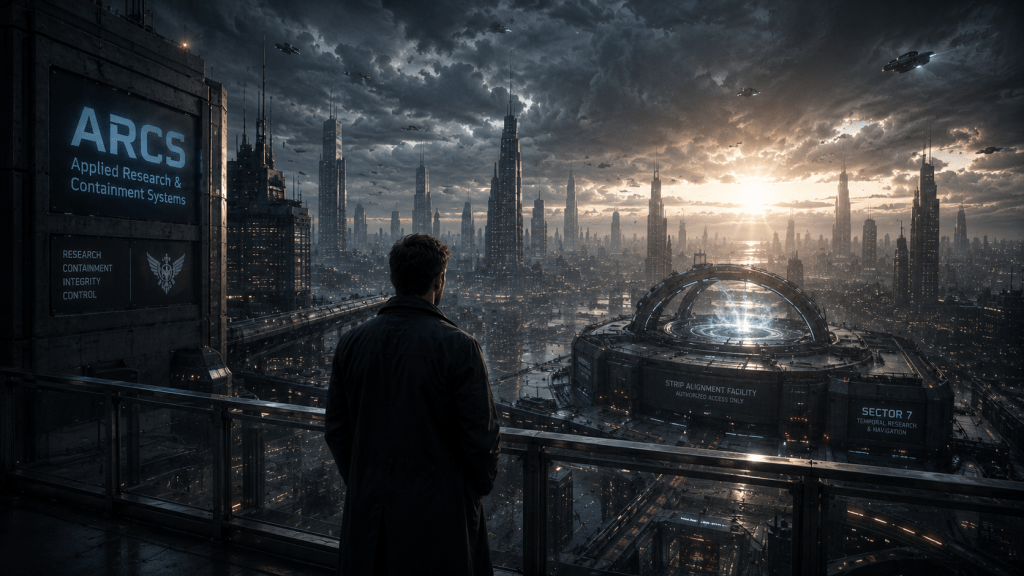
Time Strip: Before the Fall establishes the future before the wider rupture of the series.
It introduces a civilisation that believes temporal danger can be managed through infrastructure, classification and restricted knowledge. It introduces Caelen as a scientist whose body understands something his employers cannot safely explain. It establishes Silin as both an advanced AI and an intimate part of his daily stability.
Most importantly, it brings Caelen to the point where observation is no longer enough.
He is being carried away from the professional life he understands and towards a mission outside verified history. The people directing that mission believe his ability can keep them alive. They have not given him enough freedom to decide whether they should go.
The future remains calm behind him. The Time Strip waits ahead.
Readers can begin the series with Time Strip: Before the Fall on Amazon UK, available now for Kindle.
Discover more from Simon J. Phillips
Subscribe to get the latest posts sent to your email.
