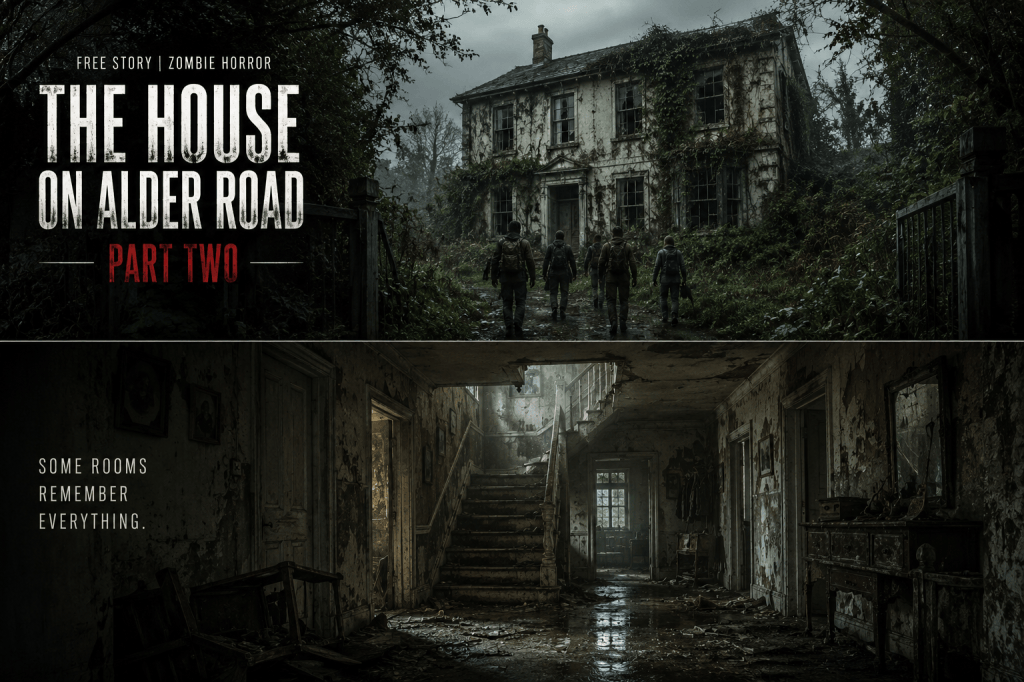
Free Story | Zombie Horror | Monthly Free Stories
Part Three of Three
This is the final part of The House on Alder Road, one complete Monthly Free Story presented in three parts.

Instead they had found bodies old enough for roots, furniture and plaster to conceal them, still capable of waking after years of stillness, and perhaps one moving despite damage that should have ended it. Mara tightened her grip on the crowbar. She had no idea how many more were hidden through the house, what injuries would actually stop these ones, or what Tamsin had already encountered upstairs.
“Our thirty seconds are gone,” Mara said.
“Then we go up,” Sera replied, already looking towards the staircase.
Jonah kept his attention on the sitting-room doorway. “And leave those behind us?”
The vine-covered arm flexed again, breaking another thin piece of plaster from the wall, while the shape beneath the sofa disturbed the hanging fabric once more.
“For now,” Sera replied, keeping her attention on Mara as she secured the satchel against her side.
Mara left Jonah watching the hall while she took Kit and Sera upstairs, following Tamsin’s muddy prints and the blood along the banister to the rear bathroom. They checked the front bedroom as they passed, finding nothing moving among the damp furniture, then heard Tamsin answer when Mara called her name.
They found her sitting against the bath with one trouser leg cut open around a bandaged bite. The flesh around it had already dried and darkened far beyond anything Sera expected from a wound less than a day old, while one eye had begun to cloud and feeling was fading from the injured leg. Three sealed medicine bags and the Lowbridge report rested inside the bath beside her, protected from the damp. Tamsin remained lucid enough to explain what had happened, though she admitted that being close to living people was becoming harder to ignore. By the time Sera finished examining her, Mara could already see where the assessment was heading.
“Sensation is failing in the leg, one eye is changing, the tissue around the bite has decayed far beyond the time since exposure, and she’s describing an increasing compulsion towards living bodies. I can’t tell you whether she keeps control for an hour, ten minutes or halfway down these stairs.”
Tamsin rested her head against the tiles and managed a dry trace of a laugh. “There. That sounded properly medical.”
“You asked for honesty,” Sera said, watching her carefully.
“I asked Mara to leave me,” Tamsin replied as her good eye moved towards the medicine in the bath. “Get those home. That part still matters.”
Mara rose from her crouch and followed Tamsin’s gaze to the sealed bags. “So do you.”
“You’re still looking for a way to carry me out,” Tamsin said, turning back towards her.
“There are four of us,” Mara replied. “We could bind your hands, keep you away from the others once we’re outside and decide what comes next before we reach Millhaven.”
Tamsin looked down at her wrists, where the dried skin had tightened around the bones. “And when my mouth reaches someone?”
Mara hesitated, then answered while Sera watched her from beside the bath. “We cover your mouth as well.”
“Listen to yourself,” Tamsin said gently, closing her eyes as she leaned her head back against the tiles.
The softness of the words hurt more than anger would have. Mara looked at her and saw memories crowding against the woman sitting there now. Tamsin at sixteen, furious after being sent back along a route because she had missed a flooded culvert. Seventeen, laughing while Jonah hauled himself through a rotten shed roof. Eighteen, sitting beside Asha through a winter fever. Nineteen, leaving Millhaven yesterday morning with a wax-sealed card in her pocket and enough confidence in Alder Road to wave once before turning away.
Tamsin opened her good eye and met Mara’s gaze. “Don’t carry me through that gate because you remember me healthy. Asha will run towards me. Lio will come close because he’ll see a patient. Jonah will keep talking because he’ll think answering him means I’m still myself. Kit will stay close enough to help, and Sera will keep checking me because she’ll think there’s one more useful thing to learn.” Her attention remained on Mara. “And you’ll keep looking for another route until one of us makes a mistake.”
Mara swallowed against the tightness in her throat. “You learned that argument well.”
“You taught me most of it,” Tamsin replied.
A scrape rose through the floor before something struck wood in the hall below, bringing Kit around towards the bathroom doorway with one hand already moving towards the pry bar.
“Whatever reached the sitting-room doorway is moving towards the stairs,” Jonah called from downstairs. “Slow, dragging one side.”
“Stay clear unless it reaches you,” Mara called back before turning towards Kit. “Take the medicine and the report onto the landing.”
Kit looked from the supplies to Tamsin. “Mara, are you sure?”
“Move them,” Mara said, keeping her voice firm.
Kit crossed to the bath and gathered the sealed bags, securing the report case beneath his arm as he moved towards the doorway. His sleeve rode back while he passed Tamsin, exposing the inside of his wrist, and her attention shifted from the medicine to the strip of bare skin.
“Kit,” Tamsin said, pressing both hands flat against the bath hard enough to whiten what remained of the skin around her knuckles.
He slowed and turned towards her. “What?”
“Keep moving,” Tamsin told him, forcing her stiff fingers against the enamel. “Please.”
Kit glanced towards Mara, and her small nod sent him through the doorway. As his wrist passed beyond reach, Tamsin’s left hand jerked after him and closed around empty air.
Sera moved instinctively towards her, drawing Tamsin’s attention before she completed the first step. Her good eye fixed on the exposed skin at Sera’s throat, and the split flesh around her mouth pulled back from her teeth as a low sound worked from behind her tongue.
“Tamsin,” Mara said as she moved between them.
Hearing her name brought Tamsin’s gaze across to Mara, recognition still visible beneath something rawer. She pushed herself away from the wall, only for the injured leg to collapse beneath her and send her onto one knee. Her right hand caught Mara’s coat near the ribs and dragged her closer with more desperation than strength.
Mara caught Tamsin’s wrist as her mouth opened towards Mara’s forearm. Her teeth stopped inches from the sleeve, every muscle along Tamsin’s jaw trembling as she fought the movement and forced her good eye upwards to meet Mara’s.
Horror replaced the hunger in her expression. Tamsin released Mara’s coat and twisted away, throwing one hand against the bath hard enough for her shoulder to strike the tiles. “I’m sorry,” she said through clenched teeth. “Mara, I’m sorry.”
“You stopped yourself,” Mara said, staying between her and Sera.
“This time,” Tamsin replied as tears gathered in the good eye. She forced her curling fingers flat against the bath and looked directly at Mara. “That’s what I’ve been trying to tell you.”
Another blow struck the lower banister hard enough to send a vibration through the bathroom floor. Jonah shouted that the first infected had reached the stairs, and Kit answered from the landing, telling him to give ground if he needed it.
Tamsin listened to the movement below before looking back at Mara. “Do it while I still know why.”
“Mara…” Sera said from beside the doorway, tightening one hand around the satchel strap.
Tamsin turned towards her. “Take Kit downstairs and help Jonah. Please.”
Sera looked towards Mara. “There may still be time.”
“There may be,” Tamsin replied quietly. “There may also be another thirty seconds like that one.”
Mara saw Sera understand, then reached down and released the fastening over her pistol. “Go to the landing. Keep the stairs clear.”
“I’ll be right outside,” Sera said as she backed towards the doorway.
“You always are,” Tamsin replied, managing a faint smile.
Sera held her gaze for another moment before joining Kit outside. Mara waited until she heard them move onto the landing, then pulled the bathroom door mostly closed, leaving a narrow gap through which Jonah’s voice and the scrape of movement below could still reach them.
Tamsin drew one stiff hand across her knee. “Tell Asha I complained.”
“She’ll assume that anyway,” Mara said as she crouched in front of her and drew the pistol, keeping it low beside her thigh.
“Tell Jonah his knots still lack discipline,” Tamsin continued.
“He’ll argue with me for a week,” Mara replied.
“He argues when he agrees,” Tamsin said, and the faint humour in her voice almost drew a laugh from Mara.
Mara held her gaze instead. “Kit?”
“Tell him I knew,” Tamsin replied after a moment.
Mara understood what she meant. “About Sera?”
“Everyone knows,” Tamsin said, her cracked mouth lifting slightly.
A quiet laugh escaped Mara before grief tightened around it.
“Good,” Tamsin said. “I wanted one more of those.”
Mara reached forward and rested her free hand against the healthier side of Tamsin’s face, where a trace of warmth remained beneath the dried skin. “You completed the mission. Lowbridge got its people out. We have their report, and Millhaven gets every course of medicine you carried here.”
Tamsin leaned into her palm and closed her eyes. “The road?”
“We close it,” Mara replied.
“And the house?” Tamsin asked, opening her good eye again.
“We mark it,” Mara said. “Nobody walks in here blind again.”
Tamsin watched her for a moment before another impact struck the stair rail below. Jonah called Kit’s name, and Kit answered immediately from the landing.
“You need to go,” Tamsin said, turning her attention towards the doorway.
Mara raised the pistol, and the fear that appeared in Tamsin’s face stripped away the composure she had fought to maintain.
“Stay with me,” Mara said, keeping her free hand against Tamsin’s cheek as she brought the muzzle close to her temple.
“I’m here,” Tamsin whispered, fixing her good eye on Mara.
Mara kept her hand against Tamsin’s cheek. “You got the medicine home.”
A faint smile began to form across Tamsin’s cracked mouth as she leaned into Mara’s palm, and Mara fired, holding her as the shot cracked through the bathroom and down the staircase. Dust shook from the ceiling while Tamsin’s remaining strength gave way against her. As Mara lowered her carefully onto the tiles, something crashed against the banister below. Plaster broke loose downstairs, furniture dragged heavily across the floor and Jonah shouted that more than one infected had reached the hall as Mara brushed the loose hair from Tamsin’s face and closed her good eye.
“Mara!” Sera called through the bathroom door.
Mara secured the pistol and pulled the door open to find Kit near the top of the staircase with the medicine and Lowbridge report held tight against his chest while Sera stood beside him with the hatchet ready.
“How many?” Mara asked as she moved towards them.
“At least two in the hall,” Kit replied, looking down the stairwell. “More moving behind them.”
Another impact shook the rail, and Jonah appeared below the turn as he gave ground one step at a time.
“Keep the medicine up here,” Mara said, tightening her grip on the crowbar as she started down towards him. “Sera stays with Kit. I’m bringing Jonah back.”
“I’ve got them,” Sera replied, moving closer to Kit while Mara descended.
She reached Jonah at the turn just as the first infected dragged itself onto the stairs below him, one shoulder striking the wall each time its ruined leg failed to clear the next tread. Plaster dust clung to its hair and face, while torn roots hung from its sleeve and the side of its neck, scraping across the banister as it climbed. Behind it, another shape forced its way through the narrowed hall in pieces, a hand curling around the doorframe before part of a head and one grey shoulder emerged beside the collapsed furniture. Farther back, something else scraped through the sitting room.
Jonah retreated another step and kept the short pry bar across his chest. “The first one’s slow. The second keeps catching on the cabinet. I heard another one moving after the shot.”
Mara looked past him towards the hall. The route to the rear kitchen had narrowed into a passage already filling with infected, while the rooms on either side still held bodies they had never fully uncovered. Fighting their way down would place Kit and the medicine directly behind them with no room to withdraw if another concealed infected entered the hall.
“We’re finished with the ground floor,” Mara said, taking hold of Jonah’s sleeve and drawing him back towards the upper flight. “Front bedroom. We use the porch roof.”
Jonah turned with her immediately as Kit called from above, “The window over the porch?”
“You saw the roofline from the garden,” Mara replied, climbing back towards them. “It gives us the shortest drop.”
Sera moved aside to let Mara and Jonah onto the landing, though her eyes caught briefly on the bathroom doorway before she turned with the others. Mara understood the hesitation. Tamsin lay only yards away, close enough that going back still felt physically possible even though nothing waiting in that room could leave with them now.
Another scrape rose from the staircase, followed by the slow knock of the infected striking the wall as it climbed.
“Move,” Mara said, directing Kit towards the front bedroom while Jonah took the rear position.
They crossed the landing together and entered the room they had searched earlier. A double bed stood beneath the broad window overlooking the porch, its mattress lost beneath spreading mould, while years of water damage had brought part of the ceiling down across the wardrobe and buried one side of the floor beneath plaster and rotted timber. Ivy pressed against the glass, filtering the grey daylight as Kit carried the medicine towards the window and tested the frame with his free hand.
“Paint has sealed the lower edge,” Kit said, pressing against the swollen wood. “The glass looks sound. The frame is less convincing.”
“Let me,” Jonah replied, slipping the short pry bar beneath the sash as he reached them. He leaned his weight into the tool, a trace of his old humour returning through the strain in his face. “Finally, a problem with proper manners.”
Sera kept watch on the doorway while Kit braced the frame. “You were quieter downstairs.”
“I was busy developing depth,” Jonah replied as the wood cracked and the sash shifted several inches.
Cold air pushed through the opening, carrying wet leaves, earth and the clean smell of the garden into the stale decay of the bedroom. Mara felt it across her face as Jonah forced the window higher, and the opening ahead finally gave them something wider than another corridor or closed door.
Kit leaned far enough through to study the roof below. “The slates fall towards the left. Moss along most of the lower edge. There’s a flatter section near the wall.”
Mara pointed towards the medicine. “You first. Keep those bags against you and set the report beside the wall once you’re out. Sera follows.”
Kit gathered everything tightly against his chest and eased one leg through the window, testing the porch roof before transferring his full weight. When the slates held, he crouched outside and reached back for the Lowbridge case. Sera passed it through, then followed him carefully, keeping the hatchet hooked against her belt while Mara turned towards the landing again.
The first infected had reached the upper turn. Fingers appeared around the banister before the rest of the body, scraping along the wood as the shoulder pulled into view. The roots hanging from its clothes caught against the rail and stretched behind it, still attached to fragments of plaster and upholstery from downstairs.
Jonah saw it and moved towards the window. “I think we’ve received the message about staying longer.”
He put one leg through, shifted his weight towards the porch roof and had almost cleared the frame when a dull thump came from beneath the bed.
Mara turned towards the sound. The mattress sagged almost to the floor, hiding the space beneath it behind a blanket stiffened by damp into heavy folds. For a second the fabric remained still, then something underneath lifted one section several inches and let it settle again.
“Jonah, keep moving,” Mara said as she crossed towards him.
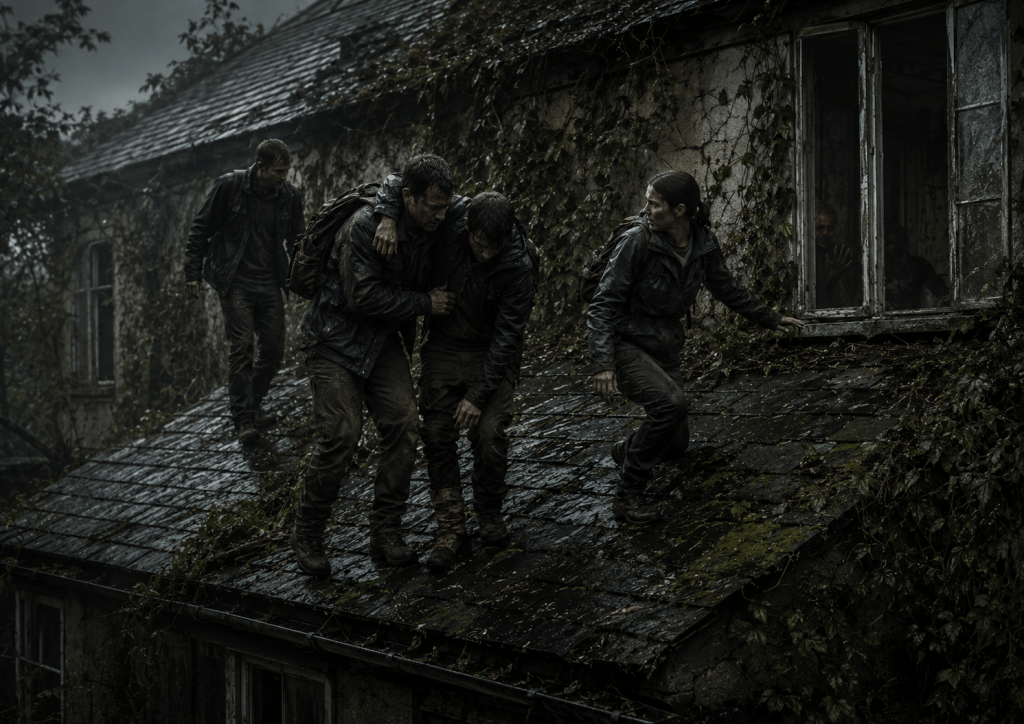
Jonah swung his second leg through the window as Mara crossed to follow him, and the blanket beneath the bed lifted again. A hand dragged from the darkness across the floor towards the sill, two fingers tangled with fine roots, while outside Sera shifted sideways along the porch roof to make room for Jonah. Her left ankle came close to the opening just as the arm thrust through and seized her boot above the heel, wrenching her sideways hard enough to drop her onto one knee against the slates.
Kit abandoned the medicine where it rested safely beside the wall and caught Sera around the waist, while Jonah seized the back of her jacket and pulled from the other side. Mara drove the crowbar down through the opening towards the arm reaching from beneath the bed.
The infected remained mostly concealed beneath the bed, though Mara could see part of its forehead under the hanging blanket, dried skin flattened beneath a crust of mould and one cloudy eye opening through root fibres as the hand tightened around Sera’s boot. A deep groove marked the wrist where timber and growth had pressed into it over the years, yet the fingers still held with slow, stubborn strength until Mara brought the crowbar down across the forearm. The grip loosened under the blow before tightening again as Kit and Jonah pulled Sera towards them.
“My boot’s caught,” Sera said through clenched teeth, twisting until she could reach the arm with the hatchet.
“Pull her again,” Mara told them, driving the crowbar down a second time while Kit hauled Sera backwards and Jonah dragged at her jacket. The boot slipped partway free before the infected’s fingers tightened around the leather above the heel, giving Sera enough room to reach beneath the window frame, find the wrist and bring the hatchet down through it.
The severed hand stayed locked around Sera’s boot until Jonah kicked it free, sending it sliding down the mossed slates, clipping the gutter before disappearing into the long grass below.
Mara climbed through as the infected from the staircase reached the bedroom doorway behind her. Its shoulder struck the frame while Jonah caught Mara’s forearm and helped her onto the roof, then Kit guided all four of them towards the flatter section beside the wall.
Sera sat with her back against the house and pulled at the bootlaces. Her fingers shook as she worked them free, while Kit crouched beside her close enough to help and Jonah kept watch on the open window.
“Give me the boot,” Sera said, dragging it from her foot before rolling the trouser leg above her ankle.
Purple marks had already begun to rise where the fingers had closed around her, and one shallow line crossed the skin near the outer bone. Sera pressed her thumb along the scrape, wiped it clean with a cloth from her satchel and examined the surface closely before releasing the tension in her shoulders.
“Bruising,” she said, looking towards Mara. “The scrape came from the boot seam. Skin stayed closed where the hand caught me.”
Kit leaned nearer, studying the ankle with an intensity Sera noticed immediately. “You’re certain?”
Sera met his eyes as she pulled the trouser leg down again. “I’m the one who gets to be certain.”
Kit nodded and kept his hand near Sera’s elbow as she rose, catching some of her weight when she tested the injured foot and winced. Sera steadied herself against him, then left his hand where it was as she found a position she could stand in.
“You can keep that there until we reach the ground,” she said as she adjusted her balance.
Kit answered with a small nod. “All right.”
Jonah glanced between them before returning his attention to the window. “I’m saving every comment I have until we’re farther from this house.”
“That may be the wisest decision you’ve made today,” Sera said as she steadied herself against Kit.
Jonah turned towards the open window as the first infected reached through, its fingers scraping over the sill while torn ivy dragged from its sleeve. He moved to the porch support and looped the rope around it, feeding the free end towards the garden while Kit guided Sera farther from the opening.
The drop was little more than eight feet, but the wet moss made the roof treacherous. Kit descended first and cleared the ground before Mara lowered the medicine and Lowbridge report into his hands.
Sera followed with Jonah controlling the rope from above, landing heavily on her good foot before Kit took her weight. Jonah descended after her, leaving Mara alone on the porch roof for several seconds with the bedroom window behind her and the upper bathroom window farther along the wall.
She looked towards that second window and thought of Tamsin lying on the tiles beyond it. There would be no body carried home through Millhaven’s east gate, no grave beyond the wall and no final sight of her for Asha or Cal. Leaving her inside hurt in a quieter way than the shot had, though carrying her out now would only turn her final decision into another danger the others had to manage. Tamsin had spent the last of herself making sure Mara understood that, and she held the thought as she gripped the rope and lowered herself towards the garden.
By the time her boots touched the ground, Kit had secured the medicine inside his pack with the Lowbridge report beneath the waterproof flap. Sera could bear weight on the bruised ankle, though a limp had entered her stride, while Jonah stood facing the house with the radio pressed close against his chest.
Behind the lower windows, shapes moved through the broken light where the sitting room had seemed empty less than an hour earlier. One hand slid down a pane through the ivy while another infected pulled slowly against the roots around the rear doorway, fabric, plaster and vine still hanging from the bodies until it seemed as though pieces of the ruined house were moving with them.
Jonah watched them for several seconds before turning towards Mara. “We’ve spent years walking past places like this.”
“We spent years checking roads,” Mara replied, looking beyond him towards the neighbouring properties.
Kit followed Mara’s gaze along the row of abandoned houses. “We’ve always treated buildings as hazards. We check entrances, signs of movement, fresh damage, anything that tells us infected have passed through or stayed nearby.” His attention returned to the house behind them. “What we haven’t been looking for is one that stopped moving long enough for the room to grow over it.”
Sera shifted her weight carefully onto the uninjured foot as she studied the dark windows beyond the garden wall. “The infected we know wander. They follow movement, drift through streets, get trapped somewhere for a while and eventually work themselves loose if they can. Those downstairs had been part of the furniture for years.”
Mara kept her eyes on the house. “They stayed there long enough for roots and furniture to close around them, and they were still alive enough to move when we came close.”
She turned away and led them back through the gardens towards the broken gate onto Alder Road, putting distance between them and the house before anything inside could work free.
The tracks they had followed earlier continued away from the residential stretch, leaving Alder Road quiet beneath the afternoon light, though Mara read that quiet differently now. Garages swallowed by ivy, curtained upstairs windows and collapsed conservatories had always been hazards along the route. What had changed was the possibility that an infected could remain hidden inside one for years, motionless enough to disappear into the building until something living came near.
At the nearest route marker, Mara stopped and opened the tin of red paint Kit carried for structural collapse and active infected concentrations. She stirred the thick surface with the wooden stick, then drew a broad red bar through the white Alder Road mark.
Kit stood beside her as the paint settled into the old grooves. “Full closure?”
“Full closure until this stretch is checked under new rules,” Mara said, adding a smaller warning mark beneath the first. “Structures treated as occupied until cleared. Concealed infected reported wherever we find them. Movement appears to wake them. Stillness may settle them again.”
Sera looked back towards the roofline of the house. “And Tamsin?”
Mara held the brush above the tin for a moment. “We report exactly what happened. Bite yesterday afternoon. Rapid decay by morning. Awareness remained while the urge to attack increased. We add no explanation we haven’t earned.”
Sera looked down at the bruising around her ankle before meeting Mara’s eyes. “She knew what was happening to her. Right to the end.” Her voice stayed controlled, though the effort showed in the way she held herself. “She warned us before she lost control, and when it happened, she pulled herself back.”
Kit stood beside her with the medicine pack over one shoulder. “She told me to keep moving before her hand went after me.” He glanced towards the road behind them, then lowered his eyes. “She knew what she was about to do before any of us did.”
Jonah had taken out his notebook, though the pencil remained motionless above the page. “I heard most of you through the floor,” he said, looking towards Mara. “Then the house got louder and I lost the words. I heard the shot.”
Mara closed the paint tin before answering him. “She asked me to do it while she could still understand why.”
Jonah’s jaw tightened, and for several seconds he looked down at the empty line waiting beneath his pencil. “Was she still Tamsin?”
“Yes,” Mara replied. “Enough of her was still there to make the decision herself.”
Sera rested one hand against the strap of her satchel. “That’s the part the report needs to keep. The infection was changing what she noticed and what her body wanted, yet she still recognised us and understood the danger she posed.”
Kit looked towards Mara. “And she still cared more about the medicine getting home than anything else in that room.”
Mara felt the weight of that settle among them. Tamsin had carried the antibiotics through the gardens, protected the Lowbridge report, braced herself behind the bathroom door and kept signalling long after fever and infection had begun taking pieces of her away. None of that made what happened in the bathroom easier, though Mara refused to let the manner of Tamsin’s death become the only thing Millhaven remembered about her.
“She completed what she went out there to do,” Mara said. “We make sure Asha and the others hear that before they hear anything else.”
Jonah finally lowered the pencil to the page, though he paused again before writing. “And the ones in the house? What do I call them?”
“Infected,” Mara replied as she wiped the brush against the rim of the tin. “Use concealed infected where the difference matters.”
Jonah wrote the words carefully while Sera looked back towards the dark line of houses. “They stayed still long enough for roots, furniture and plaster to hide them,” she said. “That’s what we actually know.”
“And living movement brought them out of it,” Kit added, adjusting the medicine pack against his shoulder. “Or seemed to.”
Mara closed the tin. “Put it exactly like that. We found one house and several infected behaving differently from the ones we know on the roads. Anything larger comes later, if we find it.”
Kit adjusted the medicine pack on his shoulders. “Every route with enclosed structures needs checking again.”
“Yes,” Mara said, returning the paint to his pack. “Houses, emergency shelters, garages, sheds, anywhere a body could stay still long enough for the place to hide it. Silence stops being proof of clearance.”
They headed west with Sera setting the pace her ankle allowed, Kit staying naturally near her injured side while Jonah tried the radio whenever the road rose high enough to give him a clearer line towards Millhaven. The return required none of the careful reconstruction that had slowed them earlier. Tamsin’s trail had already given them everything it could, and the medicine on Kit’s back mattered more now than revisiting every mark she had left.
Near the old school, the static thinned enough for Jonah to raise Millhaven, and Asha’s voice came faintly through the handset as he looked towards Mara before answering.
“East team returning,” Jonah said, holding the radio close to his mouth. “Four returning. Medicine secure. Lowbridge report secure. Alder Road closed at the residential stretch east of the petrol station. Prepare medical receiving and route review.”
Several seconds of static followed before Asha answered. “Tamsin?”
Jonah closed his eyes briefly at Asha’s question, then looked towards Mara as she held out her hand. He passed her the radio, leaving the answer to the person who had been with Tamsin at the end.
“Tamsin completed the mission,” Mara said, looking east along Alder Road. “She died before we could bring her back.”
Static filled the radio for several seconds, and Mara pictured Asha beside the east signal bell with the handset held close, trying to take in a death she had only just been told about. “Understood,” Asha said at last, her voice so quiet that Mara heard everything the single word could not carry. Lowbridge, the bite, the bathroom and the choice Tamsin had made would all have to be explained once they were home, where Asha and the others could hear the whole of it instead of receiving pieces over a weak signal on Alder Road.
“We’ll reach you before dusk,” Mara replied before returning the radio to Jonah.
Jonah lowered the radio slowly and glanced towards the pack carrying the medicine before speaking. “She’ll hate that we used ‘completed the mission’ in an official call.”
Mara started along the road again while Jonah fell into step beside her with the notebook still open in one hand, adding a few words beneath the last line before she answered him. “She can complain when we write the proper report.”
Jonah looked down at the page with a tired smile. “Her corrections will be unbearable.”
Sera glanced across from Kit’s side while favouring her injured ankle. “Then spell everything properly. She’ll find enough to argue with as it is.”
Kit kept his pace matched to hers and considered the wording before replying. “She’d object to ‘find enough’. Too imprecise.”
Jonah gave a quiet breath of laughter and made another mark in the notebook before answering. “I’m adding that before any of us forget.”
Tamsin remained with them in smaller ways as they walked, in the habits she had corrected over the years, the marks she had left along Alder Road and the medicine Kit carried towards Millhaven after she had chosen to protect it before herself.
Near the long rise where the upper edge of Millhaven’s east tower became visible through the trees, Mara stopped and removed the folded route map from her case. Alder Road crossed the paper in a pale pencil line, joined by smaller routes through villages, industrial estates and housing streets that scouts had checked, cleared and gradually learned to trust. Beside many of those lines, small squares marked buildings used as weather shelters, observation points or landmarks.
Mara drew a red line across Alder Road and let her gaze travel over the routes branching away from it. Kit came to stand beside her while Sera and Jonah waited farther along the verge, and the familiar marks carried a different weight now. Bus shelters, cottages, garages, abandoned shops and emergency houses lay beside roads the scouts had travelled for years, places where they had waited out rain or taken cover because silence had seemed safer than open ground. Other buildings had been passed with little more than a glance because the windows, doors and surrounding tracks showed no sign of movement.
The roads and buildings marked across the paper were the same ones they had trusted that morning, though Mara could no longer read them in the same way. Alder Road still ran east through the villages and housing streets, and Millhaven’s tower still waited beyond the trees as she folded the map and returned it to the case. Kit carried Tamsin’s medicine towards the infirmary, the Lowbridge report would send searchers towards the quarry refuge, and tomorrow every trusted route would have to be looked at again.
As the four of them started towards home, Mara thought of the dark rooms they had passed for years and the silence they had mistaken for absence.
Author Note
I had wanted to write a zombie story for years. I grew up enjoying the earlier kinds of zombie films, especially those I discovered around the early 1990s, when the dead were slow, physical and frightening simply because they kept coming. Later, I enjoyed The Walking Dead, especially its early sense of ordinary people trying to build lives inside a world that had already fallen apart, where survival depended as much on judgement, trust and routine as it did on fighting the infected.
As zombie stories became more common, I found myself hesitating whenever I thought about writing one of my own. Faster infected, stronger infected and increasingly extreme mutations had already been explored from almost every direction, and I wanted to find an idea closer to the kind of horror I enjoy most, where something familiar becomes dangerous because people have grown comfortable around it.
The House on Alder Road began when I started thinking about what survival might look like years after an outbreak. By then, people would have learned how the infected moved, what attracted them, which roads were dependable and which buildings were better avoided. Settlements would build rules around that knowledge, scouts would record changes, routes would be checked, and gradually certain dangers would become familiar enough to feel manageable.
That was where the story began to interest me most. Instead of changing the infected by making them faster or stronger, I wondered what would happen if some of them simply stopped moving for long enough to disappear into the places around them. A body lying inside a ruined house for years could become covered by roots, mould, fallen plaster, damaged furniture and the slow collapse of the building itself, until anyone entering might see only debris where a person had once been.
The danger would still be there. The difference would be in what the survivors had learned to see.
From that idea, the story became as much about Mara and Tamsin as the house itself. Tamsin completes the mission she was given, carries the medicine and Lowbridge report back as far as she can, and leaves enough of a trail for Mara to find her. Mara then has to face something far harder than simply losing one of her scouts. She has to accept that trusting Tamsin was never the mistake. What matters afterwards is whether she allows what happened on Alder Road to change the rules Millhaven has built around survival.
That became the part of the story I cared about most while writing it. Experience keeps people alive, yet experience can slowly become assumption when the same routines work for long enough. Alder Road had been safe because the people of Millhaven understood the dangers they knew how to recognise. By the end of the story, Mara understands that the road itself may have changed very little. What has changed is the meaning of an empty house, a quiet room and a place where nothing appears to be moving.
Monthly Free Stories is where I publish one complete story on my website each month, free to read from beginning to end. The stories can move between horror, fantasy, science fiction, historical fiction, mystery and anything else that suits the idea, with each one allowed to stand on its own and become whatever the story itself needs to be.
Some may remain standalone forever, while others may grow later if readers respond strongly and another story genuinely feels worth telling. The first promise remains simple: every Monthly Free Story should work as a complete story in its own right.
If you enjoyed The House on Alder Road, you can explore the other Monthly Free Stories, discover my published books, or join the newsletter for future fiction and publishing updates.