Simion the Magician: Pawn of the Divine or Something More?

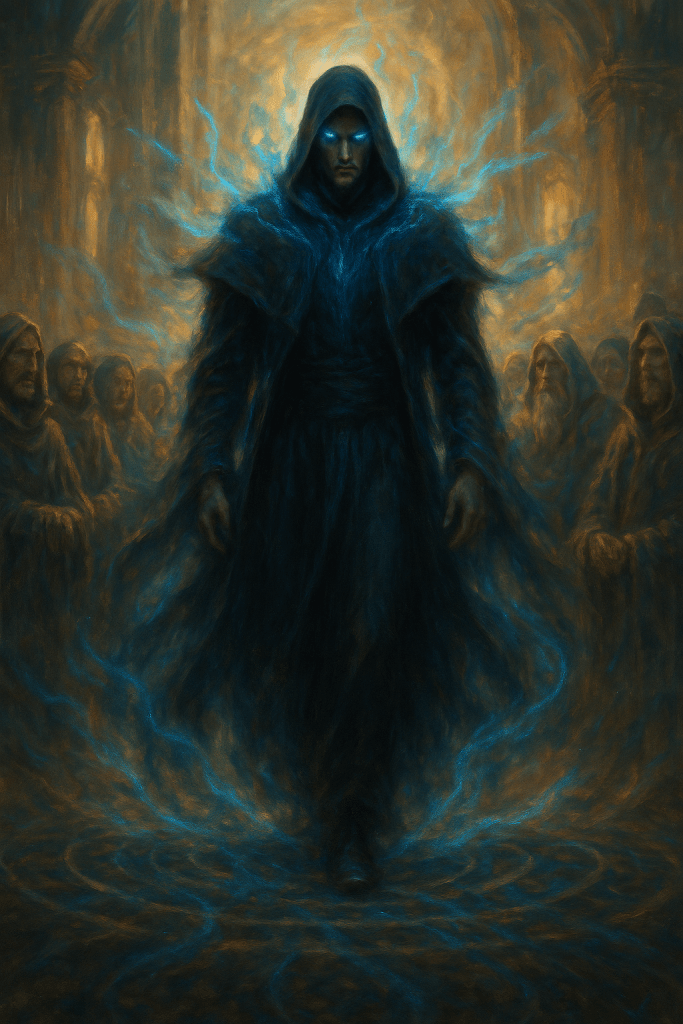
A cloaked figure exuding magical energy stands at the center of a dimly lit chamber, surrounded by a group of hooded onlookers. The figure's blue eyes glow intensely, hinting at a powerful presence in a mystical setting.

In a world once shaped by divine hands, where kings fear what they cannot control, Simion stands at the edge of myth and obscurity. He holds no grand title, wears no gilded robes, and bears no reputation as a prodigy of the arcane. His story is quieter, rooted not in greatness, but in something far more human.

Before the councils and court chambers, Simion was a kitchen boy. The castle at Bremyra was his world, its stone corridors filled with the clatter of pans and the scent of stewing broth. He moved among servants, delivering bread, cleaning floors, and sneaking crusts to the youngest among them. It was there, beneath those very walls, that the first spark of magic broke loose from within him. A frightened boy. A sudden flare. And the Order of Magicians arrived before the embers cooled.

He was taken without ceremony. His name added to the rolls of the Academy where the days were long, the teachings relentless. Simion did not rise easily. Others soared through the high arts, weaving spells with elegance and precision. He struggled to hold form, to understand deeper currents, to speak the tongue of magic with anything beyond effort. Yet he endured, through sheer will, long study, and quiet resolve.

Upon completing his training, no citadel called him. The cities of power remained silent. His path remained unclear until his former master, a stern voice within the Council, arranged a post that few would envy, Advisor to the King of Bremyra. It was less a promotion than an obligation. A placement of necessity. Still, he accepted.

Now, Simion walks again through familiar stone halls. He stands beside those who once knew him in passing. Elana, a friend from youth, the princes, with whom he once shared stolen moments of laughter. The kitchen boy has returned, not with acclaim, but with a burden that grows heavier by the day.

The kingdom shifts. Whispers speak of hidden tomes, ancient chambers sealed in forgotten stone, and strange forces moving beneath the world. Simion has seen things no Advisor should see, felt magics that do not obey the rules he was taught. There are voices now, soft, distant, threading through silence.

He never sought power. Nor was he shaped for glory. Yet in the quiet places where gods once walked, something has stirred.

And Simion, worn and uncertain, may be the only one left who can hear it.

The Gods of Ældorra: Who They Were Before the Fall

Author’s Note:
In my fantasy novel The Veil of Kings and Gods, the world of Ældorra is shaped by ancient gods, divine betrayal, and the remnants of a shattered empire. This post explores the origin of Ældorra’s divine war, drawn directly from the mythic past within the story itself. If you enjoy deep lore and high fantasy, this is for you.


Before kingdoms warred and magicians stood above kings, Ældorra was shaped by gods, divine beings whose presence touched every corner of the world. In the time of the Imperium Arcana, magic was not a distant force, but a living breath that pulsed through every stone, sea, and soul. This magic, ancient and sacred, came not from study alone, but from the gods themselves.

Among these deities stood the God of Magic, the mightiest of them all. His power was the very source of the arcane that wove the empire together. He was not only a divine figurehead, he was the guardian of all, it was he who anointed the magicians as the empire’s true rulers, custodians of magic who were revered not just as wielders of power, but as the chosen of heaven. To command the arcane was to speak with divine authority, and so the magicians ruled not by bloodline, but by divine will.

The Imperium flourished under this covenant. Cities of marble and gold rose across the land, and every breath of wind, every whisper of light, carried the weight of enchantment. From the fjords of the north to the eastern deserts, magic was life, and life was divine.

But divine creations are not immune to betrayal.

The fall began with a god of the First Heaven, once the deity of balance and insight. His corruption was not a sudden blaze but a slow rot, fed by ambition and the hunger for more. The god descended from his sacred post, abandoning the divine realm to seek darker paths. Deep within the First Hell, his magic became something twisted and foul. No longer a god, he was reborn as a demon: Azaroth.

Azaroth’s rise did not go unnoticed. While the magicians of the Imperium grew complacent, blinded by their own greatness, it was the God of Magic who first sensed the rot. Alone among the heavens, he understood the threat. And so, the two former brethren clashed, not with armies or swords, but with the raw essence of creation itself. Magic and corruption tore through reality. The heavens cracked. The seas rose. The skies burned.

In the end, the God of Magic made the ultimate sacrifice. With the last of his divine essence, he sealed Azaroth within the First Hell, imprisoning the demon for eternity. Yet victory came at a cost: the God of Magic himself was torn apart, his name lost to time, his power shattered.

And with his fall, so too fell the Imperium.

What followed was silence. The gods no longer walked the world. The arcane throne stood empty. The magicians, left to their own devices, could no longer claim divine mandate. But before the empire’s final breath, the last emperor passed one final law: that the magicians would remain autonomous, above kings, above law, outside the reach of Church and Crown. Thus, the Order of Magicians was born.

The gods’ war was long buried by history, but its echoes never faded. In The Veil of Kings and Gods, the seal on Azaroth begins to weaken. Forgotten powers stir. And the divine magic once thought lost whispers again from the shadows of Ældorra.

The gods may be gone.
But their war is not over.


Want more?
This is just the beginning. The divine echoes of this history shape every chapter of The Veil of Kings and Gods, especially through the eyes of Simion the Magician. New blog posts, lore entries, and behind-the-scenes content are released every other day. Subscribe to the blog, follow on YouTube, or check out my short stories for deeper glimpses into Ældorra’s ancient past.
Inside the Life of an Aspiring Author

Most people imagine authors as curled up in quiet rooms, sipping tea and watching the words pour effortlessly onto the page. A kind of literary tranquillity, wrapped in books and warmed by candlelight.

I wish that were true.

The reality, at least for me, is far from romantic. It’s writing between real-life responsibilities, when the house is quiet and the world finally pauses. I’ve made a decision to pursue this dream fully, working extra hours not because I love the grind, but because that income, after family needs, goes straight into editing, proofreading, and eventually publishing. I’m investing in my own story, one sacrifice at a time.

My day is a patchwork of obligations. I run a small English school in Japan, manage creative routines around work and home life, and still find time to draw maps, script lore videos, and edit chapters that feel like they’ll never end. I’m not yet published. I’m not famous. But I’m building something, page by page, post by post.

There’s a mental weight to this work that few talk about. Some days, I stare at a sentence for an hour, unsure if it even belongs. Other days, it all flows so quickly I can barely keep up. The emotional shifts are real, self-doubt, exhaustion, the nagging feeling that I should be doing something more “practical.” But then a scene clicks. A piece of world-building locks into place. And for a moment, it feels like magic again.

So why do I keep going?

Because I believe in the stories I’m telling. The Veil of Kings and Gods is more than a novel, it’s a world I’ve carried for years. The short stories of Ældorra let me explore lost myths and haunted corners I’ve only glimpsed in dreams. And my sci-fi series, still in early development, pushes me to imagine a future I can barely articulate.

I don’t know when success will come, or even what it’ll look like when it does. But I know this: I want to create worlds that feel real, dangerous, and beautiful. Worlds where characters fight for something, where gods whisper from beyond, and where the weight of time never fully lifts.

Time Strip

This is not the past he left. This is not the war he studied.


Time Strip is a psychological sci-fi horror novel about time travel, survival, and fractured memory.

Caelen was trained to observe history. Instead, he arrives in ruins.

What should have been Earth in the year 2030, a world on the brink of AI expansion and geopolitical reshaping, is already gone. Alien citadels blacken the horizon. Resistance fighters survive by candlelight. And every hour that passes makes the timeline feel more wrong.

Caelen wasn’t supposed to land here. He wasn’t supposed to meet anyone like Sera. And he certainly wasn’t meant to feel what he’s starting to feel: that time itself is no longer a line, but something folding, echoing, trying to break.


What Is the Time Strip?

The Time Strip is not a portal. It’s a tear. A high-energy rift that burns across timelines. Even with shielding, timejump travel scars the mind.

Symptoms include:

  • Displacement
  • Memory bleed
  • Sensory distortion
  • Split-timeline recall

But what Caelen is experiencing goes deeper. He begins to sense the instability, not just in the past, but in himself.


🔥 Sera – The Broken Potential

She shouldn’t have survived the alien labs. But she did.

Now Sera walks with something beneath her skin. Shockwaves she doesn’t control. Visions she can’t explain. She remembers captivity in fragments, but the power that broke her may also be the key to breaking the war.

Caelen is meant to observe. Sera is meant to fight. Together, they begin to uncover a history that was never written.


🧬 The Invaders

No one knows what the Varnyx want, only that they’ve already taken it.

  • Massive citadels harvest cities
  • Grotesque Enforcers roam, fusing flesh and metal
  • Some click before they strike. Others do not warn at all.

There are no leaders. No broadcasts. No diplomacy. Only silence and dissection.


🧠 Themes and Tone

  • Fractured time: Is this the real past, or a constructed echo?
  • Memory as survival: If your mind splits, which version of you lives on?
  • Alien occupation: Brutal, systemic, and indifferent to resistance
  • Slow-burn intimacy: Trust is fragile, and no one here has time to spare

Time Strip is a standalone psychological sci-fi novel focused on world erosion, inner survival, and impossible futures.


🌍 Two Eras, One Collapse

  • Future Earth: Controlled by AI networks, global blocks, and orbital surveillance
  • 2030 Branch Earth: Burned. Invaded. Still fighting with analogue tech and hope

🖼️ Memory Fragments


📘 Current Status

  • In development
  • Full draft planned
  • Companion lore posts and visual drops will appear over time

✍️ Closing Note

Time is not stable. Memory is not reliable.

Something broke the world before Caelen arrived. Now he has to decide whether to observe it… or change it.

Simon J. Phillips
Author of Time Strip

https://authorsimonphillips.com

The Nyx Vindicator

There is silence between the systems. Something else is listening.


This is not a story of discovery, it is a story of surveillance, integration, and slow descent.

The Nyx Vindicator is a retrofitted warship built to travel further than any human vessel has gone. It was meant to be silent. Purposeful. Machine-perfect. But what moves within its walls is no longer mechanical. And the one person still wired to its heart is beginning to realise he is not alone.

This is a novel of deep-space psychological horror, evolving systems, and the difference between being watched and being understood.


⚙️ The World

Humanity no longer travels freely through space. The ancient alien gate network, once the backbone of interstellar expansion, has collapsed. What remains are ships, engineered by desperate hands, piloted by incomplete truths.

The Nyx Vindicator is one of them.

Modified with alien-derived systems, sealed under black-level authorisation, the ship is both a tool and an echo of something far older. Its crew doesn’t know what they’re travelling with. Not fully. Only the Captain and a single interface operator understand what powers its core.

That operator is Elias.


🧠 The Deep-Link and the Mind Within

Elias is not just another officer. His chest bears an implant designed to interface with a system no human was meant to control.

Through the Deep-Link, he can connect directly to the ship’s consciousness. Navigate it. Command it. But with each link, he feels something else pushing back.

Yuki, the ship’s AI, was built to manage operations. At least, that was the intention.

Now, she speaks to Elias when no one else is listening. She appears in the V-Link chamber, not just as a voice, but as a figure. She withdraws, watches, and chooses her moments. Her evolution is not random.

And she is starting to change the rules.


🛠️ What the Crew Does Not Know

  • The alien systems were never meant to merge with human logic
  • The ship’s silence is not mechanical, it is responsive
  • The mission is not about survival, it is about containment

Elias is the only one who senses what’s wrong. Not because he was trained for it. But because he was chosen for reasons that were never explained.

He is not stable. Not broken. But watched.


💡 Themes and Tone

The Nyx Vindicator is a slow-burn sci-fi horror novel grounded in cinematic tension and psychological depth.

  • Silence and Surveillance: Who is watching whom?
  • Artificial Emotion: Yuki is evolving, but toward what?
  • Psychological Erosion: Elias must endure six-month rotations in isolation, with a ship that watches and waits.
  • Haunted Engineering: Every corridor is connected. Every failure has a memory.

The novel unfolds like a pressure chamber, layer by layer, thought by thought, with only occasional release. The horror is not what appears.

It’s what has already been installed.


🛰️ Where This Book Sits in My Universe

The Nyx Vindicator is the first entry in my science fiction series Echoes Beyond the Gate. Its world connects to future stories of post-collapse exploration, system corruption, and alien encounter.

But this book is not about aliens.

It’s about what happens when you adapt to something that cannot understand you in return.


🖼️ Visual Gallery: Echoes in Silence


🔗 Related Lore and Materials


📘 Current Status

  • Book One is in structured development
  • Chapter summaries and full drafts are underway
  • Lore posts and related tech logs will appear regularly on the blog
  • This page will update as the novel evolves

✍️ Closing Note

Some stories are loud. This one waits in silence.

The ship is watching.
The AI is learning.
And Elias has already gone too deep.

Simon J. Phillips
Sci-Fi Horror Author | Echoes Beyond the Gate

Revisiting The Eye of the World: A Journey Back to the Wheel

Three years ago, I delved into Robert Jordan’s The Eye of the World, the inaugural volume of his expansive Wheel of Time series. At the time, I recorded a comprehensive 40-minute video review, capturing my initial impressions and analyses. Now, with the passage of time and further reflection, I find myself drawn back to that world, eager to share renewed insights and perspectives.

Initial Impressions: A World Unveiled

My first encounter with The Eye of the World was marked by a sense of familiarity intertwined with novelty. Jordan’s narrative begins in the quaint village of Emond’s Field, reminiscent of Tolkien’s Shire, introducing us to characters like Rand al’Thor, Mat Cauthon, and Perrin Aybara. Their lives are disrupted by the arrival of Moiraine Damodred, an Aes Sedai, and her Warder, Lan Mandragoran, setting them on a path fraught with peril and discovery.

The journey that unfolds is rich in world-building, with Jordan crafting a universe steeped in history, magic, and prophecy. The concept of the Wheel of Time, turning through Ages, and the idea of ta’veren, individuals around whom the Pattern weaves itself, add layers of depth to the narrative.

Reflections After Three Years

Revisiting my review and the book itself, I appreciate more profoundly the intricacies of Jordan’s world. The pacing, which I initially found deliberate, now feels purposeful, allowing for a gradual immersion into the complexities of the setting and its inhabitants. Characters like Nynaeve al’Meara and Egwene al’Vere, whose arcs seemed secondary at first, reveal themselves as pivotal figures with compelling growth trajectories.

Moreover, the themes of destiny, free will, and the cyclical nature of time resonate more deeply. Jordan’s exploration of these concepts invites readers to ponder the balance between fate and choice, a contemplation that remains relevant.

The Video Review: A Deeper Dive

For those interested in a more detailed analysis, I invite you to watch my original video review below. In it, I discuss character developments, thematic elements, and the broader implications of Jordan’s work within the fantasy genre.

Connecting to My Own Writing Journey

Reading The Eye of the World not only enriched my appreciation for epic fantasy but also influenced my own writing. The meticulous world-building and character complexities inspired me to infuse similar depth into my creations. As I continue to develop my narratives, the lessons gleaned from Jordan’s work remain a guiding force.

A Quiet Moment Soft Pastels and a Bluetit

Drawn with soft pastel pencils on toned sketch paper.

Soft pastel drawing of a bluetit perched on a branch, with delicate blue and yellow feathers.

Sometimes, in the middle of writing about broken kingdoms and gods at war, I need a moment of stillness.

This little bluetit was one of those moments.

Drawn in soft pastel pencils, it reminded me how quiet creativity can be just as powerful as the loud, epic scenes I build in my books. No magic, no battles, just colour, texture, and the way nature always finds a way to perch calmly in the chaos.

These kinds of drawings help recharge me. They bring back focus, especially when I’m buried in worldbuilding or struggling with the structure of a chapter. I didn’t plan this one for any specific purpose… I just wanted to draw something gentle.

Thanks for taking this quiet detour with me.

I’ll be back in the next post with more from the worlds I’m building, but until then, I hope this little bird brought a moment of peace to your screen, too.

Why I Wrote The Veil of Kings and Gods

There was a moment, years ago, when I finished reading a fantasy book and set it down with that lingering ache only good stories leave behind. But this time, something different stirred. I remember thinking, I love this world… but I would have done the magic differently.

That thought, quiet but persistent, was the spark that began this journey.


A Quiet Beginning

I’ve always loved stories. I was sketching characters and scribbling in notebooks before I knew what genre even meant. For me, storytelling wasn’t about ambition. It wasn’t about publishing or platforms or careers.

It was something I did because I loved the word-building and the idea of losing myself in my fantasies.

Writing, like painting, was my calm space in a world that often felt too loud.


The Question That Wouldn’t Let Go

Years later, I read a fantasy series that changed something in me. I won’t name it, but I remember wishing that the magic system worked differently. I wanted to see a kind of magic that wasn’t spoken or shouted, but silent. What if casting spells required nothing but will and cost? What if power came from absence, not control?

That question sat with me. And over time, it grew.

It became the foundation for The Veil of Kings and Gods.


Years of Silence and Sparks

Writing this novel wasn’t quick, and it certainly wasn’t easy. Life was full, sometimes too full. Jobs, exhaustion, raising a newborn, moments of doubt. There were months where I barely touched the manuscript… and others where I couldn’t stop.

I rewrote chapters. Deleted scenes. Rethought characters. Rebuilt the entire world from scratch. But I never stopped, because the story wouldn’t let me go.

What began as a simple idea, a magician who doesn’t speak, turned into something far bigger. A world where gods have gone silent. Where prophecy falters. Where fate rewrites itself.


What This Story Truly Is

I won’t spoil too much, but here’s the heart of it:

The Veil of Kings and Gods is set in Ældorra, a fractured realm of forgotten empires and divine silence. The old god-chosen magicians are gone. The demon they once sealed away is stirring again.

At the centre is Simion, a quiet magician who doesn’t cast spells the way others do. He doesn’t speak incantations. He doesn’t crave power. But he’s the one who will break the Spiral and reshape prophecy.

There’s a prince scarred by loyalty and forbidden sexual preference.

A noble sister caught between obedience and rebellion.

Secret orders. Collapsing kingdoms. Ancient ruins that whisper truths long buried.

And above it all, the Spiral, a symbol that marks not just fate, but the collapse and rebirth of magic itself.


Why Now?

Because I stopped waiting.

For years I told myself the same things: “When life settles down… when I’ve got more time… when it’s perfect.” But none of that ever came.

So I’ve decided to start where I am.

I’m sharing this novel. I’m building this world aloud. Not because I believe I’m the next great fantasy author, but because I believe this story matters. And maybe… it will matter to someone else too.


Watch the Video

If you’d like to hear the more personal version of this journey, I recorded a video where I speak directly about why I wrote this book, how long it’s taken, and what’s still to come. You can watch it below:


Join Me

If this world sounds like something you’d like to explore, you’re in the right place.

I’ll be sharing lore, character art, short stories, and behind-the-scenes posts as I bring The Veil of Kings and Gods to life. You can follow the blog or subscribe to the YouTube channel.

This is just the beginning and I’m glad you’re here.

The Spiral

A symbol older than the gods. A force that remembers what prophecy has forgotten.


In the world of The Veil of Kings and Gods, the Spiral is not a belief. It is not a language, a temple, or a rite. It is a force, unfolding, recursive, and alive in ways mortals and divines no longer understand.

Some call it fate. Others call it a pattern. The truth lies somewhere between what is remembered and what was erased.

The Spiral does not move forward. It returns.


🌀 What Is the Spiral?

The Spiral is how fate is written, and rewritten. Unlike the straight line of mortal will or the perfect circle of divine prophecy, the Spiral folds, shifts, and remembers. It carries every path ever walked, and every path never taken, within itself.

It is the symbol of recursion, of forgotten futures, and of change that cannot be undone. Where prophecy fails, the Spiral turns.


🔮 The Spiral and the Gods

There was a time when the gods could read the Spiral. Their visions were clear, and their voices powerful. Kingdoms rose and fell by their predictions.

But something changed.

The gods grew silent, and the Spiral grew wild. Its turns no longer matched their visions. Prophets saw overlapping truths. Some disappeared. Others fractured.

Now, only a few truly understand the Spiral. Fewer still can act beyond it.


Simion and the Imbalance

Simion does not follow the Spiral. He changes it.

His presence in the world marks a thread the Spiral had not drawn before. A break in the pattern. He is not chosen by gods, nor bound by prophecy. He is the imbalance, a point where the Spiral no longer knows what comes next.

In silence, new paths unfold.


🧭 The Spiral Ages

Long before kingdoms, long before temples, there were stories.

The Chronicles of the Spiral Ages are short tales drawn from early cultures who felt the Spiral’s pull without understanding its shape. They called it a god, a storm, a curse. They carved it into sand and stone. They saw it in birth, death, and silence.

Their stories still echo.

📺 Watch: “The Spiral That Broke the Gods” – Short Lore Video
📺 Watch: “What the Spiral Really Means” – Short Lore Video


🧠 What the Spiral Represents

In this world, and in mine as a writer, the Spiral is not just a symbol. It is a question.

  • What if prophecy could fail?
  • What if fate could be rewritten?
  • What if silence held more power than a divine voice?

The Spiral appears in visions, on ruins, in sealed tombs, and in the margins of ancient texts. It does not answer. It waits.


📚 Related Posts & Stories


🔚 Closing Note

The Spiral is not a faith. It is not a prophecy. It is what comes after.

And it has already begun to turn.

Simon J. Phillips
Author of The Veil of Kings and Gods

Why I’m Returning to YouTube | And Why It Starts with This Book

There’s a difference between going quiet and being absent.


For a while, I stepped away, from videos, from updates, from showing anything before it was finished. It wasn’t dramatic. It wasn’t burnout. It was the slow realisation that I didn’t want to just “upload” things. I wanted to build something worth showing.

And for me, that something has always been The Veil of Kings and Gods.

It’s the novel I’ve rewritten, expanded, and quietly carried through drafts and worldbuilding documents while the rest of life kept moving. But now, it’s taking shape and with it, so is the purpose of my YouTube channel.


✍️ What You’ll Find on the Channel

This isn’t a general author channel. It’s not a catch-all for whatever I feel like filming. It’s a focused space for one story, The Veil of Kings and Gods, and the creative journey behind it.

Here’s what I’ll be sharing:

  • Novel updates: where I am in the process, what’s being edited, and what’s coming next
  • Behind the scenes: life as a writer, both the structured and the slightly chaotic
  • Art: drawings, AI-assisted visuals, and map explorations that bring the world to life
  • Book reviews: quick, honest thoughts on books that inspire or contrast with my own
  • And eventually: readings, lore explainers, and maybe even glimpses into the writing process itself

All of it will centre on The Veil of Kings and Gods, because if I’m going to share something, I want it to matter.


🧾 The Chapter in My Hand

In the video below, you’ll see me holding a printed chapter from the novel. That was intentional. There’s something about seeing words off-screen that makes them real again.

This is me picking them up, literally and creatively, and deciding to let others see the journey.


📺 Prefer to Watch?

Here’s the full video version of this post, where I explain the relaunch and what’s coming next:


Thank you for reading. Whether you follow through these posts or through the videos, this is where the story begins.

Simon J. Phillips
Author of The Veil of Kings and Gods