A Timeline Fantasy Story from Chronicles of the Spiral Ages
The Memory of Sand and the First Age of Story
Across the earliest horizon of civilisation, long before cities gathered beside rivers and long before history carved its record into clay or stone, humanity moved across the land in small and fragile communities. These early peoples lived within landscapes that shaped every instinct and every belief. Wind across desert ridges, shifting dunes beneath distant mountains, and the slow passage of seasons formed the boundaries of existence. Within such worlds, myth emerged quietly, carried through memory rather than through writing.
Stone Age fantasy fiction often returns to this distant threshold of humanity, since the age itself invites a different kind of storytelling. Survival and wonder exist beside each other. Every natural formation might conceal meaning. Every unexplained ruin stands like a question carved into the earth. When mythic historical fantasy explores this era, the story begins where language itself still searches for shape.
In a timeline fantasy series, these early moments become the first turning of a much larger wheel. Civilisations grow across centuries, belief systems evolve, and symbols travel through cultures long after their original meaning fades. The earliest ages therefore hold unusual significance, since they reveal the beginning of ideas that echo across the entire arc of history.
Within Chronicles of the Spiral Ages, the Stone Age stands as the first chapter of that unfolding world. Here the landscape remains vast and untamed, and the people who cross it carry the first sparks of story. What they encounter in these silent lands will shape memory long after their own voices disappear.
Where Myth Begins: The Landscape of Early Civilisation
Across mythic historical imagination, deserts often become places where forgotten knowledge lingers beneath the sand. The environment itself encourages reflection. Endless red dunes stretch toward a horizon where the sky grows pale and distant, while ancient rock formations rise from the desert floor as though they have watched countless generations pass.
In such a setting, the boundary between natural formation and ancient construction becomes uncertain. A weathered stone structure might appear as though it has stood since the dawn of the world. A carving discovered beneath centuries of wind erosion might resemble a symbol that no living tribe remembers.
This ambiguity forms the foundation of ancient civilisation fantasy. When a story returns to the earliest ages of humanity, the landscape becomes more than scenery. It acts as a silent archive. Every ridge and valley contains traces of cultures that existed before the present generation. Even when the characters possess no written language and little knowledge of the past, the land itself carries memory.
The Stone Age therefore becomes a fertile setting for mythic fantasy storytelling. Humanity exists close to the natural world, moving with the rhythms of migration and seasonal survival. Ritual emerges gradually as communities attempt to interpret forces that feel older than themselves. Symbols appear long before anyone fully understands their meaning.
One of the most powerful of these symbols within the Chronicles of the Spiral Ages timeline is the Spiral.
The Spiral represents continuity across time. It appears within distant cultures that have never met one another, carved into stone or traced in dust by hands that may never know why they repeat the shape. The symbol becomes a quiet thread binding centuries together, suggesting that memory travels farther than any tribe or kingdom.
In this way, the Spiral functions less as decoration and more as a living trace of history. It suggests that the earliest ages of humanity carried fragments of understanding that later civilisations only half remember.
Symbols Becoming Belief
The birth of mythology often begins with observation. A natural formation that resembles a pattern becomes a symbol. A repeated experience becomes ritual. Over time, these small acts of interpretation accumulate until they form the foundation of belief.
Ancient world fantasy novellas frequently explore this transition, showing how early cultures begin to organise the mysteries around them. When language remains young and history remains unwritten, meaning grows slowly through repeated experience.
A spiral carved into a stone wall might first appear as a curiosity. A generation later it might become a sacred mark of passage. Centuries later the same shape could stand at the centre of an entire cosmology.
The transformation occurs gradually, shaped by migration, survival, and the passage of time. Every generation inherits fragments of the previous one. Stories shift, details change, and meanings deepen.
Within a timeline fantasy series, these evolving interpretations become essential. The earliest appearance of a symbol rarely explains its purpose. Instead, the story reveals how different cultures reinterpret the same mark across centuries. What begins as a mystery eventually becomes legend, and legend slowly becomes faith.
This process forms the emotional core of mythic historical fantasy. The stories themselves become echoes of forgotten experiences. A traveller’s discovery, a tribal memory, or a carved monument may ripple outward through centuries until entire civilisations grow around those first quiet moments.
The Stone Age therefore holds unusual narrative weight. It represents the earliest turning of the wheel. Here the foundations of later myth are laid without anyone recognising their importance.
Novella Spotlight: The Sand Beyond Memory
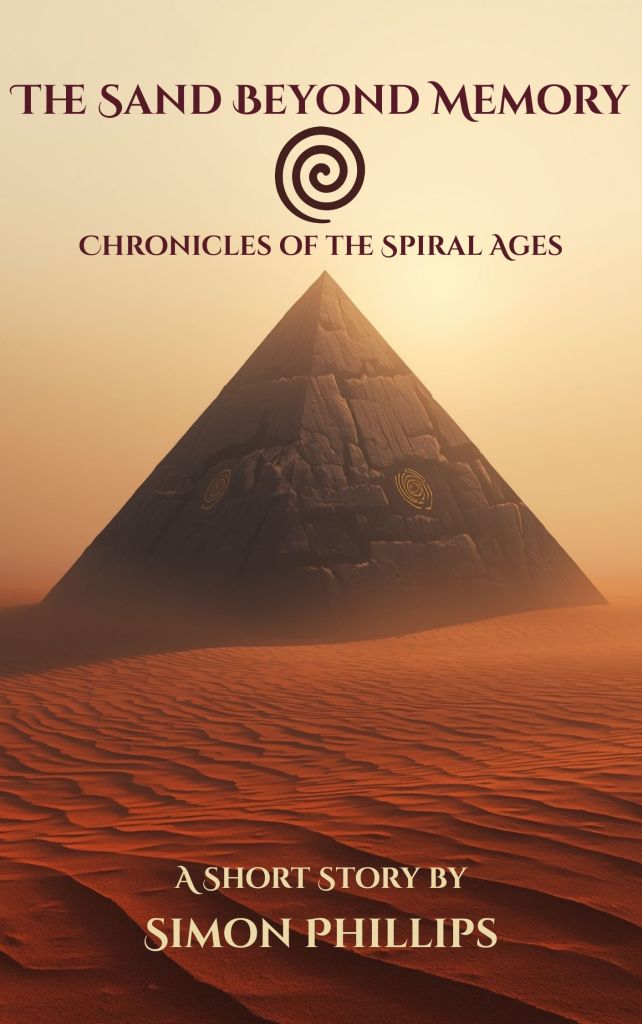
The opening entry within the Chronicles of the Spiral Ages timeline explores this early world through the novella The Sand Beyond Memory. Set within the deep desert of the Stone Age, the story follows a migrating tribe as they encounter a monument whose origin lies far beyond their understanding.
Within the red basin where the desert winds carve endless dunes, a broken pyramid rises from the sand. Time has stripped the monument of its upper form, leaving fractured stone blocks and eroded carvings exposed to the sky. No living tribe remembers who raised it. Even the oldest storytellers speak only in fragments.
For the travellers who discover it, the structure becomes a source of both curiosity and unease. Its scale suggests a civilisation older than any living memory. Its carvings hint at symbols that feel strangely familiar, even to people who have never seen them before.
Through this encounter, the novella explores the earliest tension between instinct and belief. The tribe carries its own traditions, shaped through migration and survival, yet the monument suggests a deeper past that challenges those inherited stories.
Rather than presenting the Stone Age as a primitive world, the story treats it as a formative moment in human memory. The characters stand at the edge of something larger than themselves. They sense the presence of an earlier civilisation without possessing the knowledge required to interpret it.
This quiet confrontation with the unknown forms the emotional centre of the novella. The landscape itself becomes a witness to forgotten ages, while the Spiral symbol begins its long journey through history.
Readers interested in exploring the story itself can find the novella here:
https://www.amazon.com/dp/B0GGXBP8G6
A Fragment Preserved in Motion: The Illustrated Mini-Read
Alongside the written novella, a brief illustrated mini-read offers a glimpse into the atmosphere of this early age. The video functions less as a summary and more as a preserved moment from the world itself.
The sequence focuses on a single fragment of experience within the desert landscape. Dust drifts across the broken monument. Light moves across eroded stone surfaces. The tribe approaches the structure slowly, uncertain whether the place carries danger or meaning.
Within the broader ancient civilisation fantasy setting, such moments hold unusual power. They capture the emotional texture of the story without revealing its deeper transformation. The viewer stands beside the travellers, sensing the presence of history beneath the sand.
This short visual fragment acts as a threshold into the wider world of Chronicles of the Spiral Ages, offering a brief immersion into the earliest chapter of the timeline.
You can view the illustrated mini-read here:
The Spiral Across the Ages
The Stone Age marks only the beginning of the larger timeline explored throughout the Chronicles of the Spiral Ages series. As centuries pass, new cultures emerge across distant regions. Metallurgy reshapes tools and weapons. Trade routes connect societies that once lived in isolation. Kingdoms rise beside rivers and coastlines.
Yet the Spiral continues to appear.
Sometimes it emerges as a sacred carving within temple walls. Sometimes it appears within pottery or woven cloth. In other eras it becomes a philosophical symbol associated with the passage of time itself.
Each appearance suggests continuity across generations who possess no direct knowledge of one another. The symbol survives because memory itself survives. Even when languages fade and cultures disappear, traces remain embedded within tradition and myth.
Through this long historical arc, the Spiral becomes a quiet witness to humanity’s unfolding story. It represents the persistence of meaning across centuries, a reminder that even the smallest discoveries in the earliest ages can ripple outward across time.
A Story That Begins Before History
Stories set in the earliest ages of humanity carry a unique atmosphere. They unfold in worlds where the future remains entirely unknown and where every discovery might shape the direction of civilisation.
Stone Age fantasy fiction therefore invites readers to step into a moment when myth itself still waits to be born. Symbols appear without explanation. Landscapes conceal fragments of forgotten worlds. Every encounter with the unknown becomes part of a larger historical memory.
Within Chronicles of the Spiral Ages, The Sand Beyond Memory stands as the first step into that long journey through time. The desert monument, the Spiral carving, and the quiet uncertainty felt by the travellers form the beginning of a much larger narrative stretching across centuries.
The earliest ages rarely leave written records, yet their influence lingers in the stories told by later civilisations. By returning to that distant beginning, the series explores how myth grows from memory and how symbols endure long after the voices that first carved them have faded.
Across the red desert basin, the wind continues to move across the broken pyramid. Sand drifts slowly against stone that has watched countless generations pass. Beneath those ancient carvings, the Spiral waits patiently for the ages that will follow.
 Simon J. Phillips