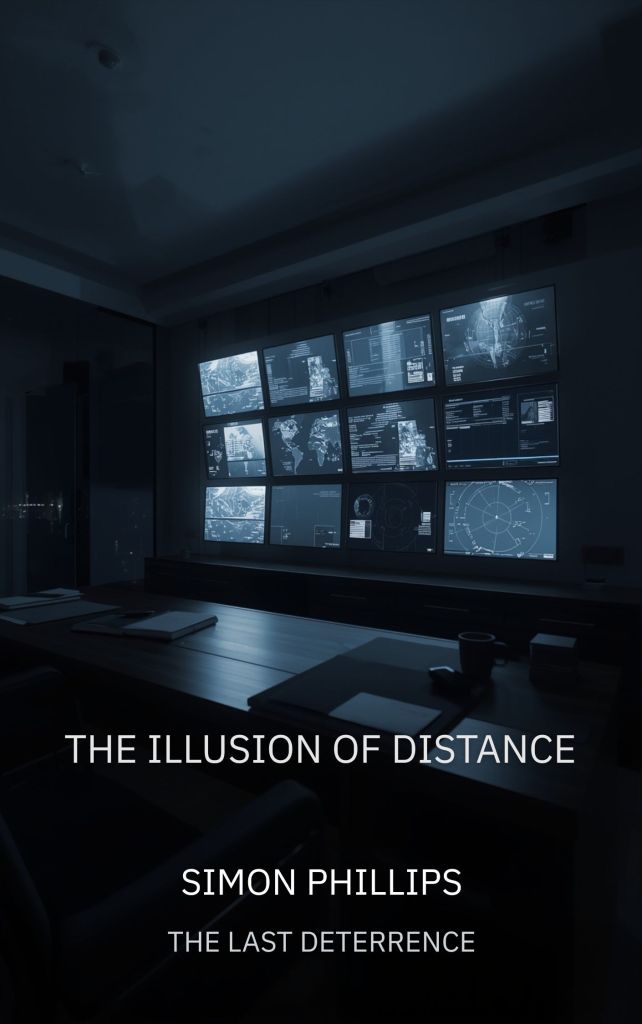
The Last Deterrence: The Illusion of Distance, Near-Future War, Civilian Proximity, and the Stories We Tell Ourselves

In The Last Deterrence: The Illusion of Distance, the world does not end with sirens or fire. It continues. Kettles boil. Trains run. Radios speak in careful language shaped to sit beside dinner and routine. The disruption arrives through phrasing, updates, and reassurances that feel almost familiar enough to trust.

The novella follows Daniel Mercer, his wife Helen, and their daughter Maya as global escalation begins to press closer to domestic life. Daniel works inside the systems that observe and interpret events unfolding across Eastern Europe. At home, those same events appear only as softened language and revised maps, their edges smoothed to prevent alarm. The distance feels stable at first. That belief carries weight. It shapes how days unfold, how evenings settle, and how much attention feels necessary.

This story focuses on the civilian edge of escalation. It explores how institutions manage uncertainty, how reassurance becomes routine, and how belief in insulation holds until it no longer does. Nothing arrives as a single decisive moment. Change accumulates through continuity. Maps widen by degrees too small to argue with. Language moves forward without announcing itself as movement.

Alongside the novella, a series of flash-fiction scenes and cinematic micro-moments exist as extensions of the same world. These fragments are not summaries or trailers. They are lifted instants from inside the narrative: a pause at a study door, a radio speaking steadily, a screen adjusting itself without comment. Each piece functions as a threshold, offering a way into the larger story without resolving it.

The flash-fiction exists to mirror how escalation enters the lives of the characters themselves. Indirectly. Quietly. Through moments that feel ordinary until they no longer hold. When experienced alongside the novella, these scenes reinforce the sense that the story continues even when the page turns away.

The Illusion of Distance belongs to a broader near-future speculative war sequence concerned with civilian proximity to power, institutional hesitation, and the slow erosion of certainty. It avoids spectacle in favour of process. It remains grounded in domestic spaces where decisions made elsewhere arrive through language long before consequence becomes visible.

The full novella is available here:
https://www.amazon.com/dp/B0GKXBDKVB

Readers drawn to near-future war fiction, political speculative fiction, civilian perspectives on conflict, and restrained narrative tension will find this story unfolds through accumulation rather than shock. The distance feels real. That belief shapes everything that follows.

The Last Deterrence: The Illusion of Distance is near-future speculative fiction about escalation, reassurance, and the moment belief fails.

Writing Through Illness Keeping the Flame Lit

There’s a particular stillness to the house when one is unwell. The windows dim, the hours stretch thin, and even the simple act of sitting at a desk becomes a task weighed with strange solemnity. Over the past week, I’ve been writing through a heavy spell of illness, not the romantic sort that lends itself to poetic fever-dreams and sudden inspiration, but the ordinary kind. The draining, silent kind. Head fog, aching bones, and the slow drag of breath.

And still, the story asks to be told.

It hasn’t been easy. The rhythm of my chapters, those long, rolling sentences that mirror the breath of the world I’m building, do not come quickly when my mind is wrapped in cotton. Dialogue feels slower to surface, the flow of magic across a battlefield takes more effort to visualise, and Simion’s thoughts… his weariness starts to echo my own. Yet somehow, that makes the writing more honest. There’s no room for pretense when you are sick. What emerges on the page feels stripped back to truth.

There’s comfort in the discipline, too. Even a few hundred words become a kind of anchor. I’ve been working steadily through Chapter 31, part by part, and while I’ve not progressed at my usual pace, I’ve remained in the world. That matters more than anything. Staying inside the rhythm of the novel, no matter how slowly, prevents the silence from becoming distance. And when you are tired, truly tired, that distance grows fast.

This post is not a grand revelation, nor a triumphant declaration of productivity. It is simply a mark on the wall. A quiet signal that the story lives, even on days when the author does not feel particularly alive himself. If you are also working through something, whether a cold, a long week, or a deeper weariness, I hope you remember this: words written under strain are still worthy. They still carry weight. And sometimes, they carry more of you than you realise.

I’ll return to the cliff’s edge soon, where Simion waits beside those ancient stones. There is much still to tell.

Until then, rest, breathe, and if you can, keep the flame lit.

Writing While Working Two Jobs: Why I Still Do It

People often ask me how I find the time to write while working two jobs. The short answer is: I don’t. Not really. Not the way I wish I could. But I do write, every week, sometimes every day, usually when I should be resting. And despite the exhaustion, the long nights, the early mornings, and the occasional doubt, I keep going. Because the story matters.

The Chaos Behind the Chapters

Right now, my life is split between running a small school, working night shifts, and squeezing in writing during stolen hours. Most days, I get by on sheer routine. Coffee helps. So does knowing that every chapter I finish brings me one step closer to the book I’ve dreamed of releasing for years: The Veil of Kings and Gods.

I’m not writing from a cabin in the woods or some serene studio. I’m writing at school, on the dinning room table, between shifts, and late into the night when everything else is quiet. This novel is being built between real life’s demands and that, in a strange way, makes it even more personal.

Why Not Wait?

It would be easy to say, “I’ll write when life slows down.” But the truth is, life might not. And if I wait for the perfect time, I might never finish the story I’ve already poured so much of myself into.

So instead, I chip away. One scene, one chapter, one revision at a time. And you know what? That consistency adds up. Even if I’m tired. Even if I sometimes question whether it’s worth it.

The Deeper Reason

I write because I love this world I’ve created. I believe in the characters. Simion, Elana, the fractured kingdoms of Ældorra, they’ve stayed with me through everything. And if they’ve stayed with me, maybe they’ll stay with readers too.

Writing gives me a sense of purpose beyond the day-to-day. It’s a reminder that I’m building something for myself, something that might one day outlive the jobs, the side gigs, and even the fatigue.

If You’re in the Same Boat

To anyone reading this who’s also juggling too much while trying to create something: keep going. Your work is valid, even if it’s slow. Even if it’s messy. Even if no one sees it yet. Just showing up matters.

What’s Next?

I’ve just finished proofreading and editing three more chapters, and it’s starting to feel real. I’ll be sharing more about the process and the book itself, both here and on my YouTube channel soon. If you’re curious about how a fantasy novel gets written under pressure (and often after midnight), subscribe or follow along.

Until then, thank you for reading, and thank you for letting me share this chaotic, hopeful journey.