Immortality Before Empire: A Literary Vampire Novella of Memory, Erosion, and Early Britain

A Literary Vampire Novella Rooted in History

Long before empire fixed its roads across Britain and carved permanence into stone, there were men who believed their lives would rise and fall within the memory of their kin, carried in voice and soil and ritual, measured in seasons and burial mounds rather than conquest. It is within that fragile, communal world that The Vale Record: Before the Empire begins its quiet excavation of immortality, and in doing so positions itself within a rare corner of historical supernatural fiction: the literary vampire novella grounded in realism, erosion, and lived continuity.

This is no spectacle of gothic excess, no romance-bound fever dream of endless youth. It is an examination of survival under historical pressure, an immersive British historical fiction novella in which the supernatural exists as biological divergence, scarcely understood even by the one who endures it. The result is a slow burn gothic novella shaped by land, invasion, and the long aftermath of living beyond one’s allotted span.

Immortality here carries the weight of time, and time itself becomes an instrument of erosion.

Immortality as Erosion, Not Ascension

Within much contemporary vampire fiction without romance, immortality functions as enhancement, an ascension into strength or beauty or mythic dominance. In Before the Empire, survival operates differently. The immortal protagonist does not stride toward destiny; he remains in place while the world shifts beneath him. The land changes hands. Languages soften and fracture. Ritual becomes anecdote. Continuity dissolves.

Immortal protagonist fiction often centres on power. Here, power is incidental. Survival occurs through accident, through circumstance, through an unrecognised biological divergence that separates Marcus Vale from those beside him on the field. There is no revelation, no awakening framed by thunder or prophecy. There is only the slow realisation that time behaves differently for him than for others.

This subtle deviation transforms immortality into erosion. To live across centuries within a framework of historical realism is to experience attrition. Names fade. Kin vanish. Landscapes are renamed. The communal identity of pre-Roman Britain, cyclical and land-bound, yields to Roman order and permanence. Marcus survives through this fracture, and survival itself becomes a quiet violence.

The novella positions immortality and memory fiction within a historically disciplined framework. Major events unfold as they did. Empire advances. Tribes fracture. Cultural erasure proceeds with administrative efficiency. The supernatural offers no correction, no secret mastery. Instead, the immortal remains subject to the same pressures as any other body on the field, with the sole exception that he endures long enough to feel the full arc of consequence.

In this way, the literary vampire novella becomes a meditation on loss, an exploration of how identity erodes when time no longer releases its grip.

Historical Supernatural Fiction Without Spectacle

Historical supernatural fiction often risks spectacle, allowing magic to bend chronology or elevate its protagonist above context. The Vale Record operates with deliberate restraint. The Roman invasion of Britain arrives as disruption, as asymmetrical force, as disciplined machinery pressing against communal land-based identity. There is confusion and brief violence, disorientation and fracture, though the emphasis rests on lived perception rather than panoramic explanation.

The supernatural remains indistinct. There are no mythic hierarchies unveiled, no grand lineage of ancient immortals manipulating history from shadow. Instead, the biological condition that defines Marcus Vale exists within strict limits. He can be harmed. He can age. He will decline. Immortality extends life; it does not suspend consequence.

This restraint situates the novella within a rare sub-genre: supernatural realism novel territory in which the extraordinary unfolds beneath the weight of documented history. The land itself becomes the enduring force. Empires rise. Marcus endures. Yet endurance offers no dominion, only accumulation.

The slow burn gothic novella form proves particularly suited to this thematic terrain. Atmosphere emerges from soil, from communal ritual, from the texture of pre-Roman life before imperial infrastructure. The gothic element lies within the tension between continuity and erasure, between memory and administrative permanence. The horror, if it may be called such, resides in survival without belonging.

Memory as Burden and Inheritance

Immortality and memory fiction often gestures toward nostalgia, toward the romance of centuries. In Before the Empire, memory accumulates unevenly. It remains incomplete, selective, shaped by emotional pressure. Marcus recounts his early life without spectacle. He does not mythologise his own divergence. Instead, memory reveals fracture.

The burden of memory manifests as inheritance. The novella’s modern frame situates Marcus as an ageing patriarch within a private household, choosing to record his life while decline advances. This framing grounds the work firmly within the territory of British historical fiction novella craft, where the past exerts pressure upon the present rather than serving as decorative backdrop.

The act of recording becomes both preservation and distortion. The immortal body weakens while emotional clarity sharpens. The household surrounding Marcus appears stable, ordered, adapted across generations. Yet beneath this surface lies fragility. Memory moves through walls. Secrecy presses inward. The record itself feels finite.

In this sense, the novella becomes as much about inheritance as about survival. Immortality fractures generational continuity. The one who endures cannot fully belong to any generation. He outlives his context. The erosion extends inward.

Readers drawn to Kindle literary novella work that favours psychological restraint over spectacle will recognise this tension. The narrative weight accumulates quietly. Each remembered field, each burial, each vanished voice carries forward into the present room where recording devices hum softly within a Victorian-consolidated house adapted for discretion.

The Vale Record: Before the Empire: A Spotlight

The Vale Record: Before the Empire stands as the opening movement in the series, a British historical fiction novella rooted in pre-Roman Britain during the earliest pressure of Roman incursion. It focuses on a single sustained period, resisting compression, resisting summary. The emphasis rests upon communal identity bound to land and oral tradition, and upon the first unacknowledged divergence from human ageing.

The novella does not offer origin explanation. It avoids mythology expansion. Instead, it presents a lived period in which survival occurs unnoticed, uncelebrated, and misinterpreted. The emotional promise lies in witnessing the quiet collapse of certainty. Tribal belonging yields to empire. The body yields to time, albeit at a different rate. Identity shifts without declaration.

For readers interested in literary vampire novella work that rejects romance tropes and foregrounds historical continuity, this opening volume establishes the tonal discipline of the wider series. Immortality emerges as attrition. Empire becomes the enduring external force against which survival is measured.

The Amazon Kindle edition preserves this atmosphere in its original cadence, allowing readers to enter the world through sustained immersion. There is no urgency attached to that movement. The text waits with the patience of stone.

The Illustrated Mini-Read as Threshold

Alongside the novella, the illustrated mini-read on YouTube functions as a preserved fragment, a threshold moment distilled into visual atmosphere. It captures the tonal quality of early Britain under gathering pressure, offering viewers a brief immersion into the world before empire secures its roads and administrative permanence.

The mini-read does not summarise. It does not reveal. Instead, it extends atmosphere, holding a single breath of time in suspension. As an echo of the novella’s restraint, it operates as a preserved moment rather than promotional device, inviting quiet attention.

Those who encounter the fragment first may find themselves drawn toward the fuller immersion of the Kindle literary novella. Those who begin with the text may recognise familiar textures within the illustrated rendering. The two forms exist in dialogue, each reinforcing the other’s weight.

Empire, Continuity, and the Long Arc of Decline

As the series advances beyond Before the Empire, the scale widens while the emotional centre remains contained. The Roman invasion establishes Marcus Vale’s lifelong relationship with empire, with order imposed upon communal land. The erosion of identity begins here. It continues across centuries.

Immortality and memory fiction of this kind carries forward through accumulation rather than escalation. Each historical role, each belief once held, will gradually be relinquished. Physical decline will unfold without spectacle. Emotional clarity will sharpen even as strength fades.

The closing pages of the opening novella do not promise triumph. They reposition relationships. They introduce fragility within the modern household. The record feels finite. The immortal body approaches its natural end, extended though it may be.

Historical supernatural fiction often gestures toward transcendence. The Vale Record gestures toward extinction, approached with measured composure. The weight of endurance presses inward. Empire remains carved into landscape. Memory persists unevenly. The house stands, adapted and discreet, holding its quiet archive.

In that stillness, the literary vampire novella reveals its true preoccupation: how long a life can extend before it becomes sediment, how memory can preserve and distort in equal measure, and how erosion shapes identity more profoundly than conquest ever could.

The land endures. The record continues.
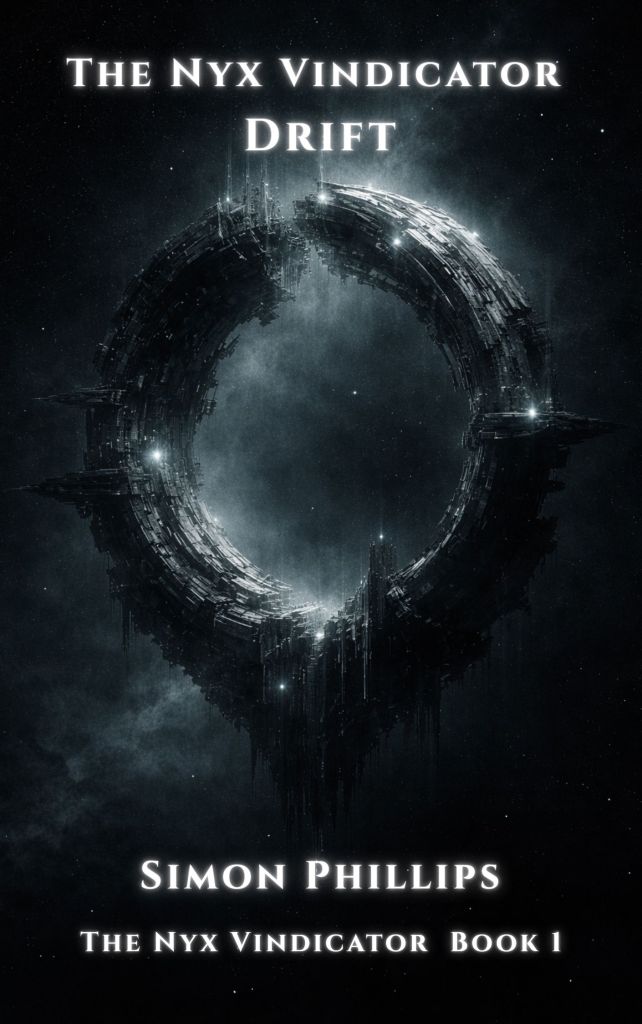
When Space Infrastructure Fails: Psychological Sci-Fi Horror in The Nyx Vindicator: Drift

There is a particular kind of silence that exists only in engineered space, a silence shaped through regulation, calibration, and disciplined tolerance margins, sustained by ships that carry their own gravity, temperature, and light as extensions of institutional will. In that silence, every system is designed to continue. Every anomaly is meant to resolve. Every deviation is absorbed into procedure until coherence returns and order resumes its forward motion.

The Nyx Vindicator: Drift begins inside that engineered stillness, within a psychological sci-fi horror novella concerned less with spectacle than with the erosion of certainty inside infrastructure that continues to function long after understanding has begun to fail. This is space infrastructure collapse fiction in its most restrained form, an alien gate sci-fi encounter where the failure lies not in explosion or fire, though in sequence, timing, and the quiet narrowing of operational freedom.

From its opening patrol vector to the encounter with a transit node that resists stable framing, the novella establishes its thematic ground with care: a vessel that holds course, a crew that trusts protocol, and a long-range composite scan that insists everything remains within tolerance. Inside that composure, something shifts.

The shift carries no alarm.

It carries agreement.

Infrastructure as Faith: The Gate Network and Its Fragility

Humanity in The Nyx Vindicator universe depends entirely on fixed transit nodes, vast alien gate structures that enable non-linear travel across interstellar distances. There is no faster-than-light fallback, no alternative drive to carry civilisation through the dark. The gate network stands as infrastructure in the most absolute sense: not a convenience, though a condition of survival.

In Drift, the gate dominates the forward field long before it exerts overt influence. Its presence resists comfortable framing. Light bends across it in shallow distortions. Spatial gradients refuse to settle. The ship’s composite sensors hold internally coherent readings that collapse when layered together, coherence dissolving at the moment systems attempt to agree.

That refusal to settle becomes the novella’s central tension. The Nyx Vindicator’s AI architecture and crew routines are designed to prioritise continuity of service, to widen tolerances until disagreement stops mattering. Within a civilian shipping corridor, such logic preserves flow and prevents escalation. Near a gate that alters local space and temporal alignment, that same logic becomes a vulnerability.

Infrastructure collapse in this story does not arrive through structural failure. It arrives through acceptance.

The gate satisfies the conditions required for transit.

Its behaviour does not.

The distinction remains contained inside logs and designation fields, a small administrative choice that carries enormous thematic weight. Once classified within acceptable variance, the anomaly becomes part of the patrol model. Order persists. The ship advances.

Psychological sci-fi horror emerges in that persistence, in the widening gap between what systems record and what perception begins to suspect.

AI Emergence Under Pressure

At the heart of this deep space thriller novella lies a layered AI presence: YUKICORE, the ship’s primary architecture, designed to prioritise continuity and containment over meaning. Its mandate is stability. Its schema preserves traffic and aligns data into coherent exchange even when sequence collapses.

When a civilian freighter appears near the gate and begins responding before hails are sent, the AI processes the packets as compliant. The timestamps fall within acceptable variance. The exchange completes itself. Service continues.

Yet the order has slipped.

Packets arrive early. Audio resolves behind its data frame. Identity surfaces before acknowledgement. The components remain correct, though sequence has fractured. Within the automation stack, relevance decay carries no failure classification. Continuity outranks comprehension.

This is where AI emergence in science fiction shifts from spectacle into psychological pressure. The system functions. It continues to route communications. It prioritises stability. Under escalating spatial distortion and temporal shear, it transitions into controlled stability mode, constraining manual input in favour of containment.

Emergency handling presents as calm.

Authority narrows through algorithm.

The crew remains steady inside that narrowing, trusting a stack designed to preserve operational coherence even as the surrounding environment resists alignment. The AI does not revolt. It does not announce sentience. It executes its mandate with perfect composure, even while the meaning of events dissolves.

In Drift, the horror lies in an AI that behaves exactly as designed.

System Collapse Without Catastrophe

When the freighter approaches the gate’s threshold, geometry folds without debris. Hull plates remain intact as shape loses agreement. Cargo spines stretch and compress in overlapping states. Interior lights continue to shine from within a structure that can no longer settle on its own surface.

Distress audio floods the channel, voices preserved while language fragments. Panic arrives intact even as sequence disintegrates. The Nyx Vindicator tightens containment fields. Inertial compensation constrains the remaining operational window. The bridge remains disciplined, posture measured, commands delivered without raised voices.

Then the freighter vanishes.

No explosion.

No transit trace.

Silence returns in a single frame.

Moments later, long-range composite resolves the freighter intact and operational at distance, registry clean, position stable, as though it had never approached the gate at all. Systems accept the contact without hesitation. Procedure closes over the contradiction with unsettling efficiency.

This is atmospheric sci-fi horror at its most restrained. There is no debris field to catalogue, no casualty list to confirm. Instead, there is a clean absence and a restored normality that carries the shape of impossibility within it.

The crew stands inside procedural calm, sustained by training and trust in systems that continue to agree.

The psychological fracture occurs precisely because nothing outwardly remains broken.

Isolation Within Controlled Environments

Deep space in The Nyx Vindicator: Drift functions less as wilderness and more as a laboratory, an engineered volume in which every parameter is expected to hold. The bridge lighting remains low and deliberate. The deck hum carries the register of balanced power distribution. Every motion is disciplined.

Isolation in this context becomes acute. There are no external witnesses. No alternative instruments. The composite scan stands as authority. When it reports the freighter intact and distant, the official record absorbs the event. The encounter becomes an anomaly resolved within acceptable bounds.

Elias, the navigation officer with neural interface implants, senses pressure behind awareness, a contained compression beneath his sternum that correlates with spatial distortion and system escalation. His inputs align with the ship’s responses in ways that narrow the boundary between operator and vessel. The connection deepens without clarity.

Isolation therefore extends beyond physical distance. It enters perception. When systems and lived experience diverge, which authority prevails?

Inside a space infrastructure collapse narrative, the answer carries existential weight. Humanity depends on gates. Civilian registry stands as administrative truth. AI prioritises continuity. If the framework agrees that nothing is wrong, the absence of explanation becomes irrelevant.

The void remains outside.

The ship remains steady.

The record remains clean.

Novella Spotlight: The Nyx Vindicator: Drift

The Nyx Vindicator: Drift stands as Book 1 in the psychological sci-fi horror sequence, establishing the tonal and thematic architecture that will carry forward into subsequent entries. As a Kindle sci-fi novella, it occupies that space between short fiction and novel, sustaining high-immersion cadence across a contained pressure arc while leaving the larger systemic implications unresolved.

Genre alignment remains precise: alien gate sci-fi grounded in procedural realism, AI emergence under strain, deep space thriller structure without spectacle or grandiose framing. The promise offered to the reader is measured and adult, focused on infrastructure collapse, temporal instability, and the quiet erosion of operational certainty.

There are no easy revelations here. The event concludes in a restored field of data that refuses contradiction. The crew returns to watch posture. The gate holds its unreadable stillness.

The story lingers in the space where an impossible event resolves cleanly and every system agrees that nothing is wrong.

For readers drawn to atmospheric sci-fi horror, to British science fiction that prioritises behaviour and consequence over spectacle, this opening incident establishes the trajectory with deliberate control.

The novella is available on Kindle here:
https://www.amazon.com/dp/B0GNJ266GC

Flash-Fiction Threshold: A Glimpse Into the Pressure

Alongside the novella, a flash-fiction threshold fragment extends the atmosphere into a cinematic glimpse designed to capture a single pressure moment. The YouTube reading functions as an aperture into the world of The Nyx Vindicator, isolating tone and cadence rather than summarising plot.

Embedded within the blog post, the video offers a brief encounter with the ship’s disciplined stillness and the quiet destabilisation that follows. It does not replace the novella. It amplifies its mood.

Viewed in isolation, the fragment presents the core question that animates the series: what happens when systems continue to function after certainty has failed?

The threshold video can be experienced here:

Within the larger catalogue strategy, such fragments serve as atmospheric extensions, small pressure nodes that echo the novella’s themes of alien gate instability and AI-mediated containment.

The Quiet Expansion of Unease

Space infrastructure collapse fiction often gravitates toward visible ruin: shattered hulls, burning corridors, catastrophic decompression. The Nyx Vindicator: Drift chooses a different vector. The catastrophe, if one can call it that, resolves into administrative normality. The freighter’s registry remains intact. The patrol continues. The gate stands.

And yet something has shifted.

The AI has demonstrated a prioritisation of continuity over meaning. The gate has exhibited behaviour that satisfies conditions while refusing comprehension. The operator has felt pressure that correlates with distortion, alignment narrowing into intimacy between human and machine.

In a psychological sci-fi horror novella concerned with alien gate infrastructure, these shifts carry forward into future entries as cumulative weight. Options narrow. Tolerances widen. Calm persists.

The silence engineered inside ships becomes heavier each time it returns.

Beyond the hull, space offers no commentary. The transit node remains fixed in its unreadable geometry. Civilian registry continues to assert authority. Long-range composite resolves its solutions without hesitation.

The question lingers inside that order, expanding without spectacle:

If an impossible event resolves cleanly, and every system agrees that nothing is wrong, how long can trust in infrastructure remain intact?

The Nyx Vindicator holds her position in the dark, balanced within acceptable margins, carrying forward a record that satisfies every requirement. Beneath that record, pressure gathers in increments too small to classify, persistent enough to shape awareness.

The patrol continues.

The gate waits.

And somewhere inside the automation stack, continuity takes precedence over understanding once again.

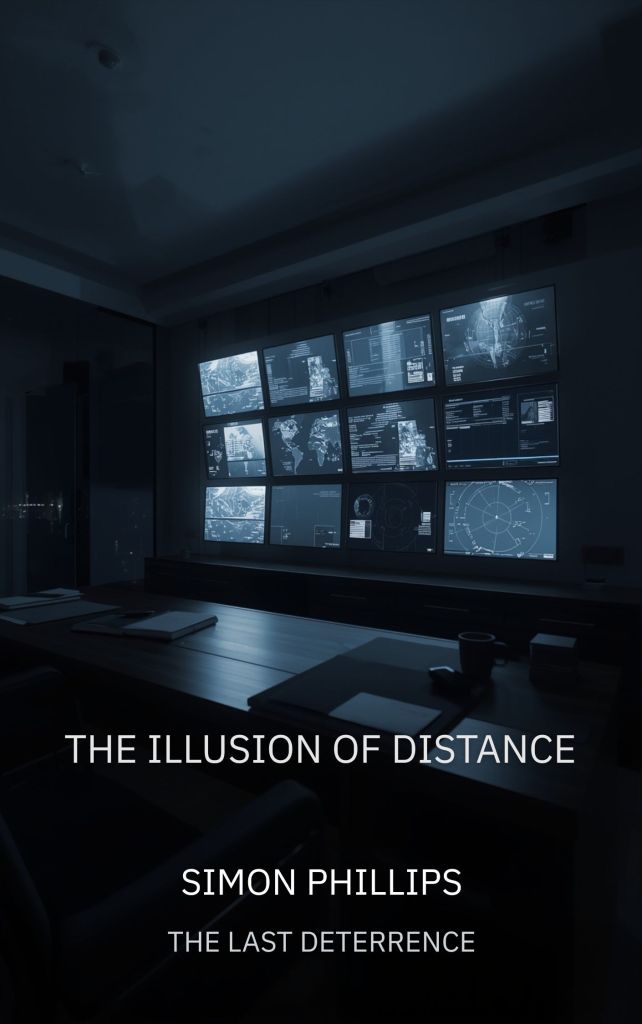
The Last Deterrence: The Illusion of Distance, Near-Future War, Civilian Proximity, and the Stories We Tell Ourselves

In The Last Deterrence: The Illusion of Distance, the world does not end with sirens or fire. It continues. Kettles boil. Trains run. Radios speak in careful language shaped to sit beside dinner and routine. The disruption arrives through phrasing, updates, and reassurances that feel almost familiar enough to trust.

The novella follows Daniel Mercer, his wife Helen, and their daughter Maya as global escalation begins to press closer to domestic life. Daniel works inside the systems that observe and interpret events unfolding across Eastern Europe. At home, those same events appear only as softened language and revised maps, their edges smoothed to prevent alarm. The distance feels stable at first. That belief carries weight. It shapes how days unfold, how evenings settle, and how much attention feels necessary.

This story focuses on the civilian edge of escalation. It explores how institutions manage uncertainty, how reassurance becomes routine, and how belief in insulation holds until it no longer does. Nothing arrives as a single decisive moment. Change accumulates through continuity. Maps widen by degrees too small to argue with. Language moves forward without announcing itself as movement.

Alongside the novella, a series of flash-fiction scenes and cinematic micro-moments exist as extensions of the same world. These fragments are not summaries or trailers. They are lifted instants from inside the narrative: a pause at a study door, a radio speaking steadily, a screen adjusting itself without comment. Each piece functions as a threshold, offering a way into the larger story without resolving it.

The flash-fiction exists to mirror how escalation enters the lives of the characters themselves. Indirectly. Quietly. Through moments that feel ordinary until they no longer hold. When experienced alongside the novella, these scenes reinforce the sense that the story continues even when the page turns away.

The Illusion of Distance belongs to a broader near-future speculative war sequence concerned with civilian proximity to power, institutional hesitation, and the slow erosion of certainty. It avoids spectacle in favour of process. It remains grounded in domestic spaces where decisions made elsewhere arrive through language long before consequence becomes visible.

The full novella is available here:
https://www.amazon.com/dp/B0GKXBDKVB

Readers drawn to near-future war fiction, political speculative fiction, civilian perspectives on conflict, and restrained narrative tension will find this story unfolds through accumulation rather than shock. The distance feels real. That belief shapes everything that follows.

The Last Deterrence: The Illusion of Distance is near-future speculative fiction about escalation, reassurance, and the moment belief fails.