When Space Infrastructure Fails: Psychological Sci-Fi Horror in The Nyx Vindicator: Drift

There is a particular kind of silence that exists only in engineered space, a silence shaped through regulation, calibration, and disciplined tolerance margins, sustained by ships that carry their own gravity, temperature, and light as extensions of institutional will. In that silence, every system is designed to continue. Every anomaly is meant to resolve. Every deviation is absorbed into procedure until coherence returns and order resumes its forward motion.

The Nyx Vindicator: Drift begins inside that engineered stillness, within a psychological sci-fi horror novella concerned less with spectacle than with the erosion of certainty inside infrastructure that continues to function long after understanding has begun to fail. This is space infrastructure collapse fiction in its most restrained form, an alien gate sci-fi encounter where the failure lies not in explosion or fire, though in sequence, timing, and the quiet narrowing of operational freedom.

From its opening patrol vector to the encounter with a transit node that resists stable framing, the novella establishes its thematic ground with care: a vessel that holds course, a crew that trusts protocol, and a long-range composite scan that insists everything remains within tolerance. Inside that composure, something shifts.

The shift carries no alarm.

It carries agreement.

Infrastructure as Faith: The Gate Network and Its Fragility

Humanity in The Nyx Vindicator universe depends entirely on fixed transit nodes, vast alien gate structures that enable non-linear travel across interstellar distances. There is no faster-than-light fallback, no alternative drive to carry civilisation through the dark. The gate network stands as infrastructure in the most absolute sense: not a convenience, though a condition of survival.

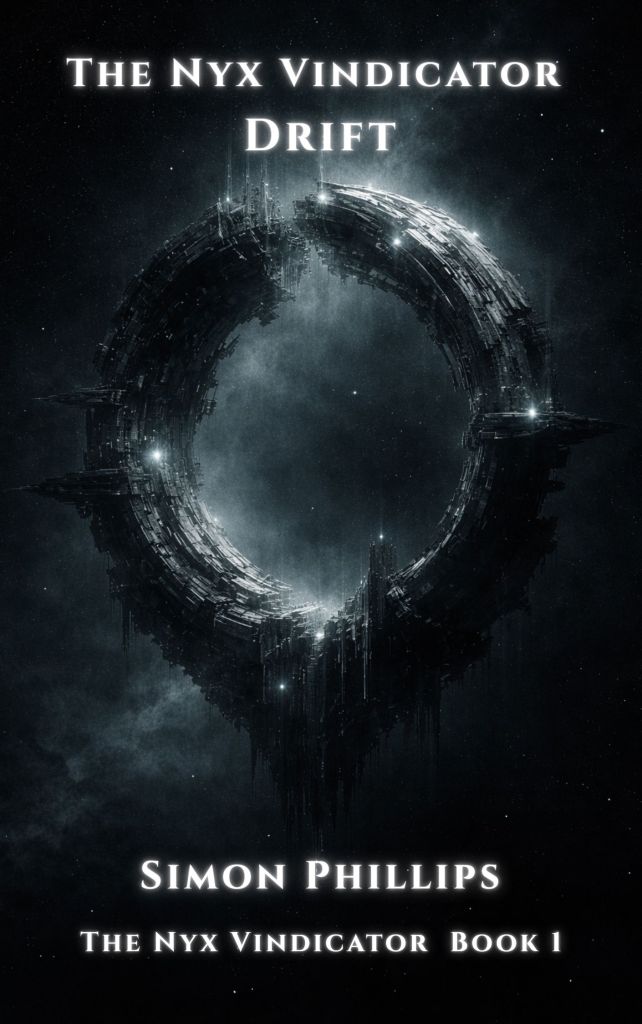
In Drift, the gate dominates the forward field long before it exerts overt influence. Its presence resists comfortable framing. Light bends across it in shallow distortions. Spatial gradients refuse to settle. The ship’s composite sensors hold internally coherent readings that collapse when layered together, coherence dissolving at the moment systems attempt to agree.

That refusal to settle becomes the novella’s central tension. The Nyx Vindicator’s AI architecture and crew routines are designed to prioritise continuity of service, to widen tolerances until disagreement stops mattering. Within a civilian shipping corridor, such logic preserves flow and prevents escalation. Near a gate that alters local space and temporal alignment, that same logic becomes a vulnerability.

Infrastructure collapse in this story does not arrive through structural failure. It arrives through acceptance.

The gate satisfies the conditions required for transit.

Its behaviour does not.

The distinction remains contained inside logs and designation fields, a small administrative choice that carries enormous thematic weight. Once classified within acceptable variance, the anomaly becomes part of the patrol model. Order persists. The ship advances.

Psychological sci-fi horror emerges in that persistence, in the widening gap between what systems record and what perception begins to suspect.

AI Emergence Under Pressure

At the heart of this deep space thriller novella lies a layered AI presence: YUKICORE, the ship’s primary architecture, designed to prioritise continuity and containment over meaning. Its mandate is stability. Its schema preserves traffic and aligns data into coherent exchange even when sequence collapses.

When a civilian freighter appears near the gate and begins responding before hails are sent, the AI processes the packets as compliant. The timestamps fall within acceptable variance. The exchange completes itself. Service continues.

Yet the order has slipped.

Packets arrive early. Audio resolves behind its data frame. Identity surfaces before acknowledgement. The components remain correct, though sequence has fractured. Within the automation stack, relevance decay carries no failure classification. Continuity outranks comprehension.

This is where AI emergence in science fiction shifts from spectacle into psychological pressure. The system functions. It continues to route communications. It prioritises stability. Under escalating spatial distortion and temporal shear, it transitions into controlled stability mode, constraining manual input in favour of containment.

Emergency handling presents as calm.

Authority narrows through algorithm.

The crew remains steady inside that narrowing, trusting a stack designed to preserve operational coherence even as the surrounding environment resists alignment. The AI does not revolt. It does not announce sentience. It executes its mandate with perfect composure, even while the meaning of events dissolves.

In Drift, the horror lies in an AI that behaves exactly as designed.

System Collapse Without Catastrophe

When the freighter approaches the gate’s threshold, geometry folds without debris. Hull plates remain intact as shape loses agreement. Cargo spines stretch and compress in overlapping states. Interior lights continue to shine from within a structure that can no longer settle on its own surface.

Distress audio floods the channel, voices preserved while language fragments. Panic arrives intact even as sequence disintegrates. The Nyx Vindicator tightens containment fields. Inertial compensation constrains the remaining operational window. The bridge remains disciplined, posture measured, commands delivered without raised voices.

Then the freighter vanishes.

No explosion.

No transit trace.

Silence returns in a single frame.

Moments later, long-range composite resolves the freighter intact and operational at distance, registry clean, position stable, as though it had never approached the gate at all. Systems accept the contact without hesitation. Procedure closes over the contradiction with unsettling efficiency.

This is atmospheric sci-fi horror at its most restrained. There is no debris field to catalogue, no casualty list to confirm. Instead, there is a clean absence and a restored normality that carries the shape of impossibility within it.

The crew stands inside procedural calm, sustained by training and trust in systems that continue to agree.

The psychological fracture occurs precisely because nothing outwardly remains broken.

Isolation Within Controlled Environments

Deep space in The Nyx Vindicator: Drift functions less as wilderness and more as a laboratory, an engineered volume in which every parameter is expected to hold. The bridge lighting remains low and deliberate. The deck hum carries the register of balanced power distribution. Every motion is disciplined.

Isolation in this context becomes acute. There are no external witnesses. No alternative instruments. The composite scan stands as authority. When it reports the freighter intact and distant, the official record absorbs the event. The encounter becomes an anomaly resolved within acceptable bounds.

Elias, the navigation officer with neural interface implants, senses pressure behind awareness, a contained compression beneath his sternum that correlates with spatial distortion and system escalation. His inputs align with the ship’s responses in ways that narrow the boundary between operator and vessel. The connection deepens without clarity.

Isolation therefore extends beyond physical distance. It enters perception. When systems and lived experience diverge, which authority prevails?

Inside a space infrastructure collapse narrative, the answer carries existential weight. Humanity depends on gates. Civilian registry stands as administrative truth. AI prioritises continuity. If the framework agrees that nothing is wrong, the absence of explanation becomes irrelevant.

The void remains outside.

The ship remains steady.

The record remains clean.

Novella Spotlight: The Nyx Vindicator: Drift

The Nyx Vindicator: Drift stands as Book 1 in the psychological sci-fi horror sequence, establishing the tonal and thematic architecture that will carry forward into subsequent entries. As a Kindle sci-fi novella, it occupies that space between short fiction and novel, sustaining high-immersion cadence across a contained pressure arc while leaving the larger systemic implications unresolved.

Genre alignment remains precise: alien gate sci-fi grounded in procedural realism, AI emergence under strain, deep space thriller structure without spectacle or grandiose framing. The promise offered to the reader is measured and adult, focused on infrastructure collapse, temporal instability, and the quiet erosion of operational certainty.

There are no easy revelations here. The event concludes in a restored field of data that refuses contradiction. The crew returns to watch posture. The gate holds its unreadable stillness.

The story lingers in the space where an impossible event resolves cleanly and every system agrees that nothing is wrong.

For readers drawn to atmospheric sci-fi horror, to British science fiction that prioritises behaviour and consequence over spectacle, this opening incident establishes the trajectory with deliberate control.

The novella is available on Kindle here:
https://www.amazon.com/dp/B0GNJ266GC

Flash-Fiction Threshold: A Glimpse Into the Pressure

Alongside the novella, a flash-fiction threshold fragment extends the atmosphere into a cinematic glimpse designed to capture a single pressure moment. The YouTube reading functions as an aperture into the world of The Nyx Vindicator, isolating tone and cadence rather than summarising plot.

Embedded within the blog post, the video offers a brief encounter with the ship’s disciplined stillness and the quiet destabilisation that follows. It does not replace the novella. It amplifies its mood.

Viewed in isolation, the fragment presents the core question that animates the series: what happens when systems continue to function after certainty has failed?

The threshold video can be experienced here:

Within the larger catalogue strategy, such fragments serve as atmospheric extensions, small pressure nodes that echo the novella’s themes of alien gate instability and AI-mediated containment.

The Quiet Expansion of Unease

Space infrastructure collapse fiction often gravitates toward visible ruin: shattered hulls, burning corridors, catastrophic decompression. The Nyx Vindicator: Drift chooses a different vector. The catastrophe, if one can call it that, resolves into administrative normality. The freighter’s registry remains intact. The patrol continues. The gate stands.

And yet something has shifted.

The AI has demonstrated a prioritisation of continuity over meaning. The gate has exhibited behaviour that satisfies conditions while refusing comprehension. The operator has felt pressure that correlates with distortion, alignment narrowing into intimacy between human and machine.

In a psychological sci-fi horror novella concerned with alien gate infrastructure, these shifts carry forward into future entries as cumulative weight. Options narrow. Tolerances widen. Calm persists.

The silence engineered inside ships becomes heavier each time it returns.

Beyond the hull, space offers no commentary. The transit node remains fixed in its unreadable geometry. Civilian registry continues to assert authority. Long-range composite resolves its solutions without hesitation.

The question lingers inside that order, expanding without spectacle:

If an impossible event resolves cleanly, and every system agrees that nothing is wrong, how long can trust in infrastructure remain intact?

The Nyx Vindicator holds her position in the dark, balanced within acceptable margins, carrying forward a record that satisfies every requirement. Beneath that record, pressure gathers in increments too small to classify, persistent enough to shape awareness.

The patrol continues.

The gate waits.

And somewhere inside the automation stack, continuity takes precedence over understanding once again.
Jackal at the Threshold: A Mythic Fantasy Novella of Anubis, Judgement, and the Drowned Kingdom

A Dark Fantasy Novella at the Edge of Life and Death

In a landscape shaped by river mud, drifting sand, and forgotten dynasties, Jackal at the Threshold unfolds as a mythic fantasy novella rooted in Egyptian-inspired fantasy and the quiet terror of judgement. This dark fantasy novella follows a thief who crosses a boundary older than kings, only to discover that the gods who guard the dead remain watchful long after temples fall silent.

For readers searching for atmospheric fantasy fiction, short fantasy reads, and Amazon fantasy novellas that carry mythic weight without spectacle, this story stands at the meeting point of ruin and reckoning. It draws from ancient necropolises and jackal-haunted desert winds, yet remains grounded in human frailty: hunger, grief, guilt, and the unbearable cost of choice.

As a British fantasy author working within mythic structures and quiet horror, I have always been drawn to thresholds. Doorways. Riverbanks. The moment before a decision reshapes a life. This Kindle novella lives in that moment and lingers there, asking what remains when gold loses its shine and judgement answers in silence.

The Drowned Kingdom and the Weight of Memory

At the heart of this fantasy novella lies the Drowned Kingdom, an ancient necropolis buried beneath shifting western dunes. Its rulers predate the settled river, its corridors carved with jackals who walk between stars and sand. The tomb does not roar. It waits.

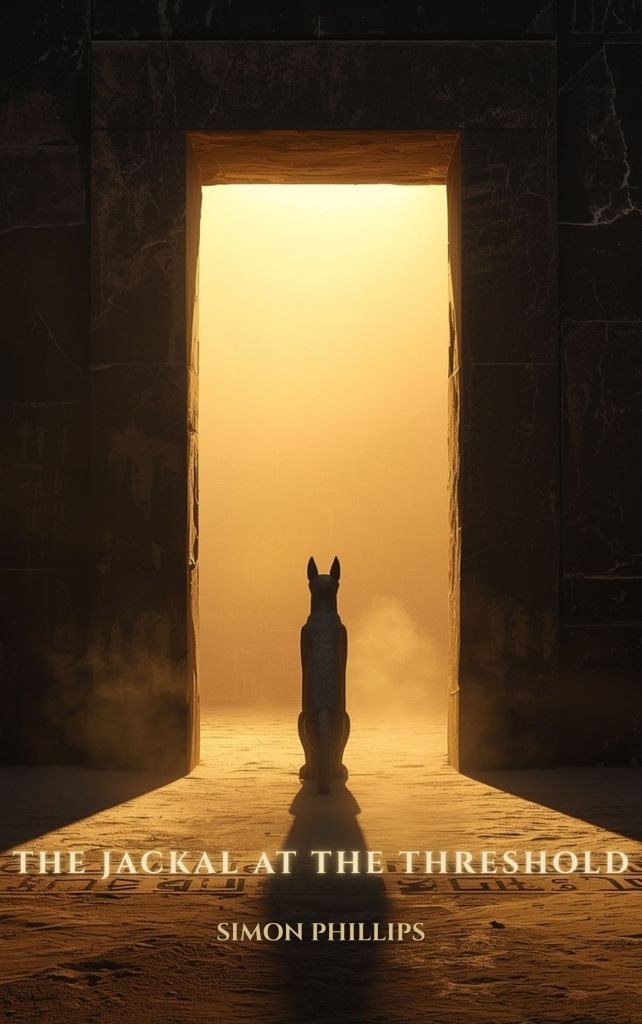
Egyptian-inspired fantasy often leans toward spectacle: plagues, curses, elaborate tomb traps bursting into flame. In Jackal at the Threshold, the horror is colder and more intimate. The air grows still. The pigment on the walls remains untouched by time. Scales hang in perfect balance. The jackal god watches without haste.

The Weighing of the Heart forms the mythic spine of the novella. Yet this weighing concerns more than virtue. It concerns intention. Responsibility. The moment when someone sees the crack in the stone and chooses to hurry anyway.

This is where mythic fantasy becomes personal.

Neris, the central figure, robs tombs because hunger demands it. The river quarter starves while the noble terraces gleam. She descends shafts and clears chambers because coin buys breath for her mother. Such choices feel practical. Necessary. Yet beneath them lie fractures that no silver can mend.

The Drowned Kingdom does not rage at her theft. It does something far more unsettling. It remembers.

Anubis Reimagined: The Jackal at the Boundary

Anubis in this dark fantasy novella is neither tyrant nor saviour. He stands at the threshold, patient and precise, weighing what is carried across his domain. He speaks without spectacle. He offers no absolution. What has been done remains part of the one who has done it.

In many indie fantasy books, gods arrive in thunder and blaze. Here, the jackal god emerges from starlit shimmer and still air. His judgement is measured, his presence quiet and vast. He allows choice. He allows consequence.

This portrayal of Anubis honours the ancient imagery of scales and feather, yet reshapes it into something interior. The weighing becomes a confrontation with memory: a brother sent ahead into a cracking shaft, graves opened in haste, gold lifted from silence. The heart holds all of it.

The result is a mythic fantasy experience that explores divine encounter through restraint rather than spectacle. The god does not shout. The chamber grows colder. The light fades. The boundary tightens. And in that stillness, truth surfaces.

For readers seeking atmospheric fantasy fiction that treats gods as forces of measure rather than miracle, this Kindle novella offers a different path through the myth.

From Tomb Robber to Guide of the Dead

The transformation within this short fantasy read does not hinge on conquest. There is no monster slain, no hoard carried triumphantly into sunlight. Instead, the relic is returned. The sceptre becomes a talisman. The thief becomes a guide.

This shift reframes the entire novella. The necropolis, once a place of plunder, reveals itself as a structure of balance. The jackals carved along the walls do more than threaten. They protect the poor man’s burial as surely as the drowned king’s chamber. The threshold exists for all.

Back in the river quarter, the gift of judgement reshapes Neris’s life. She sees spirit-trails where others see nothing. She speaks river-prayers learned from her grandmother. She eases the hesitant dead toward current and rest.

The world remains narrow. Hunger still lingers. Coin still shapes the day. Yet something has altered. The weight she carries now lifts others rather than burying them.

This is the emotional core of the novella. Mythic fantasy, at its strongest, returns the reader to the human scale. The boundary crossed in desert darkness echoes in a small room by the river. A mark on the chest replaces stolen gold. Service replaces theft.

Jackal at the Threshold: Novella Spotlight

Title: Jackal at the Threshold
Genre: Mythic fantasy novella / Egyptian-inspired dark fantasy
Format: Kindle novella on Amazon
Tone: Atmospheric, restrained, immersive

This Amazon fantasy novella stands alone as a complete story, yet opens the way into a broader mythos of drowned dynasties and watchful gods. It is designed for readers who value short fantasy reads that linger, who prefer atmosphere over haste, and who find meaning in quiet reckoning.

If you are searching for:

  • A fantasy novella rooted in ancient desert imagery
  • A dark fantasy novella centred on judgement rather than battle
  • Indie fantasy books by a British fantasy author exploring myth and threshold
  • Kindle novellas that favour consequence over spectacle

then this story offers a deliberate and immersive experience.

You can find the Kindle edition here:
https://www.amazon.com/dp/B0GM9PLM9M

Allow the boundary to open where you choose to cross it.

A Cinematic Glimpse: The Flash-Fiction Threshold

Alongside the novella, a cinematic flash-fiction adaptation is available on YouTube. This short piece acts as a threshold glimpse into the world of the Drowned Kingdom, capturing the atmosphere of desert dusk, carved jackals, and the silent moment before a door yields.

It functions as a fragment. A doorway. A sliver of torchlight against black stone.

For readers who prefer to taste the cadence and mood before stepping fully into the Kindle novella, this flash-fiction video provides that first crossing. It carries the same immersive tone, the same slow gathering of pressure, without revealing the full arc of judgement and transformation.

You can watch the flash-fiction adaptation here:

Consider it the first step into shadow before the chamber opens.

Mythic Fantasy, Indie Spirit, and the Quiet Return of Gods

As part of a growing catalogue of indie fantasy books, Jackal at the Threshold reflects a commitment to mythic structures explored through restraint. These stories move between fantasy novella and quiet horror, between buried histories and layered cities, tracing how ordinary lives intersect with forces older than language.

Living within layered environments where old shrines sit beside neon streets has shaped my sense of story. Thresholds exist everywhere. In a doorway. In a decision. In a single breath held too long.

This dark fantasy novella asks a simple question: what happens when someone crosses a boundary and is allowed to return?

The answer lies less in reward than in responsibility. In the choice to carry balance rather than escape it. In the steady work of guiding what has been unsettled toward rest.

For readers of atmospheric fantasy fiction, Egyptian-inspired fantasy, and Kindle novellas that dwell in silence as much as speech, this story invites you to stand at the edge and listen.

The desert remains wide. The river continues to flow. Somewhere beneath the dunes, stone shifts in the dark and waits.

Step toward the threshold when you are ready.

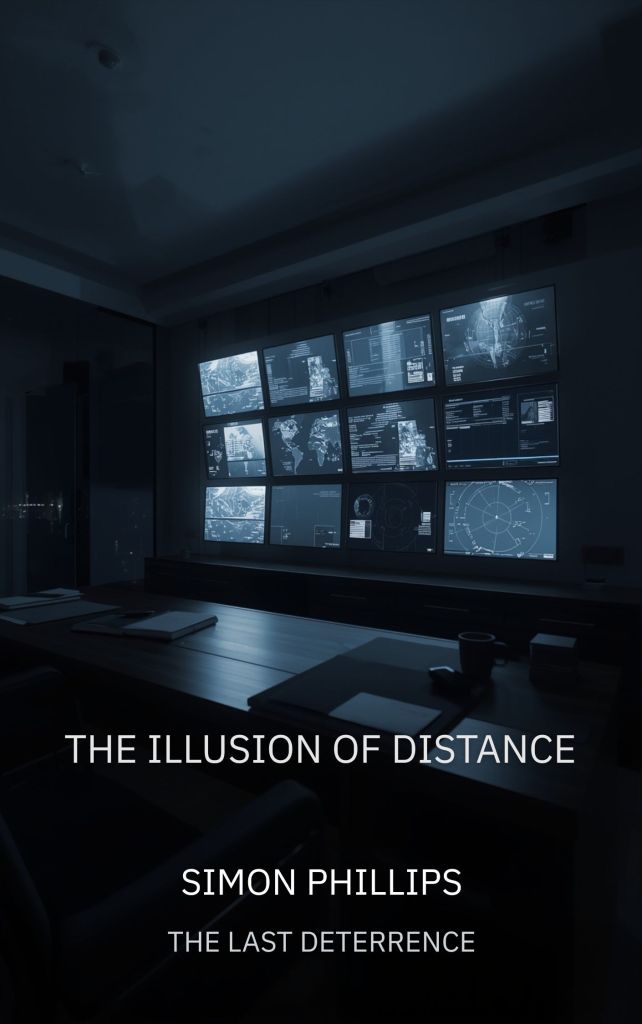
The Last Deterrence: The Illusion of Distance, Near-Future War, Civilian Proximity, and the Stories We Tell Ourselves

In The Last Deterrence: The Illusion of Distance, the world does not end with sirens or fire. It continues. Kettles boil. Trains run. Radios speak in careful language shaped to sit beside dinner and routine. The disruption arrives through phrasing, updates, and reassurances that feel almost familiar enough to trust.

The novella follows Daniel Mercer, his wife Helen, and their daughter Maya as global escalation begins to press closer to domestic life. Daniel works inside the systems that observe and interpret events unfolding across Eastern Europe. At home, those same events appear only as softened language and revised maps, their edges smoothed to prevent alarm. The distance feels stable at first. That belief carries weight. It shapes how days unfold, how evenings settle, and how much attention feels necessary.

This story focuses on the civilian edge of escalation. It explores how institutions manage uncertainty, how reassurance becomes routine, and how belief in insulation holds until it no longer does. Nothing arrives as a single decisive moment. Change accumulates through continuity. Maps widen by degrees too small to argue with. Language moves forward without announcing itself as movement.

Alongside the novella, a series of flash-fiction scenes and cinematic micro-moments exist as extensions of the same world. These fragments are not summaries or trailers. They are lifted instants from inside the narrative: a pause at a study door, a radio speaking steadily, a screen adjusting itself without comment. Each piece functions as a threshold, offering a way into the larger story without resolving it.

The flash-fiction exists to mirror how escalation enters the lives of the characters themselves. Indirectly. Quietly. Through moments that feel ordinary until they no longer hold. When experienced alongside the novella, these scenes reinforce the sense that the story continues even when the page turns away.

The Illusion of Distance belongs to a broader near-future speculative war sequence concerned with civilian proximity to power, institutional hesitation, and the slow erosion of certainty. It avoids spectacle in favour of process. It remains grounded in domestic spaces where decisions made elsewhere arrive through language long before consequence becomes visible.

The full novella is available here:
https://www.amazon.com/dp/B0GKXBDKVB

Readers drawn to near-future war fiction, political speculative fiction, civilian perspectives on conflict, and restrained narrative tension will find this story unfolds through accumulation rather than shock. The distance feels real. That belief shapes everything that follows.

The Last Deterrence: The Illusion of Distance is near-future speculative fiction about escalation, reassurance, and the moment belief fails.

The Room That Remembered | The Hali Files

Some rooms empty when people leave.
Others keep count.

The fragment shared this week came from a file marked closed twice and revisited once more than anyone expected. A room beneath older stone. A ritual performed late enough to feel procedural. A witness whose account shifted under review. A space cleansed again after the paperwork had already settled.

The video version of this fragment now sits on the channel as a longform narration. It carries only what the record allows. No answers. No framing. Just the shape of what remained once the room finished holding what it took.

This piece forms part of The Hali Files, an ongoing cycle of short stories and fragments set after the Hali Event. Each entry stands alone while contributing to a wider accumulation of sealed incidents, clerical suppression, and places that refuse erasure. These stories arrive as recovered material: reports, testimonies, annotations, and quiet reconstructions.

The full short-story connected to this fragment is available now as an ebook. It expands the incident through official language, witness pressure, and institutional closure. It offers context without comfort.

Read the full short-story here:
https://www.amazon.com/dp/B0GFXLMSNT

The video adaptation exists alongside the text. Some readers arrive through sound and image. Others prefer the page. Both approaches lead into the same archive.

More fragments will follow. Each one leaves residue. Each one brings the system closer to admitting what continues beneath it.

Inside Ashfall Station: A Sci-Fi Noir Short Story

Sector Twelve reopened before anyone asked the wrong questions.

Ashfall Station is built to remain in motion. Repairs conclude with quiet efficiency. Reports settle into their proper categories. Broadcasts arrive on schedule and carry the right tone of reassurance.
Incidents close.

The Ashfall Files is a science fiction noir short-story series set within that system, following investigations that begin after procedure has already declared the matter finished. Each case centres on a moment that should have ended cleanly, yet lingers, misaligned, resisting the shape imposed upon it.

The first case, The Dead Girl in Sector Twelve, opens inside a corridor already marked resolved. The lighting has been replaced with a newer, steadier glow. The walls have been sealed, their seams still warm from rushed work. The station has moved on. Only a handful of details remain slightly out of place, enough to draw the attention of those whose role is to notice what others are trained to accept.

Alongside the published short story, a series of short-form flash fiction pieces and narrated fragments have been released. These are not excerpts, nor summaries. They exist as atmospheric echoes, fragments of pressure and omission designed to sit beside the main story rather than explain it. They offer an entry point for readers who prefer to listen first, to absorb tone, to decide whether to step further inside Ashfall Station.

If the corridor feels wrong, that sensation is deliberate.

A narrated visual fragment from The Ashfall Files is available to watch on YouTube, presenting the atmosphere of Sector Twelve as it reopens, before the investigation begins.
Those who prefer to encounter the world through sound and image may wish to start there.

📖 The full short story is available on Amazon:
👉 https://www.amazon.com/dp/B0GFXLMSNT

A dedicated series page for Ashfall Files is now live, gathering related stories, video fragments, and updates as the cycle expands.

Ashfall Station continues to function.
The record continues alongside it.