Azaroth and the First Hell: The Demon God Who Was Once Divine

Before he became the greatest threat to Ældorra, Azaroth held a place among the divine.

During the age of the Imperium Arcana, the gods still shaped the world. Their presence guided the rise of empires, the movement of stars, and the sacred flow of magic. Among them stood Azaroth, an entity devoted to balance and universal law. He did not govern love or war. His realm existed at the intersection of order and arcane truth. Mortal kingdoms honoured him with silent offerings, while the Order of Magicians held his name among the highest in their ancient texts.

Over time, something within Azaroth shifted.

No records reveal the full path of his descent. Even the Order, with all its stored knowledge and sealed tomes, whispers only fragments. What remains clear is this: Azaroth chose to leave the High Heavens. He reached downward, into the wounded depths of reality, the realm known only as the First Hell.

That place devours meaning. Magic there fractures into madness. Time becomes a storm of echoes. Azaroth returned changed. Divine no longer, he emerged cloaked in shadows that moved like thought. His magic no longer carried harmony. It consumed. Across the divine realms, tremors of dread followed in his wake.

The God of Magic rose in response. Once kin to Azaroth, he stood alone before the fallen deity. The clash between them tore across sky, land, and sea. Entire mountain ranges cracked. Oceans surged beyond their borders. Celestial towers collapsed into memory.

The fallen was sealed. Azaroth’s essence remained trapped within the First Hell. To ensure the prison held, the God of Magic sacrificed himself. No tomb bears his name. No statue rises in his honour. His essence faded, though his victory allowed the world to continue.

The seal endured across centuries.

Now, it weakens.

In The Veil of Kings and Gods, faint tremors move through forgotten chambers and shattered temples. Spells fail. Visions twist. In moments of silence, some hear voices echoing with words never spoken. The First Hell watches once more. Azaroth reaches toward the living world through cracks in the veil.

He remains more than a demon. A god’s ambition shaped his fall. His memory was stripped from scripture, yet his will never faded. He waits, not in silence, but in hunger.

And now, the gate flickers.
Magic in Ældorra: A Gift, a Curse, or Something More?

In Ældorra, magic is not studied. It is claimed. A birthright, a spark born into the blood, seen by the Order, and seized before the world can lay its hands on you.

From the moment a child reveals the first hint of magic, whether by accident or fear, the Order of Magicians arrives. There are no family farewells. No second chances. The child is taken, their name entered into the record of the Academy, and whatever life they knew is quietly severed. To possess magic is to belong to the Order. Nothing else.

All magicians begin the same. They are taught the spoken forms, the written glyphs, the rigid cadence of incantation. Magic cannot be used without language. It must be spoken aloud, shaped by voice and carved by word. There are no silent spells, no intuitive gestures, no whispered charms in the night. If a magician forgets a word, the spell fails. If they twist its structure, the spell misfires, or worse.

Yet among those who speak the same spells, power is not equal.

Each magician draws from what the Order calls their well. Some wells are shallow, only able to fuel modest enchantments, brief illusions, momentary shields, small bursts of flame. Others are deep, vast, and enduring. Those who carry such wells rise quickly. These are the ones who bend flame to their will, who can speak a word and bring down the sky. They are the ones who ascend to the Council: The Order of Five, whose decisions shape the kingdoms more than any throne.

But even the greatest magician faces one immutable truth: they cannot heal.

It is not that healing magic is forbidden, it is simply beyond their reach. No spell, no incantation, no force of arcane will can mend the flesh or restore the spirit. That gift belongs solely to the Church of Christiana. Theirs is the divine touch, the holy word. It is a truth both sides know, yet seldom speak aloud: the Order commands the arcane, but it is the Church that claims the soul.

And though the world fears the Order, it is not without its own cruelty.

In Ældorra, only men may wield magic. Women, no matter how gifted, are forbidden by law. A woman who speaks a spell, whether for battle or for mercy, is declared a criminal. Even a healing incantation, performed in secret, may bring death. The punishment is absolute. The Order’s law is iron, and its reach does not falter.

So is magic a gift? A curse? Or something stranger still?

For those who carry the spark, there is no choice. Only the path set before them, the laws carved in stone, and the weight of a power they did not ask for, spoken word by spoken word, until their voice is no longer their own.

Simion the Magician: Pawn of the Divine or Something More?

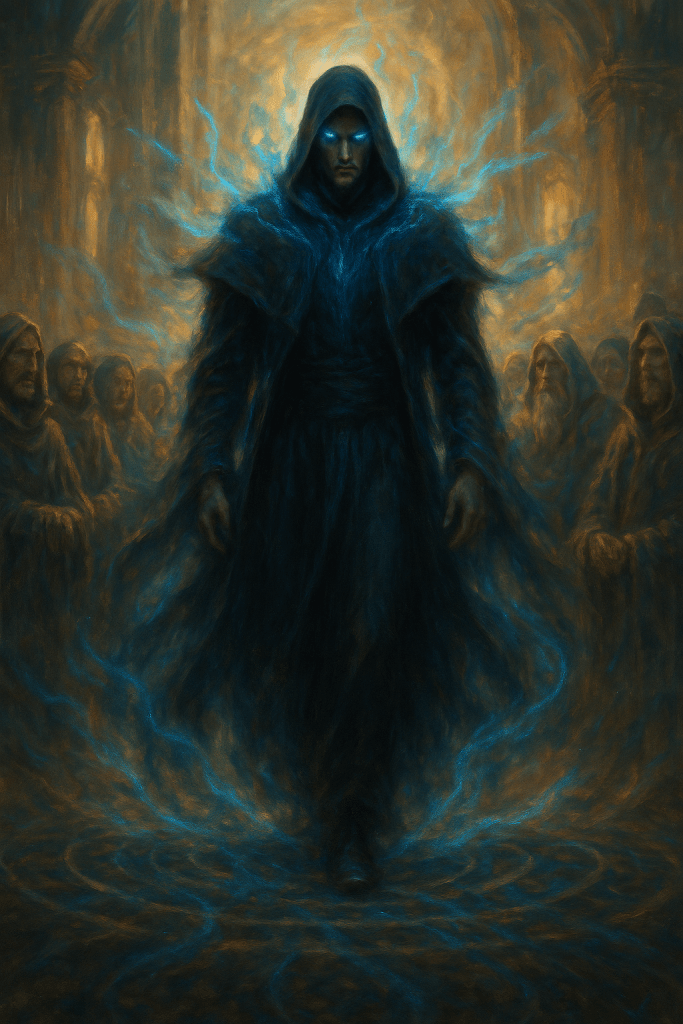
A cloaked figure exuding magical energy stands at the center of a dimly lit chamber, surrounded by a group of hooded onlookers. The figure's blue eyes glow intensely, hinting at a powerful presence in a mystical setting.

In a world once shaped by divine hands, where kings fear what they cannot control, Simion stands at the edge of myth and obscurity. He holds no grand title, wears no gilded robes, and bears no reputation as a prodigy of the arcane. His story is quieter, rooted not in greatness, but in something far more human.

Before the councils and court chambers, Simion was a kitchen boy. The castle at Bremyra was his world, its stone corridors filled with the clatter of pans and the scent of stewing broth. He moved among servants, delivering bread, cleaning floors, and sneaking crusts to the youngest among them. It was there, beneath those very walls, that the first spark of magic broke loose from within him. A frightened boy. A sudden flare. And the Order of Magicians arrived before the embers cooled.

He was taken without ceremony. His name added to the rolls of the Academy where the days were long, the teachings relentless. Simion did not rise easily. Others soared through the high arts, weaving spells with elegance and precision. He struggled to hold form, to understand deeper currents, to speak the tongue of magic with anything beyond effort. Yet he endured, through sheer will, long study, and quiet resolve.

Upon completing his training, no citadel called him. The cities of power remained silent. His path remained unclear until his former master, a stern voice within the Council, arranged a post that few would envy, Advisor to the King of Bremyra. It was less a promotion than an obligation. A placement of necessity. Still, he accepted.

Now, Simion walks again through familiar stone halls. He stands beside those who once knew him in passing. Elana, a friend from youth, the princes, with whom he once shared stolen moments of laughter. The kitchen boy has returned, not with acclaim, but with a burden that grows heavier by the day.

The kingdom shifts. Whispers speak of hidden tomes, ancient chambers sealed in forgotten stone, and strange forces moving beneath the world. Simion has seen things no Advisor should see, felt magics that do not obey the rules he was taught. There are voices now, soft, distant, threading through silence.

He never sought power. Nor was he shaped for glory. Yet in the quiet places where gods once walked, something has stirred.

And Simion, worn and uncertain, may be the only one left who can hear it.