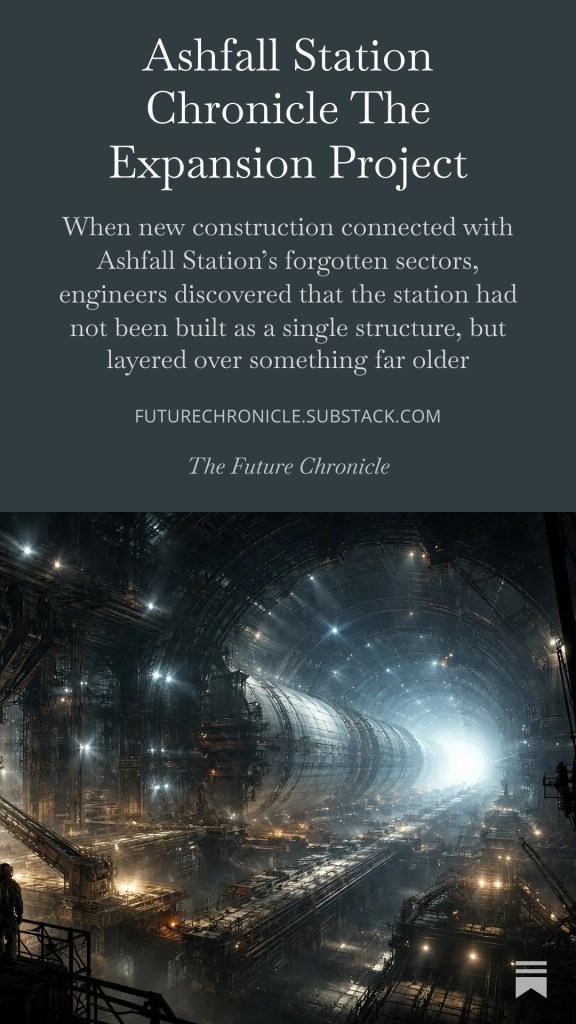
A station always reveals its age through the places where one era joins another. Fresh trusses arrive with their clean geometry and calibrated tolerances, while the older hull carries decades of weld seams, patched conduits, rerouted cable runs, and corridors whose original purpose has faded into routine. In stories built around space station expansion, that point of contact becomes one of the richest sources of unease, since the act of strengthening a structure often exposes everything the structure has been carrying in silence.
That is the central pressure inside any strong orbital station mystery. The danger rarely begins with explosion or invasion. It begins with access. A maintenance team opens a hatch. A new framework meets an old support corridor. Archived schematics suggest continuity, while the metal itself suggests something else entirely. Within that narrow gap between record and reality, science fiction finds one of its most human tensions, because every large system depends upon trust in its own memory.
Chronicle 6 of The Future Chronicle, Ashfall Station Chronicle The Expansion Project, enters that exact threshold. Its opening presents new construction reaching Ashfall Station, then follows Senior Structural Engineer Halren Voss into older support corridors where real-time scans diverge from the archived grid, a sealed panel rests inside undocumented structure, and the station begins to feel less like a single design than an accumulation of buried decisions. The entry was published on 27 April 2026, and its free opening serves as the reader’s first descent into that layered machinery.
The quiet power of layered infrastructure in science fiction
Science fiction has long loved frontier ships, research domes, and colony towers, though the orbital station carries a unique emotional charge. A station remains in place. It circles, endures, receives cargo, absorbs repair, survives policy changes, staffing shortages, rerouted trade, deferred maintenance, and the long slow compromises that gather around any inhabited machine. Over time, its structure becomes historical in a way that a sleek new vessel never can. It starts to resemble a city’s oldest quarter, a harbour wall rebuilt in sections, a factory expanded under several administrations, each leaving its own logic embedded in steel.
That sense of accumulation gives writers access to an especially believable form of speculative atmosphere. Readers understand instinctively that a long-operating station will have sealed sections, retired junctions, renamed corridors, patched subsystems, and documentation that no longer matches lived reality. Even before anything strange happens, the environment already carries memory. The architecture holds evidence of use. It has been touched by generations of workers who solved urgent problems, then moved on. Their solutions remain, layered one across another, until the present inherits a structure whose behaviour can still be managed, though never fully reduced to a clean diagram.
In practical terms, this creates a powerful narrative engine. A story can begin with ordinary engineering language, ordinary inspection routines, ordinary tolerance checks. From there, the smallest deviation gains dramatic weight. A plate sits at the wrong angle. A seam follows an older grid. A corridor continues beyond the place where the plans say it should end. None of these details requires spectacle. Their force comes from the calm recognition that the station possesses a deeper history than its operators can currently read.
Why forgotten sectors feel inhabited long before anyone speaks
Forgotten sectors in science fiction carry more than mystery. They carry social pressure. A sealed corridor suggests previous labour, previous authority, previous reasons for closure. Someone routed power through that section once. Someone marked it on a map. Someone approved its isolation. Even an empty passage retains the shape of institutional behaviour, and that gives these environments a psychological density that reaches beyond simple suspense.
This is why neglected infrastructure often feels more unsettling than overt ruin. Ruin announces its condition openly. A forgotten sector remains folded inside active life. People work two decks away. Freight continues to move. Lights still hum through occupied corridors. Administrative orders still pass from console to console. The station remains operational, which means the buried section has survived within a living system. Its silence becomes harder to dismiss because the surrounding machinery continues to function with professional confidence.
A strong Chronicle understands that pressure and allows the environment to speak through material detail. Ageing strips flicker. Reinforcement ribs sit at irregular intervals. Cable conduits show decades of rerouting. Air pressure shifts between sectors. A hatch resists opening in small mechanical ways that feel older than bureaucracy. When prose handles these details with patience, readers begin to experience the station as an inhabited archive, a structure that has preserved traces of earlier intentions even after those intentions slipped from official awareness.
That is one reason layered orbital settings hold such lasting appeal. They bring together two scales of time at once. On one level, there is the immediate shift rotation, the engineer with a display in hand, the technician waiting for instructions, the fresh frame arriving along the outer ring. On another, there is the station’s deep duration, measured in decades of expansion, closure, reinforcement, and omission. The human moment unfolds inside an older architectural memory, and the friction between those scales produces a form of unease that feels earned.
Expansion changes the emotional meaning of a station
A sealed section already carries mystery, though expansion changes its meaning. Once new construction begins to connect with older infrastructure, the buried past stops being passive. It becomes load-bearing again. That shift matters because science fiction thrives on moments when routine activity reactivates a larger hidden pattern.
Expansion projects are especially useful for this kind of storytelling since they arrive under the banner of improvement. The language around them belongs to capacity, reinforcement, efficiency, logistics, and operational lifespan. They promise stability. They promise growth. They promise a longer future for the installation and the people who depend on it. Then, through the act of connection, they expose a structure whose continuity stretches beyond accepted documentation. The project meant to secure the station begins instead to uncover the degree to which the station has been living above an unresolved foundation.
This is where the Chronicle’s premise becomes especially compelling. The fear comes less from collapse than from acceptance. The structure accepts the connection. The framework seats itself against older material. Load paths redistribute. Diagnostic systems classify anomalies within acceptable thresholds. Lights shift as though power is learning a route it once knew. A station like Ashfall grows more disturbing in the moment when it appears to cooperate with integration, since cooperation suggests history, and history suggests prior contact.
From a speculative point of view, that is a deeply satisfying move. It keeps the story grounded in engineering logic while opening the emotional space of mystery. Nothing in the scene needs to abandon procedure. Technicians still log variance. Supervisors still authorise holds. Surveys still move through standard channels. Yet the station begins to answer through pattern, rhythm, and structural response. The future feels inhabited through system behaviour rather than explanation.
The Chronicle entry as a threshold into Ashfall Station
Within The Future Chronicle, Ashfall Station Chronicle The Expansion Project uses that layered tension with unusual control. The Substack entry frames Ashfall as an ageing industrial station whose new expansion meets forgotten sectors, and its opening follows Voss from the observation deck into older support corridors where mapping diverges, floor plating resists the established grid, and a sealed access panel introduces a low-level vibration that engineering systems cannot easily resolve. The post is marked paid, while the opening remains available as a free entry point into the wider archive.
That matters because the reading experience mirrors the subject itself. A reader enters through a narrow access point, steps into a compressed corridor of detail, and gradually realises that the station’s visible form rests upon something more layered than first assumed. The Chronicle functions less like a plot summary and more like a recovered operational descent. It offers atmosphere first, then structural implication, then the quiet pressure of a system that seems to recognise the connection being imposed upon it.
A companion YouTube short extends the same premise in visual miniature, presenting the Expansion Project as routine work that uncovers something buried beneath decades of industrial construction. That additional fragment helps establish Ashfall as a living archive across formats, one where each entry feels like another angle on the same long disturbance.
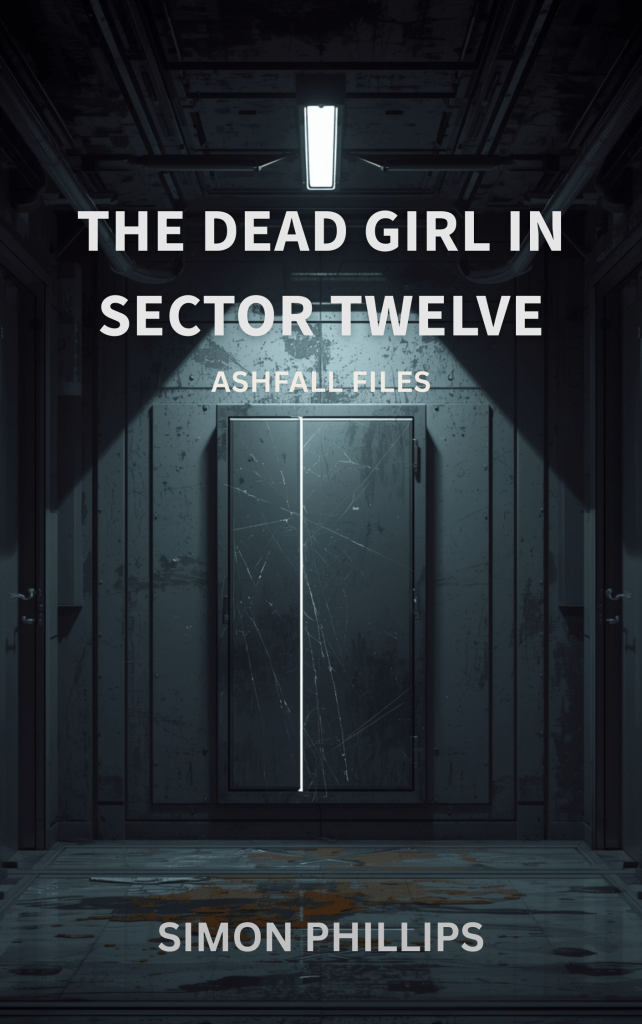
The linked Kindle book page deepens that path further. There, the station’s later consequences take investigative form in Ashfall Files: The Dead Girl in Sector Twelve, a sci-fi noir mystery centred on a young woman found dead inside a maintenance vent. Read alongside the Chronicle, the novella suggests a larger continuity in which buried structure, suppressed records, and institutional pressure continue to gather weight across time.
Why readers keep returning to stations like this
Readers return to this kind of science fiction because it understands that the future will arrive through maintenance as often as through invention. Human beings will keep living inside systems older than the policies governing them. They will keep trusting archives that only partly match material reality. They will keep expanding cities, stations, and networks whose earliest layers were shaped by motives no longer fully visible. A layered orbital station turns all of that into environment.
It also honours a quieter kind of speculative fear. Many futures on the page feel loud from the beginning. The most durable ones often begin with the sound of machinery carrying on as usual. A work order clears review. A frame locks into place. A corridor lights in sequence. Somewhere inside the structure, a pattern continues. That rhythm lingers because it suggests a civilisation extending itself into distances it can manage operationally, though never completely master emotionally.
This is where The Future Chronicle finds its strongest ground. It approaches science fiction through systems, atmosphere, and the lived pressure of environments that have endured long enough to develop their own silence. Chronicle 6 stands as a particularly strong entry into that world, since expansion offers a clean narrative surface while the deeper station keeps pressing upward through it. The official project concerns cargo capacity and reinforcement. The felt reality concerns contact with an older order concealed inside the metal.
A station like Ashfall remains compelling for the same reason old ports, old rail tunnels, and old industrial districts remain compelling. Growth never erases earlier layers. It builds across them. It seals them. It routes around them. Then, sooner or later, someone opens a hatch, extends a new connection, and realises the structure has been waiting much longer than the current shift can measure.
Beyond the record, the station continues its orbit. Framework holds. Reports enter the archive. The deeper pattern remains in place, patient as load-bearing steel, quiet as an active corridor after lights have settled, carrying the sense that somewhere inside the machinery of expansion, the future has touched something that was already there.
