Why I Still Believe in Epic Fantasy in a Cynical World

There are days when the weight of the world feels heavier than ink or fire, when the quiet corners of the soul grow dim beneath the noise of what passes for truth. In such moments, it would be easy to set aside the great tales, to dismiss them as relics, gilded stories carved for brighter ages. Yet I do not.

I still believe in epic fantasy.

That may sound strange to those who favour stark realism, whose shelves are lined with fractured heroes and greyscale worlds. We are told that truth lies in brokenness, that hope is naïve, and that honour is no more than an illusion passed down by old songs and older men. Perhaps. Perhaps the world has earned its doubt.

Even so, I return to the stories where kingdoms rise and fall, where swords gleam beneath ancient skies, and where the soul of a man can alter the course of the stars. I return not because such tales are easy, but because they ask the oldest question with unflinching grace: What is worth fighting for, when the world stands poised on the edge of ruin?

There is power in that question. Quiet, enduring power.

Epic fantasy, when it is true to its roots, does not flinch from sorrow. It walks beside it. It knows the weight of sacrifice, the silence after loss, the slow unwinding of power misused. Yet it dares to offer meaning in the ashes. It does not scoff at faith or nobility. It treats love, be it for a kingdom, a child, a forgotten god, with reverence rather than irony.

That tone, that trust, is something I refuse to let go of.

For me, writing within this tradition is an act of defiance as much as devotion. It is choosing beauty when the world favours bleakness. It is lifting a banner in fog, even when no one watches. And yes, it is believing in things unseen, magic, yes, but also memory, duty, and the soul’s quiet yearning for more.

There are moments in the story I’m shaping where the light fades, where characters stumble beneath burdens they cannot name. In those moments, it would be easy to give in. Yet the story holds steady. Because epic fantasy does not require perfection, it asks only that its heroes rise, however broken they may be.

In a cynical world, that still matters.

So if you find yourself weary of headlines, of noise, of shallow victories and hollow rage, step into a world where the stars still whisper, where the land remembers, and where even the most wounded soul may shape the fate of empires.

You may find, as I have, that there is more truth in those tales than many would dare admit.
The Shadow Rising A Turning Point in the Wheel

There comes a moment in every long series where the world tilts slightly, where what was once a journey across landscapes becomes a passage into myth itself. For The Wheel of Time, that moment arrives in The Shadow Rising, the fourth volume in Robert Jordan’s vast and labyrinthine saga. It is here the tale begins to unfold on a truly epic scale, uncoiling threads of prophecy, heritage, and power that stretch far beyond the Emond’s Field beginnings we once knew.

A Novel of Expansions and Transformations

Unlike the tightly structured urgency of The Dragon Reborn, this book refuses haste. It broadens rather than barrels forward. Rand, now declared the Dragon Reborn, does not simply charge into battle. Instead, he walks into the heart of the Aiel Waste, into a past carved by blood and fire, and into a people whose history reshapes his own. Jordan uses the Aiel journey to expand his world in the most powerful sense, not by adding more, but by revealing depth. The Waste isn’t just a desert; it’s a crucible for a cultural philosophy built on honour, tradition, and hidden sorrow.

Meanwhile, Perrin returns to the Two Rivers in what remains, for me, one of the most emotionally grounded and satisfying arcs in the series. His struggle is heavy with consequence, defending his homeland, confronting loss, becoming a reluctant leader. It’s no grand adventure; it’s resistance. The quiet strength of Perrin’s arc holds the novel together when the other threads drift toward abstraction.

Mat, of course, is dragged forward by the Pattern with coin in hand and complaint on lip. Yet beneath the bravado, something is stirring. His gift or curse, begins to awaken. And with it, we catch glimpses of a man who will one day command entire armies, whether he likes it or not.

Women of Power and Subtle Shifts

Egwene, Nynaeve, and Elayne continue their arc through Tanchico and Tel’aran’rhiod. It is perhaps the portion of the book that divides readers most. At times, their chapters feel drawn out, yet they contain critical developments. The World of Dreams becomes more than a curiosity. It begins to whisper of control, danger, and deeper truths. Nynaeve’s confrontation with Moghedien is quietly devastating, a clash of raw strength and hidden terror. Jordan doesn’t always balance his multiple arcs evenly, but there is no question he gives the women in this story power, danger, and consequence.

The Great Unfolding

What makes The Shadow Rising remarkable is not a single battle or twist. It’s the slow, deliberate shift in the series’ soul. The world feels older. The scope feels wider. Every major character walks deeper into their identity, shaped less by choice and more by necessity. Prophecy is no longer something quoted by Aes Sedai in candlelit chambers, it lives now, in action and aftermath.

It’s also worth noting that Jordan’s prose here becomes more assured. His digressions are longer, yes, and he tests patience now and again with endless politicking and braid-tugging. Yet his command of tone, setting, and foreshadowing has sharpened. He is no longer just building a world, he’s weaving fate.

Final Thoughts

This isn’t the book I’d recommend to first-time fantasy readers. It demands investment. Yet for those already caught in the turning of the Wheel, The Shadow Rising marks a threshold crossed. From here, the story no longer simply follows characters, it chases legacies. Heroes don’t just act; they echo.

If you’ve ever wondered where The Wheel of Time truly begins to feel legendary, it’s here.

If you’d prefer a more informal deep-dive, with visual breakdowns and unscripted thoughts, I’ve also posted a video review of The Shadow Rising on my YouTube channel.

When Characters Refuse to Obey A Quiet Update from the Writing Desk

There are days when the words arrive with purpose, unfolding like the tide, steady, inevitable, drawn by unseen moons I never named. And then there are days like this past week, where a single scene becomes something else entirely. Not broken, nor wrong, simply… changed. Unexpected. Alive in a way I had not planned.

I was rewriting a chapter for The Veil of Kings and Gods, one that should have followed the arc I had carefully woven. The notes were there, the pacing mapped, the motivations aligned. Simion was meant to speak. A single line. Firm, measured, final. A rejection. It would have been a turning point of sorts, the moment he chooses distance over duty.

And yet, as I reached that moment, he waited.

Not in defiance. He was simply still. Listening. Watching. And when the words came, they were not rejection, but understanding. A softness I had not intended entered the scene, subtle, unexpected, entirely right. It changed the shape of the moment. It changed him. And through him, the shape of what follows.

This is not the first time a character has shifted beneath my hands. Patrick once delayed a speech for two chapters because his silence held more weight than I had imagined. Elana once turned back when I thought she would walk away. Even Týrnan, who so often walks the edge of fire and certainty, veered off course once to grant mercy where I had written none.

These are not dramatic revisions. They are the quiet revolts, the ones that happen deep in the bones of the work. You do not always see them coming. They’re not betrayals of plan or plot. They are corrections of truth. A character, fully formed, will sometimes remind you that they are no longer yours to shape so easily.

So this is where I am. Still within the final stretch of the book. Still rewriting, refining, listening. Not rushing. Letting the weight of each word find its proper place. Some chapters arrive like stone. Others like river. All must settle before the storm.

Thank you for reading and for walking this strange, shifting path with me.

Until the next.

The Dragon Reborn by Robert Jordan Book Review

Third in The Wheel of Time Series By Simon J. Phillips

It’s no secret that The Wheel of Time series demands patience. It builds slowly, chapter by chapter, like a tapestry woven in the dark, you don’t always know what the full picture is until you’ve stepped back. But The Dragon Reborn, the third entry in Robert Jordan’s monumental saga, is where that picture finally begins to emerge from the shadows.

This is where the world stops expanding outward and begins folding back in on itself. The stakes rise, the characters deepen, and the mythic weight of Rand al’Thor’s destiny becomes more than prophecy, it becomes reality.

A Shift in Structure, a Strength in Storytelling

Unlike the previous volumes, The Dragon Reborn follows a bold structural shift. Rand, the titular Dragon, is largely absent. And that’s not a weakness, it’s a strength. His presence lingers on every page but it’s Perrin, Mat, Egwene, Nynaeve, Elayne, and others who take centre stage. Jordan challenges the typical ‘chosen one’ narrative by showing us the world reacting to Rand’s ascent rather than merely following in his wake.

It’s in this reaction that the book finds its strength. We feel the weight of prophecy as the pattern tightens. We see the signs, omens, chaos, and political unrest, as nations begin to stir, and the world reshapes itself to accommodate a Dragon Reborn.

Mat Cauthon Awakens

This is the book where Mat comes into his own. Finally freed from the Shadar Logoth dagger, we get our first real glimpse of the roguish, witty, battle-hardened gambler he’s destined to become. His escape from Tar Valon is one of the most thrilling moments in the book, a chaotic run through city streets, dice in the air, and fate at his heels.

Jordan shows incredible restraint here. Mat doesn’t immediately become the legend; he earns it page by page, through struggle and sheer bloody-mindedness. It’s some of the finest character development in the series.

Dreamers, Wolfbrothers, and the Loom of the Pattern

Perrin’s arc continues to evolve, and though his brooding nature can wear thin at times, his growing bond with the wolves adds a haunting edge. It’s here that we begin to sense the vast, spiritual undercurrents of Jordan’s world, dreamwalking: the World of Dreams, and Talents that feel less like magic and more like fate reaching through.

Egwene’s training in the Tower and her own journey through Tel’aran’rhiod offers a parallel to Rand’s, the rise of another kind of power, more subtle but no less dangerous. The female half of the One Power continues to feel richer and more complex than most fantasy series ever attempt, and Jordan does not shy away from making the women in this world powerful, flawed, and capable of true leadership.

The Stone of Tear and the Dragon’s Claim

The climax of The Dragon Reborn erupts in the heart of Tear, a city long resistant to prophecy, and the prophesied site of the Dragon’s rise. Rand enters the Stone of Tear alone, facing off against one of the Forsaken, Be’lal, and ultimately seizing Callandor, the crystalline sword that no man but the Dragon Reborn can touch.

It’s a moment both personal and mythic. Rand doesn’t just fight a Forsaken, he confronts destiny. He steps fully into the role the Pattern has woven for him. The image of Rand holding Callandor, victorious but shaken, marks a seismic shift not just in his arc, but in the world itself. The prophecies are no longer shadows, they’re real, glowing, and deadly sharp.

Final Thoughts

The Dragon Reborn is not a flawless book, it still carries Jordan’s love of travel scenes, internal repetition, and the occasional pacing lull but it’s where The Wheel of Time begins to feel truly alive.

This isn’t just a continuation. It’s a turning. A reshaping. A slow-burning epic beginning to spark.

If you’ve made it through the first two books and weren’t quite convinced, this is the one that might win you over.

You can also watch my companion review video on YouTube if you’d rather hear my full thoughts aloud. It’s linked below.

Let me know in the comments, how did The Dragon Reborn hit you? Did Rand’s absence bother you, or did it make the book stronger

Revisiting The Eye of the World: A Journey Back to the Wheel

Three years ago, I delved into Robert Jordan’s The Eye of the World, the inaugural volume of his expansive Wheel of Time series. At the time, I recorded a comprehensive 40-minute video review, capturing my initial impressions and analyses. Now, with the passage of time and further reflection, I find myself drawn back to that world, eager to share renewed insights and perspectives.

Initial Impressions: A World Unveiled

My first encounter with The Eye of the World was marked by a sense of familiarity intertwined with novelty. Jordan’s narrative begins in the quaint village of Emond’s Field, reminiscent of Tolkien’s Shire, introducing us to characters like Rand al’Thor, Mat Cauthon, and Perrin Aybara. Their lives are disrupted by the arrival of Moiraine Damodred, an Aes Sedai, and her Warder, Lan Mandragoran, setting them on a path fraught with peril and discovery.

The journey that unfolds is rich in world-building, with Jordan crafting a universe steeped in history, magic, and prophecy. The concept of the Wheel of Time, turning through Ages, and the idea of ta’veren, individuals around whom the Pattern weaves itself, add layers of depth to the narrative.

Reflections After Three Years

Revisiting my review and the book itself, I appreciate more profoundly the intricacies of Jordan’s world. The pacing, which I initially found deliberate, now feels purposeful, allowing for a gradual immersion into the complexities of the setting and its inhabitants. Characters like Nynaeve al’Meara and Egwene al’Vere, whose arcs seemed secondary at first, reveal themselves as pivotal figures with compelling growth trajectories.

Moreover, the themes of destiny, free will, and the cyclical nature of time resonate more deeply. Jordan’s exploration of these concepts invites readers to ponder the balance between fate and choice, a contemplation that remains relevant.

The Video Review: A Deeper Dive

For those interested in a more detailed analysis, I invite you to watch my original video review below. In it, I discuss character developments, thematic elements, and the broader implications of Jordan’s work within the fantasy genre.

Connecting to My Own Writing Journey

Reading The Eye of the World not only enriched my appreciation for epic fantasy but also influenced my own writing. The meticulous world-building and character complexities inspired me to infuse similar depth into my creations. As I continue to develop my narratives, the lessons gleaned from Jordan’s work remain a guiding force.

Why I Wrote The Veil of Kings and Gods

There was a moment, years ago, when I finished reading a fantasy book and set it down with that lingering ache only good stories leave behind. But this time, something different stirred. I remember thinking, I love this world… but I would have done the magic differently.

That thought, quiet but persistent, was the spark that began this journey.


A Quiet Beginning

I’ve always loved stories. I was sketching characters and scribbling in notebooks before I knew what genre even meant. For me, storytelling wasn’t about ambition. It wasn’t about publishing or platforms or careers.

It was something I did because I loved the word-building and the idea of losing myself in my fantasies.

Writing, like painting, was my calm space in a world that often felt too loud.


The Question That Wouldn’t Let Go

Years later, I read a fantasy series that changed something in me. I won’t name it, but I remember wishing that the magic system worked differently. I wanted to see a kind of magic that wasn’t spoken or shouted, but silent. What if casting spells required nothing but will and cost? What if power came from absence, not control?

That question sat with me. And over time, it grew.

It became the foundation for The Veil of Kings and Gods.


Years of Silence and Sparks

Writing this novel wasn’t quick, and it certainly wasn’t easy. Life was full, sometimes too full. Jobs, exhaustion, raising a newborn, moments of doubt. There were months where I barely touched the manuscript… and others where I couldn’t stop.

I rewrote chapters. Deleted scenes. Rethought characters. Rebuilt the entire world from scratch. But I never stopped, because the story wouldn’t let me go.

What began as a simple idea, a magician who doesn’t speak, turned into something far bigger. A world where gods have gone silent. Where prophecy falters. Where fate rewrites itself.


What This Story Truly Is

I won’t spoil too much, but here’s the heart of it:

The Veil of Kings and Gods is set in Ældorra, a fractured realm of forgotten empires and divine silence. The old god-chosen magicians are gone. The demon they once sealed away is stirring again.

At the centre is Simion, a quiet magician who doesn’t cast spells the way others do. He doesn’t speak incantations. He doesn’t crave power. But he’s the one who will break the Spiral and reshape prophecy.

There’s a prince scarred by loyalty and forbidden sexual preference.

A noble sister caught between obedience and rebellion.

Secret orders. Collapsing kingdoms. Ancient ruins that whisper truths long buried.

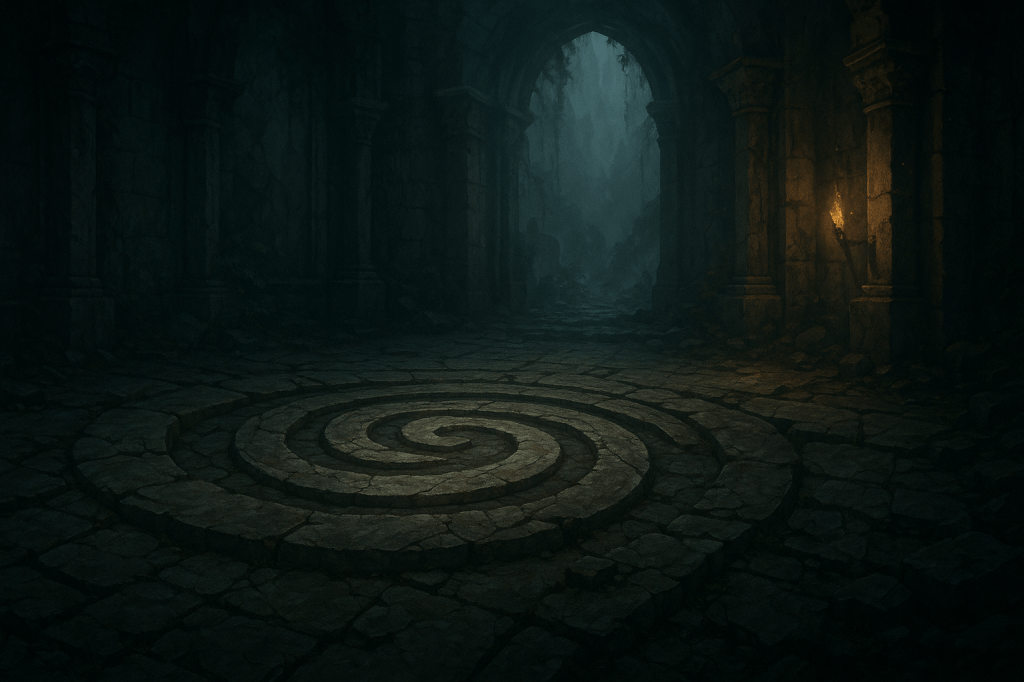
And above it all, the Spiral, a symbol that marks not just fate, but the collapse and rebirth of magic itself.


Why Now?

Because I stopped waiting.

For years I told myself the same things: “When life settles down… when I’ve got more time… when it’s perfect.” But none of that ever came.

So I’ve decided to start where I am.

I’m sharing this novel. I’m building this world aloud. Not because I believe I’m the next great fantasy author, but because I believe this story matters. And maybe… it will matter to someone else too.


Watch the Video

If you’d like to hear the more personal version of this journey, I recorded a video where I speak directly about why I wrote this book, how long it’s taken, and what’s still to come. You can watch it below:


Join Me

If this world sounds like something you’d like to explore, you’re in the right place.

I’ll be sharing lore, character art, short stories, and behind-the-scenes posts as I bring The Veil of Kings and Gods to life. You can follow the blog or subscribe to the YouTube channel.

This is just the beginning and I’m glad you’re here.

The Veil of Kings and Gods

When the gods go silent, prophecy fractures. What rises next cannot be foretold.


This is the novel that shaped the foundation of everything I’ve written since.

At its heart lies a world left in silence. The gods once spoke clearly, shaping kingdoms through chosen bloodlines and divine rituals, but that time has ended. Now, the echoes of their will are fractured, fading, or dangerously misinterpreted. The world remembers their presence but no longer hears their voice.

The Veil of Kings and Gods follows the slow unraveling of that world, and the people who remain in the absence of clear power.

It is not a story about chosen heroes or golden prophecies fulfilled. It is about those left behind. Those who were not supposed to rise, and did.


📖 The Story

The kingdom of Bremyra stands at the edge of collapse. Its kingship is fragile, held together by tradition, prophecy, and military legacy. Beyond its borders, tensions rise between faith and silence, legacy and rebellion, loyalty and doubt.

At the centre of the story is Simion, a quiet figure born without divine favour, yet carrying something far more dangerous, imbalance. Not the kind that disrupts order with chaos, but the kind that shifts the Spiral itself. His presence begins to fracture the remaining threads of prophecy.

As kingdoms struggle to interpret the gods’ absence, and as the Spiral reveals patterns not foretold, a deeper magic begins to awaken, one that predates the divine voices altogether.

This is a world where silence speaks, and power is no longer sacred, but claimed.


🌀 Core Themes

  • Divine Silence: The gods no longer answer, and mortals are forced to act without them.
  • Broken Prophecy: Destiny unravels as old visions contradict what unfolds.
  • The Spiral: Fate is not a line or a circle; it folds, forgets, and returns.
  • Inheritance and Rebellion: Bloodlines, loyalties, and faith all come undone.

🧱 Structure and Tone

The Veil of Kings and Gods is a slow-burn epic fantasy, grounded in character, world-building, and psychological tension. Dialogue is intimate. Action is rare but decisive. Power grows quietly, then reshapes everything in its path.


📍 Where This Novel Sits in My Universe

This book is the central thread in a larger mythos. Other stories connect to it, some in the past, others in forgotten corners of the world. The short story series Chronicles of the Spiral Ages explores myths, cultures, and echoes that ripple into the events of this novel.

Characters from other works will trace their bloodlines, curses, or destinies back to the moments first seen in The Veil of Kings and Gods.

This is where it begins.


🛠️ Current Status

  • Draft One is complete
  • Draft Two is in progress
  • Lore posts and short stories connected to this world will continue to appear on the blog
  • AI-generated artwork and map reveals will be shared via YouTube and site updates

🖼️ Visions from the Realm


🔗 Explore Further


✍️ Closing Note

This page will update as the novel progresses. As more fragments fall into place, through short stories, videos, or lore posts, they will be gathered here.

The silence continues. The Spiral shifts. The Veil has only begun to lift.

Simon J. Phillips
Fantasy & Sci-Fi Author
https://authorsimonphillips.com

Welcome to the Archive

The beginning of this archive, and the journey behind it.


This space has taken time to shape. Like the stories I write, it came together slowly, with silence between the threads. I didn’t rush it. I couldn’t. The worlds I build are not made in bursts of light. They are carved out of quiet, over long nights and early mornings, in the hours when everything else has settled and the work finally begins.

If you’ve arrived here, I’m grateful. Perhaps you’ve come from my YouTube channel. Perhaps from a short story, a drawing, or something whispered in passing from one page to another. However you found this place, know that it was built with purpose. It is an archive of things still in progress. A collection of worlds that are not yet whole, but growing.


What I Write

I write across fantasy and science fiction, but neither word quite holds what I mean. My stories often begin with silence. A god gone quiet. A system no longer stable. A spiral forming in the place where something once held firm.

You will find epic fantasy here, shaped by prophecy, broken kingdoms, and gods that do not answer. You will also find slow, psychological science fiction, where deep-space vessels drift far from Earth, and the only sound left is the echo of something watching from behind the interface.

I don’t believe in tidy stories. I write to explore what happens when power collapses, when prophecy fails, and when the line between magic and memory fades.


What This Site Offers

This blog will carry fragments of everything I build. It will grow slowly, as the projects do, shaped by time and intention.

Here you’ll find:

  • Reflections on the creative process and what it demands
  • Updates on my current projects, including novels and short story collections
  • Lore fragments, worldbuilding notes, and mythic structures from my worlds
  • Occasional behind-the-scenes artwork and video features drawn from my YouTube channel

If you’re unsure where to begin, you might want to explore the Projects archive, or glance through the Short Stories & Lore page, where fragments from different timelines are gathered.


What Comes Next

I have no announcement to make here. No date to mark on a calendar. This is not a launch. It is an opening.

I intend to release short stories in digital form, first as standalones, later in curated bundles. I am also working toward the completion of my epic fantasy novel, The Veil of Kings and Gods, a project that holds the heart of much of this world. There will be more. Other books. Other timelines. But not all at once.

This site will grow. Quietly. Steadily. As I do.


Beyond the Page

My YouTube channel is a companion to this space. There I read from my stories, draw maps from broken histories, and speak on the slow road of building worlds from scratch. If you prefer to listen or to watch, you may find what you’re looking for there.


Thank you for visiting. Thank you for arriving at this point in the process, the part no one sees, when the work is still forming and the pieces do not yet connect.

The spiral has begun. The first thread is drawn.

Simon J. Phillips