When Writing Becomes More Than a Hobby

You know what I’ve realised lately?

Writing, not just novels but short stories, flash fiction, even blog posts, has become more enjoyable to me than watching TV. More than movies. Sometimes, even more than reading.

Don’t get me wrong, I still love a good story in any form. But there’s something different about sitting down with a blank page. Something alive. It’s not passive, it’s creation. Every sentence, every scene, is something I get to build. To breathe life into.

It’s strange, isn’t it? We spend so much of our lives consuming stories, but when you start creating them, time shifts. You stop watching from the outside and begin shaping the inside, the heartbeat of the world you’re building.

And it’s not just about finishing something. It’s about the act itself, the quiet joy of shaping a world from nothing, of following a character you didn’t plan to meet, of reaching a line and thinking, Ah. That one was honest.

Writing has become my pause in the noise, a place where time disappears, yet I feel more present than anywhere else. It’s where I find myself again.

So I wonder, does anyone else feel this? Has writing ever felt more fulfilling than bingeing a series? More grounding than scrolling through a feed?

If so, I’d love to hear your thoughts. Because for me, writing isn’t just a pastime anymore. It’s where life slows down just enough for meaning to take shape.

Watch the video here: Why Writing Feels Better Than Watching TV | Life as an Author

5 Things I’ve Learned Writing My First Novel

When I first sat down to write The Veil of Kings and Gods, I thought I had a pretty good idea of what I was getting into. Turns out, I didn’t. Not entirely. What started as a story I’d been carrying around for years quickly became something bigger, more demanding, and surprisingly personal.

So here are five honest things I’ve learned while writing my first novel. No fluff, no glory, just the raw truths behind the word count.

1. Writing a novel is 20% writing, 80% rewriting

When people talk about “finishing a book,” what they usually mean is “finishing a first draft.” The actual writing is just the beginning. What follows is a long dance of trimming, reshaping, rewriting, and wondering what on earth you were thinking when you named a city “Flarnrath.”

Most of my real progress has come in the second draft, when characters became real, scenes started breathing, and I finally admitted that yes, that one chapter was absolute rubbish and needed to go.

2. Plot holes are sneaky little things

You can outline. You can plan. You can spend hours naming every town and hill. But I promise you, by Chapter 20, a plot hole you never saw coming will sneak up behind you like a fantasy tax collector.

Sometimes it’s a missing motivation. Sometimes a character forgets something they knew two chapters ago. Sometimes your own world’s logic turns on you. And that’s okay. Spotting the flaws means you’re actually building something worth fixing.

3. Characters have a mind of their own

This one still baffles me.

You give a character a role, supportive friend, rival noble, doomed warrior and before you know it, they’re wandering off-script, falling in love with the wrong person, or refusing to die when they’re supposed to.

It’s frustrating and brilliant. Because when a character surprises you, they’re starting to feel real. That’s when the story stops being yours alone and starts becoming something living on the page.

4. Worldbuilding is addictive (and dangerous)

Creating maps, lore, languages, timelines, ancient conflicts, it’s endlessly fun. But it can also become a brilliant excuse to avoid actual writing.

I’ve spent entire evenings designing a river system no one will probably ever look at, just to avoid a tough scene. It’s a delicate balance: build the world deep enough to feel real, but not so deep you never come up for air.

5. Progress isn’t linear, but momentum is everything

Some weeks I write two thousand words a day. Other weeks I barely manage two hundred. And that’s alright. It doesn’t mean I’m failing. It just means I’m human.

The trick is to keep showing up, to keep the story alive in your head and your heart, even when life pulls you in five different directions. Momentum builds when you stay close to the work, even if it’s just scribbling a line on your phone while riding the train.

Final Thoughts

Writing this novel has been one of the hardest and most rewarding things I’ve ever done. It’s taught me patience, discipline, and the strange kind of joy that comes from creating something nobody else can quite see, yet.

If you’re writing something of your own, or just thinking about it, I hope this little list reminds you that the struggle is part of the journey. And that you’re not alone in it.

Feel free to drop a comment below or subscribe to the blog if you’d like updates on my novel progress, lore posts, or random ramblings from the author cave.

See you in the next post.
Writing While Working Two Jobs: Why I Still Do It

People often ask me how I find the time to write while working two jobs. The short answer is: I don’t. Not really. Not the way I wish I could. But I do write, every week, sometimes every day, usually when I should be resting. And despite the exhaustion, the long nights, the early mornings, and the occasional doubt, I keep going. Because the story matters.

The Chaos Behind the Chapters

Right now, my life is split between running a small school, working night shifts, and squeezing in writing during stolen hours. Most days, I get by on sheer routine. Coffee helps. So does knowing that every chapter I finish brings me one step closer to the book I’ve dreamed of releasing for years: The Veil of Kings and Gods.

I’m not writing from a cabin in the woods or some serene studio. I’m writing at school, on the dinning room table, between shifts, and late into the night when everything else is quiet. This novel is being built between real life’s demands and that, in a strange way, makes it even more personal.

Why Not Wait?

It would be easy to say, “I’ll write when life slows down.” But the truth is, life might not. And if I wait for the perfect time, I might never finish the story I’ve already poured so much of myself into.

So instead, I chip away. One scene, one chapter, one revision at a time. And you know what? That consistency adds up. Even if I’m tired. Even if I sometimes question whether it’s worth it.

The Deeper Reason

I write because I love this world I’ve created. I believe in the characters. Simion, Elana, the fractured kingdoms of Ældorra, they’ve stayed with me through everything. And if they’ve stayed with me, maybe they’ll stay with readers too.

Writing gives me a sense of purpose beyond the day-to-day. It’s a reminder that I’m building something for myself, something that might one day outlive the jobs, the side gigs, and even the fatigue.

If You’re in the Same Boat

To anyone reading this who’s also juggling too much while trying to create something: keep going. Your work is valid, even if it’s slow. Even if it’s messy. Even if no one sees it yet. Just showing up matters.

What’s Next?

I’ve just finished proofreading and editing three more chapters, and it’s starting to feel real. I’ll be sharing more about the process and the book itself, both here and on my YouTube channel soon. If you’re curious about how a fantasy novel gets written under pressure (and often after midnight), subscribe or follow along.

Until then, thank you for reading, and thank you for letting me share this chaotic, hopeful journey.

Editing, Rereading, and Rediscovering My Story

Over the past few days, I’ve been deep in the process of proof-reading and editing three chapters of my novel, The Veil of Kings and Gods. It’s not the most glamorous part of writing, but this time, it felt different.

Something about reading the story with fresh eyes after a short break made the experience… enjoyable. Genuinely enjoyable.

I wasn’t just correcting grammar or trimming repetition, I was rediscovering the world I’d built. The tension in a particular scene, the rhythm of dialogue I’d forgotten writing, or that one line that landed exactly how I hoped it would months ago. These small victories reminded me that, yes, I’m actually telling a story worth reading.

There’s a strange kind of pride that comes with this phase. It’s less about ambition and more about affirmation. Not “Will this sell?” but “I’m glad I wrote this.”

Of course, I still tweak. I still cut. I still sigh when a sentence refuses to behave. But the difference now is that I’m refining something real, something that already exists, not chasing a blank page.

If you’ve ever written something long-form, be it a novel, a thesis, or even a personal journal, you might know the feeling: rereading your own words and thinking, This isn’t perfect… but it’s mine. And it’s good.

That’s the stage I’m in right now. And I wanted to share it, not just the technical process, but the strange joy of falling back into a world you created and realising you want to stay there a little longer.

Want to Hear the Behind-the-Scenes Version?

If you’d rather hear me talk through the editing process, I recorded a short face-to-camera video as well. You can watch it here:

Whether you’re a fellow writer, a reader waiting for the book, or just curious about the creative process, I hope this gives you a little window into what it means to edit with joy.

Let me know in the comments: Have you ever gone back to something you made and felt quietly proud of it?

Writing Between Worlds: How I Create Without a Dedicated Space

There’s a romantic image of writers, sitting at a tidy desk by the window, sunlight pouring in, coffee steaming, and silence wrapping around them like a warm blanket. I admire that image. But my reality looks nothing like it.

I don’t have a designated writing space. Instead, I bounce between my school desk during quiet moments, the dining table when it’s free, and sometimes, my children’s study desk, usually after they’ve abandoned it for something more exciting. These places aren’t ideal, but they’ve become little writing islands where my story continues to grow.

As for my schedule, it’s a puzzle I solve day by day. I try to write in the afternoons between lessons, catching the quiet moments when the school slows down. Evenings are when I get the most done, once the family is asleep and the house slips into silence, that’s when I open the laptop and step back into Ældorra or whatever world I’m working on.

Weekends are unpredictable. If there’s time, after the housework, the errands, the family time, I write. Sometimes it’s just for twenty minutes, sometimes I surprise myself with a full hour of deep focus. But I’ve learned something valuable: consistency doesn’t always mean strict routines. Sometimes it just means showing up when you can, and making those small moments count.

I don’t write in perfect conditions. I write around life. And in a way, I think that gives my stories more life too.

If you’re a writer juggling your own chaos, I’d love to hear where and when you find your writing windows. Let’s build a space together, even if it’s scattered.

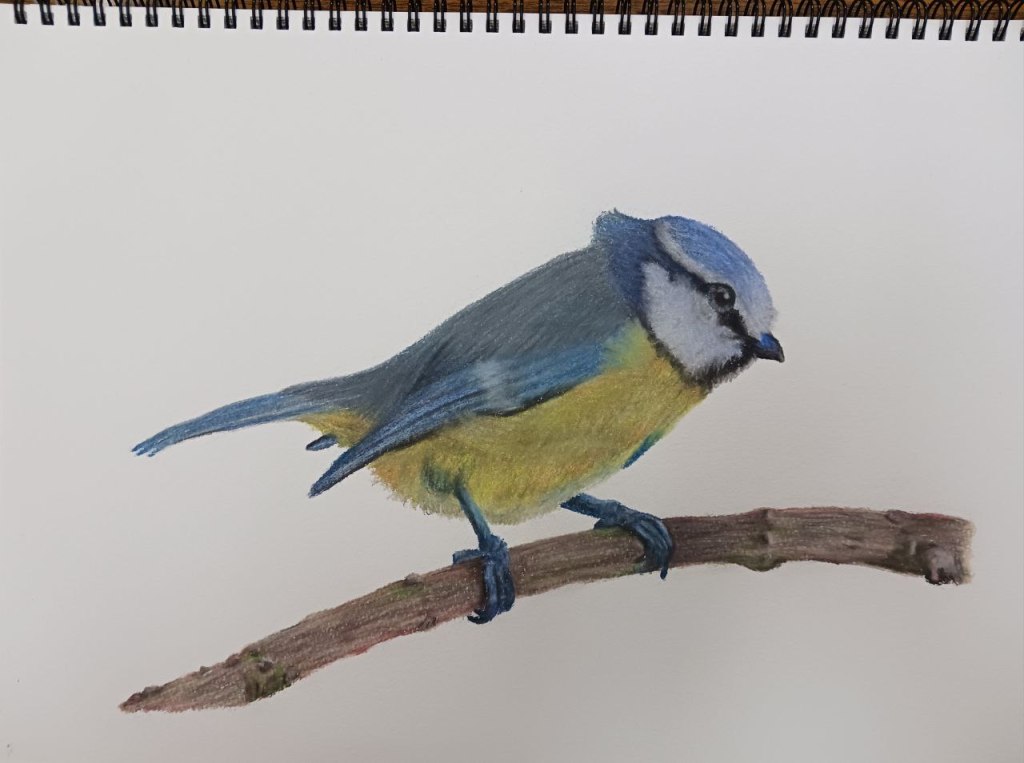
A Quiet Moment Soft Pastels and a Bluetit

Drawn with soft pastel pencils on toned sketch paper.

Soft pastel drawing of a bluetit perched on a branch, with delicate blue and yellow feathers.

Sometimes, in the middle of writing about broken kingdoms and gods at war, I need a moment of stillness.

This little bluetit was one of those moments.

Drawn in soft pastel pencils, it reminded me how quiet creativity can be just as powerful as the loud, epic scenes I build in my books. No magic, no battles, just colour, texture, and the way nature always finds a way to perch calmly in the chaos.

These kinds of drawings help recharge me. They bring back focus, especially when I’m buried in worldbuilding or struggling with the structure of a chapter. I didn’t plan this one for any specific purpose… I just wanted to draw something gentle.

Thanks for taking this quiet detour with me.

I’ll be back in the next post with more from the worlds I’m building, but until then, I hope this little bird brought a moment of peace to your screen, too.