Why I’m Writing Fantasy Short Stories (And How They Expand My Novel’s World)

Before my epic fantasy novel The Veil of Kings and Gods releases, I wanted to open a small window into the world of Ældorra, a world of stone kingdoms, fading gods, and myths that refuse to die.

Each short story I write is its own world in miniature. They don’t rely on the main novel, yet every one of them echoes it, a fragment of history, a lost prayer, or a legend that shaped the lands my characters now walk. Some are quiet and personal; others burn with the power of the divine. Together, they breathe life into Ældorra in a way that maps and lore pages never could.

Writing these stories is more than worldbuilding, it’s a way of feeling the world I’ve spent years creating. When I step into a new tale, I discover the texture of the world again: the smell of rain on stone, the flicker of temple light, the forgotten names carved into the ruins.

These short stories aren’t just for readers waiting for the novel, they’re for anyone who loves myth, emotion, and the quiet moments that make a fantasy world feel alive.

You’ll soon be able to explore them as ebooks, see the artwork behind them, and even collect the prints.

Welcome to Ældorra. The gods don’t stay silent forever.

🎥 Watch the video

Why I Still Believe in Epic Fantasy in a Cynical World

There are days when the weight of the world feels heavier than ink or fire, when the quiet corners of the soul grow dim beneath the noise of what passes for truth. In such moments, it would be easy to set aside the great tales, to dismiss them as relics, gilded stories carved for brighter ages. Yet I do not.

I still believe in epic fantasy.

That may sound strange to those who favour stark realism, whose shelves are lined with fractured heroes and greyscale worlds. We are told that truth lies in brokenness, that hope is naïve, and that honour is no more than an illusion passed down by old songs and older men. Perhaps. Perhaps the world has earned its doubt.

Even so, I return to the stories where kingdoms rise and fall, where swords gleam beneath ancient skies, and where the soul of a man can alter the course of the stars. I return not because such tales are easy, but because they ask the oldest question with unflinching grace: What is worth fighting for, when the world stands poised on the edge of ruin?

There is power in that question. Quiet, enduring power.

Epic fantasy, when it is true to its roots, does not flinch from sorrow. It walks beside it. It knows the weight of sacrifice, the silence after loss, the slow unwinding of power misused. Yet it dares to offer meaning in the ashes. It does not scoff at faith or nobility. It treats love, be it for a kingdom, a child, a forgotten god, with reverence rather than irony.

That tone, that trust, is something I refuse to let go of.

For me, writing within this tradition is an act of defiance as much as devotion. It is choosing beauty when the world favours bleakness. It is lifting a banner in fog, even when no one watches. And yes, it is believing in things unseen, magic, yes, but also memory, duty, and the soul’s quiet yearning for more.

There are moments in the story I’m shaping where the light fades, where characters stumble beneath burdens they cannot name. In those moments, it would be easy to give in. Yet the story holds steady. Because epic fantasy does not require perfection, it asks only that its heroes rise, however broken they may be.

In a cynical world, that still matters.

So if you find yourself weary of headlines, of noise, of shallow victories and hollow rage, step into a world where the stars still whisper, where the land remembers, and where even the most wounded soul may shape the fate of empires.

You may find, as I have, that there is more truth in those tales than many would dare admit.

The Shadow Rising A Turning Point in the Wheel

There comes a moment in every long series where the world tilts slightly, where what was once a journey across landscapes becomes a passage into myth itself. For The Wheel of Time, that moment arrives in The Shadow Rising, the fourth volume in Robert Jordan’s vast and labyrinthine saga. It is here the tale begins to unfold on a truly epic scale, uncoiling threads of prophecy, heritage, and power that stretch far beyond the Emond’s Field beginnings we once knew.

A Novel of Expansions and Transformations

Unlike the tightly structured urgency of The Dragon Reborn, this book refuses haste. It broadens rather than barrels forward. Rand, now declared the Dragon Reborn, does not simply charge into battle. Instead, he walks into the heart of the Aiel Waste, into a past carved by blood and fire, and into a people whose history reshapes his own. Jordan uses the Aiel journey to expand his world in the most powerful sense, not by adding more, but by revealing depth. The Waste isn’t just a desert; it’s a crucible for a cultural philosophy built on honour, tradition, and hidden sorrow.

Meanwhile, Perrin returns to the Two Rivers in what remains, for me, one of the most emotionally grounded and satisfying arcs in the series. His struggle is heavy with consequence, defending his homeland, confronting loss, becoming a reluctant leader. It’s no grand adventure; it’s resistance. The quiet strength of Perrin’s arc holds the novel together when the other threads drift toward abstraction.

Mat, of course, is dragged forward by the Pattern with coin in hand and complaint on lip. Yet beneath the bravado, something is stirring. His gift or curse, begins to awaken. And with it, we catch glimpses of a man who will one day command entire armies, whether he likes it or not.

Women of Power and Subtle Shifts

Egwene, Nynaeve, and Elayne continue their arc through Tanchico and Tel’aran’rhiod. It is perhaps the portion of the book that divides readers most. At times, their chapters feel drawn out, yet they contain critical developments. The World of Dreams becomes more than a curiosity. It begins to whisper of control, danger, and deeper truths. Nynaeve’s confrontation with Moghedien is quietly devastating, a clash of raw strength and hidden terror. Jordan doesn’t always balance his multiple arcs evenly, but there is no question he gives the women in this story power, danger, and consequence.

The Great Unfolding

What makes The Shadow Rising remarkable is not a single battle or twist. It’s the slow, deliberate shift in the series’ soul. The world feels older. The scope feels wider. Every major character walks deeper into their identity, shaped less by choice and more by necessity. Prophecy is no longer something quoted by Aes Sedai in candlelit chambers, it lives now, in action and aftermath.

It’s also worth noting that Jordan’s prose here becomes more assured. His digressions are longer, yes, and he tests patience now and again with endless politicking and braid-tugging. Yet his command of tone, setting, and foreshadowing has sharpened. He is no longer just building a world, he’s weaving fate.

Final Thoughts

This isn’t the book I’d recommend to first-time fantasy readers. It demands investment. Yet for those already caught in the turning of the Wheel, The Shadow Rising marks a threshold crossed. From here, the story no longer simply follows characters, it chases legacies. Heroes don’t just act; they echo.

If you’ve ever wondered where The Wheel of Time truly begins to feel legendary, it’s here.

If you’d prefer a more informal deep-dive, with visual breakdowns and unscripted thoughts, I’ve also posted a video review of The Shadow Rising on my YouTube channel.

When Characters Refuse to Obey A Quiet Update from the Writing Desk

There are days when the words arrive with purpose, unfolding like the tide, steady, inevitable, drawn by unseen moons I never named. And then there are days like this past week, where a single scene becomes something else entirely. Not broken, nor wrong, simply… changed. Unexpected. Alive in a way I had not planned.

I was rewriting a chapter for The Veil of Kings and Gods, one that should have followed the arc I had carefully woven. The notes were there, the pacing mapped, the motivations aligned. Simion was meant to speak. A single line. Firm, measured, final. A rejection. It would have been a turning point of sorts, the moment he chooses distance over duty.

And yet, as I reached that moment, he waited.

Not in defiance. He was simply still. Listening. Watching. And when the words came, they were not rejection, but understanding. A softness I had not intended entered the scene, subtle, unexpected, entirely right. It changed the shape of the moment. It changed him. And through him, the shape of what follows.

This is not the first time a character has shifted beneath my hands. Patrick once delayed a speech for two chapters because his silence held more weight than I had imagined. Elana once turned back when I thought she would walk away. Even Týrnan, who so often walks the edge of fire and certainty, veered off course once to grant mercy where I had written none.

These are not dramatic revisions. They are the quiet revolts, the ones that happen deep in the bones of the work. You do not always see them coming. They’re not betrayals of plan or plot. They are corrections of truth. A character, fully formed, will sometimes remind you that they are no longer yours to shape so easily.

So this is where I am. Still within the final stretch of the book. Still rewriting, refining, listening. Not rushing. Letting the weight of each word find its proper place. Some chapters arrive like stone. Others like river. All must settle before the storm.

Thank you for reading and for walking this strange, shifting path with me.

Until the next.

Azaroth and the First Hell: The Demon God Who Was Once Divine

Before he became the greatest threat to Ældorra, Azaroth held a place among the divine.

During the age of the Imperium Arcana, the gods still shaped the world. Their presence guided the rise of empires, the movement of stars, and the sacred flow of magic. Among them stood Azaroth, an entity devoted to balance and universal law. He did not govern love or war. His realm existed at the intersection of order and arcane truth. Mortal kingdoms honoured him with silent offerings, while the Order of Magicians held his name among the highest in their ancient texts.

Over time, something within Azaroth shifted.

No records reveal the full path of his descent. Even the Order, with all its stored knowledge and sealed tomes, whispers only fragments. What remains clear is this: Azaroth chose to leave the High Heavens. He reached downward, into the wounded depths of reality, the realm known only as the First Hell.

That place devours meaning. Magic there fractures into madness. Time becomes a storm of echoes. Azaroth returned changed. Divine no longer, he emerged cloaked in shadows that moved like thought. His magic no longer carried harmony. It consumed. Across the divine realms, tremors of dread followed in his wake.

The God of Magic rose in response. Once kin to Azaroth, he stood alone before the fallen deity. The clash between them tore across sky, land, and sea. Entire mountain ranges cracked. Oceans surged beyond their borders. Celestial towers collapsed into memory.

The fallen was sealed. Azaroth’s essence remained trapped within the First Hell. To ensure the prison held, the God of Magic sacrificed himself. No tomb bears his name. No statue rises in his honour. His essence faded, though his victory allowed the world to continue.

The seal endured across centuries.

Now, it weakens.

In The Veil of Kings and Gods, faint tremors move through forgotten chambers and shattered temples. Spells fail. Visions twist. In moments of silence, some hear voices echoing with words never spoken. The First Hell watches once more. Azaroth reaches toward the living world through cracks in the veil.

He remains more than a demon. A god’s ambition shaped his fall. His memory was stripped from scripture, yet his will never faded. He waits, not in silence, but in hunger.

And now, the gate flickers.

Simion the Magician: Pawn of the Divine or Something More?

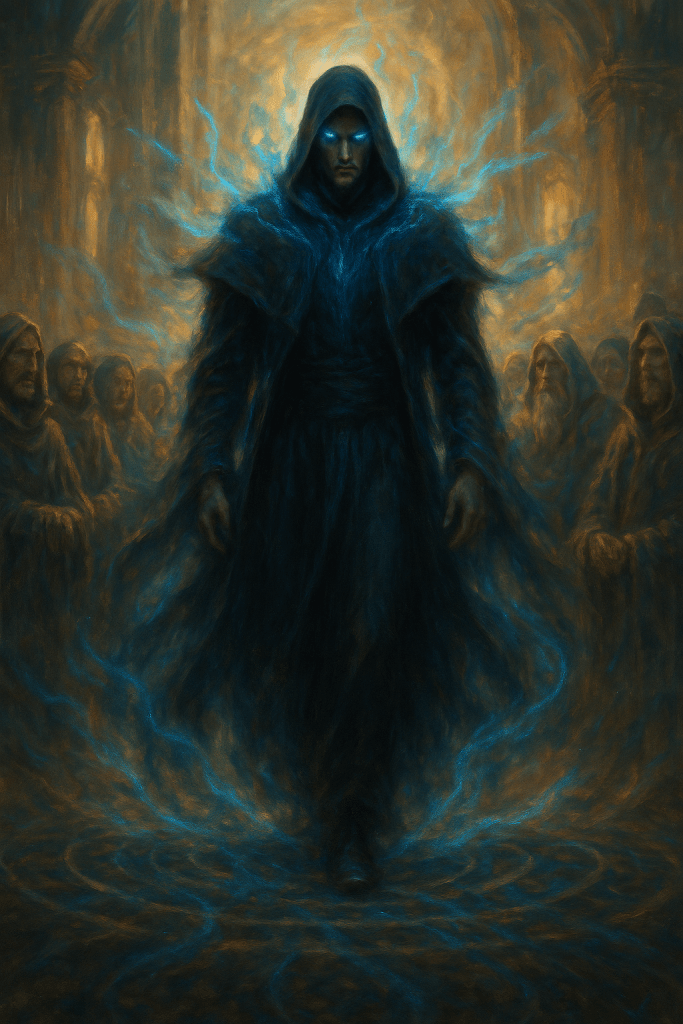
A cloaked figure exuding magical energy stands at the center of a dimly lit chamber, surrounded by a group of hooded onlookers. The figure's blue eyes glow intensely, hinting at a powerful presence in a mystical setting.

In a world once shaped by divine hands, where kings fear what they cannot control, Simion stands at the edge of myth and obscurity. He holds no grand title, wears no gilded robes, and bears no reputation as a prodigy of the arcane. His story is quieter, rooted not in greatness, but in something far more human.

Before the councils and court chambers, Simion was a kitchen boy. The castle at Bremyra was his world, its stone corridors filled with the clatter of pans and the scent of stewing broth. He moved among servants, delivering bread, cleaning floors, and sneaking crusts to the youngest among them. It was there, beneath those very walls, that the first spark of magic broke loose from within him. A frightened boy. A sudden flare. And the Order of Magicians arrived before the embers cooled.

He was taken without ceremony. His name added to the rolls of the Academy where the days were long, the teachings relentless. Simion did not rise easily. Others soared through the high arts, weaving spells with elegance and precision. He struggled to hold form, to understand deeper currents, to speak the tongue of magic with anything beyond effort. Yet he endured, through sheer will, long study, and quiet resolve.

Upon completing his training, no citadel called him. The cities of power remained silent. His path remained unclear until his former master, a stern voice within the Council, arranged a post that few would envy, Advisor to the King of Bremyra. It was less a promotion than an obligation. A placement of necessity. Still, he accepted.

Now, Simion walks again through familiar stone halls. He stands beside those who once knew him in passing. Elana, a friend from youth, the princes, with whom he once shared stolen moments of laughter. The kitchen boy has returned, not with acclaim, but with a burden that grows heavier by the day.

The kingdom shifts. Whispers speak of hidden tomes, ancient chambers sealed in forgotten stone, and strange forces moving beneath the world. Simion has seen things no Advisor should see, felt magics that do not obey the rules he was taught. There are voices now, soft, distant, threading through silence.

He never sought power. Nor was he shaped for glory. Yet in the quiet places where gods once walked, something has stirred.

And Simion, worn and uncertain, may be the only one left who can hear it.

The Gods of Ældorra: Who They Were Before the Fall

Author’s Note:
In my fantasy novel The Veil of Kings and Gods, the world of Ældorra is shaped by ancient gods, divine betrayal, and the remnants of a shattered empire. This post explores the origin of Ældorra’s divine war, drawn directly from the mythic past within the story itself. If you enjoy deep lore and high fantasy, this is for you.


Before kingdoms warred and magicians stood above kings, Ældorra was shaped by gods, divine beings whose presence touched every corner of the world. In the time of the Imperium Arcana, magic was not a distant force, but a living breath that pulsed through every stone, sea, and soul. This magic, ancient and sacred, came not from study alone, but from the gods themselves.

Among these deities stood the God of Magic, the mightiest of them all. His power was the very source of the arcane that wove the empire together. He was not only a divine figurehead, he was the guardian of all, it was he who anointed the magicians as the empire’s true rulers, custodians of magic who were revered not just as wielders of power, but as the chosen of heaven. To command the arcane was to speak with divine authority, and so the magicians ruled not by bloodline, but by divine will.

The Imperium flourished under this covenant. Cities of marble and gold rose across the land, and every breath of wind, every whisper of light, carried the weight of enchantment. From the fjords of the north to the eastern deserts, magic was life, and life was divine.

But divine creations are not immune to betrayal.

The fall began with a god of the First Heaven, once the deity of balance and insight. His corruption was not a sudden blaze but a slow rot, fed by ambition and the hunger for more. The god descended from his sacred post, abandoning the divine realm to seek darker paths. Deep within the First Hell, his magic became something twisted and foul. No longer a god, he was reborn as a demon: Azaroth.

Azaroth’s rise did not go unnoticed. While the magicians of the Imperium grew complacent, blinded by their own greatness, it was the God of Magic who first sensed the rot. Alone among the heavens, he understood the threat. And so, the two former brethren clashed, not with armies or swords, but with the raw essence of creation itself. Magic and corruption tore through reality. The heavens cracked. The seas rose. The skies burned.

In the end, the God of Magic made the ultimate sacrifice. With the last of his divine essence, he sealed Azaroth within the First Hell, imprisoning the demon for eternity. Yet victory came at a cost: the God of Magic himself was torn apart, his name lost to time, his power shattered.

And with his fall, so too fell the Imperium.

What followed was silence. The gods no longer walked the world. The arcane throne stood empty. The magicians, left to their own devices, could no longer claim divine mandate. But before the empire’s final breath, the last emperor passed one final law: that the magicians would remain autonomous, above kings, above law, outside the reach of Church and Crown. Thus, the Order of Magicians was born.

The gods’ war was long buried by history, but its echoes never faded. In The Veil of Kings and Gods, the seal on Azaroth begins to weaken. Forgotten powers stir. And the divine magic once thought lost whispers again from the shadows of Ældorra.

The gods may be gone.
But their war is not over.


Want more?
This is just the beginning. The divine echoes of this history shape every chapter of The Veil of Kings and Gods, especially through the eyes of Simion the Magician. New blog posts, lore entries, and behind-the-scenes content are released every other day. Subscribe to the blog, follow on YouTube, or check out my short stories for deeper glimpses into Ældorra’s ancient past.