Atmospheric Opening
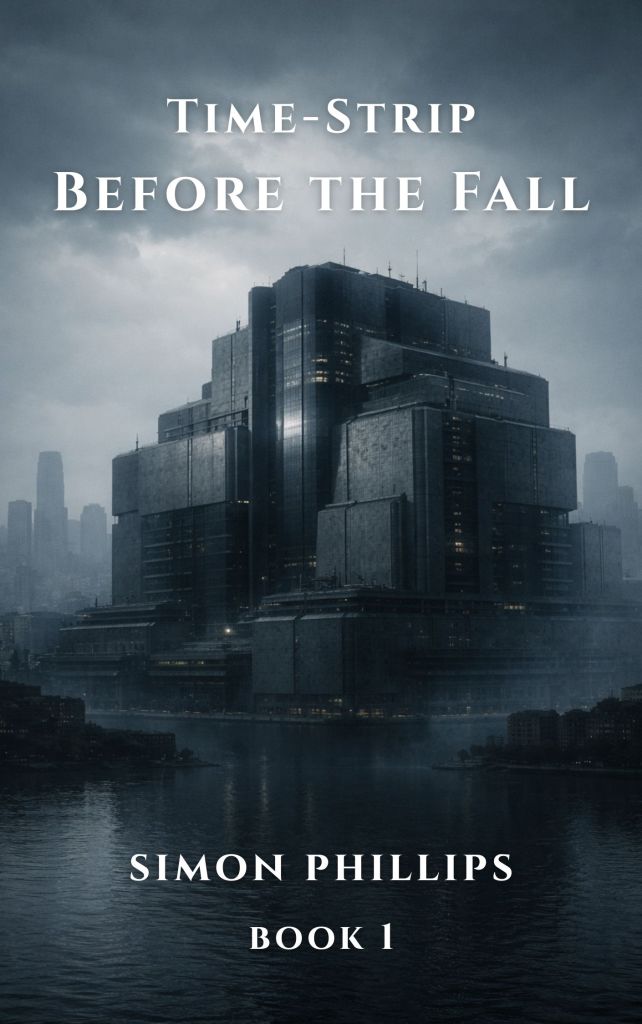
Deep beneath layers of reinforced concrete and controlled silence, a research complex prepares for an experiment that humanity has imagined for centuries. Engineers monitor fields of energy that bend along equations still fresh within scientific literature, analysts observe streams of temporal telemetry, and somewhere within that quiet machinery a gateway waits for the moment when theory becomes reality. Within this atmosphere of restrained anticipation emerges a time travel science fiction novella rooted in the believable language of research institutions and technological ambition.
Time Strip: Before the Fall unfolds within a near-future environment where advanced systems guide human movement through buildings designed for precision and containment. Artificial intelligence manages daily routines, environmental controls respond to bodily rhythms, and the routines of scientific life proceed with the calm confidence that accompanies successful technological progress. Within such surroundings, a near-future time experiment fiction setting feels plausible rather than distant.
At the centre of this environment stands Caelen, a participant within a research programme dedicated to opening what scientists have begun to call the Time Strip, a phenomenon capable of bending chronology itself. Within the language of contemporary speculative research this experiment resembles a temporal anomaly science fiction concept, where a portal emerges through enormous energy concentration and carefully calculated containment systems.
In the early hours before the experiment begins, the facility remains almost serene. Laboratories hum with restrained power, corridors glow with quiet lighting, and human movement flows through automated architecture designed for efficiency. Every detail communicates control, calculation, and confidence. The scientific community within this world believes the experiment represents the next step in human exploration.
Yet beneath that surface calm lies the unsettling awareness that humanity now approaches the edge of something vast.
The Human Desire to Control Time
For centuries the idea of travelling through time existed largely within imagination, philosophical speculation, and theoretical mathematics. Modern speculative literature frequently explores this idea through distant futures or fantastical technology. A more grounded approach to realistic time-travel science fiction asks a quieter question: what happens when contemporary scientific culture truly attempts such an experiment.
Within the world of the Time Strip series, time travel emerges through institutional research rather than adventurous curiosity. Government agencies, corporate laboratories, and academic partnerships converge around a technology capable of generating immense energy distortions. The purpose appears straightforward: observation of past and future states, controlled experimentation, and perhaps the eventual ability to move information or travellers across chronology itself.
Within such a framework, the story transforms into a psychological science fiction story rather than a spectacle of machines. The true tension grows within the human mind confronting forces that stretch beyond familiar experience.
Scientists spend their careers mastering systems that obey measurable laws. Laboratories operate through procedure and repetition. Instruments respond predictably when calibrated correctly. The promise of a time distortion sci-fi fiction concept challenges those expectations. Time itself behaves as the underlying structure of every scientific discipline. Once that structure bends, every assumption surrounding cause and effect begins to tremble.
The earliest moments within the Time Strip research facility therefore carry a subtle psychological pressure. Engineers observe instruments that drift by fractions of a second. Timing protocols require adjustment. Minor anomalies appear within readings that previously held perfect alignment. None of these changes appear dramatic in isolation. Together they suggest a reality shifting by almost invisible degrees.
Such details build the atmosphere characteristic of a time portal science fiction novella grounded in scientific culture. Instead of sudden catastrophe, the narrative explores the creeping realisation that the universe may contain layers of complexity far beyond human modelling.
Institutional Control and the Fragility of Certainty
Large research programmes rely upon layers of institutional authority. Government oversight, scientific committees, security protocols, and carefully defined procedures maintain order within environments dealing with dangerous technology. In theory such structures prevent chaos.
Within the Time Strip facility, these systems function flawlessly during the early stages of the experiment. Automated architecture guides personnel through corridors designed for efficiency. Artificial intelligence manages schedules, monitors health indicators, and ensures that participants remain within operational parameters. Environmental systems maintain temperature, air quality, and lighting according to biometric feedback.
This environment reflects the ambition of a speculative time research fiction setting in which technology anticipates human behaviour almost before it occurs. People move through the building with the quiet trust that advanced systems will guide every step.
Yet time itself refuses simple containment.
As the experiment approaches activation, the atmosphere within the facility grows subtly different. Conversations slow as scientists watch their instruments with increased attention. Security personnel maintain calm posture while absorbing unfamiliar instructions from research supervisors. Artificial intelligence systems continue providing guidance with perfect composure.
Within such moments emerges a profound question that lies at the heart of many indie science fiction novella projects exploring technological boundaries: can institutions truly manage forces that operate on a cosmic scale.
The research teams believe preparation remains complete. The facility stands fortified beneath the earth. Energy containment fields exceed projected requirements. Mathematical models predict stable conditions throughout the activation sequence.
Confidence surrounds the experiment like a shield.
Yet the deeper narrative tension suggests that confidence alone may offer little protection when humanity begins manipulating the structure of time.
Memory, Identity, and Temporal Uncertainty
Time travel stories often focus upon dramatic paradoxes or adventurous journeys across centuries. The Time Strip series approaches the concept through a more intimate lens. When chronology bends, human perception becomes the first instrument affected.
Memory forms the core of identity. Each person carries a continuous thread of experience connecting past moments to present consciousness. Temporal distortion threatens that continuity in subtle ways long before physical travel occurs.
Inside the research facility, participants begin noticing small irregularities. A corridor feels longer than expected. A scheduled announcement arrives moments earlier than predicted. An internal sense of timing grows slightly uncertain. None of these sensations immediately appear alarming. Each observation invites reflection rather than panic.
Such details transform the narrative into a psychological science fiction story where perception itself becomes an unreliable instrument.
Scientists trained to trust empirical data suddenly face experiences that resist measurement. Artificial intelligence systems report stable readings while human participants sense minute shifts within their awareness. The gap between machine certainty and human intuition widens.
Within that space of uncertainty grows the quiet dread characteristic of time distortion sci-fi fiction grounded in human psychology. If time itself begins to slip, memory may follow. Identity may stretch across unfamiliar moments. Cause and consequence may detach from their expected order.
The Time Strip experiment therefore explores more than technological ambition. It examines how human consciousness responds when the framework of reality begins to loosen.
Novella Spotlight: Time Strip: Before the Fall
The opening entry in the Kindle sci-fi novella series introduces readers to the earliest phase of humanity’s attempt to reach across time. Time Strip: Before the Fall stands as the foundation of the broader narrative, establishing the research facility, the institutional structures supporting the experiment, and the subtle pressures building around the activation of the Time Strip itself.
At its centre stands Caelen, a participant whose life unfolds within a society deeply integrated with artificial intelligence and predictive technology. Daily routines proceed with quiet efficiency. Personal AI companions manage schedules and environmental comfort. Urban infrastructure anticipates human movement with remarkable precision.
Within such a world the decision to pursue temporal experimentation appears almost inevitable. Scientific progress continually reaches toward new frontiers, and the possibility of opening a controlled passage through time represents one of the most compelling frontiers imaginable.
The novella explores this moment before the experiment crosses its threshold. Scientists prepare instruments. Observers gather within containment areas. Systems align for the activation sequence that may transform humanity’s relationship with chronology.
The narrative tension resides within atmosphere and perception rather than explosive action. Readers encounter a time travel science fiction novella where quiet scientific ambition gradually meets the unsettling possibility that time itself holds depths beyond calculation.
Further details surrounding the novella can be found through its Kindle listing, where the story stands as the first chapter within the expanding Time Strip series.
A Glimpse Through the Research Facility: The Visual Mini-Read
Alongside the written narrative exists a brief visual fragment preserved through a short cinematic presentation. The YouTube visual mini-read offers a glimpse inside the research facility where the experiment unfolds.
Within a few moments of imagery the viewer enters the sterile corridors, the calm glow of laboratory interfaces, and the quiet movement of personnel preparing for an event that may reshape human history. The visual sequence captures the restrained atmosphere that defines the early phase of the Time Strip story.
Rather than summarising the novella, the visual piece functions as a preserved moment within the world itself. A corridor illuminated by soft light. A figure moving toward the containment chamber. Instruments waiting for activation.
The video becomes an atmospheric doorway through which the broader narrative quietly reveals its presence.
Embedded within this article, the visual fragment invites viewers to experience the mood of the facility before the experiment begins.
Closing Movement
Human civilisation has always advanced through experiments that stretched the boundaries of understanding. Fire, electricity, flight, and nuclear energy each transformed the course of history once theory met reality.
The Time Strip experiment extends that tradition toward the most fundamental structure of existence: time itself.
Inside a fortified research complex, scientists continue refining their instruments. Artificial intelligence maintains the calm rhythm of daily operations. Participants move through corridors designed for precision and containment.
Somewhere within those systems, the first distortion in chronology begins to form.
At first the shift appears almost imperceptible. A subtle hesitation within timing protocols. A faint sense that events unfold with slightly altered rhythm. Observers continue their work, guided by training and procedure, trusting the calculations that brought them to this moment.
Yet time remains older than every instrument attempting to measure it.
Within the quiet heart of the research facility, the Time Strip waits.
And humanity prepares to discover what lives beyond the edge of its own chronology.
 Simon J. Phillips