The Mythic Chronical
Beneath a chapel floor, where candle smoke thins into colder air and stone remembers hands long gone, a sealed passage waits with a patience older than the living city. Few images in mythic fantasy carry such lasting force as the hidden stair, the buried foundation, the chamber whose purpose has slipped from surviving record. A sealed passage suggests more than secrecy. It suggests pressure, memory, and a world whose deepest truths lie beneath the places people still pray, trade, grieve, and sleep.
This is part of the reason ancient fantasy worlds remain so compelling. Their streets rest upon previous ages. Their halls stand over ruins. Their shrines inherit ground whose first name has fallen away. When a stair is uncovered under a chapel, the discovery opens more than a route through stone. It opens a relationship between the visible city and the older city pressed below it, where sacred use, forgotten labour, failed warding, and buried fear have settled together through time.
Chronicle One of The Mythic Chronicle, The First Sealed Passage, enters exactly that kind of place. Its power comes through restraint. The stone gives little. The record gives less. Yet the pressure within the scene gathers around every mark in the wall, every held murmur, every decision to close a passage whose closure feels uncertain even as it is recorded. That quiet weight forms the true spell of the sealed passage in mythic fantasy.
Why Sealed Passages Hold Such Power
A ruin in open air offers scale. A sealed passage offers trespass. The body feels the narrowing stair, the failing light, the change in air against the chest. Mythic fantasy thrives on such thresholds because they pull fear inward. The reader moves from landscape into enclosure, from history seen at a distance into history felt against skin and breath. Every surface begins to matter. A scratch in plaster, a gap in a register, a scent that lingers too long in stillness, each one carries force because the space around it has already been chosen for concealment.
That act of sealing matters deeply. A buried chamber may carry age, mystery, and sacred unease, yet the moment a passage has been closed by human hands, the place gains moral weight as well as atmospheric weight. Someone made a judgement. Someone chose stone, mortar, labour, and silence. In mythic fantasy, that human decision often carries more dread than any creature glimpsed in darkness, since it implies contact has already happened and memory has already failed. The wall stands as both barrier and confession.
This is where The First Sealed Passage proves so effective. The Chronicle never hurries toward spectacle. It lingers with lantern light on worn steps, with the pressure inside the stair, with the sense that sound has settled into the stone itself. Through that restraint, the passage gathers authority. The world feels old enough to have forgotten its own foundations, and human enough to keep recording stability long after certainty has weakened.
Buried Foundations and the Memory of Stone
Old cities in fantasy carry emotional force when their foundations feel layered, used, and inherited. A living district gains depth when its chapel, market, bath, tavern, or hall stands upon earlier structures whose names have faded from common speech. The ground beneath daily life becomes an archive. Stone ceases to be scenery and becomes memory given form. A stair beneath a chapel therefore carries two pressures at once: the sacred authority of the present structure and the unresolved claim of whatever came before it.
That layered architecture gives mythic fantasy its deepest atmosphere. The visible city offers order, ritual, trade, law, and custom. The buried city below offers fracture, erasure, repetition, and unfinished return. When writers bring those two cities into contact, the result feels richer than a simple haunted corridor. The setting itself begins to behave like a wounded record. Gaps appear. Marginal voices survive. Official language remains calm while the physical world suggests a stranger truth.
The chapel beneath Saint Veyne works through exactly that tension. The stair descends into a foundation whose origin has slipped from the surviving register, while the later record still tries to name the structure stable. That single contrast carries much of the Chronicle’s force. Stability is written above. Unease gathers below. Between those two layers lies the old fascination of buried foundations in fantasy literature: the sense that a city may continue functioning while its deeper stone has already begun to answer to some older pressure.
Sound becomes especially powerful in such places. A seen figure can be measured, pursued, perhaps even named. A sound held within stone resists that comfort. It belongs to structure, to weight, to enclosure, to matter that should remain still. Once a murmur seems fused to foundation, fear spreads through every block and seam around it. The threat no longer waits at the far end of the tunnel. It inhabits the tunnel itself, and by extension the city resting above it.
The First Sealed Passage and the Reading Experience of The Mythic Chronicle
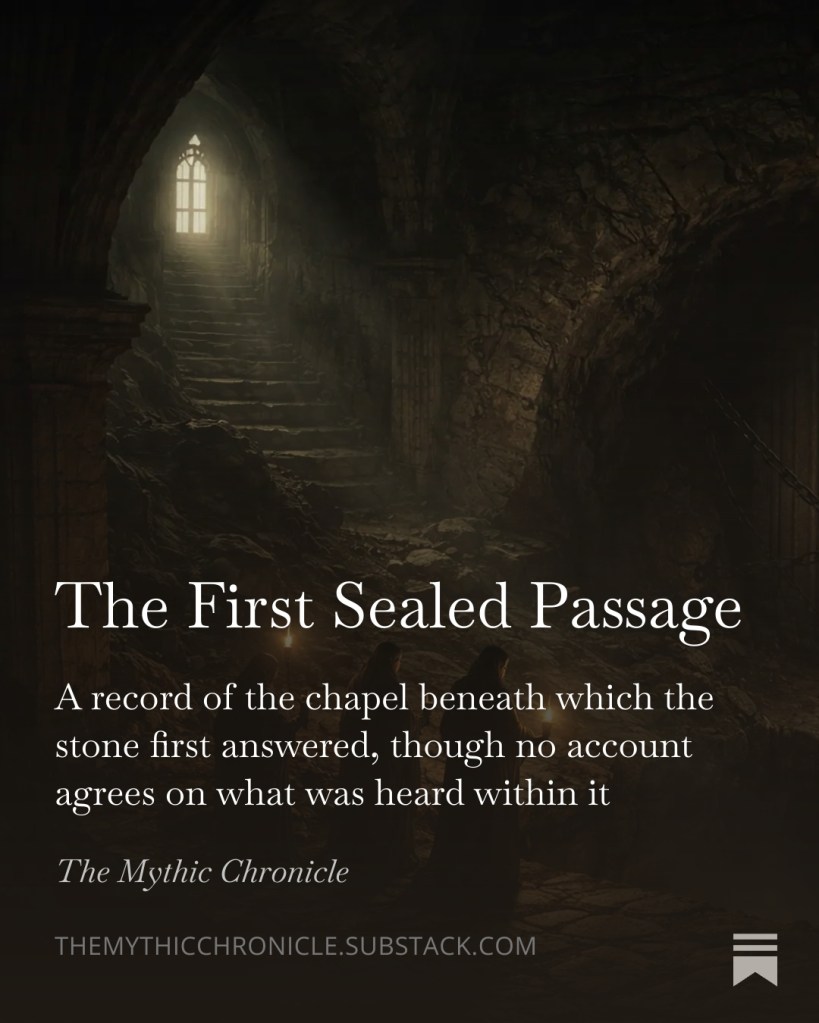
The Mythic Chronicle carries a distinctive kind of fantasy authority because its entries feel preserved and lived. The reading experience resembles the handling of a surviving fragment: a record, a register, a corrected folio, a later note in the margin, a surface account whose omissions carry as much force as the lines left intact. That method suits the sealed passage perfectly, since the theme itself concerns partial knowledge, uncertain closure, and the long survival of things buried without full understanding.
In The First Sealed Passage, the reader enters through place before explanation arrives. A chapel, a stair, a mason, a brother of the order, the faint sweetness in the air, the wall drawn across the lower way, all of it gathers with measured patience. Then the Chronicle widens into register, archive, interpretation, and continuation. The effect is quietly cumulative. Instead of offering a single scene and stepping away, it allows the passage to echo through several forms of record, each one carrying its own degree of confidence and fracture.
That structure makes Chronicle One an ideal threshold into the wider Whispering Foundations cycle. The series concerns the buried layers beneath the city and the way corruption begins, spreads, and is misunderstood through broken accounts. Chronicle One establishes that governing pressure with admirable clarity. The deeper stone answers. The official record steadies itself. The gap between those two gestures becomes the space in which the wider cycle lives.
For readers who wish to enter the preserved opening itself, the first fragment rests here:
A visual companion shaped from the same buried pressure rests here: The First Sealed Passage
From Chronicle Fragment to Fuller Record
A Chronicle entry such as this one gains further weight through the sense that other records survive elsewhere, half adjacent and half concealed. The sealed passage beneath the chapel feels complete as an individual fragment, yet it also carries the impression of a wider disturbance moving through the city’s lower structures, through walls, cellars, chambers, and misread deaths. That widening pressure gives the blog reader a natural route onward, since curiosity grows from atmosphere already established, without any abrupt invitation.
This is where the movement from Chronicle to novella becomes especially effective. The Chronicle preserves distance, symbolic weight, and partial record. The novella draws nearer to consequence, human contact, and the cost of ignoring what older places continue to hold. One form gives the mythic contour of the world. The other gives the lived encounter within it. Together they create the feeling of an archive whose surviving pieces speak across different depths of time and witness.
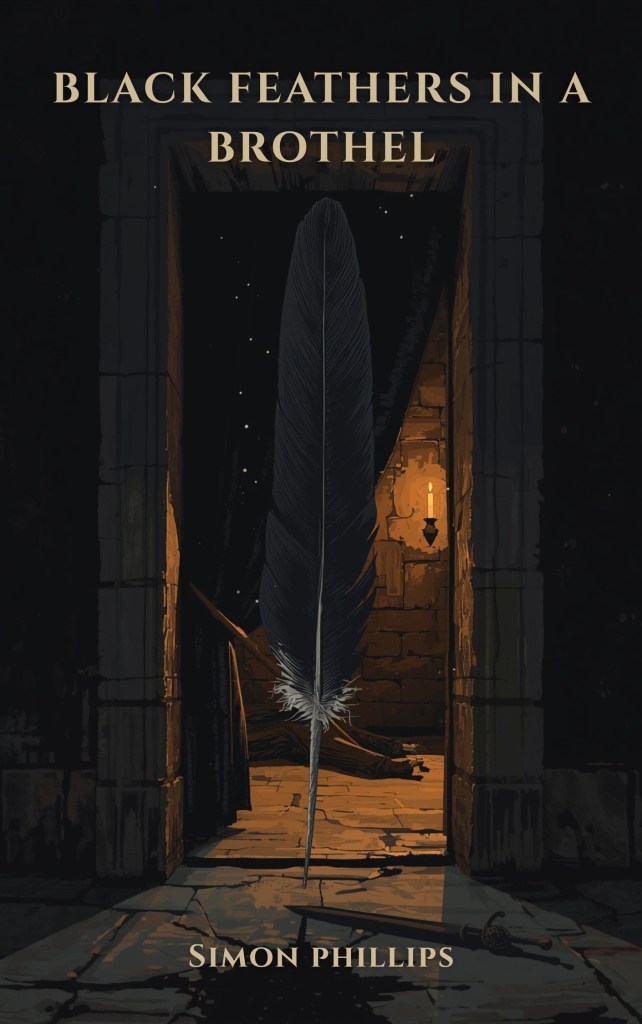
The fuller record connected to this buried pressure, preserved in Black Feathers in a Brothel, rests here:
Placed beside Chronicle One, the novella link feels less like a sales gesture and more like a second folio brought carefully from the shelf. The reader follows the pressure from chapel stone toward the lower district, from early disturbance toward later consequence, from the moment a passage is found and sealed toward the wider pattern that seal was meant to contain. That movement honours the oldest pleasure of mythic fantasy, which lies in the sense that every surviving fragment opens onto a larger darkness holding its own order.
Why Ancient-Seeming Fantasy Worlds Continue to Linger
Readers return again and again to ancient-seeming fantasy because such worlds allow memory to remain physically present. History lives in masonry, scent, ritual, crack lines, worn thresholds, reused foundations, and names half preserved within damaged records. The past has texture there. It can be climbed, touched, uncovered, sealed again, and still felt pressing upward through the present. That intimacy gives mythic fantasy a form of gravity few other modes of storytelling can sustain.
A sealed passage expresses that gravity with unusual purity. It is at once threshold and refusal, answer and erasure, architecture and omen. It promises a world larger than the immediate scene, while also reminding the reader that access always carries cost. Once the wall is opened, even briefly, the city above can never feel entirely simple again. Every chapel floor, every cellar, every quiet district street begins to imply a second life below its visible order.
That is the lasting achievement of The First Sealed Passage. It does far more than offer a mysterious stair. It restores the oldest fantasy intuition that the world beneath the world remains active, patient, and deeply woven into the lives of those who move above it with incomplete records in hand. Through calm language, fragmentary authority, and the pressure of older stone, the Chronicle turns buried architecture into a form of memory that continues speaking even when the record insists upon silence.
The passage beneath Saint Veyne remains sealed, the register remains composed, and the city above keeps its rhythm. Yet some places hold their earlier claim with great patience, and every archive worthy of return leaves one feeling that the truest movement has only just begun, somewhere below the point where the lantern light gives way.
 Simon J. Phillips