The Surface of Order
In an alternate history British Empire setting, the deepest impression rarely comes from spectacle. It comes from the settled confidence of systems that have existed long enough to mistake endurance for permanence, and from the quiet majesty of an empire that never collapsed, whose authority stretches from Westminster across the Americas, Africa, Asia, and the Pacific while Japan stands as its closest ally and China and Russia press against the edges of that order with gathering force. The world of The Measure of Empire carries that scale with unusual calm, offering a geopolitical alternate history in which modern colonial America serves as the industrial and technological heart of imperial power, even as older assumptions begin to strain beneath the weight of the century.
What gives this imperial world political fiction its particular force is the sense that control remains visible everywhere. Trade routes are supervised, fleets are deployed, encrypted messages cross oceans within seconds, and authority travels through offices, council rooms, embassies, naval towers, and colonial departments with the assurance of a structure that has governed for generations. The British Empire modern timeline at the centre of the series rests upon more than flags and ceremony. It rests upon procedure, upon military reach, upon administrative confidence, and upon the conviction that motion itself preserves stability.
That conviction gives the opening volume its atmosphere. Instruments of Authority begins far from battlefield drama and grand declaration. It opens in Ashiya, within the ordered domestic calm of Simon Hale’s life in Japan, where diplomatic service, family intimacy, and imperial duty appear to belong to the same continuous fabric. From there the novella widens across Hong Kong and Philadelphia, revealing a system whose breadth feels almost serene. Even so, every corridor carries the faint pressure of change, and every routine exchange suggests that the empire’s coherence depends upon constant adjustment.
America Within the Imperial Design
The most compelling pressure inside this speculative political fiction series lies in the place America occupies within the imperial structure. This modern colonial America thrives inside empire, draws wealth from it, strengthens it, and supplies much of its industrial and technological force. The American territories remain prosperous, militarily essential, and politically mature, which means the old language of colonial subordination carries an increasingly hollow sound. London governs the continent through a Governor-General, Colonial Congress, territorial governors, defence command, and local assemblies, yet the very sophistication of those institutions creates the conditions through which a separate political identity can harden.
That is where the larger American revolution alternate history of the series acquires its gravity. This future conflict does emerge from romantic rebellion or decorative grievance. It grows from the mismatch between administrative form and lived power. America within this world builds fleets, industries, research centres, shipyards, air bases, and communications systems that sustain the empire on a global scale. A continent carrying that degree of responsibility will eventually begin asking whether service and sovereignty can remain permanently divided. The great illusion of imperial continuity lies here: prosperity can conceal fracture for a very long time, while at the same time deepening the self-awareness that one day breaks a system open from within.
In that sense, The Measure of Empire handles imperial power global narrative with unusual intelligence. The empire remains formidable. Its armed forces possess carriers, stealth aircraft, missiles, drones, cyber systems, satellite networks, nuclear deterrence, and the global basing structure required to project power across several oceans. The Pacific, East Asia, and the American continent all exist within the same military architecture. Strength is real, visible, and measurable. Yet strength of this kind also creates obligations on a scale that no central authority can absorb forever without consequence.
Instruments of Authority and the First Movement of the Series
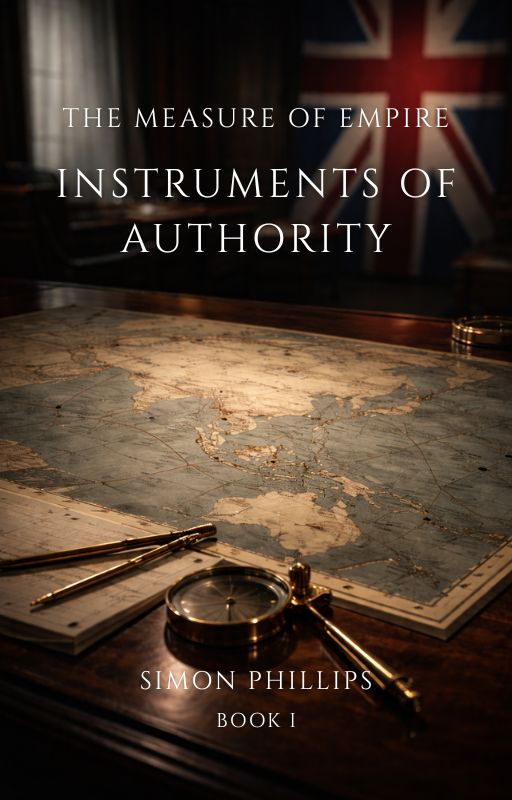
As the first volume in The Measure of Empire, Instruments of Authority chooses a disciplined surface narrative. Simon Hale, a gifted imperial administrator whose confidence in reform and structure defines much of his character, begins in Japan within the diplomatic sphere, receives an abrupt summons from London, and moves toward the political centre without yet understanding the full meaning of that recall. Around him, Admiral Edward Halstead embodies the empire’s naval reach in the Pacific, while Charlotte Mercer stands closer to the American administrative world where correspondence, policy, and political weather reveal the earliest shifts in imperial attention.
This structure matters because the novella refuses the easy route of telling the reader what to fear. It allows pressure to gather through setting, routine, tone, and institutional behaviour. Simon’s household in Ashiya carries warmth, education, and cultivated ease, even as Erina senses larger currents beneath the polished language of administration. Halstead’s Hong Kong reveals the calm geometry of maritime command, where freighters and carrier groups share the same horizon and where diplomacy, logistics, and strategic deterrence merge into one continuous practice. Charlotte’s Philadelphia, by contrast, reveals empire through desks, ledgers, inquiries, and corridors, where paper traffic begins rising before public events acquire a name.
That restraint gives the novella its authority. The machinery of empire appears through habit. A recall notice, a packet from Whitehall, a courier crossing a gallery, a harbour under surveillance, an aide carrying encrypted traffic, a city whose streets have grown prosperous through generations of imperial integration: these details create a sense of lived control far stronger than overt explanation could achieve. The result feels less like a conventional opening act and more like standing inside a structure just before its foundations begin to register strain.
The World Beyond the Page
The wider world continuity surrounding this novella deepens that impression. The British Empire remains the dominant global superpower. Japan, allied closely with Britain, anchors the eastern half of that imperial reach. China expands, Russia aligns against imperial influence, and East Asia becomes one of the most volatile theatres in the world. Within this setting, modern warfare belongs fully to the age of satellites, drones, stealth aircraft, long-range strike systems, cyber operations, naval groups, and nuclear deterrence. This matters because the coming crisis of the series unfolds inside a recognisably modern strategic order, which gives every administrative decision a wider military consequence.
The series blueprint extends that continuity further. Three central figures shape the long movement ahead: Simon Hale as the imperial administrator whose reforms help create the conditions for American independence, a revolutionary organiser seeking sovereignty, and a colonial military commander responsible for holding imperial order together as the world begins to fracture. Through them the saga moves toward the rise and fall of empires, the emergence of a new state, and the long decline that follows the first successful break in an apparently permanent global system.
Seen from that distance, Instruments of Authority gains an added richness. It reads as the first formal pressure line in a broader empire that never collapsed narrative, a volume concerned with attention, placement, and the early alignment of forces. The novella’s achievement lies in how completely it understands that history seldom announces itself at the moment it begins. More often it gathers in rooms where people still believe they are managing continuity. It passes through professional language before it reaches public speech. It takes shape in the interval between confidence and recognition.
The Pressure Beneath Continuity
Every enduring system teaches its servants to read motion as reassurance. Ships continue crossing harbours, dispatches continue crossing desks, aircraft continue carrying envoys between capitals, and ministers continue assuming that authority can absorb one more adjustment without changing its essential form. That is the atmosphere The Measure of Empire captures with such composure. Its world carries immense confidence, immense reach, and immense inherited force, though beneath that polished continuity lies a quieter truth: institutions evolve, colonies mature, loyalties divide, and the language of governance can only carry so much strain before it begins revealing what it once concealed.
For that reason, the opening volume leaves behind a feeling more durable than simple suspense. It leaves the impression of standing within history before history has accepted its own name. Simon travels toward Westminster. Halstead watches the Pacific frontier. Charlotte feels the administrative weather shifting through the corridors of Philadelphia. Across those distances the empire still appears whole, still speaks in the accents of control, still governs through ritual confidence and vast material reach. Even so, the pressure has already entered the system, and once such pressure begins to move through a world of this size, every port, office, fleet, and family will eventually feel its weight.
 Simon J. Phillips