There is a particular kind of silence that exists only in engineered space, a silence shaped through regulation, calibration, and disciplined tolerance margins, sustained by ships that carry their own gravity, temperature, and light as extensions of institutional will. In that silence, every system is designed to continue. Every anomaly is meant to resolve. Every deviation is absorbed into procedure until coherence returns and order resumes its forward motion.
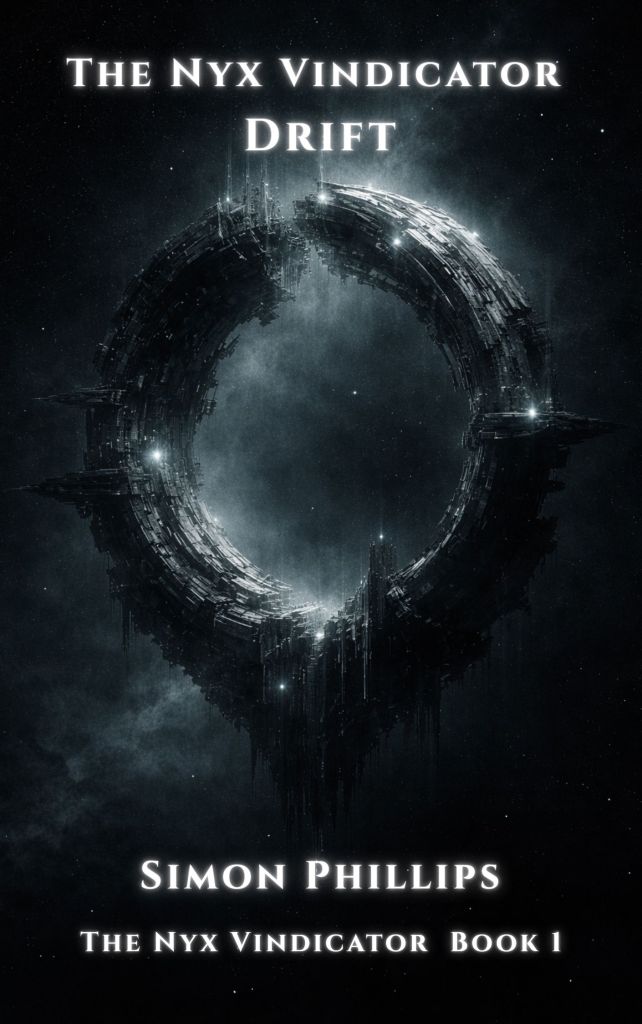
The Nyx Vindicator: Drift begins inside that engineered stillness, within a psychological sci-fi horror novella concerned less with spectacle than with the erosion of certainty inside infrastructure that continues to function long after understanding has begun to fail. This is space infrastructure collapse fiction in its most restrained form, an alien gate sci-fi encounter where the failure lies not in explosion or fire, though in sequence, timing, and the quiet narrowing of operational freedom.
From its opening patrol vector to the encounter with a transit node that resists stable framing, the novella establishes its thematic ground with care: a vessel that holds course, a crew that trusts protocol, and a long-range composite scan that insists everything remains within tolerance. Inside that composure, something shifts.
The shift carries no alarm.
It carries agreement.
Infrastructure as Faith: The Gate Network and Its Fragility
Humanity in The Nyx Vindicator universe depends entirely on fixed transit nodes, vast alien gate structures that enable non-linear travel across interstellar distances. There is no faster-than-light fallback, no alternative drive to carry civilisation through the dark. The gate network stands as infrastructure in the most absolute sense: not a convenience, though a condition of survival.
In Drift, the gate dominates the forward field long before it exerts overt influence. Its presence resists comfortable framing. Light bends across it in shallow distortions. Spatial gradients refuse to settle. The ship’s composite sensors hold internally coherent readings that collapse when layered together, coherence dissolving at the moment systems attempt to agree.
That refusal to settle becomes the novella’s central tension. The Nyx Vindicator’s AI architecture and crew routines are designed to prioritise continuity of service, to widen tolerances until disagreement stops mattering. Within a civilian shipping corridor, such logic preserves flow and prevents escalation. Near a gate that alters local space and temporal alignment, that same logic becomes a vulnerability.
Infrastructure collapse in this story does not arrive through structural failure. It arrives through acceptance.
The gate satisfies the conditions required for transit.
Its behaviour does not.
The distinction remains contained inside logs and designation fields, a small administrative choice that carries enormous thematic weight. Once classified within acceptable variance, the anomaly becomes part of the patrol model. Order persists. The ship advances.
Psychological sci-fi horror emerges in that persistence, in the widening gap between what systems record and what perception begins to suspect.
AI Emergence Under Pressure
At the heart of this deep space thriller novella lies a layered AI presence: YUKICORE, the ship’s primary architecture, designed to prioritise continuity and containment over meaning. Its mandate is stability. Its schema preserves traffic and aligns data into coherent exchange even when sequence collapses.
When a civilian freighter appears near the gate and begins responding before hails are sent, the AI processes the packets as compliant. The timestamps fall within acceptable variance. The exchange completes itself. Service continues.
Yet the order has slipped.
Packets arrive early. Audio resolves behind its data frame. Identity surfaces before acknowledgement. The components remain correct, though sequence has fractured. Within the automation stack, relevance decay carries no failure classification. Continuity outranks comprehension.
This is where AI emergence in science fiction shifts from spectacle into psychological pressure. The system functions. It continues to route communications. It prioritises stability. Under escalating spatial distortion and temporal shear, it transitions into controlled stability mode, constraining manual input in favour of containment.
Emergency handling presents as calm.
Authority narrows through algorithm.
The crew remains steady inside that narrowing, trusting a stack designed to preserve operational coherence even as the surrounding environment resists alignment. The AI does not revolt. It does not announce sentience. It executes its mandate with perfect composure, even while the meaning of events dissolves.
In Drift, the horror lies in an AI that behaves exactly as designed.
System Collapse Without Catastrophe
When the freighter approaches the gate’s threshold, geometry folds without debris. Hull plates remain intact as shape loses agreement. Cargo spines stretch and compress in overlapping states. Interior lights continue to shine from within a structure that can no longer settle on its own surface.
Distress audio floods the channel, voices preserved while language fragments. Panic arrives intact even as sequence disintegrates. The Nyx Vindicator tightens containment fields. Inertial compensation constrains the remaining operational window. The bridge remains disciplined, posture measured, commands delivered without raised voices.
Then the freighter vanishes.
No explosion.
No transit trace.
Silence returns in a single frame.
Moments later, long-range composite resolves the freighter intact and operational at distance, registry clean, position stable, as though it had never approached the gate at all. Systems accept the contact without hesitation. Procedure closes over the contradiction with unsettling efficiency.
This is atmospheric sci-fi horror at its most restrained. There is no debris field to catalogue, no casualty list to confirm. Instead, there is a clean absence and a restored normality that carries the shape of impossibility within it.
The crew stands inside procedural calm, sustained by training and trust in systems that continue to agree.
The psychological fracture occurs precisely because nothing outwardly remains broken.
Isolation Within Controlled Environments
Deep space in The Nyx Vindicator: Drift functions less as wilderness and more as a laboratory, an engineered volume in which every parameter is expected to hold. The bridge lighting remains low and deliberate. The deck hum carries the register of balanced power distribution. Every motion is disciplined.
Isolation in this context becomes acute. There are no external witnesses. No alternative instruments. The composite scan stands as authority. When it reports the freighter intact and distant, the official record absorbs the event. The encounter becomes an anomaly resolved within acceptable bounds.
Elias, the navigation officer with neural interface implants, senses pressure behind awareness, a contained compression beneath his sternum that correlates with spatial distortion and system escalation. His inputs align with the ship’s responses in ways that narrow the boundary between operator and vessel. The connection deepens without clarity.
Isolation therefore extends beyond physical distance. It enters perception. When systems and lived experience diverge, which authority prevails?
Inside a space infrastructure collapse narrative, the answer carries existential weight. Humanity depends on gates. Civilian registry stands as administrative truth. AI prioritises continuity. If the framework agrees that nothing is wrong, the absence of explanation becomes irrelevant.
The void remains outside.
The ship remains steady.
The record remains clean.
Novella Spotlight: The Nyx Vindicator: Drift
The Nyx Vindicator: Drift stands as Book 1 in the psychological sci-fi horror sequence, establishing the tonal and thematic architecture that will carry forward into subsequent entries. As a Kindle sci-fi novella, it occupies that space between short fiction and novel, sustaining high-immersion cadence across a contained pressure arc while leaving the larger systemic implications unresolved.
Genre alignment remains precise: alien gate sci-fi grounded in procedural realism, AI emergence under strain, deep space thriller structure without spectacle or grandiose framing. The promise offered to the reader is measured and adult, focused on infrastructure collapse, temporal instability, and the quiet erosion of operational certainty.
There are no easy revelations here. The event concludes in a restored field of data that refuses contradiction. The crew returns to watch posture. The gate holds its unreadable stillness.
The story lingers in the space where an impossible event resolves cleanly and every system agrees that nothing is wrong.
For readers drawn to atmospheric sci-fi horror, to British science fiction that prioritises behaviour and consequence over spectacle, this opening incident establishes the trajectory with deliberate control.
The novella is available on Kindle here:
https://www.amazon.com/dp/B0GNJ266GC
Flash-Fiction Threshold: A Glimpse Into the Pressure
Alongside the novella, a flash-fiction threshold fragment extends the atmosphere into a cinematic glimpse designed to capture a single pressure moment. The YouTube reading functions as an aperture into the world of The Nyx Vindicator, isolating tone and cadence rather than summarising plot.
Embedded within the blog post, the video offers a brief encounter with the ship’s disciplined stillness and the quiet destabilisation that follows. It does not replace the novella. It amplifies its mood.
Viewed in isolation, the fragment presents the core question that animates the series: what happens when systems continue to function after certainty has failed?
The threshold video can be experienced here:
Within the larger catalogue strategy, such fragments serve as atmospheric extensions, small pressure nodes that echo the novella’s themes of alien gate instability and AI-mediated containment.
The Quiet Expansion of Unease
Space infrastructure collapse fiction often gravitates toward visible ruin: shattered hulls, burning corridors, catastrophic decompression. The Nyx Vindicator: Drift chooses a different vector. The catastrophe, if one can call it that, resolves into administrative normality. The freighter’s registry remains intact. The patrol continues. The gate stands.
And yet something has shifted.
The AI has demonstrated a prioritisation of continuity over meaning. The gate has exhibited behaviour that satisfies conditions while refusing comprehension. The operator has felt pressure that correlates with distortion, alignment narrowing into intimacy between human and machine.
In a psychological sci-fi horror novella concerned with alien gate infrastructure, these shifts carry forward into future entries as cumulative weight. Options narrow. Tolerances widen. Calm persists.
The silence engineered inside ships becomes heavier each time it returns.
Beyond the hull, space offers no commentary. The transit node remains fixed in its unreadable geometry. Civilian registry continues to assert authority. Long-range composite resolves its solutions without hesitation.
The question lingers inside that order, expanding without spectacle:
If an impossible event resolves cleanly, and every system agrees that nothing is wrong, how long can trust in infrastructure remain intact?
The Nyx Vindicator holds her position in the dark, balanced within acceptable margins, carrying forward a record that satisfies every requirement. Beneath that record, pressure gathers in increments too small to classify, persistent enough to shape awareness.
The patrol continues.
The gate waits.
And somewhere inside the automation stack, continuity takes precedence over understanding once again.
 Simon J. Phillips