Viking Winter Camps in England: How the Great Heathen Army Turned Raids into Settlement

Winter along an English river could look deceptively still. Frost gathered among reeds and pale grass, smoke rose in thin lines above low ground, and dark hulls rested high upon the bank where autumn water had left them. In earlier generations, such a scene would have marked the end of a season of violence. Ships would be made ready, prows would turn toward the North Sea, and the men who had come for silver, livestock, and fear would vanish beyond the horizon. By the later ninth century, that pattern had begun to break. The Viking winter camps in England announced a deeper change, one bound to the coming of the Great Heathen Army and to the capture of York, or Jórvík, which gave Scandinavian war leaders a durable foothold in the north.

That change matters because conquest rarely begins with a single famous battle alone. At times it begins with shelter raised against frost, with grain stored beside a river, with scouts learning where roads cross marsh and valley. Once Viking armies remained through the cold season, England faced an enemy whose ambitions had widened. Raiding still mattered, though overwintering opened the way to something heavier and more enduring: occupation, settlement, and the slow remaking of political life across large stretches of the country. Archaeology from places such as Torksey and Repton has strengthened that picture, revealing winter sites tied to the Great Army and showing that these camps held craft activity, trade, burial, and the infrastructure of longer residence.

The season that altered the war

For coastal communities in Britain and Ireland, earlier Viking attacks had often followed a grim rhythm. Ships came with fairer weather, struck monasteries, ports, and exposed settlements, then withdrew once seas grew harder and supply became more difficult. The Great Heathen Army, which arrived in England in 865, belonged to a different scale of enterprise. Contemporary and later tradition alike preserve the sense of a force far larger than the raiding bands that had terrorised monasteries since the late eighth century. After wintering in East Anglia, the army moved north into a divided Northumbria and seized York in 866, with Northumbrian resistance collapsing fully in 867.

York mattered for reasons that went beyond prestige. It stood within an old Roman urban shell, sat near rich agricultural country, and linked roads, rivers, and regional exchange. A city like that could feed an army, house leadership, and anchor movement. Once Scandinavians possessed such a centre, the old distinction between raid and occupation grew thinner. Winter ceased to be a season of automatic withdrawal. It became a season of consolidation. That shift, more than any dramatic image of burning cloisters alone, helps explain how Viking England emerged from Viking raiding.

Rivers, camps, and the geography of staying

River systems gave Viking expansion its interior logic. Longships and related craft, with their shallow draught, could exploit estuaries and inland waterways in ways that made conventional defence far harder. The Humber, Trent, and Ouse formed routes into the body of England, carrying men and goods beyond the coast and into zones where political division had already weakened local response. A winter camp beside a river therefore served several purposes at once. It offered shelter and storage, guarded mobility, and created a platform from which spring campaigning could begin with far greater knowledge of the land.

Recent and modern archaeology has given that world sharper edges. Torksey, recorded in the Anglo-Saxon Chronicle as a winter camp in 872–873, has yielded evidence for a site large enough to hold thousands of people, alongside traces of metalworking, exchange, and extensive activity across a broad landscape. Repton, associated with the Great Army’s wintering in 873–874, has likewise remained central to discussion of overwintering, burial, and the transformation of a campaigning army into something closer to a mobile society. Such evidence makes an important point. A winter camp was no mere pause in motion. It could become a community of warriors, craftspeople, traders, animals, stores, and political intention.

From encampment to settlement

Once an army learns a landscape, its ambitions often widen. Men who spend months beside English rivers learn where fodder can be gathered, which estates hold grain, where bridges and ferries matter, and how rival kingdoms fail to coordinate under pressure. Overwintering turned knowledge into power. It also invited fresh migration. What began as armed presence gradually opened the way for settlement, law, trade, intermarriage, and the creation of territories later described as the Danelaw, a region of northern, central, and eastern England associated with Danish colonisation and with legal customs distinct from those of West Saxon England.

This is why the winter camps deserve more attention than they often receive in popular memory. A raid burns bright in the imagination. A winter camp changes the map. Hearths, storehouses, workshops, livestock pens, watch posts, tribute, river traffic, and seasonal planning all point toward a society testing the possibility of permanence. The longships still mattered, of course, since mobility remained central to Viking power. Even so, the camp beside the frozen bank marked a psychological crossing. England had ceased to be a distant field of plunder alone. It had become a place where Norse power might remain.

Entering The Forgotten Chronicle through winter

The Chronicle you shared for this entry, The Winter of the Vikings, leans into that exact threshold moment: the season when Norse raiders stopped returning home and began claiming rivers, ground, and shelter in England. It opens among frost, watchfires, longships, timber walls, and the slow labour of camp building, then follows the larger historical consequence of that choice across northern England.

Within The Forgotten Chronicle, that makes this piece an especially strong doorway for new readers. It carries the atmosphere of a cold river valley and the wider tension of an age in transition, where the familiar rhythm of raid and retreat gives way to a more permanent Scandinavian presence. Readers can enter that Chronicle here: The Winter of the Vikings. A short visual companion, adapted for WordPress embedding through the standard watch format, also extends the same mood here:

A threshold into the wider Viking series

Seen within the wider Viking Age sequence, this moment sits at the hinge of the story. Earlier Chronicles carry the shock of first attack, the growth of coastal fear, the arrival of the Great Heathen Army, and the fall of York. This one reveals the quieter consolidation that made later Scandinavian England possible. It is therefore less a pause in the narrative than a deepening of it, a chapter in which frost, rivers, and timber matter as much as kings and battlefields.

That is one of the strengths of The Forgotten Chronicle as a publication. It approaches history through atmosphere, pressure, landscape, and consequence, giving the past the weight of lived experience while keeping close to the shape of the record. The project materials behind the Chronicle describe that voice as immersive, environmentally attentive, and calm in authority, with history entering through scene and texture before widening into explanation. This Chronicle follows that design closely, which makes it well suited to readers seeking an entry into the wider archive through mood as much as through event.

Why the winter still matters

The history of Viking England survives in famous names and decisive battles, though the deeper transformation often began in quieter seasons. A camp beside a river in winter could carry more consequence than a single day of slaughter. There, in the cold, armies learned to stay. They studied routes, drew supplies from the countryside, exchanged silver, repaired tools, buried their dead, and imagined futures rooted in English soil. From such places came the enlargement of Scandinavian power, the making of the Danelaw, and a cultural mixing whose traces remain in towns, language, and memory.

That is why The Winter of the Vikings lingers. It returns the eye to a colder, quieter scene than the popular image of sudden attack, and in doing so it reaches a more unsettling truth. History often turns while the river lies grey under frost, while ships rest ashore, while men decide they will stay until spring, and longer than spring.

Why York Fell in 866: Viking Conquest, Civil War, and the Rise of Jórvík

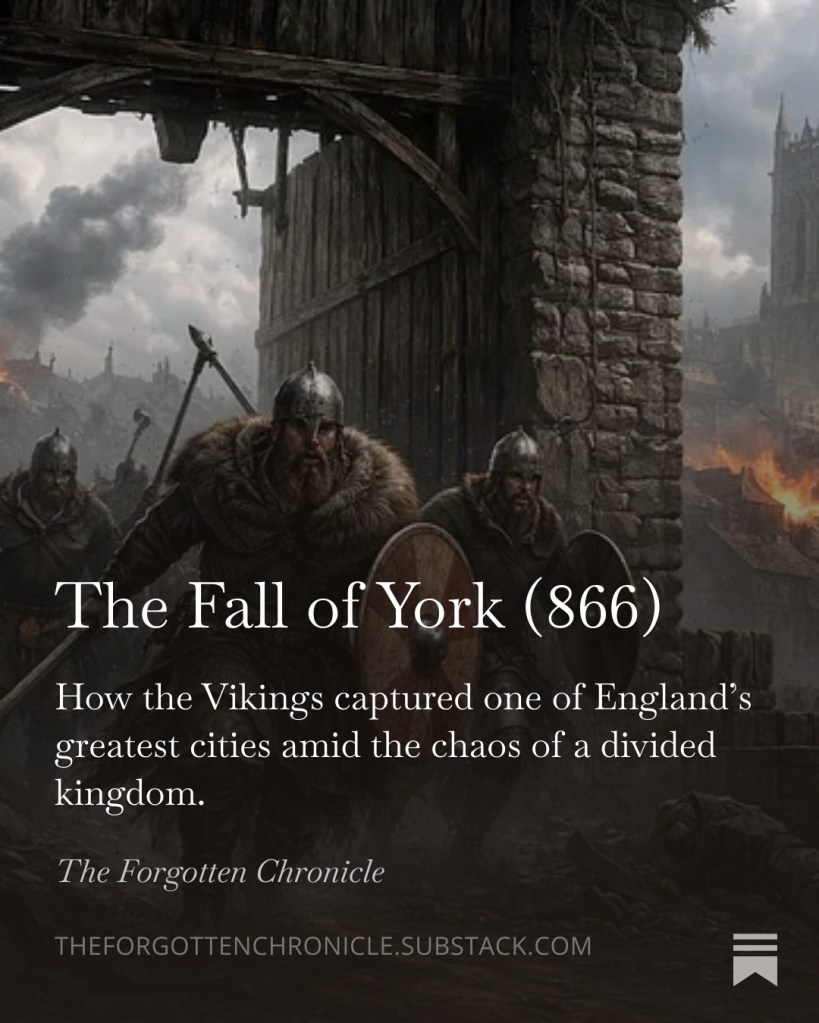
Autumn light could still lie gently across the fields around York in 866, turning the marshland beside the Ouse pale beneath the morning sky while bells carried over roofs, workshops, and crowded lanes. From the walls, the city seemed secure enough to trust its own long memory. Roman stone still held the heart of the settlement, trade still moved along the river, and Northumbria still imagined itself one of the great kingdoms of early England.

Security, however, had already begun to thin. York stood at the centre of a kingdom torn by rivalry between Ælla and Osberht, and the struggle for the Northumbrian crown weakened the very authority that should have guarded the city. When the Viking host moved north in late 866, it approached a prize of immense wealth and strategic value, though its greatest advantage lay beyond wealth alone. The kingdom behind the walls had opened wounds of its own, and the invaders understood exactly how to use them.

Each week The Forgotten Chronicle explores a moment when history quietly changed the world, and the fall of York belongs firmly within that tradition. The capture of the city marked far more than a single military success for the Vikings. It exposed the fragility of Anglo-Saxon power in the north, revealed how quickly internal conflict could unmake a realm, and prepared the ground for the rise of Jórvík, one of the most important Norse centres in Britain.

Why York mattered in ninth-century England

York was no remote settlement waiting on the edge of events. It was one of the great urban centres of early medieval England, a place shaped by Roman foundations, ecclesiastical prestige, and river commerce. Roads linked it to the wider kingdom, merchants moved through its markets, and the city carried a political significance that far exceeded its walls. Whoever held York held more than masonry and streets. He held a symbol of authority in the north.

That status made the city valuable to rival Northumbrian rulers long before the Viking army appeared. It also made York attractive to Scandinavian leaders who had already spent years studying the weaknesses of Britain through coastal raids and river movement. By the middle decades of the ninth century, Viking warfare had evolved far beyond sudden strikes on monasteries. Fleets carried seasoned warriors, commanders with wider ambitions, and a growing understanding of how divided kingdoms could be broken from within.

York offered everything such a force could seek. Wealth, infrastructure, position, and prestige all gathered there. Even more importantly, York sat inside a kingdom already distracted by its own contest for power. A rich city in a stable realm presents one challenge. A rich city in a fractured realm presents another entirely.

The civil war that opened the gates

The fall of York makes little sense when told as a simple story of Viking strength against English weakness. Strength mattered, certainly, and the Great Heathen Army had plenty of it. Yet the deeper drama lay within Northumbria itself. Osberht and Ælla struggled for the same crown, and that contest divided loyalties across the kingdom. Noble support shifted, military response lost coherence, and the authority that ought to have acted swiftly in a crisis became tangled in its own rivalries.

This is where the story acquires its real gravity. Stone walls still stood. The city still possessed defences inherited from an older imperial world. The river still carried wealth and communication through its heart. Even so, walls depend upon leadership, and fortifications become less impressive when the kingdom behind them has already begun to fray.

For the Vikings, this was a political opportunity as much as a military one. They moved toward York through a landscape already destabilised by distrust. Messages could travel slowly or arrive distorted. Decisions carried the weight of faction. Every delay favoured the approaching host. By the time the city faced the reality of the threat, the conditions for its fall had already been prepared by Northumbrian hands.

When the Viking army came north

The Viking army that advanced toward York in late 866 arrived with purpose. This was no fleeting raid launched for quick plunder before the sea turned rough. The Great Heathen Army had entered East Anglia in 865 ready to remain, gather horses, secure supplies, and study the kingdoms ahead. Its commanders understood movement, pressure, and timing. They also understood when a divided enemy had reached the point of greatest vulnerability.

York fell with a speed that still carries a sting. The city’s capture revealed how swiftly a major centre could pass into foreign hands when its defenders lacked unity. In that sense, the event feels almost eerily modern. Institutions often appear strongest just before fracture becomes visible. Streets remain busy, markets remain open, daily routines continue, and then the pressure already building beneath the surface suddenly finds its release.

For the people of York, the change would have felt immediate and disorienting. A city accustomed to its own rhythms found itself overtaken by an army whose ambitions reached beyond looting. The Vikings secured positions, established control, and transformed the political reality of the north in a remarkably short span. What had seemed durable in the morning could feel irrevocably altered by evening.

The failed recovery and the death of Northumbrian power

The tragedy deepened in 867, when Ælla and Osberht at last joined forces in an attempt to retake the city. Their temporary unity came too late. By then the Vikings had already taken hold of York and strengthened their position. The assault that followed ended in disaster, and both Northumbrian rulers were killed in the fighting.

That moment matters as much as the original capture. It meant the city’s fall was no passing shock that the kingdom could swiftly correct. The old order in Northumbria had suffered a wound from which it could no longer recover in the same form. Leadership had collapsed along with the effort to reclaim the city, and the Vikings retained the prize that could anchor lasting power in the region.

History often turns through such sequences, where one failure leads into another until a political landscape no longer resembles the one that existed a year earlier. York in 866 and 867 offers precisely that pattern. Civil conflict opened the way, conquest followed, and the desperate effort to reverse the loss only completed the ruin of the authority that had made the city vulnerable in the first place.

From York to Jórvík

The story gains even greater significance once York begins to change into Jórvík. Viking power in England is sometimes imagined only through warfare, ships, and raids, yet the Norse transformation of York points toward a broader historical reality. Scandinavian rule produced a thriving urban centre linked to trade networks stretching across the North Sea world. Craftsmen, merchants, and settlers entered the picture alongside warriors. Language, commerce, and daily life all began to absorb new influences.

This transformation is one reason the fall of York continues to hold such power for readers of the Viking Age. The city did not simply suffer conquest and pass into silence. It became something new. Jórvík emerged as a Norse centre of trade and influence, and that change left marks that endured far beyond the first battles. The event therefore belongs to the larger story of how Viking presence in Britain moved from attack to settlement, from seasonal violence to lasting political and economic power.

Seen in that light, the fall of York stands at a threshold. One world was collapsing while another was taking shape inside the same streets.

A visual route into the Chronicle

For readers who prefer to enter the subject through image and motion before moving into the longer historical piece, this visual companion can sit naturally within the blog as an embedded feature:

A short visual telling works especially well here because the fall of York carries such a strong sense of approaching pressure. Fields beyond the walls, rival rulers inside the kingdom, longships and marching columns closing the distance, all of it lends itself to a visual threshold that prepares the reader for the fuller Chronicle. The film offers a brief entry into atmosphere. The longer reading carries the weight of consequence.

Entering The Forgotten Chronicle

The fuller narrative appears here on Substack: The Fall of York (866)

That Chronicle approaches the event through atmosphere, political strain, and the slow recognition that a city can stand firm in stone while weakening in authority. It enters York before the collapse is complete, lingers over the rivalry that prepared the disaster, and follows the city into its Norse future as Jórvík. The reading experience is designed as an immersive threshold into the period, one that values tension, setting, and consequence over summary alone.

For a reader arriving through search, this piece can serve as an entry point into that wider archive. The Chronicle itself carries the fuller narrative pressure of the moment, while the surrounding publication continues to trace the Viking Age in England through conquest, settlement, exile, recovery, and legacy. In that sense, feels less like an isolated article and more like a doorway into a larger historical sequence.

Why this moment still draws us back

The fall of York continues to compel attention because it reveals a pattern that history repeats with unsettling regularity. External force matters, of course, though internal fracture often matters first. Cities and kingdoms rarely fall through assault alone. They weaken through rivalry, delayed judgement, contested legitimacy, and the gradual erosion of shared purpose. When the blow finally lands, it lands against something already strained.

York offers that truth in concentrated form. A major city, ancient walls, wealth, prestige, and memory all stood in place. Even so, division at the level of kingship made those strengths harder to use. The Viking army recognised the opening and moved through it with the kind of decisiveness that changes centuries.

There is also a deeper imaginative pull here. York sits at the meeting point of several worlds, Roman inheritance, Anglo-Saxon kingship, Christian identity, Viking expansion, and the emerging Norse city of Jórvík. The fall of the city therefore feels like a hinge in the history of England, a moment where power changed hands and the cultural texture of the north began to shift with it.

Closing movement

Across the fields outside York, the first signs of danger would once have looked small enough to misread, riders at distance, movement along the roads, rumours carried in fragments, uncertainty passing from voice to voice. Then the host drew nearer, the kingdom’s rivalries tightened into consequence, and the city that had trusted in its own standing entered a different future.

That is why the fall of York in 866 still lingers. It carries the chill of a warning and the force of a transformation. A divided kingdom lost one of its greatest cities, and from that loss emerged Jórvík, a Norse centre whose influence would shape northern England for generations. The walls remained, the streets remained, the river remained, though the world moving through them had changed.

Some moments in history vanish into sequence and summary. York resists that fate. The city still stands in the record as a place where ambition met opportunity, where internal fracture invited conquest, and where the north of England crossed into a new age whose echoes still move through the past whenever the Chronicle opens the gate again.

The Burning of Lindisfarne (793): The Viking Raid That Began the Viking Age

Burning of Lindisfarne 793

The first light of morning crept slowly across the waters of the North Sea, pale and uncertain beneath a sky still heavy with the fading colours of night. Lindisfarne lay quiet upon its small tidal island, the stone church and timbered buildings of the monastery rising from the grass like an outpost of prayer set against the restless edge of the world. Waves moved softly across the rocks below the cliffs while seabirds circled through the cold air, their distant cries carrying over the water.


The Moment That Changed the Shores of England

In the year 793, the quiet island monastery of Lindisfarne stood as one of the most sacred places in the Christian world of northern England. Pilgrims travelled across the kingdom of Northumbria to pray at the shrine of Saint Cuthbert, and the monastery had long been regarded as a place of learning, peace, and devotion.

That calm morning on the North Sea would soon be remembered for a very different reason.

From the sea came unfamiliar ships with tall sails and narrow hulls built for speed across open water and shallow rivers. These vessels carried warriors from Scandinavia, men who would soon become known across Europe as Vikings.

The raid on Lindisfarne shocked the kingdoms of England and echoed across Christian Europe. Chroniclers recorded the attack with fear and disbelief, describing it as a sign that a new and uncertain age had begun along the northern coasts.

Historians now view this event as the beginning of the Viking Age, a period when Norse seafarers would reshape the political and cultural landscape of Britain.


Watch the Chronicle in Video Form

You can explore this moment in history through a short visual retelling.

YouTube Short


The Forgotten Chronicle

Each week The Forgotten Chronicle explores a moment when history quietly changed the world.

The series follows the story of the Viking Age in England, beginning with the first raids along the coast and continuing through the wars, settlements, and transformations that reshaped the island.

The raid on Lindisfarne was only the beginning.


Continue the Chronicle

Read the full Chronicle and discover what happened when the Viking ships reached the sacred island.

Read the full Chronicle on Substack