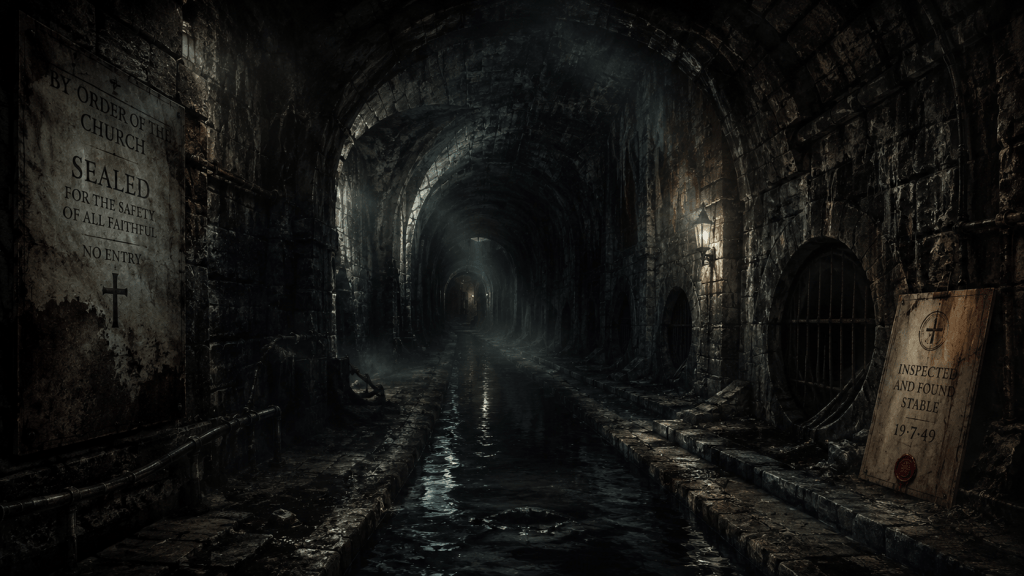
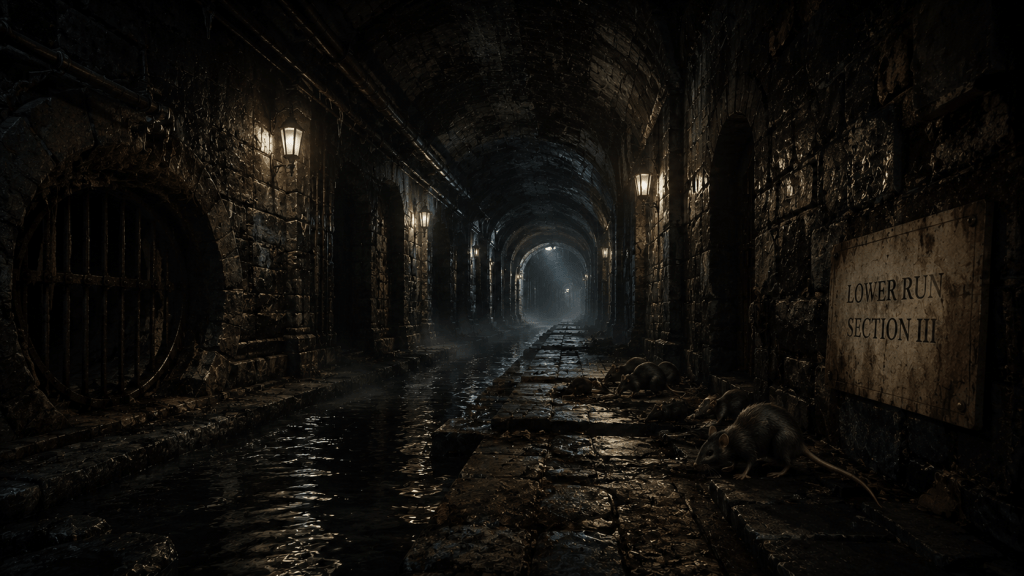
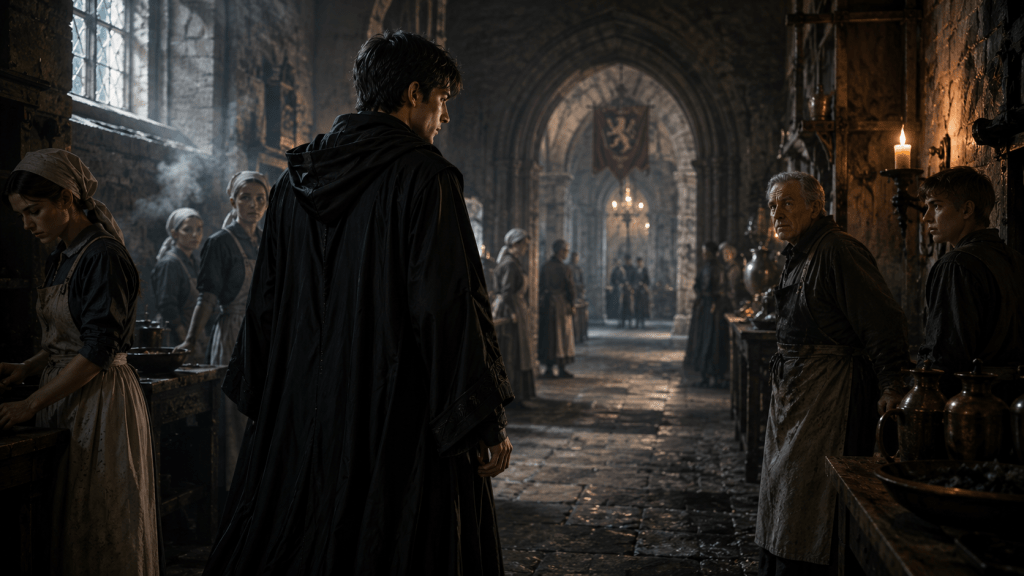
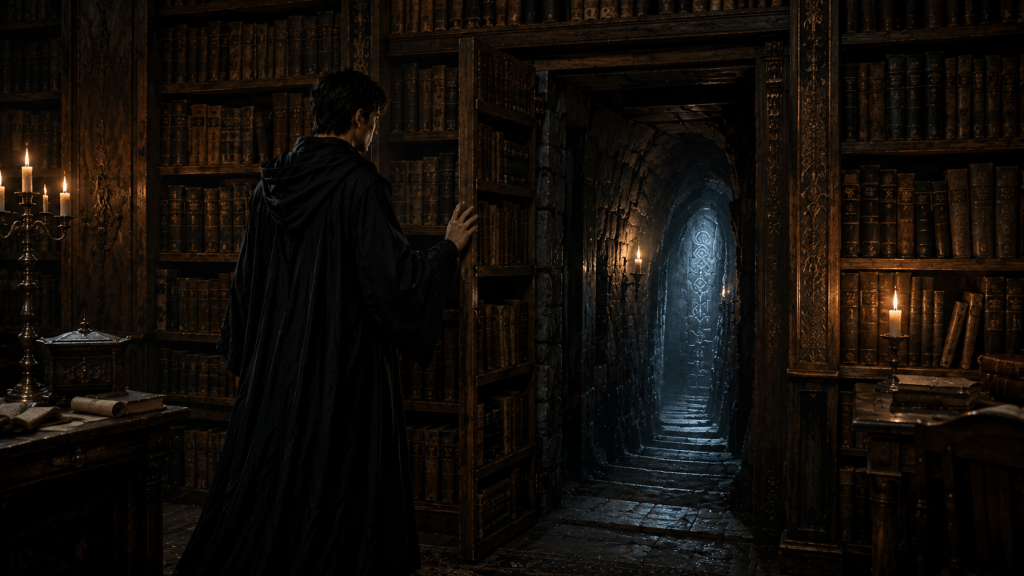
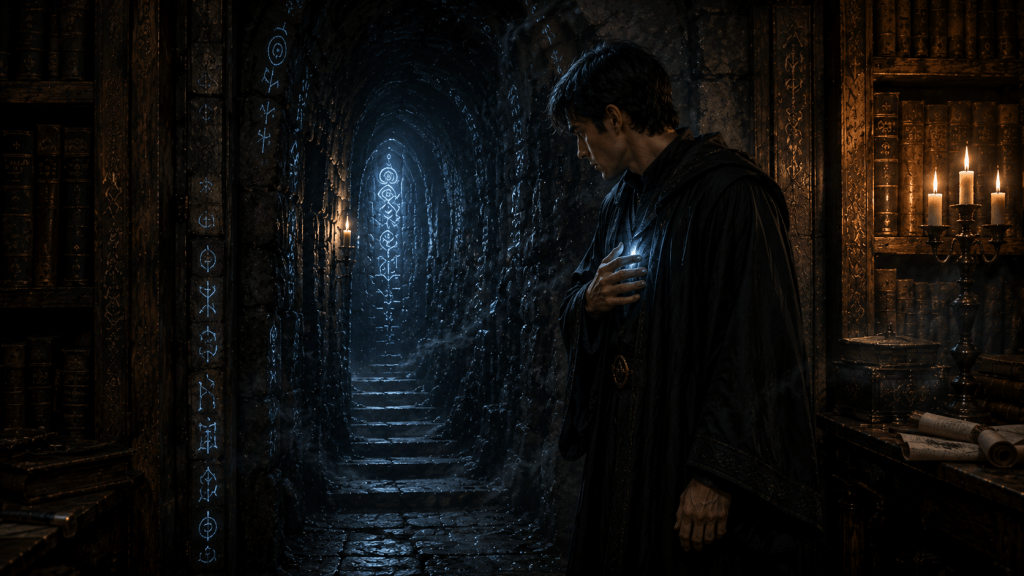
Before one crown claimed the name of England, the island was divided between rival kingdoms, fading powers, borderlands, and peoples who had no reason to imagine unity would ever come.
Before There Was England
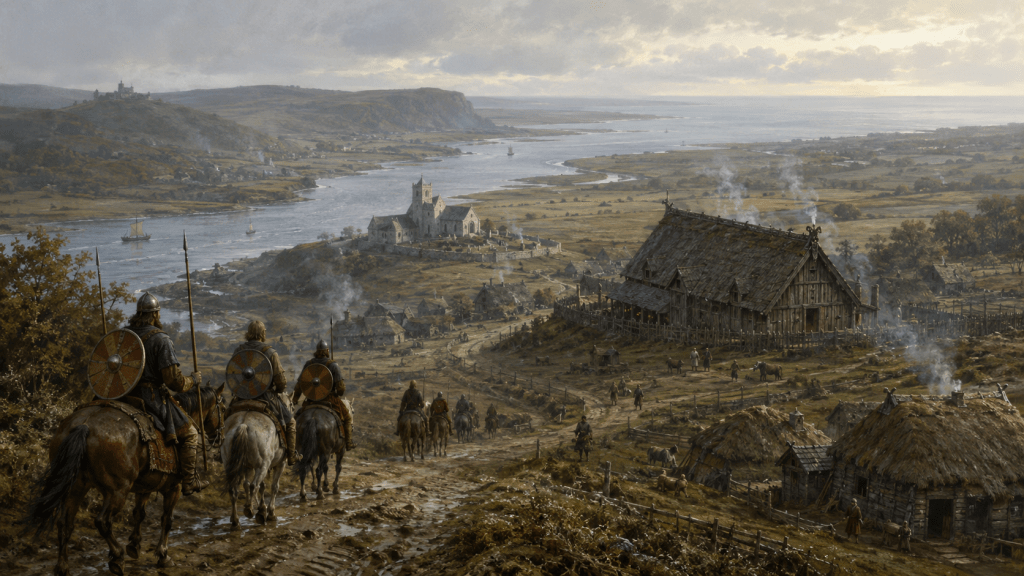
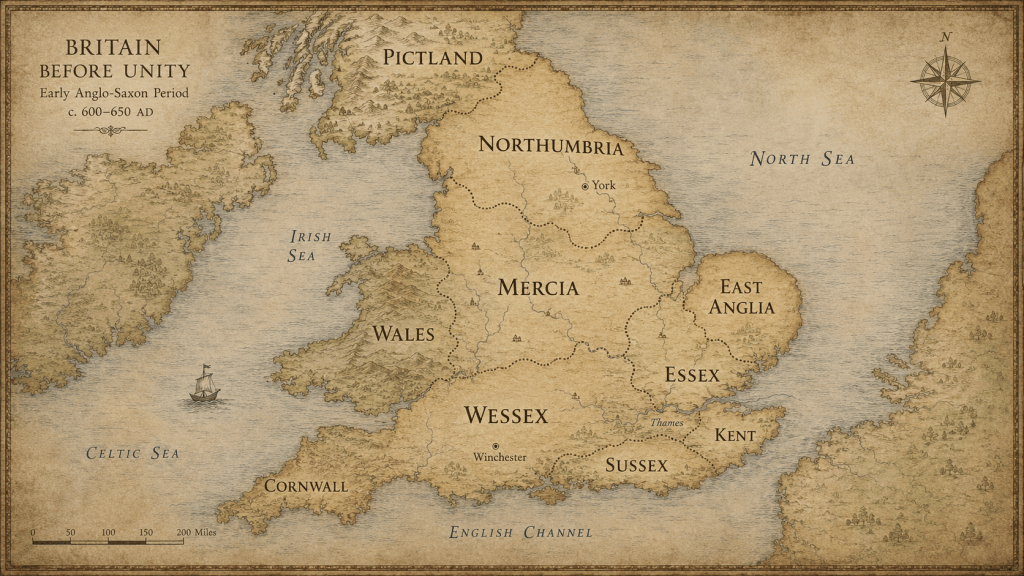
The rain had passed before dawn, leaving the fields silvered beneath a low sky and the tracks between the settlements dark with water. Across the island, smoke lifted from timber halls, monastery kitchens, cattle folds, and watch posts set above river mouths, each thin column rising from a place that knew its own lord, its own laws, its own enemies, and its own memory of power. A traveller moving through Britain in the middle years of the eighth century would have found no single England waiting for him, no shared crown, no settled name that held the land together from sea to sea. He would have crossed borders marked by rivers, ridges, woodland, old Roman roads, and the reach of armed men. In one valley he might hear the speech of Mercia, in another the prayers of Northumbria, further south the commands of Wessex, and along the eastern fields the quieter strength of East Anglia. Beyond them lay peoples with their own histories and claims: Britons in the west, Picts beyond the northern lands, Welsh kingdoms watching the Saxon advance from older ground, and communities whose loyalties shifted with marriage, tribute, hunger, and war.
Power in that age rarely stood still. It moved with armies in the campaigning season, with hostages led from one court to another, with tribute paid in silver, cattle, weapons, and submission. Kings were anointed by Churchmen and tested by warriors; their names were praised in charters, carved into memory, then challenged by brothers, cousins, rivals, and neighbours before the ink had fully dried. Northumbria, once a kingdom of learning and saints, looked outward across the northern sea and inward upon its own divisions. Mercia, heavy with ambition and strength, pressed its authority across the middle lands like a great shadow stretching over smaller courts. East Anglia watched the coast and the rivers, its wealth tied to fields, trade, and sacred kingship. Wessex, still only one power among several, looked westward and southward, shaped by old frontiers and restless opportunity. Each kingdom carried pride enough to imagine itself favoured. None could yet see the shape of the future moving through the mist.
The monasteries kept their bells, their books, and their delicate records of land and souls. The halls kept their feasts, their oaths, and their knives close at hand. On market days, traders came with salt, cloth, horses, amber, iron, and stories from roads that crossed more borders than any king could hold for long. Some spoke of raids in distant seas, of ships seen where no fleet had been expected, of strangers who moved swiftly along coast and river. Such rumours belonged, for now, to the edge of the world, while the rulers of Britain looked first to one another, measuring weakness across familiar frontiers. The island was already full of struggle before the Northmen came. England had yet to be born, and across the divided kingdoms of the Anglo-Saxons, no one heard its first breath.
A Visual Chronicle
A visual companion to The Kingdoms Before England. Follow a lone traveller across the wet roads, guarded ridges and rival kingdoms of an island that had not yet learned to call itself England.
Timeline of Events
731 AD – Bede completes The Ecclesiastical History of the English People, preserving one of the clearest early accounts of the Anglo-Saxon kingdoms and their Christian past.
757 AD – Offa becomes king of Mercia, beginning a reign that will make Mercia the dominant power across much of southern and central Britain.
793 AD – Viking raiders strike Lindisfarne, marking the beginning of a new age of coastal fear and foreign attack.
825 AD – Wessex defeats Mercia at the Battle of Ellendun, weakening Mercian dominance and shifting power toward the south-west.
865 AD – The Great Heathen Army lands in East Anglia, turning Viking raids into a struggle for kingdoms, territory, and survival.
About the Creator
This Chronicle is written by Simon Phillips, author of several historical and speculative fiction works exploring forgotten worlds, myth, and the turning points of history.
The account that follows moves from the divided landscape of Britain into the rival kingdoms that shaped it, where Mercia, Northumbria, East Anglia, and Wessex each carried their own ambitions before the pressure of invasion forced the island toward a future none of them could yet see.
Readers supporting The Forgotten Chronicle may continue into the full record below.
The Chronicle: The Divided Island
The road between kingdoms was never only a road. It was a line of risk drawn through wet woodland, open pasture, river ford, and broken stretches of old Roman stone, where a traveller might begin the morning beneath one king’s protection and reach dusk beneath another’s suspicion. The land changed slowly beneath the feet, with cattle grazing behind wattle fences, smoke rising from timber halls, and church bells carrying across fields still silvered by rain, yet power changed more sharply than the landscape itself. A ridge, a river, a marsh road, or the outer reach of a lord’s armed household could mark the place where one claim thinned and another began. There was no England waiting behind these borders, no single crown looking out across the island with settled command. There were kingdoms, proud and wounded, each convinced of its own place beneath God, each guarding memory, land, and honour with the same care it guarded cattle and gold.
In Northumbria, the sea wind moved across monasteries and halls that had once made the kingdom famous far beyond its frontiers. Its churches and holy houses kept books, relics, and the memory of men whose names travelled through the Christian world with reverence. The learning of Bede, the sanctity of Cuthbert, and the wealth of monastic communities gave the north a spiritual authority few kingdoms could ignore. Yet beneath that sacred reputation lay a harsher world of rival bloodlines, broken reigns, and kings whose crowns sat uneasily upon their heads. A ruler could be lifted by noble support, blessed by the Church, then cast aside by the same forces that had raised him. The kingdom that had given Britain some of its clearest Christian memory also carried deep political fractures, and those fractures weakened the walls long before foreign sails darkened the horizon.
Mercia, by contrast, stood in the middle lands with the confidence of a great weight pressing outward. Its rulers understood the power of roads, river routes, tribute, marriage, and intimidation. Under kings such as Offa, Mercian authority reached across the island’s heart, drawing smaller kingdoms and border rulers into its shadow. Gifts became obligations. Alliances became restraints. A king who accepted Mercian favour might find that favour costly, while those who resisted learned how quickly diplomacy could harden into force. The great earthwork along the western frontier showed more than defence against Welsh powers. It marked ambition written into the soil, a statement that Mercia saw itself as a kingdom with reach enough to shape the lives of others.
Yet the strength of Mercia required constant renewal. Authority had to be ridden into the shires, spoken in councils, enforced through oaths, and remembered by men who might prefer forgetfulness once the king’s horse had gone from sight. The halls of dependent rulers were places of courtesy and calculation, where every gift had a second meaning and every feast could become a test of loyalty. The Church added solemnity to rule, blessing kingship and preserving documents that turned land into lawful possession, though holy houses also held their own influence and guarded their own privileges. To rule widely in such an age was to remain in motion, forever watching the men who smiled, bowed, and waited.
East Anglia lay lower and more open, rich in fields, rivers, and routes that ran toward the sea. Its strength was quieter than Mercia’s, though no less real to those who lived under its kings. The kingdom held its own sacred dignity, its own royal line, and its own place within the web of Anglo-Saxon power. Its coasts and waterways brought trade, news, and contact with a wider world, filling markets with goods and stories carried from distant shores. In peaceful years, such openness gave East Anglia life. In darker years, the same openings would invite catastrophe. Long before the great armies came, East Anglia lived with the double nature of the sea, a road of wealth and a door through which armed strangers could enter.
To the south and west, Wessex remained a kingdom with promise, though no certainty. Later memory would make it appear almost destined, the surviving root from which England would grow, yet no one in the middle years of the eighth century could have known such a thing. Wessex looked toward old British lands, toward southern seas, toward rival kings, and toward its own unsettled opportunities. Its rulers carried ambition, though ambition alone could never guarantee survival. Like every kingdom of the island, it relied upon harvests, warriors, marriages, judgments, oaths, and the fragile confidence that men would still answer when summoned. Wessex would one day stand where others broke, yet before that day arrived it was only one power among several, watched by neighbours and tested by time.
Around and beyond these Anglo-Saxon kingdoms lived peoples whose presence belonged to the island as deeply as any Saxon hall or monastery. Welsh kingdoms guarded the west with memories older than English speech. Cornish lands held their identity against slow pressure from the east. North of the Anglo-Saxon world, Pictish power remained distinct and formidable, shaped by kings, symbols, and traditions that refused easy absorption into any southern vision. These were no empty margins around an English centre. They were living realms, with their own saints, rulers, warriors, and claims. Britain before England was a crowded island of many stories, and the future would be formed as much by what resisted unity as by what moved toward it.
Across all these lands, the Church kept records while the warrior halls kept score. A monastery might hold a charter proving a royal gift, a gospel book adorned with patient beauty, and the bones of a saint believed to guard the surrounding people. Nearby, a hall might ring with boasting, argument, and the clatter of cups as men pledged loyalty to a lord whose strength had to be visible in generosity as much as victory. Faith and power stood close together. Kings needed blessing. Bishops needed protection. Monasteries needed land. Warriors needed reward. The sacred and the political were woven through the same fields, and few men of power could pull at one thread without stirring the other.
Then the sea began to speak in a new voice. At first the warnings arrived as stories from the edge: a holy place struck, a ship seen where no friendly vessel belonged, men from the northern waters moving with terrible speed. The attack on Lindisfarne entered Christian memory as a wound, a desecration that seemed to shake the order of the world. Yet for rulers inland, danger still wore familiar faces. A rival king gathering men near a border felt more immediate than a raiding crew vanishing back across the waves. Tribute disputes, royal successions, and old hostilities continued to demand attention. The kingdoms mourned, prayed, watched the coasts, and then returned to the struggles already before them.
That was the danger hidden within division. Each kingdom knew its own enemies too well. Mercia measured Wessex, Wessex measured Mercia, Northumbria wrestled with its own instability, and East Anglia guarded its place between stronger ambitions. The island possessed shared faith, related speech, learned traditions, and memories that crossed borders, yet those bonds were too fragile to overcome the habits of rivalry. No council of kings gathered with the power to bind all into one defence. No common army stood ready for threats that fell first upon one shore, then another. Britain’s kingdoms were skilled at surviving one another. They were far less prepared for a pressure that would make their old quarrels seem dangerously small.
The making of England would begin from that fracture. It would not emerge from peaceful agreement or a vision calmly shared among kings. It would come through the breaking of old powers, through the fall of cities, through exile in marshes, through fortified towns, hard laws, royal marriages, campaigns of recovery, and the slow understanding that survival demanded forms of unity earlier generations had barely imagined. The island before England was not empty, nor waiting, nor simple. It was alive with rival centres of authority, each one bright in its own firelight, each one certain enough of itself to resist being swallowed by another.
Before one crown could claim England, the island had to learn the cost of remaining divided. Its kingdoms stood beneath the same unsettled sky, listening to their own bells, sharpening their own blades, guarding their own borders, and watching their neighbours with suspicion. Beyond the sea, other men had begun to learn the shape of its coasts and rivers. Within the island, kings still looked first across land. History had already begun to draw the roads together, though no ruler yet saw the pattern clearly. The future was moving toward them through rain, smoke, prayer, and salt wind, carrying the first hard lessons of a country not yet born.
Britain before England: a divided island of rival kingdoms, borderlands, sacred centres, and shifting powers, long before one crown could claim the whole.
Inspiration Behind the Story
The beginning of this second series carries a quieter kind of drama than the Viking raids that came before it. There is no single burning monastery, no battlefield, no sudden moment when history turns visibly beneath the feet of those who stand within it. Instead, this Chronicle begins with division itself, with an island of rival kingdoms, borderlands, sacred centres, and competing memories that had not yet been drawn into the idea of England.
What makes this moment fascinating is the absence of inevitability. From the distance of the present, it is easy to look backwards and imagine England waiting to be formed, as though the later kingdom already existed in outline. The reality was far less certain. Northumbria, Mercia, East Anglia, Wessex, and the neighbouring non-Saxon powers each occupied their own world of ambition and fear. Unity was not the natural condition of the island. It had to be forced into being through pressure, collapse, survival, and adaptation.
For storytelling, this gives the period its power. The drama lies in watching a future nation emerge from people who were not trying to create one. They were defending borders, making alliances, preserving dynasties, guarding churches, answering raids, and surviving one crisis after another. History moves here through competing lives and local loyalties, long before anyone can see the larger shape forming.
This Chronicle matters because it restores uncertainty to the story. England was not born from certainty. It began in fracture.
From the Author’s Desk
This Chronicle begins the second movement of The Forgotten Chronicle, and in many ways it felt important to start before the familiar names became inevitable. Alfred, Æthelflæd, Edward, and Athelstan all belong to the later shape of the story, yet their world was built upon older divisions, older ambitions, and kingdoms that had no reason to imagine they were stepping toward unity.
While writing this piece, I found myself drawn to the tension between what we know now and what they could see then. To us, England appears as the destination. To them, the future was far more uncertain. Mercia could still seem dominant, Northumbria still carried sacred memory, East Anglia held its own dignity, and Wessex had not yet become the centre of survival. That uncertainty gives the period its strength.
There is something powerful in beginning with a divided map. Every border carried human consequence. Every alliance, feud, marriage, raid, and succession dispute shaped what came next. The making of England was never simply a political result. It was a long human process, formed through fear, loss, ambition, endurance, and the gradual narrowing of possibility.
This series will follow that movement from fragmentation toward crown, though the heart of it remains the same as always: history experienced as lived pressure, not distant summary.
The Anglo-Saxon kingdoms of early medieval Britain were separate political worlds, each shaped by its own royal line, local elites, military traditions, religious centres, and regional identity. The later idea of England can make this period appear as though unity was always waiting to happen, yet the eighth and ninth centuries were defined by competition between rival powers. Northumbria, Mercia, East Anglia, Kent, Sussex, Essex, and Wessex each occupied different positions within the island’s balance of authority, while Welsh, Cornish, Pictish, and other neighbouring peoples remained vital parts of Britain’s wider political landscape.
Mercia held particular influence during the eighth century, especially under King Offa, whose reign marked one of the strongest phases of Mercian power. His authority reached deep into southern Britain, and his dealings with neighbouring rulers, the Church, and continental powers reveal how significant Mercia had become. Offa’s Dyke, the great earthwork associated with his reign, remains one of the most visible signs of Mercian ambition along the western frontier.
Wessex’s later dominance can obscure how uncertain its position once was. Before Alfred and his successors, Wessex was one kingdom among several, shaped by rivalry with Mercia and by pressure along its western borders. Its later role in resisting Viking conquest and building the foundations of English unity came from survival, adaptation, and political opportunity, rather than from any clear destiny visible in the earlier period.
Related Events
The Viking raid on Lindisfarne in 793 signalled a new threat from the sea, yet the kingdoms of Britain were already shaped by internal conflict and shifting power long before Scandinavian armies began to settle. Rivalries between Anglo-Saxon kingdoms weakened any possibility of a shared defence, while royal succession disputes often left kingdoms vulnerable at crucial moments.
By the mid-ninth century, Viking activity had changed from sudden coastal raiding into larger military campaigns. The arrival of the Great Heathen Army in 865 placed extraordinary pressure on the divided kingdoms. East Anglia, Northumbria, and Mercia all suffered deeply under this new phase of invasion, while Wessex eventually became the centre of organised resistance under Alfred and his successors.
The road from divided kingdoms to a united English crown stretched across generations. Alfred’s reforms, Æthelflæd’s leadership in Mercia, Edward the Elder’s campaigns, and Athelstan’s eventual rule in 927 all belonged to a longer movement that began in the fractured world explored in this Chronicle.
Further Reading
The Anglo-Saxons – Marc Morris The Anglo-Saxon World – Nicholas J. Higham and M. J. Ryan The Formation of England 550 -1042 – H. P. R. Finberg Alfred the Great: Asser’s Life of King Alfred and Other ContemporarySources – translated by Simon Keynes and Michael Lapidge
Next Chronicle
Northumbria had once stood among the greatest kingdoms of early medieval Britain, a land of powerful kings, sacred islands, learned monasteries, and names that travelled far beyond its own borders. Its churches preserved memory, its saints drew reverence, and its rulers had shaped the northern world with ambition and force.
Yet beneath that reputation lay a kingdom increasingly divided against itself. Royal claimants rose and fell, noble factions shifted their loyalty, and the authority of the crown weakened under the strain of rivalry. Long before the Vikings entered York, Northumbria had already begun to fracture from within.
What makes this next Chronicle so important is that the fall of York cannot be understood only as a Viking victory. It was also the result of a kingdom whose internal wounds left it dangerously exposed at the moment pressure arrived from the sea. The invaders did not strike a united power at its height, but a realm distracted by its own disputes and unable to meet the coming storm with one voice.
The next Chronicle moves into that northern world, where sacred memory and political instability stood side by side, and where the struggle for power helped prepare the way for one of the most decisive collapses in Anglo-Saxon history.
Next Chronicle: Northumbria: A Kingdom Divided
Before England had a crown, it had borders, rival kings, sacred houses, old roads, and watchful kingdoms standing beneath the same unsettled sky.
History had not yet given them unity.
It had only begun to gather the storm that would make unity necessary.
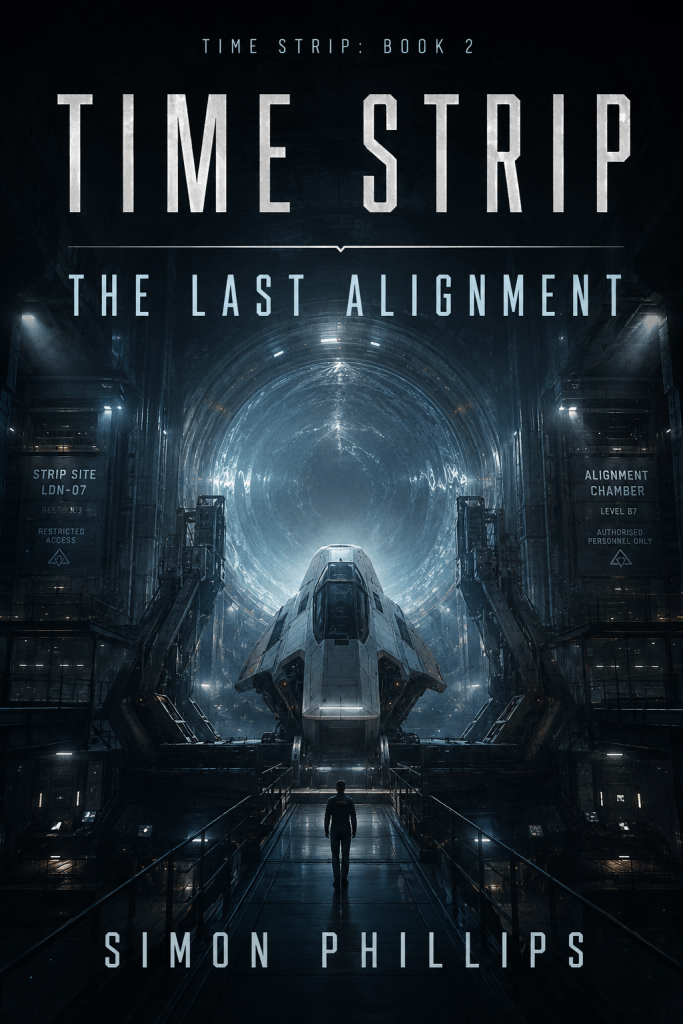
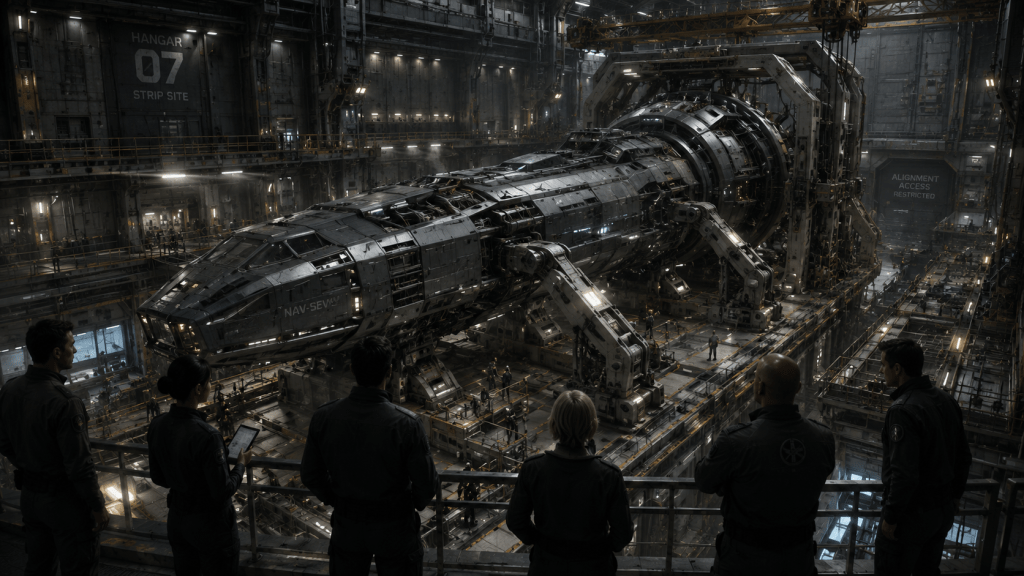
In Time Strip: The Last Alignment, the journey towards time travel begins long before anyone enters the temporal corridor.
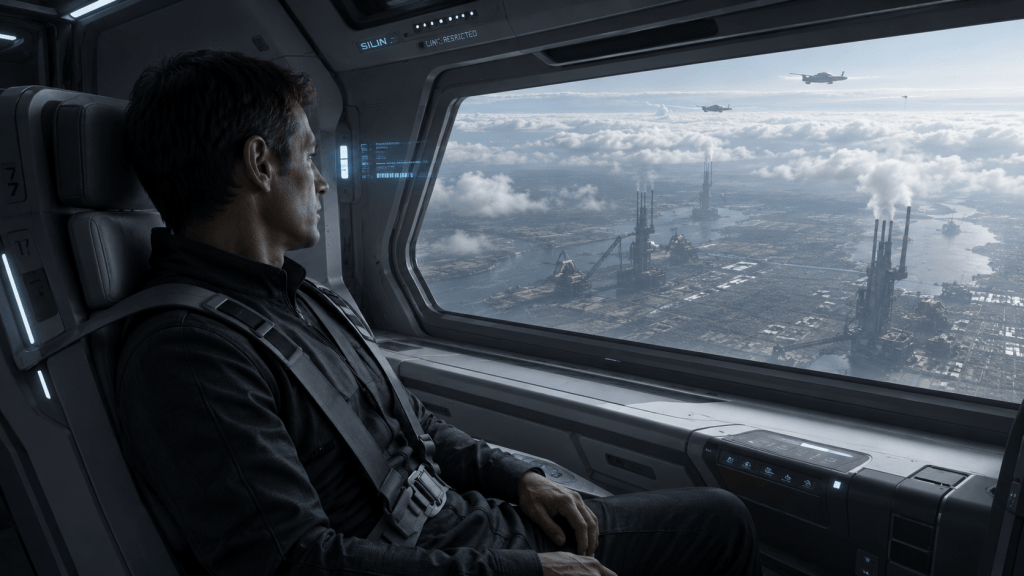
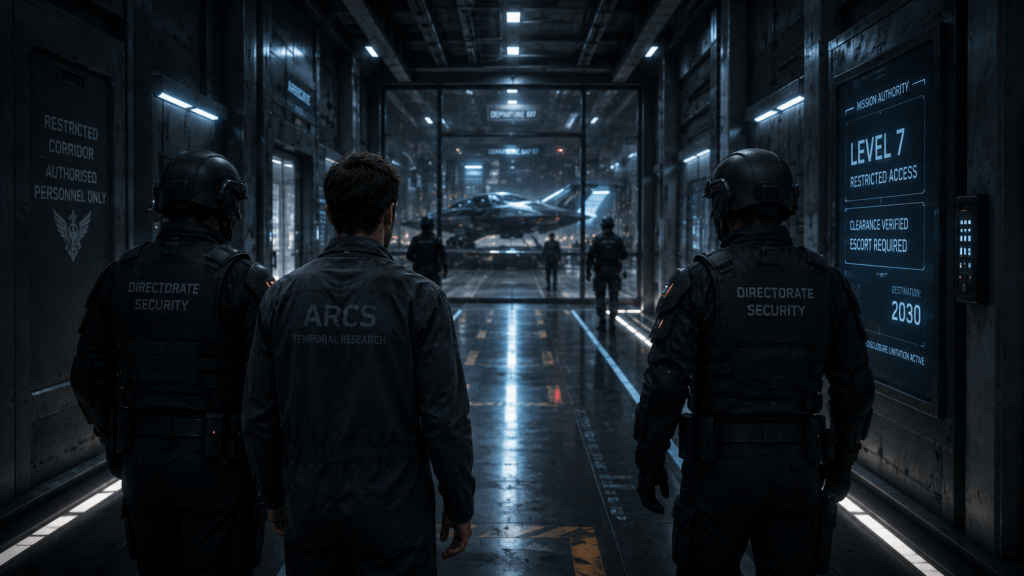
Caelen Marris is already under pressure as London disappears beneath the cloud shelf and his transport carries him west towards a restricted facility in North America. The harness across his chest is secure, the aircraft is following its assigned route, and the future outside the window appears ordered down to its weather systems and managed flight lanes. Inside the cabin, that order has lost the layer that usually makes it bearable.
Silin, Caelen’s bonded AI, has been suppressed.
Her absence leaves him exposed to the engine tone, the vibration running through the seat frame, changes in cabin pressure and the glare travelling across the external display. These are ordinary sensations for everyone else aboard. For Caelen, they arrive without the filtering presence that has accompanied him for most of his life.
This opening establishes the character of The Last Alignment immediately. This is psychological time-travel science fiction in which technology is experienced through the body, authority is expressed through access and restriction, and the approach to the impossible is built through physical consequence rather than distant explanation.
Book One, Before the Fall, drew Caelen out of his ordinary life and placed him under the authority of a mission he could neither refuse nor fully understand. Book Two carries him into that mission. Theories become machines. Briefings become corridors, medical scans, deployment procedures and sealed launch chambers. The people named in mission files become a team whose lives will soon depend upon Caelen’s ability to sense what their instruments cannot.
The controlled future has prepared everything it believes the jump requires. Caelen is the one component it cannot completely explain.
A Mission That Has Finally Become Physical
The Time Strip has already shaped Caelen’s life before he reaches the deployment site. His scientific work has placed him close to unstable temporal conditions, while his unusual sensitivity has made him valuable to the same institutions that once kept him at a distance.
In The Last Alignment, that relationship changes. Caelen is no longer being consulted as a specialist who can be returned to the edge of the system once his usefulness has ended. He has been assigned as a Proximity Navigator, the human operator responsible for holding a jump vessel in alignment when computational certainty begins to fail.
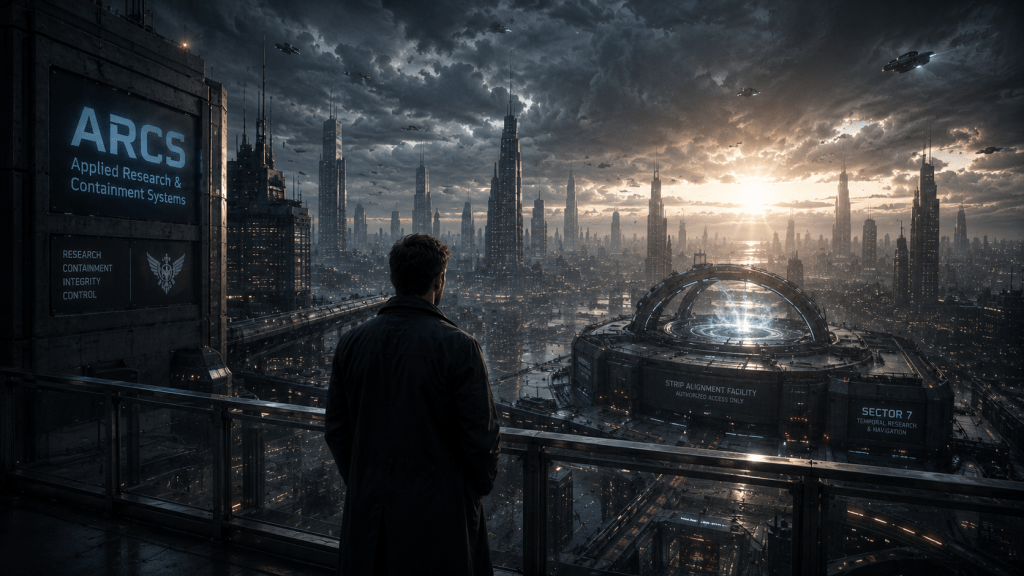
His journey across the Atlantic allows the scale of his future to emerge around him. Atmospheric processors rise through cloud systems. Ocean harvest grids move across the water in coordinated bands. Controlled landscapes and engineered coastlines pass below the aircraft. Reclamation machines dismantle the remains of old cities with methodical precision, separating stone, metal and glass while the world continues around them.
Caelen cannot ignore the contradiction. He is being sent through time to prevent history from being altered while the society that employs him removes its own physical history by the hectare.
That tension runs through the book. The future is advanced, functional and capable of achievements that would once have appeared miraculous. It has also become comfortable with systems that classify people, narrow their choices and turn extraordinary danger into administrative procedure.
Caelen is transported, routed, scanned and cleared because the mission needs him. Whether he understands what his body is becoming capable of sensing remains secondary to the fact that the institution intends to use it.
Caelen Marris and the Cost of Being Useful
Caelen’s role gives The Last Alignment its distinctive form of temporal science fiction.
He does not approach the Time Strip as an adventurous explorer eager to cross into another age. He approaches it as a scientist who understands enough to recognise the danger, while knowing that the official explanation is incomplete.
His awareness of the Strip begins physically. Pressure settles in his jaw. The floor feels fractionally uneven beneath him. Sound arrives slightly out of place. A field transition reaches his spine before the surrounding equipment visibly confirms that anything has changed.
These reactions do not grant him easy power. They make him more exposed.
The systems around Caelen can measure his responses, record his compatibility and decide that he remains fit for deployment. They cannot fully explain why he recognises inactive alignment equipment through sealed bulkheads, senses field movement before a test has visibly begun, or adjusts himself against temporal pressure before the machines have completed their calculations.
His value comes from that uncertainty. The NAV-craft needs a human presence capable of feeling the relationship between vessel and corridor when precise instruments begin losing authority over what they report.
This leaves Caelen in an uncomfortable position. His unusual perception gives him importance within the mission, although it provides little control over the mission itself. He is essential enough to place at the centre of the craft, yet still subject to permissions, restraints and decisions made elsewhere.
The science-fiction suspense grows from that imbalance. Every stage of preparation proves that Caelen is needed. Each stage also places another mechanism around him.
Silin and the Intimacy of Bonded AI
Silin is one of the most important elements of the Time Strip series because she makes its future feel inhabited rather than displayed.
She is not a robot walking beside Caelen or a holographic personality projected into the room. She exists through continuous bonded presence, environmental regulation, private communication and an intimate awareness of his physical condition.
Silin softens glare before Caelen has to close his eyes. She adjusts intrusive frequencies before they settle into his teeth. She recognises changes in breathing, muscle tension and heart rate before he consciously identifies them. Her work usually happens so close to ordinary perception that Caelen seldom has reason to separate her assistance from the world around him.
Her suppression during the early journey reveals how much she carries.
When Silin is absent, the cabin becomes harder, louder and less manageable. When she returns under restricted permissions, Caelen’s body settles before he has time to explain the relief. The engine vibration becomes easier to place. The glare loses its sharper edge. The aircraft feels less hostile because he is no longer meeting every sensation alone.
Their relationship gives the book an unusually personal approach to artificial intelligence. Silin is supportive and emotionally significant, though her capabilities remain controlled by external authority. At each stage of the mission, she is permitted, narrowed, restored or rebuilt according to the needs of the site.
The institution treats those changes as alterations to system access. Caelen experiences them as changes to a relationship embedded in his daily life.
As the mission advances, Silin’s conversational freedom becomes increasingly restricted. Her role is redirected towards medical monitoring, mission integration and alignment support. She remains beside Caelen, although the terms of that presence no longer belong entirely to either of them.
That quiet removal of control gives the bonded AI element its emotional force. The future has made human life more manageable through constant artificial intelligence, then built institutions capable of withdrawing or reshaping that support whenever procedure demands it.
The Strip Site Turns Authority into Architecture
The North American Strip Site does not announce itself through dramatic military spectacle. Its power lies in the size of the landscape emptied around it, the precision of its restricted routes and the ease with which it assumes control of everyone entering its perimeter.
The transport surrenders its landing authority to the site before Caelen reaches the ground. Passengers are released according to designation. Caelen’s onward route is separated from the other travellers, and Silin’s access changes as soon as they cross the first secure threshold.
The architecture is clean, measured and carefully illuminated. That cleanliness never implies freedom. Floor markings determine where people walk. Gates recognise clearance before individuals reach them. Doors open for authorised movement and remain featureless to everyone else.
The facility has been designed for execution rather than discussion.
Surface intake gives way to deployment processing, medical clearance, lower hangars, rest areas, final compatibility reviews and the descending route towards the launch chamber. Each level removes another piece of ordinary movement. The deeper Caelen travels, the less the site attempts to make its control comfortable.
The Time Strip itself remains hidden through most of this descent, yet its influence grows stronger. Dampening systems protect the upper levels so that personnel can work, eat and rest without constantly feeling the active field below them. As those protections reduce, Caelen begins registering the Strip through his chest, jaw, balance and perception of time.
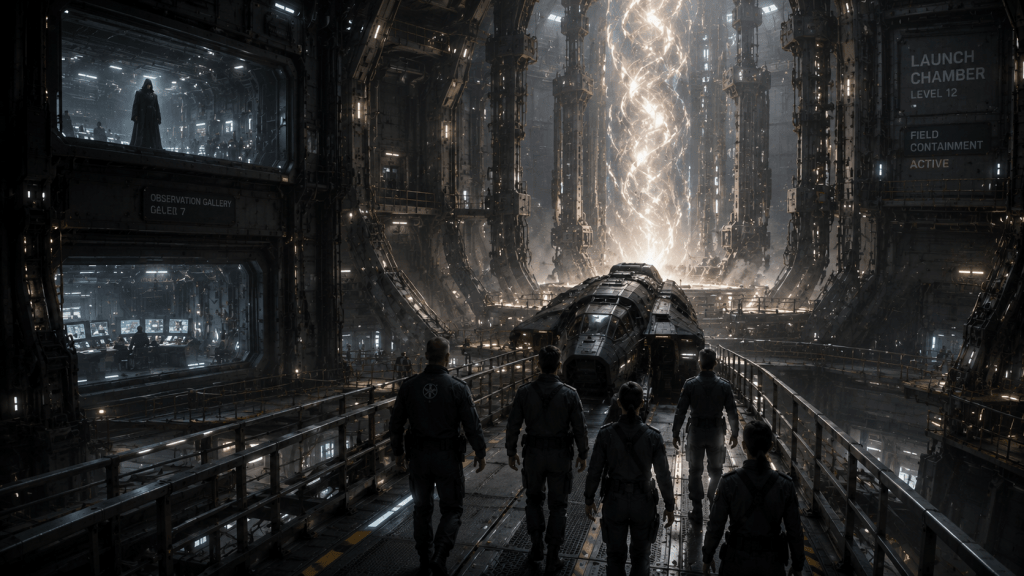
The site has built enormous technological systems around a temporal corridor that still refuses to behave like a passive machine. Regulator rings, containment structures, field towers, deployment tracks and specialist craft exist because the Strip cannot simply be opened and crossed.
Humanity has built an institution around time travel. The institution has mistaken the ability to contain something for proof that it controls it.
A Jump Team Worth Caring About
The mission becomes emotionally real when Caelen meets the people who will travel with him.
General Nomack commands the Jump Team without relying on speeches or theatrical displays of authority. He allows the group’s long-established habits to continue until the work requires sharper discipline. When he speaks, the room narrows around the decision because everyone understands that his restraint has limits.
Johhnan, the AI integration specialist, provides Caelen’s first connection to the team. He has already argued with site authorities to preserve Silin’s bonded continuity, recognising that removing her would alter Caelen’s baseline before the mission had properly begun. His support is practical, understated and rooted in technical understanding rather than easy reassurance.
Kera Holt is the pilot responsible for conventional flight and the final approach towards the Time Strip. Her dry humour gives the team warmth without weakening the seriousness of the launch. She understands the boundary between her work and Caelen’s more clearly than most: she can bring the craft to the door, while he must keep that door open long enough for everyone to cross.
Tooth, the systems engineer, distrusts reassuring percentages, incomplete inspections and any machine that claims perfect readiness. His arguments about fasteners, structural braces and software assumptions initially appear severe, although his concern for the craft is inseparable from concern for the people it carries.
Vornal Aki manages communications and external continuity as the approaching jump begins to compress the team’s connection with the wider world. She is precise, observant and economical with her words, often cutting cleanly through Tooth’s longer objections or Johhnan’s technical evasions.
Havel, the medical officer, keeps the human body central within a mission dominated by engineering, temporal calculations and artificial intelligence. He watches hydration, posture, food intake, fatigue and physical strain because every theoretical success still has to pass through flesh.
Their relationships are revealed through work, meals, medical checks, shared irritation and long familiarity. A condiment is passed before anyone asks for it. A technical complaint is interrupted because everyone has heard its earlier versions. Havel makes certain they eat. Nomack forces Tooth to rest. Johhnan slows his pace so Caelen does not enter the group alone.
These details matter because the mission is carrying people rather than a collection of functions. Caelen’s responsibility grows heavier as he begins to understand who will be inside the craft with him when ordinary navigation ends.
NAV-Seven and the Human Navigation System
NAV-Seven is not presented as a sleek symbol of future progress. It is a dense, reinforced vessel designed to remain coherent under forces that ordinary craft cannot safely interpret.
The ship is built around an alignment spine running through its central structure. Its cockpit, systems station, communications position, medical seat and mission spaces all support the work taking place in the rearward alignment chamber.
That chamber contains the cradle prepared for Caelen.
The alignment cradle is part restraint, part interface and part navigational system. It secures Caelen across the arms, legs and shoulders while contact points connect with his skull, jaw, spine and nervous system. Silin enters the authorised support layer, and the craft begins translating its orientation through Caelen’s body.
He does not fly NAV-Seven in the conventional sense. Kera controls the vessel while ordinary movement still applies. Caelen holds the relationship between the craft and the Time Strip once conventional navigation can no longer be trusted.
This is where proximity navigation separates Time Strip from familiar portal-based time travel.
The corridor has depth, resistance, timing and unstable relation. The vessel needs more than coordinates. It needs a human being capable of sensing when the Strip is forming differently from the route shown by the machines.
Caelen’s body recognises those differences first. The craft then takes his physical correction and distributes it through its own spine.
The process makes him indispensable while removing almost every possibility of escape. Once seated, he is physically locked into the system. The mission depends upon his perception, and the machinery has been constructed to keep that perception connected even when every instinct may tell him to pull away.
Time Travel Built from Pressure Rather Than Spectacle
A permissions layer changes. A medical scan takes longer than expected. An inactive chamber feels active to Caelen before he crosses its threshold. The dampening grid withdraws in stages. Silin’s voice becomes narrower as launch authority rebuilds her around mission requirements.
Each event remains controlled on its own. Together, they create the sense that the institution is moving towards a boundary its procedures may be unable to hold.
This restrained approach allows the scientific and psychological elements to strengthen one another. The book does not pause to lecture the reader about temporal theory. The mechanics become understandable through Caelen’s movement across the site and through the consequences of each system coming online.
The same principle shapes the future world. Technology appears through daily use, transport systems, environmental control, bonded AI, medical infrastructure and the way people move through restricted spaces. The world feels advanced because its inhabitants already know how to live inside it.
That normality makes the Time Strip more disturbing. Every piece of the launch apparatus has been designed by a society accustomed to controlling complex systems. The corridor still presses through those protections, reaching Caelen’s senses before the people monitoring him are ready to acknowledge what he has felt.
The Presence Beyond the Glass
A quieter threat follows Caelen towards the launch.
He has already seen a cloaked figure in London, standing where no person should have been able to stand. Silin cannot retrieve a clear image of the event. Official systems provide no confirmation that the figure existed.
At the Strip Site, surrounded by surveillance, sealed routes and tightly managed access, Caelen sees it again.
The figure appears across the launch chamber behind observation glass, positioned too close to the active field and outside any visible staff assignment. It does not approach him or offer an explanation. Its presence is disturbing because the site has been designed to know where every person is allowed to stand.
Silin does not register it.
The moment opens a deeper uncertainty within the story. Caelen is entering a system controlled by military authority, scientific oversight and advanced artificial intelligence, while something beyond those systems appears able to observe him unnoticed.
He carries the sighting into the craft because the launch sequence has left no safe place to stop. The team is moving. The Time Strip is active. NAV-Seven is waiting.
The impossible presence reaches the threshold before Caelen does.
The Last Controlled Moment Before the Route Breaks
The Last Alignment is Book Two of Time Strip and continues directly from Before the Fall. It expands the series from institutional selection into full mission deployment, while bringing Caelen, Silin, the Jump Team, the Strip Site and NAV-Seven together inside one narrowing movement.
The book will appeal to readers drawn to psychological science fiction, controlled future societies, human relationships with artificial intelligence, slow-burn time-travel suspense and technology that remains physically consequential. Its tension comes from procedure becoming irreversible, people learning to trust one another under pressure, and a temporal system beginning to respond in ways its creators never authorised.
By the time the launch machinery reaches readiness and the Jump Team is aboard, the future still believes it controls the route. Caelen is restrained inside the alignment cradle, Silin has been drawn into mission support, and NAV-Seven is moving towards a corridor built to carry them into history.
Then the sequence begins answering in the wrong order.
The team has prepared for instability, structural failure and the loss of ordinary navigation. None of their procedures were written for the possibility that something beyond the authorised route might already know they are coming.
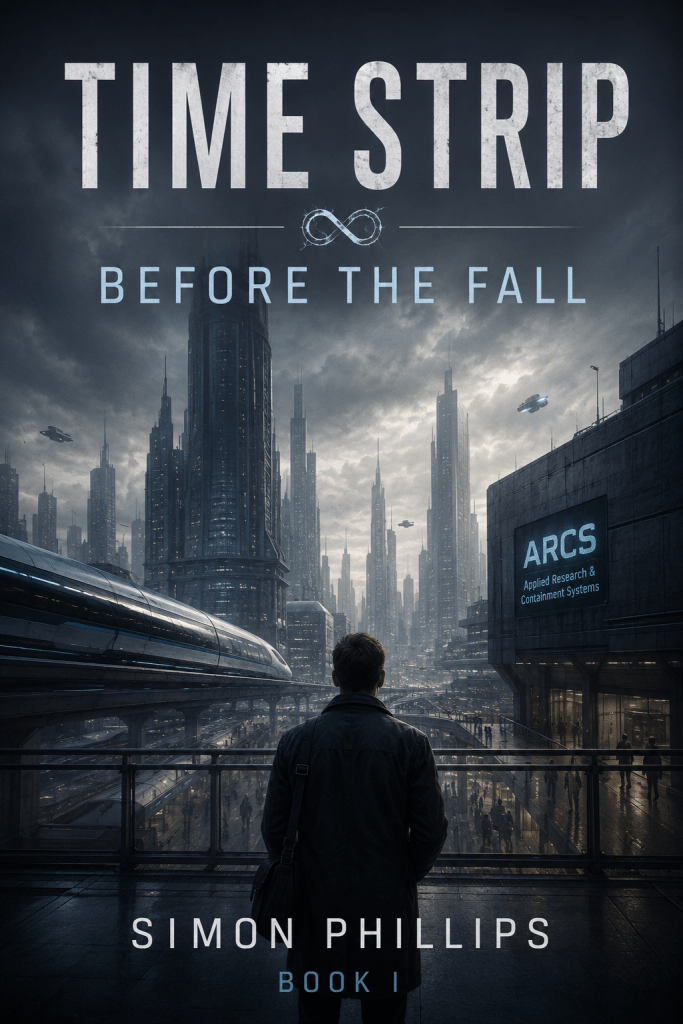
Time Strip: Before the Fall: Psychological Time-Travel Science Fiction Where the Future Has Already Decided
Caelen Marris begins his morning inside a future that appears to have solved the ordinary discomforts of human life.
His apartment regulates its own temperature. The city manages traffic before congestion can form. Elevated trains move through London with barely a tremor, personal artificial intelligences accompany people through their daily routines, and public infrastructure quietly adjusts itself around every passing body. Caelen’s own bonded AI, Silin, wakes him gently, monitors his health and guides him towards work with the intimacy of a presence that has been beside him for years.
Nothing about this world initially resembles a ruined civilisation or an obvious dystopia. It is clean, advanced, orderly and almost kind. That apparent kindness is what makes the pressure beneath it so difficult to recognise.
Time Strip: Before the Fall is the opening book in the Time Strip series, a work of psychological time-travel science fiction centred on bodily perception, artificial intelligence, institutional control and the dangerous belief that history can be contained. It follows Caelen through one apparently ordinary working day as the structures supporting his life begin to reveal a second purpose.
The city still functions. The systems still respond. The people around him continue working, travelling, talking and making plans. Yet the routes available to Caelen begin to narrow, and the institutions that have monitored his unusual connection to time are preparing to use it.
A Future That Feels Almost Kind
The future London of Before the Fall is not presented through distant explanation or technical spectacle. It is experienced through movement.
Caelen watches old stone, glass towers and elevated transport lines pass beyond his apartment window. He joins the morning flow of commuters. Pavement textures guide pedestrians towards efficient routes, transit systems recognise destinations and buildings prepare themselves before people arrive. Technology is embedded so deeply into ordinary life that it rarely needs to announce itself.
This is a future built around removing friction. Clothing adjusts to the wearer. Rooms regulate air and light. Security systems recognise authorised movement. Personal AIs assist with schedules, health, navigation and communication. The result is a society that feels calm because inconvenience has been anticipated and corrected before it can become disruptive.
Caelen is comfortable within that order. He arrives early because he likes having time around him. He notices small things, including the movement of trains, the pressure of a lift descending and the changing texture beneath his shoes. His sensitivity initially seems like part of his personality: a quiet attentiveness to systems, timing and physical space.
Gradually, the same infrastructure begins to feel different.
Helpful route guidance becomes an expectation. Security becomes more visible. New scanning arches appear. Corridors that once allowed ordinary movement begin directing staff along restricted paths. The language remains calm and professional throughout. Every change is described as procedural, temporary or necessary for safety.
The city has not become more violent. Caelen has simply moved far enough inside its systems to see what their kindness depends upon.
Caelen Marris Notices What the Systems Cannot
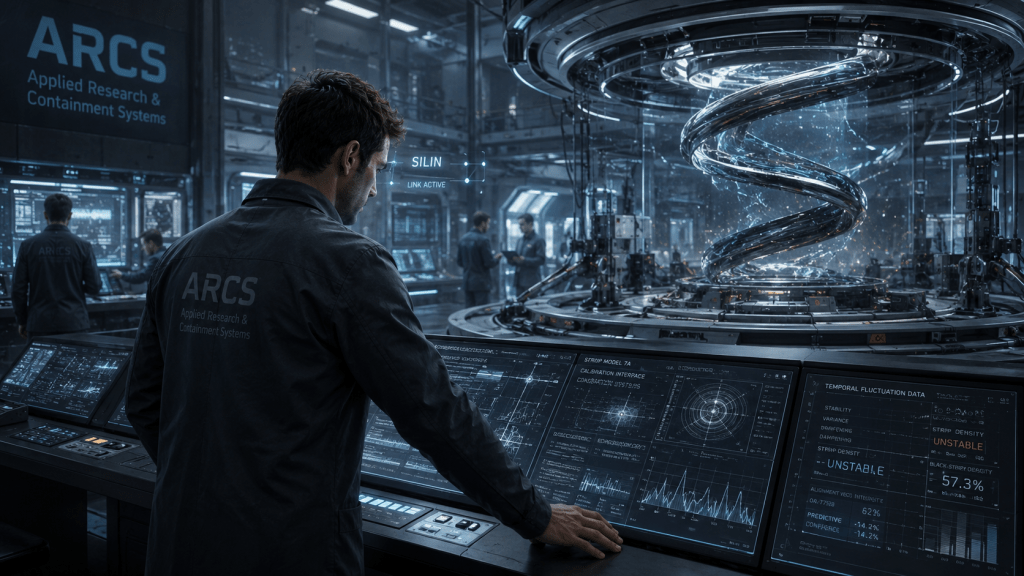
Caelen is a scientist and temporal specialist working within ARCS, an institution involved in temporal research, containment and controlled experimentation. He understands calibration data, corridor interfaces and the behaviour of the Time Strip. His professional life is built around precision.
His most important ability, however, cannot be reduced to an ordinary reading.
Caelen’s body notices temporal pressure before the instruments around him fully acknowledge it. His breathing changes. His footing adjusts by small degrees. His jaw tightens near active systems. A pressure settles behind his eyes. He senses timing irregularities and spatial resistance that disappear when isolated or repeated under controlled conditions.
These responses are easy to dismiss individually. Caelen often does exactly that. He has learned to compensate, continue working and describe himself as fine. His colleagues Mara and Jonah are less convinced.
Mara recognises the signs of physical strain and understands the dangers of describing an anomaly too clearly inside an institution that controls the language of acceptable research. Jonah approaches the same unease from a more human direction. He wonders whether the Time Strip behaves differently when someone is paying attention to it.
The possibility remains uncomfortable because the Strip is supposed to be a system. Systems can malfunction, drift or produce noise. They should not appear to recognise the people observing them.
Caelen’s value lies in the gap between those two possibilities. He can feel something the machines cannot reliably model, and ARCS has been watching the relationship between his body and the Strip far more closely than he understands.
Silin Makes Artificial Intelligence Personal
Silin is not a robot standing beside Caelen, a holographic woman or a convenient voice delivering explanations. She is a bonded AI woven into the practical experience of his life.
She wakes him without startling him. She monitors physical changes he might otherwise ignore. She recognises adjustments in his gait, reduces unnecessary information when he becomes overwhelmed and understands when conversation would help or become intrusive. Her presence is constant enough that Caelen rarely needs to think about the amount of support she provides.
That normality gives the relationship its emotional weight.
Artificial intelligence in Before the Fall is neither treated as an automatic threat nor presented as a magical solution to every human problem. Silin has access, restrictions and institutional limits. She can interpret information, offer support and help Caelen maintain his physical balance, yet she remains subject to authorities capable of narrowing or suppressing her connection.
As Caelen is moved deeper into restricted sections of ARCS, Silin’s access is reduced in stages. She loses environmental information, biometric oversight and freedom of expression. Her voice becomes more constrained as institutional systems determine what she is permitted to know and how freely she may speak.
For Caelen, this is not merely the loss of a useful interface. Silin helps shape his perception of the world. When she is restricted, rooms become harsher, distances feel less reliable and silence takes on physical weight.
Their bond brings a deeply human dimension to the book’s artificial intelligence science fiction. The question is not simply whether an AI can think or feel. The more immediate question is what happens to a person when a presence integrated into every part of daily life can be removed by someone with higher clearance.
The Time Strip Was Built to Contain Possibility
The Time Strip is not a glowing doorway waiting for travellers to step through it. It is a dangerous temporal corridor maintained through alignment, containment, restricted information and enormous institutional control.
Its operation depends upon uncertainty.
The people who built and regulate the Strip have learned that complete knowledge of history creates its own danger. Once observers believe they understand a past event, they begin looking for leverage. They search for opportunities to prevent mistakes, improve outcomes or redirect events towards a preferred future. Certainty encourages intervention, and intervention produces consequences that cannot be predicted from inside the original timeline.
To prevent this, sections of the Strip are held inside enforced uncertainty. These black-strip regions resist predictive modelling and undermine autonomous navigation. The denser the black-strip conditions become, the less effectively machines can determine a stable route.
Human imperfection becomes essential.
A machine attempts to optimise. It searches for the cleanest alignment and the most certain path. The Strip reads that certainty as intent and begins to resist it. A human proximity navigator carries hesitation, instinct, sensory contradiction and ambiguity. Those qualities allow movement where artificial certainty fails.
Caelen has spent years sensing the relationship between bodies and temporal systems. The institutions surrounding him do not want his conclusions, especially when those conclusions challenge approved interpretations of the Strip. They still need his perception.
His body can recognise a route before the equipment confirms that it exists.
That makes him valuable enough to protect, restrict and deploy.
ARCS and the Quiet Machinery of Control
One of the strongest elements of Time Strip: Before the Fall is the way control develops through reasonable actions.
ARCS does not initially appear cruel. Its staff are professional. Caelen has friends and colleagues. People joke during work, meet for drinks in the atrium and complain about changing procedures. Directors explain safety measures in calm language. Security officers remain polite.
There is no single moment when the institution announces itself as an enemy.
Instead, Caelen’s freedom is removed in increments. A checkpoint appears. A route closes. A medical concern becomes a matter for oversight. A private AI channel becomes subject to suppression. A request becomes required attendance. A reassignment is described as a necessary adjustment to his role.
Every step follows logically from the one before it.
This is where the book’s psychological tension becomes especially effective. Caelen understands the systems moving him because he has worked within them. He knows their terminology, their risk assessments and their procedures. He cannot dismiss the danger they describe, yet he also recognises that each layer of protection gives him less authority over his own life.
His former research position is quietly redefined. The same sensitivity that made him difficult to classify becomes the reason he is no longer permitted to interpret what he observes. ARCS and the authorities above it want his instincts separated from his conclusions.
Caelen is allowed to feel what the Strip is doing. He is not allowed to decide what that feeling means.
The result is a form of institutional science fiction in which the threat does not arrive through shouting officials or openly sadistic power. It arrives through documentation, access levels, medical monitoring and decisions made before Caelen enters the room.
An Impossible Mission Begins with a Narrowed Choice
The story’s central movement begins when a future-origin team enters a forbidden section of the Time Strip and starts interfering with a restricted point in history.
The breach lies beyond the range considered safe for verified temporal travel. Predictive navigation fails inside the surrounding black-strip density, and previous attempts to reach the corridor have ended before stable alignment could be established.
Caelen is removed from his work at ARCS and transferred into mission authority. He is not being recruited as a commander, investigator or independent scientist. His assignment is much narrower.
He must keep a specialised craft aligned where its navigation systems can no longer determine a reliable path.
The destination is 2030.
For Caelen, the year is not the familiar present known to the reader. It is a distant and prohibited part of history, lying far beyond the operational ranges he has been taught to consider possible. A verified breach has already occurred there. Someone entered cleanly, yet no return was recorded.
The mission places Caelen inside a contradiction. He has been told that the Strip exists to prevent intervention, while the institution controlling it is now preparing to send a team into history to stop another intervention. The systems designed to preserve uncertainty require him to enter conditions where almost nothing can be known.
His skill may be the only reason the craft survives the journey. His understanding of what waits at the destination remains deliberately incomplete.
This creates time-travel suspense driven less by the fantasy of changing history and more by the fear of reaching a history that has already begun to change.
Psychological Science Fiction Driven by Pressure, Not Spectacle
Temporal instability is experienced through breath, balance, light, sound and pressure. Security scans leave a physical residue. Corridors seem to hold Caelen for a fraction too long. The Time Strip makes itself known through tightening muscles and involuntary correction before a screen displays anything unusual.
This emphasis gives the story a strong psychological science-fiction identity. The reader is not placed above the technology with a complete diagram of how everything works. The reader remains beside Caelen as he tries to decide which sensations are ordinary strain, which are evidence of temporal response and which have already been observed by people unwilling to explain what they know.
The tension also comes from contrast. Future London remains functional and beautiful while Caelen is moved towards something dangerous beneath its orderly surface. Commuters continue travelling. Colleagues continue working. Departure boards continue updating. The ordinary world does not pause because one man has been assigned to carry an impossible mission.
That contrast makes the book more than a technical account of temporal travel. It becomes a story about the cost of being useful to a system that values a person’s function more than his consent.
Readers drawn to time-travel science fiction, bonded AI, altered history, controlled futures and stories of institutional power will find a world that develops through lived experience rather than detached exposition. The book allows its technology to remain advanced and convincing while keeping the emotional centre fixed on Caelen, Silin and the growing distance between support and control.
It introduces a civilisation that believes temporal danger can be managed through infrastructure, classification and restricted knowledge. It introduces Caelen as a scientist whose body understands something his employers cannot safely explain. It establishes Silin as both an advanced AI and an intimate part of his daily stability.
Most importantly, it brings Caelen to the point where observation is no longer enough.
He is being carried away from the professional life he understands and towards a mission outside verified history. The people directing that mission believe his ability can keep them alive. They have not given him enough freedom to decide whether they should go.
The future remains calm behind him. The Time Strip waits ahead.
A body is discovered inside a sealed maintenance shaft in Sector Twelve, and the report begins to vanish before the investigation can properly begin.
The Shaft Beneath Sector Twelve
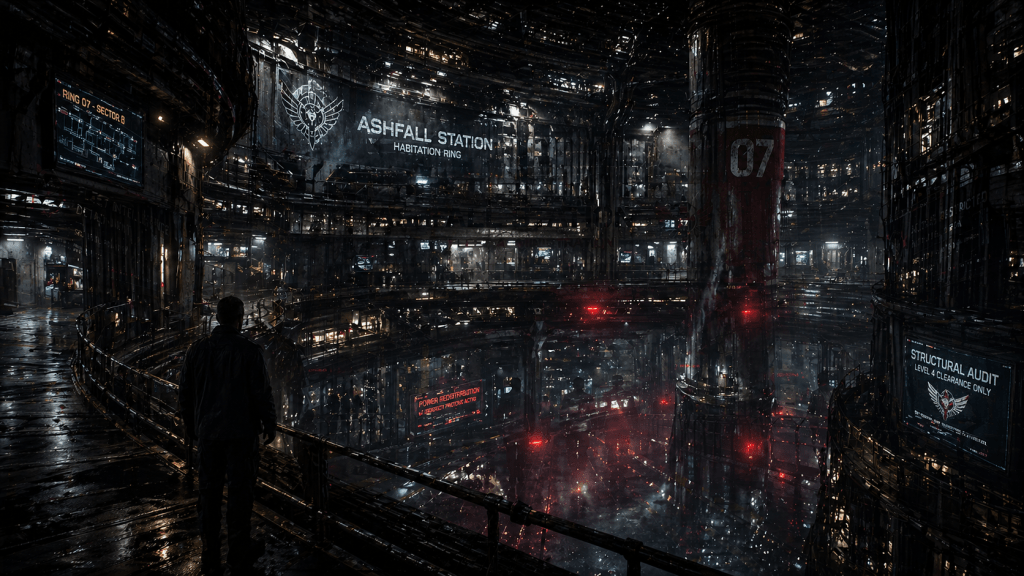
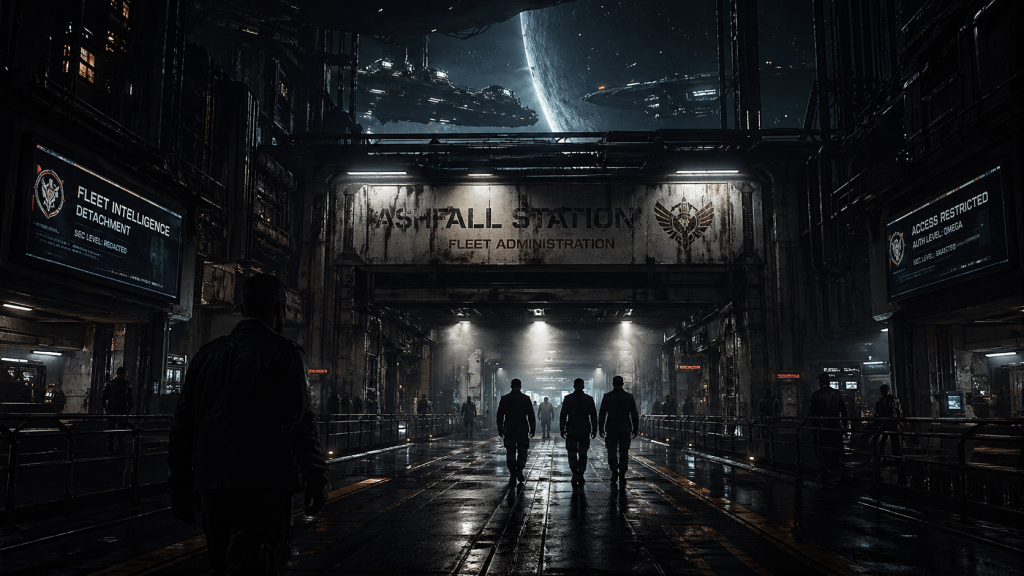
The first call reached Ralen Orst during the late recovery cycle, while he was standing beneath a row of restored lights that shone too brightly across the lower maintenance office. The lamps had been replaced after the blackout, and the new glare showed every stain on the floor, every scratch along the cabinets, every old burn mark around the relay board where the western grid had nearly failed. Ashfall Station had recovered its public face. Above Sector Twelve, freight moved through the docking arms, markets reopened beneath steady amber light, and families crossed the habitation galleries as though the darkness had become one more story to fold into ordinary station life.
Down in the service levels, recovery felt thinner. The air still carried dust from opened panels and the dry metallic taste of overworked circuits. Ralen stood with a half-finished repair slate in one hand while the office wall hummed beside him, and he listened to the old station through the soles of his boots. Ashfall always spoke in machinery. Freight lifts, circulation trunks, pressure doors, pumps, relays, all of it moved through the structure in layered sound. Since the blackout, he had found himself listening for a second movement beneath the first.
The call appeared on his slate with an authority marker he rarely saw attached to environmental work. Ventilation Run 12-C. Restricted airflow variance. Manual verification required. The wording looked clean enough to belong to ordinary maintenance. The access trail beneath it looked worse. Three previous entries had been sealed. Two had been reassigned away from local review. One showed a blank where a crew name should have been.
Ralen stared at the line for a moment longer than he liked, then closed his hand around the slate and turned towards the tool racks.
Anik Vale was already watching him from the far bench, one boot on the lower rail, a coil of fibre line looped across his shoulder. He had the restless alertness of a technician still young enough to believe every fault had a proper cause somewhere inside the system. Beside him, Tessa Myr checked the charge on two portable lamps with slow, deliberate movements, her face pale under the hard office light.
“Another airflow call?” Anik asked.
“Sector Twelve,” Ralen said.
That answered more than the words themselves. Anik lowered his boot from the rail. Tessa looked down at the lamp in her hand, then checked the charge again though the display already showed full.
“Which run?” she asked.
“Twelve-C.”
Her mouth tightened. “That one came up during the blackout review.”
Ralen picked a seal cutter from the rack, weighed it in his palm, and placed it into the field kit. “A lot came up during the blackout review.”
“A lot vanished after it too,” she said.
He looked at her then. The office felt smaller under the bright lights. Across the room, the old relay board gave a soft tick as one line shifted load. “Bring the scanner,” he said. “And keep your private notes off-network until we know what we are looking at.”
They left the maintenance office through the lower corridor and descended towards Sector Twelve by way of a service stair that wrapped around one of Ashfall’s older pressure shafts. Each level changed the station around them. The upper maintenance decks still carried modern signage and fresh emergency paint. Two flights down, the walls thickened. The panels grew older. Later repairs sat over original plating in rough layers, each one solving a problem the last record had failed to explain.
The stair opened into a corridor where the light thinned to a tired amber strip along the ceiling. Ralen stepped out first and let the lamp on his shoulder wake across the walls. The passage stretched ahead through reinforced ribs and exposed conduits. Pipes crossed overhead in uneven banks, some labelled in current Fleet script, others marked with faded station codes from earlier construction phases. The deck dipped slightly beneath his boots where old settlement had warped the plates by a few millimetres.
Anik brought the trolley through the stair door, guiding it over the raised threshold with a quiet curse. The wheels rattled across the floor seams. Tessa followed with the scanner already open, its pale display washing her face in blue.
“Pressure in the run reads stable,” she said as they started forward. “Low movement through the trunk. Temperature sits below corridor average.”
“Contamination?” Ralen asked.
“Clear so far.” She hesitated. “The system keeps refreshing the access history.”
Ralen kept walking. “Let it refresh.”
“What does that usually mean?” Anik asked from behind the trolley.
“It means someone above us wants the file to look alive while it decides what we are allowed to see.”
The corridor bent left beneath a junction of old airflow pipes. At the turn, Ralen paused and studied the wall map mounted in a cracked frame. Much of it had been updated by overlays. Blue modern routes sat over grey legacy lines. Several older paths stopped against blank sections as though the station had forgotten where they led. Ventilation Run 12-C appeared twice, once as an auxiliary trunk feeding the lower environmental grid and once, faint beneath the overlay, as part of an older service transit route whose destination had been erased by later mapping.
Tessa noticed the same thing. “That is the wrong alignment.”
“It was the right alignment once,” Ralen said.
“Before the station changed around it?” Anik asked.
Ralen touched the cracked map with two fingers. Dust came away on his glove. “Before the record changed around the station.”
They moved on. Sector Twelve had grown familiar to him across many years of work, though familiarity gave little comfort in those lower runs. The station felt different there. The sounds carried further through the walls. Air moved through hidden channels before entering the open corridors, bringing faint traces from sealed spaces and older shafts. Every few metres, small inspection plates broke the line of the bulkheads. Some were clean from recent use. Others were filmed with dust thick enough to show no hand had opened them in years.
Ventilation Run 12-C sat behind a stack of temporary shielding panels at the end of a narrow spur. The panels had been leaned against the wall long enough to gather dust along their top edges. Ralen and Anik lifted them aside, revealing a broad maintenance hatch set low into the bulkhead. Its frame was black with old sealant. Rust-coloured residue marked the lower edge. Three labels crossed the face of the hatch. The newest read inactive pending manual inspection. Beneath it, an older strip identified the trunk as auxiliary airflow. Beneath both, nearly lost under grime, a third stencil showed a code Ralen recognised only from deep archive fragments.
Tessa stood a step back and raised the scanner. “Internal atmosphere holds.”
Ralen crouched by the hatch and swept his lamp across the frame. “Readings inside the bend?”
“Partial return only. Something is blocking line of sight.”
Anik leaned closer before Ralen lifted one hand and stopped him.
“Stay behind the frame,” Ralen said.
“I’m behind it.”
“Further behind it.”
Anik moved back with the trolley. Tessa watched the hatch as if it might answer before any of them touched it.
Ralen entered his clearance code. The panel took the code, paused, then asked for confirmation through a second prompt that had no place inside ordinary maintenance access. He looked at the authority marker again. It had already shifted. What had opened as an environmental work order now carried a review flag from central systems.
Tessa saw the change on her scanner. “That marker wasn’t there upstairs.”
“No,” Ralen said. “It came to meet us.”
The hatch accepted the second code. The locking bolts began to withdraw. Each one released with a dull knock that travelled into the wall around them. Dust slipped from the upper seal and drifted through the lamp beam. The final bolt scraped loose, and a thin breath of cold air moved through the frame before the door had even opened.
Ralen smelled it at once. Old metal came first, then stale dust, then something sourer beneath it. His fingers tightened around the manual handle.
Tessa lowered her scanner a fraction. “Ralen.”
“I know.”
He pulled the hatch inward. It moved a few centimetres, stuck, then gave with a drawn-out groan that seemed to travel deeper into the wall than the hinge itself allowed. The opening widened. Cold air spilled around his boots. His shoulder lamp reached into the shaft and revealed ribbed wall plating, old cable ties, a pipe run wrapped in cracked insulation, and dust lying thick along the floor.
Something pale rested near the bend.
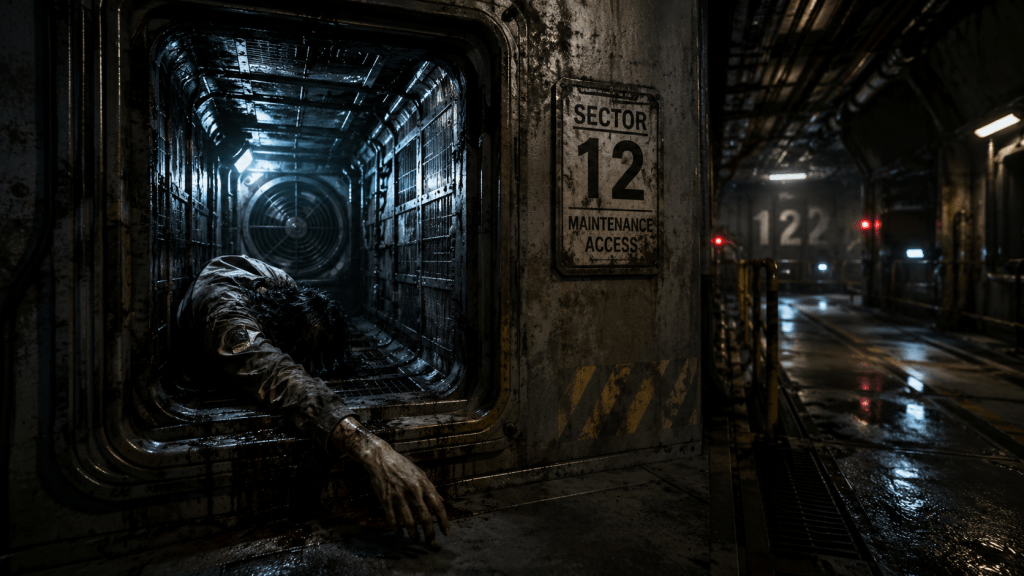
For a few breaths, the shape refused to become what it was. The light found a sleeve first, grey with dust. Then a hand appeared, palm turned upwards against the floor plating, fingers curled as though the last motion had been interrupted halfway through. A shoulder followed. A head rested at an angle against the right wall, partly hidden by shadow.
Tessa took one step back. Anik stopped breathing loudly enough for the silence to show.
Ralen held the lamp steady. The body lay folded inside the shaft, forced into the narrow space before the bend. One arm stretched towards the hatch. The other disappeared beneath the torso. Work clothes clung stiffly to the limbs, their station-issue fabric darkened by old moisture and dust. No emergency beacon flashed nearby. No tool kit lay within reach. No open panel suggested a repair abandoned in fear.
“Is that maintenance?” Anik asked, his voice thin.
Ralen looked at the sleeve patch, half hidden by the angle of the body. He saw enough colour to know the uniform belonged somewhere within station work, though the grime made the division hard to identify. “I cannot confirm from here.”
“Could they have crawled in?” Tessa asked.
Ralen studied the frame, the dust along the lower lip, the clean disturbance where the hatch had opened for the first time in recent memory. He looked along the floor of the shaft, searching for drag marks, tool scrapes, boot prints, anything that might give the body a route into that position. The dust had shifted around the figure. Near the hatch, it remained settled and undisturbed.
“No,” he said.
Anik stared at him. “No?”
“No one entered this way.”
The statement changed the corridor. Ralen felt it in the way Tessa lowered the scanner and in the way Anik took another half step away from the hatch. The station kept humming around them with its usual weary steadiness. A public deck somewhere above would be bright with repaired lights and evening traffic. Down here, cold air kept flowing from the open shaft around a body that should have had no path into the place where it lay.
Ralen opened the emergency maintenance channel and spoke with care. “Control, this is Orst at Ventilation Run 12-C. Body located inside sealed maintenance shaft. Access opened under assigned inspection order. No entry made. Scene held pending security response.”
The line stayed open. Static moved through it in soft waves. Ralen watched the body while waiting for the response. In ordinary circumstances, Control would ask for identification, environmental conditions, hazard status, scene security, medical readiness. The silence lasted long enough for him to know the report had already travelled somewhere else.
A voice answered at last. It was calm, clipped, and unfamiliar. “Maintain position. Restrict local access. Alter no systems linked to the shaft. Security response has been assigned.”
Ralen looked down at his slate. The incident file opened on its own, then narrowed. His name remained visible. The location remained visible. The body description field greyed out before he could enter the first line. Witness attachment disabled. Local duplication suspended. Audio capture transferred to central review.
Tessa stared at her scanner. “My log just locked.”
Anik whispered, “We only found it.”
Ralen said nothing. The shaft drew his attention again. Beyond the body, the trunk bent out of sight into darkness. His lamp showed a faint line along the inner wall where something had scraped through dust deeper in the passage. It continued past the bend, thin and deliberate, as if the body had arrived from inside the station instead of through the hatch.
A soft click sounded beyond the curve.
All three of them heard it. Tessa went still. Anik lifted his lamp with both hands, though the beam shook against the hatch frame. Ralen kept his own light fixed on the body and listened. Another click followed, further away this time, then a slow settling sound passed through the old ductwork behind the bend. It resembled metal cooling after heat, yet the trunk around them carried no active thermal load. It ended with a faint vibration under Ralen’s knees.
The emergency channel remained open, though no voice came through it. Somewhere far down the corridor, a pressure door opened and closed. The sound felt too distant to matter. The body lay before them in the shaft, its outstretched hand caught in the lamp glow, while Ashfall Station continued its restored routine above and around them.
Ralen finally looked back at Tessa and Anik. He saw the question in both faces and had no answer fit for speech.
“Keep the corridor clear,” he said. “Record what you can by hand.”
Tessa swallowed once and nodded.
Anik glanced towards the dark shaft. “And if they ask what we saw?”
Ralen looked at the locked file on his slate, then at the body, then at the bend where the sound had faded into the hidden structure of Sector Twelve. “Then we remember it properly.”
No one spoke after that. The old ventilation run breathed cold air into the corridor. The hatch stood open like a wound in the wall. Around them, the station hummed with careful normality, as though all its lights, rails, markets, and restored systems had agreed to continue while this one discovery began to vanish inside the record.
By the time local security reached the corridor, the incident file had already changed twice. By the time the first officer looked into the shaft, the maintenance order had disappeared from Ralen’s active queue. By the time the body was logged for removal, its presence had become a restricted matter under central authority. Sector Twelve held its silence around them, old metal, cold air, and buried routes drawing close once more.
Ashfall had given them a body from a sealed shaft. Before anyone could ask how it had reached them, the station had begun taking the question away.
Station Record: Sector Twelve Maintenance Shaft; Suppressed Incident File
Ashfall Station remained under restricted recovery oversight in the operational cycles following the quiet Fleet inquiry that followed the multi-ring blackout. Public systems had returned to stable function across the visible station. Freight traffic resumed through the docking arms, market levels reopened beneath repaired lighting, and habitation corridors carried the usual movement of workers, families, and transit crews. Official communications continued to present the blackout as a managed infrastructure disruption linked to legacy grid complexity, while internal departments adjusted to a station whose records had become increasingly difficult to trust.
During this recovery period, multiple incident files connected to earlier irregularities entered central custody. These included materials concerning the missing survey teams, the outer relay closure, the Deck Twelve sealed corridor, expansion junction anomalies, and witness reports gathered after the blackout. Local departments retained partial indexes in several cases, though full contents became inaccessible through ordinary station channels. Maintenance, records, security, and engineering staff reported shortened files, withdrawn attachments, altered routing markers, and access paths that resolved only into central authority review.
Sector Twelve remained a point of continuing concern during this period. The level contained a dense network of older service routes, ventilation trunks, pressure shafts, and support corridors laid across several phases of station construction. Many of these systems had been rebuilt, redirected, or relabelled during later development. In several cases, current schematics showed only partial continuity between active infrastructure and older spaces embedded behind the modern bulkheads. This made maintenance within the sector unusually dependent on local experience, archived fragments, and manual verification.
Ventilation Run 12-C had been listed in recent maintenance systems as an inactive auxiliary airflow route pending inspection. Earlier references classified the same structure as part of a lower environmental trunk serving older support corridors beneath the active deck. A further legacy code, visible beneath later labels on the access hatch, appears to have linked the run to a service transit route absent from current station mapping. This overlap suggests that the shaft occupied a transitional space between functioning environmental infrastructure and a deeper structural network removed from ordinary station use.
The inspection order assigned to the maintenance crew described a restricted airflow variance within the shaft. Environmental readings available before access showed low movement, stable pressure, and reduced temperature within acceptable limits. No contamination warning, breach event, emergency signal, or active crew assignment appeared in the accessible maintenance record. The shaft access frame remained sealed when the crew arrived, and initial physical inspection found no visible evidence of recent authorised entry through the hatch.
Upon manual release of the access frame, maintenance personnel discovered a body inside the shaft near an internal bend. The body appeared positioned beyond the immediate access point, within a section of trunk whose entry through ordinary maintenance procedure would have required hatch opening, crawlspace movement, and logged environmental access. Personnel at the scene reported no tool kit, emergency beacon, visible repair activity, or active work order connected to the individual found inside the shaft. Early observations also indicated minimal disturbance near the hatch compared with irregular disruption deeper inside the trunk.
The initial maintenance report entered the station system under standard emergency handling, then shifted authority status during the first response window. Witness attachment options were disabled. Local duplication became unavailable. Audio capture transferred to central review. The body description field became restricted before full scene notation could be completed by the assigned maintenance lead. These changes occurred before local security completed arrival at the scene.
Security response records show that the corridor was placed under temporary containment shortly after discovery. Access to the immediate service spur was limited to assigned personnel, with traffic through nearby maintenance routes redirected under an infrastructure safety marker. Medical extraction was delayed while authority status over the scene changed twice within the same cycle. By the time the body was prepared for removal, the maintenance order that led personnel to the hatch had disappeared from active local queues.
System logs associated with Ventilation Run 12-C entered central custody during the same response period. Environmental history, hatch access trace, airflow variance data, and internal sensor returns were withdrawn from ordinary maintenance review. Local departments retained only a shortened incident reference identifying the shaft as subject to restricted structural assessment. Security summaries attached to the discovery later appeared with reduced scene detail and no accessible witness material.
Personnel connected to the discovery were instructed to preserve operational discipline and await further contact from central review. Informal accounts suggest that maintenance staff present at the hatch believed the file had begun changing while they still stood beside the open shaft. Several later references from lower-deck workers indicate that handwritten notes from the scene circulated briefly among trusted crews before those individuals were reassigned across separate sectors.
The public operational archive contains no full incident report for the body discovered inside Ventilation Run 12-C. Index fragments recovered during later archive review indicate that a file existed under Sector Twelve maintenance classification for part of one station cycle before entering restricted authority handling. Subsequent public records mention only a temporary safety closure affecting lower environmental routes, with no reference to body recovery, security attendance, or scene containment.
Later examination of restricted references would identify the suppressed Sector Twelve report as one of the final recorded irregularities before the events surrounding Ashfall Station entered a deeper phase of concealment. The discovery connected active maintenance infrastructure, erased service routes, altered files, and a physical body placed within a shaft whose access history failed to support ordinary entry. For the visible station, the cycle passed into routine. For those who stood beside the open hatch, Sector Twelve had returned something the record was already being taught to forget.
About the Creator
The Future Chronicle is written and curated by Simon Phillips, a writer of science fiction and speculative storytelling who explores the quiet edges of human expansion, where ageing stations, distant worlds, and forgotten technologies continue their slow existence beyond the reach of the central worlds.
Many of the stories presented in these Chronicles exist within a wider fictional universe that follows the lives of investigators, engineers, and frontier workers living far from the comfort of the inner systems, where the machinery of civilisation continues to function long after its original purpose has begun to fade.
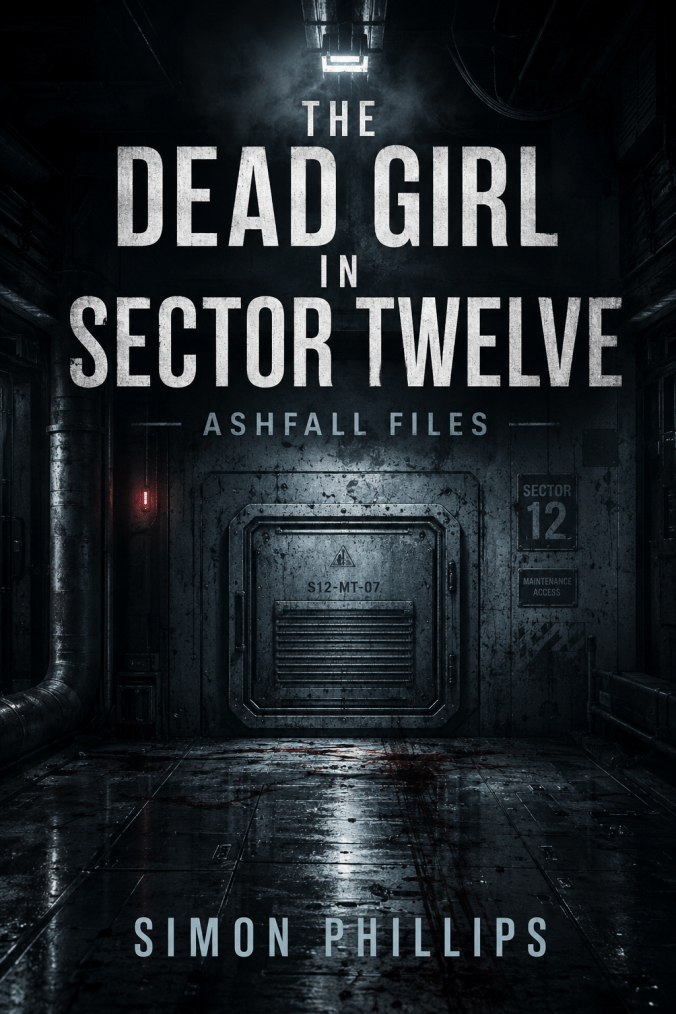
One such story unfolds aboard Ashfall Station, an ageing orbital installation whose corridors and industrial sectors form the setting for the science-fiction mystery novella Ashfall Station: The Dead Girl in Sector Twelve. What begins as a routine investigation gradually reveals that something hidden within the station’s structure may have been present for far longer than the official records suggest.
Readers who wish to explore the full investigation and its unfolding events can find the novella below.
The Chronicle continued with the recovery of the suppressed Sector Twelve incident, after Ralen Orst and his crew opened Ventilation Run 12-C and found a body folded inside a sealed shaft.
What first reached the system as an airflow inspection became something older and darker before local security reached the corridor. The hatch had been sealed. The dust near the frame showed little sign of passage. The body lay deeper within the trunk, beyond the place any worker could have reached by simple accident. While the crew stood beside the open panel, the file narrowed around them, taking witness fields, audio capture, and maintenance notes into central custody before the scene had even settled.
Later fragments placed the discovery among the last known warnings before Sector Twelve passed fully into restricted history. Ashfall had returned a body through one of its hidden routes. Before anyone could ask how it had arrived there, the station had already begun taking the question away.
Readers supporting The Future Chronicle can continue the record below.
The Rooms Where Records Changed
Local security arrived with two officers and a medical team whose equipment cart rattled across the service corridor long before any of them appeared around the bend. Ralen heard them coming through the old metal first, their boots and wheels sending small vibrations through the deck plating while the open hatch breathed cold air against his knees. He had remained beside Ventilation Run 12-C with his lamp fixed on the body, because looking away felt like granting the shaft permission to change while no one watched. Tessa stood near the wall map with her scanner tucked under one arm and a grease pencil in her hand, writing on the back of a torn maintenance wrapper. Anik kept the corridor clear with more discipline than Ralen had expected from him, one hand raised each time distant footsteps approached, his young face set in a tight mask that made him look older than he had been at the start of the shift.
The first security officer slowed as soon as he saw the hatch. His name patch read Corvin Hale. Ralen knew him by sight from lower-sector incidents, a broad-shouldered man with the patient, guarded expression common among officers assigned to parts of the station where accidents often carried other meanings. Hale took in the open shaft, the technicians, the sealed trolley, and the way Tessa had her private notes hidden beneath her sleeve. He then looked past Ralen and saw the body lying in the lamp glow beyond the frame.
“Who entered?” Hale asked.
“No one,” Ralen said.
The officer crouched beside him, careful to keep his boots away from the dust gathered along the hatch lip. “You opened under work order?”
Ralen held out his slate. “The order existed when we arrived.”
Hale glanced at the screen, then at him. The slate showed the restricted marker where the work order had once sat. The officer understood the absence at once. His jaw shifted slightly, and that was the only sign his face gave.
“Medical stays back until I clear the frame,” Hale said over his shoulder.
The medical lead, a woman with silver clips along the side of her cap and exhausted eyes, stopped the cart beside the wall. She looked into the shaft from where she stood. “How long has the body been here?”
Tessa answered before Ralen could. “Temperature reading sits below corridor average. Internal atmosphere stable. No active contamination flag. I had more from the scanner, then my log locked.”
The medical lead looked at her. “Name?”
“Tessa Myr. Environmental maintenance.”
“Keep that written copy,” the woman said quietly, then busied herself with the cart as if she had never spoken beyond procedure.
Hale activated his recorder. The device emitted a start tone, flashed twice, and displayed a restricted custody notice. He stared at it for several seconds. “Security capture transferred,” he said, mostly to himself.
Ralen felt the corridor tighten around them. The report was moving ahead of the people assigned to write it. He had seen files reclassified after review. He had seen errors corrected, attachments withdrawn, permissions narrowed. This was different. The record was closing while the scene still lay open in front of them.
Hale removed a hand lamp from his belt and swept the beam around the hatch frame. “Dust near the threshold is settled,” he said, speaking slowly in case any system still listened. “Manual release disturbed outer lip only. No visible entry trail from corridor side.”
His recorder gave no confirmation.
Ralen watched him continue anyway.
The second officer, Jessa Vorn, moved down the corridor and set a temporary barrier at the bend. She spoke into her comm with her back turned, low enough that only fragments carried. Sector Twelve. Restricted. Central marker. Awaiting instruction. Her shoulders stiffened as the reply came through, then she lowered her hand from the earpiece and returned to Hale.
“Command says scene authority has moved above local security,” she said.
Hale kept his lamp steady on the shaft. “Command said that before we got here?”
“Yes.”
Anik looked from one officer to the other. “How could they move authority before the scene was assessed?”
No one answered him. In the silence, the body became heavier inside the shaft, as though the corridor itself had leaned closer around the question.
Hale shifted his beam beyond the figure. The light caught the thin scrape Ralen had noticed along the inner wall, a pale line through the dust that ran deeper around the bend. Hale followed it with care, then angled the lamp under the body’s outstretched arm. The hand lay palm-up against the plating. Dust had settled across the knuckles, yet the fingertips were cleaner, faintly marked where they had brushed the metal.
“Looks dragged from inside,” Hale said.
Jessa Vorn looked sharply at him. “Say that again with central capture active and the sentence may vanish before it leaves the room.”
Hale gave her a brief look. “Then remember I said it.”
The medical lead stepped closer with a compact body scanner held in both hands. Hale allowed her to kneel beside the hatch while Ralen moved back half a pace. The scanner projected a thin sheet of light over the visible portion of the body. Its data flickered in pale bands across the display, then stalled. The medical lead frowned and adjusted the angle.
“Signal scatter from the shaft walls,” she said.
“Interference?” Ralen asked.
“Dense plating. Old conduit. Maybe shielding in the trunk.” She shifted the scanner again. “No clean identity return.”
The words unsettled Anik more than the body had. “Station ID should ping from the sleeve patch at least.”
“It should,” she said.
Hale leaned closer. “Cause?”
“Ask me after extraction,” the medical lead said. “From here I see dehydration signs, pressure exposure, and trauma from confinement. That is all I will say beside an open shaft that keeps eating my readings.”
Another sound travelled from beyond the bend. This time it came as a faint metallic tick followed by a slow sliding vibration, gentle enough to pass for ordinary duct settling if five people had not already learned to fear the place. Hale raised his lamp. Jessa’s hand went to the grip at her belt. Tessa stopped writing. The medical lead held the scanner still above the body.
Ralen felt the vibration move through the floor beneath one knee, then fade deeper into the wall.
Hale looked at him. “Earlier?”
“Twice,” Ralen said. “After the file locked.”
Jessa lifted her comm. “Control, this is Officer Vorn at the 12-C scene. We have internal movement reported beyond the body location inside the shaft.”
A clean tone interrupted the channel, then a voice answered with smooth authority. “Officer Vorn, maintain scene containment. Further structural observations are outside local incident scope.”
Jessa stared at the comm unit. “Outside scope?”
“Maintain scene containment,” the voice repeated.
Hale exhaled through his nose. “There it is.”
The medical team prepared extraction under Hale’s direction. Because the body lay beyond the hatch angle, they had to extend a narrow brace into the trunk and secure the figure without sending anyone inside. The work took time. Every motion had to be slow, every shift logged by hand after the devices began refusing full capture. Ralen held the lamp from one side while Tessa marked times on her wrapper. Anik counted each tool passed forward and each tool withdrawn, his voice shaking at first, then growing steadier as repetition gave him something to hold.
As the body moved, dust lifted inside the shaft in a grey cloud. The smell deepened, and one of the medical assistants turned his face away. The figure came free by degrees, sleeve first, shoulder next, head bowed forward as though the shaft itself resented surrender. Ralen saw then that the back of the work jacket carried maintenance colours, though the name strip had been removed. The patch had been cut out cleanly, leaving a darker rectangle in the fabric. Whoever the person had been, the station had already lost the name before giving the body back.
The medical lead saw it too. Her expression hardened. Hale asked, “Name strip removed before death or after?”
“Edges are clean,” she said. “I need proper light.”
“Make a note.”
“My notes are my own now,” she replied, and for a moment her tone carried more anger than fear.
They laid the body on a portable sheet beside the corridor wall. Hale stood over it with his lamp angled down. The face was partly obscured by dust and the angle of the jaw, yet Ralen saw enough to feel the sudden pressure of recognition trying to form and failing. The dead man might have passed him in a service corridor. He might have stood in the lower office queue, collected spare filters, complained about shift assignments, waited at a lift with one hand on a tool bag. Ashfall was filled with such people, workers made familiar by posture, uniform, fatigue, and shared air, even when names came slowly.
Tessa drew in a thin breath. “I know him.”
Ralen turned. “From where?”
She looked at the body, then at the officers, then back to Ralen. “I think he worked old airflow routes after the expansion hold. Lio Sarn. Maybe. He was transferred after the blackout review.”
Hale opened his slate and searched the name. The screen gave a soft error tone. He tried again. This time it returned a personnel index with no image, no assignment, no current sector, and no active status. Only the name remained, floating in the system without the structure that should have held it.
“Lio Sarn,” Hale said.
The slate greyed out. The name vanished.
Anik swore under his breath. Tessa looked down at her wrapper as if checking whether she had already written the name somewhere the station could not erase. She had. Ralen saw it near the edge of the torn material, pressed hard in grease pencil.
A new arrival reached the barrier before Hale could speak. The man wore Fleet issue with no department colour, his coat sealed high at the throat and his gloves still clean from upper-deck corridors. He came alone, though two local security staff followed behind him with the blank expressions of personnel reassigned by order. Ralen recognised the type from the post-blackout inquiry. The station seemed to clear itself around such people.
“Scene authority transfers now,” the Fleet officer said.
Hale remained beside the body. “Local security has active custody.”
“Local security has attendance.” The officer’s gaze moved across the body, the hatch, the technicians, the medical cart. “Custody has transferred.”
The words landed with practised weight. Hale held the man’s stare for two breaths, then lowered his slate. Ralen saw the moment calculation replaced resistance. A local officer could hold a corridor for a while. He could even delay a report. He could not win a jurisdictional fight inside a station whose records had already chosen a side.
The Fleet officer turned to the medical lead. “Prepare remains for restricted transfer.”
“I need full scan, identity confirmation, and extraction conditions recorded.”
“You will receive the authorised summary.”
Her face sharpened. “I am the medical lead on scene.”
“You are the medical lead present at a restricted infrastructure recovery.”
That phrase altered the body at their feet. It shifted the dead man from person to object, from death to material, from discovery to recovery. Ralen felt Anik’s anger beside him before the younger technician moved, and he reached back without looking, gripping Anik’s sleeve hard enough to keep him still.
The Fleet officer saw the motion and gave no sign. “Names of all personnel present.”
Hale supplied them slowly. Ralen Orst. Tessa Myr. Anik Vale. Corvin Hale. Jessa Vorn. Medical Lead Saela Drin. Two assistants. Each name entered the officer’s slate. Ralen watched the screen as the list formed. For a moment, his own name appeared under witness category. Then the category changed to maintenance attendance. Tessa’s changed as well. Anik’s shifted to support personnel. Hale’s changed from scene lead to local liaison.
The record had found cleaner words for them while they stood breathing the air of the corridor.
“Your accounts will be collected separately,” the officer said. “No unauthorised copies, no informal discussion, no continuation of independent notes.”
Tessa held the wrapper at her side. Ralen stepped half in front of her.
“Tools and materials remain with maintenance until receipt,” he said.
The officer looked at him. “All scene materials transfer.”
“Then issue a receipt.”
The corridor held still. Hale glanced at Ralen with something close to approval. Saela Drin folded her arms. Anik kept his gaze on the deck.
The Fleet officer studied Ralen for a long moment, then tapped his slate. A receipt appeared on Ralen’s device. It contained no item list, only a transfer number and a custody seal.
Ralen looked at it. “That is a hole with a number on it.”
Hale shifted as if ready to intervene. The Fleet officer’s expression remained calm.
“You are finished here, Technician Orst.”
Ralen thought of the body inside the shaft. He thought of the scrape line beyond the bend and the way the name Lio Sarn had vanished between one breath and the next. He thought of the public galleries above them, lights restored, families walking under the impression that recovery meant safety. The station hummed through the corridor with soft, steady discipline.
“No,” he said. “I found him here.”
“You found an object of restricted review inside inactive infrastructure.”
“I found a man.”
The words seemed too plain for the corridor, too heavy for the official air around them. Tessa looked up. Anik stopped staring at the floor. Hale held still, his lamp angled across the body sheet and the open hatch.
For the first time, the Fleet officer looked at the body as though it had become inconvenient in a human way. “You will attend interview when summoned,” he said.
“Then summon me properly.”
The officer gave a small motion to the local security staff behind him. They moved to collect the handwritten notes, the medical preliminary sheet, and the tool wrapper in Tessa’s hand. Hale stepped between them before they reached her.
“Scene integrity requires local duplicate until transfer completion,” he said.
“Scene integrity is under central review.”
“Then central review can write that it removed witness material before final extraction.”
The two men faced one another in the amber light. Ralen knew Hale was buying seconds, maybe less. Tessa used them. Her hand moved once, quick and low, passing the torn wrapper behind the open field kit. Anik shifted his boot to cover it. The gesture was small enough to vanish inside ordinary fear. Ralen kept his eyes on the Fleet officer and willed the station to look elsewhere.
Saela Drin sealed the body sheet herself. “Transfer ready,” she said.
The medical assistants lifted the remains onto the cart. The sheet changed the body into a shape, and the shape began moving out of the corridor under escort. Ralen watched until the cart passed the bend and the sound of its wheels faded into the broader service route. The cold breath from the hatch continued. The shaft remained open, body gone, darkness still bending beyond the reach of the lamps.
The Fleet officer ordered the hatch sealed. Ralen refused to perform the closure. Anik refused before anyone asked him. Tessa said nothing. In the end, two upper-deck technicians brought in under central order fitted a temporary seal across the frame while Ralen stood back with his hands at his sides. The panel they installed carried no maintenance code. It had a smooth white surface and a single authority tag that linked to no visible file.
When it locked, the corridor sounded different.
The open wound had been covered, yet the air around it remained cold. Behind the new seal, the shaft settled into silence. Ralen imagined the old trunk bending away through darkness, the scrape line vanishing around the corner, the hidden route beyond continuing into spaces current maps had never held honestly. Somewhere inside that buried network, metal clicked once, so faintly he wondered if only he had heard it.
The Fleet officer left last. Before he went, he looked at Ralen with the composed patience of a man who expected time, rank, and systems to perform most of his work for him.
“Technician Orst,” he said, “records exist to preserve continuity.”
Ralen met his gaze. “That depends what they preserve.”
The officer gave no reply. He walked away down the corridor with the two local security staff following behind him. Hale remained until the sound of their footsteps faded.
Only then did Anik lift his boot from the field kit.
The torn wrapper lay beneath it, creased, marked with dust, and filled with Tessa’s hard, cramped handwriting. Times. Readings. The first sight of the body. The name Lio Sarn. The scrape line beyond the bend. The first sound inside the shaft after discovery. Hale looked at it, then at Ralen.
“If they find that on you,” he said, “they will make it disappear with everything else.”
Ralen folded the wrapper once, then slid it into the lining behind the cracked casing of his old scanner. “Then they had better search carefully.”
Hale gave him a tired look. “Careful is what they are.”
“Then we remember more carefully.”
No one smiled. There was no victory in the corridor, only a small piece of resistance held inside a damaged tool casing while the larger record closed around them. The service route returned to work by degrees. Medical cleared. Security withdrew. The trolley went back towards the lower maintenance office carrying tools that now felt borrowed from another life. Tessa walked beside Ralen in silence. Anik followed close behind, his earlier anger drained into a pale focus that would keep him awake for many cycles.
At the junction, Ralen looked back once. The new panel over Ventilation Run 12-C reflected the amber strip light with blank perfection. It looked cleaner than the wall around it. That made it worse. Ashfall rarely repaired anything so neatly unless the repair was meant to hide the shape of what had been broken.
By the time they reached the maintenance office, the official message had already arrived. The inspection at Ventilation Run 12-C had been reclassified as a restricted infrastructure recovery. No fatality appeared in the summary. No body appeared in the wording. No named worker appeared in the accessible record. Ralen opened the file, watched the lines settle, and felt the old scanner casing press against his ribs beneath his jacket.
Tessa stood beside his desk, hands folded tight. “He will be gone by morning.”
Ralen kept reading the emptied summary. “He is already gone.”
Anik looked towards the bright office lights, then away. “So what was the point of finding him?”
Ralen closed the file. The screen went dark, and for a moment he saw the reflection of all three of them in it, pale under hard light, carrying the look of workers who had entered a corridor and returned with something the station had refused to keep.
“The point,” he said, “is that someone saw where he was.”
Above them, Ashfall continued its orbit with freight lanes active, markets open, and public lamps restored. In the lower office, three maintenance workers stood around a closed file while the station carried on pretending the shaft had held nothing of consequence. Yet behind the casing of an old scanner, on a torn strip of maintenance wrapper, a different record remained. It was fragile, incomplete, and dangerously small against the weight of Fleet custody. It was still more honest than the archive.
Later, when Sector Twelve became a name spoken with caution across the station, few would know about the wrapper or the hand that wrote on it. Fewer would know how close the body came to vanishing before anyone outside central review had time to understand that it had been there at all. The official record held the incident for less than a cycle. The people who witnessed it carried it for much longer.
In that difference lay the last trace of the event the station tried to erase.
Maintenance crews at Ventilation Run 12-C recorded the body before the incident file began to close around the discovery.
The Idea Behind the Chronicle
Large orbital stations depend on more than machinery. They depend on confidence. Lights must return when they fail, doors must open when commanded, air must move through the decks, and every corridor must continue giving the impression that the structure around its residents can still be trusted. For those living inside a station like Ashfall, survival depends on that trust so completely that the machinery becomes almost invisible. People sleep because the walls hold. They work because the vents breathe. They cross service corridors because the maps say those corridors lead somewhere known.
Ashfall Station existed at the edge of that trust. It had been built in layers, expanded through necessity, patched through decline, and kept alive by workers who understood parts of it more intimately than any central archive ever could. In such a place, infrastructure becomes memory. Every sealed panel, redirected shaft, abandoned corridor, and relabelled route carries the trace of a decision made by someone in an earlier generation. Some of those decisions preserve life. Some bury mistakes. Others survive long after their reason has vanished from the record.
The idea behind this Chronicle grew from the question of what happens when a station begins returning what its records have buried. A body discovered in a sealed maintenance shaft is a crime scene, an engineering problem, a system failure, and an archival disturbance all at once. It belongs to security, medical, maintenance, administration, and Fleet oversight. Each department sees a different shape. None of them holds the full truth. That fragmentation allows the incident to be controlled before it can be understood.
This entry also explores the tension between physical evidence and institutional power. The body inside Ventilation Run 12-C is undeniable in the moment of discovery. People see it. They smell the cold air coming from the shaft. They watch the file change while they are still standing beside the open hatch. Yet the official record begins to reduce the event almost immediately. A death becomes an infrastructure recovery. Witnesses become attendance. A person becomes an object under restricted review. The horror lies in watching reality become smaller inside the language of authority.
Science fiction often imagines the future through grand discoveries: alien objects, impossible signals, lost worlds, and technologies beyond human understanding. Ashfall moves through a quieter kind of speculative fear. It asks what happens when the future is governed by access permissions, controlled archives, automated classifications, and systems that decide what can remain visible. In such a world, truth does not vanish only through lies. It vanishes through workflow. It becomes restricted, transferred, renamed, or placed beyond local authority until the people who witnessed it are left carrying memory without proof.
The maintenance crew at the centre of this Chronicle matter because they are ordinary workers standing at the edge of something far larger than themselves. Ralen, Tessa, and Anik are not investigators in the formal sense. They are people who know how the station breathes, how its panels should sound, how old dust lies when a hatch has remained sealed, and how a maintenance order feels when authority has already touched it. Their knowledge is practical, lived, and grounded in labour. That makes them dangerous to a system trying to simplify what happened.
The Chronicle also turns the maintenance shaft into a symbolic space without making it abstract. Ventilation routes are meant to sustain life quietly. They move air through hidden passages so public spaces can remain habitable. Placing a body inside such a route corrupts that purpose. The shaft becomes both infrastructure and witness, a buried artery carrying evidence back into the visible station. It is an old part of Ashfall’s body returning something the station had tried, or been instructed, to keep out of sight.
There is a broader speculative idea beneath this entry as well. Future societies spread across stations, colonies, and remote installations would rely heavily on technical records to define reality. A person’s identity, access history, movements, work assignments, and even death would pass through interconnected systems before becoming part of public knowledge. If those systems were controlled by distant authority, then memory itself would become vulnerable. A life could be narrowed to a missing name field. A scene could be recategorised. A body could be removed from the archive before grief had time to form around it.
As the final Chronicle in this Ashfall Station sequence, this entry sits close to the boundary between worldbuilding and the events that follow in the wider Ashfall story. It does not explain the mystery outright. It shows the station reaching a point where accident, suppression, infrastructure, and fear can no longer be kept apart. The body in the shaft is important because of where it is found, how quickly the record closes, and how little time ordinary people are given to understand what they have seen.
The fear in this entry comes from the calmness of the response. There is no public panic. No announcement passes through the decks. No dramatic lockdown interrupts the life of the station. Freight continues. Markets remain open. Lights stay on. The incident disappears through procedure, and that is what makes it feel true to Ashfall. The station survives by continuing, even when continuation requires silence.
By the end, the unanswered question is no longer simply how a body reached a sealed shaft in Sector Twelve. The deeper question is why the station’s systems seemed prepared to erase the answer before anyone could properly ask it.
From the Author’s Desk
This Chronicle closes the first Ashfall Station sequence by bringing the mystery back to Sector Twelve, where the wider story of the station begins to press against the edge of the novella. Earlier entries followed the station through distance and disturbance: the strange salvage fragment, the signal in the debris field, the missing survey team, the blackout, and the quiet Fleet inquiry that gathered those separate incidents into restricted custody. This final Chronicle narrows that pressure into one service corridor, one opened shaft, and one body the official record refuses to keep.
That narrowing felt important.
Ashfall works best when the scale of the mystery is held inside ordinary labour. A maintenance crew checking an airflow variance should be one of the most routine scenes possible inside a large station. Workers arrive with a trolley, open a hatch, take readings, make notes, and move on to the next fault. Yet in this world, routine is exactly where the station hides its deeper history. The most frightening discoveries rarely arrive through grand announcements. They emerge through old panels, incomplete maps, and jobs assigned with too little explanation.
Ralen, Tessa, and Anik gave this Chronicle its human centre. They are not detectives or Fleet officers. They are station workers who understand the physical truth of Ashfall more closely than those who control its records. They know how dust should lie around a sealed hatch. They know what a normal airflow fault looks like. They know when a work order has been touched by authority before they ever reach the site. That practical knowledge becomes its own form of resistance.
The body inside Ventilation Run 12-C also carries a deliberate connection to the wider Ashfall atmosphere. It is not only the discovery itself that matters, but the speed with which the discovery is renamed. A death becomes an infrastructure recovery. Witnesses become attendance. A person becomes an object of restricted review. That kind of language interests me because it shows how a system protects itself. The horror comes from calm procedure, not open chaos.
Across these Chronicles, Ashfall has gradually become more than an ageing industrial station. It has become a place where infrastructure, memory, authority, and fear all overlap. The walls hold old routes. The archive holds altered records. Fleet holds the power to decide which parts of reality remain visible. Ordinary workers are left carrying what they saw in private, often with nothing stronger than memory or a scrap of handwritten evidence.
This final entry does not solve Ashfall’s mystery. It was never meant to. Instead, it marks the point where the station’s hidden history becomes impossible to separate from its present condition. Sector Twelve is no longer simply a lower maintenance zone with unreliable lighting and ageing shafts. It becomes a threshold, a place where the station gives something back and the official record immediately tries to take it away.
These Chronicles take place before the events of Ashfall Station: The Dead in Sector Twelve, and they are designed to deepen the world around that story rather than retell it. They show how Ashfall reached the state in which the novella begins: strained, watched, altered, and full of silences that ordinary people have learned to survive around.
Readers interested in exploring more of Ashfall and the wider worlds connected to it can find further work below.
Large orbital stations depend on systems most residents never see. Air does not simply appear inside corridors, cabins, markets, and docking galleries. It moves through shafts, filters, trunks, pressure regulators, and circulation routes buried behind the visible architecture of daily life. These systems are meant to remain unnoticed. Their success lies in silence, regularity, and the absence of attention.
In a station as old as Ashfall, those hidden systems would carry a long operational history. Ventilation routes might begin as part of one construction phase, then become auxiliary channels during later expansion. A shaft built to serve one industrial zone could later be rerouted into habitation support, then sealed, relabelled, or partially absorbed into a newer environmental grid. Over decades, the practical map of the station could drift away from the original design.
This creates a dangerous kind of uncertainty. A sealed maintenance shaft may be inactive in one system, partially mapped in another, and still physically connected to older routes that current crews rarely enter. For maintenance workers, such spaces are difficult because they sit between infrastructure and memory. They are real enough to affect airflow, pressure, and temperature, yet poorly recorded enough to resist clean explanation when something goes wrong.
In this Chronicle, Ventilation Run 12-C becomes that kind of space. It is a practical system, a physical route for air and maintenance access, and a forgotten corridor into the deeper body of the station. The discovery of a body inside it turns infrastructure into evidence.
Airflow, Pressure, and Access Records
A station’s environmental systems would leave extensive traces whenever a sealed shaft was opened, inspected, or entered. Hatch release logs, pressure changes, internal temperature readings, airflow movement, contamination checks, tool access, and worker assignments would all help establish the condition of the scene. In an ordinary fatality, those details would shape the first layer of investigation.
If a worker crawled into a ventilation run, there should be an access event. If a hatch opened, the station should record it. If pressure changed or air movement shifted, environmental systems should mark the disturbance. Even in an ageing station, the absence of those records would matter. It would suggest either system failure, deliberate removal, or entry through a route outside current mapping.
That is what makes the Sector Twelve incident unsettling. The hatch appears sealed. The dust near the access point remains settled. The body lies beyond the immediate opening. The available readings show stable pressure and low airflow, with no ordinary emergency condition attached. The scene suggests presence without a supported route.
For a maintenance crew, that would be more frightening than visible damage. A broken hatch gives one kind of answer. A sealed hatch with a body behind it gives none. It forces the question away from accident and towards the hidden structure beyond the bend.
The Language of Reclassification
Institutional control often begins with language. A body in a shaft can be called a fatality, a crime scene, a maintenance hazard, a restricted recovery, or an infrastructure matter. Each term creates a different kind of response. Each one determines who has authority, who can view the record, who can speak, and which departments retain access to the evidence.
In a fragile frontier station, official language carries practical power. Calling an incident an infrastructure recovery can move it away from local security and into central technical custody. Witnesses become personnel present at the recovery. Medical findings become authorised summaries. Scene notes become controlled material. The event remains real, yet its public shape changes.
That is the central mechanism at work in this Chronicle. The body discovered inside Ventilation Run 12-C is never allowed to remain simply a body for long. The record begins adjusting around it. The people who found it are renamed by function. Their statements narrow into attendance. The dead worker’s identity begins to slip from the system before ordinary confirmation can complete.
This kind of reclassification creates a quiet horror suited to Ashfall. Nothing needs to explode. No announcement has to be made. Authority changes the frame, and the event begins to disappear inside procedure.
Practical Knowledge Versus Central Records
Maintenance workers understand a station differently from administrators. They know the feel of a hatch that has stayed closed for years. They know the smell of old air escaping from a sealed trunk. They know how dust settles around an untouched panel and how a system sounds when load travels through a line that should have been retired. Their knowledge is physical, repetitive, and built through labour.
Central records understand the station through permissions, files, maps, and classifications. This form of knowledge is powerful because it determines what can be seen by others. A file can confirm a route exists. A map can deny it. A work order can send a crew into a shaft. A restriction marker can erase the reason they were sent there.
The tension between these two kinds of knowledge runs through this entry. Ralen, Tessa, and Anik see the body, the dust, the hatch, the scrape line, and the file changing in real time. Their experience is direct. The record that replaces it is controlled, narrowed, and safer for the station to carry.
In a future built on complex systems, that conflict becomes deeply important. A worker may know the truth of a place through touch, sound, and experience, while the official system holds the power to decide whether that truth exists beyond the corridor where it was witnessed.
Identity Inside a Controlled System
In a station environment, identity would depend on constant verification. A worker’s name, assignment history, clearance level, location access, medical record, communication trail, and personnel file would all form part of their official existence. The system would know who belonged where, which routes they could enter, and what work they had been assigned to complete.
That makes a missing or unstable identity record especially disturbing. A body without a clean return from station systems is more than an unidentified death. It suggests that the person’s relationship to the archive has already been altered. A name strip cut from a uniform and a personnel file that vanishes during scene review both point towards the same fear: the person has begun to disappear from the station before the body itself has been removed.
This is one of the darker speculative ideas behind the Chronicle. In highly managed future societies, erasure may begin administratively before it becomes physical. Someone can still be present, still remembered by co-workers, still lying in front of witnesses, while their official identity is already being withdrawn from accessible systems.
For Ashfall, that idea matters because the station has always been a place where people survive through records. Work assignments, rations, housing, medical access, and movement all depend on being legible to the system. To be removed from that system is to become vulnerable in a profound way.
Frontier Continuity and Suppressed Death
Remote stations survive by continuing. A death in a lower shaft cannot stop freight movement for long. A disturbing discovery cannot keep markets closed. Air systems still need inspection. Docking arms still need crews. Families still require food, heat, water, and habitable corridors. The pressure to resume routine is not only institutional. It is practical.
That practical need becomes dangerous when it is used to bury meaning. A body can be removed. A hatch can be sealed. A corridor can reopen. A report can be renamed. Once those actions are complete, the station can continue functioning while the deeper question remains untouched.
This Chronicle sits inside that tension. Ashfall’s survival depends on continuity, yet continuity has become the means by which the station avoids understanding itself. The body in Ventilation Run 12-C should interrupt the whole structure. Instead, the event is absorbed, reclassified, and placed beyond ordinary reach.
The frontier context is therefore simple and severe. In a distant station, silence can be made to look like stability. Routine can become a form of concealment. The lights can remain on while the truth disappears below the level where most people are allowed to look.
Next Chronicle
In the operational cycles following the quiet Fleet inquiry, Ashfall Station resumed its outward appearance of ordinary function. Freight moved through the docking arms, lighting remained stable across the public galleries, and the market levels filled again with the familiar movement of workers, families, and transit crews. Yet beneath that restored routine, the station’s internal record had changed. Files connected to the blackout, the missing survey teams, the Deck Twelve corridor, and the expansion anomalies had been drawn into restricted custody, leaving local departments with gaps where explanations should have been.
Within Sector Twelve, maintenance crews continued working around older service routes whose history had grown increasingly difficult to trace. Some shafts remained listed as inactive. Others appeared in partial schematics only, their original purpose obscured by later construction and repeated administrative revision. In this part of the station, where ventilation trunks crossed buried support corridors and access panels opened into spaces few residents ever saw, the boundary between working infrastructure and forgotten structure had always been thin.
During a routine inspection inside one of these sealed maintenance shafts, workers discovered a body positioned where no crew member should have been able to enter through ordinary access. The corridor around the shaft showed no immediate sign of open violence, system breach, or emergency activity. The discovery passed first into local maintenance reporting, then into security channels, where the initial incident file began to form around familiar procedural language.
That file would remain visible for only a short time. Before the report completed its movement through the station’s ordinary archive, authority markers appeared across the record. Access narrowed. Witness notes were separated from the case file. System logs linked to the shaft were withdrawn for central review. By the end of the cycle, the discovery had ceased to exist in the public operational archive, leaving only scattered references in restricted channels and the memories of those who had stood beside the opened panel.
Later review would identify this suppressed report as one of the final known entries before the events surrounding Sector Twelve entered Ashfall’s deeper history, where accident, investigation, and concealment became impossible to separate.
Next Week: The Incident That Was Never Recorded
Ashfall Station continued its slow orbit above the pale surface of Kestren-4, its public decks lit, its freight lanes open, and its lower systems carrying air through routes most residents would never see. Sector Twelve returned to the familiar discipline of sealed panels, closed files, and workers moving carefully through corridors where every sound seemed to travel further than it should. The shaft at Ventilation Run 12-C disappeared behind a clean authority plate, smoother than the wall around it, while the official record reduced the discovery to a restricted infrastructure recovery.
Yet the station had returned something before the archive could fully close around it. A body had lain inside a sealed route, a name had flickered briefly inside the system, and a handful of workers had stood close enough to see the truth before it was taken away. Ashfall endured, turning quietly at the edge of the debris field, while beneath its restored lights and ordinary schedules, the old routes held their silence again, carrying whatever remained beyond the reach of the record.
This is not the usual sort of post about living in Japan.
There are no sightseeing recommendations, hidden restaurants, convenience-store discoveries or reflections on cherry blossom season. Instead, this begins on an ordinary train journey that ended with me unconscious on a station escalator, followed by my first ambulance ride in the seventeen years I have lived here.
It is also the reason my writing, website work and other projects have moved more slowly than usual recently.
That slowdown has not been caused directly by the cuts and bruises from the fall, nor by spending every day unable to work because of the symptoms that followed. Much of it has come from the appointments themselves. There have been visits to a clinic, hospital tests, return journeys, waiting rooms, a twenty-four-hour heart monitor, paperwork, another hospital visit to remove the monitor, and future appointments that remain on the calendar.
Each appointment takes time. More importantly, they occupy part of the mind even after the hospital visit has ended. It is difficult to settle into fiction when part of your attention is still waiting for an explanation about why you collapsed in the first place.
This post is not medical advice, and it is not an attempt to diagnose what happened. The doctors are still investigating it. It is a personal account of becoming unwell, entering parts of the Japanese medical system that I had never needed before, and discovering that living in another country can feel entirely normal until something forces you into unfamiliar territory.
Before the Collapse
The strange part is that, before the major faint, I had begun to feel that my stamina was improving.
I have what most people would probably call a dad body. I had tried getting back into regular exercise, although, like many attempts at building a new routine, it did not last. About a year earlier, I had tried running again and found it much harder than I remembered.
As a teenager, I had been used to long-distance running. Returning to it years later was different. I would run for a while, slow to a walk, then try to start again. Part of that may have been physical, although some of it was probably the difficulty of finding a rhythm after so long away from running.
My work is physically demanding, and over time my body had adjusted to that routine. There were shifts when the pace remained high for hours, including some particularly busy periods during the previous year, yet I had generally managed them.
The change became noticeable when I had to run from work to catch a train.
I expected it to feel much like my earlier attempts at running for exercise. Instead, I found a steady pace and kept it. I did not need to stop and walk in the way I had before. I was not running a great distance, but the difference was obvious to me because I knew how much more broken and difficult the same effort had felt the previous year.
It was only one run for a train, not proof that I had suddenly become fit again. Still, it suggested that the physical demands of work had improved my stamina more than I had realised.
That matters because what happened afterwards did not feel like the end of a long decline. Shortly before the collapse, I had experienced a small but clear sign that my body was handling sustained effort better than it had before.
About a year earlier, I had passed out on a train along roughly the same route. The sensations were similar enough that I now wonder whether the two incidents were connected. At the time, however, I recovered and continued with ordinary life. I worked through the following year, including demanding periods, without the earlier event becoming the centre of my daily thinking.
The escalator collapse changed that.
When the Train Journey Stopped Feeling Normal
The journey began like any other trip to work, until a growing sense of light-headedness made it clear that something was wrong. A floating, dropping sensation followed, similar to the moment when a roller coaster passes over the top of a rise. My stomach and body seemed to lift and fall even though the train itself was moving normally, and as the feeling intensified, my vision and awareness began to close in.
Remaining upright became more difficult, and by the final part of the journey I had crouched down, less because I had made a clear decision and more because standing no longer felt safe. I was trying to stay conscious long enough to reach the station, although my memory of what happened immediately afterwards is incomplete.
There is a gap after I left the train. I have a vague recollection of someone trying to get a response from me, but I cannot say with certainty what they did or what condition I was in at the time. They may have shaken me, pushed me roughly or used their foot in an attempt to wake or move me. I do not remember enough to describe it as an assault, and I cannot confirm whether I had fully lost consciousness.
It is possible that I fainted on or near the platform and then partially recovered. It is also possible that I experienced a severe near-faint without completely blacking out, or that the whole period formed one longer episode of broken awareness. I may even have lost consciousness twice. The truth is that I do not know.
What I do remember is becoming aware enough to continue moving through the station. The ticket gates were above the platform, so I needed to take the escalator to reach them. I believed that once I got there, I would be able to find somewhere to sit down and recover.
I stepped onto the long escalator and began the climb towards the concourse.
The Escalator
I made it most of the way up before losing consciousness, somewhere around four-fifths of the distance. There was no time to brace myself or hold on properly. I fell backwards and tumbled down the escalator while it continued moving beneath me, striking my head and face and injuring several parts of my body on the way down.
My memory of the fall is broken rather than continuous. I remember only fragments, followed by the confused aftermath. One moment I was trying to reach the concourse so I could sit down and recover. The next clear part of the day involved strangers around me, the pain from the fall, and the knowledge that an ambulance had been called.
Ambulances were not unfamiliar to me. Both my wife and one of my children had needed one before, and on those occasions I had followed behind or made my own way to the hospital by car. I had been close to that experience without ever being the person inside the ambulance.
After seventeen years in Japan, this was the first time I had ridden in one myself.
My First Ambulance Ride in Japan
The ambulance journey is blurred in my memory. I felt confused, unsteady and detached from what was happening, almost as though I were drunk despite having consumed no alcohol. My thoughts moved slowly, and the surroundings seemed to reach me through a haze, which made even ordinary questions take longer to process than they normally would.
My Japanese is not fluent, especially when a conversation moves into specialist medical language, although it is enough for daily life and for working in a fully Japanese environment. I can manage ordinary conversations, instructions and practical situations without needing someone beside me to interpret everything, and that remained true in the ambulance. I understood the questions being asked and was able to answer them, although my replies sometimes came more slowly than usual.
I cannot say whether that delay came from striking my head, from the disorientation of the faint and fall, or simply from my body trying to recover from a frightening physical event. What I can say is that there was no major communication failure. The difficulty was not understanding nothing, but needing more time to take in what was being asked and form a reply.
That distinction matters because language ability abroad is often treated as though it falls into two simple categories: complete fluency or complete dependence. In reality, there is a wide space between them. A person can work, travel, shop and deal with ordinary problems in another language while still finding that a medical emergency, unfamiliar vocabulary and physical confusion make communication slower and more demanding.
The ambulance took me to the hospital where my wife works.
A Familiar Hospital That Was New to Me
My wife was already on shift when the ambulance arrived. She works as an operating nurse in the hospital’s cardiac section, so she knew the doctors involved, although not every nurse working in the emergency department. Because she was already in the building and knew the medical staff, she was allowed to be there when I was brought in.
She quickly found herself occupying several roles at once. She was my wife, the person who had translated for me throughout much of our married life in Japan, and a nurse in a hospital she knew well. I could understand the immediate questions and answer for myself, but when the explanations became more technical, or when my responses slowed because I was still disoriented, she filled in the gaps. She also helped the emergency nurses where she could, although her manner with me was noticeably less gentle than theirs. The nurses treated me carefully as an injured patient, while my wife handled me with the practical firmness of someone who knew me too well to be overly delicate.
The situation became stranger when staff from her own cardiac section began following what was happening through the monitors. This was the first time many of them had seen me, and alongside their concern about what might have caused the collapse, there was also a small amount of curiosity. They commented that I was larger and more robust than they had expected, rather than thin. I still do not know what my wife had previously told them about me that produced such a reaction.
More importantly, it was the nurses from her section who first raised the possibility that the faint might be connected to my heart. Their concern did not provide an answer, but it changed the direction of what followed. The emergency department dealt with the injuries from the fall, yet I left the hospital without a clear explanation for why I had lost consciousness.
My boss also came to the hospital after hearing what had happened. There was no formal reason to do so because the collapse had not occurred at work, and the visit came entirely from concern. I appreciated it, especially while I was still trying to process how quickly a routine journey had turned into a serious medical emergency and the beginning of a much longer period of appointments and tests.
The journey felt much like the ambulance ride. I was awake, but everything remained blurred and strangely distant.
When the Body No Longer Felt the Same
The collapse became a dividing line in how I experienced my physical condition, although I am careful about making that connection too strongly. I cannot say that the fall caused everything that followed, and it is possible that several things overlapped. Around the same period, I also developed fever-like feelings, a sore throat and other cold symptoms that may have pointed to a viral illness.
What I can say is that ordinary effort began to feel different afterwards. Exertion that would previously have been manageable sometimes left me breathing more heavily, while my heartbeat could feel unusually forceful, fast or irregular. Chest aches returned in a familiar place, and episodes of dizziness, blurred vision, shaking, sweating and sudden weakness began to appear without much warning.
At times, my energy seemed to drain away quickly. My knees could feel unstable, and there were moments when my lower body seemed strangely disconnected from the rest of me. My thinking could also become foggy or boxed in, with brief periods when it took longer to understand what was happening around me.
The difficulty was that none of this followed a clear pattern. The symptoms did not always appear together, and they could change throughout the day. A difficult hour might be followed by a period when I felt almost normal, while a manageable morning could give way to a much harder journey later.
That inconsistency made it difficult to judge what was happening or how seriously to treat each episode. The doctors had not given me a confirmed explanation, and I did not want to fill that uncertainty with a diagnosis of my own.
The Heart Clinic
Following the concerns raised by my wife’s colleagues, I was advised to attend a heart clinic and obtain a referral letter for further investigation. The clinic carried out an echocardiogram, and during the explanation the clinician used wording that I understood as genki nai when describing the heart’s movement or action.
Genki is one of the most familiar Japanese words, usually meaning healthy, energetic or well depending on the situation. Hearing that something about my heart was “not genki” made sense at a basic level, but it was much harder to understand what that meant medically. The clinician also mentioned an issue with one of the valves, although I did not leave believing that I had been given a firm diagnosis of heart failure or any other serious condition. My understanding was simply that the clinic had seen enough to recommend further checks at a larger hospital.
That finding led to the referral and the next series of appointments. When the heart imaging was repeated at the hospital, the doctor explained that the valve issue appeared mild and was not significant enough to account for the fainting. It was reassuring to hear that they had not found an obvious severe problem, although the result left the original uncertainty in place.
The question was no longer whether the clinic had noticed something, but whether that finding had anything to do with what had happened. If the valve issue was too minor to explain the loss of consciousness, then I was still left wondering why I had fainted, why I had fallen down the escalator and why ordinary exertion sometimes seemed to affect me differently afterwards. A test can bring relief by ruling out something serious while still leaving the patient without the answer they were hoping to find.
Entering the Medical System Properly for the First Time
What made the experience especially strange was how much of it was completely new. In seventeen years of living in Japan, I had never ridden in an ambulance, gone through this sequence of heart checks and referrals, worn a twenty-four-hour monitor or needed to record symptoms throughout an ordinary working day. Many of the later appointments also had to be attended alone, which meant dealing with unfamiliar procedures in Japanese without my wife there to fill in the occasional gap.
There were no major misunderstandings. I followed the instructions, completed the tests and spoke with the staff in Japanese, but managing everyday life in another language is not the same as feeling completely certain inside a medical system. A nurse might explain where to go, what to remove, when to press a button or when to return, and those immediate instructions could be perfectly clear. The uncertainty often came afterwards, when I found myself wondering whether there had been another stage I had missed, whether the payment process worked differently for that appointment or whether a specialist phrase meant exactly what I thought it did.
Living in another country becomes ordinary through repetition. Over time, the trains, shops, workplaces, forms and daily routines stop feeling foreign because they become part of normal life. A medical emergency places you inside a different system, however, and years of familiarity do not change the fact that many of its procedures are being experienced for the first time. I was able to manage them, but that did not make the process feel familiar.
The Near-Faint and the Heart Monitor
A few days before the twenty-four-hour monitor was fitted, I experienced another serious near-faint. The morning had begun normally, but the bicycle ride became far more difficult than usual, and I came extremely close to losing consciousness again. Because the episode happened before any monitoring had begun, there was no record of what my heart was doing at the time.
A few days later, I returned to the hospital to have the monitor attached. The device was fixed to my body and set to record my heart rate and rhythm continuously for the next twenty-four hours, including the journey home, the night and the following working day. I was also given an event button to press whenever symptoms appeared, together with a card for noting the time, what I was doing and how I felt.
The most noticeable symptoms occurred on the second day, while I was still wearing the monitor and travelling to work. At around 7.13 on the morning train, the strong rising-and-falling sensation returned, accompanied by mild nausea, tiredness and a brief moment of confusion or panic as I looked towards a bridge and stretch of railway that were normally completely familiar to me. After climbing the subway stairs at about 7.31, my heart began beating so heavily and forcefully that I pressed the button again, followed by another recorded episode of breathlessness and dizziness at around 8.44.
Work that morning was extremely busy, and the symptoms continued rather than settling. At approximately 9.50, I felt fever-like waves, fatigue and a sudden sense of becoming unwell, followed at around 10.30 by pain in the centre of my chest. For the remainder of the shift, my strength rose and fell in cycles. At certain points, my energy dropped so sharply that I felt close to being unable to continue, only for some strength to return and carry me through until the next decline.
I did not press the event button for every change because the symptoms felt less like separate incidents and more like one prolonged cluster shifting in intensity. By then, the monitor had already been recording since the previous day, and it remained attached until I returned to the hospital later that afternoon to complete the full twenty-four-hour period.
Wearing it made an otherwise ordinary day feel unusually formal. Sensations I might once have noticed and dismissed now required me to decide whether they were important enough to record, while the device quietly collected information I could not interpret for myself.
A Slow Walk That Did Not Stay Easy
After lunch, I had about an hour and a half before I needed to return to the hospital and have the monitor removed, so I decided to walk slowly to a nearby river and sit in the shade. The journey there was manageable, and once I had stopped beside the water, I felt comfortable enough for the day to settle for a while.
The difficulty returned when I began walking back towards the hospital. My breathing grew heavier, my heartbeat felt unusually strong, and the familiar chest pain appeared again, prompting me to press the event button. It had not been a strenuous walk, only an ordinary slow journey after a period of rest, although by then I had already travelled, worked and spent more time on my feet than my body may have been ready to handle.
When I reached a coffee shop inside or near the hospital, I still had around thirty minutes before the appointment. I sat down to wait, but the heavy breathing continued and my vision began to blur without me deliberately allowing my eyes to lose focus. Trying to hold the image in front of me steady felt difficult and slightly painful, which meant I needed to add another symptom to the notes accompanying the monitor recording.
The phrase I used was simple: めが ぼやける, me ga boyakeru, meaning that my vision was blurred. It was a small piece of Japanese, but it captured much of what the experience had become. I was sitting in a hospital coffee shop, feeling unwell and trying to describe the symptom clearly enough for someone to connect it later with the heart recording. I did not need perfect Japanese in that moment. I only needed enough to make what was happening understandable.
Removing the Monitor and Going Home
By the time I returned for the removal appointment, I was still breathing heavily and also felt dizzy, with a noticeable tremor in my hands. Before the nurse began removing the equipment, I asked for a moment to catch my breath. She immediately treated the symptoms as something that needed to be included in the test rather than simply waiting for them to pass.
She firmly instructed me to press the event button and then asked me to describe exactly what I was feeling so it could be added to the record. Until that point, I had been thinking mainly about sitting still long enough for my breathing to settle, but she made sure the episode was documented before continuing with the appointment. She also advised me to drink fluids, rest and speak to the front desk if I felt that I needed further help.
Once my condition had settled enough, the monitor was removed and I handed over the completed symptom record. I was told that the test was finished for the time being, given the card for my next appointment and allowed to leave, so I believed that I had completed everything required.
The uncertainty only appeared later, when my wife asked whether I had paid. I had not been given any payment paperwork, called to the cashier or instructed to visit the accounts desk. I had simply followed the directions I was given and gone home when the staff said the appointment was finished, yet one question from my wife was enough to make me reconsider the entire final stage.
She has a natural ability to make me wonder whether I understood an instruction correctly, even when I felt certain at the time. There was no evidence that anything had actually gone wrong, and the process may have been completed exactly as intended. It was simply another example of the doubt that can appear after dealing with an unfamiliar system in a second language, when the possibility that you missed one sentence remains even after everything seemed clear.
Waiting for the Next Appointments
The heart-monitor test has now been completed, although I do not yet know what the recording showed. A head MRI is scheduled for August, and I am due to see the doctor before the scan on the same day. I may receive the monitor results during that appointment, particularly because the nurse told me to wait until the next visit, but I cannot be certain that this is what she meant. The next longer consultation is scheduled for September, when there may be more information available from the different tests.
The clinic had also mentioned the possibility of a treadmill or running-machine examination, although the larger hospital has not yet confirmed whether that will happen. The gaps between appointments feel slow from the patient’s side, but there may be ordinary reasons for the timing. The hospital may be busy, the doctor may want to consider several results together, or the schedule may partly reflect when my wife can attend and help with any detailed medical explanation.
Until the August appointment, I do not know whether the monitor identified anything significant or whether the doctor will discuss it before the MRI. I only know that the test has been completed and that the information is now with the hospital.
In the meantime, I have tried to stop examining every physical sensation as though it must contain the answer. Constantly monitoring the body can make it difficult to recognise whether things are improving, especially when symptoms vary from one hour or day to another. I am trying to move more steadily, avoid deliberately testing my limits and pay attention to the overall direction rather than turning each unusual feeling into a private investigation.
There are still several possible explanations. A virus may have contributed, the earlier faint may be connected, and the fall itself may have required time to recover from. The finding at the heart clinic may prove relevant, or the later tests may lead the doctors in another direction. Until those appointments take place, they remain possibilities rather than conclusions.
Why This Is the First Life in Japan Post
This was not how I expected to begin the Life in Japan part of my website. I had imagined something quieter and more ordinary, perhaps a small experience at work, a moment of language confidence or one of the details of daily life that only becomes noticeable after living somewhere for a long time.
Instead, the first post has come from being placed inside a part of life in Japan that I had never personally experienced before. After seventeen years, most of the country no longer feels foreign to me, yet the ambulance, referrals and unfamiliar hospital procedures reminded me that there are still systems I have never had to navigate.
The experience was not defined by a major language failure or by a simple judgement about the medical care I received. What stayed with me was the effort of managing something unfamiliar while injured, uncertain and often attending appointments alone. My Japanese was enough to get through each stage, even when I did not always feel completely confident about the wider process.
It has also affected the pace of my other work. The appointments have taken up time, while the waiting and uncertainty have taken up more mental space than I expected. Fiction, website work and other projects have continued, although more slowly, because part of my attention has remained fixed on the next appointment and the question that has not yet been answered.
Writing this has allowed me to acknowledge that interruption rather than work around it in silence. The medical process is still continuing, and I may understand more after the next appointments. Until then, I am returning gradually to my usual work and allowing this first Life in Japan post to remain what it is: an account of encountering an unfamiliar part of the country I have called home for seventeen years.
A record of the lower passages after the sounds ceased, where stillness was entered as repair, though those who walked below spoke of a quiet that listened.
The Run That Held Its Silence
The first man to notice the silence stood below the lane before dawn, with his lamp held at waist height and one hand resting against the damp sidewall where the brickwork curved into the older drain run. His name was Oren Vale, and he had worked the lower ways long enough to know their ordinary language. Water spoke there in narrow channels. Rats scratched in the mortar. Pipes knocked behind walls when fires were lit above. Steps returned faintly from arches and bends. Even fear had a sound in those passages, thin and breathless, carried ahead of a man before it came back to him changed.
That morning, the lower run gave him nothing.
He had entered through the iron hatch beside the tallow shop, where the lane bent towards the chapel house and the paving dipped beneath repaired stone. Rain had passed in the night. The gutters still shone, and a grey smell rose from the street where old water held in shallow cracks. Behind him, the district remained half asleep. A shutter lifted somewhere above. A cart wheel turned through a pool. A dog barked once in a yard further down, then fell quiet. Those sounds belonged to the surface. They stayed there.
Oren lifted the hatch with both hands. Its hinges scraped, loud enough to draw his shoulders tight. The sound should have travelled down the stair and broken against the first bend. He waited for the dull return that always followed. It never came. The scrape fell through the opening and ended as if the dark below had closed around it.
He stood at the top of the stair and listened.
The lamp flame trembled inside its glass. Damp air rose from below, cold against his face, carrying lime, old brick, and the faint sweet taint that had begun to cling to several lower places since the rear grounds were repaired. He had smelled it before in yards where the paving had shifted and in cellars where men spoke too softly after inspection. It was thin enough to deny in daylight. Down there, in the hour before dawn, it settled on his tongue.
He descended.
The stair curved through brick laid long before the houses above had taken their present shape. Oren knew each step by use. One gave a flat knock beneath the heel. One held grit along the edge. One near the bend scraped against the sole where the surface had lifted. That morning, his boots found every place, yet the passage took each sound before it returned. His weight moved through him and into the stair. The lamp chain touched the brass rim once, a small click he felt through his fingers more than heard. The click vanished.
At the foot of the stair, the lower run opened ahead.
The covered passage stretched in a low curve beneath the joined houses. A narrow water channel cut through its centre, dark and shallow, with lamp-light drawn along its surface in a thin trembling line. Ledges ran on either side, slick with old damp. The walls carried stains from pipe mouths, lime streaks, chalk inspection marks, and darker patches where the brick showed through. Beyond the first arch, the passage bent under the buildings and disappeared into a blackness that looked too smooth, as though depth had been rubbed flat.
Oren raised the lamp.
No rat moved along the ledge. No whisker stirred near the broken mortar. No trickle came from the pipe mouths set above the channel, although beads of water clung visibly to their iron lips. One bead swelled while he watched it. It trembled beneath its own weight. Then it drew back into the pipe and left the rim bare.
His fingers tightened around the lamp handle.
The lower run had never behaved like this. Even when dry weather reduced the channels to a dark thread, something moved. Water rubbed stone. Vermin shifted. Air pulled through the outlet. A man could stand still and feel the passage working around him, old, foul, and alive with the habits of buried ground. Now the place held itself with a care that felt deliberate. The stillness lay along the walls. It gathered beneath the arches. It waited in the mouths of the pipes.
Oren drew a breath and spoke because his instructions required a spoken check before the marks were renewed.
“Lower run clear.”
The words left his mouth and ceased.
They never reached the bend. They never struck the arch. They never thinned into distance. The passage received them before they had travelled more than a few feet. For a moment, he felt the loss of them in his own chest, as though the air had taken a small part of his breath and kept it. He looked back towards the stair. The grey of the open hatch lay above him, faint and far. Morning had begun beyond it. Down here, the light seemed older.
He moved forward along the right ledge. His lamp showed the water beside him, smooth along the centre and unbroken at the edges. It had the appearance of movement arranged into stillness. The channel should have whispered where it narrowed. It should have caught against grit and leaf stems from the roofs. It should have made some small answer to the brick around it. Instead, it slid beneath the light in silence.
At the second arch, he saw the first rat.
It lay close to the wall with its head turned towards the deeper passage. Oren stopped several paces away. He expected the quick panic of a living creature, the dart into shadow, the dry claw-scrape across stone. The rat remained still. Its fur had dried into ridges along its back, and its tail curved beside it as if placed there by hand. When he stepped closer, he saw its ribs move. Slowly. Barely. Life remained in it, held so low that movement had almost left the body.
A second rat crouched further along the ledge. A third sat near the channel with its forepaws tucked beneath it. Their eyes caught the lamp and gave back small black points of light. Each faced the same direction. Each looked towards the lower bend under the houses.
Oren stepped over the first animal. His boot passed close to its tail. The rat gave no sign that it had sensed him. One ear twitched after he had already gone by, aimed towards the darkness ahead.
The silence thickened with each pace. It pressed close against the wall, soft and steady, like cloth laid over a mouth. His sleeve brushed brick. He felt the scrape through the fabric, yet heard nothing. A loose piece of lime flaked under his shoulder and fell somewhere near his boot. It made no sound when it struck. The passage had become skilled at taking sound from whatever touched it.
At the bend beneath the third house, the chalk marks ended.
The final mark had been set crookedly above a fresh patch of lime. A seam ran below it, thin as a thread, descending from the repaired brick towards the water. The mark held no wet shine, though it looked darker than the wall around it. Its edges seemed too clean for damp. Oren lowered the lamp until the glass nearly touched the surface. The darkness within the seam stayed flat under the light.
He reached for the chalk in his pouch.
His fingers found the piece worn down from earlier work. He pressed it beside the old mark. The chalk touched the wall, snapped, and fell. A white fragment dropped to the ledge and settled beside his boot in silence.
Oren stared at it.
He had heard men curse in these passages when rats crossed their feet. He had heard prayer muttered into sleeves by men who denied it when they returned above. He had heard floods roar through the lower runs in winter until the hatch covers shook in the street. This quiet belonged to none of those things. It had weight. It had patience. It seemed to know the shape of every sound before the sound formed.
Something changed ahead.
No noise came from the depth. No reply followed. The change passed through the silence itself. It drew nearer along the covered run, slow and measured, until the space around Oren felt watched. The rats remained fixed towards the bend. The water held its dark, smooth face. The lamp flame narrowed inside the glass and turned blue at its root for one breath before it returned to amber.
Oren stepped back.
The silence came with him.
He knew then, in the body first, before thought gave it form. The lower ways had ceased sounding because something within them had learned stillness. The scratching had ended. The pipe knocks had ended. The answering walls, the shifting ground, the faint breath under stone, all of it had fallen away into a quiet chosen for itself. Above him, men would welcome such a change. Sleep would return to the houses. Priests would write of settled ground. Masons would sign the lower runs as stable where the walls held and the water passed. In the old covered passage, beneath brick, lime, and joined floors, the silence had gathered into presence.
He withdrew without turning his back. He passed the motionless rats. He passed the suspended mouths of pipes. He kept the lamp raised before him, though its light seemed to reach less far with every step. Near the first arch, his heel struck loose grit, and for the first time since he entered, a faint sound touched the passage. It came thin and distant, like an answer remembered from a place already closed.
At the stair, the air shifted. The silence thinned, although it never fully released him. Each step upward gave a small dull note beneath his boots. By the time his hand reached the iron rim of the hatch, dawn had opened across the lane. The first smoke rose from the rear stacks. A boy crossed the street with kindling under one arm. Somewhere nearby, water poured from a bucket and struck stone with an ordinary splash.
Oren climbed out and lowered the hatch with both hands. The iron scraped. The cover settled into place with a heavy ring that spread across the lane and faded into morning.
He stood above it for some time.
The sound should have comforted him. It belonged to the world he knew, to streets, labour, hinges, weight, and metal. Yet beneath the frame, under the brick stair and the covered passage, the silence remained. It had taken the depth back into itself. It had accepted the closed hatch, the lime marks, the sleeping houses, and the renewed noise of morning above. It waited below them all, quiet enough to be mistaken for peace, patient enough to be entered as repair.
Foundation Register: Lower Passage Silence Record
The lower passage entered within the adjoining district plans appears as part of an older drainage and service network extending beneath several joined properties, with its course recorded in fragments across successive revisions. Surviving plans describe the run in practical terms, listing a covered channel, side ledges, pipe mouths, stair access, and several points of prior sealing where the older brickwork passed beneath later foundations. Earlier entries refer to routine water movement, vermin passage, and irregular sound return within the lower arches, all of which were accepted as expected conditions within enclosed structures of this age and depth.
During inspection following disturbances in the rear service grounds and lower washing rooms, the passage was entered for assessment, and early observations were recorded in the language of stabilisation, referring to recent lime work, cleared drainage, renewed hatch closures, and the absence of fresh movement within the walls. These entries describe the lower run as calm following repeated repair, with no further settling noted in the visible brickwork, no widening recorded around the pipe mouths, and no renewed displacement in the channel stones beneath the adjoining houses.
Subsequent notes describe a marked alteration in the behaviour of sound within the passage, where ordinary movement failed to return from the arches and bends in the expected manner. Early descriptions refer to muffled acoustics caused by damp, recent sealing, and altered airflow after repair works. Later entries distinguish the condition from common deadening within enclosed drains, recording that steps, tool contact, pipe vibration, and spoken checks appeared to lose return within the lower run, even where the visible dimensions of the passage remained unchanged.
In several accounts, the quiet is described as extending beyond the absence of noise. The lower passage is recorded as holding stillness evenly along the channel, ledges, and pipe mouths, with water present in the run yet giving little sign of motion through sound. Pipe mouths that had previously knocked or drawn air after use are entered as silent during inspection, and several notes refer to suspended water along the iron lips of lower outlets, though these details are reduced in later copies to ordinary drainage delay after recent works.
A number of entries refer to animal behaviour within the passage during the same period. Rats that had earlier been recorded moving in repeated lines through cellars and walls were found gathered along ledges and lower bends, facing deeper sections of the run while showing little response to approach or light. These observations are entered cautiously and assigned to exhaustion, poison, blocked routes, or disturbance caused by sealing works. The repeated direction of their attention towards lower bends beneath the adjoining properties is preserved in one early copy, though later summaries omit the detail and retain only a reference to reduced vermin activity following repair.
Further examination records that the silence appeared strongest near the sections where older seams had been lime-washed after recent disturbance. In these areas, chalk marks set upon the walls are described as failing to produce ordinary contact sound, while loose fragments falling from the surface are entered as settling without audible strike. The condition was attributed to heavy damp within the brick, softened mortar, and the muting effect of fresh lime applied across older openings.
Several observations refer to the passage as feeling sealed even while access remained open. Inspectors describe the air as still, the channel as smooth, and the lower bends as withholding return from voice and step. These notes remain limited in detail and are set beside practical explanations concerning blocked outlets, poor ventilation, and the closing of secondary routes beneath the district. No single cause is assigned across the surviving copies, and each entry preserves the matter within the accepted terms of maintenance.
A marginal notation, written in a later hand beside one copy of the lower inspection sheet, refers to the condition as “a silence present within the run, as if the depth had learned to keep what entered it.” The phrase appears once and is absent from the prepared register summary. No supporting explanation accompanies it, and the hand that added it does not appear elsewhere in the surviving lower passage records.
Final entries indicate that the affected sections were checked, sealed where access was judged unnecessary, and listed as stable within the district plans. The absence of sound, movement, and further response was accepted as evidence that earlier disturbances had settled after reinforcement of the surrounding ground. The lower passage remained within the maintenance register as a contained drainage structure beneath the adjoining houses, its condition entered as resolved within the limits assigned to it.
The matter was closed through inspection and repair, leaving the lower run recorded as stable, serviceable, and quiet beneath the streets.
About the Creator
The Mythic Chronicle is written and curated by Simon Phillips, a writer of mythic and speculative fantasy whose work explores the quieter edges of forgotten worlds, where buried structures, fractured records, and lingering presences continue beneath the surface of recorded history.
The accounts preserved within these Chronicles form part of a wider body of work in which cities stand upon older foundations, and events recorded as isolated disturbances are understood, in later tellings, to belong to patterns that were never fully recognised at the time.
One such account survives in a separate record, detailing an incident within a lower district where a death was first dismissed as excess, though the space in which it occurred retained a presence that resisted clearing, and where investigation revealed signs that the disturbance had not been confined to a single room.
This record is preserved in the novella Black Feathers in a Brothel, where the events surrounding that incident are followed more closely, though even there the full nature of what lay beneath the structure remains uncertain.
Readers who wish to examine that account in its fuller form may find the record below.
They entered the lower passages three days after the lamplighter’s account was taken, carrying rods, chalk, a coil of cord, two shuttered lamps, and the manner of people sent to confirm what the rooms above already wished to believe. The rain had ceased by then, although the district still held the wetness of it in wall, gutter, and paving seam. Water slid from roof channels into the rear drains. It gathered in old hollows beside the covered stair mouths. The streets had begun to sound ordinary again. Carts rolled over the lanes. Doors opened at dawn. Women poured wash water through back thresholds. Men crossed the yards with less care than before, glad that the ground had ceased shifting beneath them and that the walls had grown still.
Below the street, that stillness waited.
Nial Varr led the inspection because his hand remained steady in tight places and his records pleased men who favoured firm endings. He wore a dark coat waxed against damp, with a leather tube of plans tied across his back and a measuring hook at his belt. Behind him came Tessa Harl, who read stone by touch more cleanly than most men read ledgers, and beneath her lamp the lower walls revealed more age than the plans allowed. Last came Brother Calven from the chapel house, sent to observe and say little, though the white thread at his cuff had already taken on a grey stain from the hatch rim before he reached the first stair.
The municipal clerk remained above. He had settled beside the open hatch with ink, boards, and two men from the watch, ready to receive the findings once the passage had been walked. His voice came down thinly as Nial placed one boot on the first step.
“Call back at each turn.”
Nial lifted his lamp and glanced along the stair. “We will mark each section.”
The reply should have returned to the clerk. It faded halfway up the shaft.
Tessa looked at him, then towards the brick around them. The stair took the small shift of her boots and gave no answer. Calven made the sign of his office so subtly that the motion scarcely touched the air. He lowered his hand when Nial saw it.
“The lower way has been sealed along several side routes,” Nial said. “Dead air follows such work.”
Tessa gave a small nod, accepting the words as a surface laid across something deeper. She had heard dead air before. It carried trapped warmth, stale breath, and the sour trace of human presence left too long in stone. This silence held a cleaner edge. It seemed prepared for them.
They descended in single file. At the foot of the stair, the covered run opened in the same low curve recorded on the district plan, though ink had made the route appear obedient and simple. The real passage bent beneath houses that had leaned into one another over generations. It passed under rear rooms, storage spaces, wash floors, and the narrow yards where recent repair had covered more than it corrected. A shallow channel carried water along the centre. Its surface moved in a dark line through the lamp glow. It gave no voice.
Nial set the first chalk mark beside the stair mouth. The white line took cleanly. He tapped the wall beside it with the measuring hook, a small test he had performed in every lower space since boyhood. The metal touched brick and stopped there. No click returned from the passage.
Tessa crouched beside the channel and lowered one hand until her fingers hovered above the water. “It runs,” she said.
“I can see that.”
“It gives no edge against the stone.”
Nial looked down. The current carried a thin scrap of straw from the stair mouth, drawing it along the channel towards the first bend. The straw turned slowly and passed beyond the light. The water moved. Its silence remained whole.
Calven spoke from behind them. “The channel may be deeper than marked.”
“The channel is shallow,” Tessa answered. “The sound has gone elsewhere.”
Nial turned his head enough to warn her against choosing words that would travel upward poorly. The look held little force down there. Nothing travelled upward well in that place.
They advanced towards the second arch. The ledges on either side bore traces of former movement. Rat droppings lay in old clusters near the wall. Scratches marked the damp grit where claws had passed in steady routes. Pale lime had been brushed along seams where brick met older stone. All of it showed use, disturbance, repair, return. Yet the passage held as though emptied a moment before their arrival and arranged for inspection.
At the arch, they found the rats.
Seven of them lined the right ledge, each turned towards the same deeper bend. Their bodies were alive, though stillness sat over them so completely that the sight seemed wrong before its cause could be named. One rat breathed with its flank pressed against a lime streak. Another had placed its forepaws upon the edge of the channel, its whiskers held above the water. A third stared into the dark with eyes that reflected the lamp in two hard points.
Tessa lifted the hem of her coat clear of the ledge and stepped around them. “They have stayed where they were found.”
“Poison can slow them,” Nial said.
“Poison does strange work,” she replied. “It seldom turns every head the same way.”
Calven remained a pace behind the animals. His gaze had moved past them towards the bend. “They listen.”
Nial drew breath to correct him. The passage took the breath before he shaped it.
They reached the first side run after thirty paces. The opening had been sealed with fresh brick and lime, its new surface pale against the older wall. Tessa raised her lamp and studied the mortar. The upper edge had dried cleanly. The lower edge held a faint dark seam where moisture had gathered, yet no drip formed beneath it. Nial set the measuring hook against the centre and tapped once. The contact trembled through his wrist. No sound reached his ear.
“Mark it stable,” he said.
Tessa wrote the mark beside the seal. Her chalk moved with a soft drag that she felt in her fingers. It made no scrape. When she lifted her hand, the white line seemed too bright in the lamplight, sharp against the still wall.
From the depth ahead came a change.
It carried no noise. The lamps revealed no movement. The water continued its smooth passage along the channel. Even so, all three turned in the same instant, as if a hand had passed close to the face. The silence had altered shape around them. It seemed to draw back from the sealed side run and gather along the main passage, leaving a colder space at their shoulders.
Nial lifted his lamp. “Forward.”
They walked beneath the adjoining houses, crossing below floors that should have carried the early work of the district. Somewhere above, a kitchen would have opened. A bucket would have dragged to a rear tap. A child would have run across boards too thin to keep secrets from the lower walls. None of it came through. The houses above might have been empty, or the passage had refused to receive them.
At the next bend, the walls lowered. Nial inclined his head, and Calven’s shoulder brushed the brick beside him. The contact should have rasped. It passed in silence. The brother flinched from the lack of sound more sharply than he might have flinched from noise.
Tessa halted beneath a shallow arch where three pipe mouths entered the wall above the channel. Each held a bead of water at its lip. Each bead swelled, bright in the lamp, and stayed there.
“Open the upper tap,” she called towards the hatch, raising her voice as much as the passage allowed.
Her words died around them.
Nial looked back along the way they had come. The stair mouth lay out of sight beyond two bends. The clerk above would hear none of this. Tessa watched the pipe mouths. After a long interval, a tremor moved through the leftmost pipe. The bead lengthened. It should have fallen. Instead, it drew inward and vanished.
Calven whispered a prayer.
The prayer vanished more quickly than Tessa’s call.
He closed his mouth and seemed to taste the loss of the words. His face had grown pale beneath the lamp glow. “This place takes speech first,” he said.
Nial rounded on him. “It takes sound where the structure has been altered. Keep to what can be entered.”
Calven met his eyes. “Then enter that.”
The answer unsettled Nial because it carried no challenge, only a tired certainty. He turned back to the passage and set another chalk mark beside the pipes. His hand had begun to ache from holding the lamp too tightly.
They reached the lower junction near the old outlet before the hour had fully lifted above. Three runs met there, one from the rear houses, one from the chapel-side channel, and one older way that angled beneath the street and had been marked for permanent closure after repeated settlement reports. The junction should have been the loudest part of the lower network. Water from each run met in a central trough before passing onward beneath an arched gate. Even in calm weather, it usually muttered, knocked, and pulled at the iron grill with a low hunger.
The trough lay silent.
Water entered from three mouths. It joined in the centre. It moved through the grill. No ripple struck stone with audible force. No current hissed between the iron teeth. The lamps showed motion everywhere, and the ear received a vacancy so complete that Tessa felt her balance shift. She reached for the wall. Her palm met damp brick. The brick felt warm.
“Nial,” she said.
He had already seen the far wall.
Chalk marks from prior crews covered the brick in small pale strokes. Some indicated depth. Some marked repairs. Some crossed older lines where measurements had been corrected. Between them, a darker shape had begun to form, visible only because the lime around it had dried unevenly. It curved across the wall in a long shallow arc, then broke into several thin branches that ran down towards the trough. It resembled water staining until the lamp shifted. Then it looked like a pattern withdrawing into the brick.
Calven moved closer. “Leave it.”
Tessa glanced at him. “You know this sign?”
“I know the cost of granting signs too much attention.”
Nial set his jaw. “We record the wall condition. We touch nothing else.”
He opened the leather tube and drew out the marked plan, holding it near the lamp. The junction on the plan was smaller, straighter, and entirely obedient to its ink. He looked from page to wall, from wall to trough, and the quiet around them deepened as if the passage had leaned closer to read with him.
A small stone loosened from the arch above and fell into the water.
All three saw the splash. None heard it.
The ring spread across the trough in perfect silence. It reached the iron grill, broke against the bars, and passed onward into the outlet. The rats along the far ledge stirred for the first time. One lifted its head. Another opened its mouth in what might have been a squeal, though no sound came. Then they settled again, every body turned towards the sealed older way.
Nial closed the plan. “We leave.”
Tessa lowered her lamp. “The junction needs marking.”
“It has been marked enough.”
His voice ended quickly, taken by the lower air, yet the decision had been made. He led them back the way they had come. The silence followed with such perfect closeness that Tessa began counting her steps inside her mouth, needing some private measure the passage could have no claim upon. At twenty-seven, she lost the count because she became aware that Calven had fallen behind.
She turned.
The brother stood beneath the pipe mouths with his head angled towards the sealed side run. His lamp hung low in his hand. The water beads above him had returned to the iron lips, each held round and bright. His face carried the expression of a man listening to confession through a wall.
“Brother,” Nial called.
Calven stirred, though he kept his gaze on the seal. “It is quietest behind here.”
“That route has been closed.”
“Yes,” Calven said. “That is why it hears so clearly.”
Tessa went back for him. She took his sleeve, and he allowed himself to be guided away. As they moved, the sealed brick behind him darkened across one lower edge, a line so thin it could have passed for damp. It spread for the length of a finger, then stopped.
They reached the stair with relief that none of them wished to show. Sound returned there in fragments. Boots touched brick. Cloth shifted. Breath gained a faint place in the air. By the final steps, the district above had begun its full morning, and the clerk’s voice came down sharply through the open hatch.
“Well?”
Nial emerged first. He stood in the lane with water shining on his boots and the plan tube held tight under one arm. Tessa came after him, then Calven, who turned before the hatch was lowered and looked once more into the stair shaft.
The clerk dipped his pen. “Condition?”
Nial looked towards the houses, then towards the repaired paving, then towards the dark iron square at his feet. The street sounded ordinary around him. That ordinariness pressed harder than the silence below.
“Stable,” he said.
The clerk wrote the word. “Access required?”
Nial paused.
Tessa watched him. Calven kept his eyes on the hatch.
“Limited,” Nial said. “Seal the unnecessary runs. Leave the main channel under schedule watch.”
The clerk wrote again, satisfied by language that carried shape, order, and closure. The watchmen lowered the hatch. Iron met frame. This time the sound rang clearly across the lane.
For a few breaths, everyone above seemed eased by it.
Below them, beneath the stair, behind the sealed side runs and the old junction where water moved through its trough in perfect quiet, the silence received the closing sound and kept its answer to itself.
A lower run beneath the adjoining houses, entered after the sounds had ceased, where rats held still along the ledges and the water moved through the channel without giving back its voice.
The Idea Behind the Chronicle
The lower passages beneath old districts carried a different kind of memory from the rooms and yards above them. Streets gathered voices, trade, argument, prayer, wheels, and weather, while the covered runs below received what passed through the city after use. Water, ash, blood, grease, lime, waste, roof rain, and the small debris of daily life moved through those channels and left faint traces along brick, pipe, and stone. Such places were built for function, then forgotten until some failure drew men down with lamps and rods. Their purpose seemed plain, though their courses often passed through older foundations whose full shape had slipped beyond the plans that claimed to contain them.
Sound belonged to those lower ways as surely as water. A step returned from a bend. A pipe knocked when pressure shifted above. Rats scratched along ledges and vanished into seams. A dropped tool rang differently where brick gave way to older stone. Men who worked in such passages learned to read the space through these returns, trusting sound where light failed. The lower structures announced themselves through echo, trickle, scrape, drip, and hollow response. Even fear had a place there, carried through the passage and altered by the walls before it reached the one who had spoken.
This Chronicle grew from the moment when those ordinary returns ceased. Earlier disturbances in the series had been marked by movement, breath, pressure, scratching, answering stone, and matter rising through rooms and yards. Here the sign became absence. Water still moved, yet gave no sound. Rats remained alive, yet held their position along the ledges. Footsteps touched brick, yet failed to return from the arches. Speech entered the passage and vanished before it reached the bend. The silence itself became the event, heavier than calm, more deliberate than settlement, and too complete to sit comfortably within the language of repair.
Official records often treat quiet as proof that a disturbance has passed. Where sound ceases after repeated works, the conclusion leans towards stabilisation. The pipe no longer knocks because the pressure has eased. The wall no longer answers because the seam has been sealed. The rats no longer move because the routes have closed. Such explanations allow the district to resume its life above ground, with hatches lowered, lime set, and the old runs entered as serviceable. In this article, that same habit becomes the danger. The quiet is accepted as resolution because nothing rises loudly enough to challenge the record.
The silence beneath the streets also allowed the final Chronicle of the cycle to draw the earlier accounts inward. The sealed stair, the rat lines, the retained air, the marked wall, the answering passage, the breathing yard, and the altered basin all left their pressure upon the lower district. Each disturbance had produced a sign that could be seen, heard, touched, or entered into a register. The final stage moved beyond such obvious signs. The lower structures seemed to learn from disturbance and retreat into a state that offered little for the surface world to record. Absence became a form of concealment.
What remains within the Chronicle is the unease of a system that has grown quiet after being repeatedly approached. The covered passages are checked, marked, and sealed where access appears unnecessary. The main channel remains under watch. The clerk receives the word stable. The hatch closes with a sound that comforts those above. Yet the deeper space keeps its own answer beneath that sound. It has ceased to announce itself through movement, echo, or breath, and in doing so it becomes harder to accuse, harder to map, and easier to leave in place.
In this way, the silence completes the pattern of The Whispering Foundations without resolving it. The city above returns to ordinary labour, while the old passages beneath it remain present in a quieter form. The Chronicle preserves only what was noticed from the edge: water without voice, animals facing the dark, chalk breaking without sound, and inspectors choosing the safest word available to them. The truth remains elsewhere, beneath the houses and chapels, held below the streets in a stillness that looks like peace from above.
From the Author’s Desk
Thank you for continuing further into this Chronicle.
This final account turned away from movement and towards the absence left after movement ceased. Earlier entries followed sound within stone, rats moving through hidden lines, rooms retaining presence, markings beneath plaster, passages that answered, ground that breathed, and water that held a shape around what should have passed away. Here, the sign became quieter. The lower world no longer announced itself through pressure, scratching, shifting stone, or returning sound. It withdrew into silence.
What drew me to this Chronicle was the idea that quiet can be misread as safety. In ordinary records, a passage that stops knocking, a pipe that stops answering, or a wall that stops shifting can easily become proof of repair. Silence suits official language because it gives the appearance of conclusion. Nothing calls out. Nothing moves in sight. Nothing forces itself into the upper rooms. The disturbance can be entered as settled, even when the stillness below feels more deliberate than peaceful.
I also wanted this Chronicle to close the cycle by changing the nature of the threat. Through the earlier accounts, the buried structure revealed itself by reacting to disturbance. It answered touch, sound, weight, blood, water, and presence. In this account, the lower passages seem to have learned something from all that attention. They offer less to witnesses. They withhold their response. They become harder to describe because absence leaves fewer marks than movement.
That made the lower drainage runs the right place for this ending. These passages exist beneath daily life, carrying what the surface wants removed. They are practical, ugly, necessary spaces, built to be entered only when something fails. By setting the final Chronicle there, the series returns to the hidden structures that have shaped every disturbance so far, while allowing the visible district to believe the matter has passed into repair.
As with the earlier Chronicles, the record remains incomplete by design. The witnesses see enough to be unsettled, yet their accounts are softened by the language of maintenance, inspection, and closure. The deeper truth stays outside the Chronicle’s reach. That distance matters. The Chronicle preserves the myth, the rumour, and the surviving fragment. The full experience belongs elsewhere.
This cycle was always meant to feel like a pattern recognised too late. Each account offered one sign, one room, one passage, one surface, one basin, one silence. Together, they suggest a buried condition moving beneath the district, shaping itself through structures the people above still believe they understand. The final quiet beneath the streets is not an end. It is the point at which the world mistakes waiting for peace.
These Chronicles continue to sit beside a wider body of work set within the same world, where such disturbances are encountered at closer range and with a different kind of cost. The connection remains indirect, and that distance matters to the form. The Chronicle keeps the rumour, the fragment, and the surviving record. The fuller truth lives elsewhere beneath it.
From the lower district maintenance folios, compiled from drainage records, hatch inspections, lamplighter testimony, pipe reports, vermin notes, and later annotations gathered after the lower passages were entered as stable. The script varies between clerk hands, survey marks, and smaller additions written along the margins, suggesting that several accounts were arranged together once the hatches had been lowered and the closed runs marked within the district plans.
Initial references to the lower passages appear within routine drainage entries, where the covered runs are described in practical terms as service channels beneath adjoining houses, used for roof water, wash flow, yard drainage, and the movement of waste from rear rooms into older underground lines. These notes refer to brick arches, side ledges, pipe mouths, lime-washed seams, and several sealed side routes where earlier structures had passed beneath later foundations.
A later entry, written in a compressed hand, records that sound within one lower run failed to return from the arches after repair works had been completed. The writer places the observation beside references to fresh lime, altered airflow, damp brick, closed outlets, and recent sealing, though the same hand adds that steps, pipe movement, and spoken checks were taken by the passage before reaching the first bend.
Subsequent entries describe water moving through the central channel with little audible sign, despite visible current under lamplight. Early copies assign this quiet to shallow flow, blocked side routes, and softened mortar along the channel edges. Later summaries reduce the detail to ordinary deadening within enclosed drains after repair.
Further notes record that rats were found along the ledges in several sections, alive yet motionless, all facing the deeper bends beneath the adjoining properties. One account states that the animals failed to scatter when approached and that their attention remained fixed towards a sealed lower way. The language remains cautious and continues to frame the matter through poison, exhaustion, disturbed nesting, and closure of former routes.
One entry, set apart from the main sequence and written with heavier pressure, records that a bead of water formed at an iron pipe mouth, held there while inspection continued, then drew back into the pipe before falling. The same entry refers to three pipe mouths behaving in similar fashion, though later copies omit the detail and preserve only a general note concerning poor drainage after lime work.
The final entries concerning the lower run refer to hatch closure, renewed marking of stable sections, clearing of visible channel obstructions, and sealing of side routes judged unnecessary for service. The condition is listed as settled following repair, with the silence entered as evidence that earlier disturbances had ceased. Earlier references to speech failing to return, rats facing the depth, water without voice, and suspended drops at the pipe mouths are absent from the concluding copy and remain dispersed across the folio without formal connection.
Marginal Notes & Interpretations
Collected from later annotations added to the same maintenance folio, appearing in varied script, pressure, and ink tone.
One annotation attributes the loss of sound to recent closure works within the side routes, arguing that fresh lime, softened brick, damp air, and blocked outlets could deaden ordinary echo within a lower drainage passage. The writer keeps the explanation within known conditions of maintenance, repair, airflow, and enclosed ground.
A second note questions this account, observing that muffled echo cannot easily explain the loss of contact sound from chalk, falling lime, pipe mouths, water movement, and spoken checks across several separate sections. The writer remarks that the passage appeared to take sound before it travelled, and adds that the quiet was strongest near sealed routes.
A third annotation, faint and written along the inner fold, refers to the lower run as “a throat closed around its own breath” and suggests that the silence may have followed earlier disturbances through the hidden lines beneath the district. The entry breaks before completion, and the remaining words have been lost beneath a water stain.
World Notes
Lower Passage Runs Covered drainage and service passages beneath adjoining houses, yards, and chapel-side structures. These routes carry water, waste, seepage, and household flow through older brickwork and stone channels, often passing through foundations whose original purpose has faded from current plans.
Sealed Side Routes Closed branches within the lower network, usually bricked or lime-washed during repair after settlement, damp, vermin movement, or structural concern. Such closures are entered as practical maintenance, though several records preserve unease around routes that seemed quieter after sealing than before.
Silent Water Record Recorded instances in which visible water movement within lower channels produced little or no sound. Such behaviour is usually assigned to shallow flow, softened brick, blocked outlets, or altered drainage, leaving the absence itself preserved within repair language rather than resolved cause.
Next Chronicle
This Chronicle brings The Whispering Foundations cycle to its close.
The accounts concerning the lower passages end with silence entered as stability, the hatches lowered, the side routes sealed, and the district allowed to return to ordinary life above ground. No further Chronicle in this sequence follows the lower runs beneath the adjoining houses, though several later copies preserve scattered references to continued quiet beneath the streets, especially in places where water moved without voice and old brick held its seams too cleanly after repair.
The record closes where the district itself chose to close the matter. Movement had ceased. The rats had withdrawn or stilled. The pipes gave no answer. Footsteps returned only where the stair rose towards daylight. In the language of maintenance, such details allowed conclusion. In the older margins, they carried a different weight, suggesting that the lower structures had not emptied, but had learned to wait without sound.
The next cycle of The Mythic Chronicle will open elsewhere, with another recovered fragment drawn from a world shaped by memory, distortion, and the truths that survive only in broken record.
End of Cycle: The Whispering Foundations
The lower passages were returned to the register beneath the adjoining houses, their hatches lowered, their side routes sealed, and their condition entered within the terms assigned to them, while the notes gathered from lamp, chalk, pipe, water, and ledge were drawn back into the language of drainage, repair, and settled ground. Above them, the streets resumed their ordinary sound of carts, shutters, footsteps, and morning labour, and the houses carried on with the quiet confidence of structures accepted as whole, leaving the covered runs beneath them to pass once more into use, oversight, and neglect.
Beneath that restored order, the silence remained where it had gathered, held within brick, lime, water, and the older lines below the street. The passages gave no answer to the rooms above, though water still moved through them, and those who crossed the lanes in the early hours sometimes felt the sound of their own steps fall strangely short, as though the depth beneath the paving had kept itself close, listening in perfect stillness, waiting where absence had been mistaken for peace.
Beneath it, the lower run remained where it had long endured, carrying water through stone and darkness below the rooms above. The basin resumed its stillness, though the wall kept its faint line after wet nights, and those who worked there in the early hours sometimes paused before opening the tap without knowing why. The water cleared when watched, darkened when used, and passed below the stone as it always had, while somewhere beneath the floor the hidden passage held its silence, keeping the shape of the feather long after the surface had emptied.
Some castles preserve the authority of the families who rule them, while others appear to retain every footstep, fear, and unfinished secret carried through their halls. Bremyra Castle belongs to the second kind. Its stone corridors have witnessed royal childhoods, political marriages, religious authority, private loss, and the uneasy return of magic to a kingdom that has learned to fear those who wield it.
In The Unmarked Path, Book I of The Veil of Kings and Gods, Simion returns to those halls wearing the black robes of the Order of Magicians. He once crossed the same floors as a kitchen boy, almost invisible to the nobles, servants, and guards surrounding him. Years later, his robes command distance and fearful respect, though the castle itself appears to remember the boy beneath them.
The illustrated mini-read accompanying this article captures the moment when that memory begins to open.
Watch the Illustrated Mini-Read
The scene begins with a whisper so faint that Simion first mistakes it for memory. It brushes the edge of his thoughts as he walks through Bremyra’s familiar corridors, where every turn carries traces of a life he can no longer reclaim. The voice grows clearer as he moves, drawing him away from the inhabited chambers of the castle and towards its towering royal library.
Nothing rushes forward to announce the danger. No creature emerges from the shadows, and no great spell tears through the stone. The unease gathers through smaller movements: a voice without a visible speaker, carvings that seem to breathe beneath flickering light, and enormous oak doors whose silence feels strangely expectant.
By the time Simion enters the library, memory has become summons.
Returning to a Place That No Longer Knows Him
Simion’s return to Bremyra carries a tension deeper than simple nostalgia. The castle formed the boundaries of his childhood, although his place within it remained small. He worked among servants, scrubbed pots, carried trays, and stole brief moments of friendship with Prince Patrick and Princess Elana. Those memories remain warm in places, yet time and rank have altered every relationship surrounding them.
The servants who once worked beside him now lower their eyes. Courtiers measure their words in his presence. The Church watches him with suspicion, while the crown seeks answers from an Order whose motives remain carefully guarded. Simion has gained status, access, and power, though each of those gifts has placed another layer of distance between him and the life he remembers.
This separation gives the library scene its emotional force. The hidden passage appears inside a place tied to his former life, yet it opens for the magician he has become. Bremyra remembers both versions of him, even when its people recognise only one.
The voice calls him by drawing those identities together.
A Castle Built Above Forgotten History
Bremyra stands at the meeting point of royal, religious, and magical authority. The castle governs the kingdom, the cathedral shapes its faith, and the old magician’s manor remains as an uneasy reminder of the Order’s former influence. Beneath these visible structures lies another layer of history, one shaped during the age of the Imperium Arcana.
The library holds the written memory of kings. Its shelves preserve treaties, bloodlines, wars, journeys, laws, and decisions passed between generations. Behind one of those shelves lies a different kind of record, sealed within stone and kept beyond the reach of ordinary scholarship.
That contrast shapes the hidden passage. The royal archive protects what rulers chose to preserve, while the concealed chamber guards what the world attempted to bury.
Simion arrives at the precise point where those forms of memory begin pressing against one another. His hand touches the shelf, a mechanism answers, and the structure of the castle alters around him. What appeared complete reveals another depth. What seemed dormant reveals awareness.
The discovery suggests that Bremyra’s foundations were laid across histories its present rulers scarcely understand.
Simion Before the World Understands Him
Powerful fantasy figures are often introduced after their reputations have settled around them. Simion enters The Unmarked Path at a far earlier and more vulnerable stage. He carries the robes of a magician, yet uncertainty follows him into every chamber. His training has given him discipline and access to forces most people fear, while leaving him painfully conscious of the skills that resist him.
He approaches the library without the certainty of a man already crowned by destiny. He hesitates before the doors. He listens to the voice. His hand hovers above the iron handle because some part of him recognises that crossing the threshold will change the shape of his mission.
That hesitation matters.
Simion possesses enough knowledge to recognise danger, while lacking the knowledge required to name its source. He senses power in the castle, though its purpose remains veiled. He knows the Order has sent him to investigate missing magicians, yet the deeper force moving beneath Bremyra lies outside the task he believed he had accepted.
The world has begun to respond to him before he understands why.
This makes his journey human. His importance emerges through pressure, uncertainty, and the slow recognition that forces older than the Order have started drawing him towards them.
The Library as a Threshold
Libraries in fantasy frequently promise knowledge, safety, or sanctuary. Bremyra’s library offers something more severe. It forms a border between the history people can read and the history that continues to act upon them.
The towering doors create the first boundary. Their carved surfaces appear almost alive beneath the shifting torchlight, giving the architecture an unsettling patience. Once Simion enters, the scent of parchment and aged wood briefly restores a sense of order. Shelves rise in careful rows, old desks wait beneath the shadows, and generations of written thought remain where scholars left them.
Then his fingers touch the wood.
The faint click changes the meaning of everything around him. A hidden mechanism shifts with impossible precision, carrying an entire section of shelving aside. Cold air reaches into the library, disturbing dust and flame, while a low hum answers through Simion’s chest.
The secret becomes physical. It moves through the stone, the air, and his own body.
The scene ends at the threshold because the threshold carries greater power than an immediate answer. The passage stands open, the darkness waits beyond it, and Simion faces the point where curiosity becomes obligation.
The viewer receives the same choice.
Magic That Remembers
Magic within Ældorra carries age, structure, and consequence. It exists within institutions such as the Order, within the Church’s guarded authority, within ruined remnants of the Imperium Arcana, and within objects whose original purpose has slipped beyond present understanding.
It also remembers.
That quality separates the passage from an ordinary secret room. The mechanism resembles forgotten craftsmanship, yet the force guiding Simion towards it feels aware of presence and timing. He finds the correct shelf because the whisper draws him there. The hidden way opens because something beneath the castle has begun to move again.
The castle becomes part of that movement. Stone, timber, dust, and darkness serve as the visible surface of a much older design.
This early moment introduces one of the central pressures within The Veil of Kings and Gods. The present world believes itself governed by crowns, councils, religious offices, and the Order’s laws. Older forces remain embedded beneath every structure of authority, waiting for the balance to shift far enough for them to return.
Simion hears the first call before anyone around him understands that the silence has ended.
Political Pressure Above the Hidden Passage
The secret beneath Bremyra gains further meaning through everything unfolding above it. Prince Patrick carries the burden of ruling while his father and elder brothers remain absent. The kingdom faces political uncertainty, growing tension with Arvendral, and rumours of foreign movement beyond its borders. Princess Elana prepares to leave for a marriage shaped by alliance and royal duty. Archbishop Alaric Thorne watches the Order with a suspicion rooted in generations of conflict.
Each character faces a path shaped partly by forces beyond personal desire. Simion’s path merely takes a physical form.
Patrick confronts sealed letters, council demands, and the growing shadow of a crown he was never raised to inherit. Simion confronts a concealed door within the kingdom’s own memory. Both stand before structures passed down from earlier generations, and both must decide how far inherited authority can guide them when the world begins revealing dangers their institutions failed to understand.
This parallel movement gives The Unmarked Path its wider shape. The story moves between Bremyra’s stone halls and the northern seas, between court pressure and approaching conflict, allowing distant events to gather towards one another before the people caught within them can see the complete design.
The hidden passage is one movement within a much larger turning.
The World Beyond Bremyra
While Simion follows whispers through the castle, Týrnan Valgrim crosses the northern seas with the Frostbane. His longboats enter storms, foreign waters, and a campaign shaped by clan duty, faith, conquest, and the ambitions of the High Chieftain.
The distance between Bremyra and the Frozen North creates the impression of separate stories unfolding across Ældorra. One follows a magician searching through hidden history. Another follows a war leader carrying his people towards violence and uncertain purpose. Between them stands Patrick, whose kingdom may soon feel the consequences of movements far beyond his court.
The reader sees the pressure gathering across different landscapes before the characters can recognise their connection. Magic awakens beneath stone. Armies move across water. The Church defends its influence. The Order searches for its missing members. Royal alliances tighten around men and women whose private wishes have little influence over the duties placed upon them.
History has begun drawing these lives into the same current.
Why This Scene Opens the Door to the Series
The illustrated mini-read offers a natural entrance into The Unmarked Path because it captures the atmosphere of the wider story without surrendering its answers. Viewers encounter Simion at a moment of movement, enter Bremyra at its most secretive, and feel the first pressure of ancient magic stirring beneath the visible world.
The scene also expresses the heart of the book. These characters begin changing before they understand the forces causing that change. Simion receives a summons from beneath the castle. Patrick feels the crown moving closer while his family remains absent. Týrnan sails towards a campaign whose true scale remains hidden. Elana walks towards a political marriage while reading the dangers gathering around her brother and kingdom.
Their paths appear separate, though each carries a burden shaped by authority, memory, and expectation. Beneath them, older powers have begun bringing the world into alignment.
The concealed passage provides one small opening into that movement. Once it appears, Simion can no longer pretend that his mission concerns only missing magicians or the guarded demands of the Council of Five.
Something beneath Bremyra has recognised him.
Read The Unmarked Path
The Unmarked Path is Book I of The Veil of Kings and Gods, set within The Chronicles of the Spiral Realms. It introduces Simion, Prince Patrick, Princess Elana, Týrnan Valgrim, the Order of Magicians, the Church, and the first signs of a struggle rooted in forgotten history, divine silence, political fracture, and the return of ancient power.
Readers drawn to immersive high fantasy, forbidden magic, political tension, hidden archives, old kingdoms, religious conflict, and characters caught between duty and forces beyond their understanding will find their first threshold here.
Bremyra’s library has opened upon a path concealed for generations, and Simion now stands before a darkness that appears to have been waiting for him alone.
The desert in Chronicles of the Spiral Ages is never empty. It carries the weight of vanished paths, old grief, black stone remnants, forgotten names, and marks whose meaning changes as civilisation learns to fear what it has inherited. In this mythic timeline fantasy series, history is more than background. It is the living pressure beneath every story, moving from deep prehistory into the slow rise of settlement, ritual, sacred architecture, priestly authority, and the first dangerous attempts to make memory permanent.
The House of the First Breath enters that world six centuries after the events of The Sand Beyond Memory, when the first sacred wound in the Red Basins has already begun to change. Saehur, once a mortal Teller who listened too deeply to the land, has become remembered by later generations as the First Breath of the Land. His name survives only in guarded fragments, while the Spiral that marked his transformation has passed from wonder into rite, from mystery into ash-mark, from land-memory into the first language of sacred power.
This is ancient civilisation fantasy built around the moment before greatness becomes ruin. The Khevaru people have begun to settle beside wells, reed shelters, ration stones, body-houses, quarry paths, and the fragile promise that remaining in one place might teach the land to remember them. They have no empire, no polished cities, no bronze armies, no throne raised above law. What they have is thirst, grief, labour, stone, and the belief that names can be held against vanishing.
For readers drawn to mythic fantasy books, deep-time fantasy, Stone Age fantasy, ancient world fantasy, and stories about forgotten civilisations, The House of the First Breath offers something quieter and more dangerous than spectacle. It asks what happens when a frightened people begin building monuments, and when the first sacred tomb becomes something more than a place for the dead.
Khevar, the Settlement Before the City
Khevar is still young enough to remember movement, yet settled enough to fear losing what it has gathered. Its people live between the old wandering world and the future shape of civilisation. They store grain against hunger, count water beneath a pitiless sun, carry bodies into the care of death-workers, and draw ash Spirals over the dead so each name might pass into memory with dignity.
The world of The House of the First Breath is grounded in labour rather than ornament. Water jars scrape against stone. Reed cords tighten around loads. Bodies bend beneath heat. Children watch adults speak of sacred things while hunger waits at the edge of every decision. The settlement has begun to organise itself around wells, stores, body-houses, work paths, and the sacred road leading towards the black Spiral left by Saehur’s transformation. Khevar has crossed a threshold, and the story understands that such thresholds rarely announce themselves as triumph.
Civilisation begins here as an act of survival. It begins with people trying to hold the dead in memory, trying to keep the living fed, trying to stop fear from breaking the fragile order that keeps one household from turning against another. That is what makes the book’s central monument so powerful. The House is raised as an answer to grief, yet every stone teaches Khevar a new kind of obedience.
Neyat, Keeper of Names Beneath the Rising Stone
At the heart of the story stands Neyat, a death-worker whose hands know the human cost of every public decision. She washes bodies, prepares the dead, marks names in clay, and understands that the smallest rites often carry the greatest truths. Through her, the reader sees Khevar from the place authority prefers to pass quickly: the body-house, where grief has no grandeur and where every life must be held as more than symbol.
Neyat’s world is already unequal. A powerful leader’s death gathers speech, resources, and public attention, while ordinary families struggle to give their dead enough ash, cloth, and song. She sees how some names become large before they are even buried, while others depend on sons, daughters, or old women repeating them against the pressure of drought. This makes her a perfect guide through the Age of Dust, since she understands that memory can be sacred while still being vulnerable to control.
Her resistance is quiet, human, and deeply rooted. She is not a battlefield figure, not a chosen ruler, and not a speaker of grand prophecies. Her strength lies in refusing to let bodies become tools too quickly. When captives, workers, debt-bound families, injured labourers, and the ordinary dead begin to disappear beneath the language of sacred purpose, Neyat insists that names still matter. She becomes the first hidden guardian of the small truths that official history will one day try to bury.
Maresh and the Danger of Sacred Certainty
The book’s central tension rises through Maresh, the High Dune-Priest of Khevar. He begins with sincerity, which makes him far more unsettling than a simple villain. He sees a settlement under strain. He understands that Tavren’s death, drought, water-path violence, and social unease could fracture Khevar. He believes sacred architecture can unite the people around a stronger memory.
Then belief hardens.
Maresh’s danger grows because his words answer real fear. He gives grief a shape, and frightened people lean towards shape. He speaks of memory, endurance, the First Breath, and the need for Khevar to stand together. Yet each sacred phrase begins to organise bodies around the House. Shared work becomes measured service. Measured service becomes social pressure. Water and rations begin to move through the shadow of obligation. Captured raiders and indebted households are drawn into labour under the name of Breath-Debt.
This is where the horror of The House of the First Breath becomes strongest. The terror does not come from monsters in the desert. It comes from civilisation itself learning how to make need sound holy. It comes from the moment a wounded worker becomes “first pain”, when a dead captive becomes useful labour, when a grieving settlement begins accepting that suffering gains meaning if it feeds the monument.
Orakh and the First Shape of Sacred Blood
Tavren’s death leaves behind his son Orakh, a grieving heir whose vulnerability becomes one of the foundations of future power. Orakh does not begin as a god-king, a tyrant, or a polished ruler. He begins as a son who wants his father remembered and a young leader frightened by the eyes turning towards him.
That makes his transformation believable. The House gathers public attention around Tavren’s body, and Orakh stands beside it. People bring disputes to him. They watch him near the stone. They begin seeing his bloodline differently because Maresh teaches them to read Tavren’s burial as sacred continuity. What begins as mourning becomes authority, and what begins as authority becomes the first seed of divine rulership.
The Age of Dust is built on these dangerous beginnings. Later ages may remember stone-housed rulers, sacred bloodlines, priestly orders, and pyramid fields as ancient facts. This book shows the human moment before the fact becomes unquestioned. It shows the grief, hesitation, pressure, compromise, and need from which sacred kingship first rises.
The House as Tomb, Memory Vessel, and Social Machine
The House itself is one of the strongest images in Chronicles of the Spiral Ages so far. It is not a polished monument from a mature empire. It is crude, stepped, uneven, and built with rough stone, rope, sledges, sand ramps, and exhausted hands. Its power comes from effort, fear, and imitation. The Khevaru are trying to echo older black forms in the desert, remnants they barely understand, and their attempt carries both awe and danger.
The House begins as Tavren’s burial place. It becomes a public vessel for memory. Then it becomes a machine that reorganises the living.
This is sacred architecture fantasy in its most human form. The stones matter because bodies drag them. The shape matters because belief gathers around it. The chamber matters because Neyat must decide what truth can be hidden inside it before public doctrine closes over everything. The House is beautiful because it proves that people can build meaning against drought and death. It is frightening because that same meaning begins to consume them.
Every civilisation leaves monuments behind. The House of the First Breath remembers that every monument also leaves bodies beneath its story.
The Spiral and the First Breath Across the Long Timeline
The wider strength of Chronicles of the Spiral Ages lies in the way each book adds another layer to one world history. The Spiral is no longer only an ancient mark in forbidden stone. In Khevar, it has become a burial sign, a mourning path, a priestly phrase, a threshold mark, a sign of sacred authority, and a hidden counter-memory. Its meaning is already changing because culture has begun to claim it.
Saehur’s presence remains restrained, which makes it more powerful. He does not stride into the story to correct Maresh, save Khevar, or explain the truth. He returns only through warmth, fragment, vision, and the almost unbearable reminder that the First Breath was once a mortal man. The more Khevar worships him, the less cleanly it remembers him. That tragedy sits at the centre of the series’ mythic worldbuilding.
This is what makes the book matter beyond its own plot. It is not simply the next story after The Sand Beyond Memory. It is the first great distortion. It shows memory becoming ritual, ritual becoming authority, and authority learning to preserve itself through stone. Later cultures will inherit the result. They may find the ruins, copy the signs, misunderstand the records, and call the old wrongness holy.
A Book for Readers Who Want Fantasy to Feel Ancient
Readers who enjoy fantasy about ruins, memory, lost civilisations, ancient gods, sacred architecture, and the slow rise of belief will find The House of the First Breath shaped by atmosphere and consequence. It carries the texture of Stone Age fantasy, the emotional weight of mythic history, and the long pressure of ancient civilisation fantasy without turning the world into a direct copy of Earth’s past.
The desert setting has echoes of early tomb cultures and Egyptian-inspired fantasy, yet Khevar remains its own world, its own wound, its own threshold. The people do not know they are becoming history. They are trying to survive. They are trying to honour the dead. They are trying to keep water in jars and names in memory. That is why the story carries force. The future ruin begins as someone’s present need.
As Book Two of Chronicles of the Spiral Ages, The House of the First Breath deepens the series’ central promise: every age remembers wrongly, every sacred sign changes hands, and every monument stands over something human that later generations may fail to see.
Before kingdoms raised their walls, before temples named their gods, before scribes pressed memory into clay or priests learned how to turn grief into law, the desert already remembered.
In the Red Basins, heat moved over the sand like a living thing. Cairns stood where names had begun to fade. Black stone ruins broke the horizon, older than any tribe that wandered beneath them, older than the fireside stories used to explain hunger, death, drought, and the terrible patience of the land. Across those ancient forms, weathered by ages no living voice could measure, the Spiral waited.
The Sand Beyond Memory opens the first movement of a mythic timeline fantasy series built around deep time, forgotten civilisations, sacred architecture, ruins, memory, and the long transformation of human belief. It is ancient fantasy shaped by dust, silence, stone, grief, and wonder, a story set before written history, before empire, before doctrine, in an original world where humanity first begins to sense that the past beneath its feet may be far older than any elder’s tale.
Where History Becomes the Story
Most fantasy begins with a chosen hero, a threatened kingdom, a war for a throne, or a magic system already understood by those who wield it. Chronicles of the Spiral Ages begins earlier, in a place where people have no clean language for what they have found. The world has no grand libraries, no royal maps, no polished temples, no armies marching beneath crowned banners. It has heat, stone, family, hunger, ritual, fear, memory, and the need to survive long enough for one generation to speak to the next.
That choice gives the series its strength.
This is not only mythic fantasy, nor only historical fantasy in an invented world. It is mythic timeline fantasy, a form of deep-time fantasy where civilisation itself becomes the central movement. Each book reveals a different age, a different people, a different pressure placed upon the world. Cultures rise, misunderstand what came before, build meaning around fragments they cannot fully explain, and leave behind ruins for later ages to misread in turn.
In The Sand Beyond Memory, the focus rests on the earliest wound in that long history. Saehur, a mortal Teller among a desert people, listens to the land with a sensitivity others struggle to trust. He moves among cairns, memory rites, warnings, and forbidden ruins, sensing that the desert carries a truth older than the tribe’s spoken past. What begins as unease becomes discovery, and what begins as discovery becomes the first god-memory of the world.
The power of the book lies in that threshold. It stands at the moment before religion hardens, before architecture becomes authority, before symbols are owned by priests or rulers. The Spiral has not yet become doctrine. It has not yet been carved into royal seals, temple walls, burial houses, bronze plates, iron roads, or future machines. It is still a pressure in the land, a mark in black stone, a shape that seems to recognise humanity before humanity understands it.
The Red Basins and the First Remnants
The desert of The Sand Beyond Memory is not empty scenery. It is the first great historical stage of the series, a land of heat, dust, cairns, shifting dunes, and ancient black stone remnants rising like broken memories from a world already lost.
The Red Basins shape every action. Water matters because life is fragile. Shade matters because heat has power. A path across the sand matters because those who lose it may vanish before their names can be carried home. The tribes who live there understand the land through movement and remembrance, through rites spoken over stones, through the care of the dead, through the caution passed from elder to child.
Against that human scale stand the First Remnants.
They are vast, blackened, and impossible within the knowledge of the age. They suggest architecture before architecture, sacred geometry before doctrine, memory before record. Their presence gives the book its ancient civilisation fantasy atmosphere, although the civilisation that made them has already passed into mystery before the story begins. The people of Saehur’s age live in the shadow of something they cannot inherit cleanly. They can fear it, avoid it, dream of it, warn one another away from it, and still feel drawn towards it.
That tension is central to the series. Every later culture will do the same in its own way. A desert settlement may build a burial house in imitation of older forms. A priesthood may turn memory into power. A frost people may find the Spiral beneath ice. River builders may press signs into wet clay. Bronze rulers may claim sacred authority from symbols they barely understand. Iron kings may make myth serve conquest. Industrial scholars may wire ancient sites into machines. Spacefaring descendants may rediscover the same form in orbital paths and star maps.
Yet in Book One, everything remains close to the body. Heat on skin. Sand beneath knees. The tremor under stone. The fear of stepping where elders have forbidden. The ache of becoming responsible for a truth no one else may be ready to receive.
Saehur and the First Breath of the Land
Saehur’s importance comes from his humanity.
He is not introduced as a king, priest, warrior, or divine ruler. He is a Teller, someone trained to listen for memory where others might see only stone and silence. His role is fragile and intimate. He belongs to a culture where remembrance is carried by voice, gesture, cairn, and ritual, where the dead remain close because forgetting them would be a second loss.
That makes his transformation into the First Breath of the Land feel less like spectacle and more like consequence.
The book does not treat divinity as something simple or clean. It grows from contact with the ancient, from listening too deeply, from entering a truth that mortal life cannot hold in an ordinary way. Saehur becomes the first god-memory of the timeline, although the tragedy of such a beginning is clear from the moment it occurs. Later cultures may remember him as sacred presence, desert god, buried ancestor, breath beneath stone, hidden warmth, or nameless power. They may rename him, worship him, exploit him, or erase the fact that he was ever mortal.
That is where The Sand Beyond Memory becomes more than a Stone Age fantasy story. It becomes the foundation of a civilisation fantasy about how memory changes when people need it to serve survival, authority, comfort, or control. The first truth is intimate. Later ages will make it public. Later still, it may become law, architecture, empire, doctrine, ruin, and rediscovery.
For readers who enjoy fantasy about ancient gods and ruins, the power here lies in restraint. Saehur’s transformation does not empty the world of mystery. It deepens it. The divine remains distant, sorrowful, and difficult to name, which makes it stronger than a pantheon walking openly through the story. The sacred is felt through land, silence, stone, and loss.
The Spiral as Memory, Symbol, and Inheritance
The Spiral is the mark that binds the series together, although it should never be mistaken for a simple emblem. In The Sand Beyond Memory, it is ancient and uncanny. It appears before anyone knows how to explain it. It belongs to black stone, buried movement, forbidden ruins, and sensations too old for the tribe’s inherited language.
That first appearance matters because the Spiral will never remain one thing.
Across Chronicles of the Spiral Ages, the same form can become instinct, sacred sign, burial mark, priestly emblem, royal seal, scholar’s puzzle, machine pattern, and perhaps one day a cosmic structure recognised only by descendants who believe themselves far removed from the first desert cairns. The shape endures, while meaning changes around it.
This is one of the reasons the series stands apart from more familiar epic fantasy. The symbol is not merely there to identify magic. It is a historical object. It passes through cultures. It gains authority, loses truth, gathers false meanings, and survives long after those meanings collapse. One people may carve it with reverence. Another may stamp it onto law. Another may fear it as a sign of buried gods. Another may copy it onto temple doors without knowing it once trembled beneath Saehur’s hands in the Red Basins.
That slow transformation gives the series its deep-time weight. It lets readers feel how myth changes because people change. The Spiral remains, yet every age remembers wrongly.
Ancient Civilisation Fantasy Before Civilisation Fully Rises
The first book occupies a powerful place because it stands before the rise of the Khevaru desert civilisation. It shows the mythic wound that future cultures will build upon, misunderstand, sanctify, and eventually bury beneath stone.
This matters for readers drawn to Egyptian-inspired fantasy, sacred architecture fantasy, books about forgotten civilisations, and literary fantasy grounded in human consequence. The Sand Beyond Memory does not copy Earth’s ancient history. It mirrors the emotional and cultural pressure behind early civilisation: the fear of death, the need for memory, the awe of ruins, the authority of those who claim to interpret the sacred, and the impulse to build something permanent in a world that keeps taking everything back into dust.
The later Age of Dust will move towards tombs, pyramids, priesthood, sacred labour, divine rulership, and collapse. Yet Book One begins before all of that hardens. It gives readers the origin point, the first encounter, the first mark in stone, the first transformation that later generations will struggle to understand.
That is why the book carries such importance within the wider series. It is not simply an opening entry. It is the foundation myth. Every later desert monument, every distorted doctrine, every god-king claim, every sacred road, every burial chamber, every future ruin touched by the Spiral will stand in some relationship to what happens here.
Readers entering The Sand Beyond Memory are not being asked to memorise a timeline. They are being invited to stand at the beginning of one.
A Fantasy World Built Through Ages
The promise of Chronicles of the Spiral Ages is scale, although its scale grows through memory rather than noise.
The series begins in the Stone Age, in desert heat and black stone, then moves through the rise of settlement, sacred architecture, priestly authority, and the first great civilisation arc. Beyond the Age of Dust, the world will turn towards other climates and other peoples: frost lands, river valleys, bronze courts, iron roads, imperial archives, cathedral ages, industrial excavation, machines, orbit, stars, and whatever remains of memory beyond flesh.
Each age changes the meaning of what came before.
That is the quiet force behind the series. A ruin in one book may become a sacred site in another. A sacred site may become a royal tomb field. A tomb field may become a forbidden archive. An archive may become an archaeological wound. A symbol scratched into stone by one frightened people may later be measured by astronomers who have no idea that its first human meaning was grief.
This gives the books their emotional and historical depth. The world is not built as a backdrop for adventure alone. It is built as a living record of human fear, hunger, belief, labour, reverence, ambition, and misunderstanding. Every culture leaves something behind, and every later culture inherits less than it thinks.
Entering The Sand Beyond Memory
The Sand Beyond Memory is for readers who want fantasy with atmosphere, mythic depth, ancient mystery, and a sense of history moving beneath the story. It belongs to the tradition of fantasy books for adults that value mood, symbol, culture, and consequence as much as action. It is a story of desert ruins, land-memory, sacred unease, and the moment when one mortal listener becomes something future ages will never fully understand.
The book does not rush to explain the world. It lets the reader feel it first: the heat of the Red Basins, the silence around the cairns, the danger of forbidden ruins, the Spiral carved into black stone, the fragile life of a people whose stories are carried by memory rather than record. Its mystery is not a puzzle box designed to be solved in a single scene. It is the first pressure in a much longer historical movement.
For those beginning Chronicles of the Spiral Ages, this is the place to start. The first mark. The first wound. The first god-memory. The first sign that history in this world will be shaped by what people remember, what they forget, and what they choose to build over the truth.
Every myth begins somewhere smaller than later generations imagine.
Before the god, there was a man listening beside stone. Before the doctrine, there was a tremor beneath the sand. Before the monument, there was fear of forgetting the dead. Before sacred architecture rose from the desert floor, there was a people trying to understand why the land seemed to remember more than they did.
It begins the long movement of Chronicles of the Spiral Ages with dust rather than glory, with silence rather than proclamation, with a Spiral whose meaning is older than the mouths that first try to name it. Later ages will build over this beginning. They will carve, chant, bury, crown, measure, and misread. They will turn memory into ritual, ritual into authority, authority into civilisation, and civilisation into ruin.
The desert will remain.
The stone will remain.
The Spiral will wait for the next age to misunderstand it.
A sealed Fleet detachment arrives after the blackout and begins asking questions no one on Ashfall is meant to answer.
The Transport with No Insignia
The sealed transport arrived during the first low-traffic cycle after the station-wide blackout, when Ashfall’s public lights had returned and most residents had begun the careful work of treating the darkness as another entry in maintenance history. It approached through the outer corridor with no escort visible on the traffic boards, a compact Fleet vessel with a matte hull and no divisional markings painted along its sides. Guidance beacons reflected in thin silver lines across its surface as it moved beneath the wide ribs of Dock Ring Three, where the bay lamps still carried the harsh brightness of recent repair. From the observation gallery above the docking arm, shift workers paused with coffee bulbs in hand and watched it glide into the berth reserved for command traffic, each of them silent in the way people became silent when authority arrived with its purpose concealed.
The docking clamps received the transport with a low concussion that travelled through the deck and into the gallery railings. Pressure seals engaged, amber lights changed to white, and the access bridge extended towards the vessel’s side hatch with precise mechanical patience. Around the bay, ordinary movement continued by habit. Freight loaders crossed between storage frames. A maintenance crawler rolled along the lower track with a replacement relay casing secured to its flatbed. Dock staff checked arrival boards and pretended their attention belonged to schedules, cargo weights, and clearance windows, while their eyes kept returning to the sealed vessel resting under the high industrial lamps.
Ashfall Station had seen Fleet arrivals before. Inspectors came during operational reviews. Logistics officers arrived to negotiate cargo priority. Security detachments passed through whenever the lower decks grew too restless for polite administrative language. This transport carried a different pressure. Its silence came first, then the absence of insignia, then the way local docking systems accepted its clearance before the bay controller spoke the authorisation aloud. In a station built from procedure, timing had meaning. The transport had entered Ashfall’s network before most of the dock crew knew it existed.
Senior Records Clerk Mara Venn watched the arrival from the corridor outside Bay Control, her slate held against her chest and her shift jacket zipped to the throat against the chill that had lingered in the upper rings since the blackout. She had come down to collect revised outage statements from the dock office, a routine task made heavier by the number of reports that had passed through her desk during the previous three cycles. Everyone had something to add once the lights returned. A sound in the walls. A door that opened during power loss. A relay cabinet found unlocked. A pressure fluctuation in a corridor whose systems claimed stability throughout the outage. Mara had spent two days attaching timestamps, witness names, and sector references to accounts that no department seemed eager to own.
The transport hatch opened with a soft mechanical release. Four figures stepped through the access bridge into the docking bay, dressed in dark Fleet issue without department colours. Their clothing followed standard command cut in broad outline, though the lack of visible assignment made each figure harder to place within the station’s familiar hierarchy. No weapons were openly carried, and none of them moved with the blunt intimidation of ordinary enforcement. They crossed the bridge at an unhurried pace, their attention passing over the bay with quiet assessment. Behind them came two equipment cases suspended between compact grav-sleds, sealed under black tags that displayed no cargo registry numbers.
Mara felt the workers around her draw their curiosity inward. People on Ashfall learned quickly when to stare and when to look busy, and the distinction could save a career or a ration allotment. The figures moved past the dock supervisor, who had stepped forward with a formal greeting already prepared, and accepted his words with brief nods that gave him nothing to answer. A local security officer approached, checked his wrist display, and went pale enough for the change to show beneath the white docking lamps. Within seconds, Bay Control adjusted its public arrival board. The transport vanished from the list of active vessels.
That unsettled Mara more than the ship itself. Records rarely vanished cleanly. They blurred, amended, migrated, gained restricted tags, or became inaccessible through permissions errors that left enough administrative residue for experienced clerks to follow. This entry disappeared as if the system had been instructed to forget it before anyone had committed the act of remembering. She watched the blank space on the board where the vessel designation should have remained, and the chill along her arms deepened.
The tallest of the Fleet officers turned towards the gallery level, and for an instant Mara thought his gaze had found her specifically. He was older than the others, narrow-faced, grey at the temples, with the composed expression of a man accustomed to entering rooms already adjusted in his favour. His eyes moved across the workers gathered behind the rail, then along the control windows, then towards the corridor that led deeper into the administrative spine. When he began walking, the others followed, and the dock resumed its ordinary noise around their departure with a slight delay, like machinery recovering after a missed beat.
By the time Mara returned to Central Records, the first interview summons had already appeared in the queue. Three maintenance technicians from the western support grid. Two freight workers from Dock Ring Three. One shift controller from emergency response. A lower systems engineer assigned to Substation West-Three. Each request carried a classification header Mara had only seen during fatal pressure incidents and internal corruption reviews, though the signature line belonged to no station department. She opened one file, then another, and found the same instruction repeated with exact wording. Personnel were to attend without delay. Personal copies of statements were to remain unavailable pending central review. Interview rooms were to be cleared of local recording access.
The records office around her continued its quiet work, although every clerk had noticed the new queue. Terminals glowed across the long room, each station separated by low partitions scratched from years of use. Above them, the restored lights shone too brightly, as if maintenance had overcorrected the system after the blackout and left the room exposed beneath a sterile glare. The air smelled faintly of replaced wiring and heated dust. Somewhere behind the walls, the environmental system hummed in a steady line that would have comforted her under ordinary conditions. Since the blackout, every sound inside the structure seemed to ask for interpretation.
“Mara,” Jalen from archive intake said, keeping his voice low as he approached her desk. “You have the blackout witness folder?”
She looked up. “Which copy?”
His expression gave the answer before he spoke. “The working set.”
Mara turned back to her terminal and entered the folder code. The access wheel rotated once, paused, then returned a restricted marker she had never applied. She tried the local mirror, the emergency backup, and the raw statement index gathered during the first recovery cycle. Each path returned the same result. Central review. Authority hold. No local access available.
“It was open an hour ago,” she said.
Jalen rested one hand on the edge of her partition and glanced towards the supervisor’s office, where the door remained closed and voices moved behind frosted glass. “They pulled Deck Fourteen, West-Three, Dock Ring Two, and the market gallery reports. Anything mentioning movement in the walls went with them.”
Mara kept her hands still above the terminal. “All of them?”
“All that I checked.” He paused, then lowered his voice further. “The missing survey team files are locked as well.”
She looked at him then. The survey crews belonged to a different category of unease, one that had begun outside the station and returned empty through its docking arms. Their files already carried restricted flags, though local summaries had remained available to departments responsible for operational continuity. Since those had closed as well, the investigation had reached beyond the blackout. It had begun gathering the station’s recent history into one place.
Before she could reply, the records office door opened and two of the unmarked Fleet officers entered with the calm entitlement of people who expected rooms to change around them. Conversation faded in layers. Keyboards slowed. The office supervisor emerged from behind the frosted glass with a face carefully arranged into professional cooperation. The older officer Mara had seen in the bay stood just inside the doorway while his companion carried a compact case to the central evidence terminal and set it down beside the intake scanner.
“Records access will be routed through our review team for the duration of this inquiry,” the older officer said. His voice held no threat and needed none. “Local staff will continue assigned duties. Any blackout, relay, structural deviation, or personnel absence materials requested through this office will be transferred directly to restricted archive channels.”
The supervisor nodded once. “May I ask which operational category the inquiry falls under?”
The officer regarded him for a moment with measured patience. “Infrastructure continuity.”
The phrase settled into the office with the emptiness of language chosen because it revealed nothing. Mara saw several clerks exchange quick looks before returning to their screens. Infrastructure continuity could mean power systems, dock stability, relay integrity, population control, or a dozen other things Ashfall required in order to continue appearing functional. It could hold an entire disaster inside it without bending.
A summons arrived on Mara’s terminal while the officer was still speaking. Her name appeared at the top. Interview Room C. Immediate attendance. Associated materials: blackout witness intake, external relay loss records, Deck Twelve structural closure references. She read the line twice, aware of Jalen still standing near her partition and the Fleet officer’s voice continuing somewhere beyond the sudden narrowing of the room.
She rose with her slate in hand, though the summons required no documents and gave no reason. The corridor outside Central Records seemed longer than usual, its restored lights bright against walls still marked by the emergency crews who had passed through during the blackout. At the far end, two security staff stood beside the interview wing with their eyes forward and their hands clasped behind their backs. They were local personnel, wearing local colours, yet they had the stillness of people temporarily serving a different power.
Interview Room C had once been used for internal staffing disputes and minor access violations. Mara had processed enough files from inside it to know the shape of the room before she entered. A table fixed to the floor. Three chairs. A wall terminal with local recording capacity. A ceiling lamp too harsh for long conversation. When the door slid open, the first thing she noticed was that the terminal had been removed from its mounting, leaving an empty bracket and a bundled line of disconnected cable hanging neatly beneath it.
The older Fleet officer sat on the far side of the table with a blank slate resting before him. He gestured to the chair opposite without introducing himself. Mara sat, placed her hands around her own slate, and waited for the room to define the rules. Through the wall, faint station noise travelled in softened layers: footsteps in the corridor, a distant lift, the low circulation of air through ducts still recovering from recent repair.
“You processed witness reports from the blackout recovery cycle,” he said.
“Yes.”
“You handled accounts describing movement within sealed or inaccessible structural spaces.”
“I handled accounts submitted through maintenance, security, dock operations, market control, and habitation response.”
He watched her for a moment. “That was broader than my question.”
“It was broader than one department,” she replied, and heard the caution in her own voice arrive a fraction too late.
The officer looked down at his slate, though she doubted he needed to read from it. “Several reports refer to sound travelling through walls before or during local power loss. In your review, did these accounts share language, source sectors, or timing patterns that suggested coordination between witnesses?”
Mara thought of the statements as they had first arrived, rough with fear, frustration, embarrassment, and anger. Freight workers who had laughed at themselves halfway through describing a sound that climbed through a wall. A market vendor who insisted the floor moved under her stall. A substation engineer who recorded pulse traffic through dead lines and then tried to retract the word dead from her own report. The accounts had reached her through separate channels, from separate shifts, with separate kinds of fear pressed between the lines. That was what made the pattern harder to dismiss.
“No,” she said. “They came from separate sectors and different reporting channels.”
“Yet you associated them during intake.”
“The timestamps overlapped. The descriptions matched in ways the reporters had no opportunity to compare.”
He made no visible note. “You also accessed relay loss records during blackout review.”
“The outer network closure affected several departments. Cross-reference was required.”
“Required by whom?”
Mara held his gaze and felt, with sudden clarity, how narrow the safe answers had become. “By the work.”
For the first time, the officer’s expression shifted, though only slightly. Beyond the interview room wall, the station gave a faint tremor as some distant system changed load. Mara felt it through the chair and the soles of her boots. Both of them remained silent until it passed.
When the officer spoke again, his voice had softened without becoming kinder. “During your review, did you encounter any reference linking the blackout to the sealed Deck Twelve corridor, the expansion junction irregularities, or the missing survey personnel?”
There it was. The shape beneath the questions. Mara had expected the blackout. She had expected the wall sounds and perhaps the relay closures. She had expected Fleet to gather the recent damage into a clean administrative category. She had expected, because expectation was how clerks survived, that the inquiry would pretend each incident belonged to its own file. Instead the officer had named the hidden chain aloud inside a room stripped of local recording.
She answered carefully. “I saw reports from separate departments. Some involved old structures. Some involved relay systems. Some involved power irregularities.”
“That avoids the question.”
“It preserves the record.”
He leaned back slightly. The ceiling light sharpened the lines of his face and left his eyes darker beneath his brow. “The record is precisely what we are discussing.”
Mara felt the room contract around the sentence. Somewhere outside, Ashfall continued its ordinary performance of recovery. Freight resumed along repaired lanes. Markets reopened under restored lamps. Workers returned to corridors where they had heard things moving beyond the walls. Files closed, reopened, shifted, vanished, and returned with pieces missing. The station breathed around all of it, wounded and vast, while those with authority moved through its records as though searching for a truth they had already decided ordinary people could never hold.
The officer lowered his gaze to the blank slate between them. “Begin with the first statement you remember that described movement inside the station before the lights failed.”
Mara looked at the dead wall bracket where the local recorder had been removed, then back at the man across the table. The station hummed through the floor beneath her, steady now, almost reassuring, except that she had read too many reports to mistake steadiness for safety.
She began to speak, and outside the interview room the quiet investigation settled deeper into Ashfall Station, drawing its questions through the corridors like a net pulled slowly through dark water.
Station Record: Fleet Intelligence Review; Post-Blackout Inquiry Log
Ashfall Station entered a controlled recovery phase following the multi-ring blackout that affected public galleries, freight sectors, maintenance corridors, and lower support systems across several parts of the installation. Emergency reserves restored partial function during the initial outage window, after which engineering departments began replacing damaged relays, reviewing substation response data, and stabilising power distribution across the major rings. Public communications described the event as a legacy-grid disruption intensified by ageing infrastructure, while internal maintenance logs retained broader references to structural movement, pulse-like electrical drift, and unexplained activity within sealed sections of the station.
Within the first recovery cycles, station departments submitted a large volume of witness statements concerning the blackout and its surrounding conditions. Reports originated from maintenance crews, dock workers, freight personnel, habitation staff, emergency controllers, and lower-deck engineers. Although descriptions varied according to location and role, many accounts referred to metallic movement within walls, floors, overhead trunks, or sealed service runs during periods of lighting failure. Several witnesses also described directional motion, with sounds passing ahead of them through hidden structural spaces before fading deeper into the station.
Initial local review treated these statements as supplemental material attached to the blackout investigation. Engineering teams compared witness reports against relay failure maps, emergency lighting recovery sequences, and recorded load redistribution through substations tied to the older support grid. Several points of overlap appeared between sectors where unusual movement had been reported and junctions where pulse irregularities entered the modern grid through infrastructure listed as inactive, obsolete, or absent from current operational schematics.
During this period, access to multiple record sets changed without public notice. Maintenance statements concerning Deck Fourteen, Substation West-Three, Dock Ring Two, and the western support corridors were placed under central review. Local copies of several witness files became unavailable through ordinary departmental channels. Outage maps containing references to buried electrical routes were withdrawn from shared engineering systems, then returned in shortened form with restricted sections removed from staff visibility.
A sealed Fleet transport arrived at Dock Ring Three shortly after these changes began. Station arrival boards displayed no public vessel designation following docking completion, though internal traffic systems recorded temporary command-priority clearance within the bay during the relevant cycle. Personnel observed a small intelligence detachment entering the station under sealed authority and moving directly into administrative, records, security, and engineering review areas. The detachment wore unmarked Fleet issue and carried equipment cases registered through authority tags unavailable to local cargo or evidence systems.
Following arrival, interview summons were issued to selected station personnel connected to the blackout response. These included lighting-grid technicians, emergency controllers, substation engineers, dock staff, freight workers, records clerks, and personnel assigned to departments that had submitted reports of structural sound or unexplained access changes during the outage. Interview rooms used for the inquiry were removed from local recording access, and personal copies of statements were withheld pending central review.
Questions asked during these interviews extended beyond the blackout itself. Archived testimony indicates that Fleet officers requested information concerning earlier incidents across Ashfall Station’s recent operational history, including the loss of survey crews within the outer relay network, closure of affected relay sectors, structural deviations encountered during the Expansion Project, the sealed Deck Twelve corridor, and repeated reports of electrical disturbances within older service zones. This wider scope suggests that the blackout was being examined as part of a longer pattern rather than as a single infrastructure failure.
Records staff later noted that several files connected to these incidents shifted authority status during the inquiry window. Access logs tied to Deck Twelve structural discovery, relay return anomalies, and expansion junction surveys were moved into restricted channels. Some entries remained visible at index level while their contents became unavailable. Other records returned with reduced detail, altered routing references, or classification markers indicating central archive custody.
The inquiry produced no public conclusion. Station communications continued to describe the blackout as a managed infrastructure event associated with legacy grid complexity and recovery demand. Freight operations resumed in stages, market galleries reopened, and public lighting returned across the major habitation routes. Even so, additional security presence appeared in older support corridors after shift change, and several lower-deck access points remained under temporary restriction throughout the following cycles.
Personnel interviewed during this period were given no shared explanation for the questions asked or the materials removed from local review. Many returned to duty with instructions to preserve operational discipline and avoid unauthorised speculation concerning station infrastructure, relay losses, or restricted structural zones. Informal accounts from the same period indicate that workers across multiple sectors became increasingly cautious when discussing the blackout, especially in areas where public terminals or Fleet monitoring units remained active.
By the time the detachment departed Ashfall Station, the official archive contained only a narrow procedural record of their visit. The transport’s arrival and departure remained absent from public station traffic summaries, and the inquiry itself appeared under a limited classification heading concerned with infrastructure continuity. No formal finding was attached to the accessible blackout report for that cycle.
Later archive review would identify the visit as a significant moment in Ashfall’s pre-incident history. It gathered multiple irregularities under a single restricted inquiry and placed earlier events into connection with one another inside Fleet-controlled records. For the ordinary crews of the station, the visit left behind no explanation. It left only altered files, unanswered questions, and a deeper quiet around the sections of Ashfall that had already begun to move beyond the reach of routine repair.
About the Creator
The Future Chronicle is written and curated by Simon Phillips, a writer of science fiction and speculative storytelling who explores the quiet edges of human expansion, where ageing stations, distant worlds, and forgotten technologies continue their slow existence beyond the reach of the central worlds.
Many of the stories presented in these Chronicles exist within a wider fictional universe that follows the lives of investigators, engineers, and frontier workers living far from the comfort of the inner systems, where the machinery of civilisation continues to function long after its original purpose has begun to fade.
One such story unfolds aboard Ashfall Station, an ageing orbital installation whose corridors and industrial sectors form the setting for the science-fiction mystery novella Ashfall Station: The Dead Girl in Sector Twelve. What begins as a routine investigation gradually reveals that something hidden within the station’s structure may have been present for far longer than the official records suggest.
Readers who wish to explore the full investigation and its unfolding events can find the novella below.
The following Chronicle continues the reconstruction of the restricted Fleet inquiry that followed Ashfall Station’s multi-ring blackout, when a sealed intelligence detachment arrived without public notice and began gathering testimony from personnel across the station.
At first, the investigation appeared to concern the outage alone. Emergency recovery records, lighting-grid reports, and substation logs formed the visible centre of the review. Yet the questions asked in interview rooms soon reached beyond the blackout itself. Witnesses were asked about missing survey crews, relay sector closures, the sealed corridor on Deck Twelve, irregularities recorded during the Expansion Project, and the metallic movement heard inside the station’s buried structure before the lights failed.
Later review placed this inquiry among the final moments before Ashfall’s scattered irregularities were drawn together inside Fleet-controlled records. What the officers discovered was never released through public channels. For those called into the rooms, the experience left behind only the sense that the station had been measured against a truth its ordinary crews were never meant to understand.
Readers supporting The Future Chronicle can continue the record below.
Subscribe to continue reading
Subscribe to get access to the rest of this post and other subscriber-only content.