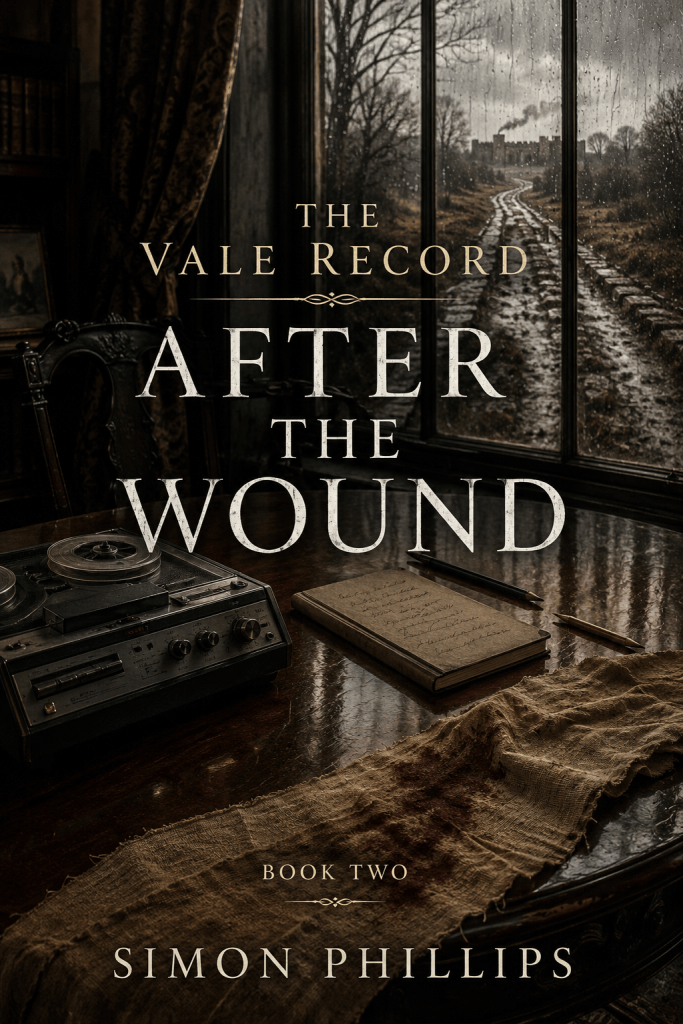
Free Story | Gothic Folk Horror | Monthly Free Stories
When six children return from the forbidden keep with the Walkman their father lost there as a boy, the adults know at once that something has followed them home.
Estimated reading time: 70–80 minutes.
Reading checkpoints:
The story begins below.
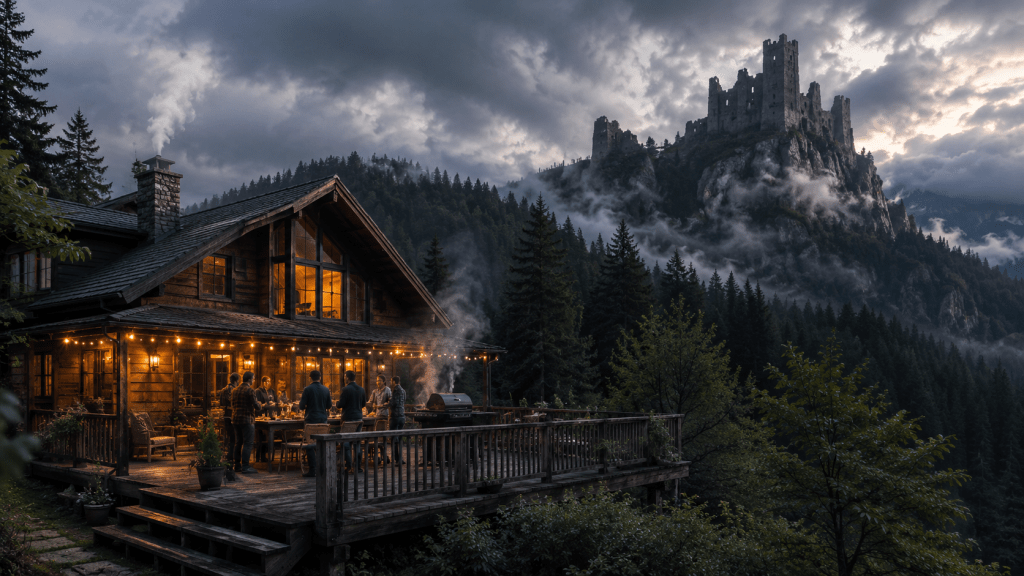
By late afternoon, the front terrace of Martin Kells’s house had become the sort of job that pulled old friends towards it, with tools spread across the boards, food waiting under foil, and everyone convinced the repair would have been finished hours earlier if sense had been allowed into the work.
The house stood above the lower lanes of the settlement, built from dark timber and pale stone against the forest’s shoulder. Its wide windows took the last mountain light, while the terrace reached out among the trees as if family life could be held there by screws, rail posts, barbecue smoke, and voices that had known each other since school.
Martin worked on one knee near the outer rail, driving a screw into a weathered plank while Raj Malik held the board steady with both hands. The plank gave a long, sour creak under the pressure, and Gareth Pike made a thoughtful sound from the steps, where he had settled himself with a beer and an expression of grave professional concern.
“That rail’s leaning because Martin measured it by eye and prayer.” Gareth lifted the bottle towards the corner post. “I said somebody’s auntie would go through there one day holding a paper plate and three sausages, and everyone would act surprised.”
Raj glanced up from the board, his face calm beneath the dust on his cheek. “You arrived two hours late with one screwdriver and a story about a bad knee, so your engineering evidence has been received.”
“My knee was terrible,” Gareth said, patting the wrong leg as Clare came past him with a tray wrapped in foil. “Serious, long-term, possibly village-record terrible.”
Clare Kells rested the tray on the table near the barbecue and gave him the narrow look that usually meant she had already decided how far he would be allowed to take something. “It was fine when you carried the beer from the boot. If you start limping when the washing-up appears, I’ll send Sam to fetch your conscience from the shed.”
Naomi Price laughed from the far end of the table, where she was sorting plates beside the bread. “Leave him there. He’s performing the rare and ancient craft of supervising. Men in this valley have passed it down for generations.”
The laughter moved easily over the terrace and out through the trees, where the slope fell towards the stream path and the lower houses of the settlement. Smoke from the barbecue drifted under the eaves, carrying fat and rosemary, and somewhere inside the house a radio murmured through the kitchen doorway beneath the bump of cupboard doors and the clink of glasses. The afternoon had the worn comfort of a gathering arranged around a task, the kind that let adults stand close, complain about screws, eat too much, and pretend the children had been sent out for fresh air instead of peace.
Martin’s son Elliot had taken the others down towards the stream after lunch, with the usual boundaries laid out and accepted in the loose, half-listening manner of children who meant to obey the shape of an instruction while testing its edges. Noah had gone with him, along with Sam, Maya, Lena, and Tom, all of them in old shoes and hoodies already stained from the paths. They had promised to stay below the old sheep gate, keep to the marked trails, and come back when the light dropped behind the far trees.
“They are late,” Clare said as she took a pair of tongs from beside the barbecue and turned the chicken with more force than the meat deserved.
Martin looked towards the gap in the trees where the path entered the woods, watching the lower branches shift in the mountain wind, silver underneath and green above, while the path itself remained empty. “A little.” He kept his voice easy as he reached for the last screw.
Clare glanced at him across the smoke. “Your son hears a time and treats it as a rough philosophical position.”
“He gets that from his mother,” Martin said, smiling when Clare pointed the tongs at him.
Raj sat back on his heels and wiped his hands on his jeans. “Noah will be watching the minutes. He has that worried face now, the one where he looks as if he personally owes the council an apology.”
Naomi’s smile softened, and her gaze moved over the trees as the wind opened a space above them. High beyond the forest, where the ridge rose in broken black shapes against the cloud, the old keep showed itself for a few seconds through the shifting grey. Its broken wall and tower pieces held there between mist and stone, small with distance and still close enough to pull the warmth from the terrace, while the radio murmured on in the kitchen and fat spat softly into the barbecue flame. The laughter thinned around those ordinary sounds until, for a moment, nobody seemed ready to begin it again.
Gareth lowered his beer from his mouth. “Weather’s coming down from the ridge.”
Nobody corrected him. Around here, rain was what people talked about when the keep showed itself. Martin drove the final screw too hard and felt the bit chew the head. He eased the pressure, drew a breath through the smell of timber dust and smoke, and kept his eyes on the work. There had always been rules around the ridge, spoken in the same practical voices adults used for thin ice, floodwater, loose scree, and dogs with bad tempers. Stay off the upper track, keep below the old sheep gate, leave the stones alone. The words survived through repetition, and each generation had its own private reason for remembering.
Clare watched him across the smoke until he had to look at her. “Martin,” she said, softer this time, “how late is a little?”
He checked his watch, then looked again towards the tree gap. The light had started to change, shifting from gold to something flatter, draining from the trunks first, then from the spaces between them, and still the path gave nothing back.
“They’ll be on their way up,” Martin said, placing the drill down beside him and standing with one hand pressed against the ache in his knee. “Elliot knows the line.”
Naomi folded the top plate between her hands, the plastic bending with a faint click. “Maya knows the line too. Knowing it and caring about it are separate talents.”
“They’ll be muddy, starving, and carrying some dead thing in a crisp packet,” Gareth said, coming off the steps and setting his bottle on the rail cap. “That was the whole point of being eleven.”
Raj’s gaze stayed on the trees, his earlier humour thinning a little at the edges. “The lower paths are easy enough to lose if they cut across behind Ward’s old place.”
“Then they’ll come out by the pump track,” Martin answered too quickly, and heard it himself.
For a moment the old friends stood among the smells of food and cut timber, listening past the ordinary noise of the settlement below, past the car door closing somewhere down the hill, the dog barking once, the child calling from one of the lanes. Above the house, cloud moved across the ridge, and the keep faded again until only a suggestion of stone remained behind the grey.
Clare set the tongs down, wiped her hands on a tea towel, and reached for the phone on the table. “I’m ringing Elliot.”
“He left it here.” Martin nodded towards the kitchen windowsill, where Elliot’s phone lay face-down beside a bowl of salad Clare had made him help carry out earlier. “He said it was nearly dead.”
Clare closed her eyes for a moment, then opened them with the patience of a woman who had survived eleven years of male logic in various sizes. “Of course he did.”
“I can walk down and give them a shout.” Gareth leaned his elbows on the rail and looked towards the tree gap.
Martin kept his eyes on the tools a moment longer, taking the hammer from beside the boards and sliding it into the toolbox with more care than the task needed before he answered. “Give them five minutes. They know better than to stay out once the light turns.”
Naomi looked from Martin to Raj, then towards the ridge where the keep had vanished again. “We all knew better at their age.”
Her words took the last of the ease from the terrace. The barbecue hissed on, smoke curling under the roof and drifting between them, turning each face pale for a moment before the wind cleared it. Martin felt the old rule shift inside him like a splinter under skin, quiet for years until the exact pressure found it.
A shout rose from the slope below the house, high and breathless, with another voice close behind it. Branches thrashed at the lower edge of the undergrowth, wet earth breaking loose as someone scrambled up from the woods where the path should have brought them out cleanly. Gareth straightened, his mouth already opening around the first shape of a complaint, while Clare moved to the edge of the terrace with the tea towel still in her hand. Beside Martin, Raj had gone quiet, and Naomi lowered the bent plate onto the table as every face turned towards the slope.
Martin stared into the darkening gap below the trees, listening to branches crack and wet earth tear loose, while the house behind him seemed to hold its warmth a little tighter against the forest. Elliot broke through first, his hoodie snagged with bracken and one knee dark with mud, his breath high in his chest as he dragged himself over the rise and glanced back with the fierce, guilty pride of a boy who had made himself leader for longer than wisdom allowed. Noah followed close behind him, pale under the dirt on his face, then Maya and Sam together, both talking too quickly over each other as if volume might carry them safely past the questions waiting above them. Tom came last with Lena Ward beside him, their hands scratched, their shoes caked to the laces, and their eyes moving everywhere except towards the adults.
Clare reached the top of the steps before any of them could scatter around the side of the house. “Stop there,” she said, holding the tea towel in one hand as though it had become part of her authority. “Every single one of you, stay exactly where you are.”
The children halted in an uneven line below the terrace, breathing hard and looking suddenly smaller against the bank. Elliot wiped his cheek with the heel of his hand and left a streak of mud across his skin. “We’re here,” he said, trying for irritation and landing nearer to relief. “We were coming back.”
Martin stepped down from the terrace, feeling the boards shift beneath his boots, and the old warmth of the afternoon seemed to drain behind him while he looked over his son’s clothes, the torn cuff, the burrs on the hoodie, the wet marks where the stream mud had dried in patches. “Where have you been?” he asked, keeping his voice lower than the question wanted to be.
“Down by the stream,” Sam answered too fast, carrying Gareth’s broadness in his shoulders and a child’s poor understanding of when confidence had become confession. “Then we went round by the old wall, near Ward’s sheep field, then Maya said there was a faster way back.”
“I said there was a path.” Maya turned on him, her ponytail stuck to her neck, shooting a glance towards Naomi before fixing her eyes on Sam again. “I never said it was faster.”
“Maya Price.” Naomi came to the rail, one hand closing around the timber until her knuckles paled. “Where exactly was this path?”
Maya lifted her chin. “Past the stream.”
“Past the stream where?” Clare stepped down beside Martin, close enough for her shoulder to brush his arm.
Elliot looked from his mother to Martin, then beyond them to Raj and Gareth on the terrace. “We stayed below the gate,” he said, though the pause before the final word made it weaker than he meant. “Mostly.”
“Mostly is where trouble lives.” Raj moved down one step, his gaze settling on Noah’s face. “Look at me, Noah. How far?”
Noah swallowed and glanced at Elliot before the words came. “We only wanted to see the old track. Everyone talks about it like there are guards up there or something.”
“Nobody talks about guards.” Gareth’s humour surfaced for half a breath, then faded as he looked from one child to the next. “We talk about sense, which is the boring cousin of guards.”
Sam shifted his weight, mud cracking at the edge of his trainer. “We never went up all the way,” he said, and the way his eyes skipped across the adults made every word feel handled and chosen.
Behind Martin, the barbecue spat beneath the terrace roof while the radio in the kitchen broke into a burst of static, and somewhere near the table a loose screw rolled against the boards after somebody caught the toolbox with an elbow. His gaze had already moved beyond the children’s faces, catching on their hands, their pockets, and the shape of something half-hidden beneath Elliot’s hoodie where he held it close to his ribs.
“What have you got?” Martin moved towards his son as he spoke.
Elliot drew his arm tighter across the shape beneath his hoodie, and Clare’s hand found Martin’s sleeve. “Elliot,” she said, quieter than before, “show us.”
“It’s just old junk,” Elliot said, with the defensive pride he always carried home after finding something nobody else had noticed. “We found it. That’s all.”
Elliot pulled the thing from beneath his hoodie and held it by its cracked belt clip, letting it swing from one muddy finger. Lena drew in a small breath, and Tom dropped his eyes as the terrace went still behind Martin.
It was a cassette Walkman, its grey plastic dulled by grime and one side scuffed nearly white beneath a clouded window, with orange foam hanging from one earphone and a loose length of tape clinging to Elliot’s sleeve like weed dragged from a ditch. Beneath the dirt beside the battery cover, Martin saw his own name scratched into the plastic in the crooked letters he had made with a compass point during a wet school lunch, while the chipped blue sticker beside the play button still curled at one corner. His younger hand came back to him then, pushing the earphones into his pocket while Gareth whispered something filthy and frightened in the dark, and the smell of old stone, damp wool and rot trapped beneath cold air seemed to fill his mouth as he took the Walkman from Elliot so sharply that his son flinched. The cracked plastic struck Martin’s palm, light and filthy and impossible, while the loose tape stuck briefly to his thumb before sliding free.
“Dad,” Elliot said, hurt sharpening his voice. “Careful.”
Martin closed his fist around the Walkman until the casing pressed into his skin. “Where did you find this?”
Elliot stared at him, his anger collapsing under the look on Martin’s face. “In some stones.”
“What stones?” Martin asked.
Clare’s fingers tightened on his sleeve. “Martin.”
Her warning stayed in the air with the children’s breathing and Raj’s steps on the terrace behind him, while Martin kept his eyes on Elliot. “Tell me where.”
“We found it lying there. It was already broken,” Maya cut in before Elliot could answer, one hand tightening around the sleeve at her wrist.
Naomi turned towards her daughter. “Maya. He asked where.”
“Near the top track.” Maya looked down at the mud around her shoes. “By the rocks past the gate.”
“Past the gate.” Gareth’s hand closed around the rail.
Sam looked up at his father, confusion pulling at his face. “We came back, didn’t we? Everyone’s acting like we broke something.”
“Inside or outside?” Raj’s hand settled on Noah’s shoulder, and the boy leaned into it for a second before catching himself and straightening.
“Outside,” he said, though his eyes had begun to shine.
“Noah.” Elliot turned sharply towards him, yet Clare was already stepping away from Martin with the tea towel hanging forgotten at her side. “Inside where?”
The children remained where they were, saying nothing as the forest shifted behind them beneath the first push of evening wind. Branches lifted and settled, while a light came on in one of the lower houses down the slope and cloud drew across the ridge above the trees.
Martin looked from Elliot to Maya, then to Lena, who had folded both arms around herself and tucked her scratched hands under her elbows. “Lena,” he said, trying to soften his voice and hearing how little softness remained in it, “did you go inside?”
Lena looked towards Clare, her mouth trembling as though mothers, even other people’s mothers, were safer. “We only went in a bit,” she whispered.
Gareth made a sound like a laugh cut apart in his throat. “A bit,” he said, staring down at the boards beneath his boots. “Christ.”
Clare faced Gareth, the tea towel still hanging from one hand. “Gareth, what is going on?”
Gareth lifted both hands, palms open, his face stripped of its earlier colour. “I’m saying nothing in front of them.”
“You are saying enough,” Clare said, and Martin saw anger begin to rise through her fear. “All of you are.”
Naomi came down the steps, leaving the plates behind on the table. “Maya, take Lena inside,” she said. “All of you. Shoes off in the porch first.”
Martin shook his head, the Walkman held tight in his hand. “Wait. They stay here.”
The children went still around Elliot. His eyes stayed on the object before lifting to Martin, carrying a hurt that reached him even through the fear. “It’s yours, isn’t it?” he said. “That’s why you’re being weird.”
Clare’s gaze held on Martin while Raj turned away and Naomi closed her eyes for a moment. The answer sat old and bitter in his mouth. He had spent years living around it, raising a son in the same settlement, repeating the same warnings in practical voices, trusting distance to do the work truth had never done. The Walkman lay in his hand like a piece of time pulled wet from the dark.
“Yes,” Martin said.
Elliot’s face brightened with the thrill of being right, then the certainty drained from it as he realised that being right offered no safety. “How could it be yours?”
Martin slid the Walkman into the pocket of his work jacket and felt its hard corner against his hip. “Inside,” he said, forcing his voice to behave. “All of you. Now.”
Sam opened his mouth as though protest might still work, then caught Gareth’s eye and thought better of it. Maya touched Lena’s elbow, gentler than her expression suggested, while Tom started around the bank towards the porch with his head lowered. Noah followed after one last glance at Raj, and Sam came behind him slowly, leaving dark prints from his muddy shoes across the stone.
Only Elliot remained below the terrace, and Clare crossed to him with one hand settling behind his neck. “Move,” she said, guiding him towards the house with firmness that stopped short of force. “We’ll talk inside.”
Elliot allowed himself to be turned, though he looked back at his father over his shoulder. “We never broke anything,” he said. “We only looked.”
Martin felt the questions gather inside him, all of them circling what the children might have seen or heard inside the keep, how far the inner passage had carried them, whether the wet rot beneath the stones had reached them, and whether they had felt the air moving through rooms where every doorway stood dead still. Looking was how it began, and he kept that much behind his teeth.
Instead he watched the children file into the porch, one by one, carrying mud, bracken and scratched hands into the house, their earlier bravado gone quiet beneath a fear they had begun to understand. The kitchen door swallowed their voices as Clare lingered at the threshold, her eyes fixed on Martin with a question he had avoided for half their marriage, before she followed them inside to keep the children together.
The terrace held the adults in a silence that felt older than the evening. Raj stood with one hand still raised from where Noah’s shoulder had been. Naomi stared at the porch door, breathing through her nose, anger and fear working against each other across her face. Gareth looked towards the ridge, then away again so quickly that Martin knew he had seen the same dark tower in his mind.
Martin took the Walkman from his pocket and laid it on the terrace table among the plates, tools, salad bowls, beer bottles and foil-covered food, where its old plastic looked smaller than it had in Elliot’s hand and the loose tape stirred faintly in the wind.
Raj stared at the scratched name near the battery cover. “I thought you dropped it in the lower ruins,” he said, his voice almost gone.
Martin’s eyes lifted to Raj, whose face tightened around the words as though he had only just heard them. Naomi crossed the terrace and stood over the Walkman with both hands pressed against the table edge. “You said that all this time,” she told Martin, keeping her voice low for the children inside. “You said it fell near the sheep wall.”
Gareth swallowed and rubbed both hands down his face. “We all said plenty of things.”
Martin looked towards the kitchen, where Elliot’s voice rose in protest and Clare answered him with strained patience. Even after setting the Walkman down, he could still feel its shape in his palm.
“They went inside the keep,” Naomi said.
Raj shook his head, slow and useless. “Maybe only the outer room.”
Gareth gave him a bleak look. “You hear yourself?”
Martin took the Walkman up again, the cracked plastic cold in his hand, and for a moment he heard his younger self breathing hard among the stone passages of the keep. “It came down with them.”
Gareth looked from the Walkman to Martin, while Raj held his place beside the table and Naomi remained braced against its edge.
Clare appeared in the doorway behind them, one hand on the frame as the children’s voices carried from the kitchen. “What did they bring back?” Her eyes moved from the adults to the cassette player. “And what has happened to all of you?”
Martin looked down at the Walkman, its loose tape lying across the table, and remembered leaving it beneath fallen stone and wet dust before spending years building his life around the belief that it would stay there.
“Get the children into the sitting room,” he told Clare. “Keep them there for a minute.”
Clare’s face sharpened. “Martin, you are frightening them.”
“I know,” he said, turning towards her. “Please.”
For a moment she stayed where she was, anger held close to the surface of her expression. Then she looked past him at Raj, at Gareth, and Naomi, and something in their silence gave her enough to understand that the argument could wait.
“Towels by the radiator, then all of you into the sitting room,” Clare called over her shoulder. “Elliot, take the others through. Nobody goes upstairs. Nobody goes near the back door.”
Elliot’s voice rose from the kitchen. “Why?”
“Because I asked you to,” Clare answered, shutting the question down with a steadiness that left no room around it.
Inside the house, the children moved away from the kitchen, their voices carrying for a moment as Martin caught Sam speaking and Tom murmuring something too low to make out. The sitting-room door closed deeper in the house with a soft finality, and Clare came back onto the terrace, easing the kitchen door almost shut behind her.
“Talk,” she said, folding the tea towel between both hands. “Someone had better talk.”
Naomi lifted her eyes towards Martin. “You should have told her years ago.”
Martin gave a small shake of his head. “Told her what?”
“The truth,” Naomi said, moving closer to the table. “Or as much of it as any of us had.”
Gareth dragged a hand across the back of his neck and looked out towards the tree line. “We were children,” he said. “We saw something in a ruin, ran home half sick with fright, then spent a week waiting for our parents to find out where we had been. Nobody sat down and made a responsible adult plan.”
Naomi’s mouth tightened. “We were old enough to know where we had gone, and old enough to know why we lied.”
Raj’s gaze stayed fixed on the Walkman. “We were old enough to know that every grown-up in the village told us to stay away,” he said, his voice worn at the edges. “That made it harder to say we had ignored them.”
Clare looked from one face to another, and Martin saw the shape of their history beginning to form in her mind. “You went up there,” she said. “All of you.”
Martin kept both hands on the table, rough wood beneath his palms, and said, “Once.”
“When?” Clare asked, holding his eyes.
“Summer after we finished school,” Martin said. “We were thirteen. Maybe fourteen.”
Gareth gave a short breath through his nose. “Fourteen for me. You lot were still children.”
“You were born in February,” Naomi said, and the old irritation in her voice had no energy behind it now. “That never made you older.”
For a second, the terrace held the faint ghost of the laughter they had shared earlier, and Martin felt the loss of it more sharply than he expected. Then Clare looked at the Walkman again.
Clare’s eyes moved from Martin to Naomi. “You took that with you?”
Martin nodded, his thumb resting against the cracked edge of the Walkman without looking up.
“Why?” Clare asked.
“Music,” he said, though the answer sounded useless in the open air. “I had a tape in it. Something I had recorded from the radio. I thought it would make the climb less boring.”
Clare’s eyes narrowed. “You went to a forbidden keep with a cassette player because you thought the walk would be boring?”
Gareth shifted his bottle away from the table. “That was Martin. He had a soundtrack for everything.”
Martin looked at him, and Gareth’s attempt at a smile faded before it settled.
“We had been daring each other for weeks,” Raj said, taking over gently. “The summer holidays had started. Every older kid had a story about getting near the place. We thought we could walk up there, look around, come back before dark, and tell everyone we had done it.”
“Did you go inside?” Clare asked.
Martin watched smoke lift from the barbecue in long blue threads while the wind moved through the branches behind the house, bringing the smell of wet earth up from the lower slope. Damp stone pressed against his hand, and sweat stung beneath his shirt as Gareth whispered too loudly near his ear. At the foot of a stair, Naomi’s fingers closed hard around his sleeve.
“We went through the first doorway, into an outer hall and then a passage beyond it,” Martin said. “It smelled wrong in there, like old water, like something had died and stayed trapped under the floor.”
“There were marks on the walls.” Naomi’s face had lost its colour. “Long ones, far too high for children even then.”
“Do you remember the room with the broken table?” Raj lifted his head sharply.
“I remember enough.” Naomi’s voice quietened as soon as the words left her.
The broken table came back to Martin with its far end disappearing into shadow beneath a fallen section of roof, damp blackening the stones around it. Through one earphone, his Walkman had played softly, the tape warbling as the battery weakened, a thin cheerful sound swallowed by the dark around them.
“There was movement,” Gareth said, staring at his hands. “At the edge of the rooms.”
Clare looked at him. “What kind of movement?”
Gareth swallowed. “The kind that made us run.”
“That tells me very little,” Clare said, holding the tea towel tighter between her hands.
“It tells you all I had then,” Gareth replied, pressing his palms together. “Something crossed the hall behind us. I heard claws on stone. I looked back, and there was a shape where there should have been empty dark. I ran. We all ran.”
Martin closed his eyes as the old rush came back, feet striking stone beneath him while Naomi shouted ahead and Raj hit a wall hard enough to lose his footing. The earphones tore free from Martin’s neck as something scraped through the darkness behind them, and he dropped the Walkman near the narrow stair with no thought left for anything except getting out.
“When I reached the door, I realised it was gone. I turned back once. Just once.”
Clare moved closer, her voice quieter now. “Martin, what did you see?”
He could not quite meet her eyes. “Something low at the end of the passage. It had its hands on the floor, with arms too long for its body. Its face stayed hidden, though I remember its eyes catching the light from outside before Gareth caught my jacket and dragged me down the hill.”
Gareth’s voice came out hoarse. “I thought you were going back for it.”
“I was,” Martin said.
Raj looked at him. “For the Walkman?”
“For you,” Martin said.
Gareth lowered his eyes as Clare came closer, stopping within reach of Martin with a small crease between her eyebrows.
“You saw that,” she said. “You saw something in the keep and spent almost thirty years pretending the story ended with a broken cassette player near a field.”
Martin looked down at the object. “We told ourselves we had been scared of a fox. Or a feral dog. Anything with claws.”
“And you believed it?” Clare asked.
Martin drew breath, though Naomi was already looking towards the kitchen door. “The children said they only went into the outer rooms. Lena said there was something behind them. Elliot had that thing in his hands, and Martin’s name is still scratched into it. How much belief do you need now?”
Raj moved beside Naomi, his face damp with the cold coming through the trees. “We have no proof that whatever we saw followed them,” he said. “We have fear, memory, and a piece of plastic that should have stayed up there.”
“Exactly,” Naomi said. “It should have stayed up there.”
Martin turned the Walkman over in his hand, the loose battery cover lifting at one corner beside the M.K. he had carved into the grey plastic with a compass point, the letters still jagged beneath the dirt. Its weight brought back the run down the mountain, and then the sudden lightness when the cord caught and tore free.
Clare stepped closer. “What are you thinking?”
Martin looked towards the woods, where the dark had gathered beyond the terrace and the ridge lay somewhere above the cloud.
“I’m going to break it,” he said.
Raj gave a humourless blink. “Martin.”
“I mean it,” Martin said, reaching for the hammer inside the toolbox. “I’ll smash it, pull the tape out, scatter every piece. It has sat up there all this time. It has no place in this house.”
Naomi stared at him. “You think it is holding a door open?”
“I think I have no idea what it is doing,” Martin said. “I think the children carried it down from a place we were warned away from, and I think I have spent most of my life waiting for something to prove we were foolish enough to be frightened. It is here now.”
“Then we call somebody,” Clare said, a hard edge entering her voice. “The police. Mountain rescue. The parish council. Anyone.”
“And tell them what?” Gareth asked, lifting one shoulder with helpless anger. “Six children found a cassette player at a ruin, and five adults have decided an old story climbed down after them?”
Clare looked at him. “How it sounds is irrelevant.”
Martin’s chest tightened at the thought of Elliot sitting in the room beyond the kitchen, muddy and embarrassed, still thinking he had found a prize. “Keep the children together,” he said. “Keep the doors shut. Stay inside. I’ll go to the tree line and deal with this.”
Clare caught his wrist before he could take the hammer from the box. “You are walking into the woods because you are afraid,” she said.
“Yes,” Martin told her, meeting her eyes. “I am.”
For a moment, Clare could only look at him, and Martin understood that he had never allowed fear to stand openly between them. It had entered their marriage through quieter things instead, through the upper paths he checked after storms, the evenings he refused to let Elliot stay out after dark, and every practical warning he had offered where a story should have been.
Raj stepped forward. “I’ll come with you,” he said.
“Stay here,” Martin said, looking towards the kitchen door. “Noah needs you. Everyone needs people in this house.”
Naomi reached for a torch from the tool shelf beside the back door. “Take this,” she said, pushing it towards him. “And leave the phone on.”
Martin accepted the torch. “You stay with Maya.”
“Maya needs me alive,” Naomi replied, testing the beam with a hard click. “She also needs me to stop pretending silence is protection.”
Clare let go of Martin’s wrist, took the hammer from the toolbox, and placed it into his palm with her fingers closing around his for a moment, firm and warm.
“You keep your head,” Clare said, holding his gaze. “You break the thing, then you come back. You hear me?”
Martin closed his hand around the hammer. “I hear you.” He tucked the Walkman inside his jacket, its cold, hard shape settling against his side as he turned towards the steps, with the forest waiting beyond the terrace in the darkening air and the people he had known since childhood gathered around the house as though its walls might still be enough.
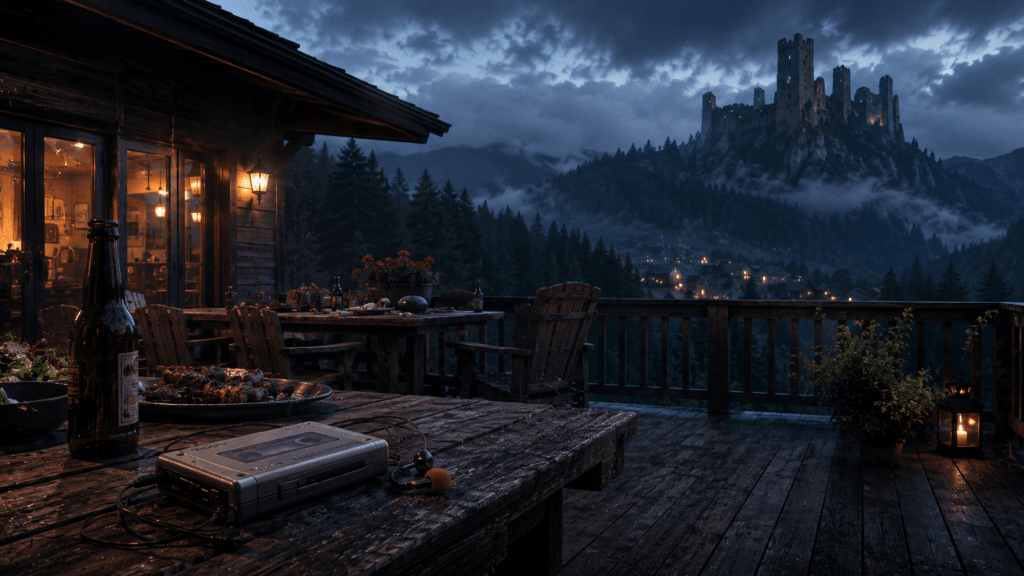
The torch felt cold in one hand and the hammer heavier than it should have in the other as he took the steps down towards the garden. Behind him, the house shone through its windows, holding supper, children’s voices from deeper inside, and the old friends who had spent the afternoon arguing over timber and sausages as though those things still belonged to the same evening.
Clare remained beneath the porch light until the branches began to close around him. One hand was raised against the chill gathering over the valley, her face pale beside the warm square of the kitchen window.
“Straight back, Martin,” she called, keeping her voice level for the children inside.
He turned and lifted the hammer a little before the gesture embarrassed him. “I will.”
When he faced the garden again, the torch beam crossed wet grass at his feet, and he walked on towards the trees. Beyond the lawn, the ground loosened where the children had torn their way up from the slope, then drew him into the closer press of trunks and low branches, where the remaining light thinned into blue-grey murk. For several yards, the terrace lamps remained visible through the trees, their glow catching on wet boards and low leaves before the wood took it from him.
He knew this stretch better than any path above the village. Elliot had learned the way down to the stream at his side in summer, and Martin had carried fallen branches back through the trees for the fire, checked the lower fence after storms, and used the track in snow when the road around the hill became too steep for the car. With the house shrinking behind him, none of that familiarity offered comfort. Roots rose harder beneath the wet leaves, the old drainage ditch looked darker where it crossed the path, and every bend between the trunks held enough shadow to make him look twice.
At the fallen beech, whose trunk had split years earlier and left a pale hollow inside the dark wood, Martin stopped far enough from the house that the children would not hear the hammer, though the kitchen window still showed faintly through the branches behind him. He set Naomi’s torch on a low stump, drew the Walkman from his jacket, and rubbed his thumb across the dirt beside the battery cover until the old scratches beneath it caught the light.
He placed it on the stump and raised the hammer. For a moment he heard the keep again, Gareth shouting somewhere ahead of him, Raj slipping against the stone, the earphones tearing free as something scraped through the darkness behind them. His arm stayed lifted while the branches moved overhead and the wind carried their rough sound through the wood, until a wet leaf struck the ground beside his boot and he lowered the hammer without having touched the Walkman.
“You should have stayed there,” he said, wiping his free hand across his mouth.
His voice barely travelled beyond the stump, and when he looked back, the kitchen window still showed as a narrow gold line through the trees. Elliot had held the player by its broken belt clip with the pride of a boy who expected his father to smile at the find, and Martin could still see the hurt settling across his face when it had been taken from him. He knew that look too well. Nearly thirty years earlier, he had stood below the keep with Gareth beside him, both of them burning from the run and too ashamed to meet the others’ eyes, while the Walkman lay somewhere above them among the stone.
He turned back to the stump and brought the hammer down. The first blow split the casing near the battery cover, sending a grey shard into the leaves, and when he struck again the cloudy window gave beneath the hammer head, scattering dull flakes across the wet wood as the cassette shifted inside its ruined shell and loose tape spilled from the opening in a black tangle.
For a moment he stood over it with the hammer still in his hand, waiting for the sound of breaking plastic to die. He had expected the act to settle something in him, yet the crack seemed to linger too clearly through the wood, followed by a faint scrape somewhere uphill.
Martin lifted the torch towards the slope, its beam catching wet bark, fern heads and a low branch slick with rain before darkness closed around it again. Bark rubbing against bark, he told himself, or a branch dragged across stone by the wind, though each explanation weakened before he had properly formed it. When the sound came again, lighter this time and farther away, he bent over the stump and pulled the cassette free.
Its label had long since peeled away, leaving a pale rectangle beneath the clear plastic, and as Martin worked the cassette loose he remembered the song he had caught badly from the radio, its opening half-covered by the presenter’s voice and Gareth laughing somewhere behind him while he held the microphone too close to the speaker. Then a length of black tape slid across his fingers, and the memory gave way to cold stone beside the narrow stair, pale daylight beyond the doorway, and something striking the floor behind him.
He tore the tape hard enough to cut the side of his thumb, and blood gathered beside the nail as he wiped it on his jeans, set the cassette back on the stump, and brought the hammer down until the spool split beneath it. He kept going with the same steady force, breaking the ruined player apart until the casing opened among the leaves and its small metal pieces showed through the wet plastic.
When the last blow fell, Martin remained bent over the stump with the hammer hanging from his hand, listening beyond the rain beginning to tick through the higher branches for the scrape to return from somewhere uphill. It did not. Only the wet movement of the trees reached him, and that silence unsettled him more than any clear sound might have done.
Martin crouched beside the fallen beech and gathered what remained before rain or leaf mould could take it from sight, pushing the cracked buttons, loose tape and larger fragments beneath the exposed roots before pressing wet earth over them with the heel of his boot. The hammer head sank once into the soft ground beside the hollow, leaving a dark dent that slowly filled with rainwater, while the battery cover remained in his pocket.
A colder breath crossed the back of his neck as he straightened and looked uphill towards the black slope of trees. Cloud lay low enough to hide the keep, though he could still feel where it stood beyond the branches, above the old sheep gate and the paths he had spent years teaching Elliot to avoid. Naomi’s insistence that the children had gone inside returned with Lena’s trembling mouth and Elliot looking over his shoulder as Clare led them into the house, still trying to explain that they had only looked.
His hand went to the pocket holding the battery cover. If something had come down with the children because of what they carried, then he had walked away from the house with the last piece of it still on him. He pulled it free before throwing it hard into the trees. It struck something unseen and vanished among the branches as rain gathered in the leaves above him and began to fall more heavily through the wood, leaving Martin to listen for a moment before he turned back towards home.
The terrace lights came into view between the trunks, while the windows still shone warmly against the slope, smoke lifting from the cold barbecue beneath the eaves and figures moving behind the glass as though supper might yet go on in some damaged version of the evening, until a shape crossed the upstairs window and stopped him where he stood. For a second he took it for Elliot’s narrow frame, before Clare’s order came back to him that all six children were in the sitting room and nobody was upstairs.
Their voices reached him before he reached the terrace, carrying from the sitting room through the house in uneven bursts beneath Clare’s attempts to keep them gentle. Rain darkened the shoulders of his jacket as he climbed the steps with the hammer hanging loose at his side, then paused beneath the eaves and looked through the front window.
All six children were gathered in the sitting room. Elliot sat on the hearthrug with his knees drawn up beneath him, still wearing the red hoodie and staring into the fire as though he could force it to answer him, while Noah had taken the far end of the sofa beside Raj, who sat forward with his hands clasped between his knees. Sam stood near the armchair in wet socks, glancing towards the hallway whenever one of the others spoke, and Maya had wrapped herself in an old blanket from the cupboard under the stairs, her gaze sharp above its edge as Lena sat close beside her and Tom remained on the floor near their feet. Clare moved among them with mugs of tea and squash, stepping around the low table where the untouched plates from the terrace had been set down in a hurry.
The upstairs window was empty now, though Martin carried the glimpse of that shape with him as he opened the kitchen door.
Clare turned at the sound of the latch and looked at him across the kitchen. “You’re soaked.” Her gaze moved over his empty hands, then past him towards the trees. “Is it done?”
“Yeah,” Martin said, closing the door and pressing it until the latch caught. “I broke it up and buried what I could.”
Gareth stood beside the island, rubbing the same clean patch of worktop with a tea towel. “You buried it?” His eyes settled on the mud along Martin’s boots. “You could have taken it down to the river.”
“I wanted it away from the house,” Martin said, setting the hammer on the counter beside the sink. “The river runs past half the valley.”
Naomi came through from the sitting room with her arms folded tightly across her chest. “Did you see anything?” she asked, keeping her voice low as she looked from Martin’s face to the rain gathering on the windows.
Martin took the torch from his jacket pocket and set it beside the hammer. “I heard branches. On the way back, I saw something cross the upstairs window.”
Clare’s hand went still on the counter. “What do you mean, something?”
“Someone,” Martin said, meeting her eyes. “For a second I thought it was Elliot.”
Clare’s face changed before Martin had finished speaking. She looked towards the sitting room, already moving, one hand brushing the counter as she pushed past Raj. “Elliot?”
“I’m here,” Elliot called back, irritated and frightened from beyond the doorway.
Clare reached the sitting-room threshold and looked in hard enough to count them, her lips moving silently as her eyes passed from Elliot on the hearthrug to Noah at the end of the sofa, Sam by the armchair, Maya under the blanket, Lena beside her, and Tom on the floor near their feet, before she turned back into the kitchen with her gaze already lifting towards the ceiling. “Every child has been in that room since I brought them through,” she said, her voice steady enough to show the strain beneath it. “So what did you see upstairs?”
Gareth lowered the tea towel from the worktop and looked towards the hall, where the staircase climbed beside the narrow framed print of the valley in winter.
“Did you hear anything up there?” Naomi asked.
“No,” Clare said. “Nothing.”
“Then we check,” Gareth said, though he made no move towards the stairs.
Raj came through from the sitting room behind Clare, one glance still held on Noah before his eyes moved to the hammer on the counter and then to Martin’s face. “We shouldn’t all rush upstairs because you saw something through wet glass,” he said, lifting one hand towards the light above the island as though the explanation needed something solid to rest on. “It could have been a reflection. A shadow from the terrace, maybe.”
Martin looked past him towards the hall and the dark line of the stairwell. “It could have been,” he said, though the words offered little comfort.
Clare pushed a mug towards him. “Drink that before you start seeing something in every shadow.”
Martin took the mug, grateful for the heat against his palms. “I am trying to convince myself it was a reflection.”
“You can try harder after you get out of those clothes,” Clare said, her voice steady enough to sound ordinary. “The spare jumper is in the utility room.”
He looked towards the sitting room door, where Elliot’s red sleeve showed near the hearth. “I want to talk to him first.”
“Give them five minutes,” Clare said, lowering her voice. “They have spent the last half hour trying to understand why their parents turned into strangers on a terrace.”
Martin looked through the sitting-room doorway again and saw what she meant. Maya had bent close to Lena beneath the old blanket, speaking so quietly that the words barely reached the hall, while Tom sat on the floor worrying at the cuff of his muddy sleeve and Sam stood near the armchair with his attention fixed on the voices from the kitchen.
“We need to keep them together,” Martin said.
Naomi leaned against the counter, her eyes dark with exhaustion. “They are together.”
“Keep them where we can see them,” Martin said. “No one goes upstairs. Nobody uses the back door. The front door stays locked.”
Gareth gave a thin smile that failed to reach his face. “You missed your calling. You should have run the youth club.”
Martin looked at him without answering, and the small defence in Gareth’s face gave way.
“I’m sorry,” Gareth said, setting the tea towel down. “I know what this sounds like. I know I sound like I’m trying to make it smaller.”
“You are,” Naomi said, her fingers tightening around her own mug. “You always do that when you are frightened.”
Gareth looked away from her and towards the sitting room, where Sam stood near the armchair with his attention still fixed on the kitchen. “I am frightened,” he said, and the admission stripped the last of the joke from his face, leaving only the rain against the glass, the fire’s distant crackle, and the muffled movement of six children beginning to understand that the adults were keeping something from them.
Martin moved through the kitchen into the hall, carrying the mug with him. The house had always been built around the front room, with the sitting room opening off the entrance hall and the dining space running behind it towards the kitchen. A narrow corridor led past the downstairs bathroom and utility room to the back door, while the stairs rose above the coat hooks into the bedrooms and small study that Martin had never quite finished clearing of boxes. Every route felt visible at once now. The front door, the back door, the stairwell, the small passage beside the pantry; each one became a place a body could be forced through or trapped inside.
He checked the front lock first, lifting the chain into place and sliding the deadbolt across. Then he crossed to the utility room, where wet coats hung above the washing machine and a stack of split logs waited beside the back door. The room smelled of detergent, damp wool, and cold stone from the floor beneath his feet. He tested the handle once, then twice, and set the old wooden doorstop against it as if that small act could give the house a little more weight.
Coming back through the hall, Martin found the children quieter around the fire. Elliot looked up from the hearthrug before Martin had settled on the edge of the armchair. “Where did you put it?”
“The Walkman?” Martin asked, though he already knew.
Elliot’s mouth tightened. “Yes.”
Martin lowered himself into the chair, the heat from the fire warming his knees. “I broke it.”
Elliot’s eyes widened. “Why?”
“It belonged in the place where you found it,” Martin said, keeping his hands together around the mug. “You should never have brought it home.”
“We had no idea it was yours,” Elliot said, anger pushing through his fear again. “You never told me you went there.”
Martin looked at the boy’s muddy trousers, the scratched line across one knuckle, the small dark crescent of dirt behind his ear. “I should have,” he said.
Maya watched him from under the blanket. “What was in there?” she asked, her voice quieter than Elliot’s. “Why does everyone keep acting as though we did something worse than climbing through a broken wall?”
Naomi moved behind the sofa and rested one hand on Maya’s shoulder. “You went somewhere you had been told to avoid,” she said. “That part matters.”
“We know that now.” Maya looked up at her mother, anger and embarrassment caught together in her face. “You all made sure of it.”
Beside her, Lena pressed closer to the sofa cushion as Tom lifted his head. “There was a noise,” he said, his voice small beneath the fire’s crackle. “After we found the thing.”
Martin’s hand tightened around the mug, and Naomi’s fingers pressed slightly into Maya’s shoulder.
“It sounded like someone was walking behind us,” Tom said, rubbing his sleeve between his fingers. “Up high, on the stones.”
Sam shook his head quickly. “That was the rain starting.”
“It had not started then,” Lena said into the blanket.
Elliot’s hand moved towards the poker beside the hearth, then stopped when Martin looked at him. “I heard it too,” he said. “At first I thought it was an animal.” His eyes shifted towards the fire. “Then it stopped when we stopped.”
Clare came in from the kitchen carrying a plate of food, though she left it untouched on the side table when she saw their faces. “You should never have gone up there,” she said, looking from Elliot to the others. “The place was forbidden for a reason, even if none of us told you enough.”
Elliot lowered his eyes, and Clare’s voice softened as she knelt beside him and placed one hand on his shoulder. “But you are inside now. All of you. Everyone is together.”
A soft knock reached them from somewhere beyond the front of the house before anyone could answer, and the children looked towards the hall as Gareth rose with one hand already moving towards Sam. The sound came again through the rain, faint but clear, then a third time from the far side of the terrace, slow enough to feel deliberate.
“It’ll be the trees knocking against the roof,” Gareth said, drawing Sam close by the shoulder and trying for a smile that came out wrong. “Or one of Martin’s terrible rail posts finally giving up. Stay here, all right?”
Martin set his mug down and took the hammer from the hall table, looking past the rain running in thin lines down the glass beside the front door to the empty terrace beyond, where the food cooled beneath the lamps and the chairs stood at odd angles around the barbecue as the knock came once more from somewhere beyond the light.
The sound faded into the rain, leaving the house full of listening faces and the strained hush that came when everyone waited for an ordinary answer to arrive. Martin held his place by the door, the hammer low at his side, while the terrace lamps threw their warm pools across the wet boards and the dark line of trees pressed close beyond them.
Clare moved from the sitting-room doorway, one hand lifted towards the children behind her. “Martin,” she said, watching him look through the glass, “is it the trees?”
“I can’t see anyone.” He shifted closer to the door and turned his head, trying to see past the reflection of the hall light. “Terrace is empty.”
Clare’s voice tightened. “Then what’s knocking?”
Martin’s grip closed harder around the hammer. “Stay back from the windows.”
Gareth edged into the hall, then stopped when Sam came with him. “No,” he murmured, turning the boy gently back towards the sitting room. “You can mock me when we’re safe and I’ve recovered my dignity.”
Sam tried to smile because his father had offered him the shape of one. “Dad.”
“I know,” Gareth said, keeping his hand on Sam’s shoulder. “Back inside.”
Raj came in from the kitchen side, carrying the heavy iron poker from beside the old stove in both hands. His eyes went first to Martin, then to the stairs. “I checked the back,” he said. “Door’s held. Utility window’s latched.”
Naomi’s voice cut through the children’s whispers from inside the sitting room. “Maya, get away from that curtain. Sit down beside Lena.”
Another knock sounded, though this time it came from deeper inside the house, somewhere in the wall between the sitting room and the dining space.
“What’s knocking?” Tom asked.
The question hung there long enough for the sound to come again, soft and patient against the timber panelling. Elliot started to rise from the hearthrug, and Clare caught the movement before pointing him back down. “Elliot,” she said, each word controlled, “you sit.”
“Is it in the kitchen?” Maya asked from beneath the blanket, her voice low, curiosity thinning into fear.
Raj’s eyes moved towards the dining room, where the warm light thinned at the edge of the kitchen doorway. He took one careful step forward, lifting the poker. “Martin.”
Martin crossed the hall with Raj, every board beneath his feet creaking too loudly. Behind them, Noah whispered something to Elliot, and Lena asked Maya if someone was outside, while the dining space beyond the sitting room opened towards the kitchen in one long, warm stretch of lamplight, the table pushed askew from the hurried meal and chairs standing unevenly around it. The kitchen door to the terrace remained closed. The back passage beyond the pantry lay dark at the edge of the room, where the utility door and the small downstairs bathroom waited in shadow, and then something tapped the dining table once, gently enough to make the fork nearest the edge roll from a plate and strike the floor.
Clare gathered the children behind her as Martin stepped into the sitting room, his shoulder brushing the doorframe. “Everyone stay by the fire,” she said, spreading one arm across Elliot and Noah as if her body could widen enough to cover them all. “Gareth, keep Sam with you.”
Gareth moved in front of his son and reached for the nearest chair. “I’ve got him.”
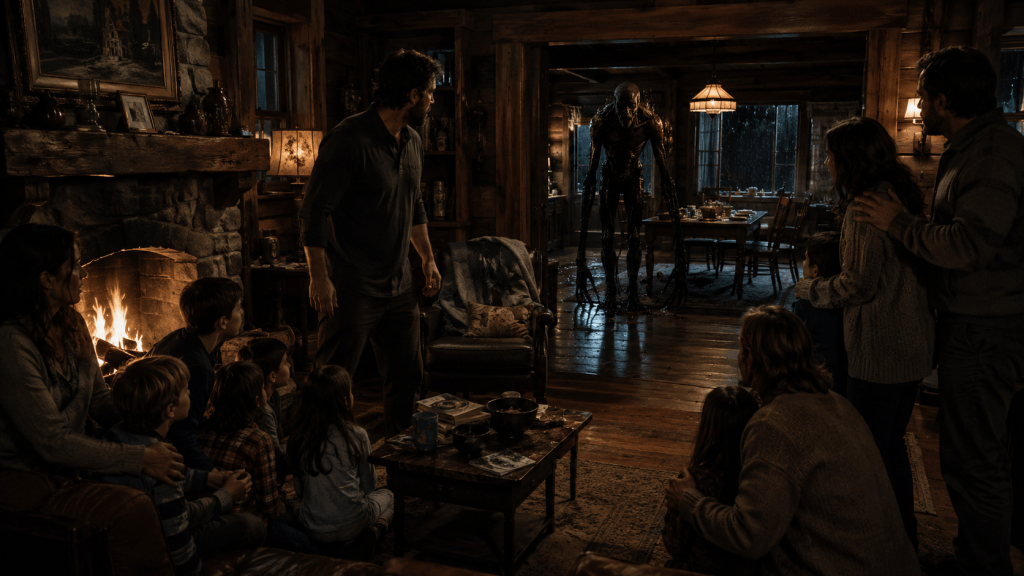
The thing shifted in the dining room before coming through from the kitchen side, upright enough at first for Martin’s mind to try making a person out of it. For a thought, he saw height and limbs and a head held forward under the ceiling light, and some desperate, trained part of him reached for ordinary answers, a man, a stranger, some soaked and starving lunatic from the ridge who had broken into the house through a window. Then it turned its face towards the sitting room, and every human answer collapsed.
Rain shone across its skin in broken patches, dark where it sank into hollows, pale where the ceiling light caught the ridges of its shoulders and face. Its shoulders rose high and narrow, its arms hung far below its hips, and black hooked fingers brushed the floorboards with small clicking sounds.
Behind Clare, Lena sobbed, and the small broken sound drew the creature down towards the floor. It folded slowly where joints should have resisted, one hand finding the boards, then the other, its back rising under damp skin as it came to all fours and tilted its head towards the fire and the children gathered there. The sight of it moving that way brought the keep back to Martin in one violent rush, claws on stone, breath trapped in a passage, Gareth’s hand dragging his jacket, daylight at the door.
Clare turned to Martin as if he might have carried an answer back from that old fear. “What is it?”
Martin had no answer, and Elliot was still staring past him at the thing on the floor when Clare’s hand reached blindly behind her for the children. “Behind me,” she said, the words breaking as they came. “All of you, behind me.”
Elliot stayed fixed where he was, staring past Martin at the thing on the floor, and Martin stepped between his son and the dining room, lifting the hammer as he forced the boy’s name through a throat that had gone tight. “Elliot. Move when your mother tells you.”
The creature gathered itself near the table while the words were still in the air, then surged across the dining space so quickly that Gareth only just got the chair in front of Sam before it struck. The backrest splintered into the sideboard with a crack like a branch giving under
weight, and Gareth grunted as he drove forward anyway, his body set between the thing and his son, both hands gripping what remained of the chair.
“Sam, back!” Gareth shouted, rough with command, without turning from the thing in front of him.
Sam stayed close behind him, trying to see past his father’s arm and crying his name as Raj surged in from the hall with the poker raised, the iron catching the ceiling light. Naomi dragged Maya and Lena towards the sofa. Clare pushed Elliot and Noah behind the armchair. The room broke into separate flashes around Martin, and through them Gareth swung what remained of the chair into the creature’s shoulder, hard enough for the frame to shatter in his hands.
For one terrible second, Gareth and the thing stood close enough for Martin to see the old schoolboy in him beneath the beard and the panic, the same broad face, the same stubborn refusal to give ground when every sensible instinct said run. Then one hooked hand flashed upward and Gareth vanished sideways out of Martin’s clear sight, striking the edge of the dining table with enough force to lift plates and mugs into the air before his body hit the floor and Sam tore free from Clare, screaming for his father as if the sound might pull him back.
Raj caught Sam around the waist and dragged him away as the boy kicked and clawed at his arm, his cries tearing through Martin’s ears. Naomi seized the fallen poker and swung low as the creature twisted from Gareth towards the movement. The iron bar struck the side of its skull or shoulder with a hard, flat sound, though the thing gave no cry.
“Kitchen!” Clare shouted, her hands closing around Elliot’s hoodie and Noah’s sleeve as the creature shifted between them and the hall. “Move through the kitchen!”
“The front door’s here!” Raj called, fighting to hold Sam while watching the creature turn towards them.
“It’s between us and the hall,” Clare answered, shoving Elliot towards the far side of the room. “Martin!”
Martin moved at her voice, driving in with the hammer aimed at the long hand scraping against the boards as the creature gathered itself. The head of the tool struck bone, or something harder than bone, and a thin crack ran through the metal as pain jolted through Martin’s wrist and up his arm. The creature recoiled a fraction, turning its face towards him, and the movement showed him the mouth, or the torn place where a mouth should have been, opening far too wide beneath a flattened nose. Teeth showed in the darkness inside it, long at the front and crowded at the sides, wet under the firelight, while its small eyes gleamed above them, pale and bead-bright and fixed on him.
He kept the broken hammer raised as he stepped back, drawing the creature’s stare away from Clare while she pulled the children towards the kitchen side of the sitting room. “Go!” he shouted. “All of you, go!”
Maya pulled Lena after her hard enough for both girls to stumble, and Tom followed close behind them, white-faced and silent as one shoe slid on the mud near the rug. Elliot moved last, looking once towards Gareth and then back at Martin, his face twisted around a question Martin had no time to answer.
“Elliot,” Clare snapped, using the voice she saved for roads and knives and falling glass. “With me.”
Elliot ran to her, and Naomi snatched up the poker Raj had dropped, holding her ground long enough to swing it again as the creature reached for them. The iron caught the reaching arm and the lamp on the side table in the same blow, bursting the lamp against the wall and throwing shade, ceramic and dust across the carpet. The room dropped into firelight and kitchen glow, shadows lengthening around the furniture and the dining table where Gareth lay half-hidden beyond the creature’s back.
Martin tried to see him properly, searching for the rise of his chest or a hand finding purchase on the boards, until Raj dragged Sam farther away and shouted over the boy’s struggling. “Gareth! Gareth, answer me!”
A small, wet sound came from beyond the table, wrong enough to change Raj’s face. Sam heard it too, sagging for one stunned second in Raj’s grip before fighting twice as hard, twisting towards his father as the creature gathered itself and sprang.
Raj threw Sam behind him and took the impact across his shoulder, crashing into the armchair and overturning it into the hearth tools. Martin saw claws tear through Raj’s jacket sleeve and heard Raj curse in pain, though he stayed on his feet long enough to shove Sam towards Naomi.
“Take him!” Raj shouted.
Naomi grabbed Sam around the chest from behind and pulled him hard enough to lift him from the floor. “Sam, breathe,” she said against his ear, dragging him towards the kitchen. “You breathe and move, love. Move now.”
Clare had the other children at the kitchen threshold, counting by touch as each one passed her. “Elliot, Noah, Maya, Lena, Tom,” she said, voice shaking under the words. “Sam, where is Sam?”
“With Naomi,” Martin shouted, though the broken light made the room difficult to see through. A fallen cushion had rolled too close to the grate, and smoke began to curl from the fabric as the creature turned from Raj and climbed onto the side of the dining table, its claws digging into the wood among the plates. It moved in a way Martin could not make sense of, folding and releasing across the furniture as if the house had been built for its limbs, its head swinging towards the children’s retreating voices.
Martin hurled the hammer at it before the creature could launch itself after them. The tool struck the wall beside its head and bounced into the ruined chair, loud enough to check the creature’s movement and bring its attention back to him.
He backed towards the kitchen, one hand searching behind him for the doorframe. “Raj,” he said, keeping his eyes on the thing. “Get up.”
Raj pushed himself from the armchair with a harsh breath, blood running from somewhere beneath his sleeve. “I’m up.”
Martin’s fingers found the frame as the creature slid down from the table and followed, its claws clicking over the dining-room boards. Clare was already pulling the children deeper into the kitchen, guiding them towards the narrow corridor beside the pantry with both hands, touching shoulders, sleeves, hoods, anything she could reach, while Naomi hauled Sam past the island with the poker awkward in her free hand and Raj came after them with blood darkening the torn fabric along his arm.
“Keep going,” Clare said, her voice stretched thin as she pushed Elliot ahead of Noah. “Straight through. Utility room. Stay where I can see you.”
Sam twisted in Naomi’s grip, his face turned back towards the dining room. “Dad’s there,” he cried, dragging his heels against the tiles. “Dad’s still there.”
Naomi held him tighter, her mouth close to his ear as she forced him along beside her. “Sam, listen to me. Your dad got you clear. Don’t waste that. Move now.”
Sam’s knees dipped under him, and Naomi hauled him upright before he could fold. Maya reached for Lena and pulled her close as cutlery slid from the counter and the low animal scrape of the creature came after them from the dining room.
Naomi thrust the poker back at Raj as she dragged Sam towards the corridor. Raj caught it against his side, grabbed the end of the kitchen table, and drove it sideways with his hip. “Martin, help me.”
Martin caught the far edge and shoved, pain flashing through the wrist he had jarred with the hammer. The table lurched across the tiles, knocking chairs aside and slamming against the island, leaving a cramped barrier between the kitchen and dining room as plates slid from the edge and a mug burst near his boot.
The creature came after them anyway, long fingers finding the table edge among the broken crockery as it hauled itself up, its body folding low under the kitchen lights while Gareth’s blood darkened the boards behind it.
Raj stepped in with the poker gripped in his good hand and swung across the reaching fingers before the creature could pull itself fully over. The iron struck with a hard ringing sound, and one hooked finger bent back at an ugly angle before straightening again as the creature dragged itself forward, head lifting towards the corridor where the children’s voices stumbled over each other.
“Move!” Martin shouted, grabbing a chair and throwing it into the creature’s path.
The chair struck its shoulder and bounced aside, barely checking the creature as its weight drove the table harder against the island. Glasses jumped from the counter and shattered in the sink while Clare forced the children towards the corridor entrance, beyond which the downstairs bathroom, boot space and utility room narrowed towards the back door. Coats swung from iron hooks, the old freezer hummed under a shelf of paint tins and spare bulbs, and the practical end of the house, built for wet boots, laundry baskets and ordinary family movement, seemed too narrow for the fear being pushed into it.
“Elliot, Noah, through,” Clare said, shoving them ahead. “Maya, take Lena. Tom, with me. Sam?”
“Here,” Naomi answered from behind Martin, Sam pinned hard against her side. “I’ve got him.”
Sam stumbled beside Naomi with his eyes fixed over his shoulder, quieter now than when he had been screaming, as if some part of him had stayed in the room where Gareth had fallen.
The creature pushed again, the table grinding against the island as its long arm swept across the counter and sent a bowl into the wall. Raj cursed through his teeth and reached for the pan rack, tearing down a heavy cast-iron skillet that clanged against the hob before he lifted it in both hands.
“Go,” Raj said to Martin, raising the pan as the creature gathered itself for another push. “I’ll hold it for two seconds.”
“You’ll hold it for one,” Martin said, seizing a carving knife from the magnetic strip beside the cooker. “Make it count.”
Raj’s breathless laugh broke as the creature came over the island headfirst, one arm sweeping out again across the counter. He drove the skillet into the side of its head, and Martin lunged at the reaching arm with the knife, stabbing low, missing tendon or bone and feeling the blade slide through slick skin with less resistance than he expected. The creature jerked back, its mouth opening in a sound too thin to be a cry, and the space it gave them was only a heartbeat wide, barely enough for Martin to turn and force himself towards the corridor.
Ahead, Clare had reached the utility door and was fighting the wooden stop he had jammed there earlier. The chain sat across the frame, the old deadbolt stiff from rain-swollen timber, and the pile of boots beneath it had been kicked everywhere by the children pressing too close.
“Back door,” Martin said, forcing himself through the knot of bodies. “Open it.”
“I’m trying,” Clare said, dragging at the chain with shaking fingers. “It’s caught.”
Martin found them crowded into the utility room in broken pieces of panic, Maya holding Lena against the washing machine with one arm across the younger girl’s chest, Elliot white-faced near the freezer with a broom handle gripped in both hands, and Noah crouched beside him, breathing too fast. Sam had slid down the wall near Naomi’s legs, and she bent over him with one hand on his shoulder and the other braced against the freezer, as if she could hold him there and keep the room from breaking open at the same time.
“Where’s Tom?” Martin asked.
Clare’s hands froze on the chain, and her eyes swept the cramped corridor, counting too quickly over Elliot, Noah, Maya, Lena and Sam before she turned back towards the kitchen. “Tom?” she called, her voice breaking at the edge. “Tom, answer me.”
Maya’s face changed. “He was behind me.”
Lena shook her head hard against Maya’s hand. “He went the other way.”
“What other way?” Naomi asked, turning sharply.
Lena pointed towards the small downstairs bathroom, where the door stood half open behind the hanging coats. “There. When it hit the table.”
Martin pushed past Raj as he came stumbling into the corridor with blood running from his sleeve and the skillet hanging from one hand.
“Martin,” Raj said, looking back towards the kitchen. “It’s coming.”
“I know,” Martin said, already moving.
The bathroom door trembled once against the wall as he reached it. He kicked away the boots piled in front, pulled it wide, and found Tom crouched behind the laundry basket under the sink, both hands clamped over his mouth, eyes huge in the dim yellow light.
“Come here,” Martin said, reaching for him. “Tom, take my hand.”
Tom shook his head, silent, trapped in some private place of terror.
“Tom,” Martin said, lowering his voice as glass broke again in the kitchen. “Look at me. Elliot is out here. Lena is out here. You come now.”
Tom lunged forward so fast that the knife nearly slipped from Martin’s hand. He caught the boy under the arms and hauled him into the corridor, turning his own body between Tom and the kitchen as the creature slammed into the table jammed across the passage mouth.
The force drove Raj backwards into the freezer, sending paint tins from the shelf above him bursting across the floor, white paint spilling over the tiles like milk. The creature’s arm came through the gap between the kitchen table and the pantry wall, impossibly long, claws raking along the corridor plaster as it tried to pull itself after them.
“Go!” Martin shouted, pushing Tom towards Clare.
Tom stumbled, and Naomi caught him with one arm while keeping Sam pinned with the other. “I’ve got him,” she said, breathless. “Clare, take Sam.”
Sam looked up as Clare reached for him, his face broken by confusion. “Where’s my dad?”
Clare’s hand settled on his shoulder and tightened there without meaning to. Her mouth moved once, soundless, while the smoke and broken light from the dining room pressed in behind them.
Naomi answered instead, bending until she was in front of Sam’s eyes. “Your dad needs you away from here.”
The creature forced the table aside with a splintering crack and entered the corridor low to the floor, one shoulder scraping along the pantry wall, long fingers finding the tiles between them. Raj hurled the skillet into its face, the pan striking hard before spinning away across the floor, and Martin drove the bathroom door against the reaching arm, pinning it for a second until the creature struck from the other side with enough force to buckle the hinges.
“Back door!” Raj shouted.
“The chain is caught,” Clare said, pulling at it again as Elliot tried to help, his small hands fumbling over hers.
“Move,” Martin said, passing the knife handle to Raj and driving his shoulder against the utility door near the chain. The frame jumped against the wall, yet the chain held, and when he hit it again pain burst across his upper arm as the bolt shifted half an inch before sticking deeper in the swollen wood.
Behind him, the bathroom door burst open hard enough to strike the corridor wall, and the creature’s hooked hand swept through the narrow space at waist height as Naomi twisted to shield Tom and Sam together, both children pressed against her. The claws caught her across the upper side and shoulder, ripping through jumper and skin in one fast, wet motion that tore a hard cry from her before she fell against the freezer, leaving a red smear across its white enamel as Tom slipped from her grip and crawled towards Clare.
“Mum!” Maya screamed, surging forward.
Clare caught Maya around the waist before she could reach the creature. “Stay back.”
Naomi’s face had gone grey, one hand pressed hard against the wound as blood spread between her fingers and darkened the wool beneath her palm. She forced herself upright with her other hand braced against the freezer, finding Maya through the pain. “Maya, look at me. I’m here. You keep moving.”
Maya sobbed once, fierce and furious, then grabbed Lena again as if saving her could become the only thing large enough to hold.
Martin slammed the utility door with his shoulder a third time. The chain tore half free, carving a splintered groove through the frame as cold rain rushed through the crack, and for one wild second he thought the way out had opened. Then the door jarred against something outside after only a few inches, a fallen stack of logs or the warped edge of the old step, leaving them with a gap no wider than an arm.
“Can we squeeze the children through?” Raj asked, trying to force himself beside Martin with the knife still in his hand.
Martin looked at the gap, at the rain beyond it, at the dark back garden where the trees stood close against the wall. Through the narrow opening, something scraped along the outer boards, and Clare’s hand went to Elliot’s chest before he could move towards the door.
“Martin,” she said, her eyes fixed on the crack.
The corridor seemed to close around them from both ends, the creature gathering itself behind them after Naomi’s blood while the rain-dark back door opened onto a garden that no longer felt empty.
Martin took one step back, breathing hard, feeling the knife handle slick where Raj had pressed it into his palm again. “Front,” he said.
Raj stared at him. “Back through that thing?”
“The hall gives us more room,” Martin said, though the words sounded like a poor bargain as soon as he spoke them. “The front door opens clear.”
Naomi pushed away from the freezer, pain dragging through her face with every movement. “Then get us moving,” she said. “Before I fall over and make this dramatic.”
It was the kind of line Gareth should have caught, the kind that should have dragged some ruined joke out of him even now, and the missing answer went through Martin harder than the words.
Clare turned the children back along the corridor with both arms, forcing them into a tight cluster as Elliot went first, white-faced and looking past Martin towards the kitchen, Noah pressed close behind him, Maya holding Lena against her side, Tom stumbling between Clare and Raj, and Sam pulled along by Naomi’s bloodied grip on the back of his shirt.
The creature waited between the corridor and the kitchen, low on its hands, its head shifting as they came towards it. Its claws rested on the tiles among spilled paint, broken glass and wet footprints, each black hook spread against the floor as though it already knew where they had to pass.
Martin moved first, stepping towards the kitchen with the knife held low before the line behind him had time to falter. Raj came up beside him, breathing through his teeth and keeping his torn arm tucked close against his side, while Clare kept the children moving with her body, one hand on Elliot’s shoulder and the other reaching back for whoever was nearest. Naomi followed with blood running between her fingers and Sam’s shirt clenched in her fist, and the house seemed to pull at every one of them, catching sleeves on hooks, feet on boots, shoulders on doorframes, the familiar clutter of family life suddenly turning mean beneath their fear.
Elliot’s voice came from behind Clare, tight and small. “Dad.”
Martin glanced back long enough to find his son’s face among the others. “Stay with your mum,” he said. “Eyes on her. Hands on whoever is in front of you.”
Clare touched Elliot’s shoulder and drew him back into the line. “You heard him. Move when I move.”
Naomi gave a breath that shook, then steadied. “Maya, Lena, you are glued together now. Tom, if you lose sight of Clare’s jumper, grab mine.”
Tom nodded so fast his chin trembled, and Martin drove forward before the creature could finish gathering itself, shouting as he slashed low at the nearest hand while Raj kicked the bathroom bin hard into its front legs. The blade glanced along hooked fingers, scraping more than cutting, while the bin struck with enough force to make the creature recoil and shift its weight towards the pantry wall. It was not much, barely a stumble, barely a gap, but it gave Martin enough room to shoulder past the pantry opening and into the kitchen.
“Now!” he shouted.
Clare drove the children after him in a tight rush, Elliot stumbling through first with Noah almost against his back as Maya dragged Lena beside them and Tom came after, half caught between Clare’s arm and Raj’s shoulder. Naomi forced Sam through last, folded under her injured arm as if grief had made him younger than the rest, while Raj backed after them to keep himself between her and the creature tearing a long strip of plaster from the pantry wall.
They crossed the kitchen through wreckage, over sauce slicked near the island, past the split chair under the table and the broken lampshade that had rolled as far as the cooker, gathering ash from the smouldering cushion. In the dining room beyond, the table stood crooked from the force of Gareth’s fall, and Martin’s eyes tried to avoid the shape beyond it until Sam turned the same way.
“Dad,” Sam whispered, the word pulling loose from him like thread from a wound.
Naomi caught his face with her clean hand, forcing his eyes away. “Look at me, love,” she said, though pain dragged at her voice. “You keep walking. One foot, then the other. That is all you owe this minute.”
Sam shook under her hand as Naomi pulled him on, and Raj limped into the dining space ahead of them, sweeping broken crockery from the table with his forearm to clear a path round the far side. “Front hall,” he said. “Keep left of the table.”
The creature came from the corridor behind them with a force that threw the kitchen door against the wall. It slipped across the tiles on the paint and blood, caught itself with both hands, then launched onto the island, scattering pans and bowls with a crash that tore a scream from Lena.
“Do reach for the screaming children,” Naomi muttered through clenched teeth, lifting a carving fork from the counter with her good hand. “Charming little habit.”
Something shifted beyond the dining table, a wet drag of sound from Gareth’s side of the room, and Martin’s eyes went there before he could stop them.
Clare dragged the children into the dining room, forcing them past without slowing. “Eyes forward,” she said, voice breaking under command. “Nobody looks down. Nobody stops.”
Elliot looked down before Martin could reach him, and whatever he saw pulled the colour from his face as the creature sprang from the island into the dining room, landing on the far side of the table with all four limbs spread across the wood. Plates slid beneath its weight, claws scoring the surface as it crawled along the tabletop towards them, body low, mouth wide, water or spit hanging from its teeth in strings.
Raj hurled a chair into the creature’s path, the frame breaking across its chest as Naomi drove the carving fork into the table in front of one reaching hand. The tines pinned the hooked fingers for a single breath before bending and tearing free, and Martin grabbed the far end of the dining table and heaved hard enough to shift it sideways. Gareth’s body rolled partly into view beneath the movement, dragging another scream from Sam as Clare shouted from the hall, “Martin!”
Martin let the table go and forced himself forward, catching Sam under one arm as Naomi swayed from blood loss. “Raj, Naomi, through!”
Raj shoved Naomi towards the hall, sending her hard into the doorframe before she forced herself on with one hand pressed to her shoulder. Maya reached for her, only for Naomi to shake her head once, rough and immediate, refusing to let her daughter slow.
“You keep Lena,” Naomi said, breathless. “That is your job.”
Maya tightened her hold on Lena and moved with the others as they spilled into the hall beneath the stairwell, where the front door waited with its chain and deadbolt still across it. Rain hammered against the glass beyond the terrace lights, and for one wild second Martin saw open air through the streaked water, the steps, the slope, the lower lane, neighbours, help, anything beyond the house.
Clare reached the door first and tore at the chain. “It’s stuck,” she said, voice rising as it jammed against the slot. “Martin, the chain is stuck.”
“Lift it,” Martin said, setting Sam on his feet and reaching past her. “Up, then across.”
Behind them, the creature climbed down from the dining table and entered the sitting room by the fireplace, moving over the back of the sofa as if it were a fallen branch. Firelight caught its wet skin in ugly pieces as it crossed the furniture instead of the floor, one hooked foot finding the armchair, one hand sinking into the rug near the hearth.
Elliot reached for the poker again, and Martin caught him by the sleeve before his fingers closed around it. “Leave it,” he barked, shoving the boy towards Noah. “Door first.”
Raj put his shoulder against the front door as Clare finally lifted the chain free. The deadbolt screamed in its track, and rain blew through the gap before the door had opened a hand’s breadth, cold and clean and impossible after the heat and smoke inside.
“Go,” Raj said, pushing Noah through first as the whole house narrowed to bodies forcing themselves through the door. Maya dragged Lena into the rain, and Tom slipped after them half turned towards Clare, his mouth open as though he wanted to ask where to stand once he reached the terrace. Sam reached the threshold last and stopped there, looking back towards the dining room until Naomi seized his shoulders with the last of her strength.
“Sam Pike,” Naomi said, voice ragged and fierce. “Your father put you behind him. You go through that door.”
Sam stumbled out after the others, and Elliot came next, one hand catching on the frame as his voice broke towards Martin. “Dad!”
Clare reached for him, rain and tears shining on Elliot’s face, while Martin turned back towards the sitting room and found the creature on the chimney breast. It clung above the mantel with its claws buried in stone and old plaster, body flattened against the wall, head turned upside down towards them, the fire beneath it throwing its long shadow across the ceiling until, for a heartbeat, it seemed part of the house itself, something stored in the stones and released by the sound of children’s fear.
His name tore from the doorway as the creature dropped from above the mantel and sprang for the front door, crossing the sitting room over the fallen armchair, the low table and the place where the children had been gathered minutes earlier. Raj lunged into its path, catching its shoulder with the full weight of his body and slowing it for one breath before it struck him away into the hall wall beneath the framed winter valley.
Martin shoved Clare and Elliot through the doorway into the rain. “Take him,” he called, though he had no idea who stood outside to receive them.
She twisted back, one hand gripping the frame, her face turned towards him. “Martin, come on!”
Behind him, the creature reached the hall floor, claws finding the boards as Elliot stared past Clare from the rain, mouth open around a sound Martin could no longer hear. Martin stepped back inside and pulled the door, only for Clare to catch the edge from outside.
“No!” Clare shouted, fighting to hold it open.
Her fingers clung there for one second, wedding ring wet and bright in the terrace light, before Martin pushed the door hard enough to force her hand clear. The door closed between them with a heavy clap, and he drove the deadbolt across just as something struck the other side, fist, shoulder, Clare’s whole body, he could not tell. Voices broke through the rain and wood, Elliot’s rising once above them all, high enough to tear the breath from Martin’s chest before the creature hit him from the side.
The blow carried him across the hall into the sitting room, smashing his hip against the overturned armchair and dropping him near the hearth, where smoke from the scorched cushion crawled across the floor. Pain burst through his ribs when he tried to rise.
Raj lay against the wall, breathing in harsh pulls, one hand pressed high against his torn arm, his eyes finding Martin’s through the smoke. “Door?”
“Closed,” Martin said.
Raj nodded once, barely moving, his head sinking back against the wall as the creature climbed onto the stone hearth and set one hooked hand on the mantel, making the family photographs tremble in their frames. Martin dragged himself backwards across the rug, searching for the poker, the knife, anything, until broken ceramic bit beneath his palm. Another blow shook the door from outside, Clare’s voice distorted by the wood, and the creature came down from the hearth towards him.
It moved slowly now, each pull of its long body finding him clearly through the firelight, one hooked hand sinking into the wool before the other reached forward, while Martin pushed himself backwards with one elbow and felt the shard slice deeper into the soft part of his palm. Raj stirred against the hall wall, blood running dark through the sleeve above the hand he held to his arm, his face slack around the pain as he tried to lift himself while the creature drew nearer.
“Martin,” Raj said, his breath catching on the name. “Move.”
Martin wanted to answer him, to tell Raj to stay down, to save whatever strength remained in him, to crawl towards the door if it opened and follow Clare and the children into the rain. The words had no room inside his chest, where each breath scraped through him shallow and hot, his ribs flaring whenever he tried to draw air as the creature reached the edge of the hearthrug and lowered its head as if it recognised him.
The angle of the creature’s lowered head brought the keep back into the sitting room. Daylight whitened the passage mouth ahead of him, Gareth’s jacket dragged across his hand, Raj slipped hard against the wall, and Naomi’s shout came through the dark as Martin felt himself small again, empty-handed, lungs burning, running with nothing inside him large enough to stand. The memory pressed into the present, into the smoke near the grate, the scorched cushion, and the shard biting his palm beneath the trembling photographs of Elliot smiling from a summer impossibly far away.
Before the image could clear, the creature lunged into Martin’s upward thrust, the shard driving into the side of its face near the throat and tearing something under the jagged edge. Its hiss cut through the pounding at the door before its full weight came down on him, one clawed hand striking the floor beside his ear as the other tore across his lower ribs and stomach in a burst of heat so bright it seemed almost clean. He tried to twist away, yet the creature’s knees pinned his hips and its long arm pressed across his chest, holding him on his back beside the hearth.
Clare hammered at the door from outside, calling his name through the rain. Elliot’s cry followed hers, high and panicked, drawing Martin’s head towards them through the creature’s weight. The door stood closed beyond the hall, deadbolt across, chain hanging loose where Clare had freed it. Her next blow shook the wood hard enough to make him think the frame might give before the creature’s claws pressed deeper.
Martin’s hands closed around its wrist, trying to hold it above him as cold, slick skin shifted beneath his fingers over narrow bones his mind could barely follow. He pushed with everything left in his arms, fixed only on keeping those talons from sinking further while blood moved warm across his side and down into the waistband of his jeans.
“Raj,” he forced out.
Raj lifted his head a fraction, his eyes moving from Martin to the door and back again, understanding enough to hate it.
“Stay down,” Martin managed, though the words came apart under the pressure.
The creature leaned closer, its mouth opening too wide above him, teeth crowded and wet in the firelight, its breath smelling of damp stone, old water and the sealed dark beneath the keep. Martin turned his face away from it, towards the family photographs along the mantel, where Clare laughed in a garden summer, Elliot held up a trout too small to brag about, and snow hid the ridge behind the three of them on the terrace.
The sight pulled the children through him in broken pieces: Elliot bright with rain at the door, Noah vanishing after him, Maya holding Lena tight, Tom small and shaking, Sam dragged towards safety by Naomi’s bloodied hand. He tried to keep them there, safe inside their names, yet one slipped and another came back as the door took another blow, Clare’s voice breaking raw beyond the wood while the room filled with rain, footsteps, sobbing, someone calling for Naomi, perhaps Raj trying to breathe, perhaps Martin’s own breath making everything larger and farther away.
The creature pressed down, forcing a low sound from him as his grip weakened. Its pale eyes stayed on his face, head tilted and still, too close now for anything in the room to remain whole except its breath, the firelight and the pain opening through him.
The Walkman came back to him in pieces, broken plastic packed under tree roots, wet earth, tape wound through leaves like a dead black vein. He had carried the last remnant of his boyhood terror into the woods and returned with empty hands, as if fear could be buried once the object that held it was gone. The creature shifted again, and the room blurred around the mantel, the rug, Raj’s shoe near the wall and the door still holding beyond the hall, where Elliot’s cry cut through the rain clear enough to reach him.
Martin turned towards his son’s voice with the last strength in his neck. He tried to tell Elliot to run, yet the word broke apart before it reached his mouth, and blood came instead.
The dark shape above him filled the last of his sight. Somewhere beyond it, the door shook, Clare called his name, and Raj made a broken sound from the hall. Martin tried to hold the children in his mind once more, starting with Elliot, but the names loosened before he could gather them. Firelight folded into shadow, and the last thing he knew was the deadbolt holding beneath the rain.
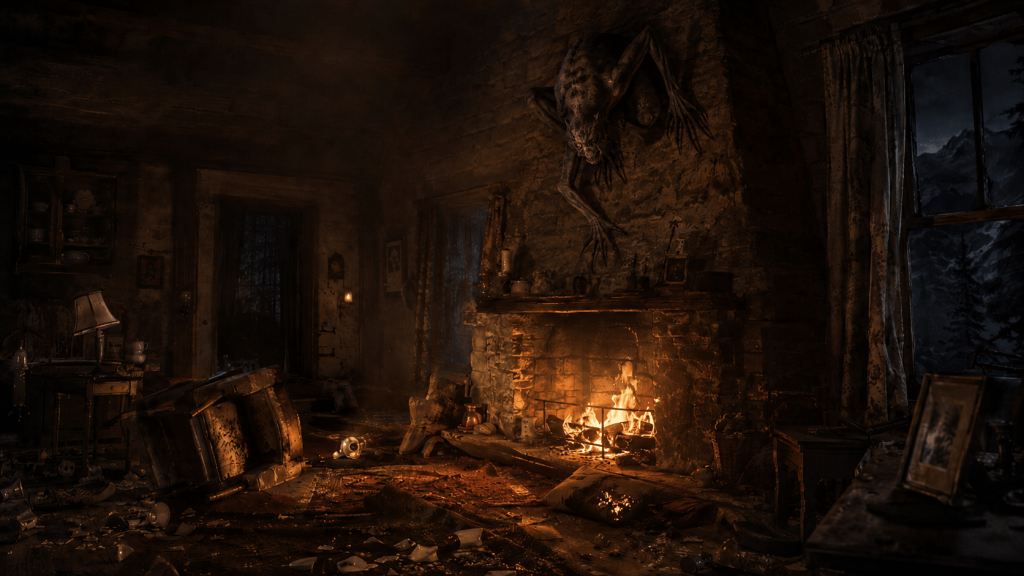
Author Note
This story began with a dream image: a father inside a woodland house, a creature moving across a fireplace, and the terrible choice of holding a door closed while others tried to escape.
From that image came the forbidden keep, the old Walkman, and the idea of a childhood trespass returning through the next generation. The Walkman itself was always meant to be ordinary. Its horror came from where it had been, who recognised it, and what its return meant for people who had spent years living around a truth they never fully named.
Monthly Free Stories is a project where I publish one complete free story on my website each month. The stories may be horror, fantasy, science fiction, historical fiction, mystery, or anything else that fits the idea. Some may remain standalone forever. Some may grow later if readers respond to them. The first promise is always the same: a complete story, freely available to read.
For more fiction, you can read more free stories, explore my published books, or join the newsletter for future stories and book updates.