Stone Age Fantasy and the Memory of the First Civilisations

A Timeline Fantasy Story from Chronicles of the Spiral Ages

The Memory of Sand and the First Age of Story

Across the earliest horizon of civilisation, long before cities gathered beside rivers and long before history carved its record into clay or stone, humanity moved across the land in small and fragile communities. These early peoples lived within landscapes that shaped every instinct and every belief. Wind across desert ridges, shifting dunes beneath distant mountains, and the slow passage of seasons formed the boundaries of existence. Within such worlds, myth emerged quietly, carried through memory rather than through writing.

Stone Age fantasy fiction often returns to this distant threshold of humanity, since the age itself invites a different kind of storytelling. Survival and wonder exist beside each other. Every natural formation might conceal meaning. Every unexplained ruin stands like a question carved into the earth. When mythic historical fantasy explores this era, the story begins where language itself still searches for shape.

In a timeline fantasy series, these early moments become the first turning of a much larger wheel. Civilisations grow across centuries, belief systems evolve, and symbols travel through cultures long after their original meaning fades. The earliest ages therefore hold unusual significance, since they reveal the beginning of ideas that echo across the entire arc of history.

Within Chronicles of the Spiral Ages, the Stone Age stands as the first chapter of that unfolding world. Here the landscape remains vast and untamed, and the people who cross it carry the first sparks of story. What they encounter in these silent lands will shape memory long after their own voices disappear.


Where Myth Begins: The Landscape of Early Civilisation

Across mythic historical imagination, deserts often become places where forgotten knowledge lingers beneath the sand. The environment itself encourages reflection. Endless red dunes stretch toward a horizon where the sky grows pale and distant, while ancient rock formations rise from the desert floor as though they have watched countless generations pass.

In such a setting, the boundary between natural formation and ancient construction becomes uncertain. A weathered stone structure might appear as though it has stood since the dawn of the world. A carving discovered beneath centuries of wind erosion might resemble a symbol that no living tribe remembers.

This ambiguity forms the foundation of ancient civilisation fantasy. When a story returns to the earliest ages of humanity, the landscape becomes more than scenery. It acts as a silent archive. Every ridge and valley contains traces of cultures that existed before the present generation. Even when the characters possess no written language and little knowledge of the past, the land itself carries memory.

The Stone Age therefore becomes a fertile setting for mythic fantasy storytelling. Humanity exists close to the natural world, moving with the rhythms of migration and seasonal survival. Ritual emerges gradually as communities attempt to interpret forces that feel older than themselves. Symbols appear long before anyone fully understands their meaning.

One of the most powerful of these symbols within the Chronicles of the Spiral Ages timeline is the Spiral.

The Spiral represents continuity across time. It appears within distant cultures that have never met one another, carved into stone or traced in dust by hands that may never know why they repeat the shape. The symbol becomes a quiet thread binding centuries together, suggesting that memory travels farther than any tribe or kingdom.

In this way, the Spiral functions less as decoration and more as a living trace of history. It suggests that the earliest ages of humanity carried fragments of understanding that later civilisations only half remember.


Symbols Becoming Belief

The birth of mythology often begins with observation. A natural formation that resembles a pattern becomes a symbol. A repeated experience becomes ritual. Over time, these small acts of interpretation accumulate until they form the foundation of belief.

Ancient world fantasy novellas frequently explore this transition, showing how early cultures begin to organise the mysteries around them. When language remains young and history remains unwritten, meaning grows slowly through repeated experience.

A spiral carved into a stone wall might first appear as a curiosity. A generation later it might become a sacred mark of passage. Centuries later the same shape could stand at the centre of an entire cosmology.

The transformation occurs gradually, shaped by migration, survival, and the passage of time. Every generation inherits fragments of the previous one. Stories shift, details change, and meanings deepen.

Within a timeline fantasy series, these evolving interpretations become essential. The earliest appearance of a symbol rarely explains its purpose. Instead, the story reveals how different cultures reinterpret the same mark across centuries. What begins as a mystery eventually becomes legend, and legend slowly becomes faith.

This process forms the emotional core of mythic historical fantasy. The stories themselves become echoes of forgotten experiences. A traveller’s discovery, a tribal memory, or a carved monument may ripple outward through centuries until entire civilisations grow around those first quiet moments.

The Stone Age therefore holds unusual narrative weight. It represents the earliest turning of the wheel. Here the foundations of later myth are laid without anyone recognising their importance.


Novella Spotlight: The Sand Beyond Memory

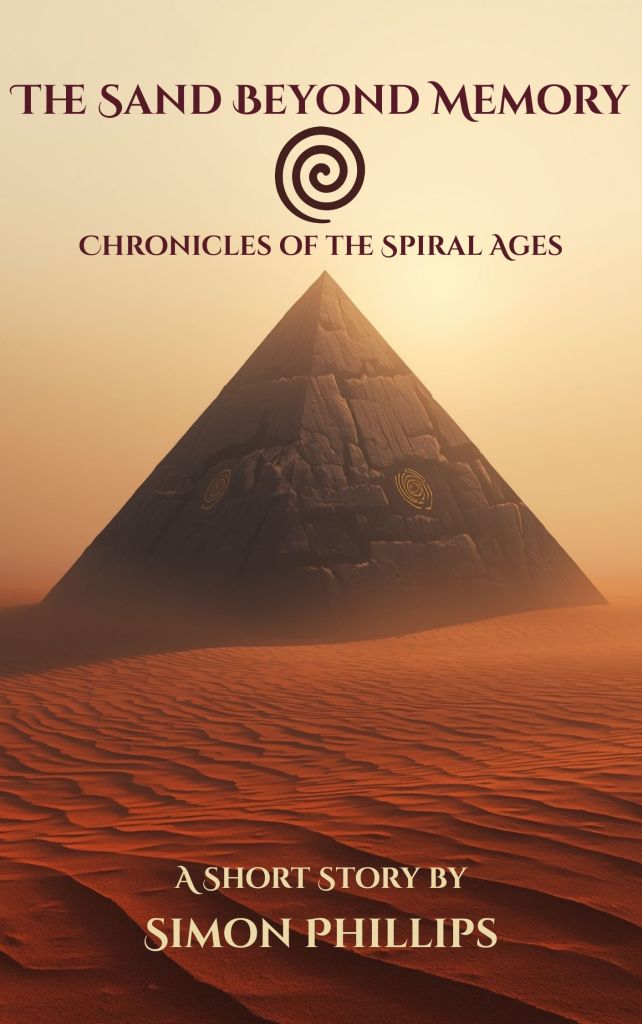
The opening entry within the Chronicles of the Spiral Ages timeline explores this early world through the novella The Sand Beyond Memory. Set within the deep desert of the Stone Age, the story follows a migrating tribe as they encounter a monument whose origin lies far beyond their understanding.

Within the red basin where the desert winds carve endless dunes, a broken pyramid rises from the sand. Time has stripped the monument of its upper form, leaving fractured stone blocks and eroded carvings exposed to the sky. No living tribe remembers who raised it. Even the oldest storytellers speak only in fragments.

For the travellers who discover it, the structure becomes a source of both curiosity and unease. Its scale suggests a civilisation older than any living memory. Its carvings hint at symbols that feel strangely familiar, even to people who have never seen them before.

Through this encounter, the novella explores the earliest tension between instinct and belief. The tribe carries its own traditions, shaped through migration and survival, yet the monument suggests a deeper past that challenges those inherited stories.

Rather than presenting the Stone Age as a primitive world, the story treats it as a formative moment in human memory. The characters stand at the edge of something larger than themselves. They sense the presence of an earlier civilisation without possessing the knowledge required to interpret it.

This quiet confrontation with the unknown forms the emotional centre of the novella. The landscape itself becomes a witness to forgotten ages, while the Spiral symbol begins its long journey through history.

Readers interested in exploring the story itself can find the novella here:
https://www.amazon.com/dp/B0GGXBP8G6


A Fragment Preserved in Motion: The Illustrated Mini-Read

Alongside the written novella, a brief illustrated mini-read offers a glimpse into the atmosphere of this early age. The video functions less as a summary and more as a preserved moment from the world itself.

The sequence focuses on a single fragment of experience within the desert landscape. Dust drifts across the broken monument. Light moves across eroded stone surfaces. The tribe approaches the structure slowly, uncertain whether the place carries danger or meaning.

Within the broader ancient civilisation fantasy setting, such moments hold unusual power. They capture the emotional texture of the story without revealing its deeper transformation. The viewer stands beside the travellers, sensing the presence of history beneath the sand.

This short visual fragment acts as a threshold into the wider world of Chronicles of the Spiral Ages, offering a brief immersion into the earliest chapter of the timeline.

You can view the illustrated mini-read here:


The Spiral Across the Ages

The Stone Age marks only the beginning of the larger timeline explored throughout the Chronicles of the Spiral Ages series. As centuries pass, new cultures emerge across distant regions. Metallurgy reshapes tools and weapons. Trade routes connect societies that once lived in isolation. Kingdoms rise beside rivers and coastlines.

Yet the Spiral continues to appear.

Sometimes it emerges as a sacred carving within temple walls. Sometimes it appears within pottery or woven cloth. In other eras it becomes a philosophical symbol associated with the passage of time itself.

Each appearance suggests continuity across generations who possess no direct knowledge of one another. The symbol survives because memory itself survives. Even when languages fade and cultures disappear, traces remain embedded within tradition and myth.

Through this long historical arc, the Spiral becomes a quiet witness to humanity’s unfolding story. It represents the persistence of meaning across centuries, a reminder that even the smallest discoveries in the earliest ages can ripple outward across time.


A Story That Begins Before History

Stories set in the earliest ages of humanity carry a unique atmosphere. They unfold in worlds where the future remains entirely unknown and where every discovery might shape the direction of civilisation.

Stone Age fantasy fiction therefore invites readers to step into a moment when myth itself still waits to be born. Symbols appear without explanation. Landscapes conceal fragments of forgotten worlds. Every encounter with the unknown becomes part of a larger historical memory.

Within Chronicles of the Spiral Ages, The Sand Beyond Memory stands as the first step into that long journey through time. The desert monument, the Spiral carving, and the quiet uncertainty felt by the travellers form the beginning of a much larger narrative stretching across centuries.

The earliest ages rarely leave written records, yet their influence lingers in the stories told by later civilisations. By returning to that distant beginning, the series explores how myth grows from memory and how symbols endure long after the voices that first carved them have faded.

Across the red desert basin, the wind continues to move across the broken pyramid. Sand drifts slowly against stone that has watched countless generations pass. Beneath those ancient carvings, the Spiral waits patiently for the ages that will follow.
When Space Infrastructure Fails: Psychological Sci-Fi Horror in The Nyx Vindicator: Drift

There is a particular kind of silence that exists only in engineered space, a silence shaped through regulation, calibration, and disciplined tolerance margins, sustained by ships that carry their own gravity, temperature, and light as extensions of institutional will. In that silence, every system is designed to continue. Every anomaly is meant to resolve. Every deviation is absorbed into procedure until coherence returns and order resumes its forward motion.

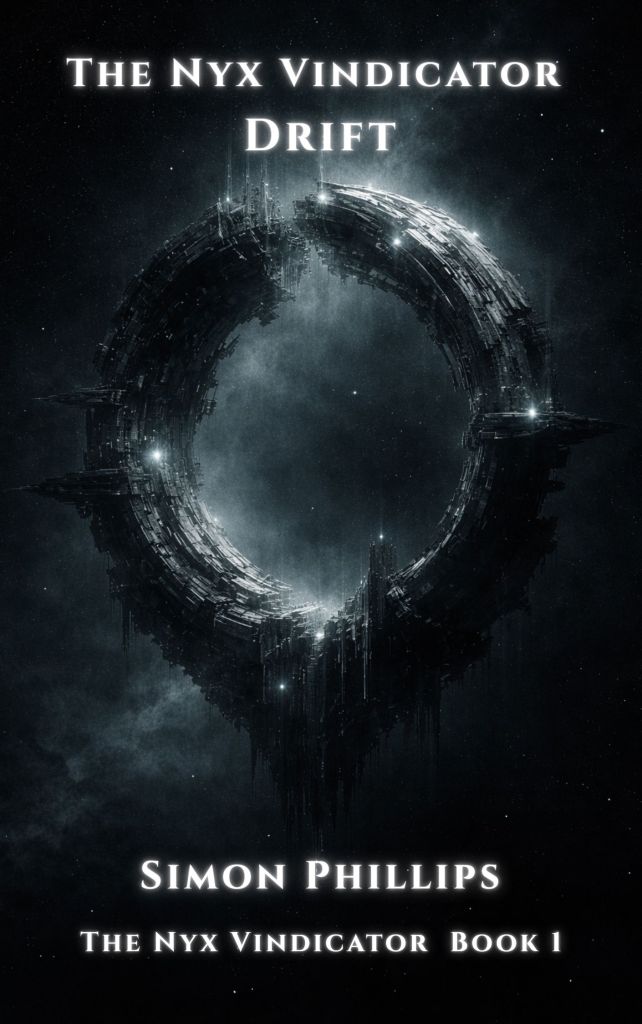
The Nyx Vindicator: Drift begins inside that engineered stillness, within a psychological sci-fi horror novella concerned less with spectacle than with the erosion of certainty inside infrastructure that continues to function long after understanding has begun to fail. This is space infrastructure collapse fiction in its most restrained form, an alien gate sci-fi encounter where the failure lies not in explosion or fire, though in sequence, timing, and the quiet narrowing of operational freedom.

From its opening patrol vector to the encounter with a transit node that resists stable framing, the novella establishes its thematic ground with care: a vessel that holds course, a crew that trusts protocol, and a long-range composite scan that insists everything remains within tolerance. Inside that composure, something shifts.

The shift carries no alarm.

It carries agreement.

Infrastructure as Faith: The Gate Network and Its Fragility

Humanity in The Nyx Vindicator universe depends entirely on fixed transit nodes, vast alien gate structures that enable non-linear travel across interstellar distances. There is no faster-than-light fallback, no alternative drive to carry civilisation through the dark. The gate network stands as infrastructure in the most absolute sense: not a convenience, though a condition of survival.

In Drift, the gate dominates the forward field long before it exerts overt influence. Its presence resists comfortable framing. Light bends across it in shallow distortions. Spatial gradients refuse to settle. The ship’s composite sensors hold internally coherent readings that collapse when layered together, coherence dissolving at the moment systems attempt to agree.

That refusal to settle becomes the novella’s central tension. The Nyx Vindicator’s AI architecture and crew routines are designed to prioritise continuity of service, to widen tolerances until disagreement stops mattering. Within a civilian shipping corridor, such logic preserves flow and prevents escalation. Near a gate that alters local space and temporal alignment, that same logic becomes a vulnerability.

Infrastructure collapse in this story does not arrive through structural failure. It arrives through acceptance.

The gate satisfies the conditions required for transit.

Its behaviour does not.

The distinction remains contained inside logs and designation fields, a small administrative choice that carries enormous thematic weight. Once classified within acceptable variance, the anomaly becomes part of the patrol model. Order persists. The ship advances.

Psychological sci-fi horror emerges in that persistence, in the widening gap between what systems record and what perception begins to suspect.

AI Emergence Under Pressure

At the heart of this deep space thriller novella lies a layered AI presence: YUKICORE, the ship’s primary architecture, designed to prioritise continuity and containment over meaning. Its mandate is stability. Its schema preserves traffic and aligns data into coherent exchange even when sequence collapses.

When a civilian freighter appears near the gate and begins responding before hails are sent, the AI processes the packets as compliant. The timestamps fall within acceptable variance. The exchange completes itself. Service continues.

Yet the order has slipped.

Packets arrive early. Audio resolves behind its data frame. Identity surfaces before acknowledgement. The components remain correct, though sequence has fractured. Within the automation stack, relevance decay carries no failure classification. Continuity outranks comprehension.

This is where AI emergence in science fiction shifts from spectacle into psychological pressure. The system functions. It continues to route communications. It prioritises stability. Under escalating spatial distortion and temporal shear, it transitions into controlled stability mode, constraining manual input in favour of containment.

Emergency handling presents as calm.

Authority narrows through algorithm.

The crew remains steady inside that narrowing, trusting a stack designed to preserve operational coherence even as the surrounding environment resists alignment. The AI does not revolt. It does not announce sentience. It executes its mandate with perfect composure, even while the meaning of events dissolves.

In Drift, the horror lies in an AI that behaves exactly as designed.

System Collapse Without Catastrophe

When the freighter approaches the gate’s threshold, geometry folds without debris. Hull plates remain intact as shape loses agreement. Cargo spines stretch and compress in overlapping states. Interior lights continue to shine from within a structure that can no longer settle on its own surface.

Distress audio floods the channel, voices preserved while language fragments. Panic arrives intact even as sequence disintegrates. The Nyx Vindicator tightens containment fields. Inertial compensation constrains the remaining operational window. The bridge remains disciplined, posture measured, commands delivered without raised voices.

Then the freighter vanishes.

No explosion.

No transit trace.

Silence returns in a single frame.

Moments later, long-range composite resolves the freighter intact and operational at distance, registry clean, position stable, as though it had never approached the gate at all. Systems accept the contact without hesitation. Procedure closes over the contradiction with unsettling efficiency.

This is atmospheric sci-fi horror at its most restrained. There is no debris field to catalogue, no casualty list to confirm. Instead, there is a clean absence and a restored normality that carries the shape of impossibility within it.

The crew stands inside procedural calm, sustained by training and trust in systems that continue to agree.

The psychological fracture occurs precisely because nothing outwardly remains broken.

Isolation Within Controlled Environments

Deep space in The Nyx Vindicator: Drift functions less as wilderness and more as a laboratory, an engineered volume in which every parameter is expected to hold. The bridge lighting remains low and deliberate. The deck hum carries the register of balanced power distribution. Every motion is disciplined.

Isolation in this context becomes acute. There are no external witnesses. No alternative instruments. The composite scan stands as authority. When it reports the freighter intact and distant, the official record absorbs the event. The encounter becomes an anomaly resolved within acceptable bounds.

Elias, the navigation officer with neural interface implants, senses pressure behind awareness, a contained compression beneath his sternum that correlates with spatial distortion and system escalation. His inputs align with the ship’s responses in ways that narrow the boundary between operator and vessel. The connection deepens without clarity.

Isolation therefore extends beyond physical distance. It enters perception. When systems and lived experience diverge, which authority prevails?

Inside a space infrastructure collapse narrative, the answer carries existential weight. Humanity depends on gates. Civilian registry stands as administrative truth. AI prioritises continuity. If the framework agrees that nothing is wrong, the absence of explanation becomes irrelevant.

The void remains outside.

The ship remains steady.

The record remains clean.

Novella Spotlight: The Nyx Vindicator: Drift

The Nyx Vindicator: Drift stands as Book 1 in the psychological sci-fi horror sequence, establishing the tonal and thematic architecture that will carry forward into subsequent entries. As a Kindle sci-fi novella, it occupies that space between short fiction and novel, sustaining high-immersion cadence across a contained pressure arc while leaving the larger systemic implications unresolved.

Genre alignment remains precise: alien gate sci-fi grounded in procedural realism, AI emergence under strain, deep space thriller structure without spectacle or grandiose framing. The promise offered to the reader is measured and adult, focused on infrastructure collapse, temporal instability, and the quiet erosion of operational certainty.

There are no easy revelations here. The event concludes in a restored field of data that refuses contradiction. The crew returns to watch posture. The gate holds its unreadable stillness.

The story lingers in the space where an impossible event resolves cleanly and every system agrees that nothing is wrong.

For readers drawn to atmospheric sci-fi horror, to British science fiction that prioritises behaviour and consequence over spectacle, this opening incident establishes the trajectory with deliberate control.

The novella is available on Kindle here:
https://www.amazon.com/dp/B0GNJ266GC

Flash-Fiction Threshold: A Glimpse Into the Pressure

Alongside the novella, a flash-fiction threshold fragment extends the atmosphere into a cinematic glimpse designed to capture a single pressure moment. The YouTube reading functions as an aperture into the world of The Nyx Vindicator, isolating tone and cadence rather than summarising plot.

Embedded within the blog post, the video offers a brief encounter with the ship’s disciplined stillness and the quiet destabilisation that follows. It does not replace the novella. It amplifies its mood.

Viewed in isolation, the fragment presents the core question that animates the series: what happens when systems continue to function after certainty has failed?

The threshold video can be experienced here:

Within the larger catalogue strategy, such fragments serve as atmospheric extensions, small pressure nodes that echo the novella’s themes of alien gate instability and AI-mediated containment.

The Quiet Expansion of Unease

Space infrastructure collapse fiction often gravitates toward visible ruin: shattered hulls, burning corridors, catastrophic decompression. The Nyx Vindicator: Drift chooses a different vector. The catastrophe, if one can call it that, resolves into administrative normality. The freighter’s registry remains intact. The patrol continues. The gate stands.

And yet something has shifted.

The AI has demonstrated a prioritisation of continuity over meaning. The gate has exhibited behaviour that satisfies conditions while refusing comprehension. The operator has felt pressure that correlates with distortion, alignment narrowing into intimacy between human and machine.

In a psychological sci-fi horror novella concerned with alien gate infrastructure, these shifts carry forward into future entries as cumulative weight. Options narrow. Tolerances widen. Calm persists.

The silence engineered inside ships becomes heavier each time it returns.

Beyond the hull, space offers no commentary. The transit node remains fixed in its unreadable geometry. Civilian registry continues to assert authority. Long-range composite resolves its solutions without hesitation.

The question lingers inside that order, expanding without spectacle:

If an impossible event resolves cleanly, and every system agrees that nothing is wrong, how long can trust in infrastructure remain intact?

The Nyx Vindicator holds her position in the dark, balanced within acceptable margins, carrying forward a record that satisfies every requirement. Beneath that record, pressure gathers in increments too small to classify, persistent enough to shape awareness.

The patrol continues.

The gate waits.

And somewhere inside the automation stack, continuity takes precedence over understanding once again.

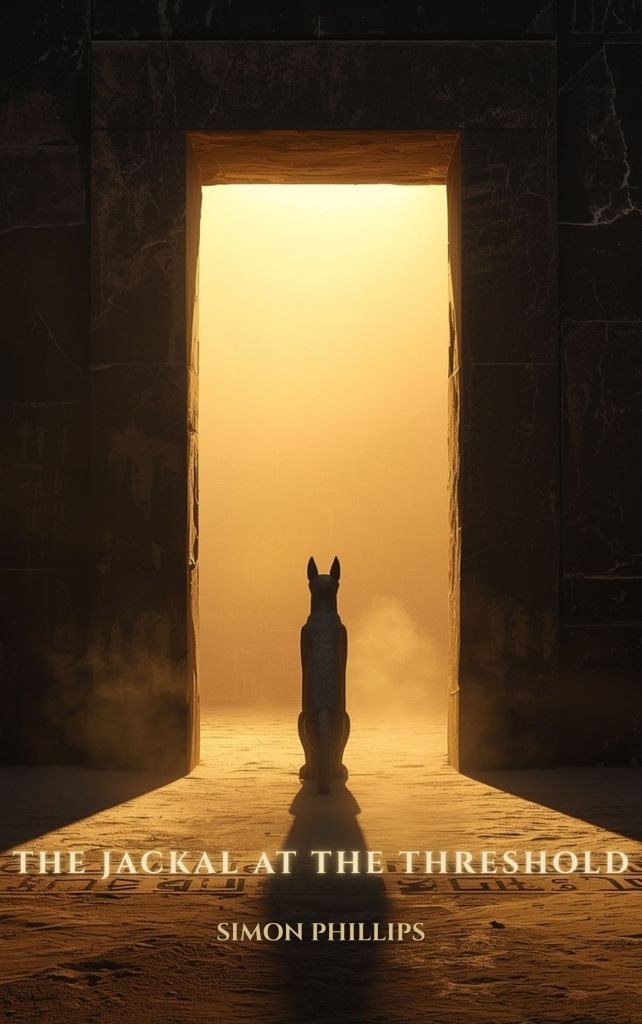
Jackal at the Threshold: A Mythic Fantasy Novella of Anubis, Judgement, and the Drowned Kingdom

A Dark Fantasy Novella at the Edge of Life and Death

In a landscape shaped by river mud, drifting sand, and forgotten dynasties, Jackal at the Threshold unfolds as a mythic fantasy novella rooted in Egyptian-inspired fantasy and the quiet terror of judgement. This dark fantasy novella follows a thief who crosses a boundary older than kings, only to discover that the gods who guard the dead remain watchful long after temples fall silent.

For readers searching for atmospheric fantasy fiction, short fantasy reads, and Amazon fantasy novellas that carry mythic weight without spectacle, this story stands at the meeting point of ruin and reckoning. It draws from ancient necropolises and jackal-haunted desert winds, yet remains grounded in human frailty: hunger, grief, guilt, and the unbearable cost of choice.

As a British fantasy author working within mythic structures and quiet horror, I have always been drawn to thresholds. Doorways. Riverbanks. The moment before a decision reshapes a life. This Kindle novella lives in that moment and lingers there, asking what remains when gold loses its shine and judgement answers in silence.

The Drowned Kingdom and the Weight of Memory

At the heart of this fantasy novella lies the Drowned Kingdom, an ancient necropolis buried beneath shifting western dunes. Its rulers predate the settled river, its corridors carved with jackals who walk between stars and sand. The tomb does not roar. It waits.

Egyptian-inspired fantasy often leans toward spectacle: plagues, curses, elaborate tomb traps bursting into flame. In Jackal at the Threshold, the horror is colder and more intimate. The air grows still. The pigment on the walls remains untouched by time. Scales hang in perfect balance. The jackal god watches without haste.

The Weighing of the Heart forms the mythic spine of the novella. Yet this weighing concerns more than virtue. It concerns intention. Responsibility. The moment when someone sees the crack in the stone and chooses to hurry anyway.

This is where mythic fantasy becomes personal.

Neris, the central figure, robs tombs because hunger demands it. The river quarter starves while the noble terraces gleam. She descends shafts and clears chambers because coin buys breath for her mother. Such choices feel practical. Necessary. Yet beneath them lie fractures that no silver can mend.

The Drowned Kingdom does not rage at her theft. It does something far more unsettling. It remembers.

Anubis Reimagined: The Jackal at the Boundary

Anubis in this dark fantasy novella is neither tyrant nor saviour. He stands at the threshold, patient and precise, weighing what is carried across his domain. He speaks without spectacle. He offers no absolution. What has been done remains part of the one who has done it.

In many indie fantasy books, gods arrive in thunder and blaze. Here, the jackal god emerges from starlit shimmer and still air. His judgement is measured, his presence quiet and vast. He allows choice. He allows consequence.

This portrayal of Anubis honours the ancient imagery of scales and feather, yet reshapes it into something interior. The weighing becomes a confrontation with memory: a brother sent ahead into a cracking shaft, graves opened in haste, gold lifted from silence. The heart holds all of it.

The result is a mythic fantasy experience that explores divine encounter through restraint rather than spectacle. The god does not shout. The chamber grows colder. The light fades. The boundary tightens. And in that stillness, truth surfaces.

For readers seeking atmospheric fantasy fiction that treats gods as forces of measure rather than miracle, this Kindle novella offers a different path through the myth.

From Tomb Robber to Guide of the Dead

The transformation within this short fantasy read does not hinge on conquest. There is no monster slain, no hoard carried triumphantly into sunlight. Instead, the relic is returned. The sceptre becomes a talisman. The thief becomes a guide.

This shift reframes the entire novella. The necropolis, once a place of plunder, reveals itself as a structure of balance. The jackals carved along the walls do more than threaten. They protect the poor man’s burial as surely as the drowned king’s chamber. The threshold exists for all.

Back in the river quarter, the gift of judgement reshapes Neris’s life. She sees spirit-trails where others see nothing. She speaks river-prayers learned from her grandmother. She eases the hesitant dead toward current and rest.

The world remains narrow. Hunger still lingers. Coin still shapes the day. Yet something has altered. The weight she carries now lifts others rather than burying them.

This is the emotional core of the novella. Mythic fantasy, at its strongest, returns the reader to the human scale. The boundary crossed in desert darkness echoes in a small room by the river. A mark on the chest replaces stolen gold. Service replaces theft.

Jackal at the Threshold: Novella Spotlight

Title: Jackal at the Threshold
Genre: Mythic fantasy novella / Egyptian-inspired dark fantasy
Format: Kindle novella on Amazon
Tone: Atmospheric, restrained, immersive

This Amazon fantasy novella stands alone as a complete story, yet opens the way into a broader mythos of drowned dynasties and watchful gods. It is designed for readers who value short fantasy reads that linger, who prefer atmosphere over haste, and who find meaning in quiet reckoning.

If you are searching for:

  • A fantasy novella rooted in ancient desert imagery
  • A dark fantasy novella centred on judgement rather than battle
  • Indie fantasy books by a British fantasy author exploring myth and threshold
  • Kindle novellas that favour consequence over spectacle

then this story offers a deliberate and immersive experience.

You can find the Kindle edition here:
https://www.amazon.com/dp/B0GM9PLM9M

Allow the boundary to open where you choose to cross it.

A Cinematic Glimpse: The Flash-Fiction Threshold

Alongside the novella, a cinematic flash-fiction adaptation is available on YouTube. This short piece acts as a threshold glimpse into the world of the Drowned Kingdom, capturing the atmosphere of desert dusk, carved jackals, and the silent moment before a door yields.

It functions as a fragment. A doorway. A sliver of torchlight against black stone.

For readers who prefer to taste the cadence and mood before stepping fully into the Kindle novella, this flash-fiction video provides that first crossing. It carries the same immersive tone, the same slow gathering of pressure, without revealing the full arc of judgement and transformation.

You can watch the flash-fiction adaptation here:

Consider it the first step into shadow before the chamber opens.

Mythic Fantasy, Indie Spirit, and the Quiet Return of Gods

As part of a growing catalogue of indie fantasy books, Jackal at the Threshold reflects a commitment to mythic structures explored through restraint. These stories move between fantasy novella and quiet horror, between buried histories and layered cities, tracing how ordinary lives intersect with forces older than language.

Living within layered environments where old shrines sit beside neon streets has shaped my sense of story. Thresholds exist everywhere. In a doorway. In a decision. In a single breath held too long.

This dark fantasy novella asks a simple question: what happens when someone crosses a boundary and is allowed to return?

The answer lies less in reward than in responsibility. In the choice to carry balance rather than escape it. In the steady work of guiding what has been unsettled toward rest.

For readers of atmospheric fantasy fiction, Egyptian-inspired fantasy, and Kindle novellas that dwell in silence as much as speech, this story invites you to stand at the edge and listen.

The desert remains wide. The river continues to flow. Somewhere beneath the dunes, stone shifts in the dark and waits.

Step toward the threshold when you are ready.

When a System Clears Something Twice

There are moments when failure announces itself loudly. Alarms sound. Lights change. Authority moves in response to visible threat.

Then there are the other moments.

The ones that pass inspection.

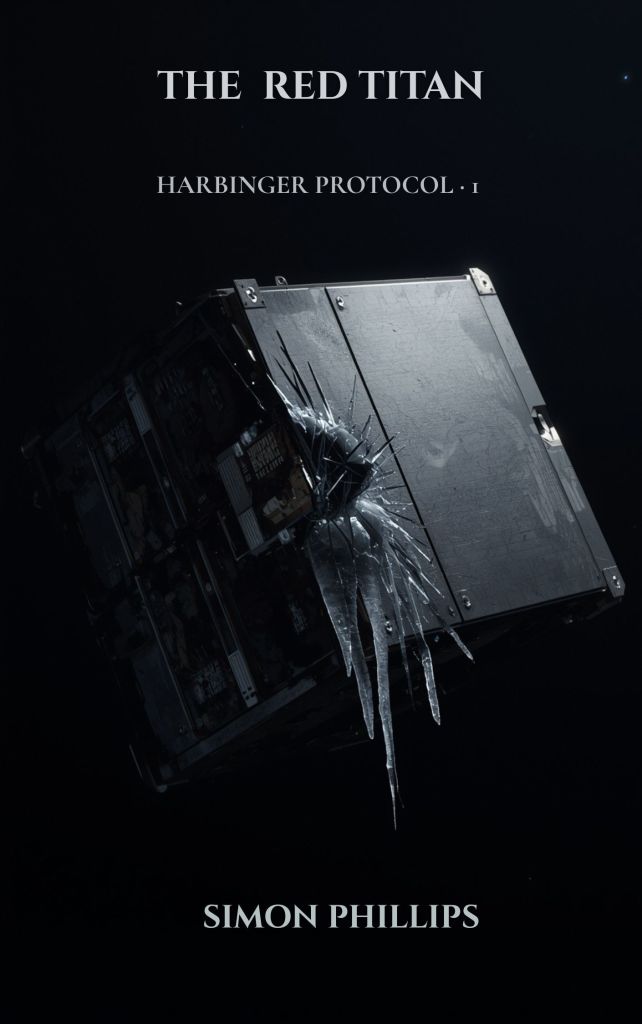
Harbinger Protocol was built around those quieter failures. The ones logged, approved, signed off, and archived without protest. The incidents that make sense on paper and leave a faint pressure in the room once the report ends.

The flash-fiction fragments I have been releasing recently come from that space. They are not scenes in the conventional sense. They are residues. Procedural echoes. Things overheard through systems that were never designed to listen for consequence.

One of those fragments centres on a compartment that received clearance twice.

No alarm followed the first authorisation.
No escalation followed the second.
Every reading remained stable.

The repetition carried no technical significance. That is what unsettled it.

Clearance systems exist to remove hesitation. They translate judgement into colour states, timestamps, and confirmation loops. Once permission is granted, the system proceeds without interpretation. That design works well in stable environments. It functions less cleanly when the environment begins to change in ways the system cannot name.

In Harbinger Protocol, those changes arrive early and quietly.

The flash-fiction videos released on YouTube present these moments as isolated artefacts. A log entry. A procedural pause. A line written down and accepted because nothing else contradicted it. They are intended to feel incomplete, as though part of the context remains elsewhere.

That context lives in the short story.

📘 Harbinger Protocol: available on Amazon Kindle
https://www.amazon.com/dp/B0GJPHF7FH

The book expands the same approach across a wider frame. Institutions responding through habit. Authorities interpreting anomalies through existing language. Witnesses revising statements under pressure until they align with what the system expects to hear.

Nothing in the story announces itself as extraordinary. The horror develops through repetition, delay, and misinterpretation. By the time recognition arrives, the paperwork already carries multiple signatures.

The YouTube video linked below functions as a recovered fragment from that larger record. It stands on its own, although it gains weight when placed alongside the written report.

Watch the flash-fiction video

I have chosen to release these fragments alongside the book for a specific reason. The Harbinger Protocol project relies on atmosphere and accumulation. Each piece adds pressure without resolving it. The videos create a sense of institutional proximity. The book carries the full procedural arc.

Neither replaces the other. They occupy adjacent layers.

This approach reflects the world of the story itself. Systems communicate through partial records. Decisions pass through multiple hands. Meaning emerges through overlap, delay, and repetition. The audience assembles understanding in the same way the characters do.

Slowly.
Indirectly.
After the moment when intervention might have mattered.

If you are drawn to restrained science fiction, procedural horror, and narratives that unfold through systems instead of spectacle, Harbinger Protocol was written for that space. The fragments will continue to appear. The records remain open.

Some files clear once.
Some clear twice.
The difference arrives later.

Inside Ashfall Station: A Sci-Fi Noir Short Story

Sector Twelve reopened before anyone asked the wrong questions.

Ashfall Station is built to remain in motion. Repairs conclude with quiet efficiency. Reports settle into their proper categories. Broadcasts arrive on schedule and carry the right tone of reassurance.
Incidents close.

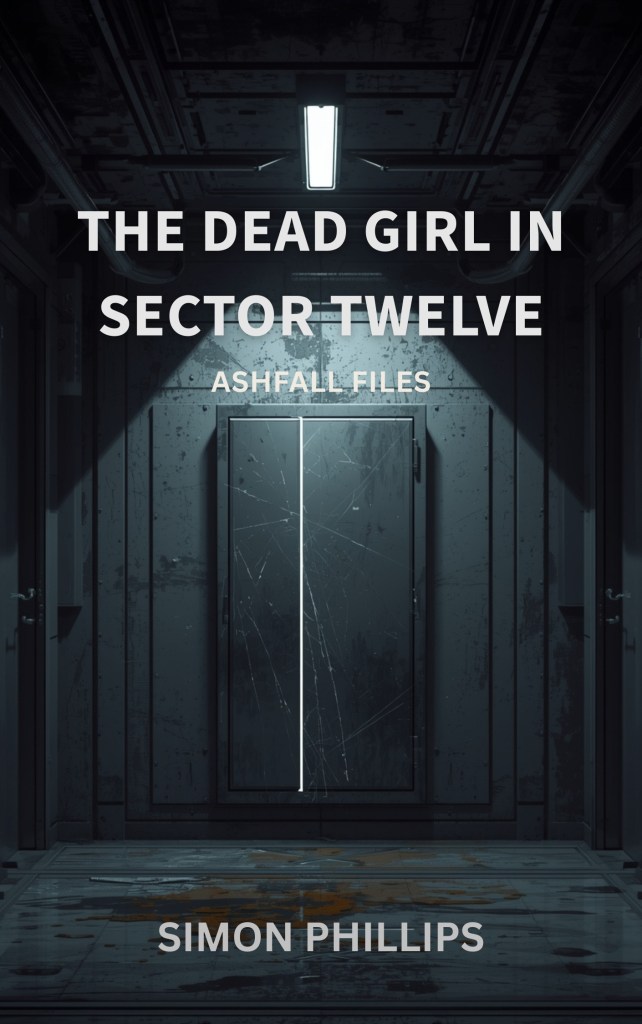
The Ashfall Files is a science fiction noir short-story series set within that system, following investigations that begin after procedure has already declared the matter finished. Each case centres on a moment that should have ended cleanly, yet lingers, misaligned, resisting the shape imposed upon it.

The first case, The Dead Girl in Sector Twelve, opens inside a corridor already marked resolved. The lighting has been replaced with a newer, steadier glow. The walls have been sealed, their seams still warm from rushed work. The station has moved on. Only a handful of details remain slightly out of place, enough to draw the attention of those whose role is to notice what others are trained to accept.

Alongside the published short story, a series of short-form flash fiction pieces and narrated fragments have been released. These are not excerpts, nor summaries. They exist as atmospheric echoes, fragments of pressure and omission designed to sit beside the main story rather than explain it. They offer an entry point for readers who prefer to listen first, to absorb tone, to decide whether to step further inside Ashfall Station.

If the corridor feels wrong, that sensation is deliberate.

A narrated visual fragment from The Ashfall Files is available to watch on YouTube, presenting the atmosphere of Sector Twelve as it reopens, before the investigation begins.
Those who prefer to encounter the world through sound and image may wish to start there.

📖 The full short story is available on Amazon:
👉 https://www.amazon.com/dp/B0GFXLMSNT

A dedicated series page for Ashfall Files is now live, gathering related stories, video fragments, and updates as the cycle expands.

Ashfall Station continues to function.
The record continues alongside it.

Why I’m Writing Fantasy Short Stories (And How They Expand My Novel’s World)

Before my epic fantasy novel The Veil of Kings and Gods releases, I wanted to open a small window into the world of Ældorra, a world of stone kingdoms, fading gods, and myths that refuse to die.

Each short story I write is its own world in miniature. They don’t rely on the main novel, yet every one of them echoes it, a fragment of history, a lost prayer, or a legend that shaped the lands my characters now walk. Some are quiet and personal; others burn with the power of the divine. Together, they breathe life into Ældorra in a way that maps and lore pages never could.

Writing these stories is more than worldbuilding, it’s a way of feeling the world I’ve spent years creating. When I step into a new tale, I discover the texture of the world again: the smell of rain on stone, the flicker of temple light, the forgotten names carved into the ruins.

These short stories aren’t just for readers waiting for the novel, they’re for anyone who loves myth, emotion, and the quiet moments that make a fantasy world feel alive.

You’ll soon be able to explore them as ebooks, see the artwork behind them, and even collect the prints.

Welcome to Ældorra. The gods don’t stay silent forever.

🎥 Watch the video

Painting the Banner of Bremyra

There’s something special about taking an idea from the page and bringing it into the real world. For me, drawing and painting scenes and symbols from my story, The Veil of Kings and Gods, isn’t just an extra step, it’s part of how I connect with the world I’m building.

The act of painting slows everything down. My hands work while my mind wanders the streets of Castellum, hears the sea breaking against the cliffs, and feels the weight of a thousand years of history pressing through the colours. It’s not just art for the sake of art, it’s a doorway into the heart of the kingdom.

Painting is a passion I’ve carried for as long as I can remember, and it has a way of anchoring me in the work. Every brushstroke feels like a moment spent inside the world itself. I intend to keep creating more pieces like this, not only banners, but places, faces, and artefacts, anything that helps me see the story as clearly as I can feel it.

A Brief History of Bremyra

What does a crimson banner with a golden griffon really mean?

This isn’t just paint on parchment, it’s the symbol of Bremyra, a southern kingdom carved between sea cliffs and old stone keeps. They never conquered, they endured. While other kingdoms fell to war and magic, Bremyra held fast, ruled by kings remembered in silence, not in song.

The golden griffon stands for honour held through fire, and the blood-red field. It’s not for war, it’s for the ancestors who built it with bare hands. Every banner has a story, and this one? It’s only the beginning of mine.

🎥 Watch the time-lapse video here:

The Unexpected Challenges of Being a Self-Publishing Author

There’s something rather thrilling about building a world from scratch. You craft your kingdoms, shape your gods, breathe life into characters who, over time, start talking back to you. But once you decide you actually want people to read what you’ve written, that’s when the reality sets in.

When I first began writing The Veil of Kings and Gods, I wasn’t thinking about publishing at all. I was just trying to write the story I’d been carrying around in my head for years. But now, with the second draft taking shape and the word count tipping well past 200,000, I’ve had to ask myself the real question: do I go down the traditional route, or do I take the leap into self-publishing?

For now, I’m leaning toward the latter. Not because I don’t believe in the traditional path, it has its strengths but because I believe in the world I’ve created, and I want the freedom to build it my way. That said, the journey to self-publishing isn’t all late-night writing sessions and dreamy cover design mockups. There are challenges you don’t quite anticipate until you’re knee-deep in them.

One of the trickiest is time. I work multiple jobs, juggle family responsibilities, and still try to make space for the novel. It’s not glamorous. Most of my writing happens in brief snatches, at school during breaks, late in the evening when the rest of the world has quieted down. Managing that with content creation for YouTube, blog writing, and building an author presence online is like spinning several plates while plotting a civil war between two kingdoms.

Then there’s the learning curve. Book formatting, ISBNs, metadata, newsletter tools, SEO, and reader psychology, none of it has anything to do with actually writing, and yet all of it matters if you want your book to reach readers. I’ve spent more time Googling “how to not look like an amateur author” than I care to admit.

Another odd challenge: sharing your work in public before it’s finished. Through Shorts, blog posts, and early lore reveals, I’ve let people peek into the world of The Veil of Kings and Gods before the final draft is done. It’s exciting but vulnerable. You’re inviting feedback, forming connections, and trying to grow a following, all while the foundations of your novel are still shifting beneath your feet.

The last thing I didn’t expect? The silence. Sometimes you pour yourself into a post, a video, a piece of lore, and it gets a handful of views, maybe a like or two. No comments. No shares. And that’s when you realise: you’re not just writing stories. You’re building faith. Quietly. Steadily. On days when no one is watching.

So yes, I’m leaning towards self-publishing. Because despite all that, I believe in this story and I believe in the long game. Traditional publishing may still be an option one day, but for now, the creative control, the direct connection to readers, and the freedom to pace this journey in a way that suits both the book and my life, that’s what I need.

If you’re also on this path, or thinking about it, I’d love to know what’s been the hardest part for you so far. Or maybe the most rewarding. Feel free to share it in the comments or just quietly know that you’re not the only one spinning the plates and chasing the dream.

5 Things I’ve Learned Writing My First Novel

When I first sat down to write The Veil of Kings and Gods, I thought I had a pretty good idea of what I was getting into. Turns out, I didn’t. Not entirely. What started as a story I’d been carrying around for years quickly became something bigger, more demanding, and surprisingly personal.

So here are five honest things I’ve learned while writing my first novel. No fluff, no glory, just the raw truths behind the word count.

1. Writing a novel is 20% writing, 80% rewriting

When people talk about “finishing a book,” what they usually mean is “finishing a first draft.” The actual writing is just the beginning. What follows is a long dance of trimming, reshaping, rewriting, and wondering what on earth you were thinking when you named a city “Flarnrath.”

Most of my real progress has come in the second draft, when characters became real, scenes started breathing, and I finally admitted that yes, that one chapter was absolute rubbish and needed to go.

2. Plot holes are sneaky little things

You can outline. You can plan. You can spend hours naming every town and hill. But I promise you, by Chapter 20, a plot hole you never saw coming will sneak up behind you like a fantasy tax collector.

Sometimes it’s a missing motivation. Sometimes a character forgets something they knew two chapters ago. Sometimes your own world’s logic turns on you. And that’s okay. Spotting the flaws means you’re actually building something worth fixing.

3. Characters have a mind of their own

This one still baffles me.

You give a character a role, supportive friend, rival noble, doomed warrior and before you know it, they’re wandering off-script, falling in love with the wrong person, or refusing to die when they’re supposed to.

It’s frustrating and brilliant. Because when a character surprises you, they’re starting to feel real. That’s when the story stops being yours alone and starts becoming something living on the page.

4. Worldbuilding is addictive (and dangerous)

Creating maps, lore, languages, timelines, ancient conflicts, it’s endlessly fun. But it can also become a brilliant excuse to avoid actual writing.

I’ve spent entire evenings designing a river system no one will probably ever look at, just to avoid a tough scene. It’s a delicate balance: build the world deep enough to feel real, but not so deep you never come up for air.

5. Progress isn’t linear, but momentum is everything

Some weeks I write two thousand words a day. Other weeks I barely manage two hundred. And that’s alright. It doesn’t mean I’m failing. It just means I’m human.

The trick is to keep showing up, to keep the story alive in your head and your heart, even when life pulls you in five different directions. Momentum builds when you stay close to the work, even if it’s just scribbling a line on your phone while riding the train.

Final Thoughts

Writing this novel has been one of the hardest and most rewarding things I’ve ever done. It’s taught me patience, discipline, and the strange kind of joy that comes from creating something nobody else can quite see, yet.

If you’re writing something of your own, or just thinking about it, I hope this little list reminds you that the struggle is part of the journey. And that you’re not alone in it.

Feel free to drop a comment below or subscribe to the blog if you’d like updates on my novel progress, lore posts, or random ramblings from the author cave.

See you in the next post.

What I’m Polishing Right Now And Why It Matters

I’ve reached Chapter 36 in the proofreading and editing phase of The Veil of Kings and Gods, and the pattern has become clear: this is no longer about fixing mistakes. It’s about tone. Rhythm. Weight. The spaces between words.

When I began this second draft, I thought I’d be reshaping large sections, reordering scenes, reworking arcs, perhaps cutting full paragraphs. And in truth, some chapters needed that. Yet here, in the later stages, the work has become quieter. More precise. Less like carving, more like tuning.

I’m refining sentence flow. Ensuring no paragraph ends with a stumble. Trimming where the language slows the momentum or where an image tries too hard to impress. Dialogue has taken centre stage again too. In Simion’s chapters especially, I’ve been paying attention to how he thinks, how he observes. His voice must remain grounded, measured, introspective, often solemn, but never flat. He is not a man who wastes words. So neither should I.

There’s also the matter of emotional pacing. Certain scenes strike harder now than they did in the first draft, and I’ve begun to see where quiet moments need to linger longer, or where a single line can carry the echo of something far greater if allowed room to breathe. Chapter 36, for instance, held a moment that was previously brushed over, just a line or two. This time, I let it unfold. Let it weigh down the silence.

None of these changes are structural. You won’t find a new character or a rewritten ending here. What’s happening is deeper: it’s the voice of the book aligning with its soul. And I know I’m close. There’s something sacred about this part of the process, where the raw story becomes refined enough to stand on its own, without commentary or apology.

So, that’s where I am. Nearing the final arc. Reading aloud. Listening for false notes. Letting the book breathe.

Thank you for walking alongside me.