Calibration Cycle: Meteor Event and the Quiet Violence of a Psychological Science Fiction Novella

When the room is calm, the pressure has already entered
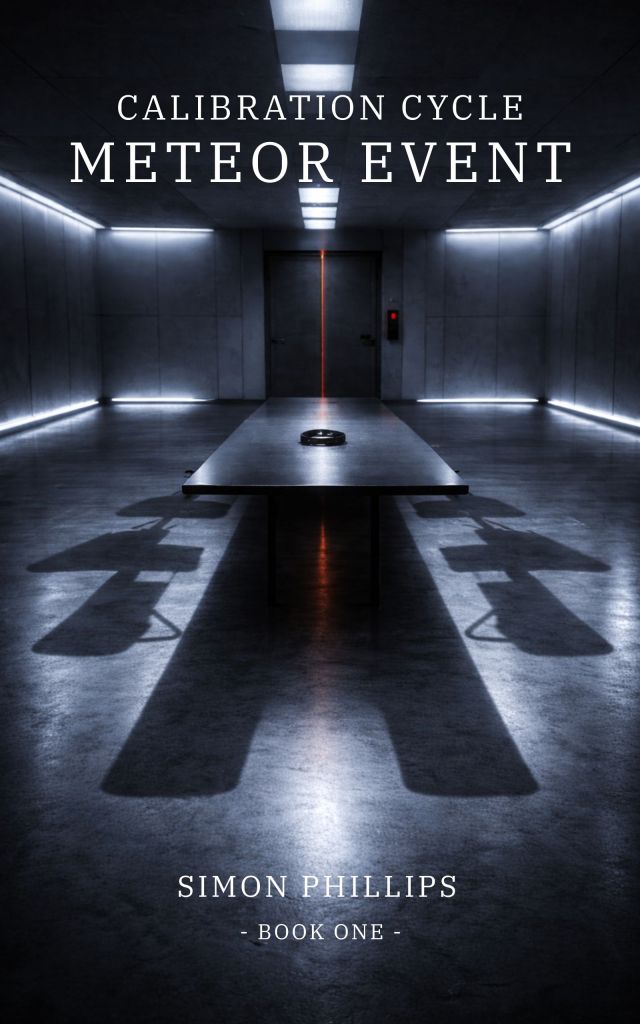
Calibration Cycle: Meteor Event is Book 1, opening inside an orientation room shaped by muted white walls, measured voices, and a clinical calm whose restraint carries unease from the first page. The project blueprint positions that opening as institutional tone and subtle unease before the transition into a meteor-threat world, permanent casualty, nuclear interception, and a return whose wrongness reveals itself through structural divergence.

Few forms of psychological science fiction novella work with pressure as effectively as simulation reality science fiction when it chooses fluorescent stillness over spectacle. Meteor Event understands that from the opening line. The room exists to settle the pulse, which means it also exists to manage compliance, and Simon Phillips lets that management gather through surfaces, posture, ventilation, lighting, and voice until the reader feels enclosed long before the wider system shows its hand. For readers drawn toward alternate reality science fiction novella territory, the strength here lies in that first act of restraint, since the environment feels composed, professional, almost ordinary, and the ordinary becomes the instrument.

At surface level, the premise carries the shape of a VR experiment gone wrong story. Volunteers arrive at a classified facility. Headbands settle against the temples. A crisis scenario begins. Yet the lived texture of the novella keeps moving away from familiar game logic. Pain registers. Authority hardens. Weather carries weight. A body falls and remains. By the time the characters start searching for the seam, the deeper unease has already shifted from technology toward consequence.

Simulation, optimisation, and the human cost of procedure

The strongest current running through Meteor Event comes from the collision between optimisation and human judgment. The yard scene, the wristband prompts, the intervention protocol, the countdown toward interception, each piece pushes the group toward decision through a language of probabilities, access, and mission framing. No speech arrives in the language of conscience. Every instruction arrives as if a calculation has already taken place elsewhere.

That shift matters because reality distortion fiction often leans on visual confusion, dream logic, or metaphysical excess. Phillips chooses a colder method. He places his people inside a structure that feels procedural enough to trust, then lets trust erode through continuity marks, fatal force, and the quiet discovery that injury remains after return. The effect is less like hallucination and more like administrative violence, the kind that passes through systems, screens, corridors, and uniforms before it reaches skin.

This is also where the novella starts to feel like an experimental science fiction story in the strongest sense. The experiment sits inside the narrative, and the prose itself behaves experimentally through control: tension accumulates through measured observation, repeated institutional language, and an almost forensic attention to how a space feels in the body. The meteor, the bunker, and the launch sequence carry scale, though the deeper fear grows from the sense that each step has already been accounted for, and that the characters are being gently shepherded toward actions whose moral cost no one around them is willing to own. The series architecture reinforces that long arc, framing the wider premise as a classified AI and VR experiment that opens into real dimensional displacement, false returns, and transformation across later books.

The moment when reality keeps its shape and loses its certainty

One of the most effective choices in Meteor Event comes from the way certainty fragments while the physical world remains coherent. The opening room feels coherent. The yard feels coherent. The bunker feels coherent. Even the return to the waiting room arrives with such smooth continuity that relief becomes plausible. Then the body begins to argue with the mind. The missing temple hardware, the swelling ankle, the bruises, the pressure marks, and the absence of other returnees all begin to undermine the comfort of re-entry.

That approach gives the novella its psychological charge. Many speculative stories ask whether reality is real. Meteor Event asks a colder question: what happens when the world feels stable enough to obey, even as consequence proves that stability false. The ending crystallises that pressure through the single-star flag, a detail small enough to require a second look, devastating enough to redraw every room that came before it. The project notes define Book 1 through an observation-room repetition and a “full wrongness” ending, and the novel’s final image delivers precisely that sensation, since the divergence arrives through symbol, absence, and institutional composure instead of spectacle.

Novella spotlight: Calibration Cycle: Meteor Event

As the opening movement in a speculative science fiction series, Meteor Event carries an unusually clean sense of purpose. It introduces Aaron Cole and the wider group inside a controlled environment whose calm grows steadily more suspect, then forces them through a crisis framed as collaborative decision-making before revealing that return itself may be another layer of displacement. The Movement I blueprint positions Book 1 around orientation, death permanence, nuclear interception, and a structurally wrong return, which gives this first volume a complete pressure arc while also opening the wider corridor of the series.

The emotional experience of the novella comes less from plot revelation and more from exposure to managed pressure. Aaron’s observational steadiness, Rei’s discipline, Connor’s analytical drive, Marcus’s tactical realism, Declan’s sceptical civilian eye, and Sofia’s growing sensory unease create a group dynamic where moral judgment shifts under stress instead of arriving as grand statement. The result feels intimate even during scenes of missile launch and atmospheric catastrophe, because the real subject remains choice under constrained information. That is where the novella earns its place inside psychological science fiction over action-first military futurism.

For readers browsing Amazon for a Kindle science fiction series or an indie sci-fi novella with a more controlled atmosphere, the listing for Calibration Cycle: Meteor Event sits under Simon Phillips in Kindle and paperback formats. The listing functions almost like the novella’s own threshold: quiet, formal, and more unsettling once the first pages begin to gather force.

Why this pressure lingers

What lingers after Meteor Event is the sense that the system gains power through calm presentation. The white room, the clipped instructions, the mission prompts, the neutral terminology around intervention and access, each one pushes against the human need for moral language. Even the series documents emphasise escalation through personal risk, false return, and grounded continuity instead of flamboyant rupture, which helps explain why the novella feels so persistent after the final page. The pressure keeps its shoes on. It walks through doors. It speaks in measured tones. It carries a badge.

That is why Calibration Cycle: Meteor Event lands so effectively within simulation reality science fiction, alternate reality science fiction novella territory, and the wider field of experimental science fiction story craft. The book extends unease through environment, consequence, and institutional behaviour, and it closes on an image that leaves reality almost intact, which in many cases is the most unsettling fracture of all. The world remains visible. The pressure remains active. The corridor continues.
Institutional Sci-Fi Horror Novella: The Open Gate and the Psychology of Controlled Access

Where the System Still Holds: Until It Doesn’t

There is a particular kind of silence that forms around controlled places, a silence shaped through repetition, procedure, and the quiet confidence of systems that have held for longer than anyone working within them can fully account for. In a speculative science fiction novella such as The Open Gate, that silence becomes the first signal, faint at first, though persistent enough to suggest that something within the structure has begun to drift beyond its original design.

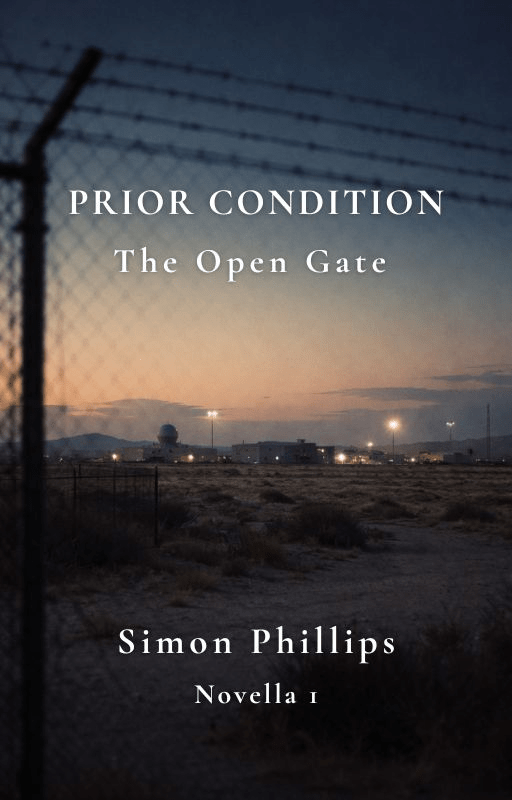
The landscape surrounding the facility offers nothing dramatic to draw the eye, only distance, fencing, and the slow rhythm of movement along established routes. Vehicles pass through checkpoints with practised ease, personnel follow familiar patterns, and each action reinforces the impression that the system remains intact. This is the architecture of institutional science fiction horror, where tension gathers through routine rather than disruption, and where certainty begins to thin long before anything visibly fails.

Within this kind of slow-burn science fiction novella, the unease emerges through proximity rather than spectacle. The closer one moves toward the centre of control, the more the atmosphere shifts, almost imperceptibly, into something denser, something that resists easy explanation. The language of procedure continues to operate, though its meaning begins to stretch, and the structures designed to contain begin to reveal the limits of their understanding.


When Access Becomes Assumption

At the heart of The Open Gate lies a question that extends beyond the physical boundary of the installation itself, reaching into a broader reflection on how humanity approaches systems it believes it has mastered. Access, once granted, carries with it an unspoken confidence, a belief that entry implies comprehension, and that comprehension implies control. Over time, this belief settles into routine, and routine hardens into institutional certainty.

In psychological speculative fiction, this shift becomes the foundation of tension. The facility continues to function, reports continue to circulate, and personnel continue to operate within defined parameters, even as the underlying reality begins to diverge from those parameters. There is no sudden collapse, no immediate rupture. Instead, there is a gradual misalignment between what is observed and what is recorded, between what is experienced and what is permitted to be acknowledged.

The language used within such environments reflects this resistance. Observations are softened, anomalies are reframed, and deviations are absorbed into existing frameworks wherever possible. The system protects itself through interpretation, maintaining coherence even as coherence becomes increasingly difficult to sustain. This is the essence of science fiction about secrecy and control, where the most dangerous element lies in the refusal to recognise that control has already begun to slip.


The Weight of Containment

A base or facility science fiction novella often draws its strength from the tension between structure and what exists beyond that structure. In The Open Gate, containment serves as both a physical and psychological boundary, shaping how individuals move, think, and interpret their surroundings. The walls, the protocols, and the layered systems of verification create an environment where uncertainty has little room to surface openly.

Yet uncertainty finds its way through smaller channels. It appears in hesitation, in repeated checks that extend beyond necessity, and in the subtle shift of attention toward elements that once required no thought. The individuals within the facility continue their roles, maintaining outward composure, while an internal awareness begins to form, one that remains difficult to articulate within the language available to them.

This tension between internal recognition and external procedure forms a central thread in existential science fiction stories. The system demands continuity, while the individual senses discontinuity. The result is a form of quiet psychological pressure, one that builds through accumulation rather than escalation. Each moment passes without incident, though each moment carries an increasing weight, as if the structure itself has begun to hold something it cannot fully contain.


Routine as a Form of Denial

Within institutional settings, routine serves a dual purpose. It provides stability, allowing complex operations to continue without interruption, and it offers a form of insulation against uncertainty. In a slow-burn science fiction novella, routine becomes a mechanism through which denial operates, smoothing over inconsistencies and maintaining the appearance of normality.

The repetition of actions reinforces the belief that nothing has changed. Doors open and close as expected, systems respond within acceptable parameters, and communications follow established patterns. Each confirmation strengthens the illusion of continuity, even as subtle deviations begin to accumulate beneath the surface.

Psychological speculative fiction often explores this space, where the most significant shifts occur in areas that remain technically functional. The system continues to operate, though its outputs no longer align perfectly with the reality it seeks to manage. The individuals within the system recognise these discrepancies, though recognition alone proves insufficient to disrupt the broader structure.

This creates a condition where awareness exists alongside compliance, where individuals continue to perform their roles even as their confidence in those roles begins to erode. The result is a form of quiet tension that permeates the environment, shaping interactions and altering perception without ever fully breaking through into open confrontation.


The Open Gate: Novella Spotlight

The Open Gate: Prior Condition stands as the opening movement within a broader Kindle sci-fi novella series, establishing the tonal and thematic foundation through a restrained, observational approach to speculative fiction. Positioned at the beginning of the sequence, it introduces a world defined through systems, boundaries, and the quiet assumption that those boundaries remain secure.

The central pressure shaping this novella emerges through the intersection of procedure and perception. The facility operates as intended, its structures intact, its protocols unchanged. At the same time, a subtle shift begins to take hold, one that resists clear definition and remains just beyond the reach of formal acknowledgement. The narrative moves through this space with a steady, controlled cadence, allowing the tension to gather through detail, observation, and the gradual erosion of certainty.

For those drawn to indie science fiction novellas that prioritise atmosphere and psychological depth over spectacle, The Open Gate offers an entry point into a series that unfolds through accumulation, where each layer adds weight to what remains unseen. The novella can be found here:
https://www.amazon.com/dp/B0GSLLRL7C


A Threshold Made Visible

Alongside the written work, the visual and atmospheric media connected to The Open Gate functions as an extension of the same space, capturing fragments of the environment in a form that allows them to be observed from a slight remove. These pieces act as preserved thresholds, moments where the system remains intact on the surface, while something beneath that surface suggests a different reality.

The imagery associated with the series often focuses on the elements that define its tone: the fencing that marks the boundary, the structures that enforce separation, and the landscapes that surround these installations without offering explanation. Light shifts across these surfaces in ways that emphasise their stillness, creating a sense that the environment itself holds a form of awareness that extends beyond the individuals moving within it.

Viewing these fragments offers a different form of engagement, one that complements the reading experience without attempting to replace it. They serve as points of return, places where the atmosphere of the novella can be revisited and examined from another angle, reinforcing the sense that the world of The Open Gate exists beyond the page.


Where Procedure Continues

What defines the world of The Open Gate is the persistence of procedure in the face of growing uncertainty. Systems continue to operate, reports continue to be filed, and individuals continue to move through their assigned roles with a level of discipline that has been established over years of repetition. The structure remains, even as the confidence that supports it begins to shift.

This is the quiet centre of the novella’s tension, where the most significant change lies in the recognition that the system may no longer fully understand what it contains. There is no immediate collapse, no clear moment where control is lost. Instead, there is a gradual realisation that control may have always been partial, and that the boundaries defining the facility extend into areas that resist containment.

The installation remains in place, its fences unbroken, its procedures intact. Vehicles continue along their routes, personnel continue their tasks, and the language of control continues to frame each observation. Yet beneath this continuity, a different awareness begins to take shape, one that suggests the boundary has already shifted, even if the system has yet to recognise it.

And so the work continues, measured, controlled, and precise, as the threshold remains where it has always been, waiting, unchanged in appearance, though altered in ways that remain just beyond the reach of certainty.