When the Muse Doesn’t Show Up

There are days when the words come easily. They arrive like old friends, familiar, unannounced, and warmly welcome. You sit down with your tea, open the manuscript, and something clicks. The sentences lean into each other. The story breathes.

And then there are the other days.

You know the ones. Where every sentence feels like it was dragged from the mud. Where the cursor blinks like a silent metronome, keeping time with your growing doubt. When the characters stop speaking. When the world you’ve built, so vivid yesterday, fades like mist at first light.

We talk a lot about inspiration in this line of work. The muse. The spark. The rush of a new idea. But we don’t often talk about what it means to write without any of that. To write when it’s quiet. When it’s hard. When it hurts.

That, I’ve found, is where the real work lives.

Writing isn’t always romantic. Sometimes it’s just a decision: to show up. To sit with the silence. To tap out a paragraph you’ll probably delete tomorrow, not because it’s good, but because it keeps the habit alive. It’s resistance in its softest form, writing even when the muse doesn’t show up.

And on those days, there’s a different kind of satisfaction. Not the high of a breakthrough, but the quiet pride of keeping faith with the story. Of putting your hand to the wheel even when the stars aren’t shining.

Because the truth is, the muse does come back. Eventually. She always does. But sometimes she waits to see if you’ll keep writing without her.

And that’s when the real pages are written.

Azaroth and the First Hell: The Demon God Who Was Once Divine

Before he became the greatest threat to Ældorra, Azaroth held a place among the divine.

During the age of the Imperium Arcana, the gods still shaped the world. Their presence guided the rise of empires, the movement of stars, and the sacred flow of magic. Among them stood Azaroth, an entity devoted to balance and universal law. He did not govern love or war. His realm existed at the intersection of order and arcane truth. Mortal kingdoms honoured him with silent offerings, while the Order of Magicians held his name among the highest in their ancient texts.

Over time, something within Azaroth shifted.

No records reveal the full path of his descent. Even the Order, with all its stored knowledge and sealed tomes, whispers only fragments. What remains clear is this: Azaroth chose to leave the High Heavens. He reached downward, into the wounded depths of reality, the realm known only as the First Hell.

That place devours meaning. Magic there fractures into madness. Time becomes a storm of echoes. Azaroth returned changed. Divine no longer, he emerged cloaked in shadows that moved like thought. His magic no longer carried harmony. It consumed. Across the divine realms, tremors of dread followed in his wake.

The God of Magic rose in response. Once kin to Azaroth, he stood alone before the fallen deity. The clash between them tore across sky, land, and sea. Entire mountain ranges cracked. Oceans surged beyond their borders. Celestial towers collapsed into memory.

The fallen was sealed. Azaroth’s essence remained trapped within the First Hell. To ensure the prison held, the God of Magic sacrificed himself. No tomb bears his name. No statue rises in his honour. His essence faded, though his victory allowed the world to continue.

The seal endured across centuries.

Now, it weakens.

In The Veil of Kings and Gods, faint tremors move through forgotten chambers and shattered temples. Spells fail. Visions twist. In moments of silence, some hear voices echoing with words never spoken. The First Hell watches once more. Azaroth reaches toward the living world through cracks in the veil.

He remains more than a demon. A god’s ambition shaped his fall. His memory was stripped from scripture, yet his will never faded. He waits, not in silence, but in hunger.

And now, the gate flickers.

Magic in Ældorra: A Gift, a Curse, or Something More?

In Ældorra, magic is not studied. It is claimed. A birthright, a spark born into the blood, seen by the Order, and seized before the world can lay its hands on you.

From the moment a child reveals the first hint of magic, whether by accident or fear, the Order of Magicians arrives. There are no family farewells. No second chances. The child is taken, their name entered into the record of the Academy, and whatever life they knew is quietly severed. To possess magic is to belong to the Order. Nothing else.

All magicians begin the same. They are taught the spoken forms, the written glyphs, the rigid cadence of incantation. Magic cannot be used without language. It must be spoken aloud, shaped by voice and carved by word. There are no silent spells, no intuitive gestures, no whispered charms in the night. If a magician forgets a word, the spell fails. If they twist its structure, the spell misfires, or worse.

Yet among those who speak the same spells, power is not equal.

Each magician draws from what the Order calls their well. Some wells are shallow, only able to fuel modest enchantments, brief illusions, momentary shields, small bursts of flame. Others are deep, vast, and enduring. Those who carry such wells rise quickly. These are the ones who bend flame to their will, who can speak a word and bring down the sky. They are the ones who ascend to the Council: The Order of Five, whose decisions shape the kingdoms more than any throne.

But even the greatest magician faces one immutable truth: they cannot heal.

It is not that healing magic is forbidden, it is simply beyond their reach. No spell, no incantation, no force of arcane will can mend the flesh or restore the spirit. That gift belongs solely to the Church of Christiana. Theirs is the divine touch, the holy word. It is a truth both sides know, yet seldom speak aloud: the Order commands the arcane, but it is the Church that claims the soul.

And though the world fears the Order, it is not without its own cruelty.

In Ældorra, only men may wield magic. Women, no matter how gifted, are forbidden by law. A woman who speaks a spell, whether for battle or for mercy, is declared a criminal. Even a healing incantation, performed in secret, may bring death. The punishment is absolute. The Order’s law is iron, and its reach does not falter.

So is magic a gift? A curse? Or something stranger still?

For those who carry the spark, there is no choice. Only the path set before them, the laws carved in stone, and the weight of a power they did not ask for, spoken word by spoken word, until their voice is no longer their own.

Writing While Working Two Jobs: Why I Still Do It

People often ask me how I find the time to write while working two jobs. The short answer is: I don’t. Not really. Not the way I wish I could. But I do write, every week, sometimes every day, usually when I should be resting. And despite the exhaustion, the long nights, the early mornings, and the occasional doubt, I keep going. Because the story matters.

The Chaos Behind the Chapters

Right now, my life is split between running a small school, working night shifts, and squeezing in writing during stolen hours. Most days, I get by on sheer routine. Coffee helps. So does knowing that every chapter I finish brings me one step closer to the book I’ve dreamed of releasing for years: The Veil of Kings and Gods.

I’m not writing from a cabin in the woods or some serene studio. I’m writing at school, on the dinning room table, between shifts, and late into the night when everything else is quiet. This novel is being built between real life’s demands and that, in a strange way, makes it even more personal.

Why Not Wait?

It would be easy to say, “I’ll write when life slows down.” But the truth is, life might not. And if I wait for the perfect time, I might never finish the story I’ve already poured so much of myself into.

So instead, I chip away. One scene, one chapter, one revision at a time. And you know what? That consistency adds up. Even if I’m tired. Even if I sometimes question whether it’s worth it.

The Deeper Reason

I write because I love this world I’ve created. I believe in the characters. Simion, Elana, the fractured kingdoms of Ældorra, they’ve stayed with me through everything. And if they’ve stayed with me, maybe they’ll stay with readers too.

Writing gives me a sense of purpose beyond the day-to-day. It’s a reminder that I’m building something for myself, something that might one day outlive the jobs, the side gigs, and even the fatigue.

If You’re in the Same Boat

To anyone reading this who’s also juggling too much while trying to create something: keep going. Your work is valid, even if it’s slow. Even if it’s messy. Even if no one sees it yet. Just showing up matters.

What’s Next?

I’ve just finished proofreading and editing three more chapters, and it’s starting to feel real. I’ll be sharing more about the process and the book itself, both here and on my YouTube channel soon. If you’re curious about how a fantasy novel gets written under pressure (and often after midnight), subscribe or follow along.

Until then, thank you for reading, and thank you for letting me share this chaotic, hopeful journey.

Editing, Rereading, and Rediscovering My Story

Over the past few days, I’ve been deep in the process of proof-reading and editing three chapters of my novel, The Veil of Kings and Gods. It’s not the most glamorous part of writing, but this time, it felt different.

Something about reading the story with fresh eyes after a short break made the experience… enjoyable. Genuinely enjoyable.

I wasn’t just correcting grammar or trimming repetition, I was rediscovering the world I’d built. The tension in a particular scene, the rhythm of dialogue I’d forgotten writing, or that one line that landed exactly how I hoped it would months ago. These small victories reminded me that, yes, I’m actually telling a story worth reading.

There’s a strange kind of pride that comes with this phase. It’s less about ambition and more about affirmation. Not “Will this sell?” but “I’m glad I wrote this.”

Of course, I still tweak. I still cut. I still sigh when a sentence refuses to behave. But the difference now is that I’m refining something real, something that already exists, not chasing a blank page.

If you’ve ever written something long-form, be it a novel, a thesis, or even a personal journal, you might know the feeling: rereading your own words and thinking, This isn’t perfect… but it’s mine. And it’s good.

That’s the stage I’m in right now. And I wanted to share it, not just the technical process, but the strange joy of falling back into a world you created and realising you want to stay there a little longer.

Want to Hear the Behind-the-Scenes Version?

If you’d rather hear me talk through the editing process, I recorded a short face-to-camera video as well. You can watch it here:

Whether you’re a fellow writer, a reader waiting for the book, or just curious about the creative process, I hope this gives you a little window into what it means to edit with joy.

Let me know in the comments: Have you ever gone back to something you made and felt quietly proud of it?

Writing Between Worlds: How I Create Without a Dedicated Space

There’s a romantic image of writers, sitting at a tidy desk by the window, sunlight pouring in, coffee steaming, and silence wrapping around them like a warm blanket. I admire that image. But my reality looks nothing like it.

I don’t have a designated writing space. Instead, I bounce between my school desk during quiet moments, the dining table when it’s free, and sometimes, my children’s study desk, usually after they’ve abandoned it for something more exciting. These places aren’t ideal, but they’ve become little writing islands where my story continues to grow.

As for my schedule, it’s a puzzle I solve day by day. I try to write in the afternoons between lessons, catching the quiet moments when the school slows down. Evenings are when I get the most done, once the family is asleep and the house slips into silence, that’s when I open the laptop and step back into Ældorra or whatever world I’m working on.

Weekends are unpredictable. If there’s time, after the housework, the errands, the family time, I write. Sometimes it’s just for twenty minutes, sometimes I surprise myself with a full hour of deep focus. But I’ve learned something valuable: consistency doesn’t always mean strict routines. Sometimes it just means showing up when you can, and making those small moments count.

I don’t write in perfect conditions. I write around life. And in a way, I think that gives my stories more life too.

If you’re a writer juggling your own chaos, I’d love to hear where and when you find your writing windows. Let’s build a space together, even if it’s scattered.

How I Stay Inspired While Writing the Same Story for Years

Writing a novel isn’t always a straight path. For me, it’s been more like a winding mountain trail, sometimes clear and exciting, other times foggy and slow. I’ve been working on The Veil of Kings and Gods for years now. The world, the characters, and the themes have all evolved over time. And yet, somehow, I’ve never walked away from it.

So how do I stay inspired?

It’s not some mystical lightning bolt. It’s smaller than that, quieter. Sometimes it’s rediscovering an old scene I wrote months ago that still makes me smile. Other times it’s worldbuilding, filling in the map of Ældorra, thinking about what life is like in a ruined empire or how a long-forgotten piece of magic reshapes a character’s fate.

I also let the story grow with me. When I started this book, I was in a very different place in life. But I didn’t throw it out and start over. Instead, I’ve allowed my voice, my ideas, and my perspective to shift as the years have passed. I’ve rewritten, restructured, and reimagined, but never lost the heart of it.

What helps most, though, is this: I don’t pressure myself to rush.

This is a story I care about. I want it to be the best version of itself, not the fastest one. That mindset keeps the love alive. Some days I only manage a few lines. Other days I go deep. But each word brings me closer to the story I want to share.

If you’re writing something that’s taken years, you’re not alone. Let it take the time it needs. Let it change with you. The story will be stronger for it.

I’d love to hear about your long-term projects. What keeps you going? What has changed since you started?

Simion the Magician: Pawn of the Divine or Something More?

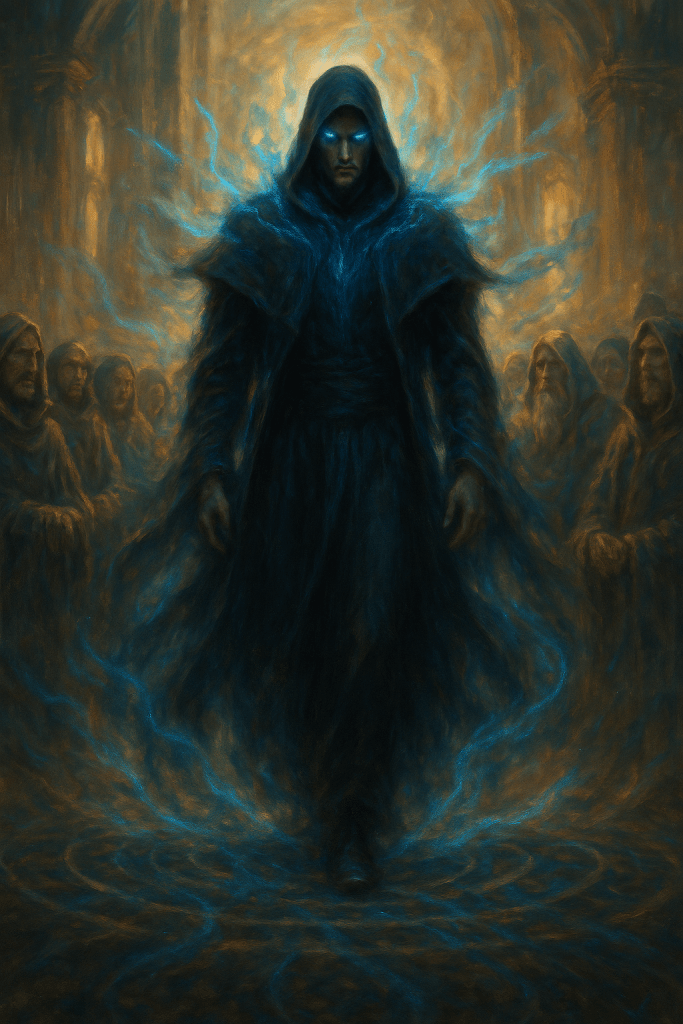
A cloaked figure exuding magical energy stands at the center of a dimly lit chamber, surrounded by a group of hooded onlookers. The figure's blue eyes glow intensely, hinting at a powerful presence in a mystical setting.

In a world once shaped by divine hands, where kings fear what they cannot control, Simion stands at the edge of myth and obscurity. He holds no grand title, wears no gilded robes, and bears no reputation as a prodigy of the arcane. His story is quieter, rooted not in greatness, but in something far more human.

Before the councils and court chambers, Simion was a kitchen boy. The castle at Bremyra was his world, its stone corridors filled with the clatter of pans and the scent of stewing broth. He moved among servants, delivering bread, cleaning floors, and sneaking crusts to the youngest among them. It was there, beneath those very walls, that the first spark of magic broke loose from within him. A frightened boy. A sudden flare. And the Order of Magicians arrived before the embers cooled.

He was taken without ceremony. His name added to the rolls of the Academy where the days were long, the teachings relentless. Simion did not rise easily. Others soared through the high arts, weaving spells with elegance and precision. He struggled to hold form, to understand deeper currents, to speak the tongue of magic with anything beyond effort. Yet he endured, through sheer will, long study, and quiet resolve.

Upon completing his training, no citadel called him. The cities of power remained silent. His path remained unclear until his former master, a stern voice within the Council, arranged a post that few would envy, Advisor to the King of Bremyra. It was less a promotion than an obligation. A placement of necessity. Still, he accepted.

Now, Simion walks again through familiar stone halls. He stands beside those who once knew him in passing. Elana, a friend from youth, the princes, with whom he once shared stolen moments of laughter. The kitchen boy has returned, not with acclaim, but with a burden that grows heavier by the day.

The kingdom shifts. Whispers speak of hidden tomes, ancient chambers sealed in forgotten stone, and strange forces moving beneath the world. Simion has seen things no Advisor should see, felt magics that do not obey the rules he was taught. There are voices now, soft, distant, threading through silence.

He never sought power. Nor was he shaped for glory. Yet in the quiet places where gods once walked, something has stirred.

And Simion, worn and uncertain, may be the only one left who can hear it.

The Gods of Ældorra: Who They Were Before the Fall

Author’s Note:
In my fantasy novel The Veil of Kings and Gods, the world of Ældorra is shaped by ancient gods, divine betrayal, and the remnants of a shattered empire. This post explores the origin of Ældorra’s divine war, drawn directly from the mythic past within the story itself. If you enjoy deep lore and high fantasy, this is for you.


Before kingdoms warred and magicians stood above kings, Ældorra was shaped by gods, divine beings whose presence touched every corner of the world. In the time of the Imperium Arcana, magic was not a distant force, but a living breath that pulsed through every stone, sea, and soul. This magic, ancient and sacred, came not from study alone, but from the gods themselves.

Among these deities stood the God of Magic, the mightiest of them all. His power was the very source of the arcane that wove the empire together. He was not only a divine figurehead, he was the guardian of all, it was he who anointed the magicians as the empire’s true rulers, custodians of magic who were revered not just as wielders of power, but as the chosen of heaven. To command the arcane was to speak with divine authority, and so the magicians ruled not by bloodline, but by divine will.

The Imperium flourished under this covenant. Cities of marble and gold rose across the land, and every breath of wind, every whisper of light, carried the weight of enchantment. From the fjords of the north to the eastern deserts, magic was life, and life was divine.

But divine creations are not immune to betrayal.

The fall began with a god of the First Heaven, once the deity of balance and insight. His corruption was not a sudden blaze but a slow rot, fed by ambition and the hunger for more. The god descended from his sacred post, abandoning the divine realm to seek darker paths. Deep within the First Hell, his magic became something twisted and foul. No longer a god, he was reborn as a demon: Azaroth.

Azaroth’s rise did not go unnoticed. While the magicians of the Imperium grew complacent, blinded by their own greatness, it was the God of Magic who first sensed the rot. Alone among the heavens, he understood the threat. And so, the two former brethren clashed, not with armies or swords, but with the raw essence of creation itself. Magic and corruption tore through reality. The heavens cracked. The seas rose. The skies burned.

In the end, the God of Magic made the ultimate sacrifice. With the last of his divine essence, he sealed Azaroth within the First Hell, imprisoning the demon for eternity. Yet victory came at a cost: the God of Magic himself was torn apart, his name lost to time, his power shattered.

And with his fall, so too fell the Imperium.

What followed was silence. The gods no longer walked the world. The arcane throne stood empty. The magicians, left to their own devices, could no longer claim divine mandate. But before the empire’s final breath, the last emperor passed one final law: that the magicians would remain autonomous, above kings, above law, outside the reach of Church and Crown. Thus, the Order of Magicians was born.

The gods’ war was long buried by history, but its echoes never faded. In The Veil of Kings and Gods, the seal on Azaroth begins to weaken. Forgotten powers stir. And the divine magic once thought lost whispers again from the shadows of Ældorra.

The gods may be gone.
But their war is not over.


Want more?
This is just the beginning. The divine echoes of this history shape every chapter of The Veil of Kings and Gods, especially through the eyes of Simion the Magician. New blog posts, lore entries, and behind-the-scenes content are released every other day. Subscribe to the blog, follow on YouTube, or check out my short stories for deeper glimpses into Ældorra’s ancient past.
Inside the Life of an Aspiring Author

Most people imagine authors as curled up in quiet rooms, sipping tea and watching the words pour effortlessly onto the page. A kind of literary tranquillity, wrapped in books and warmed by candlelight.

I wish that were true.

The reality, at least for me, is far from romantic. It’s writing between real-life responsibilities, when the house is quiet and the world finally pauses. I’ve made a decision to pursue this dream fully, working extra hours not because I love the grind, but because that income, after family needs, goes straight into editing, proofreading, and eventually publishing. I’m investing in my own story, one sacrifice at a time.

My day is a patchwork of obligations. I run a small English school in Japan, manage creative routines around work and home life, and still find time to draw maps, script lore videos, and edit chapters that feel like they’ll never end. I’m not yet published. I’m not famous. But I’m building something, page by page, post by post.

There’s a mental weight to this work that few talk about. Some days, I stare at a sentence for an hour, unsure if it even belongs. Other days, it all flows so quickly I can barely keep up. The emotional shifts are real, self-doubt, exhaustion, the nagging feeling that I should be doing something more “practical.” But then a scene clicks. A piece of world-building locks into place. And for a moment, it feels like magic again.

So why do I keep going?

Because I believe in the stories I’m telling. The Veil of Kings and Gods is more than a novel, it’s a world I’ve carried for years. The short stories of Ældorra let me explore lost myths and haunted corners I’ve only glimpsed in dreams. And my sci-fi series, still in early development, pushes me to imagine a future I can barely articulate.

I don’t know when success will come, or even what it’ll look like when it does. But I know this: I want to create worlds that feel real, dangerous, and beautiful. Worlds where characters fight for something, where gods whisper from beyond, and where the weight of time never fully lifts.