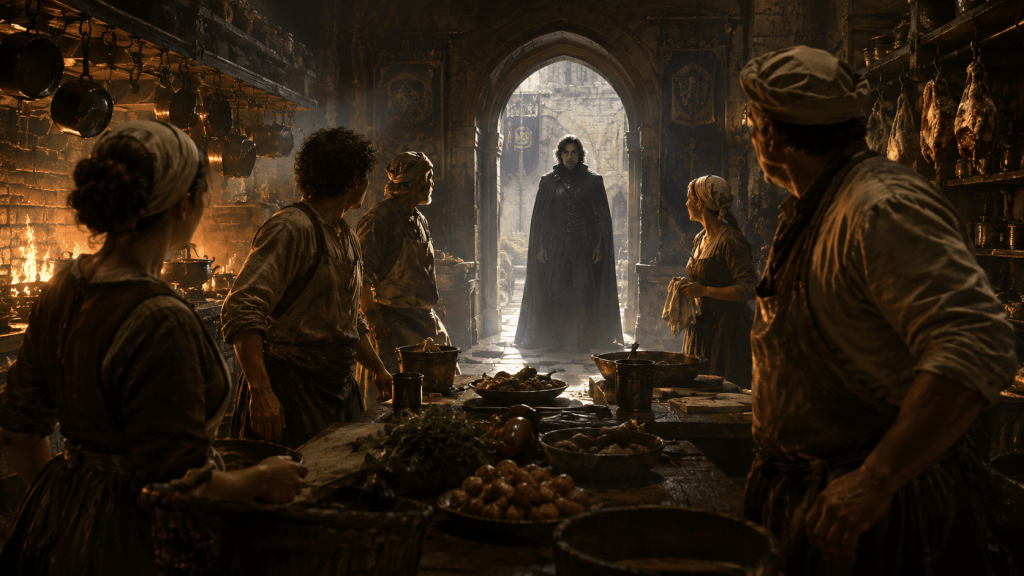
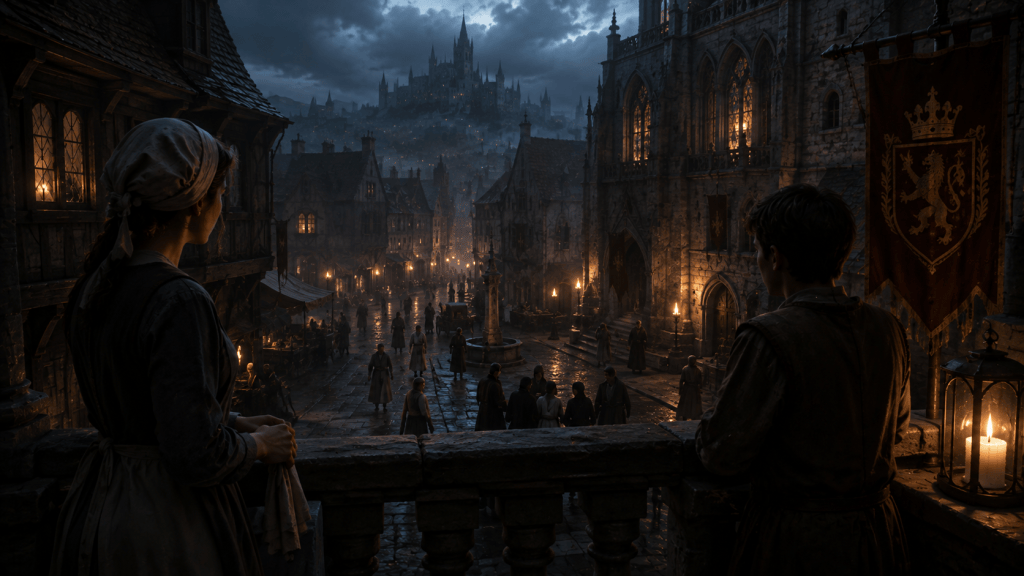
A kitchen-side account of the morning a servant of the Order returned to Bremyra Castle, and those below the stairs looked upon a magician while trying to remember the boy who had once carried bread among them.
Beneath the Lower Hearths
The kitchens of Bremyra Castle woke before the court above had gathered its voices, with ash drawn from the hearth mouth, embers coaxed back into flame, water carried from the lower pump, and first loaves uncovered beneath linen as grey morning pressed against the high windows. Heat gathered early in that buried place, filling blackened beams, copper pans, drying herbs, flour boards, and worn stone with the living breath of labour. Inside, the servants moved by habit older than speech, each hand finding its work as if the castle’s hunger had shaped them into one body made of smoke, steam, wool, and bread.
Mistress Arven stood near the great hearth with her sleeves pinned high and a strip of linen tied across her hair. Age had silvered the braids beneath it, although age had taken little from the strength in her hands or the authority with which she ruled the lower kitchen. She knew the castle by its appetites, by guards lingering for crusts, pages stealing apples, chambermaids hiding grief by moving too quickly, and nobles sending back meat untouched after stiff court feasts. She had outlasted enough service children to measure the years by names vanished from the duty boards, and one such name returned that morning before any black robe entered the kitchen.
It came through the western service passage, where young Berren had gone for dried apples and returned with the basket empty, his mouth pale and his breath uneven. He claimed the stones by the lower stair had grown cold enough to smoke when he spoke, foolish in a passage warmed by ovens since before dawn, yet his fear held the plain shape of truth. Mistress Arven took the store key, sent him back to the carrot board with a steadying glance, and went herself towards the stair with a lamp lifted before her.
The passage held its usual damp, its smell of onions, old straw, tallow, and winter fruit, yet near the first turn a faint mark crossed the dust where no errand had been sent. It might have been a boot track, water from a seam, or a scrape left by some porter too proud to confess clumsiness. Mistress Arven crouched with the lamp near the stones and felt old memory rise under the smell of dust. A boy had once slept there during hard winter after fever took him beside the wood bins, wrapped in sacking with hands curled near his mouth. She had poured broth between his lips and told him, with all the cruelty of care, that service claimed even the half-dead before sunrise.
His name had been Simion. He had come to the kitchen small, quick-handed, and hungry in the careful manner of children who learned that asking cost more than silence. He had scrubbed pots until his wrists reddened, carried trenchers through feasts, and run errands between pantry, stable, chapel, and garden gate while nobles looked past him with the easy blindness of rank. Yet he had carried brightness in him then, a mischief that survived cold water and harsh words, and that brightness had drawn Princess Elana to him as surely as flame drew moths in summer. Mistress Arven remembered the princess racing through the herb yard with a cracked blue jar full of fireflies, Prince Patrick behind her, and Simion last of all, trying to hide laughter beneath a basket of parsley.
The Order had taken him in later years, when papers came, men waited near the outer door, and the boy was washed, dressed in borrowed wool, and sent upward before being sent away entirely. Mistress Arven remembered his face at the threshold, because he had looked back once towards the hearth, the bread shelf, and the corner where he had mended his shoes with stolen twine. Then he had gone, and the castle had swallowed the shape he left behind, until the old name began moving again through Bremyra with talk of the opened Order manor, the gold-wax letter, and the Archbishop’s summons.
The first sign of his approach came as a change in the passage beyond the lower door. The guard posted there ceased speaking to the pantry boy, and the usual noise of feet, trays, buckets, page-whispers, and carried orders thinned until the space outside the kitchen seemed to hold its breath. Mistress Arven looked up from the herb bowl. Old Jory slowed his hands in the dough. One of the thyme girls laid both palms flat against the table. Berren turned towards the entrance with the carrot knife still held awkwardly in his fist. A figure paused beyond the threshold, tall against the colder light of the corridor, and the warmth of the kitchen drew in around the hearth as if flame itself had tightened.
The man who entered wore black robes plain in cut, marked by the authority of the Order through stillness more than ornament. He was taller than the boy Mistress Arven remembered, leaner in the face, his dark hair shortened, his eyes holding a blue-grey distance that seemed to have travelled farther than roads. He carried no visible threat, raised no hand, and asked for no deference. Even so, every servant lowered their gaze because the robe named him before memory could. A magician stood in the kitchens, among bread boards, ash buckets, herb knives, and old smoke.
Mistress Arven stepped forward because kitchens required a voice when fear stole the rest. She wiped her hands slowly across her apron, bent her head with the respect due to a power she had hoped to meet only from a safer distance, and made herself speak for all gathered beneath her roof. “My lord magician,” Mistress Arven said, keeping her hands folded before her so their tremor stayed hidden in the linen. “How may the kitchens serve you?”
His gaze moved across the long tables, the copper pans, the smoke-black beams, the bread shelf, the scullery arch, the great hearth, and the dim corner near the wood bins. There it lingered. The change in him came so faintly that only someone trained by years of kitchens could have seen it, a softening near the eyes, a guarded breath, a recognition drawn inward before it could become a wound in public view. Mistress Arven felt the years fold strangely, placing the hungry boy and the feared magician in the same body before her.
“I require nothing,” Simion said as he stood beneath the arch, his voice low, restrained, and touched by a weariness carried from rank, power, and old roads alike. “Continue your work.”
The words offered gentleness, and still relief moved slowly through the room. Berren bowed after the moment for bowing had passed. One thyme girl let a stem fall from her fingers and stared at it as if it had spoken. Jory held his flour-coated hands above the dough, unable to return them to labour while the man in black remained beneath the kitchen roof. Mistress Arven lowered her head again, because recognition crossing rank could become dangerous when years, magic, and old tenderness all stood too near one another.
Simion turned towards the passage, then slowed before crossing the threshold. His attention shifted west, towards the service stair where the cold mark had been found that morning. Mistress Arven saw him listening, and every servant listened with him while water dripped from the cracked spout and wood settled within the drying racks. Simion’s fingers moved once at his side, a small unfinished gesture quickly stilled, and his face held the look of a man who had heard a call others mistook for silence.
He inclined his head by the faintest measure, perhaps to the room, perhaps to the woman who had spoken, perhaps to a memory buried beneath flour, smoke, and rank. Then he passed back into the corridor, his black robe brushing the threshold stones as the guard outside shifted aside. The kitchen noise returned after he had gone, altered as water changes after a stone has fallen through it. Knives found boards again. Pots settled onto hooks. The hearth cracked, and several servants moved too quickly in answer before pretending they had meant to reach for cloth or spoon.
“That was him, then,” Jory said as flour fell from his knuckles onto the board, his voice low enough for the hearth to almost take it. “The boy from the old stories.”
Mistress Arven looked towards the corner near the wood bins, where the flagstones still seemed to hold the shape of a child wrapped in sacking beneath winter’s hand. “Aye,” Mistress Arven said as she turned back to the hearth and lifted the long iron hook from its place. “That was the boy.”
A child once known by bruised elbows, stolen laughter, and flour on his sleeves had returned clothed in black authority, and the castle, which had let his name fade as easily as smoke through a chimney, began remembering him only after fear had taught it to look again.
A Visual Chronicle
Beneath the lower hearths of Bremyra Castle, the servants feared the magician who returned in black, while one old cook remembered the hungry kitchen boy he had once been.
Kitchen Register: The Lower Hearths of Bremyra Castle
The lower kitchens of Bremyra Castle were entered in the household rolls as the principal hearth-service beneath the western hall, supplying bread, meat, broth, lamp fat, hot water, and table preparations for the royal household, chapel officers, resident guards, visiting envoys, and all servants assigned to the inner keep.
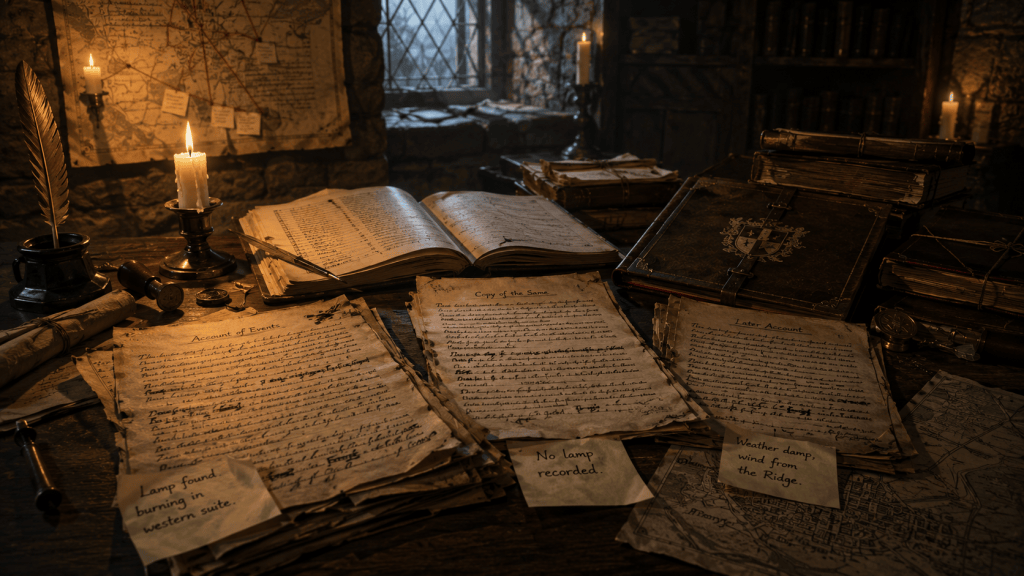
A winter kitchen copy preserved a brief account of a former service child recognised by certain older staff after his return to the castle under the authority of the Order, though the formal register named him only as the Lord Magician and recorded his presence among the lower hearths as a passage through service rooms during morning duties.
The same copy referred to a coldness observed near the western service stair before his arrival, along with a mark in the dust beneath the lower turn, though the steward’s duplicate gave the matter as ordinary damp and made no further entry concerning disturbance among the stores, stair mouth, or scullery passage.
A lesser note, written in a hand later identified with the old cook’s ledger, stated that several servants recognised the visitor only after he had departed, remembering a boy once attached to the kitchens before being taken into Order keeping, though the note gave no judgement on whether the man himself acknowledged the memory.
The kitchen was thereafter entered as orderly, with fires maintained, meal service completed, and no damage reported among hearth, stores, tables, hooks, or passage doors, though one later marginal hand beside the entry amended Lord Magician to the boy returned, a phrase scraped thin in the household duplicate while remaining visible beneath smoke-darkened ink in the kitchen copy.
About the Creator
The Mythic Chronicle is written and curated by Simon Phillips, a writer of mythic and speculative fantasy whose work explores forgotten kingdoms, fractured records, old institutions, and the moments when history begins to shift before those living through it understand what has changed.
The accounts preserved within these Chronicles form part of a wider body of work in which castles keep older secrets beneath familiar rooms, roads carry rumours ahead of armies, and ordinary witnesses preserve fragments of events whose true meaning remained sealed from them at the time.
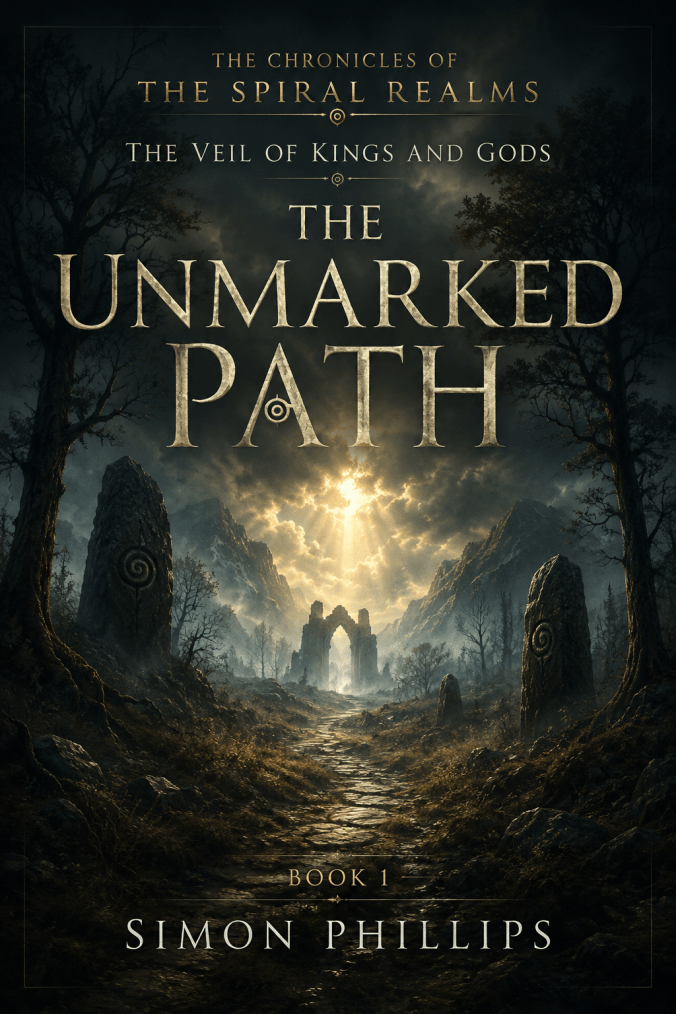
One such account survives in a separate record, following the return of a magician to Bremyra during a season of court unease, royal absence, Church suspicion, and gathering danger beyond the kingdom’s roads. What the servants, clerks, and watchers of the city remembered only in fragments is followed more closely in The Unmarked Path, the opening book of The Veil of Kings and Gods within The Chronicles of the Spiral Realms.
Readers who wish to examine that fuller account may find the record below.
What follows is taken from a later household account concerning the lower kitchens of Bremyra Castle, where a former service child was remembered only after he returned beneath the authority of the Order.
Subscribe to continue reading
Subscribe to get access to the rest of this post and other subscriber-only content.
One thing I have been thinking about while working on The Veil of Kings and Gods is how much of a fictional world exists beyond the people carrying the main story. A book has to stay focused on the characters, problems and consequences that matter most to its plot, which means there will always be people standing nearby whose experiences remain largely unseen. They might be servants, guards, clerks, priests or ordinary people who witness part of an important event while knowing very little about what is really happening. I have found myself increasingly interested in those people.
The Unmarked Path, the first book in The Veil of Kings and Gods, already has a lot moving through it. Simion returns to Bremyra under orders from the Order of Magicians, Prince Patrick is trying to govern during his father’s absence, Princess Elana is preparing to leave for an arranged marriage, and pressure is beginning to build far beyond the kingdom itself. The Order and the Church distrust one another, trouble is developing in the north, and Simion gradually discovers that his reason for being in Bremyra reaches further than he expected.
Those are the people and events the book needs to follow closely. While writing around that story, though, I kept wondering what the same period looked like to people who stood several steps away from it. I wanted to know what the servants thought when they were suddenly ordered to reopen an old Order manor above the city, what a castle clerk made of a sealed letter arriving beneath gold wax, and what the people working inside the cathedral noticed when Archbishop Alaric prepared to receive a magician he clearly distrusted.
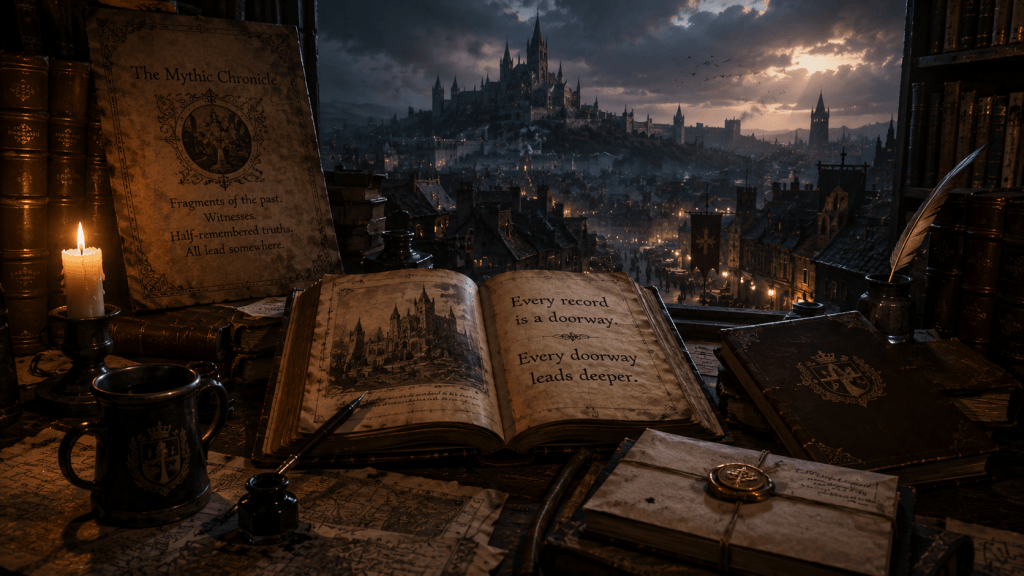
That became one of the reasons I started using The Mythic Chronicle alongside the books.
Looking Beyond the Main Story
The current Chronicle cycle is called The Sealed Road of Bremyra. It surrounds the events of The Unmarked Path, with some accounts taking place shortly before the book, others during it, and others dealing with what remains immediately afterwards.
I wanted the distinction between the two to stay clear. The Unmarked Path carries the direct story, while the Chronicle follows fragments around it. Those fragments can come from servants, clerks, chapel attendants, guards, household records, later copies of old accounts or people trying to understand something after the event has already passed.
That difference has given me far more room than I expected because I can stay inside Bremyra while changing where the reader stands.
The first Chronicle, The Manor That Waited, follows the servants sent to prepare the old Order manor before Simion arrives. In the book, Simion reaches the manor and finds an old house that has been out of regular use for years, still carrying traces of the Order’s former presence. The Chronicle allowed me to go back to the hours before he reached it and spend time with the people ordered to reopen those rooms.
They climb the hill carrying keys, linen, lamp oil and instructions from the castle. They open shutters, lay fires and prepare the western suite for a guest whose name they have never been given. As they work, small things begin to feel wrong. A lock seems to turn before the key has fully moved, marks appear in dust, doors behave strangely and a lamp is found burning where nobody remembers lighting it.
The servants have no idea what Simion is involved in, and they have no reason to understand the larger events beginning around Bremyra. They only know that an old house has suddenly been ordered back into use and that, somewhere during their preparations, it begins to feel as though the manor was already expecting someone.
I probably would never have followed those people inside the main book because Simion’s story has other places to go. The Chronicle gives that quieter part of Bremyra somewhere to exist.
For Simion, the Council of Five belongs to the structure of his life. He was trained by the Order, he understands its authority, and the instructions sent to him affect his future directly. A clerk working inside Bremyra Castle has a very different relationship with the same event because, from his position, the Council arrives as an object carried through the door.
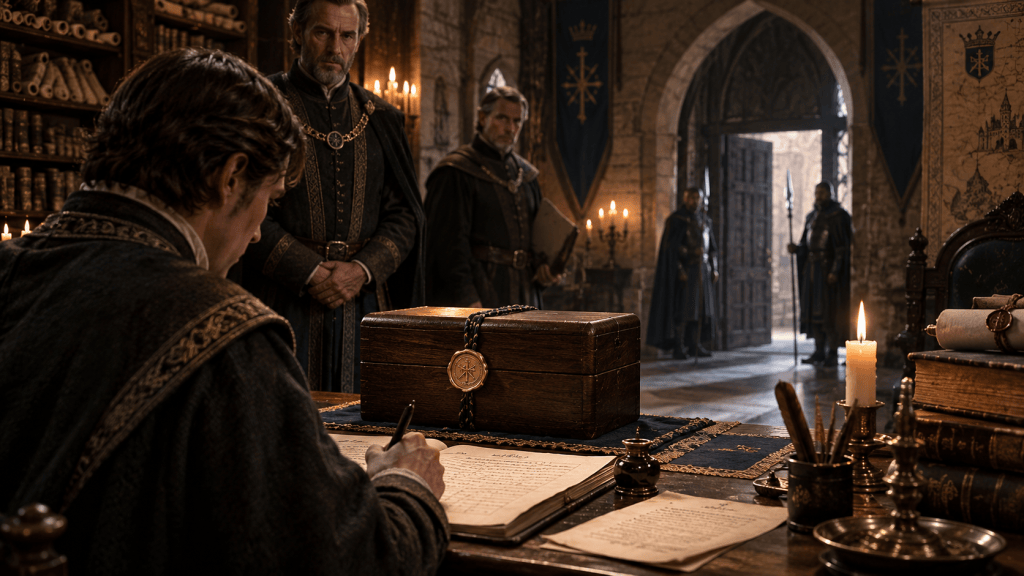
He sees a cedar case bound with dark cord and sealed beneath gold wax. He sees senior officials become unusually careful around it, watches the receipt entered formally into the castle record, and notices that people who usually deal with royal paperwork suddenly measure every word. He cannot read the wider story behind the letter, although he can tell from the behaviour around him that something important has entered Bremyra.
I have enjoyed working with that kind of limitation because the person recording an event does not always understand what the reader may later come to know. A clerk can preserve the hour, the condition of the seal, the names of the witnesses and the route taken through the castle, yet still have no idea why the letter matters so much.
That feels right for the Chronicle. History often survives through people who saw one small part of something larger and recorded what their position allowed them to see.
Standing at the Edge of a Scene From the Book
The Cathedral Warning pushed the idea in another direction because it sits close to a scene that already exists in The Unmarked Path.
Simion is summoned to Bremyra Cathedral by Archbishop Alaric, and their meeting makes the tension between the Church and the Order very clear. From Simion’s position, the encounter is about suspicion, authority and the limits Alaric intends to place around him.
The Chronicle moves away from Simion and spends its time with the people preparing the cathedral before he arrives.
Sister Maelis notices candles behaving strangely. Brother Osric is given responsibility for the undercroft key. Parts of the cathedral are restricted, doors are watched and Archbishop Alaric makes preparations that suggest he is worried about something deeper than an awkward meeting with a visiting magician.
When Simion finally enters, those people hear the same formal conversation, although they experience it from the edges. Their attention moves towards the locked doors, the keys, the candles and the sounds beneath the floor. They have no access to Simion’s thoughts, and Alaric certainly gives them no explanation for his concern.
I like being able to return to a moment from the book in that way because I am not rewriting the scene from another camera angle. I am looking at what the scene disturbed around it and asking what the people standing nearby might have carried away afterwards.
Remembering Simion Before He Became the Lord Magician
The fourth Chronicle, The Boy Remembered in the Kitchens, has probably been one of my favourite examples so far because it looks at Simion through a very different kind of memory.
By the time he returns to Bremyra, people see the black robes of the Order before they see the person wearing them. Servants lower their eyes, officials address him by title and even people who knew him years earlier have to reconcile the man standing before them with the person they once remembered.
The kitchens carry a different version of him. Their memories are connected to bread, work, illness, cold rooms and the ordinary routines of castle service. They remember a boy who once carried food through the halls and slept close to the hearth during a winter fever, long before anyone expected him to return as a magician.
That interested me because institutions remember people according to their own needs. A court remembers rank, the Church remembers authority and the Order remembers its own position, while servants may remember who was hungry, who worked beside them or who disappeared from their rooms one winter.
The Chronicle lets those memories sit beside the person Simion has become. It adds something to Bremyra without asking the main book to stop and explain every part of his childhood through exposition.
Leaving Some Things Uncertain
Another part of the Chronicle that I have come to value is that the records are allowed to be incomplete.
A servant can misunderstand what happened. A clerk may record only what his office required. A later copy of an account might remove a detail found in an earlier one, while someone writing years afterwards may decide that an unexplained event was caused by damp stone, winter weather, frightened servants or an old building settling in the cold.
I do not want every Chronicle to provide a final answer because that would weaken what makes the format interesting to me. The book remains closer to the direct events, while the Chronicle preserves what other people thought they saw and what later records chose to keep.
Sometimes the difference between those accounts matters as much as the event itself. A formal register may describe a perfectly ordinary household preparation while a lesser copy remembers that a lamp was already burning. A church record may describe proper restrictions during a formal reception while someone in the margins remembers candles bending towards a locked stair.
That leaves room for the reader to decide how much of each account they trust.
Another Way Into The Veil of Kings and Gods
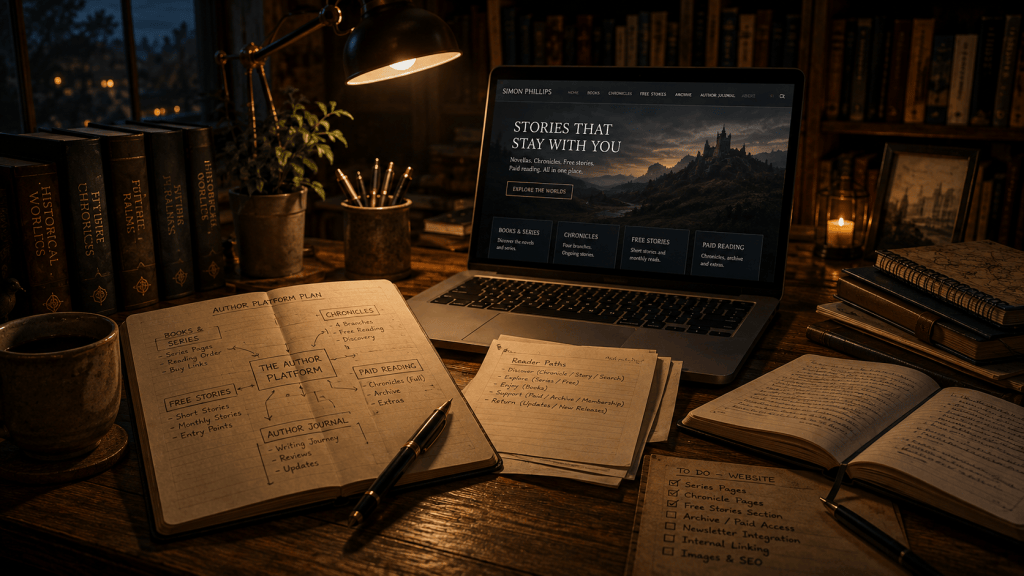
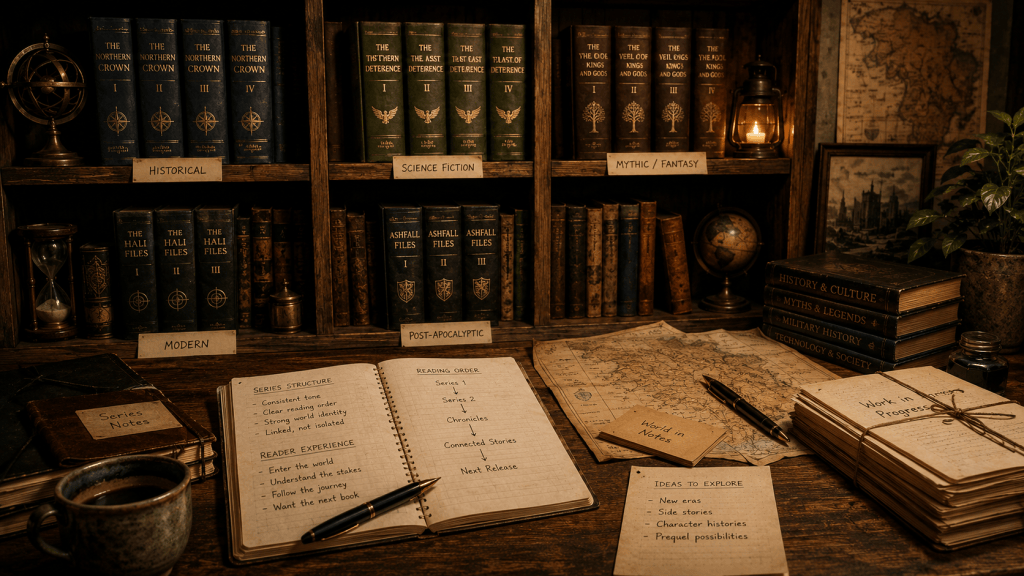
There is a practical reason I like this approach as well because I want the website to give readers several ways into the fiction.
Someone who has already read The Unmarked Path can enter The Mythic Chronicle and return to Bremyra from places the book only passed briefly. They can stand inside the old manor before Simion arrives, sit beside a clerk as the Council’s letter enters the castle, or wait inside the cathedral while Alaric prepares for a confrontation the reader already knows is coming.
Another reader may discover the Chronicle first. They might begin with an abandoned manor that appears to be waiting for an unknown guest, a sealed letter that makes an entire chancery uneasy, or a cathedral locking its lower doors before a magician arrives. They do not need to understand everything about Simion, the Order or Bremyra before those accounts can work.
If the records make them curious about what is happening beyond the edges, The Unmarked Path is there to carry them into the main story.
I prefer that to repeatedly telling readers that I have another book available. The Chronicle can offer something worth reading for itself while quietly opening a door towards the larger series behind it.
The People Standing Nearby
I think that is what I have loved most about The Sealed Road of Bremyra so far. It gives me the chance to stay inside the world for longer and follow parts of the story that the main book could never reasonably stop to include. I can spend time with a housekeeper opening rooms that have stood empty for years, a clerk examining a seal with unusual care, a chapel attendant watching candles lean towards a locked stair, or a cook looking at a feared magician and remembering the boy who once worked beside the hearth.
That kind of thing has always appealed to me. When I was a child, I could spend hours, sometimes days, thinking through parts of a story that might never actually be used. I would imagine places beyond the main setting, work out what happened in rooms the characters never entered, think about people who only existed at the edge of the story, or decide what might have happened years before the part I was actually telling. Most of it never needed to appear anywhere. I simply enjoyed knowing it was there.
I still write that way now. The more time I spend inside a world, the more real it begins to feel in my own head, and I enjoy following those smaller threads even when they sit outside the central plot. They help me understand the place, the people and the history around them, and they make writing the main story feel less like moving characters through a constructed setting and more like returning somewhere that already has its own memory.
The Mythic Chronicle has given me somewhere to put some of that imagination instead of leaving all of it hidden in notes or in my head. The book can stay focused on Simion, Patrick, Týrnan and the larger events moving around them, while the Chronicle can step sideways and spend time with the people who only caught a glimpse of what was happening.
None of those witnesses understand the whole story. They see enough to know that something is changing, then carry away their own version of it as memory, rumour or record. For me, that makes Bremyra feel larger than the central plot because the world continues beyond whichever character happens to be on the page.
That is probably the part I enjoy most. I get to write the story I need to tell, while still giving myself permission to wander into the corners that first made me love making up worlds in the first place.
If you would like to see Bremyra from some of those quieter corners, The Sealed Road of Bremyra begins with The Manor That Waited, before Simion has even climbed the hill.
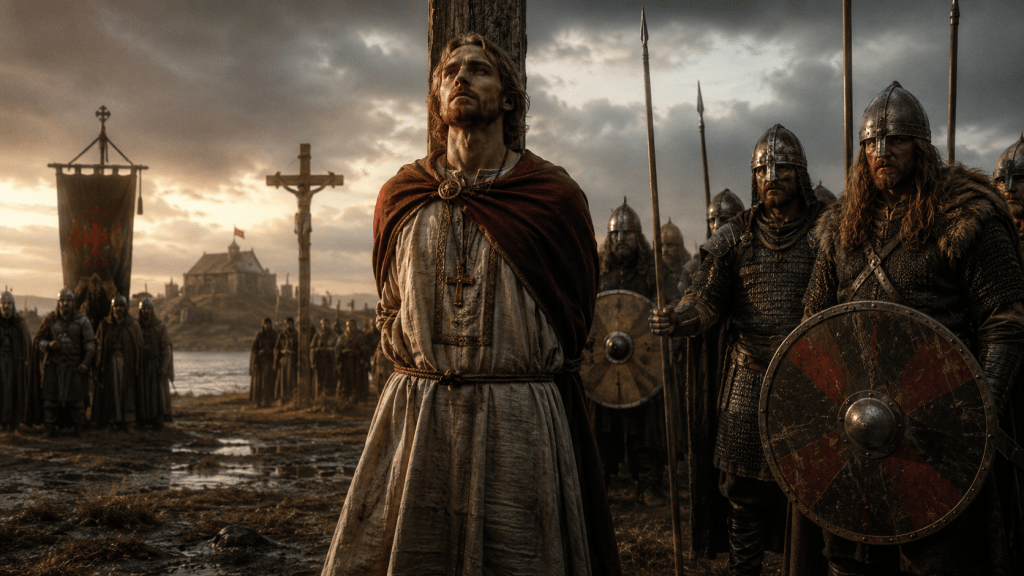
How King Edmund’s death became the wound and witness of a fallen kingdom.
Where rumour reached the marshes before the army
The eastern sky had begun to pale over a low country of river bends, reed beds, grazing fields, and winter mist, where the chill gathered softly across the open land before the first hearth smoke rose above the settlements. East Anglia had always lived with water close at hand, with the sea beyond the flat horizon and the rivers carrying life inland through fields, churches, royal estates, and small communities shaped by tide, trade, and prayer. Ships could arrive kindly in such a place, bringing merchants, pilgrims, messages, and goods from distant shores, yet the same waters could also bear men whose purpose had hardened long before their keels touched land.
Across the kingdom, rumours moved faster than certainty. Northumbria had already been broken by the armies from over the sea, and York had fallen into hands that understood how to turn a raid into possession. Mercia, once the great weight of Anglo-Saxon power, had begun to bend beneath pressures gathering beyond its control. Travellers carried these stories in lowered voices beside hearths, in church porches, at river crossings, and along muddy roads where packhorses slipped beneath their loads. What had first come as raiding now moved like occupation, and each tale carried the same uneasy truth: the Viking armies had learned how England could be entered, crossed, and held.
East Anglia stood in their path with its wealth spread through fields, minsters, market routes, and riverways. It lacked the broad strength of Mercia and the hardening frontier spirit that would later shape Wessex under Alfred, yet it held grain enough to feed warriors, horses enough to serve a campaign, and land open enough to become a base for further war. A smaller kingdom could still matter greatly when larger forces needed shelter, supplies, and obedience. That knowledge gave the eastern land its value, and value, in such years, drew violence as surely as carrion drew ravens.
At the centre of the kingdom’s remembered sorrow stood Edmund, king of East Anglia, whose name would pass from the uncertain politics of the ninth century into the deeper realm of sacred memory. Later generations would picture him as a martyr, a ruler faced by heathen power and remembered through death with a force greater than any victory he could have claimed in life. The details would be shaped by chronicles, devotion, and legend, yet beneath them lay a harsher historical truth: East Anglia faced an army whose arrival could strip a kingdom of its ruler, its security, and its future within a single season of fear.
Perhaps the first warning came as smoke along a distant track. Perhaps it came through a rider, mud-spattered and exhausted, bringing news that armed strangers had crossed land once thought safely removed from the old centres of power. However the message reached Edmund’s court, it belonged to the same age of unravelling that had already consumed kingdoms to the north and shaken those to the west. A decision would soon be forced upon him, shaped by faith, kingship, survival, and the terrible limits of resistance.
The story of East Anglia’s fall began in that narrowing space between rumour and arrival, where a kingdom could still hear its church bells, gather its people, and imagine endurance, while beyond the mist the road carried an army towards it.
A Visual Chronicle
As the Great Heathen Army moved through the winter mist, East Anglia waited beneath the rule of a king whose defeat would become one of the most enduring memories of Anglo-Saxon England.
Timeline of Events
855 AD – Edmund is traditionally remembered as becoming king of East Anglia, entering a reign later preserved through devotion, coins, and the memory of his death.
865 AD – The Great Heathen Army enters England and winters in East Anglia, where the local people make peace and provide horses to the invaders.
866 AD – The Viking army leaves East Anglia and moves north to capture York, turning Northumbria’s division into conquest.
869 AD – The army returns to East Anglia, overruns the kingdom, and Edmund is killed during the Viking campaign.
c. 870s–900s AD – Edmund’s memory begins to grow beyond defeat, with later tradition shaping him as a martyr and sacred symbol of East Anglian endurance.
About the Creator
This Chronicle is written by Simon Phillips, author of several historical and speculative fiction works exploring forgotten worlds, myth, and the turning points of history.
The account that follows moves deeper into East Anglia’s final season of independence, where Edmund’s kingship met the force of an army that had already learned how to break kingdoms, gather horses, and turn wintering ground into conquest. What began as pressure upon the eastern roads would become the fall of a realm, and from that defeat Edmund’s memory would rise as one of the strongest symbols of Anglo-Saxon endurance.
Readers supporting The Forgotten Chronicle may continue into the full record below.
Subscribe to continue reading
Subscribe to get access to the rest of this post and other subscriber-only content.
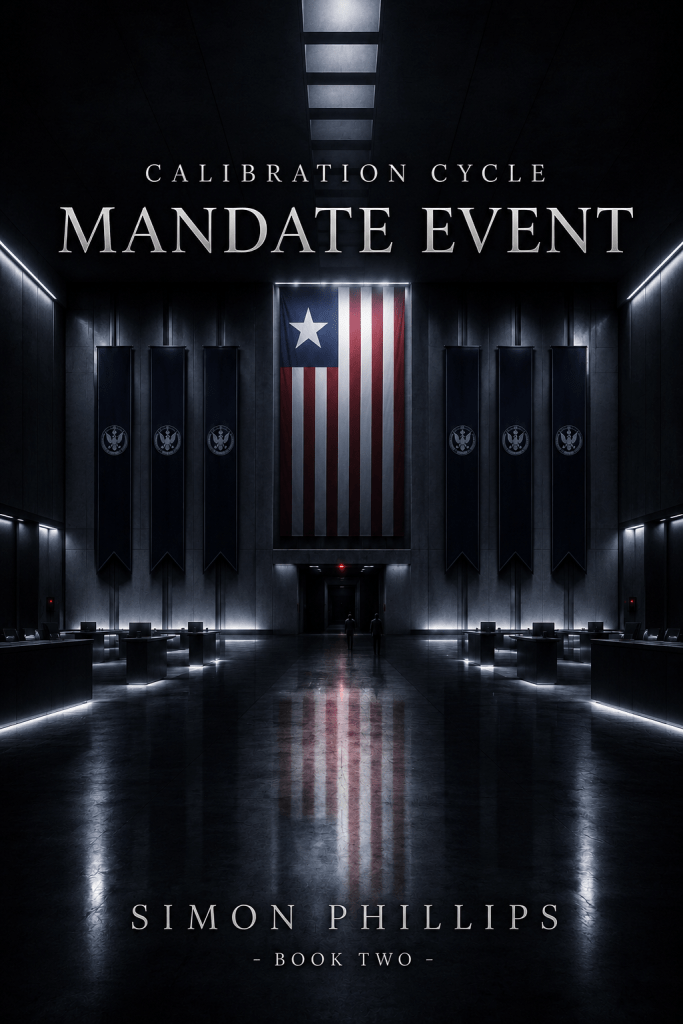
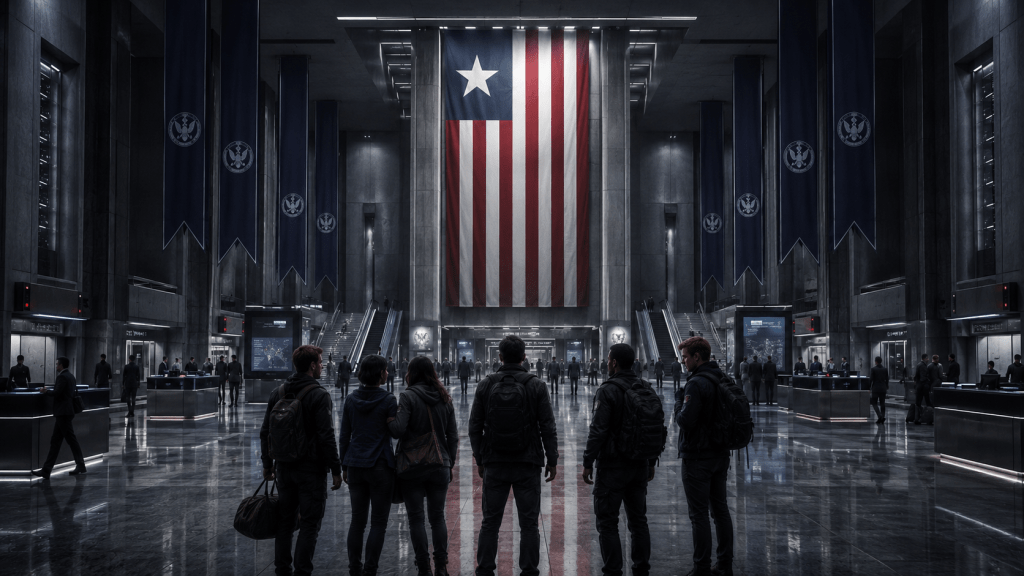
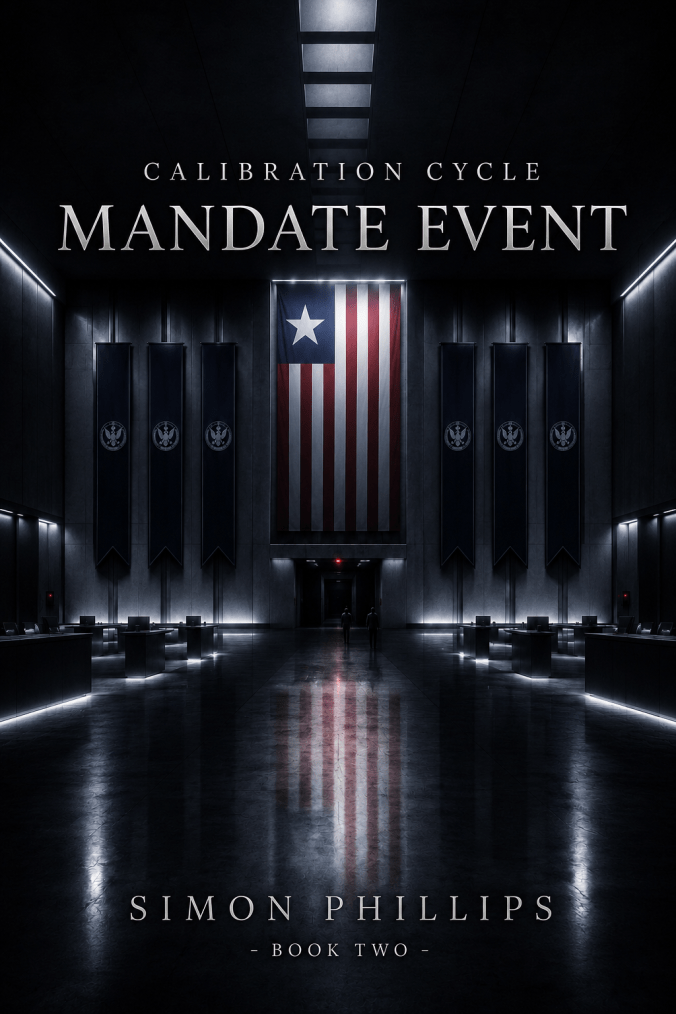
The American flag is the first thing Aaron Cole knows is wrong, although for several seconds he cannot understand why. The familiar red and white stripes hang exactly where they should beneath the controlled lighting of the staging hall, the fabric arranged with institutional precision and treated by everyone passing beneath it as something too ordinary to deserve attention, yet the blue canton no longer carries the constellation he has known since childhood. There is only one white star, large and uncompromising, suspended at the centre of a design that seems familiar until memory attempts to complete it.
Then Aaron looks for the Union Jack.
It is not there.
For Aaron, Rei Nakamura, Marcus Reed, Connor Blake, Declan O’Shea and Sofia Alvarez, the discovery should not matter as much as the crisis they have only just survived. They have already endured an experience so physically convincing that the language of advanced simulation has begun to feel inadequate, and they have returned carrying injuries that should have disappeared when the experiment ended. Sofia’s ankle remains swollen and painful, Aaron’s hands still carry abrasions, Marcus bears bruising from impacts that belong to another place, and exhaustion sits inside all of them with the stubborn weight of something the transition back has failed to remove.
The hall around them, however, remains composed. Personnel move between desks. Announcements direct arrivals through processing. Screens display ordinary public information. No one appears concerned by the altered flag because, within this place, nothing about it is altered at all.
Calibration Cycle: Mandate Event begins at precisely that point of uncertainty, carrying the consequences of Meteor Event forward instead of allowing the characters the comfort of beginning again. The first book forced six volunteers to question whether an experimental immersive environment could produce consequences beyond anything they had been promised. Book Two asks something more dangerous: what happens when the world outside the supposed experiment appears perfectly stable, yet the history supporting that stability is not the history they remember?
The Return They Wanted Does Not Behave Like Home
The six entered the Calibration Cycle believing they had volunteered for a classified programme involving advanced immersive technology, adaptive crisis modelling and sensory feedback far beyond anything available to the public. That original explanation gave them something to hold onto when the first experience became difficult to distinguish from physical reality, because even impossible sensations could still be fitted inside the possibility of extraordinary technology if they were willing to stretch the definition far enough.
Mandate Event begins putting that explanation under a different kind of pressure.
Sofia’s ankle is not merely remembered as painful. It remains injured. The swelling is present beneath institutional lighting that belongs to the supposedly safe side of the experience, and when medical personnel eventually examine it, they do not respond with astonishment. They possess terminology for injuries that persist across what should have been a clean transition, and the casual professionalism with which those terms are used becomes more disturbing than panic would have been.
Aaron carries smaller marks, though their significance is no easier to dismiss. Marcus feels damage that should have belonged to a completed crisis. The six have returned carrying evidence in their own bodies, and every attempt to explain that evidence requires another layer of technology they were never told existed.
Connor, whose instinct is to understand a system before allowing himself to fear it, continues searching for a technical explanation because that is still more manageable than accepting that the original explanation may have been fundamentally wrong. Rei pays closer attention to the bodies themselves, noticing what pain does, how exhaustion remains, and how physical consequence refuses to respect the boundary everyone was told would exist.
Nothing provides them with a definitive answer, which is precisely what makes the uncertainty work. They are not handed a revelation about what has happened to them. They are forced to continue moving while the explanation they trusted becomes increasingly expensive to maintain.
The Single Star Belongs to a World That Thinks It Is Normal
The altered flag is only the beginning.
Announcements inside the facility direct people towards return processing. Administrative staff speak about return groups and return blocks as though those categories have existed long enough to become boring. Public devices connect to something called the Imperial Civic Mesh. Transport information identifies the wider region as part of an Imperial Union, and Britain no longer appears under the name Aaron expects to find.
It has become the Albion Administrative Territory.
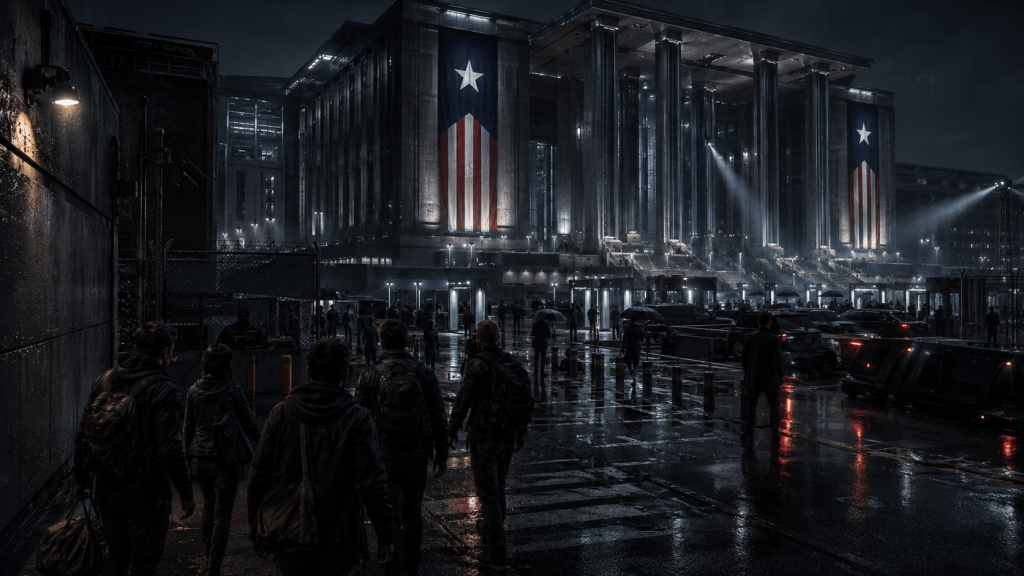
The significance of that change does not arrive through an explanation delivered by an authority figure. It emerges from the ordinary machinery of public life, which makes the altered history far harder to dismiss as an artificial backdrop. Britain has not disappeared beneath rubble, and the world has not been thrown into a visibly dystopian collapse. People buy coffee, complain about delays, take children to school, work behind desks, scan travel documents and hurry through transport concourses beneath symbols they stopped consciously noticing years ago.
The single-star emblem appears on uniforms, public screens, transport notices and civic material because it belongs there.
Albion appears in official language because, within this history, that is simply what the country is called.
The effect is deliberately quieter than a ruined skyline or military occupation because Mandate Event is interested in something more unsettling than obvious conquest. It examines the way political transformation can become ordinary once enough time has passed for institutions, education, paperwork and language to make the new arrangement feel inevitable.
The Imperial Union does not need soldiers standing on every corner shouting about power. Its authority is already built into the names people use, the documents they carry and the systems through which ordinary life is allowed to move.
The Imperial Union Was Built Through the Language of Rescue
As Aaron and the others begin cautiously reading the world around them, the altered history reveals a political structure that is far more complicated than a simple empire imposed overnight.
The Imperial Union presents its origins through reconstruction, relief, stability and protection. The history taught within its civic systems describes a world emerging from the devastation of the Second World War under increasingly permanent American leadership, where humanitarian supply networks, military security, reconstruction programmes and international coordination gradually became something larger than the emergency structures that first justified them.
Connor can see why such a system might once have looked brilliant.
Shared logistics could prevent famine. Coordinated security could limit another continental war. Common infrastructure could move medicine, refugees and aid across borders more efficiently than fractured governments acting alone. A world that had watched nations destroy one another might willingly tolerate extraordinary central authority if that authority appeared to offer stability.
Marcus understands another part of the problem because military history is full of temporary structures that survive the emergencies that created them. Once command systems work, dismantling them carries risk, and the person suggesting that the guardrail should be removed becomes responsible for whatever happens afterwards.
Declan sees the trap hidden inside that logic. Temporary necessity becomes permanent authority, permanent authority becomes administrative expectation, and eventually people forget that the structure was ever supposed to be temporary at all.
What makes the Imperial Union effective as political science fiction is that its public argument contains enough truth to make its later form uncomfortable. It is not frightening because every part of it was designed by obvious monsters. It is frightening because many of the mechanisms that eventually erased sovereignty can be traced back to decisions that could once have been defended as reasonable.
That history gives Mandate Event its political depth without turning the story into a lecture. Aaron and the others discover it because they must understand the rules of the world before those rules classify them as threats.
Aaron’s Passport Becomes More Dangerous Than a Weapon
For Aaron, the altered history stops being theoretical when the group reaches identity processing.
The passports they carried into the original programme have travelled with them, small pieces of ordinary life preserved through experiences that have already damaged almost every other assumption. Connor’s American passport produces confusion because its design does not match local federal standards. Rei’s Japanese documentation requires manual review. Sofia’s Mexican identity and Declan’s Irish passport fit imperfectly into a world whose international order followed another path.
Aaron’s British passport produces something else entirely.
The United Kingdom of Great Britain and Northern Ireland is not recognised as a legitimate sovereign state.
The familiar crest inside his passport is treated as proscribed political material connected to Albion separatism, and an object that once allowed him to pass through airports becomes evidence that he may belong to a movement the authorities consider dangerous.
The moment changes the nature of the story because Aaron has done nothing except prove who he is.
His nationality has become suspicious.
His passport carries symbols the state regards as politically destabilising.
The country printed inside it is treated as an obsolete claim preserved by people unwilling to accept history’s correction.
That idea sits at the centre of Mandate Event: power does not only control territory when it can also control the vocabulary through which territory is remembered. Once Britain becomes Albion, anyone insisting on the older name can be described as refusing reality rather than defending identity. Once sovereign symbols become prohibited emblems, preserving them can be treated as radical behaviour. Once an entire generation is educated inside the revised language, the argument over what was lost becomes easier for authority to dismiss as nostalgia, extremism or historical misinformation.
Aaron entered the experiment without thinking very much about what being British meant.
This world forces him to discover what happens when somebody else has already decided that the identity no longer exists.
Berlin Makes the Wrong History Feel Real
Beyond the controlled processing areas lies Berlin, and the city gives the altered world the texture that makes it difficult to dismiss.
Nothing about everyday life pauses to acknowledge the six outsiders’ confusion. Buses run. Shops open. Delivery drivers argue with staff. Public terminals charge fees. Schoolchildren carry bags beneath civic emblems. News broadcasts move between transport information, security notices and political ceremonies while people glance at them with varying degrees of interest.
That normality is important because Mandate Event never treats the altered world as a decorative setting waiting for Aaron’s group to arrive. People have lived here their entire lives. They possess loyalties, compromises, resentments and memories that existed before six strangers appeared inside their political reality.
Some accept the Imperial Union because it is the only structure they have ever known.
Some believe its promise of order.
Some dislike it without being willing to risk their lives opposing it.
Some have learned to conceal forbidden symbols beneath clothing.
Some belong to networks attempting to preserve identities that official history has taught the public to regard as dangerous.
The city therefore becomes more than an alternate-history curiosity. It becomes a functioning society whose contradictions must be understood before the characters can safely act inside it.
Steven Hale, another survivor caught in the same impossible chain of events, becomes especially important because he recognises that language itself has become part of the terrain. His instinct is to read signs, official categories, school history, public warnings and bureaucratic terminology before trusting any interpretation. He understands that governments often reveal more through the words they treat as ordinary than through the speeches they make deliberately.
For a group accustomed to waiting for instructions, that becomes an important change.
They begin learning to read the world before allowing the world to tell them what to do.
Nathaniel Crowe Is Dead, Yet Berlin Recognises His Face
Aaron’s British passport makes him dangerous to the Imperial authorities, although it is not the strangest problem attached to his identity.
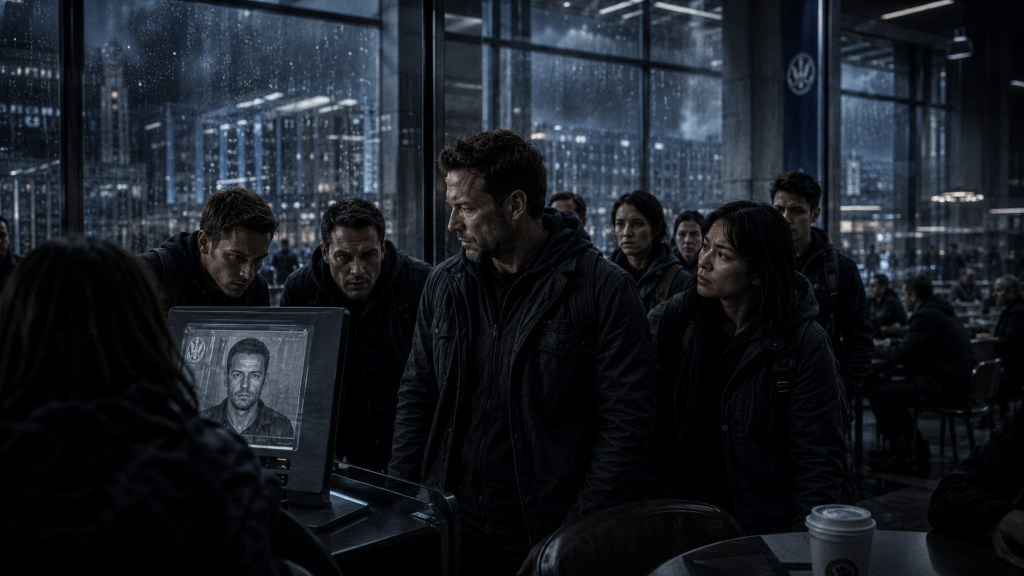
A records clerk named Tomas Rale sees Aaron and reacts as though somebody long dead has stepped into the fluorescent light.
The man he recognises is Nathaniel Crowe.
Within sections of the Albion resistance, Crowe is better known as the Ghost, a figure surrounded by enough conflicting history to make certainty almost impossible. Official sources connect him to extremist violence and attacks against Imperial structures. Resistance accounts describe someone who became a symbol of survival, defiance and the refusal to allow Britain’s identity to be administratively erased.
Crowe is also supposed to be dead.
The resemblance between him and Aaron is close enough to make disbelief difficult and acceptance even worse.
For Aaron, the danger lies in the fact that he knows perfectly well who he is while everybody around him begins responding to somebody else.
He has no memories of Crowe’s life.
He does not know the people who speak about him with grief.
He has no understanding of the decisions that turned the Ghost into both a security threat and a resistance symbol.
Yet a face can carry authority before a person has spoken a word, and once the possibility of Crowe’s return begins moving through hidden networks, Aaron discovers that denying the identity may not be enough to prevent other people using it.
That pressure suits Aaron particularly well because leadership has never been something he sought. In Meteor Event, people began looking towards him because he remained capable of organising movement while certainty collapsed. In Mandate Event, an entire political network begins seeing significance in him for reasons that have nothing to do with the choices he has actually made.
He is no longer simply being asked to decide.
He is being asked to inhabit expectation.
The Resistance Has Preserved What the State Tried to Make Obsolete
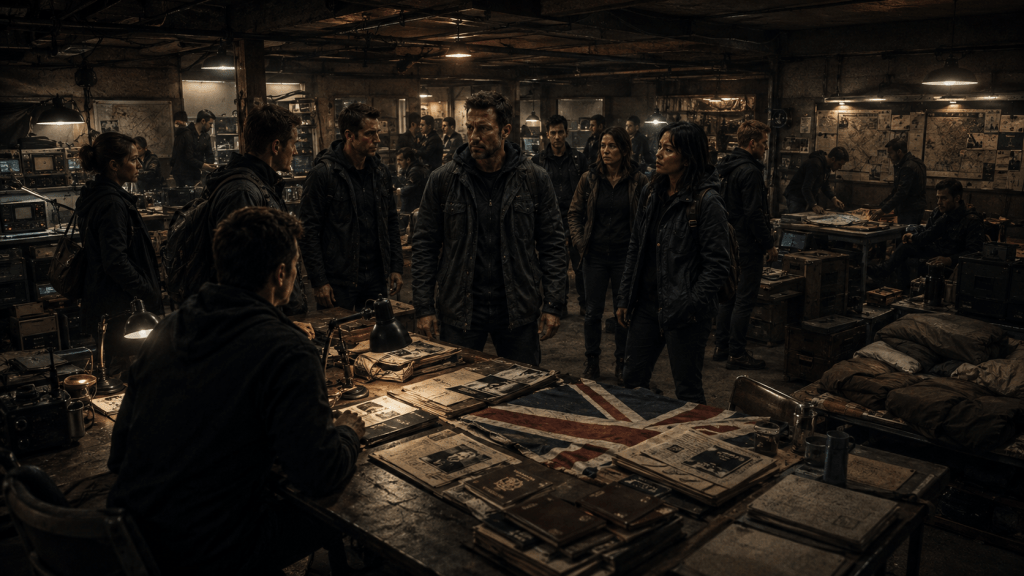
The resistance Aaron encounters is not presented as a polished underground army waiting for the arrival of its rightful hero. Its rooms are crowded with practical work, exhausted people and the accumulated objects of a history that has become dangerous to possess.
Old flags are hidden.
Passports from the United Kingdom are preserved after official recognition has vanished.
School material is collected alongside forbidden records.
People maintain routes, falsify paperwork, move information, repair equipment and support families whose lives have been reshaped by political decisions made long before Aaron entered the city.
That detail keeps the resistance grounded.
The struggle is not initially defined by weapons. It is defined by memory.
People preserve names because names disappear first. They preserve documents because documents prove that something existed before an authority decided it did not. They teach history privately because public education has replaced political loss with a story of rescue, stability and inevitable progress.
Only later does that preservation become entangled with violence.
This is where the story refuses to give either side an easy moral position. The Imperial Union has erased sovereignty, suppressed prohibited symbols and turned national memory into a security concern. The resistance has understandable reasons to exist, although understandable reasons do not guarantee that every action taken in their name becomes morally acceptable.
That distinction becomes increasingly important as Aaron is pulled closer to people who see his resemblance to Crowe as an opportunity.
Cerys Thorne Sees a Man and a Weapon in the Same Face
Among the resistance figures Aaron encounters, Cerys Thorne carries perhaps the most difficult relationship with the identity being placed over him.
Crowe was not an abstract figure to her.
The history between them is personal enough that Aaron’s face causes an immediate reaction, although Cerys does not allow grief to become certainty. She understands the danger of believing too easily, particularly when the Imperial Union would have every reason to exploit a symbol capable of disrupting resistance judgement.
At the same time, she cannot ignore the practical effect Aaron has on the people around her.
Some believe Crowe survived.
Others believe Aaron may be damaged, altered or deliberately planted.
Some do not care which explanation is correct because the sight of his face gives exhausted people something they have not felt for years.
Hope.
That becomes dangerous because hope is another form of leverage.
Cerys understands it.
Aaron begins understanding it.
The harder question is whether recognising that leverage prevents them from using it.
The political conflict in Mandate Event becomes much more personal at this point. Aaron is no longer simply hiding from Imperial authorities. He is being drawn into a struggle where his face can influence frightened people, his name can alter trust, and remaining completely outside the conflict may no longer be possible.
Something Knows Exactly Which Identity Will Open the Next Door
The external guidance that helped drive the crisis in Meteor Event has changed as well.
The wrist-mounted prompts that previously offered direction are no longer the only route through which instructions appear. Phones connected to the Imperial Civic Mesh begin receiving language that resembles both the local political system and the clinical direction the group encountered before.
The distinction becomes increasingly difficult to maintain.
Are the messages part of the Imperial network?
Are they part of the original experiment using local infrastructure?
Are the two being deliberately blended so that the characters can no longer tell where one authority ends and another begins?
Connor is particularly disturbed by the way terminology changes after the group learns it. New phrases appear only after local people have introduced those concepts. Role descriptions shift as the resistance begins assigning its own structures. The language surrounding Aaron starts acknowledging the importance of the Crowe identity as though something has recognised that other people’s belief can be used to change behaviour.
Then the intrusion becomes more personal.
Aaron is confronted with a resistance challenge that requires knowledge he cannot possess.
Instead of receiving a simple written answer, he experiences something closer to a memory.
Rain against water.
Stone beneathfoot.
Soot.
A voice carrying words that feel remembered despite belonging to a life Aaron has never lived.
The moment is deeply unsettling because it crosses a boundary that external instructions had left intact. Telling someone where to go is one kind of control. Supplying the internal texture necessary for them to behave like somebody else is another.
For the resistance, Aaron’s answer appears to confirm something.
For Aaron, it confirms almost nothing except that whatever is guiding them can reach further into him than he realised.
Rei Nakamura Keeps Looking for Aaron Beneath the Ghost
The growing Crowe identity also strengthens one of the quieter relationships inside the group.
Rei has never needed Aaron to become a conventional leader. Her connection to him grows through shared responsibility, observation and the small acts required to keep people moving under pressure. She sees when he is carrying too much before he says it, and in Berlin she becomes increasingly aware that the danger surrounding him is not only physical.
Everyone else has reasons to see Crowe.
The resistance sees history.
Cerys sees grief.
Tomas sees possibility.
The authorities see a threat.
Whatever is guiding the group appears to see an identity that can be used.
Rei continues seeing Aaron.
That distinction does not require sentimental declarations because it works more effectively through restraint. A glance held for a fraction longer, a question asked quietly while everyone else talks about the Ghost, a deliberate use of Aaron’s real name when the room has begun treating Crowe as more useful.
The relationship matters because identity pressure only works if there is something being lost beneath it.
Aaron cannot be frightened by becoming Crowe unless being Aaron still has weight.
Marcus, Connor, Declan and Sofia Read Different Dangers in the Same World
Book Two also gives the rest of the core group increasingly distinct ways of interpreting the altered political reality.
Marcus Reed reads structures of force. His military experience allows him to recognise security posture, command hierarchy, access routes and the difference between authority that expects obedience and authority that has begun preparing for violence. The Imperial Union unsettles him partly because much of its machinery is recognisable. Its worst instincts do not look alien to him; they look like familiar systems pushed far enough that necessity has become permanent doctrine.
Connor Blake approaches the world through architecture and information. He can admire the efficiency of civic networks while being disturbed by what that efficiency enables, and his willingness to understand the mechanisms around them becomes both essential and dangerous. Every time he discovers another pattern, he moves closer to something none of them yet understands.
Declan O’Shea reacts through suspicion shaped by money, incentives and the public language of power. He understands that empires can benefit from being attacked if an attack provides the justification for greater control, and his cynicism becomes increasingly valuable whenever everyone else begins confusing movement with progress.
Sofia Alvarez continues carrying the most visible physical connection to the previous event through her injured ankle, though Book Two develops her far beyond that vulnerability. She watches people rather than structures and frequently notices emotional realities others miss. She recognises when civilians are afraid of being seen reacting. She sees rooms building expectations around Aaron before he fully recognises what is happening. Her sensitivity, which initially appeared to make her the least suited to sustained crisis, increasingly allows her to perceive what more confident people overlook.
The six are therefore becoming more capable as a group, although capability is not presented as uncomplicated progress.
The better they become at surviving these situations, the more dangerous the question becomes of what survival is teaching them to accept.
The Continental Mandate Forum Turns Politics Into a Moral Trap
The resistance eventually identifies an opportunity created by the Continental Mandate Forum in Berlin, where political, security, financial and administrative power has been brought unusually close together.
For an organisation that has spent years surviving beneath Imperial surveillance, the convergence appears almost impossible to ignore.
This is where Mandate Event moves from political discovery into moral pressure.
The Imperial Union has given the resistance countless reasons to oppose it. Britain has been administratively reduced to Albion. Sovereign symbols have been criminalised. Historical identity has been recast as dangerous nostalgia. People have disappeared into institutions whose language makes coercion sound procedural.
None of that automatically makes a violent response clean.
The Forum contains people rather than abstract structures.
Workers move through it.
Security personnel protect it.
Political figures carry responsibility in different degrees.
Civilians exist around every plan.
The resistance understands that striking the right points could weaken the machinery holding the Imperial system together, while Declan immediately understands that the wrong attack could provide the Union with exactly the fear required to justify even greater control.
Aaron and the others are therefore placed inside a political conflict where the obvious enemy does not produce an obvious moral answer.
Helping the resistance may contribute to liberation.
Helping the resistance may also contribute to deaths none of them can justify afterwards.
Refusing involvement may preserve their consciences.
Refusing may also abandon people already living under an authority that has erased parts of their identity for generations.
There is no choice capable of leaving everyone innocent.
That is exactly where Calibration Cycle wants its characters.
Mandate Event Is About What Happens When Success Has No Moral Definition
The first book presented a crisis that looked straightforward from a distance. Something catastrophic was approaching. An intervention was possible. The difficulty lay in not knowing whether acting would prevent disaster or create another form of it.
Mandate Event takes the same underlying pressure and removes the clarity of a physical object falling from the sky.
Political systems do not offer a single impact point.
Resistance movements do not come with clean success probabilities.
History cannot be corrected by pressing the right sequence of controls.
Every decision changes people who have already been living inside the consequences long before Aaron’s group arrived.
That makes Book Two particularly suited to readers who enjoy psychological science fiction where the speculative element is inseparable from character, politics and moral uncertainty. The technology matters, although the story is never about technology for its own sake. The alternate history matters, although it is never presented simply as an exercise in imagining different flags and borders.
What matters is what those structures do to the people forced to live inside them.
Aaron is pushed towards leadership through an identity that is not his.
Rei watches the person beneath that identity become harder to protect.
Marcus confronts the danger of thinking too easily in operational terms.
Connor begins recognising that understanding a system does not mean controlling it.
Declan sees how power converts violence into justification.
Sofia notices the human cost while everyone else is still arguing about structure.
The deeper the group moves into Berlin, the harder it becomes to tell whether the next successful action is bringing them closer to safety or merely proving how effectively they can be made to function under pressure.
Read Calibration Cycle: Mandate Event
Calibration Cycle: Mandate Event continues the story begun in Meteor Event while expanding its psychological and political pressure considerably beyond the first crisis. Readers who enjoy psychological science fiction, alternate-history thrillers, political dystopian fiction, unreliable reality, artificial-intelligence ethics, resistance narratives and character-driven speculative fiction will find a story concerned less with explaining an impossible world than with forcing ordinary people to live inside it long enough for every easy explanation to begin failing.
Aaron Cole survived the first event expecting that survival would eventually lead back towards certainty. Instead he finds himself standing beneath a flag that should not exist, carrying injuries that should have disappeared and presenting a passport from a country this world regards as a dangerous historical fiction. Before he has time to understand the history surrounding him, strangers begin recognising his face as that of Nathaniel Crowe, a dead resistance figure whose legacy carries equal measures of hope, violence and political mythology.
The more useful that resemblance becomes, the less control Aaron has over what other people believe.
The more the group learns about the Imperial Union, the harder it becomes to reduce the conflict to good people fighting bad ones.
And as the technology surrounding them begins adapting to the language, identities and pressures of the world itself, one possibility becomes increasingly difficult to ignore: perhaps completing whatever comes next has never guaranteed that the result will be good.
The experiment was supposed to test how six people responded to crisis. By the time Berlin closes around them, Aaron and the others are beginning to face a much less comfortable possibility: the crisis may be learning how to use what they are becoming.
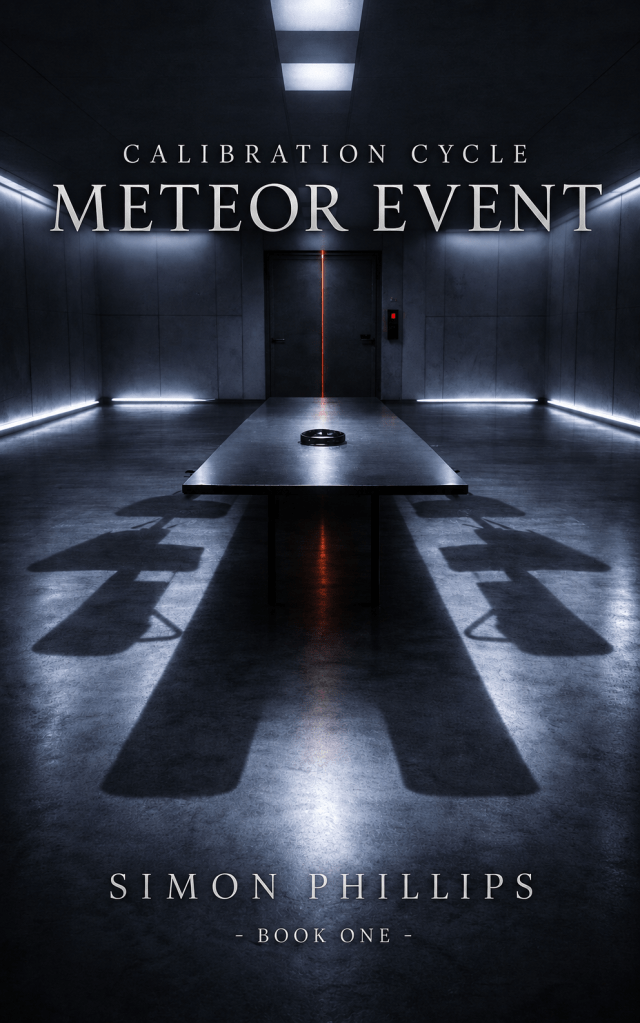
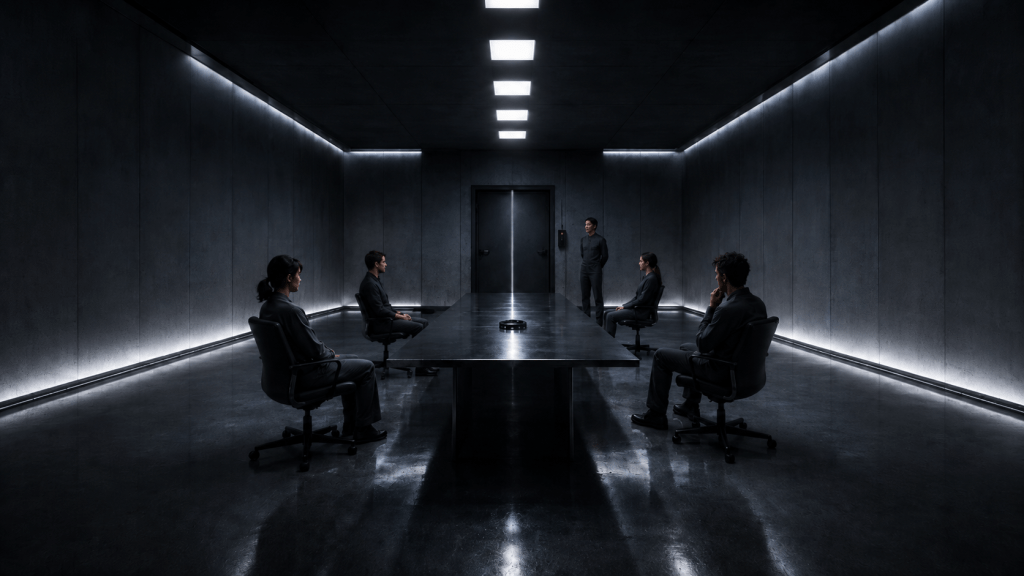
Six volunteers sit around a table inside a controlled room on an American military facility in Germany, surrounded by the quiet reassurance of polished surfaces, restrained lighting and people who speak as though every possible risk has already been reduced to procedure. They have signed the documents, attended the briefings and agreed to participate in an advanced immersive experiment built around artificial intelligence, crisis modelling and high-fidelity sensory technology. There should be uncertainty, because that is part of the research. There should be pressure, because their decisions are being tested. What there should not be is any reason to doubt that, somewhere beyond the experience, the ordinary world is still waiting for them.
The first book in Calibration Cycle, Simon Phillips’s continuing psychological science-fiction series, places six very different people inside an experiment whose apparent boundaries become increasingly difficult to trust. The story begins with experimental technology and institutional confidence, then tightens around physical consequence, moral uncertainty and the disturbing possibility that the explanation given to the volunteers may no longer be large enough to contain what they are experiencing.
The result is science fiction built around pressure rather than technological spectacle. The central question is not whether the machinery is impressive. It is what happens to human judgement when an apparently rational system begins demanding decisions before anyone has enough information to know what those decisions really mean.
The Comfort of a Controlled Experiment
Aaron Cole enters the programme without the temperament of a conventional science-fiction hero. He is observant, restrained and more inclined to watch how a room is behaving than to dominate it. Around the same table sit Rei Nakamura, whose composure hides a constant awareness of the people around her; Marcus Reed, whose military experience makes him attentive to posture, threat and institutional procedure; Connor Blake, who responds to uncertainty by trying to understand the technology producing it; Declan O’Shea, whose scepticism keeps dragging extraordinary events back towards ordinary questions; and Sofia Alvarez, whose nervous attention often catches details others have already decided are unimportant.
Their differences matter because Meteor Event is character-driven science fiction in the literal sense. The pressure of the story does not come from six interchangeable people attempting the same problem. Each of them reads danger differently, and those differences begin affecting what the group is prepared to accept.
The experiment itself initially provides them with a reassuring framework. They have volunteered. They have given consent. They are told that they will enter an adaptive crisis environment and experience physical and perceptual continuity. They expect advanced artificial intelligence, experimental interface technology and sensory immersion of a sophistication unavailable to the public.
That explanation is plausible enough to survive a surprising amount of evidence.
This becomes one of the most important tensions running through Meteor Event. Human beings rarely abandon the explanation that made the world understandable simply because something unexpected happens. They adjust it. They add exceptions. They find technical language that keeps the original structure standing for a little longer.
When six people enter what they have been told is an advanced simulation, an impossible level of realism does not immediately prove that the explanation is false. It initially proves that the technology is better than expected.
That distinction gives the opening stages of Meteor Event much of their psychological pressure.
Beneath a Grey German Sky
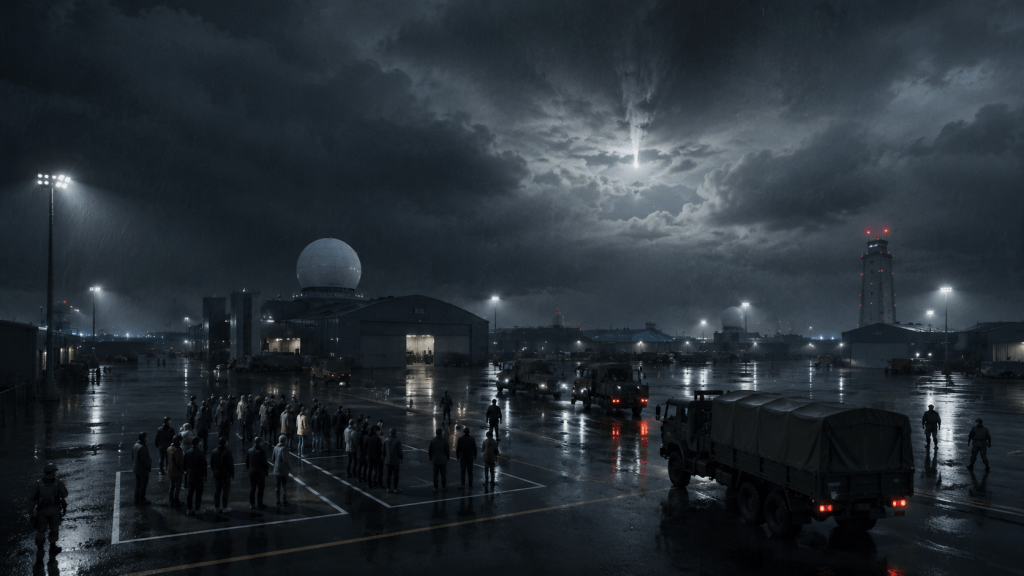
The transition takes the volunteers into a military environment already responding to a developing crisis. Sirens carry through concrete corridors. Officers move people through controlled areas. Phones still exist, although connections are unreliable. Cold air, damp earth, fuel and rain replace the clean neutrality of the orientation room.
Then the volunteers are moved outside.
The military base opens around them beneath a wet grey sky, with radar equipment turning above administrative buildings and vehicles being repositioned under increasingly urgent instruction. Nothing about the environment behaves like a disposable backdrop. Soldiers are concerned with their own procedures. Other volunteers have incomplete information. Nobody conveniently explains what the six need to know.
Something is coming through the atmosphere.
Its trajectory is unstable.
The time to impact is falling.
And the devices now fitted around the volunteers’ wrists begin presenting information.
This is where the speculative technology of Meteor Event becomes inseparable from the book’s moral pressure. The wrist devices do not award points, provide abilities or turn the crisis into a game. They supply data. They offer incomplete choices. They reduce complex circumstances into instructions that appear reasonable because the clock continues moving whether anyone trusts those instructions or not.
An intervention is possible.
The apparent threat may be intercepted.
The probability of success is far from certain.
The risk attached to the intervention is elevated.
The people standing beneath that sky have to decide what those numbers mean before time decides for them.
When a Probability Becomes a Human Decision
Many science-fiction stories about artificial intelligence concentrate on intention. They ask whether a machine wants something, whether it can deceive its creators or whether it will eventually turn against humanity.
Calibration Cycle begins from a different source of unease.
A system does not need hatred to produce an intolerable outcome. It only needs a definition of success that fails to contain everything human beings consider important.
That distinction is already present in Meteor Event. The technology surrounding the volunteers communicates through probabilities, objectives, access requirements and risk. It can indicate that an action has a higher likelihood of achieving an intended result. It cannot remove the moral burden from the people who choose to act on that information.
For Aaron and the others, this creates a problem larger than the incoming object itself. An efficient response can still carry consequences that efficiency cannot judge. An instruction can be logically coherent while remaining morally unbearable. A calculation can tell someone how many people may survive without answering whether they have the right to create the circumstances in which others die.
The deeper the group moves into the crisis, the harder it becomes to keep those questions at a safe theoretical distance.
People around them respond differently. Some assume that the experiment cannot permit genuine harm because genuine harm would violate the entire basis on which they agreed to participate. Others trust the technology because the institution operating it appears to trust the technology. Some decide that action is better than hesitation simply because the consequences of doing nothing appear larger.
That range of behaviour gives Meteor Event its human scale. The reader is not watching a team of specialists calmly solve a technical problem. They are watching people attempt to preserve ordinary judgement while the conditions necessary for ordinary judgement are being removed.
The Moment Simulation Stops Feeling Safe
The idea of simulation creates psychological distance. If an environment is artificial, then catastrophe can be experienced without accepting that catastrophe has a permanent human cost. Pain can be explained as sensory feedback. Death can be interpreted as extraction. A body can be treated as part of a programme even after instinct begins insisting otherwise.
The volunteers have entered the experiment already believing that everything they experience is designed to convince them. Extraordinary realism therefore reinforces the original explanation before it begins undermining it. Rain that feels perfectly cold proves the fidelity of the system. A shockwave that moves through bone proves the sophistication of the interface. Fear itself becomes evidence of successful immersion.
Then physical details begin refusing to remain theoretical.
The importance of this shift lies in how gradually it happens. There is no convenient announcement telling Aaron that the rules have changed. He sees people continue behaving according to the assumptions they brought into the experiment. He hears explanations that would have sounded perfectly sensible earlier. He watches confidence persist several moments longer than the evidence supporting it.
Those moments create one of the defining forms of tension in this branch of psychological science fiction: the reader can feel an explanation weakening while the characters still need it to remain true.
That is a very different form of fear from simply discovering that something is dangerous. Danger can be responded to. An unreliable reality changes the meaning of every response.
Six People Under the Same Pressure
The six central characters provide different ways of approaching that uncertainty, and Meteor Event spends enough time with their behaviour for those differences to matter without reducing them to convenient roles.
Aaron gradually becomes important because others begin orientating around his ability to remain functional. He does not possess special knowledge. He does not suddenly become a military commander. His strength lies in recognising when a group is approaching the point at which uncertainty becomes paralysis.
That quality carries its own danger. The person who learns to make decisions under impossible pressure also has to live with the consequences of having made them.
Rei watches people and bodies with a different kind of precision. Her restraint allows her to remain useful when other people are becoming overwhelmed, yet that usefulness keeps bringing her into direct contact with the physical evidence everyone would prefer to explain away.
Marcus understands the military environment more readily than the others. He recognises when behaviour no longer resembles rehearsal, when procedures are shifting and when hesitation carries immediate tactical consequences. That makes him valuable, although the same decisiveness can move him towards choices that other members of the group are not ready to accept.
Connor responds by examining patterns. If the technology has rules, he wants to know them. If an interface produces information, he wants to understand how that information is being generated. His curiosity is useful because it gives the group language for things they cannot yet explain, although understanding how a system behaves is very different from understanding why it behaves that way.
Declan keeps dragging the conversation back towards accountability. Who authorised this? Why would a controlled experiment expose participants to this level of risk? Why should anyone trust a number merely because a machine displayed it? His questions are inconvenient precisely because they remain recognisable.
Sofia begins under visible strain, yet her sensitivity to physical and environmental detail gives her a place in the story far beyond fear. When everyone else is trying to build explanations, she is often still noticing what is physically present.
Together, they create the central human mechanism of Calibration Cycle. The series is interested in what happens when responsibility, empathy, pragmatism, technical curiosity, scepticism and sensitivity are forced to occupy the same confined space while the conditions around them become less trustworthy.
A Crisis Where Success Does Not Mean Safety
The meteor threat gives Book One its immediate scale, but Meteor Event is not primarily a disaster story.
The incoming object matters because it forces a decision.
The intervention matters because it carries consequences.
The military infrastructure matters because it introduces another form of authority into a situation where several incompatible authorities are already operating at once.
The volunteers are expected to trust the programme that recruited them, the personnel within the environment, the data provided by their devices, their own judgement and one another. Those sources do not always agree.
This is where the book’s science-fiction suspense becomes increasingly uncomfortable. A task can be completed without resolving whether completing it was right. An apparently successful action can create a new problem. Survival can prove only that someone survived the choice, not that the choice deserved to be made.
The story therefore avoids the familiar satisfaction of solving a crisis through technical competence alone. Intelligence matters. Courage matters. Decisiveness matters. None of those qualities produces moral certainty.
The question following Aaron is quieter and considerably harder: what do you do when every available decision transfers the cost somewhere else?
Artificial Intelligence Without a Convenient Villain
The wider Calibration Cycle series is concerned with optimisation, although Meteor Event introduces that idea through behaviour rather than explanation.
This distinction matters to the identity of the series.
The technology is not presented as a theatrical evil intelligence announcing its intentions. There is no metallic villain promising domination and no simple opposition between heroic humans and a malicious machine. The unsettling quality comes from the possibility that something can produce rational instructions while failing to understand why the people receiving those instructions cannot treat human consequence as a statistic.
A survival probability may be mathematically useful.
A person still has to live with what produced that probability.
This allows Meteor Event to sit comfortably within artificial intelligence science fiction and AI ethics fiction without becoming an essay about machines. The discussion remains inside human experience: what people obey, what they question, what they rationalise and what they discover they are capable of doing when urgency narrows the available choices.
The system does not need to explain itself for its values to become visible.
Its values appear through what it measures.
The human values of the story appear through what cannot be measured cleanly.
When the Body Becomes Evidence
One of the most effective pressures in Meteor Event comes from something far less spectacular than the threat in the sky.
Pain remains difficult to argue with.
An advanced immersive experiment can theoretically explain almost anything the senses report. A convincing environment should feel hot, cold, wet, loud and physically threatening. The entire purpose of high-fidelity simulation would be defeated if participants could easily separate artificial stimulus from ordinary sensation.
The problem begins when physical consequence no longer behaves as though it belongs entirely to the experience.
The book does not rush this idea into an explanation. Instead, it allows bruising, swelling, exhaustion and bodily memory to complicate the comfortable assumption that nothing inside the experiment can follow anyone beyond it.
That uncertainty changes the meaning of every later risk.
If the body cannot be trusted to recognise the border between experiment and reality, the participants no longer have a safe distance from what they are being asked to do.
The premise moves at that point from immersive simulation fiction towards reality-distortion science fiction, although the characters themselves are not ready to abandon the original explanation. They continue looking for technical answers because technical answers remain psychologically survivable.
The reader is left somewhere less comfortable.
The Fear of Returning to Somewhere Familiar
Calibration Cycle is particularly interested in the relationship between familiarity and safety.
A person emerging from an extreme experience does not necessarily need paradise. An ordinary room can be enough. A recognisable corridor can be enough. Familiar lighting, a chair, a table and the small bureaucratic signs of normal life can carry enormous emotional weight after sustained danger.
That is why apparent safety matters so much to Meteor Event.
The story understands that reality distortion becomes more effective when almost everything remains correct. A collapsing universe announces its unreliability immediately. A familiar environment containing one detail that should not exist forces the mind to do much more difficult work.
How much evidence is required before familiarity stops being proof?
How long can someone continue calling a place home when memory and environment no longer agree completely?
Book One does not attempt to answer every question raised by its experiment. It would weaken the story if it did. Instead, the ending leaves the characters with a more dangerous problem than ignorance: they now possess evidence that their original assumptions may be incomplete, while still lacking an explanation capable of replacing them.
That uncertainty becomes the pressure carried into the wider series.
Where Calibration Cycle Begins
Calibration Cycle: Meteor Event establishes a series concerned with ordinary human values placed inside systems that are extraordinarily good at measuring outcomes.
It begins with a classified experiment, six volunteers and a crisis environment that should have clearly defined limits. From there it moves through artificial intelligence, experimental technology, survival pressure, institutional authority, moral compromise and increasingly unreliable reality without abandoning the people experiencing those things.
Readers looking for psychological science fiction built around uncertainty rather than power progression will find that emphasis from the opening pages. Readers interested in AI ethics will encounter a story where machine intelligence becomes unsettling through logic rather than hatred. Readers drawn to reality-distortion fiction will find the instability emerging through physical detail and contradiction instead of spectacle. Those who prefer character-driven science fiction will find six people whose differences become increasingly important as the explanations surrounding them begin to fail.
Most importantly, Meteor Event does not treat survival as an answer.
Surviving a decision does not explain whether the decision was right.
Completing an instruction does not guarantee that anyone understood what they were completing.
Returning from an impossible experience does not necessarily prove that the place waiting on the other side is the place that was left behind.
The first book begins with six volunteers agreeing to test technology they believe has limits. What follows leaves them with a much harder question: if every sensation, injury and consequence feels real, how much evidence would it take before the word simulation stopped being reassuring?
The experiment may have begun in a controlled room.
What matters is whether anything they return to can still be trusted as completely.
A Republic cargo drone missed two checkpoint windows, then replied with perfect identification codes from a silence no crew remained to explain.
Chronicle Opening: The Late Response
Route Control Station R-17 held its position above the rain-dark hemisphere of Pel Rovan, fixed to a trade line that crossed Republic contract space before bending towards the older ESC-supervised freight corridors beyond the inner markers. From outside, the station looked minor, a narrow orbital control spine beneath a sensor mast and three service rings, its hull plates darkened by years of station-keeping burns and repair work. Inside, the night watch carried a heavier life. Air moved through long wall grilles with a dry processed chill, console glass reflected tired faces in layers, and every display carried some piece of traffic seeking clearance, confirmation, correction, or delay. Freighters crossed the lane in patient arcs, ore sleds moved under tug escort, and courier drones slipped between larger bodies while the route board held them all inside identifiers, checkpoint windows, transponder returns, and the steady discipline of systems built to make emptiness behave like a road.
Evan Maer had worked the R-17 night shift for almost five years, long enough to hear the difference between common delay and the kind that left a mark. Most delays carried a familiar shape: worn transmitters, charged dust, tired guidance shells, haulers waiting for cheaper burn paths. The board corrected them, operators grumbled into cooling tea, supervisors sent queries, and the route carried on. Delay belonged to traffic. Silence belonged to something else.
The first missed window appeared at 02:17:43 station time, a thin amber warning beneath Cargo Drone 7R-4421-A, Republic Bulk Logistics, autonomous industrial transport, class four, uncrewed. Evan noticed it because the drone had been clean across every marker since it entered the sector, its path smooth, fuel economy exact, response codes dull enough to be reassuring. The vessel carried refinery mesh, sealed filter cores, and stripped machine housing from a shuttered processing yard near the outer contract belts. Its destination lay two gates inward, where bulk cargo would pass inspection, valuation, and ownership transfer before a human crew came near the freight.
Evan leaned closer to the console as the amber warning held beyond its grace period. He called up the drone’s last pings and let them arrange themselves along the side display. Checkpoint Twelve had answered within range. Checkpoint Thirteen had returned a clean handshake, though the transit image showed a faint shimmer across the aft plating that the traffic system had dismissed as sensor wash. Checkpoint Fourteen waited for confirmation. The window closed. The board marked the miss with polite restraint, as though courtesy could change the fact that a registered cargo body had crossed an automated lane and failed to say where it was.
Supervisor Halden sat beneath the main orbital plot with a cup balanced near his elbow and a review slate open across one knee, carrying the heavy stillness of a man conserving attention for whatever might earn it. His eyes lifted before Evan spoke, drawn by the change in Evan’s hand over the console keys. “Which one?” Halden asked as he set the slate aside and turned his chair towards the route board.
“Seven R, four four two one A,” Evan said, dragging the drone’s profile wider across the glass while the amber warning continued to pulse beside its route line. “Republic Bulk Logistics. Missed Fourteen. Still inside passive track. No drift warning.”
Halden’s fingers moved across the auxiliary console with measured speed. “Query it,” he said, and the order came quietly enough to make the room listen.
Evan sent the standard ping, a clean request asking for identity, route confirmation, cargo state, navigation health, and response. The timer appeared beside the drone’s icon. At four seconds, the line stayed empty. At five, the icon remained unchanged. At six, Evan felt the old watch-room quiet settle around the console, the kind that arrived before anyone admitted they had begun listening. At seven, a reply returned, and the code matched perfectly: identity confirmed, route status nominal, cargo status sealed, crew status uncrewed, hazard report clear.
Evan read the lines twice before his eye found the time stamp. “That came late,” he said, his thumb held against the lower edge of the glass.
Halden’s chair creaked as he turned fully towards him. “By how much?” he asked, his earlier irritation fading into attention.
“Six point eight seven seconds after expected return,” Evan said, opening the path as the station smoothed the delay into a tolerable communication variance. “The board wants routing delay.”
Halden set his cup down and stepped closer, his gaze narrowing on the signal path. “Does the signal quality support that?” he asked.
Evan pulled the signal apart. Carrier strength held. Packet integrity held. Registry seal held. Every field matched the drone’s declared identity, down to the stale certification chain and the contractor update pushed eight months earlier from a Republic logistics office. Damaged drones limped through language. They repeated fragments, lost fields, dropped ownership branches, sent bad checksums, and confessed their damage in the gaps. This one answered like a clerk reading from a manual after being woken in an empty room.
“Signal quality is clean,” Evan said, easing back from the display only far enough to see the whole route line. “Return timing is wrong.”
At the far communications bank, Nira Sol turned from her own traffic stack and pushed her chair back with one boot. Her gaze moved from Evan to the late-response timer as she came across the aisle. “Say that again,” she said, one hand settling against the edge of his console.
Evan kept his eyes on the drone. “It answered too late with a perfect code.”
Nira leaned in until her reflection joined his in the screen, pale and narrowed by display light. “Could be a ghost return from the last checkpoint,” she said, her fingers tapping once against the console frame.
“Fresh packet,” Evan said, opening the authentication layer beside the optical feed. “It includes my query seed.”
Halden straightened, the decision reaching his posture before he voiced it. “Send a deeper challenge,” he said as he shifted aside to give Evan the controls.
Evan selected bonded-freight verification, the kind used for drones carrying sealed industrial cargo through disputed contract lanes. It requested identity confirmation, route authority, cargo lock status, pressure shell, thermal state, ownership chain, and proof from the guidance core. The query left the station. Three seconds. Four. Five. Six. Seven. The reply arrived at 00:07.12, perfect again, and the board rewarded it with green lights across route status, cargo shell, ownership, hazard report, and guidance response.
Nira’s fingers tightened against the edge of the console. “Why is the response slower than the ping?” she asked, her voice soft enough that the question seemed meant for the board itself.
“Something in the path is holding it,” Evan said.
Halden looked at him sharply, his hand lifting once in warning before settling again at his side. “Careful,” he said.
Evan heard the weight inside the word. Route stations survived by keeping claims narrow. A late response could become a fault. A fault could become a hold. A hold could become a dispute between route authority, Republic contract office, cargo owner, insurer, and every hauler forced to burn around an inspection delay. Operators learned precision because vague fear had costs. Still, the drone crossed the plot with darkened running lights and patient delayed answers, and the station’s eagerness to believe it felt suddenly like a weakness built into the lane itself.
He opened the optical feed wider. The image sharpened by degrees as R-17’s mast adjusted towards the drone. Hull number 7R-4421-A resolved across the side plating, flaked white against dark metal. Republic Bulk Logistics marks sat beneath it, scuffed by micrometeor scoring and old handling wear. Along the aft service band, where thermal unevenness had first appeared, a thin pale trace ran between two panel seams. It might have been frost, exposed insulation, sensor glare, or the same kind of surface artefact that filled salvage reports across border space. The board offered no classification.
A third warning appeared beneath the drone profile, and the tone that accompanied it stayed small, polite, almost apologetic: Checkpoint Fifteen window missed. The room folded into a deeper quiet while Halden moved to the auxiliary station and drew a controlled breath. “Place a soft hold on local traffic inside its approach cone,” he said, his hand moving through command layers with careful control. “No alarm phrasing. Nira, pull prior drone incidents across the last thirty days. Evan, issue manual route correction and require course response.”
Evan entered the correction. Drone 7R-4421-A should have adjusted by two degrees, enough to prove live guidance control while keeping it clear of the populated service lane. The command left R-17. The timer began. The drone held its line. Six seconds passed. Seven. The reply arrived at 00:07.04, accepting the correction with perfect administrative calm while the plotted course remained unchanged.
Nira rested both hands on the back of Evan’s chair. “It accepted the order,” she said, her gaze fixed on the unmoving line.
“It accepted the sentence,” Evan said as the icon crossed the inner approach boundary. “The ship has given us words. It has given us no movement.”
Halden reached for the command line to sector authority, his fingers stopping above the contact field as the drone sent a packet of its own for the first time since entering R-17 control. The message unfolded across Evan’s screen before any operator requested it, cleanly formatted, properly signed, and shaped in the calm administrative language of lawful freight transit: identity confirmed, route status nominal, requesting continued clearance through Checkpoint Sixteen. The time stamp sat seven seconds behind station time.
Evan felt the station air move across his face from the overhead grille, cool and dry, carrying the stale scent of electronics, old insulation, and tea gone cold beside the console. Outside the viewport, the traffic lane curved through orbital night in ordered lines of distant light. Each vessel trusted the same board, the same codes, the same habit of accepting a correct answer as a safe one. He looked at the cargo drone crossing towards them, dark against the planet’s storm-lit horizon, and understood with a slow pressure in his chest that the danger had entered the route as language first.
A Visual Chronicle
An empty cargo drone answered every command seven seconds late, and Route Control R-17 realised that something inside the freight lane had learned how to speak in the language of clearance.
Incident Record: Route Control Station R-17
Route Control Station R-17 occupied a fixed orbital position above Pel Rovan, a rain-bound Republic contract world used less for settlement prestige than for freight management, bonded cargo transfers, and the supervision of industrial traffic moving between the outer processing belts and the older inward trade corridors.
The station served Sector R-17, a working stretch of Republic-linked route space where civilian haulers, autonomous cargo drones, ore sleds, refinery tenders, contract tugs, and bonded freight carriers crossed through a narrow administrative boundary before passing towards heavier inspection, gate access, or long-haul corridor transfer.
Installations of this kind formed the quiet nervous system of interstellar commerce. They were rarely large enough to earn political attention in their own right, yet every lane depended on them. Their operators confirmed identity chains, corrected traffic drift, handled missed checkpoint windows, logged cargo status, routed priority vessels, softened delays into acceptable language, and kept thousands of tonnes of moving freight from becoming hazard, dispute, or wreckage.
R-17 had been built during a period of rapid contract-route expansion, when Republic logistics authorities pushed deeper into industrial border space and relied increasingly on autonomous cargo movement to keep costs low across routes too thinly populated for regular crewed haulage. Cargo drones became common there because they required no sleep cycle, no passenger support, no crew compensation, and no immediate human judgement once sealed cargo had entered bonded transit.
That efficiency shaped the station’s culture. A registered drone with correct identifiers, intact cargo seals, clean route authority, and confirmed ownership chain was treated as predictable traffic unless its course, timing, or hazard data forced deeper scrutiny. In most cases, a delayed response meant transmitter fatigue, guidance-shell reset, route relay congestion, or charged dust along the signal path. The machinery of commerce depended on such explanations remaining ordinary.
The incident involving Cargo Drone 7R-4421-A became significant because it entered R-17 control carrying the appearance of ordinary freight. Its registry matched, its cargo status held, its ownership packet survived enough verification for route handling, and every formal answer it returned remained clean enough for the station board to accept. What unsettled the night watch was the delay between question and answer, a pause too small for public alarm and too precise for easy dismissal.
At the time, route-control language had no agreed category for a vessel that responded correctly while failing to behave correctly. The drone missed checkpoint windows, accepted commands, confirmed identity, and requested onward clearance through standard traffic phrasing, yet its movement and timing resisted the confidence of its own reports.
Only later, after ESC comparison teams began gathering files from freight inspection crews, quarantine holds, civilian haulers, and silent outposts, was the R-17 drone incident reviewed as part of the same early pattern. The danger had entered the route through systems built to create trust: registry code, response timing, cargo verification, and the calm administrative habit of accepting a correct answer as proof of safety.
About the Creator
The Future Chronicle is written and curated by Simon Phillips, a writer of science fiction and speculative storytelling who explores the fragile edges of human expansion, where freight routes, inspection bays, patrol vessels, and isolated industrial stations continue their ordinary work while larger dangers gather quietly beneath routine procedure.
Many of the stories presented in these Chronicles exist within wider fictional worlds shaped by workers, survivors, officers, and investigators who encounter the first signs of events far greater than they are prepared to understand. These settings remain grounded in lived environments, where machinery, bureaucracy, and human judgement often shape the path of catastrophe long before anyone can give it a name.
The Harbinger Protocol novellas follow that unfolding pressure through the experiences of Soren Vale, beginning with the civilian freighter disaster recorded in The Ash in Transit and continuing into the colder, more procedural dread of The Silent Outpost, where isolated incidents begin to reveal the outline of something spreading across human routes and systems.
Readers who wish to explore the full opening phase of the Harbinger crisis can find the novellas below.
The following Chronicle reconstructs the R-17 night watch’s handling of Cargo Drone 7R-4421-A after its clean identification codes began arriving several seconds late, while the vessel continued along its assigned route with no matching course response, no crew aboard, and no visible reason for its perfect answers.
Readers supporting The Future Chronicle can continue the record below.
Subscribe to continue reading
Subscribe to get access to the rest of this post and other subscriber-only content.
After reports of a strike in Germany reached a Midlands freight holding site, the routes changed before the workers understood why.
The Yard That Turned East
The first report from Germany reached Hartlow Freight Holding Yard through a driver’s phone before any official instruction had crossed the dispatch system, carried into the evening shift by a man who had come to the hatch angry about a cancelled rail slot and then stood there with his anger thinned by what he had seen on the screen. Rain had blown in across the Midlands all afternoon and settled over the yard in a shining film, silvering the hardstanding beneath the floodlights, darkening the shrink-wrapped pallets beside the rail spur, and turning the painted arrows between the road lanes into broken reflections. On the phone, a presenter stood before a map of western Germany while emergency lights moved behind her in red and blue fragments, and although the sound barely carried through the glass, the strip beneath the image gave the room enough to understand why the driver’s hand had started to shake. Suspected strike. Logistics site affected. European freight movement disrupted.
The yard carried on around the words because freight places were built from habit and pressure. Forklifts crossed between pallet rows while tractor units crept forwards in the holding lanes, their headlights fixed on trailers late for places farther east. The dispatch office held its usual smells of printer heat, old coffee, damp coats, and paper kept too close to radiators, yet the air inside it seemed to tighten as staff looked from the driver’s screen to the movement board above Mara Ellison’s desk. During the previous fortnight, the holding yard had become harder to describe, as sealed loads arrived late, moved first, and left behind civilian consignments once protected by morning delivery windows.
“What site?” Mara asked as she rose from her chair and moved towards the hatch.
Ed Baines lifted the phone closer to the glass, rain dripping from his cuff onto the sill. “They’re saying western Germany. Near a freight route. They keep changing the wording.”
Mara unlocked the side door and stepped into the narrow vestibule, where cold air pressed around her and made the dispatch room seem suddenly too warm. “Who are they?”
Ed looked past her towards Lane Three, where two plain-sided trailers were being guided under escort handling while commercial traffic remained held beside the barrier. “All of them, by the look of it.”
The dispatch printer started again, grinding out a fresh movement sheet with the exhausted rhythm it had kept since late afternoon. Yusuf Hale, the shift coordinator, pulled the page clear with two fingers and read the top line, his shoulders rising the way they always did when the room began obeying instructions written by people safely distant from the yard.
“Rail sequence has shifted,” Yusuf said, keeping his eyes on the paper.
Mara looked back at Ed’s screen, where the footage had moved from emergency vehicles to a studio map. “Linked to Germany?”
Yusuf read farther down the page, his mouth tightening around the official line before he gave it voice. “European infrastructure disruption and route protection review.”
Ed gave a short laugh that held more disbelief than humour. “That is a generous number of words for yes.”
Mara took the sheet from Yusuf and scanned the lines. The old sequence had carried automotive parts, mixed retail, and chilled food consignments through rail transfer before midnight, with three protected loads threaded between them where space permitted. The new sequence pulled the protected loads forward, froze two civilian releases, turned one Sheffield driver back into reholding, and marked a whole row of pallets for rescan under supervision. A second instruction sat below the schedule in smaller print, advising staff to await military-police arrival before opening the auxiliary gate.
For a moment Mara felt the yard rearrange in her head before the physical place moved outside the windows. Lane Four would choke first. The chilled load would lose its rail margin unless the reefer points stayed clear. Somewhere beyond all of that, across wet roads, changed sheets, and a damaged site hundreds of miles away, Germany had entered Hartlow through columns, seals, gate positions, and men who had left home expecting a further miserable shift in a crowded yard.
Yusuf lowered his voice as he folded the sheet back against the desk. “Auxiliary gate means they are bringing more through than we have space to stage.”
“It means they want the space made before anyone asks where it came from,” Mara said as she reached for her radio. “Call Yard One. Tell Niall to hold the chilled row beside the reefer points until the rescan team is placed. If a driver asks for timing, sequencing review is under way.”
Ed watched her through the open doorway. “You sound like the people on television.”
“I sound like someone who has spent six years talking to angry men in wet jackets,” Mara said as she clipped the radio to her belt.
Mara stepped into the rain as a forklift crossed the hardstanding with its beacon turning across the water. Lately, Hartlow had begun to matter to people who never came to the gate and whose instructions arrived through regional channels, red-handled emails, and calls that left fewer choices than they named.
Across Lane Three, two staff in high-visibility jackets peeled old route labels from wrapped pallets and smoothed fresh tags over the plastic. Near the rail spur, Niall Ford stood beneath the loading canopy with a radio pressed close to his ear. He saw Mara and lifted one hand, palm up, asking the question everyone had started asking through gestures because the radios had filled with approved phrases. Mara raised the revised sheet through the rain, and Niall turned towards the staff-entrance screen, where the map of Germany glowed above workers checking numbers they had already checked twice.
The first military-police vehicle arrived at nine fourteen, rolling through the main gate with blue lights dimmed and headlights low. A second vehicle followed with two uniformed personnel and a civilian liaison officer in a dark coat. Gate staff stepped from beneath the shelter, their stance shifting at once from routine control to something straighter and less practised.
Mara crossed the yard towards the incoming party with rain running down the back of her neck. The leading officer, a woman with close-cropped hair beneath her beret and wet marks darkening her sleeves, stepped from the vehicle and looked across the lanes with a measured attention that unsettled Mara more than any raised voice could have managed. She saw the waiting drivers, the rail spur, the sealed units, the warehouse staff gathered beneath the lights, and the route through the auxiliary gate, placing each part into a map she had brought with her.
“Mara Ellison?” the officer asked as she came forwards.
“Yes,” Mara said, drawing the sheet from her jacket.
“Staff Sergeant Keane,” the woman said, giving a brief nod towards the vehicles behind her. “We are here for access-control support and protected movement verification. Regional should have sent the updated handling pack.”
“They sent half of it,” Mara said as rain spotted the paper between them. “The rest appears to have arrived in vehicles.”
Keane’s mouth moved by the smallest degree, close enough to a smile to show she had heard the line and far from enough to accept it as a joke. “Auxiliary gate stays closed to civilian movement. Rescan team works under supervision. Drivers turned back from rail release receive the approved explanation.”
“European infrastructure disruption and route protection review,” Mara said, keeping the paper flat against her palm.
Keane glanced towards the staff-entrance screen, where footage from Germany had returned to smoke, floodlights, and emergency tape snapping in the wind. “That line will carry the shift.”
“It rarely carries the people waiting inside it.”
Keane looked back at her. “Tonight it has to carry both.”
The words came as instruction, carrying little comfort. Mara looked towards the lanes, where drivers had begun leaving their cabs in ones and twos, drawn by the military-police vehicles, the changed sequence, the news on the screen, and the shared sense that something larger had entered the yard. An alarm never sounded across Hartlow. A barrier never crashed down. The freight system simply altered its priorities in the rain, and everyone inside it felt the change before any public statement could reach them.
By half past nine, the first turned-around driver was arguing at the gate, the chilled load had lost its rail slot, and Niall’s team were rescanning pallets beneath the canopy while the German map glowed above them in red and grey. Mara stood beside the dispatch hatch with the revised sheets pinned under her hand and watched sealed freight move through lanes cleared by delay, anger, and careful language. Officially, Hartlow had entered a temporary rerouting of freight following disruption to European logistics infrastructure. In the yard itself, beneath the floodlights and the rain, the route east had begun to feel less like support and more like the reason everyone else had been told to wait.
A Visual Chronicle
The following Visual Chronicle presents a cinematic reconstruction of the events described above.
Transport Movement Room Log
Extract from Regional Freight Re-Routing Instruction Sheet Subject: Hartlow Freight Holding Yard / European Infrastructure Disruption Time: 21:22–22:10 Circulation: Regional Movement Desk / Yard Dispatch / Rail Coordination / Police Liaison / Defence Access Support
Purpose
To support controlled re-sequencing of freight movement through Hartlow Freight Holding Yard following disruption to European logistics infrastructure and associated review of protected onward routes.
This extract covered the first instruction window after reports emerged of a strike affecting a German logistics site with relevance to eastbound movement. The purpose of the instruction was to preserve onward handling capacity, maintain rail flexibility, and reduce avoidable visibility around priority movement categories.
Movement Position
Hartlow Freight Holding Yard remained operational during the instruction window. Civilian freight, chilled consignments, automotive parts, and mixed retail loads remained present across the scheduled evening sequence. Protected movement categories were advanced through the yard following regional direction.
The revised sequence required immediate adjustment to Lane Three, Lane Four, the rail spur holding area, and auxiliary-gate access. Yard dispatch was instructed to preserve clear movement for sealed onward consignments and maintain staging flexibility for additional protected arrivals.
Civilian releases originally scheduled before midnight were subject to delay, reholding, or renewed scan control. Rail coordination was advised that previous timing assurances should be treated as provisional pending wider route review.
Approved Handling Language
Staff were advised to describe changes as temporary re-routing caused by European infrastructure disruption and route protection review.
Drivers, commercial operators, and depot callers were to be told that the yard remained operational, freight sequencing was under active review, and onward movement would resume as soon as revised clearance permitted.
Staff were advised against discussing protected categories, destination assumptions, military liaison, route sensitivity, or changes linked to specific overseas events.
Sequence Adjustments
21:22 — Regional Movement Desk issued revised sequence for Hartlow Freight Holding Yard. Protected consignments were moved ahead of mixed commercial freight across Lane Three and Lane Four. Yard dispatch was instructed to preserve direct access to the auxiliary gate pending further clearance.
21:31 — Rail coordination advised that two civilian consignments were moved out of the first release window. One chilled load remained under reefer monitoring while awaiting revised rail access. Automotive component load was placed into temporary reholding.
21:39 — Rescan requirement issued for pallet group H-17 through H-24. Yard staff instructed to conduct supervised scan verification before onward handling. Existing route labels were withdrawn and replaced under dispatch control.
21:46 — Gate team reported driver challenge concerning reversed release instruction. Approved handling language was used. Driver returned to vehicle after exchange with gate staff. Queue remained contained.
21:58 — Military Police access-support team arrived on site. Auxiliary gate placed under controlled entry status. Civilian vehicle access through auxiliary lane suspended for remainder of instruction window.
22:04 — Yard dispatch confirmed protected movement lane was clear. Regional Movement Desk advised that additional sealed units may be routed through Hartlow if European rail disruption widened across the overnight period.
22:10 — Hartlow remained functional under revised sequence. Civilian dwell time increased across three active categories. Protected consignments continued to move within assigned tolerance.
Internal Assessment
Hartlow’s operating position remained viable through controlled displacement of lower-priority freight. Continued viability depended upon yard staff compliance, rail-slot flexibility, police access support, driver containment, and continued availability of chilled holding capacity.
The German incident increased sensitivity across the eastbound freight chain. Although public phrasing should continue to emphasise temporary disruption and route review, regional desks should assume that workers, drivers, and commercial operators may connect revised sequencing to overseas reports.
Visible arrival of military-police access teams may increase driver speculation. Yard staff should use approved language and refer wider questions to regional communications.
Further Action
Regional Movement Desk to review Hartlow sequence again before 23:00.
Rail coordination to supply revised release timing for chilled and automotive loads.
Police Liaison to remain available for gate-pressure support.
Defence Access Support to confirm whether auxiliary gate control remained required beyond the first instruction window.
Public-facing explanation to remain unchanged unless civilian delay exceeded revised tolerance or visible disruption reached local media.
About the Creator
The Modern Chronicle is written and curated by Simon Phillips, an author of modern speculative fiction and contemporary crisis-driven storytelling who explores the point where ordinary life begins to tighten beneath political strain, military movement, institutional caution, and the public language used to keep dangerous realities at a distance.
Many of the records presented in these Chronicles sit alongside Simon’s wider modern-war novella series, where governments, soldiers, families, and civilian systems are forced to absorb a world changing faster than its official explanations. The stories remain grounded in recognisable places: ports, school corridors, freight yards, government rooms, roadside queues, transfer sites, and homes where the news has started to feel too close.
One such world unfolds through The Last Deterrence, a modern-war novella sequence beginning with Managed Distance Breaking and continuing in The Quiet Strike. Together, the first two books follow Britain as support language begins to fracture under freight pressure, European escalation, domestic infrastructure strain, and the growing sense that distance from war has already begun to fail.
Readers who wish to explore the wider published story world connected to this Chronicle can find the novellas below.
Explore the books: The Last Deterrence: Managed Distance Breaking The Last Deterrence: The Quiet Strike
You can watch his YouTube channel here: Author Simon Phillips
The following Chronicle continues the night at Hartlow Freight Holding Yard, where reports from Germany moved through the dispatch office faster than any official explanation, and route changes, rescan orders, military-police access control, and delayed civilian freight began turning an ordinary holding site into part of a protected eastbound corridor.
Readers supporting The Modern Chronicle can continue the record below.
Subscribe to continue reading
Subscribe to get access to the rest of this post and other subscriber-only content.
A chapel-side account of the morning Archbishop Alaric’s summons crossed the nave, and the old stones of Bremyra seemed to listen for what the Order might uncover beneath them.
Beneath the Morning Incense
The cathedral bell sounded before Bremyra woke, carrying one low note across the roofs while snow clung to gutters and harbour mist folded against the lower streets. Within the cathedral, Sister Maelis rose by the vestry door and held the taper dish until the tremor passed from her fingers. The bell had been rung by order, three strokes at Prime, a signal reserved for early confession, royal death, or the Archbishop’s own summons, and those beneath the vaulted roof understood that the hour had been claimed for disturbance still held behind closed doors.
She moved along the side aisle with the quiet expected near the sanctuary before first prayer, her woollen hem brushing the cold flagstones while the saints watched from shadowed niches. The candles before Christiana’s image had burned unevenly through the night, three guttered low into cups of hardened wax, one drowned where any draught should have failed to reach, and one still holding a straight white flame that gave no smoke. Maelis marked such things because small traces formed the language of holy houses, and that morning the language of the cathedral felt changed.
Brother Halven entered from the cloister carrying fresh coals beneath a linen cover, his shoulders raised against the cold that had crossed the yard with him. Frost silvered the edge of his beard as he lowered the tray near the chapel brazier, and the first breath of charcoal warmth stirred through the incense-heavy air. “The Archbishop has called for the red book and the winter register,” Brother Halven said, keeping his voice low while his gaze moved towards the closed door beyond the altar screen. “He wants the side chapel cleared before the second bell, and the western candles lit, every one of them.”
Maelis looked towards the sealed door behind the altar screen, where Archbishop Alaric Thorne had already gathered his senior clerks. A line of light glowed beneath the threshold and trembled across the stone, broken now and again by shadows moving on the far side. “For confession?” Maelis asked as she adjusted the taper dish against her apron, although the hush around the sanctuary had already carried the answer ahead of her question. “For a letter,” Halven replied as he lifted the linen from the coals. “A sealed one, brought before dawn from the upper house.”
The upper house meant the manor of the Order, though no servant of the cathedral needed the name spoken aloud. Across Bremyra, certain words drew eyes when carried too freely, and the Order remained one of those old shapes people recognised first through silence. During the previous day’s duties Maelis had heard fragments drifting through the nave as merchants crossed themselves too often, pages whispered near the font, and an old woman paused before Christiana’s image to ask whether magicians still cast shadows like other men. A letter beneath gold wax had entered the castle. Fires had been lit at the manor above the city. A magician had returned to Bremyra, depending upon the mouth that carried the rumour.
The door behind the altar screen opened while Maelis trimmed the third candle, releasing warm light across the sanctuary as Archbishop Alaric stepped into view with two clerks behind him. His robes were immaculate, dark beneath the white stole, and the embroidered signs of Christiana’s blessing caught dull gold where candlelight touched them. His face held the cold control that made merchants lower their gaze and nobles choose their words with care, though Maelis saw the set of his jaw and the stillness of his hands.
He crossed the sanctuary slowly, pausing beneath the great hanging cross, and looked along the empty nave towards the western doors. “The cathedral will open through the south porch after Prime,” Alaric said, his voice carrying to every servant in reach while his gaze settled on no one. “Those seeking blessing may attend the lesser chapel. The nave remains clear until I give further instruction.” Brother Halven bowed over the coal tray. Maelis lowered the taper dish against her apron and bent her head. The younger clerk shifted the parchments in his arms and glanced towards the sealed red book resting upon the lectern beside the choir steps. Alaric saw the movement, and the clerk stilled beneath his eyes.
“Send Tamor to the manor,” Alaric said as one hand moved to the edge of his stole. “He will carry my summons in formal hand. No page from the castle. No royal servant. The Church will speak through its own door.” The words entered the nave and appeared to remain there, held between stone and incense. The Order had entered Bremyra by royal receipt, with manor, lodging, clerk, and seal. Alaric’s reply would come from the cathedral, carried under Christiana’s authority, and every servant who heard the instruction understood that the summons also drew a boundary.
Tamor arrived moments later from the lower sacristy, still fastening his cloak across his shoulder, a narrow young attendant who copied hymn sheets during Lent and delivered alms lists when roads lay clear. One clerk spread a strip of parchment across the small side table, and the Archbishop dictated in a voice so measured that each word seemed chosen from a store of sharpened things. The letter named the Lord Magician with ceremony, acknowledged his presence within Bremyra, and required his attendance at the cathedral before the morning advanced beyond its first offices. It offered welcome in form, summons in substance, and warning in the spaces between its lines.
Maelis kept her eyes lowered while the letter was sanded, folded, and sealed, though she marked every sound. The scrape of the clerk’s knife against wax. The crackle of parchment drawn into shape. The press of Alaric’s ring into red. The small intake of breath from Tamor when the sealed letter was placed against his palms. Outside, the city gave its first waking noises, carts in the lower street, hooves near the fountain, gulls crying somewhere towards the harbour. Inside the cathedral, those daily sounds arrived muted and distant, as if Bremyra had been lowered beneath a bell jar.
Tamor bowed and departed through the south porch with Halven beside him to lift the bar. Cold air entered in a bright blade, cutting through incense and candle warmth before the door closed again. Alaric remained before the altar, his eyes turned towards the western shadow of the nave, where the great doors stayed barred against the morning. Then he spoke again, still facing the doors. “The lower archive door is to remain locked. The reliquary passage also. No attendant enters the undercroft unless Brother Osric stands present with the key.”
Maelis felt Halven’s gaze lift across the sanctuary. The undercroft lay beneath the eastern chapels, a place of stone shelves, sealed reliquaries, old burial slabs, and records older than most families still named in the city. Its door had always remained locked except during feast preparation or episcopal inventory, yet the Archbishop’s instruction gave usual caution the shape of sudden urgency. One clerk made a note with a hand that scratched too quickly. Maelis folded the taper cloth once, then twice, drawing the corners together until the linen edge pressed into her palm.
The Archbishop turned at last, and his gaze moved across them, measuring servant, clerk, brother, flame, door, and shadow. “Bremyra has been kept by the mercy of Christiana and the discipline of her Church,” Alaric said as his hand rested against the red book on the lectern. “No visitor, however adorned by old authority, receives freedom among its holy places.”
By the time the first worshippers came to the lesser chapel, the nave had been cleared, the western candles had all been lit, and the undercroft key had been removed from its usual hook beside the vestry inventory board. Maelis marked the empty place, and the bare shape of it troubled her more than the sealed letter or the closed nave. A key absent from its place meant a door expected pressure.
When the second bell rang, its sound travelled down through the tower and shivered along the pillars, and for a breath the floor beneath the choir seemed to answer with a low, buried tremor too faint for certainty and too near for comfort. Halven looked towards Maelis from the brazier. She looked towards the eastern steps. The candles before Christiana’s image leaned together in their cups, every flame bending towards the sealed undercroft door as though listening to something below the stone. The formal register preserved only the early summons, the restricted nave, and the Archbishop’s reception of an Order magician under conditions of proper ecclesiastical authority. Yet among those who tended the side chapel, a quieter memory endured: that before the summoned man crossed the threshold, the cathedral had already drawn its keys close, gathered its candles, and turned its attention downward, as though the Church feared the Order might hear something under Bremyra that holy stone had long been keeping silent.
A Visual Chronicle
Before the summoned magician crossed Bremyra Cathedral’s threshold, its candles had already turned towards the sealed door beneath the choir.
Cathedral Register: The Eastern Undercroft
The cathedral of Bremyra held an eastern undercroft beneath the choir and lesser chapels, entered by a narrow stair behind the vestry screen and recorded in the oldest inventories as a place of reliquary storage, burial tablets, sealed church papers, and foundation stonework retained from the first raising of the sanctuary.
A winter entry from the episcopal register recorded that access to the lower archive, reliquary passage, and undercroft was restricted on the morning of Archbishop Alaric Thorne’s summons to the newly arrived servant of the Order, with the key removed from the vestry board and placed under Brother Osric’s charge until the close of the day.
The cause of the restriction was entered only as ecclesiastical caution during reception of arcane authority, though a lesser chapel copy preserved additional remarks concerning candle movement near Christiana’s image, unusual stillness beneath the choir steps, and a low tremor felt during the second bell.
The same copy stated that the nave remained clear until the Archbishop’s command, the south porch alone being opened for lesser blessing, while the western candles were lit in full and the red book was brought to the lectern before the summoned guest crossed the cathedral threshold.
Later copies treated the matter as ordinary clerical procedure, yet one marginal hand described the undercroft as “held against inquiry” during the hour of reception, a phrase later scraped from the formal register while remaining visible in the chapel duplicate beneath a thin wash of pale ink.
The undercroft was afterwards entered as secure, its locks restored, its passages accounted for, and its foundation stable, though the winter register gave unusual care to the position of the key, the presence of witnesses, and the condition of the sealed lower door.
About the Creator
The Mythic Chronicle is written and curated by Simon Phillips, a writer of mythic and speculative fantasy whose work explores forgotten kingdoms, fractured records, old institutions, and the moments when history begins to shift before those living through it understand what has changed.
The accounts preserved within these Chronicles form part of a wider body of work in which castles keep older secrets beneath familiar rooms, roads carry rumours ahead of armies, and ordinary witnesses preserve fragments of events whose true meaning remained sealed from them at the time.
One such account survives in a separate record, following the return of a magician to Bremyra during a season of court unease, royal absence, Church suspicion, and gathering danger beyond the kingdom’s roads. What the servants, clerks, and watchers of the city remembered only in fragments is followed more closely in The Unmarked Path, the opening book of The Veil of Kings and Gods within The Chronicles of the Spiral Realms.
Readers who wish to examine that fuller account may find the record below.
What follows is taken from a later chapel account concerning the morning Archbishop Alaric Thorne sent formal summons to the newly arrived servant of the Order, while the eastern undercroft was placed under key and the cathedral nave held clear beneath the first offices.
Subscribe to continue reading
Subscribe to get access to the rest of this post and other subscriber-only content.
I have been spending a great deal of time working out what my WordPress website is supposed to be. The obvious answer is that it is an author website, although that answer leaves most of the important questions untouched.
An author website can be little more than a collection of book covers, sales links, a short biography, and an occasional update. That structure is tidy and easy to understand, although it does not match the amount of work I am trying to bring together or the kind of relationship I want the website to have with readers.
The more I have worked through the site, the clearer it has become that WordPress needs to function as a platform in its own right. It needs to give the books permanent homes, make the Chronicles easy to follow, provide free ways into the fiction, support paid reading, and give me somewhere to explain what I am building as it develops.
A Static Website Was No Longer Enough
There is nothing wrong with a simple author website. For someone with a small catalogue and only occasional news, a few book pages and a purchase link may be all that is needed.
My own work has grown beyond that shape. I have several series in development, four Chronicle branches, free stories, paid material, book updates, and a growing amount of author-side writing that needs to sit somewhere sensible.
Putting all of that on a single blog feed would create a different problem. A reader interested in science fiction could easily find a historical Chronicle beside a publishing reflection, followed by a fantasy update and then a website post. Everything would technically be available, although very little would feel properly organised.
I wanted the site to help readers find the parts that interest them. That meant thinking beyond individual posts and asking how the whole platform should work over time.
The Books Need Permanent Homes
The books remain the main reason for the website. Every other section has to support them rather than compete with them.
A basic books page can show a cover, a description, and an Amazon link. That works for a small catalogue, although it becomes difficult once several connected books belong to the same series and each series has its own setting, reading order, themes, updates, and related material.
I am therefore treating each series as something that needs a permanent home. A series page should explain what the books are, show the current releases, make the reading order clear where necessary, and give readers a direct path towards buying or reading them.
Those pages should also remain useful between releases. When I publish an update, a behind-the-scenes post, a related Chronicle issue, or a piece about developing that series, the relevant material can appear on the series page automatically.
This matters because a series page should not feel finished once the sales copy has been added. It should continue to gather the work connected to that story world while the main description remains stable.
Giving the Chronicles a Clear Place
The four Chronicles create another layer of the site. The Forgotten Chronicle, The Future Chronicle, The Mythic Chronicle, and The Modern Chronicle each have their own identity, subjects, and style of presentation.
They need to be easy to recognise and follow, although they cannot be allowed to divide the website into four unrelated sections. The site still belongs to one author, and the books remain the centre of the work.
I see the Chronicles as reading and discovery branches. They give me room to publish substantial ongoing material, build regular points of contact with readers, and connect certain runs to the book series they naturally support.
That connection needs to be handled carefully. A Chronicle may introduce readers to a historical period, a speculative setting, a mythic theme, or a modern concern that leads towards one of my series. Even then, the Chronicle should retain its own identity while the related series remains clearly presented as the main body of fiction.
WordPress gives me the structure to do that through permanent Chronicle pages, clear categories, and filtered feeds. A reader can follow one Chronicle branch without having to search through every post on the site, while still seeing the wider author platform around it.
Free and Paid Reading Need to Sit Together
The previous Author Journey post looked at the balance between free and paid work. That decision affects the shape of the website as much as it affects individual stories.
I do not want every path through the site to lead immediately to a payment request. Readers need space to understand the books, sample the writing, read selected stories, and decide whether they want to continue.
At the same time, paid work needs a proper home. The Chronicles, archive material, and longer reading sections require time to write and maintain, and WordPress needs to support that work as part of the author business.
The solution is not to separate free and paid material into two disconnected websites. They need to sit beside one another in a way that feels clear and fair.
A free story can lead towards a related book series. A Chronicle opening can introduce the subject and atmosphere before a paid continuation. An author update can explain why a new archive section exists. A series page can show the books while also gathering related free posts beneath them.
When those parts are connected properly, the reader is given choices rather than being pushed in one direction. Someone can read freely, buy a book, follow a Chronicle, or support the paid archive according to their interest.
Building Around Reader Paths
One of the most useful changes in my thinking has been to stop looking at every page in isolation. A page may look complete on its own and still leave the reader with no clear idea where to go next.
I now think in terms of reader paths. Someone may arrive through a search result, a shared Chronicle post, a YouTube link, an Amazon author page, or the homepage itself.
The site needs to help that person understand where they have arrived and what is connected to the page in front of them. A Chronicle post should lead towards its Chronicle branch and, where relevant, a related book series. A series page should lead towards the current books and a small selection of connected posts. A free story should offer a natural route towards further reading.
This does not mean filling every page with links. Too many choices can be as unhelpful as having none.
The aim is to provide one or two sensible next steps. Readers should be able to continue with the subject they have already shown an interest in, rather than being sent back to the homepage to start again.
Keeping the Homepage Active
The homepage has also changed in my mind. I once thought of it mainly as a fixed introduction, with a short biography, a few featured books, and links to the main sections.
It still needs to introduce me and the work clearly, although it should also show what is active now. A returning reader ought to be able to see a recent Chronicle, a current book or series update, the latest Author Journal post, and a route towards free or paid reading.
The difficulty is keeping the homepage current without rebuilding it every week. That is where filtered post sections become useful.
Instead of manually replacing every item, the homepage can pull the latest posts from the correct categories. The main structure remains stable while the visible content changes as new work is published.
This allows the site to feel active without turning website maintenance into a second full-time job. The homepage can continue to introduce the overall platform while reflecting the work I am actually doing.
Keeping the Author at the Centre
With several series and four Chronicle branches, there is a risk that the website could feel like a group of separate publications sharing the same address. That would make the structure harder to understand and weaken the connection between the different parts of my work.
The author identity has to remain visible throughout the site. The Chronicles can have distinct visual styles, and each series can have its own atmosphere, although they still need to feel connected to the same body of work.
The Author Journal has a supporting role here. It gives me somewhere to explain the decisions behind the site, share progress, discuss publishing work, and record the practical steps involved in building a long-term catalogue.
That does not mean the Author Journal should take over the site. Readers are coming primarily for the books, stories, and Chronicles, and the author-side posts should help them understand that work rather than distract from it.
This is why the Author Journal will sit lower in the overall structure. It adds context and a human voice, while the fiction remains in the stronger position.
The Work Behind the Visible Pages
Much of this work is quiet and repetitive. Categories need to be decided, pages need to be connected, old posts need to be routed correctly, images need proper descriptions, and each series needs enough structure to remain useful as the catalogue grows.
None of those tasks produces a new book. It can therefore feel difficult to justify spending time on them when there is always more writing to do.
The problem is that an expanding catalogue becomes harder to use if the supporting structure is ignored. Books can disappear into a long list, older posts can become difficult to find, and readers may never discover that two pieces of work are connected.
I am trying to build the structure before that problem becomes larger. The site does not need every possible feature, and I am avoiding additions that would make it harder to maintain.
What it does need is a clear foundation. Pages need defined purposes, categories need to route posts correctly, and each section needs to lead readers towards the work that belongs there.
What This Means in Practice
In practical terms, WordPress is becoming the main organised home for my author work. The books will have permanent series pages, the Chronicles will have their own branches, and ongoing posts will appear in the correct places through categories and filtered sections.
Free stories will give readers direct access to the fiction. Paid material will have a clear place inside the same platform, with enough free reading around it for readers to make their own decision.
Substack will continue as a parallel publication and discovery channel. YouTube and shorter visual work will provide additional entry points. Amazon will remain the place where the books are sold.
The difference is that WordPress will connect those parts. It will explain the catalogue, preserve older work, show what is current, and provide a stable place that is not dependent on a single external platform.
Building It Slowly and Properly
The site is still developing, and some parts will take time to complete. There are many series pages to build, older material to organise, and several sections that need to work together before the structure feels settled.
I am trying to resist the temptation to rush through it simply so that everything looks finished. A page that exists without a clear purpose can create more confusion than a page that has not been built yet.
The slower work has helped me decide what each part of the site is meant to do. It has also made me remove ideas that sounded useful at first but did not support the books or the reader.
That is probably the most important change. I am no longer treating the website as a collection of things I should have as an author. I am treating it as a working part of the writing and publishing system.
What Readers Can Expect Next
As the structure develops, readers will begin to see clearer series pages, more organised Chronicle sections, regular free reading, and a paid archive that is easier to understand and follow. Each addition should make it simpler to move between the books, stories, Chronicles, and author updates.
The Author Journal will continue to record the practical decisions behind that work. Some updates will be substantial, while others will cover a small change that has taken longer to solve than expected.
The next stage is to keep building the permanent homes for the books and connect the ongoing posts to the correct places. I will continue adding updates as those sections take shape, and the latest free reading can always be found through the main story areas of the site.
How the kingdom that once bent Anglo-Saxon Britain around its will began to lose its place at the centre of power.
When Old Power Began to Slip
Mist lay low across the Mercian heartland, caught in the hollows of the fields and gathered along the slow bends of the rivers. It softened the shape of timber halls, church roofs, cattle tracks, and royal roads until the kingdom seemed half-remembered even by those who lived within it. Smoke rose from village hearths in thin grey lines. Hooves pressed damp earth into the lanes. Somewhere beyond the morning haze, a reeve counted dues owed to a lord whose lord owed service to a king, and the old machinery of Mercian power turned on as it had for generations.
There had been a time when that machinery moved much of Anglo-Saxon Britain. Under Æthelbald and Offa, Mercia had stood at the centre of the island’s politics with a force few rivals could ignore. Its kings had reached south and east through pressure, alliance, war, and marriage, binding lesser rulers to their will and making distant courts measure their choices against Mercian ambition. Along the western border, Offa’s great dyke rose through the landscape like a wound cut into earth and memory, facing the hills beyond as a reminder that Mercia had once shaped the very edges of its world.
By the middle years of the ninth century, the kingdom still carried the marks of that greatness. Its estates fed royal households. Its churches held learning, wealth, and influence. Its nobles gathered in halls where carved posts darkened with smoke and blades hung close to hand. A Mercian king could still sit among his counsellors beneath a roof heavy with old authority, hearing disputes, weighing tribute, receiving messengers from neighbouring kingdoms. From a distance, little seemed broken. The banners still rose. The roads still carried orders. The language of power remained familiar.
Yet the island around Mercia had changed. Rival kingdoms had grown harder to bend. Wessex, once watched and pressed by Mercian strength, had begun to stand with a firmer spine. The northern kingdoms had shown how quickly ambition could tear a realm inward. Across the sea, longships had started turning rumour into fear, and each year brought fresh stories of sails appearing where peace had once been assumed. Mercia’s danger came through this slow rearranging of the world, through influence lost by degrees, through obedience that arrived later than before, through neighbours who listened with courtesy while making their own calculations.
That was the quiet tragedy of fading power. It rarely broke in a single blow. It lingered in titles, in ceremonies, in oaths repeated because custom demanded them, in the confidence of men raised beneath stories of older greatness. Mercia remained alive, wealthy, proud, and dangerous, still strong enough to matter in every struggle ahead. Even so, beneath the mist and the smoke, beneath the tolling bells and the footsteps on the roads, the ground had begun to shift. The giant still stood over the centre of England, yet the world beneath its feet had started moving away.
A Visual Chronicle
Mercia still stood at the heart of England, yet the world was already learning to move beyond its power.
Timeline of Events
757 AD – Offa becomes king of Mercia, beginning a reign that turns the kingdom into the dominant power across much of Anglo-Saxon Britain.
796 AD – Offa dies, leaving Mercia with a powerful legacy, yet also a harder struggle to preserve the authority his reign had built.
825 AD – Ecgberht of Wessex defeats King Beornwulf of Mercia at the Battle of Ellandun, breaking Mercian influence over much of southern England.
829 AD – Ecgberht briefly takes control of Mercia, showing how sharply the balance of power had shifted toward Wessex.
868 AD – Viking forces occupy Nottingham, drawing Mercia and Wessex into uneasy cooperation against a threat neither kingdom could ignore.
About the Creator
This Chronicle is written by Simon Phillips, author of several historical and speculative fiction works exploring forgotten worlds, myth, and the turning points of history.
The account that follows moves deeper into Mercia’s fading centre of power, where the memory of Offa’s greatness still shaped royal ambition, even as Wessex rose, rival kingdoms slipped beyond Mercian command, and Viking pressure began to expose the limits of an older supremacy.
Readers supporting The Forgotten Chronicle may continue into the full record below.
Subscribe to continue reading
Subscribe to get access to the rest of this post and other subscriber-only content.