The corridor where the machinery keeps breathing
Some of the strongest space station horror begins far from command decks, fleet engagements, or grand discoveries. It begins in the maintenance corridor, under weak industrial lighting, with a technician who knows the ordinary sound of a structure so well that the smallest change arrives like a hand laid quietly against the spine. Space station maintenance horror carries unusual force because it grows inside a place built to keep people alive. The pressure hull, the air cycling through the vents, the conduits feeding heat and power through the walls, the sealed doors that divide one ring from the next, all of it belongs to survival before it belongs to drama.
That is where slow-burn science fiction finds one of its most persuasive forms of unease. A corridor along the outer hull of an ageing installation already carries a mild emotional charge. It stands close to vacuum. It stands close to failure. It stands close to the reality that human life in space depends upon metal, routine, and trust in systems that rarely receive affection from anyone until something begins to shift inside them. In that kind of environment, fear enters through vibration, through rhythm, through the slight scrape that refuses to settle into any accepted mechanical pattern.
Industrial sci-fi has always understood that the future feels most convincing when it carries wear. A polished station with pristine surfaces can look impressive from a distance, yet an old orbital structure with patched conduits, reinforcement plates, faded markings, and long service routes feels inhabited. It has history in its joints. It has labour in its walls. The future there seems less like an exhibition and more like a place where people have been carrying out difficult work for years, perhaps decades, with no audience watching them.
Watch the visual fragment:
Why maintenance spaces carry a deeper fear
A maintenance corridor does something that a bridge or laboratory seldom achieves with equal quietness. It strips away public life. It leaves one worker, one lamp, one route, and the persistent sense that every sound has a source even when that source remains hidden. In a living station, people come to know the structure through repetition. They recognise lift motors. They recognise air circulation. They recognise the cooling cycle passing through the walls after a long rotation. Once that knowledge settles into the body, the smallest deviation begins to feel intimate.
This is why space station horror feels strongest when it grows from expertise instead of ignorance. Fear becomes far more convincing when the person experiencing it understands the machinery well enough to recognise that something has moved outside the accepted order. The technician on the graveyard shift is rarely frightened because space is vast or lonely in some abstract way. He is frightened because the station has changed character for a moment, and he knows the difference.
There is a great deal of psychological truth in that. Human beings live inside systems every day, and most of those systems fade into the background once they function smoothly enough. Elevators, trains, pipes, electrical lines, hospital monitors, ventilation grids, they become invisible through consistency. The same principle extends into speculative fiction. A future station feels real when it has settled into habit, and horror enters when habit loses its reliability. One sound arrives where no sound should be. One tremor travels in a direction that feels too deliberate. One corridor becomes less like infrastructure and more like a listening surface.
That change in perception matters. The walls cease to feel passive. The station begins to suggest awareness, or at least hidden occupation. Slow-burn science fiction excels here because it refuses easy explanation. It allows the worker to remain within uncertainty for longer than comfort allows. The result carries far more weight than a sudden reveal ever could.
Ageing infrastructure and the beauty of worn futures
There is another reason this form of science fiction endures. Ageing infrastructure creates narrative depth almost by instinct. An old station already implies forgotten decisions, deferred repairs, sealed sections, obsolete systems, corners of institutional memory that never reached the official archive. A new installation can be eerie, though an old one carries layers. Every reinforcement plate suggests an earlier fracture. Every mismatched panel suggests one generation of engineers working over the remains of another. Every rerouted conduit hints at pressure, compromise, and the long afterlife of frontier expansion.
That kind of environment gives horror a natural home. The station already possesses a buried past. The people moving through it are already living among traces of work completed by crews long gone. They inherit routines without inheriting total knowledge. They follow maintenance protocols designed to keep the structure stable, while the deeper history of the place rests behind bulkheads, under plating, within sections no one visits unless the system demands it.
In practical terms, this means the environment can hold mystery without forcing spectacle. The setting itself has earned its ambiguity. A strange vibration inside a brand-new station might feel like a plot device. The same vibration inside an orbital structure that has survived long after the industry that created it began to thin out feels plausible. The structure has had time to accumulate silence.
This is one of the great strengths of industrial sci-fi. It allows space to feel used. It allows progress to look patched, inherited, slightly tired, and therefore human. The future stops posing. It starts working.
The night shift as a speculative pressure chamber
The graveyard shift deepens all of this. Daylight, even artificial daylight, fills a station with confirmation. People move through docking arms, control rooms answer quickly, traffic creates noise, systems speak over one another. The night cycle changes the emotional register. Cargo flow slows. Habitation sectors dim. Long corridors empty. Sound becomes legible.
In story terms, the night shift functions as a pressure chamber for attention. It isolates one worker inside the most vulnerable parts of a structure and asks him to decide whether what he has felt belongs to routine or to something that should be reported. This is where plausible science fiction meets institutional tension. A technician hears movement. Control checks the logs. Sensor data reports stability. Thermal readings remain acceptable. Traffic shows nothing nearby. The system answers with calm, and that calm itself becomes unsettling.
Readers recognise that pattern because it belongs to real organisational life. A person at the edge of an event senses trouble before the wider structure does. The report enters the system. The system explains. The explanation holds for a while. Meanwhile the individual remains face to face with the thing that still has no proper name.
That space between report and recognition is fertile ground for speculative fiction. It allows the story to explore more than fear. It explores credibility, labour, isolation, and the quiet dignity of people whose work consists of noticing what everyone else hopes will remain minor.
Where The Future Chronicle enters that silence
This pressure sits at the centre of Ashfall Station Chronicle The Long Night Shift, a post on The Future Chronicle that places a lone technician, Marek Ilyan, inside Ashfall Station’s outer hull corridors during the graveyard cycle, where he begins to hear and then feel movement travelling through the structure. The Substack entry frames Ashfall as an ageing industrial station in orbit above Kestren-4, with older maintenance corridors, reinforcement beams, night-shift inspections, and no scheduled external crews near the section where the disturbance begins.
What gives the piece its hold is the refusal to overstate the disturbance. The station keeps breathing through freight, power circulation, air systems, and old structural rhythms. The technician keeps working. The anomaly enters first as vibration, then as dragging weight, then as the suggestion of something moving across the outer hull where the logs should have shown nothing at all. That sequence is precisely why the Chronicle lands so well. It understands that convincing unease grows from a functioning world, not from theatrical collapse.
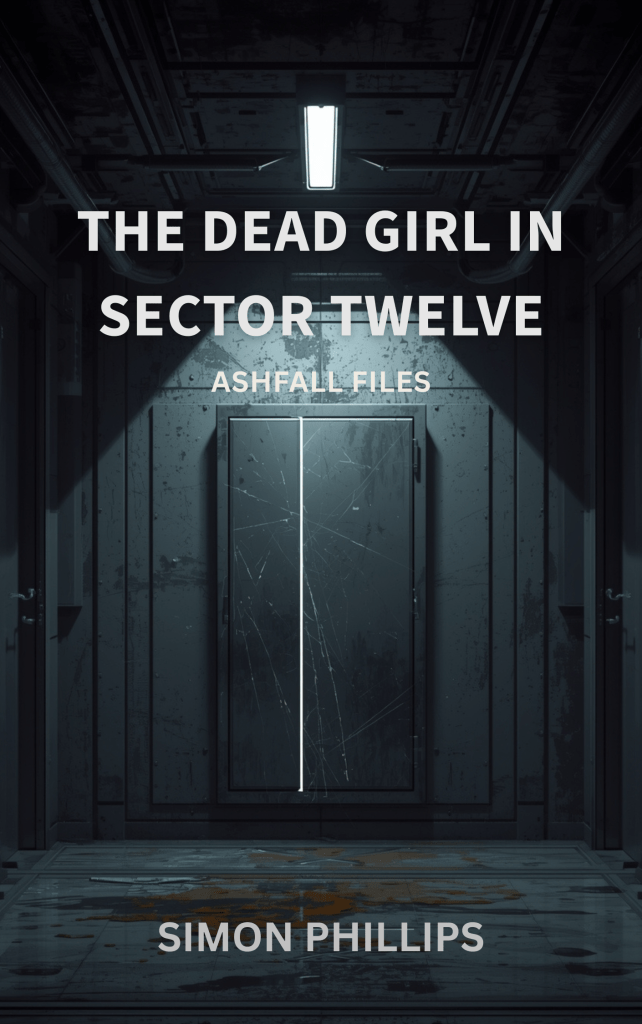
The wider Ashfall line deepens that effect. On the same Substack page, the Chronicle positions Ashfall as part of a broader fictional universe and connects it to the novella Ashfall Files: The Dead Girl in Sector Twelve, which follows a later investigation aboard the station. The Ashfall ebook listing describes the station as overcrowded, exhausted, and stretched by surveillance, rationing, and political strain, which gives the Chronicle’s quieter archival atmosphere a later echo in full narrative form.
Why this makes a strong entry point for new readers
For someone arriving fresh, this kind of Chronicle works especially well because it offers atmosphere before explanation. There is no need to master a dense body of lore. There is no demand to absorb a map of factions or technologies before the tension begins to function. A corridor, a maintenance route, a shift report, a vibration in the hull, that is enough. The world opens through implication, which means the reader enters through sensation and inference instead of through briefing.
That is a rare strength in science-fiction publishing. Many speculative worlds present themselves through scale. The Future Chronicle approaches through residue. It lets the world accumulate around the reader, fragment by fragment, as though each post were a recovered record from a larger future history. The effect feels less like stepping into a conventional content stream and more like opening a file that carries a little more weight than its title first suggests.
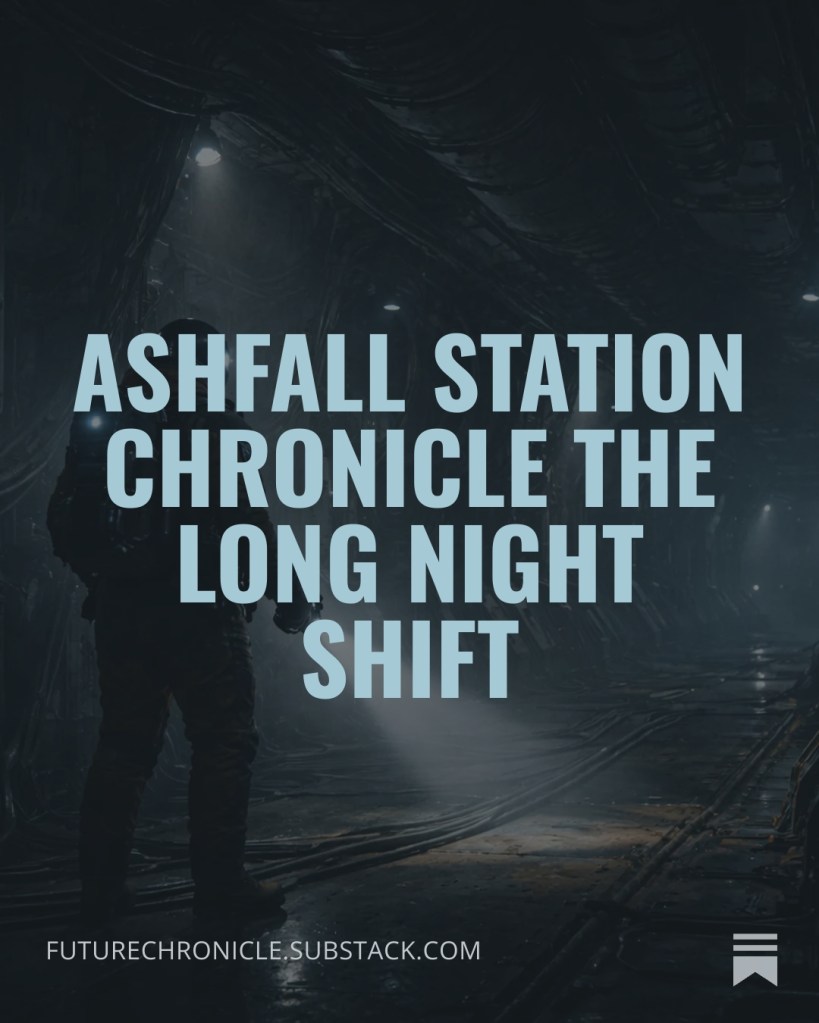
The opening section of The Long Night Shift serves as an especially clean threshold because it contains the core pressures that make Ashfall compelling. Ageing infrastructure. Solitary labour. Institutional routine. A station old enough to sound alive. A disturbance that refuses easy categorisation. From there, the archive gains force through accumulation. The next entry matters because the earlier one has already altered the reader’s sense of the station.
A companion flash-fiction short can extend that pressure in visual form, though the Chronicle itself carries the stronger emotional architecture. The written piece leaves room for the mind to inhabit the corridor fully, to feel the steel underfoot, to register how much trust goes into the systems holding vacuum beyond a few metres of alloy. That inward quality is where the unease settles.
Readers who want to step directly into that atmosphere can begin with Ashfall Station Chronicle: The Long Night Shift on The Future Chronicle, where the station’s older maintenance corridors, night inspection routes, and first recorded signs of movement across the hull emerge in the quiet language of an archival reconstruction. From there, the wider Ashfall record opens outward through the surrounding Chronicle entries, each one deepening the sense that the station carried its disturbance long before anyone found the words for it.
The Chronicle functions well as a first threshold because it asks very little of the reader except attention. It opens a corridor, lets the machinery breathe, and leaves the larger shape of Ashfall waiting further inside the archive.
The future feels strongest when it can still go unheard
Perhaps that is the deeper reason space station maintenance horror remains persuasive. It reminds us that the future, however advanced, will still depend upon unnoticed people moving through unnoticed systems at inconvenient hours, listening for the first sign that something has shifted. The great speculative image is easy to admire from a distance. The maintenance route is harder to forget. It carries duty, repetition, and the quiet fear that the structure may know more about itself than its occupants do.
An orbital station becomes memorable when it holds more than scale. It needs labour in its corridors and history in its plating. It needs the accumulated hum of years. It needs one human figure pausing beside a bulkhead because the sound travelling through it no longer belongs to the ordinary breathing of the machine.
That is where Ashfall lingers. The station continues its orbit. The records continue to fill. Somewhere along the outer structure, a disturbance first enters the archive as a minor irregularity, and the future reveals one of its oldest truths, which is that pressure almost always arrives quietly before anyone agrees on what it means.
 Simon J. Phillips