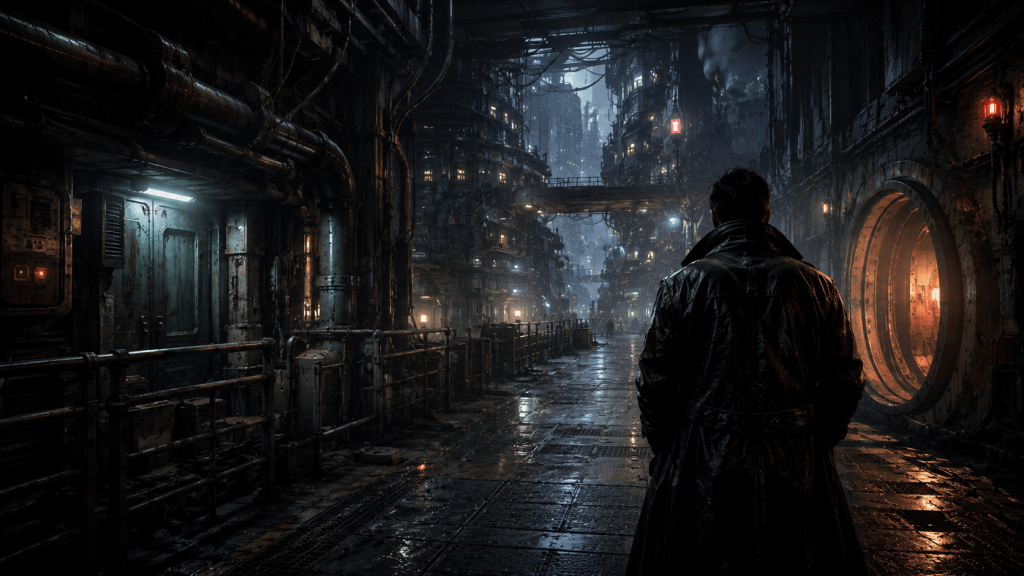
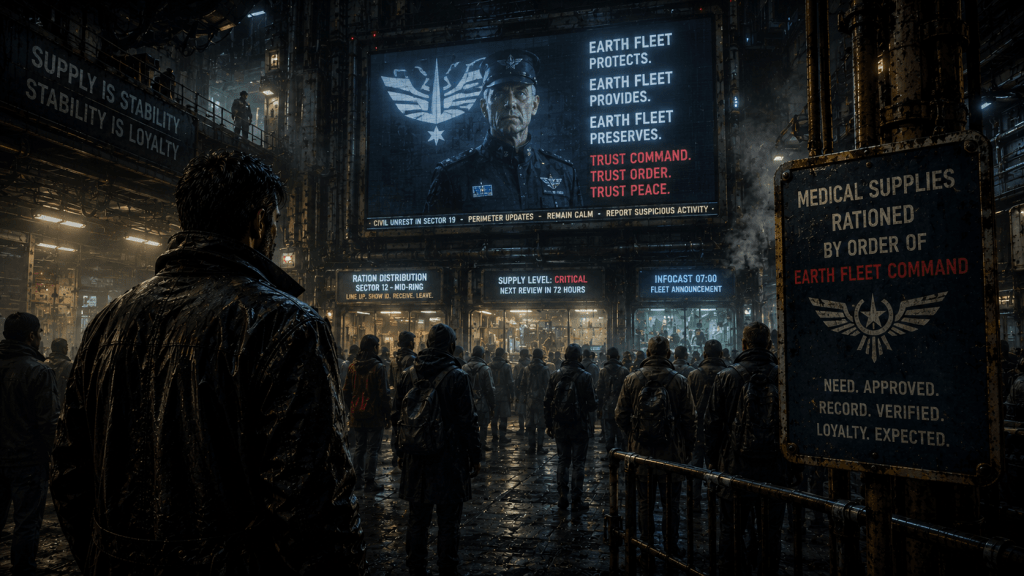
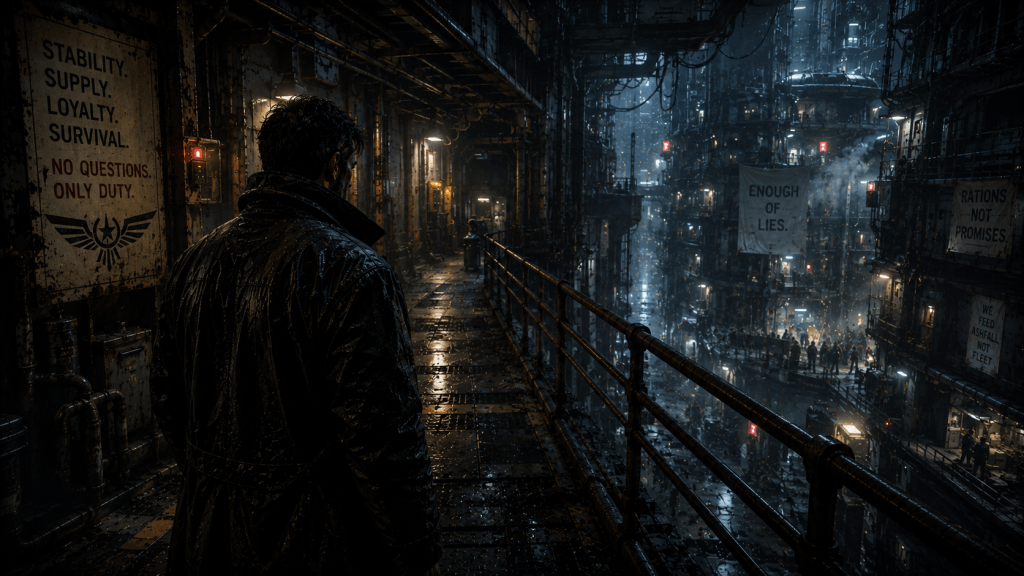
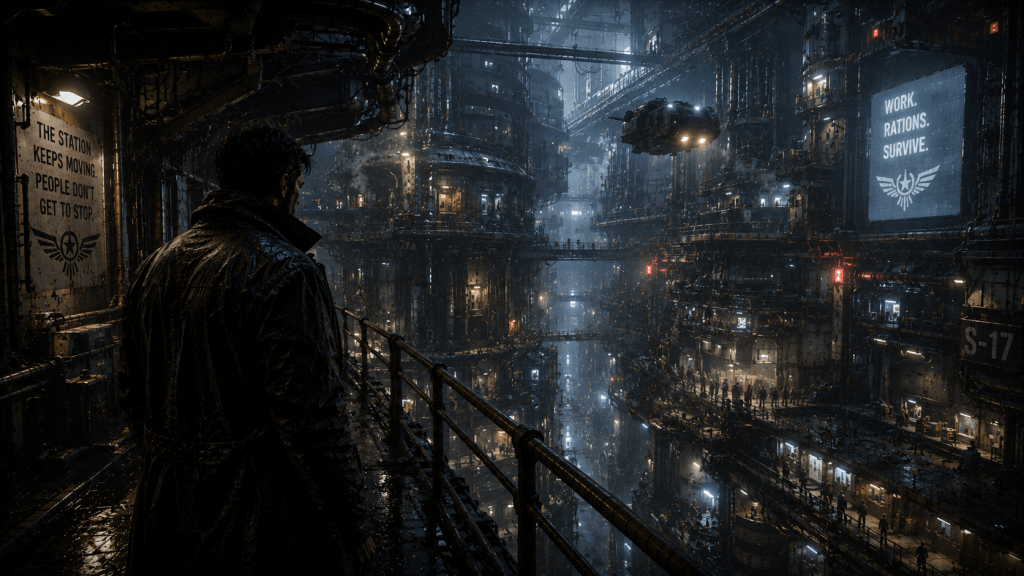
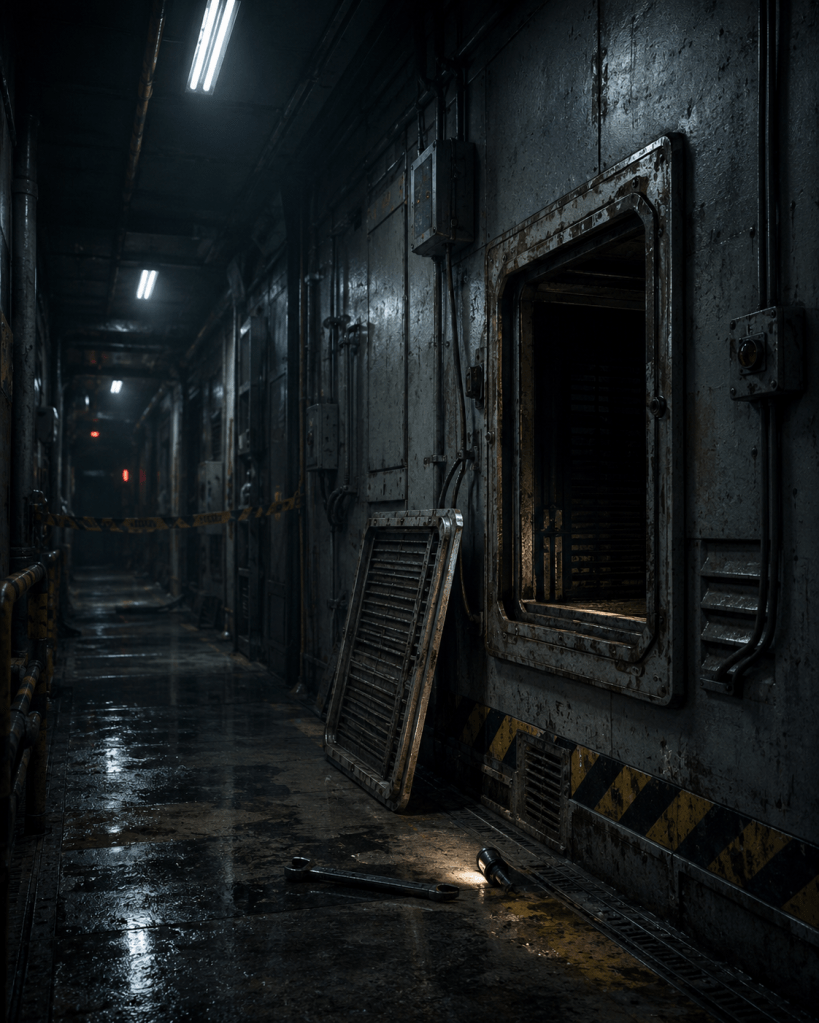
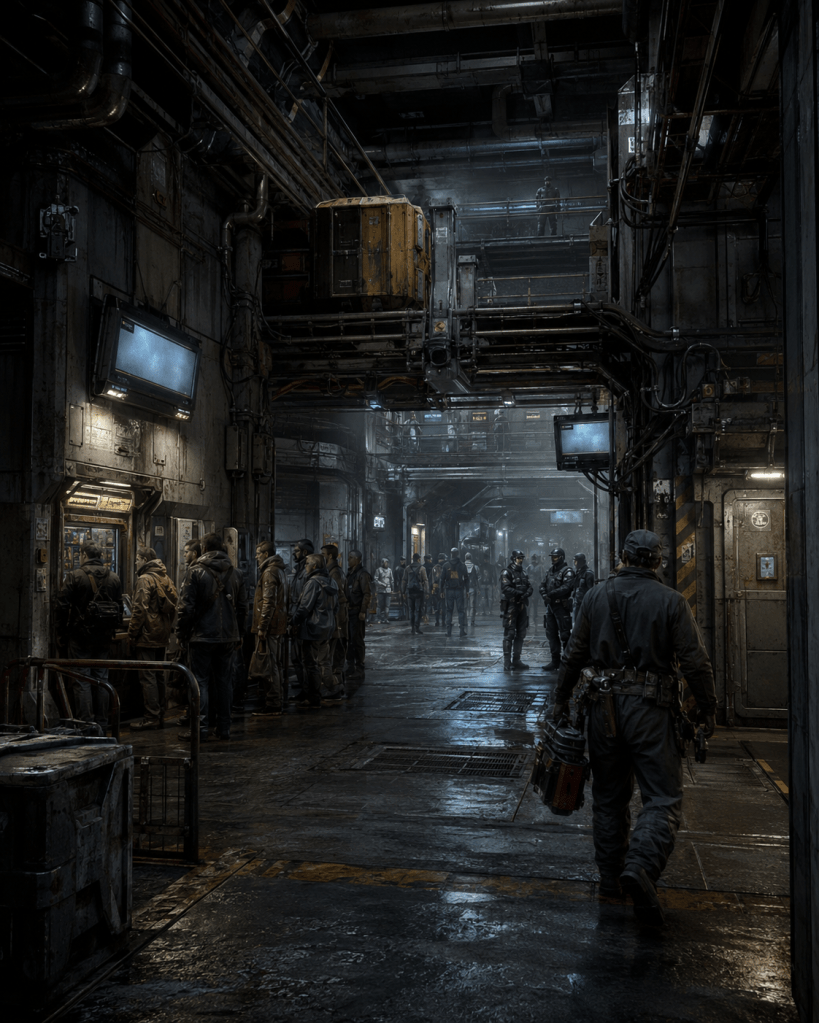
Its corridors brighten in stages, old ceiling strips warming through yellow light while ration queues form before the first shift has even settled into motion. Lift alarms drag through the transit levels. Market shutters rattle open. Public screens speak in clean administrative language, telling tired workers that delays are temporary, supplies are stable, and order remains intact. Below those screens, people count water tokens, trade rumours, watch medbay lines grow longer, and listen for the difference between a maintenance fault and the beginning of something worse.
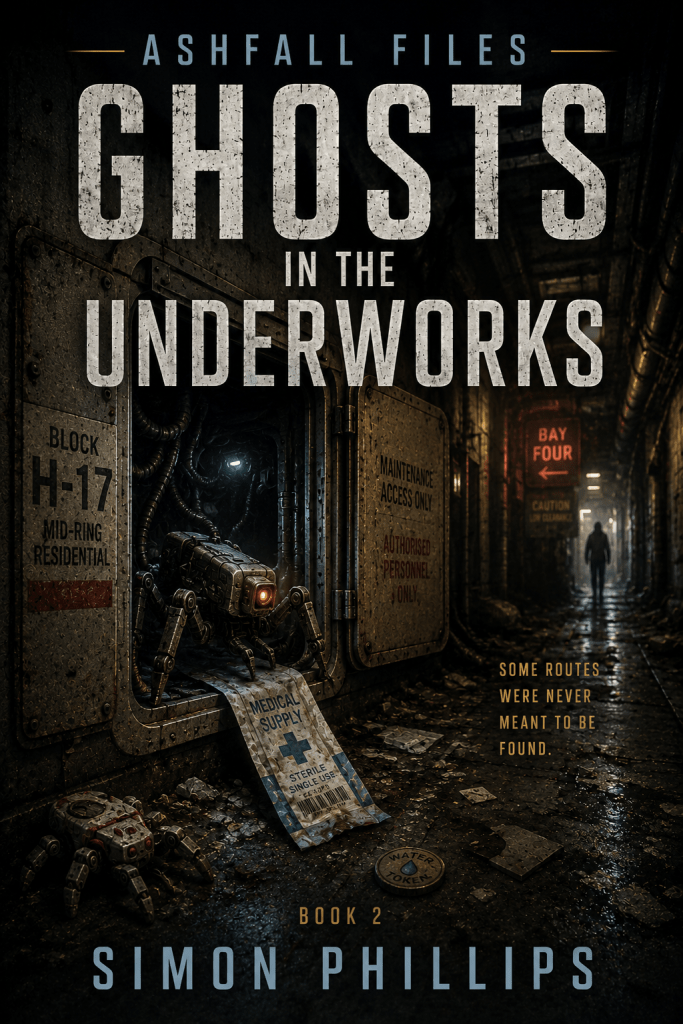
That is the world of Ghosts in the Underworks, the second book in Ashfall Files, a sci-fi noir detective series built around crime, pressure, and the slow failure of official truth aboard an ageing orbital station. It is a space station crime thriller where the mystery begins with a local wound: stolen medical ration packs, a family accused before the facts arrive, and a sick woman waiting for support that should already have reached her.
Ashfall does not fall apart in a single dramatic moment. It wears down through missed deliveries, altered records, exhausted workers, frightened witnesses, and corridors where people lower their voices before naming Earth Fleet. The danger lives in routine. That is what makes the station feel alive, and what makes each investigation matter.
When a Crime Scene Begins Inside Ordinary Life
A good noir mystery rarely begins with spectacle. It begins with a room, a body, a missing object, a witness who saw too little, or a record that seems too clean. On Ashfall Station, those small beginnings carry more weight because every ordinary failure sits inside a larger system already under strain.
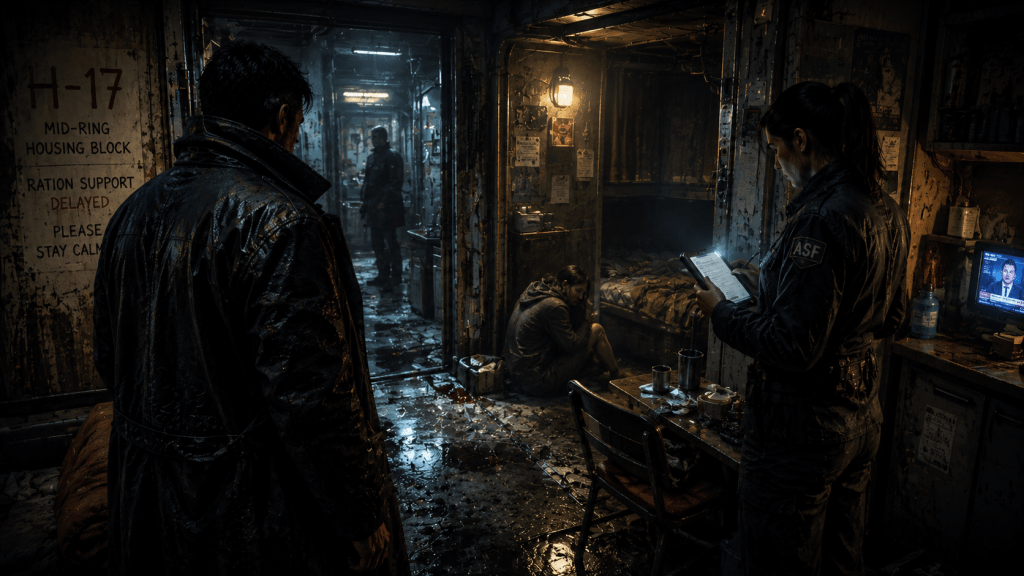
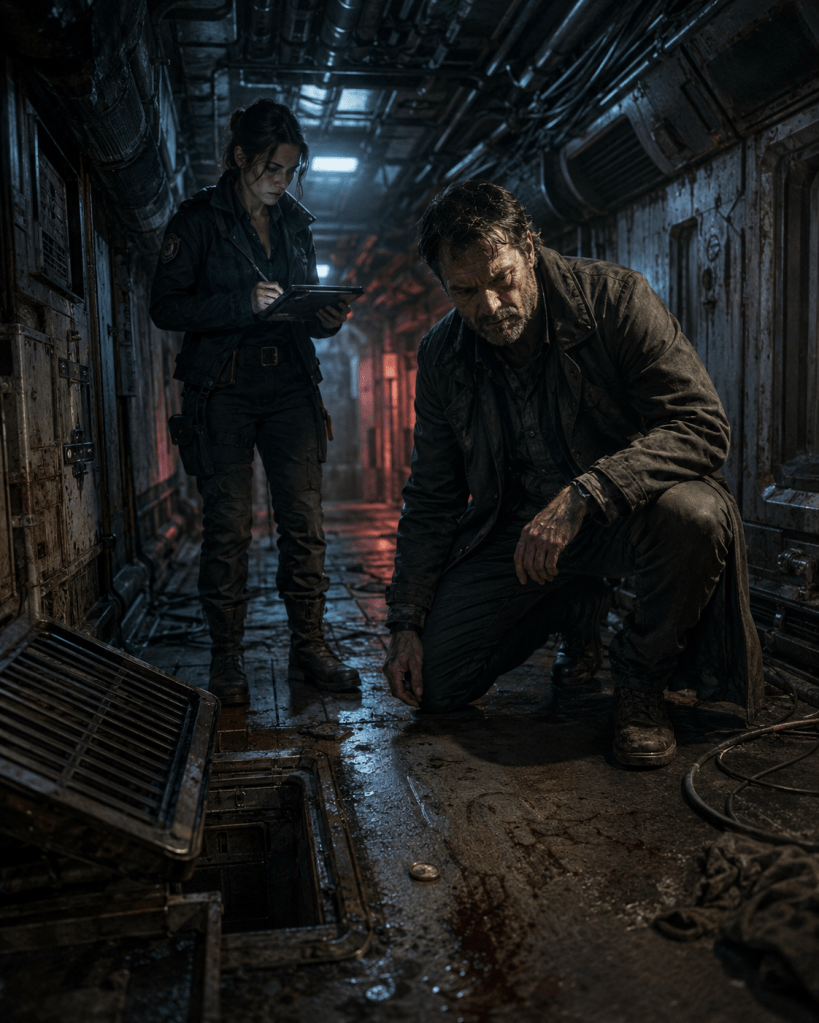
In Ghosts in the Underworks, Ruff Kale and Lena Marik are called to H-Seventeen, a Mid-Ring housing block where stolen medical ration packs and filtration components have appeared inside a civilian unit. The discovery should create a simple case. Someone stole from medical supply. Someone hid the goods. Someone else suffered because of it.
Ashfall refuses that kind of simplicity.
The Pell family become targets before evidence can catch up. Talla Vesk misses a needed medical dose. The corridor turns on itself, driven by fear, rumour, and the kind of anger that grows in places where medicine arrives late and official language never admits panic. By the time Ruff and Lena step into the block, the damage has already become social as well as criminal.
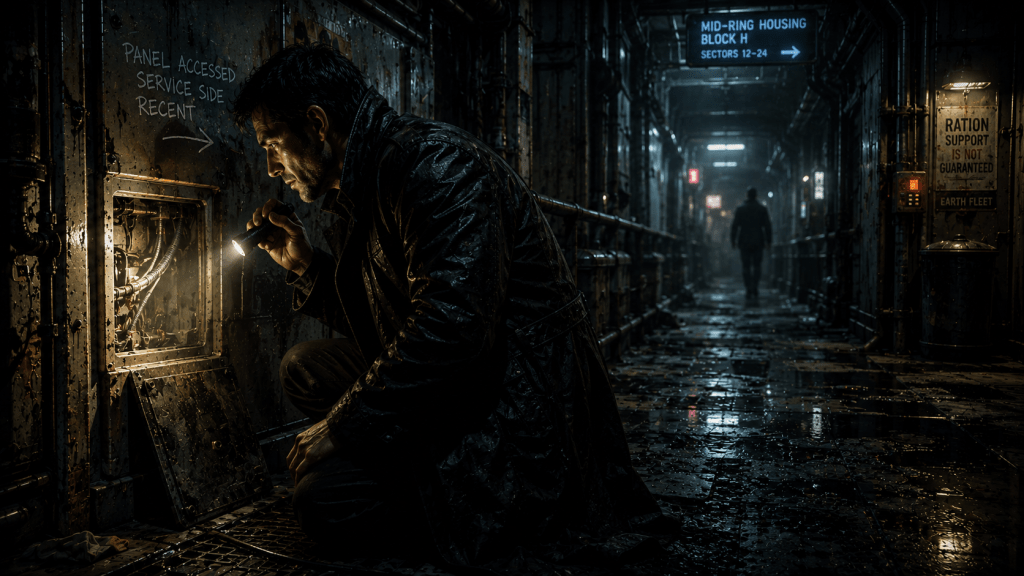
This is where the book leans into dystopian detective fiction. The crime matters because it hurts people directly, yet it also reveals how fragile the station has become. A single missing allocation can turn neighbours against one another. A phrase on a public feed can change market prices before the truth reaches the people waiting in line. A wall panel can matter more than a locked door.
Ruff Kale and the Things Records Miss
Ruff Kale is useful because Ashfall cannot be read from a case slate alone.
He knows the difference between a forced room and a staged one. He notices heat along a panel seam, grit where no resident should have disturbed it, and the careful silence that follows a crowd realising it may have blamed the wrong family. He understands that official records often describe the station as it wishes to appear, while walls, routes, smells, and frightened people describe what actually happened.
That makes him the centre of Ashfall Files as a noir detective in space. He is tired, rough, cynical, and difficult, yet he moves through the station with the instincts of someone who has spent years watching systems fail in practical ways. Ruff does not chase grand conspiracies from a clean desk. He follows the small human cost first.
Lena Marik gives the investigation its counterweight. She documents what Ruff senses. She preserves evidence before command can reduce it. She handles witnesses with care in rooms where fear has already done most of the damage. Her role is central because procedure still matters, even when power tries to narrow what procedure is allowed to prove.
Their partnership works because each sees a different part of the same lie. Ruff finds the route into the truth. Lena keeps enough of it alive to survive the file.
The Hidden Station Beneath the Mapped One
The central pressure inside Ghosts in the Underworks is movement.
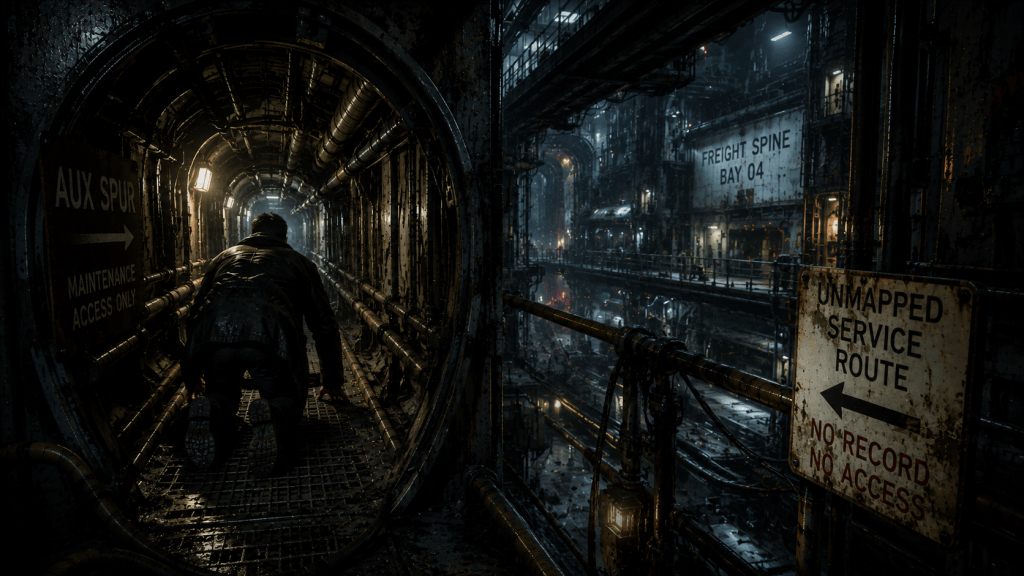
Ashfall has official routes: lifts, transit bands, service corridors, cargo lanes, maintenance access, registered doors. Those routes are watched, logged, delayed, priced, restricted, or controlled. Beneath them lies another station, one made from old service spurs, crawler tubes, blind panels, hidden alcoves, route marks, dockside whispers, and people who know how to pass between systems that no longer serve them.
Medical supplies move through those spaces. So do warnings. So do rumours. So, perhaps, did the dead girl whose erased case began the wider Ashfall Files sequence.
That is what gives this book its wider mystery. The case begins with stolen medical ration packs and filtration components, yet the investigation uncovers the logic of a hidden movement network. Maintenance crawlers, auxiliary spurs, Bay Four, Dock Twelve, route marks, cleaners, runners, and unnamed “ends” create a structure that belongs partly to crime, partly to survival, and partly to something far more dangerous.
Ashfall’s hidden routes are not glamorous secret tunnels. They are practical, cramped, hot, dirty, and useful. They exist because watched people need unwatched movement, because poor residents are easier to use as cover, and because official doors often ask questions that desperate people cannot afford to answer.
Earth Fleet, Supply Pressure, and Controlled Truth
Earth Fleet’s power in Ashfall Files rarely needs to arrive shouting.
It appears through resource control, information control, and the quiet pressure of jurisdiction. Medical supplies are delayed under clean terms. Cargo lanes are inspected. Public broadcasts translate shortages into temporary redistribution. Administrative language softens danger until the people living under it have already learned to trust rumour first.
This gives Ghosts in the Underworks its political sci-fi thriller edge while keeping the story grounded in a station-level investigation. The book never needs to turn Fleet into spectacle. Its influence is felt through the systems Ruff and Lena have to work around: supply chains, maintenance access, medbay records, case routing, and official summaries that make dangerous truths smaller than they are.
That narrowing becomes one of the book’s strongest pressures. Ruff and Lena can find evidence, preserve it, and understand its shape, yet command still has the power to decide which words survive in the official file. A route can become “local smuggling.” A supply breach can become “unauthorised maintenance access.” A wider pattern can be reduced until it looks containable.
The reader is left with the same discomfort Ruff carries: the case may be partly closed, yet the station has revealed something it cannot safely admit.
Read Ghosts in the Underworks on Kindle
Ghosts in the Underworks is available now on Amazon Kindle.
This book is for readers who enjoy atmospheric sci-fi noir, space station mystery, dystopian detective fiction, and adult science fiction built around pressure rather than spectacle. It follows Ruff Kale and Lena Marik into a case where stolen medicine, hidden routes, supply control, and institutional silence all point towards a larger Ashfall Files mystery.
The story stands as its own investigation while deepening the wider series world. It begins in the heat of Mid-Ring housing and moves through medbay queues, market overhangs, maintenance spurs, crawler bays, Freight Spine service spaces, and finally towards cleaner decks where danger wears a better surface.
At the centre of the book is a simple question with dangerous consequences: how does something move through a watched station without appearing in the records? The answer does not arrive through clean exposition or distant spectacle. It emerges through witness statements, damaged rooms, service panels, maintenance crawlers, missing supplies, and the ordinary people caught between need and blame.
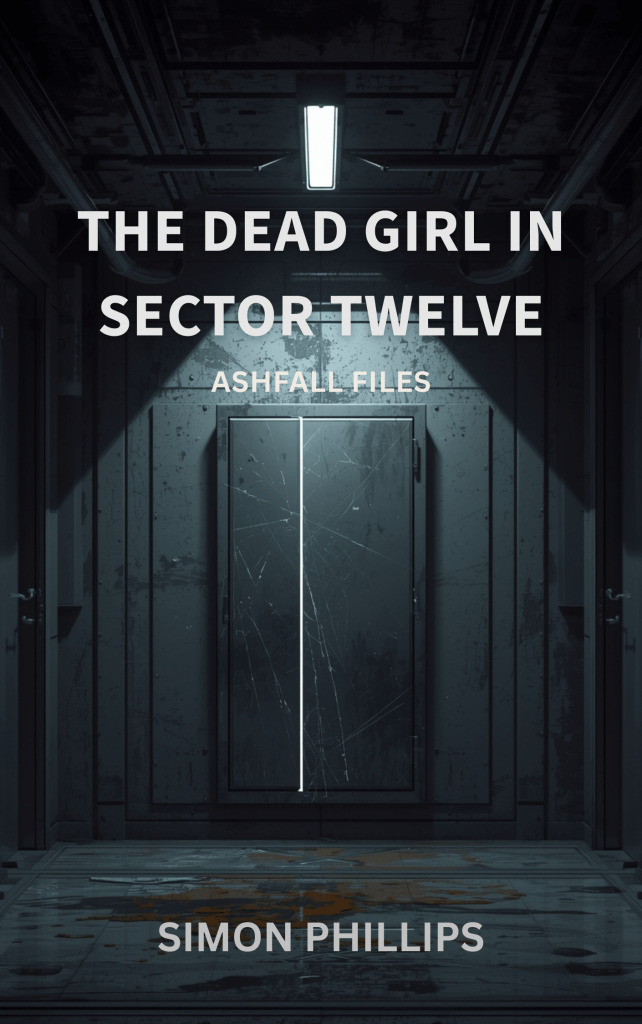
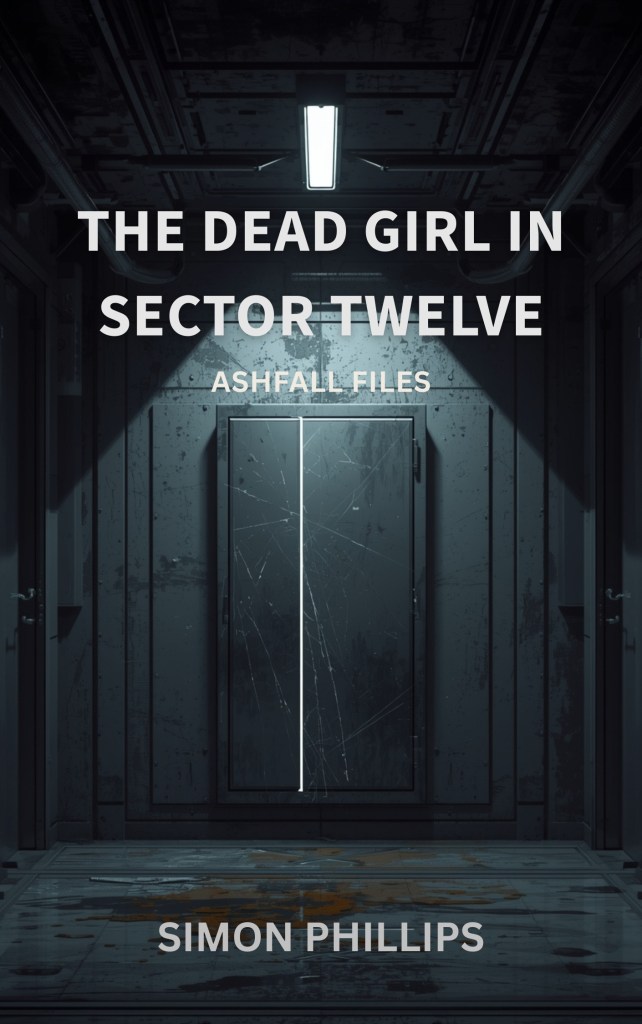
For readers entering Ashfall Files through this book, Ghosts in the Underworks offers a grounded sci-fi crime story with a complete case, while still carrying the pressure of a larger mystery beneath it. For returning readers, it follows the thread left by The Dead Girl in Sector Twelve and pushes Ruff and Lena deeper into the hidden systems that keep Ashfall Station moving even as official truth begins to fracture.
It is a story of ration pressure, compromised infrastructure, controlled language, and the quiet cost of asking questions inside a system built to narrow the answers.
Watch the Ghosts in the Underworks Short
A short atmospheric video for Ghosts in the Underworks is available on YouTube, offering a fast visual entry point into the mood of Ashfall Station and the pressure behind the book.
The short is designed to carry the same atmosphere as the story: industrial corridors, station grime, noir shadow, failing light, hidden movement, and the sense that every official surface has something moving behind it. It gives viewers a glimpse of the world Ruff Kale and Lena Marik move through, where ration pressure, controlled broadcasts, maintenance routes, and quiet institutional fear shape every investigation.
Rather than explaining the case outright, the video works as a mood piece for the Ashfall Files series. It reflects the book’s central feeling: a watched station where truth rarely travels through the front door, and where the most important evidence may be hidden in service tunnels, wall seams, crawler bays, and the spaces ordinary people are forced to use when official systems fail them.
For readers discovering the series through video first, it offers a brief introduction to Ashfall’s blend of sci-fi noir, space station mystery, dystopian crime, and slow-burn detective pressure before entering the full book.
Why Ashfall Files Is Built Around Pressure
Ashfall Files is a detective science fiction series because investigation is the cleanest way to enter a dirty system.
Each case begins with something local enough to matter immediately: a dead courier, stolen medicine, missing evidence, altered records, a frightened witness, a family blamed too quickly, a route no one admits exists. The wider conspiracy does not arrive as a lecture. It appears through the practical work of asking who was hurt, who benefits from silence, who controls the file, and why the official explanation feels too neat.
That structure keeps Ashfall Station human. The station is more than a backdrop. It is a living pressure system where rationing, poverty, infrastructure decay, surveillance, and corruption shape every decision. People lie because truth costs them. Witnesses hesitate because records can be changed. Workers know routes that maps leave out. Criminal economies grow in the gaps left by official neglect.
This is what gives the series its noir identity. Truth exists, yet it moves through damaged channels. Power exists, yet it often appears first as delay, obstruction, or polite wording. Justice exists only as far as someone is willing to carry it after the case has already been made smaller.
The Station Keeps Moving
By the end of Ghosts in the Underworks, the immediate harm has been partly addressed. Evidence survives. Some supplies are recovered. The falsely accused are given enough official recognition to stand a little straighter. A sick woman receives support that should never have gone missing.
Yet Ashfall does not feel safer.
The route remains larger than the case file. The people who carry the middle still fear the ends. The dead girl’s movement through Sector Twelve has become less mysterious in one way and more dangerous in another. Ruff knows more than he can prove. Lena has preserved more than command wanted left intact.
That is the quiet strength of Ashfall Files. The books do not ask the reader to believe in a clean victory. They ask the reader to follow the evidence through a station where every answer opens another sealed panel, and every official summary leaves something breathing behind the wall.
A Fleet inspection mission arrives expecting to close a dying industrial outpost. Instead, the station receives quiet orders for expansion
Chronicle Opening: The Arrival at Ashfall
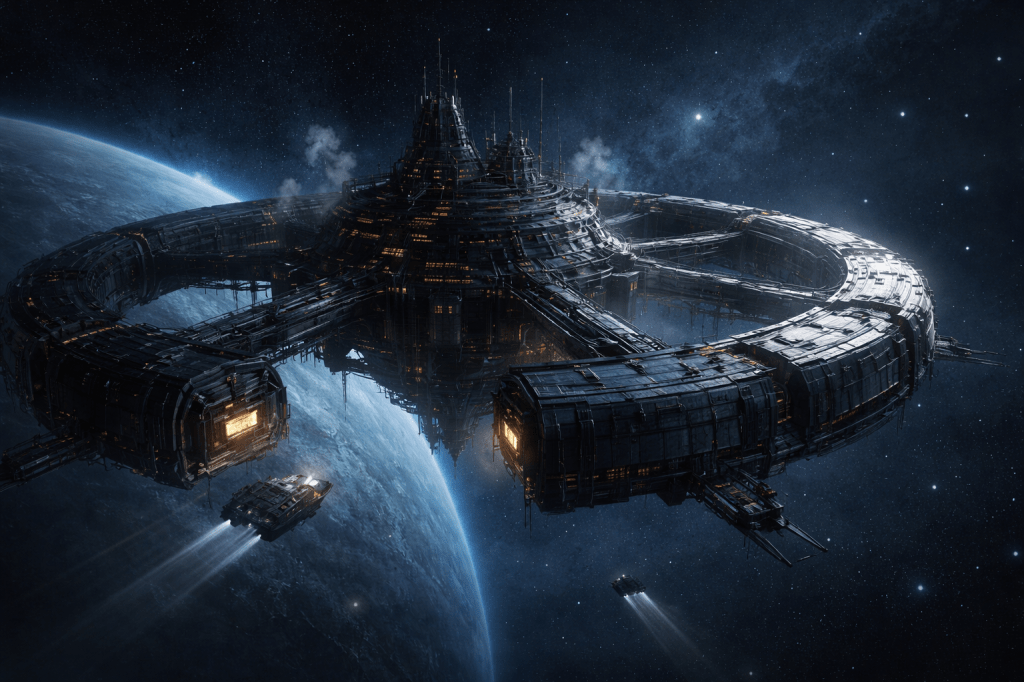
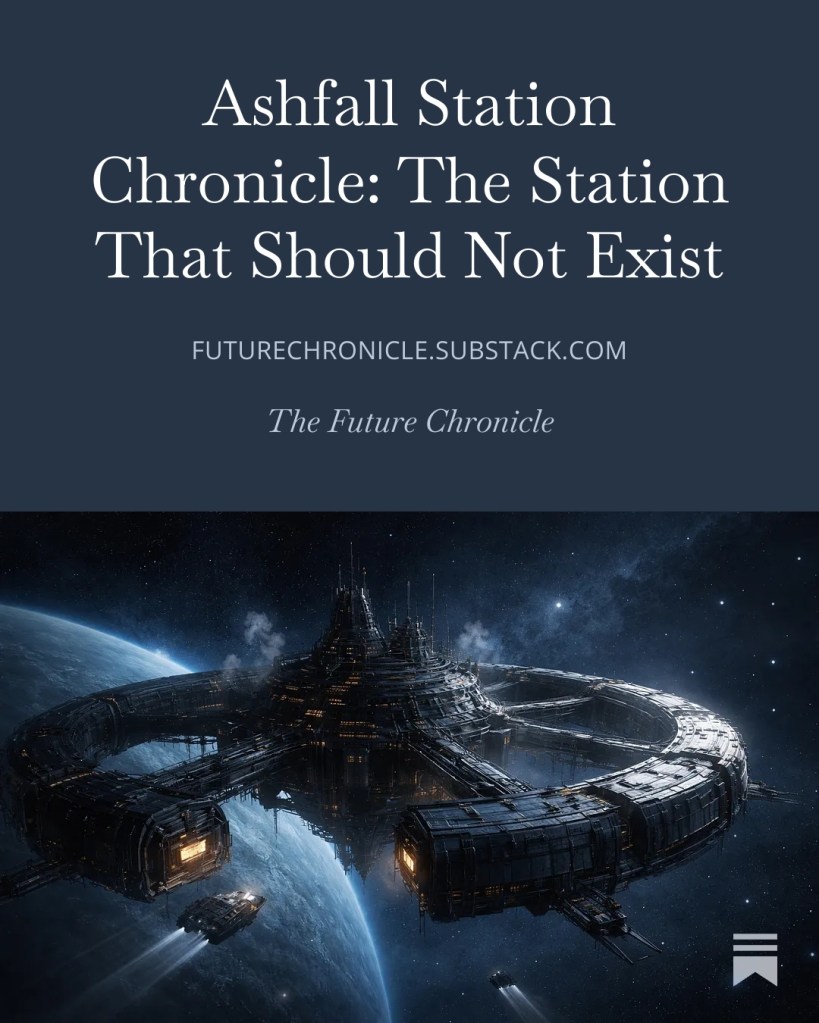
The inspection shuttle drifted through the outer traffic corridor with the slow patience of an ageing machine that had travelled far beyond the routes it once served. Ashfall Station filled the viewport ahead, an immense ring of darkened metal turning in quiet orbit above the pale curve of the planet below. From a distance the structure possessed the appearance of a relic left behind after a long war, its surfaces scarred by decades of repairs, extensions, and forgotten construction. Amber maintenance lights burned along the docking arms like distant lanterns hanging in a storm.
Inspector Halverin remained seated beside the forward console while the shuttle’s guidance system threaded its approach vector through a cloud of drifting cargo tugs and maintenance craft. Each vessel moved with the weary rhythm of workers who had spent their lives in the shadow of machinery, their engines leaving thin trails of ion light that faded into the deep blue of the surrounding stars. Ashfall grew larger with every passing second until the station occupied the entire frame of the viewport, its ring sections broken by thick industrial spines that connected to a central tower rising through the station’s heart.
Halverin studied the structure in silence while the shuttle rotated to align with Docking Arm Twelve. Fleet files described Ashfall as an ageing extraction hub at the far edge of controlled territory, a place built during an earlier phase of expansion when ore routes from the outer belt carried real promise. Those routes had faded many years earlier, leaving the station suspended between usefulness and abandonment. The inspection order carried a simple purpose: to evaluate the installation and prepare the paperwork required for closure.
Through the shuttle glass Halverin observed long rows of habitation windows scattered across the station ring. Many remained dark. Others glowed with dim interior light that hinted at quiet lives unfolding behind metal walls. Somewhere inside those corridors engineers maintained life support systems older than most Fleet vessels, while cargo crews moved freight between bays that had witnessed decades of traffic. Ashfall continued to function through habit as much as necessity.
The pilot cleared his throat while guiding the shuttle toward the docking corridor.
“Dock control confirms our arrival,” he said. “They sound relieved to see a Fleet inspection team.”
Halverin allowed his gaze to follow the slow movement of a cargo hauler sliding away from the docking arm ahead. The vessel’s hull carried a patchwork of weld seams and fresh plating where older sections had been replaced. Every surface told the same story of endurance and improvisation. A station like this survived through constant repair.
“Relief usually appears when rumours begin,” Halverin replied quietly.
The pilot glanced toward him. “Rumours, sir?”
Halverin opened the inspection tablet resting across his lap and scrolled through the preliminary maintenance reports transmitted by the station administration. Power fluctuations across several outer sectors. Unscheduled system resets inside the older structural corridors. Salvage traffic arriving from beyond the debris perimeter. Each entry carried the tone of routine paperwork, though the pattern beneath the reports suggested a station working harder than its ageing systems allowed.
Beyond the viewport Docking Arm Twelve opened like a vast mechanical tunnel. Rows of guidance lights stretched into the interior bay while maintenance drones drifted along the outer hull inspecting the arm’s pressure seals. Ashfall Station continued its slow rotation above the silent planet below, an immense structure that had survived long enough to become part of the frontier itself.
Fleet command expected a recommendation for decommissioning, a quiet administrative ending for a station that had already outlived the era that built it.
Halverin held the tablet screen in his hands while the shuttle glided toward the docking cradle. The files suggested a different future unfolding across the station’s decks, one that would require expansion orders instead of closure.
By every measure recorded in the inspection files, Ashfall Station had reached the end of its intended life, a frontier installation whose purpose had faded as trade routes shifted and distant mining operations closed.
Yet the deeper layers of Fleet correspondence suggested another direction unfolding beyond the official briefing, a quiet decision somewhere within command. This ageing station drifting at the edge of human expansion would expand instead of vanish.
The arrival of Fleet Inspector Halverin marked the beginning of a series of quiet events that would gradually change the fate of Ashfall Station.
Station Record: Ashfall Station
Ashfall Station occupies a slow orbital path above the frontier world of Kestren-4, a mining planet whose richest deposits were exhausted many decades earlier, leaving behind a landscape of silent refineries and abandoned extraction pits that once supplied entire industrial regions across the expanding territories of human space.
The station itself began life as a resource transfer hub during the fourth wave of outer-system expansion, an era when cargo vessels arrived daily from the belt refineries and the surrounding mining fields, unloading vast shipments of processed ore that were then routed inward toward the manufacturing worlds closer to the core systems, where factories and orbital shipyards transformed that material into the infrastructure of a rapidly growing civilisation.
As the richest mining zones declined and transport routes shifted toward newer territories, many installations built during that period were gradually dismantled or abandoned, their structural rings stripped for salvage or their corridors left drifting in quiet orbit around worlds that had already been forgotten by the trade fleets.
Ashfall, however, remained in operation through a mixture of persistence, adaptation, and the quiet administrative decisions that often shaped the frontier more strongly than official policy ever admitted.
Fleet administration eventually classified the station as a declining industrial outpost whose continued operation served a limited set of purposes, most notably the coordination of salvage vessels working the debris fields beyond the system and the support of long-range transport traffic that occasionally passed through this region of space while travelling between distant territories.
Inspection orders issued shortly before the events recorded in this Chronicle suggested that Ashfall Station had reached the final stage of its operational life and that Fleet command intended to evaluate the installation for decommissioning once the remaining contracts tied to the station had concluded.
Yet within a matter of weeks, the direction of those orders began to change, as if information circulating through the deeper layers of Fleet command had altered the station’s fate long before the reason for that decision ever appeared in the official record.
About the Creator
The Future Chronicle is written and curated by Simon Phillips, a writer of science fiction and speculative storytelling who explores the quiet edges of human expansion, where ageing stations, distant worlds, and forgotten technologies continue their slow existence beyond the reach of the central worlds.
Many of the stories presented in these Chronicles exist within a wider fictional universe that follows the lives of investigators, engineers, and frontier workers living far from the comfort of the inner systems, where the machinery of civilisation continues to function long after its original purpose has begun to fade.
One such story unfolds aboard Ashfall Station, an ageing orbital installation whose corridors and industrial sectors form the setting for the science-fiction mystery novella Ashfall Station: The Dead Girl in Sector Twelve, where a routine investigation gradually reveals that something hidden within the station’s structure may have been present for far longer than the official records suggest.
Readers who wish to explore the full investigation and its unfolding events can find the novella below.
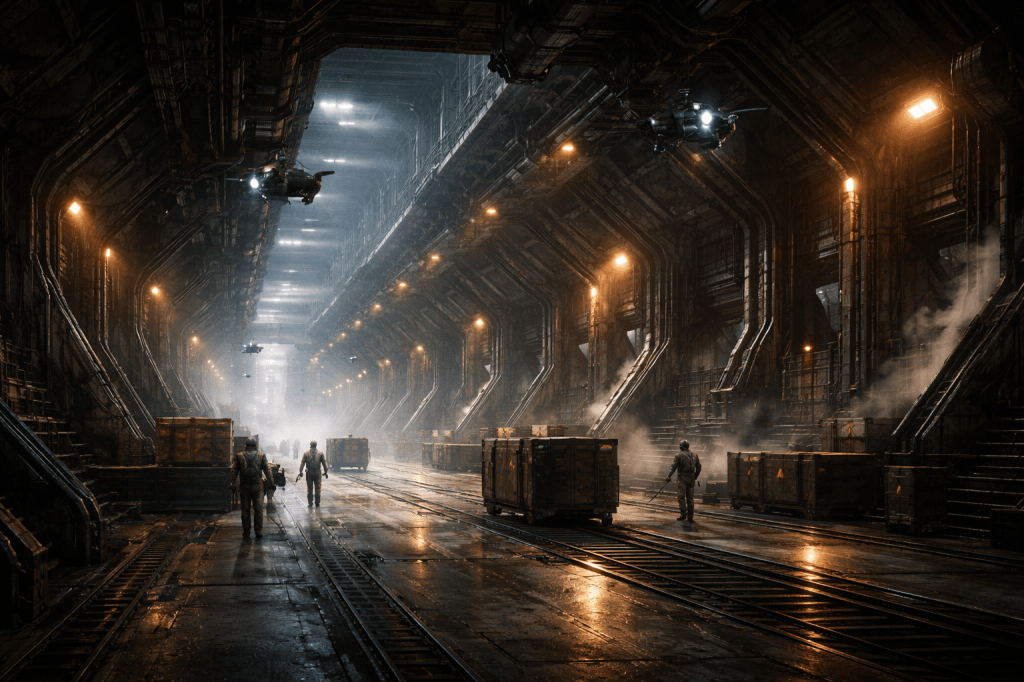
Inspector Halverin followed the station administrator along the docking corridor while the sounds of the bay settled into a steady industrial rhythm that seemed to pulse through every plate of metal beneath his boots. The corridor stretched forward beneath rows of amber maintenance lamps whose light reflected across the worn alloy floor in long warm bands. Along the distant walls, cargo machinery moved with patient deliberation while crews guided freight containers toward the interior lifts that carried materials deeper into the rotating ring of the station.
Ashfall possessed the atmosphere of a place whose working life had continued for so many years that every surface carried the quiet marks of labour. Rail tracks cut shallow grooves through the deck plating where freight trolleys had rolled for decades, and handrails bore the polished sheen left by countless gloved hands guiding themselves through artificial gravity shifts during docking operations. Above them, the massive skeletal framework of Docking Arm Twelve rose into the dimness like the interior of an enormous machine that had grown layer upon layer through successive expansions.
“Your arrival stirred a certain level of curiosity among the station crews,” the administrator said while guiding Halverin toward a security arch positioned at the end of the corridor. “Fleet inspections arrive rarely this far beyond the core trade lanes.”
Halverin glanced across the open docking chamber where two cargo haulers drifted slowly into their assigned berths while docking clamps moved outward to receive them.
“Curiosity usually accompanies uncertainty,” he replied. “Inspection orders tend to appear when Fleet administration begins reconsidering the value of a frontier installation.”
The administrator allowed a thoughtful expression to pass across her face while the security arch scanned Halverin’s identification tablet and cleared them into the interior access corridor.
“Ashfall has endured several such reconsiderations across its history,” she said. “Each time the station adapted to whatever circumstances followed.”
Beyond the checkpoint, the corridor widened into a long transit gallery whose walls were lined with structural ribs and exposed service conduits that carried power and atmosphere throughout the station. Freight lifts descended through circular shafts positioned at intervals along the passage, each platform transporting containers toward sectors hidden deeper within the ring. Overhead, the slow rotation of the station created a subtle sensation of movement, as if the entire structure breathed with mechanical patience.
Halverin studied the gallery while they walked, noting the layered architecture that revealed decades of construction phases. Some sections of the corridor carried the clean geometric lines typical of modern Fleet engineering, while older segments retained heavier structural plating from earlier eras when stations were built to endure harsher industrial demands. The result created a complex patchwork of engineering philosophies that had merged together through years of expansion.
“Fleet records describe Ashfall as a declining transfer hub,” Halverin said while examining a series of maintenance panels mounted along the wall. “Traffic levels appear healthier than the reports suggested.”
“Salvage operations increased across the outer debris field,” the administrator explained. “When older transport routes collapsed, many vessels and relay structures remained scattered across that region of space. Independent crews began recovering those materials several years ago, and Ashfall gradually became their primary staging port.”
The explanation carried the tone of an administrative summary that had been repeated many times. Halverin sensed an additional layer of thought behind the words, something unspoken that hovered beneath the careful clarity of the station official’s voice. Frontier installations often survived through precisely such quiet adjustments, yet the inspection reports resting inside Halverin’s tablet suggested deeper structural changes occurring within the station.
They passed beneath another bank of lighting where maintenance drones hovered close to the corridor ceiling while scanning the integrity of the power conduits embedded in the wall. Each machine moved with delicate mechanical grace, extending slender sensor arms that traced the seams between metal plates. The drones worked with such silent efficiency that their presence almost blended into the surrounding machinery.
“Your crew maintains a considerable amount of infrastructure,” Halverin observed. “The station appears larger than the official registry diagrams indicate.”
The administrator slowed slightly as they approached a junction where three corridors met beneath a circular observation window overlooking the inner ring of Ashfall Station. Through the glass, Halverin saw the immense curve of the rotating habitation decks stretching across the interior structure like the inside wall of a vast mechanical horizon. Cargo traffic moved along illuminated transit lanes while distant maintenance vehicles travelled between docking sectors that appeared as small points of light scattered along the ring.
“Ashfall grew in stages,” the administrator said while gesturing toward the interior view. “Each phase connected new construction to older frameworks. Salvage materials often supplemented the official supply chains during those expansions.”
Halverin listened while studying the station’s interior landscape. Layers of habitation modules, cargo corridors, and structural trusses formed a dense industrial ecosystem whose complexity extended far beyond the simple diagrams included in the Fleet archives. The station resembled a living organism assembled from decades of improvisation.
“Expansion during a period of declining traffic suggests unusual priorities,” Halverin said thoughtfully.
“Frontier economies evolve through necessity,” the administrator replied while guiding him toward a lift platform descending into the lower administrative decks. “Ashfall discovered ways to remain useful.”
The lift platform engaged with a low mechanical vibration and began its descent through the circular shaft that opened beneath the gallery floor. As the platform lowered into the interior levels of the station, Halverin watched the layered structure pass slowly around them, each deck revealing new corridors filled with workers moving between maintenance stations, habitation modules, and equipment lockers arranged along the walls.
Artificial gravity strengthened slightly as they travelled deeper into the rotating ring. The change produced a subtle shift in the balance of Halverin’s stance while the platform continued downward through the immense framework of the station.
Across the descending levels, he noticed several sealed corridors branching away from the primary decks. Their entrances carried reinforced bulkheads whose surfaces bore the faded markings of earlier construction authorities. Some appeared old enough to predate the most recent expansions recorded within Fleet engineering logs.
“Several sectors remain isolated,” Halverin observed while pointing toward one of the sealed passages sliding past the lift cage.
“Structural preservation zones,” the administrator said calmly. “Older engineering frameworks occasionally require separation from modern systems while reinforcement projects proceed.”
Halverin considered the answer while the lift continued its steady descent. Frontier stations possessed many hidden compartments where obsolete equipment waited for eventual removal. Yet the inspection reports inside his tablet contained references to unexplained power fluctuations originating from precisely such sealed areas.
The lift platform reached the administrative deck and slowed as the surrounding corridor came into view. Unlike the industrial spaces above, this level carried the quieter atmosphere of operational management. Offices lined the passage while communication terminals flickered with the pale light of long-range transmissions travelling between Ashfall and distant Fleet relays.
The administrator stepped from the lift and guided Halverin toward a wide observation corridor overlooking the station’s central command tower. From this vantage point, the immense rotating ring of Ashfall Station curved upward into the distance while the planet below cast a soft blue reflection across the lower structural beams.
Halverin paused beside the observation rail and studied the vast interior landscape spreading across the station. Freight moved through the illuminated corridors. Maintenance drones traced their patient circuits along the structural ribs. Human lives unfolded quietly inside thousands of compartments distributed across the rotating ring.
Ashfall continued its slow orbit above the silent world below while the machinery of the station carried on with the steady rhythm of a place that had grown accustomed to survival.
Yet somewhere within that immense industrial labyrinth, the inspection files suggested the presence of changes that had begun long before Fleet command issued the order that brought Halverin to this distant frontier installation.
Docking Arm Twelve formed one of the oldest sections of Ashfall Station, a corridor of machinery and freight traffic where decades of expansion had layered new construction upon the station’s original industrial framework.
The Idea Behind the Chronicle
Large orbital stations like Ashfall appear frequently in science fiction, yet their origins come from very real ideas that engineers and planners have considered for decades. As humanity expands further into space, the distances between settled worlds grow wider, and the infrastructure required to support trade, travel, and exploration becomes increasingly complex. Vast stations positioned along transport routes would function as the ports and industrial centres of those distant frontiers.
Early visions of space colonisation imagined elegant rotating habitats filled with gardens and cities suspended in orbit, though the practical reality of expansion would likely unfold in a far more industrial manner. Freight depots, salvage ports, fuel processing hubs, and maintenance platforms would appear long before comfortable civilian settlements, and many of those installations would begin life as harsh working environments where engineers and cargo crews kept machinery running under difficult conditions.
Ashfall Station belongs to this imagined era of expansion. It represents the kind of installation built quickly to serve a specific economic purpose, then left to adapt when the frontier moved elsewhere. Across human history many places have followed a similar path. Mining towns, remote harbours, and railway settlements have often survived long after the industries that created them began to fade, reshaping themselves into something new through the quiet persistence of the people who remained behind.
The Chronicle of Ashfall explores that idea of survival and adaptation. A station designed for one purpose gradually becomes something more complex as new trades appear, old systems are modified, and sections of the structure accumulate decades of layered construction. Over time the installation begins to feel less like a machine and more like a living environment shaped by the countless lives that have passed through its corridors.
In such places the boundary between past and present becomes blurred. Old infrastructure remains hidden behind modern upgrades, forgotten corridors continue to exist beyond sealed bulkheads, and the history of the station lingers within the machinery that keeps it alive.
Ashfall Station therefore serves as both setting and character within the Chronicle, an immense frontier installation whose long history has left traces that the official records may never fully explain.
From the Author’s Desk
Ashfall Station began as a simple image that lingered in my imagination for several years: the idea of an immense industrial structure drifting at the far edge of human space long after the frontier that created it had moved on. Science fiction often grows most naturally from such quiet beginnings, where a single place or moment suggests a much larger history waiting somewhere beyond the visible story.
The Chronicles presented here explore the earlier life of that station, revealing small fragments of its past through the people who lived and worked within its corridors. Each episode focuses on a single event or encounter, gradually uncovering how Ashfall evolved from an ordinary frontier installation into a place carrying deeper layers of history hidden within its structure.
The novella Ashfall Station: The Dead Girl in Sector Twelve takes place much later in that timeline, when the station has already accumulated decades of expansion, modification, and quiet mystery. Writing the Chronicle series offers the opportunity to step backwards into that earlier period and observe the smaller moments that shaped the station long before the events of the investigation began.
Alongside these Chronicles I continue writing fiction across several science fiction and speculative projects, many of which explore frontier environments where technology, distance, and human persistence intersect in unexpected ways.
Readers interested in those stories can explore more through the links below.
Industrial stations such as Ashfall represent one of the most practical solutions to the challenge of distance in space exploration. Vast orbital platforms positioned along transport routes would form the logistical backbone of any expanding civilisation, providing docking capacity for freight vessels, repair facilities for long-range ships, and storage infrastructure for resources moving between distant systems.
During the earliest phases of expansion such stations would likely resemble harsh industrial environments rather than comfortable settlements. Engineers, cargo crews, and salvage operators would occupy modular habitats attached to immense structural frameworks designed primarily for durability and efficiency. Over time these installations might grow far beyond their original plans as new sectors were added to support changing economic activity.
Ashfall Station reflects this gradual evolution. A structure originally designed for ore transfer slowly becomes a hybrid of freight port, salvage hub, and frontier settlement as different industries pass through the system.
Salvage Economies
Salvage operations often emerge in regions where earlier waves of exploration have left abandoned infrastructure behind. Derelict cargo ships, obsolete relay stations, and fragments of industrial platforms may remain drifting through orbital space for decades or even centuries. Independent crews recover valuable materials from these forgotten structures and return them to frontier ports, where metal and components can be reused.
A station positioned near a large debris field would therefore become a natural gathering point for salvage crews and transport contractors. Over time such activity could replace the station’s original purpose entirely, allowing an installation once built for mining traffic to survive long after the surrounding resource economy has faded.
Layered Structures
One intriguing feature of long-lived orbital stations would be the accumulation of multiple engineering eras within a single structure. New modules could be attached to older frameworks, outdated systems might remain sealed behind bulkheads, and corridors originally designed for industrial machinery might later become part of habitation districts or storage sectors.
This layered architecture creates environments where the past remains physically embedded within the present. Forgotten corridors and abandoned compartments can persist inside the station’s interior, hidden behind structural reinforcements that few workers ever have reason to access.
Ashfall Station carries the weight of this accumulated history, a frontier installation whose present appearance reflects decades of adaptation, expansion, and quiet improvisation by the people who have kept its machinery running.
Next Chronicle
Several months before the inspection recorded in this Chronicle, a salvage vessel arrived at Ashfall Station after operating far beyond the normal navigation perimeter of the system. The ship returned with a fragment of unidentified structure recovered from deep orbit within the outer debris field, an object whose origin could not immediately be traced to any registered vessel or industrial installation.
Station logs record that the fragment was transferred quietly into a sealed research hold shortly after the salvage crew docked, and within a few hours the object disappeared from the public cargo registry entirely. Few workers on Ashfall understood what had been recovered from the silent region of space beyond the station, though rumours began to circulate through the docking sectors that the salvage crew had discovered something far older than the drifting wreckage normally collected from the debris field.
The next Chronicle returns to that earlier moment, when the salvage ship first approached the station carrying its unusual cargo and the events began that would slowly alter the future of Ashfall Station.
Next Week: The Salvage Run
Ashfall Station continued its slow orbit above the silent world of Kestren-4, carrying within its vast structure the quiet beginnings of events that few among its workers yet realised had already begun.
Ashfall Station kept its corridors lit because darkness made people ask questions.
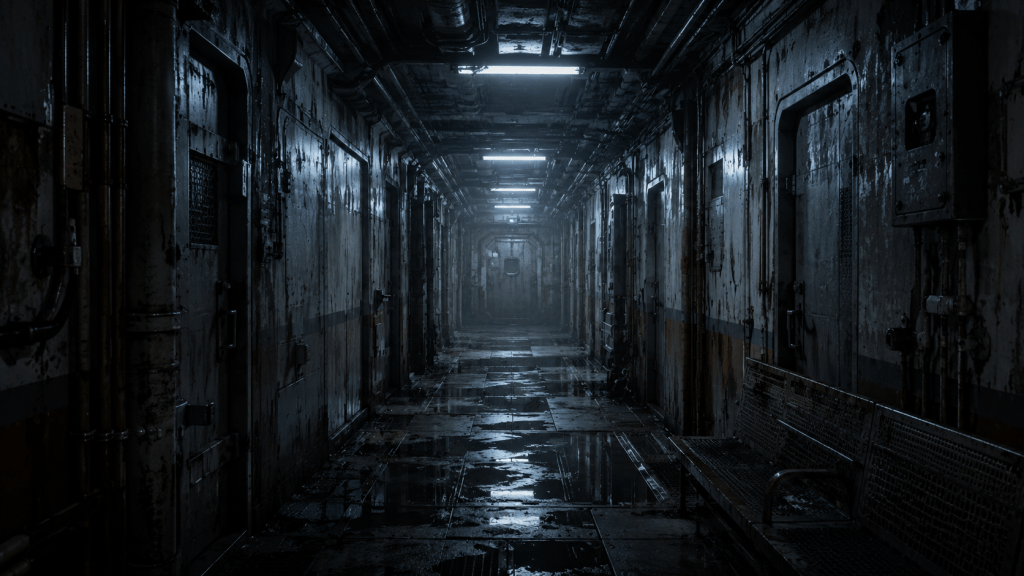
The light was rarely clean. It came from failing strips fixed into patched ceilings, from public screens rolling calm station updates over ration queues, from warning panels that flickered above bulkhead doors which sealed too slowly during drills and too quickly during unrest. Every surface carried the memory of pressure. Scratched metal. Repaired seams. Old stains worked into floor plating by boots, coolant, and time.
For readers entering a sci-fi noir novella, that kind of world matters. A crime aboard a space station only carries weight when the station itself has something to hide. Ashfall Station is built around that pressure. It is an orbital place of work, scarcity, surveillance, and exhausted routine, where a death can be filed as maintenance failure before anyone has finished looking at the body.
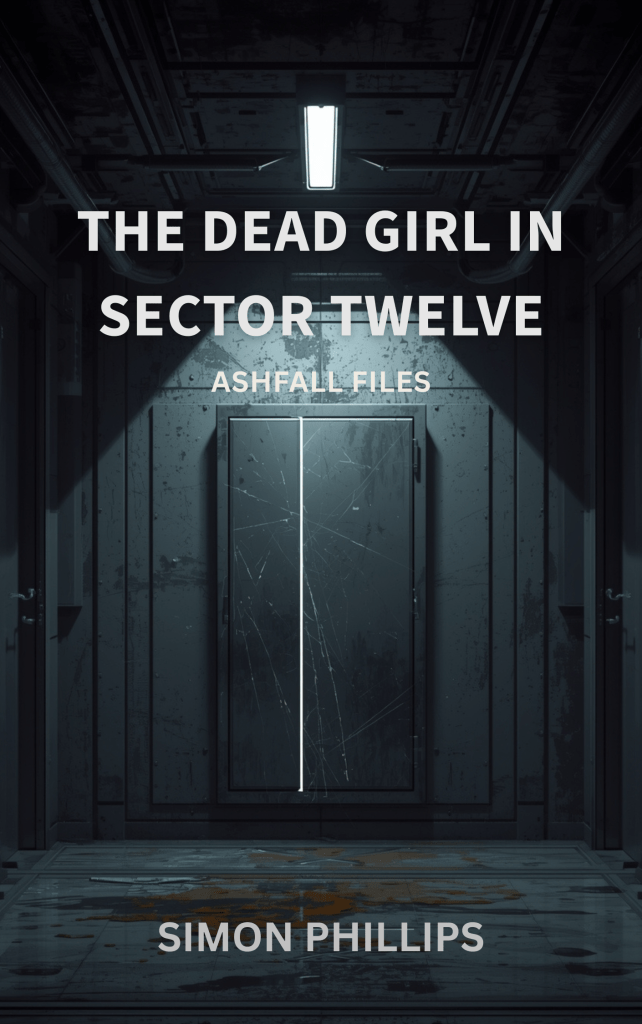
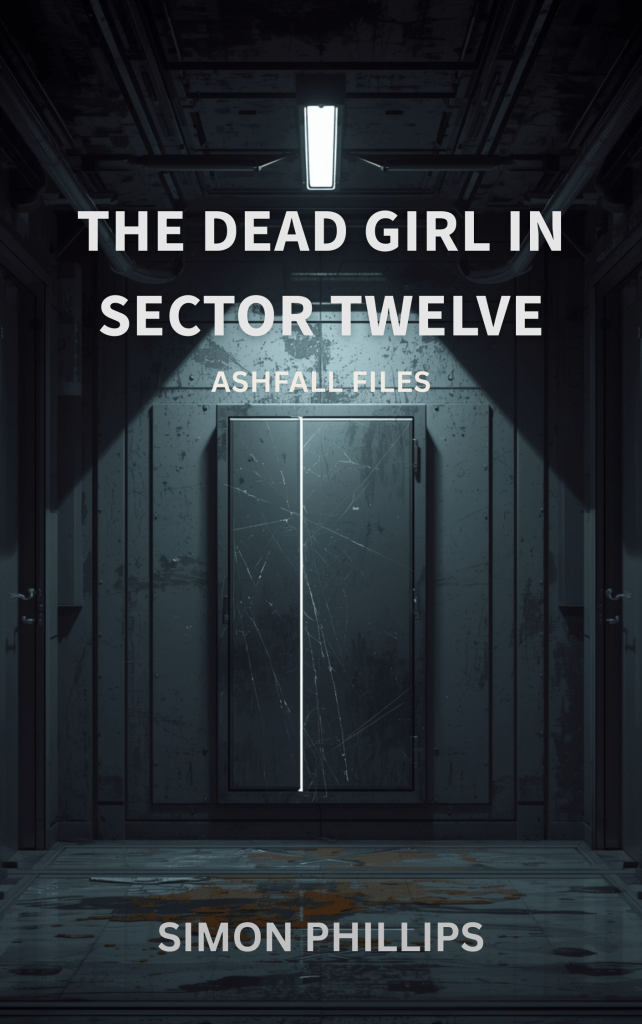
The first case, The Dead Girl in Sector Twelve, opens the door into an atmospheric sci-fi noir world shaped by crime, rationing, damaged infrastructure, official silence, and the slow corrosion of trust. It is a space station crime thriller built around investigation rather than spectacle, where one body in a ventilation shaft reveals more about the system around it than the system is willing to admit.
When a Body Becomes a Question
A failing station teaches people to lower their expectations before it teaches them to survive.
On Ashfall, power dips are routine until they happen at the wrong moment. Missing camera feeds become technical faults until they protect the wrong person. Records vanish into administrative language. Witnesses remember enough to be frightened, then stop speaking before a name leaves their mouth.
That is the central pressure of the series. Crime on Ashfall Station grows from scarcity and neglect. People steal ration tokens because water has value. They lie to security because truth carries cost. They move through half-lit service corridors because official routes belong to patrols, supervisors, cameras, and Fleet oversight. Every investigation becomes a study of how people behave when survival has narrowed their choices.
The noir element emerges through that moral compression. Ruff Kale, the detective at the centre of the Ashfall Files, understands the station too well to trust its explanations. He knows how quickly a report can soften a death into an incident. He knows the difference between disorder and arrangement. He knows silence when it has been trained into a room.
Lena Marik enters the case with procedure, discipline, and a belief that careful work still matters. Her presence gives the investigation its second pressure point. She records, checks, documents, and follows the lines the system claims to respect. The case teaches her what happens when those lines lead directly into obstruction.
Together, Ruff and Lena form the human scale of the wider Ashfall cycle. He reads the station through habit and damage. She reads it through records and inconsistencies. Between them, the reader sees how a corrupt space station fiction world becomes believable: through the small details that refuse to align.
A death in Sector Twelve becomes more than a crime scene. It becomes a question.
Who benefits when the records clear themselves?
Who decides which worker stays visible?
Who controls the broadcasts that tell civilians everything remains stable?
And what kind of authority needs a dead maintenance courier forgotten so quickly?
The Dead Girl in Sector Twelve
The Dead Girl in Sector Twelve is the first novella in the Ashfall Files cycle, and it works as the opening case in a larger detective science fiction series. The surface story is controlled and intimate: Ruff Kale and Lena Marik investigate a young woman found dead inside a maintenance shaft in Sector Twelve. Her placement feels wrong. Her records have been stripped. The systems around her hesitate in ways old infrastructure alone cannot explain.
Its strength lies in how quietly it expands. The investigation starts with a body, then moves through missing logs, frightened workers, erased evidence, and Fleet pressure. The case never needs to announce itself as a space station conspiracy. It becomes one through behaviour. A supervisor answers too quickly. A corridor falls silent. A witness disappears from the record before anyone can take a statement. An official explanation arrives with suspicious speed.
The result is an adult science fiction mystery rooted in atmosphere and consequence. The reader is taken through service corridors, Freight Spine noise, tired workers, precinct pressure, and the controlled politeness of authority. Ashfall Station never pauses to explain itself. It continues running, which makes its cruelty feel more convincing.
This opening novella also establishes the wider Ashfall Files method. Each case can be entered as a contained investigation, yet each one contributes to the larger movement of the station. A single death leads toward erased records. Erased records lead toward missing witnesses. Missing witnesses lead toward Fleet jurisdiction. Fleet jurisdiction points toward something far larger than the official report.
That sense of scale remains restrained. The story stays close to Ruff, Lena, and the immediate investigation. It lets the reader feel the conspiracy through pressure before understanding its full shape.
Ashfall Station as a Living Pressure System
Ashfall Station is a living pressure system.
Its sectors carry their own forms of decay. The Upper Concourse holds the polished language of administration and command. The Mid-Ring carries family noise, work exhaustion, and ration anxiety. The Freight Spine moves cargo, rumours, bribes, and bodies of evidence that pass through too many hands. The Red Decks hold the markets, dens, gangs, and informal networks that flourish wherever official supply fails. Beneath them all, the Underworks remain close, dark, humid, and only partly mapped.
Earth Fleet sits across that structure as authority, security, and threat. Its power appears through access locks, jurisdictional claims, missing files, controlled announcements, and the careful shaping of public truth. Fleet control is rarely dramatic at first. It arrives as a polite correction. A procedural reminder. A closed file. A warning phrased so cleanly it leaves no mark.
That is what makes Ashfall Files work as political sci-fi thriller material. The politics are lived before they are named. Civilians feel them in ration lines. Workers feel them when patrols pass. Detectives feel them when evidence disappears from intake. The station’s broadcasts ask people to remain calm while the people closest to the damage already understand that calm is being manufactured.
Ruff’s investigations provide the entry point into this world. He walks the corridors, talks to workers, pressures informants, reads silence, and notices when a room has been made too clean. Lena brings structure and conscience, forcing the case into forms the system then tries to corrupt. Her role matters because Ashfall needs someone who still believes procedure should protect people. Watching that belief bend under pressure gives the series its emotional edge.
The wider Ashfall Files cycle moves from grounded crime into civil fracture. That movement begins here, in small ways. A dead worker. A missing shard. A witness erased from housing records. A public system that keeps speaking after truth has been removed from the room.
A station never collapses all at once. It teaches collapse in stages.
First, people accept faulty lights.
Then they accept missing footage.
Then they accept closed reports.
Then they accept the absence of someone they spoke to yesterday.
By the time open unrest arrives, the damage has already been living in the walls.
The First Thread of the Ashfall Files
The Dead Girl in Sector Twelve matters because it begins with a simple institutional reflex: make the problem small enough to file.
That is how power survives aboard Ashfall Station. It reduces a life to a case number. It reduces fear to rumour. It reduces obstruction to procedure. It reduces truth to something that can be delayed until the station moves on.
Ruff Kale knows better than to expect justice from the machinery around him. Lena Marik still needs to learn how much machinery can lie. Between them, the first Ashfall Files case becomes a quiet act of resistance, carried through observation, unease, and the refusal to let a dead girl vanish cleanly into official language.
The station continues to hum. Broadcasts continue to roll. Ration queues continue to form beneath flickering light.
Somewhere inside that noise, the first thread has already been pulled.
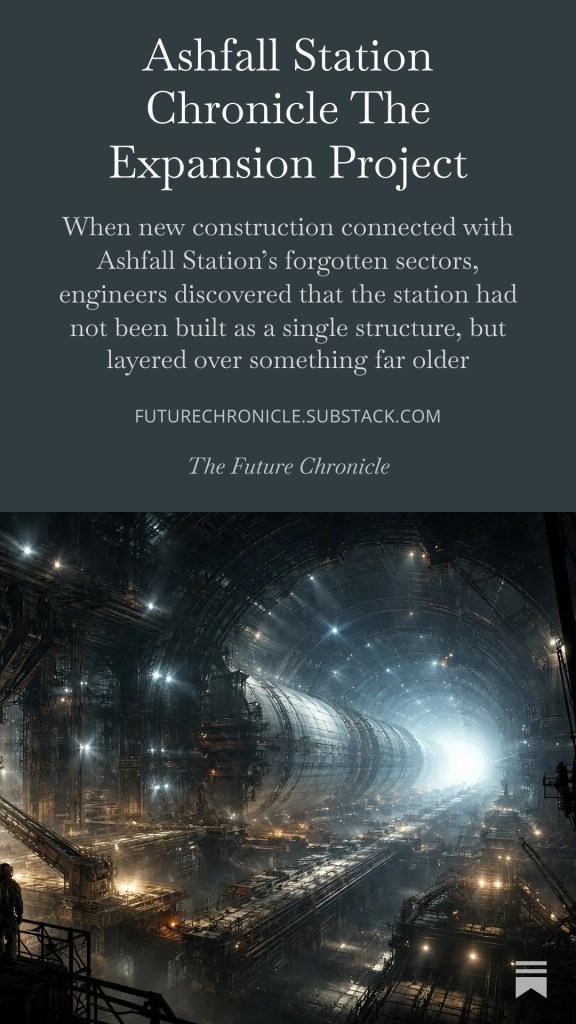
A station always reveals its age through the places where one era joins another. Fresh trusses arrive with their clean geometry and calibrated tolerances, while the older hull carries decades of weld seams, patched conduits, rerouted cable runs, and corridors whose original purpose has faded into routine. In stories built around space station expansion, that point of contact becomes one of the richest sources of unease, since the act of strengthening a structure often exposes everything the structure has been carrying in silence.
That is the central pressure inside any strong orbital station mystery. The danger rarely begins with explosion or invasion. It begins with access. A maintenance team opens a hatch. A new framework meets an old support corridor. Archived schematics suggest continuity, while the metal itself suggests something else entirely. Within that narrow gap between record and reality, science fiction finds one of its most human tensions, because every large system depends upon trust in its own memory.
Chronicle 6 of The Future Chronicle, Ashfall Station Chronicle The Expansion Project, enters that exact threshold. Its opening presents new construction reaching Ashfall Station, then follows Senior Structural Engineer Halren Voss into older support corridors where real-time scans diverge from the archived grid, a sealed panel rests inside undocumented structure, and the station begins to feel less like a single design than an accumulation of buried decisions. The entry was published on 27 April 2026, and its free opening serves as the reader’s first descent into that layered machinery.
The quiet power of layered infrastructure in science fiction
Science fiction has long loved frontier ships, research domes, and colony towers, though the orbital station carries a unique emotional charge. A station remains in place. It circles, endures, receives cargo, absorbs repair, survives policy changes, staffing shortages, rerouted trade, deferred maintenance, and the long slow compromises that gather around any inhabited machine. Over time, its structure becomes historical in a way that a sleek new vessel never can. It starts to resemble a city’s oldest quarter, a harbour wall rebuilt in sections, a factory expanded under several administrations, each leaving its own logic embedded in steel.
That sense of accumulation gives writers access to an especially believable form of speculative atmosphere. Readers understand instinctively that a long-operating station will have sealed sections, retired junctions, renamed corridors, patched subsystems, and documentation that no longer matches lived reality. Even before anything strange happens, the environment already carries memory. The architecture holds evidence of use. It has been touched by generations of workers who solved urgent problems, then moved on. Their solutions remain, layered one across another, until the present inherits a structure whose behaviour can still be managed, though never fully reduced to a clean diagram.
In practical terms, this creates a powerful narrative engine. A story can begin with ordinary engineering language, ordinary inspection routines, ordinary tolerance checks. From there, the smallest deviation gains dramatic weight. A plate sits at the wrong angle. A seam follows an older grid. A corridor continues beyond the place where the plans say it should end. None of these details requires spectacle. Their force comes from the calm recognition that the station possesses a deeper history than its operators can currently read.
Why forgotten sectors feel inhabited long before anyone speaks
Forgotten sectors in science fiction carry more than mystery. They carry social pressure. A sealed corridor suggests previous labour, previous authority, previous reasons for closure. Someone routed power through that section once. Someone marked it on a map. Someone approved its isolation. Even an empty passage retains the shape of institutional behaviour, and that gives these environments a psychological density that reaches beyond simple suspense.
This is why neglected infrastructure often feels more unsettling than overt ruin. Ruin announces its condition openly. A forgotten sector remains folded inside active life. People work two decks away. Freight continues to move. Lights still hum through occupied corridors. Administrative orders still pass from console to console. The station remains operational, which means the buried section has survived within a living system. Its silence becomes harder to dismiss because the surrounding machinery continues to function with professional confidence.
A strong Chronicle understands that pressure and allows the environment to speak through material detail. Ageing strips flicker. Reinforcement ribs sit at irregular intervals. Cable conduits show decades of rerouting. Air pressure shifts between sectors. A hatch resists opening in small mechanical ways that feel older than bureaucracy. When prose handles these details with patience, readers begin to experience the station as an inhabited archive, a structure that has preserved traces of earlier intentions even after those intentions slipped from official awareness.
That is one reason layered orbital settings hold such lasting appeal. They bring together two scales of time at once. On one level, there is the immediate shift rotation, the engineer with a display in hand, the technician waiting for instructions, the fresh frame arriving along the outer ring. On another, there is the station’s deep duration, measured in decades of expansion, closure, reinforcement, and omission. The human moment unfolds inside an older architectural memory, and the friction between those scales produces a form of unease that feels earned.
Expansion changes the emotional meaning of a station
A sealed section already carries mystery, though expansion changes its meaning. Once new construction begins to connect with older infrastructure, the buried past stops being passive. It becomes load-bearing again. That shift matters because science fiction thrives on moments when routine activity reactivates a larger hidden pattern.
Expansion projects are especially useful for this kind of storytelling since they arrive under the banner of improvement. The language around them belongs to capacity, reinforcement, efficiency, logistics, and operational lifespan. They promise stability. They promise growth. They promise a longer future for the installation and the people who depend on it. Then, through the act of connection, they expose a structure whose continuity stretches beyond accepted documentation. The project meant to secure the station begins instead to uncover the degree to which the station has been living above an unresolved foundation.
This is where the Chronicle’s premise becomes especially compelling. The fear comes less from collapse than from acceptance. The structure accepts the connection. The framework seats itself against older material. Load paths redistribute. Diagnostic systems classify anomalies within acceptable thresholds. Lights shift as though power is learning a route it once knew. A station like Ashfall grows more disturbing in the moment when it appears to cooperate with integration, since cooperation suggests history, and history suggests prior contact.
From a speculative point of view, that is a deeply satisfying move. It keeps the story grounded in engineering logic while opening the emotional space of mystery. Nothing in the scene needs to abandon procedure. Technicians still log variance. Supervisors still authorise holds. Surveys still move through standard channels. Yet the station begins to answer through pattern, rhythm, and structural response. The future feels inhabited through system behaviour rather than explanation.
The Chronicle entry as a threshold into Ashfall Station
Within The Future Chronicle, Ashfall Station Chronicle The Expansion Project uses that layered tension with unusual control. The Substack entry frames Ashfall as an ageing industrial station whose new expansion meets forgotten sectors, and its opening follows Voss from the observation deck into older support corridors where mapping diverges, floor plating resists the established grid, and a sealed access panel introduces a low-level vibration that engineering systems cannot easily resolve. The post is marked paid, while the opening remains available as a free entry point into the wider archive.
That matters because the reading experience mirrors the subject itself. A reader enters through a narrow access point, steps into a compressed corridor of detail, and gradually realises that the station’s visible form rests upon something more layered than first assumed. The Chronicle functions less like a plot summary and more like a recovered operational descent. It offers atmosphere first, then structural implication, then the quiet pressure of a system that seems to recognise the connection being imposed upon it.
A companion YouTube short extends the same premise in visual miniature, presenting the Expansion Project as routine work that uncovers something buried beneath decades of industrial construction. That additional fragment helps establish Ashfall as a living archive across formats, one where each entry feels like another angle on the same long disturbance.
The linked Kindle book page deepens that path further. There, the station’s later consequences take investigative form in Ashfall Files: The Dead Girl in Sector Twelve, a sci-fi noir mystery centred on a young woman found dead inside a maintenance vent. Read alongside the Chronicle, the novella suggests a larger continuity in which buried structure, suppressed records, and institutional pressure continue to gather weight across time.
Why readers keep returning to stations like this
Readers return to this kind of science fiction because it understands that the future will arrive through maintenance as often as through invention. Human beings will keep living inside systems older than the policies governing them. They will keep trusting archives that only partly match material reality. They will keep expanding cities, stations, and networks whose earliest layers were shaped by motives no longer fully visible. A layered orbital station turns all of that into environment.
It also honours a quieter kind of speculative fear. Many futures on the page feel loud from the beginning. The most durable ones often begin with the sound of machinery carrying on as usual. A work order clears review. A frame locks into place. A corridor lights in sequence. Somewhere inside the structure, a pattern continues. That rhythm lingers because it suggests a civilisation extending itself into distances it can manage operationally, though never completely master emotionally.
This is where The Future Chronicle finds its strongest ground. It approaches science fiction through systems, atmosphere, and the lived pressure of environments that have endured long enough to develop their own silence. Chronicle 6 stands as a particularly strong entry into that world, since expansion offers a clean narrative surface while the deeper station keeps pressing upward through it. The official project concerns cargo capacity and reinforcement. The felt reality concerns contact with an older order concealed inside the metal.
A station like Ashfall remains compelling for the same reason old ports, old rail tunnels, and old industrial districts remain compelling. Growth never erases earlier layers. It builds across them. It seals them. It routes around them. Then, sooner or later, someone opens a hatch, extends a new connection, and realises the structure has been waiting much longer than the current shift can measure.
Beyond the record, the station continues its orbit. Framework holds. Reports enter the archive. The deeper pattern remains in place, patient as load-bearing steel, quiet as an active corridor after lights have settled, carrying the sense that somewhere inside the machinery of expansion, the future has touched something that was already there.
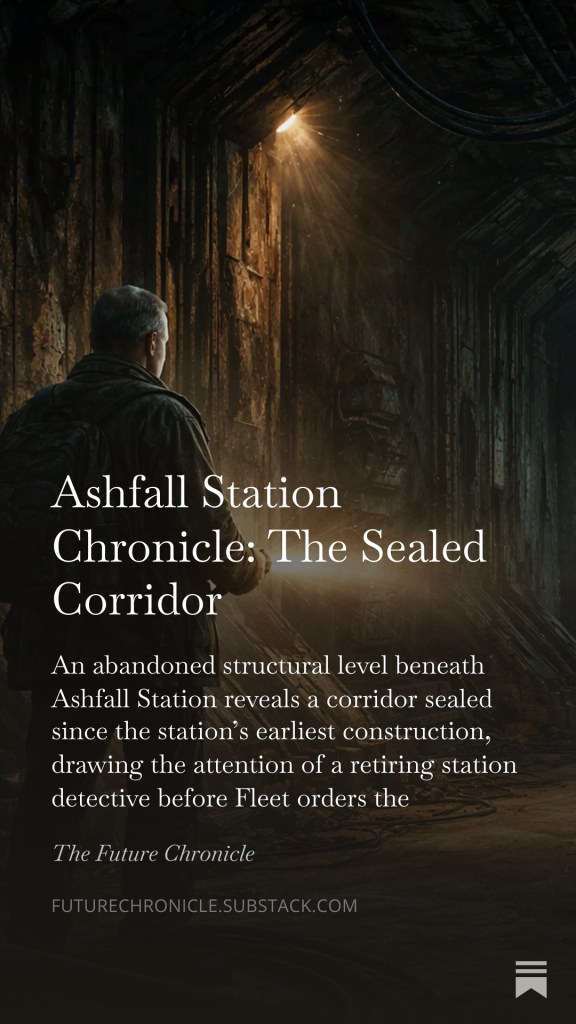
A sealed corridor inside a space station carries a peculiar kind of gravity. The image feels simple at first glance: a pressure door buried behind later construction, a service level erased from current schematics, a section of infrastructure left sleeping inside the larger body of the station. Yet that image opens a deeper unease, because a hidden passage suggests more than age. It suggests choice. Someone closed that route. Someone covered it over. Someone left it inside the walls, where future crews would keep living beside it without knowing what had been folded away.
That tension lies at the centre of Ashfall Station Chronicle: The Sealed Corridor, the current Ashfall entry on The Future Chronicle on Substack, where a routine engineering survey on Deck Twelve reveals a transit corridor concealed since the earliest phase of Ashfall Station’s construction. Detective Adrian Mercer, drawn into what first appears to be an ordinary security review, finds himself standing before a doorway that has vanished from three generations of station records, only for Fleet authority to reach downward with unusual speed once the passage opens.
What makes that premise linger is the way it treats the space station as an inhabited archive instead of a clean machine. Many futuristic settings depend on smooth surfaces and visible systems, as though advanced civilisation would sand away every rough seam left by time. Ashfall moves in the opposite direction. Its corridors carry freight dust, maintenance residue, ageing structure, and the long accumulation of decisions made by people who served the station during earlier decades. The result feels industrial, human, and quietly uneasy. A door sealed within that kind of place does more than add mystery. It reveals a wound in institutional memory.
Why sealed corridors remain so unsettling in science fiction
Science fiction returns again and again to abandoned decks, closed service shafts, darkened access tunnels, and transit routes erased from the active life of a station or ship. The reason reaches beyond visual atmosphere. A sealed corridor creates pressure between two versions of a place. One version is the official environment, mapped, lit, regulated, and understood well enough for daily routine. The other sits just behind it, preserved in silence, carrying the possibility that the world has always possessed an interior layer hidden from ordinary movement.
Within a planetary city, forgotten streets can sink beneath redevelopment. Within a station, forgotten passageways remain physically near every working system. Crews sleep, work, eat, and age only metres from chambers they no longer remember. That closeness gives the idea unusual force. The past has never truly gone anywhere. It remains in the walls, under the decking, behind the reinforcement plates, waiting for expansion work, structural failure, or human curiosity to cut back into it.
A sealed corridor also sharpens one of science fiction’s oldest questions: how much of a technological civilisation survives in genuine human memory, and how much survives only through procedure? In places built for endurance, procedure often outlasts explanation. Teams inherit maps, security classifications, maintenance routes, and authority chains whose origins have faded into archival depth. The station keeps functioning. Freight still moves. Atmosphere still cycles. Lights still come on across the inhabited decks. Meanwhile, older choices remain embedded in the structure, stripped of context, still exerting force.
That idea gives The Sealed Corridor its weight. The discovery on Deck Twelve carries no theatrical spectacle. There is no immediate catastrophe, no screaming alarm, no violent rupture across the station. The unease arrives through restraint. Engineers uncover an access frame where a solid wall was expected. Scanner readings show a hollow route inside the subframe. Dust, faded lettering, and the cold seam of an old pressure door begin to suggest that Ashfall’s history contains areas where concealment mattered more than record keeping. Then Fleet intervenes, and the station’s calm surface becomes harder to trust. A space station grows like a city, then begins to forget itself
The strongest space station stories often treat infrastructure as social history made physical. Every expansion ring, service transit, docking arm, and support grid reflects a previous phase of labour, urgency, policy, and economic need. Over time, a station gains layers. New freight systems bypass old ones. Living districts migrate. Engineering standards change. Administrative power centralises, fragments, or hardens. What once served as a vital artery can become a dead route sealed behind newer plating.
Ashfall Station feels convincing because its buried levels follow that logic. Deck Twelve belongs to the station’s earliest industrial period, when Ashfall served as an ore transfer hub above Kestren-4. Later growth covered those earlier transit networks beneath newer sectors and revised structural plans. From an engineering point of view, that process feels entirely plausible. From a narrative point of view, it creates a setting where the physical environment can hold memory more faithfully than the people moving through it. A wall panel can preserve history long after the registry has thinned it into omission. s is one of the quiet strengths of industrial science fiction. It understands that future settings carry bureaucracy as well as invention. Large systems create blind zones. Records become layered. Departments protect their own authority. Classification settles over awkward histories like dust over unused metal. Once that happens, space itself begins to participate in secrecy. The corridor on Deck Twelve has no voice, no overt intelligence, no dramatic display. Its mere existence is enough. The concealed access frame, the obsolete transit markings, and the absent schematics tell their own institutional story.
Engineering memory and human memory drift apart
One reason sealed infrastructure feels so effective in science fiction is that it captures a familiar modern anxiety in a future form. People already live inside systems few individuals fully understand. Cities depend on hidden services. Digital life depends on opaque layers of code, policy, and ownership. Industrial life depends on technical inheritance, old standards, legacy machinery, and habits passed forward through routine. A frontier station only intensifies that truth. Distance from central oversight, long operational life, and successive waves of expansion create the ideal conditions for forgotten corridors, sealed chambers, and partial records.
In The Sealed Corridor, Detective Mercer stands at the edge of precisely that divide. He is no engineer and no grand political figure. He is a station detective approaching retirement, someone who has spent enough years inside Ashfall to hear its changing mood through the background vibration of machinery and freight movement. That makes him an ideal witness. He reads the corridor through professional instinct and through accumulated familiarity with the station as a lived environment. The discovery unsettles him because it violates the station’s ordinary logic. A decommissioned passage would make sense. A deliberately erased one suggests an older decision whose consequences may still be active. Ashfall Station turns mystery into atmosphere
Many mystery-driven science fiction stories rely on puzzle mechanics alone. A clue appears, a question rises, and plot movement follows. Ashfall works through atmosphere first. The mystery gains force because the station already feels heavy with work, age, and endurance before the sealed passage enters view. Offices remain lit through the station cycle. Freight departures continue. Dust gathers in engineering spaces. Amber light reflects from older lift interiors. Outer docking arms glow above the pale clouded world below. Every detail deepens the sense that this place has kept functioning for a very long time, carrying more history than any single worker could hold in mind at once. t atmosphere makes the Chronicle an especially strong entry point for readers curious about science fiction built from pressure, environment, and institutional behaviour instead of spectacle. The Future Chronicle frames its Ashfall series as recovered future records, reconstructed incidents, and quiet disturbances unfolding across the life of an ageing frontier station. Entering through The Sealed Corridor feels like stepping into a report whose edges have started to fray, where the visible account is steady enough to trust and strange enough to invite a second look.
For readers arriving fresh to Ashfall, the Chronicle offers a contained threshold into the wider archive. It introduces the station through labour, architecture, and omission. It shows how minor engineering work can touch something older than the current order of things. It also leaves room for the larger implication to spread on its own, which suits this kind of fiction beautifully. A hidden corridor carries power precisely because full explanation remains at a distance. The station keeps orbit. The authority chain remains in place. The question settles deeper.
From the sealed corridor to the dead girl in Sector Twelve
The Chronicle also gains depth from its connection to the wider Ashfall setting. The corridor on Deck Twelve exists years before the later events of Ashfall Files: The Dead Girl in Sector Twelve, the linked ebook set within the same broader environment. The relation between those works gives the station an appealing sense of duration. One text opens a buried seam in the station’s past. The other follows an investigation unfolding inside a place already shaped by long neglect, institutional pressure, and structural secrets. t relationship is where The Future Chronicle feels especially effective as a literary gateway. The Chronicle stands on its own as a finished speculative essay-story, with its own internal weight and unease. At the same time, it opens a route toward the novella for readers who want to remain inside Ashfall a little longer, to move from reconstructed station history into a fuller noir investigation carried through living corridors and working sectors. The transition feels organic because the setting has already been prepared through texture, mood, and accumulated pressure.
There is also a short visual companion on YouTube, which works well as a brief atmospheric threshold before or after the written Chronicle. In a project built around reports, fragments, future records, and recurring disturbances, that kind of cross-format echo strengthens the sense that Ashfall is being approached from several angles, each one revealing a different surface of the same old structure.
The corridor behind the wall
A sealed corridor inside a space station endures in the imagination because it transforms architecture into withheld knowledge. The wall ceases to be a boundary and becomes a decision preserved in metal. On Ashfall Station, that decision carries the residue of labour, authority, and time. Engineers uncover a passage where current plans promised solid structure. A detective senses that the omission has weight. Fleet moves to close the opening before inquiry can gather momentum. The corridor returns to silence, though the silence now feels charged.
That is the quiet spell of The Sealed Corridor. It understands that the most unsettling future environments rarely depend on scale alone. They depend on layers. They depend on inhabited systems whose official version of themselves has begun to slip against the deeper truth held in their structure. A station like Ashfall keeps turning above Kestren-4, freight moving through its active decks, lights shining across its present routines, while older routes remain hidden in the body of the place, carrying histories that still press against the wall from the other side.
For readers drawn to abandoned infrastructure, industrial space station fiction, and science fiction shaped by secrecy, labour, and buried records, Ashfall offers a compelling threshold. The first doorway stands open in The Sealed Corridor on Substack. Beyond it waits a larger station history, and further in, the investigation at the heart of Ashfall Files: The Dead Girl in Sector Twelve. The pressure inside these stories comes from what a place continues to hold after memory has thinned, after maps have changed, and after official language has settled over the seam.
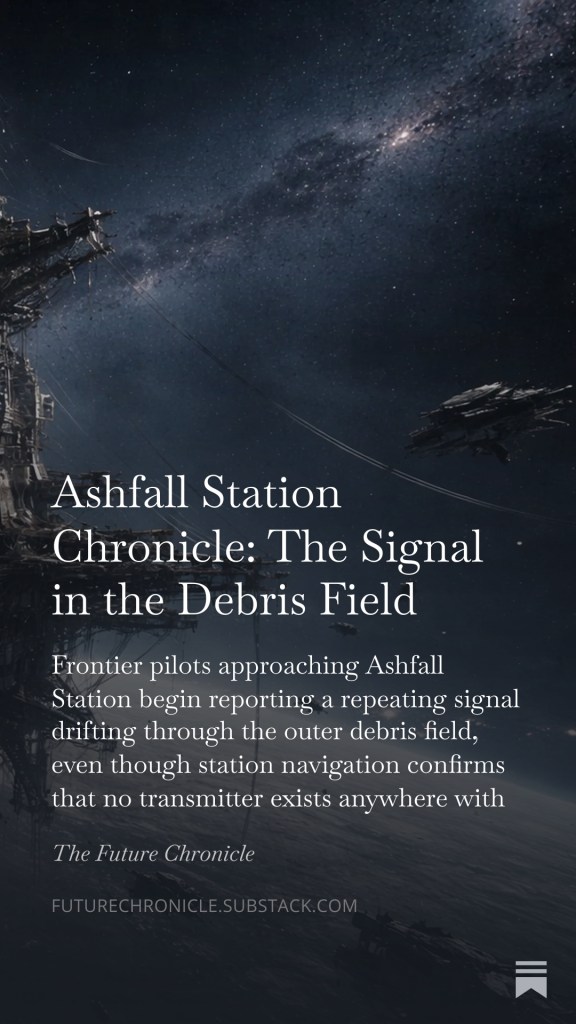
Out beyond the docking lanes, where a frontier station gives way to the wreckage of older industry, a debris field becomes more than background scenery. It becomes memory made physical. Broken cargo towers, relay frames, scaffold sections, and dead satellites drift in slow procession around a spent world, each fragment holding the shape of labour that once mattered. When a deep-space signal begins pulsing from within that ruin, science fiction touches a very old fear. Someone, or something, is still speaking from a place the present has already abandoned.
That tension sits at the heart of space station mystery fiction. A station suggests order, registry, mapped corridors, monitored traffic, and the steady reassurance of systems under observation. A debris field suggests the opposite: overflow, residue, long aftermath, the industrial graveyard left circling after profit has moved elsewhere. Bring the two together, and the result carries a peculiar strain of unease. The organised world remains close enough to see through the canopy glass, while the dark beyond still holds structures whose original purpose has thinned into rumour.
Chronicle 4 of the Ashfall Station sequence understands that pressure with impressive calm. In The Signal in the Debris Field, the first disturbance arrives through a routine approach, a receiver sweep, a pilot who hears something repeating where no transmitter should remain. The effect comes through restraint. The signal enters the scene as a technical irregularity, almost small enough to miss, and that scale gives it force. A corridor alarm would feel immediate. A faint pulse drifting through wreckage feels patient, older, and somehow more certain of its own endurance.
The debris field as a zone of memory
Science fiction has always found power in the image of abandoned infrastructure. A derelict ship, a sealed habitat, a disused mining platform, an orbital relay whose designation has outlived its function, each one carries a quiet promise that time has continued moving inside the machinery even after official attention moved elsewhere. The debris field expands that promise across a wider landscape. Instead of one haunted object, the reader faces an entire environment shaped by accumulation.
That matters because a debris field resists the clean romanticism often attached to deep space. This is space as aftermath. These structures once belonged to schedules, quotas, crews, budgets, accidents, repairs, and routine decisions made under industrial pressure. Someone welded those frames. Someone signed off on those towers. Someone logged the final traffic before the route fell quiet. Years later, the broken skeletons remain in orbit as a record of labour whose living context has drained away.
A repeating signal inside that setting does more than introduce mystery. It reactivates the graveyard. The field stops behaving like scenery and begins behaving like an archive. Every drifting fragment becomes a potential source, every torn ring or fractured panel a possible witness. The reader starts searching the wreckage in the same way a pilot or receiver operator would, trying to imagine which remnant still holds charge, which chamber still preserves circuitry, which cold section of metal has gone on speaking long after its builders vanished from the route maps.
That is one reason deep-space signal stories retain such force. They awaken dead environments. The pulse gives shape to emptiness. It turns drifting matter into intention, even before anyone can say what that intention means.
Why a signal unsettles more deeply than a visible threat
A visible threat lets the mind draw boundaries. A hostile vessel, a boarding party, a damaged hull, a breach warning, each one carries a recognisable edge. A signal works differently. It arrives through pattern, delay, and repetition. The source remains hidden while the effect spreads through interpretation. People listen, compare, classify, question, rerun scans, check registries, and discover that language begins to slip. A signal forces institutions to confront uncertainty in their own preferred idiom: records, arrays, identification protocols, archived frequencies, sensor sweeps, official reassurance.
That tension gives signal fiction a profoundly human quality. Fear enters through procedure. The crew member who notices the anomaly remains at a console. The navigation office answers in a steady voice. Arrays turn. Data arrives. Silence follows. The dread grows inside administrative competence.
In the Ashfall setting, that calm procedural atmosphere carries special weight because the station itself depends upon navigational certainty. Approach corridors, beacon records, traffic coordination, safe separation from older wreckage, all of these form the ordinary discipline of survival around Kestren-4. When a repeating transmission emerges from the debris field and every system insists that no registered transmitter exists there, the disruption reaches deeper than a single strange moment. It touches trust itself. The map says one thing. The receiver says another. The corridor remains open anyway.
This is where the Chronicle’s science-fiction mood becomes especially effective. The future feels inhabited through work. Pilots hold approach vectors. Navigation officers speak in measured exchanges. Sensor towers search empty space. The mystery grows within the texture of a functioning industrial culture. That sense of lived system pressure gives the signal gravity. Nothing flamboyant needs to happen. A steady pulse across the spectrum is enough.
Frontier systems make these stories feel plausible
A frontier setting gives signal fiction a natural home because frontiers contain leftovers. Expansion creates equipment faster than memory can preserve it. Systems grow around extraction, transport, survey work, emergency contingencies, contract cycles, and temporary structures whose temporary status stretches across decades. As traffic thins and economies shift, the hardware remains behind, turning orbit into a layered field of present use and historical residue.
Within that kind of environment, a signal from abandoned machinery feels plausible in the first instant. That plausibility matters. The reader accepts the practical explanation before the deeper disturbance begins. Of course old infrastructure can transmit. Of course a mining beacon or relay unit might survive. Of course a receiver operator would assume a technical remnant before anything stranger. The future opens through ordinary logic.
Then the second movement begins. The frequency matches nothing familiar. The source location feels wrong. The pattern repeats with an exactness that suggests design. The structure carrying the transmission appears cold, silent, and dead. That shift from plausible remnant to unresolved persistence is where frontier science fiction often finds its sharpest atmosphere. The story remains grounded in work, machinery, and registry, yet a pressure larger than procedure starts pressing through the seams.
The result feels less like spectacle and more like slow contamination of certainty. For readers who prefer controlled speculative fiction over grand operatic display, this mode carries unusual appeal. It trusts implication. It lets the industrial environment hold the weight.
The Chronicle as a threshold into Ashfall
Within The Future Chronicle on Substack, The Signal in the Debris Field works especially well as a threshold text because it introduces Ashfall Station through distance. The station appears across the approach lanes, lit against the black horizon, while the deeper disturbance rises from the wreckage surrounding it. That choice gives the whole entry a measured elegance. Readers arrive from outside. They see the station as incoming crews see it. The system feels broad, quiet, and old before the mystery tightens.
This matters for the wider Ashfall Station sequence. A chronicle like this one does more than tell a contained episode. It establishes reading conditions. The archive grows through fragments, reports, observations, quiet anomalies, and moments that seemed manageable when first recorded. A signal detected on approach becomes one more entry in a larger field of pressure. The reader senses the archive thickening.
That archival method suits science fiction particularly well when the goal is psychological atmosphere instead of rapid revelation. The future enters as a record under review. Every small event acquires retrospective weight. A pilot reports a pulse. Navigation fails to locate a legal source. A structure in the debris field speaks in a sequence no one recognises. The event passes into the logs. Later, the meaning expands.
For a new reader, that creates a strong entry point. There is no burden of excessive lore. There is a station, a world beneath it, a debris corridor, a transmission, and the first slight shift in the trust people place in their systems. The world opens through implication, which often leaves a deeper impression than explanation.
From Chronicle atmosphere to novella pressure
For readers who want to step from the archive into a more sustained narrative, the connected Kindle novella, Ashfall Files: The Dead Girl in Sector Twelve, provides a natural second threshold. The movement from Chronicle to novella feels organic because the Chronicle builds environment first. It lets Ashfall exist as place, record, and accumulated unease. The novella can then enter that same station carrying the denser pressure of investigation.
This relationship between Chronicle and novella is one of the strongest aspects of the wider project. The chronicle form gives room for early signs, peripheral witnesses, overlooked incidents, and the quiet sediment of history. The novella form gathers that atmosphere into a closer narrative line, where consequence presses more directly upon the people moving through the station’s ageing structure. One form broadens the archive. The other deepens the encounter.
That distinction matters for readers drawn to space station mystery, industrial science fiction, and slow-burn speculative tension. Some want the distant view first: the station as system, the route map, the old infrastructure, the fragment recovered from orbit, the unexplained signal turning through the dark. Others want the closer pressure of a case unfolding inside that world. Ashfall offers both, and Chronicle 4 sits at a particularly effective junction between them.
Why readers keep returning to signals from the dark
A signal carries something ancient inside a futuristic form. It is a call, a trace, a pattern seeking reception. It promises meaning before meaning has been secured. Human beings remain vulnerable to that structure across every age. We hear repetition and assume intention. We hear order and assume origin. We hear persistence and assume that someone, somewhere, continues to hold the other end of the line.
In science fiction, that instinct becomes even more powerful because distance removes reassurance. Space is large enough to hold forgotten industry, failed empires, unfinished projects, silent research, sealed compartments, and transmissions still moving after their makers are gone. The signal becomes a way for the past to remain active inside the future. It crosses vacuum and arrives without explanation, carrying the unsettling suggestion that history never fully releases its grip on the systems built to contain it.
That is why a debris field signal feels so potent. The message comes from waste, from structures society has already written into the margins, from a region treated as background hazard and navigational inconvenience. The future receives its disturbance from what it chose to leave behind.
Ashfall understands that dynamic with admirable restraint. The pulse enters quietly. The route remains open. The station continues its orbit. The record grows by one more line. Somewhere beyond the docking rings, among fractured towers and silent machinery turning above Kestren-4, a sequence continues repeating into the dark. The archive hears it. The station hears it. Long after the immediate approach has passed, the pressure remains.
Some of the strongest space station horror begins far from command decks, fleet engagements, or grand discoveries. It begins in the maintenance corridor, under weak industrial lighting, with a technician who knows the ordinary sound of a structure so well that the smallest change arrives like a hand laid quietly against the spine. Space station maintenance horror carries unusual force because it grows inside a place built to keep people alive. The pressure hull, the air cycling through the vents, the conduits feeding heat and power through the walls, the sealed doors that divide one ring from the next, all of it belongs to survival before it belongs to drama.
That is where slow-burn science fiction finds one of its most persuasive forms of unease. A corridor along the outer hull of an ageing installation already carries a mild emotional charge. It stands close to vacuum. It stands close to failure. It stands close to the reality that human life in space depends upon metal, routine, and trust in systems that rarely receive affection from anyone until something begins to shift inside them. In that kind of environment, fear enters through vibration, through rhythm, through the slight scrape that refuses to settle into any accepted mechanical pattern.
Industrial sci-fi has always understood that the future feels most convincing when it carries wear. A polished station with pristine surfaces can look impressive from a distance, yet an old orbital structure with patched conduits, reinforcement plates, faded markings, and long service routes feels inhabited. It has history in its joints. It has labour in its walls. The future there seems less like an exhibition and more like a place where people have been carrying out difficult work for years, perhaps decades, with no audience watching them.
Watch the visual fragment:
Why maintenance spaces carry a deeper fear
A maintenance corridor does something that a bridge or laboratory seldom achieves with equal quietness. It strips away public life. It leaves one worker, one lamp, one route, and the persistent sense that every sound has a source even when that source remains hidden. In a living station, people come to know the structure through repetition. They recognise lift motors. They recognise air circulation. They recognise the cooling cycle passing through the walls after a long rotation. Once that knowledge settles into the body, the smallest deviation begins to feel intimate.
This is why space station horror feels strongest when it grows from expertise instead of ignorance. Fear becomes far more convincing when the person experiencing it understands the machinery well enough to recognise that something has moved outside the accepted order. The technician on the graveyard shift is rarely frightened because space is vast or lonely in some abstract way. He is frightened because the station has changed character for a moment, and he knows the difference.
There is a great deal of psychological truth in that. Human beings live inside systems every day, and most of those systems fade into the background once they function smoothly enough. Elevators, trains, pipes, electrical lines, hospital monitors, ventilation grids, they become invisible through consistency. The same principle extends into speculative fiction. A future station feels real when it has settled into habit, and horror enters when habit loses its reliability. One sound arrives where no sound should be. One tremor travels in a direction that feels too deliberate. One corridor becomes less like infrastructure and more like a listening surface.
That change in perception matters. The walls cease to feel passive. The station begins to suggest awareness, or at least hidden occupation. Slow-burn science fiction excels here because it refuses easy explanation. It allows the worker to remain within uncertainty for longer than comfort allows. The result carries far more weight than a sudden reveal ever could.
Ageing infrastructure and the beauty of worn futures
There is another reason this form of science fiction endures. Ageing infrastructure creates narrative depth almost by instinct. An old station already implies forgotten decisions, deferred repairs, sealed sections, obsolete systems, corners of institutional memory that never reached the official archive. A new installation can be eerie, though an old one carries layers. Every reinforcement plate suggests an earlier fracture. Every mismatched panel suggests one generation of engineers working over the remains of another. Every rerouted conduit hints at pressure, compromise, and the long afterlife of frontier expansion.
That kind of environment gives horror a natural home. The station already possesses a buried past. The people moving through it are already living among traces of work completed by crews long gone. They inherit routines without inheriting total knowledge. They follow maintenance protocols designed to keep the structure stable, while the deeper history of the place rests behind bulkheads, under plating, within sections no one visits unless the system demands it.
In practical terms, this means the environment can hold mystery without forcing spectacle. The setting itself has earned its ambiguity. A strange vibration inside a brand-new station might feel like a plot device. The same vibration inside an orbital structure that has survived long after the industry that created it began to thin out feels plausible. The structure has had time to accumulate silence.
This is one of the great strengths of industrial sci-fi. It allows space to feel used. It allows progress to look patched, inherited, slightly tired, and therefore human. The future stops posing. It starts working.
The night shift as a speculative pressure chamber
The graveyard shift deepens all of this. Daylight, even artificial daylight, fills a station with confirmation. People move through docking arms, control rooms answer quickly, traffic creates noise, systems speak over one another. The night cycle changes the emotional register. Cargo flow slows. Habitation sectors dim. Long corridors empty. Sound becomes legible.
In story terms, the night shift functions as a pressure chamber for attention. It isolates one worker inside the most vulnerable parts of a structure and asks him to decide whether what he has felt belongs to routine or to something that should be reported. This is where plausible science fiction meets institutional tension. A technician hears movement. Control checks the logs. Sensor data reports stability. Thermal readings remain acceptable. Traffic shows nothing nearby. The system answers with calm, and that calm itself becomes unsettling.
Readers recognise that pattern because it belongs to real organisational life. A person at the edge of an event senses trouble before the wider structure does. The report enters the system. The system explains. The explanation holds for a while. Meanwhile the individual remains face to face with the thing that still has no proper name.
That space between report and recognition is fertile ground for speculative fiction. It allows the story to explore more than fear. It explores credibility, labour, isolation, and the quiet dignity of people whose work consists of noticing what everyone else hopes will remain minor.
Where The Future Chronicle enters that silence
This pressure sits at the centre of Ashfall Station Chronicle The Long Night Shift, a post on The Future Chronicle that places a lone technician, Marek Ilyan, inside Ashfall Station’s outer hull corridors during the graveyard cycle, where he begins to hear and then feel movement travelling through the structure. The Substack entry frames Ashfall as an ageing industrial station in orbit above Kestren-4, with older maintenance corridors, reinforcement beams, night-shift inspections, and no scheduled external crews near the section where the disturbance begins.
What gives the piece its hold is the refusal to overstate the disturbance. The station keeps breathing through freight, power circulation, air systems, and old structural rhythms. The technician keeps working. The anomaly enters first as vibration, then as dragging weight, then as the suggestion of something moving across the outer hull where the logs should have shown nothing at all. That sequence is precisely why the Chronicle lands so well. It understands that convincing unease grows from a functioning world, not from theatrical collapse.
The wider Ashfall line deepens that effect. On the same Substack page, the Chronicle positions Ashfall as part of a broader fictional universe and connects it to the novella Ashfall Files: The Dead Girl in Sector Twelve, which follows a later investigation aboard the station. The Ashfall ebook listing describes the station as overcrowded, exhausted, and stretched by surveillance, rationing, and political strain, which gives the Chronicle’s quieter archival atmosphere a later echo in full narrative form.
Why this makes a strong entry point for new readers
For someone arriving fresh, this kind of Chronicle works especially well because it offers atmosphere before explanation. There is no need to master a dense body of lore. There is no demand to absorb a map of factions or technologies before the tension begins to function. A corridor, a maintenance route, a shift report, a vibration in the hull, that is enough. The world opens through implication, which means the reader enters through sensation and inference instead of through briefing.
That is a rare strength in science-fiction publishing. Many speculative worlds present themselves through scale. The Future Chronicle approaches through residue. It lets the world accumulate around the reader, fragment by fragment, as though each post were a recovered record from a larger future history. The effect feels less like stepping into a conventional content stream and more like opening a file that carries a little more weight than its title first suggests.
The opening section of The Long Night Shift serves as an especially clean threshold because it contains the core pressures that make Ashfall compelling. Ageing infrastructure. Solitary labour. Institutional routine. A station old enough to sound alive. A disturbance that refuses easy categorisation. From there, the archive gains force through accumulation. The next entry matters because the earlier one has already altered the reader’s sense of the station.
A companion flash-fiction short can extend that pressure in visual form, though the Chronicle itself carries the stronger emotional architecture. The written piece leaves room for the mind to inhabit the corridor fully, to feel the steel underfoot, to register how much trust goes into the systems holding vacuum beyond a few metres of alloy. That inward quality is where the unease settles.
Readers who want to step directly into that atmosphere can begin with Ashfall Station Chronicle: The Long Night Shift on The Future Chronicle, where the station’s older maintenance corridors, night inspection routes, and first recorded signs of movement across the hull emerge in the quiet language of an archival reconstruction. From there, the wider Ashfall record opens outward through the surrounding Chronicle entries, each one deepening the sense that the station carried its disturbance long before anyone found the words for it.
The Chronicle functions well as a first threshold because it asks very little of the reader except attention. It opens a corridor, lets the machinery breathe, and leaves the larger shape of Ashfall waiting further inside the archive.
The future feels strongest when it can still go unheard
Perhaps that is the deeper reason space station maintenance horror remains persuasive. It reminds us that the future, however advanced, will still depend upon unnoticed people moving through unnoticed systems at inconvenient hours, listening for the first sign that something has shifted. The great speculative image is easy to admire from a distance. The maintenance route is harder to forget. It carries duty, repetition, and the quiet fear that the structure may know more about itself than its occupants do.
An orbital station becomes memorable when it holds more than scale. It needs labour in its corridors and history in its plating. It needs the accumulated hum of years. It needs one human figure pausing beside a bulkhead because the sound travelling through it no longer belongs to the ordinary breathing of the machine.
That is where Ashfall lingers. The station continues its orbit. The records continue to fill. Somewhere along the outer structure, a disturbance first enters the archive as a minor irregularity, and the future reveals one of its oldest truths, which is that pressure almost always arrives quietly before anyone agrees on what it means.
The Salvage Run: A Deep Space Station Mystery at Ashfall Station
The salvage vessel emerged from the outer debris field with the unhurried motion of something returning from a place that few ships were willing to enter.
Beyond its hull, the remains of earlier industry drifted in slow orbit, fragments of relay towers and shattered cargo frames turning through the dark. Far ahead, Ashfall Station held its silent position above the pale curve of Kestren-4, its long industrial arms catching faint light from distant stars.
The object followed behind in the tow frame.
It held its shape with an unnatural stillness, its surface reflecting thin bands of light that revealed no markings, no registry codes, and no familiar signs of origin.
Every scan returned incomplete.
Introduction
Across the outer systems, salvage work forms the quiet backbone of frontier survival.
Ships travel beyond mapped traffic lanes, moving through fields of abandoned machinery where earlier waves of expansion have long since faded. Most recoveries pass through station registries without comment, reduced to material value and processed through the steady rhythm of cargo transfer systems.
This Chronicle begins with one such return.
A vessel arrives carrying a fragment recovered from deep orbit, something that resists classification even under the station’s most routine procedures. There is no immediate alarm, no sudden disruption, only the subtle presence of an object that does not quite fit within the known catalogue of frontier construction.
Within a station such as Ashfall, moments like this rarely draw attention at first.
They settle quietly into the record.
Embedded Video Section
Chronicle Series Context
Chronicle Series Context
The Future Chronicle presents speculative science fiction as archival reconstruction, a record assembled from fragments of events that unfolded across humanity’s expansion into deep space.
Within the Ashfall Station Chronicles, each entry returns to a single moment in the station’s past. Engineers, pilots, inspectors, and cargo crews move through their routines while something less visible begins to take shape within the structure itself.
Ashfall Station exists at the edge of relevance, an ageing installation orbiting a world whose richest resources have already been stripped away. Its corridors carry the accumulated weight of decades of modification, repair, and quiet adaptation. Over time, small irregularities begin to appear: signals that cannot be traced, sealed corridors without explanation, and fragments of history that seem to arrive without origin.
The arrival of the salvage vessel marks one of the earliest of these moments.
At the time, it passed through the station as routine cargo. Only later would records suggest that this was the point at which something new entered Ashfall’s systems.
Continue the Chronicle on Substack:
Read the full Chronicle and follow the fragment as it moves deeper into the station’s inner sectors, where its presence begins to leave a trace within the structure itself.
Ashfall Station Mystery | Sci-Fi Space Station Story & Deep Space Anomaly
The inspection shuttle drifted through the outer traffic corridor with the slow patience of an ageing machine that had travelled far beyond the routes it once served.
Ahead, Ashfall Station turned in quiet orbit above the pale curve of the planet below, its vast ring marked by decades of repair, expansion, and forgotten construction. Amber maintenance lights burned along the docking arms like distant lanterns suspended in the dark.
From a distance, the station carried the presence of something that had endured longer than it was ever designed to survive.
The Purpose That Had Already Ended
Ashfall Station was not meant to remain.
Built during an earlier phase of expansion, it had once served as a transfer hub for resource traffic moving between distant mining operations and the inner systems. Over time those routes faded, leaving the station suspended between relevance and abandonment.
Fleet records reflected that decline with quiet certainty. Inspection orders were issued. Closure was expected. The station would be catalogued, dismantled, and eventually forgotten like so many frontier installations before it.
Yet somewhere within the deeper layers of command, that conclusion shifted.
The same inspection that should have marked the station’s end instead became the beginning of something else.
The Moment the Record Changes
The arrival of Fleet Inspector Halverin marked that transition.
What appeared, on the surface, to be a routine administrative process carried a different weight beneath it. Maintenance reports hinted at irregularities. Salvage traffic arrived from beyond the recognised perimeter. Systems behaved in ways that official logs described, yet never fully explained.
None of these details alone suggested anything unusual.
Taken together, they formed the outline of a station that had begun to change before anyone formally acknowledged it.
A Visual Record of Arrival
The following visual reconstruction presents a brief glimpse of that moment, as the inspection shuttle approached Ashfall Station for the first time
The Ashfall Station Chronicles
The Future Chronicle presents speculative events as reconstructed records from possible futures, where fragments of human expansion remain long after their purpose has faded.
Within this series, Ashfall Station serves as the central setting. An ageing industrial installation orbiting the frontier world of Kestren-4, it exists as both infrastructure and environment, shaped by decades of adaptation and quiet persistence.
Each Chronicle follows a different individual moving through the station’s corridors—inspectors, engineers, pilots, and workers—revealing isolated events that, over time, begin to form a larger and more unsettling pattern.
The structure itself becomes part of that story, carrying traces of earlier construction, sealed sectors, and decisions that were never fully recorded.
Continue the Chronicle
The opening record captures only the moment of arrival.
To follow Inspector Halverin beyond the docking corridors, into the layered interior of Ashfall Station where the first signs of change begin to surface:
→ Continue reading on Substack
A Story Within the Station
The Chronicle records the early history of Ashfall Station.
The events that follow unfold years later.
In Ashfall Station: The Dead Girl in Sector Twelve, a routine investigation begins within the station’s ageing structure, where something long embedded within its corridors begins to emerge.