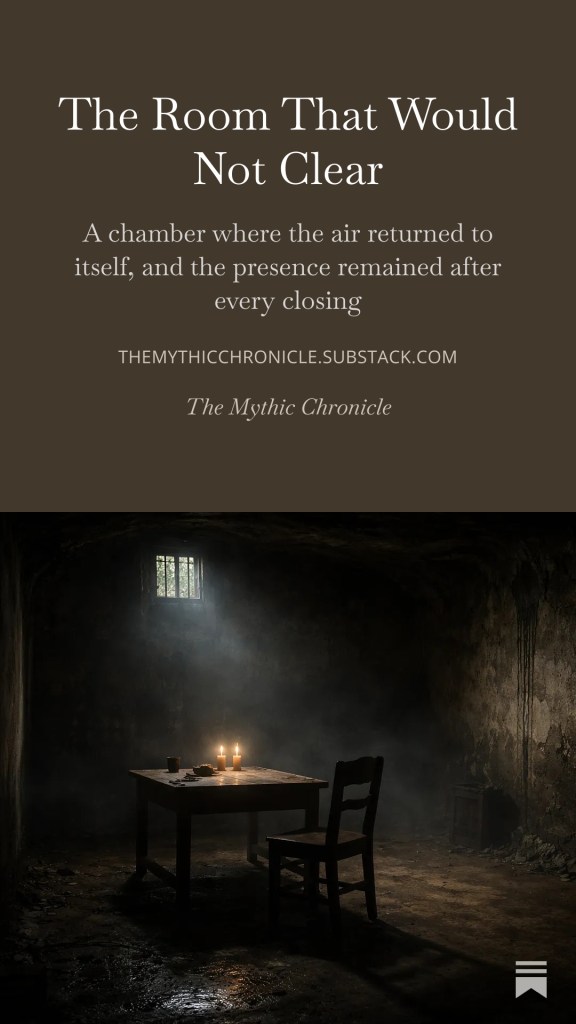
There are places in mythic fantasy where danger arrives with iron, flame, prophecy, or blood, and there are places where the pressure gathers in silence, within a room, along a stair, beneath a district whose people have carried on above it for so long that the older ground has begun to feel patient. Forgotten chambers hold a particular authority in fantasy because they draw the reader towards enclosure, memory, and the sense that stone itself has accepted a burden no living witness can fully name.
That atmosphere stands at the heart of The Mythic Chronicle and of Chronicle Three, Chronicle Three, a preserved account from The Whispering Foundations cycle in which a lower chamber restores its own air after every opening, as though the space has settled into a condition of its own choosing. The entry moves through cellar stone, closed doors, lamp light, and the uneasy rhythm of practical investigation, allowing the chamber to speak through weight, repetition, and the behaviour of the air itself.
Within mythic fantasy, rooms like this endure because they feel older than the people who enter them. They carry the pull of a shrine after worship has faded, a burial place after names have thinned, a store chamber built over an earlier structure whose purpose has long since slipped out of record. A reader steps into such a place and feels, almost at once, that the room has been waiting.
Where Enclosed Spaces Gather Power
A forgotten chamber in fantasy rarely depends upon spectacle. Its force comes from boundary. Wall, stair, lintel, beam, floor, and air create a limit around the body, and within that limit every change becomes more intimate. A hall can echo. A forest can suggest distance. A chamber presses close. It narrows the world until breath, silence, and presence begin to carry the full burden of the scene.
This is why enclosed spaces recur across ancient-seeming fantasy. Temples keep their cold. Burial rooms keep their dust. Undercrypts keep the residue of prayer, grief, and ceremony. Cellars beneath mercantile districts keep the overlooked matter of daily life, and in that neglect they become ideal vessels for another kind of inheritance. What has been sealed away acquires weight. What has gone unexamined acquires shape.
The strongest mythic settings understand that place is never passive. Stone records pressure. Timber holds smoke. Air takes on the character of whatever has passed through it. A chamber that returns to the same atmosphere after every disturbance carries more than a physical oddity. It suggests continuity. It gives the sense that the room has entered into a pattern, and that pattern can outlast the efforts of those who try to name it in the plain language of storage, damp, or disuse.
In Chronicle Three, this effect arrives through repetition. The door opens. The air eases. The air returns. The chamber is cleared. The chamber restores itself. That cycle matters because repetition is one of the oldest engines of mythic dread. A single event may be dismissed as chance. A recurrence begins to feel ordained. The world appears to be obeying a law whose terms remain hidden.
Air, Stone, and the Language of Presence
One of the most compelling features of this Chronicle lies in its treatment of atmosphere as record. The lower chamber is entered and examined through practical eyes. Merchants, clerks, ward keepers, and labourers meet the space with the habits of their work. They weigh, inspect, clear, measure, and return. Even their fear carries restraint. That restraint gives the chamber its power, since the language remains close to lived experience and close to material fact.
This approach matters for mythic fantasy as a form. The genre often becomes most persuasive when it allows mystery to remain inside the grain of ordinary life. The chamber sits beneath trade houses. The shelves are real. The table is real. The lamp flame shortens in air that has grown too close, and the room receives every attempt at clearing with the same quiet persistence. Nothing in the scene asks for thunder. The authority comes from calm observation meeting a condition that refuses to alter.
Readers remain drawn to forgotten rooms for this very reason. Such spaces hold the meeting point between the known and the withheld. A lower room can still be counted on a register, still be entered on a plan, still be used for storage, and yet every practical description starts to bend under the pressure of repeated encounter. Terms such as stale, close, damp, or confined begin as explanation, then gradually reveal their own insufficiency. The language remains grounded while the meaning deepens beneath it.
There is also a sacred echo within these scenes, even when the setting appears secular. A chamber beneath trade houses may carry the emotional force of a buried shrine. Repetition turns use into ritual. Opening the door becomes an act of approach. Standing at the threshold becomes a kind of observance. The air itself begins to feel like a vessel, and the vessel remembers.
That quality gives forgotten chambers a lasting place in fantasy literature. They hold the sense that memory can survive outside speech, outside inscription, outside dynasty. Long after names have faded, a room may keep its pressure. Long after purpose has altered, a space may continue to receive those who enter it according to an older order.
Why This Chronicle Feels Like a Recovered Fragment
The Mythic Chronicle has built its identity around preserved accounts, partial records, and disturbed remnants of older worlds, and Chronicle Three embodies that method with unusual clarity. The reading experience is shaped less like a conventional fantasy scene and more like an entry drawn from surviving testimony, where several hands, several visits, and several layers of understanding settle into a single line of record.
That structure gives the Chronicle a quiet authority. The chamber is never flattened into a convenient answer. The account stays with the room, the stair, the workers, the register, the later annotations. It trusts atmosphere to carry meaning. It allows contradiction and incompletion to remain within the page. For readers who hunger for fantasy that feels ancient, tactile, and preserved through damaged memory, that method has immense force.
The same entry point can be found through the free opening section of Chronicle Three on Substack, where the first movement of the account opens the lower chamber and lets the reader feel the room settle around them. From there, the wider archive of The Mythic Chronicle begins to reveal its deeper habit: each preserved fragment opens onto further disturbance, further record, further hints of a world whose foundations have never been entirely still.
A Threshold into The Whispering Foundations
Chronicle Three also serves as a strong threshold into The Whispering Foundations, the active cycle that follows buried passages, altered air, disturbed stone, and the quiet spread of corruption beneath the city. The chamber stands as a local event on the surface of the record, though its implications travel further. It suggests that the city rests above spaces whose behaviour can no longer be contained by trade practice, repair work, or official language.
This is where the Chronicle form becomes especially powerful. A novella can follow direct experience. A Chronicle entry can widen the world around that experience by showing what the district believed, what the registers preserved, and what passed from one witness to another in forms too partial for certainty. The result feels less like plot and more like recovered history.
Readers who enter through this chamber are entering through atmosphere first. The room offers pressure before explanation, presence before doctrine, and physical unease before any wider pattern has been spoken aloud. That makes it an ideal doorway into the publication as a whole. The Chronicle is approached through mood, material, and symbolic weight, with the city itself behaving like an archive whose pages have been laid beneath plaster, timber, and stone.
Where the Fuller Record Lies
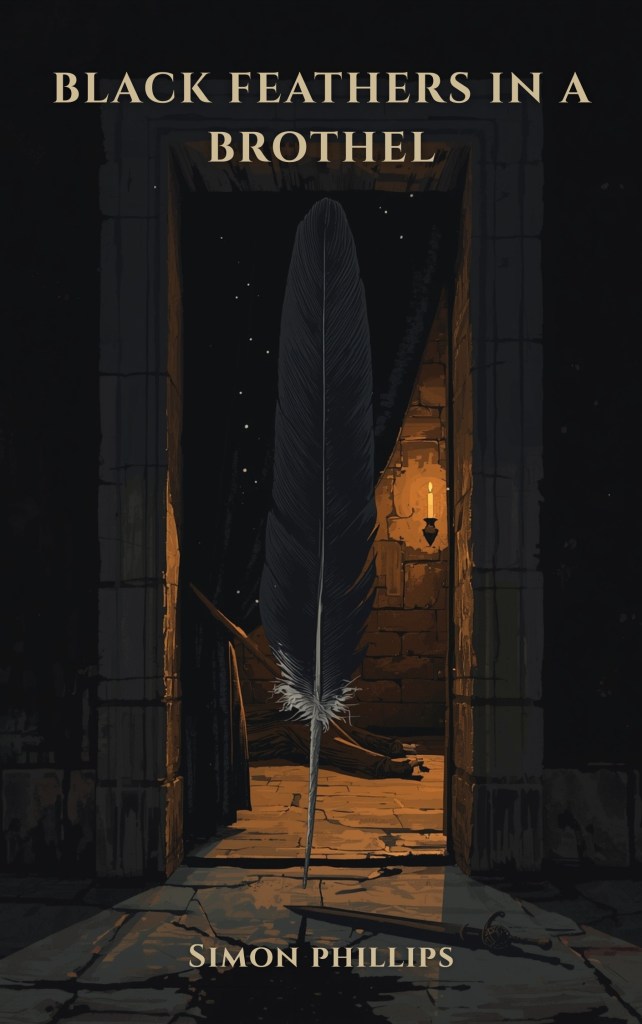
For those who wish to move from fragment into fuller narrative, the connected novella Black Feathers in a Brothel preserves a closer account from the same world. The relationship remains restrained and organic. The Chronicle deepens the atmosphere. The novella follows the pressure as it moves through lived experience. One form watches the world from the angle of record. The other walks into the room and stays there.
That connection matters because mythic fantasy often gains its richest texture when world and story are allowed to answer one another across different forms. A Chronicle entry can hold rumour, register, and marginal hand. A novella can hold encounter, consequence, and proximity. Together they create the sense of a world that extends beyond any single page, and that extension is part of the pleasure. The reader feels that one surviving account has led them towards another.
In the case of Chronicle Three, the movement feels especially natural. The chamber already carries the pressure of an unwitnessed inheritance. It hints at prior structures, unseen causes, and the quiet failure of ordinary remedies. A fuller narrative from the same world therefore feels less like a diversion and more like a descent.
The Lasting Pull of the Room
Forgotten chambers endure in mythic fantasy because they speak to an old human fear and an old human desire at once. They suggest that place can remember, that air can hold a trace, that the built world may preserve forces long after language has thinned around them. At the same time, they invite approach. The threshold remains there. The lamp is lifted. The door opens again.
Chronicle Three understands that power with admirable restraint. Its lower chamber never needs to proclaim itself. It gathers pressure, restores its own atmosphere, and settles back into the record with the patience of something that has found its place beneath the city. Through that patience, the room acquires gravity. Through that gravity, the reader is drawn onward.
Those who step into Chronicle Three are entering more than a single scene. They are entering a preserved account within a larger archive of stone, memory, and buried continuance. Beyond that threshold, Black Feathers in a Brothel keeps the fuller record close at hand, waiting where another door opens, and where the air has already begun to settle.
Discover more from Simon J. Phillips
Subscribe to get the latest posts sent to your email.
