On the final crossing before winter, an ageing ferryman carries a young woman towards an island that disappeared from the marsh generations ago.
Estimated reading time: 5 minutes.
By the time Jory Venn hauled the last mooring rope through the iron ring, dusk had flattened the Greyfen marsh into pewter channels between black reeds, and the first skin of winter ice had begun to gather along the shore. He had covered the ferry lantern and stacked his pole beneath the gunwale when footsteps came down the plank path behind him.
The young woman stopped beside the weathered post, carrying a hooded lantern in one hand and a leather case in the other. Her cloak was travel-stained, and when she looked across the marsh she seemed to be measuring distance against something only she could see.
“You’ve left it late,” Jory said, keeping one hand on the rope while his eyes moved towards the thickening mist. “Where are you trying to reach?”
“The island beyond the Crown Reach,” she said, giving a small inclination of her head. “My name is Elianor.”
Jory rested the rope against the post and studied her. “No island has stood beyond that reach in my lifetime, and I’ve spent most of it crossing these waters.”
“There was a landing there once,” Elianor replied, taking a dark silver seal from the leather case. “Perhaps this will persuade you that I know the place I mean.”
It was worn smooth at the edges, with the old split crown of Greyfen pressed deep into its face. Jory had seen the same mark half-erased on stones beneath newer jetties and carved into the oldest timber in his ferry shed. He looked from the seal to Elianor, then towards the mist swallowing the far bank.
“If I take you out there and find reeds, you’ll still owe the fare,” Jory said as he loosened the rope again.
The young woman answered with a faint smile and stepped aboard. Jory freed the ferry from the post, and the marsh closed around them quickly, the landing lamp shrinking behind the reeds as he worked the long pole through water he knew by depth, pull and resistance. She settled near the bow with the old lantern between her feet, speaking only when the channels divided, and each turning she named made the familiar water shift beneath his understanding.
“Take the left fork after the drowned gate,” Elianor said, leaning forward as broken stone appeared beside the reeds.
Jory eased the ferry round with a practised turn of the pole. “That’s Marsh Hook. Always has been.”
Elianor kept her gaze on the stones as they passed. “It was a gate before the road sank.”
Her words carried the quiet correction of someone remembering where a chair had once stood in a room. As they moved farther into the marsh, she called a low ridge of masonry the eastern landing, though Jory had crossed above those stones since boyhood and thought of them only as a place where nets snagged. When the lantern’s covering shifted in the breeze, a narrow gold line moved across the water, and for several breaths he saw squared foundations beneath the black surface where he had always believed the marsh bed lay empty.
“What are you carrying?” Jory asked, slowing the ferry until the pole rested against his shoulder.
Elianor placed one hand over the lantern’s warm metal crown, and the composure in her face softened as she looked down. “The last light of Greyfen.”
Jory waited for more, though none came. The flame behind the glass was small and steady, yet wherever its glow touched the marsh, old shapes gathered briefly through the water and mist, a blackened post rising beside steps that descended beneath the channel before the broken edge of a causeway appeared farther on.
He pushed them onwards, watching those vanished traces appear and fade beside the ferry while Elianor kept one hand upon the lantern. Ahead, the mist thinned so gradually that he first took the darker mass for reeds, until stone steps rose from the water, followed by a low landing and bare trees whose branches lifted around fragments of wall that should have lain generations beneath the marsh. Jory knew this stretch through summer drought and winter flood, and there had never been land beneath his boat.
“Do you want me to wait?” he asked, catching the landing with his pole, though he already knew there would be no return fare.
Elianor stepped ashore and turned towards him, the lantern casting warmth over her tired face. “No, Jory. You have already brought me farther than anyone else could.”
He watched her walk between the ruined walls until the mist reduced her to a moving glow, then to a single point of gold among the stones. The light faded there, softly enough that Jory almost missed the moment it went, and as darkness settled, the landing, bare trees and broken walls thinned with it, dissolving into reeds and open water around the ferry. Jory remained in the channel until cold worked through his gloves, then turned towards home.
The royal seal lay on the bench where Elianor had been sitting, solid beneath his thumb when he picked it up, while the marsh stretched around him exactly as it had every winter of his life. As he guided the ferry back through the dark, the broken stones beside the channels no longer looked like debris, only the last traces of roads, doorways and crossings that had once carried people home, and Greyfen felt older in its absence than it ever had in ruin.
Author Note
The Last Lantern of Greyfen grew from the idea of a place that had already disappeared from history, yet had one final thing left to surrender. I liked the thought of an ordinary ferryman travelling through a landscape he believed he knew completely, only to discover that the ruins and old stones around him had once belonged to a living world.
At its heart, this is a story about memory, disappearance, and the quiet moment when something finally passes beyond anyone’s keeping.
Monthly Free Stories is a project where I publish complete pieces of fiction here on my website. The stories can move between fantasy, horror, science fiction, historical fiction, mystery, and anything else that suits the idea. Each one is written to stand as a finished story in its own right and is freely available to read.
If you enjoyed this story, you can explore more free fiction on the website or take a look at my published books.
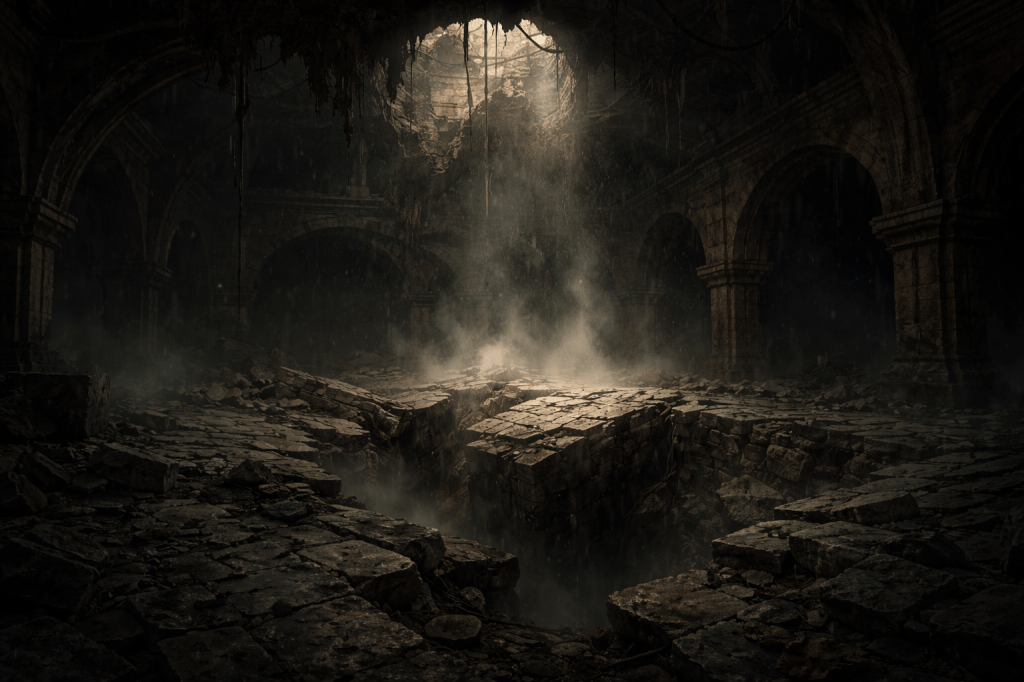
Where the ground beneath the district gave underfoot, then rose again in measured stillness, as though the stone itself had taken breath.
The Stone that Breathed
The yard behind the adjoining houses lay in the grey hour before trade had taken full hold of the district. High walls enclosed it on three sides, patched through years of repair with fresh mortar laid over older stone, while the flagging underfoot held the shine of recent rain in long dark seams. Water gathered in the shallow wear of the slabs and clung there, turning the ground into a dull mirror wherever the light from above found it. Even at that early hour the place carried a kind of hush that felt set apart from the lanes beyond, as though voices and wheels lost their force before they crossed the passage and entered that enclosed square. When three men came through the side gate with rods, a level frame, and a crate of tools, the scrape of iron over stone seemed to travel too far, then sink away into the yard as if the ground had received it.
Carvel, who led the inspection, stood with one hand resting on the frame and looked across the central run of slabs where the steward had marked a settlement on the evening before. At first glance the paving seemed sound. The rear step held firm beneath the water trough. The stack of empty casks still leaned beside the arch. The drain channel ran straight towards the passage mouth. Yet the eye kept returning to a broad patch near the middle where the joints had darkened into a ring and the stone sat lower by a whisper of an inch. It was the kind of change most men would pass twice before they saw it, then once seen, would carry in the mind with growing unease.
“Set the rods at the edge first,” he said. His voice stayed low, shaped by long habit in old places.
Hedd, younger and quicker in all his movements, crouched at the northern joint and fed the iron down between two slabs until it met resistance. Marr, broad-backed and slow, crossed to the western side and did the same. Carvel opened his folio, fixed the slate within it, and made the first marks while the light strengthened over the wall tops and laid a pale strip across the stones.
“Read.”
“Five inches,” Hedd said.
“Six at this side,” Marr answered.
Carvel marked both figures. “Again.”
They shifted position. Each new measure changed by a fraction. On the eastern side the rod turned slightly as it sank, as though the space beneath the paving opened away from the line where it had been set. Hedd drew it up and rubbed the pale dust from its grooves between finger and thumb. No damp clung to it, though the joints above still held the dark from the rain.
“That came from deeper down,” he said.
Carvel took the rod and looked at it for a moment. Fine grit lay in the score lines, light as ash and dry as old mortar ground under a hammer.
“A hollow sits under the centre,” Marr said.
“Perhaps,” Carvel replied. He lowered the rod and glanced again at the dark ring. “Though hollows in old yards usually keep still.”
They set the level frame over the marked patch and adjusted its feet with care. Hedd hung the plumb line from the crossbar and watched the weighted point circle above the widest slab. The line slowed, steadied, and came to rest over a joint that looked almost black in the poor light.
“Strike the outer edge,” Carvel said.
Marr took the haft of his hammer and tapped the stones in turn. The first four answered with the same blunt contained tone. Each sound travelled across the yard, pressed into the walls, and died there. When he struck the lowered slab, the note changed at once. It dropped away through the ground instead of spreading across it, carrying a depth that seemed out of keeping with the yard’s small measure. All three men heard it. All three men kept still after it passed.
“Hear that again,” Carvel said.
Marr struck the same stone a second time. The note fell as before, though this time it lingered below them for the length of a drawn breath, and during that held moment a faint pressure touched the soles of their boots. Hedd shifted his weight and looked towards the surveyor. Marr lowered the hammer a little, his hand tightening on the wood.
“That moved under us,” Hedd said.
Carvel crouched and laid his palm flat against the slab. The stone felt cold. Beneath the cold there came a rise so slight he could almost have named it memory, save that it gathered under his hand, held, and eased away again with slow purpose. He drew back at once, stood, and closed his folio.
“Clear the casks from the wall,” he said. “Move the crate as well. Leave the yard open.”
Neither man asked him for a reason. Marr went first, lifting the empty barrels one by one and carrying them through the passage into the lane. Hedd gathered the tools and the frame, set them by the gate, then returned and stood just clear of the dark ring, watching Carvel as though the older man might give shape to what had begun under the stone. Carvel’s attention remained on the plumb line. The weighted point hung almost still. Then it drew a fraction to the south, paused, and came back. No wind touched the yard. The water in the trough by the rear step held its surface smooth as glass.
“It shifts between measures,” Hedd said.
Carvel gave a brief nod. “Bring the lamp.”
Hedd fetched it from the crate and lit it with a spill from the shuttered flame he carried at his belt. The small amber light spread over the flagged centre and sharpened the wet seams between the stones. In that warmer glow the ring appeared wider than before, the dark joints holding a moist blackness that seemed fresh laid, as though the paving had drawn breath from below and pressed it upward through the cracks.
Marr came back from the lane and set down the last cask. “The steward will ask what holds us here,” he said.
“He can ask,” Carvel replied. “Take the lifting bar to the centre seam.”
Marr slid the iron under the lip of the broadest slab and leaned his weight into it. At first the stone held firm. Then, with a fine grinding sound from somewhere below its edge, it rose the depth of two fingers and hung there on the bar. A thread of dust drifted upward through the opening, pale in the lamplight. Hedd bent with the lamp and lowered the flame towards the gap. The beam caught broken mortar, a wedge of darkness, and the faint movement of more dust rising from beneath in slow twisting lines.
“There is space under it,” Hedd said.
“There is more than space,” Carvel answered.
A scent came up through the join while he spoke, dry and old at first, then touched by a sweetness that turned the stomach through its very thinness. It carried no richness of rot. It had the strange lightness of something long shut away that still found means to linger. Hedd drew his head back, though his eyes never left the gap.
“That smell came from deep stone,” he said.
“Raise it a little further,” Carvel said.
Marr shifted his grip and pressed again. The slab lifted another inch. The sound that followed rose through the opening in a slow drawn exhalation, as if the ground had released a held breath through a narrow throat. The men heard no crack, saw no breaking edge, felt no sudden violence. The change began in the joints around the lifted slab. One seam widened. Then a second opened near it. Across the whole dark ring the paving eased downward together in a motion so slow the eye could follow every part of it. The plumb line trembled above the centre. Water in the worn hollows shivered and drew inward along the widening seams. The entire marked section lowered the depth of a hand.
Hedd stepped back until his shoulders touched the wall. Marr kept the bar fixed under the slab, though his stance had altered and his face had emptied of all labourer’s ease. Carvel alone stayed near the edge, the lamp held low, his gaze moving across the ring as each stone settled into its lowered place.
“It sinks in measure,” Marr said.
Carvel heard him, though his attention had gone elsewhere. A low pressure had risen with the movement, no sound at first, only a gathering in the air that filled the chest and held there. Then, from below the lowered paving, there came a tone so faint it seemed almost to live inside the ear instead of within the yard. It lasted only a moment. Even so, it followed the descent as clearly as a sigh follows effort.
The ground stayed down for the space of three breaths.
Dust continued to rise through the open seam under Marr’s bar. The sweet thin scent strengthened, then spread through the yard in a shallow veil. Hedd kept one sleeve over his mouth. Marr stared into the gap beneath his stone, as though he expected some hand or face to rise into the lamplight. Carvel watched the plumb line. The weighted point had ceased its trembling and now hung slightly lower, the cord pulled taut over a centre that no longer sat where it had sat a moment before.
Then the ground came up again.
The motion followed the same dreadful calm. The lowered slabs rose together by degrees. The widened joints drew inward. Water ran back across the stone in fine trembling lines. Marr’s lifted slab eased down against the bar as the whole centre returned to level, and when at last it settled into its bed the sound it made held the softness of a mouth closing after speech. The plumb weight turned once more and came to rest. The dark ring remained. The yard stood as it had stood when they entered, save that the seams now looked fresher, wetter, and more deeply cut.
Hedd found his voice first. “That was no collapse.”
“No,” Carvel said.
Marr eased the bar from the joint and laid it on the stones with care. “Then what do I enter when he asks?”
Carvel looked across the centre and spoke only after a long pause. “You enter what was seen.”
Marr gave a humourless breath. “The ground gave way and rose again?”
“If you have the courage for plain truth, yes.”
No one moved for a while. Beyond the yard the district had begun its day in earnest. Wheels passed over cobbles. A woman called from an upper window. Somewhere along the lane a hammer started its work upon wood. Within that enclosed space, each outer sound arrived thinned and distant, while beneath them all there seemed to linger the memory of the lower movement, held close under the flags like a second life under the first.
Carvel took the rod from Hedd and knelt again beside the centre seam. He fed the iron into the joint where Marr had lifted the slab. It sank deeper than before. When it stopped, the rod gave a slight turn in his hand, then steadied. He drew it back and found a pale trace upon the lower score lines, finer than dust, almost white.
Marr saw it first. “Mortar?”
Carvel rubbed it with his thumb. The grit felt dry, fine, and faintly greasy, as though it had passed through long-closed air before reaching the surface. He lifted it to the lamp. White flecks caught the light against his skin.
“Keep your hands clear of the joints,” he said.
Hedd’s eyes went at once to the ring around the centre. “You think something is working upward.”
Carvel rose. “I think the ground answered its own measure. That is enough for one morning.”
He closed the folio, though the charcoal in his hand had paused over the slate before making its final line. Marr gathered the bar and hammer. Hedd lifted the lamp and the rods, his gaze still fixed on the central slabs as if he feared a second motion might begin the instant his back turned. Together they moved towards the gate, each step careful and placed with more thought than it had carried on the way in.
At the threshold Carvel stopped and looked back.
The flagged centre lay quiet in the pale light. The ring of darkened joints held around it with a shape too even for chance. A last thread of dust drifted up from one narrow seam and vanished in the damp air. Then, under the watch of all three men, the broadest slab sank by the breadth of a finger and rose again, a small measured motion, no more than a pulse passing through skin.
Hedd made a sound in his throat and stepped into the passage. Marr followed at once. Carvel remained one moment longer, the folio held under his arm, the lamp glow reaching only so far across the yard.
He heard it then, or felt it, and for years afterward he would have struggled to say which. A low interior pressure gathered beneath the stones, held there, and eased away again in a slow returning wave, as though some buried mass below the district had drawn in air through the roots of the walls and released it once more into the foundations above.
When he left the yard and drew the gate to behind him, the sound of the lane closed around the three men and the morning took them back into its ordinary movement. Behind the timber, beyond the patched walls, the ground settled into stillness. It held that stillness with perfect composure, while under the flags the dark seams kept their widened shape and the space beneath the centre lay ready for the next slow descent.
Foundation Register: Rear Foundation Movement Record
The yard entered within the adjoining property plans appears as part of a shared service ground set behind several lower structures, its surface formed through successive layers of paving laid over earlier fill and supporting stone. Surviving revisions record minor alterations to drainage and access across different years, while the central flagged section remained unchanged in outline, its condition accepted as sound within the ordinary pattern of repair.
During routine inspection following reports of settlement within the rear paving, the yard was entered for assessment, and early observations were recorded in practical terms, referring to slight lowering across a central run of slabs, widening damp within the joints, and the possibility of subsidence beneath the flagged surface. These entries held to the language of maintenance and assigned the condition to age, weathering, and long pressure within the underlying fill.
Subsequent notes describe irregularities in the behaviour of the paving during measurement, where rods placed through the joints returned differing depths across a confined section whose outline remained stable in the surrounding stone. Early descriptions refer to this as uneven settlement, though later entries distinguish the movement from ordinary ground loss, recording that the flagged centre appeared to lower and recover within a measured interval while the adjoining sections held firm.
In several accounts, the movement is described as occurring across the full marked section at once, with the slabs easing downward in a single contained shift before returning to their prior level. These observations are entered cautiously, with later revisions attributing the effect to distributed pressure beneath the paving or to movement within a concealed pocket of older material set below the visible surface.
A number of entries refer to changes accompanying the descent, where seams widened briefly, pale residue rose through the opened joints, and a low pressure gathered in the air above the flagged centre. These notes remain limited in detail and are not expanded within the primary record, with several later annotations omitting reference to the atmospheric change entirely and retaining only the structural description.
Further examination records that the behaviour appeared more pronounced where individual slabs were raised for inspection, at which point the movement below the surface was entered as responsive to disturbance within the upper layer. In these sections, the paving is described as lowering in deliberate measure rather than in fracture, and the return is recorded as steady, with no breaking edge or collapse extending beyond the marked ring.
Several observations refer to material recovered from the deeper joints, where a dry pale grit was brought up from beneath the paving despite recent rainfall across the yard above. This substance is entered as degraded mortar or residue from older construction below the present surface, and no further inquiry was undertaken concerning its source or persistence.
The condition was attributed to instability within the underlying fill and to concealed voids or channels set beneath the rear ground, and limited reinforcement was recommended along the affected section. The yard remained in use for a short period following inspection, during which additional observations were entered in reduced form, referring to minor repeated shifts within the central paving and the continued darkening of the surrounding seams.
A marginal notation, written in a later hand, refers to the movement as “measured settlement within the lower layers, as if the ground yielded and resumed in turn”, a phrase set apart from the main entry and left without further explanation. The notation appears once and is absent from subsequent revisions of the same record.
Final entries indicate that the affected section was reinforced during later works carried out beneath the adjoining structures, and its condition was listed as stabilised within the internal plans. The irregular movement was recorded as contained within the limits of structural variation, and no further observation was entered following the completion of those measures.
The matter was entered as resolved within the register, and the yard remains recorded as a stable rear service ground behind the district properties, its condition accepted within the limits assigned to it and requiring no further attention.
About the Creator
The Mythic Chronicle is written and curated by Simon Phillips, a writer of mythic and speculative fantasy whose work explores the quieter edges of forgotten worlds, where buried structures, fractured records, and lingering presences continue beneath the surface of recorded history.
The accounts preserved within these Chronicles form part of a wider body of work in which cities stand upon older foundations, and events recorded as isolated disturbances are understood, in later tellings, to belong to patterns that were never fully recognised at the time.
One such account survives in a separate record, detailing an incident within a lower district where a death was first dismissed as excess, though the space in which it occurred retained a presence that resisted clearing, and where investigation revealed signs that the disturbance had not been confined to a single room.
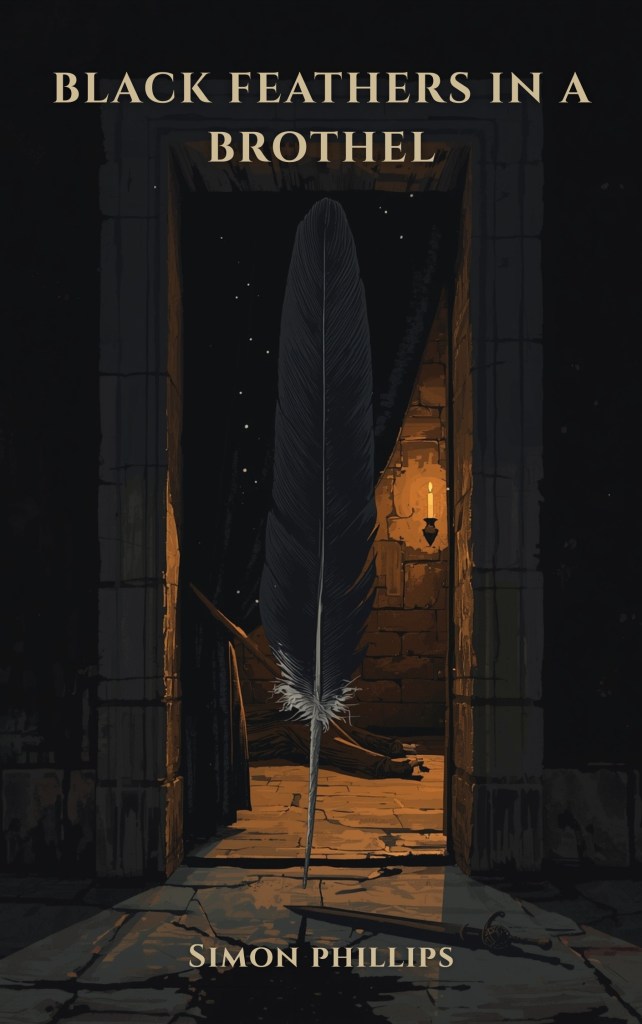
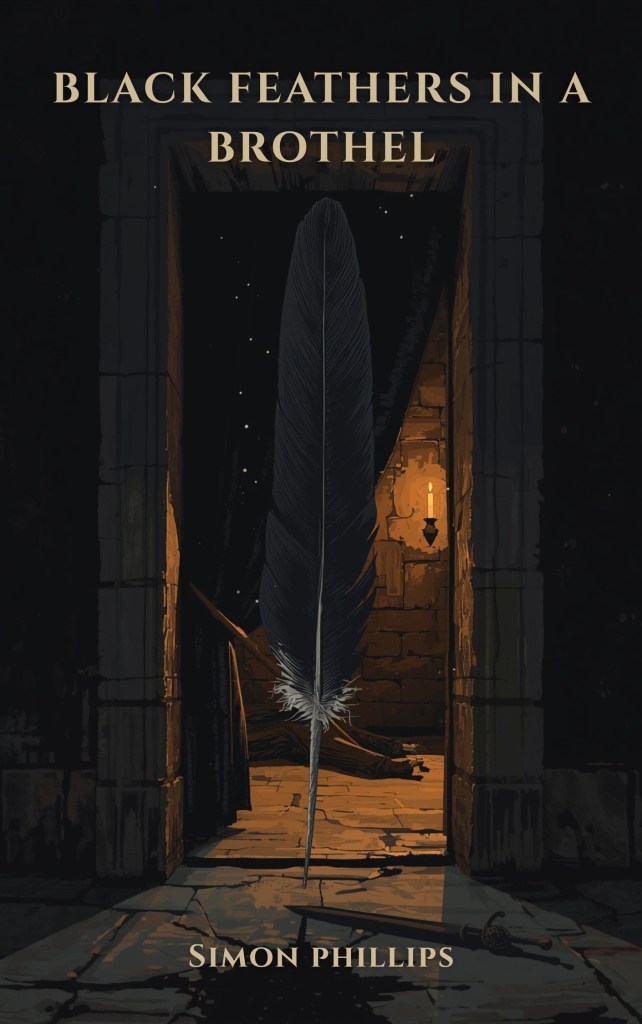
This record is preserved in the novella Black Feathers in a Brothel, where the events surrounding that incident are followed more closely, though even there the full nature of what lay beneath the structure remains uncertain.
Readers who wish to examine that account in its fuller form may find the record below.
What follows is drawn from later entries concerning the rear yard behind the adjoining houses, where movement was first entered as ordinary settlement within the flagged centre. Early accounts describe the change in practical terms and assign it to age, pressure, and variation within the lower fill, though subsequent notes refer to repeated instances in which the ground was seen to lower and recover in measured sequence. Each occurrence is entered briefly and left within the language of maintenance, while several annotations refer to widening seams, pale residue rising through the joints, and a pressure within the air that gathered before the movement took hold. In later entries, the descent is described as affecting the full marked section at once, as though the surface answered to a deeper motion within the hidden layers beneath the yard. The cause remains assigned to structural conditions below the paving, and each account concludes with the ground accepted within the limits set down for it in the register.
Subscribe to continue reading
Subscribe to get access to the rest of this post and other subscriber-only content.
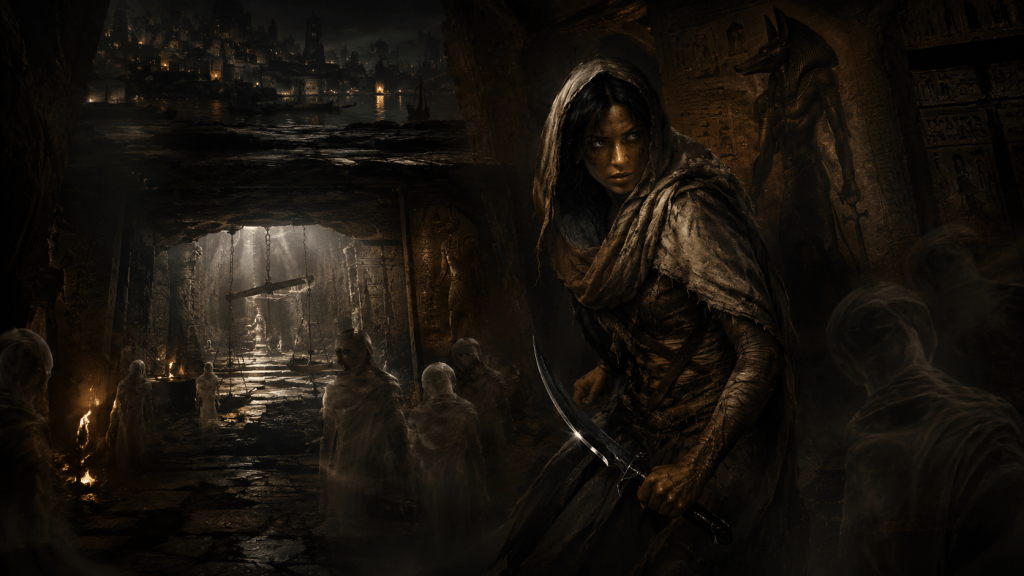
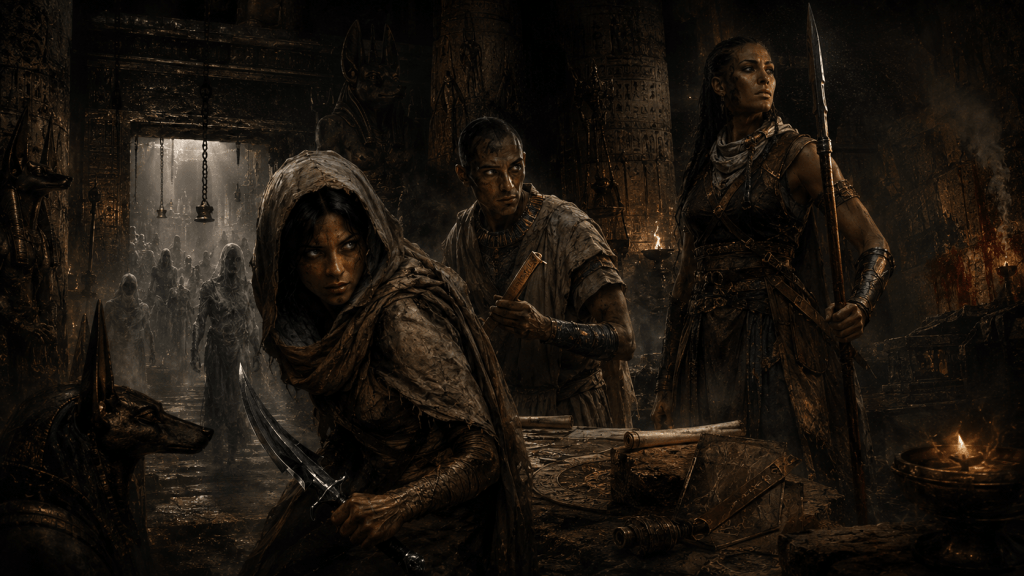
Above ground, life presses through the lanes in smoke, heat, fish-blood, old grain, cheap oil, medicine, shouted bargains, and the dull fatigue of people trying to make one more day hold together. Below those same streets, older systems remain. Tomb passages run beneath foundations. Faded shrines keep their painted eyes turned towards forgotten doors. Burial routes pass through stone chambers where the living once prepared the dead for their final journey.
For readers drawn to Egyptian mythic fantasy, dark fantasy, and stories shaped by ancient gods rather than borrowed decoration, the river quarter matters as much as any temple or necropolis. It is where Neris lives. It is where she steals from tombs because medicine costs money, rent still comes due, and grief does little to feed a household. It is where the distance between sacred history and ordinary survival becomes painfully small.
Neris has already crossed a threshold that should have remained closed. She has returned carrying the uneasy sense that the dead can find her, that their unfinished burdens can gather at the edge of her thoughts, and that something in the dark has changed the shape of her life. She calls herself a bridge because the word gives her burden a use. A bridge joins two places. A bridge carries weight. A bridge does not need to ask who built it or why.
Yet every bridge can become a crossing point for something far more dangerous.
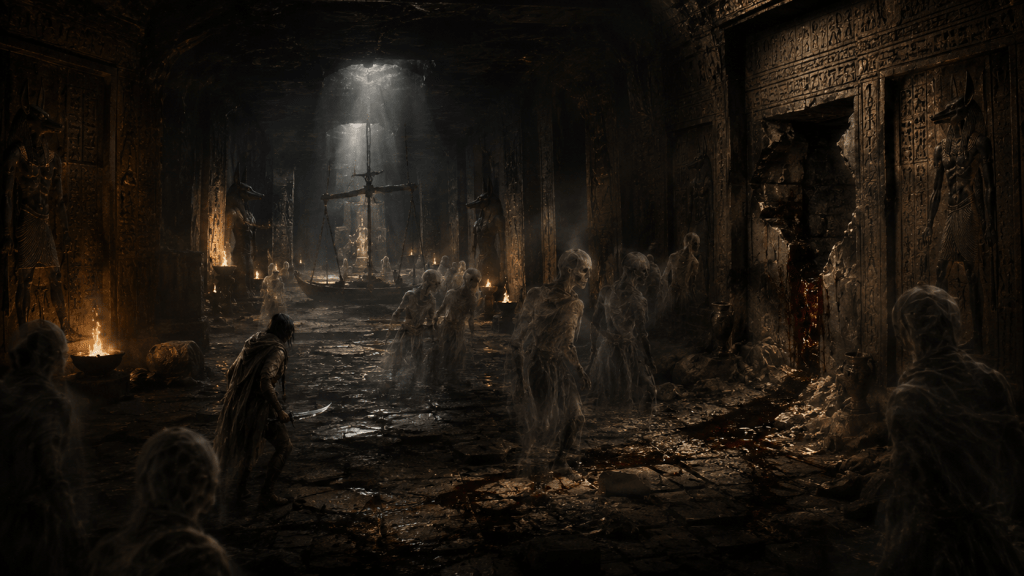
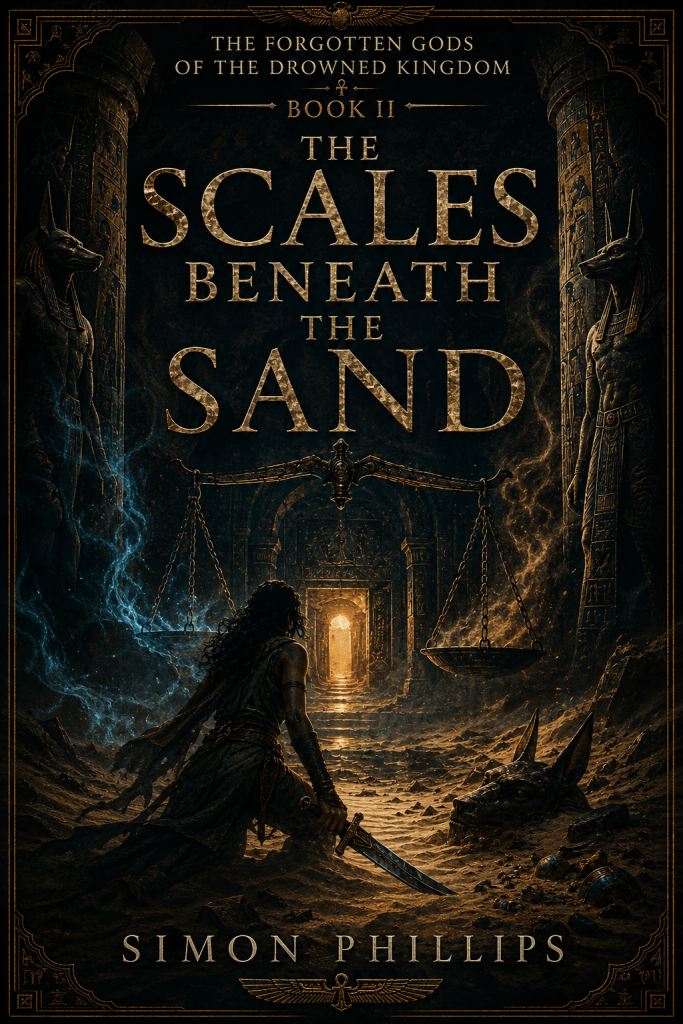
In The Scales Beneath the Sand, the second book in The Forgotten Gods of the Drowned Kingdom, the old routes beneath the river city begin to fail. Souls gather where they should pass cleanly. Sacred passages hold pressure where there should be release. The dead seem to hesitate before a crossing that has served them for generations.
That kind of wrongness belongs to more than haunting.
It belongs to interference.
When the Routes of the Dead Are Wounded
Tombs in Egyptian mythic fantasy should never feel like empty scenery waiting for an adventurer to enter them. They are architecture built around memory, judgement, ritual, identity, grief, and passage. A burial chamber holds the shape of the people who believed in it. A threshold carries the weight of those who crossed it before. A damaged shrine can become more than abandoned stone when its sacred purpose still remains close beneath the surface.
The buried spaces beneath Neris’s city work in that way.
They are not merely ruins. They are old systems of passage. Ferry chambers, weighing rooms, record houses, forgotten shrine courts, and narrow cut-stone ways still preserve the language of burial order. They remember what the dead are meant to do even when the living have stopped listening.
That makes the disturbance at the heart of The Scales Beneath the Sand more unsettling than an ordinary haunting. The dead are not simply restless. Their routes have been handled. Stone has been cut. Ash and blood have been worked into sacred spaces. Something has opened wounds inside the passages where the dead should move towards judgement.
The result is a form of underworld fantasy grounded in pressure rather than spectacle.
The danger begins in small signs. A spill of natron near a jackal-marked recess. Fresh blood in a place that should have been empty. A torn piece of blackened leather. Marks carved into old stone with enough force to make the sacred architecture itself feel violated. Neris follows those signs because she knows the human cost of walking away from something wrong. The dead follow her thoughts. Their fear becomes difficult to leave behind.
The city above continues unaware. People drink beneath reed awnings. Children cry in upper rooms. Fishmongers scrape scales into buckets as night settles over the quay. Yet underneath those ordinary lives, sacred order has begun to fracture.
That is where the hidden god-war first becomes visible.
Not through armies at a city gate. Not through gods tearing open the sky. Through the dead failing to rest.
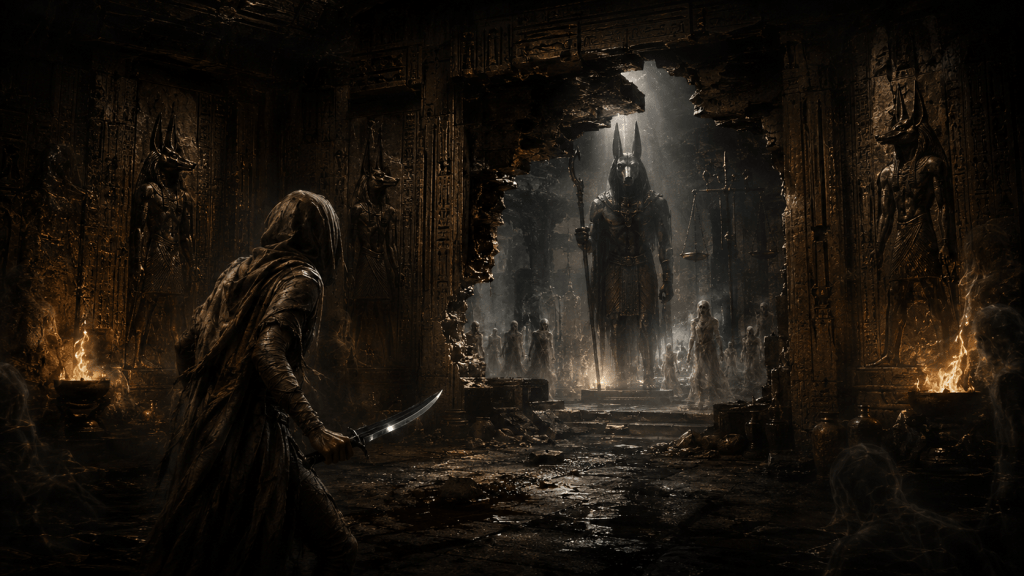
Anubis at the Broken Threshold
Anubis has always belonged at the edge of fear and judgement.
He is associated with tombs, funerary practice, embalming, the care of the dead, and the passage towards rightful judgement. His presence carries a particular weight because he is not simply a god of death. He stands at the point where death must be ordered, witnessed, and given its proper place.
That makes him a powerful centre for an Anubis fantasy story.
Neris’s connection to him offers no easy blessing. Her jackal talisman becomes a funerary blade only when the dead press too close or when a threshold has been disturbed. The weapon is intimate, cold, and made for narrow places. It belongs in stone corridors, flood-cut passages, old shrines, and the close terror of being unable to step far enough away from another person’s blade.
That distinction matters.
The divine weapon does not turn Neris into a polished fighter. She remains a survivor first. Her instincts come from tomb shafts, slum alleys, unstable stone, hidden routes, and the practical knowledge that escape can matter more than victory. She fights low, close, and desperately. She uses clutter, broken walls, ash, tight spaces, bad footing, and whatever the room gives her.
The funerary blade gives her a way to answer sacred wrongness. It does not erase fear from her body.
This is where the series separates itself from clean chosen-one adventure. Being marked by a god does not lift Neris above poverty, grief, injury, or uncertainty. It makes her visible to forces that already understand more about her than she understands about herself.
Chosen people carry relics shaped by divine domains. Their weapons reflect the gods who claim them. Their strengths are tied to endurance, discipline, training, fear, nerve, judgement, and the cost of surviving long enough to learn. That keeps the hidden war close to the body. Feet slip. Hands shake. Wounds open. Pride creates mistakes. A blade can be sacred and still fail in an untrained grip.
Khamet enters the story through record houses, burial tallies, ferry counts, ledgers, ink-stained fingers, and maps of disturbed passage. His relationship to the dead comes through pattern and reckoning. Where Neris feels the wrongness in her skin and breath, Khamet sees broken measure. He watches the numbers around burial, crossings, oils, and names begin to separate from one another, then follows the distortion towards something buried beneath the city.
He is useful almost immediately.
He is also irritating almost immediately.
Their early connection is shaped by distrust, exhaustion, sharp replies, wounded pride, and practical necessity. Neither gives the other comfort. Neither enters the other’s life gently. That matters because the war has no interest in providing safe companions at the right moment. It brings people together when pressure leaves them no cleaner choice.
Meretneith arrives from a different part of that same world.
She is a veteran chosen of Neith, shaped by martial discipline, old war knowledge, and the unsentimental truth that survival demands more than instinct. Her presence changes the scale of the story because she reveals what long experience looks like. Every movement has purpose. Every correction lands where it needs to land. Her weapon is an extension of training rather than a spectacle.
For Neris, that becomes its own kind of humiliation.
Surviving is not the same as knowing how to fight.
A hard lesson begins with the feet.
The Scales Beneath the Sand
The title The Scales Beneath the Sand reaches towards the deeper tension of the series. Scales suggest judgement. Sand suggests burial, erosion, time, and the slow concealment of what people once believed was secure. Together they point towards a world where sacred order has been buried so long that even those living above it may no longer know what holds their city together.
Neris enters that buried order carrying the wrong tools for a war she never chose.
She has a funerary blade, a sick mother, a body already marked by grief, and a life rooted in streets where every coin must be counted before it can be spent. The hidden conflict enters through those ordinary pressures. It reaches for her because she has been claimed, though the claim means danger long before it means understanding.
The story remains focused on tombs, thresholds, divine weapons, and the uneasy movement of the dead, yet its centre stays human. The fear is not only that a sacred route may break. The fear is that the break will climb. It will move upward through the stone, into the lanes, into the rooms where people sleep, and eventually towards the few fragile lives Neris still believes she can protect.
That is the real weight of hidden god-war.
It begins in the places no one thinks to watch.
When the War Learns the Road Home
The strongest ancient gods fantasy does not need to announce its scale at once.
It can begin with a single wound in old stone.
It can begin with dead souls gathering at a closed passage.
It can begin with a woman carrying medicine home through a river city, sensing that something beneath the streets has started to call her name.
The first signs are rarely grand enough for anyone above ground to notice. A lamp gutters in a shrine that has stood neglected for years. A burial tally fails to match the names written beside it. An offering bowl lies overturned where no living hand should have passed. In the dark beneath the quarter, old routes begin to tighten around the dead, holding them in places meant only for crossing.
By the time fear has a name, the damage has already travelled.
The Scales Beneath the Sand stands at that moment of widening pressure. Neris has moved beyond the lonely belief that she is only a bridge between the living and the dead. The hidden conflict has found her. Other claimed people have entered her path. A predator has tested her strength and seen where her life is weakest.
She still carries the same burdens she carried before the dead began to answer her. Her mother still waits in a narrow room. Medicine still costs more than she can spare. The river quarter remains full of damp walls, thin lamps, crowded lanes, and people trying to protect what little has survived another difficult day. The divine has entered her life, yet it has offered no escape from any of that.
Instead, it has placed those fragile things in danger.
The city remains standing. The temples have not fallen. The gods have not yet stepped openly into the streets. Their names still belong to shrine walls, old stories, ritual words, and the fears people carry quietly through the night.
Even so, the balance has shifted.
Something beneath the city has learned that sacred order can be wounded. Something has begun to test the routes of the dead, the people marked by old gods, and the living ties that make those people vulnerable. Neris has survived the first movement of that pressure, though survival has only brought her closer to the truth waiting beneath it.
The war begins before anyone understands its full shape.
It begins in tomb dust, river stink, jackal shadows, broken thresholds, and the silence left behind when the dead fail to rest.
It begins beneath the sand, where old scales still wait for something to be weighed.
There are places in mythic fantasy where danger arrives with iron, flame, prophecy, or blood, and there are places where the pressure gathers in silence, within a room, along a stair, beneath a district whose people have carried on above it for so long that the older ground has begun to feel patient. Forgotten chambers hold a particular authority in fantasy because they draw the reader towards enclosure, memory, and the sense that stone itself has accepted a burden no living witness can fully name.
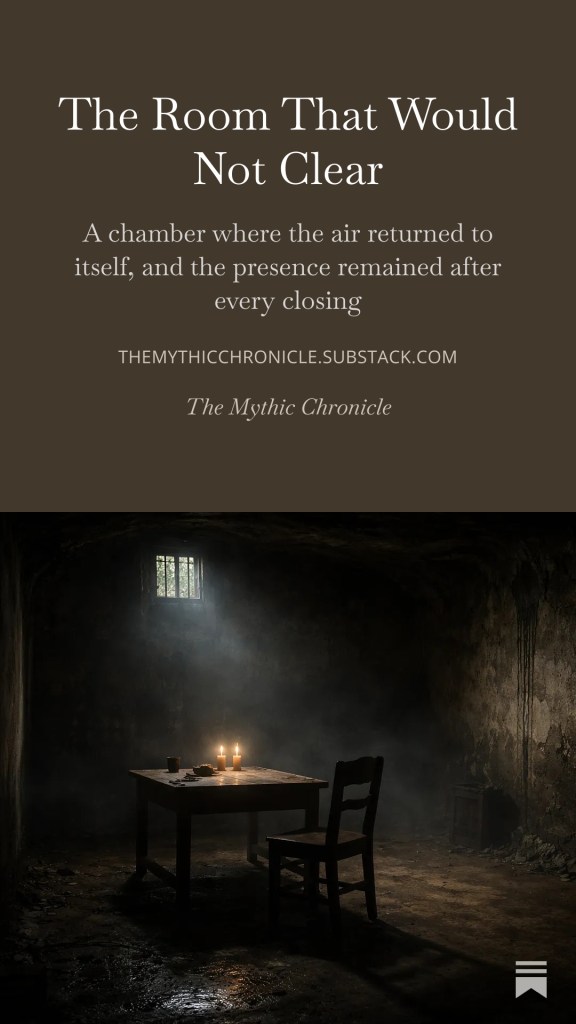
That atmosphere stands at the heart of The Mythic Chronicle and of Chronicle Three, Chronicle Three, a preserved account from The Whispering Foundations cycle in which a lower chamber restores its own air after every opening, as though the space has settled into a condition of its own choosing. The entry moves through cellar stone, closed doors, lamp light, and the uneasy rhythm of practical investigation, allowing the chamber to speak through weight, repetition, and the behaviour of the air itself.
Within mythic fantasy, rooms like this endure because they feel older than the people who enter them. They carry the pull of a shrine after worship has faded, a burial place after names have thinned, a store chamber built over an earlier structure whose purpose has long since slipped out of record. A reader steps into such a place and feels, almost at once, that the room has been waiting.
Where Enclosed Spaces Gather Power
A forgotten chamber in fantasy rarely depends upon spectacle. Its force comes from boundary. Wall, stair, lintel, beam, floor, and air create a limit around the body, and within that limit every change becomes more intimate. A hall can echo. A forest can suggest distance. A chamber presses close. It narrows the world until breath, silence, and presence begin to carry the full burden of the scene.
This is why enclosed spaces recur across ancient-seeming fantasy. Temples keep their cold. Burial rooms keep their dust. Undercrypts keep the residue of prayer, grief, and ceremony. Cellars beneath mercantile districts keep the overlooked matter of daily life, and in that neglect they become ideal vessels for another kind of inheritance. What has been sealed away acquires weight. What has gone unexamined acquires shape.
The strongest mythic settings understand that place is never passive. Stone records pressure. Timber holds smoke. Air takes on the character of whatever has passed through it. A chamber that returns to the same atmosphere after every disturbance carries more than a physical oddity. It suggests continuity. It gives the sense that the room has entered into a pattern, and that pattern can outlast the efforts of those who try to name it in the plain language of storage, damp, or disuse.
In Chronicle Three, this effect arrives through repetition. The door opens. The air eases. The air returns. The chamber is cleared. The chamber restores itself. That cycle matters because repetition is one of the oldest engines of mythic dread. A single event may be dismissed as chance. A recurrence begins to feel ordained. The world appears to be obeying a law whose terms remain hidden.
Air, Stone, and the Language of Presence
One of the most compelling features of this Chronicle lies in its treatment of atmosphere as record. The lower chamber is entered and examined through practical eyes. Merchants, clerks, ward keepers, and labourers meet the space with the habits of their work. They weigh, inspect, clear, measure, and return. Even their fear carries restraint. That restraint gives the chamber its power, since the language remains close to lived experience and close to material fact.
This approach matters for mythic fantasy as a form. The genre often becomes most persuasive when it allows mystery to remain inside the grain of ordinary life. The chamber sits beneath trade houses. The shelves are real. The table is real. The lamp flame shortens in air that has grown too close, and the room receives every attempt at clearing with the same quiet persistence. Nothing in the scene asks for thunder. The authority comes from calm observation meeting a condition that refuses to alter.
Readers remain drawn to forgotten rooms for this very reason. Such spaces hold the meeting point between the known and the withheld. A lower room can still be counted on a register, still be entered on a plan, still be used for storage, and yet every practical description starts to bend under the pressure of repeated encounter. Terms such as stale, close, damp, or confined begin as explanation, then gradually reveal their own insufficiency. The language remains grounded while the meaning deepens beneath it.
There is also a sacred echo within these scenes, even when the setting appears secular. A chamber beneath trade houses may carry the emotional force of a buried shrine. Repetition turns use into ritual. Opening the door becomes an act of approach. Standing at the threshold becomes a kind of observance. The air itself begins to feel like a vessel, and the vessel remembers.
That quality gives forgotten chambers a lasting place in fantasy literature. They hold the sense that memory can survive outside speech, outside inscription, outside dynasty. Long after names have faded, a room may keep its pressure. Long after purpose has altered, a space may continue to receive those who enter it according to an older order.
Why This Chronicle Feels Like a Recovered Fragment
The Mythic Chronicle has built its identity around preserved accounts, partial records, and disturbed remnants of older worlds, and Chronicle Three embodies that method with unusual clarity. The reading experience is shaped less like a conventional fantasy scene and more like an entry drawn from surviving testimony, where several hands, several visits, and several layers of understanding settle into a single line of record.
That structure gives the Chronicle a quiet authority. The chamber is never flattened into a convenient answer. The account stays with the room, the stair, the workers, the register, the later annotations. It trusts atmosphere to carry meaning. It allows contradiction and incompletion to remain within the page. For readers who hunger for fantasy that feels ancient, tactile, and preserved through damaged memory, that method has immense force.
The same entry point can be found through the free opening section of Chronicle Three on Substack, where the first movement of the account opens the lower chamber and lets the reader feel the room settle around them. From there, the wider archive of The Mythic Chronicle begins to reveal its deeper habit: each preserved fragment opens onto further disturbance, further record, further hints of a world whose foundations have never been entirely still.
A Threshold into The Whispering Foundations
Chronicle Three also serves as a strong threshold into The Whispering Foundations, the active cycle that follows buried passages, altered air, disturbed stone, and the quiet spread of corruption beneath the city. The chamber stands as a local event on the surface of the record, though its implications travel further. It suggests that the city rests above spaces whose behaviour can no longer be contained by trade practice, repair work, or official language.
This is where the Chronicle form becomes especially powerful. A novella can follow direct experience. A Chronicle entry can widen the world around that experience by showing what the district believed, what the registers preserved, and what passed from one witness to another in forms too partial for certainty. The result feels less like plot and more like recovered history.
Readers who enter through this chamber are entering through atmosphere first. The room offers pressure before explanation, presence before doctrine, and physical unease before any wider pattern has been spoken aloud. That makes it an ideal doorway into the publication as a whole. The Chronicle is approached through mood, material, and symbolic weight, with the city itself behaving like an archive whose pages have been laid beneath plaster, timber, and stone.
Where the Fuller Record Lies
For those who wish to move from fragment into fuller narrative, the connected novella Black Feathers in a Brothel preserves a closer account from the same world. The relationship remains restrained and organic. The Chronicle deepens the atmosphere. The novella follows the pressure as it moves through lived experience. One form watches the world from the angle of record. The other walks into the room and stays there.
That connection matters because mythic fantasy often gains its richest texture when world and story are allowed to answer one another across different forms. A Chronicle entry can hold rumour, register, and marginal hand. A novella can hold encounter, consequence, and proximity. Together they create the sense of a world that extends beyond any single page, and that extension is part of the pleasure. The reader feels that one surviving account has led them towards another.
In the case of Chronicle Three, the movement feels especially natural. The chamber already carries the pressure of an unwitnessed inheritance. It hints at prior structures, unseen causes, and the quiet failure of ordinary remedies. A fuller narrative from the same world therefore feels less like a diversion and more like a descent.
The Lasting Pull of the Room
Forgotten chambers endure in mythic fantasy because they speak to an old human fear and an old human desire at once. They suggest that place can remember, that air can hold a trace, that the built world may preserve forces long after language has thinned around them. At the same time, they invite approach. The threshold remains there. The lamp is lifted. The door opens again.
Chronicle Three understands that power with admirable restraint. Its lower chamber never needs to proclaim itself. It gathers pressure, restores its own atmosphere, and settles back into the record with the patience of something that has found its place beneath the city. Through that patience, the room acquires gravity. Through that gravity, the reader is drawn onward.
Those who step into Chronicle Three are entering more than a single scene. They are entering a preserved account within a larger archive of stone, memory, and buried continuance. Beyond that threshold, Black Feathers in a Brothel keeps the fuller record close at hand, waiting where another door opens, and where the air has already begun to settle.
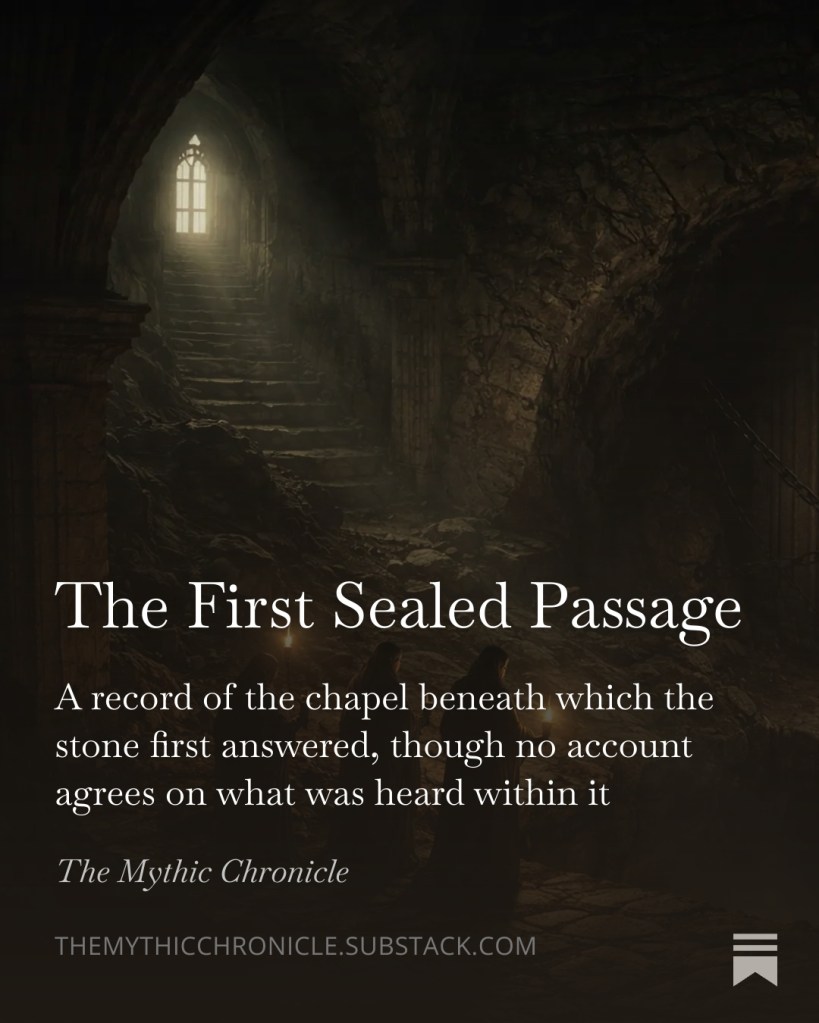
Beneath a chapel floor, where candle smoke thins into colder air and stone remembers hands long gone, a sealed passage waits with a patience older than the living city. Few images in mythic fantasy carry such lasting force as the hidden stair, the buried foundation, the chamber whose purpose has slipped from surviving record. A sealed passage suggests more than secrecy. It suggests pressure, memory, and a world whose deepest truths lie beneath the places people still pray, trade, grieve, and sleep.
This is part of the reason ancient fantasy worlds remain so compelling. Their streets rest upon previous ages. Their halls stand over ruins. Their shrines inherit ground whose first name has fallen away. When a stair is uncovered under a chapel, the discovery opens more than a route through stone. It opens a relationship between the visible city and the older city pressed below it, where sacred use, forgotten labour, failed warding, and buried fear have settled together through time.
Chronicle One of The Mythic Chronicle, The First Sealed Passage, enters exactly that kind of place. Its power comes through restraint. The stone gives little. The record gives less. Yet the pressure within the scene gathers around every mark in the wall, every held murmur, every decision to close a passage whose closure feels uncertain even as it is recorded. That quiet weight forms the true spell of the sealed passage in mythic fantasy.
Why Sealed Passages Hold Such Power
A ruin in open air offers scale. A sealed passage offers trespass. The body feels the narrowing stair, the failing light, the change in air against the chest. Mythic fantasy thrives on such thresholds because they pull fear inward. The reader moves from landscape into enclosure, from history seen at a distance into history felt against skin and breath. Every surface begins to matter. A scratch in plaster, a gap in a register, a scent that lingers too long in stillness, each one carries force because the space around it has already been chosen for concealment.
That act of sealing matters deeply. A buried chamber may carry age, mystery, and sacred unease, yet the moment a passage has been closed by human hands, the place gains moral weight as well as atmospheric weight. Someone made a judgement. Someone chose stone, mortar, labour, and silence. In mythic fantasy, that human decision often carries more dread than any creature glimpsed in darkness, since it implies contact has already happened and memory has already failed. The wall stands as both barrier and confession.
This is where The First Sealed Passage proves so effective. The Chronicle never hurries toward spectacle. It lingers with lantern light on worn steps, with the pressure inside the stair, with the sense that sound has settled into the stone itself. Through that restraint, the passage gathers authority. The world feels old enough to have forgotten its own foundations, and human enough to keep recording stability long after certainty has weakened.
Buried Foundations and the Memory of Stone
Old cities in fantasy carry emotional force when their foundations feel layered, used, and inherited. A living district gains depth when its chapel, market, bath, tavern, or hall stands upon earlier structures whose names have faded from common speech. The ground beneath daily life becomes an archive. Stone ceases to be scenery and becomes memory given form. A stair beneath a chapel therefore carries two pressures at once: the sacred authority of the present structure and the unresolved claim of whatever came before it.
That layered architecture gives mythic fantasy its deepest atmosphere. The visible city offers order, ritual, trade, law, and custom. The buried city below offers fracture, erasure, repetition, and unfinished return. When writers bring those two cities into contact, the result feels richer than a simple haunted corridor. The setting itself begins to behave like a wounded record. Gaps appear. Marginal voices survive. Official language remains calm while the physical world suggests a stranger truth.
The chapel beneath Saint Veyne works through exactly that tension. The stair descends into a foundation whose origin has slipped from the surviving register, while the later record still tries to name the structure stable. That single contrast carries much of the Chronicle’s force. Stability is written above. Unease gathers below. Between those two layers lies the old fascination of buried foundations in fantasy literature: the sense that a city may continue functioning while its deeper stone has already begun to answer to some older pressure.
Sound becomes especially powerful in such places. A seen figure can be measured, pursued, perhaps even named. A sound held within stone resists that comfort. It belongs to structure, to weight, to enclosure, to matter that should remain still. Once a murmur seems fused to foundation, fear spreads through every block and seam around it. The threat no longer waits at the far end of the tunnel. It inhabits the tunnel itself, and by extension the city resting above it.
The First Sealed Passage and the Reading Experience of The Mythic Chronicle
The Mythic Chronicle carries a distinctive kind of fantasy authority because its entries feel preserved and lived. The reading experience resembles the handling of a surviving fragment: a record, a register, a corrected folio, a later note in the margin, a surface account whose omissions carry as much force as the lines left intact. That method suits the sealed passage perfectly, since the theme itself concerns partial knowledge, uncertain closure, and the long survival of things buried without full understanding.
In The First Sealed Passage, the reader enters through place before explanation arrives. A chapel, a stair, a mason, a brother of the order, the faint sweetness in the air, the wall drawn across the lower way, all of it gathers with measured patience. Then the Chronicle widens into register, archive, interpretation, and continuation. The effect is quietly cumulative. Instead of offering a single scene and stepping away, it allows the passage to echo through several forms of record, each one carrying its own degree of confidence and fracture.
That structure makes Chronicle One an ideal threshold into the wider Whispering Foundations cycle. The series concerns the buried layers beneath the city and the way corruption begins, spreads, and is misunderstood through broken accounts. Chronicle One establishes that governing pressure with admirable clarity. The deeper stone answers. The official record steadies itself. The gap between those two gestures becomes the space in which the wider cycle lives.
For readers who wish to enter the preserved opening itself, the first fragment rests here:
A Chronicle entry such as this one gains further weight through the sense that other records survive elsewhere, half adjacent and half concealed. The sealed passage beneath the chapel feels complete as an individual fragment, yet it also carries the impression of a wider disturbance moving through the city’s lower structures, through walls, cellars, chambers, and misread deaths. That widening pressure gives the blog reader a natural route onward, since curiosity grows from atmosphere already established, without any abrupt invitation.
This is where the movement from Chronicle to novella becomes especially effective. The Chronicle preserves distance, symbolic weight, and partial record. The novella draws nearer to consequence, human contact, and the cost of ignoring what older places continue to hold. One form gives the mythic contour of the world. The other gives the lived encounter within it. Together they create the feeling of an archive whose surviving pieces speak across different depths of time and witness.
Placed beside Chronicle One, the novella link feels less like a sales gesture and more like a second folio brought carefully from the shelf. The reader follows the pressure from chapel stone toward the lower district, from early disturbance toward later consequence, from the moment a passage is found and sealed toward the wider pattern that seal was meant to contain. That movement honours the oldest pleasure of mythic fantasy, which lies in the sense that every surviving fragment opens onto a larger darkness holding its own order.
Why Ancient-Seeming Fantasy Worlds Continue to Linger
Readers return again and again to ancient-seeming fantasy because such worlds allow memory to remain physically present. History lives in masonry, scent, ritual, crack lines, worn thresholds, reused foundations, and names half preserved within damaged records. The past has texture there. It can be climbed, touched, uncovered, sealed again, and still felt pressing upward through the present. That intimacy gives mythic fantasy a form of gravity few other modes of storytelling can sustain.
A sealed passage expresses that gravity with unusual purity. It is at once threshold and refusal, answer and erasure, architecture and omen. It promises a world larger than the immediate scene, while also reminding the reader that access always carries cost. Once the wall is opened, even briefly, the city above can never feel entirely simple again. Every chapel floor, every cellar, every quiet district street begins to imply a second life below its visible order.
That is the lasting achievement of The First Sealed Passage. It does far more than offer a mysterious stair. It restores the oldest fantasy intuition that the world beneath the world remains active, patient, and deeply woven into the lives of those who move above it with incomplete records in hand. Through calm language, fragmentary authority, and the pressure of older stone, the Chronicle turns buried architecture into a form of memory that continues speaking even when the record insists upon silence.
The passage beneath Saint Veyne remains sealed, the register remains composed, and the city above keeps its rhythm. Yet some places hold their earlier claim with great patience, and every archive worthy of return leaves one feeling that the truest movement has only just begun, somewhere below the point where the lantern light gives way.