The first pressure is rarely announced as war
Modern war does not always arrive first as fire on the skyline. Sometimes it arrives as a changed route, a delayed convoy, a guarded gate, a school rumour, a longer queue at a port, or a government phrase that no longer has enough strength to hold the truth inside it.
In grounded modern war fiction, Britain is rarely most interesting when it is already burning. The deeper tension begins earlier, when ordinary systems keep moving while the meaning beneath them changes. A freight yard still opens. A school still takes registration. A minister still speaks of restraint. A soldier still loads crates under rain. A family still eats at the kitchen table while the television softens danger into careful language. Nothing has fully broken yet, and that is what makes the atmosphere more frightening.
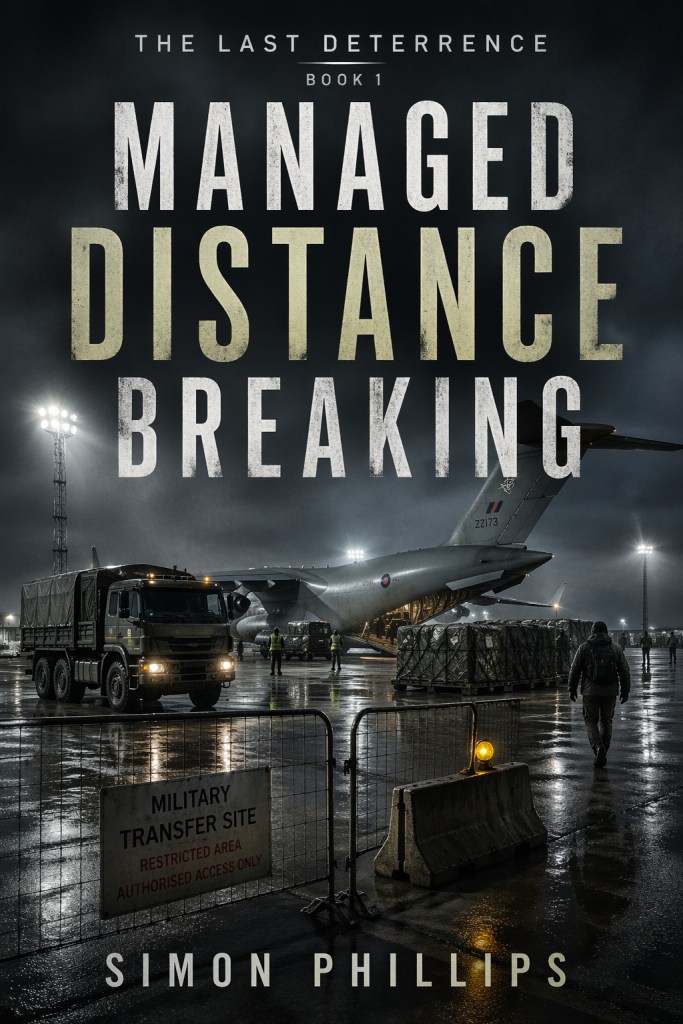
This is the world entered by Managed Distance Breaking, the opening novella of The Last Deterrence. It is a British war fiction novella about the stage before open war becomes undeniable, when NATO crisis fiction is still able to wear the clothes of policy, logistics, reassurance, and routine. The conflict remains officially elsewhere, yet every practical detail begins to suggest that distance has already failed.
Public calm and private movement
A country under pressure often speaks in layers. There is the public language, made for kitchens and news bulletins. There is the private language, spoken in offices, briefing rooms, depots, and command spaces. Then there is what is actually happening on the ground, where phrases such as support, preparedness, resilience, and restraint have to become fuel, medical crates, aircraft dispersal, armed guards, road priority, and exhausted people making bad systems work for one more night.
That gap matters. It is where political military fiction about Britain can become more than speeches and strategy. The real strain appears when government language tries to remain calm while the physical country beneath it is already changing shape.
In Managed Distance Breaking, the pressure does not come from spectacle. It comes from the slow recognition that support is no longer cleanly separate from participation. Aid to Ukraine and Europe is not abstract. It has to move through ports, road networks, military bases, freight yards, rail options, and civilian workers whose own lives are already stretched. Once those routes matter, they can be delayed, overloaded, watched, probed, and struck.
Modern war punishes movement. It punishes concentration. It punishes visible preparation. That is why infrastructure becomes as important as the battlefield. A port is not just a port. A rail spur is not just a rail spur. A fuel compound, a logistics site, a transfer yard, a guarded airfield, and a civilian freight lane all become part of the pressure map.
The public may still hear that Britain is steady. The people moving the weight know something has altered.
The family as a national pressure system
War fiction often widens too quickly. It reaches for maps, briefings, fronts, and declarations before the reader has felt what national danger does to a household. Yet the domestic line is where public truth is tested first. A family hears the softened words, sees the altered routines, and learns to read the spaces between them.
A school teacher notices the way pupils bring adult fear into the classroom as jokes, rumours, and half-understood politics. A daughter near government hears how phrases are shaped before they reach the public. A soldier sees how support becomes physical labour before anyone admits it has become military exposure. Another family member at a port sees the same pressure through containers, shift overruns, and freight chaos. A younger child feels it through cancelled buses, strange adult silences, and the slow loss of ordinary certainty.
That is what gives a modern war novella series its human spine. The war is not simply out there. It is distributed through family life. It reaches one person as a briefing, another as a queue, another as a route order, another as a classroom question, another as a message that arrives too late or says too little.
The Mercer family at the centre of The Last Deterrence carries that split. Leah, Helen, and Daniel do not experience the same truth at the same time. They cannot. One is close to government language. One is surrounded by civilian consequence. One is inside military movement. The emotional power comes from the fact that all three are right in partial ways, and all three are denied the whole shape of what is happening.
That separation is essential to grounded world war escalation fiction. When every character knows everything too early, tension collapses into explanation. When knowledge is uneven, the world feels larger, colder, and more believable.
Logistics as the hidden battlefield
The glamour version of war ignores logistics until it needs a dramatic convoy. A more serious war novel about modern technology has to understand that movement itself becomes a target. Drones, missiles, surveillance, digital systems, damaged roads, exposed depots, and stretched civilian infrastructure all make the act of moving material dangerous.
Before a soldier fires a shot, somebody has to load, route, fuel, guard, sign, scan, delay, unload, and reload. Somebody has to decide which civilian freight loses priority. Somebody has to explain why supermarkets, ports, buses, petrol stations, and schools are being touched by a war that the public has been told is still distant.
That is where the phrase “managed distance” begins to fail. Britain may still describe its role as support, yet support has weight. It takes up road space. It uses drivers, ships, rail slots, fuel, security, airfields, and political credibility. It creates patterns that adversaries can read. It makes domestic weakness visible.
In this kind of NATO crisis fiction, the first battlefield may be the route network. Not because roads and ports are more dramatic than soldiers, but because soldiers cannot exist apart from them. The state may speak from a lectern, yet the war moves through a gate in the rain.
NATO hesitation without caricature
A restrained political war thriller about Britain should not treat NATO hesitation as cowardice or simple incompetence. Alliance politics are slower and more strained than that. Every state has its own public, military limits, geography, stockpiles, industrial weaknesses, elections, memories, and fears. To move together, allies must translate danger into language each capital can survive.
That makes hesitation part of the drama. A government may know more than it says and still not know enough to speak plainly. It may fear panic at home as much as misreading abroad. It may need to reassure allies while avoiding a phrase that locks it into action before the military system is ready.
In Managed Distance Breaking, this strain is felt through the changing relation between Germany, Britain, NATO support, and the Russia-Ukraine war. The point is not to reduce escalation to one dramatic decision. It is to show how pressure accumulates until careful language becomes too thin for the events it is meant to contain.
The most dangerous moments are not always the loudest. Sometimes they are the moments when everyone still speaks calmly because no one can afford the alternative.
Drones, signals, and the loss of a safe rear
Drone warfare fiction often focuses on the machine itself: the object in the sky, the strike, the surveillance, the sudden violence. Yet the deeper unease lies in what drones do to the idea of distance. They make the rear feel watched. They turn fences, fuel points, cameras, and minor outages into signs that something hostile may already be inside the system.
A drone does not have to destroy a base to change how the base feels. A cut feed, a broken device near a fence, a temporary light failure, or a small intrusion at the wrong hour can force armed men to move differently on home soil. It changes posture. It changes sleep. It changes the meaning of a quiet night.
That is the beginning of the no-safe-rear logic. Not full collapse. Not spectacle. A subtler and more frightening transition: ordinary military space becomes alert space, then guarded space, then exposed space. The country has not yet admitted it is in the war, yet parts of it are already behaving as though the war has found them.
Why the first book begins before the explosion
There is a temptation in world war escalation fiction to hurry. To reach the declaration, the strike, the invasion, the nuclear threshold, the ruined city. Yet escalation only has force when the reader understands what has been lost before the obvious loss begins.
Managed Distance Breaking begins with the failure of ordinary reassurance. It lets the reader feel the country before open war has hardened it. Downing Street still speaks in careful phrases. Schools still operate. Freight still moves. Soldiers still joke while hauling loads. Families still argue about buses, food, work, and whether anyone is saying the whole truth.
That matters because later destruction needs memory. Places must feel inhabited before they are damaged. Systems must feel functional before they fail. Relationships must have humour, irritation, habit, and warmth before fear begins to alter them.
The novella’s pressure lies in recognising that the state, the family, and the military are all moving at different speeds towards the same conclusion. The public is told that things are manageable. The people closest to the machinery can feel that manageability thinning. The soldier sees the change first in orders, routes, load sheets, and posture rather than in speeches.
This is why the book does not need to shout. Its unease comes from delay, repetition, wet roads, freight lanes, official rooms, and the growing suspicion that every ordinary process has acquired a second meaning.
The road towards the nuclear threshold
The Last Deterrence is not only about the opening phase of war. Its wider world points towards darker territory: open European war, global overload, nuclear threshold fiction, and eventually post-nuclear survival fiction in Britain. Yet the early books matter because the final threshold must never feel like a shortcut.
Nuclear fear becomes hollow when it appears too early as spectacle. It becomes credible when it emerges from accumulated failure: conventional war that cannot decide anything cleanly, alliances under intolerable strain, infrastructure exposed, command confidence damaged, public truth corroded, and leaders forced to make decisions under shrinking time and worsening information.
That road begins with smaller failures. A phrase that no longer holds. A logistics system that cannot stretch further. A family that stops believing reassurance. A soldier recalled from one kind of work into another. A government discovering that calm has become expensive.
The aftermath, when it comes, must also grow from this same world. Not wasteland fantasy. Not instant lawlessness. A half-surviving Britain would still have queues, notices, local councils, ration points, military remnants, missing-person lists, exhausted teachers, damaged ports, guarded depots, and people arguing over who has the right to give orders. The horror would not be emptiness. It would be uneven survival.
Entering Britain before it understands itself
The strength of grounded modern war fiction lies in what it refuses to simplify. War is not only battle. Politics is not only speeches. Family life is not only worry. Military service is not only action. Each becomes part of the same strained system, and the pressure moves through all of it.
Managed Distance Breaking enters Britain at the point where the old distinction between elsewhere and here begins to fail. It does not ask the reader to admire war. It asks them to feel how a country starts changing before it has the courage, evidence, or permission to say plainly what is happening.
A road remains a road until it becomes a route.
A port remains a port until it becomes a pressure point.
A school remains a school until children start bringing the war in through rumour.
A family remains ordinary until every silence starts to mean more than it should.
A government remains calm until calm itself becomes part of the deception.
The world does not end in the opening movement. That is not the point. The more unsettling truth is that it continues. Lights stay on. Meals are made. Statements are issued. Vehicles move. People go to work. Children ask questions adults cannot answer cleanly.
The change comes first through roads, rooms, queues, gates, silences, and delays.
Understanding follows later.
Discover more from Simon J. Phillips
Subscribe to get the latest posts sent to your email.
