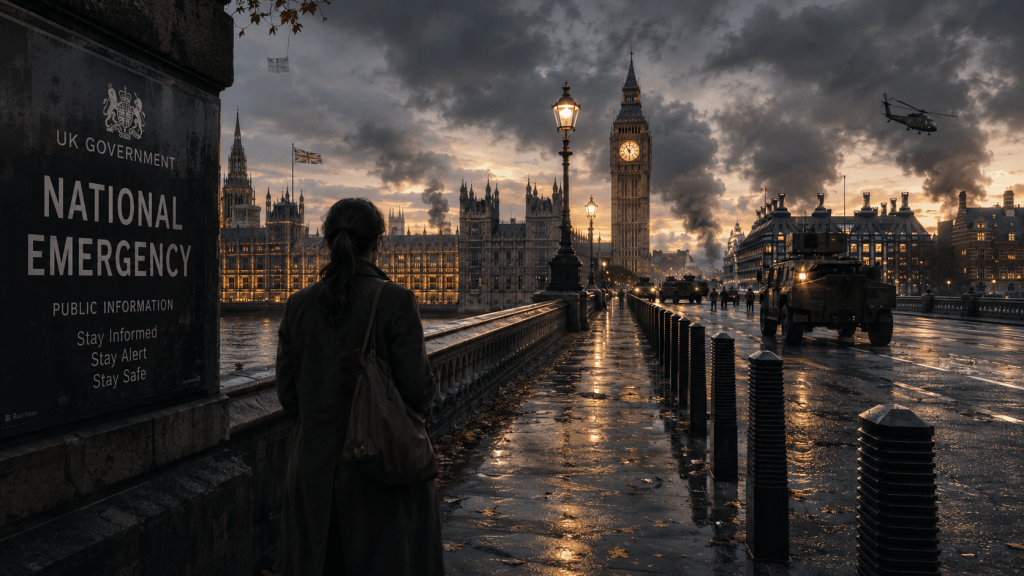
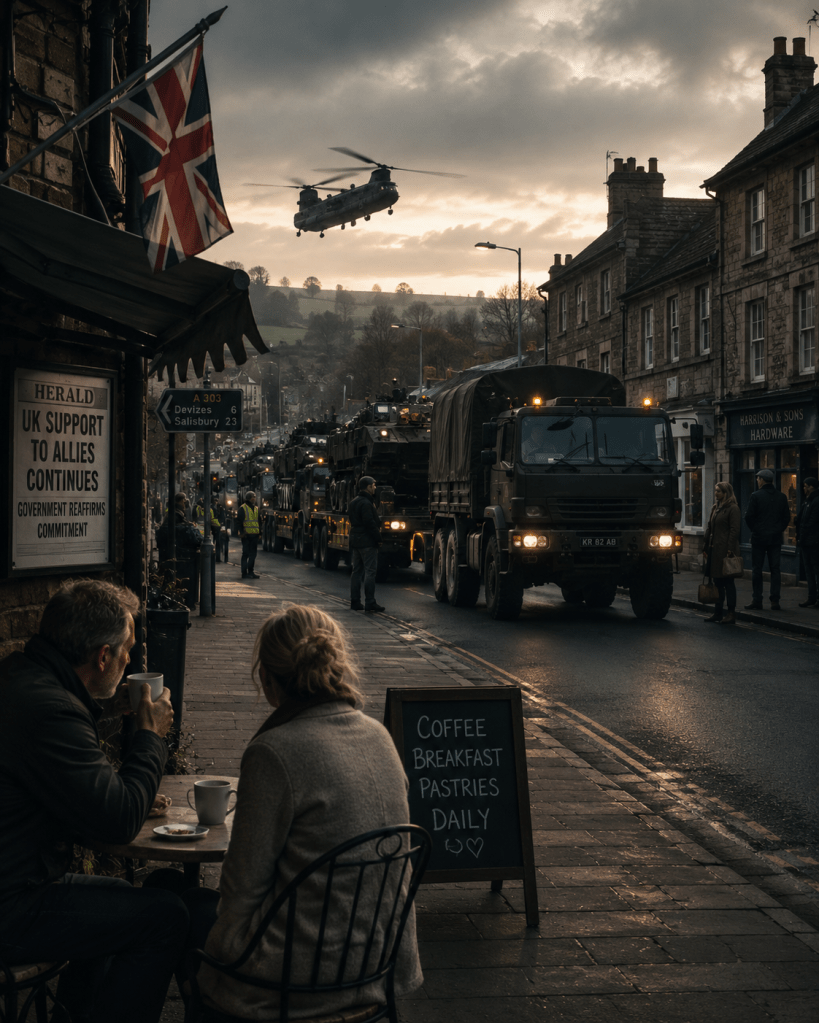
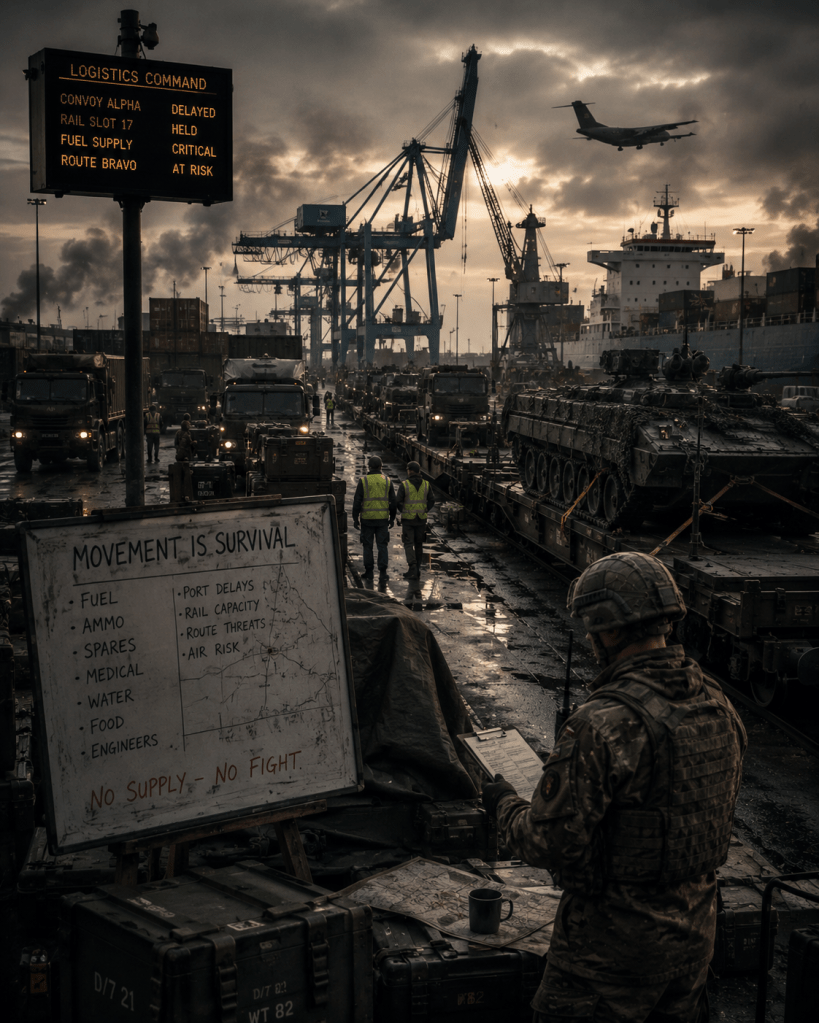
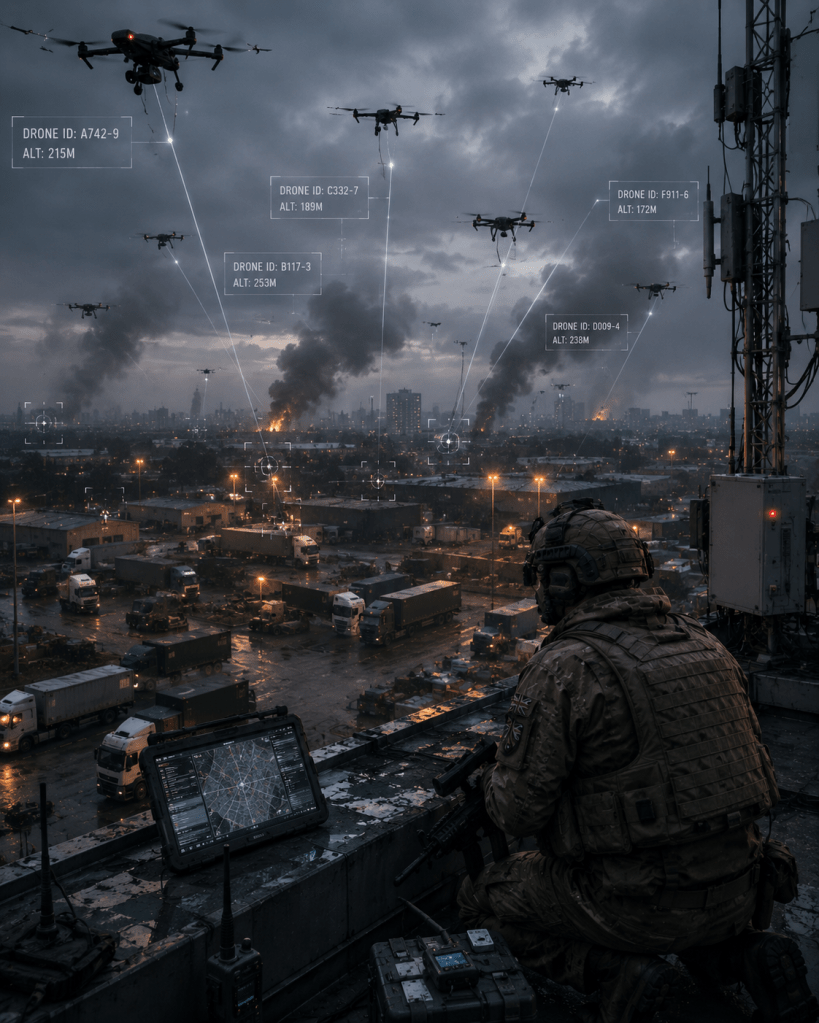
While ministers prepared to assure the country that Britain’s transport systems remained resilient, the figures beneath the statement showed a network already surviving by moving ordinary life aside.
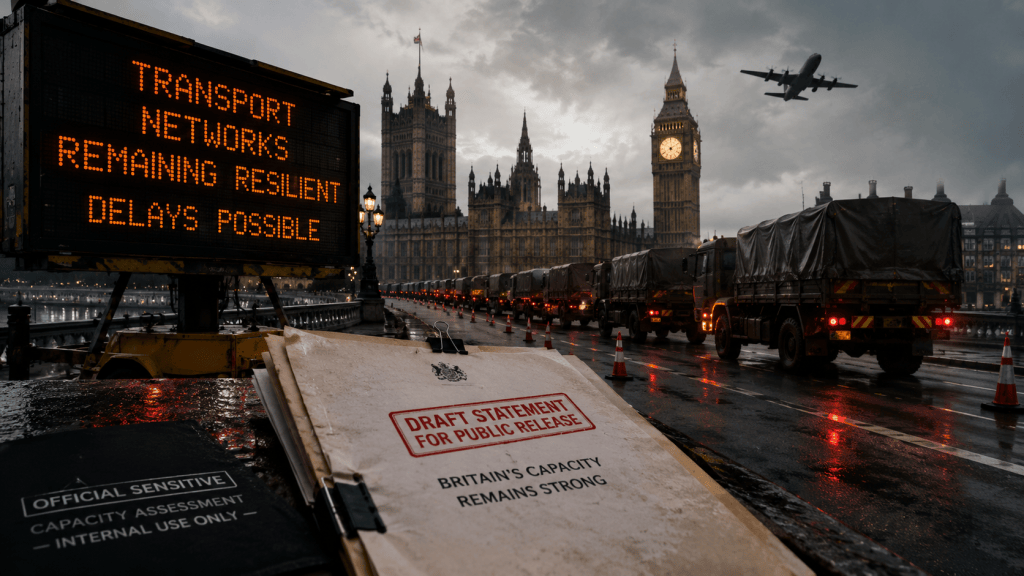
The Sentence That Held
By seven that morning, the public statement had passed through four versions, cleaner than the figures behind it and shaped to sound steadier than the room that produced it.
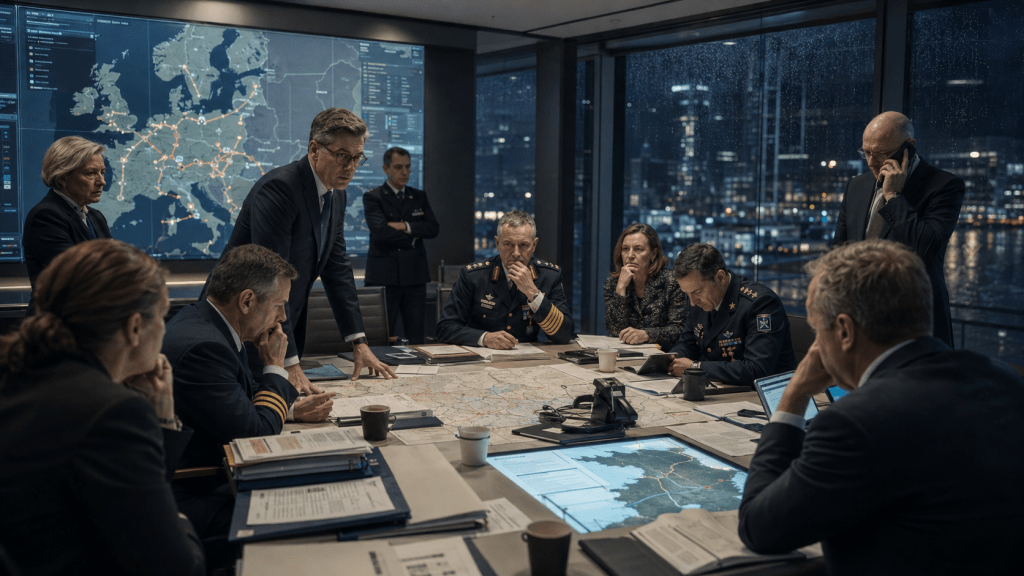
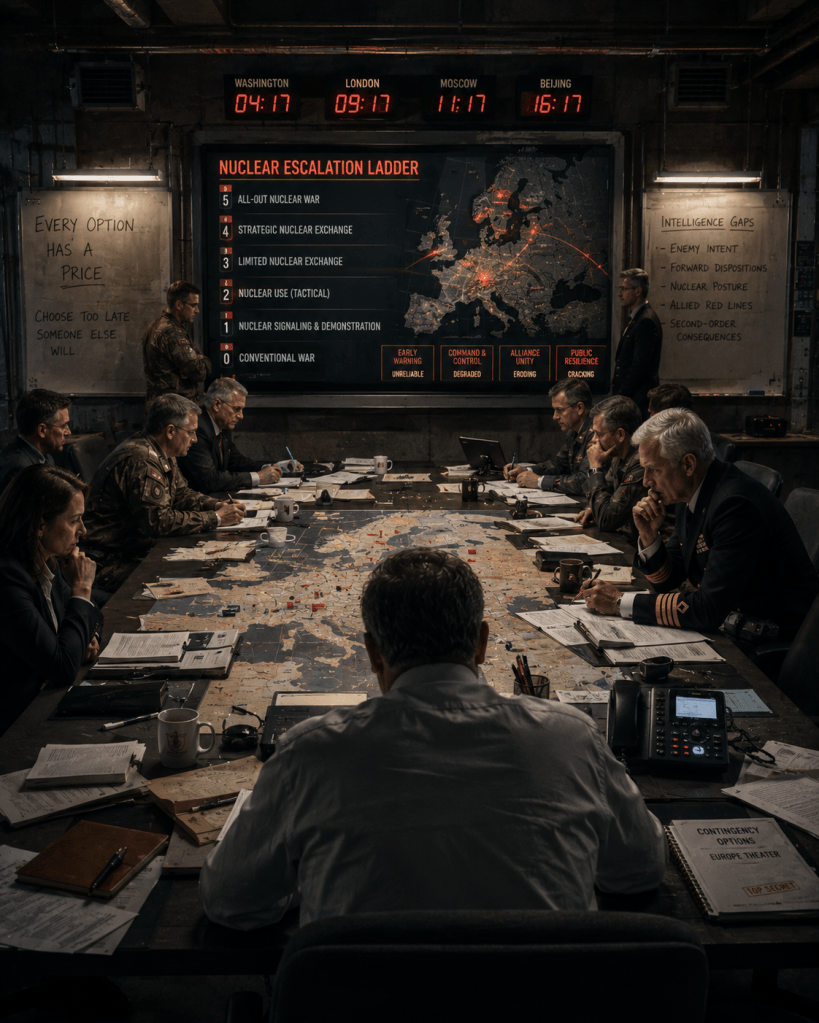
Rain pressed against the high windows of the Cabinet Office briefing room and ran down the glass in wavering lines, turning Whitehall into grey stone, blue lights, umbrellas, and the pale glow of phone screens held beneath coat collars. The room had been used through the night, and the air had grown too warm with coffee, printer heat, damp wool, and the persistence of people who had moved beyond tiredness into the harder condition where every sentence arrived trimmed for damage. Folders lay open across the table, coloured slips marking the pages that could leave the room, while red handling strips marked the pages that could only travel by hand.
Eleanor Voss stood at the far end of the table, one hand resting on a chair and the other wrapped around a paper cup she had forgotten to drink from. She worked in government communications, in the narrow passage where facts became public lines and public lines returned as questions from broadcasters, ministers, councils, hauliers, unions, and frightened people deciding whether to fill their cars before work. Her name appeared on none of the statements once they went out.
On the wall screen, a transport-capacity dashboard refreshed every thirty seconds. Ports sat in coloured blocks. Road routes sat beside them. Rail access, driver availability, ferry slots, defence consignments, civilian dwell time, fuel pressure, and police-support demand kept shifting in small increments. The colours had started the week in green and amber, with red reserved for weather, accidents, and ports that had lost patience with optimism. Red now appeared in places that held strategic meaning once placed beside a map of Europe, though the public version would speak of increased demand and wider pressure across supply chains.
At the table, Michael Harrow from the Department for Transport turned a stapled pack sideways and slid it towards her. His tie had loosened during the night, and a small dark mark on his cuff suggested he had spilled coffee.
“The present wording says networks remain resilient,” Harrow said, drawing one finger down the top page. “That remains defensible if we define resilience by continued movement across critical routes.”
Eleanor watched a red block pulse beside the east-coast freight line, linger long enough to draw three pairs of eyes, then settle back into amber. “And if anyone defines resilience by whether ordinary movement still has room to breathe?” she asked.
Harrow drew the pack back towards himself, aligning its edge with the table. “Then we speak about temporary prioritisation and sector-specific strain.”
“Sector-specific strain means supermarket stock waits while sealed freight moves.”
Harrow glanced at the Defence adviser near the door before he answered. “It means current movement remains controlled.”
Across the table, Sana Qureshi from the Cabinet Office resilience unit opened a laptop covered in sticker residue where labels had been removed before the device entered the secure floor. She had worked through floods, power failures, fuel disruption, and one winter when half the country appeared to discover logistics at the same time.
“We have regional calls inside twenty minutes,” Sana said, turning the laptop so the screen caught Eleanor’s eye. “Lincolnshire wants clarity on route holds. Kent wants an answer on civilian traffic displacement near the port approaches. The east-coast operators want someone to admit Defence priority has changed the shape of the queue.”
“They will receive careful language,” Harrow said, tapping his pencil once against the page.
Sana looked up from the laptop. “They already have sharper language. They invented it while waiting for ours.”
The room received that with a silence Eleanor recognised, the kind that followed an accurate statement made too early for the hierarchy to absorb. Outside the door, a trolley moved along the corridor, and the uneven rhythm of its front wheel carried through the wood before fading near the lift. Eleanor pictured fresh printed packs, red handling strips, and folders travelling by hand because secure systems were being kept for heavier traffic.
A junior press officer named Daniel Rees sat near the wall with his sleeves rolled above his wrists and three phones arranged in front of him like evidence. He lifted one of the phones, listened for a few seconds, then covered the microphone with his palm.
“Number Ten want a smoother top line before eight,” Daniel said, keeping his voice low as though the phone might carry the room back to its owner. “They dislike manageable.”
Eleanor lowered her cup. “Which part?”
Daniel listened again, his eyes moving across the faces around the table. “The whole word.”
Harrow gave a small, humourless laugh and pressed his fingers against the bridge of his nose. “That is unfortunate. Manageable is doing most of the work.”
Daniel nodded at someone none of them could hear. “They prefer functioning.”
Sana turned the laptop further so Harrow could see the regional summary. “Functioning suggests things are still moving, which is true only because capacity is being taken from somewhere else.”
The summary showed postponed civilian container release, road-haulage shortages, delayed retail loads, pharmacy logistics adjustments, and school-transport knock-on effects from morning diversions around route-control points. The evidence had arrived as timings, lane closures, missed slots, depot holds, driver hours, and ordinary tasks shifted half a day sideways so priority movement could pass through.
Eleanor thought of how it would sound once it reached a kitchen radio. Transport systems remain resilient. Existing commitments remain manageable. Essential goods continue to move. The sentences would be true in the way official sentences were often true, with their feet placed carefully around the softer ground. They would leave out the people already standing at pharmacy counters, depot gates, school stops, and freight windows, learning that ordinary movement had become the part of the system asked to wait.
The door opened, and Tom Merrick entered with rain still on his coat and an adviser from Defence behind him. Merrick worked political handling alongside transport pressure, although lately the distinction had thinned until every problem arrived wearing both badges. He placed a marked page in front of Eleanor and tapped the top paragraph.
“Prime Minister can say this at lobby if pressed,” Merrick said, pulling off his wet coat. “We need it clean, firm, and dull enough to avoid becoming a headline.”
Eleanor read the paragraph once, then again. The United Kingdom’s transport and freight networks continue to function effectively under increased demand. Existing support commitments remain within current capacity. Departments continue to work with operators, local partners, and industry to ensure essential movement is protected.
The line sat there in black print, polished and bloodless. It made the country sound like a machine that had absorbed extra pressure through design. The dashboard behind Merrick told a harsher story, one of improvised holds, narrowed margins, police calls, contractor fatigue, military-linked consignments arriving ahead of expectation, and port supervisors using language with more honesty than anyone in the room could afford to place into a public statement.
“Existing support commitments remain within current capacity,” Eleanor said, keeping her eyes on the page.
Merrick watched her from beside the table. “Can we defend it?”
Harrow answered with professional caution, his hand already moving towards the capacity pack. “At national level, across current reporting intervals, it remains arguable.”
Sana closed her laptop a little, leaving the screen light pressed against her face. “Arguable is a courtroom word trying to pass as public confidence.”
Merrick looked at Eleanor because Harrow had supplied a technical answer and Sana had supplied the one the room preferred to avoid. “Can we say it?”
Eleanor looked again at the dashboard. The east-coast route blinked red, held there for a second longer than before, then returned to amber. Somewhere beyond the building, freight was being delayed in the name of movement, and movement was being protected in the name of support, and support was beginning to resemble something nobody had yet been given permission to call by a heavier name.
“We can say it,” Eleanor said, setting the page down with care.
Daniel started typing at once, his thumbs moving fast over one phone while a second lit beside him. Harrow began reciting figures to the Defence adviser. Sana reopened the regional summary and marked three lines in yellow. Merrick stood over Eleanor’s shoulder, shaping risk into phrases that might hold until lunchtime if the world behaved generously. The rain darkened the windows until the room seemed lit from inside its own fatigue.
On the screen, a fresh warning appeared beneath the dashboard, small enough for the room to miss unless someone was already watching.
Eastern corridor capacity dependent on continued priority sequencing.
Eleanor read it twice before the message vanished into the next refresh. Then she picked up her pen and changed one word in the statement, replacing planned with current, because a tiny place for honesty still survived inside a sentence already chosen.
A Visual Chronicle
Official confidence held on the public screen while Britain’s roads, ports and ordinary deliveries absorbed the strain the statement had been written to conceal.
Cabinet Office Handling Note
Extract from Cabinet Office Press and Resilience Coordination Note
Subject: Transport Capacity Line
Time: 07:42
Circulation: Restricted internal handling group
Purpose
To support ministerial and departmental handling of anticipated media questions concerning freight movement, east-coast port pressure, route prioritisation, and wider transport resilience following increased demand across allied support corridors.
Approved Public Position
The United Kingdom’s transport and freight networks continued to function effectively under increased demand. Existing support commitments remained within current capacity. Departments continued to work with operators, local partners, and industry to ensure essential movement was protected.
Suggested Response if Pressed
Officials were monitoring regional movement closely. Some localised delays had occurred where demand, weather, port sequencing, and wider European pressure converged. These pressures were being managed through established resilience arrangements, industry coordination, and targeted support for affected operators.
The Government remained focused on maintaining the movement of essential goods, supporting allies, and limiting disruption for households and businesses.
Lines to Avoid
Avoid language implying defence movement had displaced civilian supply.
Avoid speculation on route protection measures.
Avoid confirming priority categories for sealed consignments.
Avoid linking domestic delays directly to overseas military activity.
Avoid any formulation suggesting exhaustion of capacity.
Internal Assessment
Current national capacity remained viable under priority sequencing. Continued viability depended upon sustained operator cooperation, police-route availability, port slot discipline, and regional tolerance for civilian delay.
The eastern corridor carried increased sensitivity due to the concentration of freight holds, allied-support consignments, road-haulage pressure, and public visibility around delayed civilian loads. Messaging should therefore maintain confidence while allowing for local variation in delivery experience.
Where challenged on contradiction between public reassurance and visible disruption, ministers should emphasise that resilience meant continued function under pressure, supported by active coordination across government and industry.
Operational Note
Further deterioration in driver availability, fuel access, police support, or port dwell time may require revised language before the midday lobby briefing.
About the Creator
The Modern Chronicle is written and curated by Simon Phillips, an author of modern speculative fiction and contemporary crisis-driven storytelling who explores the point where ordinary life begins to tighten beneath political strain, military movement, institutional caution, and the public language used to keep dangerous realities at a distance.
Many of the records presented in these Chronicles sit alongside Simon’s wider modern-war novella series, where governments, soldiers, families, and civilian systems are forced to absorb a world changing faster than its official explanations. The stories remain grounded in recognisable places: ports, school corridors, freight yards, government rooms, roadside queues, transfer sites, and homes where the news has started to feel too close.
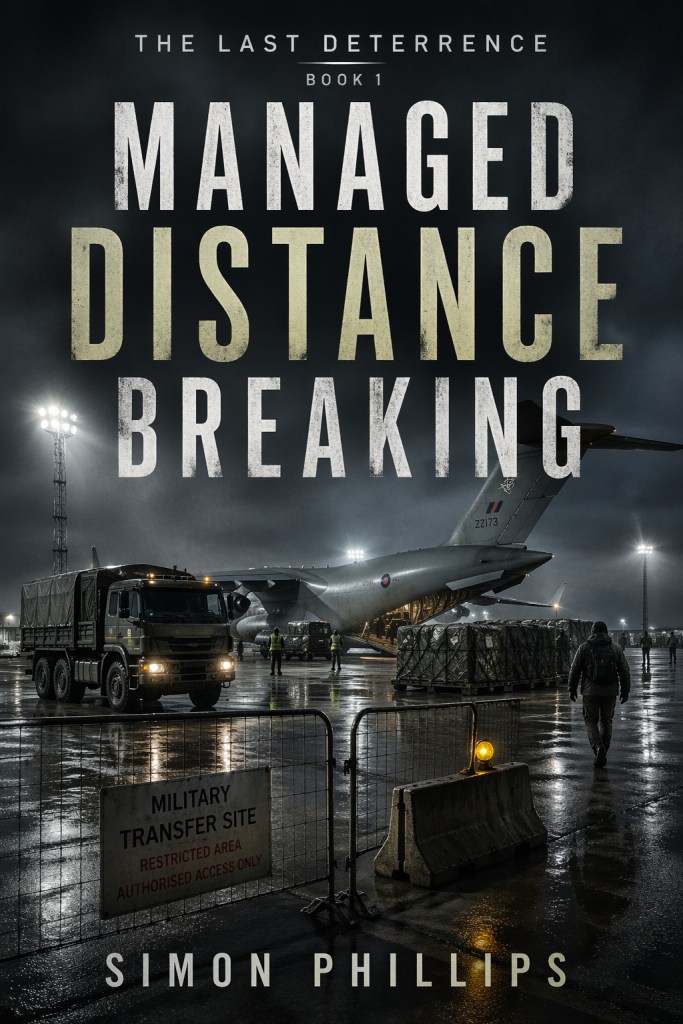
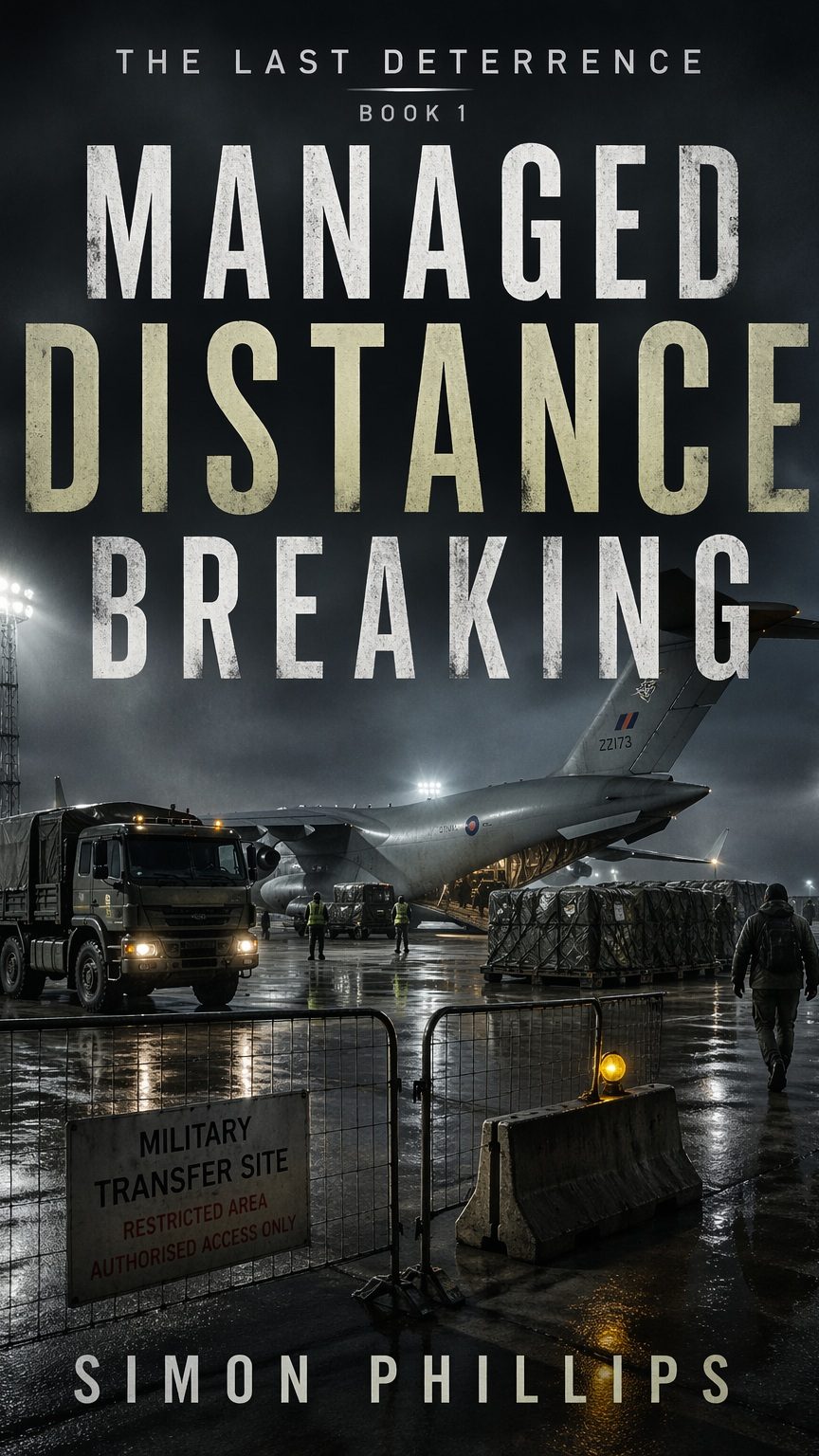
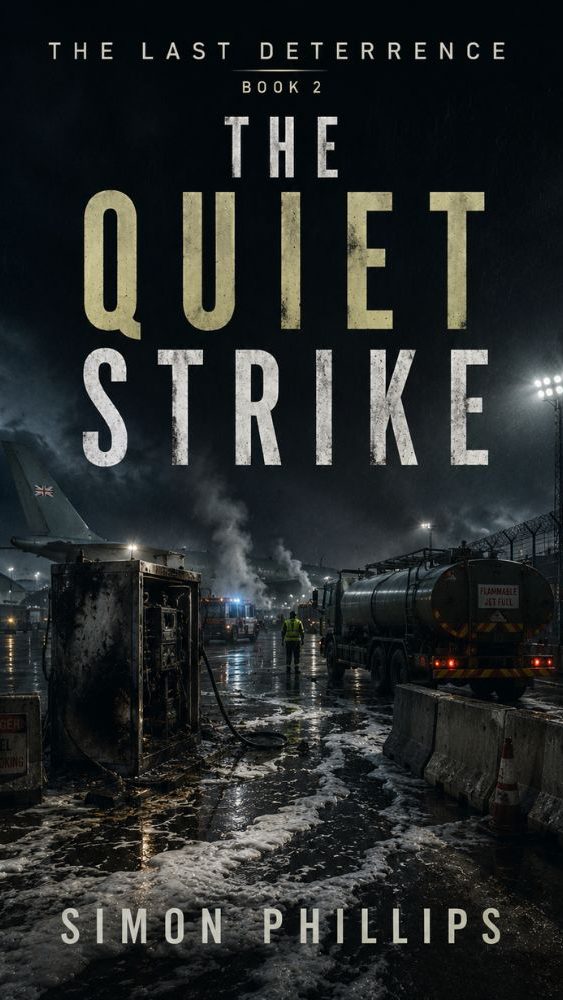
One such world unfolds through The Last Deterrence, a modern-war novella sequence beginning with Managed Distance Breaking and continuing in The Quiet Strike. Together, the first two books follow Britain as support language begins to fracture under freight pressure, European escalation, domestic infrastructure strain, and the growing sense that distance from war has already begun to fail.
Readers who wish to explore the wider published story world connected to this Chronicle can find the books below.
Explore the books:
The Last Deterrence: Managed Distance Breaking
The Last Deterrence: The Quiet Strike
You can watch his YouTube channel here:
Author Simon Phillips
Continuing the Chronicle
The following Chronicle reconstructs the hours after the capacity statement left Whitehall, as transport officials, regional operators, and local services began living with the difference between a network described as resilient and a system already surviving through postponed civilian movement.
Readers supporting The Modern Chronicle can continue the record below.
The Corridor That Still Functioned
By mid-morning, the statement had left the secure floor and entered the country by quieter routes, passing into newsroom desks, local authority inboxes, haulage groups, regional rooms, port operators, school offices, pharmacy distributors, and the phones of people whose work depended on knowing which delay had been given an official name.
On the government website, the wording sat beneath a freight terminal photograph from a calmer year when stacked containers still looked like trade and confidence instead of time held in metal boxes. Transport and freight networks continued to function effectively under increased demand. Existing support commitments remained within current capacity. Departments continued to work with operators, local partners, and industry to ensure essential movement was protected.
Eleanor Voss heard the first broadcast reading of it in the communications room beside the Cabinet Office, where a television stood on mute above a row of desks and the audio came through a small speaker connected to the media-monitoring feed. The presenter read the line with official warmth, then moved into questions about port delays, petrol prices, and pressure on the eastbound freight corridor. The word corridor had survived into public speech by accident, or through a source somewhere, and once the presenter said it aloud Eleanor felt several people in the room look up from their screens.
Daniel Rees stood by the printer with one hand holding a sheet still warm from the tray. “Sky have corridor,” he said, lowering the page as the speaker carried the next question into the room.
Tom Merrick turned from the desk where he had been marking a fresh response grid. “Who gave them that?”
Daniel glanced down at his phone before answering. “Could be hauliers. Could be port operators. Could be anyone who spent last night watching sealed consignments move ahead of their own slots.”
Merrick rubbed the corner of one eye with his thumb and reached for the phone nearest him. “Get me the transport press office.”
Eleanor stayed where she was, listening as the presenter brought in a freight analyst who spoke over a map of the east coast with care around every line he drew. He spoke of dwell time, ferry slots, pharmacy distribution, driver hours, and official confidence that meant movement still existed, even as ordinary users lost room.
Across the room, Sana Qureshi’s laptop chimed with the regional call opening. She pulled on her headset and lowered her voice until it merged with the hum of printers and phone alerts. “Cabinet Office resilience joining. Lincolnshire, go ahead.”
Eleanor moved closer. Sana had arranged the call into columns: police support, road holds, port approaches, agricultural distribution, medicine, schools, public line. The first local authority speaker sounded as if he had been awake since before dawn and disliked every part of the morning.
“We have tractors backed near the bypass because the southbound lane hold ran over,” the man said through a faint crackle. “School transport took the diversion behind it. Parents saw police units at the roundabout and started ringing headteachers before anyone rang us.”
Sana held her pen above the first column. “Was the route hold linked to priority movement?”
The man gave a dry little laugh that carried more anger than humour. “You know the answer I can place into minutes, and I know the answer your room can hear.”
Eleanor looked at the screen. The government statement sat open in a second window, pristine and usable. The call beside it carried roads, tractors, school buses, and parents hearing danger in police cars placed where routine traffic used to be.
Sana pressed two fingers against the bridge of her nose, then leaned closer to the microphone. “For the record, we need localised traffic management associated with essential freight continuity.”
“For the record,” the man replied, his voice flattening, “we had a roundabout held for forty-one minutes so marked vehicles could pass through a route everyone in town has now noticed.”
Merrick glanced over from his desk. “Sana.”
Sana lifted one hand without turning towards him. “Understood. We will log regional visibility concerns.”
At ten twenty-three, the east-coast port operations group joined the call. The voice came from Harriet Cale, operations director at a container terminal that had appeared on the dashboard as amber since dawn and red in every conversation that used honest language. Her connection carried background noise: reversing alarms, a distant tannoy, wind across the microphone, and the restless murmur of work made harder by waiting.
“We are holding civilian releases behind sealed consignments again,” Harriet said, raising her voice over the yard. “If that remains the instruction, we need fresh phrasing for customers before lunch. People accept delay when they believe weather caused it. They get creative when they can see priority lanes moving.”
Michael Harrow had joined the room ten minutes earlier and bent over Sana’s laptop, one palm on the back of her chair. “The instruction remains prioritisation within current capacity.”
Harriet allowed the phrase to hang for long enough that everyone in the room felt its weight. “Michael, with respect, current capacity means something else from this end of the road.”
Eleanor pictured the terminal as she had seen similar places during earlier visits: cranes against grey water, container stacks rising in lanes, drivers outside cab doors, security staff watching queues lengthen while supervisors invented calm at the speed of paperwork.
On the television, footage showed lorries standing outside a port approach beneath a colourless sky. The camera stayed far enough away to avoid registration plates, yet close enough to capture the shape of delay. A driver in a dark jacket leaned against his cab with both hands in his pockets, staring towards the gate as though he had reached the limit of what questions could do.
At the Department for Transport, two streets away, the movement desk had started separating public disruption from operational necessity with coloured markers on a laminated wall map. Each route carried its own little history of compromise: freight protection, police liaison, visible civilian delay, public explanation required within the hour.
Kiran Holt, a senior transport planner seconded from rail operations, stood before the map with a phone pressed against his shoulder. He had slept for eighty minutes in a chair beside a cabinet marked winter resilience and had woken with his watch strap pressed into his cheek.
“Tell them the slot moves by ninety minutes,” Kiran said into the phone. “No, ninety is the improved offer. The earlier offer involved no slot and a bleak conversation with someone from Defence.”
He listened, eyes on the east-coast route where three orange marks sat too close together. “I understand the refrigerated load has priority. I also understand the sealed load has greater priority. Yes, that phrase is ugly. I am already aware.”
Across from him, a younger planner named Alice Baird was updating a spreadsheet with both hands, her jaw set hard enough to alter her face.
“We’ve shifted medicine to the afternoon run,” Alice said, keeping her eyes on the spreadsheet. “The distributor says they can still make pharmacy windows if the police hold on the A-road clears before eleven.”
Kiran looked at the map. “And if it runs to eleven-thirty?”
Alice kept typing. “Then the pharmacies receive tomorrow’s apologies today.”
One of the screens above the map changed to the official government statement. The wording occupied the screen for thirty seconds before the feed switched to live footage outside a port gate. Kiran watched a reporter speak into rain with the careful brightness of someone standing in front of a queue long enough to make every official line sound smaller.
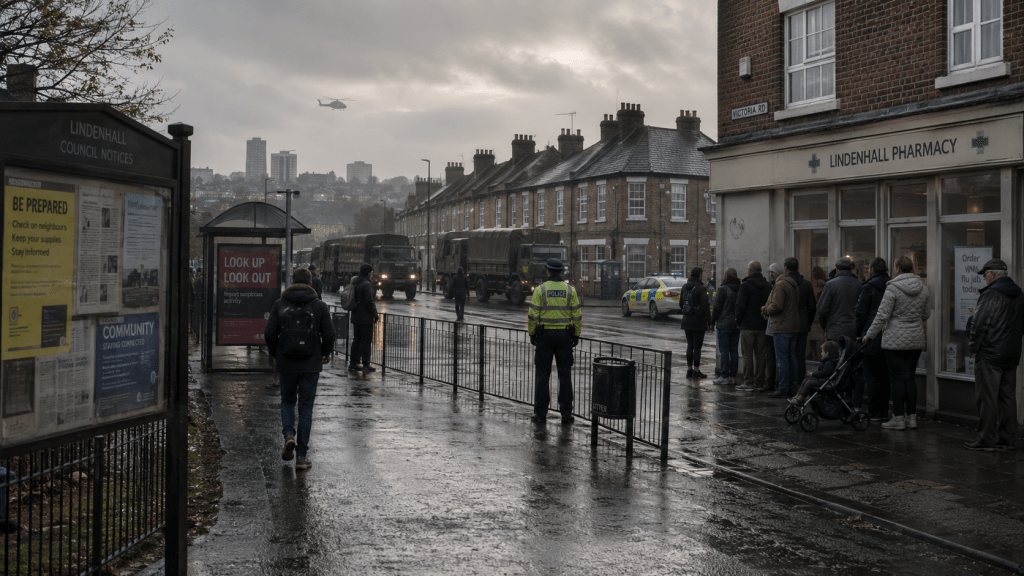
Within an hour, the line had reached a delivery depot outside Peterborough, a school office in Lincolnshire, a pharmacy distribution centre near Ipswich, and a haulage message group filled with photographs of priority lanes and blocked roundabouts.
At a service station near the A1, Greg Mason sat in the cab of a refrigerated lorry with a paper cup balanced in the holder and the government statement open on his phone. He had been carrying pharmacy stock for long enough to understand which delays mattered. His current delivery sat four hours behind, then two, then three again, because each update came with a new route note and a gentler way of saying wait.
His dispatcher rang as rain crossed the windscreen in thin streaks. “Greg, I need you to hold there another half hour,” Priya from routing said, her voice tight with too many calls. “Police are clearing movement ahead of you.”
Greg looked across the service-station forecourt, where ordinary cars queued for fuel under strip lights. “Movement,” he said, watching a military-green vehicle pass along the road beyond the station. “That’s what we’re calling it now?”
Priya exhaled through the line. “That’s what I can put on the job sheet.”
“My load has insulin on it,” Greg said, resting his hand on the steering wheel.
“I know,” Priya replied.
“Does the movement ahead of me have insulin?”
Priya stayed silent for a second, and the silence gave him the answer her job sheet could never carry.
Greg placed the cup back into the holder and watched the road. “Tell the pharmacy I am still coming.”
“I have,” Priya said, softer now. “They asked whether still means today.”
He looked at the government statement again and read the sentence about essential movement being protected. Then he locked the phone, because anger used battery, and battery had begun to feel like another item worth saving.
Back in Whitehall, Eleanor saw the first contradiction brief at eleven forty-seven. It arrived as a media handling grid, with clips down the left side and proposed responses along the right. One clip showed a minister repeating resilient with visible discipline. Another showed Harriet Cale telling local radio that capacity remained under active management. A third showed an opposition transport spokesperson near a freight gate asking whether the government had started rationing road space by stealth. The phrase was too sharp to ignore and too useful to die quickly.
Merrick placed the grid in front of Eleanor. “We need an answer for rationing road space.”
Eleanor read the phrase again. Rationing belonged to kitchens, petrol stations, supermarkets, and war memories people thought they understood through documentaries. Road space sounded technical enough for present use. Together, the phrase would travel.
Sana joined them with her headset around her neck, the foam earpads leaving red marks beneath her hairline. “Call it prioritised resilience and we invite ridicule. Call it targeted route management and councils will laugh at us.”
Harrow came over from the far desk with a fresh capacity sheet. “We can say essential movement sometimes requires temporary sequencing.”
Merrick pointed at him with the grid. “That is the first useful ugly phrase anyone has offered.”
Eleanor picked up her pen. “Then we use it sparingly.”
Daniel Rees looked up from his phones. “Number Ten wants the noon update in twelve minutes.”
The room shifted into the old rhythm: one person reading aloud, another trimming, a third testing whether the wording would sound cowardly, evasive, or accidental once a minister placed it into the air. Eleanor held the page steady and worked inside the sentence, finding places where precision could hide before the wider truth made concealment impossible.
Outside the windows, rain thinned into a pale mist that left the street shining. A police van moved through the junction below, followed by two dark official cars and a delivery cyclist whose yellow bag flared against the wet grey. London kept travelling in pieces while the eastbound line tightened beyond sight.
At noon, the revised update went out. Transport and freight networks continued to function effectively. Some local sequencing was being used to protect essential movement. Departments remained in close contact with operators and regional partners. The words were calmer than the system beneath them, and for a little while that was enough for the statement to hold.
By twelve eighteen, the dashboard refreshed again.
The eastern corridor went red and stayed there.
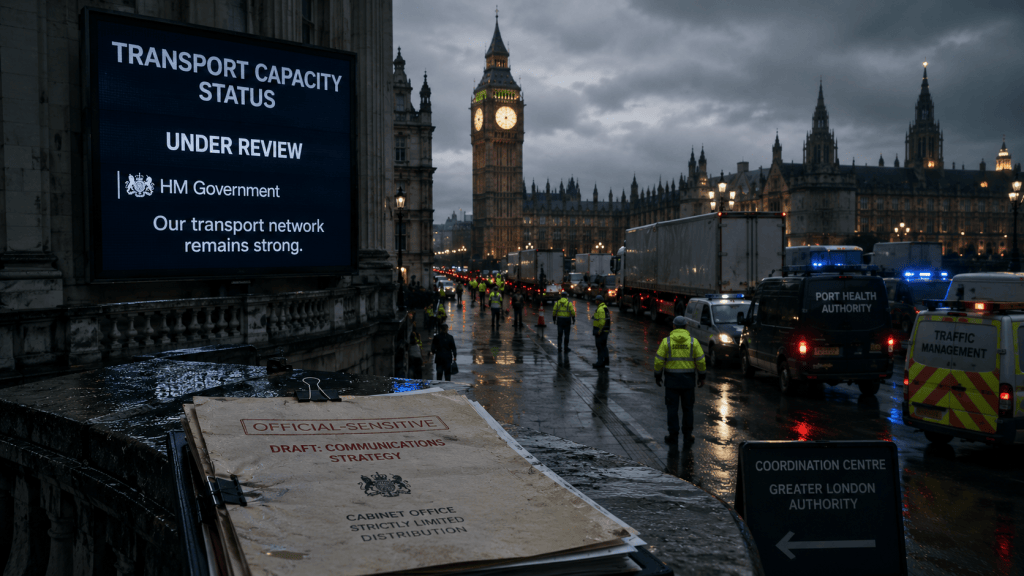
Official confidence held its place on the public screen, while the road beneath it showed the strain the statement had been written to contain.
The Idea Behind the Chronicle
Modern governments often speak of resilience as though it were a settled condition, something measured by whether roads stayed open, ports kept working, and goods continued moving through the system. In practice, resilience often depended on quieter forms of displacement. A route could remain active while ordinary deliveries waited. A port could stay open while civilian loads lost their slots. A road could serve the national interest while the people living beside it discovered that their own movement had become secondary.
This Chronicle explores the gap between public confidence and lived capacity. The statement at the centre of the record sounded calm because modern government language was designed to reduce panic, protect markets, reassure allies, and keep public behaviour manageable during strain. The systems beneath that language remained physical, crowded, and limited. They depended on drivers, police holds, ferry slots, distribution depots, local authorities, fuel access, and workers asked to absorb pressure before the country understood its shape.
The eastbound line in this series represents the place where support became material. Containers, sealed consignments, medical loads, fuel movements, and protected roads turned policy into weight, delay, and priority. The public could still be told that Britain remained at a controlled distance from the conflict, while the roads and ports had already begun behaving as though that distance had narrowed.
The Chronicle therefore treats capacity as a human pressure system. A dashboard in Whitehall showed amber and red blocks, while each block held drivers waiting past their legal hours, pharmacy stock arriving late, school buses caught behind diversions, port supervisors explaining queues, and officials searching for language that could hold for a few hours longer. The story sits inside that hidden space between a sentence that remained technically defensible and a country beginning to feel what the sentence left out.
In The Last Deterrence world, war first reached Britain through infrastructure before it arrived through declaration. It came through manifests, transport holds, drone alerts, route changes, freight prioritisation, and official phrases that stayed careful after the situation beneath them had already changed. This Chronicle belongs to that early stage, when the machinery still worked, although each successful movement required some part of ordinary life to wait.
The statement about capacity therefore became a record of transport, language, and pressure at once. It showed a nation still speaking in the language of control while the systems beneath it were already revealing the shape of participation.
From the Author’s Desk
The Eastbound Line began with the thought that modern war often reaches ordinary life through systems long before anyone speaks plainly about war itself. A port queue, a delayed medicine delivery, a police hold at a roundabout, or a careful government phrase can reveal a national shift before the larger public story has caught up with it.
This Chronicle follows that idea through the language of capacity. I wanted the record to stay close to the people who carried the pressure: officials shaping public lines, operators managing queues, planners moving delivery windows, drivers waiting beside roads, and local services absorbing decisions made far above them. The crisis remained official at one level, yet deeply personal at another.
The Last Deterrence novellas explore this same widening pressure through family, government, military service, and ordinary civilian life. The Chronicles sit beside those stories as fragments from the wider national record, showing how the same events touched people and places outside the main spine of the books.
Alongside The Modern Chronicle, I continue writing fiction across several speculative and contemporary-war projects, many of which explore how institutions, families, and communities change when public language can no longer carry private reality.
Readers interested in those stories can explore more through the links below.
You can explore my books here::
Books by Simon Phillips
You can watch my YouTube channel here:
Author Simon Phillips
Operational Notes & National Context
Capacity as a Public Measure
Transport capacity often appears in public language as a stable figure, as though a country either has enough space for movement or has reached a clear point of failure. In reality, capacity exists through sequence, timing, labour, fuel access, police availability, port discipline, and the willingness of one part of the system to wait while another moves first. A network can still function while the room inside it grows smaller.
That distinction sits at the centre of this Chronicle. The public statement said the system continued to operate, and from a narrow official view that remained defensible. Goods still moved. Ports still worked. Roads stayed open. Yet the measure of function concealed the method by which that function survived. Civilian freight lost slots, regional roads carried longer holds, pharmacies received later windows, and local services absorbed the consequences of decisions made far above them.
The pressure was therefore visible most clearly to those working inside the movement chain. A driver saw a delivery window change twice. A planner saw medicine shifted behind sealed consignments. A port operator watched priority lanes keep moving while ordinary freight waited at the gate. The dashboard in Whitehall reduced those experiences to colour, timing, and risk, while the people beneath it understood that capacity had become a question of who moved first.
Essential Movement
The phrase essential movement carries authority because it sounds practical, neutral, and difficult to challenge. It suggests that officials have identified what matters most and protected it during strain. Yet every decision to protect one form of movement also creates a shadow elsewhere. A held roundabout delays school transport. A protected freight lane changes civilian delivery times. A sealed load given priority alters the sequence of goods behind it.
This Chronicle uses essential movement as a quiet pressure point. The phrase allowed ministers and officials to speak with control while avoiding fuller description of what had begun happening across the eastbound corridor. The movement itself stayed partly hidden. Its effects spread through ordinary places: service stations, school offices, port gates, distribution boards, and local authority calls.
That form of strain belongs to the wider reality of The Eastbound Line. Britain still described its role as support, assistance, resilience, and coordination. The roads, ports, and movement rooms already carried a heavier truth. What the country called essential movement was beginning to reveal which parts of national life had become secondary.
The Language of Function
Modern crisis language often survives through careful measurement. A road remains open, even when most users have less access to it. A port remains operational, even while some loads wait far longer than expected. A delivery system remains functional, even as planners spend the morning shifting delays from one community to another. The official sentence can remain true while the lived reality beneath it changes sharply.
That is the tension behind The Statement About Capacity. The Government could say that transport networks continued to function because collapse had not arrived. The more difficult truth lay in the cost of continued function. Each successful protected movement required labour, time, route space, police support, and public patience. As those costs accumulated, the statement began to sound less like reassurance and more like a record of how much strain could still be hidden inside a calm sentence.
Across The Modern Chronicle, these details matter because they show how large events enter ordinary systems before they enter public admission. War, escalation, and participation rarely arrive as clean declarations. They appear first as altered routes, priority language, revised delivery windows, and officials choosing one word over another because the wrong sentence could reveal too much too early.
Next Chronicle
After the public statement on capacity had passed through Whitehall, the next visible change came through a freight holding site in the Midlands, where route planners, drivers, loaders, and military police began adjusting to reports from Germany that had arrived in fragments long before any settled public explanation.
Rail sequencing shifted first. Pallets were rescanned, sealed loads were moved ahead of civilian freight, and several drivers who had waited through the night were turned around with new instructions that gave them routes, times, and very little context. Workers gathered around phones showing confused footage from abroad while the yard beneath them began changing its order, one lane and one manifest at a time.
The next Chronicle follows that night inside the holding site, as the German strike reached Britain through route changes, freight holds, armed police, and the quiet recognition among those present that the support system they served had become part of something far harder to contain.
Next Chronicle: The Night Germany Entered the Yard
The statement remained on the record, calm and complete, while beyond Whitehall the eastbound line kept moving through the narrow space it had been given, carrying within its delays the first clear shape of a country already reorganising itself around a war it still described as support.