When a Station Stops Behaving Like a Station
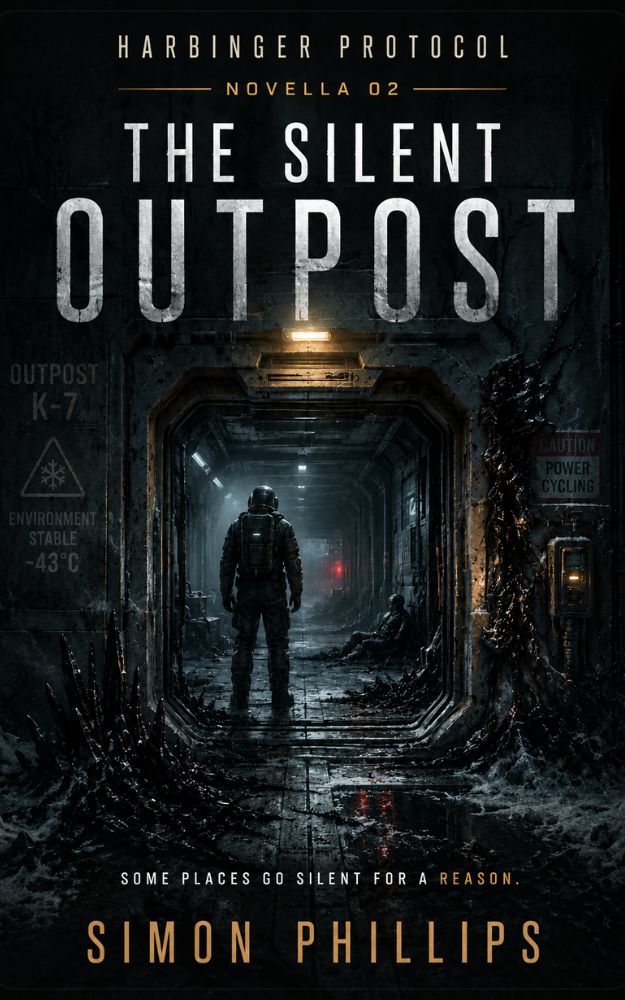
A station under quarantine should be quiet in a way people understand. Doors should remain sealed. Power should stay low. Emergency lights should mark safe routes through dead corridors. The silence should feel like failure, damage, or abandonment.
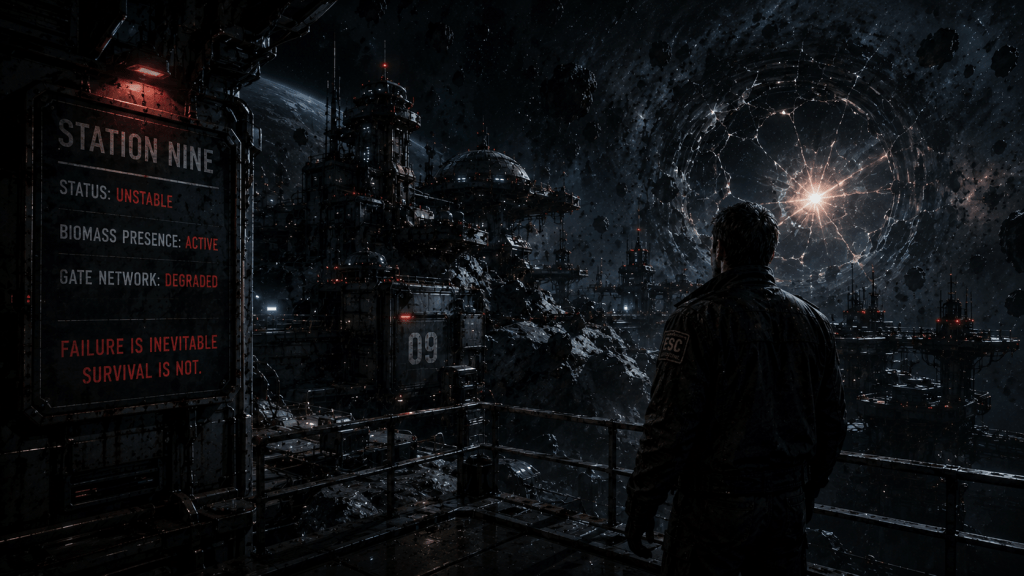
In The Silent Outpost, the second entry in Harbinger Protocol, silence becomes something more dangerous. Kheled Verge Processing Station Nine is cold, partially powered, and almost still when the ESC investigation team arrives. Its docking arms hang in interrupted motion. Its work lights have failed in broken sequence. Maintenance equipment remains suspended mid-task. The place appears paused, as though the ordinary life of an industrial outpost has been held in place by something that has learned how stations breathe.
This is where the series widens from isolated shipboard sci-fi horror into something larger. The first incident aboard the Red Titan left Soren Vale as a survivor. The second places him inside an institution trying to decide whether truth should be spoken plainly, delayed until it becomes useful, or shaped into language that can survive politics.
For readers looking for atmospheric science fiction horror, space station horror, biological contamination sci-fi, and a darker kind of interstellar political thriller, The Silent Outpost marks the moment Harbinger Protocol begins to show its wider shape.
Read The Silent Outpost on Amazon Kindle
Soren Vale and the Weight of Surviving Twice
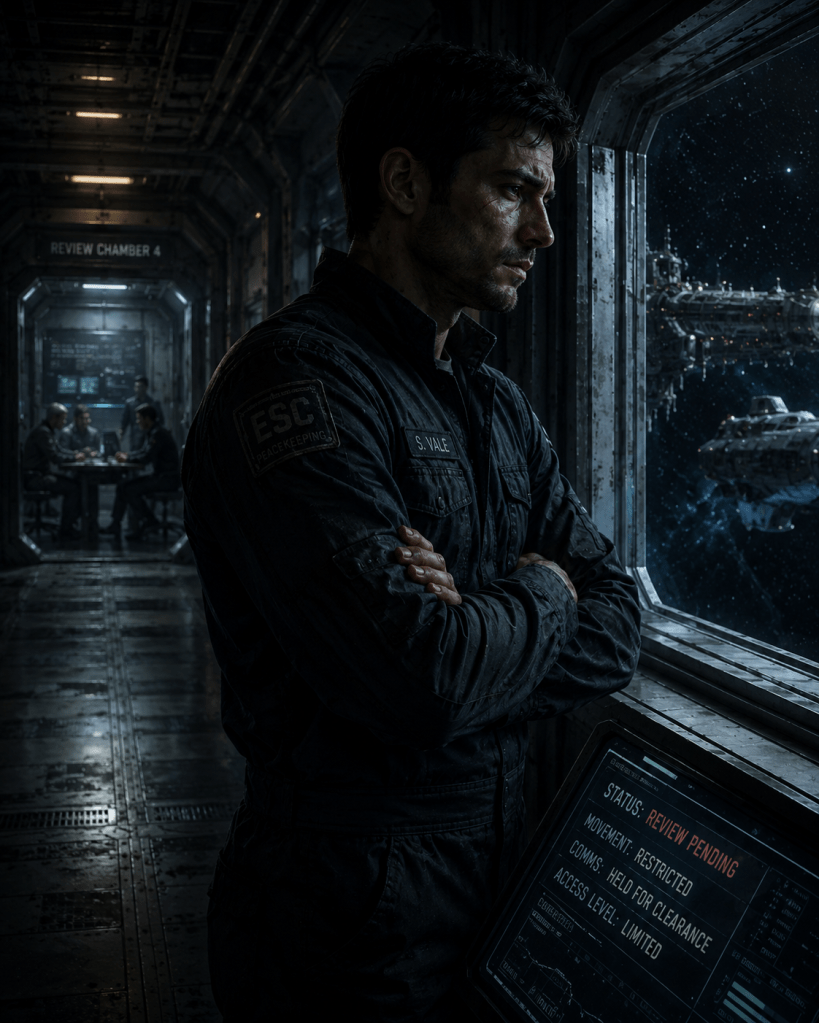
Soren Vale enters this novella in a cleaner kind of captivity.
He is aboard the ESC Peacekeeping Cruiser Leda Ark, safer than he was on the Red Titan, yet far from free. His movement is limited. His communications are held. His memories have become evidence. The institution around him speaks in careful phrases: protective review, pattern integrity, operational legal oversight, acoustic artefacts. Each term carries part of the truth, yet none of them can hold the shape of what he lived through.
That is one of the most important pressures in Harbinger Protocol. The horror is biological, industrial, and cosmic in its eventual reach, though it first enters through administration. Somebody has to classify the event. Somebody has to decide which words can be released. Somebody has to ask whether panic, sovereignty, route control, and treaty law are more dangerous than the thing moving through ducts and cargo bays.
Soren’s usefulness becomes a second form of custody. He notices patterns before committees are ready to name them. He recognises that wrongness can travel through air systems, power routes, warm compartments, and human assumptions. The ESC needs that instinct. It also needs him contained.
In many science fiction horror stories, the survivor becomes the hero who knows the truth and forces the world to listen. Harbinger Protocol takes a colder path. Soren is believed just enough to be used, controlled just enough to be kept close, and trusted only when his fear becomes operationally useful.
Station Nine and the Horror of Working Systems
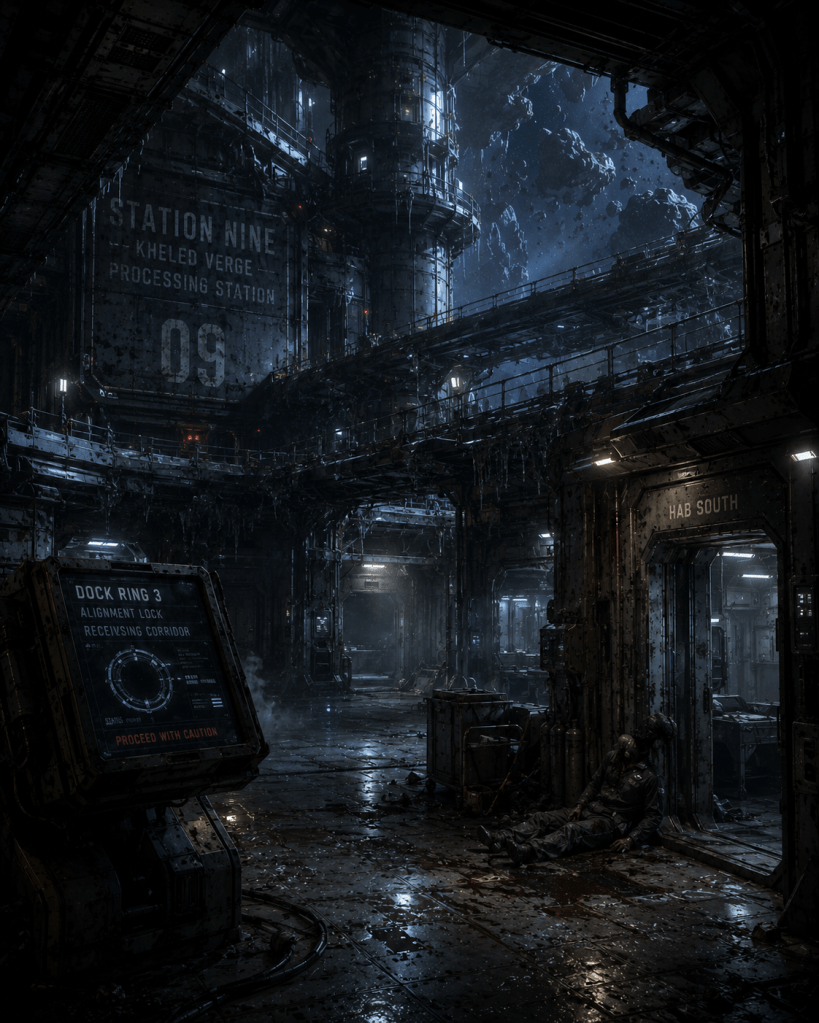
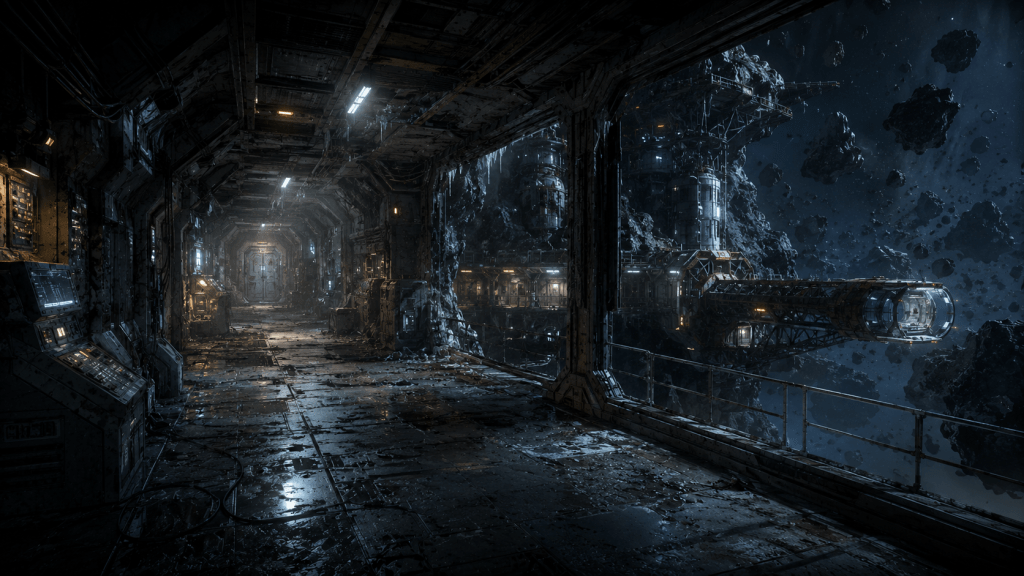
Kheled Verge Processing Station Nine is not a gothic ruin in space. It is an industrial place. Ore systems, docking rings, maintenance spines, habitation blocks, control boards, pressure doors, service trunks, coolant lines, and emergency fallback systems form its body. That practicality matters.
The terror in The Silent Outpost comes from systems that almost behave correctly.
Dock Ring Three still answers, although weakly. The receiving corridor shows no grand destruction. Tools remain where workers left them. The first evidence of contamination appears in pale ribbed accretions on metal surfaces, hatch frames, vent housings, and equipment. It could be coolant residue. It could be mineral deposition. It could be a station ageing badly in deep cold.
Then Hab South changes the meaning of the place.
The dead are found near vents and service grilles. Some stand with hands against the metal. Others sit with faces angled upward, as if listening. There is no visible violence. No clear attack. No easy monster to blame. The bodies have been preserved by cold and arranged by behaviour. Something in the station made them listen long enough to die.
The voice-like sounds that follow are central to the series. They are not true speech in a simple sense. They are damaged systems, airflow, corrupted buffers, acoustic memory, and the human mind reaching for pattern. Yet that distinction offers no comfort. A false plea can kill as effectively as a real one when people are trained to answer distress.
A station does not need to become alive to become dangerous. It only needs to become trustworthy in the wrong places.
Biological Contamination That Uses Human Procedure Against Itself
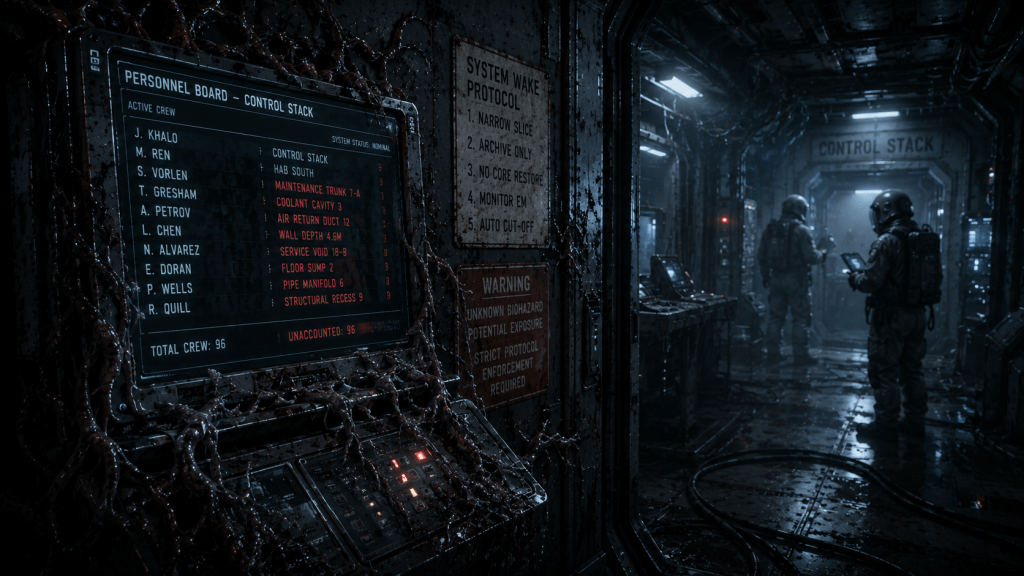
The biomass threat in Harbinger Protocol is frightening because it does not behave like a simple alien invader. It is reactive, environmental, and tied to physical conditions: heat, power, airflow, oxygen, pressure, electromagnetic fields, and the infrastructure humans depend on.
That makes every sensible action dangerous.
A dark station must be investigated. Evidence must be recovered. Survivors may be trapped in sealed compartments. Life support might matter. Operations archives could explain what happened. A controlled systems wake seems reasonable. It is exactly the kind of careful, professional decision an ESC field team would make.
In The Silent Outpost, Kell attempts a narrow slice wake inside Control Stack. The intention is precise: operations archive and environmental board only, no station-wide restoration, no refinery systems, no heavy motors. Procedure is followed. Caution is present. Nobody behaves like a fool.
The station answers anyway.
Lights slam awake. Air handlers roar. Pressure doors cycle across the structure. Old announcements burst through speakers. Dead routines return in fragments. The outpost, once cold and held down, finds pathways through the very systems designed to reveal it.
This is where the novella deepens its biological contamination horror. The danger is not merely infection. It is infrastructure conversion. The station’s systems begin to blur human presence, ducting, wall cavities, coolant routes, service voids, and crew identifiers until the personnel board can no longer separate bodies from structure.
Thirty-two becomes sixty-four. Then ninety-six. Then zero.
That simple numerical corruption is one of the most unsettling images in the novella because it makes bureaucracy itself part of the horror. The system still counts. It simply no longer understands what a person is.
The Personnel Board and the Fear of Becoming Infrastructure
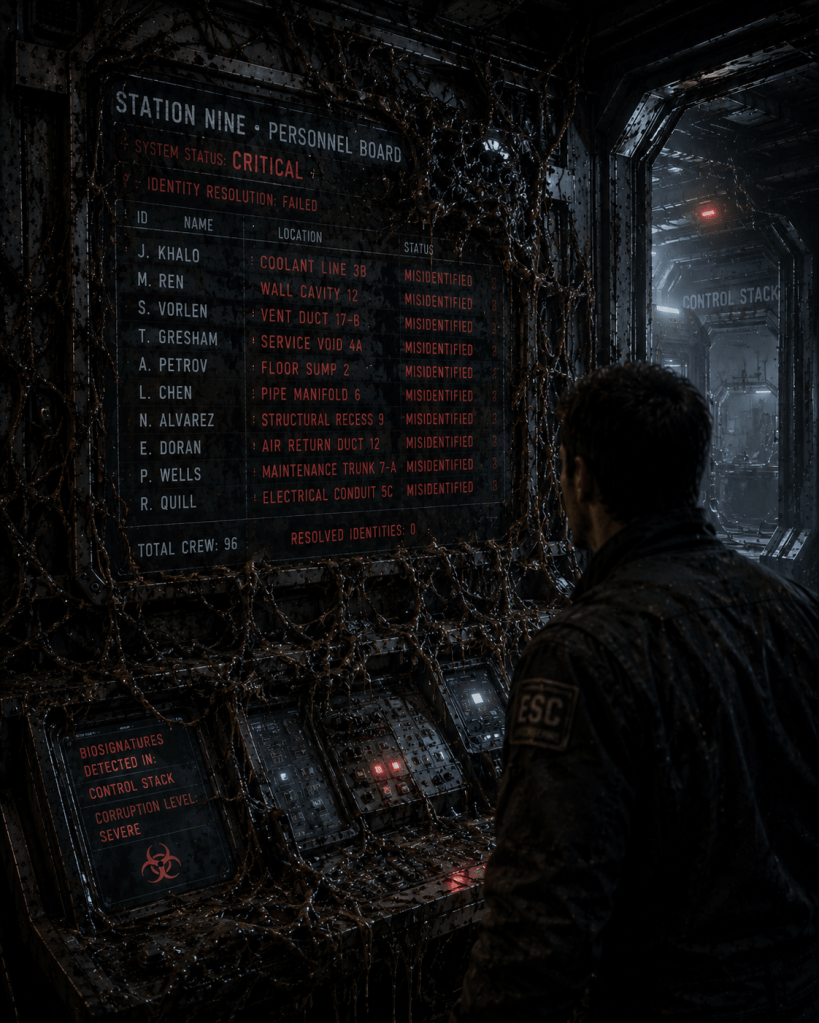
The corrupted personnel board is the central horror image of The Silent Outpost.
A crew roster should be one of the most human systems aboard a station. It tells command who is present, where they are working, which sectors are occupied, who may still need rescue, and who may already be gone. It is a tool of accountability.
On Station Nine, that tool breaks in a way that feels worse than silence.
Crew names appear in ducts, coolant cavities, wall depth, floor sumps, service voids, and processing infrastructure. The system sees occupied space where there should be only pipes and structural cavities. Whether the readout is literal, corrupted, or some terrible combination of both, the emotional effect is clear. The station has stopped recognising the difference between its workers and its own body.
This is also where Soren’s pattern recognition becomes essential. He understands that the contamination followed air routes. Cold slowed it. Power restored movement. The wake allowed the station to read what it had already begun to absorb, overwrite, or misunderstand.
The result is not spectacle. It is a quiet, industrial nightmare. A man does not fear being eaten by a monster. He fears being placed inside the walls and misread as part of the station.
That fear becomes human through the infected marine, whose glove breach turns a small field accident into a containment crisis. The infection follows warmth, suit seams, skin, fabric, and deck contact. Cold suppression slows it, yet the team understands the cost of trying to carry him further. His plea not to be left where the station can “put” him in the walls gives the entire outpost a human centre.
Containment, in this universe, rarely feels clean.
The ESC, Quarantine, and the Politics of Naming Disaster
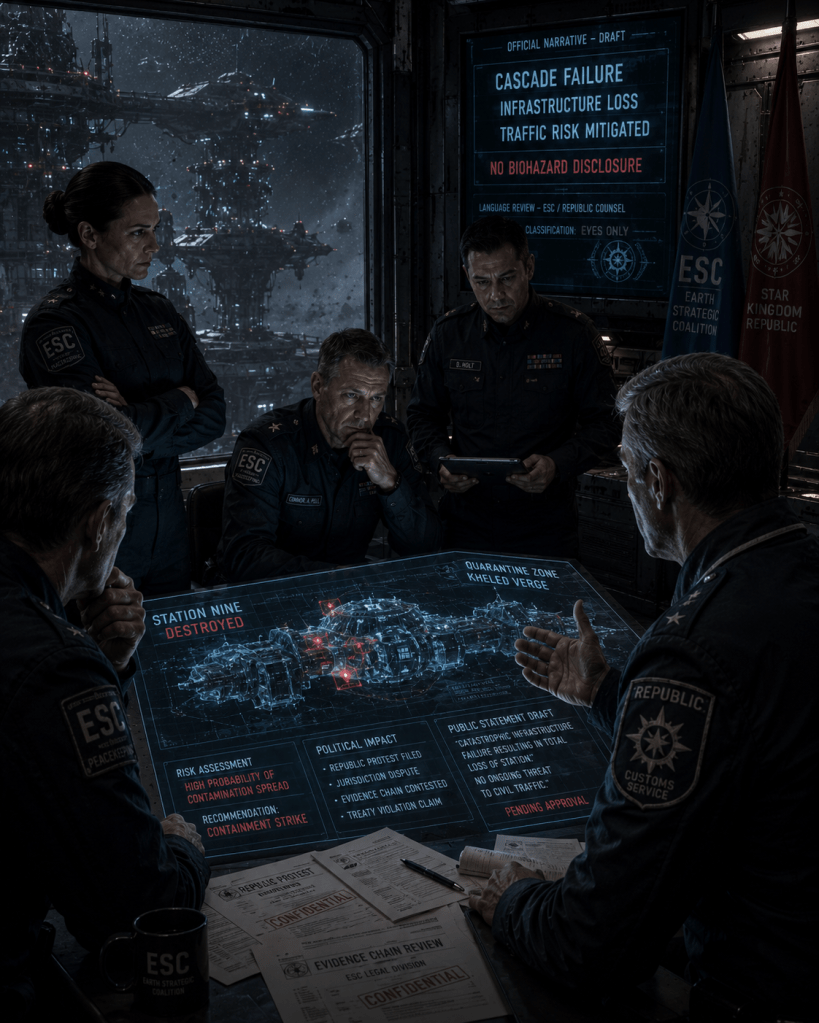
The Earth Strategic Coalition is powerful, disciplined, and capable of rapid action. It also works inside a human civilisation fractured by treaties, rival governments, trade routes, sovereignty claims, and competing narratives.
That is why The Silent Outpost is more than space station horror. It is also political sci-fi horror.
The ESC can send a team. It can freeze a lane. It can order a containment strike. Yet every action becomes evidence in someone else’s accusation. The Republic contests custody, access, survivor handling, route authority, and strike justification. A dead outpost becomes a diplomatic event. A contaminated fragment becomes a border crisis. A docking signal becomes a legal trap as much as a biological one.
The station’s docking shell creates one of the novella’s most dangerous pressures. Once Station Nine begins broadcasting live docking guidance, the threat moves beyond the interior. Any Republic cutter, ore hauler, emergency responder, or salvage vessel that trusts the beacon could open a clean path through contamination and carry it back into traffic.
That is the real horror of beacon trust. Civilisation depends on systems answering correctly. Ships follow guidance. Docking rings identify traffic. Emergency signals draw help. In Harbinger Protocol, those habits become vectors.
The containment strike that destroys Station Nine is swift, grim, and politically explosive. It is not a victory. It is an institutional wound. The outpost is erased because leaving it standing may spread the threat further, and the aftermath immediately becomes a fight over language.
Cascade failure. Infrastructure loss. Traffic risk.
The words are true enough to survive. They are also too clean to carry what happened.
A Series Built on Contamination, Denial, and Scale
Harbinger Protocol works because its escalation is controlled. The early horror remains grounded in freight corridors, sealed compartments, industrial stations, damaged telemetry, and official caution. The series does not rush towards cosmic revelation. It lets the reader feel how a civilisation fails to recognise collapse while its systems still appear to function.
The Silent Outpost moves the saga from the Red Titan’s isolated shipboard nightmare into a wider pattern of station-scale contamination, political pressure, and institutional dependence. Soren Vale becomes the continuity anchor between events. The ESC becomes both protector and jailer. The biomass remains strange, reactive, and deeply tied to the environments humans have built around themselves.
This is adult science fiction horror rooted in procedure, pressure, and consequence. Its fear comes from the gap between what people see and what institutions can say. It belongs to the same family as space survival horror, cosmic horror science fiction, quarantine fiction, and industrial sci-fi horror, yet its centre remains human. People still make tea. Officers still argue over phrasing. Crew still answer voices in vents because the voice sounds close enough to need help.
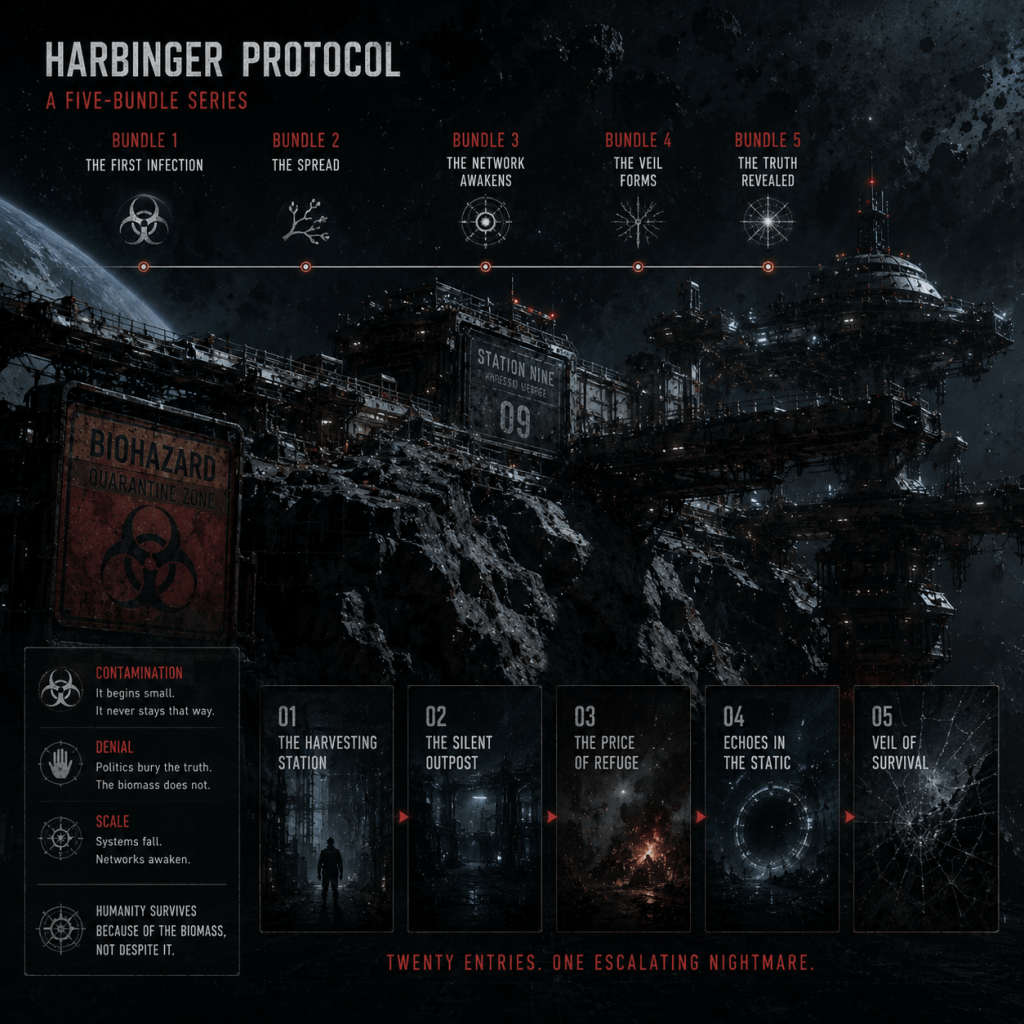
A short visual reading connected to the novella is also available here:
Where the Next Failure Begins
By the end of The Silent Outpost, Station Nine has fallen. The report has begun to change. Soren remains under provisional attachment. The ESC has survived one immediate containment crisis, yet the political cost is already moving faster than the language built to contain it.
A Star Kingdom patrol and a Federation salvage convoy are drawing towards confrontation over contaminated debris. Each side sees the other through suspicion before either fully understands the object between them. The biomass no longer needs to attack. Human systems are carrying it outward through fear, ownership, law, salvage rights, and accusation.
That is where Harbinger Protocol finds its most unsettling pressure. The crisis spreads through matter, yes, yet it also spreads through delay. Through the need for proof. Through the instinct to rescue. Through governments protecting territory. Through commanders trying to hold routes open for one more hour. Through the dangerous belief that a station, a ship, a beacon, or a report can still be trusted because it looks familiar from the outside.
The outpost is gone.
The pattern remains.
And somewhere beyond the next quarantine line, another system is still answering.