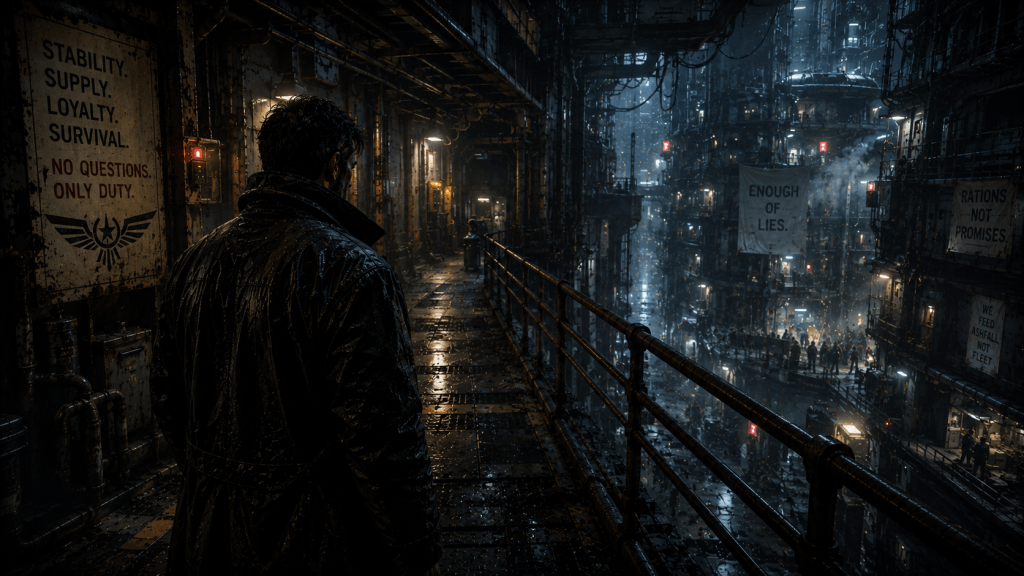
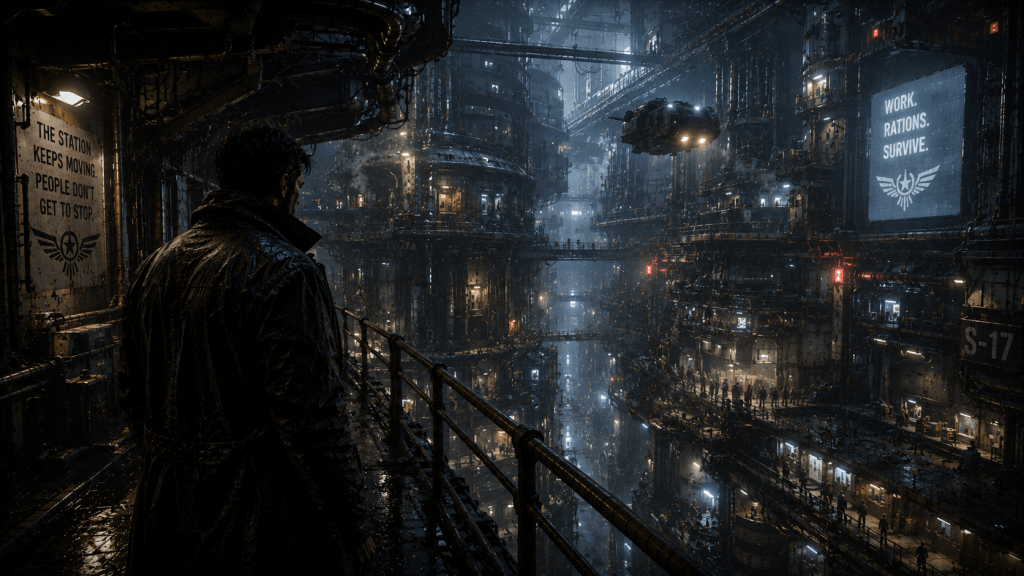
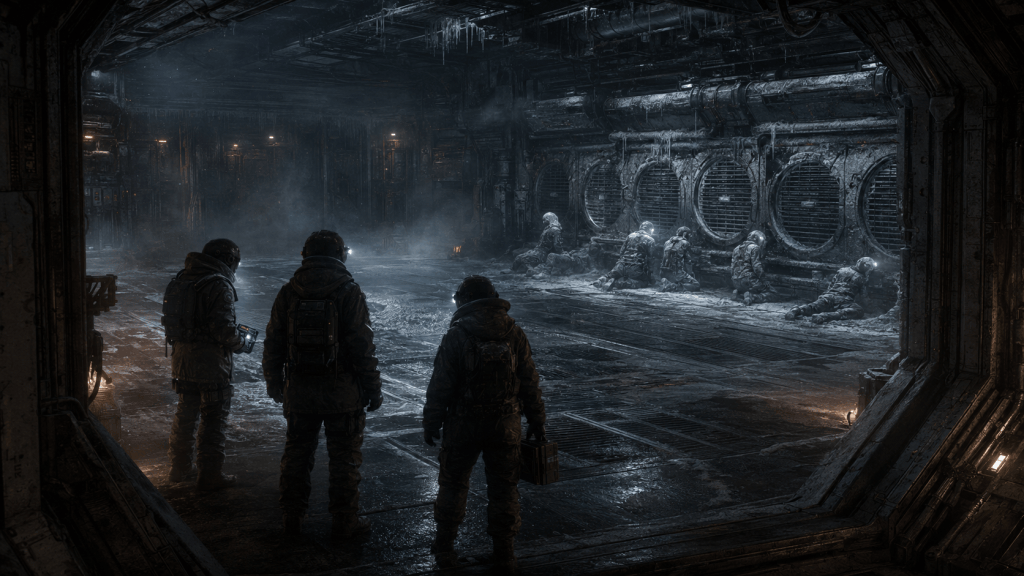
A first-response team entered a silent auxiliary station and found its frozen crew gathered beside the ventilation grilles, as though listening to something the official record could not call a voice.
Where the Air Was Still Moving
Morrow Auxiliary Four hung beneath the shadow of a stripped iron moon, turning through the scattered light of the Kheled Verge with its guidance lamps reduced to a single pale line along the docking collar. From the forward glass of the ESC response cutter Ardent, the station resembled a piece of discarded machinery caught above the moon’s broken horizon, its habitation drum dark, its service spine edged with frost, and its two external relay vanes locked at different angles as though work had ended in the middle of an ordinary adjustment. The stars remained clear around it, sharp against the absence of local traffic, while the cutter moved closer under restrained thrust and received only the same faint carrier pulse repeating every eleven seconds from a communications array that had missed three scheduled reports. Morrow Four still held power somewhere inside its hull, although every system meant to welcome an approaching vessel had fallen silent.
Medical Response Officer Lena Oras watched the station grow across the glass while cold gathered through the soles of her boots from the cutter’s forward deck. The Ardent had left a Republic-linked freight lane six hours earlier with a four-person response team, a sealed medical cradle, and an initial failure notice describing fourteen missing workers as a probable life-support casualty. That description had followed them through the dark in clean official lettering, joined by estimates for coolant loss, communications collapse, and evacuation delay, each possibility familiar enough to fit inside the equipment stacked behind Lena’s seat. Even so, the station ahead carried an order that the report had failed to describe, because the docking arms remained folded, the maintenance crawler sat secured in its rail, and every outer hatch showed green seal integrity while the people responsible for those systems had vanished from the network together.
“Range is four hundred metres, and the collar still refuses an active handshake,” pilot-specialist Corin Jale said as he leaned over the approach board and reduced the cutter’s forward drift. He ran two fingers along the response trace, then glanced towards Lieutenant Harun Cade at the rear of the flight deck. “I can place us against the passive guides, Lieutenant, although the station will be accepting us from stored instruction. If the clamps close, they may have no live controller behind them.”
Cade tightened the seal at his right wrist and studied the docking image from beside Lena’s chair. The lieutenant had spent most of the approach speaking in the even practical tone of someone refusing to let uncertainty set the pace of a room. “Bring us in on mechanical capture and keep our data link narrow,” he said as he rested one hand against Corin’s seat. “If Morrow tries to widen the exchange after contact, isolate the cutter first and ask questions once our own systems are clear.”
Engineer Sera Quill shifted inside her harness near the rear equipment rack and raised the station diagram across her forearm slate. “The carrier pulse includes a valid house key from the previous shift,” she said while the habitation layout opened in dim blue lines. “That gives us access through Dock Two and the central service passage. It also tells us somebody left the communications shell running long enough to load the current key before the reports stopped.”
Lena turned from the station and checked the fourteen crew identifiers waiting on her medical display, where each name held the same unresolved grey field beside life status. “A valid key tells us the station remembered its last instruction,” she said as she secured the display against her sleeve. “It gives us very little about the people who entered it.”
The Ardent crossed the remaining distance with the low vibration of manoeuvring jets passing through its frame. Morrow Four slid above the forward glass until the docking collar filled the view, scarred by mineral dust and old repair plates whose Republic contract markings had faded into dull red bars. Corin brought the cutter between the passive guides with small measured corrections, and the hull answered each thrust with a pressure that moved through Lena’s ribs. Contact came as a firm metallic knock, followed several seconds later by the deeper pull of clamps closing around the cutter’s docking lugs one after the next.
Corin held his hands above the controls while a thin status line travelled across the board and stopped short of completion. “Mechanical capture is secure,” he said as he watched the unfinished line remain in place. “The station accepted our mass and sealed the collar. Its traffic system still refuses to acknowledge that we arrived.”
Cade released his harness and stepped into the narrow aisle between the seats. “Then we treat the collar as unsecured beyond our own hatch,” he said while drawing his helmet forward from the equipment rail. “Closed suits, local air, cold lights, and a fixed line back to the cutter. Sera reads systems, Corin holds the link from this side, and Lena stays behind me until the receiving lock gives us a clear environmental picture.”
“I heard the order,” Lena replied as she lifted the medical pack onto her shoulders and met his eyes through the rising edge of her faceplate. “If someone is alive in there, I move when the reading supports it. You may complain after I bring them back.”
Cade’s expression softened for a moment as he locked his helmet ring into place. “Bring them back first, Officer Oras,” he said while the suit display painted a faint amber reflection across his face. “I will prepare a thorough complaint for the return flight.”
The docking passage opened ahead of them beneath two strips of emergency light that brightened slowly from red to weak amber. Lena followed Cade through the cutter hatch with Sera close behind, their boots crossing the flexible collar while the metal around them carried a distant shiver from Morrow Four. The station-side seal showed full pressure, although the indicator took three attempts to settle on a stable figure, sliding from breathable mix to sensor review and back again before Sera placed her glove against the manual reader. A line of frost had formed around the inner frame, pale and delicate across hinges that had seen years of freight dust, coolant vapour, and human hands.
Sera angled her helmet lamp across the lock and traced the pressure feed to its local panel. “Temperature sits at nine below, oxygen is low yet serviceable, and air movement is holding at preservation draw,” she said as she expanded the environmental reading. “The habitat heaters dropped out in stages. Ventilation kept running at reduced load after the main grid fell away.”
Cade looked through the small window set into the inner hatch, where a reception passage extended beyond the glass in blue shadow. “Any atmosphere event strong enough to kill the full crew?” he asked as he raised one gloved hand towards the manual release.
Lena checked the pressure history moving along her wrist. “No rapid loss, no fire purge, and no toxic warning preserved in the local buffer,” she said while the final six hours arranged themselves into a descending temperature curve. “Cold could have killed them after prolonged exposure. It fails to explain why every medical tag disappeared from the station board before the habitat reached freezing.”
Cade held her gaze for a second through the faceplate, then turned the release wheel. The inner hatch withdrew with a slow grinding pull, allowing a blade of colder air to cross their suits and carry the smell of metal, stale filtration, and something faintly sweet from the unheated passage. Their helmet lamps reached over wall cabinets, two empty pressure-suit cradles, and a row of work boots left beneath the crew board. One boot lay on its side near the centre of the deck, its laces open, while a thermal coat remained hooked above it with a station badge fixed neatly to the breast.
Sera stepped through after Cade and swept her system reader along the walls. “Local current is present in the emergency run, and the habitat door reports sealed open,” she said as she stopped beside the abandoned boot. “The board has erased crew location data. I can see the memory blocks where the tags should sit, all of them cleared within the same minute.”
Lena crouched beside the boot and moved her lamp across the deck. A shallow crescent of frost marked the floor around its heel, interrupted by a dragged line leading towards the habitat passage, while the thermal coat above it showed no sign of hurried removal. “Someone came through here after the temperature fell,” she said as she rose and followed the line with her light. “They lost the boot, kept moving, and left the warmest coat on the wall.”
Cade faced the dark passage beyond the reception lock and increased his lamp until the beam reached a junction thirty metres ahead. “Morrow Response, this is ESC Lieutenant Cade aboard the Ardent,” he called through his suit speaker while his free hand remained close to the restraint weapon at his hip. “We are inside Dock Two and moving towards habitation. Any crew member receiving this call, answer through local comms or strike a bulkhead three times.”
His voice travelled into the station and returned as a thin reflection from the metal walls. For several seconds the only reply came from the ventilation system, a low pull of air passing through service channels behind the panels with enough force to stir fine frost from a grille near the ceiling. Then a softer sound moved beneath it, carrying the rounded shape of a human vowel before pressure flattened it into the hum of the duct.
Sera lifted one hand and turned her helmet towards the grille. “Hold your next call,” she said as she brought the acoustic trace onto her slate and watched a narrow band rise through the airflow noise. “There was something inside the return line. It could be a damaged announcement fragment crossing from the habitat speakers.”
Cade kept his lamp on the grille while he opened a local record marker. “Log it as an untraced acoustic event,” he said as his thumb moved across the suit control. “We follow the crew search route and leave the duct sealed until you have a source.”
Lena remained beneath the grille long enough to hear the airflow draw through it again. The sound carried no clear word, only a fragile lift and fall that resembled a person speaking from the far side of a closed door, and her training supplied a dozen mechanical causes before memory could offer a human face. She turned towards the habitat corridor, where Cade had begun moving under the emergency lights, and followed with her medical scanner open across the centre of her visor.
They passed the galley first, finding cups secured in their wall recesses and a half-completed shift list waiting on a table beneath a film of frost. The next compartment held six sleep berths with their curtains drawn back, blankets folded at the foot of four mattresses, and one personal lamp still glowing beside an unfinished message slate. Every room carried the marks of people expecting to return within minutes, while the dragged frost lines on the deck led deeper towards Habitation Junction South, crossing each other at corners and converging along the route taken by the station’s main return ducts.
Sera slowed beside a wall panel where the service diagram showed three ventilation branches joining beyond the next hatch. “All return airflow passes through the south junction before it reaches the exchange stack,” she said as she placed her glove against a vibration in the metal. “The pressure is low, although this panel feels warmer than the corridor. Something in the exchange route still carries load.”
Cade reached the junction hatch and studied the narrow darkness beyond its window. “Officer Oras, I have a possible casualty,” he said as he shifted to one side and directed his lamp through the glass. “Three metres inside, seated against the left wall. I need your reading before we enter.”
Lena moved beside him and lifted the medical scanner towards the window. The beam crossed a figure wearing station overalls, knees drawn close to the chest, one bare foot resting against the deck where frost had closed around the skin. The figure’s head leaned towards a service grille at shoulder height, and one hand remained pressed flat across the mesh with the fingers spread as though feeling for air. Her scanner searched through the hatch, returned no cardiac activity, and placed the time of death somewhere inside the long fall of the station’s temperature.
“Adult male, preserved by cold, with no visible suit breach or external injury,” Lena said as she forced her breath into a slower rhythm and widened the scan. More shapes appeared beyond the first body, soft grey outlines gathered along the far wall and beneath the ceiling returns. “Harun, there are at least seven people inside that junction, and every one of them is facing a grille.”
Cade lowered his head for half a second, then raised it as duty settled back across his posture. “Record before entry and keep the hatch between us and the room until Sera checks the air path,” he said while his lamp moved from one frozen face to the next. “These people came here together, so we learn what brought them before we follow the same route.”
The ventilation shifted beyond the glass, drawing a veil of frost from the nearest grille and carrying the sound through the sealed hatch with startling softness. This time the shape lasted longer, rising beneath the mechanical pull as though a tired speaker had formed two words and lost them inside the metal. Lena saw the dead man’s hand against the mesh, the waiting turn of his head, and the seven pale faces angled towards the same narrow opening while her suit recorder struggled to decide whether it had captured airflow or speech.
Sera stepped back from the hatch, her system reader trembling slightly in her grip. “The station archive will call that duct resonance,” she said as she looked towards Cade through the blue light. “Lieutenant, it sounded like someone asking us to come closer.”
Cade kept his eyes on the people gathered beyond the glass and sealed the junction access beneath a restricted-entry marker. “Then we stay here,” he said as his hand remained firm against the manual lock. “We listen from this side until we understand why fourteen experienced workers chose the other one.”
Station Record: Morrow Auxiliary Four
Morrow Auxiliary Four occupied a narrow maintenance orbit above an iron-rich moon on the southern edge of the Kheled Verge, positioned where three freight routes crossed before separating towards the outer extraction fields. The station had been built to support the civilian haulers, mineral carriers, maintenance cutters, and survey vessels working beyond the reach of the larger Republic-linked ports.
Its original structure consisted of a docking collar, a service spine, and two rotating relay vanes assembled from prefabricated industrial sections. Later contracts added a habitation drum, an equipment store, and an environmental exchange stack large enough to sustain twenty-two workers. Permanent staffing rarely exceeded fourteen, with most shifts divided between traffic monitoring, relay maintenance, hull inspection, and emergency support for vessels crossing the Verge.
Life aboard Morrow Four followed the requirements of the freight lanes. Crews worked irregular shifts around convoy arrivals, equipment failures, and the long communication delays common beyond the central routes. The station possessed a compact galley, six shared sleeping compartments, a medical room intended for stabilisation work, and a narrow observation gallery overlooking the moon. Personal space remained limited, and most of the crew lived within hearing distance of the machinery that kept the station functioning.
The ventilation system formed one of its oldest surviving networks. Air drawn through the habitation compartments passed along three return branches before meeting at Habitation Junction South, where the combined flow entered the exchange stack beneath the service spine. Years of repairs had left the ducts lined with replacement filters, pressure regulators, and mismatched acoustic baffles installed under several different maintenance contracts.
Crew reports from earlier rotations occasionally mentioned vibration passing through the southern grilles when the exchange fans moved between operating levels. The station engineer had classified the effect as pressure flutter caused by the age of the return channels. Repair work had been scheduled twice and postponed after inspections found airflow within acceptable limits.
Morrow Four also carried a preservation cycle intended to protect critical equipment during power loss. When the main grid failed, the station reduced heat, lighting, and residential power while maintaining a controlled draw through the ventilation network. The system could slow corrosion, preserve medical supplies, and prevent moisture damage until a repair crew arrived. It had never been designed to keep the habitation compartments safe for prolonged human occupation.
The final routine report from Morrow Four described a minor irregularity inside the environmental exchange stack. One pressure sensor had begun correcting its own readings after each diagnostic pass, while a second registered short changes in airflow during periods when the fans remained at fixed output. The duty engineer opened a maintenance file and requested replacement components from the next scheduled supply vessel.
Two hours later, the station transmitted its last complete traffic update.
Over the following shift, all fourteen medical tags disappeared from the local crew board within the same minute. The main heaters then failed in stages, internal communications fragmented, and the preservation cycle assumed control of the remaining environmental systems. No decompression alarm, evacuation order, or fire warning entered the emergency archive.
The station continued transmitting a valid carrier pulse every eleven seconds.
When the ESC response cutter Ardent reached Morrow Four, the outer seals remained intact, the docking equipment accepted mechanical capture, and reduced ventilation still moved air through the darkened habitation drum. Inside, the crew’s abandoned rooms suggested an interruption measured in minutes. Cups remained secured beside unfinished meals, personal displays waited beside open messages, and thermal clothing hung where the workers had left it.
Every trace of movement led towards Habitation Junction South.
There, beside the oldest ventilation grilles aboard the station, the response team found the missing crew gathered in the cold.
About the Creator

The Future Chronicle is written and curated by Simon Phillips, a writer of science fiction and speculative storytelling who explores the fragile edges of human expansion, where freight routes, inspection bays, patrol vessels, and isolated industrial stations continue their ordinary work while larger dangers gather quietly beneath routine procedure.
Many of the stories presented in these Chronicles exist within wider fictional worlds shaped by workers, survivors, officers, and investigators who encounter the first signs of events far greater than they are prepared to understand. These settings remain grounded in lived environments, where machinery, bureaucracy, and human judgement often shape the path of catastrophe long before anyone can give it a name.
The Harbinger Protocol follow that unfolding pressure through the experiences of Soren Vale, beginning with the civilian freighter disaster recorded in The Ash in Transit and continuing into the colder, more procedural dread of The Silent Outpost, where isolated incidents begin to reveal the outline of something spreading across human routes and systems.
Readers who wish to explore the full opening phase of the Harbinger crisis can find the below.
Explore the books:
The Ash in Transit
The Silent Outpost
You can watch his YouTube channel here:
Author Simon Phillips
Continuing the Chronicle
The following Chronicle reconstructs the first-response search inside Morrow Auxiliary Four, where the crew of the Ardent found fourteen station workers gathered beside the ventilation grilles and began tracing the sound that had drawn them into the cold.
Readers supporting The Future Chronicle can continue the record below.

Subscribe to continue reading
Subscribe to get access to the rest of this post and other subscriber-only content.