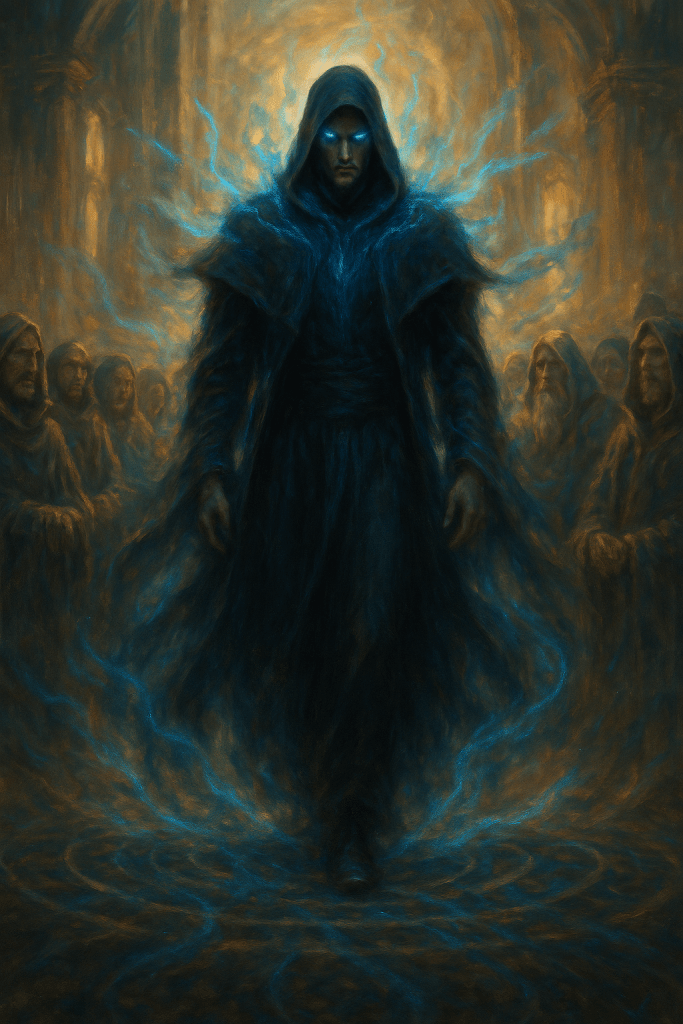
The moment where certainty fractures is rarely loud, though it alters everything that stands upon it
There are stories that begin with spectacle, with fire or proclamation, with the unmistakable signal that something has already broken beyond repair. This is not one of those stories. This is a story that begins with a page.
A man stands beneath morning light in a conservation studio, surrounded by the quiet labour of preservation, where history is handled gently, corrected carefully, and returned to stability through patience rather than force. The world outside continues as it always has, measured and dependable, its rhythms so deeply understood that they no longer require attention. Within that space, knowledge feels contained, ordered, and complete.
Then the page shifts.
It does not announce itself. It does not tear or burn. It folds inward.
And the world follows.
A Book That Does Not Behave Like a Book
Some objects are not preserved by time. They are waiting within it.
At the centre of The Unclassified, the first entry in The Hollow Flame Cycle, lies an object that resists classification at the most fundamental level. It resembles a book in form, though resemblance is the only certainty it offers. Its script refuses recognition, its structure resists familiarity, and its presence unsettles the very idea of passive material.
Silas Thorn approaches it as he would any artefact: with care, with discipline, and with the quiet confidence of someone who has spent his life restoring the past to coherence. His work is grounded in physical reality, in fibres, ink, binding, and time. Every action is deliberate, reversible, and measured against centuries of accumulated knowledge.
The book does not respond to that framework.
It holds warmth where none should exist. It bends light in ways that resist explanation. It answers touch with something that cannot be reduced to material behaviour.
What unfolds in that moment is not destruction, nor is it revelation in any familiar sense. It is intrusion.
The known world does not break. It gives way.
The Crossing That Leaves No Mark
Not all thresholds are visible. Some exist only in the moment they are crossed.
When Silas falls through the page, the act is not framed as travel. There is no preparation, no ritual, no understanding. The transition occurs in the space between expectation and perception, where reality has not yet had time to correct itself.
He lands not in chaos, though that might have been easier to comprehend.
He arrives in order.
The chamber that receives him is vast, structured, and deliberate. Its architecture carries the weight of centuries, its design shaped by authority rather than accident. Nothing appears broken. Nothing appears disturbed. The world into which he emerges does not recognise itself as interrupted.
This is the first tension the novella establishes with precision: the crossing is not treated as an anomaly by the space itself.
It is treated as an event that must be answered.
Authority Before Understanding
Institutions do not wait for clarity. They respond.
One of the defining tensions within The Unclassified lies in the way power reacts to uncertainty. The Crown, embodied through Princess Lirael and the sovereign, does not hesitate. The event is assessed, contained, and integrated into existing frameworks of control with remarkable efficiency.
There is no panic.
There is no denial.
There is only response.
Silas is not treated as an intruder in the traditional sense, nor is he embraced as a miracle. He is categorised as a problem requiring management. His presence is stabilised through containment, his movement restricted, his existence placed within the boundaries of governance.
This reaction reveals something fundamental about the world itself.
It does not collapse under pressure.
It absorbs it.
The Quiet Fracture Beneath Control
The most dangerous shift is the one that leaves everything looking unchanged.
While the structures of authority hold firm, the novella introduces a quieter, more unsettling movement beneath them. Through Princess Seréne, a different kind of awareness begins to emerge, one less concerned with immediate control and more attuned to what the event represents.
The foundations have opened.
They have closed again.
No mark remains.
This absence of damage becomes the central disturbance.
If the system can admit something without rupture, then the boundaries that define it are not as absolute as they were believed to be. The palace, the Crown, the Guild, and the very idea of structured reality all rest upon assumptions that have not yet been tested in this way.
Seréne does not rush to resolve this contradiction.
She recognises it.
And in doing so, she becomes the first to truly stand within the question the novella poses.
A World That Does Not Recognise Itself
When two systems meet, neither remains untouched.
The introduction of Silas’s world, described in fragments through his attempts to explain it, creates a second layer of tension. His reality is defined by written law, mechanical systems, and a complete absence of what this new world considers foundational.
There is no magic.
There are no sigils.
There is no binding of authority into stone.
And yet he stands within a place where all of those things are not only real, but necessary.
The contrast does not resolve into superiority or dismissal. Instead, it reveals the limits of both systems. Each world contains structures that appear complete within their own context. Each becomes unstable when viewed through the lens of the other.
The crossing does not simply move a man from one place to another.
It introduces incompatibility.
Where the First Movement Ends
The hall settles. The question remains.
By the close of the novella, nothing outwardly catastrophic has occurred. The palace still stands. Authority remains intact. The man has been contained. The Guild has been summoned. The system continues to function.
And yet something irreversible has begun.
The foundations have responded to something they were never meant to receive.
A man from a world without magic stands at the centre of a system built upon it.
The Crown has acted without understanding.
The Guild has arrived without conclusion.
The question has entered the world.
It has not left.
Step Into the Hall
If you want to experience the full unfolding of this first disturbance, you can read The Unclassified here:
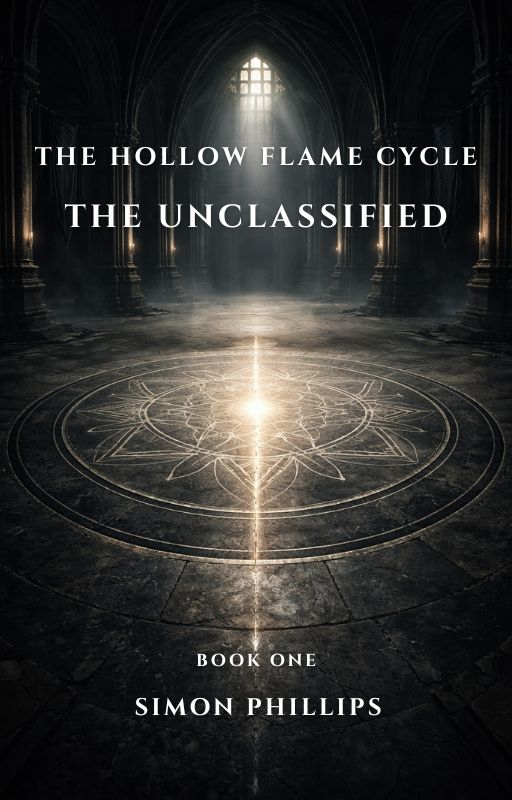
This is the opening movement of The Hollow Flame Cycle, where the story does not begin with collapse, but with the moment just before it becomes possible.
The page has opened.
The world has followed.
And nothing, though it appears unchanged, will remain as it was.