Out beyond the docking lanes, where a frontier station gives way to the wreckage of older industry, a debris field becomes more than background scenery. It becomes memory made physical. Broken cargo towers, relay frames, scaffold sections, and dead satellites drift in slow procession around a spent world, each fragment holding the shape of labour that once mattered. When a deep-space signal begins pulsing from within that ruin, science fiction touches a very old fear. Someone, or something, is still speaking from a place the present has already abandoned.
That tension sits at the heart of space station mystery fiction. A station suggests order, registry, mapped corridors, monitored traffic, and the steady reassurance of systems under observation. A debris field suggests the opposite: overflow, residue, long aftermath, the industrial graveyard left circling after profit has moved elsewhere. Bring the two together, and the result carries a peculiar strain of unease. The organised world remains close enough to see through the canopy glass, while the dark beyond still holds structures whose original purpose has thinned into rumour.
Chronicle 4 of the Ashfall Station sequence understands that pressure with impressive calm. In The Signal in the Debris Field, the first disturbance arrives through a routine approach, a receiver sweep, a pilot who hears something repeating where no transmitter should remain. The effect comes through restraint. The signal enters the scene as a technical irregularity, almost small enough to miss, and that scale gives it force. A corridor alarm would feel immediate. A faint pulse drifting through wreckage feels patient, older, and somehow more certain of its own endurance.
The debris field as a zone of memory
Science fiction has always found power in the image of abandoned infrastructure. A derelict ship, a sealed habitat, a disused mining platform, an orbital relay whose designation has outlived its function, each one carries a quiet promise that time has continued moving inside the machinery even after official attention moved elsewhere. The debris field expands that promise across a wider landscape. Instead of one haunted object, the reader faces an entire environment shaped by accumulation.
That matters because a debris field resists the clean romanticism often attached to deep space. This is space as aftermath. These structures once belonged to schedules, quotas, crews, budgets, accidents, repairs, and routine decisions made under industrial pressure. Someone welded those frames. Someone signed off on those towers. Someone logged the final traffic before the route fell quiet. Years later, the broken skeletons remain in orbit as a record of labour whose living context has drained away.
A repeating signal inside that setting does more than introduce mystery. It reactivates the graveyard. The field stops behaving like scenery and begins behaving like an archive. Every drifting fragment becomes a potential source, every torn ring or fractured panel a possible witness. The reader starts searching the wreckage in the same way a pilot or receiver operator would, trying to imagine which remnant still holds charge, which chamber still preserves circuitry, which cold section of metal has gone on speaking long after its builders vanished from the route maps.
That is one reason deep-space signal stories retain such force. They awaken dead environments. The pulse gives shape to emptiness. It turns drifting matter into intention, even before anyone can say what that intention means.
Why a signal unsettles more deeply than a visible threat
A visible threat lets the mind draw boundaries. A hostile vessel, a boarding party, a damaged hull, a breach warning, each one carries a recognisable edge. A signal works differently. It arrives through pattern, delay, and repetition. The source remains hidden while the effect spreads through interpretation. People listen, compare, classify, question, rerun scans, check registries, and discover that language begins to slip. A signal forces institutions to confront uncertainty in their own preferred idiom: records, arrays, identification protocols, archived frequencies, sensor sweeps, official reassurance.
That tension gives signal fiction a profoundly human quality. Fear enters through procedure. The crew member who notices the anomaly remains at a console. The navigation office answers in a steady voice. Arrays turn. Data arrives. Silence follows. The dread grows inside administrative competence.
In the Ashfall setting, that calm procedural atmosphere carries special weight because the station itself depends upon navigational certainty. Approach corridors, beacon records, traffic coordination, safe separation from older wreckage, all of these form the ordinary discipline of survival around Kestren-4. When a repeating transmission emerges from the debris field and every system insists that no registered transmitter exists there, the disruption reaches deeper than a single strange moment. It touches trust itself. The map says one thing. The receiver says another. The corridor remains open anyway.
This is where the Chronicle’s science-fiction mood becomes especially effective. The future feels inhabited through work. Pilots hold approach vectors. Navigation officers speak in measured exchanges. Sensor towers search empty space. The mystery grows within the texture of a functioning industrial culture. That sense of lived system pressure gives the signal gravity. Nothing flamboyant needs to happen. A steady pulse across the spectrum is enough.
Frontier systems make these stories feel plausible
A frontier setting gives signal fiction a natural home because frontiers contain leftovers. Expansion creates equipment faster than memory can preserve it. Systems grow around extraction, transport, survey work, emergency contingencies, contract cycles, and temporary structures whose temporary status stretches across decades. As traffic thins and economies shift, the hardware remains behind, turning orbit into a layered field of present use and historical residue.
Within that kind of environment, a signal from abandoned machinery feels plausible in the first instant. That plausibility matters. The reader accepts the practical explanation before the deeper disturbance begins. Of course old infrastructure can transmit. Of course a mining beacon or relay unit might survive. Of course a receiver operator would assume a technical remnant before anything stranger. The future opens through ordinary logic.
Then the second movement begins. The frequency matches nothing familiar. The source location feels wrong. The pattern repeats with an exactness that suggests design. The structure carrying the transmission appears cold, silent, and dead. That shift from plausible remnant to unresolved persistence is where frontier science fiction often finds its sharpest atmosphere. The story remains grounded in work, machinery, and registry, yet a pressure larger than procedure starts pressing through the seams.
The result feels less like spectacle and more like slow contamination of certainty. For readers who prefer controlled speculative fiction over grand operatic display, this mode carries unusual appeal. It trusts implication. It lets the industrial environment hold the weight.
The Chronicle as a threshold into Ashfall
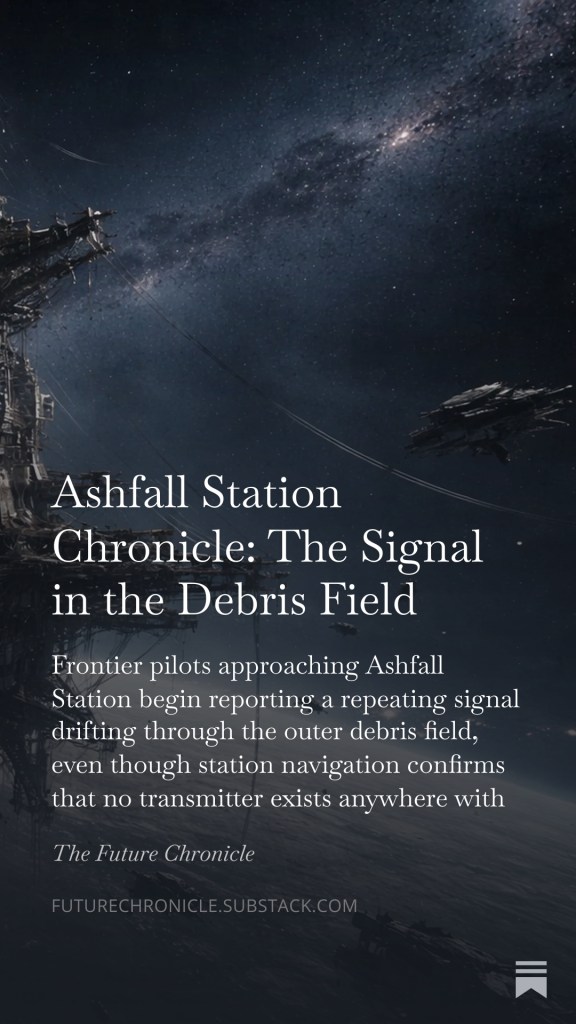
Within The Future Chronicle on Substack, The Signal in the Debris Field works especially well as a threshold text because it introduces Ashfall Station through distance. The station appears across the approach lanes, lit against the black horizon, while the deeper disturbance rises from the wreckage surrounding it. That choice gives the whole entry a measured elegance. Readers arrive from outside. They see the station as incoming crews see it. The system feels broad, quiet, and old before the mystery tightens.
This matters for the wider Ashfall Station sequence. A chronicle like this one does more than tell a contained episode. It establishes reading conditions. The archive grows through fragments, reports, observations, quiet anomalies, and moments that seemed manageable when first recorded. A signal detected on approach becomes one more entry in a larger field of pressure. The reader senses the archive thickening.
That archival method suits science fiction particularly well when the goal is psychological atmosphere instead of rapid revelation. The future enters as a record under review. Every small event acquires retrospective weight. A pilot reports a pulse. Navigation fails to locate a legal source. A structure in the debris field speaks in a sequence no one recognises. The event passes into the logs. Later, the meaning expands.
For a new reader, that creates a strong entry point. There is no burden of excessive lore. There is a station, a world beneath it, a debris corridor, a transmission, and the first slight shift in the trust people place in their systems. The world opens through implication, which often leaves a deeper impression than explanation.
From Chronicle atmosphere to novella pressure
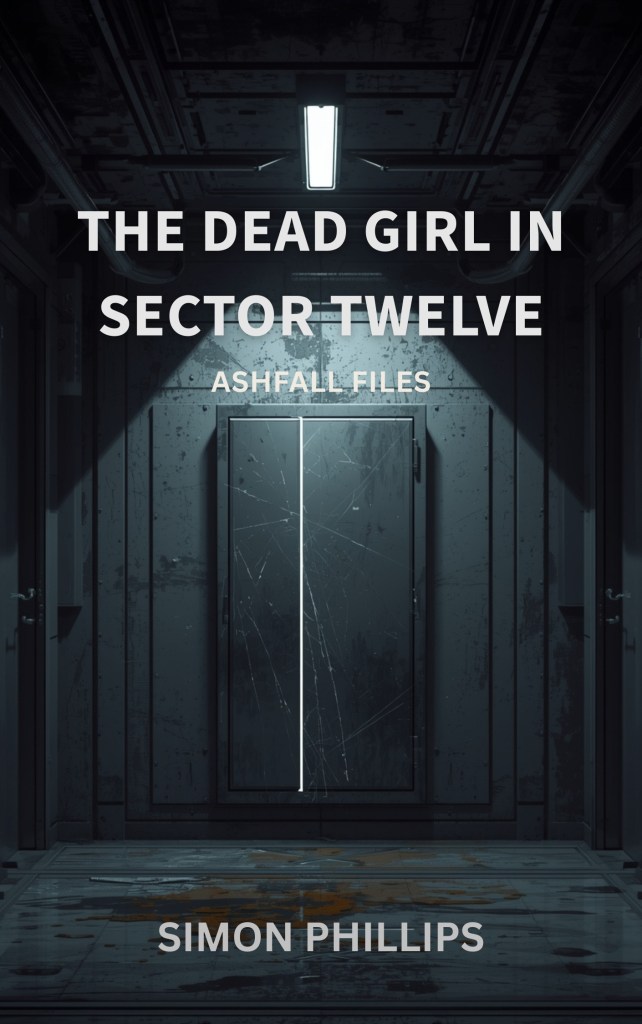
For readers who want to step from the archive into a more sustained narrative, the connected Kindle novella, Ashfall Files: The Dead Girl in Sector Twelve, provides a natural second threshold. The movement from Chronicle to novella feels organic because the Chronicle builds environment first. It lets Ashfall exist as place, record, and accumulated unease. The novella can then enter that same station carrying the denser pressure of investigation.
This relationship between Chronicle and novella is one of the strongest aspects of the wider project. The chronicle form gives room for early signs, peripheral witnesses, overlooked incidents, and the quiet sediment of history. The novella form gathers that atmosphere into a closer narrative line, where consequence presses more directly upon the people moving through the station’s ageing structure. One form broadens the archive. The other deepens the encounter.
That distinction matters for readers drawn to space station mystery, industrial science fiction, and slow-burn speculative tension. Some want the distant view first: the station as system, the route map, the old infrastructure, the fragment recovered from orbit, the unexplained signal turning through the dark. Others want the closer pressure of a case unfolding inside that world. Ashfall offers both, and Chronicle 4 sits at a particularly effective junction between them.
Why readers keep returning to signals from the dark
A signal carries something ancient inside a futuristic form. It is a call, a trace, a pattern seeking reception. It promises meaning before meaning has been secured. Human beings remain vulnerable to that structure across every age. We hear repetition and assume intention. We hear order and assume origin. We hear persistence and assume that someone, somewhere, continues to hold the other end of the line.
In science fiction, that instinct becomes even more powerful because distance removes reassurance. Space is large enough to hold forgotten industry, failed empires, unfinished projects, silent research, sealed compartments, and transmissions still moving after their makers are gone. The signal becomes a way for the past to remain active inside the future. It crosses vacuum and arrives without explanation, carrying the unsettling suggestion that history never fully releases its grip on the systems built to contain it.
That is why a debris field signal feels so potent. The message comes from waste, from structures society has already written into the margins, from a region treated as background hazard and navigational inconvenience. The future receives its disturbance from what it chose to leave behind.
Ashfall understands that dynamic with admirable restraint. The pulse enters quietly. The route remains open. The station continues its orbit. The record grows by one more line. Somewhere beyond the docking rings, among fractured towers and silent machinery turning above Kestren-4, a sequence continues repeating into the dark. The archive hears it. The station hears it. Long after the immediate approach has passed, the pressure remains.
