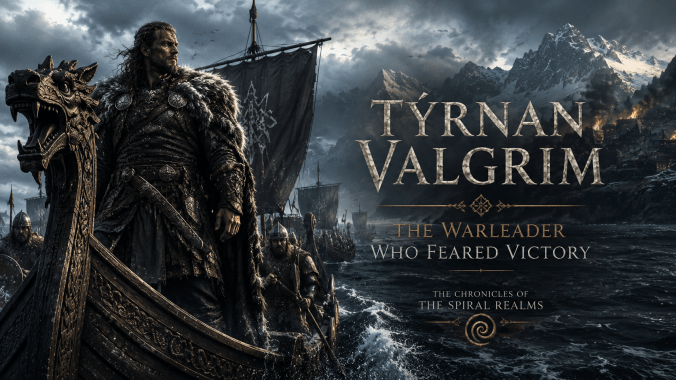
In The Unmarked Path, Book 1 of The Veil of Kings and Gods, Týrnan Valgrim enters the story from the cold edge of Ældorra, where the northern seas carve strength into those who survive them and the people of Njorvik learn early that mercy does not always keep a tribe alive.
He is introduced as a warleader, yet not as a simple raider hungry for blood or glory. Týrnan stands at the prow of a longboat with the bitter wind pulling at his fur-lined cloak, surrounded by warriors preparing for the voyage south. Behind him are the Frostbane, his own people, bound by loyalty, hardship, and the old belief that endurance is the truest measure of strength. Before him lies the sea, the storm, and the uncertain promise of conquest.
What makes Týrnan compelling is not that he sails towards war, but that he already understands something is wrong before the first battle has truly begun. His world expects strength from him. His warriors expect command. The High Chieftain expects obedience. Yet beneath those demands, Týrnan carries a more difficult burden, because he is beginning to see that victory may require a man to surrender more of himself than defeat ever could.
A Warleader Shaped by the Frozen North
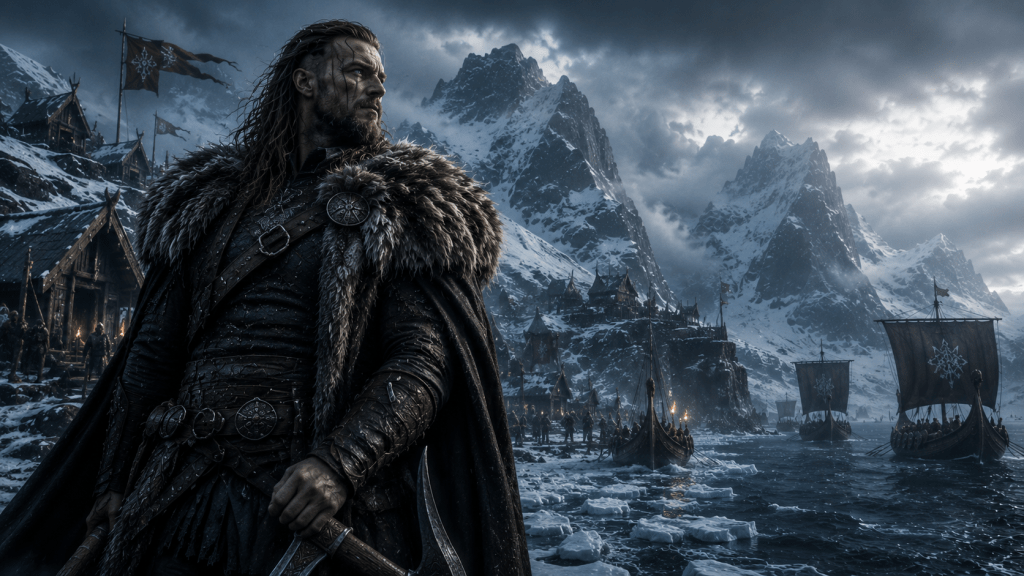
Týrnan belongs to Njorvik, a northern realm of icy fjords, restless seas, and hard coastlines where survival is never treated as a gentle thing. The land itself teaches discipline before any elder or warrior can speak of it. Winter presses close, food must be guarded, ships must be built well enough to withstand storms, and every clan knows that weakness can place an entire people at risk.
That background matters because Týrnan’s violence does not come from emptiness. He has been shaped by a culture that understands war as one of the tools by which a people endure. The Frostbane are not soft men dragged unwillingly into conflict. They are seafarers, fighters, raiders, and survivors, and Týrnan has risen among them because they trust his judgement as much as his strength.
Yet leadership in such a world is never only a matter of being the strongest man with an axe. Týrnan must hold together warriors who carry pride, old grudges, fear, hunger, loyalty, and ambition into the same ships. When men under his command threaten to turn their blades upon one another before the voyage has even begun, he does not answer with rage for its own sake. He steps between them and reminds them that their strength belongs to the tribe, not to private quarrels.
That moment reveals the foundation of his character. Týrnan is dangerous, certainly, but he is not careless. He understands that a warband divided by pride will break long before an enemy army reaches it. His authority rests not merely in his ability to kill, but in his ability to restrain men who might otherwise mistake violence for honour.
The Shadow of the High Chieftain
The southern invasion does not begin under clean banners or noble certainty. It begins under the influence of a High Chieftain whose rule has already darkened into fear. Whispers move through the clans of villages punished for defiance and warriors slain for questioning commands, suggesting that the campaign is being driven by more than survival alone.
For Týrnan, this creates a fracture he cannot easily ignore. He is loyal to his people, and he understands the need for strength, but he also recognises the difference between command and cruelty. The High Chieftain speaks of conquest and unity, yet his rule begins to look less like leadership and more like domination. That distinction becomes important because Týrnan’s own authority depends upon trust, while the High Chieftain’s power increasingly depends upon fear.
Elder Gormund’s warning sharpens this tension. When he tells Týrnan that the Frostbane follow him more than they follow the High Chieftain, he is not simply offering praise. He is placing a weight upon him. It means Týrnan can no longer hide behind obedience. If the campaign becomes brutal, if honour gives way to appetite, if the invasion ceases to be about survival and becomes something uglier, then Týrnan will have to decide how much of it he is willing to carry.
That is where his story begins to deepen. He is not outside the violence. He is part of it. He sails with the invasion, commands warriors within it, and benefits from its victories. Yet the story does not allow him the comfort of pretending that all violence is the same. From the beginning, Týrnan is forced to measure the difference between necessary war and the kind of brutality that consumes the people who practise it.
Across the Storm-Torn Sea
The crossing south is one of Týrnan’s defining early trials because it strips leadership back to its simplest form. There are no walls, councils, thrones, or excuses upon the open sea. There is only the longboat, the storm, the oars, the men, and the question of whether fear will break them before the waves do.
As the sea rises and the sky darkens, Týrnan must become the voice his warriors cling to. He invokes Tharok, the war god revered among the northern tribes, not as decoration, but as a language his people understand in moments of terror. When a young warrior falters and cries that the gods have turned away, Týrnan does not dismiss the fear as weakness. He turns it into endurance, telling the men that the gods test those who would be worthy of their gaze.
This is not simple faith. It is leadership shaped through belief.
Týrnan understands that warriors do not survive because they are never afraid. They survive because someone gives their fear a shape that can be endured. In that storm, he does exactly that. He takes the panic spreading through the crew and binds it back into rhythm, rowing, prayer, and defiance. When lightning reveals the other longboats still moving through the dark sea, the sight becomes more than relief. It becomes proof that the tribes have not yet been scattered, even if the gods remain silent.
The storm therefore becomes a mirror of Týrnan himself. On the surface he is steady, commanding, and immovable. Beneath that strength, uncertainty continues to gather, because surviving the sea only brings him closer to the harder question waiting on land.
The First Shore and the First Doubt
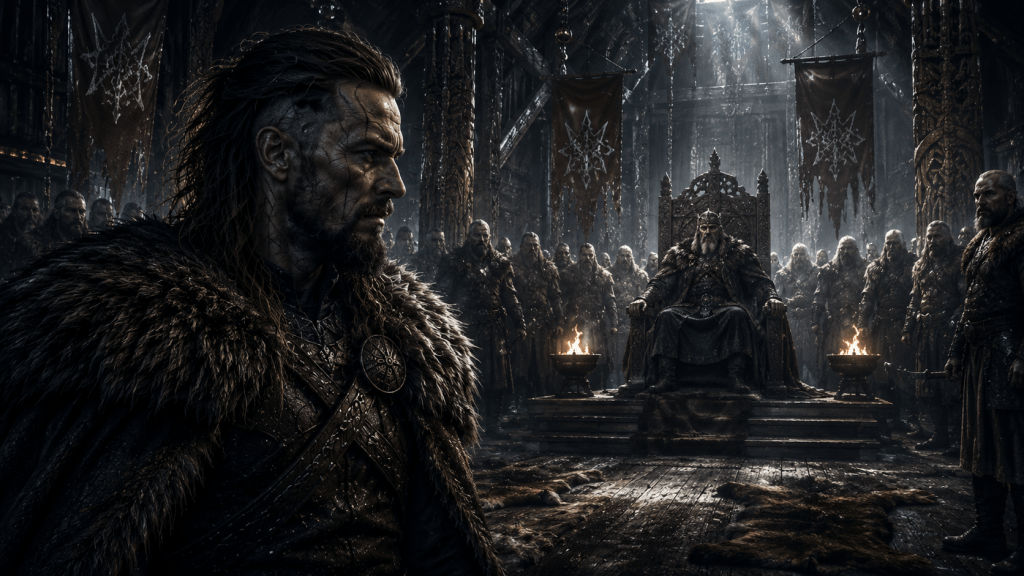
When the longboats reach Vaeldring, the invasion becomes real. The ships grind onto the shore, warriors spill into the shallows, and the first village falls beneath Frostbane steel. It would be easy to frame this moment as triumph, but Týrnan’s reaction complicates it. The victory comes too easily, and that ease unsettles him more than resistance might have done.
The defenders are few. The settlements seem exposed. Villages are abandoned with a speed that suggests preparation rather than cowardice. Other chieftains see weakness and opportunity, while Týrnan sees a pattern he cannot yet explain. Something has drawn Vaeldring’s strength elsewhere, and the silence left behind feels less like surrender than a warning.
This is where Týrnan’s mind separates from the men around him. Some see plunder. Some see captives. Some see a road opening towards greater conquest. Týrnan sees absence, and that absence troubles him because it implies a larger movement beyond the reach of his immediate knowledge.
His refusal to let the Frostbane take slaves matters here. It does not make him innocent, and it does not erase the violence of the invasion, but it marks a boundary within him. He will take resources for war. He will fight enemies. He will march into foreign lands for the future he believes his people need. Yet he refuses to let his tribe become a swarm of men who mistake suffering for spoils.
That line may not be enough to save him from guilt, but it shows that a line still exists.
The Conqueror Who Has Not Yet Chosen Himself
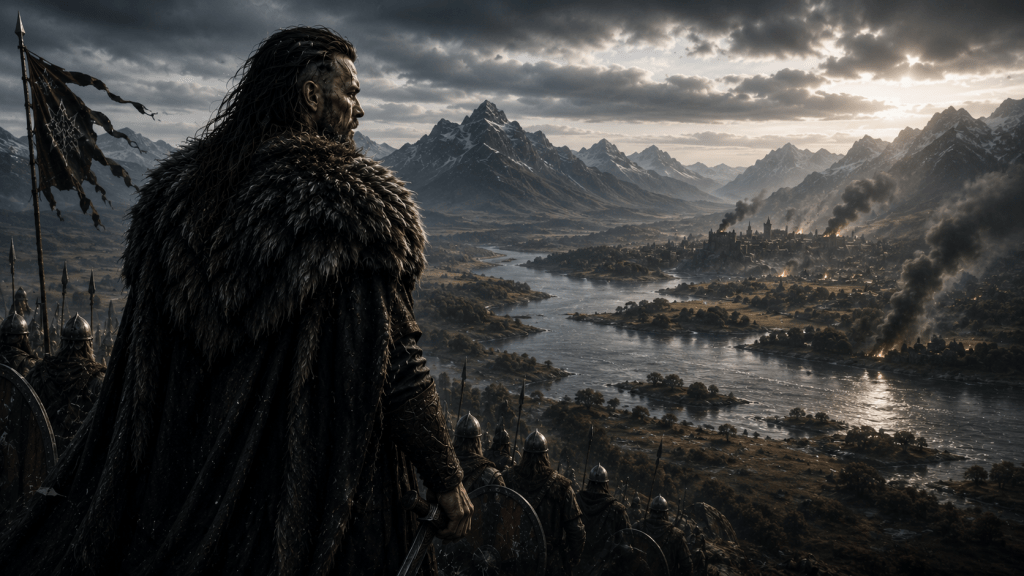
Týrnan’s Book 1 arc matters because he begins as a conqueror who has not fully understood what conquest will ask of him. He believes he is moving towards survival, honour, and perhaps divine favour, yet every step south places him closer to truths that disturb the simplicity of that belief.
He is not a hero standing cleanly apart from the darkness. He is not a villain without conscience. He is a man moving through war while still trying to preserve some inner law against the appetite of the campaign around him. That makes his choices more interesting because they do not come from purity. They come from pressure, contradiction, and the slow recognition that a leader may be judged not only by the victories he wins, but by what he allows victory to turn him into.
The lands ahead are already preparing for another threat, and Týrnan does not yet understand how wide the conflict truly is. The southern kingdoms are not empty prizes waiting for northern hands. They are part of a larger world already strained by hidden forces, political fractures, ancient memory, and powers moving beneath the surface of ordinary war.
By the end of his early movement, Týrnan has crossed the sea, entered the southern kingdoms, and begun the invasion that will shape his future. Yet the most important part of his story is not the land he takes. It is the doubt he carries with him.
The war he crossed the sea to fight is only the beginning, and before long the warleader of the Frostbane will be forced to decide whether strength means obedience, conquest, restraint, or something far harder than any of them.
He will have to decide what kind of man he truly is.
