Where the ground beneath the district gave underfoot, then rose again in measured stillness, as though the stone itself had taken breath.
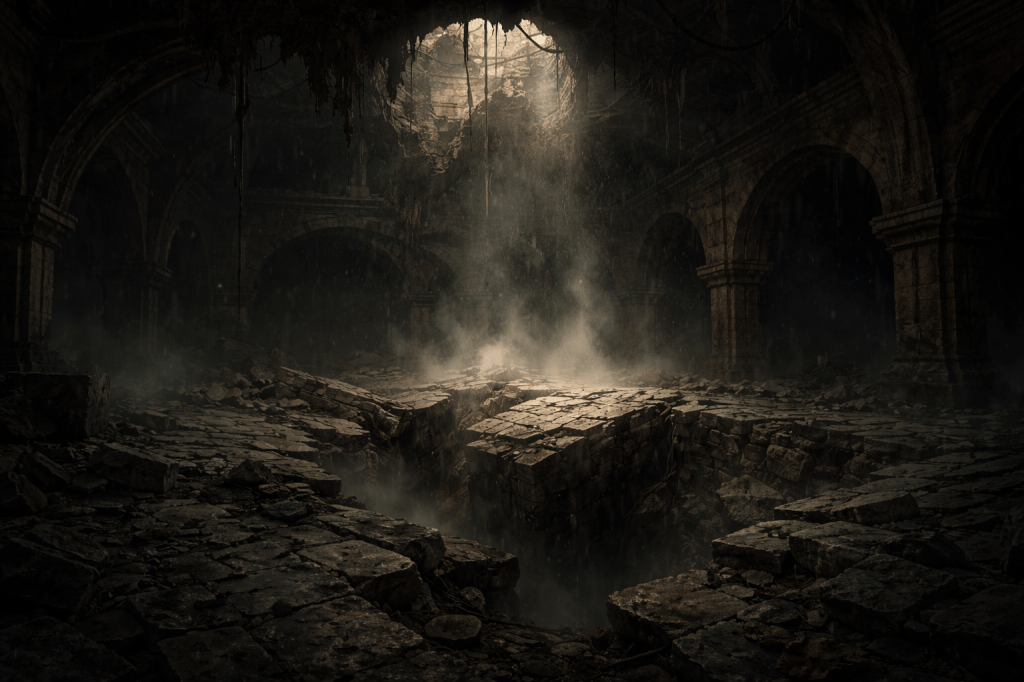
The Stone that Breathed
The yard behind the adjoining houses lay in the grey hour before trade had taken full hold of the district. High walls enclosed it on three sides, patched through years of repair with fresh mortar laid over older stone, while the flagging underfoot held the shine of recent rain in long dark seams. Water gathered in the shallow wear of the slabs and clung there, turning the ground into a dull mirror wherever the light from above found it. Even at that early hour the place carried a kind of hush that felt set apart from the lanes beyond, as though voices and wheels lost their force before they crossed the passage and entered that enclosed square. When three men came through the side gate with rods, a level frame, and a crate of tools, the scrape of iron over stone seemed to travel too far, then sink away into the yard as if the ground had received it.
Carvel, who led the inspection, stood with one hand resting on the frame and looked across the central run of slabs where the steward had marked a settlement on the evening before. At first glance the paving seemed sound. The rear step held firm beneath the water trough. The stack of empty casks still leaned beside the arch. The drain channel ran straight towards the passage mouth. Yet the eye kept returning to a broad patch near the middle where the joints had darkened into a ring and the stone sat lower by a whisper of an inch. It was the kind of change most men would pass twice before they saw it, then once seen, would carry in the mind with growing unease.
“Set the rods at the edge first,” he said. His voice stayed low, shaped by long habit in old places.
Hedd, younger and quicker in all his movements, crouched at the northern joint and fed the iron down between two slabs until it met resistance. Marr, broad-backed and slow, crossed to the western side and did the same. Carvel opened his folio, fixed the slate within it, and made the first marks while the light strengthened over the wall tops and laid a pale strip across the stones.
“Read.”
“Five inches,” Hedd said.
“Six at this side,” Marr answered.
Carvel marked both figures. “Again.”
They shifted position. Each new measure changed by a fraction. On the eastern side the rod turned slightly as it sank, as though the space beneath the paving opened away from the line where it had been set. Hedd drew it up and rubbed the pale dust from its grooves between finger and thumb. No damp clung to it, though the joints above still held the dark from the rain.
“That came from deeper down,” he said.
Carvel took the rod and looked at it for a moment. Fine grit lay in the score lines, light as ash and dry as old mortar ground under a hammer.
“A hollow sits under the centre,” Marr said.
“Perhaps,” Carvel replied. He lowered the rod and glanced again at the dark ring. “Though hollows in old yards usually keep still.”
They set the level frame over the marked patch and adjusted its feet with care. Hedd hung the plumb line from the crossbar and watched the weighted point circle above the widest slab. The line slowed, steadied, and came to rest over a joint that looked almost black in the poor light.
“Strike the outer edge,” Carvel said.
Marr took the haft of his hammer and tapped the stones in turn. The first four answered with the same blunt contained tone. Each sound travelled across the yard, pressed into the walls, and died there. When he struck the lowered slab, the note changed at once. It dropped away through the ground instead of spreading across it, carrying a depth that seemed out of keeping with the yard’s small measure. All three men heard it. All three men kept still after it passed.
“Hear that again,” Carvel said.
Marr struck the same stone a second time. The note fell as before, though this time it lingered below them for the length of a drawn breath, and during that held moment a faint pressure touched the soles of their boots. Hedd shifted his weight and looked towards the surveyor. Marr lowered the hammer a little, his hand tightening on the wood.
“That moved under us,” Hedd said.
Carvel crouched and laid his palm flat against the slab. The stone felt cold. Beneath the cold there came a rise so slight he could almost have named it memory, save that it gathered under his hand, held, and eased away again with slow purpose. He drew back at once, stood, and closed his folio.
“Clear the casks from the wall,” he said. “Move the crate as well. Leave the yard open.”
Neither man asked him for a reason. Marr went first, lifting the empty barrels one by one and carrying them through the passage into the lane. Hedd gathered the tools and the frame, set them by the gate, then returned and stood just clear of the dark ring, watching Carvel as though the older man might give shape to what had begun under the stone. Carvel’s attention remained on the plumb line. The weighted point hung almost still. Then it drew a fraction to the south, paused, and came back. No wind touched the yard. The water in the trough by the rear step held its surface smooth as glass.
“It shifts between measures,” Hedd said.
Carvel gave a brief nod. “Bring the lamp.”
Hedd fetched it from the crate and lit it with a spill from the shuttered flame he carried at his belt. The small amber light spread over the flagged centre and sharpened the wet seams between the stones. In that warmer glow the ring appeared wider than before, the dark joints holding a moist blackness that seemed fresh laid, as though the paving had drawn breath from below and pressed it upward through the cracks.
Marr came back from the lane and set down the last cask. “The steward will ask what holds us here,” he said.
“He can ask,” Carvel replied. “Take the lifting bar to the centre seam.”
Marr slid the iron under the lip of the broadest slab and leaned his weight into it. At first the stone held firm. Then, with a fine grinding sound from somewhere below its edge, it rose the depth of two fingers and hung there on the bar. A thread of dust drifted upward through the opening, pale in the lamplight. Hedd bent with the lamp and lowered the flame towards the gap. The beam caught broken mortar, a wedge of darkness, and the faint movement of more dust rising from beneath in slow twisting lines.
“There is space under it,” Hedd said.
“There is more than space,” Carvel answered.
A scent came up through the join while he spoke, dry and old at first, then touched by a sweetness that turned the stomach through its very thinness. It carried no richness of rot. It had the strange lightness of something long shut away that still found means to linger. Hedd drew his head back, though his eyes never left the gap.
“That smell came from deep stone,” he said.
“Raise it a little further,” Carvel said.
Marr shifted his grip and pressed again. The slab lifted another inch. The sound that followed rose through the opening in a slow drawn exhalation, as if the ground had released a held breath through a narrow throat. The men heard no crack, saw no breaking edge, felt no sudden violence. The change began in the joints around the lifted slab. One seam widened. Then a second opened near it. Across the whole dark ring the paving eased downward together in a motion so slow the eye could follow every part of it. The plumb line trembled above the centre. Water in the worn hollows shivered and drew inward along the widening seams. The entire marked section lowered the depth of a hand.
Hedd stepped back until his shoulders touched the wall. Marr kept the bar fixed under the slab, though his stance had altered and his face had emptied of all labourer’s ease. Carvel alone stayed near the edge, the lamp held low, his gaze moving across the ring as each stone settled into its lowered place.
“It sinks in measure,” Marr said.
Carvel heard him, though his attention had gone elsewhere. A low pressure had risen with the movement, no sound at first, only a gathering in the air that filled the chest and held there. Then, from below the lowered paving, there came a tone so faint it seemed almost to live inside the ear instead of within the yard. It lasted only a moment. Even so, it followed the descent as clearly as a sigh follows effort.
The ground stayed down for the space of three breaths.
Dust continued to rise through the open seam under Marr’s bar. The sweet thin scent strengthened, then spread through the yard in a shallow veil. Hedd kept one sleeve over his mouth. Marr stared into the gap beneath his stone, as though he expected some hand or face to rise into the lamplight. Carvel watched the plumb line. The weighted point had ceased its trembling and now hung slightly lower, the cord pulled taut over a centre that no longer sat where it had sat a moment before.
Then the ground came up again.
The motion followed the same dreadful calm. The lowered slabs rose together by degrees. The widened joints drew inward. Water ran back across the stone in fine trembling lines. Marr’s lifted slab eased down against the bar as the whole centre returned to level, and when at last it settled into its bed the sound it made held the softness of a mouth closing after speech. The plumb weight turned once more and came to rest. The dark ring remained. The yard stood as it had stood when they entered, save that the seams now looked fresher, wetter, and more deeply cut.
Hedd found his voice first. “That was no collapse.”
“No,” Carvel said.
Marr eased the bar from the joint and laid it on the stones with care. “Then what do I enter when he asks?”
Carvel looked across the centre and spoke only after a long pause. “You enter what was seen.”
Marr gave a humourless breath. “The ground gave way and rose again?”
“If you have the courage for plain truth, yes.”
No one moved for a while. Beyond the yard the district had begun its day in earnest. Wheels passed over cobbles. A woman called from an upper window. Somewhere along the lane a hammer started its work upon wood. Within that enclosed space, each outer sound arrived thinned and distant, while beneath them all there seemed to linger the memory of the lower movement, held close under the flags like a second life under the first.
Carvel took the rod from Hedd and knelt again beside the centre seam. He fed the iron into the joint where Marr had lifted the slab. It sank deeper than before. When it stopped, the rod gave a slight turn in his hand, then steadied. He drew it back and found a pale trace upon the lower score lines, finer than dust, almost white.
Marr saw it first. “Mortar?”
Carvel rubbed it with his thumb. The grit felt dry, fine, and faintly greasy, as though it had passed through long-closed air before reaching the surface. He lifted it to the lamp. White flecks caught the light against his skin.
“Keep your hands clear of the joints,” he said.
Hedd’s eyes went at once to the ring around the centre. “You think something is working upward.”
Carvel rose. “I think the ground answered its own measure. That is enough for one morning.”
He closed the folio, though the charcoal in his hand had paused over the slate before making its final line. Marr gathered the bar and hammer. Hedd lifted the lamp and the rods, his gaze still fixed on the central slabs as if he feared a second motion might begin the instant his back turned. Together they moved towards the gate, each step careful and placed with more thought than it had carried on the way in.
At the threshold Carvel stopped and looked back.
The flagged centre lay quiet in the pale light. The ring of darkened joints held around it with a shape too even for chance. A last thread of dust drifted up from one narrow seam and vanished in the damp air. Then, under the watch of all three men, the broadest slab sank by the breadth of a finger and rose again, a small measured motion, no more than a pulse passing through skin.
Hedd made a sound in his throat and stepped into the passage. Marr followed at once. Carvel remained one moment longer, the folio held under his arm, the lamp glow reaching only so far across the yard.
He heard it then, or felt it, and for years afterward he would have struggled to say which. A low interior pressure gathered beneath the stones, held there, and eased away again in a slow returning wave, as though some buried mass below the district had drawn in air through the roots of the walls and released it once more into the foundations above.
When he left the yard and drew the gate to behind him, the sound of the lane closed around the three men and the morning took them back into its ordinary movement. Behind the timber, beyond the patched walls, the ground settled into stillness. It held that stillness with perfect composure, while under the flags the dark seams kept their widened shape and the space beneath the centre lay ready for the next slow descent.
Foundation Register: Rear Foundation Movement Record
The yard entered within the adjoining property plans appears as part of a shared service ground set behind several lower structures, its surface formed through successive layers of paving laid over earlier fill and supporting stone. Surviving revisions record minor alterations to drainage and access across different years, while the central flagged section remained unchanged in outline, its condition accepted as sound within the ordinary pattern of repair.
During routine inspection following reports of settlement within the rear paving, the yard was entered for assessment, and early observations were recorded in practical terms, referring to slight lowering across a central run of slabs, widening damp within the joints, and the possibility of subsidence beneath the flagged surface. These entries held to the language of maintenance and assigned the condition to age, weathering, and long pressure within the underlying fill.
Subsequent notes describe irregularities in the behaviour of the paving during measurement, where rods placed through the joints returned differing depths across a confined section whose outline remained stable in the surrounding stone. Early descriptions refer to this as uneven settlement, though later entries distinguish the movement from ordinary ground loss, recording that the flagged centre appeared to lower and recover within a measured interval while the adjoining sections held firm.
In several accounts, the movement is described as occurring across the full marked section at once, with the slabs easing downward in a single contained shift before returning to their prior level. These observations are entered cautiously, with later revisions attributing the effect to distributed pressure beneath the paving or to movement within a concealed pocket of older material set below the visible surface.
A number of entries refer to changes accompanying the descent, where seams widened briefly, pale residue rose through the opened joints, and a low pressure gathered in the air above the flagged centre. These notes remain limited in detail and are not expanded within the primary record, with several later annotations omitting reference to the atmospheric change entirely and retaining only the structural description.
Further examination records that the behaviour appeared more pronounced where individual slabs were raised for inspection, at which point the movement below the surface was entered as responsive to disturbance within the upper layer. In these sections, the paving is described as lowering in deliberate measure rather than in fracture, and the return is recorded as steady, with no breaking edge or collapse extending beyond the marked ring.
Several observations refer to material recovered from the deeper joints, where a dry pale grit was brought up from beneath the paving despite recent rainfall across the yard above. This substance is entered as degraded mortar or residue from older construction below the present surface, and no further inquiry was undertaken concerning its source or persistence.
The condition was attributed to instability within the underlying fill and to concealed voids or channels set beneath the rear ground, and limited reinforcement was recommended along the affected section. The yard remained in use for a short period following inspection, during which additional observations were entered in reduced form, referring to minor repeated shifts within the central paving and the continued darkening of the surrounding seams.
A marginal notation, written in a later hand, refers to the movement as “measured settlement within the lower layers, as if the ground yielded and resumed in turn”, a phrase set apart from the main entry and left without further explanation. The notation appears once and is absent from subsequent revisions of the same record.
Final entries indicate that the affected section was reinforced during later works carried out beneath the adjoining structures, and its condition was listed as stabilised within the internal plans. The irregular movement was recorded as contained within the limits of structural variation, and no further observation was entered following the completion of those measures.
The matter was entered as resolved within the register, and the yard remains recorded as a stable rear service ground behind the district properties, its condition accepted within the limits assigned to it and requiring no further attention.
About the Creator
The Mythic Chronicle is written and curated by Simon Phillips, a writer of mythic and speculative fantasy whose work explores the quieter edges of forgotten worlds, where buried structures, fractured records, and lingering presences continue beneath the surface of recorded history.
The accounts preserved within these Chronicles form part of a wider body of work in which cities stand upon older foundations, and events recorded as isolated disturbances are understood, in later tellings, to belong to patterns that were never fully recognised at the time.
One such account survives in a separate record, detailing an incident within a lower district where a death was first dismissed as excess, though the space in which it occurred retained a presence that resisted clearing, and where investigation revealed signs that the disturbance had not been confined to a single room.
This record is preserved in the novella Black Feathers in a Brothel, where the events surrounding that incident are followed more closely, though even there the full nature of what lay beneath the structure remains uncertain.
Readers who wish to examine that account in its fuller form may find the record below.
Explore the book:
Black Feathers in a Brothel
You can watch his YouTube channel here:
Author Simon Phillips

Continuation of the Record
What follows is drawn from later entries concerning the rear yard behind the adjoining houses, where movement was first entered as ordinary settlement within the flagged centre. Early accounts describe the change in practical terms and assign it to age, pressure, and variation within the lower fill, though subsequent notes refer to repeated instances in which the ground was seen to lower and recover in measured sequence. Each occurrence is entered briefly and left within the language of maintenance, while several annotations refer to widening seams, pale residue rising through the joints, and a pressure within the air that gathered before the movement took hold. In later entries, the descent is described as affecting the full marked section at once, as though the surface answered to a deeper motion within the hidden layers beneath the yard. The cause remains assigned to structural conditions below the paving, and each account concludes with the ground accepted within the limits set down for it in the register.

Subscribe to continue reading
Subscribe to get access to the rest of this post and other subscriber-only content.
