A record of the chapel beneath which the stone first answered, though no account agrees on what was heard within it
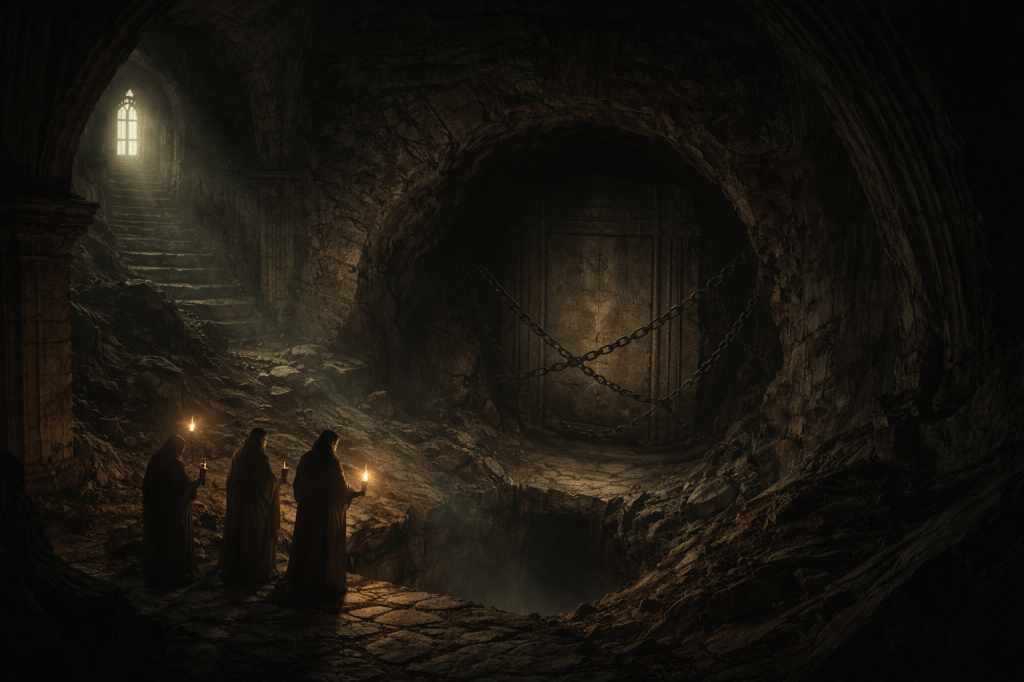
The Record of the Lower Chapel Stair
The steps beneath the chapel had been sealed long before any of them were born, while the stone held the memory of passage and the air carried a stillness that belonged to use long since withdrawn.
Brother Halven paused at the threshold where the last of the daylight reached, his lantern held low as though the flame itself might disturb what lay below, and he remained there for a time as his eyes adjusted to the dimness and the quiet settled more firmly around him. The stairwell curved away in a narrow descent, worn smooth by a passage that had once seen frequent use, even if no record within the chapel spoke of its purpose, and the marks left by that former movement seemed to linger with a presence that had not entirely faded.
“Are you certain it begins here?” he asked, the words drawn out more from a need for sound than from doubt, as though the act of speaking might steady the space itself.
The man beside him, a stonemason by trade, though called here under a quieter instruction, shifted his weight and looked down into the dark as though it might answer before he did, his gaze lingering in a way that suggested he had already measured what could be seen and found it insufficient.
“It is where it was closed,” the mason said after a moment, his voice carrying without strain into the confined space. “Where it begins lies further in.”
Halven held his gaze on the stair, taking in the shallow curve of the walls and the faint marks left by hands long gone, each one catching the lantern light in ways that suggested presence lingering in absence, and he found that his attention returned to them again and again, as though they carried some trace of what had passed through here before the sealing had taken place.
Behind them, the chapel doors had been drawn shut, leaving the world above reduced to a distant sense of structure rather than sound, while the faint trace of incense lingered along the stone as though unwilling to fade, and the memory of it seemed to press downward with them as they stood at the edge of the descent.
Halven stepped forward, committing his weight to the stair with a measured motion that carried him from the threshold into the enclosed passage, and the change in the air came at once, subtle though unmistakable.
The first step took his weight with a dull shift that travelled further than it should have, and the dust that rose beneath his boot hung for a moment in the air as though held in place before it settled again, while the faint sound of the movement seemed to linger longer than its cause.
He raised the lantern, allowing the light to press outward into the space ahead, where it thinned as it reached forward, fading into the darkness without meeting any clear boundary, and as he watched it, he became aware that the walls seemed to draw closer as the stair descended, rough where the stone had been cut and smoother where time and touch had worn it down.
“How far?” he asked, his voice lowered by the space itself, shaped by the closeness of the walls and the weight that seemed to rest within them.
The mason followed a pace behind, his own lamp casting a second shadow that moved against the first in a slow and uneven rhythm, the two shapes crossing and separating as the descent continued.
“Only a short distance,” he said. “The break lies near the base. The stone there carries through the wall.”
Halven let the words settle, the phrasing holding without opening, and he moved on as the stair drew them further down.
They continued step by step, the passage narrowing in feeling, if not in measure, while the air cooled as they descended and pressed against the chest in a manner that belonged to confinement rather than depth, and Halven became aware of his breathing as it moved through him with a faint resistance that had not followed him from above.
At the turn of the stair, he slowed and then came to a stop, his hand tightening around the lantern’s handle as he listened more closely to what lay ahead.
“Do you hear that?” he asked, keeping his voice low as though the space itself might answer if given cause.
The mason inclined his head, listening with a stillness that suggested familiarity with such moments, his attention fixed on something that lay beyond the reach of sight, and he remained in that posture long enough that the silence around them seemed to deepen in response.
“It is within the stone,” he said.
Halven frowned, his eyes narrowing as he strained to place the sound, which seemed to rest in the space rather than move through it, and each attempt to follow it only caused it to slip further from clear perception.
“This carries no shape,” he said. “It holds itself in place.”
“It requires no path,” the mason replied, his voice quiet though steady.
The sound lingered, a low and layered presence that rose and fell without direction, slipping from any attempt to follow it and leaving only the sense that it had been there at all, while beneath it a faint scent threaded through the air, turning slowly as it settled, something sweet that had been left too long in stillness.
“We should leave this place,” Halven said, though he remained where he stood, his grip tightening slightly on the lantern as the thought failed to carry him back.
The mason gave a small nod, his attention still held ahead, and together they continued downward until the stair ended at a narrow landing where the passage met its closure.
The wall ahead had been reinforced with heavy stone blocks set at a later time than the passage itself, their edges uneven and their placement hurried, as though the act of closing had mattered more than the manner of it, and the join between them held a tension that had not settled into age.
Halven stepped forward and placed his hand against the surface, feeling the cold of the stone beneath his palm, while within that cold there lay a faint movement that passed into him, slight at first though it held once it reached him, as though something shifted deep within the wall.
He drew his hand back, his fingers tightening slightly as he looked to the mason, the sensation lingering in his skin even after contact had been broken.
“This was done in haste,” he said, allowing the words to settle into the space between them.
“Years ago,” the mason replied, his gaze still fixed on the wall. “The marks remain.”
Halven lifted the lantern closer, bringing the light across the surface where scratches ran along the blocks, shallow and uneven, as though something had pressed against them from the other side, each line catching the light before fading back into the roughness of the stone, and the repetition of them suggested a persistence that had not eased.
“Tools would leave a cleaner edge,” Halven said, his voice quieter now, shaped by the closeness of the space and the weight of what lay before him.
The mason shook his head once.
“No tool reaches through stone from the far side,” he said.
The sound came again, and this time it gathered for longer, a layered murmur that seemed to rise through the wall itself, holding for a breath before breaking apart into something that slipped away again, leaving a trace that lingered in the air.
Halven felt his throat tighten as he stepped back from the surface, the space around him seeming to shift with the movement.
“There are people below,” he said, though the words failed to hold as they left him.
The mason remained still, his attention fixed beyond the wall.
“There is something below,” he said.
The lantern light flickered, its flame bending without any movement in the air to disturb it, and Halven steadied it with his hand, watching as the shadows shifted along the walls in a slow and uneven motion.
“We must break through,” he said, forcing the words into shape as the pressure within the space grew harder to ignore. “If anything remains.”
“There is nothing left to reach,” the mason said quietly.
Halven turned to him, searching his expression, though the man’s gaze remained fixed beyond the wall, as though the stone itself held more than its surface revealed.
“How can you speak with such assurance?” he asked.
The mason remained still, his attention held by what lay unseen.
“Because this was sealed to hold something in place,” he said.
The sound returned once more, and it held longer this time, gathering into something that almost took shape before slipping away again, while the scent in the air deepened and settled between them.
Halven felt the space thicken around him as the lantern light dimmed without losing its flame, and the words came as though they had been spoken before.
“We close it again,” he said.
The mason remained where he stood.
“It was never closed,” he said.
Halven held his breath for a moment, the weight of the stair rising behind him and the chapel above reduced to something distant, while before him the wall remained steady in a way that grew less certain with each passing breath, and the presence within the stone seemed to settle more fully into the space.
The sound faded, and the silence that followed carried it more fully than any echo could have done, settling into the stone as though it had always been there.
Foundation Register: Chapel of Saint Veyne
The chapel stood upon an earlier foundation whose origin was absent from the surviving register, and what remained of the record held only passing reference to structures that had once occupied the ground before the present walls had been raised.
During restoration of the lower chamber, structural surveys recorded a void beneath the western section, reached by a narrow stair that descended into the foundation and was later sealed at its base, the entry noting the closure as completed following disturbance encountered within the stone during inspection of the wall.
The nature of that disturbance was left without description, though a separate notation, set apart from the main record, referred to the presence of sound within the structure, described only as persistent and unaffected by movement within the passage, and no attempt was made within the register to assign cause or meaning to what had been heard.
The stair was marked as secured, though later annotations suggested further work had been required after the initial closure, and the absence of any formal record of its completion remained without correction, leaving the entry incomplete in a manner that was neither revised nor removed.
No subsequent references to the passage appeared within the register, and the foundation beneath the chapel was thereafter recorded as stable.
About the Creator
The Mythic Chronicle is written and curated by Simon Phillips, a writer of mythic and speculative fantasy whose work explores the quieter edges of forgotten worlds, where buried structures, fractured records, and lingering presences continue beneath the surface of recorded history.
The accounts preserved within these Chronicles form part of a wider body of work in which cities stand upon older foundations, and events recorded as isolated disturbances are understood, in later tellings, to belong to patterns that were never fully recognised at the time.
One such account survives in a separate record, detailing an incident within a lower district where a death was first dismissed as excess, though the space in which it occurred retained a presence that resisted clearing, and where investigation revealed signs that the disturbance had not been confined to a single room.
This record is preserved in the novella Black Feathers in a Brothel, where the events surrounding that incident are followed more closely, though even there the full nature of what lay beneath the structure remains uncertain.
Readers who wish to examine that account in its fuller form may find the record below.

Explore the book:
Black Feathers in a Brothel
You can watch his YouTube channel here:
Author Simon Phillips
Chronicle Record: Lower Chapel Passage
They returned to the chapel before dawn, when the streets above still held the quiet that came before trade and prayer reclaimed the day, and the doors were opened only far enough to admit those who had already been told what they would find within, the hinges giving a low sound that carried briefly before settling into the stillness of the nave.
Brother Halven stood at the front with two others drawn from the order, men who carried themselves with the restraint expected of their station, while their attention moved often toward the western wall where the stair lay concealed beneath stone that gave no outward sign of what rested below. The air within the chapel held its usual scent of wax and incense, while beneath it a faint sweetness lingered, settled so lightly that it might have passed unnoticed had it not already been known.
“You heard it clearly?” one of the brothers asked, his voice kept low so that it remained within the space between them and did not travel further into the chamber.
“It held within the stone,” Halven said, keeping his tone even, though the memory of it remained present as he spoke, resting within him with a weight that had not lessened since the night before. “It carried no distance.”
The second man, older and marked by years of quiet service, inclined his head in a slow acknowledgement, his gaze fixed upon Halven with a steadiness that measured more than the words alone.
“And the passage remains sealed.”
“It was sealed when we left it,” Halven replied, his eyes shifting briefly toward the wall before returning. “Whether it holds is another matter.”
The older brother turned slightly, his attention moving toward the wall as though he might read it through the stone alone, and after a moment he spoke again, his tone steady and contained, shaped by long habit rather than hesitation.
“We will leave it,” he said. “The work below has been concluded. There is no purpose in opening what has already been set aside.”
Halven held his silence, the memory of the sound resting within him with a persistence that gave the words little weight, and the stillness of the chapel pressed more firmly around him, as though it held that same memory in place.
“It remains active,” he said after a moment, his voice quiet though certain. “Whatever lies below has not settled.”
The older man’s expression remained unchanged, though his eyes sharpened slightly as he regarded Halven more closely, weighing what had been said without allowing it to alter his stance.
“Then it will settle,” he said. “Such things pass.”
Halven lowered his gaze, the answer meeting the weight of the space and falling short, and he turned his attention toward the wall once more, where the stone held its place with an ease that felt too steady to trust.
“We should confirm the seal,” he said, the suggestion carried with quiet insistence, though it held the shape of something already decided.
The two men exchanged a brief glance, and the younger shifted his stance as though preparing to object, though the older brother raised a hand and the motion ceased before it took form.
“You will confirm it,” he said to Halven. “You will do so with care, and you will record that the foundation remains stable.”
Halven inclined his head, accepting the instruction without further word, and turned toward the western wall, where the covering stone had already been prepared for removal.
The stair was opened again, the slab drawn back and the narrow descent revealed once more, while the air that rose from it felt heavier than before, as though it had settled deeper into itself in the hours since they had left it, carrying with it the same faint sweetness that had no place within stone.
Halven took the lantern and stepped down, the others remaining above at the edge of the opening where the light did not reach, and as he descended the silence below deepened into something that held rather than waited, enclosing the space around him with a steadiness that resisted change.
Each step carried him further into that held space, and the marks along the walls seemed more pronounced, the worn stone catching the light in ways that suggested movement long after it had ceased, and his gaze returned to them again and again, as though they held some trace of what had passed here before the passage had been closed.
At the turn of the stair, he slowed, listening for the sound that had lingered before, though it gave no immediate answer, leaving only the weight of the air and the scent that had deepened into something more difficult to ignore as it settled within the passage.
He continued downward, the stair giving way to the narrow landing where the reinforced wall stood as it had before, its surface marked by shallow lines that caught the lantern light and faded again, though the pattern of them suggested a persistence that had not eased with time.
As Halven approached, he felt the faint movement within the stone before his hand reached it, the vibration passing outward with a presence that required no contact, and he stopped a short distance from the wall, holding himself still as he listened.
The sound came then, filling the space at once, a layered murmur that held within the stone and pressed outward without direction, and as Halven listened, he felt it settle into him, received and held.
He drew a breath and stepped closer, raising the lantern so that the light moved across the scratches, where they seemed to shift as the flame moved, though no change held once his gaze fixed upon them.
“Brother Halven.”
The voice came from above, distant though clear, and he turned his head slightly, though his stance remained, the sound within the wall holding his attention even as the call reached him.
“It holds,” he said, his voice carrying upward through the stair. “The stone remains set.”
“Then return,” the voice replied. “The record will be made.”
Halven remained where he stood, the sound within the wall gathering again, holding longer this time, and within it there came a pattern that gathered toward shape before slipping away again.
“Brother Halven.”
The call came again, sharper now, and he drew a breath, forcing his attention back toward the stair, though the sound lingered within him as he turned away from the wall.
“I am returning,” he said, and stepped back, the movement breaking something in the air so that the sound shifted with it, thinning for a moment before gathering again, though it no longer held with the same weight as before.
He began the ascent, the stair rising before him in a slow curve that seemed longer than before, and with each step the air grew lighter, the pressure remaining with him as he moved upward, settling deeper with each step.
When he reached the threshold, the light from above pressed down, and the presence within the passage fell away enough that he drew a full breath, though the faint trace of sweetness lingered still.
“It holds,” he said as he stepped into the chapel once more, his voice steady, though the memory of the space below remained with him.
The older brother watched him, his gaze measuring more than the words alone, and then inclined his head in quiet acceptance.
“Then it will remain so,” he said, and the covering stone was returned to its place, the stair sealed once more beneath it as the chapel resumed its usual order.
Halven remained for a time after the others had gone, standing near the western wall where the stone gave no sign of what lay below, and his attention returned to that place again and again, where the wall gave nothing back.
The day passed in its accustomed rhythm, the chapel filling and emptying as it always did, though the memory of the stair remained close, held without fading as the light shifted and the hours moved on.
As evening fell, Halven returned to the lower chamber, carrying no lantern, allowing the dimness of the space to remain undisturbed as he stood before the sealed stair, his breath steady as he listened into the stillness that held there.
For a long time, the space remained quiet, though the quiet itself held a weight that pressed gently against the ear, and when the sound came again, it rose slowly from within the stone, gathering into a layered murmur that held in place and pressed outward without direction.
Halven stood without speaking, feeling the presence settle into him once more, deeper now, and he remained there as it gathered and shifted, pressing toward shape before slipping away again.
When it faded, the silence that followed held its shape, settling into the stone as though it had always been there, and Halven remained for a time longer before turning away, leaving the wall as it stood.
The chapel above remained unchanged, the record would carry the foundation as stable, and the stair would remain sealed, while beneath it the sound held its place without need of witness.
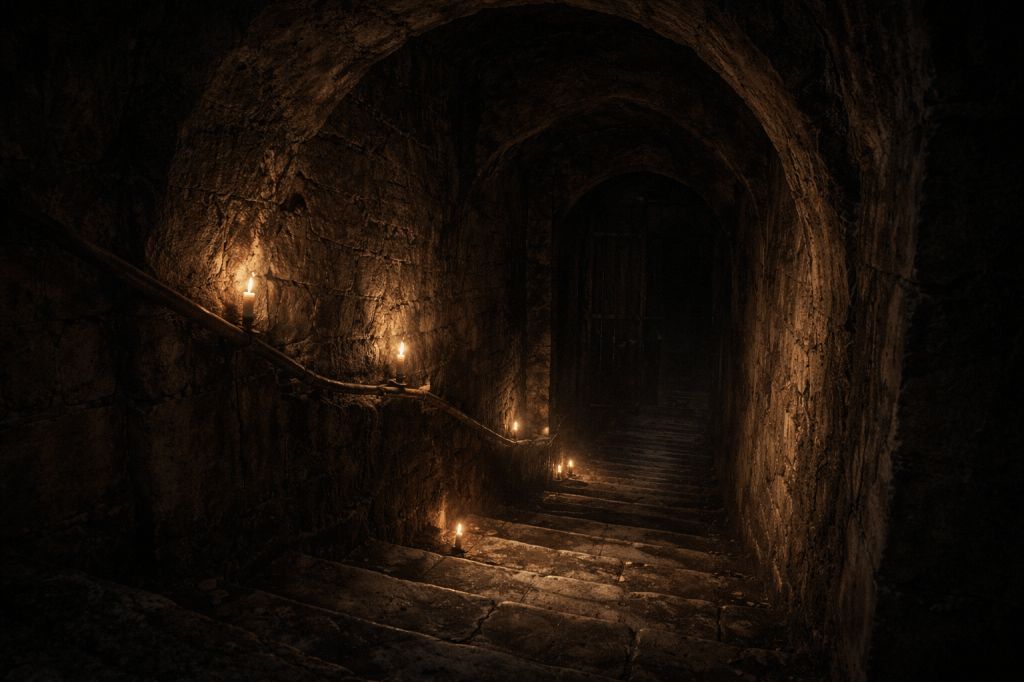
A stair reopened beneath the chapel revealed a passage that held its silence too closely, where the stone carried a presence that remained unchanged by time or touch, and where those who descended found that the quiet itself did not remain empty for long.
The Idea Behind the Chronicle
Many cities are built upon ground that has been used and reshaped across generations, where each new structure rests upon what came before, and the earlier layers are seldom removed entirely. Foundations remain, passages are sealed, and spaces that once held purpose are left beneath the visible world, their presence acknowledged only when something disturbs them.
The Chronicle of the lower chapel draws upon this quiet layering of place, where construction does not erase what lies beneath, though it conceals it within stone and time. In such environments, the boundary between past use and present structure becomes uncertain, and what has been closed away does not always settle into stillness as expected.
Throughout history, records of sealed passages, hidden chambers, and disturbed foundations appear in fragments rather than complete accounts. Repairs uncover voids where none were expected, walls reveal markings that hold no clear origin, and spaces once considered secure are revisited only when something alters the behaviour of the structure itself.
The Whispering Foundations series explores this idea of persistence within built environments. Rather than presenting corruption as something that arrives from outside, these accounts suggest that it exists within the structure, moving through stone, settling within walls, and remaining present even when the spaces it inhabits are closed.
In such places, sound behaves differently. Air carries traces that do not disperse. Surfaces hold impressions that resist removal. Those who encounter these conditions often record what they observe, though their accounts remain incomplete, shaped by what they can perceive rather than what fully exists.
The chapel in this Chronicle stands as one such place. Its foundation supports the structure above, while beneath it the earlier construction remains, carrying with it a presence that is neither fully understood nor entirely absent. The record preserves only what was noted at the time, leaving the rest to remain within the stone.
From the Author’s Desk
Thank you for continuing into this Chronicle.
This first account was shaped around the idea that a place can change long before anyone understands that it has, and that those early moments are often recorded in fragments that carry more uncertainty than clarity. The lower chapel passage sits within that space, where observation comes before understanding, and where what is noted at the time rarely reflects the full extent of what is present.
Across this series, each Chronicle will return to similar spaces beneath the city, where structures hold traces of disturbance that were once dismissed, misread, or left unresolved. These are not complete accounts, though fragments preserved from different points of contact, each one adding to a pattern that was never fully recognised.
Beyond the Chronicle, my writing continues across a range of fantasy and speculative work, including short stories and novellas that explore the same underlying themes from a different perspective. Some of those accounts follow events more closely, while others remain at a distance, allowing the world to emerge through what is recorded rather than what is explained.
Readers who wish to explore further may find additional work through the links included in this publication.
You can explore my books here:
Books by Simon Phillips
You can watch my YouTube channel here:
Author Simon Phillips
Archive & Interpretations
Fragment from the Archive
From the sealed folios of Saint Veyne, origin uncertain. The script shows signs of partial erasure and later correction.
The lower passage was first entered during repair of the western foundation, where the stone gave way beneath inspection and revealed a void that held no place within the earlier plans, and those sent below recorded no immediate hazard, though the air within the passage carried a stillness that resisted disturbance, while the light failed to travel far beyond the first stretch of descent.
A second entry, written in a different hand, records that those assigned to the work began to remark upon sound within the walls, though the accounts remain inconsistent in their description, some referring to a low murmur, others to a pressure that settled within the space, and one entry, less steady in its form, describing the sound as remaining even when no movement was made and no voice was raised.
The passage was ordered sealed after a short period of inspection, and the method of closure is recorded in detail, though the reason for that decision is absent from the primary entry, leaving the act preserved without the cause that required it.
A later annotation, set within the margin in a tighter script, states that the sealing required reinforcement beyond the original instruction, and that further work was undertaken after the first attempt failed to hold, though no full account of that failure remains within the folio.
The final notation marks the passage as secured, and no further entries refer to the lower chamber, leaving the record complete in form, though lacking in explanation.
Marginal Notes & Interpretations
Collected from later annotations found in the outer margins of the same folio.
One annotation suggests that the reports of sound arose from strain within the foundation, attributed to age and shifting weight from the structure above, and the writer dismisses the accounts as the result of confined air and heightened awareness within a closed space, though no supporting detail is offered beyond the assertion itself.
Another note, written in a firmer hand, disputes this interpretation, stating that the persistence of the sound, as described in the earlier entries, does not align with movement within the structure alone, and that the absence of variation between positions within the passage suggests a source that does not correspond to natural cause, though the writer leaves the statement without further conclusion.
A third annotation, faint and partially obscured, records that those assigned to the sealing spoke little after the work was completed, and that one requested reassignment without offering reason, the line ending before the thought is fully set down and the remainder of the note lost to the damage along the edge of the page.
World Notes
Saint Veyne Chapel
A modest structure built upon an earlier foundation whose origin is not preserved within the surviving records, the current chapel serving the surrounding district, while the lower construction beneath it belongs to an earlier phase that has not been fully accounted for
Foundation Passages
Subterranean spaces uncovered during repair or expansion of older structures, often absent from formal plans and recorded only at the point of discovery, after which they are commonly sealed, particularly where their origin or purpose cannot be determined with certainty.
Recorded Disturbance
A term found within limited ecclesiastical records, used to describe irregularities within structure or space that resist immediate classification, where official entries tend to assign natural cause, though marginal annotations sometimes preserve alternative observations that remain unresolved.
Next Chronicle
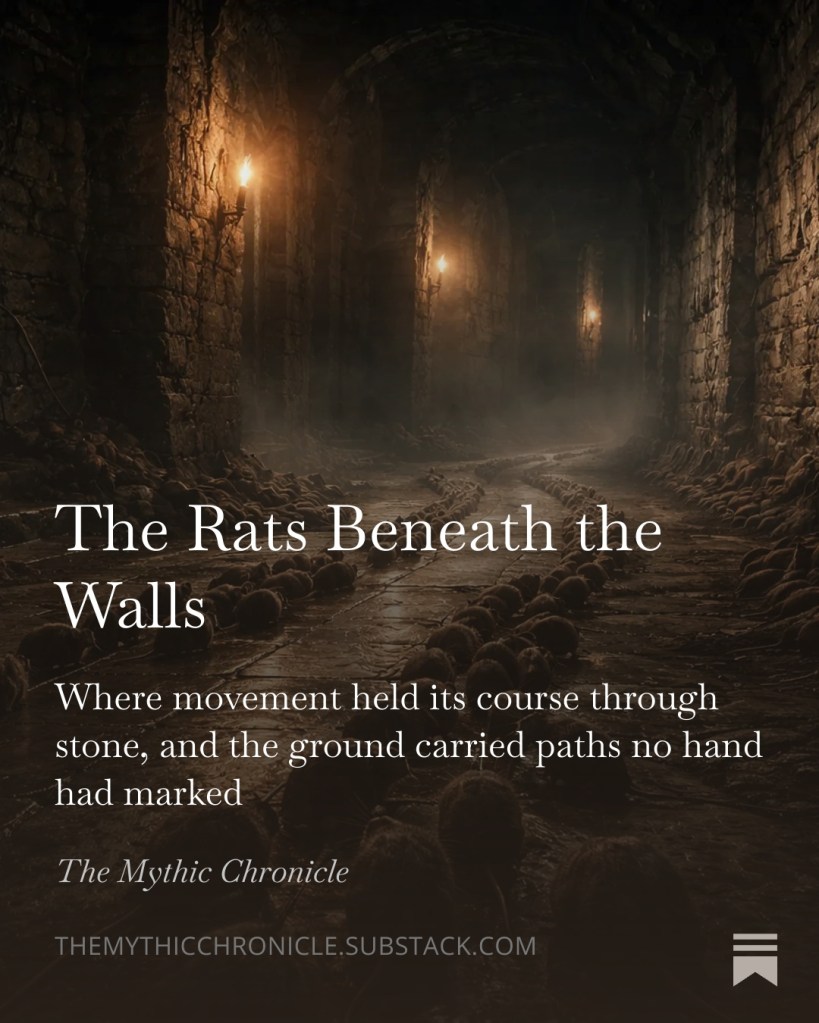
In the weeks following the sealing of the passage beneath Saint Veyne, brief reports began to appear across the lower district, noting unusual rat movement within cellars and along foundation walls, where the animals were observed moving in narrow, repeated paths that did not break when disturbed.
These movements were recorded without further inquiry, attributed to changes within the ground beneath the city, though several entries remark upon the consistency of the routes, which appeared to hold their place even where no passage was known to exist.
No connection was made to the earlier disturbance beneath the chapel.
Next Chronicle:
The Rats Beneath the Walls
The chapel of Saint Veyne remained as it had been, its walls steady and its records complete, while beneath its foundation the sealed passage held in silence, and within that silence something persisted, unchanged by its concealment and untouched by the certainty recorded above it.