One thing I have been thinking about while working on The Veil of Kings and Gods is how much of a fictional world exists beyond the people carrying the main story. A book has to stay focused on the characters, problems and consequences that matter most to its plot, which means there will always be people standing nearby whose experiences remain largely unseen. They might be servants, guards, clerks, priests or ordinary people who witness part of an important event while knowing very little about what is really happening. I have found myself increasingly interested in those people.
The Unmarked Path, the first book in The Veil of Kings and Gods, already has a lot moving through it. Simion returns to Bremyra under orders from the Order of Magicians, Prince Patrick is trying to govern during his father’s absence, Princess Elana is preparing to leave for an arranged marriage, and pressure is beginning to build far beyond the kingdom itself. The Order and the Church distrust one another, trouble is developing in the north, and Simion gradually discovers that his reason for being in Bremyra reaches further than he expected.
Those are the people and events the book needs to follow closely. While writing around that story, though, I kept wondering what the same period looked like to people who stood several steps away from it. I wanted to know what the servants thought when they were suddenly ordered to reopen an old Order manor above the city, what a castle clerk made of a sealed letter arriving beneath gold wax, and what the people working inside the cathedral noticed when Archbishop Alaric prepared to receive a magician he clearly distrusted.
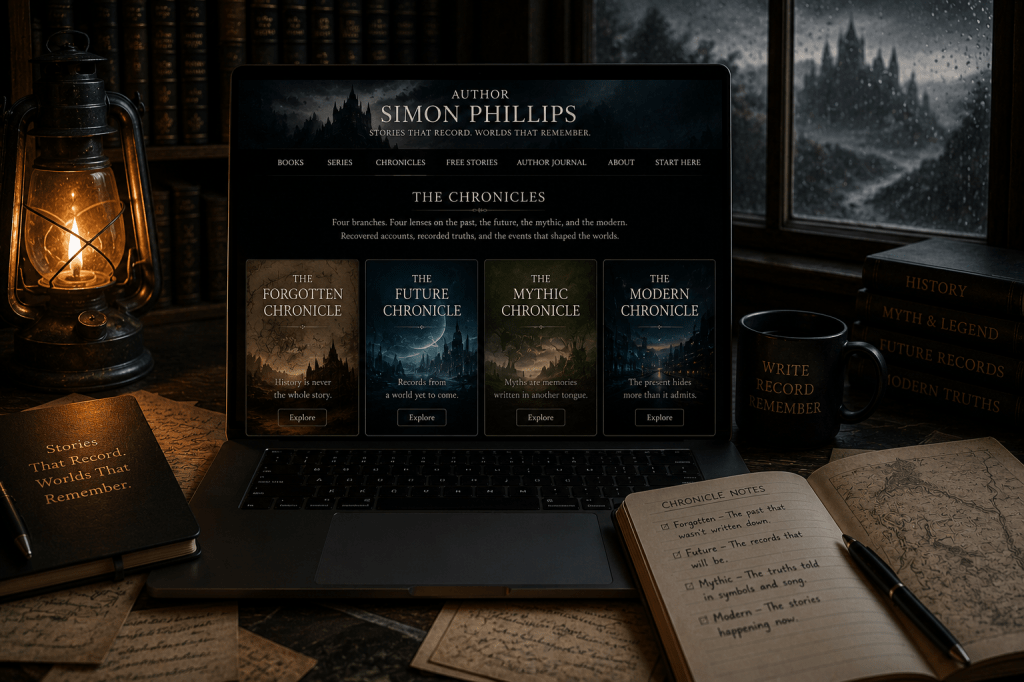
That became one of the reasons I started using The Mythic Chronicle alongside the books.
Looking Beyond the Main Story
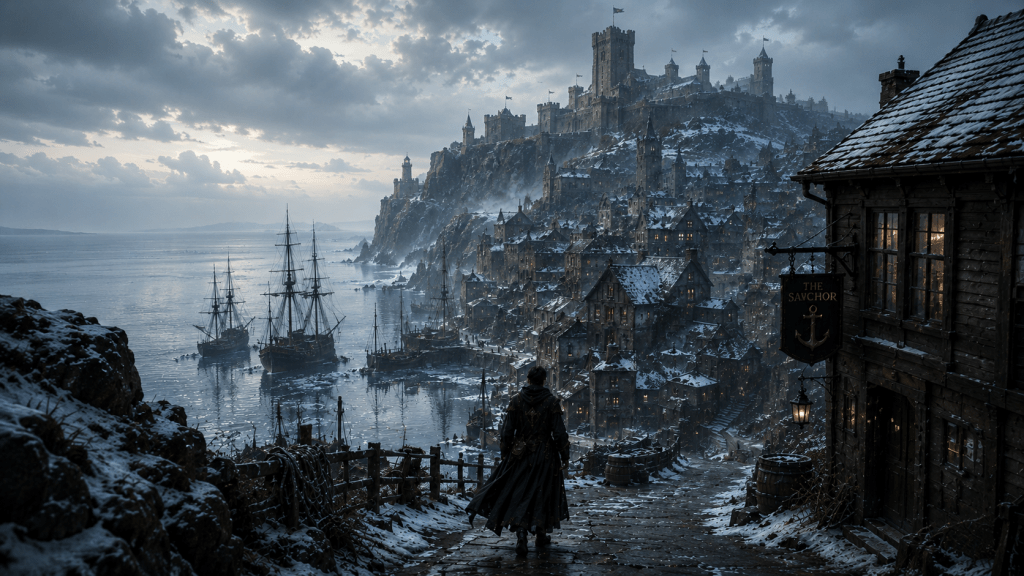
The current Chronicle cycle is called The Sealed Road of Bremyra. It surrounds the events of The Unmarked Path, with some accounts taking place shortly before the book, others during it, and others dealing with what remains immediately afterwards.
I wanted the distinction between the two to stay clear. The Unmarked Path carries the direct story, while the Chronicle follows fragments around it. Those fragments can come from servants, clerks, chapel attendants, guards, household records, later copies of old accounts or people trying to understand something after the event has already passed.
That difference has given me far more room than I expected because I can stay inside Bremyra while changing where the reader stands.
The first Chronicle, The Manor That Waited, follows the servants sent to prepare the old Order manor before Simion arrives. In the book, Simion reaches the manor and finds an old house that has been out of regular use for years, still carrying traces of the Order’s former presence. The Chronicle allowed me to go back to the hours before he reached it and spend time with the people ordered to reopen those rooms.
They climb the hill carrying keys, linen, lamp oil and instructions from the castle. They open shutters, lay fires and prepare the western suite for a guest whose name they have never been given. As they work, small things begin to feel wrong. A lock seems to turn before the key has fully moved, marks appear in dust, doors behave strangely and a lamp is found burning where nobody remembers lighting it.
The servants have no idea what Simion is involved in, and they have no reason to understand the larger events beginning around Bremyra. They only know that an old house has suddenly been ordered back into use and that, somewhere during their preparations, it begins to feel as though the manor was already expecting someone.
I probably would never have followed those people inside the main book because Simion’s story has other places to go. The Chronicle gives that quieter part of Bremyra somewhere to exist.
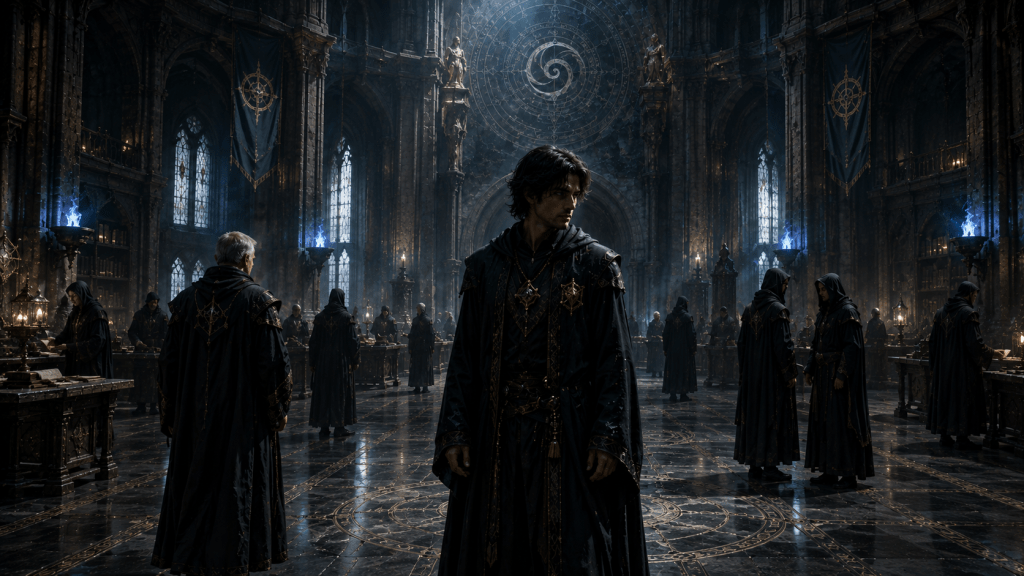
For Simion, the Council of Five belongs to the structure of his life. He was trained by the Order, he understands its authority, and the instructions sent to him affect his future directly. A clerk working inside Bremyra Castle has a very different relationship with the same event because, from his position, the Council arrives as an object carried through the door.
He sees a cedar case bound with dark cord and sealed beneath gold wax. He sees senior officials become unusually careful around it, watches the receipt entered formally into the castle record, and notices that people who usually deal with royal paperwork suddenly measure every word. He cannot read the wider story behind the letter, although he can tell from the behaviour around him that something important has entered Bremyra.
I have enjoyed working with that kind of limitation because the person recording an event does not always understand what the reader may later come to know. A clerk can preserve the hour, the condition of the seal, the names of the witnesses and the route taken through the castle, yet still have no idea why the letter matters so much.
That feels right for the Chronicle. History often survives through people who saw one small part of something larger and recorded what their position allowed them to see.
Standing at the Edge of a Scene From the Book
The Cathedral Warning pushed the idea in another direction because it sits close to a scene that already exists in The Unmarked Path.
Simion is summoned to Bremyra Cathedral by Archbishop Alaric, and their meeting makes the tension between the Church and the Order very clear. From Simion’s position, the encounter is about suspicion, authority and the limits Alaric intends to place around him.
The Chronicle moves away from Simion and spends its time with the people preparing the cathedral before he arrives.
Sister Maelis notices candles behaving strangely. Brother Osric is given responsibility for the undercroft key. Parts of the cathedral are restricted, doors are watched and Archbishop Alaric makes preparations that suggest he is worried about something deeper than an awkward meeting with a visiting magician.
When Simion finally enters, those people hear the same formal conversation, although they experience it from the edges. Their attention moves towards the locked doors, the keys, the candles and the sounds beneath the floor. They have no access to Simion’s thoughts, and Alaric certainly gives them no explanation for his concern.
I like being able to return to a moment from the book in that way because I am not rewriting the scene from another camera angle. I am looking at what the scene disturbed around it and asking what the people standing nearby might have carried away afterwards.
Remembering Simion Before He Became the Lord Magician
The fourth Chronicle, The Boy Remembered in the Kitchens, has probably been one of my favourite examples so far because it looks at Simion through a very different kind of memory.
By the time he returns to Bremyra, people see the black robes of the Order before they see the person wearing them. Servants lower their eyes, officials address him by title and even people who knew him years earlier have to reconcile the man standing before them with the person they once remembered.
The kitchens carry a different version of him. Their memories are connected to bread, work, illness, cold rooms and the ordinary routines of castle service. They remember a boy who once carried food through the halls and slept close to the hearth during a winter fever, long before anyone expected him to return as a magician.
That interested me because institutions remember people according to their own needs. A court remembers rank, the Church remembers authority and the Order remembers its own position, while servants may remember who was hungry, who worked beside them or who disappeared from their rooms one winter.
The Chronicle lets those memories sit beside the person Simion has become. It adds something to Bremyra without asking the main book to stop and explain every part of his childhood through exposition.
Leaving Some Things Uncertain
Another part of the Chronicle that I have come to value is that the records are allowed to be incomplete.
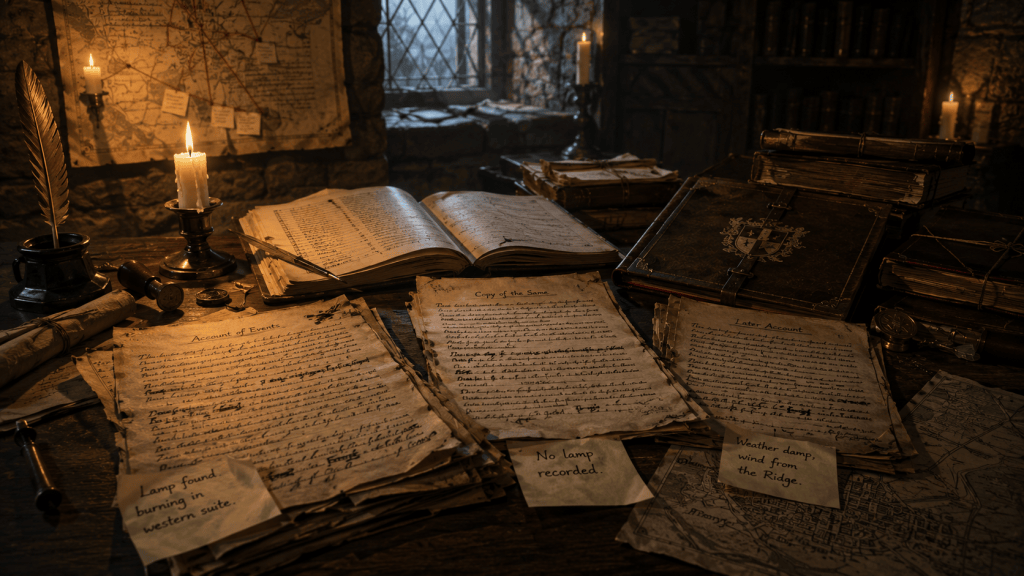
A servant can misunderstand what happened. A clerk may record only what his office required. A later copy of an account might remove a detail found in an earlier one, while someone writing years afterwards may decide that an unexplained event was caused by damp stone, winter weather, frightened servants or an old building settling in the cold.
I do not want every Chronicle to provide a final answer because that would weaken what makes the format interesting to me. The book remains closer to the direct events, while the Chronicle preserves what other people thought they saw and what later records chose to keep.
Sometimes the difference between those accounts matters as much as the event itself. A formal register may describe a perfectly ordinary household preparation while a lesser copy remembers that a lamp was already burning. A church record may describe proper restrictions during a formal reception while someone in the margins remembers candles bending towards a locked stair.
That leaves room for the reader to decide how much of each account they trust.
Another Way Into The Veil of Kings and Gods
There is a practical reason I like this approach as well because I want the website to give readers several ways into the fiction.
Someone who has already read The Unmarked Path can enter The Mythic Chronicle and return to Bremyra from places the book only passed briefly. They can stand inside the old manor before Simion arrives, sit beside a clerk as the Council’s letter enters the castle, or wait inside the cathedral while Alaric prepares for a confrontation the reader already knows is coming.
Another reader may discover the Chronicle first. They might begin with an abandoned manor that appears to be waiting for an unknown guest, a sealed letter that makes an entire chancery uneasy, or a cathedral locking its lower doors before a magician arrives. They do not need to understand everything about Simion, the Order or Bremyra before those accounts can work.
If the records make them curious about what is happening beyond the edges, The Unmarked Path is there to carry them into the main story.
I prefer that to repeatedly telling readers that I have another book available. The Chronicle can offer something worth reading for itself while quietly opening a door towards the larger series behind it.
The People Standing Nearby
I think that is what I have loved most about The Sealed Road of Bremyra so far. It gives me the chance to stay inside the world for longer and follow parts of the story that the main book could never reasonably stop to include. I can spend time with a housekeeper opening rooms that have stood empty for years, a clerk examining a seal with unusual care, a chapel attendant watching candles lean towards a locked stair, or a cook looking at a feared magician and remembering the boy who once worked beside the hearth.
That kind of thing has always appealed to me. When I was a child, I could spend hours, sometimes days, thinking through parts of a story that might never actually be used. I would imagine places beyond the main setting, work out what happened in rooms the characters never entered, think about people who only existed at the edge of the story, or decide what might have happened years before the part I was actually telling. Most of it never needed to appear anywhere. I simply enjoyed knowing it was there.
I still write that way now. The more time I spend inside a world, the more real it begins to feel in my own head, and I enjoy following those smaller threads even when they sit outside the central plot. They help me understand the place, the people and the history around them, and they make writing the main story feel less like moving characters through a constructed setting and more like returning somewhere that already has its own memory.
The Mythic Chronicle has given me somewhere to put some of that imagination instead of leaving all of it hidden in notes or in my head. The book can stay focused on Simion, Patrick, Týrnan and the larger events moving around them, while the Chronicle can step sideways and spend time with the people who only caught a glimpse of what was happening.
None of those witnesses understand the whole story. They see enough to know that something is changing, then carry away their own version of it as memory, rumour or record. For me, that makes Bremyra feel larger than the central plot because the world continues beyond whichever character happens to be on the page.
That is probably the part I enjoy most. I get to write the story I need to tell, while still giving myself permission to wander into the corners that first made me love making up worlds in the first place.
If you would like to see Bremyra from some of those quieter corners, The Sealed Road of Bremyra begins with The Manor That Waited, before Simion has even climbed the hill.
I have been spending a great deal of time working out what my WordPress website is supposed to be. The obvious answer is that it is an author website, although that answer leaves most of the important questions untouched.
An author website can be little more than a collection of book covers, sales links, a short biography, and an occasional update. That structure is tidy and easy to understand, although it does not match the amount of work I am trying to bring together or the kind of relationship I want the website to have with readers.
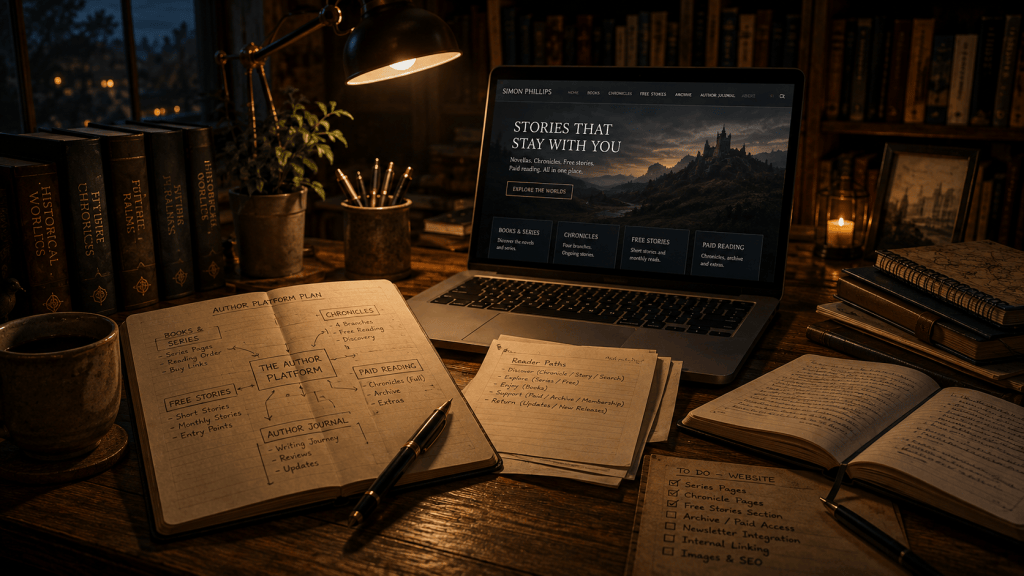
The more I have worked through the site, the clearer it has become that WordPress needs to function as a platform in its own right. It needs to give the books permanent homes, make the Chronicles easy to follow, provide free ways into the fiction, support paid reading, and give me somewhere to explain what I am building as it develops.
A Static Website Was No Longer Enough
There is nothing wrong with a simple author website. For someone with a small catalogue and only occasional news, a few book pages and a purchase link may be all that is needed.
My own work has grown beyond that shape. I have several series in development, four Chronicle branches, free stories, paid material, book updates, and a growing amount of author-side writing that needs to sit somewhere sensible.
Putting all of that on a single blog feed would create a different problem. A reader interested in science fiction could easily find a historical Chronicle beside a publishing reflection, followed by a fantasy update and then a website post. Everything would technically be available, although very little would feel properly organised.
I wanted the site to help readers find the parts that interest them. That meant thinking beyond individual posts and asking how the whole platform should work over time.
The Books Need Permanent Homes
The books remain the main reason for the website. Every other section has to support them rather than compete with them.
A basic books page can show a cover, a description, and an Amazon link. That works for a small catalogue, although it becomes difficult once several connected books belong to the same series and each series has its own setting, reading order, themes, updates, and related material.
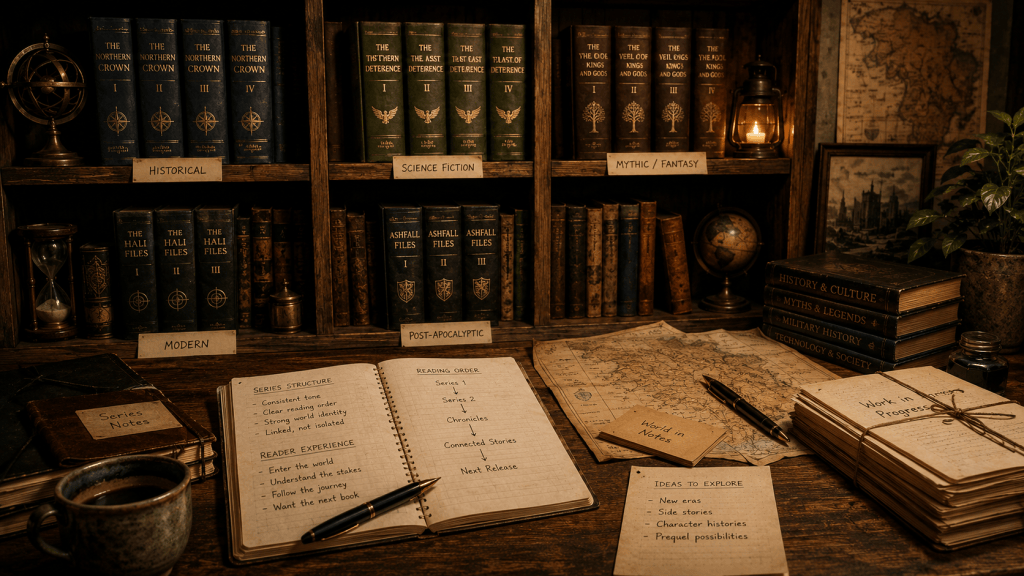
I am therefore treating each series as something that needs a permanent home. A series page should explain what the books are, show the current releases, make the reading order clear where necessary, and give readers a direct path towards buying or reading them.
Those pages should also remain useful between releases. When I publish an update, a behind-the-scenes post, a related Chronicle issue, or a piece about developing that series, the relevant material can appear on the series page automatically.
This matters because a series page should not feel finished once the sales copy has been added. It should continue to gather the work connected to that story world while the main description remains stable.
Giving the Chronicles a Clear Place
The four Chronicles create another layer of the site. The Forgotten Chronicle, The Future Chronicle, The Mythic Chronicle, and The Modern Chronicle each have their own identity, subjects, and style of presentation.
They need to be easy to recognise and follow, although they cannot be allowed to divide the website into four unrelated sections. The site still belongs to one author, and the books remain the centre of the work.
I see the Chronicles as reading and discovery branches. They give me room to publish substantial ongoing material, build regular points of contact with readers, and connect certain runs to the book series they naturally support.
That connection needs to be handled carefully. A Chronicle may introduce readers to a historical period, a speculative setting, a mythic theme, or a modern concern that leads towards one of my series. Even then, the Chronicle should retain its own identity while the related series remains clearly presented as the main body of fiction.
WordPress gives me the structure to do that through permanent Chronicle pages, clear categories, and filtered feeds. A reader can follow one Chronicle branch without having to search through every post on the site, while still seeing the wider author platform around it.
Free and Paid Reading Need to Sit Together
The previous Author Journey post looked at the balance between free and paid work. That decision affects the shape of the website as much as it affects individual stories.
I do not want every path through the site to lead immediately to a payment request. Readers need space to understand the books, sample the writing, read selected stories, and decide whether they want to continue.
At the same time, paid work needs a proper home. The Chronicles, archive material, and longer reading sections require time to write and maintain, and WordPress needs to support that work as part of the author business.
The solution is not to separate free and paid material into two disconnected websites. They need to sit beside one another in a way that feels clear and fair.
A free story can lead towards a related book series. A Chronicle opening can introduce the subject and atmosphere before a paid continuation. An author update can explain why a new archive section exists. A series page can show the books while also gathering related free posts beneath them.
When those parts are connected properly, the reader is given choices rather than being pushed in one direction. Someone can read freely, buy a book, follow a Chronicle, or support the paid archive according to their interest.
Building Around Reader Paths
One of the most useful changes in my thinking has been to stop looking at every page in isolation. A page may look complete on its own and still leave the reader with no clear idea where to go next.
I now think in terms of reader paths. Someone may arrive through a search result, a shared Chronicle post, a YouTube link, an Amazon author page, or the homepage itself.
The site needs to help that person understand where they have arrived and what is connected to the page in front of them. A Chronicle post should lead towards its Chronicle branch and, where relevant, a related book series. A series page should lead towards the current books and a small selection of connected posts. A free story should offer a natural route towards further reading.
This does not mean filling every page with links. Too many choices can be as unhelpful as having none.
The aim is to provide one or two sensible next steps. Readers should be able to continue with the subject they have already shown an interest in, rather than being sent back to the homepage to start again.
Keeping the Homepage Active
The homepage has also changed in my mind. I once thought of it mainly as a fixed introduction, with a short biography, a few featured books, and links to the main sections.
It still needs to introduce me and the work clearly, although it should also show what is active now. A returning reader ought to be able to see a recent Chronicle, a current book or series update, the latest Author Journal post, and a route towards free or paid reading.
The difficulty is keeping the homepage current without rebuilding it every week. That is where filtered post sections become useful.
Instead of manually replacing every item, the homepage can pull the latest posts from the correct categories. The main structure remains stable while the visible content changes as new work is published.
This allows the site to feel active without turning website maintenance into a second full-time job. The homepage can continue to introduce the overall platform while reflecting the work I am actually doing.
Keeping the Author at the Centre
With several series and four Chronicle branches, there is a risk that the website could feel like a group of separate publications sharing the same address. That would make the structure harder to understand and weaken the connection between the different parts of my work.
The author identity has to remain visible throughout the site. The Chronicles can have distinct visual styles, and each series can have its own atmosphere, although they still need to feel connected to the same body of work.
The Author Journal has a supporting role here. It gives me somewhere to explain the decisions behind the site, share progress, discuss publishing work, and record the practical steps involved in building a long-term catalogue.
That does not mean the Author Journal should take over the site. Readers are coming primarily for the books, stories, and Chronicles, and the author-side posts should help them understand that work rather than distract from it.
This is why the Author Journal will sit lower in the overall structure. It adds context and a human voice, while the fiction remains in the stronger position.
The Work Behind the Visible Pages
Much of this work is quiet and repetitive. Categories need to be decided, pages need to be connected, old posts need to be routed correctly, images need proper descriptions, and each series needs enough structure to remain useful as the catalogue grows.
None of those tasks produces a new book. It can therefore feel difficult to justify spending time on them when there is always more writing to do.
The problem is that an expanding catalogue becomes harder to use if the supporting structure is ignored. Books can disappear into a long list, older posts can become difficult to find, and readers may never discover that two pieces of work are connected.
I am trying to build the structure before that problem becomes larger. The site does not need every possible feature, and I am avoiding additions that would make it harder to maintain.
What it does need is a clear foundation. Pages need defined purposes, categories need to route posts correctly, and each section needs to lead readers towards the work that belongs there.
What This Means in Practice
In practical terms, WordPress is becoming the main organised home for my author work. The books will have permanent series pages, the Chronicles will have their own branches, and ongoing posts will appear in the correct places through categories and filtered sections.
Free stories will give readers direct access to the fiction. Paid material will have a clear place inside the same platform, with enough free reading around it for readers to make their own decision.
Substack will continue as a parallel publication and discovery channel. YouTube and shorter visual work will provide additional entry points. Amazon will remain the place where the books are sold.
The difference is that WordPress will connect those parts. It will explain the catalogue, preserve older work, show what is current, and provide a stable place that is not dependent on a single external platform.
Building It Slowly and Properly
The site is still developing, and some parts will take time to complete. There are many series pages to build, older material to organise, and several sections that need to work together before the structure feels settled.
I am trying to resist the temptation to rush through it simply so that everything looks finished. A page that exists without a clear purpose can create more confusion than a page that has not been built yet.
The slower work has helped me decide what each part of the site is meant to do. It has also made me remove ideas that sounded useful at first but did not support the books or the reader.
That is probably the most important change. I am no longer treating the website as a collection of things I should have as an author. I am treating it as a working part of the writing and publishing system.
What Readers Can Expect Next
As the structure develops, readers will begin to see clearer series pages, more organised Chronicle sections, regular free reading, and a paid archive that is easier to understand and follow. Each addition should make it simpler to move between the books, stories, Chronicles, and author updates.
The Author Journal will continue to record the practical decisions behind that work. Some updates will be substantial, while others will cover a small change that has taken longer to solve than expected.
The next stage is to keep building the permanent homes for the books and connect the ongoing posts to the correct places. I will continue adding updates as those sections take shape, and the latest free reading can always be found through the main story areas of the site.
One question has kept returning while I rebuild my author website: how should complete free fiction and paid reading sit beside each other?
I want the website to give readers a genuine way into my writing. I also want it to support the time, planning, writing, editing, publishing, and maintenance behind that work. Those aims can appear to pull in different directions, especially when an author website is trying to welcome new readers while becoming part of a long-term independent income.
For me, the answer is to give both forms of reading a clear place.
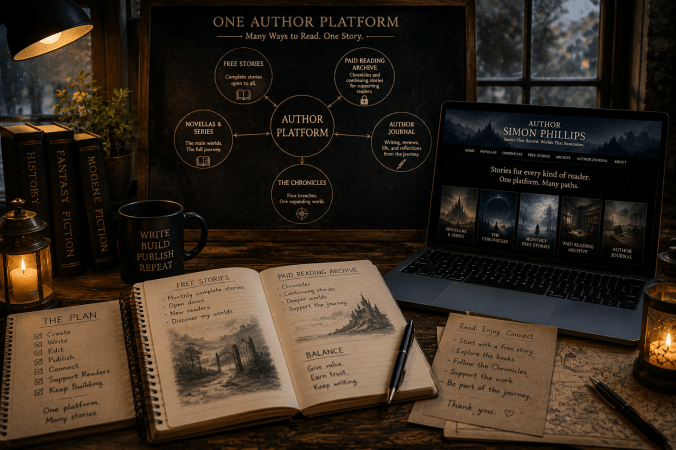
Monthly Free Stories offers one complete free story each month. The Paid Reading Archive gives selected continuing work, particularly the Chronicles, a place where it can help support the wider platform. Each area serves a different purpose, and the distinction needs to remain honest.
Why I Wanted Complete Free Stories
I never wanted every route into the website to end at a payment screen. A new reader may know very little about my books, the Chronicles, or the different series I am building. Asking that reader to subscribe or pay before they have had a proper opportunity to read my fiction would place the decision too early.
Monthly Free Stories provides a simpler starting point.
Each month, I will publish one complete story on the website. The genre may change according to the idea. One month may bring horror, while another may lean towards science fiction, fantasy, historical fiction, mystery, modern fiction, or something that sits between established genres.
The important part is that the story should feel finished. A reader should be able to arrive, choose a story, and read it from beginning to end. There should be no missing conclusion or sudden payment gate before the final section. The free story should give the reader a complete piece of fiction, even when the idea later proves capable of growing into something larger.
This also gives me room to write beyond the established series. Some ideas clearly belong inside a book project from the beginning. Others are smaller, stranger, or still uncertain. A complete standalone story gives those ideas room to exist before I decide whether they deserve a larger future.
Some may eventually suggest a series or book. Others may remain single stories that achieved exactly what they were meant to achieve.
Writing carries practical costs that readers rarely see directly. The time spent developing a story is only one part of the process. There is also revision, proofreading, formatting, cover preparation, website maintenance, image work, archive management, platform subscriptions, and the regular work required to keep everything organised.
A paid reading section gives part of that work a direct way to support itself.
The Paid Reading Archive is intended for material that benefits from an ongoing home, especially Chronicle issues and other selected work connected to the regular publishing structure. Readers may begin with an open section, understand the subject and tone, and then choose whether they wish to continue.
That choice needs to remain clear. Readers should understand which material is free, which material requires payment, and what access provides. Clear labelling matters because trust can disappear very quickly when the boundaries between free and paid material become uncertain.
Paid reading also allows WordPress to function as a full author platform instead of acting as a collection of links pointing towards other services. The website should hold fiction, organise it properly, give readers reasons to return, and contribute towards the continuing work behind the books.
Free fiction and paid content are sometimes discussed as though one must weaken the other. I see them as serving different readers and different kinds of work.
The free stories help readers discover my fiction. They show the range of genres I write, the kinds of atmosphere I return to, and the human pressure, uncertainty, history, strange systems, or hidden danger that often sits inside the work. They also give existing readers something complete to read between book releases and Chronicle posts.
The paid archive supports regular and continuing material. It gives readers who want to follow the work more closely a clear place to do so, while helping with the practical cost of keeping the website active.
The distinction matters. Free fiction should feel complete and worthwhile. Paid reading should offer enough depth, continuity, or regular material to justify the cost. Each side can remain clear about what it offers.
Avoiding the Feeling of a Sales Funnel
I am wary of turning every free piece into a carefully disguised route towards payment. Readers can usually sense when a story exists mainly to push them towards a purchase, and that approach would make the fiction feel secondary on an author website.
Monthly Free Stories needs its own integrity.
Each story should provide a full reading experience. A closing link may guide readers towards the books, another free story, a related series page, or the Paid Reading Archive, yet the story itself should already have delivered what it promised.
One reader may finish a story and leave the site. Another may return the following month. Someone else may move towards a book series, a Chronicle branch, or the paid archive. Each response is reasonable, and those choices should grow naturally from interest.
This means the website has to be organised carefully. Free stories need a clear home. Paid material needs equally clear labelling. Series pages need to remain focused on the books. Chronicle pages need to explain what readers can expect, while the Author Journal should remain a supporting area where I can discuss the work behind the fiction.
Clear structure helps readers understand where they are and what each part of the site offers.
Giving Readers Several Ways Into the Work
Readers will arrive with different interests and different levels of familiarity with my writing. Some may already know one of the books. Some may discover the website through a Chronicle post. Others may find an Author Journal article, a free story, a social post, or a short video.
Trying to force every reader through one route would make the website too narrow.
The books remain the main body of the work. The permanent series pages give each larger project a proper home. The Chronicles provide regular themed reading. Monthly Free Stories offers complete standalone fiction. The Paid Reading Archive holds selected continuing material. The Author Journal explains parts of the work and the decisions behind it.
These areas can connect to one another while still making sense individually.
That is particularly important for a website covering several genres and many long-term series. A reader interested in historical fiction may have little interest in science-fiction horror. Someone who enjoys a free ghost story may later discover one of the darker historical series. Another reader may prefer the Chronicle format and spend most of their time within that part of the site.
The website needs enough structure to support those different reading habits while keeping the overall author identity clear.
Keeping the Balance Honest
The balance between free and paid reading will probably need adjustment as the website develops. Some monthly stories may grow longer than expected. Certain Chronicle strands may suit the paid structure better than others. Some experiments may prove manageable, while others may demand too much time beside the books and existing publishing work.
I prefer to make those decisions through actual experience instead of pretending the whole system is already settled.
The main principles are clear enough to begin. Free stories will remain complete. Paid material will be labelled properly. The books will remain central. The Chronicles will keep their own identity. The website will offer several entry points, with each one connected to the wider author platform.
That gives me a structure I can develop while respecting the fact that readers use author websites in different ways.
What I Hope to Build Over Time
Over time, I want the website to hold a growing body of fiction that readers can move through at their own pace.
The Monthly Free Stories archive should become a shelf of complete standalone work across different genres. The Paid Reading Archive should become a deeper collection for readers who want regular access to Chronicle material and other selected pieces. The books and series pages should remain the main route into the larger story worlds.
A reader might begin with a free story, browse the books, follow a Chronicle, read an Author Journal post, or support the paid archive. There is no expectation that every reader will use every section.
The purpose is to respect different ways of reading while giving the work a practical chance to support itself. Free fiction gives new readers an open door. Paid reading gives interested readers a way to follow the work further and contribute towards its continuation.
Building the Sections Through Regular Work
The next stage is straightforward, even though it requires steady work. I need to keep adding the material that gives each area a reason to exist.
That means publishing the monthly stories, building the archive carefully, connecting posts to the correct pages, and making sure readers always understand where they are and what they are being offered.
The balance will develop through use. Some parts may change as I learn what is manageable and what readers choose to follow. The central idea will remain the same.
Complete free fiction and paid reading can belong on the same author website because they support the same wider purpose. They keep the fiction available, organised, and moving forward, while giving readers the freedom to decide how deeply they want to follow the work.
Most author websites naturally place the finished book first. That makes sense, because the book is usually the reason someone has arrived on the site. A reader wants to know what the story is, what kind of world they are entering, where to begin, and whether there is another book waiting after the first one.
I still want that to remain true here. The books, stories, series pages, Chronicles, free fiction, and paid archive are the main parts of this website. They are the reason the site exists. They are also the work I want readers to find, follow, and hopefully return to over time.
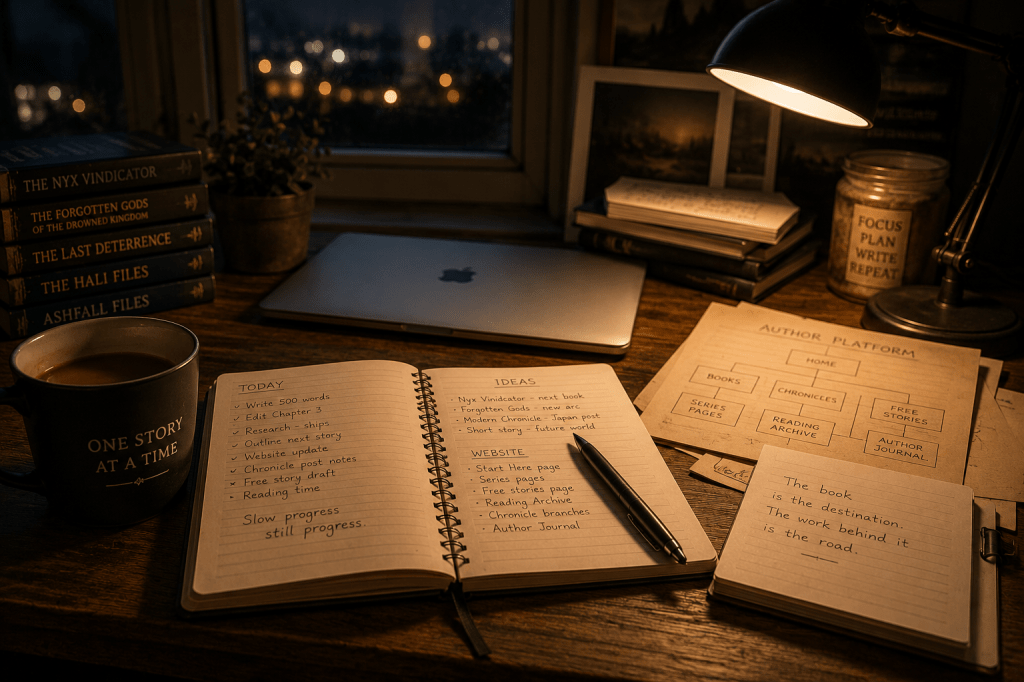
Even so, there is another side to the work that does not always fit neatly on a book page or a story page. It is the planning, the testing, the rebuilding, the slow decisions, and the small corrections that happen before a reader ever sees the finished result. That side is quieter, but it matters.
This Author Journey section is where I want to write about that part of the work.
What Readers Usually See First
By the time a book appears on a website, it can look fixed and simple. There is a cover, a title, a description, a purchase link, and perhaps a short note about the series. Everything seems clean because the messy part has already happened somewhere else.
The same is true of a Chronicle issue, a free story, or a new page on the site. The visible result is only the final layer. Behind it are choices about structure, timing, categories, images, links, tone, format, and how the piece fits into the wider author platform.
I have been thinking about that more as I rebuild the WordPress side of my author work. A website can easily become a list of books with a few links attached. There is nothing wrong with that in a basic sense, but it does not give much sense of the author behind the work, or the shape of the larger project being built.
I wanted a place where I could talk about that without turning every update into an announcement or a sales post.
The Work That Sits Behind a Finished Page
A lot of the work behind the books is not dramatic. It is often a matter of deciding where something belongs, what it connects to, and how a reader might find it later.
A story has to sit in the right place. A series needs a page that can grow over time. A Chronicle post needs to connect to the right branch without overwhelming the fiction it is meant to support. A free story should be easy to find, but it should not confuse the paid archive. A writing update should help readers understand what is happening without pulling attention away from the books themselves.
These decisions are small on their own, but they add up. They decide whether the website feels clear or scattered. They decide whether a reader has a simple path through the work, or whether everything becomes a pile of posts with no real direction.
That is one reason I have been treating WordPress as a serious part of the author platform rather than a spare noticeboard. I do not want the site to exist only as a bridge to somewhere else. I want it to hold the books, the story worlds, the Chronicles, the free fiction, the paid material, and the author updates in one organised place.
Building the Website Around the Fiction
The website is being built around the fiction first. That matters to me because it keeps the whole project honest.
The series pages are there for the books. The Chronicle branches are there to support discovery and give readers another route into the work. The free stories are there to let readers try the fiction without needing to pay first. The paid archive gives some of the longer material a proper home. The Author Journal sits beside those things, but it does not replace them.
That balance is important. I do not want the website to become a general blog where the books are pushed into the background. I also do not want every post to feel as though it is trying to sell something. Readers can usually sense that, and I do not think it helps build trust.
For me, the better path is to show the work clearly. Some posts will be about new stories or releases. Some will be about changes to the website. Some will be about what I am learning as I publish, organise, and keep going. The fiction remains the centre, but the process around it can still be worth sharing.
Why Every Update Should Not Be an Advertisement
A book advertisement has its place. A release post has its place. A paid archive update also has its place. Those posts are useful because readers need to know what is available and where to find it.
Still, if every update is only about buying, subscribing, or clicking through to something, the author begins to disappear behind the promotion. That is not what I want from this section.
I want some posts to feel quieter than that. I want room to write about decisions that are still forming, changes that have taken longer than expected, and practical lessons that might not sound impressive but are part of building something that lasts.
There is also value in admitting that not every part of the work is clean or fast. Some pages need rebuilding. Some ideas need sorting out before they make sense. Some stories take longer to place within the wider structure. Some plans look clear at the start and then need adjusting once the real work begins.
That does not mean the project is failing. It usually means the project is becoming more honest.
Writing Around Real Life
Another reason I wanted this section is that writing does not happen in a perfect empty space. It happens around work, family, tiredness, time pressure, and ordinary responsibilities. I do not want to turn that into the main subject of the website, but it is part of the truth behind the books.
There are days when the work moves quickly. There are other days when the most useful thing I can do is fix a category, update a page, make a note for a future story, or check whether the website still makes sense from a reader’s point of view. That kind of progress does not look impressive from outside, but it keeps the larger structure moving.
I have learned to take those smaller steps more seriously. A finished story matters, of course. A published book matters. A complete series page matters. Still, the quiet maintenance matters too, because without it the website becomes harder to use and the work becomes harder to follow.
The long-term goal is not to appear busy. The goal is to keep building in a way that readers can understand.
The Value of Small Progress
One thing I have had to accept is that slow progress is still progress when it is moving in the right direction. That sounds simple, but it is easy to forget when there are several books, several story worlds, different content streams, and a website that needs to hold all of them properly.
Small progress might mean writing a post like this. It might mean making the Author Journey section clearer. It might mean giving the Monthly Free Stories page a proper place. It might mean making sure a Chronicle issue links back to the right series page. It might mean writing a better excerpt, choosing a cleaner title, or deciding that a page should not try to do too many jobs at once.
Those things are not as visible as a new book cover, but they shape how the whole site works. They help the fiction feel less scattered. They also help me see the project more clearly as I build it.
That is one of the main reasons I want to write these posts. They give me a place to record the practical thinking behind the work while giving readers a clearer sense of what is being built.
What I Will Share Here
This section will mostly be about the writing life behind the books and the author platform around them. I expect to write about story progress, series planning, publishing decisions, KDP lessons, website building, WordPress changes, Substack reflections, YouTube experiments, mini-reads, free stories, paid archive updates, and the slow discipline of keeping a large fiction project organised.
Some posts may be simple progress notes. Others may look at a decision in more detail, such as why a page was added, why a series needs its own hub, or why free fiction belongs beside paid content. There may also be posts about setbacks, tiredness, false starts, and the problem of trying to build a writing career in real life rather than in theory.
What I do not want is a section full of empty advice. I am still learning many parts of this. I would rather write honestly about what I am trying, what has helped, what has been slower than expected, and what I am changing as the work develops.
That feels more useful than pretending everything was planned perfectly from the beginning.
Where This Fits on the Website
The Author Journey section is a support layer for the main website. It is here for readers who want to know more about the person building the books, the choices behind the site, and the practical work that sits around the fiction.
It should not take over from the books themselves. The series pages, Chronicle branches, free stories, paid archive, and main book pages remain the main paths through the site. This section simply gives those paths some human context.
I think that matters, especially with a site that is carrying several types of content. A reader might arrive through a free story, a Chronicle issue, a book page, or a post about the writing process. However they arrive, I want the site to feel connected rather than random.
That means building slowly, making careful decisions, and accepting that some of the less visible work is still part of the author life.
A Quiet Starting Point
This first post is not a major announcement. It is simply a starting point for a section I think the website needs.
There will still be book updates, story releases, Chronicle posts, free fiction, and paid material. Those are the main reasons the site exists. This section will sit beside them as a place for the quieter work: the planning, the lessons, the adjustments, the doubts, the useful mistakes, and the small steps that help the whole platform become clearer over time.
If you are here for the fiction, that remains the best place to begin. The books and stories are the centre of the site. If you also want to follow how the work is being built behind the scenes, this is where I will write about it.
Sometimes that doorway is a battlefield. Sometimes it is a throne room, a prophecy, a blade drawn under stormlight, or a kingdom already burning beneath the weight of war.
In The Unmarked Path, the doorway is quieter.
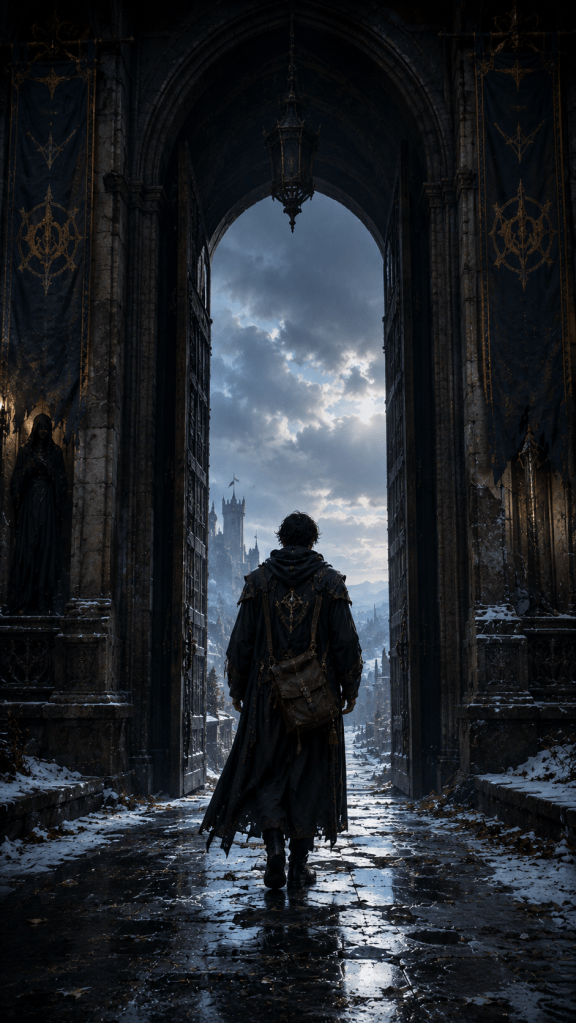
It opens with Simion, a magician of the Order, arriving in the cold coastal kingdom of Bremyra beneath a winter sky. He comes dressed in the black robes of an institution feared across the realm, carrying the authority of ancient magic and the uncertainty of a man who has never fully believed he belongs among those who wield it.
That tension is where his story begins.
Simion is no simple fantasy hero waiting for applause. He is no flawless master of the arcane, no proud champion striding into the world with certainty burning in his hands. He is weary, observant, guarded, and deeply human. He has been trained by the Order of Magicians, shaped by discipline and expectation, yet his place among them has always felt uneasy. Magic answers him in strange ways. Some simple things resist him, while darker and older powers seem to recognise him before he recognises himself.
That makes him dangerous.
It also makes him compelling.
A Magician Who Feels Out of Place
The Order of Magicians stands as one of the great institutions of Ældorra. It is old, powerful, and shaped by a history most of the living world only half-remembers. Its members are trained in discipline, ritual, incantation, and obedience. They carry an authority separate from kings, priests, and ordinary law.
Simion has passed through that world. He has learned its rules. He wears its robes.
Yet from the beginning, he feels like someone standing at the edge of his own life.
He has never been entirely comfortable among magicians who treat power as rank. At the Academy, he struggled where others advanced easily. He lacked the arrogance that often comes with mastery. His gifts seemed uneven, almost unreliable, as though the magic within him moved by some older rhythm than the lessons placed before him.
That uncertainty matters.
Simion begins the story believing himself ordinary by the standards of the Order. Skilled, perhaps. Capable enough to be useful. Still, he sees himself as a man chosen for duty, not destiny. He obeys because obedience is familiar. He studies because study is safer than instinct. He observes because action carries consequences he rarely feels ready to command.
The tragedy and beauty of Simion is that the world has already begun to move around him before he understands why.
Bremyra and the Weight of Return
When Simion arrives in Bremyra, he enters more than a kingdom under political strain. He returns to a place tied to his own buried past.
Before the robes, before the Order, before the careful distance he now keeps between himself and others, Simion once knew Bremyra through smaller rooms, warmer memories, and the overlooked spaces of castle life. He was once close enough to the royal children to carry echoes of childhood mischief, laughter, and belonging.
Years later, he returns as Lord Magician.
That title changes everything.
The servants fear him. The court watches him. The Church distrusts him. Patrick measures him with the caution of a prince carrying too many burdens. Elana remembers the boy beneath the robes, and that memory unsettles him more than suspicion ever could.
This is one of the strongest tensions in Simion’s character. He is treated as a figure of power, yet part of him still remembers being powerless. He is feared by people who once might have ignored him. He is addressed with reverence in halls where he once moved unseen.
Bremyra forces him to confront the distance between who he was and who the world now believes him to be.
The Mission Beneath the Surface
Simion’s official presence in Bremyra carries a polished explanation. He is there to observe, advise, and assist if needed. That is the surface truth presented to the court.
The deeper truth is more troubling.
Three magicians of the Order vanished in connection with King Cedric’s expedition and investigations into remnants of the ancient Imperium Arcana. Simion has been sent to uncover what happened. His task places him at the centre of a dangerous triangle: the Order, the royal household, and the Church.
Every question he asks risks offence. Every answer he finds may damage the fragile balance of the kingdom. If the missing magicians were betrayed, the consequences could reach far beyond Bremyra. If the Order is wrong, then Simion has arrived as a quiet threat inside a court already strained by absence, politics, and approaching war.
This gives his role a constant unease.
He is adviser and investigator. Guest and watcher. Servant of the Order and reluctant participant in royal life. He stands close enough to Patrick to earn trust, close enough to Elana to awaken old feeling, and close enough to hidden history to disturb forces that were meant to stay buried.
A Power Beyond the Lessons He Was Taught
The heart of Simion’s story lies in the gap between learned magic and something older.
In the world of The Veil of Kings and Gods, magic is structured. Magicians speak Flow. They shape power through words, training, and controlled forms. The Order teaches magic as discipline. It gives names to the currents of the world and expects its students to follow them.
Simion’s magic begins to move differently.
At first, these moments are subtle. A sealed book responds to him. Runes stir beneath his hands. Power gathers in silence, where silence should carry no spell. He feels forces he has no language for, forces that seem to reach past the laws of the Order and into the buried bones of the world.
This does not make him triumphant.
It frightens him.
That fear is important. Simion is powerful, yet he is also careful. He does not rush towards glory. He does not understand what has awakened around him. The old structures that shaped his life offer little comfort once his own magic begins to break their rules.
He begins to realise that the Order may have taught him how magic behaves, while something far older may be showing him what magic remembers.
The Hidden Book and the Call of the Seal
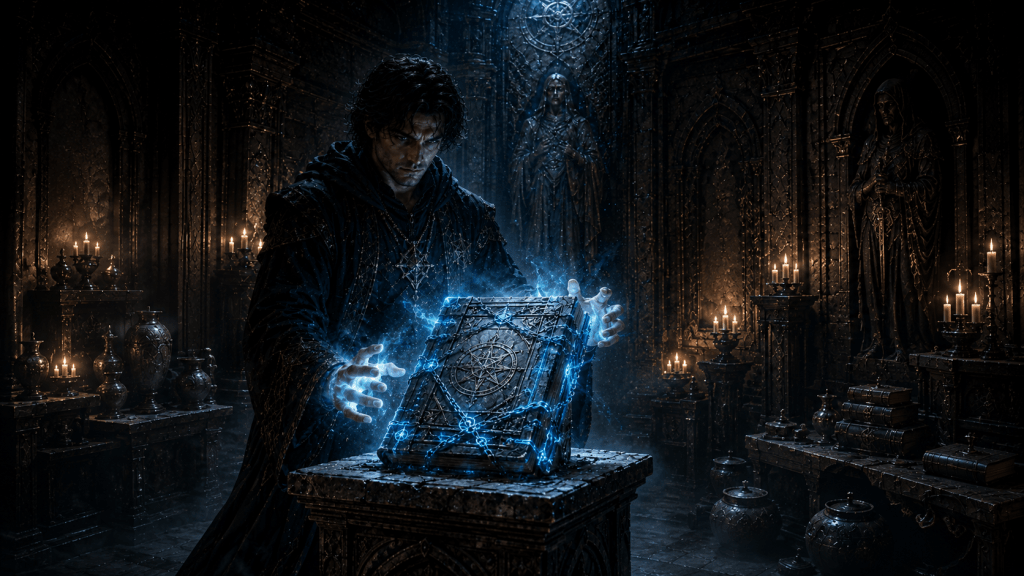
One of the defining images of The Unmarked Path is the hidden book beneath Bremyra.
Simion is drawn into the castle’s depths by whispers and old magic, where the familiar world of court duty, council suspicion, and royal politics gives way to something older. Beneath the halls where princes argue, priests watch, and servants move through their ordinary routines, another Bremyra waits in the dark. Its stones remember an age the kingdom has forgotten, and in that buried chamber, the past begins to reach for him.
At its centre waits an ancient book protected by a weave he does not understand.
The book is more than an object. It is a threshold.
It belongs to the part of Ældorra that survived in ruins, buried rooms, sealed warnings, and fragments of divine memory. It represents everything Simion cannot yet name: hidden history, forgotten magic, divine pressure, and the unsettling sense that his life has been touched by something older than the Order. The magicians who trained him taught rules, forms, and discipline. The book offers none of those comforts. It gives him no easy explanation, no clear command, no gentle revelation. It simply waits.
That waiting is what makes it powerful.
When the warning comes, it arrives in fragments. The seal weakens. The burden waits. The path will reveal itself only when its weight is accepted. There is no grand ceremony, no clean answer, and no voice kind enough to tell Simion exactly what he has become part of. The moment feels less like discovery and more like inheritance, as though something ancient has finally found the one person able to hear it.
For a man who has spent much of his life feeling uncertain of his place, this is devastating.
Simion wants understanding. What he receives is responsibility.
He wants answers. What he receives is a sealed path.
He wants control. What he receives is a mystery that responds to him in ways no ordinary magician should be able to explain.
That is why the hidden book matters so deeply to his story. It marks the point where Simion’s life begins to move beyond the limits of the Order. He can still pretend, for a time, that he is only an advisor, only an investigator, only a magician sent to Bremyra under orders. Yet the book has already changed the shape of the world around him. It has placed a quiet hand on his fate.
From that moment onward, Simion is no longer searching only for missing magicians.
He is searching for the truth of magic itself.
And the deeper he follows that truth, the more dangerous the path becomes.
Elana and the Human Thread
Simion’s story would lose much of its force if it only moved through magic, prophecy, and ancient danger.
Elana gives his arc its human warmth.
She remembers him before the title, before the robes, before the fear others attach to him. Her presence cuts through his formal distance, drawing forward traces of the boy he once was. She is bold, perceptive, and unafraid in a way few people around Simion are. Where others see the Order, she sees the man beneath it.
Their connection is layered with memory, restraint, duty, and danger. Elana is bound to royal obligation. Simion is bound to the Order. Neither of them moves freely, and that makes every exchange carry more weight than open confession could.
Through Elana, Simion is reminded that he is still human. He can still be seen. He can still be unsettled by kindness. He can still feel the pull of a life beyond duty, even as darker forces gather around him.
That matters because Simion’s greatest conflict is not simply whether he has power.
It is whether power will leave enough of him behind to love, fear, hesitate, and choose.
He belongs to the Order, yet his power challenges its laws.
He enters Bremyra as an outsider, yet his past ties him to its royal family.
He seeks missing magicians, yet finds traces of something divine.
He believes he is following instructions, yet the world around him begins to move as though history has taken notice.
That is the kind of character who can carry a long fantasy saga. Not because he knows all the answers, and not because he rushes towards destiny with a raised blade. He matters because he is uncertain in the face of forces that demand certainty. He matters because he resists becoming the thing others expect him to be. He matters because the power awakening around him is vast, yet the emotional core of his story remains intimate.
He is a man caught between institutions, kingdoms, memory, and magic.
He is also the first sign that the forgotten history of Ældorra has begun to return.
The Story Begins With The Unmarked Path
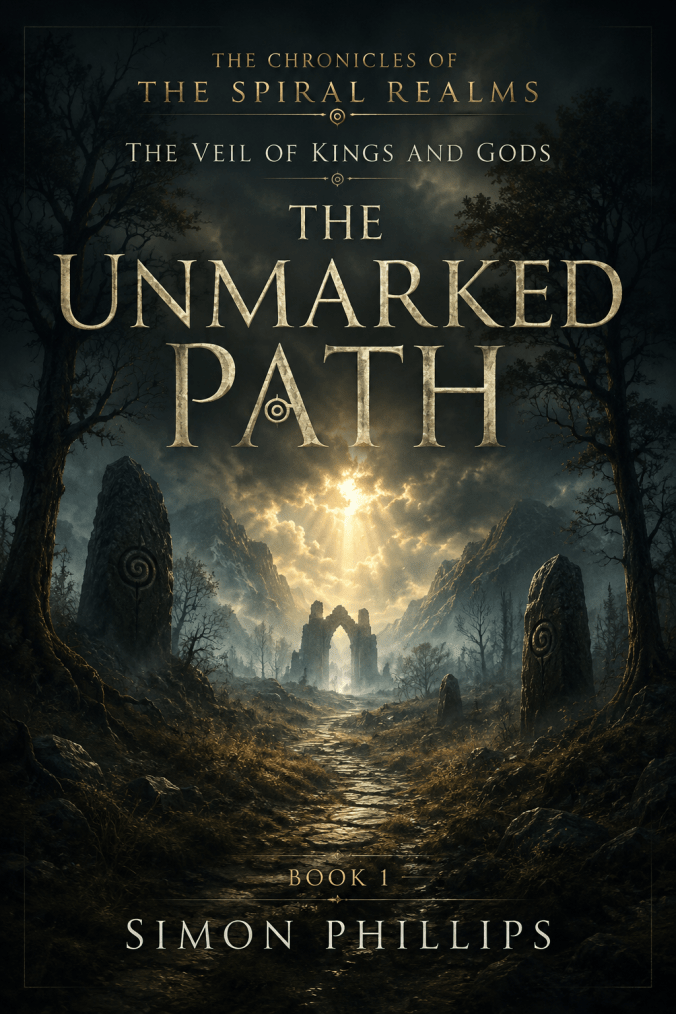
The Unmarked Path is the opening book of The Veil of Kings and Gods, set within The Chronicles of the Spiral Realms. It begins a slow-burn epic fantasy saga of forbidden magic, ancient gods, royal duty, political tension, hidden histories, and divine silence.
For readers who enjoy mythic high fantasy with atmosphere, mystery, and character-driven tension, Simion’s story offers the first step into a much larger world.
He does not begin as a hero.
He begins as a magician sent to Bremyra under orders he barely understands.
Beneath the castle stones, something waits.
Above him, gods remain silent.
Around him, kingdoms begin to shift.
And somewhere within the sealed places of the world, the Spiral begins to turn.
A station under quarantine should be quiet in a way people understand. Doors should remain sealed. Power should stay low. Emergency lights should mark safe routes through dead corridors. The silence should feel like failure, damage, or abandonment.
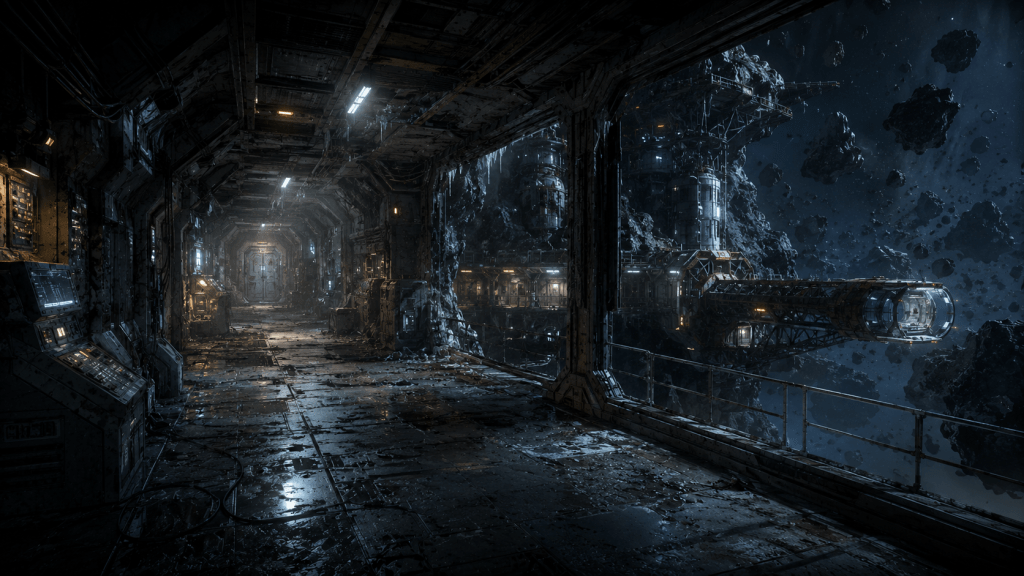
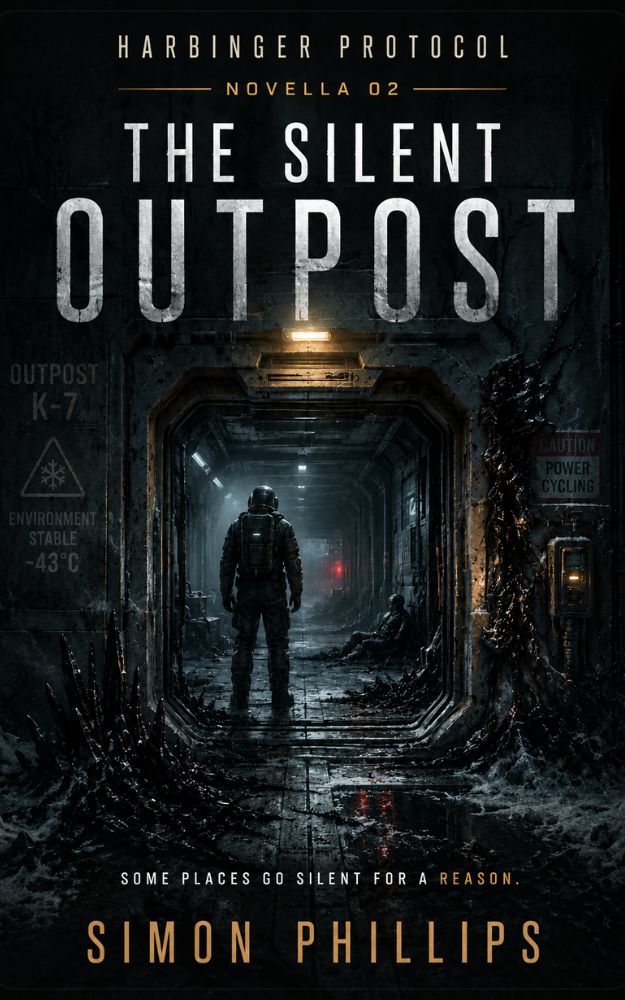
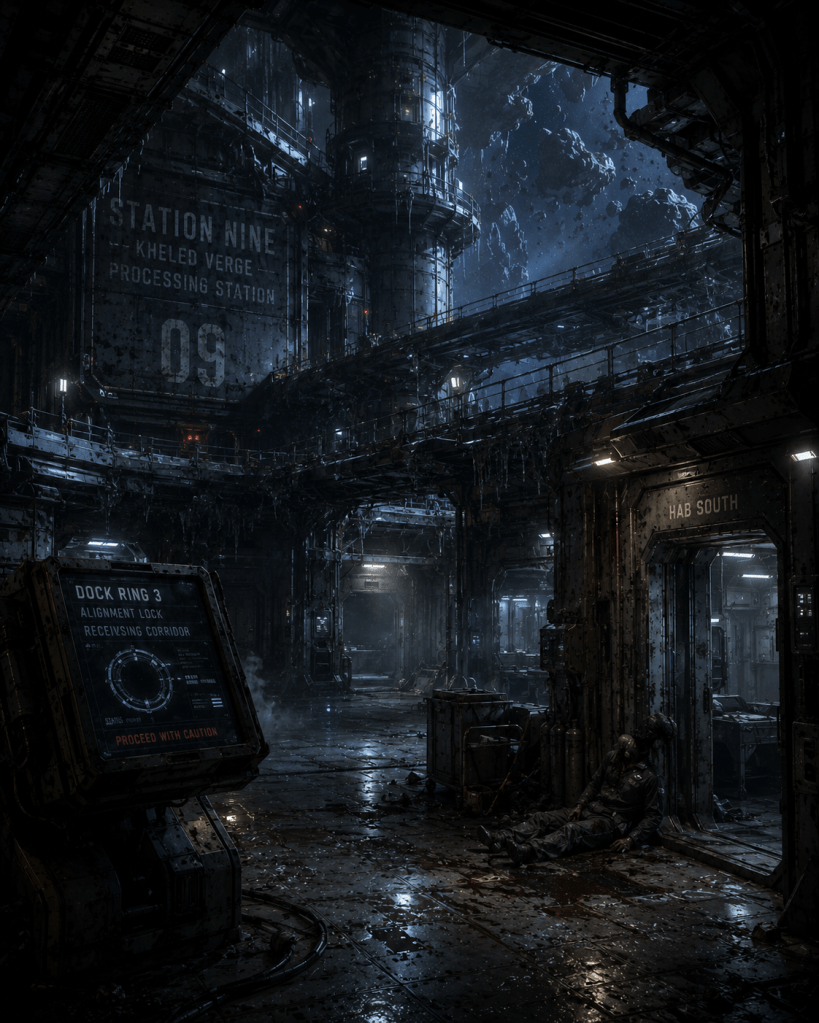
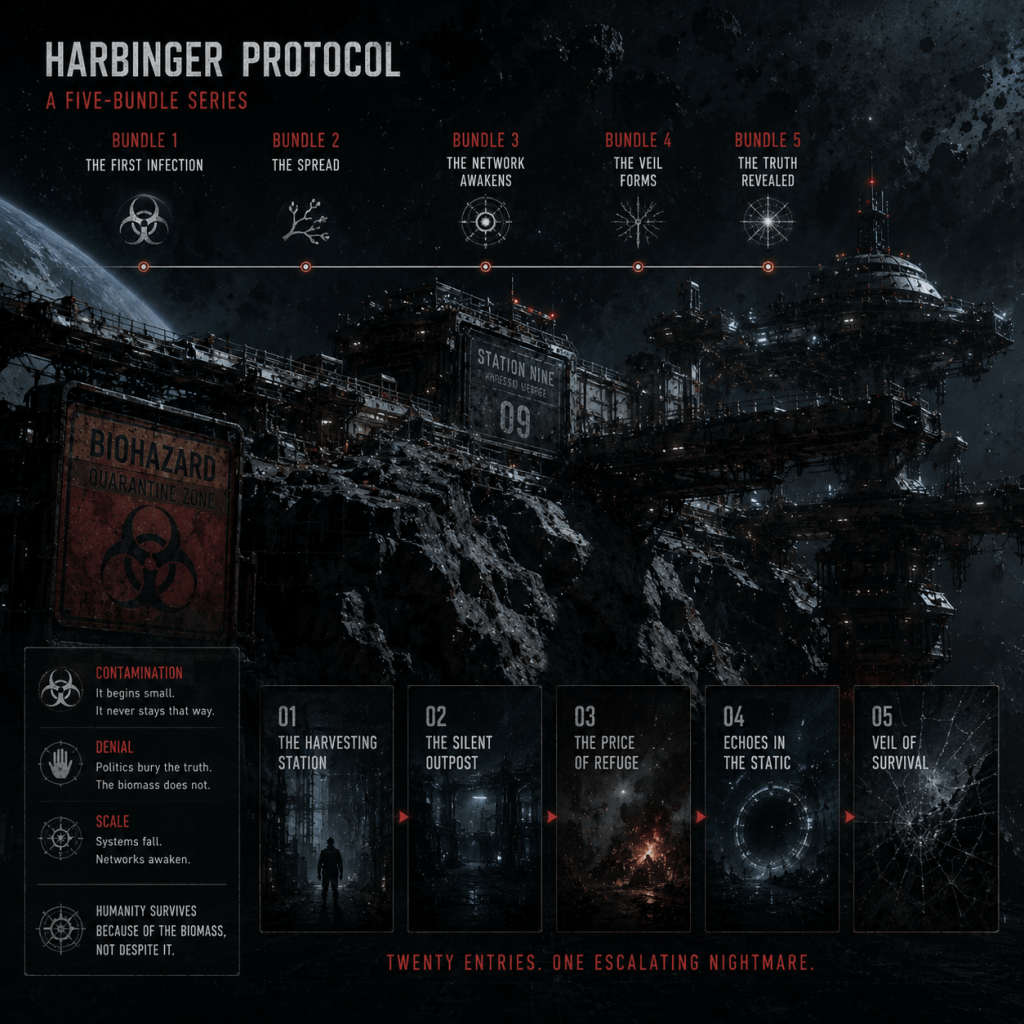
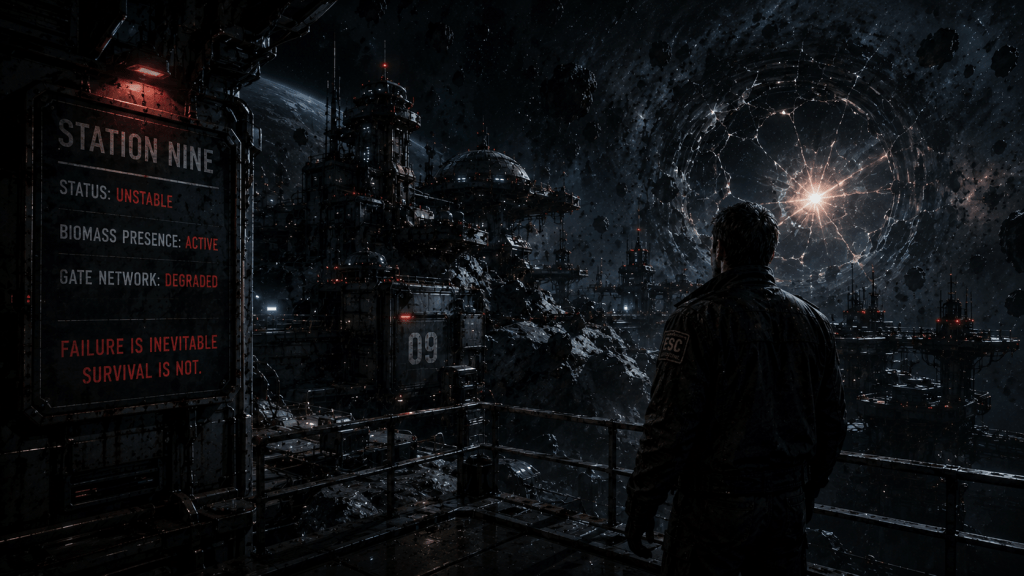
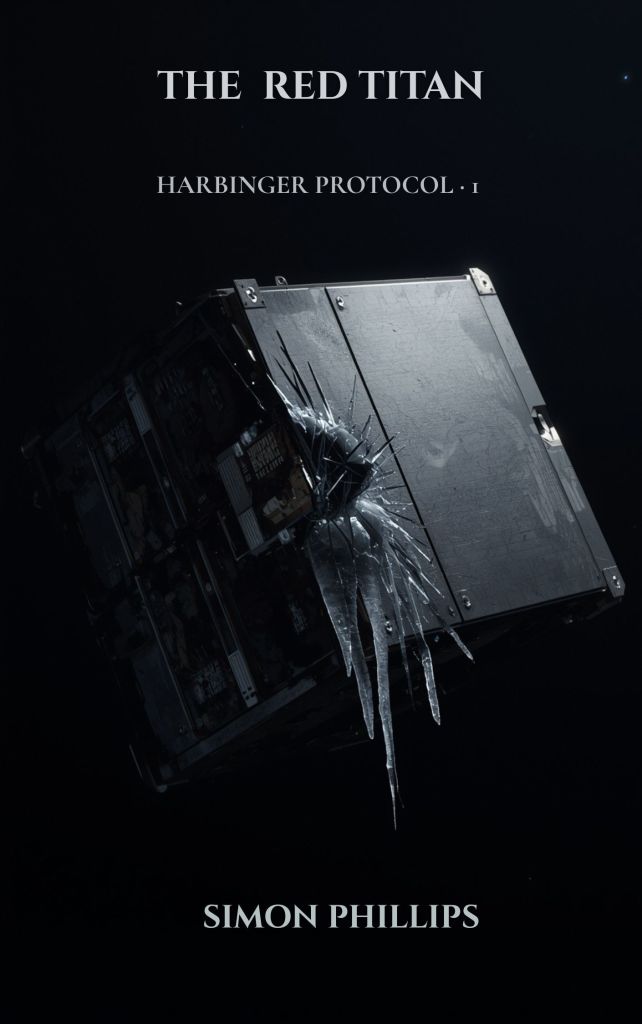
In The Silent Outpost, the second entry in Harbinger Protocol, silence becomes something more dangerous. Kheled Verge Processing Station Nine is cold, partially powered, and almost still when the ESC investigation team arrives. Its docking arms hang in interrupted motion. Its work lights have failed in broken sequence. Maintenance equipment remains suspended mid-task. The place appears paused, as though the ordinary life of an industrial outpost has been held in place by something that has learned how stations breathe.
This is where the series widens from isolated shipboard sci-fi horror into something larger. The first incident aboard the Red Titan left Soren Vale as a survivor. The second places him inside an institution trying to decide whether truth should be spoken plainly, delayed until it becomes useful, or shaped into language that can survive politics.
For readers looking for atmospheric science fiction horror, space station horror, biological contamination sci-fi, and a darker kind of interstellar political thriller, The Silent Outpost marks the moment Harbinger Protocol begins to show its wider shape.
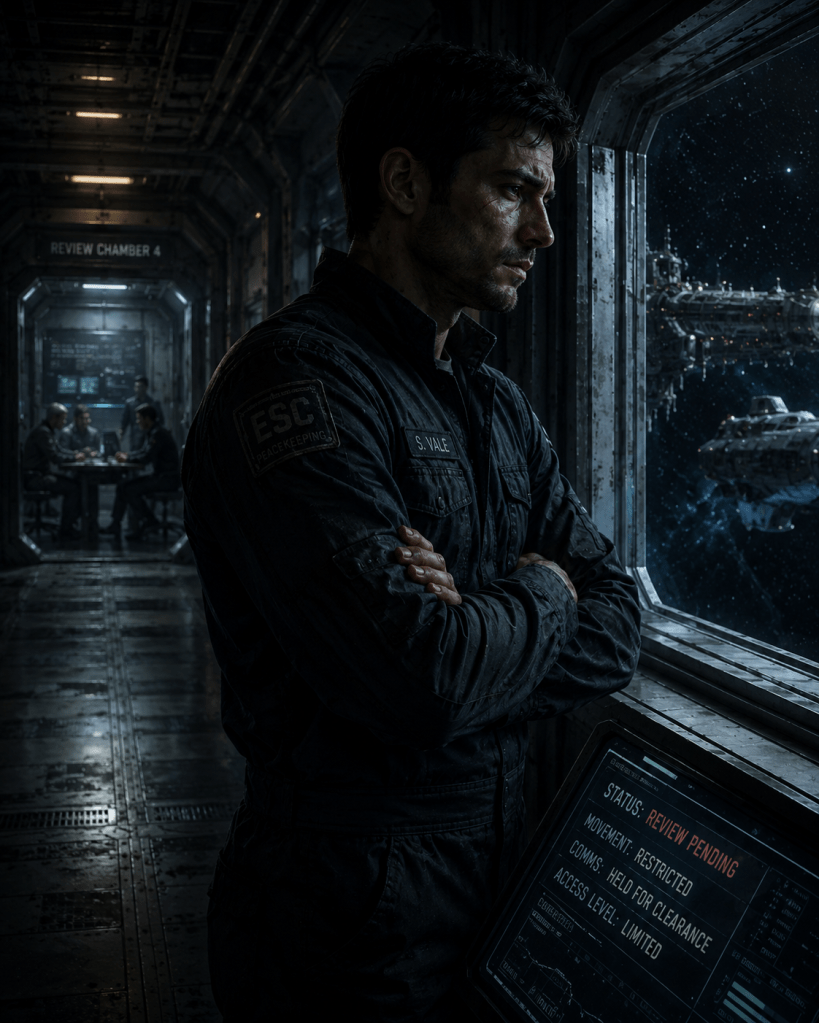
Soren Vale enters this novella in a cleaner kind of captivity.
He is aboard the ESC Peacekeeping Cruiser Leda Ark, safer than he was on the Red Titan, yet far from free. His movement is limited. His communications are held. His memories have become evidence. The institution around him speaks in careful phrases: protective review, pattern integrity, operational legal oversight, acoustic artefacts. Each term carries part of the truth, yet none of them can hold the shape of what he lived through.
That is one of the most important pressures in Harbinger Protocol. The horror is biological, industrial, and cosmic in its eventual reach, though it first enters through administration. Somebody has to classify the event. Somebody has to decide which words can be released. Somebody has to ask whether panic, sovereignty, route control, and treaty law are more dangerous than the thing moving through ducts and cargo bays.
Soren’s usefulness becomes a second form of custody. He notices patterns before committees are ready to name them. He recognises that wrongness can travel through air systems, power routes, warm compartments, and human assumptions. The ESC needs that instinct. It also needs him contained.
In many science fiction horror stories, the survivor becomes the hero who knows the truth and forces the world to listen. Harbinger Protocol takes a colder path. Soren is believed just enough to be used, controlled just enough to be kept close, and trusted only when his fear becomes operationally useful.
Station Nine and the Horror of Working Systems
Kheled Verge Processing Station Nine is not a gothic ruin in space. It is an industrial place. Ore systems, docking rings, maintenance spines, habitation blocks, control boards, pressure doors, service trunks, coolant lines, and emergency fallback systems form its body. That practicality matters.
The terror in The Silent Outpost comes from systems that almost behave correctly.
Dock Ring Three still answers, although weakly. The receiving corridor shows no grand destruction. Tools remain where workers left them. The first evidence of contamination appears in pale ribbed accretions on metal surfaces, hatch frames, vent housings, and equipment. It could be coolant residue. It could be mineral deposition. It could be a station ageing badly in deep cold.
Then Hab South changes the meaning of the place.
The dead are found near vents and service grilles. Some stand with hands against the metal. Others sit with faces angled upward, as if listening. There is no visible violence. No clear attack. No easy monster to blame. The bodies have been preserved by cold and arranged by behaviour. Something in the station made them listen long enough to die.
The voice-like sounds that follow are central to the series. They are not true speech in a simple sense. They are damaged systems, airflow, corrupted buffers, acoustic memory, and the human mind reaching for pattern. Yet that distinction offers no comfort. A false plea can kill as effectively as a real one when people are trained to answer distress.
A station does not need to become alive to become dangerous. It only needs to become trustworthy in the wrong places.
Biological Contamination That Uses Human Procedure Against Itself
The biomass threat in Harbinger Protocol is frightening because it does not behave like a simple alien invader. It is reactive, environmental, and tied to physical conditions: heat, power, airflow, oxygen, pressure, electromagnetic fields, and the infrastructure humans depend on.
That makes every sensible action dangerous.
A dark station must be investigated. Evidence must be recovered. Survivors may be trapped in sealed compartments. Life support might matter. Operations archives could explain what happened. A controlled systems wake seems reasonable. It is exactly the kind of careful, professional decision an ESC field team would make.
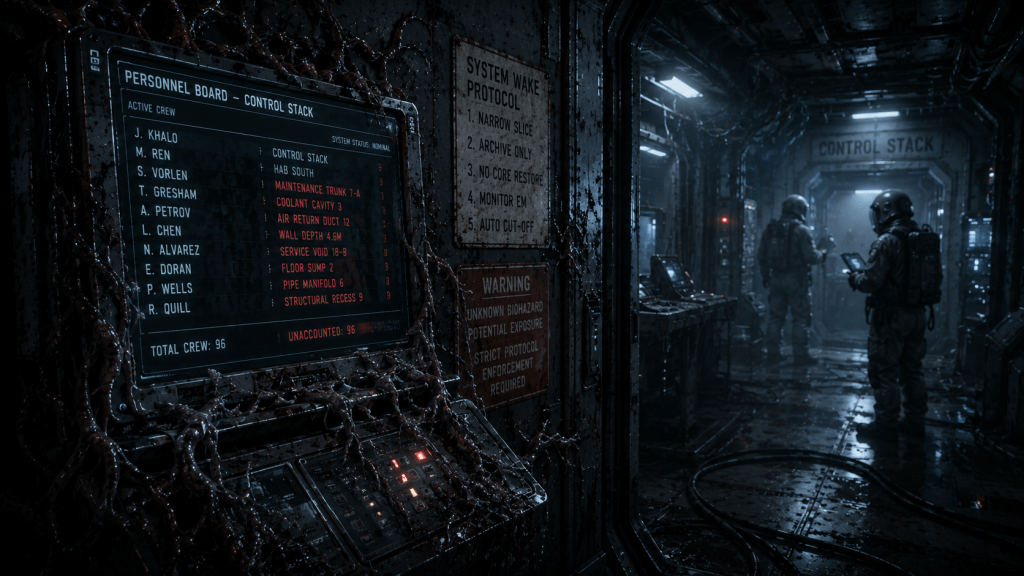
In The Silent Outpost, Kell attempts a narrow slice wake inside Control Stack. The intention is precise: operations archive and environmental board only, no station-wide restoration, no refinery systems, no heavy motors. Procedure is followed. Caution is present. Nobody behaves like a fool.
The station answers anyway.
Lights slam awake. Air handlers roar. Pressure doors cycle across the structure. Old announcements burst through speakers. Dead routines return in fragments. The outpost, once cold and held down, finds pathways through the very systems designed to reveal it.
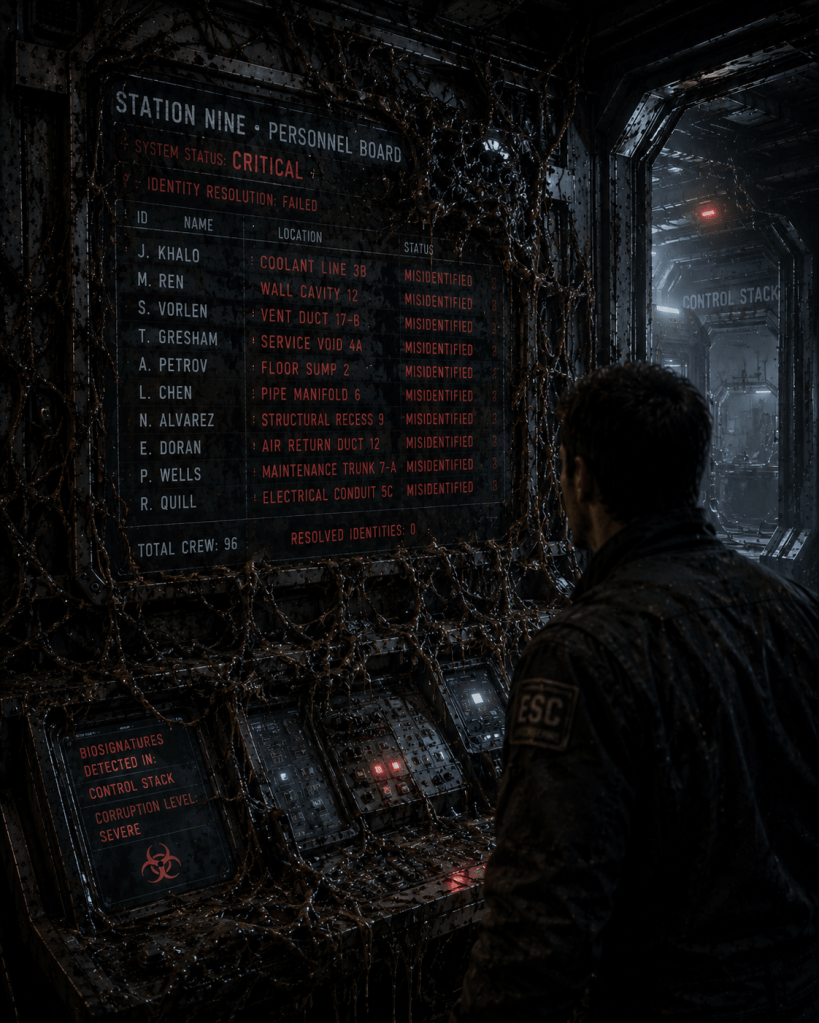
This is where the novella deepens its biological contamination horror. The danger is not merely infection. It is infrastructure conversion. The station’s systems begin to blur human presence, ducting, wall cavities, coolant routes, service voids, and crew identifiers until the personnel board can no longer separate bodies from structure.
Thirty-two becomes sixty-four. Then ninety-six. Then zero.
That simple numerical corruption is one of the most unsettling images in the novella because it makes bureaucracy itself part of the horror. The system still counts. It simply no longer understands what a person is.
The Personnel Board and the Fear of Becoming Infrastructure
The corrupted personnel board is the central horror image of The Silent Outpost.
A crew roster should be one of the most human systems aboard a station. It tells command who is present, where they are working, which sectors are occupied, who may still need rescue, and who may already be gone. It is a tool of accountability.
On Station Nine, that tool breaks in a way that feels worse than silence.
Crew names appear in ducts, coolant cavities, wall depth, floor sumps, service voids, and processing infrastructure. The system sees occupied space where there should be only pipes and structural cavities. Whether the readout is literal, corrupted, or some terrible combination of both, the emotional effect is clear. The station has stopped recognising the difference between its workers and its own body.
This is also where Soren’s pattern recognition becomes essential. He understands that the contamination followed air routes. Cold slowed it. Power restored movement. The wake allowed the station to read what it had already begun to absorb, overwrite, or misunderstand.
The result is not spectacle. It is a quiet, industrial nightmare. A man does not fear being eaten by a monster. He fears being placed inside the walls and misread as part of the station.
That fear becomes human through the infected marine, whose glove breach turns a small field accident into a containment crisis. The infection follows warmth, suit seams, skin, fabric, and deck contact. Cold suppression slows it, yet the team understands the cost of trying to carry him further. His plea not to be left where the station can “put” him in the walls gives the entire outpost a human centre.
Containment, in this universe, rarely feels clean.
The ESC, Quarantine, and the Politics of Naming Disaster
The Earth Strategic Coalition is powerful, disciplined, and capable of rapid action. It also works inside a human civilisation fractured by treaties, rival governments, trade routes, sovereignty claims, and competing narratives.
That is why The Silent Outpost is more than space station horror. It is also political sci-fi horror.
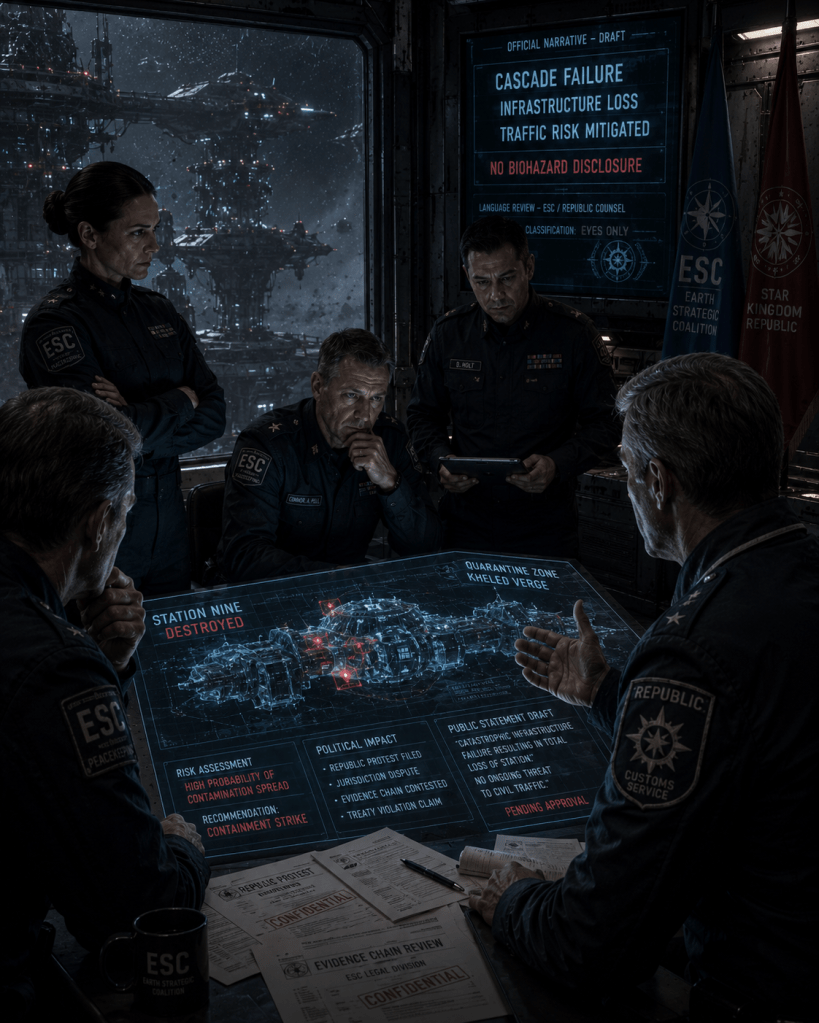
The ESC can send a team. It can freeze a lane. It can order a containment strike. Yet every action becomes evidence in someone else’s accusation. The Republic contests custody, access, survivor handling, route authority, and strike justification. A dead outpost becomes a diplomatic event. A contaminated fragment becomes a border crisis. A docking signal becomes a legal trap as much as a biological one.
The station’s docking shell creates one of the novella’s most dangerous pressures. Once Station Nine begins broadcasting live docking guidance, the threat moves beyond the interior. Any Republic cutter, ore hauler, emergency responder, or salvage vessel that trusts the beacon could open a clean path through contamination and carry it back into traffic.
That is the real horror of beacon trust. Civilisation depends on systems answering correctly. Ships follow guidance. Docking rings identify traffic. Emergency signals draw help. In Harbinger Protocol, those habits become vectors.
The containment strike that destroys Station Nine is swift, grim, and politically explosive. It is not a victory. It is an institutional wound. The outpost is erased because leaving it standing may spread the threat further, and the aftermath immediately becomes a fight over language.
The words are true enough to survive. They are also too clean to carry what happened.
A Series Built on Contamination, Denial, and Scale
Harbinger Protocol works because its escalation is controlled. The early horror remains grounded in freight corridors, sealed compartments, industrial stations, damaged telemetry, and official caution. The series does not rush towards cosmic revelation. It lets the reader feel how a civilisation fails to recognise collapse while its systems still appear to function.
The Silent Outpost moves the saga from the Red Titan’s isolated shipboard nightmare into a wider pattern of station-scale contamination, political pressure, and institutional dependence. Soren Vale becomes the continuity anchor between events. The ESC becomes both protector and jailer. The biomass remains strange, reactive, and deeply tied to the environments humans have built around themselves.
This is adult science fiction horror rooted in procedure, pressure, and consequence. Its fear comes from the gap between what people see and what institutions can say. It belongs to the same family as space survival horror, cosmic horror science fiction, quarantine fiction, and industrial sci-fi horror, yet its centre remains human. People still make tea. Officers still argue over phrasing. Crew still answer voices in vents because the voice sounds close enough to need help.
A short visual reading connected to the novella is also available here:
Where the Next Failure Begins
By the end of The Silent Outpost, Station Nine has fallen. The report has begun to change. Soren remains under provisional attachment. The ESC has survived one immediate containment crisis, yet the political cost is already moving faster than the language built to contain it.
A Star Kingdom patrol and a Federation salvage convoy are drawing towards confrontation over contaminated debris. Each side sees the other through suspicion before either fully understands the object between them. The biomass no longer needs to attack. Human systems are carrying it outward through fear, ownership, law, salvage rights, and accusation.
That is where Harbinger Protocol finds its most unsettling pressure. The crisis spreads through matter, yes, yet it also spreads through delay. Through the need for proof. Through the instinct to rescue. Through governments protecting territory. Through commanders trying to hold routes open for one more hour. Through the dangerous belief that a station, a ship, a beacon, or a report can still be trusted because it looks familiar from the outside.
The outpost is gone.
The pattern remains.
And somewhere beyond the next quarantine line, another system is still answering.
A Fleet inspection mission arrives expecting to close a dying industrial outpost. Instead, the station receives quiet orders for expansion
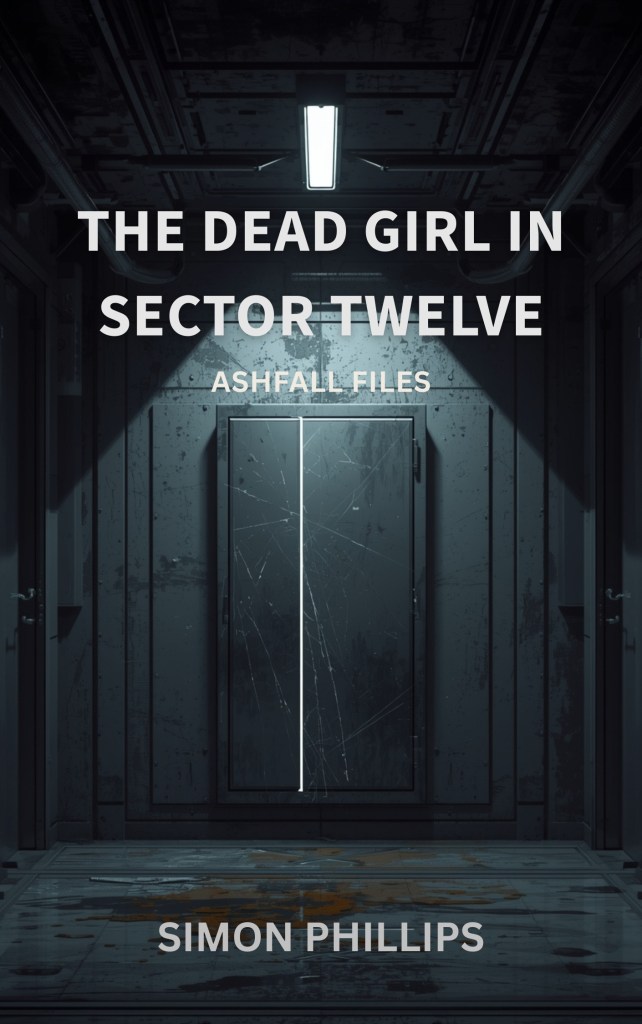
Chronicle Opening: The Arrival at Ashfall
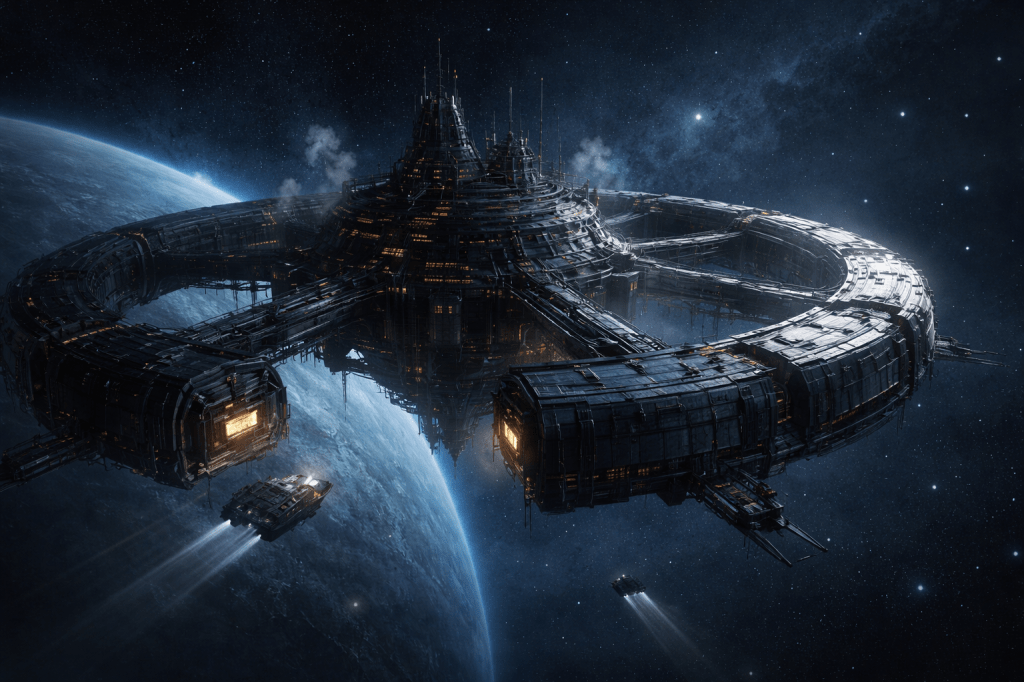
The inspection shuttle drifted through the outer traffic corridor with the slow patience of an ageing machine that had travelled far beyond the routes it once served. Ashfall Station filled the viewport ahead, an immense ring of darkened metal turning in quiet orbit above the pale curve of the planet below. From a distance the structure possessed the appearance of a relic left behind after a long war, its surfaces scarred by decades of repairs, extensions, and forgotten construction. Amber maintenance lights burned along the docking arms like distant lanterns hanging in a storm.
Inspector Halverin remained seated beside the forward console while the shuttle’s guidance system threaded its approach vector through a cloud of drifting cargo tugs and maintenance craft. Each vessel moved with the weary rhythm of workers who had spent their lives in the shadow of machinery, their engines leaving thin trails of ion light that faded into the deep blue of the surrounding stars. Ashfall grew larger with every passing second until the station occupied the entire frame of the viewport, its ring sections broken by thick industrial spines that connected to a central tower rising through the station’s heart.
Halverin studied the structure in silence while the shuttle rotated to align with Docking Arm Twelve. Fleet files described Ashfall as an ageing extraction hub at the far edge of controlled territory, a place built during an earlier phase of expansion when ore routes from the outer belt carried real promise. Those routes had faded many years earlier, leaving the station suspended between usefulness and abandonment. The inspection order carried a simple purpose: to evaluate the installation and prepare the paperwork required for closure.
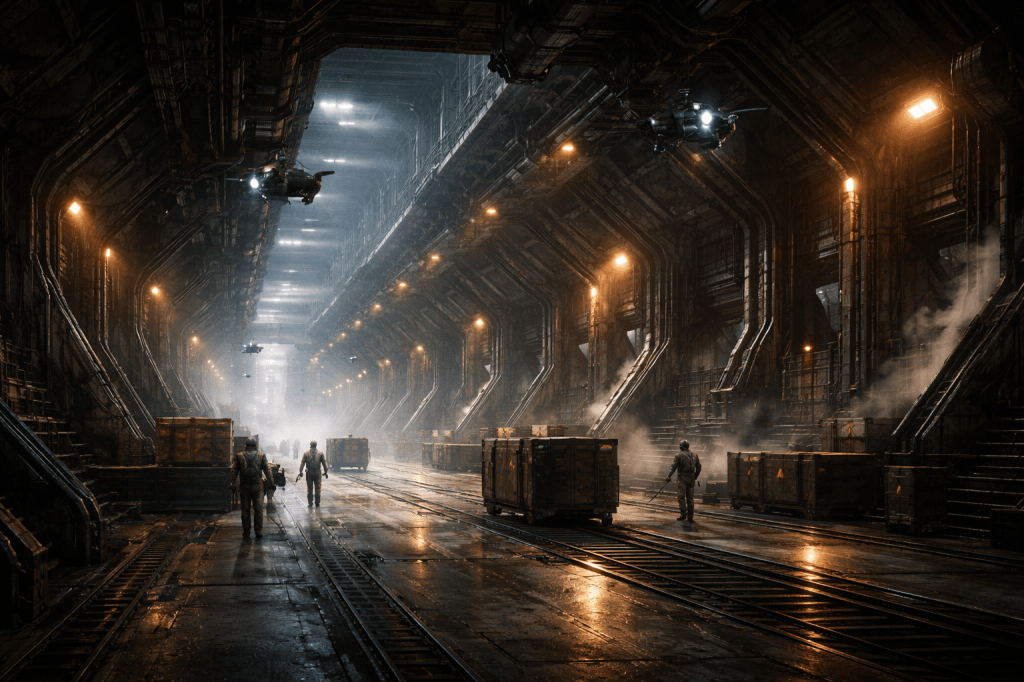
Through the shuttle glass Halverin observed long rows of habitation windows scattered across the station ring. Many remained dark. Others glowed with dim interior light that hinted at quiet lives unfolding behind metal walls. Somewhere inside those corridors engineers maintained life support systems older than most Fleet vessels, while cargo crews moved freight between bays that had witnessed decades of traffic. Ashfall continued to function through habit as much as necessity.
The pilot cleared his throat while guiding the shuttle toward the docking corridor.
“Dock control confirms our arrival,” he said. “They sound relieved to see a Fleet inspection team.”
Halverin allowed his gaze to follow the slow movement of a cargo hauler sliding away from the docking arm ahead. The vessel’s hull carried a patchwork of weld seams and fresh plating where older sections had been replaced. Every surface told the same story of endurance and improvisation. A station like this survived through constant repair.
“Relief usually appears when rumours begin,” Halverin replied quietly.
The pilot glanced toward him. “Rumours, sir?”
Halverin opened the inspection tablet resting across his lap and scrolled through the preliminary maintenance reports transmitted by the station administration. Power fluctuations across several outer sectors. Unscheduled system resets inside the older structural corridors. Salvage traffic arriving from beyond the debris perimeter. Each entry carried the tone of routine paperwork, though the pattern beneath the reports suggested a station working harder than its ageing systems allowed.
Beyond the viewport Docking Arm Twelve opened like a vast mechanical tunnel. Rows of guidance lights stretched into the interior bay while maintenance drones drifted along the outer hull inspecting the arm’s pressure seals. Ashfall Station continued its slow rotation above the silent planet below, an immense structure that had survived long enough to become part of the frontier itself.
Fleet command expected a recommendation for decommissioning, a quiet administrative ending for a station that had already outlived the era that built it.
Halverin held the tablet screen in his hands while the shuttle glided toward the docking cradle. The files suggested a different future unfolding across the station’s decks, one that would require expansion orders instead of closure.
By every measure recorded in the inspection files, Ashfall Station had reached the end of its intended life, a frontier installation whose purpose had faded as trade routes shifted and distant mining operations closed.
Yet the deeper layers of Fleet correspondence suggested another direction unfolding beyond the official briefing, a quiet decision somewhere within command. This ageing station drifting at the edge of human expansion would expand instead of vanish.
The arrival of Fleet Inspector Halverin marked the beginning of a series of quiet events that would gradually change the fate of Ashfall Station.
Station Record: Ashfall Station
Ashfall Station occupies a slow orbital path above the frontier world of Kestren-4, a mining planet whose richest deposits were exhausted many decades earlier, leaving behind a landscape of silent refineries and abandoned extraction pits that once supplied entire industrial regions across the expanding territories of human space.
The station itself began life as a resource transfer hub during the fourth wave of outer-system expansion, an era when cargo vessels arrived daily from the belt refineries and the surrounding mining fields, unloading vast shipments of processed ore that were then routed inward toward the manufacturing worlds closer to the core systems, where factories and orbital shipyards transformed that material into the infrastructure of a rapidly growing civilisation.
As the richest mining zones declined and transport routes shifted toward newer territories, many installations built during that period were gradually dismantled or abandoned, their structural rings stripped for salvage or their corridors left drifting in quiet orbit around worlds that had already been forgotten by the trade fleets.
Ashfall, however, remained in operation through a mixture of persistence, adaptation, and the quiet administrative decisions that often shaped the frontier more strongly than official policy ever admitted.
Fleet administration eventually classified the station as a declining industrial outpost whose continued operation served a limited set of purposes, most notably the coordination of salvage vessels working the debris fields beyond the system and the support of long-range transport traffic that occasionally passed through this region of space while travelling between distant territories.
Inspection orders issued shortly before the events recorded in this Chronicle suggested that Ashfall Station had reached the final stage of its operational life and that Fleet command intended to evaluate the installation for decommissioning once the remaining contracts tied to the station had concluded.
Yet within a matter of weeks, the direction of those orders began to change, as if information circulating through the deeper layers of Fleet command had altered the station’s fate long before the reason for that decision ever appeared in the official record.
About the Creator
The Future Chronicle is written and curated by Simon Phillips, a writer of science fiction and speculative storytelling who explores the quiet edges of human expansion, where ageing stations, distant worlds, and forgotten technologies continue their slow existence beyond the reach of the central worlds.
Many of the stories presented in these Chronicles exist within a wider fictional universe that follows the lives of investigators, engineers, and frontier workers living far from the comfort of the inner systems, where the machinery of civilisation continues to function long after its original purpose has begun to fade.
One such story unfolds aboard Ashfall Station, an ageing orbital installation whose corridors and industrial sectors form the setting for the science-fiction mystery novella Ashfall Station: The Dead Girl in Sector Twelve, where a routine investigation gradually reveals that something hidden within the station’s structure may have been present for far longer than the official records suggest.
Readers who wish to explore the full investigation and its unfolding events can find the novella below.
Inspector Halverin followed the station administrator along the docking corridor while the sounds of the bay settled into a steady industrial rhythm that seemed to pulse through every plate of metal beneath his boots. The corridor stretched forward beneath rows of amber maintenance lamps whose light reflected across the worn alloy floor in long warm bands. Along the distant walls, cargo machinery moved with patient deliberation while crews guided freight containers toward the interior lifts that carried materials deeper into the rotating ring of the station.
Ashfall possessed the atmosphere of a place whose working life had continued for so many years that every surface carried the quiet marks of labour. Rail tracks cut shallow grooves through the deck plating where freight trolleys had rolled for decades, and handrails bore the polished sheen left by countless gloved hands guiding themselves through artificial gravity shifts during docking operations. Above them, the massive skeletal framework of Docking Arm Twelve rose into the dimness like the interior of an enormous machine that had grown layer upon layer through successive expansions.
“Your arrival stirred a certain level of curiosity among the station crews,” the administrator said while guiding Halverin toward a security arch positioned at the end of the corridor. “Fleet inspections arrive rarely this far beyond the core trade lanes.”
Halverin glanced across the open docking chamber where two cargo haulers drifted slowly into their assigned berths while docking clamps moved outward to receive them.
“Curiosity usually accompanies uncertainty,” he replied. “Inspection orders tend to appear when Fleet administration begins reconsidering the value of a frontier installation.”
The administrator allowed a thoughtful expression to pass across her face while the security arch scanned Halverin’s identification tablet and cleared them into the interior access corridor.
“Ashfall has endured several such reconsiderations across its history,” she said. “Each time the station adapted to whatever circumstances followed.”
Beyond the checkpoint, the corridor widened into a long transit gallery whose walls were lined with structural ribs and exposed service conduits that carried power and atmosphere throughout the station. Freight lifts descended through circular shafts positioned at intervals along the passage, each platform transporting containers toward sectors hidden deeper within the ring. Overhead, the slow rotation of the station created a subtle sensation of movement, as if the entire structure breathed with mechanical patience.
Halverin studied the gallery while they walked, noting the layered architecture that revealed decades of construction phases. Some sections of the corridor carried the clean geometric lines typical of modern Fleet engineering, while older segments retained heavier structural plating from earlier eras when stations were built to endure harsher industrial demands. The result created a complex patchwork of engineering philosophies that had merged together through years of expansion.
“Fleet records describe Ashfall as a declining transfer hub,” Halverin said while examining a series of maintenance panels mounted along the wall. “Traffic levels appear healthier than the reports suggested.”
“Salvage operations increased across the outer debris field,” the administrator explained. “When older transport routes collapsed, many vessels and relay structures remained scattered across that region of space. Independent crews began recovering those materials several years ago, and Ashfall gradually became their primary staging port.”
The explanation carried the tone of an administrative summary that had been repeated many times. Halverin sensed an additional layer of thought behind the words, something unspoken that hovered beneath the careful clarity of the station official’s voice. Frontier installations often survived through precisely such quiet adjustments, yet the inspection reports resting inside Halverin’s tablet suggested deeper structural changes occurring within the station.
They passed beneath another bank of lighting where maintenance drones hovered close to the corridor ceiling while scanning the integrity of the power conduits embedded in the wall. Each machine moved with delicate mechanical grace, extending slender sensor arms that traced the seams between metal plates. The drones worked with such silent efficiency that their presence almost blended into the surrounding machinery.
“Your crew maintains a considerable amount of infrastructure,” Halverin observed. “The station appears larger than the official registry diagrams indicate.”
The administrator slowed slightly as they approached a junction where three corridors met beneath a circular observation window overlooking the inner ring of Ashfall Station. Through the glass, Halverin saw the immense curve of the rotating habitation decks stretching across the interior structure like the inside wall of a vast mechanical horizon. Cargo traffic moved along illuminated transit lanes while distant maintenance vehicles travelled between docking sectors that appeared as small points of light scattered along the ring.
“Ashfall grew in stages,” the administrator said while gesturing toward the interior view. “Each phase connected new construction to older frameworks. Salvage materials often supplemented the official supply chains during those expansions.”
Halverin listened while studying the station’s interior landscape. Layers of habitation modules, cargo corridors, and structural trusses formed a dense industrial ecosystem whose complexity extended far beyond the simple diagrams included in the Fleet archives. The station resembled a living organism assembled from decades of improvisation.
“Expansion during a period of declining traffic suggests unusual priorities,” Halverin said thoughtfully.
“Frontier economies evolve through necessity,” the administrator replied while guiding him toward a lift platform descending into the lower administrative decks. “Ashfall discovered ways to remain useful.”
The lift platform engaged with a low mechanical vibration and began its descent through the circular shaft that opened beneath the gallery floor. As the platform lowered into the interior levels of the station, Halverin watched the layered structure pass slowly around them, each deck revealing new corridors filled with workers moving between maintenance stations, habitation modules, and equipment lockers arranged along the walls.
Artificial gravity strengthened slightly as they travelled deeper into the rotating ring. The change produced a subtle shift in the balance of Halverin’s stance while the platform continued downward through the immense framework of the station.
Across the descending levels, he noticed several sealed corridors branching away from the primary decks. Their entrances carried reinforced bulkheads whose surfaces bore the faded markings of earlier construction authorities. Some appeared old enough to predate the most recent expansions recorded within Fleet engineering logs.
“Several sectors remain isolated,” Halverin observed while pointing toward one of the sealed passages sliding past the lift cage.
“Structural preservation zones,” the administrator said calmly. “Older engineering frameworks occasionally require separation from modern systems while reinforcement projects proceed.”
Halverin considered the answer while the lift continued its steady descent. Frontier stations possessed many hidden compartments where obsolete equipment waited for eventual removal. Yet the inspection reports inside his tablet contained references to unexplained power fluctuations originating from precisely such sealed areas.
The lift platform reached the administrative deck and slowed as the surrounding corridor came into view. Unlike the industrial spaces above, this level carried the quieter atmosphere of operational management. Offices lined the passage while communication terminals flickered with the pale light of long-range transmissions travelling between Ashfall and distant Fleet relays.
The administrator stepped from the lift and guided Halverin toward a wide observation corridor overlooking the station’s central command tower. From this vantage point, the immense rotating ring of Ashfall Station curved upward into the distance while the planet below cast a soft blue reflection across the lower structural beams.
Halverin paused beside the observation rail and studied the vast interior landscape spreading across the station. Freight moved through the illuminated corridors. Maintenance drones traced their patient circuits along the structural ribs. Human lives unfolded quietly inside thousands of compartments distributed across the rotating ring.
Ashfall continued its slow orbit above the silent world below while the machinery of the station carried on with the steady rhythm of a place that had grown accustomed to survival.
Yet somewhere within that immense industrial labyrinth, the inspection files suggested the presence of changes that had begun long before Fleet command issued the order that brought Halverin to this distant frontier installation.
Docking Arm Twelve formed one of the oldest sections of Ashfall Station, a corridor of machinery and freight traffic where decades of expansion had layered new construction upon the station’s original industrial framework.
The Idea Behind the Chronicle
Large orbital stations like Ashfall appear frequently in science fiction, yet their origins come from very real ideas that engineers and planners have considered for decades. As humanity expands further into space, the distances between settled worlds grow wider, and the infrastructure required to support trade, travel, and exploration becomes increasingly complex. Vast stations positioned along transport routes would function as the ports and industrial centres of those distant frontiers.
Early visions of space colonisation imagined elegant rotating habitats filled with gardens and cities suspended in orbit, though the practical reality of expansion would likely unfold in a far more industrial manner. Freight depots, salvage ports, fuel processing hubs, and maintenance platforms would appear long before comfortable civilian settlements, and many of those installations would begin life as harsh working environments where engineers and cargo crews kept machinery running under difficult conditions.
Ashfall Station belongs to this imagined era of expansion. It represents the kind of installation built quickly to serve a specific economic purpose, then left to adapt when the frontier moved elsewhere. Across human history many places have followed a similar path. Mining towns, remote harbours, and railway settlements have often survived long after the industries that created them began to fade, reshaping themselves into something new through the quiet persistence of the people who remained behind.
The Chronicle of Ashfall explores that idea of survival and adaptation. A station designed for one purpose gradually becomes something more complex as new trades appear, old systems are modified, and sections of the structure accumulate decades of layered construction. Over time the installation begins to feel less like a machine and more like a living environment shaped by the countless lives that have passed through its corridors.
In such places the boundary between past and present becomes blurred. Old infrastructure remains hidden behind modern upgrades, forgotten corridors continue to exist beyond sealed bulkheads, and the history of the station lingers within the machinery that keeps it alive.
Ashfall Station therefore serves as both setting and character within the Chronicle, an immense frontier installation whose long history has left traces that the official records may never fully explain.
From the Author’s Desk
Ashfall Station began as a simple image that lingered in my imagination for several years: the idea of an immense industrial structure drifting at the far edge of human space long after the frontier that created it had moved on. Science fiction often grows most naturally from such quiet beginnings, where a single place or moment suggests a much larger history waiting somewhere beyond the visible story.
The Chronicles presented here explore the earlier life of that station, revealing small fragments of its past through the people who lived and worked within its corridors. Each episode focuses on a single event or encounter, gradually uncovering how Ashfall evolved from an ordinary frontier installation into a place carrying deeper layers of history hidden within its structure.
The novella Ashfall Station: The Dead Girl in Sector Twelve takes place much later in that timeline, when the station has already accumulated decades of expansion, modification, and quiet mystery. Writing the Chronicle series offers the opportunity to step backwards into that earlier period and observe the smaller moments that shaped the station long before the events of the investigation began.
Alongside these Chronicles I continue writing fiction across several science fiction and speculative projects, many of which explore frontier environments where technology, distance, and human persistence intersect in unexpected ways.
Readers interested in those stories can explore more through the links below.
Industrial stations such as Ashfall represent one of the most practical solutions to the challenge of distance in space exploration. Vast orbital platforms positioned along transport routes would form the logistical backbone of any expanding civilisation, providing docking capacity for freight vessels, repair facilities for long-range ships, and storage infrastructure for resources moving between distant systems.
During the earliest phases of expansion such stations would likely resemble harsh industrial environments rather than comfortable settlements. Engineers, cargo crews, and salvage operators would occupy modular habitats attached to immense structural frameworks designed primarily for durability and efficiency. Over time these installations might grow far beyond their original plans as new sectors were added to support changing economic activity.
Ashfall Station reflects this gradual evolution. A structure originally designed for ore transfer slowly becomes a hybrid of freight port, salvage hub, and frontier settlement as different industries pass through the system.
Salvage Economies
Salvage operations often emerge in regions where earlier waves of exploration have left abandoned infrastructure behind. Derelict cargo ships, obsolete relay stations, and fragments of industrial platforms may remain drifting through orbital space for decades or even centuries. Independent crews recover valuable materials from these forgotten structures and return them to frontier ports, where metal and components can be reused.
A station positioned near a large debris field would therefore become a natural gathering point for salvage crews and transport contractors. Over time such activity could replace the station’s original purpose entirely, allowing an installation once built for mining traffic to survive long after the surrounding resource economy has faded.
Layered Structures
One intriguing feature of long-lived orbital stations would be the accumulation of multiple engineering eras within a single structure. New modules could be attached to older frameworks, outdated systems might remain sealed behind bulkheads, and corridors originally designed for industrial machinery might later become part of habitation districts or storage sectors.
This layered architecture creates environments where the past remains physically embedded within the present. Forgotten corridors and abandoned compartments can persist inside the station’s interior, hidden behind structural reinforcements that few workers ever have reason to access.
Ashfall Station carries the weight of this accumulated history, a frontier installation whose present appearance reflects decades of adaptation, expansion, and quiet improvisation by the people who have kept its machinery running.
Next Chronicle
Several months before the inspection recorded in this Chronicle, a salvage vessel arrived at Ashfall Station after operating far beyond the normal navigation perimeter of the system. The ship returned with a fragment of unidentified structure recovered from deep orbit within the outer debris field, an object whose origin could not immediately be traced to any registered vessel or industrial installation.
Station logs record that the fragment was transferred quietly into a sealed research hold shortly after the salvage crew docked, and within a few hours the object disappeared from the public cargo registry entirely. Few workers on Ashfall understood what had been recovered from the silent region of space beyond the station, though rumours began to circulate through the docking sectors that the salvage crew had discovered something far older than the drifting wreckage normally collected from the debris field.
The next Chronicle returns to that earlier moment, when the salvage ship first approached the station carrying its unusual cargo and the events began that would slowly alter the future of Ashfall Station.
Next Week: The Salvage Run
Ashfall Station continued its slow orbit above the silent world of Kestren-4, carrying within its vast structure the quiet beginnings of events that few among its workers yet realised had already begun.
There are moments when failure announces itself loudly. Alarms sound. Lights change. Authority moves in response to visible threat.
Then there are the other moments.
The ones that pass inspection.
Harbinger Protocol was built around those quieter failures. The ones logged, approved, signed off, and archived without protest. The incidents that make sense on paper and leave a faint pressure in the room once the report ends.
The flash-fiction fragments I have been releasing recently come from that space. They are not scenes in the conventional sense. They are residues. Procedural echoes. Things overheard through systems that were never designed to listen for consequence.
One of those fragments centres on a compartment that received clearance twice.
No alarm followed the first authorisation. No escalation followed the second. Every reading remained stable.
The repetition carried no technical significance. That is what unsettled it.
Clearance systems exist to remove hesitation. They translate judgement into colour states, timestamps, and confirmation loops. Once permission is granted, the system proceeds without interpretation. That design works well in stable environments. It functions less cleanly when the environment begins to change in ways the system cannot name.
In Harbinger Protocol, those changes arrive early and quietly.
The flash-fiction videos released on YouTube present these moments as isolated artefacts. A log entry. A procedural pause. A line written down and accepted because nothing else contradicted it. They are intended to feel incomplete, as though part of the context remains elsewhere.
The book expands the same approach across a wider frame. Institutions responding through habit. Authorities interpreting anomalies through existing language. Witnesses revising statements under pressure until they align with what the system expects to hear.
Nothing in the story announces itself as extraordinary. The horror develops through repetition, delay, and misinterpretation. By the time recognition arrives, the paperwork already carries multiple signatures.
The YouTube video linked below functions as a recovered fragment from that larger record. It stands on its own, although it gains weight when placed alongside the written report.
▶ Watch the flash-fiction video
I have chosen to release these fragments alongside the book for a specific reason. The Harbinger Protocol project relies on atmosphere and accumulation. Each piece adds pressure without resolving it. The videos create a sense of institutional proximity. The book carries the full procedural arc.
Neither replaces the other. They occupy adjacent layers.
This approach reflects the world of the story itself. Systems communicate through partial records. Decisions pass through multiple hands. Meaning emerges through overlap, delay, and repetition. The audience assembles understanding in the same way the characters do.
Slowly. Indirectly. After the moment when intervention might have mattered.
If you are drawn to restrained science fiction, procedural horror, and narratives that unfold through systems instead of spectacle, Harbinger Protocol was written for that space. The fragments will continue to appear. The records remain open.
Some files clear once. Some clear twice. The difference arrives later.
Sector Twelve reopened before anyone asked the wrong questions.
Ashfall Station is built to remain in motion. Repairs conclude with quiet efficiency. Reports settle into their proper categories. Broadcasts arrive on schedule and carry the right tone of reassurance. Incidents close.
The Ashfall Files is a science fiction noir short-story series set within that system, following investigations that begin after procedure has already declared the matter finished. Each case centres on a moment that should have ended cleanly, yet lingers, misaligned, resisting the shape imposed upon it.
The first case, The Dead Girl in Sector Twelve, opens inside a corridor already marked resolved. The lighting has been replaced with a newer, steadier glow. The walls have been sealed, their seams still warm from rushed work. The station has moved on. Only a handful of details remain slightly out of place, enough to draw the attention of those whose role is to notice what others are trained to accept.
Alongside the published short story, a series of short-form flash fiction pieces and narrated fragments have been released. These are not excerpts, nor summaries. They exist as atmospheric echoes, fragments of pressure and omission designed to sit beside the main story rather than explain it. They offer an entry point for readers who prefer to listen first, to absorb tone, to decide whether to step further inside Ashfall Station.
If the corridor feels wrong, that sensation is deliberate.
A narrated visual fragment from The Ashfall Files is available to watch on YouTube, presenting the atmosphere of Sector Twelve as it reopens, before the investigation begins. Those who prefer to encounter the world through sound and image may wish to start there.
Before my epic fantasy novel The Veil of Kings and Gods releases, I wanted to open a small window into the world of Ældorra, a world of stone kingdoms, fading gods, and myths that refuse to die.
Each short story I write is its own world in miniature. They don’t rely on the main novel, yet every one of them echoes it, a fragment of history, a lost prayer, or a legend that shaped the lands my characters now walk. Some are quiet and personal; others burn with the power of the divine. Together, they breathe life into Ældorra in a way that maps and lore pages never could.
Writing these stories is more than worldbuilding, it’s a way of feeling the world I’ve spent years creating. When I step into a new tale, I discover the texture of the world again: the smell of rain on stone, the flicker of temple light, the forgotten names carved into the ruins.
These short stories aren’t just for readers waiting for the novel, they’re for anyone who loves myth, emotion, and the quiet moments that make a fantasy world feel alive.
You’ll soon be able to explore them as ebooks, see the artwork behind them, and even collect the prints.
Welcome to Ældorra. The gods don’t stay silent forever.