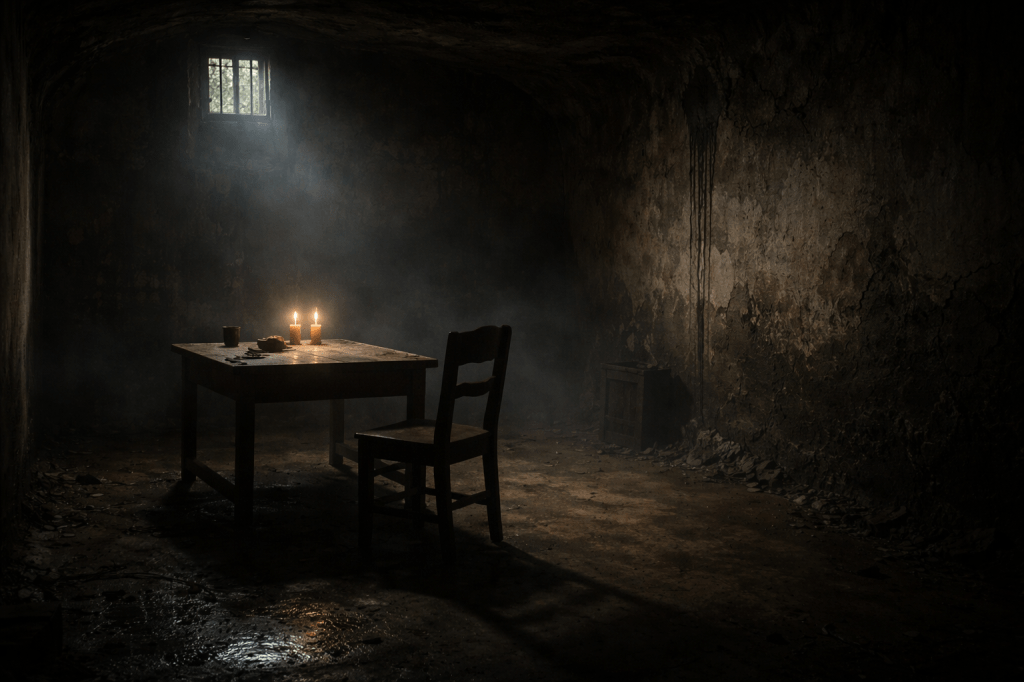
A record of a death where the body settled against itself, and the room retained a stillness that did not pass with breath or with time.
The Record of the Upper Chamber
The room stood above the lane where the evening light lingered longest, its windows set high above the street and its shutters drawn back just enough to admit the last of the day. What entered passed across the floor in a narrow band, touched the foot of the bed, and faded slowly into the dimness, while the chamber held to itself with a quiet reserve that seemed older than the house around it.
The man who had occupied it kept his surroundings in a way that spoke of habit more than comfort. Papers rested in measured piles upon the table, each set bound with cord drawn tight and turned once more through the knot for certainty. The chair stood close to the table’s edge, its legs worn in the same places by years of being pulled back and returned. The coverlet upon the bed had been smoothed in the morning, and a coat still hung from the peg beside the door as though the next hour had been expected to proceed as every other hour before it.
When the room was opened after his death, those who entered remarked first upon the stillness that lay inside it. It settled against the body and held there, deepening the breath and slowing the step, until even the smallest movement seemed to travel farther than it should.
“You felt it as you came in,” said the woman who stood just inside the threshold, her voice lowered by the space before she seemed aware of it. “It presses upon the chest.”
The constable remained with one hand upon the latch for a moment longer, as though the act of releasing it required more thought than usual. The air gathered around him with a quiet weight, and his first breath within the room drew shorter than the one he had taken in the passage.
“It is close in here,” he said at last. “The window should have eased it.”
“It stood open when they found him,” the woman replied. “They left it so for most of the night.”
He stepped fully inside and allowed the door to rest behind him, while the floorboards received his weight with a low creak that seemed to drift thinly through the chamber before settling into the walls. He gave his attention to the bed first, then to the window, then to the table, as though the proper order of ordinary things might restore the room to reason.
“Who found him?” he asked.
“A neighbour from the next house,” she said. “He came for a ledger that had been promised and never brought down.”
“And the state in which he was found?”
She paused then, her eyes returning to the bed with the same reluctance they must have carried the first time. “He had fallen,” she said, “though the form of it carried little of an ordinary fall.”
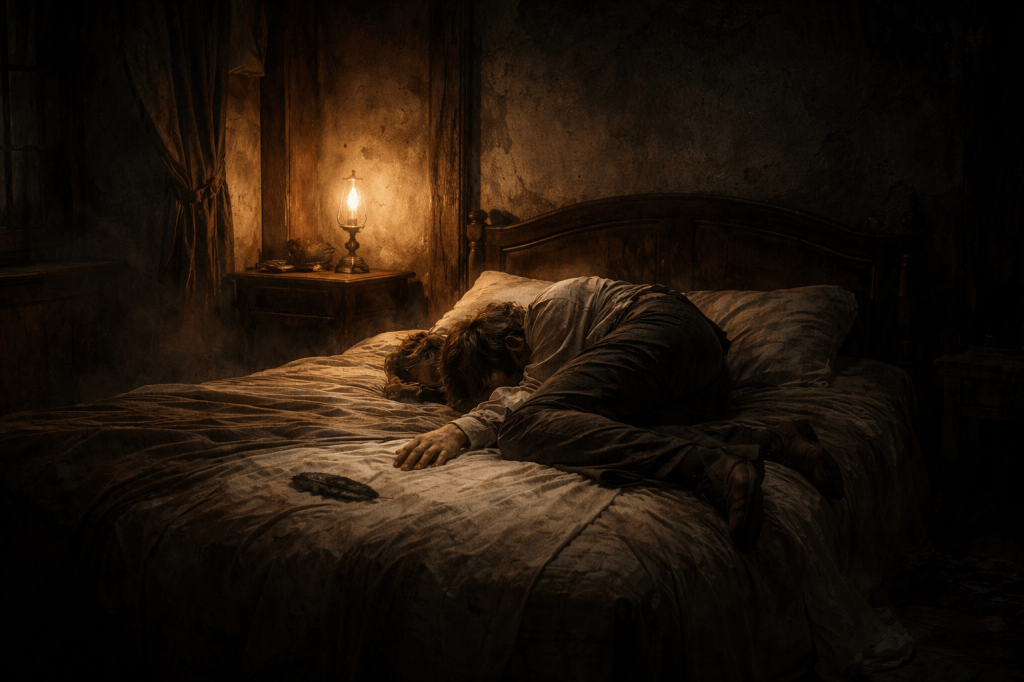
The constable moved nearer, each step measured and deliberate. The sheets had been drawn back after the body was taken away, though an impression remained in the fabric. It ran inward in a shape that troubled the eye, as though the weight that had made it had folded towards itself before it came to rest.
He stood over it for some moments in silence. The evening light had weakened by then, and the room seemed to hold more of its own dimness than the hour should have given it.
“There is no sign of struggle,” he said.
“None was spoken of,” the woman replied.
“No cry heard through the wall?”
“None that anyone would swear to.”
He bent slightly and held his hand above the sheet, close enough to feel the air gathered there. His expression altered in a way so slight another man might have missed it, though the woman at the door saw it clearly and lowered her gaze.
“It holds itself,” he said quietly.
“It returns,” she answered.
His eyes moved to the window again. The shutters remained open, and a faint current entered from the lane outside, carrying the last sounds of trade and passage below. That air entered the room and weakened within a few feet, as though the chamber accepted it only to set it gently aside.
“You kept the room open after he was found,” he said.
Yes.”
“And the air changed?”
“For a little while.”
He turned away from the bed and crossed to the table. The wood felt cool beneath his palm, and the papers upon it remained aligned with the care of a man who had expected to return to them. He lifted the edge of one packet and let it rest again, the slight sound of cord against paper carrying thinly through the room.
“He had been working,” he said.
“He always worked at that hour.”
“And then crossed to the bed.”
“That is how it appeared.”
The constable studied the chair, then the space between chair and bed, then the bed again. “He rose of his own will,” he said.
“That is what the room suggests.”
He looked towards her then. “The room suggests many things.”
She received that without change. “It does.”
He moved back towards the bed and placed his fingertips lightly upon the sheet. The fabric yielded at once, though the air above it seemed to gather around his hand and hold there, as though preserving the memory of weight after the weight itself had gone. He withdrew at once and straightened, his fingers curling briefly before he let them fall.
“It settles over the bed more strongly,” he said.
“Yes.”
“And nowhere else?”
The woman’s gaze shifted towards the chair by the table. “It held there as well, on the first evening. Less now.”
He followed her look. The chair stood with one leg turned slightly inward, the smallest disturbance in an otherwise ordered room.
“He became aware of something,” she said.
The constable remained silent for a moment. Then he asked, “You speak as though you had seen it.”
“I saw the room after,” she replied. “At times that is enough.”
He accepted that with the reserved expression of a man who had learned that certain answers closed more doors than they opened. His attention returned to the walls, which held plain plaster above old timber, sound enough to the eye and giving no sign of breach or entry.
“There is no mark of another presence,” he said.
“No mark that would satisfy a ledger.”
That drew his gaze back to her once more. She stood with her hands folded before her, composed in the way of those accustomed to difficult rooms and the stories that gathered inside them. Her age was hard to place in the dimness. Her voice had the steadiness of one who had long practised the art of speaking plainly when others wished for easier versions of events.
“It will be entered as failure of the body,” he said.
“Yes,” she replied.
“The position in which he was found will be noted.”
“Yes.”
He glanced again at the bed, then at the chair, and the stillness within the room seemed to draw closer, as though it heard and waited. “There will be no advantage in saying more than that.”
“There rarely is.”
The light had faded enough by then that the lamp in the passage cast a pale shape across the threshold. The constable went to the window and pushed one shutter wider, allowing more evening air to enter. For a brief moment the chamber eased, though the change remained slight and passed almost at once, the weight in the room settling back into its earlier form with a patience that carried something deeply unsettling in it.
He stood very still as that happened, and when he turned back his face had lost the last trace of practical certainty with which he had entered.
“How long has it remained this way?” he asked.
“Since the body was carried out.”
“And each time the room was entered?”
“It gathered again after every disturbance.”
The constable gave a slow nod and moved towards the door. He paused at the threshold, then looked back once more upon the bed, the table, and the ordered papers that would never be touched by the hand that had arranged them.
“Have the room closed,” he said. “There is little to be gained from leaving it open.”
“It will remain as it is.”
“I believe that.”
The woman stepped forward after he had passed into the corridor. She took one last look inside before drawing the door towards her. As it moved, the room seemed to gather itself more fully, the stillness deepening over bed and chair and table alike, while the dimness within held its place against the fading day.
When the latch settled, the chamber was shut again. Within it, the impression upon the bed remained, the papers waited in their ordered stacks, and the air drew inward once more into the same quiet state, patient and unchanged, as though it required no witness in order to hold what had occurred there.
Foundation Register: Lower Chamber Storage Record
The chamber recorded within the upper district plans appears as a private room set above the adjoining trade lane, its structure resting upon earlier timber and plaster whose alterations are noted across several revisions of the building. Surviving layouts refer to the space only in domestic terms, with no indication that it held any distinction beyond its use as a place of work and rest for its occupant.
During routine inquiry following a reported death within the room, entries began to note irregular conditions concerning the atmosphere of the chamber, where the air was described as holding its density beyond expected limits, and where the space failed to clear despite the opening of shutters and the introduction of air from the street below. These observations were recorded alongside the primary account and attributed to the enclosed nature of the room, as well as the materials of its construction and the arrangement of the surrounding structures.
Further entries describe the persistence of these conditions across repeated visits, noting that the atmosphere within the chamber appeared to settle into a consistent state after disturbance, returning to that state regardless of how long the room remained open. The effect was observed in each instance without variation, and no external source within the adjoining properties was identified that might account for the behaviour.
The death itself was entered in practical terms, with the position of the body recorded as having settled in a manner that did not align with an ordinary fall. This detail was included without expansion and was not pursued beyond its initial notation, the cause being assigned to failure of the body under strain.
A marginal notation, written in a later hand, refers to the chamber as holding “a retained stillness”, a phrase set apart from the primary entry and left without further clarification. The notation appears once and is not repeated within the register.
Subsequent entries indicate that the chamber remained in use following the incident, with no structural alteration or remedial work recorded. Recommendations were limited to continued ventilation and ordinary oversight, and the absence of further reports was taken as sufficient indication that the condition had stabilised.
No connection was made between this chamber and other irregularities noted within the district, and the record concludes with the structure listed as functional, its condition accepted without further inquiry.
About the Creator
The Mythic Chronicle is written and curated by Simon Phillips, a writer of mythic and speculative fantasy whose work explores the quieter edges of forgotten worlds, where buried structures, fractured records, and lingering presences continue beneath the surface of recorded history.
The accounts preserved within these Chronicles form part of a wider body of work in which cities stand upon older foundations, and events recorded as isolated disturbances are understood, in later tellings, to belong to patterns that were never fully recognised at the time.
One such account survives in a separate record, detailing an incident within a lower district where a death was first dismissed as excess, though the space in which it occurred retained a presence that resisted clearing, and where investigation revealed signs that the disturbance had not been confined to a single room.
This record is preserved in the novella Black Feathers in a Brothel, where the events surrounding that incident are followed more closely, though even there the full nature of what lay beneath the structure remains uncertain.
Readers who wish to examine that account in its fuller form may find the record below.
Explore the book:
Black Feathers in a Brothel
You can watch his YouTube channel here:
Author Simon Phillips

Continuation of the Record
What follows is taken from later accounts concerning the upper chamber, where the death was first entered as a failure of the body, and where the condition of the room was noted in passing within the same record. Subsequent entries describe the persistence of the atmosphere across repeated visits, where the space was observed to settle into a fixed state, and where the stillness remained after each disturbance, returning as though it held to a form of its own.

Subscribe to continue reading
Subscribe to get access to the rest of this post and other subscriber-only content.