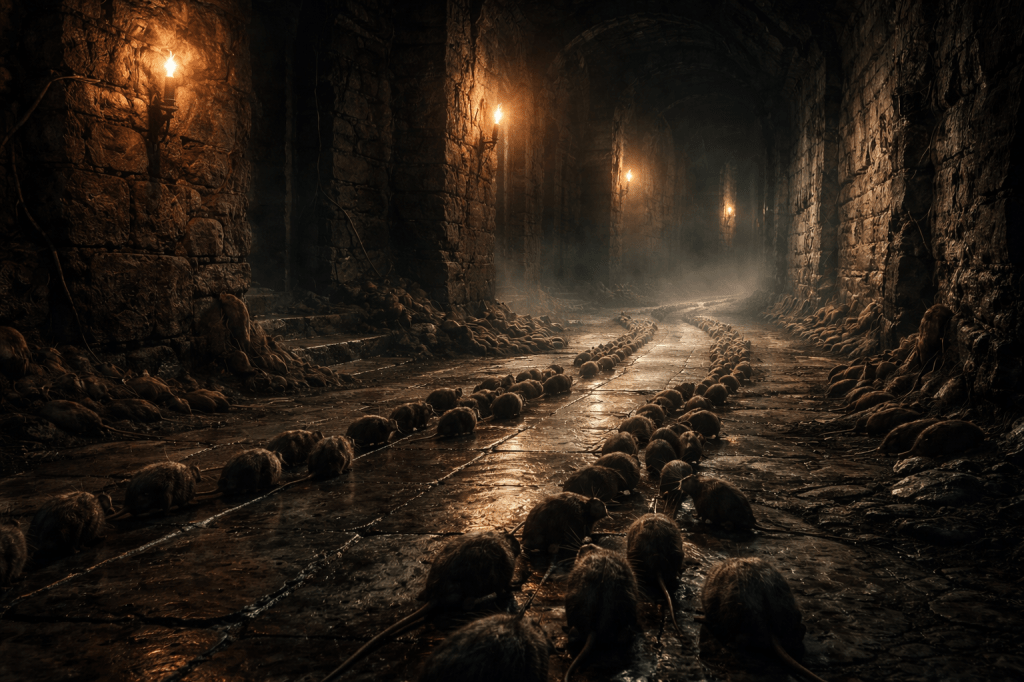
The Record of the Lower Cellar
The cellar door dragged across the stone with a sound that seemed to linger in the wood after the movement had ceased. Merrow kept one hand upon the iron ring for a moment longer than needed, listening into the dark below as though the space might offer some sign of its temper before he trusted his weight to the steps. The lantern in his other hand cast a low amber circle across the threshold, touching the worn lip of the stair and the rough bloom of old damp upon the wall. The smell that rose from beneath carried earth, stale grain, and the faint sour trace of standing water that always gathered under the lower houses once the weather turned.
“You are later than you said,” his wife called from above, her voice softened by the kitchen floorboards and the quiet work of the house settling around her. “If the casks have gone again, leave them until morning. You can mend a hoop in daylight.”
Merrow glanced back over his shoulder, though she remained above and out of sight, somewhere near the hearth where she would be folding the cloths for the next day’s baking. “It is only the latch I came to see,” he said. “Something knocked through the bins after supper. I thought a fox had found a gap.”
“A fox would have made more noise.”
He gave a small breath that might have passed for amusement under easier conditions, then lifted the lantern higher and began to descend. The stone steps were narrow and bowed at their centres from generations of use, and each one received his boot with a dull wet sound that told him the damp had risen further than it should. Their house stood in the lower quarter, where the ground always held the memory of what ran beneath it: old channels and filled hollows, and buried walls that the masons had built across long before Merrow’s father had taken the property. The cellar had never stayed entirely dry through the colder months.
He knew its shapes by habit. He knew where the wall angled inward near the third cask, where the mortar had opened above the eastern shelf, where the timber beam brushed the taller men upon the brow if they forgot to duck.
That knowledge met something altered the moment he reached the foot of the stair.
The room had changed in no obvious fashion. The bins remained in place. The casks stood along the far wall beneath the shelves of winter jars. A bundle of split wood still leaned in the corner where his son had left it. Yet the air carried a pressure that held against the chest, light enough to dismiss if asked, firm enough to feel once one had stepped wholly into it. Merrow paused with the lantern raised as the silence gathered more tightly than the room allowed.
He stood still until his eyes adjusted to the low red dark beyond the reach of the flame. Something moved along the base of the western wall. Then another shape joined it, and another after that, each one small and quick and close to the stone.
Rats were common enough in this part of the district. He had trapped them before beneath the grain sacks and once above the rafters. What made him hold his breath was the manner of their passing. They crossed the floor in a narrow line, nose to tail, with the same measured spacing between them, and where the lantern light touched their backs they failed to scatter or falter, though any rat with sense would have broken for shadow.
Merrow lowered the lantern slightly and took two steps forward. The line continued. From a crack beneath the shelf they emerged one by one, crossed the room in a shallow curve, then vanished through a seam in the opposite wall where the plaster had separated from the stone. More came behind them. The path they followed held with such precision that it seemed laid down before their paws reached it.
“What in God’s name,” he said, and the words sounded wrong in the cellar, too open for the space that received them.
A shape rustled overhead as his wife reached the top of the stair. “What is it?” she asked. “Have the bins split?”
“Come down with the second light,” he said, keeping his gaze upon the wall. “Slowly.”
Her steps followed after a brief pause, careful and deliberate, and when she reached the lower floor with the tallow lamp cupped in both hands, she stopped at once beside him. “Saints preserve us,” she murmured.
The line of rats held its course between them and the casks. A dozen had crossed already. Another six moved from the crack beneath the shelf. Their bodies brushed the floor with a faint dry whisper, and the sound of it drew across the stone like a seam being stitched.
“They should be running from the light,” she said.
“They should.”
His wife moved a little closer, the warmth from her sleeve touching his arm. “There are too many.”
Merrow nodded. He knew that as well. Rats came in bursts where food lay open or rot had reached the beams, and their movement usually carried the scramble of panic, the ugly energy of creatures snatching what they could before danger closed around them. This procession held no hunger he could see. It held direction.
Even where the floor dipped near the centre, where water from the last rain had gathered in a shallow black sheen, the line bent around it with the same spacing as before, then resumed its course toward the seam in the far wall.
His wife drew a tighter grip upon the lamp. “Fetch the spade,” she said. “If they have found a nest in the plaster, I want them out before dawn.”
Merrow set the lantern upon a barrel head and reached for the short grain shovel resting by the wood bundle. He stepped toward the line and brought the flat of the tool sharply down across the stones ahead of the leading animals. The blow rang through the cellar.
Any common rat would have scattered in all directions. These stopped only for the smallest part of a breath, their bodies gathered close as though receiving a signal too slight for him to notice. Then the first shifted aside and continued past the iron edge. The others followed in order. One climbed over the back of another where the path tightened, then settled again into place.
His wife made a low sound in her throat. “They are following something.”
Merrow turned his head. “There is nothing there.”
She kept her eyes upon the floor. “I can see that.”
The reply unsettled him more than the rats. He knew her habits of speech. She was plain by nature and slow to lend fear a shape before necessity demanded it. Now the lamp trembled in her hands, sending a soft ripple through the cellar shadows, while her gaze remained fixed upon the line as though she feared to lose the pattern once it had been seen.
He crouched near the crack beneath the shelf and thrust the shovel blade against the stones. Two rats emerged as he did so and ran across the iron without changing speed. Their fur brushed the metal. Their whiskers twitched. Their eyes gave him no sign of frenzy. They seemed intent upon a route already chosen.
“There is a draught in the wall,” he said, more to steady himself than from conviction. “They have found heat somewhere beyond.”
“Then why do they keep to one road?”
He had no answer worth speaking. He set the shovel aside and pressed his palm to the plaster near the seam where the animals disappeared. The wall felt cold. Beneath that cold lay something else, a soft uneven pulse that might have been water moving through a hidden channel, if it had carried a rhythm so faint and slow that he felt it more as a suggestion than a touch.
He snatched his hand back and looked down at his fingers, anger rising before he understood the cause.
“Did you feel that?” his wife asked.
He stared at the wall. “Feel what?”
She shifted the lamp to one hand and laid her free palm against the plaster where his had been. For a moment she remained still. Then her expression altered, the colour leaving her face beneath the warm lamp glow. “It is like air through a throat,” she said.
Merrow took her wrist and drew her away at once. “Enough. Go upstairs.”
She resisted him for the first time in years, though only by the smallest measure. “Listen.”
He had been listening since he opened the door. He heard the creak of the floorboards above them. He heard the low hiss of the lamp wick and the wet settling sound from the far cask where the hoop had loosened with age.
Yet beneath those familiar things there came another sound, one he had no wish to name. It lay below hearing and inside it at once, a long faint gathering that seemed to move through the wall without crossing the air. While it held, the line of rats thickened.
From the crack beneath the shelf, a fresh stream emerged. They came from somewhere too narrow to contain them in such number. Small ones. Full-grown ones. Grey-backed and brown-backed. A white-scarred creature with half an ear. All of them entered the same curve across the cellar floor and passed toward the seam in the far wall, as though drawn by a breath he could feel upon the plaster.
His wife stepped nearer to him. “Wake Teren,” she said quietly. “Tell him to go for the ward keeper.”
“At this hour?”
“At once.”
Her certainty cut through his reluctance. He turned toward the stair and raised his voice. “Teren.”
For a few moments nothing followed. Then the boards above groaned, and his son’s sleepy reply came down through the open door. “What is it?”
“Dress yourself and fetch Master Veys from the south lane. Tell him there is movement in the cellar walls.”
A pause answered him. “Movement?”
“Go.”
The boy must have heard something in his father’s tone that allowed no further question, for a moment later they caught the quick uneven tread of feet across the kitchen and the scrape of the outer bar being lifted.
The rats continued. Merrow reached for the lantern again and raised it toward the shelves. He expected to find torn sacks or spoiled stores, some plain cause that would return the room to sense.
The barley stood untouched. The turnips lay clean in their crate. Even the hanging herbs above the stair showed no gnawing. Food had drawn none of this. The line passed through the cellar as pilgrims crossed a church floor, intent upon arrival.
His wife had fallen silent beside him. When he looked at her, he saw that she was following the movement with the focused attention of one trying to hear a distant speaker in a crowded room.
“Do you know where that seam leads?” she asked.
He shook his head. “Into old stone. The neighbour’s foundation lies beyond, or part of it. The mason told my father the wall was thicker there than the house required.”
“The line keeps going lower.”
He listened, then heard it too. Beyond the visible crossing and the dry whisper of paws over stone, there came a continued rustle somewhere inside the wall itself, a layered movement descending through hidden channels and narrow breaks in the buried masonry. The sound might have belonged to many bodies passing through one space, or to one motion repeated over and over beneath the floor.
When Master Veys arrived, wrapped in his dark cloak and carrying a lantern of horn and brass, the rats had thinned enough that the first line had already vanished beyond the seam, while a second still crossed from the crack beneath the shelf. He came down the stairs with the guarded tread of a man summoned often to drunk arguments and burst pipes, prepared for nuisance and unwilling to admit concern before he had earned it.
That manner left him when he reached the floor.
“How long has this continued?” he asked.
“Since I opened the door,” Merrow said. “Perhaps longer.”
Veys crouched near the line. He extended two fingers toward a passing rat, then stopped short of touching it. “They keep the same distance.”
Merrow gave a hard little laugh, empty of humour. “So I had noticed.”
The ward keeper ignored the remark. He lifted his lantern toward the far wall and watched the animals vanish into the seam. “No bait?”
“None.”
“No disturbance in the bins?”
“None.”
Veys rose slowly. The horn panels of his lantern threw a steadier light than Merrow’s, and within that clearer glow the wall seemed older than it had a short while before, its plaster stretched thin across shapes the room was never meant to reveal.
“You said they held their course when checked.”
Merrow took up the shovel once more and laid it across the path. The next rat reached the iron edge, paused, and turned along it until the way opened, whereupon it resumed the line at once. Two more did the same. Behind them, the others continued with patient certainty.
Veys remained very still. “Have no one sleep below stairs tonight,” he said.
His wife answered before Merrow could speak. “You believe this carries a cause.”
The ward keeper kept his gaze upon the wall. “I believe the ground has begun to tell us where it keeps its hidden ways,” he said. “And I believe your cellar sits over one of them.”
The last of the visible rats passed into the seam. Their tails vanished one by one, leaving the stone bare again, though the room felt no lighter for their absence.
Beneath the wall, the faint interior rustle continued, moving downward through the buried foundation as though the line had gone on where sight could no longer follow, and the three of them stood in the cellar listening to that unseen passage, while above their heads the sleeping district held its houses in silence, unaware of the narrow roads that had begun to open beneath them.
Foundation Register: Lower District Cellars
The lower district cellars were recorded across multiple holdings, each structure resting upon earlier stone whose origin remained absent from the surviving plans. What records endured referred only to ground that had been used and enclosed before the present dwellings were raised.
During routine inspection of storage levels beneath several properties, entries began to note irregular activity along foundation walls, where small animals were observed moving in narrow and repeated paths that held their course across the same sections of floor and stone. These movements were recorded without immediate concern and attributed to seasonal change within the ground and the presence of damp conditions below street level.
Further entries describe the persistence of these movements, noting that the animals did not disperse when approached, and that the routes they followed remained consistent across separate properties, even where no direct passage or connection between structures was known to exist. The paths appeared to continue through walls and beneath foundations in a manner that was not accounted for within the existing plans.
The behaviour was recorded in practical terms, with recommendations issued for the clearing of affected areas and the reinforcement of lower walls where necessary. No unified cause was assigned within the register, and each occurrence was treated as isolated, despite the repetition of detail across multiple entries.
A marginal notation, added in a later hand, refers to the alignment of these movements with underlying ground structures not present in the recorded layout. It suggests that the routes may correspond to earlier construction now concealed within the foundation, though this observation remains incomplete and is not expanded upon within the primary record.
Subsequent entries note that the activity diminished in certain locations following clearance efforts, though no formal confirmation of resolution was entered, and the absence of further reports was taken as sufficient indication that the matter had settled without need for continued observation.
The cellars were thereafter recorded as stable, and no connection was made between these movements and earlier disturbances noted elsewhere within the district.
About the Creator

The Mythic Chronicle is written and curated by Simon Phillips, a writer of mythic and speculative fantasy whose work explores the quieter edges of forgotten worlds, where buried structures, fractured records, and lingering presences continue beneath the surface of recorded history.
The accounts preserved within these Chronicles form part of a wider body of work in which cities stand upon older foundations, and events recorded as isolated disturbances are understood, in later tellings, to belong to patterns that were never fully recognised at the time.
One such account survives in a separate record, detailing an incident within a lower district where a death was first dismissed as excess, though the space in which it occurred retained a presence that resisted clearing, and where investigation revealed signs that the disturbance had not been confined to a single room.
This record is preserved in the novella Black Feathers in a Brothel, where the events surrounding that incident are followed more closely, though even there the full nature of what lay beneath the structure remains uncertain.
Readers who wish to examine that account in its fuller form may find the record below.
Explore the book:
Black Feathers in a Brothel
You can watch his YouTube channel here:
Author Simon Phillips
Chronicle Record: The Lines That Held Beneath the Walls
They came to the lower lanes with the same quiet insistence that had held within the cellar walls, passing from house to house by ways no hand had marked. The first to speak of it did so in passing, as though the matter would settle if left without weight.
A cooper set down his tools to watch them cross his floor in a thin line that held from the back wall to the door. When he stamped his heel beside them, the bodies shifted and closed again, their spacing preserved with a care that belonged to craft rather than hunger. The man stood with the mallet in his hand and found that he could not bring himself to strike.
“Drive them out,” his neighbour said, leaning in the open frame with a cloth thrown over his shoulder and the smell of boiled hides clinging to him. “You will have the whole quarter under your boards by week’s end if you leave them.”
“I tried,” the cooper replied. “They keep to a line. Watch how they pass the crack. They turn as one.”
The neighbour bent to look, his brow drawing tight as the lantern light caught the sheen of the worn floor where the animals moved. “There is a draught,” he said after a moment. “You have a hollow beneath you. They follow warmth.”
The cooper gave a slow shake of the head. “Then why does the warmth take a straight road through the stone?”
The question lingered between them, and the neighbour stepped back with less certainty than he had carried in. He left the doorway open, and the line of rats crossed through it without pause, as though the space held no boundary worth their notice.
Across the lane, a woman in the dye house stood over her vats and watched the same passage take form along the base of her wall, where the brick had opened with age and the mortar had drawn back from its join. She saw how the colour in the water shifted as the animals passed, a pale thread moving through the deeper stain, as though something beneath the surface had drawn it aside, leaving a mark that held for a moment before it settled again into the whole.
“You see that,” she said, turning to the boy who tended the fire beneath the vats.
He wiped his hands upon his apron and came to stand beside her. “It is the light,” he said, though he leaned closer as he spoke. “It plays upon the surface.”
“It moves before the light reaches it.”
The boy said nothing more. He watched the line continue along the wall, then turned back to the fire with a care that held his hands too still for a man at his work.
In the baker’s cellar, the flour lay smooth across the stones until the first of the rats crossed it, leaving a narrow track that held its shape even as the man swept it aside. The white line returned by the time he turned back to look, drawn again from wall to wall as though the floor itself had taken the measure of it and set it down once more.
“This is wrong,” he said to his brother, who stood with the door bar in his hand.
“It is vermin,” the brother replied. “We have had worse.”
“We have had hunger,” the baker said. “This carries no hunger.”
The brother looked at the floor, then at the wall where the line vanished into the stone, and he set the bar in place without another word.
The ward keepers were called, and they came with their measures and their small brass instruments, tapping along the foundations and marking the walls with chalk where the tone altered beneath the strike. In each place, the marks formed a path that matched the movement seen upon the floors above, though no plan held those paths within its lines. The men who set the marks spoke in low voices that held more thought than they allowed to reach their words.
“You hear it,” one said in the narrow space beneath a counting house, where the ceiling brushed the crown of his head and the air pressed close around the lungs. “The strike returns to the hand.”
“It settles within the wall,” the other replied, lifting his lantern so that the light slid across the mortar lines and showed the fine dark seam that ran from one corner to the next. “As though the stone holds its own reply.”
They marked the seam and moved on, leaving the chalk to dry against the surface. The line of rats passed across it later that same evening, their bodies carrying the mark forward in a faint broken trail that faded as the movement continued.
Children followed the paths where they could be seen, for children kept their eyes upon the ground where others looked ahead. They laid small sticks across the floor and watched how the line would meet them, and each time the sticks were moved aside, set back into place without force or haste, and the line resumed its course as though the interruption had been measured and allowed for before it arrived.
A boy pressed his ear to the wall where the movement ended and drew back with a look he could not name. When his sister asked what he had heard, he told her only that the wall had held a sound that shaped itself and then was gone, leaving nothing he could carry back into words.
The priests came in the third week, and they stood within a brewer’s cellar where the line had been seen to pass for three nights running. Their robes were held clear of the damp, and their hands were set with the care of men who had been called to restore order where it had slipped beyond the reach of common work. The brewer placed a small table between them with a bowl of water and a single flame, and the eldest among them raised his hand above it and spoke the words that had settled such spaces before.
The water lay still. The flame held. The line of rats entered from the rear wall and crossed the floor between them and the brewer. The eldest watched them pass with a steadiness that did not alter as the animals moved within arm’s reach.
“This is a matter of infestation,” he said, and the words carried the weight of use. “The ground has opened to them.”
“They follow a road,” the brewer answered, his hands set flat upon the table. “I have lived here these twelve years. There is no road where they walk.”
The second priest stepped forward and laid his palm against the wall where the line vanished, holding it there as though the stone might yield something under the pressure. When he drew it back, his expression held a measure that had not been present when he entered.
“There is a current,” he said. “It runs below.”
The eldest inclined his head. “Then we close what we can reach.”
They set their marks upon the wall and floor, small signs placed where the line had been seen to pass, and they spoke their words again. The brewer stood with his hands upon the table and watched as the work was done. When they had finished, the eldest told him that the matter would settle and that he should keep his stores raised from the ground until the season turned.
That night, the line passed again, touching the marks and moving through them as water moves through a narrow place, parting and closing without loss of form. In the morning, the brewer found a pale thread drawn through the water in the bowl, a line that held for a moment before it broke and settled into the whole.
Entries were made in the ledgers, each one set down beneath its own heading, and those who kept the records gave to each a cause that allowed it to stand alone. Damp. Settlement. Infestation. Old work beneath new. The words held in place. The lines beneath the city held elsewhere.
A mason opened a section of wall that had begun to bow inward, expecting to find the rot of timber or the failure of a beam. Instead, he found a narrow space behind the plaster where the stone had been set back from itself, a shallow run that curved downward beyond the reach of his lamp. As he raised the light, a line of rats passed along the hollow, their bodies brushing the inner face of the stone, and he felt a movement beneath his hand that matched their passing, a soft pressure that rose and fell in time with the unseen depth of the space.
“Close it,” he said at once.
“With what?” the apprentice asked, his voice thin within the narrow room.
“With whatever holds,” the mason replied, already reaching for the mortar.
They sealed the opening by lamplight, packing the gap until the wall returned to its line. When they stepped back, the room held its shape, though the mason kept his hand upon the stone as though he expected it to answer him again.
Across the district, similar repairs were made. Cracks were filled. Seams were bound. Floors were lifted and set down again where the boards had worn thin. Each act held its place within the work of a day, and each was set down in the small notes kept by those who tended to such things, entries that spoke of maintenance and care and the usual demands of a city that rested upon older ground.
Yet the lines continued.
They moved through cellars and along walls, across floors and beneath thresholds, appearing where they had been seen before and where they had not, holding their course with a precision that refused to loosen. Those who watched them began to mark their passage with chalk and ash and thread, laying lines across the floor to test where the movement would turn. In each case, the path held to itself, bending where it must and resuming its course beyond the reach of sight.
A clerk in the lower offices gathered the reports and set them side by side upon his desk, drawing a map from the fragments as best he could. His pen moved from one account to the next as he traced the routes described in the margins and the brief notes left in the ledgers. When he had finished, he sat for a long time with the page before him, for the lines he had drawn formed a pattern that held beyond any single house or street, a network that ran beneath the district in a shape that had not been set down in any plan he knew.
He carried the page to his superior and laid it upon the table, and he spoke of the movement in careful terms, avoiding any suggestion that would place the matter beyond the common run of maintenance and repair.
“These are reports of vermin,” the superior said, after a brief glance. “They follow food.”
“They follow a line,” the clerk replied. “The line passes through walls.”
The superior turned the page slightly, as though the change in angle might alter what it showed. “You have drawn this from separate entries.”
“I have set them together.”
“And in doing so, you have made a shape that suits your concern.”
“The shape is present whether I draw it or no.”
The superior scattered sand across the page to dry the ink. “Leave this with me,” he said. “I will see it placed within the proper file.”
The clerk withdrew. When the page was entered into the record, it was entered under the heading of seasonal infestation, and the lines were reduced to notes within the margin, each one assigned to its place without reference to the whole.
Toward the end of the fourth week, the movement lessened in several houses at once, and those who had seen it took this as a sign that the matter had passed, that the ground had settled and the animals had moved on to other quarters where the stores lay open and the walls gave easier passage. The ward keepers marked their notes accordingly. The priests spoke of patience and the virtue of ordered space. The ledgers received their final entries.
In certain places, however, the sound beneath the walls continued, a faint interior rustle that moved through the stone without crossing the air. Those who listened for it found that it held a direction that led downward, away from the reach of the cellars and the rooms above, into depths that the city had long since covered and forgotten. When the nights grew still and the houses settled into their quiet, the walls carried that movement in a manner that suggested it had found a road it would keep, whether watched or left to itself.
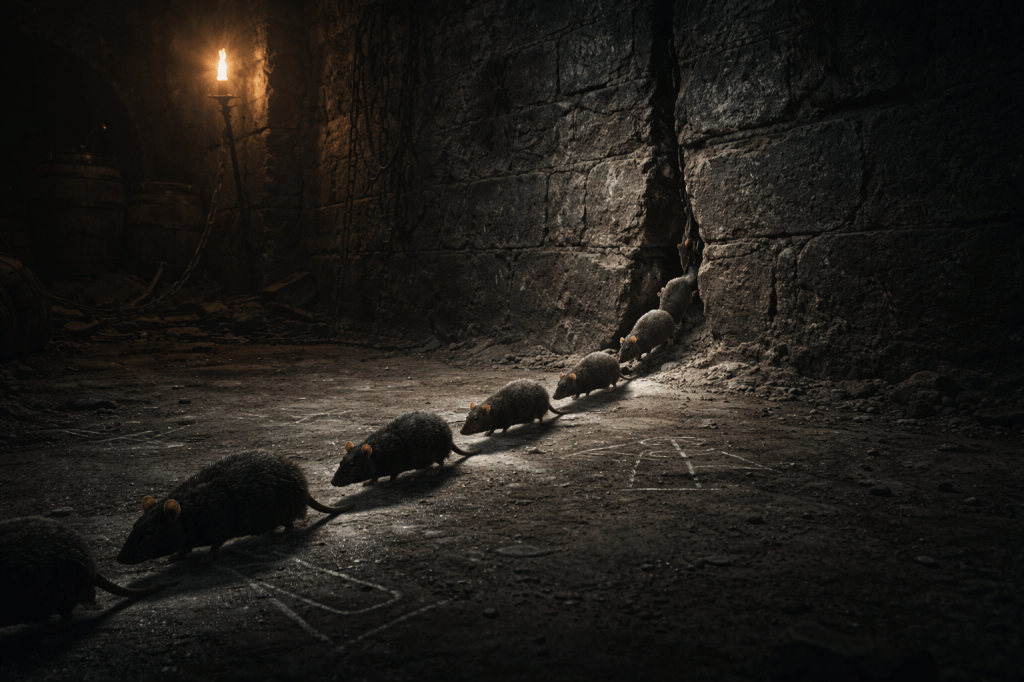
Rats were observed moving in narrow lines along the foundation walls, maintaining their course even when the path ahead was disturbed.
The Idea Behind the Chronicle
The lower districts of any city carry a different kind of history, one that settles beneath daily life and gathers within the spaces that remain unseen. Cellars, storage rooms, and foundation corridors often extend beyond their original purpose, shaped over time by repair, extension, and quiet neglect. These spaces hold the marks of earlier construction, where walls have been altered, passages closed, and ground reworked in ways that are no longer fully recorded.
This Chronicle draws upon that layered nature of built environments, where what lies beneath continues to influence what stands above. Movement within such spaces is often attributed to natural causes. Animals follow scent and warmth, water shifts through unseen channels, and structures settle under their own weight. These explanations hold in most cases, though there are instances where behaviour within these environments carries a consistency that exceeds simple cause.
Accounts of unusual animal movement appear across historical records, particularly within dense settlements where food, waste, and shelter draw them into close proximity with human habitation. In many of these accounts, the behaviour follows expected patterns. In others, it reflects something more structured, where movement occurs along fixed routes that persist even when disturbed. These routes sometimes appear to correspond with earlier construction, suggesting that what has been built over may still guide what passes through it.
The Whispering Foundations series explores this relationship between structure and persistence. In these accounts, the environment itself carries behaviour that cannot be easily attributed to any single source. Movement follows paths that hold their form across separate locations. Surfaces respond in ways that seem to retain what has passed over them. Spaces that appear enclosed reveal connections that exist beyond visible design.
In this Chronicle, the movement of rats serves as the visible layer of a deeper pattern. Their behaviour is recorded as practical observation, noted in the same manner as any infestation or disturbance within a working district. Yet the consistency of their paths, and the way those paths extend beyond the limits of individual structures, suggest an underlying continuity that remains unrecognised within the official record.
What is preserved here reflects only what was seen and written at the time. The records remain grounded in explanation, attributing the events to conditions within the ground and the structures built upon it. The possibility that the movement followed something more enduring is left without confirmation, held only in the repetition of detail across separate accounts.
The lower districts continue to function as they always have, their foundations supporting the weight of the city above. Beneath them, the earlier layers remain, carrying the forms and spaces that were set down before the present walls were raised. The Chronicle preserves a moment when those layers made themselves known, though only through the movement of what passed along them, leaving the deeper cause to remain within the ground itself.
From the Author’s Desk
Thank you for continuing into this Chronicle.
This account was shaped around the idea that movement can reveal what structure conceals. In many places, the first sign of change arrives through behaviour rather than form, where something small begins to follow a path that should not exist. That path holds long enough to be seen more than once. The lower districts offered a natural setting for this, where foundations overlap and earlier work remains beneath the visible world.
The movement of the rats serves as the surface layer of this Chronicle, a detail that can be recorded, explained, and set aside within practical terms. Yet what interested me most was the persistence of the line itself, the way it continues and the way it appears across separate spaces without clear connection. That sense of continuity becomes the focus, rather than the animals that carry it.
As this series develops, each Chronicle will return to similar moments of early observation, where something is present before it is understood, and where the records reflect only what could be seen at the time. These accounts remain incomplete by design, shaped by the limits of those who encountered them, and by the tendency of the record to settle upon explanation even when something remains unresolved beneath it.
Beyond the Chronicle, my work continues across a range of fantasy and speculative writing that explores these same ideas from a closer distance, where events unfold more directly and the underlying structures begin to take clearer form. Those stories exist alongside these records, offering a different view of the same world.
You can explore my books here:
Books by Simon Phillips
You can watch my YouTube channel here:
Author Simon Phillips
Archive & Interpretations
Fragment from the Archive
From the lower district registers, compiled across multiple holdings. The script varies in form, suggesting entries gathered from separate hands and later combined within a single record.
Initial reports of movement were entered during routine inspection of cellar levels, where animals were observed passing along foundation walls in narrow and repeated lines. The entries describe the behaviour in practical terms, noting the presence of damp and the likelihood of underlying channels within the ground, though no single source was identified within the early record.
A subsequent entry, written in a tighter hand, records that the movement remained consistent across separate properties, and that the paths taken by the animals appeared to align where structures stood apart. The writer noted that the routes held even where no passage was known to exist, and that interruption of the movement failed to disperse it beyond the immediate point of contact.
Later annotations describe attempts to clear the affected areas, including the sealing of visible cracks and the reinforcement of lower walls. The entries remark upon the return of the movement following such work, with the lines reappearing along the same routes, and no alteration in their course recorded despite repeated disturbance.
One entry, less formal in its structure, refers to the behaviour as following “a line within the ground”. The phrase is set apart from the main record and carries no further explanation, leaving the note preserved without clarification or expansion.
The final entries record a reduction in visible activity across several locations, and the matter is thereafter marked as resolved within the register, though no definitive cause is assigned beyond reference to seasonal conditions and underlying structural variation.
Marginal Notes & Interpretations
Collected from later annotations added to the same register, appearing in varied script and ink.
One annotation attributes the movement to established animal behaviour, suggesting that the consistency of the paths reflects known patterns of travel through confined environments, where scent and environmental memory guide repeated routes. The writer frames the observations as exaggerated by close conditions within cellar spaces.
A second note challenges this explanation, observing that the alignment of the routes across separate structures suggests a continuity that extends beyond individual environments. The persistence of spacing and direction, as recorded in multiple entries, indicates a pattern that is maintained independently of visible pathways, though the writer leaves the observation without further conclusion.
A third annotation, faint and partially obscured, records that those who observed the movement most closely remarked upon a sensation within the walls themselves, described in uncertain terms as a pressure or passage beneath the stone. The note breaks off before the thought is completed, and the remainder of the line is lost to damage along the edge of the page.
World Notes
Lower District Cellars
Subterranean storage spaces constructed beneath residential and trade buildings, often extending beyond their original design through successive modification, and frequently resting upon earlier foundations whose structure is no longer fully recorded.
Foundation Alignment
A term occasionally used within structural records to describe correspondence between features of separate buildings, particularly where underlying construction predates current layouts, and where such alignment may influence movement or stress within the ground.
Recorded Movement
Entries within municipal and trade registers noting the presence and behaviour of animals within built environments, typically attributed to natural causes. In certain cases, however, the consistency of such movement is recorded without clear explanation, and remains preserved only within the repetition of detail across separate accounts.
Next Chronicle
In the days that followed the reports of movement beneath the lower district, attention shifted toward a chamber recorded in earlier plans as storage. Later entries describe the space as holding a presence that remained after each night’s closing, where the air settled in a manner that did not clear with use or passage, and where those who entered remarked upon a weight that returned even after the room had stood empty.
These accounts were entered without formal concern, attributed to damp conditions and poor ventilation within enclosed spaces. Several notes refer to the persistence of the atmosphere, which appeared to restore itself despite efforts to clear it through light and air.
No connection was made to the movement previously observed within the surrounding structures.
Next Chronicle: The Room That Would Not Clear
The lower district returned to its ordinary rhythm, the cellars cleared and the walls repaired, while the records marked the disturbance as settled and the movement as passed. Beneath the foundations, the paths remained where they had formed, holding their course beyond sight, and within that unseen ground something continued along them, unchanged by their disappe
