A Fleet inspection mission arrives expecting to close a dying industrial outpost. Instead, the station receives quiet orders for expansion
Chronicle Opening: The Arrival at Ashfall
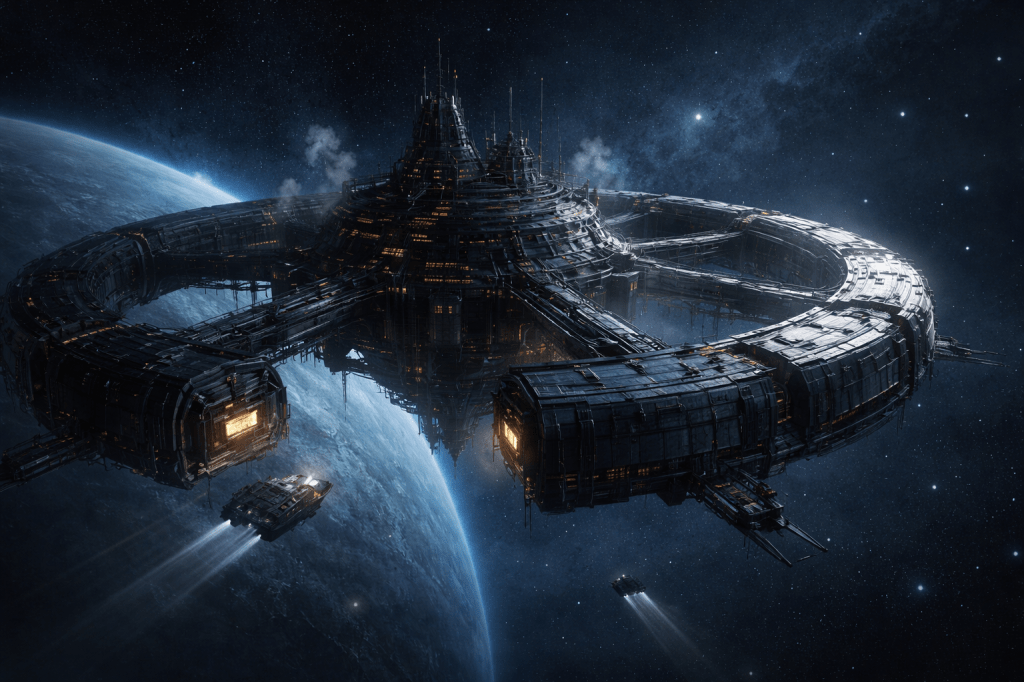
The inspection shuttle drifted through the outer traffic corridor with the slow patience of an ageing machine that had travelled far beyond the routes it once served. Ashfall Station filled the viewport ahead, an immense ring of darkened metal turning in quiet orbit above the pale curve of the planet below. From a distance the structure possessed the appearance of a relic left behind after a long war, its surfaces scarred by decades of repairs, extensions, and forgotten construction. Amber maintenance lights burned along the docking arms like distant lanterns hanging in a storm.
Inspector Halverin remained seated beside the forward console while the shuttle’s guidance system threaded its approach vector through a cloud of drifting cargo tugs and maintenance craft. Each vessel moved with the weary rhythm of workers who had spent their lives in the shadow of machinery, their engines leaving thin trails of ion light that faded into the deep blue of the surrounding stars. Ashfall grew larger with every passing second until the station occupied the entire frame of the viewport, its ring sections broken by thick industrial spines that connected to a central tower rising through the station’s heart.
Halverin studied the structure in silence while the shuttle rotated to align with Docking Arm Twelve. Fleet files described Ashfall as an ageing extraction hub at the far edge of controlled territory, a place built during an earlier phase of expansion when ore routes from the outer belt carried real promise. Those routes had faded many years earlier, leaving the station suspended between usefulness and abandonment. The inspection order carried a simple purpose: to evaluate the installation and prepare the paperwork required for closure.
Through the shuttle glass Halverin observed long rows of habitation windows scattered across the station ring. Many remained dark. Others glowed with dim interior light that hinted at quiet lives unfolding behind metal walls. Somewhere inside those corridors engineers maintained life support systems older than most Fleet vessels, while cargo crews moved freight between bays that had witnessed decades of traffic. Ashfall continued to function through habit as much as necessity.
The pilot cleared his throat while guiding the shuttle toward the docking corridor.
“Dock control confirms our arrival,” he said. “They sound relieved to see a Fleet inspection team.”
Halverin allowed his gaze to follow the slow movement of a cargo hauler sliding away from the docking arm ahead. The vessel’s hull carried a patchwork of weld seams and fresh plating where older sections had been replaced. Every surface told the same story of endurance and improvisation. A station like this survived through constant repair.
“Relief usually appears when rumours begin,” Halverin replied quietly.
The pilot glanced toward him. “Rumours, sir?”
Halverin opened the inspection tablet resting across his lap and scrolled through the preliminary maintenance reports transmitted by the station administration. Power fluctuations across several outer sectors. Unscheduled system resets inside the older structural corridors. Salvage traffic arriving from beyond the debris perimeter. Each entry carried the tone of routine paperwork, though the pattern beneath the reports suggested a station working harder than its ageing systems allowed.
Beyond the viewport Docking Arm Twelve opened like a vast mechanical tunnel. Rows of guidance lights stretched into the interior bay while maintenance drones drifted along the outer hull inspecting the arm’s pressure seals. Ashfall Station continued its slow rotation above the silent planet below, an immense structure that had survived long enough to become part of the frontier itself.
Fleet command expected a recommendation for decommissioning, a quiet administrative ending for a station that had already outlived the era that built it.
Halverin held the tablet screen in his hands while the shuttle glided toward the docking cradle. The files suggested a different future unfolding across the station’s decks, one that would require expansion orders instead of closure.
By every measure recorded in the inspection files, Ashfall Station had reached the end of its intended life, a frontier installation whose purpose had faded as trade routes shifted and distant mining operations closed.
Yet the deeper layers of Fleet correspondence suggested another direction unfolding beyond the official briefing, a quiet decision somewhere within command. This ageing station drifting at the edge of human expansion would expand instead of vanish.
The arrival of Fleet Inspector Halverin marked the beginning of a series of quiet events that would gradually change the fate of Ashfall Station.
Station Record: Ashfall Station
Ashfall Station occupies a slow orbital path above the frontier world of Kestren-4, a mining planet whose richest deposits were exhausted many decades earlier, leaving behind a landscape of silent refineries and abandoned extraction pits that once supplied entire industrial regions across the expanding territories of human space.
The station itself began life as a resource transfer hub during the fourth wave of outer-system expansion, an era when cargo vessels arrived daily from the belt refineries and the surrounding mining fields, unloading vast shipments of processed ore that were then routed inward toward the manufacturing worlds closer to the core systems, where factories and orbital shipyards transformed that material into the infrastructure of a rapidly growing civilisation.
As the richest mining zones declined and transport routes shifted toward newer territories, many installations built during that period were gradually dismantled or abandoned, their structural rings stripped for salvage or their corridors left drifting in quiet orbit around worlds that had already been forgotten by the trade fleets.
Ashfall, however, remained in operation through a mixture of persistence, adaptation, and the quiet administrative decisions that often shaped the frontier more strongly than official policy ever admitted.
Fleet administration eventually classified the station as a declining industrial outpost whose continued operation served a limited set of purposes, most notably the coordination of salvage vessels working the debris fields beyond the system and the support of long-range transport traffic that occasionally passed through this region of space while travelling between distant territories.
Inspection orders issued shortly before the events recorded in this Chronicle suggested that Ashfall Station had reached the final stage of its operational life and that Fleet command intended to evaluate the installation for decommissioning once the remaining contracts tied to the station had concluded.
Yet within a matter of weeks, the direction of those orders began to change, as if information circulating through the deeper layers of Fleet command had altered the station’s fate long before the reason for that decision ever appeared in the official record.
About the Creator
The Future Chronicle is written and curated by Simon Phillips, a writer of science fiction and speculative storytelling who explores the quiet edges of human expansion, where ageing stations, distant worlds, and forgotten technologies continue their slow existence beyond the reach of the central worlds.
Many of the stories presented in these Chronicles exist within a wider fictional universe that follows the lives of investigators, engineers, and frontier workers living far from the comfort of the inner systems, where the machinery of civilisation continues to function long after its original purpose has begun to fade.
One such story unfolds aboard Ashfall Station, an ageing orbital installation whose corridors and industrial sectors form the setting for the science-fiction mystery novella Ashfall Station: The Dead Girl in Sector Twelve, where a routine investigation gradually reveals that something hidden within the station’s structure may have been present for far longer than the official records suggest.
Readers who wish to explore the full investigation and its unfolding events can find the novella below.
Explore the book:
Ashfall Station: The Dead Girl in Sector Twelve
You can watch his YouTube channel here:
Author Simon Phillips
The First Walk Through Ashfall
Inspector Halverin followed the station administrator along the docking corridor while the sounds of the bay settled into a steady industrial rhythm that seemed to pulse through every plate of metal beneath his boots. The corridor stretched forward beneath rows of amber maintenance lamps whose light reflected across the worn alloy floor in long warm bands. Along the distant walls, cargo machinery moved with patient deliberation while crews guided freight containers toward the interior lifts that carried materials deeper into the rotating ring of the station.
Ashfall possessed the atmosphere of a place whose working life had continued for so many years that every surface carried the quiet marks of labour. Rail tracks cut shallow grooves through the deck plating where freight trolleys had rolled for decades, and handrails bore the polished sheen left by countless gloved hands guiding themselves through artificial gravity shifts during docking operations. Above them, the massive skeletal framework of Docking Arm Twelve rose into the dimness like the interior of an enormous machine that had grown layer upon layer through successive expansions.
“Your arrival stirred a certain level of curiosity among the station crews,” the administrator said while guiding Halverin toward a security arch positioned at the end of the corridor. “Fleet inspections arrive rarely this far beyond the core trade lanes.”
Halverin glanced across the open docking chamber where two cargo haulers drifted slowly into their assigned berths while docking clamps moved outward to receive them.
“Curiosity usually accompanies uncertainty,” he replied. “Inspection orders tend to appear when Fleet administration begins reconsidering the value of a frontier installation.”
The administrator allowed a thoughtful expression to pass across her face while the security arch scanned Halverin’s identification tablet and cleared them into the interior access corridor.
“Ashfall has endured several such reconsiderations across its history,” she said. “Each time the station adapted to whatever circumstances followed.”
Beyond the checkpoint, the corridor widened into a long transit gallery whose walls were lined with structural ribs and exposed service conduits that carried power and atmosphere throughout the station. Freight lifts descended through circular shafts positioned at intervals along the passage, each platform transporting containers toward sectors hidden deeper within the ring. Overhead, the slow rotation of the station created a subtle sensation of movement, as if the entire structure breathed with mechanical patience.
Halverin studied the gallery while they walked, noting the layered architecture that revealed decades of construction phases. Some sections of the corridor carried the clean geometric lines typical of modern Fleet engineering, while older segments retained heavier structural plating from earlier eras when stations were built to endure harsher industrial demands. The result created a complex patchwork of engineering philosophies that had merged together through years of expansion.
“Fleet records describe Ashfall as a declining transfer hub,” Halverin said while examining a series of maintenance panels mounted along the wall. “Traffic levels appear healthier than the reports suggested.”
“Salvage operations increased across the outer debris field,” the administrator explained. “When older transport routes collapsed, many vessels and relay structures remained scattered across that region of space. Independent crews began recovering those materials several years ago, and Ashfall gradually became their primary staging port.”
The explanation carried the tone of an administrative summary that had been repeated many times. Halverin sensed an additional layer of thought behind the words, something unspoken that hovered beneath the careful clarity of the station official’s voice. Frontier installations often survived through precisely such quiet adjustments, yet the inspection reports resting inside Halverin’s tablet suggested deeper structural changes occurring within the station.
They passed beneath another bank of lighting where maintenance drones hovered close to the corridor ceiling while scanning the integrity of the power conduits embedded in the wall. Each machine moved with delicate mechanical grace, extending slender sensor arms that traced the seams between metal plates. The drones worked with such silent efficiency that their presence almost blended into the surrounding machinery.
“Your crew maintains a considerable amount of infrastructure,” Halverin observed. “The station appears larger than the official registry diagrams indicate.”
The administrator slowed slightly as they approached a junction where three corridors met beneath a circular observation window overlooking the inner ring of Ashfall Station. Through the glass, Halverin saw the immense curve of the rotating habitation decks stretching across the interior structure like the inside wall of a vast mechanical horizon. Cargo traffic moved along illuminated transit lanes while distant maintenance vehicles travelled between docking sectors that appeared as small points of light scattered along the ring.
“Ashfall grew in stages,” the administrator said while gesturing toward the interior view. “Each phase connected new construction to older frameworks. Salvage materials often supplemented the official supply chains during those expansions.”
Halverin listened while studying the station’s interior landscape. Layers of habitation modules, cargo corridors, and structural trusses formed a dense industrial ecosystem whose complexity extended far beyond the simple diagrams included in the Fleet archives. The station resembled a living organism assembled from decades of improvisation.
“Expansion during a period of declining traffic suggests unusual priorities,” Halverin said thoughtfully.
“Frontier economies evolve through necessity,” the administrator replied while guiding him toward a lift platform descending into the lower administrative decks. “Ashfall discovered ways to remain useful.”
The lift platform engaged with a low mechanical vibration and began its descent through the circular shaft that opened beneath the gallery floor. As the platform lowered into the interior levels of the station, Halverin watched the layered structure pass slowly around them, each deck revealing new corridors filled with workers moving between maintenance stations, habitation modules, and equipment lockers arranged along the walls.
Artificial gravity strengthened slightly as they travelled deeper into the rotating ring. The change produced a subtle shift in the balance of Halverin’s stance while the platform continued downward through the immense framework of the station.
Across the descending levels, he noticed several sealed corridors branching away from the primary decks. Their entrances carried reinforced bulkheads whose surfaces bore the faded markings of earlier construction authorities. Some appeared old enough to predate the most recent expansions recorded within Fleet engineering logs.
“Several sectors remain isolated,” Halverin observed while pointing toward one of the sealed passages sliding past the lift cage.
“Structural preservation zones,” the administrator said calmly. “Older engineering frameworks occasionally require separation from modern systems while reinforcement projects proceed.”
Halverin considered the answer while the lift continued its steady descent. Frontier stations possessed many hidden compartments where obsolete equipment waited for eventual removal. Yet the inspection reports inside his tablet contained references to unexplained power fluctuations originating from precisely such sealed areas.
The lift platform reached the administrative deck and slowed as the surrounding corridor came into view. Unlike the industrial spaces above, this level carried the quieter atmosphere of operational management. Offices lined the passage while communication terminals flickered with the pale light of long-range transmissions travelling between Ashfall and distant Fleet relays.
The administrator stepped from the lift and guided Halverin toward a wide observation corridor overlooking the station’s central command tower. From this vantage point, the immense rotating ring of Ashfall Station curved upward into the distance while the planet below cast a soft blue reflection across the lower structural beams.
Halverin paused beside the observation rail and studied the vast interior landscape spreading across the station. Freight moved through the illuminated corridors. Maintenance drones traced their patient circuits along the structural ribs. Human lives unfolded quietly inside thousands of compartments distributed across the rotating ring.
Ashfall continued its slow orbit above the silent world below while the machinery of the station carried on with the steady rhythm of a place that had grown accustomed to survival.
Yet somewhere within that immense industrial labyrinth, the inspection files suggested the presence of changes that had begun long before Fleet command issued the order that brought Halverin to this distant frontier installation.
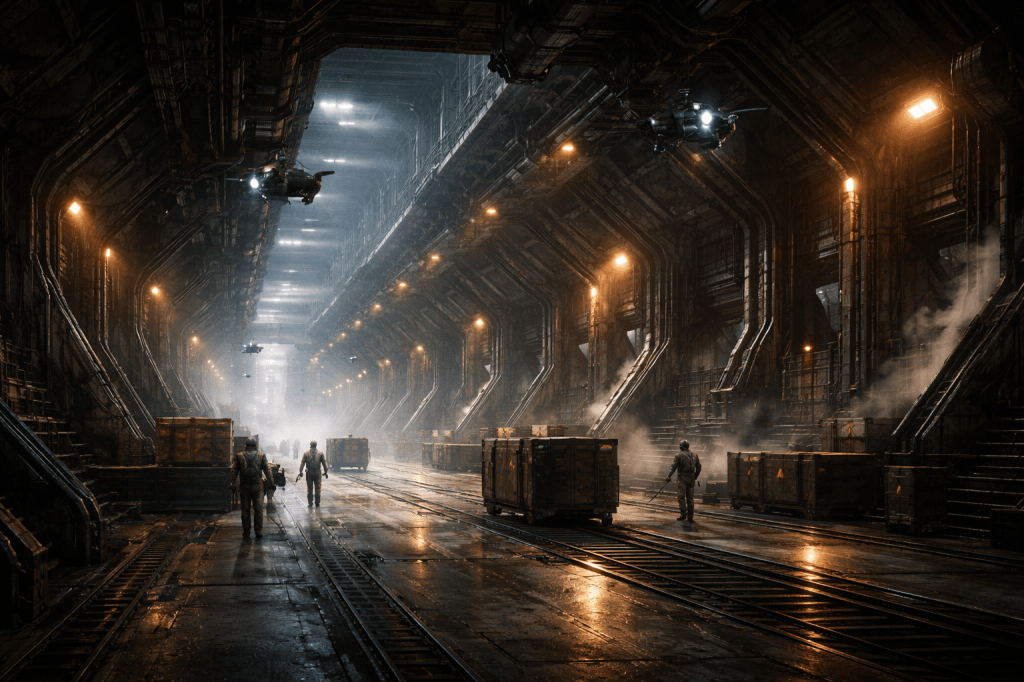
Docking Arm Twelve formed one of the oldest sections of Ashfall Station, a corridor of machinery and freight traffic where decades of expansion had layered new construction upon the station’s original industrial framework.
The Idea Behind the Chronicle
Large orbital stations like Ashfall appear frequently in science fiction, yet their origins come from very real ideas that engineers and planners have considered for decades. As humanity expands further into space, the distances between settled worlds grow wider, and the infrastructure required to support trade, travel, and exploration becomes increasingly complex. Vast stations positioned along transport routes would function as the ports and industrial centres of those distant frontiers.
Early visions of space colonisation imagined elegant rotating habitats filled with gardens and cities suspended in orbit, though the practical reality of expansion would likely unfold in a far more industrial manner. Freight depots, salvage ports, fuel processing hubs, and maintenance platforms would appear long before comfortable civilian settlements, and many of those installations would begin life as harsh working environments where engineers and cargo crews kept machinery running under difficult conditions.
Ashfall Station belongs to this imagined era of expansion. It represents the kind of installation built quickly to serve a specific economic purpose, then left to adapt when the frontier moved elsewhere. Across human history many places have followed a similar path. Mining towns, remote harbours, and railway settlements have often survived long after the industries that created them began to fade, reshaping themselves into something new through the quiet persistence of the people who remained behind.
The Chronicle of Ashfall explores that idea of survival and adaptation. A station designed for one purpose gradually becomes something more complex as new trades appear, old systems are modified, and sections of the structure accumulate decades of layered construction. Over time the installation begins to feel less like a machine and more like a living environment shaped by the countless lives that have passed through its corridors.
In such places the boundary between past and present becomes blurred. Old infrastructure remains hidden behind modern upgrades, forgotten corridors continue to exist beyond sealed bulkheads, and the history of the station lingers within the machinery that keeps it alive.
Ashfall Station therefore serves as both setting and character within the Chronicle, an immense frontier installation whose long history has left traces that the official records may never fully explain.
From the Author’s Desk
Ashfall Station began as a simple image that lingered in my imagination for several years: the idea of an immense industrial structure drifting at the far edge of human space long after the frontier that created it had moved on. Science fiction often grows most naturally from such quiet beginnings, where a single place or moment suggests a much larger history waiting somewhere beyond the visible story.
The Chronicles presented here explore the earlier life of that station, revealing small fragments of its past through the people who lived and worked within its corridors. Each episode focuses on a single event or encounter, gradually uncovering how Ashfall evolved from an ordinary frontier installation into a place carrying deeper layers of history hidden within its structure.
The novella Ashfall Station: The Dead Girl in Sector Twelve takes place much later in that timeline, when the station has already accumulated decades of expansion, modification, and quiet mystery. Writing the Chronicle series offers the opportunity to step backwards into that earlier period and observe the smaller moments that shaped the station long before the events of the investigation began.
Alongside these Chronicles I continue writing fiction across several science fiction and speculative projects, many of which explore frontier environments where technology, distance, and human persistence intersect in unexpected ways.
Readers interested in those stories can explore more through the links below.
You can explore my books here::
Books by Simon Phillips
You can watch my YouTube channel here:
Author Simon Phillips
Technical Notes & Frontier Context
Frontier Infrastructure
Industrial stations such as Ashfall represent one of the most practical solutions to the challenge of distance in space exploration. Vast orbital platforms positioned along transport routes would form the logistical backbone of any expanding civilisation, providing docking capacity for freight vessels, repair facilities for long-range ships, and storage infrastructure for resources moving between distant systems.
During the earliest phases of expansion such stations would likely resemble harsh industrial environments rather than comfortable settlements. Engineers, cargo crews, and salvage operators would occupy modular habitats attached to immense structural frameworks designed primarily for durability and efficiency. Over time these installations might grow far beyond their original plans as new sectors were added to support changing economic activity.
Ashfall Station reflects this gradual evolution. A structure originally designed for ore transfer slowly becomes a hybrid of freight port, salvage hub, and frontier settlement as different industries pass through the system.
Salvage Economies
Salvage operations often emerge in regions where earlier waves of exploration have left abandoned infrastructure behind. Derelict cargo ships, obsolete relay stations, and fragments of industrial platforms may remain drifting through orbital space for decades or even centuries. Independent crews recover valuable materials from these forgotten structures and return them to frontier ports, where metal and components can be reused.
A station positioned near a large debris field would therefore become a natural gathering point for salvage crews and transport contractors. Over time such activity could replace the station’s original purpose entirely, allowing an installation once built for mining traffic to survive long after the surrounding resource economy has faded.
Layered Structures
One intriguing feature of long-lived orbital stations would be the accumulation of multiple engineering eras within a single structure. New modules could be attached to older frameworks, outdated systems might remain sealed behind bulkheads, and corridors originally designed for industrial machinery might later become part of habitation districts or storage sectors.
This layered architecture creates environments where the past remains physically embedded within the present. Forgotten corridors and abandoned compartments can persist inside the station’s interior, hidden behind structural reinforcements that few workers ever have reason to access.
Ashfall Station carries the weight of this accumulated history, a frontier installation whose present appearance reflects decades of adaptation, expansion, and quiet improvisation by the people who have kept its machinery running.
Next Chronicle
Several months before the inspection recorded in this Chronicle, a salvage vessel arrived at Ashfall Station after operating far beyond the normal navigation perimeter of the system. The ship returned with a fragment of unidentified structure recovered from deep orbit within the outer debris field, an object whose origin could not immediately be traced to any registered vessel or industrial installation.
Station logs record that the fragment was transferred quietly into a sealed research hold shortly after the salvage crew docked, and within a few hours the object disappeared from the public cargo registry entirely. Few workers on Ashfall understood what had been recovered from the silent region of space beyond the station, though rumours began to circulate through the docking sectors that the salvage crew had discovered something far older than the drifting wreckage normally collected from the debris field.
The next Chronicle returns to that earlier moment, when the salvage ship first approached the station carrying its unusual cargo and the events began that would slowly alter the future of Ashfall Station.
Next Week: The Salvage Run
Ashfall Station continued its slow orbit above the silent world of Kestren-4, carrying within its vast structure the quiet beginnings of events that few among its workers yet realised had already begun.