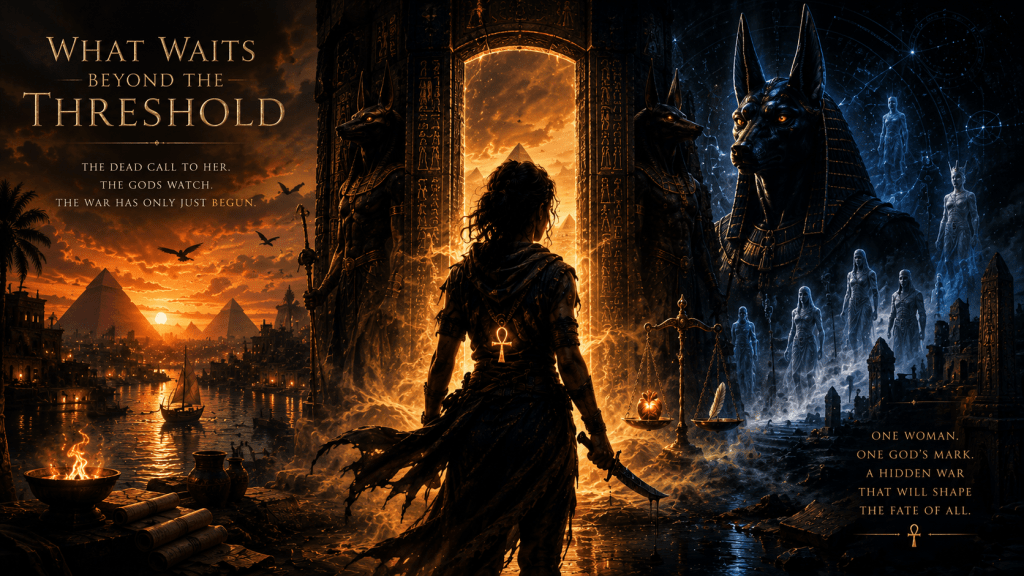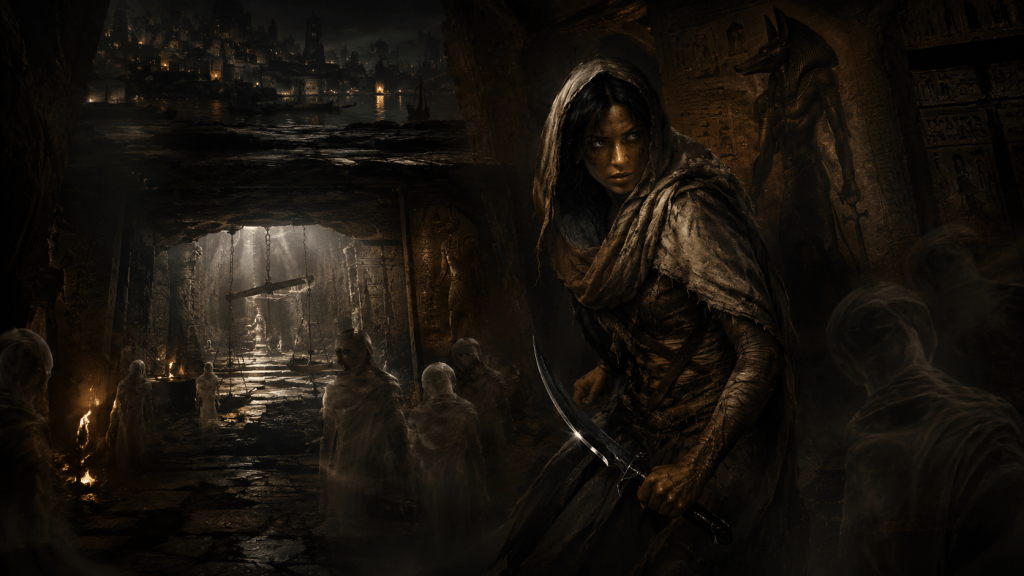
The City Beneath the City
A river city carries its dead differently.
Above ground, life presses through the lanes in smoke, heat, fish-blood, old grain, cheap oil, medicine, shouted bargains, and the dull fatigue of people trying to make one more day hold together. Below those same streets, older systems remain. Tomb passages run beneath foundations. Faded shrines keep their painted eyes turned towards forgotten doors. Burial routes pass through stone chambers where the living once prepared the dead for their final journey.
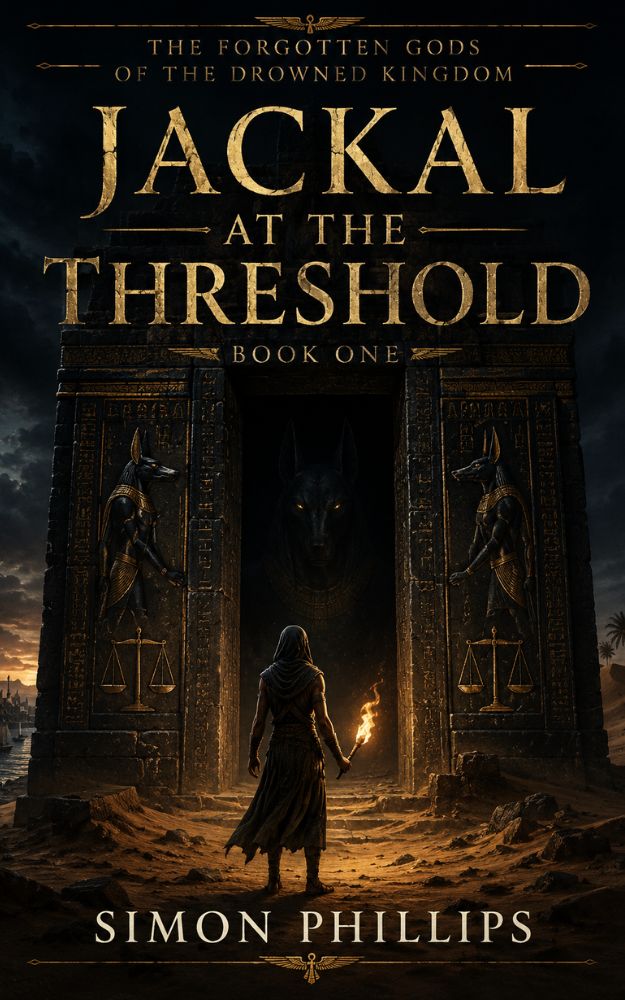
That is where The Forgotten Gods of the Drowned Kingdom begins to deepen.
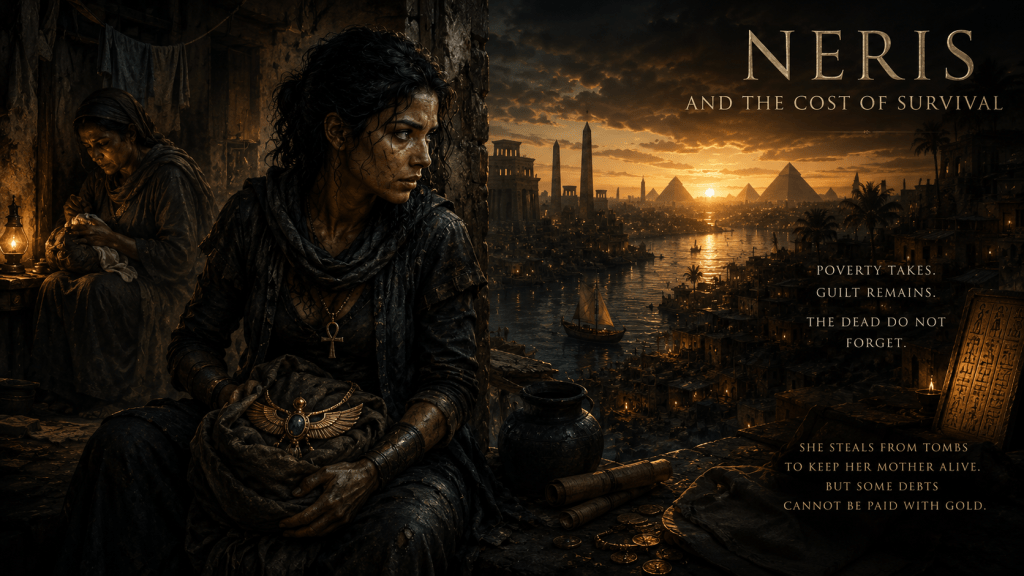
For readers drawn to Egyptian mythic fantasy, dark fantasy, and stories shaped by ancient gods rather than borrowed decoration, the river quarter matters as much as any temple or necropolis. It is where Neris lives. It is where she steals from tombs because medicine costs money, rent still comes due, and grief does little to feed a household. It is where the distance between sacred history and ordinary survival becomes painfully small.
Neris has already crossed a threshold that should have remained closed. She has returned carrying the uneasy sense that the dead can find her, that their unfinished burdens can gather at the edge of her thoughts, and that something in the dark has changed the shape of her life. She calls herself a bridge because the word gives her burden a use. A bridge joins two places. A bridge carries weight. A bridge does not need to ask who built it or why.
Yet every bridge can become a crossing point for something far more dangerous.
In The Scales Beneath the Sand, the second book in The Forgotten Gods of the Drowned Kingdom, the old routes beneath the river city begin to fail. Souls gather where they should pass cleanly. Sacred passages hold pressure where there should be release. The dead seem to hesitate before a crossing that has served them for generations.
That kind of wrongness belongs to more than haunting.
It belongs to interference.
When the Routes of the Dead Are Wounded
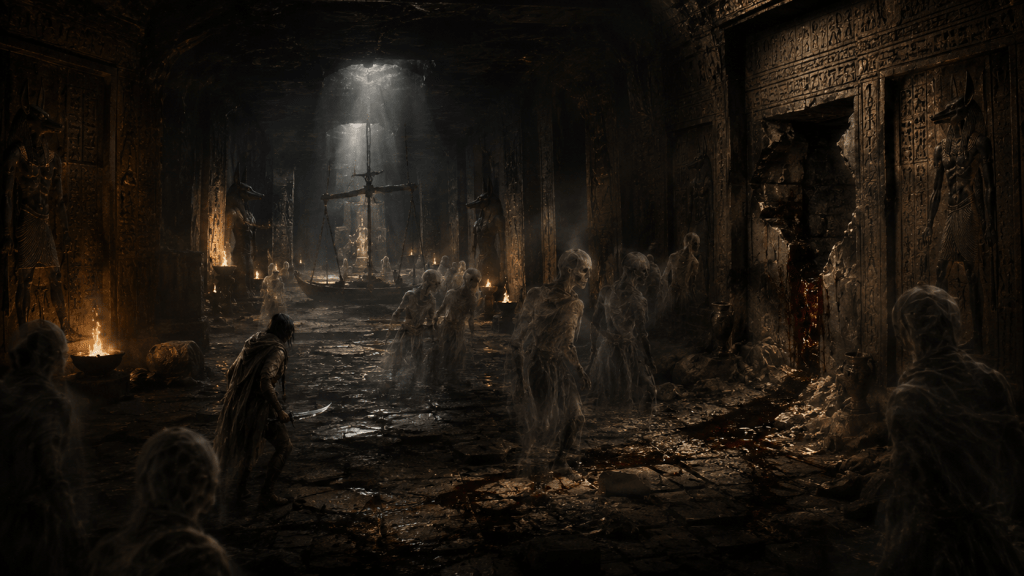
Tombs in Egyptian mythic fantasy should never feel like empty scenery waiting for an adventurer to enter them. They are architecture built around memory, judgement, ritual, identity, grief, and passage. A burial chamber holds the shape of the people who believed in it. A threshold carries the weight of those who crossed it before. A damaged shrine can become more than abandoned stone when its sacred purpose still remains close beneath the surface.
The buried spaces beneath Neris’s city work in that way.
They are not merely ruins. They are old systems of passage. Ferry chambers, weighing rooms, record houses, forgotten shrine courts, and narrow cut-stone ways still preserve the language of burial order. They remember what the dead are meant to do even when the living have stopped listening.
That makes the disturbance at the heart of The Scales Beneath the Sand more unsettling than an ordinary haunting. The dead are not simply restless. Their routes have been handled. Stone has been cut. Ash and blood have been worked into sacred spaces. Something has opened wounds inside the passages where the dead should move towards judgement.
The result is a form of underworld fantasy grounded in pressure rather than spectacle.
The danger begins in small signs. A spill of natron near a jackal-marked recess. Fresh blood in a place that should have been empty. A torn piece of blackened leather. Marks carved into old stone with enough force to make the sacred architecture itself feel violated. Neris follows those signs because she knows the human cost of walking away from something wrong. The dead follow her thoughts. Their fear becomes difficult to leave behind.
The city above continues unaware. People drink beneath reed awnings. Children cry in upper rooms. Fishmongers scrape scales into buckets as night settles over the quay. Yet underneath those ordinary lives, sacred order has begun to fracture.
That is where the hidden god-war first becomes visible.
Not through armies at a city gate. Not through gods tearing open the sky. Through the dead failing to rest.
Anubis at the Broken Threshold
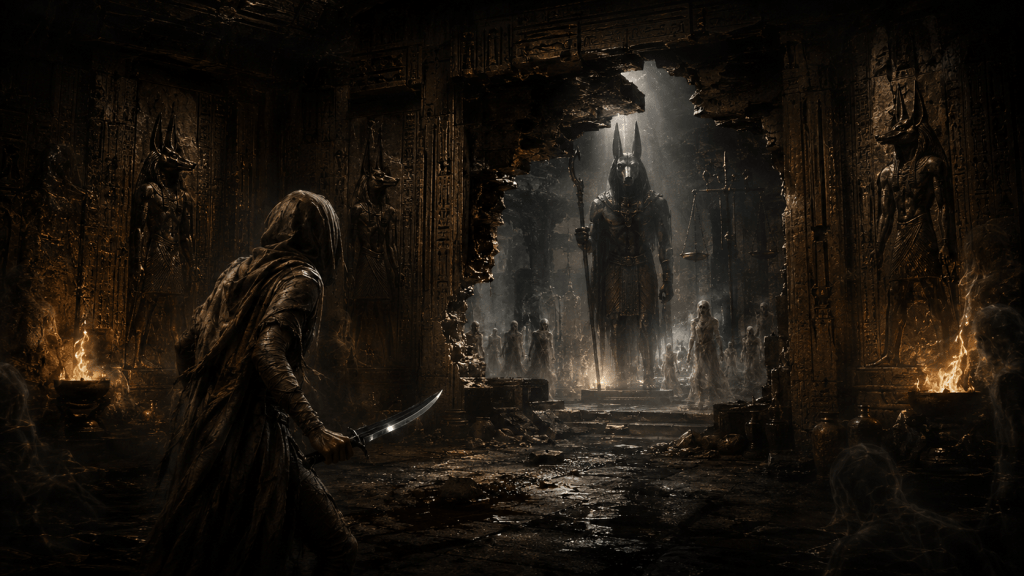
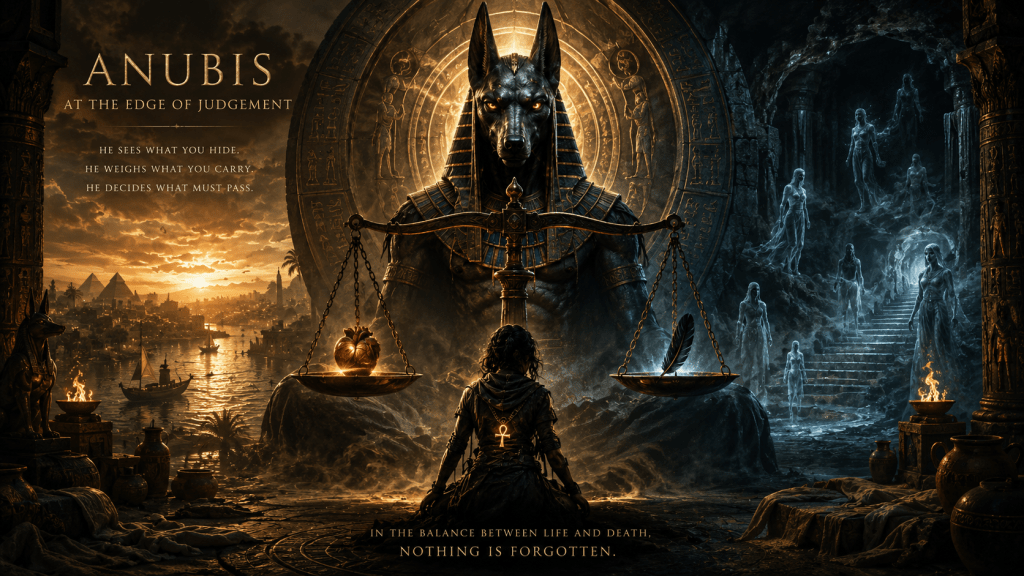
Anubis has always belonged at the edge of fear and judgement.
He is associated with tombs, funerary practice, embalming, the care of the dead, and the passage towards rightful judgement. His presence carries a particular weight because he is not simply a god of death. He stands at the point where death must be ordered, witnessed, and given its proper place.
That makes him a powerful centre for an Anubis fantasy story.
Neris’s connection to him offers no easy blessing. Her jackal talisman becomes a funerary blade only when the dead press too close or when a threshold has been disturbed. The weapon is intimate, cold, and made for narrow places. It belongs in stone corridors, flood-cut passages, old shrines, and the close terror of being unable to step far enough away from another person’s blade.
That distinction matters.
The divine weapon does not turn Neris into a polished fighter. She remains a survivor first. Her instincts come from tomb shafts, slum alleys, unstable stone, hidden routes, and the practical knowledge that escape can matter more than victory. She fights low, close, and desperately. She uses clutter, broken walls, ash, tight spaces, bad footing, and whatever the room gives her.
The funerary blade gives her a way to answer sacred wrongness. It does not erase fear from her body.
This is where the series separates itself from clean chosen-one adventure. Being marked by a god does not lift Neris above poverty, grief, injury, or uncertainty. It makes her visible to forces that already understand more about her than she understands about herself.
The burden comes first.
The meaning comes later.
The Hands Carrying the Gods’ War
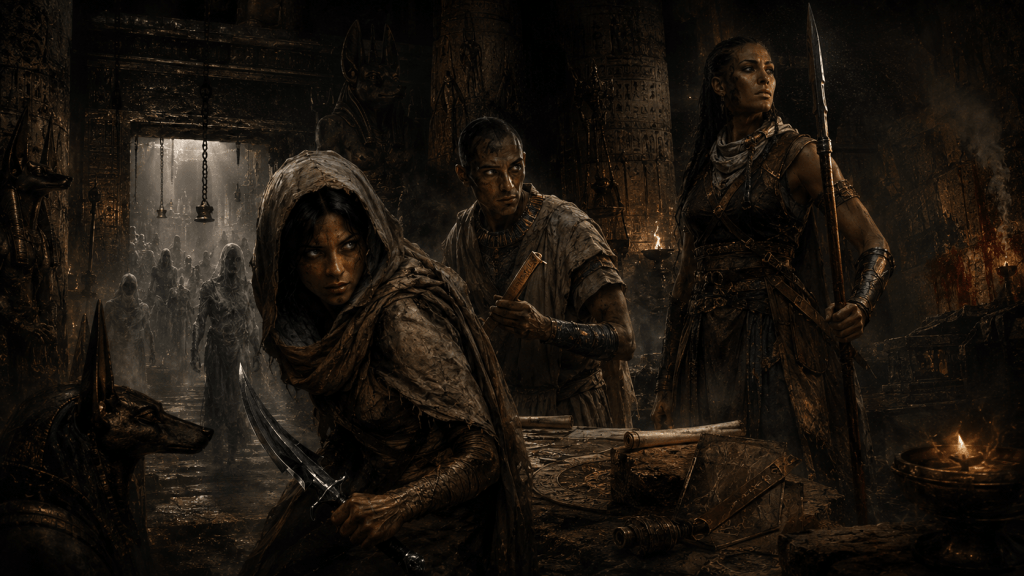
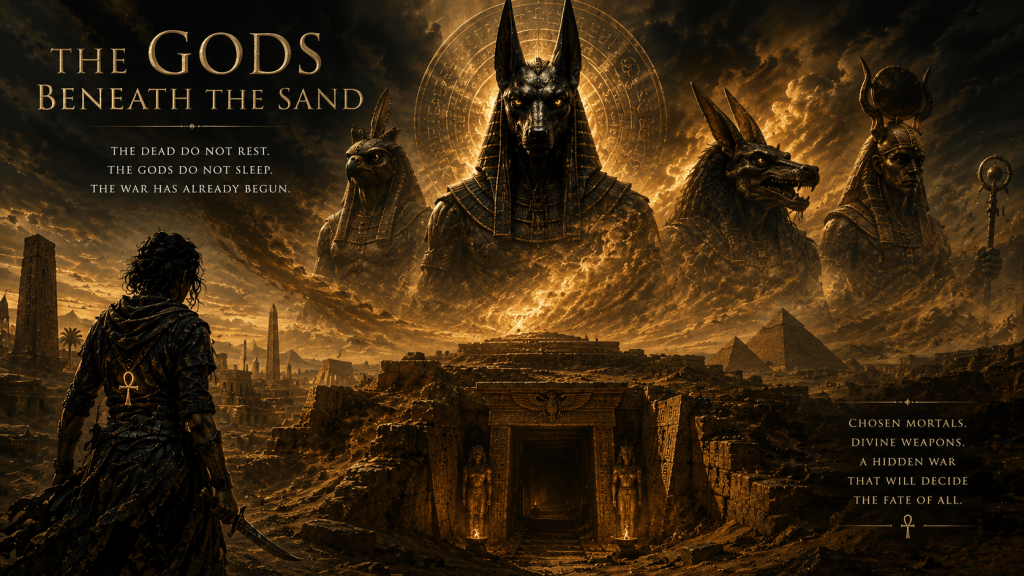
The gods of The Forgotten Gods of the Drowned Kingdom do not begin by fighting openly.
Their conflict moves through human hands.
Chosen people carry relics shaped by divine domains. Their weapons reflect the gods who claim them. Their strengths are tied to endurance, discipline, training, fear, nerve, judgement, and the cost of surviving long enough to learn. That keeps the hidden war close to the body. Feet slip. Hands shake. Wounds open. Pride creates mistakes. A blade can be sacred and still fail in an untrained grip.
In The Scales Beneath the Sand, Neris learns that she is no longer alone inside this pressure.
Khamet enters the story through record houses, burial tallies, ferry counts, ledgers, ink-stained fingers, and maps of disturbed passage. His relationship to the dead comes through pattern and reckoning. Where Neris feels the wrongness in her skin and breath, Khamet sees broken measure. He watches the numbers around burial, crossings, oils, and names begin to separate from one another, then follows the distortion towards something buried beneath the city.
He is useful almost immediately.
He is also irritating almost immediately.
Their early connection is shaped by distrust, exhaustion, sharp replies, wounded pride, and practical necessity. Neither gives the other comfort. Neither enters the other’s life gently. That matters because the war has no interest in providing safe companions at the right moment. It brings people together when pressure leaves them no cleaner choice.
Meretneith arrives from a different part of that same world.
She is a veteran chosen of Neith, shaped by martial discipline, old war knowledge, and the unsentimental truth that survival demands more than instinct. Her presence changes the scale of the story because she reveals what long experience looks like. Every movement has purpose. Every correction lands where it needs to land. Her weapon is an extension of training rather than a spectacle.
For Neris, that becomes its own kind of humiliation.
Surviving is not the same as knowing how to fight.
A hard lesson begins with the feet.
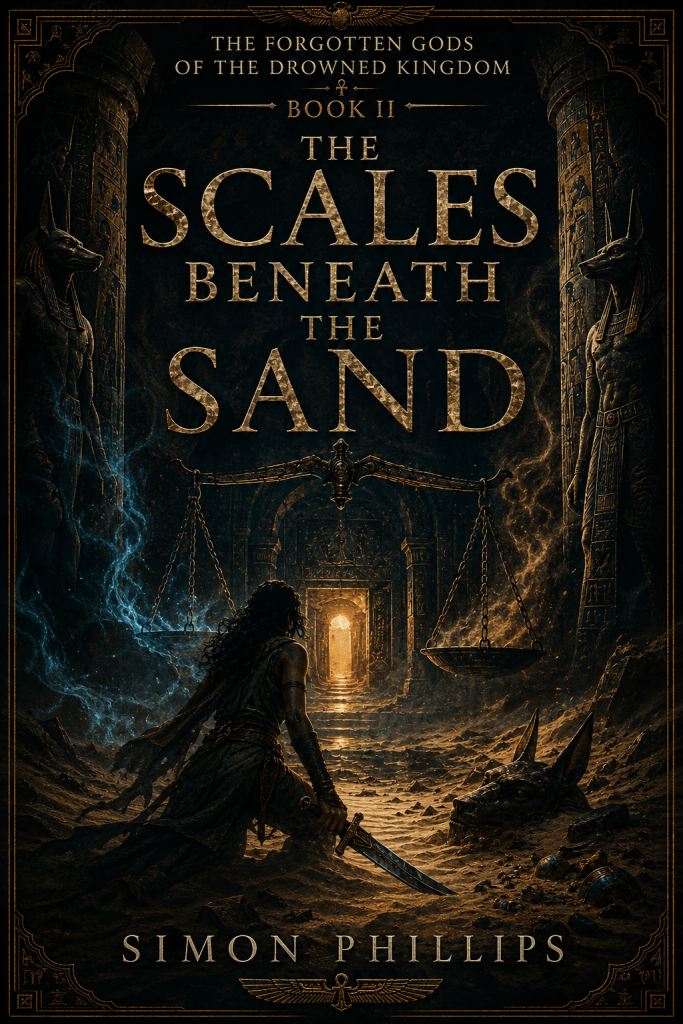
The Scales Beneath the Sand
The title The Scales Beneath the Sand reaches towards the deeper tension of the series. Scales suggest judgement. Sand suggests burial, erosion, time, and the slow concealment of what people once believed was secure. Together they point towards a world where sacred order has been buried so long that even those living above it may no longer know what holds their city together.
Neris enters that buried order carrying the wrong tools for a war she never chose.
She has a funerary blade, a sick mother, a body already marked by grief, and a life rooted in streets where every coin must be counted before it can be spent. The hidden conflict enters through those ordinary pressures. It reaches for her because she has been claimed, though the claim means danger long before it means understanding.
The story remains focused on tombs, thresholds, divine weapons, and the uneasy movement of the dead, yet its centre stays human. The fear is not only that a sacred route may break. The fear is that the break will climb. It will move upward through the stone, into the lanes, into the rooms where people sleep, and eventually towards the few fragile lives Neris still believes she can protect.
That is the real weight of hidden god-war.
It begins in the places no one thinks to watch.
When the War Learns the Road Home
The strongest ancient gods fantasy does not need to announce its scale at once.
It can begin with a single wound in old stone.
It can begin with dead souls gathering at a closed passage.
It can begin with a woman carrying medicine home through a river city, sensing that something beneath the streets has started to call her name.
The first signs are rarely grand enough for anyone above ground to notice. A lamp gutters in a shrine that has stood neglected for years. A burial tally fails to match the names written beside it. An offering bowl lies overturned where no living hand should have passed. In the dark beneath the quarter, old routes begin to tighten around the dead, holding them in places meant only for crossing.
By the time fear has a name, the damage has already travelled.
The Scales Beneath the Sand stands at that moment of widening pressure. Neris has moved beyond the lonely belief that she is only a bridge between the living and the dead. The hidden conflict has found her. Other claimed people have entered her path. A predator has tested her strength and seen where her life is weakest.
She still carries the same burdens she carried before the dead began to answer her. Her mother still waits in a narrow room. Medicine still costs more than she can spare. The river quarter remains full of damp walls, thin lamps, crowded lanes, and people trying to protect what little has survived another difficult day. The divine has entered her life, yet it has offered no escape from any of that.
Instead, it has placed those fragile things in danger.
The city remains standing. The temples have not fallen. The gods have not yet stepped openly into the streets. Their names still belong to shrine walls, old stories, ritual words, and the fears people carry quietly through the night.
Even so, the balance has shifted.
Something beneath the city has learned that sacred order can be wounded. Something has begun to test the routes of the dead, the people marked by old gods, and the living ties that make those people vulnerable. Neris has survived the first movement of that pressure, though survival has only brought her closer to the truth waiting beneath it.
The war begins before anyone understands its full shape.
It begins in tomb dust, river stink, jackal shadows, broken thresholds, and the silence left behind when the dead fail to rest.
It begins beneath the sand, where old scales still wait for something to be weighed.