There were some wars a country could watch from the edge of the room for a while. It could send equipment, issue statements, argue over proportionality, absorb the rise in fuel, and tell itself that distance still meant safety. It could speak of support, resilience, defensive aid, allied infrastructure, and managed escalation. It could choose careful words and hope the world accepted the distinction between helping a war and entering one.
That distinction was never as strong as the language around it.
Grounded modern war fiction begins in that weakness. Not in the clean declaration, not in the heroic charge, not in the moment when every citizen wakes to find history has suddenly changed, but earlier, in the days when the signs are visible and still denied. It begins with the barrier moved outside a government building, the police route changed twice in the rain, the school trip trapped near a protest line, the supermarket notice asking people not to buy too much, the fuel queue stretching into traffic, the family message left unanswered because the person who could answer is not free to say what happened.
That is the pressure at the heart of The Last Deterrence. It is not a story about war arriving all at once. It is about the failure of distance, and the way a country can be changed by war before it admits that war has reached it.
The War Before the Declaration
Modern war does not always announce itself in the old way. There may be no clean dividing line between peace and conflict, no single morning when every public statement finally matches the physical evidence. A government may still speak of restraint while bases move to elevated posture. Ministers may still use the language of support while fuel lanes, air movement sites, ports, depots, railheads, and logistics hubs become part of the battlefield.
That is why political military fiction has to pay attention to language as much as weapons. The public statement is not decoration. It is a tool, a shield, a delay mechanism, and sometimes a confession made carefully enough to pass as reassurance. In a NATO crisis, every phrase has several audiences. Allies hear one thing. Opponents hear another. The public hears something smaller and more domestic, something filtered through the price of petrol, the tone of a presenter, the closed road by the station, or the silence of someone serving overseas.
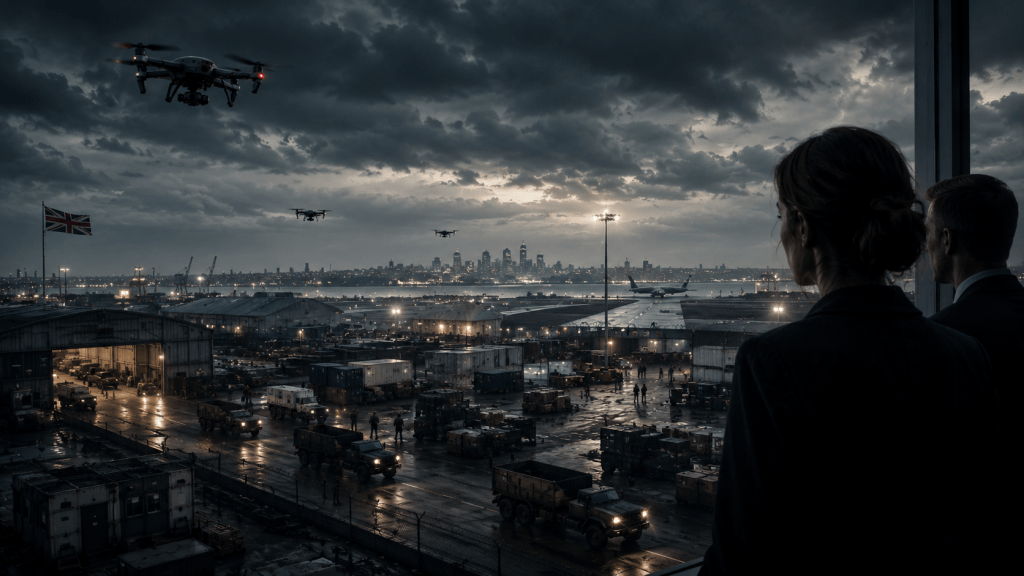
In The Quiet Strike, the second book of The Last Deterrence, Britain has not declared open war. That matters. It also matters that the country is already behaving as though the old distance has failed. The government still speaks of defensive reinforcement and allied logistics. Yet the physical world is moving faster than the public vocabulary. Military-linked sites are being watched. Small drones test perimeters. Fuel infrastructure becomes exposed. Support routes begin to look, to an adversary, like the early shape of intervention.
This is where grounded modern-war fiction finds its strongest tension: not in spectacle, but in contradiction.
Britain Under Pressure
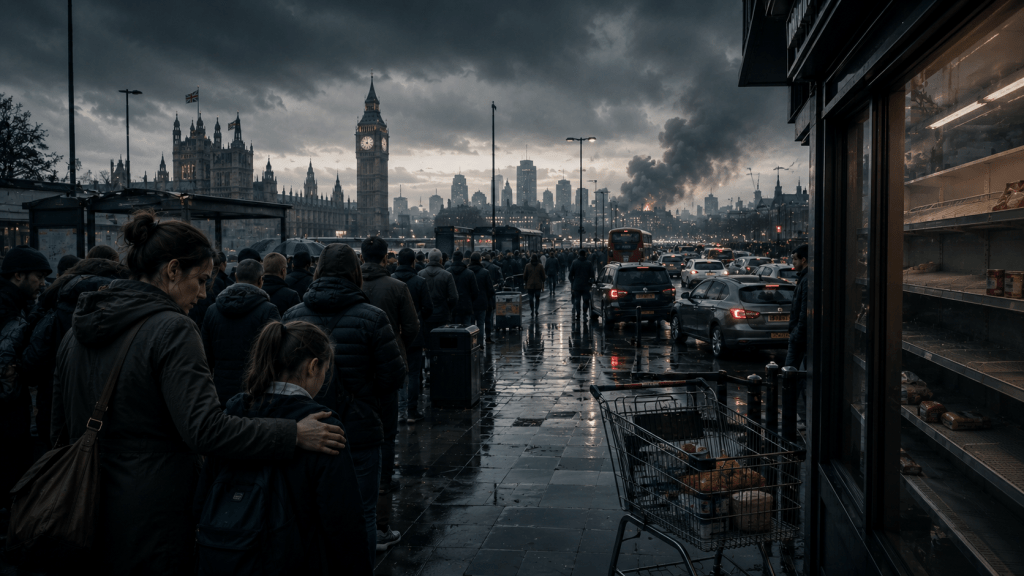
A war story set around Britain cannot only be told through ministers and soldiers. If the country is under pressure, the pressure has to enter ordinary systems. It has to touch schools, shops, transport, pharmacies, family kitchens, shopping centres, petrol stations, police lines, local roads, and the tired staff who become the visible edge of decisions made elsewhere.
The home front is not passive in this kind of fiction. It is where the official story is tested against lived reality. A minister may say supplies are stable, but a parent sees the shelf gaps. A security correspondent may say an incident is under investigation, but a mother hears the phrase “military-linked site” and knows her son is somewhere inside that careful wording. A government may insist that measures are routine, but everyone can see more barriers, more police, more delays, more shortages, more signs asking people to stay calm.
That is one reason British war fiction has a different texture when it is handled seriously. Britain is small enough for the state, family, media, road network, military estate, and public mood to feel connected. A crisis in Whitehall can become a traffic jam, a cancelled bus, a school safeguarding concern, a family argument, or a queue outside a petrol station within hours. The distance between policy and kitchen table is never as wide as official language needs it to be.
In The Last Deterrence, Helen Mercer’s civilian line carries that weight. Her life is not separate from the strategic world. It is where that world becomes intimate. She sees the strain through prices, public anger, school routes, teenage fear, fuel anxiety, and the changing tone of ordinary conversations. Her family does not receive the war as doctrine. They receive it as disruption, silence, worry, and the slow shrinking of what used to be normal.
NATO Crisis Fiction Without Clean Certainty
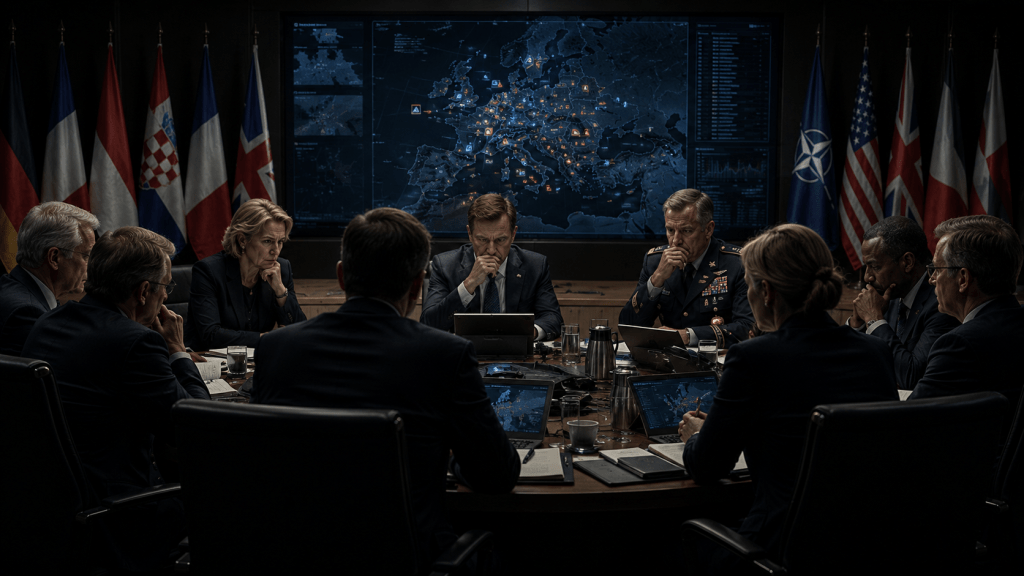
A NATO crisis in fiction can easily become too neat. One side provokes, the other responds, alliances hold or fail according to simple dramatic need, and the story moves from escalation point to escalation point as if decision-makers are pushing buttons on a map.
The more frightening version is slower and less certain.
Alliances are made of governments, and governments are made of people working under pressure, with incomplete information, public fear, legal risk, military advice, domestic politics, media pressure, and allies who all need slightly different language. No capital hears the same phrase in exactly the same way. One country wants restraint named. Another wants deterrence visible. Another wants ambiguity. Another wants speed. Another wants proof that solidarity means more than statements.
That is where political military thrillers can become more than crisis machinery. They can show the strain of holding a coalition together when every word changes the room. The danger is not only that an enemy misreads a movement. It is that allies misread one another, governments speak past their publics, and military necessity begins to outrun political permission.
Leah Mercer’s state line exists inside that pressure. She works near the centre of government, where public language, private fear, and actual events pull apart. Her work is not simply to “know more” than the public. In many ways, her knowledge is another form of exposure. She sees how phrases are built to hold panic at bay. She sees which words are avoided, which ones are kept private, and which ones are released because no better shelter remains.
In this kind of story, the state is not omniscient. It is strained, reactive, skilled in language, and often behind the physical reality it is trying to manage.
Drone Warfare and the End of the Safe Rear
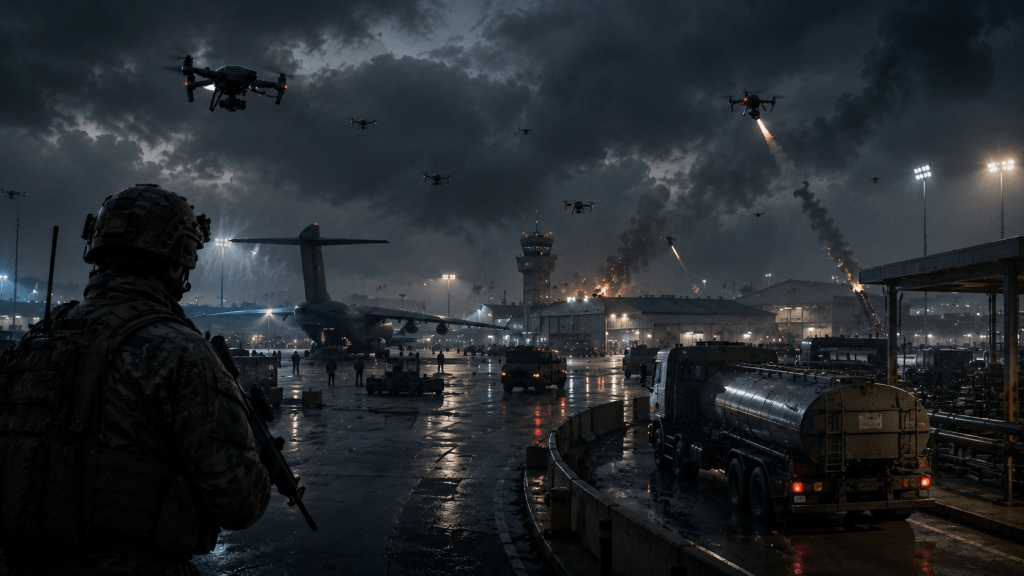
Modern war punishes movement. It punishes concentration, exposed logistics, predictable routes, fuel points, open tarmac, contractor sprawl, weak perimeters, and old assumptions about what counts as the rear. A site does not have to be on the front line to matter. It only has to be useful.
That is why drone warfare fiction has become central to any serious modern-war story. Drones change the emotional grammar of military space. A soldier can no longer assume that danger arrives with a visible enemy, a clear direction, or a traditional battlefield. A small unmanned platform can test a perimeter, record response patterns, reveal blind spots, disrupt fuel handling, damage confidence, or force a whole site to show its reflexes.
The danger is physical, but it is also psychological. Men look up before crossing open ground. Contractor vehicles are checked longer than before. A fuel lane becomes a target. A camera outage becomes a strategic problem. The air above a base stops being empty and becomes watched.
Daniel Mercer’s military line carries that truth from the ground. He does not experience the war as policy. He experiences it as rain on concrete, helmet straps, ruined food, shouted orders, smoke, blast pressure, exposed fuel systems, injured men, and the knowledge that support infrastructure is now part of the fight. His world is not abstract. It is made of gates, lanes, floodlights, barriers, radios, technical cases, medics, aircraft, and people trying to keep working after the site has been hit.
That is the crucial shift in The Quiet Strike. Rear space stops feeling rear. Support becomes dangerous not because someone has declared war, but because the machinery of support has become visible enough to strike.
The Quiet Strike: Book Two of The Last Deterrence
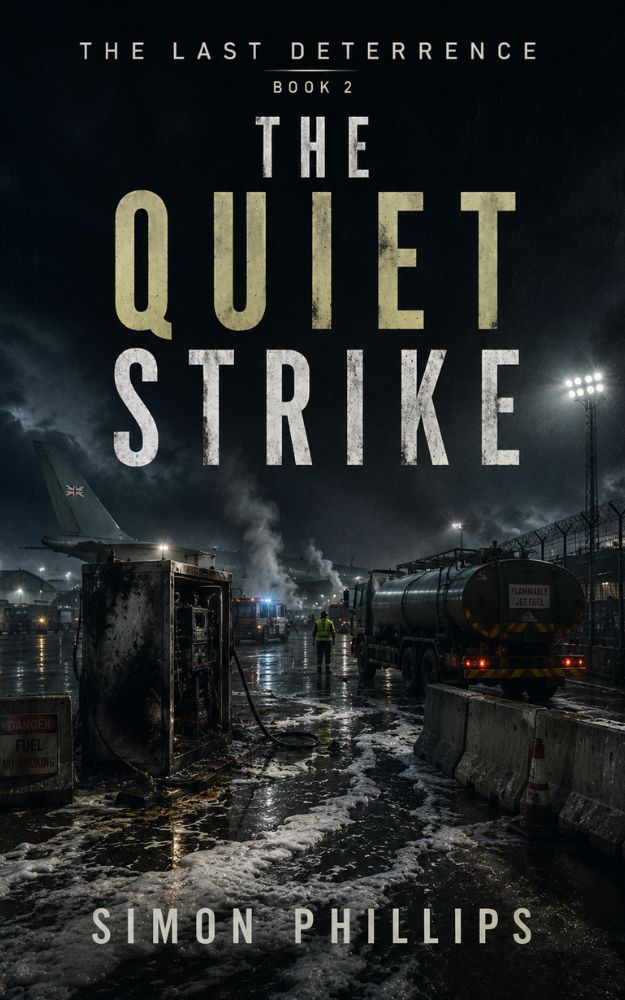
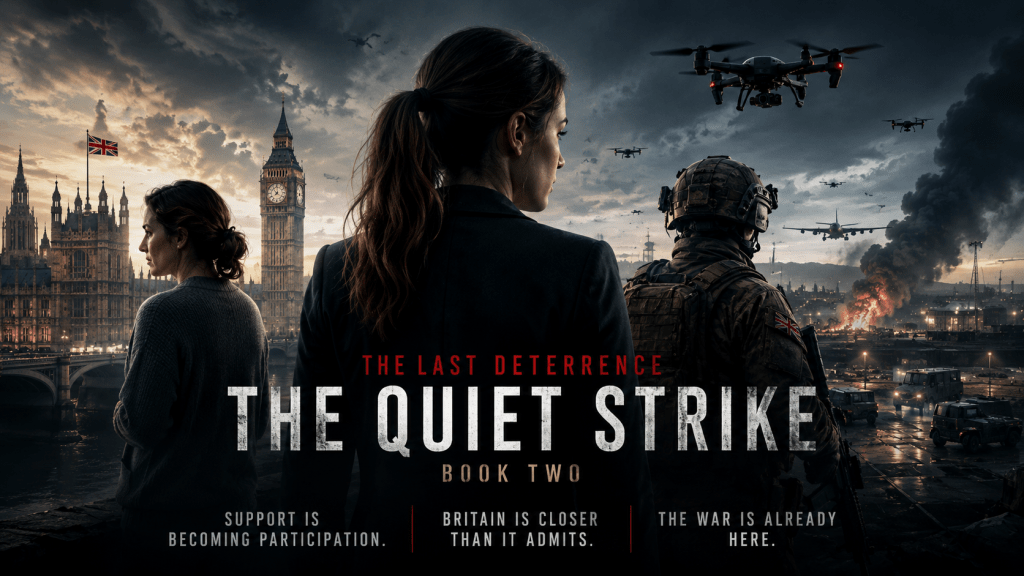
The Quiet Strike is the second book in The Last Deterrence, and it sits at the point where Britain can no longer keep the war at a comfortable political distance.
The first book, Managed Distance Breaking, showed the early failure of distance: public reassurance, government strain, family unease, and the first signs that a war described as external was already bending British life around it. The Quiet Strike moves the pressure closer. The language of support still remains in place, but the physical reality has changed. British-linked military space is being watched, tested, and struck. Drones reach towards air movement and fuel infrastructure. NATO allies argue over how much restraint can survive when the systems supporting the war are already under attack.
The book follows that pressure through three connected lines: Leah Mercer inside the machinery of government, Helen Mercer at home as public life narrows around shortages, transport disruption and family fear, and Daniel Mercer on the ground as the rear stops feeling safe. Together, those lines show the same crisis at different levels of knowledge. Leah sees the careful wording. Helen hears what the wording refuses to say. Daniel lives the danger that official statements reduce to incident language.
This is the published second entry in the series, and it marks the moment where support becomes participation in practice. Not through a formal declaration. Not through spectacle. Through movement, fuel lanes, exposed bases, public statements, family calls, and the slow recognition that Britain is already being pulled into the machinery of a wider war.
Family as the Place Where Strategy Lands
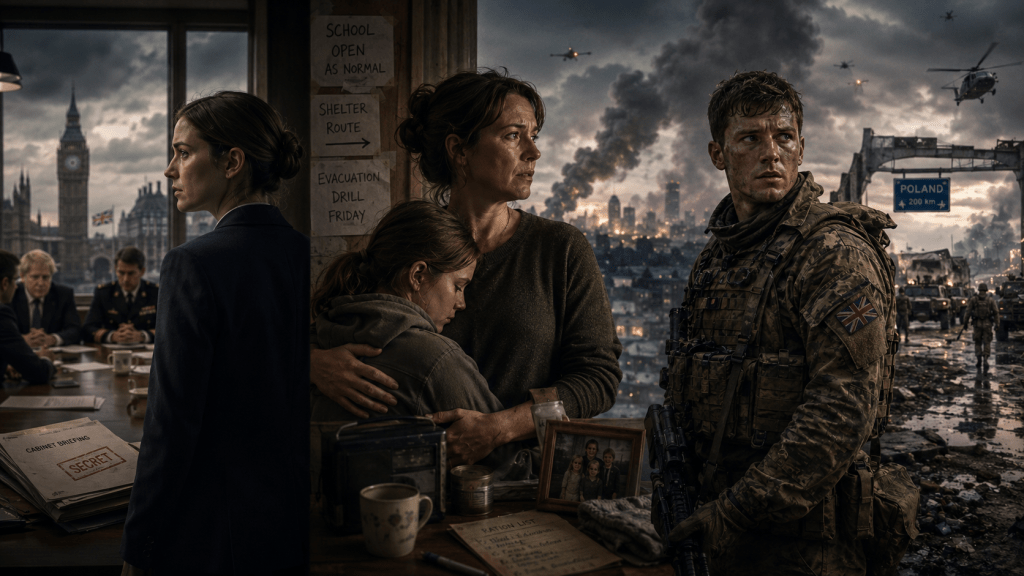
Large-scale war fiction often risks losing the human centre beneath the machinery of escalation. Maps grow larger. Threats multiply. The reader is told what governments fear, what armies require, what alliances decide. Yet the cost of those decisions becomes thinner if it does not land somewhere specific.
In The Last Deterrence, the Mercer family is that place.
The family connection is not decorative. It joins the three major forms of exposure: state, civilian, and military. Leah sees the language of government from inside the system. Helen feels the same language fail to comfort at home. Daniel lives the physical consequences of what is still publicly described as support. Around them, the wider family absorbs the crisis through finance, adolescence, transport, work, worry, and messages that are too short to carry the truth.
This matters because war does not give everyone the same knowledge. A soldier knows what happened at the fuel lane but not the full political calculation. A government staffer sees the restricted incident summary but not the smoke, fear, and ringing ears. A mother sees the public statement and knows only enough to be frightened. Each truth is partial. Each truth is real. The distance between them is where much of the story lives.
That separation gives the series its emotional force. Public truth, private knowledge, and actual events do not arrive together. They move at different speeds, and the family has to live inside the gaps.
The Quiet Strike and the Failure of Managed Distance
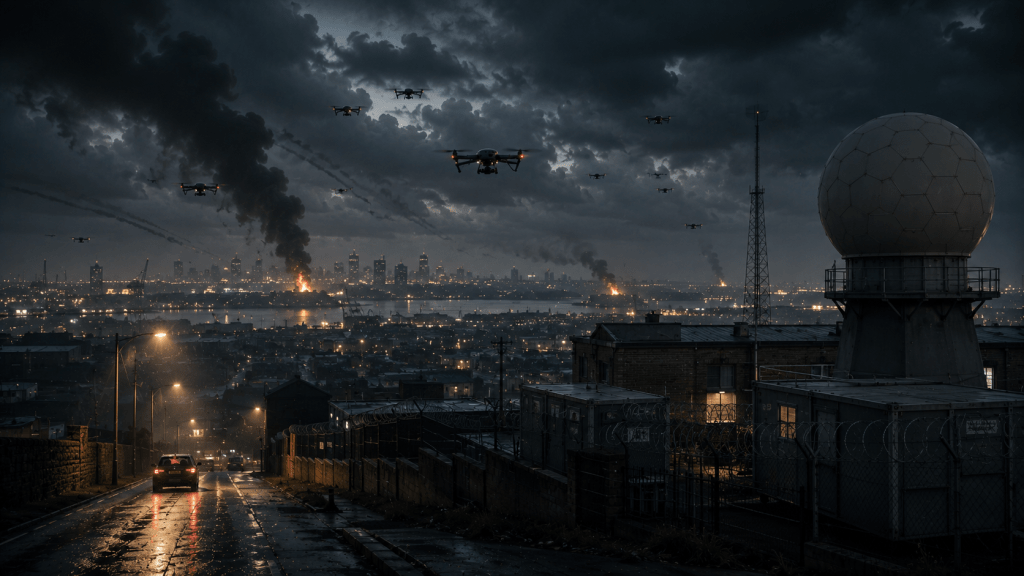
The Quiet Strike belongs to the stage before open European war, when the language of control still exists but has begun to carry too much weight. It is a book about British-linked military infrastructure under pressure, NATO allies trying to hold discipline, and a family discovering that the war can reach them through systems before it reaches them through declaration.
Its title points towards the way modern escalation often feels. Not quiet because nothing happens, but quiet because the public words remain controlled. Quiet because attribution is withheld. Quiet because the attack is processed through incident summaries, protective measures, revised lane plans, and cautious statements. Quiet because families hear only what can be safely said. Quiet because the real change is already moving beneath the surface.
The strike does not need to destroy a city to matter. It needs to change posture. It needs to make a base reveal its weaknesses. It needs to make fuel, air movement, technical support, and site security part of the war. It needs to turn defensive support into something that looks, to those watching, like participation.
That is the point where genre and story meet. This is grounded modern-war fiction because the war is not treated as spectacle. It is political military fiction because language, alliance pressure, and state decision matter. It is British war fiction because the crisis enters recognisable civic life. It is drone warfare fiction because small systems change large behaviour. It is NATO escalation fiction because every defensive movement can be read by someone else as the next rung.
The Wider Shape of The Last Deterrence
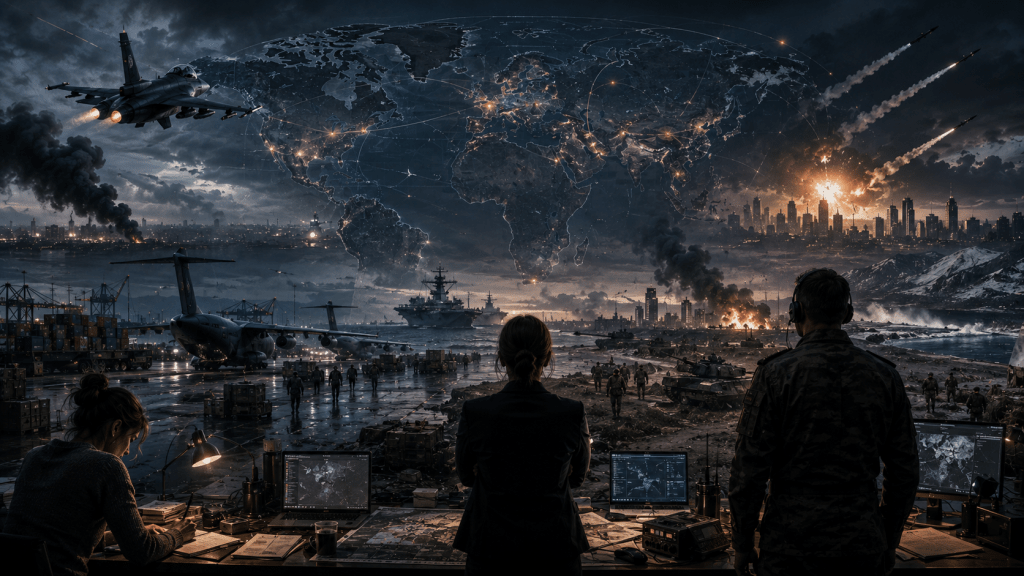
The wider series is built around the collapse of managed distance. It begins with a recognisable proxy-war frame and follows the way support, aid, training, movement, and infrastructure slowly become harder to separate from participation. The story widens through Europe, alliance overload, global pressure, nuclear threshold, and the long aftermath of partial survival.
But the purpose is not to hurry towards spectacle. The purpose is to let each stage change the people living inside it.
Ports matter because ships and fuel matter. Roads matter because movement is vulnerable. Schools matter because public reassurance reaches children through adults who are no longer sure what to say. Government rooms matter because the wrong phrase can harden an alliance, frighten a public, or give an adversary a signal it was already waiting to find. Bases matter because the rear is no longer safe simply because someone calls it rear.
The world of The Last Deterrence is built from these pressures. It is a war story about systems, but never systems alone. It is about the people who have to keep working inside them: the staffer drafting the line, the mother wiping water from a kitchen counter while the news scrolls beneath her, the soldier walking up an aircraft ramp with smoke still in his sleeve, the technician holding herself together because damaged equipment still needs to be made safe, the young private learning that fear can be carried but not dismissed.
When the World Changes Before the Words Do
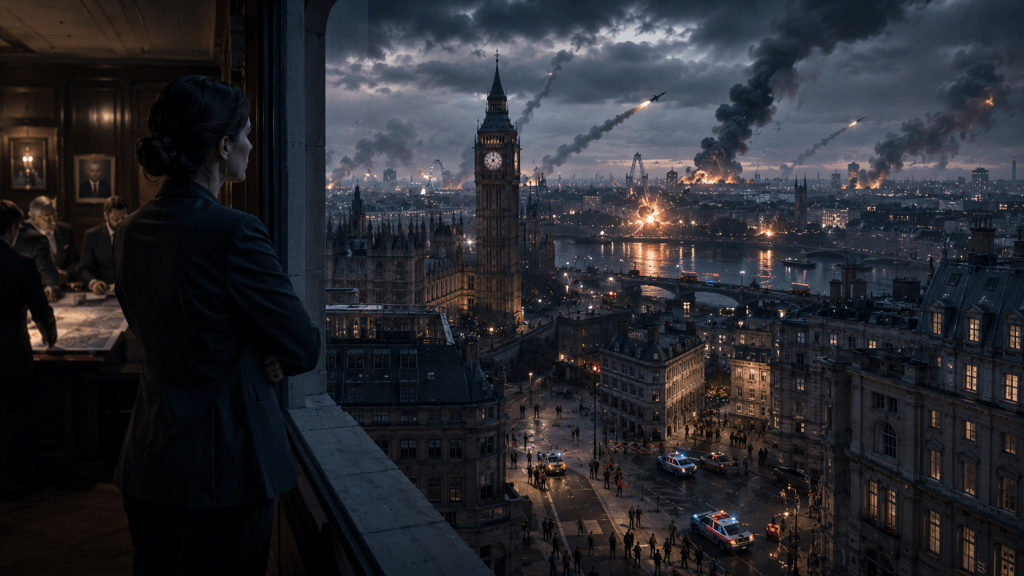
The most dangerous moment is not always the loudest one. Sometimes it is the interval when everyone knows the situation has changed but the official language has not caught up. The country is still told that measures are defensive. The military is still told that movement is support. Families are still told that details cannot be shared. Allies are still told that consultation is holding. The public is still told that everything remains under urgent review.
And yet the roads are different. The gates are different. The queues are different. The silences are different.
That is where The Quiet Strike stands. It is the moment when support becomes participation in practice, when Britain’s distance from the war fails not through a declaration, but through movement, fuel, drones, family calls, public statements, and the visible strain of a state trying to remain calm while reality pushes past the words.
The world changes first.
Understanding follows later, unevenly, through official phrases, damaged places, short messages, and the people left to carry what those phrases cannot say.