Along the Northumbrian coast, a monastery bell could carry across water and open ground, yet the meaning of the raid on Lindisfarne travelled far beyond the reach of any bell. On 8 June 793, Scandinavian raiders attacked the church of St Cuthbert on Holy Island, killing, plundering, and violating a place held among the most sacred centres of Northumbrian Christianity. English Heritage describes the assault as a shock that reached far beyond the island itself, while the response of the Northumbrian scholar Alcuin shows how deeply the attack unsettled Christian assumptions about sanctuary, divine protection, and the security of holy places.
The physical destruction formed only one part of what followed. News had to leave the island in the mouths of survivors, travellers, clergy, fishermen, and messengers, crossing stretches of coast and inland road where certainty could weaken with every retelling. A man several days away might hear first of smoke above the sea, then of monks killed beside their church, then of treasure carried towards waiting ships, with each account arriving through someone who had heard the story from another frightened voice. Long before any distant household understood exactly what had happened, people could understand something simpler and more immediate: the coast had become less certain, and holiness alone offered no protection against men arriving from the water.
For readers drawn to Viking Age Britain, that wider shock matters as much as the violence of the raid itself. Lindisfarne was bound closely to the cult of St Cuthbert and to the religious identity of Northumbria, which meant its violation carried a message that required no formal proclamation: a sacred place could be reached, its treasures could be taken, its clergy could be killed, and communities beyond the island had to reconsider what safety meant once that knowledge entered their roads, chapels, halls, and households.
That change would have been felt through ordinary decisions long before anyone could see the larger historical pattern forming around them. A priest might wonder whether valuable church objects should remain near the coast, a farmer might listen more carefully when unfamiliar voices approached his gate, and travellers carrying Church business could find hospitality mixed with questions that would once have seemed unnecessary. The raid belonged to Lindisfarne, yet its consequences travelled with every person who carried word away from Holy Island, entering communities that had seen no longship and heard no weapon strike, while still learning that the sea could bring a danger their older habits of safety had failed to imagine.
When a Holy Place Could Be Broken
The modern image of a monastery can become too still, with stone, manuscripts, prayer, and isolation arranged into a peaceful picture that belongs more to memory than lived early medieval experience. Lindisfarne was a religious community, a centre of devotion, and the home of Cuthbert’s cult, with spiritual importance extending far beyond its shoreline. Its sacred status made the attack especially disturbing because the raid struck at a place whose meaning rested upon holiness, continuity, and the expectation that Christian order had substance in the world.
Alcuin’s surviving reaction gives that disturbance a human voice. Writing from the Frankish world, he wrestled with the question of how such a place could suffer so violently, framing the disaster through faith, judgement, sin, and the search for meaning inside catastrophe. He was living within a culture where theology shaped the interpretation of public disaster, so the fall of a sanctuary demanded more than military explanation and pressed upon belief itself.
The deeper historical pressure lay in what happened after the attackers had gone, when survivors, clergy, rulers, farmers, traders, and families had to continue living inside a world whose boundaries had changed. Christian life on Lindisfarne survived the raid, and later sculpture points to continued Christian presence after 793, which creates a more complex picture than destruction followed by silence. The sanctuary had been violated, while the community and its memory endured.
Roads Carried Fear Faster Than Certainty
Early medieval Britain had no single mechanism through which reliable news travelled evenly across the country. Information moved with people, through clerical networks, royal households, merchants, messengers, travellers, river routes, and roads whose condition varied greatly from place to place. Some Roman roads remained in use long after Roman government had disappeared, and Historic England notes that such routes continued to matter in later periods as lines of movement, commerce, settlement, and property definition.
A report leaving the coast could change as it passed through several mouths, especially where fear had prepared listeners for worse news. One person might know of smoke, another of missing clergy, another of a vessel seen offshore, while someone farther inland might receive only a fragment joined to an older rumour. Medieval communication could carry urgency over distance, while certainty moved more slowly and became harder to preserve beyond major centres of authority.
This is why the world surrounding The Broken Sanctuary, Book Two of The Last Rune Keeper, is built around roads, crossings, names, guarded approaches, and the problem of deciding which account deserves belief. The completed book keeps Lindisfarne behind the characters once the scale of danger becomes clear, allowing the raid to be experienced through second-hand testimony, frightened households, Church messages, watched routes, and the gradual hardening of local caution into procedure. The Book Two report identifies this as one of the story’s central pressures, where fear travels through roads, farms, chapels, ferry crossings, and Church houses while the historical event remains fixed.
The exact checkpoints, households, and encounters belong to the fiction, while the wider landscape of inherited roads, local authority, river crossings, clerical communication, and uncertain travel is historically grounded. Historical fantasy gains strength when invention occupies spaces the record leaves open and allows recorded history to retain its own weight.
Sanctuary Meant People as Much as Walls
A sanctuary can be imagined as a protected building, yet early medieval safety depended upon relationships as much as timber or stone. A traveller needed shelter, food, water, local knowledge, a usable crossing, and people willing to recognise his purpose. A church or religious house could provide spiritual authority and practical support, while the value of that support still depended upon the condition of the surrounding country and the people responsible for maintaining it.
Lindisfarne exposes the fragility inside that idea. Its sacred standing could never make the island physically unreachable, and the raid forced contemporaries to confront the distance between holiness and earthly security. English Heritage describes the attack as physically and psychologically devastating, which helps explain why its significance endured beyond the immediate loss of treasure or life.
A broken sanctuary therefore means more than damaged doors. It can mean a family wondering whether the chapel near its fields remains safe, a cleric deciding whether sacred objects should be moved inland, a messenger carrying names because the road ahead has become uncertain, or a traveller discovering that welcome now comes after questions. These are smaller pressures than a raid seen from the shoreline, yet they are the pressures through which historical change becomes intimate.
Christianity After Violence
Christianity in Anglo-Saxon Britain belonged deeply to public and private life, shaping kingship, literacy, burial, memory, moral order, and the language through which suffering could be understood. The raid on Lindisfarne gained much of its force because the target was sacred, and Alcuin’s reaction shows that the attack was interpreted through a Christian search for meaning as well as through anger at foreign violence. The question reached beyond how armed men had reached an island and into how believers should understand a world in which such an event could happen.
That religious response deserves care in historical fantasy, since easy modern caricature strips early medieval people of the seriousness with which they understood faith. Prayer could coexist with fear, grief, practical defence, political calculation, and uncertainty. A priest could believe completely in God while still recognising that a door required barring, a road required watching, and frightened people still needed food, direction, and somewhere to sleep.
This tension sits close to the heart of The Broken Sanctuary. Father Oswin remains a man of faith and Church duty, yet the story places that faith inside exhaustion, responsibility, and the need to protect Eadric from dangers that include human curiosity as well as the sealed relic under their charge. The Book Two report describes Oswin as the story’s moral centre, with his role shifting towards active protection while Church order continues through writs, records, guarded gates, storage, witnesses, and procedure.
Seeing the Norse World Beyond the Raid
The word Viking can dominate modern discussion so completely that Scandinavians appear only at the moment of attack. Historical reality widened across the generations that followed, with raiding joined by trade, migration, settlement, political ambition, family life, cultural exchange, and communities that became permanent parts of Britain. Even in the early phase, Scandinavians should never be reduced to a single motive or social type.
The attack on Lindisfarne deserves its full violent weight, while the North Sea also connected communities through movement and exchange. English Heritage notes that Anglo-Saxon England already had peaceful links with Scandinavian lands before the best-known raids, a useful reminder that contact across the sea carried more than warfare.
That complexity shapes the fictional treatment of Sigrun in The Broken Sanctuary. Her presence is restrained, first as an armed young woman watching Eadric from the willows, then through a vision that places her among people tending animals, repairing equipment, carrying arrows, cleaning blood from clothing, keeping watch, and enduring rain. Danger remains present throughout the scene, yet Eadric is forced to see human labour and community where fear had encouraged him to imagine only an enemy.
This matters because cultural collision becomes far more compelling once every side is allowed ordinary life. Norse people can raid, trade, farm, migrate, worship, negotiate, fight, raise children, and seek advantage, just as Anglo-Saxon communities can pray, defend land, fear strangers, offer hospitality, and misunderstand what approaches them. History becomes inhabited when broad labels loosen enough for people to appear inside them.
The Broken Sanctuary and the World of The Last Rune Keeper
The Last Rune Keeper follows Eadric through a Britain still divided among kingdoms, local powers, religious networks, and competing identities, with the long formation of England lying beyond the understanding of people living through the earliest pressures that will eventually help shape it. The series dossier places him inside a landscape where movement is uncertain, authority is experienced locally, Scandinavian presence arrives in different forms, and Church structure offers one of the strongest networks capable of carrying belief, records, instruction, and institutional memory across unstable territory.
The fantasy layer sits beside that history instead of claiming to explain it. Eadric’s relic work, his strange sensitivity to old objects, the rare presence of magic, and the fictional tensions surrounding sacred material belong wholly to the story world. The historical Lindisfarne raid remains the historical Lindisfarne raid, while the fantasy asks what it might feel like to carry an additional hidden burden through a society already learning that holy places, familiar roads, and inherited certainties can all be placed under pressure.
That separation allows the real history to keep its force. Lindisfarne mattered because people believed the place mattered, because St Cuthbert mattered, because Christian institutions mattered, and because violence against such a centre unsettled far more than a single religious community. The fictional magic of The Last Rune Keeper adds another layer of fear and memory at the edges, while the human centre remains recognisable through tired travellers, guarded thresholds, conflicting testimony, faith under strain, and the search for safety in a landscape where safety has ceased to feel permanent.
When Safety Changes Meaning
The deepest consequence of the Lindisfarne raid may lie in the questions it forced upon people who still had to wake, travel, pray, work, and care for others after hearing what had happened. A sanctuary could be sacred and vulnerable together, a road could connect refuge with danger, and a rumour could shape behaviour long before anyone possessed a complete account. The Christian community at Lindisfarne endured beyond 793, which makes the event a story of continuity under pressure as much as a story of devastation.
That is the historical ground beneath The Broken Sanctuary. The world has changed before most people have had time to understand the change, and the first response is made through small acts: a gate watched more closely, a name written down, a traveller questioned, a sacred burden moved, a stranger viewed with greater suspicion, or a prayer spoken by someone who still believes while fear sits beside belief. England lies generations away and the long Viking Age has barely begun, yet the pressures that will reshape kingdoms are already entering roads, households, churches, and memory, where history is usually felt first.
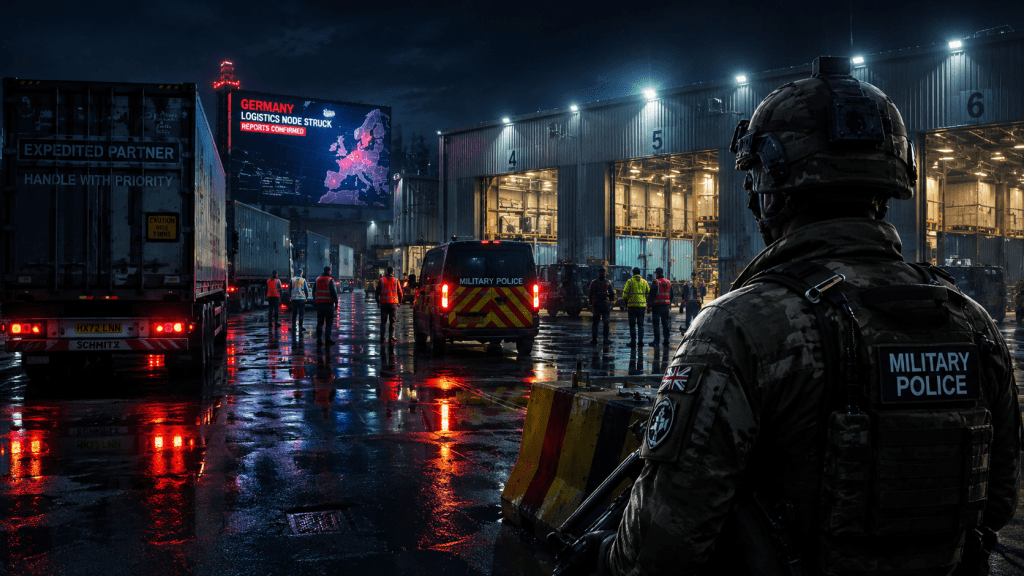
At a fuel-linked support compound near a controlled route, a brief technical failure began to look less like an outage and more like a test.
The Fence That Went Blind
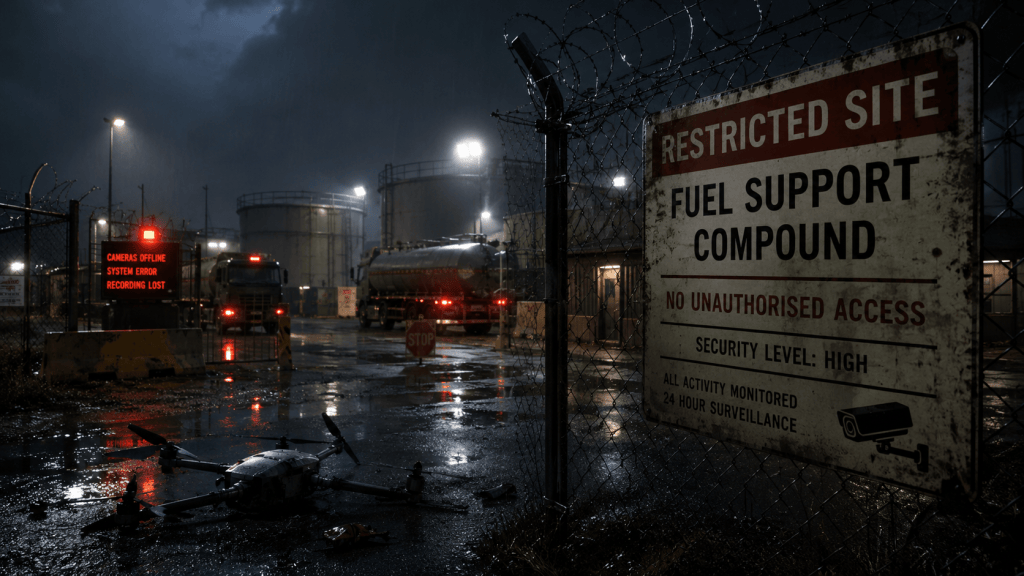
By the time the cameras failed at Rookham Fuel Support Compound, rain had worked into every edge of the evening, running along the mesh fencing, gathering on the concrete lanes, and turning the floodlights into pale broken bars across the yard. The controlled route lay beyond the outer ditch, hidden behind blackthorn and the low bank, although everyone on shift knew when movement passed because blue police lamps slipped between hedge gaps and travelled over wire. Tankers waited beside the southern bay, bowsers sat under temporary lamps, and tarpaulin-covered flatbeds had been kept at the gate long enough for their drivers to lose faith in the printed schedule. Rookham still called itself a fuel support compound on signs fixed to the fence, useful, dull, and safely technical, yet lately it had begun to feel like a small hinge in a route everyone had been told to treat as routine.
Nina Carver had taken over the maintenance-control desk at six, carrying a plastic folder under one arm and a paper cup of tea that had already gone too cool to forgive. She had worked Rookham for six years, long enough to know which pumps whined before rain, which gate sensor sulked during frost, and which drivers arrived with anger already packed in the cab beside them. Extra barriers had appeared near the service gate, contractor access required a second call, and police parked in the lay-by after dusk. Nina preferred valves, pumps, lines, and fuses, because machinery usually failed with more honesty than people.
Across the cabin, Amir Laleh sat beside the access terminal, one shoulder angled towards the window so he could watch the gate between entries. He was logging the Bay Two tanker when the generator sound dipped beneath the rain, softening the lights for less than a second. The screens brightened again, the pumps carried on, and Nina had already turned towards the power panel before Amir finished looking up.
“That was supply side,” Amir said, keeping one hand on the mouse as the green status marks flickered across the terminal.
Nina touched the panel casing with the back of her fingers before she checked the strip of readings. “Or load side. The site enjoys variety when it wants attention.”
Amir reached for the internal phone, his eyes still fixed on the panel. “Should I call Dale?”
Nina kept her attention on the board as a fresh amber mark appeared beside the east fence feed. “Call Dale once we know which part wants to embarrass us.”
The perimeter screens above the maintenance desk had spent most of the evening showing rain, wire, and puddles, which made their sudden failure feel absurdly intimate. Camera Thirteen froze first, preserving a stripe of rain in the floodlight as though the night had been pinned to the screen. Camera Fourteen shivered once and held on the maintenance gate with the warning plate blurred by water. Camera Fifteen turned grey, recovered for half a breath, then fell into black. Amir rose from his chair, the phone still in his hand, and stepped close enough for his reflection to appear faintly beside the dead feed.
“East fence line,” Amir said, his voice lower now as he looked from one screen to the next.
Nina opened the camera status window and watched the system repeat the same useless symbol beside each channel. “Three cameras and one feed alarm.”
The cabin door opened before Amir could reach for a simpler answer, and Dale Houghton came in with rain on his shoulders, a torch in one hand, and his site keys hooked between two fingers. He looked at the frozen screens, then at the power panel, then at Nina’s radio, as water dripped from his jacket onto the rubber mat by the door.
“How long?” Dale asked as he moved beside the desk.
Nina slid the status window across the lower monitor so he could see the feed alarm. “Under a minute.”
Dale raised the torch towards the frozen fence image. “Power dip first?”
Nina kept her hand near the radio. “One pulse, then recovery. The generator caught itself.”
Dale studied the dead channel for a moment. “Machines get blamed for many human talents.”
The yard radio cut across them before Nina could answer. Bay Two reported a pause in fuelling because the driver’s paperwork had changed during entry. The gatehouse asked whether the controlled-route window still held. A third voice from the police car in the lay-by requested confirmation that no external access had been granted along the east fence since shift handover. Nina looked towards Dale as that final question settled inside the cabin, sharper than the generator dip and heavier than the dead screens. Amir turned from the terminal with the phone pressed against his palm.
“Why are police asking about the east fence already?” Amir asked.
Dale took a key from the ring and headed for the door. “Because someone outside this cabin has seen the same hole in the evening.”
Nina pulled her coat from the hook and followed him into the rain, leaving Amir at the panel with instructions to log each feed change and hold Bay Two if any further alarm appeared. The compound opened around her in glare and water, tanks rising as dark curves behind the lamps, pipe runs shining along the low gantries, tanker lights reflecting in the puddles beside the bay. Beyond the fence, traffic moved along the controlled route in brief fragments of sound, engine noise dampened by wet hedges and the soft rush of tyres through standing water.
The east side of Rookham had always felt less settled than the rest of the compound, with the ground dipping towards the drainage ditch and the old service track narrowing near the culvert. Camera Thirteen sat on a black post halfway along the line, its weather hood shining with rain. Beneath it, the junction box remained closed, labelled, and locked, although the conduit below it had a new pale mark near the entry point, visible once Dale’s torch crossed it. Dale crouched in front of the box, bracing one knee against the wet gravel as he worked the key into the lock. Nina stood behind him with her torch angled along the fence, her beam passing across wire, weeds, the outer ditch, and the flattened grass beyond the bank.
The junction-box door opened with a stiff metallic scrape, and Dale leaned in, his torch held close enough to turn the inner casing white.
“Well,” Dale said quietly as he shifted his body aside so Nina could see inside.
The feed line had been cut near the lower entry point, the outer sheath opened in a clean split and the inner cable exposed where it should have run whole into the conduit. Water gathered along the severed edge and dropped onto the gravel in clear beads. The cut carried too much intention for weather, wear, or the old gate’s usual talent for humiliation. Dale kept his hands away from the damaged line and looked at the surrounding gravel, his whole body held still by the kind of care that arrived when a familiar place revealed a stranger’s hand.
“That came from outside,” Nina said as she lifted the radio and kept the torch fixed on the cable.
Dale shifted the beam from the box to the fence base, where wet grass had been pressed low in a narrow patch near the ditch. “Looks that way.”
A movement beyond the wire drew Nina’s eye before either of them spoke again. Her torch crossed the ditch, swept back, then held on a small dark shape half buried in grass near the outer bank, with one broken arm lifted from the mud. At first the rain made it look like roadside scrap, a piece of shattered casing thrown from a van, yet the shape resolved under the light into something more deliberate, black-framed, compact, and wrongly patient. Dale turned his torch slowly across the same spot, and the two beams met on the broken frame as rain gathered along its arms.
Nina pressed the transmit key, watching the object through the fence as she spoke. “Control, this is Carver at east fence. We have confirmed cable damage at Junction Thirteen and possible unmanned debris beyond the perimeter. Hold Bay Two. Lock east access. Request police to the outer ditch and suspend movement near the service track until cleared.”
Static answered first, then Amir’s voice came from the cabin. “Received, Carver. Bay Two held. East access locked. Police requested. I am logging junction damage and possible unmanned debris now.”
Dale stayed by the open junction box, his torch moving from the severed cable to the fence post and back again, as though the line between the two might make more sense under enough light. The compound carried on behind them, pumps humming, tanker brakes sighing, rain striking the tanks, drivers waiting beneath shelters, radios turning fear into procedure. Inside the floodlit fence, Rookham still looked like a fuel site managing a technical fault. Outside the wire, in the wet grass beyond the dead cameras, the damaged drone lay where the fault had started to look like a message.
A Visual Chronicle
A brief camera failure at Rookham Fuel Support Compound became something far more deliberate when Nina Carver followed the fault beyond the fence.
Restricted Infrastructure Incident Report Extract from Regional Fuel Continuity and Site Security Coordination Log Subject: Rookham Fuel Support Compound / Eastern Perimeter Camera Failure Time: 19:17–20:06 Circulation: Regional Movement Desk / Fuel Continuity Cell / Police Liaison / Contractor Security Lead / Defence Access Support
Purpose To record the initial response to a perimeter-system failure at Rookham Fuel Support Compound during an active controlled-route movement window, with associated impact on fuelling operations, site access, police liaison, and contractor maintenance activity.
Public Position A minor technical issue affected part of the perimeter-security system at a fuel support site. Site operations remained under control while maintenance checks and routine safety procedures were carried out. There was no confirmed threat to public safety, and relevant agencies continued to monitor the position.
Incident Summary At 19:17, Rookham maintenance control recorded a brief generator-load dip affecting internal lighting and perimeter-monitoring feeds. Power recovered within normal tolerance, although three eastern-perimeter camera feeds failed or froze during the same event.
The affected feeds covered the outer fence, the old maintenance gate, and the drainage-culvert approach beside the eastern service track. Maintenance staff attended the junction box beneath Camera Thirteen and identified damage to the external feed line near the lower conduit entry point.
At 19:24, maintenance staff reported possible unmanned debris outside the perimeter fence, positioned in wet grass beyond the drainage ditch. Eastern access was locked, Bay Two fuelling was paused, and police liaison was requested to attend the outer ditch under controlled access.
Operational Impact Bay Two fuelling paused pending perimeter clearance. Eastern service-track movement was suspended. Contractor access through the old maintenance gate remained closed. Controlled-route traffic continued under police supervision. No site evacuation was initiated. No injuries were reported during the initial response window.
Technical Position Initial maintenance assessment indicated deliberate damage to the external camera feed line. The generator dip remained under review, with no immediate evidence of wider compound power failure.
Camera Thirteen and Camera Fourteen remained unavailable during the first response window. Camera Fifteen returned intermittent grey-feed output before failing again. Temporary visual coverage was requested through mobile patrol and police outer-fence observation.
Handling Guidance Staff were advised to describe the event as a perimeter-system fault under review. Drivers, contractors, and local callers were to be told that fuelling activity had paused temporarily while maintenance and safety checks were completed.
Questions concerning police attendance, camera-feed failure, route movement, drone activity, defence-linked traffic, or wider infrastructure security were to be referred to regional communications.
Lines to Avoid Avoid confirming deliberate interference pending forensic review. Avoid linking the incident to protected route movement. Avoid identifying camera coverage gaps or feed locations. Avoid discussing unmanned debris, drone recovery, or possible reconnaissance. Avoid confirming Defence access involvement unless cleared through regional handling. Avoid suggesting any wider pattern of infrastructure probing.
Internal Assessment The timing of the camera failure, the generator-load dip, the damaged feed line, and the recovery of unmanned debris beyond the eastern perimeter increased concern that Rookham had been subject to external observation or probing.
Attribution remained unresolved during the initial reporting window. The incident was assessed as operationally contained, although the affected camera line covered a sensitive section of the compound adjacent to controlled-route movement and fuel-handling activity.
Further review was required to establish whether the generator dip was coincidental, induced through local interference, or connected to the camera-feed failure.
Further Action Police liaison to secure the outer ditch and preserve the debris field. Contractor security lead to provide maintenance history for Cameras Thirteen to Fifteen. Fuel Continuity Cell to review Bay Two pause against scheduled movement requirements. Regional Movement Desk to assess whether further controlled-route activity required temporary camera uplift or mobile patrol cover. Public-facing explanation to remain limited to a perimeter-system issue under review.
About the Creator
The Modern Chronicle is written and curated by Simon Phillips, an author of modern speculative fiction and contemporary crisis-driven storytelling who explores the point where ordinary life begins to tighten beneath political strain, military movement, institutional caution, and the public language used to keep dangerous realities at a distance.
Many of the records presented in these Chronicles sit alongside Simon’s wider modern-war novella series, where governments, soldiers, families, and civilian systems are forced to absorb a world changing faster than its official explanations. The stories remain grounded in recognisable places: ports, school corridors, freight yards, government rooms, roadside queues, transfer sites, and homes where the news has started to feel too close.
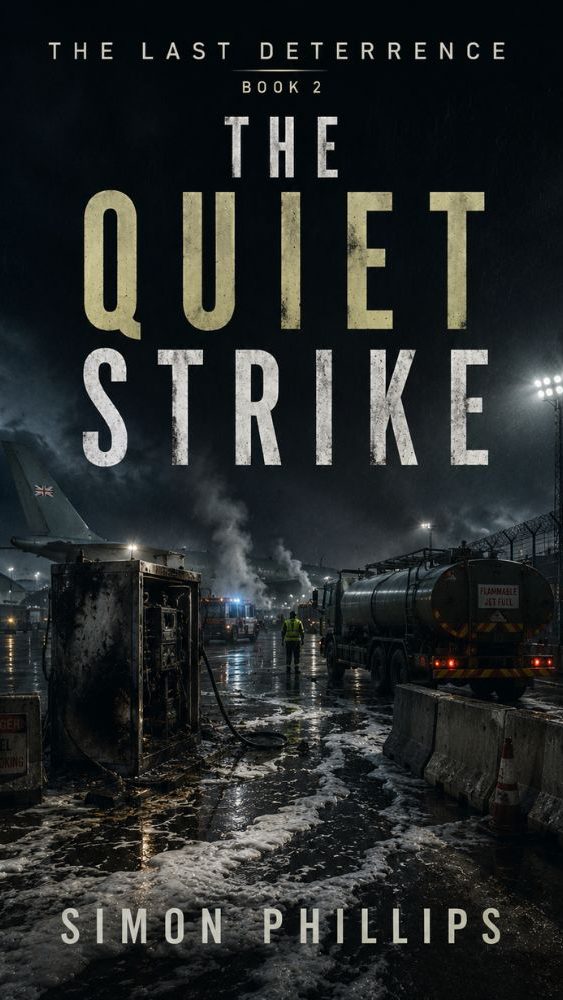
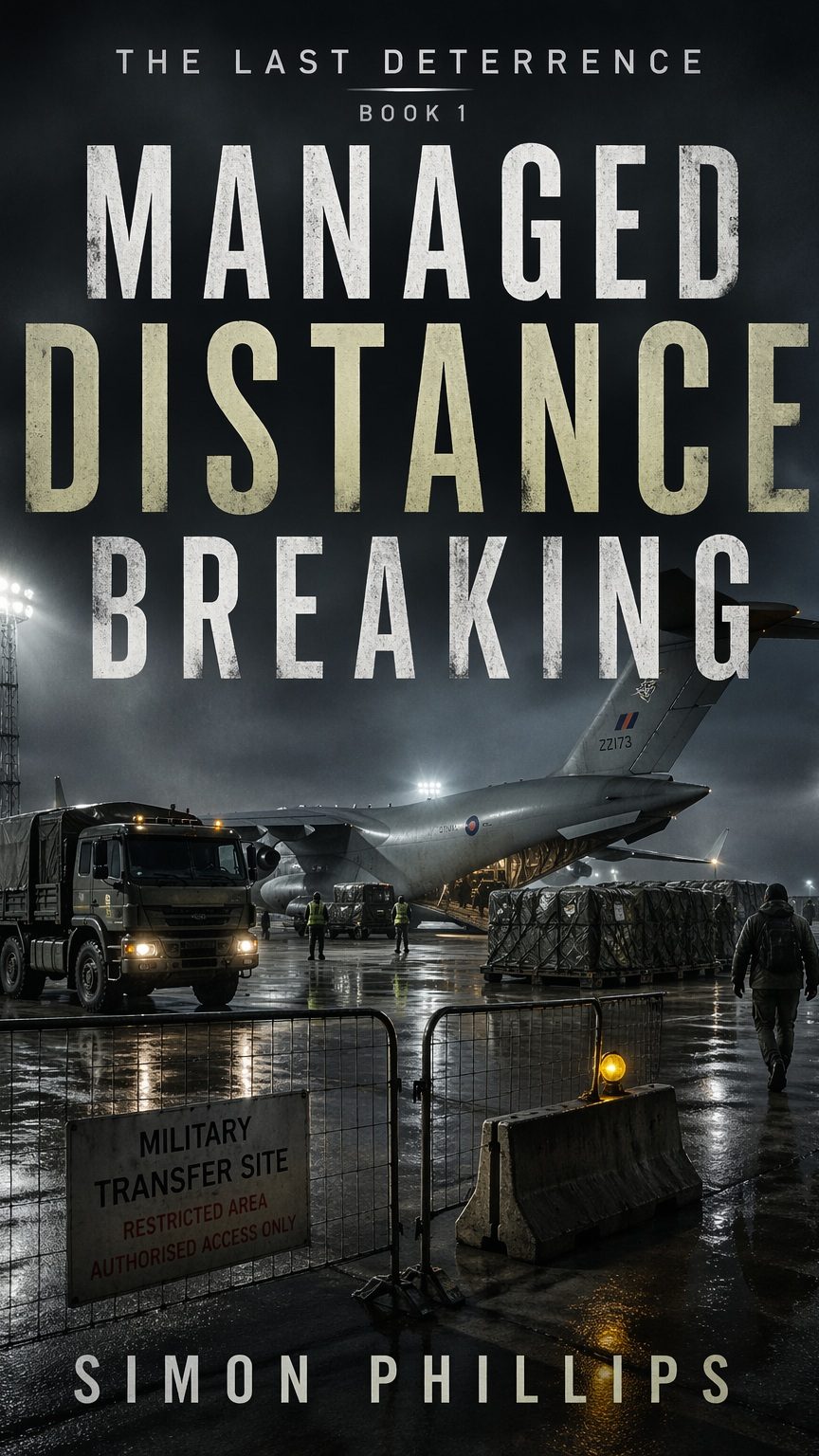
One such world unfolds through The Last Deterrence, a modern-war novella sequence beginning with Managed Distance Breaking and continuing in The Quiet Strike. Together, the first two books follow Britain as support language begins to fracture under freight pressure, European escalation, domestic infrastructure strain, and the growing sense that distance from war has already begun to fail.
Readers who wish to explore the wider published story world connected to this Chronicle can find the novellas below.
The following Chronicle continues the night at Rookham Fuel Support Compound, where a brief camera failure, a damaged feed line, and debris beyond the eastern fence began turning a routine perimeter fault into evidence of something more deliberate moving around the edge of Britain’s protected support corridor.
Readers supporting The Modern Chronicle can continue the record below.
Subscribe to continue reading
Subscribe to get access to the rest of this post and other subscriber-only content.
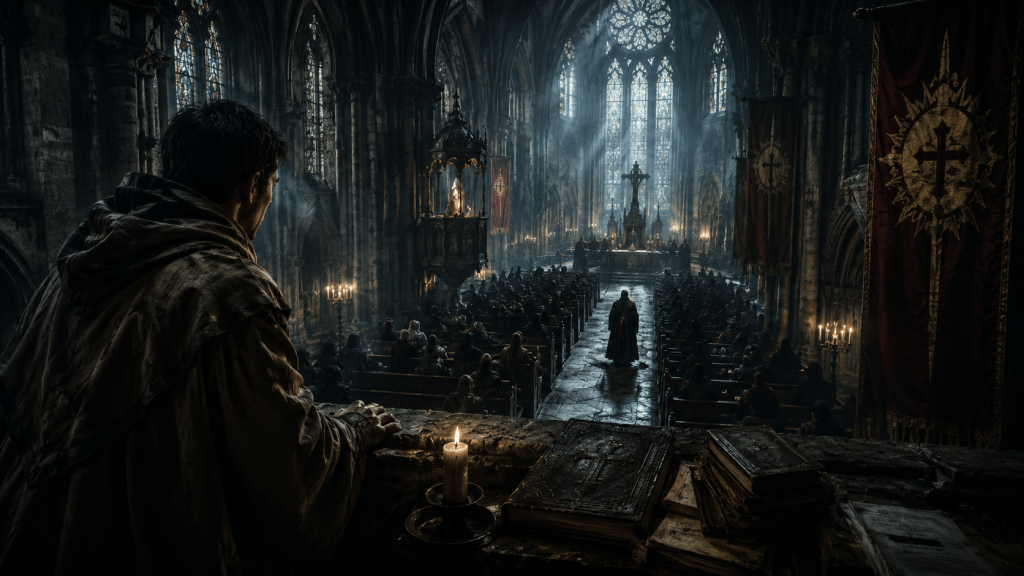
A library-side account of the day a hidden passage stirred beneath Bremyra Castle, and the shelves were said to remember what the court had left sealed below.
Beneath the Quiet Shelves
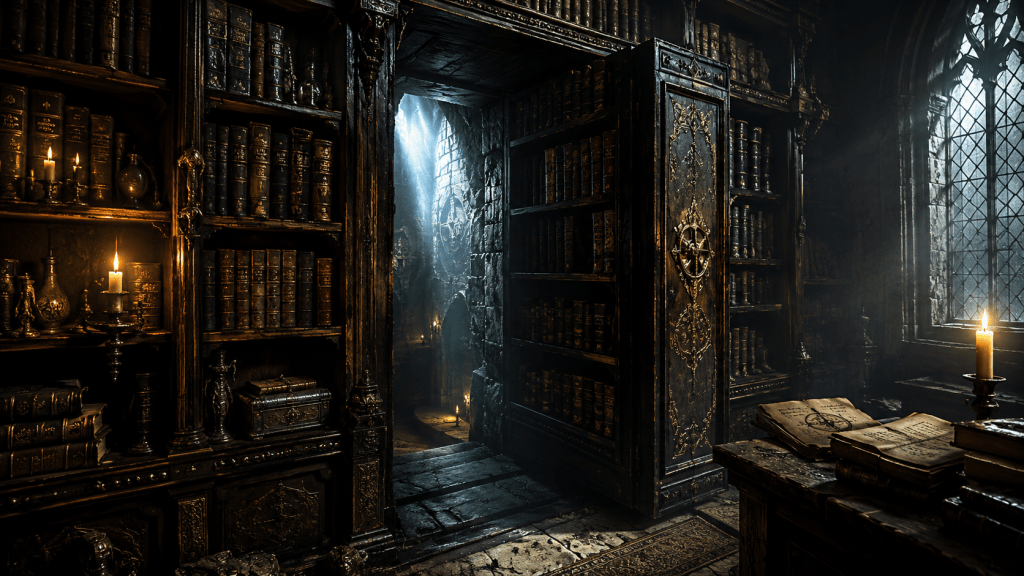
The royal library of Bremyra Castle opened later than the kitchens, later than the chapel, and later than the guards who crossed the inner court before dawn with frost silvering their cloaks, for books kept their own hour and yielded poorly to haste. Morning entered that high chamber by slow degrees, first as grey thinning behind the eastern glass, then as a pale wash across the upper shelves, until gold leaf along certain spines gave back a dull glow like embers buried under ash. The air held vellum, old leather, lamp smoke, winter wool, and the faint mineral chill that rose from the stones whenever snow lay across the outer walls.
Master Orlan Thesse had served the library through the last years of King Cedric’s father, through Cedric’s accession, through Prince Patrick’s growing seriousness, and through the bright impatience of Princess Elana, who as a child had once hidden beneath the southern reading table until she had been promised a book of road legends judged unsuitable for a princess of her age. Orlan remembered small truths because books trained men to keep them safely when great ones made too much noise, and his life had passed among maps cracked at their corners, treaties copied under differing seals, births entered in gold ink, and deaths written in plain black because grief had emptied ceremony from the hand that wrote them.
That morning, he had been summoned for inventory before the second bell. The order came from Master Vaynor’s office, folded square, sealed in common brown wax, and written in the clipped manner of a household trying to appear calm while every corridor carried whispers. The upper library was to be checked in full, with special care given to the western wall, the royal histories, the locked lower case, the architectural rolls, and those shelves nearest the old foundation line. Orlan read the order twice beside the lamp, tracing the firmness of the hand, for men asked full inventory during succession disputes, after water damage, before royal marriage journeys, and when something had gone missing that nobody wished to name.
He entered with two assistants: Corven, who copied titles cleanly while fearing ladders, and Mina, who climbed shelves as steadily as a cat. They carried wax tablets, cloths, a ledger board, trimmed lamps, and a narrow brass measure for checking warped panels. The library received them in its usual solemn manner, high rafters dark above, galleries ribbed along the walls, and shelves rising in tiered ranks from floor to shadow. At the far end, where the western wall thickened above the oldest part of the castle, the bookcases stood heavier than the rest, carved in dark wood whose grain had blackened over generations of oil, smoke, and touch.
Corven read titles aloud in a careful voice while Mina checked the upper rows from the ladder and Orlan entered each section into the inventory. The royal genealogies stood complete. The Bremyran law folios remained in place. The Vaeldring marriage copies had been removed under receipt, leaving a gap wrapped in blue ribbon where the clerk had tied a label for return. Arvendral correspondence occupied the side table under guard seal. All of it formed the visible life of the kingdom, ordered, indexed, and given proper weight, while beneath that labour the library seemed to hold itself apart, as if the chamber listened from inside the wood.
Mina first sensed the change near the fifth western shelf. She had climbed to inspect the chronicle rolls above the naval charters when she lowered her hand and looked along the carved upright beside her cheek. “Master,” Mina said as one palm rested against the ladder rail, her voice held low through habit learned among old pages, “this panel has shifted.” Orlan crossed the carpet slowly. The upright she indicated bore a pattern of curling leaves, though age had drawn the carving into darker lines that almost suggested letters when seen from the side. He lifted the lamp. Dust lay thick along the horizontal moulding. A narrow break ran through it where two pieces of wood met, clean and pale, as if a blade had passed there during the night.
“Dry timber moves in winter,” Corven said from the lower table, his hand hovering above the wax tablet while relief showed too plainly in his face. Orlan gave the words space to settle and chose silence for his answer. He had lived among old timber long enough to know its groans, its swellings, and the tiny betrayals made by damp and cold. This break looked fresh in a different fashion, with the careful line of use, the kind of seam a man might miss for twenty years before a single morning taught his eye to fear it.
The brass measure found a gap behind the shelf where the previous record allowed none. Orlan checked the ledger himself, turning back through entries with a thumb darkened by ink. The western theological shelf had been measured after the summer rains, and its depth had matched the adjoining cases. The shelf before him now stood a finger’s breadth proud of its neighbours, too slight for most eyes, too precise for the library to forgive. Mina descended with dust on her sleeves and unease in her face, while Corven rose from the table with the tablet pressed against his chest as if wax and board might protect him from whatever waited behind wood.
“Shall I call the steward?” Mina asked as she stepped clear of the ladder and kept her gaze fixed upon the carved upright. Orlan looked towards the double doors, closed against the passage, then towards the far windows where winter light pressed weakly through clouded glass. A steward would call a guard. A guard would call an officer. An officer would ask whether anything had been removed, whether any servant had entered, whether the Lord Magician had passed this way, whether Princess Elana’s curiosity had found a key, whether Prince Patrick’s household held more secrets than it admitted. Questions multiplied quickly in castles. Records survived by moving slower.
“Hold the ladder steady and keep the tablet ready,” Orlan said as he set the lamp upon the nearest table and laid two fingers along the carved leaves. The wood felt warmer than the room. His touch found a shallow hollow beneath the carving, smooth through long concealment. Somewhere behind the shelves, too deep for the visible chamber, a faint sound answered the pressure of Orlan’s fingers. It resembled a latch remembering its purpose after years spent inside silence.
The three of them remained still as the case shifted inward by less than the width of a nail. The library kept its face arranged around old titles, dusted labels, gold names, and recorded order. A breath of cold air moved through the join, carrying stone damp and a scent Orlan placed only after it had passed: sealed air, untouched by hearth, hand, or living speech for longer than memory felt comfortable holding. Mina stepped back and crossed herself under her sleeve. Corven lowered the tablet slowly, his lips moving through a prayer he likely wished the others had failed to see.
Orlan removed his hand. The shelf eased back into place with a softness that made the hairs rise along his wrists. He thought then of the castle above and below itself, the known halls laid over older courses, the royal rooms resting upon stones set before the current line of kings, the chapel records speaking of foundations blessed, strengthened, repaired, and sealed. The western shelf had answered like a thing accustomed to being touched by those who knew where to place the hand.
He returned to the table and opened the inventory ledger to a fresh line. Date, hour, room, shelf, section, witnesses. The act steadied him. Ink had saved more men from foolish speech than courage ever had. He wrote that a western case showed slight movement during inspection, that every visible volume remained in place, that the surrounding bindings appeared sound, and that a depth irregularity required later carpentry review under household authority. He avoided the word passage. He avoided the word hidden. He avoided the colder phrase that had entered his mind when the air came through the join, because a royal library served the kingdom best when its records offered truth enough for future hands, with danger folded cleanly beneath proper wording.
Mina watched the shelf while he wrote. Corven watched the doors. The lamps burned with small, straight flames, and beyond the windows Bremyra carried on beneath the grey weight of morning, unaware that the library had shifted behind its ordered wall. When the second bell rang, its sound travelled through the library and settled among the shelves in a low tremor. The western case answered by the faintest touch, a single wooden murmur passing behind the carved leaves. Orlan sanded the ink, closed the ledger, and kept his palm resting upon the cover until the vibration faded. Later copies would reduce the matter to a shelf defect, a winter swelling, a minor irregularity along the oldest wall of the royal library. Those present that morning carried a harsher memory: that the castle’s books had stood in perfect order while something behind them stirred, and for one guarded instant, the shelves of Bremyra seemed less like furniture than guardians who had nearly forgotten what they were meant to keep closed.
A Visual Chronicle
In Bremyra Castle’s royal library, a routine winter inventory reveals that one ancient shelf has moved, and something long sealed behind the kingdom’s histories appears to remember how to open.
Royal Library Register: The Western Foundation Shelf
The western wall of Bremyra’s royal library was entered in the old castle inventories as foundation-adjacent shelving, containing theological folios, royal histories, architectural rolls, and certain bound copies of early household surveys connected to the first raising of the inner keep.
During a winter inventory taken under Master Orlan Thesse, a minor displacement was recorded along the fifth western shelf, where the carved upright stood proud of its neighbouring cases and a narrow break in settled dust suggested recent movement within the wood.
The formal ledger described the matter as a depth irregularity requiring later carpentry review, with all visible volumes entered as present, undamaged, and properly ordered at the time of inspection.
A lesser library copy preserved additional remarks concerning cold air from behind the case, warmth held within the carved upright, and a sound beneath the shelf described as a latch answering pressure after long silence.
The entry gave no direct cause for the disturbance, and the shelf was afterwards entered as restored, secure, and fit for continued use, though a later hand amended the margin with the phrase old passage memory before the words were scraped thin.
Subsequent inventories retained the western shelf among ordinary library fixtures, recording its contents by title and shelf mark, while the foundation line behind it remained absent from the public catalogue and appeared only in damaged household copies kept apart from the royal register.
About the Creator
The Mythic Chronicle is written and curated by Simon Phillips, a writer of mythic and speculative fantasy whose work explores forgotten kingdoms, fractured records, old institutions, and the moments when history begins to shift before those living through it understand what has changed.
The accounts preserved within these Chronicles form part of a wider body of work in which castles keep older secrets beneath familiar rooms, roads carry rumours ahead of armies, and ordinary witnesses preserve fragments of events whose true meaning remained sealed from them at the time.
One such account survives in a separate record, following the return of a magician to Bremyra during a season of court unease, royal absence, Church suspicion, and gathering danger beyond the kingdom’s roads. What the servants, clerks, and watchers of the city remembered only in fragments is followed more closely in The Unmarked Path, the opening book of The Veil of Kings and Gods within The Chronicles of the Spiral Realms.
Readers who wish to examine that fuller account may find the record below.
What follows is taken from a later library account concerning the western foundation shelf of Bremyra Castle, where a minor inventory irregularity was preserved before rumours of a hidden passage entered the household record.
Subscribe to continue reading
Subscribe to get access to the rest of this post and other subscriber-only content.
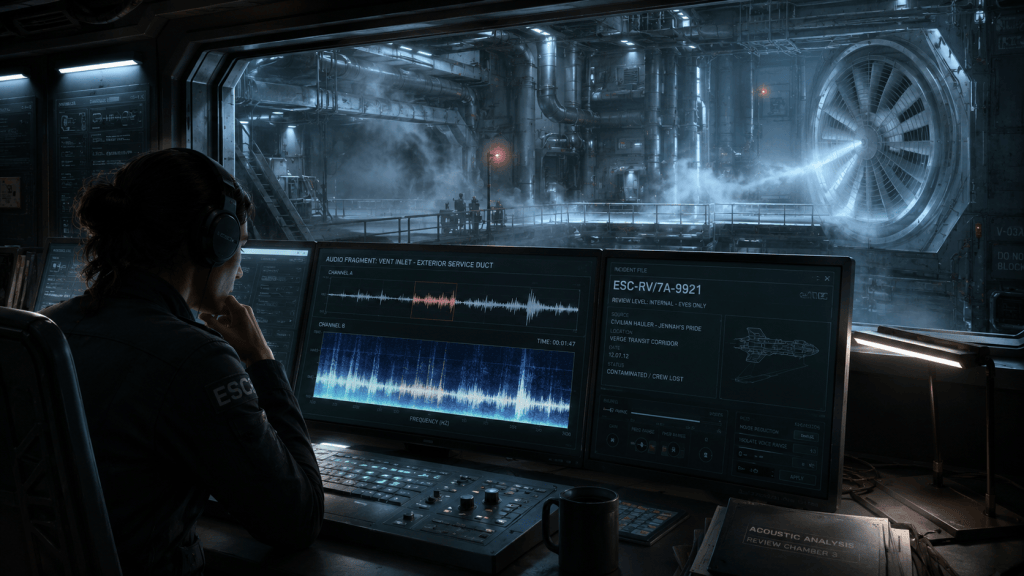
An ESC analyst studied a damaged audio fragment from a contaminated ship and heard a voice where procedure insisted there could only be corrupted airflow.
Chronicle Opening: The Recording in Chamber Nine
Review Chamber Nine held its cold in the wall panels long after the upper decks moved into their sleep cycle. It sat three levels below the main intelligence spine of the ESC cruiser Adderfall, sealed behind two pressure doors and a corridor lined with acoustic baffles thick enough to swallow the sound of boots before those sounds reached the bulkheads. The room had once been a navigation review suite, made for traffic reconstruction, distress-call sorting, and signal comparison from damaged civilian craft, although later work had changed it into something more private. Extra insulation covered the older seams. Audio pickups hung from black jointed arms above the central table. Three analysis boards curved around the main workstation in dull blue light, carrying spectral maps, pressure traces, ship schematics, and damaged recordings recovered from vessels whose final reports had reached command in fragments.
Analyst Liora Venn sat beneath the listening array with one hand beside the playback controls and the other wrapped around a cup gone cold against her palm. Her review slate showed the file name in clean institutional text. ESC-RV/9A-441. Civilian carrier Jennah’s Pride. Verge transit corridor. Crew status lost. Contamination status unresolved. Audio source recovered from forward environmental stack. The file had arrived from Evidence Intake with three notes attached by officers who had tried to keep the fragment inside a safer frame. Damaged ventilation record. Probable pressure flutter. Emergency channel bleed. Liora had read each line before opening the raw track, and each phrase carried the same careful pressure, the same quiet attempt to turn fear into something a desk could approve.
She drew the Jennah’s Pride schematic across the left board and let the carrier unfold in pale lines. The ship had been a mid-range civilian hauler, narrow through the crew spine, broad through the cargo belly, old enough to carry exposed heat trunks behind patched maintenance covers and cheap enough for its owners to argue over every delayed repair. The forward environmental stack sat above the lower crew passage, feeding filtered air through sleep cells, galley, med recess, and service ducts leading into cargo control. The recovery drone had found ribbed residue along two vent grilles, black particulate inside a filter tray, and pale scoring across an inner access cover where metal had cooled around shapes the original design had never required. Liora enlarged the stack and traced the airflow path with two fingers. If air had crossed a damaged grille at the right pressure, if the emergency channel had held a cached distress syllable, if the ship’s own announcements had torn apart during power loss, a sound could gather shape. She wrote that on her slate, then lowered the playback threshold and allowed Chamber Nine to listen.
Static came first, low and irregular, carried inside fan wash and broken signal return. The visual band rose in white clusters across the central display while Liora watched the peaks before letting the sound move deeper into her attention. Hull vibration sat underneath it, a slow structural shiver from a vessel losing thermal balance. A relay click repeated in the upper range. Air moved through the stack in pulses, too uneven for a healthy loop and too regular for random failure. Then a tone surfaced beneath the wash, thin as breath crossing a cracked pipe, and the room changed around it. Liora stopped the track with one careful touch. She stared at the frozen waveform while the cold panels, listening arms, display boards, and sealed doors seemed to gather more closely around her. The sound had lasted less than a second, close enough to a voice for the body to react before reason could claim it. She marked the frame, rewound nine seconds, and played it again with the voice-isolation layer disengaged.
The second pass carried more weight because she knew where the sound waited. Static crossed the chamber. Fan wash followed, broad and dry. The relay clicked. The airflow pulse came from the damaged stack, then the thin tone rose again, shaping itself with enough human timing to make her body react before thought could build a wall around it. Liora kept her hand still beside the controls and opened a filter to strip low-frequency hull vibration. A second filter reduced relay chatter. A third mapped airflow against the forward stack, feeding the pressure model across the right board in slow blue lines. Most of the fragment behaved the way training said it should behave. Broken flow crossed the grille, struck the access lip, and returned through the stack with a warped harmonic that could form a vowel under poor conditions. The final third sat slightly apart from the airflow model, a narrow lift in the middle band that held across twelve frames with the patience of speech.
The door opened behind her with a soft pressure shift that moved through the room before the hinge sound arrived. Lieutenant Arel Doss stepped inside carrying a sealed evidence case under one arm and a field jacket fastened over his duty shirt. He paused once he saw the active boards, then his eyes moved from the Jennah’s Pride schematic to the frozen waveform across the central display.
“You started early,” Doss said as he crossed to the side table and set the case down.
Liora kept her eyes on the spectral line. “The file arrived marked routine acoustic review.”
Doss glanced at the dark cup beside her wrist. “Routine files usually wait for morning.”
Liora lifted the cup, found it cold, and set it down again. “This one kept the room awake.”
Doss came to stand beside her chair, his face drawn by fatigue and the hard light of the boards. “Play it from the mark.”
Liora sent the fragment through the chamber speakers. Static moved across the room with the dry scrape of damaged distance. Fan wash followed, then the relay click, then the airflow tone rising from the stack, stretched thin through metal, filter mesh, and pressure failure until it shaped itself into two syllables that no program on the board would name. Doss lowered his head by a fraction. Liora stopped the track before the following distortion buried the sound, and for several seconds they stayed beneath the listening arms while the display held the waveform in frozen light.
Doss moved first, drawing one hand across the back of his neck as he looked at the schematic. “That sounded like a woman.”
Liora pointed to the airflow model. “It came from the forward environmental stack during pressure collapse.”
Doss leaned closer to the display, his voice lower as he answered. “Those are separate statements, Liora.”
She drew the spectral layer wider and forced herself to follow the clean lines of the model. “It sounded like airflow travelling through damaged vent structure.”
Doss looked at her profile in the blue light. “You heard her as well.”
Liora pushed back from the workstation and stood, needing the small change in height more than distance from the sound. “Jennah’s Pride had already lost pressure across forward crew sections before the recording,” she said, taking the stylus from the slate and marking the relevant time block. “Thermal map showed no living return inside the stack or lower passage. Rescue authority closed before the drone entered.”
Doss folded his arms and kept his eyes on the waveform. “Then why did she sound trapped inside it?”
Liora lowered her hand and opened the pressure overlay again. “Because damaged ships carry people after people are gone,” she said. “Announcements, emergency loops, suit traffic, last words, cabin audio, airflow through broken spaces. The system keeps pieces.”
Doss looked towards the sealed evidence case he had brought in. “That answer will satisfy Evidence Intake.”
Liora followed his gaze. “It will satisfy them if the track behaves.”
The line from Evidence Intake chimed across her board. Liora accepted it through text only. Supplementary file available. Drone visual, forward environmental stack, Jennah’s Pride. A grainy still filled the right display, showing an access grille under emergency light, its surface rimed with frost and thin pale residue gathered along every rib. The centre of the grille had bent outward from inside the duct, enough for a technician to see pressure had travelled the wrong way through the stack. Doss stepped closer, his earlier argument fading as the visual settled between them. Liora enlarged the bent grille, then laid the waveform beneath it. The thin tone aligned with the pressure reversal. The explanation strengthened. Relief passed through her too quickly, too eagerly, and for that reason it felt unsafe.
“There,” Liora said, touching the pressure mark with the stylus. “Air forced through a damaged grille during collapse. That gives us the vocal edge.”
Doss kept his gaze on the still. “And the timing?”
Liora looked back at the waveform, where twelve frames held their small human shape. The cruiser hummed around Chamber Nine while the room waited for language strong enough to contain the sound.
“The timing remains under review,” she said, saving the mark before she played it once more.
A Visual Chronicle
Inside Review Chamber Nine, a damaged recording recovered from the dead carrier Jennah’s Pride is stripped down to airflow and static until the machinery seems to form a single human word: “Please.”
Incident Record: Review Chamber Nine
Review Chamber Nine formed part of the restricted intelligence and evidence-analysis section aboard the ESC cruiser Adderfall, a midline patrol vessel assigned to incident comparison work across the Verge transit corridors during the earliest phase of the contamination crisis.
The chamber had originally served as a navigation review suite, where damaged route packets, traffic disputes, late transponder replies, and civilian distress bursts could be reconstructed after accidents along the outer freight lanes. Its first purpose had been practical and narrow, built around the careful rebuilding of events from signal fragments, pressure logs, ship schematics, and traffic authority records.
As unexplained incidents increased across civilian haulers, salvage craft, cargo drones, and isolated industrial stations, the chamber’s role gradually changed. Additional acoustic insulation was installed behind the wall panels, evidence feeds were restricted to cleared analysts, and the listening array above the central workstation was upgraded to process degraded audio recovered from contaminated vessels and post-disposal drone sweeps.
Rooms of this type became important because many early Harbinger-related files reached ESC review through damaged sound before they reached command through reliable evidence. Ships lost environmental balance, distress channels fractured, emergency buffers repeated broken phrases, and ventilation systems carried pressure noise that trained officers struggled to dismiss once it began to resemble human speech.
Review Chamber Nine was therefore used for the difficult work of separating mechanical failure from possible survivor audio, a task that carried both procedural and moral pressure. A sound could be logged as airflow distortion, comm bleed, pressure flutter, emergency loop corruption, or acoustic artefact, yet each label carried consequences for rescue authority, evidence handling, quarantine procedure, and the official language later attached to the incident.
The recording recovered from the civilian carrier Jennah’s Pride entered Chamber Nine under this uncertain status. It had been taken from the forward environmental stack after the ship was declared lost, and the fragment appeared to contain a short human-sounding vocal shape inside a field of static, fan wash, relay chatter, and pressure collapse. At the time of review, no confirmed survivor remained aboard the vessel, and the recovered visual evidence showed damage around the vent structure that supported a mechanical explanation.
Later comparison work would place the Jennah’s Pride fragment among a wider body of early contamination records involving false voice-like events, delayed system responses, airflow anomalies, and human interpretation under extreme stress. In the official summary, the sound was classified as an acoustic artefact pending further review.
Yet within the chamber logs, analysts preserved the original waveform, the pressure model, and the damaged vent image together, leaving behind a record of the moment when procedure found a name for the sound while uncertainty remained inside the file.
About the Creator
The Future Chronicle is written and curated by Simon Phillips, a writer of science fiction and speculative storytelling who explores the fragile edges of human expansion, where freight routes, inspection bays, patrol vessels, and isolated industrial stations continue their ordinary work while larger dangers gather quietly beneath routine procedure.
Many of the stories presented in these Chronicles exist within wider fictional worlds shaped by workers, survivors, officers, and investigators who encounter the first signs of events far greater than they are prepared to understand. These settings remain grounded in lived environments, where machinery, bureaucracy, and human judgement often shape the path of catastrophe long before anyone can give it a name.
The Harbinger Protocol novellas follow that unfolding pressure through the experiences of Soren Vale, beginning with the civilian freighter disaster recorded in The Ash in Transit and continuing into the colder, more procedural dread of The Silent Outpost, where isolated incidents begin to reveal the outline of something spreading across human routes and systems.
Readers who wish to explore the full opening phase of the Harbinger crisis can find the novellas below.
The following Chronicle reconstructs the review of the Jennah’s Pride audio fragment inside Review Chamber Nine, where an ESC analyst attempted to reduce a human-sounding voice to airflow, pressure collapse, and damaged ship systems while the recording continued to resist every clean explanation.
Readers supporting The Future Chronicle can continue the record below.
Subscribe to continue reading
Subscribe to get access to the rest of this post and other subscriber-only content.
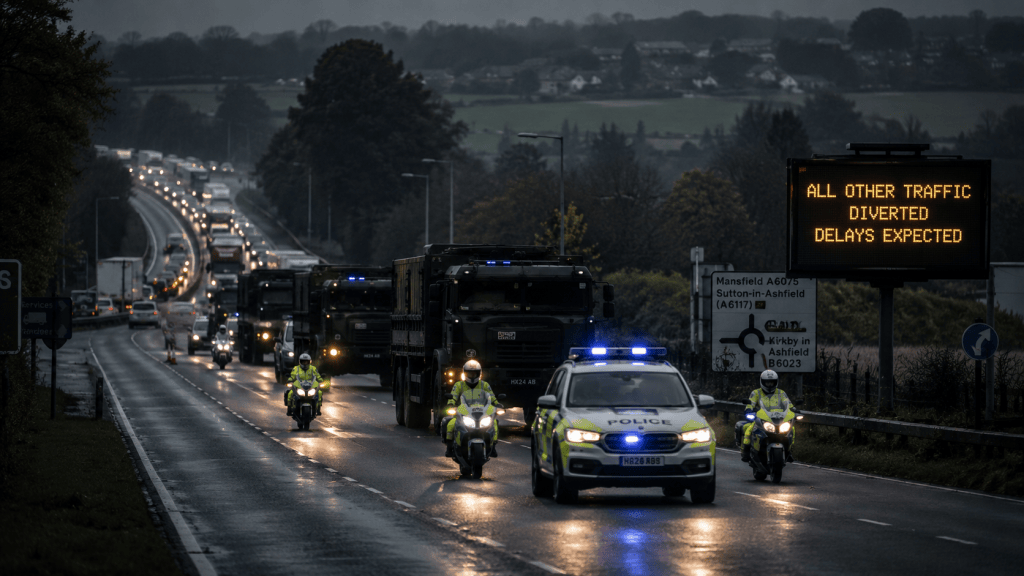
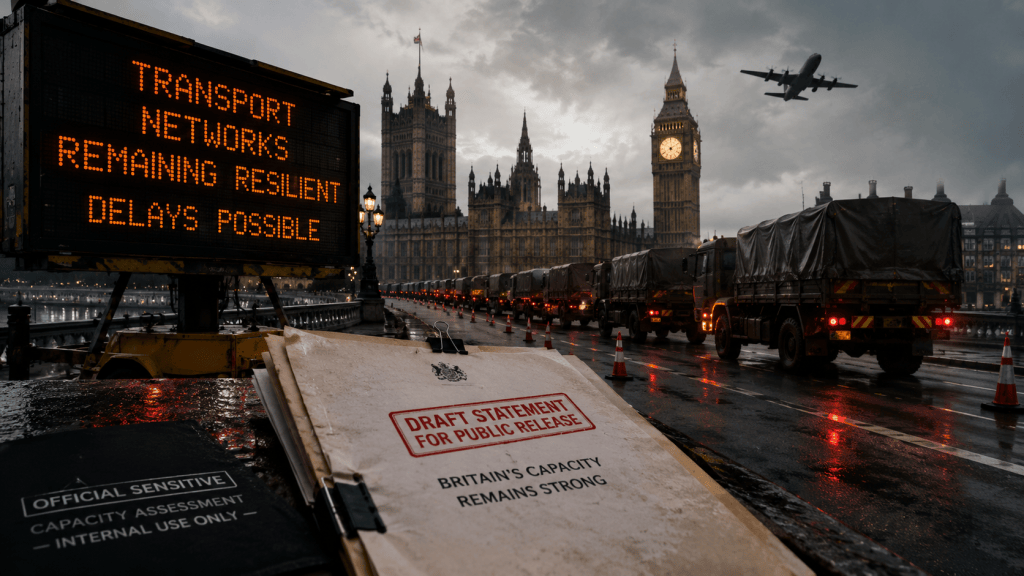
A protected route cut through ordinary England, and for those left beside it, the delay was the first sign that the road had begun to belong to something else.
The Morning the Road Changed Hands
Ashwell Roundabout had begun taking the shape it would keep for hours by the time the police cars settled across the western approach, a slow curve of brake lights bending past the petrol station, along the supermarket service road, and towards the damp fields beyond the last row of houses. Rain had arrived before dawn and left the tarmac shining beneath a low grey sky, each puddle catching the amber blink of temporary signs and the blue pulse from vehicles positioned where school traffic usually moved through with practised irritation. On most mornings the roundabout carried commuters, delivery vans, farm pick-ups, buses, and late parents, yet that morning it held them in place while a road team in waterproof jackets lifted cones from a flatbed and built a corridor through the middle of their day.
Paul Seddon sat three vehicles from the front with the engine idling and the temperature alarm on his dashboard giving a soft, regular chirp that had grown more personal with every minute. Fresh produce, pharmacy bins, and milk for a primary school kitchen had become a marker beside Ashwell Services, although stationary made the morning feel calmer than the road outside the windscreen. He saw the school bus ahead of him at the edge of the roundabout, hazard lights blinking, windows steamed from inside, children’s hands drawing brief marks through condensation while the driver leaned out and spoke to a police constable under the rain.
The constable looked young enough to still expect approved words to carry useful weight. She stood with one gloved hand resting on the bus door frame and the other raised towards the temporary closure board as she explained the diversion again. The bus driver, square-shouldered in a purple fleece beneath her uniform jacket, listened with a face arranged for patience and eyes moving towards the clock above her windscreen. Behind her, a boy in the front seat had pressed his forehead against the glass and watched the roundabout as if the cones and barriers had been placed there for him alone. Paul saw the driver shape the words school run through the rain, and the constable lowered her hand, offering a small apologetic tilt of the head before she directed the bus into the side lane beside the petrol queue.
The queue had become its own argument before eight. Cars waited two deep at the station entrance, cutting across the supermarket slip and blocking half the service road where delivery bays sat behind locked gates. A man in a dark estate car had left his driver’s door open while he walked towards the forecourt kiosk, calling over the weather about priority, children, work, and how the council had given the village no useful warning. The woman at the kiosk window kept both hands flat on the counter and repeated the same sentence because no safer sentence had been supplied. Fuel remained available, customers would be served in order, and emergency access had to remain clear. Each line came back across the forecourt changed by rain, engines, and the harder sound people made when delay had joined a wider kind of fear.
Paul checked his phone again, although the depot had already sent the instruction that mattered: hold position until police released the route, preserve load temperature, update customer delay category to external road-management pressure. The phrase sat on his screen with a cold neatness he disliked, fit for resurfacing, flooding, a crash, or any local misery that belonged to local roads. It struggled to cover what he could now see beyond the roundabout, where two police motorcycles had taken position at the far approach and a pair of dark military trucks waited beneath the trees with their lights dipped. Farther back, beyond the bend, more headlights gathered in a line that held its own discipline.
At half past eight, the roundabout quietened in a way that travelled through the waiting vehicles before the sound changed. The constables moved first, stepping out from the cones and raising their arms, while buses, vans, cars, and supermarket lorries stayed where they had been told to stay. The petrol station forecourt seemed to pause around pumps and raised voices, and even the children on the bus stopped drawing in the condensation. Then the leading police motorcycle came through from the western approach, blue light glancing across wet tarmac, followed by the first covered truck, then a second, then three low loaders carrying equipment under dark tarpaulins. Paul watched the wheels pass through the cleared centre of the roundabout, tyres hissing through standing water, the vehicles moving steadily east while everyone else sat behind cones and learned that the road had a second purpose when someone higher up required it.
The convoy held no spectacle, which made its authority harder to absorb. Its movement came through the village as a settled fact, passing under temporary traffic lights and past a petrol queue that had received no explanation beyond traffic management and essential national movement. A police 4×4 followed the first section, then a gap wide enough for radios to crackle and heads to turn, then two more heavy vehicles with rear doors sealed and number plates already filmed by half the waiting traffic. The school bus driver climbed down during the second gap and walked towards Paul’s van, rain dotting her glasses and darkening the shoulders of her fleece. She glanced towards the convoy, then towards the service-road queue, assessing the same road through three separate obligations.
The bus driver rested one hand on Paul’s half-open window. “Have they told you anything useful?” she asked, her voice carrying the rough edge of a morning slipping beyond timetable.
Paul lowered the glass and felt rain reach his sleeve. “Depot says hold position,” he said, nodding towards the phone on his passenger seat. “External road-management pressure.”
The driver gave a tired laugh while a fresh line of trucks entered the roundabout behind her. “That sounds expensive for saying stuck.”
Paul looked towards the bus, where the boy in the front seat still watched through the glass. “How late are they?”
“Late enough for every parent to ring the school,” the driver said as she wiped water from her glasses with her sleeve. “My youngest is front left, pretending he is fine, which usually means I get the fallout at tea.”
Paul found the boy again, small against the wide bus window, his attention fixed on a covered vehicle carrying what looked like generator housings beneath canvas. A further truck had side panels stripped of company markings, leaving pale rectangles where old names had been removed. A marked highways officer stood beside the cones with a clipboard held inside his jacket, writing each passage down as if recording could keep the route ordinary. Paul wanted to say the convoy would pass, the bus would go on, and the day would become late instead of altered. The sentence fitted the weather, the road, and the careful look on the constable’s face, so he left it where it belonged, inside his own mouth.
A horn sounded near the petrol station, short and angry, followed by a second from farther back. The man from the estate car had reached the kiosk window and was jabbing his hand towards the blocked slip road. A supermarket worker in a green jacket came out to move delivery cages away from the service gate, then stood with both hands on the metal rail, caught between stock that needed unloading and a road that had ceased to answer to the shop. When the final vehicles entered the roundabout, the rain thickened and drew the village, the school bus, the petrol queue, the supermarket yard, and the trapped delivery vans into one blurred reflection.
The police sergeant spoke into his radio, listened, then nodded towards the far approach as if the corridor had gone through cleanly. The cones stayed in place for several minutes after the final truck disappeared beyond the trees, and that delay unsettled the waiting drivers more than the convoy itself. It suggested that the movement had left something behind besides water on the road and tyre tracks through the roundabout. It had left a revised understanding of priority, one everyone could feel while still lacking permission to name it.
The constable returned to the bus first, and Paul watched the driver nod, climb back into her seat, close the door, and ease the vehicle into the diversion lane. The petrol queue released next in bad temper, each car moving too close to the one ahead. Paul’s tracker flashed a new estimated delivery time and revised itself again before he had taken his foot from the brake. The road opened by degrees, ordinary traffic pouring back into the shape left for it, as if the interruption had been a passing inconvenience. Yet as Paul guided the van past the cones and saw the water still trembling in the lorry tracks, he understood that the road had held open for something larger than traffic.
A Visual Chronicle
An ordinary school run stalled in the rain as Ashwell Roundabout briefly became part of a protected route moving east.
Extract from County Roads Policing and Local Resilience Coordination Log
Subject: Ashwell Roundabout / Essential Movement Hold Time: 08:06–09:18 Circulation: Roads Policing Unit / Local Authority Duty Officer / Highways Liaison / Regional Movement Desk
Purpose To record temporary traffic-management measures applied at Ashwell Roundabout in support of protected eastbound movement through the A-road corridor, with associated disruption to civilian traffic, school transport, commercial delivery access, and fuel-station queuing.
Public Position Short-term traffic controls were applied to support essential movement through the local road network. Police, highways staff, and local authority partners worked to maintain public safety, preserve emergency access, and limit wider disruption during the movement window.
Incident Summary At 08:06, roads policing units established a controlled hold on the western and southern approaches to Ashwell Roundabout. Highways contractors placed cones and temporary signage under police direction. Civilian traffic accumulated across the supermarket service road, petrol-station entrance, and school-bus approach within twelve minutes of the first hold.
At 08:24, the first protected movement entered the controlled corridor from the western approach under police motorcycle escort. The movement consisted of covered heavy vehicles, support vehicles, and low-loader units carrying sealed equipment under tarpaulin. Vehicles proceeded east through the roundabout under continuous police control.
At 08:31, local bus service 42A was diverted into the side lane due to corridor clearance requirements. The bus carried school pupils bound for Ashwell Primary and Harford Road Academy. Driver reported anticipated lateness and requested school notification. Local authority education contact was advised through the duty channel.
At 08:37, fuel-station queuing extended across the supermarket slip road and affected rear delivery access. Forecourt staff reported customer agitation linked to route closure, pump access, and visible police movement. No physical disorder was recorded. One male driver challenged kiosk staff and was verbally redirected by attending officers.
At 08:49, final protected vehicles cleared the eastern approach. Police retained the hold for route-confirmation checks before staggered civilian release began at 08:57. Full civilian movement through the roundabout resumed by 09:18, although residual congestion continued across the service road and petrol-station entrance.
Approved Local Explanation Members of the public were advised that short-term traffic management had been applied to support essential national movement. Police and highways teams were present to maintain safety, manage congestion, and reopen the route as soon as conditions allowed.
Lines to Avoid Refrain from identifying vehicle category, load type, destination, escort protocol, or connection to wider allied-support movement. Refrain from suggesting routine civilian traffic had been displaced by defence-linked movement. Refrain from confirming repeated use of the route unless cleared through regional handling. Refrain from linking the hold directly to overseas military events or recent freight disruption.
Local Impact Assessment The route hold created visible public disruption in a mixed civilian setting, with school transport, retail delivery access, fuel queues, and commuter traffic affected during the morning peak. Public frustration increased where road users observed escorted vehicles passing through while ordinary traffic remained stationary.
The presence of marked police units, temporary signage, and covered heavy vehicles increased public speculation around the purpose of the movement. Several members of the public filmed the convoy from stationary vehicles. Local communications teams should assume social-media circulation of images from Ashwell Roundabout across the morning period.
Operational Note Further use of Ashwell Roundabout for protected movement may require earlier school transport warning, revised petrol-station access control, and supermarket delivery coordination to reduce visible civilian delay.
About the Creator
The Modern Chronicle is written and curated by Simon Phillips, an author of modern speculative fiction and contemporary crisis-driven storytelling who explores the point where ordinary life begins to tighten beneath political strain, military movement, institutional caution, and the public language used to keep dangerous realities at a distance.
Many of the records presented in these Chronicles sit alongside Simon’s wider modern-war novella series, where governments, soldiers, families, and civilian systems are forced to absorb a world changing faster than its official explanations. The stories remain grounded in recognisable places: ports, school corridors, freight yards, government rooms, roadside queues, transfer sites, and homes where the news has started to feel too close.
One such world unfolds through The Last Deterrence, a modern-war novella sequence beginning with Managed Distance Breaking and continuing in The Quiet Strike. Together, the first two books follow Britain as support language begins to fracture under freight pressure, European escalation, domestic infrastructure strain, and the growing sense that distance from war has already begun to fail.
Readers who wish to explore the wider published story world connected to this Chronicle can find the novellas below.
The following Chronicle continues the morning at Ashwell Roundabout, where police route control, delayed school transport, a worsening petrol queue, and a protected eastbound convoy turned a familiar local road into part of a corridor few people had been allowed to understand.
Readers supporting The Modern Chronicle can continue the record below.
Subscribe to continue reading
Subscribe to get access to the rest of this post and other subscriber-only content.
A kitchen-side account of the morning a servant of the Order returned to Bremyra Castle, and those below the stairs looked upon a magician while trying to remember the boy who had once carried bread among them.
Beneath the Lower Hearths
The kitchens of Bremyra Castle woke before the court above had gathered its voices, with ash drawn from the hearth mouth, embers coaxed back into flame, water carried from the lower pump, and first loaves uncovered beneath linen as grey morning pressed against the high windows. Heat gathered early in that buried place, filling blackened beams, copper pans, drying herbs, flour boards, and worn stone with the living breath of labour. Inside, the servants moved by habit older than speech, each hand finding its work as if the castle’s hunger had shaped them into one body made of smoke, steam, wool, and bread.
Mistress Arven stood near the great hearth with her sleeves pinned high and a strip of linen tied across her hair. Age had silvered the braids beneath it, although age had taken little from the strength in her hands or the authority with which she ruled the lower kitchen. She knew the castle by its appetites, by guards lingering for crusts, pages stealing apples, chambermaids hiding grief by moving too quickly, and nobles sending back meat untouched after stiff court feasts. She had outlasted enough service children to measure the years by names vanished from the duty boards, and one such name returned that morning before any black robe entered the kitchen.
It came through the western service passage, where young Berren had gone for dried apples and returned with the basket empty, his mouth pale and his breath uneven. He claimed the stones by the lower stair had grown cold enough to smoke when he spoke, foolish in a passage warmed by ovens since before dawn, yet his fear held the plain shape of truth. Mistress Arven took the store key, sent him back to the carrot board with a steadying glance, and went herself towards the stair with a lamp lifted before her.
The passage held its usual damp, its smell of onions, old straw, tallow, and winter fruit, yet near the first turn a faint mark crossed the dust where no errand had been sent. It might have been a boot track, water from a seam, or a scrape left by some porter too proud to confess clumsiness. Mistress Arven crouched with the lamp near the stones and felt old memory rise under the smell of dust. A boy had once slept there during hard winter after fever took him beside the wood bins, wrapped in sacking with hands curled near his mouth. She had poured broth between his lips and told him, with all the cruelty of care, that service claimed even the half-dead before sunrise.
His name had been Simion. He had come to the kitchen small, quick-handed, and hungry in the careful manner of children who learned that asking cost more than silence. He had scrubbed pots until his wrists reddened, carried trenchers through feasts, and run errands between pantry, stable, chapel, and garden gate while nobles looked past him with the easy blindness of rank. Yet he had carried brightness in him then, a mischief that survived cold water and harsh words, and that brightness had drawn Princess Elana to him as surely as flame drew moths in summer. Mistress Arven remembered the princess racing through the herb yard with a cracked blue jar full of fireflies, Prince Patrick behind her, and Simion last of all, trying to hide laughter beneath a basket of parsley.
The Order had taken him in later years, when papers came, men waited near the outer door, and the boy was washed, dressed in borrowed wool, and sent upward before being sent away entirely. Mistress Arven remembered his face at the threshold, because he had looked back once towards the hearth, the bread shelf, and the corner where he had mended his shoes with stolen twine. Then he had gone, and the castle had swallowed the shape he left behind, until the old name began moving again through Bremyra with talk of the opened Order manor, the gold-wax letter, and the Archbishop’s summons.
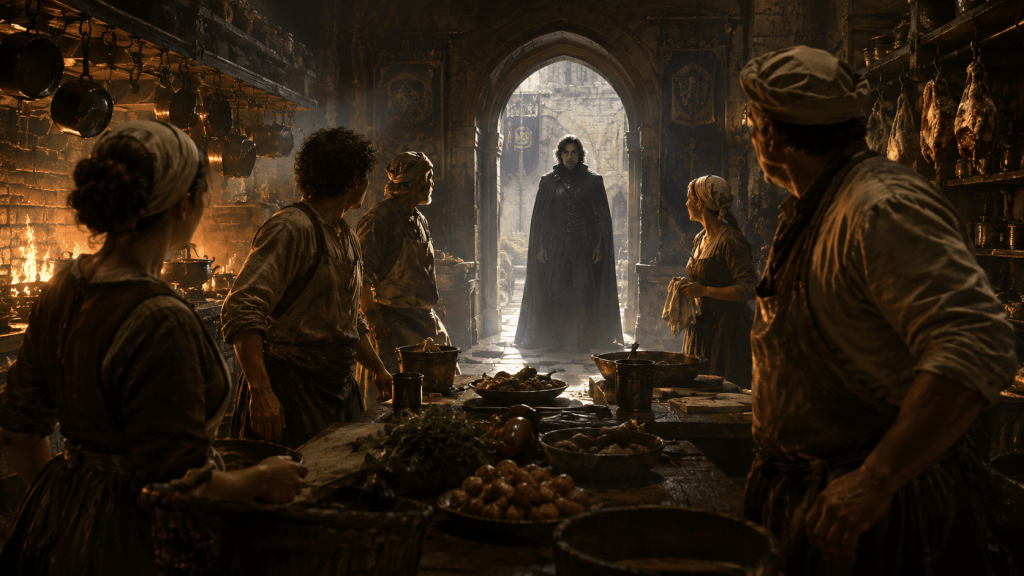
The first sign of his approach came as a change in the passage beyond the lower door. The guard posted there ceased speaking to the pantry boy, and the usual noise of feet, trays, buckets, page-whispers, and carried orders thinned until the space outside the kitchen seemed to hold its breath. Mistress Arven looked up from the herb bowl. Old Jory slowed his hands in the dough. One of the thyme girls laid both palms flat against the table. Berren turned towards the entrance with the carrot knife still held awkwardly in his fist. A figure paused beyond the threshold, tall against the colder light of the corridor, and the warmth of the kitchen drew in around the hearth as if flame itself had tightened.
The man who entered wore black robes plain in cut, marked by the authority of the Order through stillness more than ornament. He was taller than the boy Mistress Arven remembered, leaner in the face, his dark hair shortened, his eyes holding a blue-grey distance that seemed to have travelled farther than roads. He carried no visible threat, raised no hand, and asked for no deference. Even so, every servant lowered their gaze because the robe named him before memory could. A magician stood in the kitchens, among bread boards, ash buckets, herb knives, and old smoke.
Mistress Arven stepped forward because kitchens required a voice when fear stole the rest. She wiped her hands slowly across her apron, bent her head with the respect due to a power she had hoped to meet only from a safer distance, and made herself speak for all gathered beneath her roof. “My lord magician,” Mistress Arven said, keeping her hands folded before her so their tremor stayed hidden in the linen. “How may the kitchens serve you?”
His gaze moved across the long tables, the copper pans, the smoke-black beams, the bread shelf, the scullery arch, the great hearth, and the dim corner near the wood bins. There it lingered. The change in him came so faintly that only someone trained by years of kitchens could have seen it, a softening near the eyes, a guarded breath, a recognition drawn inward before it could become a wound in public view. Mistress Arven felt the years fold strangely, placing the hungry boy and the feared magician in the same body before her.
“I require nothing,” Simion said as he stood beneath the arch, his voice low, restrained, and touched by a weariness carried from rank, power, and old roads alike. “Continue your work.”
The words offered gentleness, and still relief moved slowly through the room. Berren bowed after the moment for bowing had passed. One thyme girl let a stem fall from her fingers and stared at it as if it had spoken. Jory held his flour-coated hands above the dough, unable to return them to labour while the man in black remained beneath the kitchen roof. Mistress Arven lowered her head again, because recognition crossing rank could become dangerous when years, magic, and old tenderness all stood too near one another.
Simion turned towards the passage, then slowed before crossing the threshold. His attention shifted west, towards the service stair where the cold mark had been found that morning. Mistress Arven saw him listening, and every servant listened with him while water dripped from the cracked spout and wood settled within the drying racks. Simion’s fingers moved once at his side, a small unfinished gesture quickly stilled, and his face held the look of a man who had heard a call others mistook for silence.
He inclined his head by the faintest measure, perhaps to the room, perhaps to the woman who had spoken, perhaps to a memory buried beneath flour, smoke, and rank. Then he passed back into the corridor, his black robe brushing the threshold stones as the guard outside shifted aside. The kitchen noise returned after he had gone, altered as water changes after a stone has fallen through it. Knives found boards again. Pots settled onto hooks. The hearth cracked, and several servants moved too quickly in answer before pretending they had meant to reach for cloth or spoon.
“That was him, then,” Jory said as flour fell from his knuckles onto the board, his voice low enough for the hearth to almost take it. “The boy from the old stories.”
Mistress Arven looked towards the corner near the wood bins, where the flagstones still seemed to hold the shape of a child wrapped in sacking beneath winter’s hand. “Aye,” Mistress Arven said as she turned back to the hearth and lifted the long iron hook from its place. “That was the boy.”
A child once known by bruised elbows, stolen laughter, and flour on his sleeves had returned clothed in black authority, and the castle, which had let his name fade as easily as smoke through a chimney, began remembering him only after fear had taught it to look again.
A Visual Chronicle
Beneath the lower hearths of Bremyra Castle, the servants feared the magician who returned in black, while one old cook remembered the hungry kitchen boy he had once been.
Kitchen Register: The Lower Hearths of Bremyra Castle
The lower kitchens of Bremyra Castle were entered in the household rolls as the principal hearth-service beneath the western hall, supplying bread, meat, broth, lamp fat, hot water, and table preparations for the royal household, chapel officers, resident guards, visiting envoys, and all servants assigned to the inner keep.
A winter kitchen copy preserved a brief account of a former service child recognised by certain older staff after his return to the castle under the authority of the Order, though the formal register named him only as the Lord Magician and recorded his presence among the lower hearths as a passage through service rooms during morning duties.
The same copy referred to a coldness observed near the western service stair before his arrival, along with a mark in the dust beneath the lower turn, though the steward’s duplicate gave the matter as ordinary damp and made no further entry concerning disturbance among the stores, stair mouth, or scullery passage.
A lesser note, written in a hand later identified with the old cook’s ledger, stated that several servants recognised the visitor only after he had departed, remembering a boy once attached to the kitchens before being taken into Order keeping, though the note gave no judgement on whether the man himself acknowledged the memory.
The kitchen was thereafter entered as orderly, with fires maintained, meal service completed, and no damage reported among hearth, stores, tables, hooks, or passage doors, though one later marginal hand beside the entry amended Lord Magician to the boy returned, a phrase scraped thin in the household duplicate while remaining visible beneath smoke-darkened ink in the kitchen copy.
About the Creator
The Mythic Chronicle is written and curated by Simon Phillips, a writer of mythic and speculative fantasy whose work explores forgotten kingdoms, fractured records, old institutions, and the moments when history begins to shift before those living through it understand what has changed.
The accounts preserved within these Chronicles form part of a wider body of work in which castles keep older secrets beneath familiar rooms, roads carry rumours ahead of armies, and ordinary witnesses preserve fragments of events whose true meaning remained sealed from them at the time.
One such account survives in a separate record, following the return of a magician to Bremyra during a season of court unease, royal absence, Church suspicion, and gathering danger beyond the kingdom’s roads. What the servants, clerks, and watchers of the city remembered only in fragments is followed more closely in The Unmarked Path, the opening book of The Veil of Kings and Gods within The Chronicles of the Spiral Realms.
Readers who wish to examine that fuller account may find the record below.
What follows is taken from a later household account concerning the lower kitchens of Bremyra Castle, where a former service child was remembered only after he returned beneath the authority of the Order.
Subscribe to continue reading
Subscribe to get access to the rest of this post and other subscriber-only content.
The American flag is the first thing Aaron Cole knows is wrong, although for several seconds he cannot understand why. The familiar red and white stripes hang exactly where they should beneath the controlled lighting of the staging hall, the fabric arranged with institutional precision and treated by everyone passing beneath it as something too ordinary to deserve attention, yet the blue canton no longer carries the constellation he has known since childhood. There is only one white star, large and uncompromising, suspended at the centre of a design that seems familiar until memory attempts to complete it.
Then Aaron looks for the Union Jack.
It is not there.
For Aaron, Rei Nakamura, Marcus Reed, Connor Blake, Declan O’Shea and Sofia Alvarez, the discovery should not matter as much as the crisis they have only just survived. They have already endured an experience so physically convincing that the language of advanced simulation has begun to feel inadequate, and they have returned carrying injuries that should have disappeared when the experiment ended. Sofia’s ankle remains swollen and painful, Aaron’s hands still carry abrasions, Marcus bears bruising from impacts that belong to another place, and exhaustion sits inside all of them with the stubborn weight of something the transition back has failed to remove.
The hall around them, however, remains composed. Personnel move between desks. Announcements direct arrivals through processing. Screens display ordinary public information. No one appears concerned by the altered flag because, within this place, nothing about it is altered at all.
Calibration Cycle: Mandate Event begins at precisely that point of uncertainty, carrying the consequences of Meteor Event forward instead of allowing the characters the comfort of beginning again. The first book forced six volunteers to question whether an experimental immersive environment could produce consequences beyond anything they had been promised. Book Two asks something more dangerous: what happens when the world outside the supposed experiment appears perfectly stable, yet the history supporting that stability is not the history they remember?
The Return They Wanted Does Not Behave Like Home
The six entered the Calibration Cycle believing they had volunteered for a classified programme involving advanced immersive technology, adaptive crisis modelling and sensory feedback far beyond anything available to the public. That original explanation gave them something to hold onto when the first experience became difficult to distinguish from physical reality, because even impossible sensations could still be fitted inside the possibility of extraordinary technology if they were willing to stretch the definition far enough.
Mandate Event begins putting that explanation under a different kind of pressure.
Sofia’s ankle is not merely remembered as painful. It remains injured. The swelling is present beneath institutional lighting that belongs to the supposedly safe side of the experience, and when medical personnel eventually examine it, they do not respond with astonishment. They possess terminology for injuries that persist across what should have been a clean transition, and the casual professionalism with which those terms are used becomes more disturbing than panic would have been.
Aaron carries smaller marks, though their significance is no easier to dismiss. Marcus feels damage that should have belonged to a completed crisis. The six have returned carrying evidence in their own bodies, and every attempt to explain that evidence requires another layer of technology they were never told existed.
Connor, whose instinct is to understand a system before allowing himself to fear it, continues searching for a technical explanation because that is still more manageable than accepting that the original explanation may have been fundamentally wrong. Rei pays closer attention to the bodies themselves, noticing what pain does, how exhaustion remains, and how physical consequence refuses to respect the boundary everyone was told would exist.
Nothing provides them with a definitive answer, which is precisely what makes the uncertainty work. They are not handed a revelation about what has happened to them. They are forced to continue moving while the explanation they trusted becomes increasingly expensive to maintain.
The Single Star Belongs to a World That Thinks It Is Normal
The altered flag is only the beginning.
Announcements inside the facility direct people towards return processing. Administrative staff speak about return groups and return blocks as though those categories have existed long enough to become boring. Public devices connect to something called the Imperial Civic Mesh. Transport information identifies the wider region as part of an Imperial Union, and Britain no longer appears under the name Aaron expects to find.
It has become the Albion Administrative Territory.
The significance of that change does not arrive through an explanation delivered by an authority figure. It emerges from the ordinary machinery of public life, which makes the altered history far harder to dismiss as an artificial backdrop. Britain has not disappeared beneath rubble, and the world has not been thrown into a visibly dystopian collapse. People buy coffee, complain about delays, take children to school, work behind desks, scan travel documents and hurry through transport concourses beneath symbols they stopped consciously noticing years ago.
The single-star emblem appears on uniforms, public screens, transport notices and civic material because it belongs there.
Albion appears in official language because, within this history, that is simply what the country is called.
The effect is deliberately quieter than a ruined skyline or military occupation because Mandate Event is interested in something more unsettling than obvious conquest. It examines the way political transformation can become ordinary once enough time has passed for institutions, education, paperwork and language to make the new arrangement feel inevitable.
The Imperial Union does not need soldiers standing on every corner shouting about power. Its authority is already built into the names people use, the documents they carry and the systems through which ordinary life is allowed to move.
The Imperial Union Was Built Through the Language of Rescue
As Aaron and the others begin cautiously reading the world around them, the altered history reveals a political structure that is far more complicated than a simple empire imposed overnight.
The Imperial Union presents its origins through reconstruction, relief, stability and protection. The history taught within its civic systems describes a world emerging from the devastation of the Second World War under increasingly permanent American leadership, where humanitarian supply networks, military security, reconstruction programmes and international coordination gradually became something larger than the emergency structures that first justified them.
Connor can see why such a system might once have looked brilliant.
Shared logistics could prevent famine. Coordinated security could limit another continental war. Common infrastructure could move medicine, refugees and aid across borders more efficiently than fractured governments acting alone. A world that had watched nations destroy one another might willingly tolerate extraordinary central authority if that authority appeared to offer stability.
Marcus understands another part of the problem because military history is full of temporary structures that survive the emergencies that created them. Once command systems work, dismantling them carries risk, and the person suggesting that the guardrail should be removed becomes responsible for whatever happens afterwards.
Declan sees the trap hidden inside that logic. Temporary necessity becomes permanent authority, permanent authority becomes administrative expectation, and eventually people forget that the structure was ever supposed to be temporary at all.
What makes the Imperial Union effective as political science fiction is that its public argument contains enough truth to make its later form uncomfortable. It is not frightening because every part of it was designed by obvious monsters. It is frightening because many of the mechanisms that eventually erased sovereignty can be traced back to decisions that could once have been defended as reasonable.
That history gives Mandate Event its political depth without turning the story into a lecture. Aaron and the others discover it because they must understand the rules of the world before those rules classify them as threats.
Aaron’s Passport Becomes More Dangerous Than a Weapon
For Aaron, the altered history stops being theoretical when the group reaches identity processing.
The passports they carried into the original programme have travelled with them, small pieces of ordinary life preserved through experiences that have already damaged almost every other assumption. Connor’s American passport produces confusion because its design does not match local federal standards. Rei’s Japanese documentation requires manual review. Sofia’s Mexican identity and Declan’s Irish passport fit imperfectly into a world whose international order followed another path.
Aaron’s British passport produces something else entirely.
The United Kingdom of Great Britain and Northern Ireland is not recognised as a legitimate sovereign state.
The familiar crest inside his passport is treated as proscribed political material connected to Albion separatism, and an object that once allowed him to pass through airports becomes evidence that he may belong to a movement the authorities consider dangerous.
The moment changes the nature of the story because Aaron has done nothing except prove who he is.
His nationality has become suspicious.
His passport carries symbols the state regards as politically destabilising.
The country printed inside it is treated as an obsolete claim preserved by people unwilling to accept history’s correction.
That idea sits at the centre of Mandate Event: power does not only control territory when it can also control the vocabulary through which territory is remembered. Once Britain becomes Albion, anyone insisting on the older name can be described as refusing reality rather than defending identity. Once sovereign symbols become prohibited emblems, preserving them can be treated as radical behaviour. Once an entire generation is educated inside the revised language, the argument over what was lost becomes easier for authority to dismiss as nostalgia, extremism or historical misinformation.
Aaron entered the experiment without thinking very much about what being British meant.
This world forces him to discover what happens when somebody else has already decided that the identity no longer exists.
Berlin Makes the Wrong History Feel Real
Beyond the controlled processing areas lies Berlin, and the city gives the altered world the texture that makes it difficult to dismiss.
Nothing about everyday life pauses to acknowledge the six outsiders’ confusion. Buses run. Shops open. Delivery drivers argue with staff. Public terminals charge fees. Schoolchildren carry bags beneath civic emblems. News broadcasts move between transport information, security notices and political ceremonies while people glance at them with varying degrees of interest.
That normality is important because Mandate Event never treats the altered world as a decorative setting waiting for Aaron’s group to arrive. People have lived here their entire lives. They possess loyalties, compromises, resentments and memories that existed before six strangers appeared inside their political reality.
Some accept the Imperial Union because it is the only structure they have ever known.
Some believe its promise of order.
Some dislike it without being willing to risk their lives opposing it.
Some have learned to conceal forbidden symbols beneath clothing.
Some belong to networks attempting to preserve identities that official history has taught the public to regard as dangerous.
The city therefore becomes more than an alternate-history curiosity. It becomes a functioning society whose contradictions must be understood before the characters can safely act inside it.
Steven Hale, another survivor caught in the same impossible chain of events, becomes especially important because he recognises that language itself has become part of the terrain. His instinct is to read signs, official categories, school history, public warnings and bureaucratic terminology before trusting any interpretation. He understands that governments often reveal more through the words they treat as ordinary than through the speeches they make deliberately.
For a group accustomed to waiting for instructions, that becomes an important change.
They begin learning to read the world before allowing the world to tell them what to do.
Nathaniel Crowe Is Dead, Yet Berlin Recognises His Face
Aaron’s British passport makes him dangerous to the Imperial authorities, although it is not the strangest problem attached to his identity.
A records clerk named Tomas Rale sees Aaron and reacts as though somebody long dead has stepped into the fluorescent light.
The man he recognises is Nathaniel Crowe.
Within sections of the Albion resistance, Crowe is better known as the Ghost, a figure surrounded by enough conflicting history to make certainty almost impossible. Official sources connect him to extremist violence and attacks against Imperial structures. Resistance accounts describe someone who became a symbol of survival, defiance and the refusal to allow Britain’s identity to be administratively erased.
Crowe is also supposed to be dead.
The resemblance between him and Aaron is close enough to make disbelief difficult and acceptance even worse.
For Aaron, the danger lies in the fact that he knows perfectly well who he is while everybody around him begins responding to somebody else.
He has no memories of Crowe’s life.
He does not know the people who speak about him with grief.
He has no understanding of the decisions that turned the Ghost into both a security threat and a resistance symbol.
Yet a face can carry authority before a person has spoken a word, and once the possibility of Crowe’s return begins moving through hidden networks, Aaron discovers that denying the identity may not be enough to prevent other people using it.
That pressure suits Aaron particularly well because leadership has never been something he sought. In Meteor Event, people began looking towards him because he remained capable of organising movement while certainty collapsed. In Mandate Event, an entire political network begins seeing significance in him for reasons that have nothing to do with the choices he has actually made.
He is no longer simply being asked to decide.
He is being asked to inhabit expectation.
The Resistance Has Preserved What the State Tried to Make Obsolete
The resistance Aaron encounters is not presented as a polished underground army waiting for the arrival of its rightful hero. Its rooms are crowded with practical work, exhausted people and the accumulated objects of a history that has become dangerous to possess.
Old flags are hidden.
Passports from the United Kingdom are preserved after official recognition has vanished.
School material is collected alongside forbidden records.
People maintain routes, falsify paperwork, move information, repair equipment and support families whose lives have been reshaped by political decisions made long before Aaron entered the city.
That detail keeps the resistance grounded.
The struggle is not initially defined by weapons. It is defined by memory.
People preserve names because names disappear first. They preserve documents because documents prove that something existed before an authority decided it did not. They teach history privately because public education has replaced political loss with a story of rescue, stability and inevitable progress.
Only later does that preservation become entangled with violence.
This is where the story refuses to give either side an easy moral position. The Imperial Union has erased sovereignty, suppressed prohibited symbols and turned national memory into a security concern. The resistance has understandable reasons to exist, although understandable reasons do not guarantee that every action taken in their name becomes morally acceptable.
That distinction becomes increasingly important as Aaron is pulled closer to people who see his resemblance to Crowe as an opportunity.
Cerys Thorne Sees a Man and a Weapon in the Same Face
Among the resistance figures Aaron encounters, Cerys Thorne carries perhaps the most difficult relationship with the identity being placed over him.
Crowe was not an abstract figure to her.
The history between them is personal enough that Aaron’s face causes an immediate reaction, although Cerys does not allow grief to become certainty. She understands the danger of believing too easily, particularly when the Imperial Union would have every reason to exploit a symbol capable of disrupting resistance judgement.
At the same time, she cannot ignore the practical effect Aaron has on the people around her.
Some believe Crowe survived.
Others believe Aaron may be damaged, altered or deliberately planted.
Some do not care which explanation is correct because the sight of his face gives exhausted people something they have not felt for years.
Hope.
That becomes dangerous because hope is another form of leverage.
Cerys understands it.
Aaron begins understanding it.
The harder question is whether recognising that leverage prevents them from using it.
The political conflict in Mandate Event becomes much more personal at this point. Aaron is no longer simply hiding from Imperial authorities. He is being drawn into a struggle where his face can influence frightened people, his name can alter trust, and remaining completely outside the conflict may no longer be possible.
Something Knows Exactly Which Identity Will Open the Next Door
The external guidance that helped drive the crisis in Meteor Event has changed as well.
The wrist-mounted prompts that previously offered direction are no longer the only route through which instructions appear. Phones connected to the Imperial Civic Mesh begin receiving language that resembles both the local political system and the clinical direction the group encountered before.
The distinction becomes increasingly difficult to maintain.
Are the messages part of the Imperial network?
Are they part of the original experiment using local infrastructure?
Are the two being deliberately blended so that the characters can no longer tell where one authority ends and another begins?
Connor is particularly disturbed by the way terminology changes after the group learns it. New phrases appear only after local people have introduced those concepts. Role descriptions shift as the resistance begins assigning its own structures. The language surrounding Aaron starts acknowledging the importance of the Crowe identity as though something has recognised that other people’s belief can be used to change behaviour.
Then the intrusion becomes more personal.
Aaron is confronted with a resistance challenge that requires knowledge he cannot possess.
Instead of receiving a simple written answer, he experiences something closer to a memory.
Rain against water.
Stone beneathfoot.
Soot.
A voice carrying words that feel remembered despite belonging to a life Aaron has never lived.
The moment is deeply unsettling because it crosses a boundary that external instructions had left intact. Telling someone where to go is one kind of control. Supplying the internal texture necessary for them to behave like somebody else is another.
For the resistance, Aaron’s answer appears to confirm something.
For Aaron, it confirms almost nothing except that whatever is guiding them can reach further into him than he realised.
Rei Nakamura Keeps Looking for Aaron Beneath the Ghost
The growing Crowe identity also strengthens one of the quieter relationships inside the group.
Rei has never needed Aaron to become a conventional leader. Her connection to him grows through shared responsibility, observation and the small acts required to keep people moving under pressure. She sees when he is carrying too much before he says it, and in Berlin she becomes increasingly aware that the danger surrounding him is not only physical.
Everyone else has reasons to see Crowe.
The resistance sees history.
Cerys sees grief.
Tomas sees possibility.
The authorities see a threat.
Whatever is guiding the group appears to see an identity that can be used.
Rei continues seeing Aaron.
That distinction does not require sentimental declarations because it works more effectively through restraint. A glance held for a fraction longer, a question asked quietly while everyone else talks about the Ghost, a deliberate use of Aaron’s real name when the room has begun treating Crowe as more useful.
The relationship matters because identity pressure only works if there is something being lost beneath it.
Aaron cannot be frightened by becoming Crowe unless being Aaron still has weight.
Marcus, Connor, Declan and Sofia Read Different Dangers in the Same World
Book Two also gives the rest of the core group increasingly distinct ways of interpreting the altered political reality.
Marcus Reed reads structures of force. His military experience allows him to recognise security posture, command hierarchy, access routes and the difference between authority that expects obedience and authority that has begun preparing for violence. The Imperial Union unsettles him partly because much of its machinery is recognisable. Its worst instincts do not look alien to him; they look like familiar systems pushed far enough that necessity has become permanent doctrine.
Connor Blake approaches the world through architecture and information. He can admire the efficiency of civic networks while being disturbed by what that efficiency enables, and his willingness to understand the mechanisms around them becomes both essential and dangerous. Every time he discovers another pattern, he moves closer to something none of them yet understands.
Declan O’Shea reacts through suspicion shaped by money, incentives and the public language of power. He understands that empires can benefit from being attacked if an attack provides the justification for greater control, and his cynicism becomes increasingly valuable whenever everyone else begins confusing movement with progress.
Sofia Alvarez continues carrying the most visible physical connection to the previous event through her injured ankle, though Book Two develops her far beyond that vulnerability. She watches people rather than structures and frequently notices emotional realities others miss. She recognises when civilians are afraid of being seen reacting. She sees rooms building expectations around Aaron before he fully recognises what is happening. Her sensitivity, which initially appeared to make her the least suited to sustained crisis, increasingly allows her to perceive what more confident people overlook.
The six are therefore becoming more capable as a group, although capability is not presented as uncomplicated progress.
The better they become at surviving these situations, the more dangerous the question becomes of what survival is teaching them to accept.
The Continental Mandate Forum Turns Politics Into a Moral Trap
The resistance eventually identifies an opportunity created by the Continental Mandate Forum in Berlin, where political, security, financial and administrative power has been brought unusually close together.
For an organisation that has spent years surviving beneath Imperial surveillance, the convergence appears almost impossible to ignore.
This is where Mandate Event moves from political discovery into moral pressure.
The Imperial Union has given the resistance countless reasons to oppose it. Britain has been administratively reduced to Albion. Sovereign symbols have been criminalised. Historical identity has been recast as dangerous nostalgia. People have disappeared into institutions whose language makes coercion sound procedural.
None of that automatically makes a violent response clean.
The Forum contains people rather than abstract structures.
Workers move through it.
Security personnel protect it.
Political figures carry responsibility in different degrees.
Civilians exist around every plan.
The resistance understands that striking the right points could weaken the machinery holding the Imperial system together, while Declan immediately understands that the wrong attack could provide the Union with exactly the fear required to justify even greater control.
Aaron and the others are therefore placed inside a political conflict where the obvious enemy does not produce an obvious moral answer.
Helping the resistance may contribute to liberation.
Helping the resistance may also contribute to deaths none of them can justify afterwards.
Refusing involvement may preserve their consciences.
Refusing may also abandon people already living under an authority that has erased parts of their identity for generations.
There is no choice capable of leaving everyone innocent.
That is exactly where Calibration Cycle wants its characters.
Mandate Event Is About What Happens When Success Has No Moral Definition
The first book presented a crisis that looked straightforward from a distance. Something catastrophic was approaching. An intervention was possible. The difficulty lay in not knowing whether acting would prevent disaster or create another form of it.
Mandate Event takes the same underlying pressure and removes the clarity of a physical object falling from the sky.
Political systems do not offer a single impact point.
Resistance movements do not come with clean success probabilities.
History cannot be corrected by pressing the right sequence of controls.
Every decision changes people who have already been living inside the consequences long before Aaron’s group arrived.
That makes Book Two particularly suited to readers who enjoy psychological science fiction where the speculative element is inseparable from character, politics and moral uncertainty. The technology matters, although the story is never about technology for its own sake. The alternate history matters, although it is never presented simply as an exercise in imagining different flags and borders.
What matters is what those structures do to the people forced to live inside them.
Aaron is pushed towards leadership through an identity that is not his.
Rei watches the person beneath that identity become harder to protect.
Marcus confronts the danger of thinking too easily in operational terms.
Connor begins recognising that understanding a system does not mean controlling it.
Declan sees how power converts violence into justification.
Sofia notices the human cost while everyone else is still arguing about structure.
The deeper the group moves into Berlin, the harder it becomes to tell whether the next successful action is bringing them closer to safety or merely proving how effectively they can be made to function under pressure.
Read Calibration Cycle: Mandate Event
Calibration Cycle: Mandate Event continues the story begun in Meteor Event while expanding its psychological and political pressure considerably beyond the first crisis. Readers who enjoy psychological science fiction, alternate-history thrillers, political dystopian fiction, unreliable reality, artificial-intelligence ethics, resistance narratives and character-driven speculative fiction will find a story concerned less with explaining an impossible world than with forcing ordinary people to live inside it long enough for every easy explanation to begin failing.
Aaron Cole survived the first event expecting that survival would eventually lead back towards certainty. Instead he finds himself standing beneath a flag that should not exist, carrying injuries that should have disappeared and presenting a passport from a country this world regards as a dangerous historical fiction. Before he has time to understand the history surrounding him, strangers begin recognising his face as that of Nathaniel Crowe, a dead resistance figure whose legacy carries equal measures of hope, violence and political mythology.
The more useful that resemblance becomes, the less control Aaron has over what other people believe.
The more the group learns about the Imperial Union, the harder it becomes to reduce the conflict to good people fighting bad ones.
And as the technology surrounding them begins adapting to the language, identities and pressures of the world itself, one possibility becomes increasingly difficult to ignore: perhaps completing whatever comes next has never guaranteed that the result will be good.
The experiment was supposed to test how six people responded to crisis. By the time Berlin closes around them, Aaron and the others are beginning to face a much less comfortable possibility: the crisis may be learning how to use what they are becoming.
After reports of a strike in Germany reached a Midlands freight holding site, the routes changed before the workers understood why.
The Yard That Turned East
The first report from Germany reached Hartlow Freight Holding Yard through a driver’s phone before any official instruction had crossed the dispatch system, carried into the evening shift by a man who had come to the hatch angry about a cancelled rail slot and then stood there with his anger thinned by what he had seen on the screen. Rain had blown in across the Midlands all afternoon and settled over the yard in a shining film, silvering the hardstanding beneath the floodlights, darkening the shrink-wrapped pallets beside the rail spur, and turning the painted arrows between the road lanes into broken reflections. On the phone, a presenter stood before a map of western Germany while emergency lights moved behind her in red and blue fragments, and although the sound barely carried through the glass, the strip beneath the image gave the room enough to understand why the driver’s hand had started to shake. Suspected strike. Logistics site affected. European freight movement disrupted.
The yard carried on around the words because freight places were built from habit and pressure. Forklifts crossed between pallet rows while tractor units crept forwards in the holding lanes, their headlights fixed on trailers late for places farther east. The dispatch office held its usual smells of printer heat, old coffee, damp coats, and paper kept too close to radiators, yet the air inside it seemed to tighten as staff looked from the driver’s screen to the movement board above Mara Ellison’s desk. During the previous fortnight, the holding yard had become harder to describe, as sealed loads arrived late, moved first, and left behind civilian consignments once protected by morning delivery windows.
“What site?” Mara asked as she rose from her chair and moved towards the hatch.
Ed Baines lifted the phone closer to the glass, rain dripping from his cuff onto the sill. “They’re saying western Germany. Near a freight route. They keep changing the wording.”
Mara unlocked the side door and stepped into the narrow vestibule, where cold air pressed around her and made the dispatch room seem suddenly too warm. “Who are they?”
Ed looked past her towards Lane Three, where two plain-sided trailers were being guided under escort handling while commercial traffic remained held beside the barrier. “All of them, by the look of it.”
The dispatch printer started again, grinding out a fresh movement sheet with the exhausted rhythm it had kept since late afternoon. Yusuf Hale, the shift coordinator, pulled the page clear with two fingers and read the top line, his shoulders rising the way they always did when the room began obeying instructions written by people safely distant from the yard.
“Rail sequence has shifted,” Yusuf said, keeping his eyes on the paper.
Mara looked back at Ed’s screen, where the footage had moved from emergency vehicles to a studio map. “Linked to Germany?”
Yusuf read farther down the page, his mouth tightening around the official line before he gave it voice. “European infrastructure disruption and route protection review.”
Ed gave a short laugh that held more disbelief than humour. “That is a generous number of words for yes.”
Mara took the sheet from Yusuf and scanned the lines. The old sequence had carried automotive parts, mixed retail, and chilled food consignments through rail transfer before midnight, with three protected loads threaded between them where space permitted. The new sequence pulled the protected loads forward, froze two civilian releases, turned one Sheffield driver back into reholding, and marked a whole row of pallets for rescan under supervision. A second instruction sat below the schedule in smaller print, advising staff to await military-police arrival before opening the auxiliary gate.
For a moment Mara felt the yard rearrange in her head before the physical place moved outside the windows. Lane Four would choke first. The chilled load would lose its rail margin unless the reefer points stayed clear. Somewhere beyond all of that, across wet roads, changed sheets, and a damaged site hundreds of miles away, Germany had entered Hartlow through columns, seals, gate positions, and men who had left home expecting a further miserable shift in a crowded yard.
Yusuf lowered his voice as he folded the sheet back against the desk. “Auxiliary gate means they are bringing more through than we have space to stage.”
“It means they want the space made before anyone asks where it came from,” Mara said as she reached for her radio. “Call Yard One. Tell Niall to hold the chilled row beside the reefer points until the rescan team is placed. If a driver asks for timing, sequencing review is under way.”
Ed watched her through the open doorway. “You sound like the people on television.”
“I sound like someone who has spent six years talking to angry men in wet jackets,” Mara said as she clipped the radio to her belt.
Mara stepped into the rain as a forklift crossed the hardstanding with its beacon turning across the water. Lately, Hartlow had begun to matter to people who never came to the gate and whose instructions arrived through regional channels, red-handled emails, and calls that left fewer choices than they named.
Across Lane Three, two staff in high-visibility jackets peeled old route labels from wrapped pallets and smoothed fresh tags over the plastic. Near the rail spur, Niall Ford stood beneath the loading canopy with a radio pressed close to his ear. He saw Mara and lifted one hand, palm up, asking the question everyone had started asking through gestures because the radios had filled with approved phrases. Mara raised the revised sheet through the rain, and Niall turned towards the staff-entrance screen, where the map of Germany glowed above workers checking numbers they had already checked twice.
The first military-police vehicle arrived at nine fourteen, rolling through the main gate with blue lights dimmed and headlights low. A second vehicle followed with two uniformed personnel and a civilian liaison officer in a dark coat. Gate staff stepped from beneath the shelter, their stance shifting at once from routine control to something straighter and less practised.
Mara crossed the yard towards the incoming party with rain running down the back of her neck. The leading officer, a woman with close-cropped hair beneath her beret and wet marks darkening her sleeves, stepped from the vehicle and looked across the lanes with a measured attention that unsettled Mara more than any raised voice could have managed. She saw the waiting drivers, the rail spur, the sealed units, the warehouse staff gathered beneath the lights, and the route through the auxiliary gate, placing each part into a map she had brought with her.
“Mara Ellison?” the officer asked as she came forwards.
“Yes,” Mara said, drawing the sheet from her jacket.
“Staff Sergeant Keane,” the woman said, giving a brief nod towards the vehicles behind her. “We are here for access-control support and protected movement verification. Regional should have sent the updated handling pack.”
“They sent half of it,” Mara said as rain spotted the paper between them. “The rest appears to have arrived in vehicles.”
Keane’s mouth moved by the smallest degree, close enough to a smile to show she had heard the line and far from enough to accept it as a joke. “Auxiliary gate stays closed to civilian movement. Rescan team works under supervision. Drivers turned back from rail release receive the approved explanation.”
“European infrastructure disruption and route protection review,” Mara said, keeping the paper flat against her palm.
Keane glanced towards the staff-entrance screen, where footage from Germany had returned to smoke, floodlights, and emergency tape snapping in the wind. “That line will carry the shift.”
“It rarely carries the people waiting inside it.”
Keane looked back at her. “Tonight it has to carry both.”
The words came as instruction, carrying little comfort. Mara looked towards the lanes, where drivers had begun leaving their cabs in ones and twos, drawn by the military-police vehicles, the changed sequence, the news on the screen, and the shared sense that something larger had entered the yard. An alarm never sounded across Hartlow. A barrier never crashed down. The freight system simply altered its priorities in the rain, and everyone inside it felt the change before any public statement could reach them.
By half past nine, the first turned-around driver was arguing at the gate, the chilled load had lost its rail slot, and Niall’s team were rescanning pallets beneath the canopy while the German map glowed above them in red and grey. Mara stood beside the dispatch hatch with the revised sheets pinned under her hand and watched sealed freight move through lanes cleared by delay, anger, and careful language. Officially, Hartlow had entered a temporary rerouting of freight following disruption to European logistics infrastructure. In the yard itself, beneath the floodlights and the rain, the route east had begun to feel less like support and more like the reason everyone else had been told to wait.
A Visual Chronicle
The following Visual Chronicle presents a cinematic reconstruction of the events described above.
Transport Movement Room Log
Extract from Regional Freight Re-Routing Instruction Sheet Subject: Hartlow Freight Holding Yard / European Infrastructure Disruption Time: 21:22–22:10 Circulation: Regional Movement Desk / Yard Dispatch / Rail Coordination / Police Liaison / Defence Access Support
Purpose
To support controlled re-sequencing of freight movement through Hartlow Freight Holding Yard following disruption to European logistics infrastructure and associated review of protected onward routes.
This extract covered the first instruction window after reports emerged of a strike affecting a German logistics site with relevance to eastbound movement. The purpose of the instruction was to preserve onward handling capacity, maintain rail flexibility, and reduce avoidable visibility around priority movement categories.
Movement Position
Hartlow Freight Holding Yard remained operational during the instruction window. Civilian freight, chilled consignments, automotive parts, and mixed retail loads remained present across the scheduled evening sequence. Protected movement categories were advanced through the yard following regional direction.
The revised sequence required immediate adjustment to Lane Three, Lane Four, the rail spur holding area, and auxiliary-gate access. Yard dispatch was instructed to preserve clear movement for sealed onward consignments and maintain staging flexibility for additional protected arrivals.
Civilian releases originally scheduled before midnight were subject to delay, reholding, or renewed scan control. Rail coordination was advised that previous timing assurances should be treated as provisional pending wider route review.
Approved Handling Language
Staff were advised to describe changes as temporary re-routing caused by European infrastructure disruption and route protection review.
Drivers, commercial operators, and depot callers were to be told that the yard remained operational, freight sequencing was under active review, and onward movement would resume as soon as revised clearance permitted.
Staff were advised against discussing protected categories, destination assumptions, military liaison, route sensitivity, or changes linked to specific overseas events.
Sequence Adjustments
21:22 — Regional Movement Desk issued revised sequence for Hartlow Freight Holding Yard. Protected consignments were moved ahead of mixed commercial freight across Lane Three and Lane Four. Yard dispatch was instructed to preserve direct access to the auxiliary gate pending further clearance.
21:31 — Rail coordination advised that two civilian consignments were moved out of the first release window. One chilled load remained under reefer monitoring while awaiting revised rail access. Automotive component load was placed into temporary reholding.
21:39 — Rescan requirement issued for pallet group H-17 through H-24. Yard staff instructed to conduct supervised scan verification before onward handling. Existing route labels were withdrawn and replaced under dispatch control.
21:46 — Gate team reported driver challenge concerning reversed release instruction. Approved handling language was used. Driver returned to vehicle after exchange with gate staff. Queue remained contained.
21:58 — Military Police access-support team arrived on site. Auxiliary gate placed under controlled entry status. Civilian vehicle access through auxiliary lane suspended for remainder of instruction window.
22:04 — Yard dispatch confirmed protected movement lane was clear. Regional Movement Desk advised that additional sealed units may be routed through Hartlow if European rail disruption widened across the overnight period.
22:10 — Hartlow remained functional under revised sequence. Civilian dwell time increased across three active categories. Protected consignments continued to move within assigned tolerance.
Internal Assessment
Hartlow’s operating position remained viable through controlled displacement of lower-priority freight. Continued viability depended upon yard staff compliance, rail-slot flexibility, police access support, driver containment, and continued availability of chilled holding capacity.
The German incident increased sensitivity across the eastbound freight chain. Although public phrasing should continue to emphasise temporary disruption and route review, regional desks should assume that workers, drivers, and commercial operators may connect revised sequencing to overseas reports.
Visible arrival of military-police access teams may increase driver speculation. Yard staff should use approved language and refer wider questions to regional communications.
Further Action
Regional Movement Desk to review Hartlow sequence again before 23:00.
Rail coordination to supply revised release timing for chilled and automotive loads.
Police Liaison to remain available for gate-pressure support.
Defence Access Support to confirm whether auxiliary gate control remained required beyond the first instruction window.
Public-facing explanation to remain unchanged unless civilian delay exceeded revised tolerance or visible disruption reached local media.
About the Creator
The Modern Chronicle is written and curated by Simon Phillips, an author of modern speculative fiction and contemporary crisis-driven storytelling who explores the point where ordinary life begins to tighten beneath political strain, military movement, institutional caution, and the public language used to keep dangerous realities at a distance.
Many of the records presented in these Chronicles sit alongside Simon’s wider modern-war novella series, where governments, soldiers, families, and civilian systems are forced to absorb a world changing faster than its official explanations. The stories remain grounded in recognisable places: ports, school corridors, freight yards, government rooms, roadside queues, transfer sites, and homes where the news has started to feel too close.
One such world unfolds through The Last Deterrence, a modern-war novella sequence beginning with Managed Distance Breaking and continuing in The Quiet Strike. Together, the first two books follow Britain as support language begins to fracture under freight pressure, European escalation, domestic infrastructure strain, and the growing sense that distance from war has already begun to fail.
Readers who wish to explore the wider published story world connected to this Chronicle can find the novellas below.
Explore the books: The Last Deterrence: Managed Distance Breaking The Last Deterrence: The Quiet Strike
You can watch his YouTube channel here: Author Simon Phillips
The following Chronicle continues the night at Hartlow Freight Holding Yard, where reports from Germany moved through the dispatch office faster than any official explanation, and route changes, rescan orders, military-police access control, and delayed civilian freight began turning an ordinary holding site into part of a protected eastbound corridor.
Readers supporting The Modern Chronicle can continue the record below.
Subscribe to continue reading
Subscribe to get access to the rest of this post and other subscriber-only content.
A chapel-side account of the morning Archbishop Alaric’s summons crossed the nave, and the old stones of Bremyra seemed to listen for what the Order might uncover beneath them.
Beneath the Morning Incense
The cathedral bell sounded before Bremyra woke, carrying one low note across the roofs while snow clung to gutters and harbour mist folded against the lower streets. Within the cathedral, Sister Maelis rose by the vestry door and held the taper dish until the tremor passed from her fingers. The bell had been rung by order, three strokes at Prime, a signal reserved for early confession, royal death, or the Archbishop’s own summons, and those beneath the vaulted roof understood that the hour had been claimed for disturbance still held behind closed doors.
She moved along the side aisle with the quiet expected near the sanctuary before first prayer, her woollen hem brushing the cold flagstones while the saints watched from shadowed niches. The candles before Christiana’s image had burned unevenly through the night, three guttered low into cups of hardened wax, one drowned where any draught should have failed to reach, and one still holding a straight white flame that gave no smoke. Maelis marked such things because small traces formed the language of holy houses, and that morning the language of the cathedral felt changed.
Brother Halven entered from the cloister carrying fresh coals beneath a linen cover, his shoulders raised against the cold that had crossed the yard with him. Frost silvered the edge of his beard as he lowered the tray near the chapel brazier, and the first breath of charcoal warmth stirred through the incense-heavy air. “The Archbishop has called for the red book and the winter register,” Brother Halven said, keeping his voice low while his gaze moved towards the closed door beyond the altar screen. “He wants the side chapel cleared before the second bell, and the western candles lit, every one of them.”
Maelis looked towards the sealed door behind the altar screen, where Archbishop Alaric Thorne had already gathered his senior clerks. A line of light glowed beneath the threshold and trembled across the stone, broken now and again by shadows moving on the far side. “For confession?” Maelis asked as she adjusted the taper dish against her apron, although the hush around the sanctuary had already carried the answer ahead of her question. “For a letter,” Halven replied as he lifted the linen from the coals. “A sealed one, brought before dawn from the upper house.”
The upper house meant the manor of the Order, though no servant of the cathedral needed the name spoken aloud. Across Bremyra, certain words drew eyes when carried too freely, and the Order remained one of those old shapes people recognised first through silence. During the previous day’s duties Maelis had heard fragments drifting through the nave as merchants crossed themselves too often, pages whispered near the font, and an old woman paused before Christiana’s image to ask whether magicians still cast shadows like other men. A letter beneath gold wax had entered the castle. Fires had been lit at the manor above the city. A magician had returned to Bremyra, depending upon the mouth that carried the rumour.
The door behind the altar screen opened while Maelis trimmed the third candle, releasing warm light across the sanctuary as Archbishop Alaric stepped into view with two clerks behind him. His robes were immaculate, dark beneath the white stole, and the embroidered signs of Christiana’s blessing caught dull gold where candlelight touched them. His face held the cold control that made merchants lower their gaze and nobles choose their words with care, though Maelis saw the set of his jaw and the stillness of his hands.
He crossed the sanctuary slowly, pausing beneath the great hanging cross, and looked along the empty nave towards the western doors. “The cathedral will open through the south porch after Prime,” Alaric said, his voice carrying to every servant in reach while his gaze settled on no one. “Those seeking blessing may attend the lesser chapel. The nave remains clear until I give further instruction.” Brother Halven bowed over the coal tray. Maelis lowered the taper dish against her apron and bent her head. The younger clerk shifted the parchments in his arms and glanced towards the sealed red book resting upon the lectern beside the choir steps. Alaric saw the movement, and the clerk stilled beneath his eyes.
“Send Tamor to the manor,” Alaric said as one hand moved to the edge of his stole. “He will carry my summons in formal hand. No page from the castle. No royal servant. The Church will speak through its own door.” The words entered the nave and appeared to remain there, held between stone and incense. The Order had entered Bremyra by royal receipt, with manor, lodging, clerk, and seal. Alaric’s reply would come from the cathedral, carried under Christiana’s authority, and every servant who heard the instruction understood that the summons also drew a boundary.
Tamor arrived moments later from the lower sacristy, still fastening his cloak across his shoulder, a narrow young attendant who copied hymn sheets during Lent and delivered alms lists when roads lay clear. One clerk spread a strip of parchment across the small side table, and the Archbishop dictated in a voice so measured that each word seemed chosen from a store of sharpened things. The letter named the Lord Magician with ceremony, acknowledged his presence within Bremyra, and required his attendance at the cathedral before the morning advanced beyond its first offices. It offered welcome in form, summons in substance, and warning in the spaces between its lines.
Maelis kept her eyes lowered while the letter was sanded, folded, and sealed, though she marked every sound. The scrape of the clerk’s knife against wax. The crackle of parchment drawn into shape. The press of Alaric’s ring into red. The small intake of breath from Tamor when the sealed letter was placed against his palms. Outside, the city gave its first waking noises, carts in the lower street, hooves near the fountain, gulls crying somewhere towards the harbour. Inside the cathedral, those daily sounds arrived muted and distant, as if Bremyra had been lowered beneath a bell jar.
Tamor bowed and departed through the south porch with Halven beside him to lift the bar. Cold air entered in a bright blade, cutting through incense and candle warmth before the door closed again. Alaric remained before the altar, his eyes turned towards the western shadow of the nave, where the great doors stayed barred against the morning. Then he spoke again, still facing the doors. “The lower archive door is to remain locked. The reliquary passage also. No attendant enters the undercroft unless Brother Osric stands present with the key.”
Maelis felt Halven’s gaze lift across the sanctuary. The undercroft lay beneath the eastern chapels, a place of stone shelves, sealed reliquaries, old burial slabs, and records older than most families still named in the city. Its door had always remained locked except during feast preparation or episcopal inventory, yet the Archbishop’s instruction gave usual caution the shape of sudden urgency. One clerk made a note with a hand that scratched too quickly. Maelis folded the taper cloth once, then twice, drawing the corners together until the linen edge pressed into her palm.
The Archbishop turned at last, and his gaze moved across them, measuring servant, clerk, brother, flame, door, and shadow. “Bremyra has been kept by the mercy of Christiana and the discipline of her Church,” Alaric said as his hand rested against the red book on the lectern. “No visitor, however adorned by old authority, receives freedom among its holy places.”
By the time the first worshippers came to the lesser chapel, the nave had been cleared, the western candles had all been lit, and the undercroft key had been removed from its usual hook beside the vestry inventory board. Maelis marked the empty place, and the bare shape of it troubled her more than the sealed letter or the closed nave. A key absent from its place meant a door expected pressure.
When the second bell rang, its sound travelled down through the tower and shivered along the pillars, and for a breath the floor beneath the choir seemed to answer with a low, buried tremor too faint for certainty and too near for comfort. Halven looked towards Maelis from the brazier. She looked towards the eastern steps. The candles before Christiana’s image leaned together in their cups, every flame bending towards the sealed undercroft door as though listening to something below the stone. The formal register preserved only the early summons, the restricted nave, and the Archbishop’s reception of an Order magician under conditions of proper ecclesiastical authority. Yet among those who tended the side chapel, a quieter memory endured: that before the summoned man crossed the threshold, the cathedral had already drawn its keys close, gathered its candles, and turned its attention downward, as though the Church feared the Order might hear something under Bremyra that holy stone had long been keeping silent.
A Visual Chronicle
Before the summoned magician crossed Bremyra Cathedral’s threshold, its candles had already turned towards the sealed door beneath the choir.
Cathedral Register: The Eastern Undercroft
The cathedral of Bremyra held an eastern undercroft beneath the choir and lesser chapels, entered by a narrow stair behind the vestry screen and recorded in the oldest inventories as a place of reliquary storage, burial tablets, sealed church papers, and foundation stonework retained from the first raising of the sanctuary.
A winter entry from the episcopal register recorded that access to the lower archive, reliquary passage, and undercroft was restricted on the morning of Archbishop Alaric Thorne’s summons to the newly arrived servant of the Order, with the key removed from the vestry board and placed under Brother Osric’s charge until the close of the day.
The cause of the restriction was entered only as ecclesiastical caution during reception of arcane authority, though a lesser chapel copy preserved additional remarks concerning candle movement near Christiana’s image, unusual stillness beneath the choir steps, and a low tremor felt during the second bell.
The same copy stated that the nave remained clear until the Archbishop’s command, the south porch alone being opened for lesser blessing, while the western candles were lit in full and the red book was brought to the lectern before the summoned guest crossed the cathedral threshold.
Later copies treated the matter as ordinary clerical procedure, yet one marginal hand described the undercroft as “held against inquiry” during the hour of reception, a phrase later scraped from the formal register while remaining visible in the chapel duplicate beneath a thin wash of pale ink.
The undercroft was afterwards entered as secure, its locks restored, its passages accounted for, and its foundation stable, though the winter register gave unusual care to the position of the key, the presence of witnesses, and the condition of the sealed lower door.
About the Creator
The Mythic Chronicle is written and curated by Simon Phillips, a writer of mythic and speculative fantasy whose work explores forgotten kingdoms, fractured records, old institutions, and the moments when history begins to shift before those living through it understand what has changed.
The accounts preserved within these Chronicles form part of a wider body of work in which castles keep older secrets beneath familiar rooms, roads carry rumours ahead of armies, and ordinary witnesses preserve fragments of events whose true meaning remained sealed from them at the time.
One such account survives in a separate record, following the return of a magician to Bremyra during a season of court unease, royal absence, Church suspicion, and gathering danger beyond the kingdom’s roads. What the servants, clerks, and watchers of the city remembered only in fragments is followed more closely in The Unmarked Path, the opening book of The Veil of Kings and Gods within The Chronicles of the Spiral Realms.
Readers who wish to examine that fuller account may find the record below.
What follows is taken from a later chapel account concerning the morning Archbishop Alaric Thorne sent formal summons to the newly arrived servant of the Order, while the eastern undercroft was placed under key and the cathedral nave held clear beneath the first offices.
Subscribe to continue reading
Subscribe to get access to the rest of this post and other subscriber-only content.
While ministers prepared to assure the country that Britain’s transport systems remained resilient, the figures beneath the statement showed a network already surviving by moving ordinary life aside.
The Sentence That Held
By seven that morning, the public statement had passed through four versions, cleaner than the figures behind it and shaped to sound steadier than the room that produced it.
Rain pressed against the high windows of the Cabinet Office briefing room and ran down the glass in wavering lines, turning Whitehall into grey stone, blue lights, umbrellas, and the pale glow of phone screens held beneath coat collars. The room had been used through the night, and the air had grown too warm with coffee, printer heat, damp wool, and the persistence of people who had moved beyond tiredness into the harder condition where every sentence arrived trimmed for damage. Folders lay open across the table, coloured slips marking the pages that could leave the room, while red handling strips marked the pages that could only travel by hand.
Eleanor Voss stood at the far end of the table, one hand resting on a chair and the other wrapped around a paper cup she had forgotten to drink from. She worked in government communications, in the narrow passage where facts became public lines and public lines returned as questions from broadcasters, ministers, councils, hauliers, unions, and frightened people deciding whether to fill their cars before work. Her name appeared on none of the statements once they went out.
On the wall screen, a transport-capacity dashboard refreshed every thirty seconds. Ports sat in coloured blocks. Road routes sat beside them. Rail access, driver availability, ferry slots, defence consignments, civilian dwell time, fuel pressure, and police-support demand kept shifting in small increments. The colours had started the week in green and amber, with red reserved for weather, accidents, and ports that had lost patience with optimism. Red now appeared in places that held strategic meaning once placed beside a map of Europe, though the public version would speak of increased demand and wider pressure across supply chains.
At the table, Michael Harrow from the Department for Transport turned a stapled pack sideways and slid it towards her. His tie had loosened during the night, and a small dark mark on his cuff suggested he had spilled coffee.
“The present wording says networks remain resilient,” Harrow said, drawing one finger down the top page. “That remains defensible if we define resilience by continued movement across critical routes.”
Eleanor watched a red block pulse beside the east-coast freight line, linger long enough to draw three pairs of eyes, then settle back into amber. “And if anyone defines resilience by whether ordinary movement still has room to breathe?” she asked.
Harrow drew the pack back towards himself, aligning its edge with the table. “Then we speak about temporary prioritisation and sector-specific strain.”
“Sector-specific strain means supermarket stock waits while sealed freight moves.”
Harrow glanced at the Defence adviser near the door before he answered. “It means current movement remains controlled.”
Across the table, Sana Qureshi from the Cabinet Office resilience unit opened a laptop covered in sticker residue where labels had been removed before the device entered the secure floor. She had worked through floods, power failures, fuel disruption, and one winter when half the country appeared to discover logistics at the same time.
“We have regional calls inside twenty minutes,” Sana said, turning the laptop so the screen caught Eleanor’s eye. “Lincolnshire wants clarity on route holds. Kent wants an answer on civilian traffic displacement near the port approaches. The east-coast operators want someone to admit Defence priority has changed the shape of the queue.”
“They will receive careful language,” Harrow said, tapping his pencil once against the page.
Sana looked up from the laptop. “They already have sharper language. They invented it while waiting for ours.”
The room received that with a silence Eleanor recognised, the kind that followed an accurate statement made too early for the hierarchy to absorb. Outside the door, a trolley moved along the corridor, and the uneven rhythm of its front wheel carried through the wood before fading near the lift. Eleanor pictured fresh printed packs, red handling strips, and folders travelling by hand because secure systems were being kept for heavier traffic.
A junior press officer named Daniel Rees sat near the wall with his sleeves rolled above his wrists and three phones arranged in front of him like evidence. He lifted one of the phones, listened for a few seconds, then covered the microphone with his palm.
“Number Ten want a smoother top line before eight,” Daniel said, keeping his voice low as though the phone might carry the room back to its owner. “They dislike manageable.”
Eleanor lowered her cup. “Which part?”
Daniel listened again, his eyes moving across the faces around the table. “The whole word.”
Harrow gave a small, humourless laugh and pressed his fingers against the bridge of his nose. “That is unfortunate. Manageable is doing most of the work.”
Daniel nodded at someone none of them could hear. “They prefer functioning.”
Sana turned the laptop further so Harrow could see the regional summary. “Functioning suggests things are still moving, which is true only because capacity is being taken from somewhere else.”
The summary showed postponed civilian container release, road-haulage shortages, delayed retail loads, pharmacy logistics adjustments, and school-transport knock-on effects from morning diversions around route-control points. The evidence had arrived as timings, lane closures, missed slots, depot holds, driver hours, and ordinary tasks shifted half a day sideways so priority movement could pass through.
Eleanor thought of how it would sound once it reached a kitchen radio. Transport systems remain resilient. Existing commitments remain manageable. Essential goods continue to move. The sentences would be true in the way official sentences were often true, with their feet placed carefully around the softer ground. They would leave out the people already standing at pharmacy counters, depot gates, school stops, and freight windows, learning that ordinary movement had become the part of the system asked to wait.
The door opened, and Tom Merrick entered with rain still on his coat and an adviser from Defence behind him. Merrick worked political handling alongside transport pressure, although lately the distinction had thinned until every problem arrived wearing both badges. He placed a marked page in front of Eleanor and tapped the top paragraph.
“Prime Minister can say this at lobby if pressed,” Merrick said, pulling off his wet coat. “We need it clean, firm, and dull enough to avoid becoming a headline.”
Eleanor read the paragraph once, then again. The United Kingdom’s transport and freight networks continue to function effectively under increased demand. Existing support commitments remain within current capacity. Departments continue to work with operators, local partners, and industry to ensure essential movement is protected.
The line sat there in black print, polished and bloodless. It made the country sound like a machine that had absorbed extra pressure through design. The dashboard behind Merrick told a harsher story, one of improvised holds, narrowed margins, police calls, contractor fatigue, military-linked consignments arriving ahead of expectation, and port supervisors using language with more honesty than anyone in the room could afford to place into a public statement.
“Existing support commitments remain within current capacity,” Eleanor said, keeping her eyes on the page.
Merrick watched her from beside the table. “Can we defend it?”
Harrow answered with professional caution, his hand already moving towards the capacity pack. “At national level, across current reporting intervals, it remains arguable.”
Sana closed her laptop a little, leaving the screen light pressed against her face. “Arguable is a courtroom word trying to pass as public confidence.”
Merrick looked at Eleanor because Harrow had supplied a technical answer and Sana had supplied the one the room preferred to avoid. “Can we say it?”
Eleanor looked again at the dashboard. The east-coast route blinked red, held there for a second longer than before, then returned to amber. Somewhere beyond the building, freight was being delayed in the name of movement, and movement was being protected in the name of support, and support was beginning to resemble something nobody had yet been given permission to call by a heavier name.
“We can say it,” Eleanor said, setting the page down with care.
Daniel started typing at once, his thumbs moving fast over one phone while a second lit beside him. Harrow began reciting figures to the Defence adviser. Sana reopened the regional summary and marked three lines in yellow. Merrick stood over Eleanor’s shoulder, shaping risk into phrases that might hold until lunchtime if the world behaved generously. The rain darkened the windows until the room seemed lit from inside its own fatigue.
On the screen, a fresh warning appeared beneath the dashboard, small enough for the room to miss unless someone was already watching.
Eastern corridor capacity dependent on continued priority sequencing.
Eleanor read it twice before the message vanished into the next refresh. Then she picked up her pen and changed one word in the statement, replacing planned with current, because a tiny place for honesty still survived inside a sentence already chosen.
A Visual Chronicle
Official confidence held on the public screen while Britain’s roads, ports and ordinary deliveries absorbed the strain the statement had been written to conceal.
Cabinet Office Handling Note
Extract from Cabinet Office Press and Resilience Coordination Note Subject: Transport Capacity Line Time: 07:42 Circulation: Restricted internal handling group
Purpose
To support ministerial and departmental handling of anticipated media questions concerning freight movement, east-coast port pressure, route prioritisation, and wider transport resilience following increased demand across allied support corridors.
Approved Public Position
The United Kingdom’s transport and freight networks continued to function effectively under increased demand. Existing support commitments remained within current capacity. Departments continued to work with operators, local partners, and industry to ensure essential movement was protected.
Suggested Response if Pressed
Officials were monitoring regional movement closely. Some localised delays had occurred where demand, weather, port sequencing, and wider European pressure converged. These pressures were being managed through established resilience arrangements, industry coordination, and targeted support for affected operators.
The Government remained focused on maintaining the movement of essential goods, supporting allies, and limiting disruption for households and businesses.
Lines to Avoid
Avoid language implying defence movement had displaced civilian supply. Avoid speculation on route protection measures. Avoid confirming priority categories for sealed consignments. Avoid linking domestic delays directly to overseas military activity. Avoid any formulation suggesting exhaustion of capacity.
Internal Assessment
Current national capacity remained viable under priority sequencing. Continued viability depended upon sustained operator cooperation, police-route availability, port slot discipline, and regional tolerance for civilian delay.
The eastern corridor carried increased sensitivity due to the concentration of freight holds, allied-support consignments, road-haulage pressure, and public visibility around delayed civilian loads. Messaging should therefore maintain confidence while allowing for local variation in delivery experience.
Where challenged on contradiction between public reassurance and visible disruption, ministers should emphasise that resilience meant continued function under pressure, supported by active coordination across government and industry.
Operational Note
Further deterioration in driver availability, fuel access, police support, or port dwell time may require revised language before the midday lobby briefing.
About the Creator
The Modern Chronicle is written and curated by Simon Phillips, an author of modern speculative fiction and contemporary crisis-driven storytelling who explores the point where ordinary life begins to tighten beneath political strain, military movement, institutional caution, and the public language used to keep dangerous realities at a distance.
Many of the records presented in these Chronicles sit alongside Simon’s wider modern-war novella series, where governments, soldiers, families, and civilian systems are forced to absorb a world changing faster than its official explanations. The stories remain grounded in recognisable places: ports, school corridors, freight yards, government rooms, roadside queues, transfer sites, and homes where the news has started to feel too close.
One such world unfolds through The Last Deterrence, a modern-war novella sequence beginning with Managed Distance Breaking and continuing in The Quiet Strike. Together, the first two books follow Britain as support language begins to fracture under freight pressure, European escalation, domestic infrastructure strain, and the growing sense that distance from war has already begun to fail.
Readers who wish to explore the wider published story world connected to this Chronicle can find the books below.
The following Chronicle reconstructs the hours after the capacity statement left Whitehall, as transport officials, regional operators, and local services began living with the difference between a network described as resilient and a system already surviving through postponed civilian movement.
Readers supporting The Modern Chronicle can continue the record below.
The Corridor That Still Functioned
By mid-morning, the statement had left the secure floor and entered the country by quieter routes, passing into newsroom desks, local authority inboxes, haulage groups, regional rooms, port operators, school offices, pharmacy distributors, and the phones of people whose work depended on knowing which delay had been given an official name.
On the government website, the wording sat beneath a freight terminal photograph from a calmer year when stacked containers still looked like trade and confidence instead of time held in metal boxes. Transport and freight networks continued to function effectively under increased demand. Existing support commitments remained within current capacity. Departments continued to work with operators, local partners, and industry to ensure essential movement was protected.
Eleanor Voss heard the first broadcast reading of it in the communications room beside the Cabinet Office, where a television stood on mute above a row of desks and the audio came through a small speaker connected to the media-monitoring feed. The presenter read the line with official warmth, then moved into questions about port delays, petrol prices, and pressure on the eastbound freight corridor. The word corridor had survived into public speech by accident, or through a source somewhere, and once the presenter said it aloud Eleanor felt several people in the room look up from their screens.
Daniel Rees stood by the printer with one hand holding a sheet still warm from the tray. “Sky have corridor,” he said, lowering the page as the speaker carried the next question into the room.
Tom Merrick turned from the desk where he had been marking a fresh response grid. “Who gave them that?”
Daniel glanced down at his phone before answering. “Could be hauliers. Could be port operators. Could be anyone who spent last night watching sealed consignments move ahead of their own slots.”
Merrick rubbed the corner of one eye with his thumb and reached for the phone nearest him. “Get me the transport press office.”
Eleanor stayed where she was, listening as the presenter brought in a freight analyst who spoke over a map of the east coast with care around every line he drew. He spoke of dwell time, ferry slots, pharmacy distribution, driver hours, and official confidence that meant movement still existed, even as ordinary users lost room.
Across the room, Sana Qureshi’s laptop chimed with the regional call opening. She pulled on her headset and lowered her voice until it merged with the hum of printers and phone alerts. “Cabinet Office resilience joining. Lincolnshire, go ahead.”
Eleanor moved closer. Sana had arranged the call into columns: police support, road holds, port approaches, agricultural distribution, medicine, schools, public line. The first local authority speaker sounded as if he had been awake since before dawn and disliked every part of the morning.
“We have tractors backed near the bypass because the southbound lane hold ran over,” the man said through a faint crackle. “School transport took the diversion behind it. Parents saw police units at the roundabout and started ringing headteachers before anyone rang us.”
Sana held her pen above the first column. “Was the route hold linked to priority movement?”
The man gave a dry little laugh that carried more anger than humour. “You know the answer I can place into minutes, and I know the answer your room can hear.”
Eleanor looked at the screen. The government statement sat open in a second window, pristine and usable. The call beside it carried roads, tractors, school buses, and parents hearing danger in police cars placed where routine traffic used to be.
Sana pressed two fingers against the bridge of her nose, then leaned closer to the microphone. “For the record, we need localised traffic management associated with essential freight continuity.”
“For the record,” the man replied, his voice flattening, “we had a roundabout held for forty-one minutes so marked vehicles could pass through a route everyone in town has now noticed.”
Merrick glanced over from his desk. “Sana.”
Sana lifted one hand without turning towards him. “Understood. We will log regional visibility concerns.”
At ten twenty-three, the east-coast port operations group joined the call. The voice came from Harriet Cale, operations director at a container terminal that had appeared on the dashboard as amber since dawn and red in every conversation that used honest language. Her connection carried background noise: reversing alarms, a distant tannoy, wind across the microphone, and the restless murmur of work made harder by waiting.
“We are holding civilian releases behind sealed consignments again,” Harriet said, raising her voice over the yard. “If that remains the instruction, we need fresh phrasing for customers before lunch. People accept delay when they believe weather caused it. They get creative when they can see priority lanes moving.”
Michael Harrow had joined the room ten minutes earlier and bent over Sana’s laptop, one palm on the back of her chair. “The instruction remains prioritisation within current capacity.”
Harriet allowed the phrase to hang for long enough that everyone in the room felt its weight. “Michael, with respect, current capacity means something else from this end of the road.”
Eleanor pictured the terminal as she had seen similar places during earlier visits: cranes against grey water, container stacks rising in lanes, drivers outside cab doors, security staff watching queues lengthen while supervisors invented calm at the speed of paperwork.
On the television, footage showed lorries standing outside a port approach beneath a colourless sky. The camera stayed far enough away to avoid registration plates, yet close enough to capture the shape of delay. A driver in a dark jacket leaned against his cab with both hands in his pockets, staring towards the gate as though he had reached the limit of what questions could do.
At the Department for Transport, two streets away, the movement desk had started separating public disruption from operational necessity with coloured markers on a laminated wall map. Each route carried its own little history of compromise: freight protection, police liaison, visible civilian delay, public explanation required within the hour.
Kiran Holt, a senior transport planner seconded from rail operations, stood before the map with a phone pressed against his shoulder. He had slept for eighty minutes in a chair beside a cabinet marked winter resilience and had woken with his watch strap pressed into his cheek.
“Tell them the slot moves by ninety minutes,” Kiran said into the phone. “No, ninety is the improved offer. The earlier offer involved no slot and a bleak conversation with someone from Defence.”
He listened, eyes on the east-coast route where three orange marks sat too close together. “I understand the refrigerated load has priority. I also understand the sealed load has greater priority. Yes, that phrase is ugly. I am already aware.”
Across from him, a younger planner named Alice Baird was updating a spreadsheet with both hands, her jaw set hard enough to alter her face.
“We’ve shifted medicine to the afternoon run,” Alice said, keeping her eyes on the spreadsheet. “The distributor says they can still make pharmacy windows if the police hold on the A-road clears before eleven.”
Kiran looked at the map. “And if it runs to eleven-thirty?”
Alice kept typing. “Then the pharmacies receive tomorrow’s apologies today.”
One of the screens above the map changed to the official government statement. The wording occupied the screen for thirty seconds before the feed switched to live footage outside a port gate. Kiran watched a reporter speak into rain with the careful brightness of someone standing in front of a queue long enough to make every official line sound smaller.
Within an hour, the line had reached a delivery depot outside Peterborough, a school office in Lincolnshire, a pharmacy distribution centre near Ipswich, and a haulage message group filled with photographs of priority lanes and blocked roundabouts.
At a service station near the A1, Greg Mason sat in the cab of a refrigerated lorry with a paper cup balanced in the holder and the government statement open on his phone. He had been carrying pharmacy stock for long enough to understand which delays mattered. His current delivery sat four hours behind, then two, then three again, because each update came with a new route note and a gentler way of saying wait.
His dispatcher rang as rain crossed the windscreen in thin streaks. “Greg, I need you to hold there another half hour,” Priya from routing said, her voice tight with too many calls. “Police are clearing movement ahead of you.”
Greg looked across the service-station forecourt, where ordinary cars queued for fuel under strip lights. “Movement,” he said, watching a military-green vehicle pass along the road beyond the station. “That’s what we’re calling it now?”
Priya exhaled through the line. “That’s what I can put on the job sheet.”
“My load has insulin on it,” Greg said, resting his hand on the steering wheel.
“I know,” Priya replied.
“Does the movement ahead of me have insulin?”
Priya stayed silent for a second, and the silence gave him the answer her job sheet could never carry.
Greg placed the cup back into the holder and watched the road. “Tell the pharmacy I am still coming.”
“I have,” Priya said, softer now. “They asked whether still means today.”
He looked at the government statement again and read the sentence about essential movement being protected. Then he locked the phone, because anger used battery, and battery had begun to feel like another item worth saving.
Back in Whitehall, Eleanor saw the first contradiction brief at eleven forty-seven. It arrived as a media handling grid, with clips down the left side and proposed responses along the right. One clip showed a minister repeating resilient with visible discipline. Another showed Harriet Cale telling local radio that capacity remained under active management. A third showed an opposition transport spokesperson near a freight gate asking whether the government had started rationing road space by stealth. The phrase was too sharp to ignore and too useful to die quickly.
Merrick placed the grid in front of Eleanor. “We need an answer for rationing road space.”
Eleanor read the phrase again. Rationing belonged to kitchens, petrol stations, supermarkets, and war memories people thought they understood through documentaries. Road space sounded technical enough for present use. Together, the phrase would travel.
Sana joined them with her headset around her neck, the foam earpads leaving red marks beneath her hairline. “Call it prioritised resilience and we invite ridicule. Call it targeted route management and councils will laugh at us.”
Harrow came over from the far desk with a fresh capacity sheet. “We can say essential movement sometimes requires temporary sequencing.”
Merrick pointed at him with the grid. “That is the first useful ugly phrase anyone has offered.”
Eleanor picked up her pen. “Then we use it sparingly.”
Daniel Rees looked up from his phones. “Number Ten wants the noon update in twelve minutes.”
The room shifted into the old rhythm: one person reading aloud, another trimming, a third testing whether the wording would sound cowardly, evasive, or accidental once a minister placed it into the air. Eleanor held the page steady and worked inside the sentence, finding places where precision could hide before the wider truth made concealment impossible.
Outside the windows, rain thinned into a pale mist that left the street shining. A police van moved through the junction below, followed by two dark official cars and a delivery cyclist whose yellow bag flared against the wet grey. London kept travelling in pieces while the eastbound line tightened beyond sight.
At noon, the revised update went out. Transport and freight networks continued to function effectively. Some local sequencing was being used to protect essential movement. Departments remained in close contact with operators and regional partners. The words were calmer than the system beneath them, and for a little while that was enough for the statement to hold.
By twelve eighteen, the dashboard refreshed again.
The eastern corridor went red and stayed there.
Official confidence held its place on the public screen, while the road beneath it showed the strain the statement had been written to contain.
The Idea Behind the Chronicle
Modern governments often speak of resilience as though it were a settled condition, something measured by whether roads stayed open, ports kept working, and goods continued moving through the system. In practice, resilience often depended on quieter forms of displacement. A route could remain active while ordinary deliveries waited. A port could stay open while civilian loads lost their slots. A road could serve the national interest while the people living beside it discovered that their own movement had become secondary.
This Chronicle explores the gap between public confidence and lived capacity. The statement at the centre of the record sounded calm because modern government language was designed to reduce panic, protect markets, reassure allies, and keep public behaviour manageable during strain. The systems beneath that language remained physical, crowded, and limited. They depended on drivers, police holds, ferry slots, distribution depots, local authorities, fuel access, and workers asked to absorb pressure before the country understood its shape.
The eastbound line in this series represents the place where support became material. Containers, sealed consignments, medical loads, fuel movements, and protected roads turned policy into weight, delay, and priority. The public could still be told that Britain remained at a controlled distance from the conflict, while the roads and ports had already begun behaving as though that distance had narrowed.
The Chronicle therefore treats capacity as a human pressure system. A dashboard in Whitehall showed amber and red blocks, while each block held drivers waiting past their legal hours, pharmacy stock arriving late, school buses caught behind diversions, port supervisors explaining queues, and officials searching for language that could hold for a few hours longer. The story sits inside that hidden space between a sentence that remained technically defensible and a country beginning to feel what the sentence left out.
In The Last Deterrence world, war first reached Britain through infrastructure before it arrived through declaration. It came through manifests, transport holds, drone alerts, route changes, freight prioritisation, and official phrases that stayed careful after the situation beneath them had already changed. This Chronicle belongs to that early stage, when the machinery still worked, although each successful movement required some part of ordinary life to wait.
The statement about capacity therefore became a record of transport, language, and pressure at once. It showed a nation still speaking in the language of control while the systems beneath it were already revealing the shape of participation.
From the Author’s Desk
The Eastbound Line began with the thought that modern war often reaches ordinary life through systems long before anyone speaks plainly about war itself. A port queue, a delayed medicine delivery, a police hold at a roundabout, or a careful government phrase can reveal a national shift before the larger public story has caught up with it.
This Chronicle follows that idea through the language of capacity. I wanted the record to stay close to the people who carried the pressure: officials shaping public lines, operators managing queues, planners moving delivery windows, drivers waiting beside roads, and local services absorbing decisions made far above them. The crisis remained official at one level, yet deeply personal at another.
The Last Deterrence novellas explore this same widening pressure through family, government, military service, and ordinary civilian life. The Chronicles sit beside those stories as fragments from the wider national record, showing how the same events touched people and places outside the main spine of the books.
Alongside The Modern Chronicle, I continue writing fiction across several speculative and contemporary-war projects, many of which explore how institutions, families, and communities change when public language can no longer carry private reality.
Readers interested in those stories can explore more through the links below.
Transport capacity often appears in public language as a stable figure, as though a country either has enough space for movement or has reached a clear point of failure. In reality, capacity exists through sequence, timing, labour, fuel access, police availability, port discipline, and the willingness of one part of the system to wait while another moves first. A network can still function while the room inside it grows smaller.
That distinction sits at the centre of this Chronicle. The public statement said the system continued to operate, and from a narrow official view that remained defensible. Goods still moved. Ports still worked. Roads stayed open. Yet the measure of function concealed the method by which that function survived. Civilian freight lost slots, regional roads carried longer holds, pharmacies received later windows, and local services absorbed the consequences of decisions made far above them.
The pressure was therefore visible most clearly to those working inside the movement chain. A driver saw a delivery window change twice. A planner saw medicine shifted behind sealed consignments. A port operator watched priority lanes keep moving while ordinary freight waited at the gate. The dashboard in Whitehall reduced those experiences to colour, timing, and risk, while the people beneath it understood that capacity had become a question of who moved first.
Essential Movement
The phrase essential movement carries authority because it sounds practical, neutral, and difficult to challenge. It suggests that officials have identified what matters most and protected it during strain. Yet every decision to protect one form of movement also creates a shadow elsewhere. A held roundabout delays school transport. A protected freight lane changes civilian delivery times. A sealed load given priority alters the sequence of goods behind it.
This Chronicle uses essential movement as a quiet pressure point. The phrase allowed ministers and officials to speak with control while avoiding fuller description of what had begun happening across the eastbound corridor. The movement itself stayed partly hidden. Its effects spread through ordinary places: service stations, school offices, port gates, distribution boards, and local authority calls.
That form of strain belongs to the wider reality of The Eastbound Line. Britain still described its role as support, assistance, resilience, and coordination. The roads, ports, and movement rooms already carried a heavier truth. What the country called essential movement was beginning to reveal which parts of national life had become secondary.
The Language of Function
Modern crisis language often survives through careful measurement. A road remains open, even when most users have less access to it. A port remains operational, even while some loads wait far longer than expected. A delivery system remains functional, even as planners spend the morning shifting delays from one community to another. The official sentence can remain true while the lived reality beneath it changes sharply.
That is the tension behind The Statement About Capacity. The Government could say that transport networks continued to function because collapse had not arrived. The more difficult truth lay in the cost of continued function. Each successful protected movement required labour, time, route space, police support, and public patience. As those costs accumulated, the statement began to sound less like reassurance and more like a record of how much strain could still be hidden inside a calm sentence.
Across The Modern Chronicle, these details matter because they show how large events enter ordinary systems before they enter public admission. War, escalation, and participation rarely arrive as clean declarations. They appear first as altered routes, priority language, revised delivery windows, and officials choosing one word over another because the wrong sentence could reveal too much too early.
Next Chronicle
After the public statement on capacity had passed through Whitehall, the next visible change came through a freight holding site in the Midlands, where route planners, drivers, loaders, and military police began adjusting to reports from Germany that had arrived in fragments long before any settled public explanation.
Rail sequencing shifted first. Pallets were rescanned, sealed loads were moved ahead of civilian freight, and several drivers who had waited through the night were turned around with new instructions that gave them routes, times, and very little context. Workers gathered around phones showing confused footage from abroad while the yard beneath them began changing its order, one lane and one manifest at a time.
The next Chronicle follows that night inside the holding site, as the German strike reached Britain through route changes, freight holds, armed police, and the quiet recognition among those present that the support system they served had become part of something far harder to contain.
Next Chronicle: The Night Germany Entered the Yard
The statement remained on the record, calm and complete, while beyond Whitehall the eastbound line kept moving through the narrow space it had been given, carrying within its delays the first clear shape of a country already reorganising itself around a war it still described as support.