A record of sound within the tunnels that did not echo, though returned in answer to those who entered
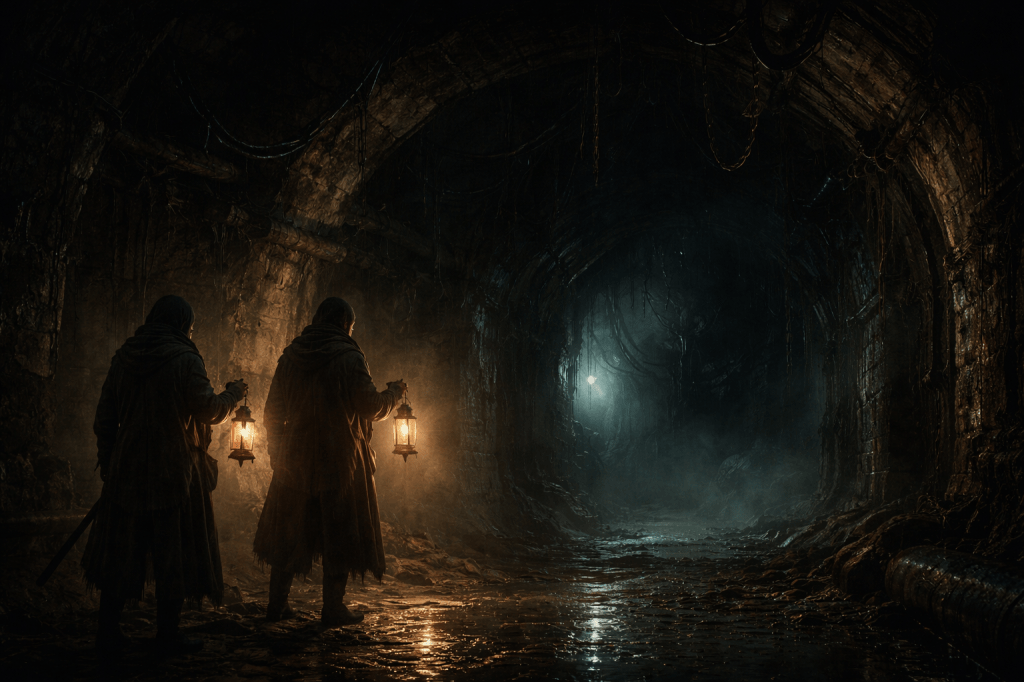
The Passage That Answered
The passage had been entered in the record as a maintenance route, one of several that lay beneath the district and carried no distinction beyond their function. It formed part of an older network that predated the present structures, its course set through stone that had been opened and closed across successive years, though no single plan held its full extent. Those who worked along its length regarded it as ordinary ground, a place where sound travelled poorly and light settled close to the source, leaving the far sections to gather in shadow without depth or clear boundary.
On the morning it was first noted, two men were assigned to inspect a section where damp had been reported along the lower walls, the matter entered as a minor concern within the broader maintenance schedule. They carried a single lamp between them and a length of chalk for marking the points where repair would be required, moving at an unhurried pace through the narrow turn that led into the passage. Their attention was given more to the condition of the stone beneath their hands than to the space ahead of them.
“It ran further than the last plan showed,” the first said after a time, his voice held low as though the walls pressed it back upon him. “The turn should have come by now.”
The second lifted the lamp and let its light fall along the length of the corridor, where the walls drew in slightly before widening again, the line continuing without interruption. “The plans seldom match the ground,” he replied. “They follow what was set when the surface above was taken. This would have been left from earlier work.”
They continued on, marking the points where the stone showed signs of strain, their chalk passing in brief strokes across the surface before they moved on. The air held steady around them, cool and close, carrying a faint weight that settled after each step and returned to its place once they had passed, as though the space retained the shape of their movement before allowing it to fall away.
“It carried differently here,” the first said, pausing near a narrowing in the wall where the stone pressed inward. He rested his hand against the surface and held it there for a moment. “The sound sits lower.”
The second glanced back. “You hear your own step in these places,” he said. “It comes back from the turns.”
The first did not answer at once. He stepped forward and struck the wall lightly with the base of his tool, listening as the sound travelled into the stone and returned in a dull, contained form that held no echo beyond its point of contact. He struck it again, closer to the narrowing, and the sound carried further along the passage before settling.
“That was not the same return,” he said.
The second man set the lamp upon a ledge in the wall and leaned in to listen, his head angled slightly as he followed the path of the sound. “It carries along the length,” he said after a moment. “The wall opens beyond this point.”
The first struck the surface once more, this time with greater force. The sound travelled ahead of them and held for a moment before falling back. Within that brief space between the strike and its return there came a second sound, softer and set further along the passage, as though something within the stone had taken up the motion and given it back again in altered form.
They remained still.
“Did you hear that?” the first said.
The second did not reply at once. He lifted the lamp and stepped forward, holding the light out so that it reached further into the passage, though it revealed nothing beyond the same narrow stretch of stone. “Strike it again,” he said.
The first man did so, placing the tool against the wall and driving it forward with a measured blow. The sound carried ahead, clear and contained, and again there followed that second return, set apart from the first and delayed by a breath, its tone altered in a way that did not follow the shape of the corridor.
“It answers,” the first said quietly.
“It returns,” the second replied, though his voice held less certainty than before.
They moved forward together, their steps slower now, their attention drawn ahead of them where the light fell short. The air shifted as they advanced, the weight within it gathering slightly and then easing again, so that each movement seemed to meet a faint resistance before passing through.
The second man raised the lamp higher. “There is a junction ahead,” he said, though the light revealed no such division. “You can hear where the space opens.”
The first listened, though he could not mark the point where the corridor changed, only that the sound ahead carried a depth that had not been present before. He struck the wall once more, this time at the height of his shoulder. The sound travelled forward and returned, followed by that second response, closer now and more clearly set within the space beyond their sight.
“It came back to meet the sound,” he said.
The second man turned slightly, his gaze moving along the walls as though he might locate the source within them. “It follows the line,” he said. “There are channels set behind these sections. The sound carries through them.”
The first stepped closer to the narrowing and placed his ear against the stone. The surface held a faint coolness that stood apart from the air, and beneath that there lay a low vibration that did not align with the movement of their steps.
“Strike it again,” he said.
The second man hesitated, then did as asked, the tool striking the wall with a firm, controlled motion. The sound travelled into the passage, and for a moment it seemed to fade as before, though instead of settling it returned in two parts. The first followed the path already known, and the second emerged with a clearer shape, as though the sound had been taken up and set again with intent.
The first man drew back from the wall. “That is no echo,” he said.
The second lifted the lamp and held it steady, his hand tightening slightly around its handle. “There is no space ahead large enough to hold such a return,” he said. “It would show in the plans.”
The first gave a small nod. “Then it does not follow the plans.”
They stood in silence for a time, the lamp flame held steady between them, its light pressed close by the walls. The air gathered around their movement and settled again, and within that settling there remained a faint impression of the second sound, as though it had not fully passed from the space.
“We will mark this section,” the second said at last, though his voice carried the tone of a decision made to conclude the matter rather than to resolve it. He took up the chalk and set a small line upon the wall where the narrowing began. “It will be entered for further inspection.”
The first watched him for a moment, then turned back to the passage ahead. “Strike it once more,” he said.
The second man did so, though with less force than before, and the sound travelled forward and returned, followed by that second response, closer still and set at a height that did not align with the strike that had preceded it.
The first man spoke then, his voice held low within the space. “Who carries there?” he said.
The words settled into the passage and moved along it, their shape breaking slightly against the stone before returning, thinner and drawn out by the distance. For a moment there came no further sound, and the air held still around them.
Then, from further along the passage, there came a reply.
It did not take the form of words, though it followed the rhythm of speech, a low shaping of sound that rose and fell within the space ahead, carrying the same pattern as the voice that had preceded it, though altered in tone and set within a narrower range, as though it had been drawn through the stone before being returned.
The second man stepped back at once, his shoulder striking the wall as he turned. “There is someone ahead,” he said.
The first did not move. He stood where he was, his gaze fixed upon the darkness beyond the reach of the lamp. “No light shows,” he said.
“It could be set beyond the turn.”
“There is no turn marked here.”
The second lifted the lamp and held it higher, though the light fell short as before. “Call again,” he said.
The first man hesitated, then spoke once more. “Who stands there?” he said.
The words travelled forward and broke against the space, returning in their first form, and then again in that altered shape. The second sound followed with a delay that held too long to belong to the length of the passage.
The reply came again, closer now and with a clearer structure, though still without form that could be understood, its pattern aligned with the call that had preceded it and set within the same measure of sound.
The second man lowered the lamp slightly. “It repeats,” he said.
The first gave a small nod. “It answers,” he replied.
They did not advance further. The passage held before them, unchanged in its form, though altered in the manner in which it carried sound. The air settled around them once more, though it did not return to the same stillness it had held before their arrival.
“We will return this to the register,” the second said, his voice steadier now that the decision had been made. “It will be marked for survey.”
The first turned at last, though his gaze lingered for a moment upon the darkness ahead. “Mark it as you will,” he said. “It remains where it stands.”
They withdrew along the passage, their steps measured and their voices held low. The sound of their movement travelled behind them, returning in its usual form, though once, before they reached the turn, there came again that second response, faint and set at a distance that did not follow their retreat.
When they emerged into the broader corridor, the air shifted at once, the weight lifting from it as the space opened around them. The sound of their steps returned to its earlier pattern, carrying no second voice beyond their own.
The section was entered within the record as a matter requiring further inspection. The description held to the language of structure, referring to irregular sound return within a confined passage and noting the possibility of unseen channels within the stone. No mention was made of the reply that followed the call, and the matter was set within the register without expansion, its condition accepted within the limits of the space in which it had been observed.
The passage remained open for a time, and those who passed along it recorded no further irregularity, though one note referred to a moment in which a tool struck the wall and the sound returned with a delay that exceeded the expected length of the corridor, a detail entered without further comment.
The section was closed again following later works carried out along the adjoining structures, and the entrance was sealed in accordance with standard practice, its location marked only within the internal plans and its condition listed as stable.
No further reference appears within the primary record.
In later accounts, drawn from separate hands and gathered after the works had passed, there are brief mentions of sound within the lower passages that followed the shape of those who entered, returning in altered form and carrying the pattern of their movement ahead of them. These entries remain unconnected within the record and are set apart from the earlier inspection, their origin left without confirmation.
The passage holds its place beneath the district, its line set within the stone as it was before it was opened, and within it the air continues to gather and settle after each disturbance, returning to its earlier state. The sound within that space does not always follow the path it is given, and where it is carried forward it may return in a form that does not belong to the strike that set it in
Foundation Register: Lower Passage Acoustic Record
The passage entered within the lower district plans appears as part of a continuous substructure extending beneath adjoining properties, its course recorded across successive revisions with minor variation in length and alignment. Earlier entries refer to the corridor in practical terms, noting its function as a service route and its condition as stable, despite signs of prior sealing at several points along its length.
During routine inspection following reports of damp within adjacent structures, the passage was reopened for assessment, and initial observations were entered without distinction, referring to surface wear, minor shifts within the stone, and the need for limited reinforcement along sections where the wall had drawn inward. These entries hold to the language of maintenance and record no condition beyond those expected within enclosed substructures of this age.
Subsequent notes record irregularities in the behaviour of sound within the corridor, where impacts against the wall were observed to return in a manner that did not align with the known dimensions of the passage. Early descriptions refer to this as extended resonance, though later entries distinguish between the initial return and a secondary response set apart from it by a measurable delay.
In several accounts, the secondary sound is described as carrying the form of the original strike while failing to match its placement within the corridor, appearing instead at a distance inconsistent with the recorded length of the space. These observations are entered cautiously, with later revisions attributing the effect to concealed channels within the stone or to variations in the structure behind the visible surface.
A number of entries refer to instances in which spoken words were followed by a return that preserved elements of the original phrasing, though altered in tone and drawn through the structure before being heard. These notes remain limited in detail and are not expanded within the primary record, with several later annotations omitting reference to vocal response entirely.
Further examination records that the behaviour appeared more pronounced within sections where the passage narrowed or where the wall showed evidence of prior disturbance, though no consistent point of origin was identified. In these areas, sound is described as holding briefly within the space before returning in two parts. The second is set apart from the first by both timing and form.
The phenomenon was attributed to structural variation within the corridor and to the presence of voids or channels set beyond the visible surface, and no further inquiry was undertaken. The passage remained open for a limited period following inspection, during which additional observations were entered in reduced form, noting irregular sound return without elaboration.
A marginal notation, written in a later hand, refers to the behaviour as “a return that follows the voice rather than the wall”, a phrase set apart from the primary entry and left without further explanation. The notation appears once and is not repeated elsewhere within the register.
Final entries indicate that the passage was sealed following completion of adjacent works, and its condition was listed as stable within the internal plans. The acoustic irregularities were recorded as resolved through closure of the space, and no further observation was entered following its sealing.
The matter was entered as concluded within the register, and the passage remains recorded as a contained structure beneath the district, its condition accepted within the limits assigned to it and requiring no further attention.
About the Creator
The Mythic Chronicle is written and curated by Simon Phillips, a writer of mythic and speculative fantasy whose work explores the quieter edges of forgotten worlds, where buried structures, fractured records, and lingering presences continue beneath the surface of recorded history.
The accounts preserved within these Chronicles form part of a wider body of work in which cities stand upon older foundations, and events recorded as isolated disturbances are understood, in later tellings, to belong to patterns that were never fully recognised at the time.
One such account survives in a separate record, detailing an incident within a lower district where a death was first dismissed as excess, though the space in which it occurred retained a presence that resisted clearing, and where investigation revealed signs that the disturbance had not been confined to a single room.
This record is preserved in the novella Black Feathers in a Brothel, where the events surrounding that incident are followed more closely, though even there the full nature of what lay beneath the structure remains uncertain.
Readers who wish to examine that account in its fuller form may find the record below.
Explore the book:
Black Feathers in a Brothel
You can watch his YouTube channel here:
Author Simon Phillips

Continuation of the Record
What follows is drawn from later entries concerning the passage beneath the district, where sound was first noted to return in irregular form during routine inspection. Initial accounts record the behaviour in practical terms and attribute it to variation within the structure, though subsequent notes refer to repeated instances in which impact and voice were returned in altered form. Each occurrence is entered briefly and left without further inquiry. In several cases, the response is described as following the shape of the sound set into the space, though no source is identified within the passage itself. Each record concludes with the condition accepted within the limits assigned to it.

Subscribe to continue reading
Subscribe to get access to the rest of this post and other subscriber-only content.
