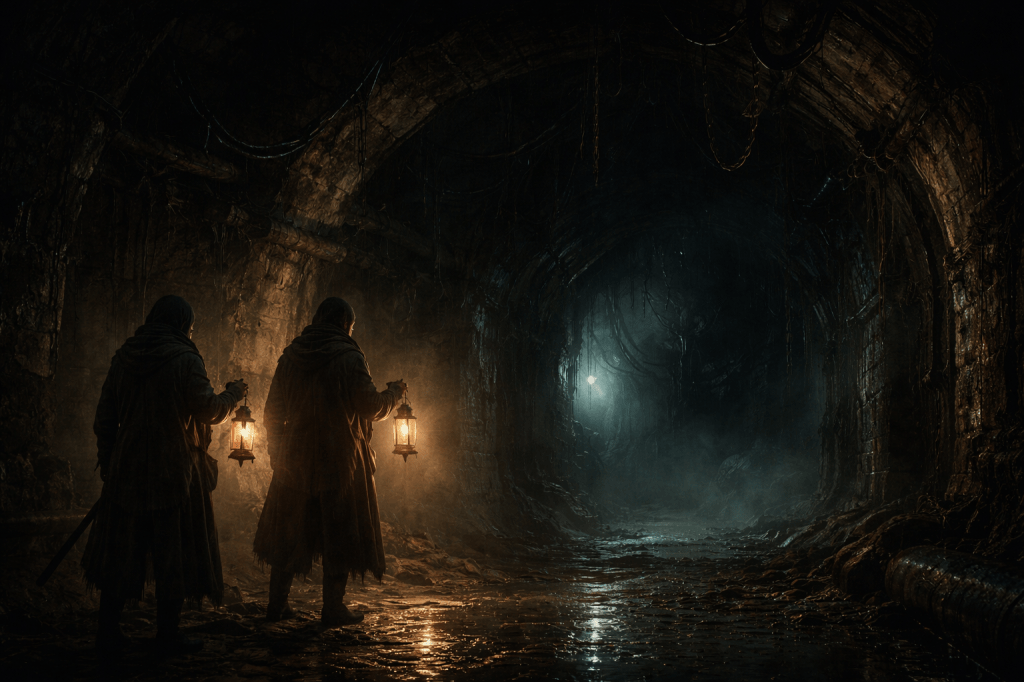
A record of the lower passages after the sounds ceased, where stillness was entered as repair, though those who walked below spoke of a quiet that listened.
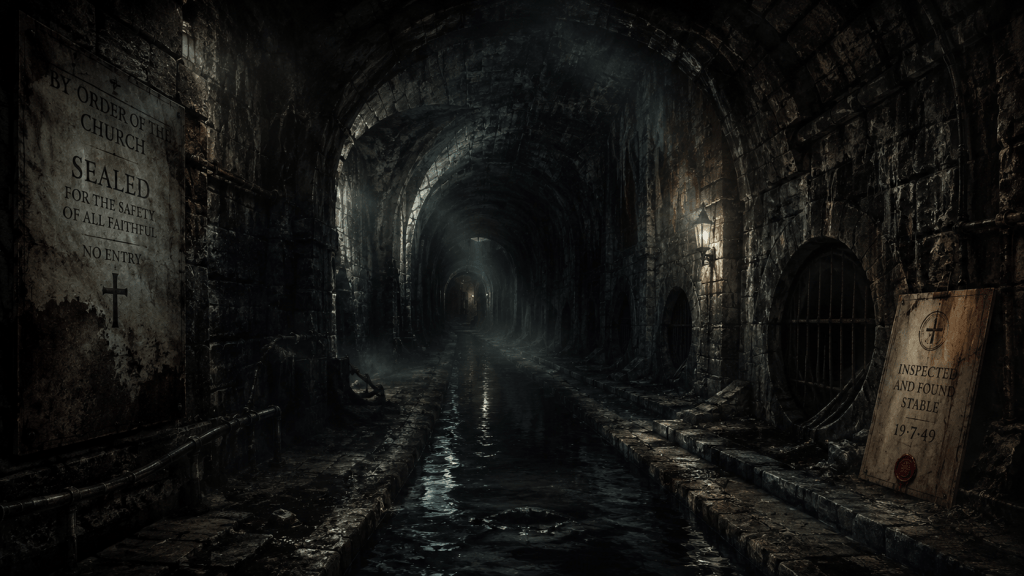
The Run That Held Its Silence
The first man to notice the silence stood below the lane before dawn, with his lamp held at waist height and one hand resting against the damp sidewall where the brickwork curved into the older drain run. His name was Oren Vale, and he had worked the lower ways long enough to know their ordinary language. Water spoke there in narrow channels. Rats scratched in the mortar. Pipes knocked behind walls when fires were lit above. Steps returned faintly from arches and bends. Even fear had a sound in those passages, thin and breathless, carried ahead of a man before it came back to him changed.
That morning, the lower run gave him nothing.
He had entered through the iron hatch beside the tallow shop, where the lane bent towards the chapel house and the paving dipped beneath repaired stone. Rain had passed in the night. The gutters still shone, and a grey smell rose from the street where old water held in shallow cracks. Behind him, the district remained half asleep. A shutter lifted somewhere above. A cart wheel turned through a pool. A dog barked once in a yard further down, then fell quiet. Those sounds belonged to the surface. They stayed there.
Oren lifted the hatch with both hands. Its hinges scraped, loud enough to draw his shoulders tight. The sound should have travelled down the stair and broken against the first bend. He waited for the dull return that always followed. It never came. The scrape fell through the opening and ended as if the dark below had closed around it.
He stood at the top of the stair and listened.
The lamp flame trembled inside its glass. Damp air rose from below, cold against his face, carrying lime, old brick, and the faint sweet taint that had begun to cling to several lower places since the rear grounds were repaired. He had smelled it before in yards where the paving had shifted and in cellars where men spoke too softly after inspection. It was thin enough to deny in daylight. Down there, in the hour before dawn, it settled on his tongue.
He descended.
The stair curved through brick laid long before the houses above had taken their present shape. Oren knew each step by use. One gave a flat knock beneath the heel. One held grit along the edge. One near the bend scraped against the sole where the surface had lifted. That morning, his boots found every place, yet the passage took each sound before it returned. His weight moved through him and into the stair. The lamp chain touched the brass rim once, a small click he felt through his fingers more than heard. The click vanished.
At the foot of the stair, the lower run opened ahead.
The covered passage stretched in a low curve beneath the joined houses. A narrow water channel cut through its centre, dark and shallow, with lamp-light drawn along its surface in a thin trembling line. Ledges ran on either side, slick with old damp. The walls carried stains from pipe mouths, lime streaks, chalk inspection marks, and darker patches where the brick showed through. Beyond the first arch, the passage bent under the buildings and disappeared into a blackness that looked too smooth, as though depth had been rubbed flat.
Oren raised the lamp.
No rat moved along the ledge. No whisker stirred near the broken mortar. No trickle came from the pipe mouths set above the channel, although beads of water clung visibly to their iron lips. One bead swelled while he watched it. It trembled beneath its own weight. Then it drew back into the pipe and left the rim bare.
His fingers tightened around the lamp handle.
The lower run had never behaved like this. Even when dry weather reduced the channels to a dark thread, something moved. Water rubbed stone. Vermin shifted. Air pulled through the outlet. A man could stand still and feel the passage working around him, old, foul, and alive with the habits of buried ground. Now the place held itself with a care that felt deliberate. The stillness lay along the walls. It gathered beneath the arches. It waited in the mouths of the pipes.
Oren drew a breath and spoke because his instructions required a spoken check before the marks were renewed.
“Lower run clear.”
The words left his mouth and ceased.
They never reached the bend. They never struck the arch. They never thinned into distance. The passage received them before they had travelled more than a few feet. For a moment, he felt the loss of them in his own chest, as though the air had taken a small part of his breath and kept it. He looked back towards the stair. The grey of the open hatch lay above him, faint and far. Morning had begun beyond it. Down here, the light seemed older.
He moved forward along the right ledge. His lamp showed the water beside him, smooth along the centre and unbroken at the edges. It had the appearance of movement arranged into stillness. The channel should have whispered where it narrowed. It should have caught against grit and leaf stems from the roofs. It should have made some small answer to the brick around it. Instead, it slid beneath the light in silence.
At the second arch, he saw the first rat.
It lay close to the wall with its head turned towards the deeper passage. Oren stopped several paces away. He expected the quick panic of a living creature, the dart into shadow, the dry claw-scrape across stone. The rat remained still. Its fur had dried into ridges along its back, and its tail curved beside it as if placed there by hand. When he stepped closer, he saw its ribs move. Slowly. Barely. Life remained in it, held so low that movement had almost left the body.
A second rat crouched further along the ledge. A third sat near the channel with its forepaws tucked beneath it. Their eyes caught the lamp and gave back small black points of light. Each faced the same direction. Each looked towards the lower bend under the houses.
Oren stepped over the first animal. His boot passed close to its tail. The rat gave no sign that it had sensed him. One ear twitched after he had already gone by, aimed towards the darkness ahead.
The silence thickened with each pace. It pressed close against the wall, soft and steady, like cloth laid over a mouth. His sleeve brushed brick. He felt the scrape through the fabric, yet heard nothing. A loose piece of lime flaked under his shoulder and fell somewhere near his boot. It made no sound when it struck. The passage had become skilled at taking sound from whatever touched it.
At the bend beneath the third house, the chalk marks ended.
The final mark had been set crookedly above a fresh patch of lime. A seam ran below it, thin as a thread, descending from the repaired brick towards the water. The mark held no wet shine, though it looked darker than the wall around it. Its edges seemed too clean for damp. Oren lowered the lamp until the glass nearly touched the surface. The darkness within the seam stayed flat under the light.
He reached for the chalk in his pouch.
His fingers found the piece worn down from earlier work. He pressed it beside the old mark. The chalk touched the wall, snapped, and fell. A white fragment dropped to the ledge and settled beside his boot in silence.
Oren stared at it.
He had heard men curse in these passages when rats crossed their feet. He had heard prayer muttered into sleeves by men who denied it when they returned above. He had heard floods roar through the lower runs in winter until the hatch covers shook in the street. This quiet belonged to none of those things. It had weight. It had patience. It seemed to know the shape of every sound before the sound formed.
Something changed ahead.
No noise came from the depth. No reply followed. The change passed through the silence itself. It drew nearer along the covered run, slow and measured, until the space around Oren felt watched. The rats remained fixed towards the bend. The water held its dark, smooth face. The lamp flame narrowed inside the glass and turned blue at its root for one breath before it returned to amber.
Oren stepped back.
The silence came with him.
He knew then, in the body first, before thought gave it form. The lower ways had ceased sounding because something within them had learned stillness. The scratching had ended. The pipe knocks had ended. The answering walls, the shifting ground, the faint breath under stone, all of it had fallen away into a quiet chosen for itself. Above him, men would welcome such a change. Sleep would return to the houses. Priests would write of settled ground. Masons would sign the lower runs as stable where the walls held and the water passed. In the old covered passage, beneath brick, lime, and joined floors, the silence had gathered into presence.
He withdrew without turning his back. He passed the motionless rats. He passed the suspended mouths of pipes. He kept the lamp raised before him, though its light seemed to reach less far with every step. Near the first arch, his heel struck loose grit, and for the first time since he entered, a faint sound touched the passage. It came thin and distant, like an answer remembered from a place already closed.
At the stair, the air shifted. The silence thinned, although it never fully released him. Each step upward gave a small dull note beneath his boots. By the time his hand reached the iron rim of the hatch, dawn had opened across the lane. The first smoke rose from the rear stacks. A boy crossed the street with kindling under one arm. Somewhere nearby, water poured from a bucket and struck stone with an ordinary splash.
Oren climbed out and lowered the hatch with both hands. The iron scraped. The cover settled into place with a heavy ring that spread across the lane and faded into morning.
He stood above it for some time.
The sound should have comforted him. It belonged to the world he knew, to streets, labour, hinges, weight, and metal. Yet beneath the frame, under the brick stair and the covered passage, the silence remained. It had taken the depth back into itself. It had accepted the closed hatch, the lime marks, the sleeping houses, and the renewed noise of morning above. It waited below them all, quiet enough to be mistaken for peace, patient enough to be entered as repair.
Foundation Register: Lower Passage Silence Record
The lower passage entered within the adjoining district plans appears as part of an older drainage and service network extending beneath several joined properties, with its course recorded in fragments across successive revisions. Surviving plans describe the run in practical terms, listing a covered channel, side ledges, pipe mouths, stair access, and several points of prior sealing where the older brickwork passed beneath later foundations. Earlier entries refer to routine water movement, vermin passage, and irregular sound return within the lower arches, all of which were accepted as expected conditions within enclosed structures of this age and depth.
During inspection following disturbances in the rear service grounds and lower washing rooms, the passage was entered for assessment, and early observations were recorded in the language of stabilisation, referring to recent lime work, cleared drainage, renewed hatch closures, and the absence of fresh movement within the walls. These entries describe the lower run as calm following repeated repair, with no further settling noted in the visible brickwork, no widening recorded around the pipe mouths, and no renewed displacement in the channel stones beneath the adjoining houses.
Subsequent notes describe a marked alteration in the behaviour of sound within the passage, where ordinary movement failed to return from the arches and bends in the expected manner. Early descriptions refer to muffled acoustics caused by damp, recent sealing, and altered airflow after repair works. Later entries distinguish the condition from common deadening within enclosed drains, recording that steps, tool contact, pipe vibration, and spoken checks appeared to lose return within the lower run, even where the visible dimensions of the passage remained unchanged.
In several accounts, the quiet is described as extending beyond the absence of noise. The lower passage is recorded as holding stillness evenly along the channel, ledges, and pipe mouths, with water present in the run yet giving little sign of motion through sound. Pipe mouths that had previously knocked or drawn air after use are entered as silent during inspection, and several notes refer to suspended water along the iron lips of lower outlets, though these details are reduced in later copies to ordinary drainage delay after recent works.
A number of entries refer to animal behaviour within the passage during the same period. Rats that had earlier been recorded moving in repeated lines through cellars and walls were found gathered along ledges and lower bends, facing deeper sections of the run while showing little response to approach or light. These observations are entered cautiously and assigned to exhaustion, poison, blocked routes, or disturbance caused by sealing works. The repeated direction of their attention towards lower bends beneath the adjoining properties is preserved in one early copy, though later summaries omit the detail and retain only a reference to reduced vermin activity following repair.
Further examination records that the silence appeared strongest near the sections where older seams had been lime-washed after recent disturbance. In these areas, chalk marks set upon the walls are described as failing to produce ordinary contact sound, while loose fragments falling from the surface are entered as settling without audible strike. The condition was attributed to heavy damp within the brick, softened mortar, and the muting effect of fresh lime applied across older openings.
Several observations refer to the passage as feeling sealed even while access remained open. Inspectors describe the air as still, the channel as smooth, and the lower bends as withholding return from voice and step. These notes remain limited in detail and are set beside practical explanations concerning blocked outlets, poor ventilation, and the closing of secondary routes beneath the district. No single cause is assigned across the surviving copies, and each entry preserves the matter within the accepted terms of maintenance.
A marginal notation, written in a later hand beside one copy of the lower inspection sheet, refers to the condition as “a silence present within the run, as if the depth had learned to keep what entered it.” The phrase appears once and is absent from the prepared register summary. No supporting explanation accompanies it, and the hand that added it does not appear elsewhere in the surviving lower passage records.
Final entries indicate that the affected sections were checked, sealed where access was judged unnecessary, and listed as stable within the district plans. The absence of sound, movement, and further response was accepted as evidence that earlier disturbances had settled after reinforcement of the surrounding ground. The lower passage remained within the maintenance register as a contained drainage structure beneath the adjoining houses, its condition entered as resolved within the limits assigned to it.
The matter was closed through inspection and repair, leaving the lower run recorded as stable, serviceable, and quiet beneath the streets.
About the Creator
The Mythic Chronicle is written and curated by Simon Phillips, a writer of mythic and speculative fantasy whose work explores the quieter edges of forgotten worlds, where buried structures, fractured records, and lingering presences continue beneath the surface of recorded history.
The accounts preserved within these Chronicles form part of a wider body of work in which cities stand upon older foundations, and events recorded as isolated disturbances are understood, in later tellings, to belong to patterns that were never fully recognised at the time.
One such account survives in a separate record, detailing an incident within a lower district where a death was first dismissed as excess, though the space in which it occurred retained a presence that resisted clearing, and where investigation revealed signs that the disturbance had not been confined to a single room.
This record is preserved in the novella Black Feathers in a Brothel, where the events surrounding that incident are followed more closely, though even there the full nature of what lay beneath the structure remains uncertain.
Readers who wish to examine that account in its fuller form may find the record below.
Black Feathers in a Brothel
You can watch his YouTube channel here:
Author Simon Phillips

Chronicle Record: The Silence Beneath the Streets
They entered the lower passages three days after the lamplighter’s account was taken, carrying rods, chalk, a coil of cord, two shuttered lamps, and the manner of people sent to confirm what the rooms above already wished to believe. The rain had ceased by then, although the district still held the wetness of it in wall, gutter, and paving seam. Water slid from roof channels into the rear drains. It gathered in old hollows beside the covered stair mouths. The streets had begun to sound ordinary again. Carts rolled over the lanes. Doors opened at dawn. Women poured wash water through back thresholds. Men crossed the yards with less care than before, glad that the ground had ceased shifting beneath them and that the walls had grown still.
Below the street, that stillness waited.
Nial Varr led the inspection because his hand remained steady in tight places and his records pleased men who favoured firm endings. He wore a dark coat waxed against damp, with a leather tube of plans tied across his back and a measuring hook at his belt. Behind him came Tessa Harl, who read stone by touch more cleanly than most men read ledgers, and beneath her lamp the lower walls revealed more age than the plans allowed. Last came Brother Calven from the chapel house, sent to observe and say little, though the white thread at his cuff had already taken on a grey stain from the hatch rim before he reached the first stair.
The municipal clerk remained above. He had settled beside the open hatch with ink, boards, and two men from the watch, ready to receive the findings once the passage had been walked. His voice came down thinly as Nial placed one boot on the first step.
“Call back at each turn.”
Nial lifted his lamp and glanced along the stair. “We will mark each section.”
The reply should have returned to the clerk. It faded halfway up the shaft.
Tessa looked at him, then towards the brick around them. The stair took the small shift of her boots and gave no answer. Calven made the sign of his office so subtly that the motion scarcely touched the air. He lowered his hand when Nial saw it.
“The lower way has been sealed along several side routes,” Nial said. “Dead air follows such work.”
Tessa gave a small nod, accepting the words as a surface laid across something deeper. She had heard dead air before. It carried trapped warmth, stale breath, and the sour trace of human presence left too long in stone. This silence held a cleaner edge. It seemed prepared for them.
They descended in single file. At the foot of the stair, the covered run opened in the same low curve recorded on the district plan, though ink had made the route appear obedient and simple. The real passage bent beneath houses that had leaned into one another over generations. It passed under rear rooms, storage spaces, wash floors, and the narrow yards where recent repair had covered more than it corrected. A shallow channel carried water along the centre. Its surface moved in a dark line through the lamp glow. It gave no voice.
Nial set the first chalk mark beside the stair mouth. The white line took cleanly. He tapped the wall beside it with the measuring hook, a small test he had performed in every lower space since boyhood. The metal touched brick and stopped there. No click returned from the passage.
Tessa crouched beside the channel and lowered one hand until her fingers hovered above the water. “It runs,” she said.
“I can see that.”
“It gives no edge against the stone.”
Nial looked down. The current carried a thin scrap of straw from the stair mouth, drawing it along the channel towards the first bend. The straw turned slowly and passed beyond the light. The water moved. Its silence remained whole.
Calven spoke from behind them. “The channel may be deeper than marked.”
“The channel is shallow,” Tessa answered. “The sound has gone elsewhere.”
Nial turned his head enough to warn her against choosing words that would travel upward poorly. The look held little force down there. Nothing travelled upward well in that place.
They advanced towards the second arch. The ledges on either side bore traces of former movement. Rat droppings lay in old clusters near the wall. Scratches marked the damp grit where claws had passed in steady routes. Pale lime had been brushed along seams where brick met older stone. All of it showed use, disturbance, repair, return. Yet the passage held as though emptied a moment before their arrival and arranged for inspection.
At the arch, they found the rats.
Seven of them lined the right ledge, each turned towards the same deeper bend. Their bodies were alive, though stillness sat over them so completely that the sight seemed wrong before its cause could be named. One rat breathed with its flank pressed against a lime streak. Another had placed its forepaws upon the edge of the channel, its whiskers held above the water. A third stared into the dark with eyes that reflected the lamp in two hard points.
Tessa lifted the hem of her coat clear of the ledge and stepped around them. “They have stayed where they were found.”
“Poison can slow them,” Nial said.
“Poison does strange work,” she replied. “It seldom turns every head the same way.”
Calven remained a pace behind the animals. His gaze had moved past them towards the bend. “They listen.”
Nial drew breath to correct him. The passage took the breath before he shaped it.
They reached the first side run after thirty paces. The opening had been sealed with fresh brick and lime, its new surface pale against the older wall. Tessa raised her lamp and studied the mortar. The upper edge had dried cleanly. The lower edge held a faint dark seam where moisture had gathered, yet no drip formed beneath it. Nial set the measuring hook against the centre and tapped once. The contact trembled through his wrist. No sound reached his ear.
“Mark it stable,” he said.
Tessa wrote the mark beside the seal. Her chalk moved with a soft drag that she felt in her fingers. It made no scrape. When she lifted her hand, the white line seemed too bright in the lamplight, sharp against the still wall.
From the depth ahead came a change.
It carried no noise. The lamps revealed no movement. The water continued its smooth passage along the channel. Even so, all three turned in the same instant, as if a hand had passed close to the face. The silence had altered shape around them. It seemed to draw back from the sealed side run and gather along the main passage, leaving a colder space at their shoulders.
Nial lifted his lamp. “Forward.”
They walked beneath the adjoining houses, crossing below floors that should have carried the early work of the district. Somewhere above, a kitchen would have opened. A bucket would have dragged to a rear tap. A child would have run across boards too thin to keep secrets from the lower walls. None of it came through. The houses above might have been empty, or the passage had refused to receive them.
At the next bend, the walls lowered. Nial inclined his head, and Calven’s shoulder brushed the brick beside him. The contact should have rasped. It passed in silence. The brother flinched from the lack of sound more sharply than he might have flinched from noise.
Tessa halted beneath a shallow arch where three pipe mouths entered the wall above the channel. Each held a bead of water at its lip. Each bead swelled, bright in the lamp, and stayed there.
“Open the upper tap,” she called towards the hatch, raising her voice as much as the passage allowed.
Her words died around them.
Nial looked back along the way they had come. The stair mouth lay out of sight beyond two bends. The clerk above would hear none of this. Tessa watched the pipe mouths. After a long interval, a tremor moved through the leftmost pipe. The bead lengthened. It should have fallen. Instead, it drew inward and vanished.
Calven whispered a prayer.
The prayer vanished more quickly than Tessa’s call.
He closed his mouth and seemed to taste the loss of the words. His face had grown pale beneath the lamp glow. “This place takes speech first,” he said.
Nial rounded on him. “It takes sound where the structure has been altered. Keep to what can be entered.”
Calven met his eyes. “Then enter that.”
The answer unsettled Nial because it carried no challenge, only a tired certainty. He turned back to the passage and set another chalk mark beside the pipes. His hand had begun to ache from holding the lamp too tightly.
They reached the lower junction near the old outlet before the hour had fully lifted above. Three runs met there, one from the rear houses, one from the chapel-side channel, and one older way that angled beneath the street and had been marked for permanent closure after repeated settlement reports. The junction should have been the loudest part of the lower network. Water from each run met in a central trough before passing onward beneath an arched gate. Even in calm weather, it usually muttered, knocked, and pulled at the iron grill with a low hunger.
The trough lay silent.
Water entered from three mouths. It joined in the centre. It moved through the grill. No ripple struck stone with audible force. No current hissed between the iron teeth. The lamps showed motion everywhere, and the ear received a vacancy so complete that Tessa felt her balance shift. She reached for the wall. Her palm met damp brick. The brick felt warm.
“Nial,” she said.
He had already seen the far wall.
Chalk marks from prior crews covered the brick in small pale strokes. Some indicated depth. Some marked repairs. Some crossed older lines where measurements had been corrected. Between them, a darker shape had begun to form, visible only because the lime around it had dried unevenly. It curved across the wall in a long shallow arc, then broke into several thin branches that ran down towards the trough. It resembled water staining until the lamp shifted. Then it looked like a pattern withdrawing into the brick.
Calven moved closer. “Leave it.”
Tessa glanced at him. “You know this sign?”
“I know the cost of granting signs too much attention.”
Nial set his jaw. “We record the wall condition. We touch nothing else.”
He opened the leather tube and drew out the marked plan, holding it near the lamp. The junction on the plan was smaller, straighter, and entirely obedient to its ink. He looked from page to wall, from wall to trough, and the quiet around them deepened as if the passage had leaned closer to read with him.
A small stone loosened from the arch above and fell into the water.
All three saw the splash. None heard it.
The ring spread across the trough in perfect silence. It reached the iron grill, broke against the bars, and passed onward into the outlet. The rats along the far ledge stirred for the first time. One lifted its head. Another opened its mouth in what might have been a squeal, though no sound came. Then they settled again, every body turned towards the sealed older way.
Nial closed the plan. “We leave.”
Tessa lowered her lamp. “The junction needs marking.”
“It has been marked enough.”
His voice ended quickly, taken by the lower air, yet the decision had been made. He led them back the way they had come. The silence followed with such perfect closeness that Tessa began counting her steps inside her mouth, needing some private measure the passage could have no claim upon. At twenty-seven, she lost the count because she became aware that Calven had fallen behind.
She turned.
The brother stood beneath the pipe mouths with his head angled towards the sealed side run. His lamp hung low in his hand. The water beads above him had returned to the iron lips, each held round and bright. His face carried the expression of a man listening to confession through a wall.
“Brother,” Nial called.
Calven stirred, though he kept his gaze on the seal. “It is quietest behind here.”
“That route has been closed.”
“Yes,” Calven said. “That is why it hears so clearly.”
Tessa went back for him. She took his sleeve, and he allowed himself to be guided away. As they moved, the sealed brick behind him darkened across one lower edge, a line so thin it could have passed for damp. It spread for the length of a finger, then stopped.
They reached the stair with relief that none of them wished to show. Sound returned there in fragments. Boots touched brick. Cloth shifted. Breath gained a faint place in the air. By the final steps, the district above had begun its full morning, and the clerk’s voice came down sharply through the open hatch.
“Well?”
Nial emerged first. He stood in the lane with water shining on his boots and the plan tube held tight under one arm. Tessa came after him, then Calven, who turned before the hatch was lowered and looked once more into the stair shaft.
The clerk dipped his pen. “Condition?”
Nial looked towards the houses, then towards the repaired paving, then towards the dark iron square at his feet. The street sounded ordinary around him. That ordinariness pressed harder than the silence below.
“Stable,” he said.
The clerk wrote the word. “Access required?”
Nial paused.
Tessa watched him. Calven kept his eyes on the hatch.
“Limited,” Nial said. “Seal the unnecessary runs. Leave the main channel under schedule watch.”
The clerk wrote again, satisfied by language that carried shape, order, and closure. The watchmen lowered the hatch. Iron met frame. This time the sound rang clearly across the lane.
For a few breaths, everyone above seemed eased by it.
Below them, beneath the stair, behind the sealed side runs and the old junction where water moved through its trough in perfect quiet, the silence received the closing sound and kept its answer to itself.
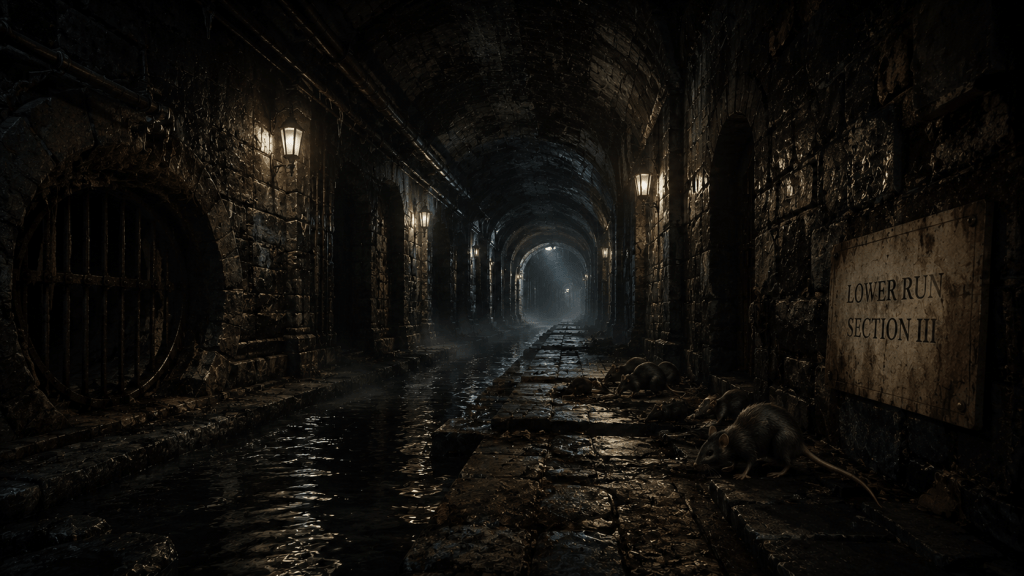
A lower run beneath the adjoining houses, entered after the sounds had ceased, where rats held still along the ledges and the water moved through the channel without giving back its voice.
The Idea Behind the Chronicle
The lower passages beneath old districts carried a different kind of memory from the rooms and yards above them. Streets gathered voices, trade, argument, prayer, wheels, and weather, while the covered runs below received what passed through the city after use. Water, ash, blood, grease, lime, waste, roof rain, and the small debris of daily life moved through those channels and left faint traces along brick, pipe, and stone. Such places were built for function, then forgotten until some failure drew men down with lamps and rods. Their purpose seemed plain, though their courses often passed through older foundations whose full shape had slipped beyond the plans that claimed to contain them.
Sound belonged to those lower ways as surely as water. A step returned from a bend. A pipe knocked when pressure shifted above. Rats scratched along ledges and vanished into seams. A dropped tool rang differently where brick gave way to older stone. Men who worked in such passages learned to read the space through these returns, trusting sound where light failed. The lower structures announced themselves through echo, trickle, scrape, drip, and hollow response. Even fear had a place there, carried through the passage and altered by the walls before it reached the one who had spoken.
This Chronicle grew from the moment when those ordinary returns ceased. Earlier disturbances in the series had been marked by movement, breath, pressure, scratching, answering stone, and matter rising through rooms and yards. Here the sign became absence. Water still moved, yet gave no sound. Rats remained alive, yet held their position along the ledges. Footsteps touched brick, yet failed to return from the arches. Speech entered the passage and vanished before it reached the bend. The silence itself became the event, heavier than calm, more deliberate than settlement, and too complete to sit comfortably within the language of repair.
Official records often treat quiet as proof that a disturbance has passed. Where sound ceases after repeated works, the conclusion leans towards stabilisation. The pipe no longer knocks because the pressure has eased. The wall no longer answers because the seam has been sealed. The rats no longer move because the routes have closed. Such explanations allow the district to resume its life above ground, with hatches lowered, lime set, and the old runs entered as serviceable. In this article, that same habit becomes the danger. The quiet is accepted as resolution because nothing rises loudly enough to challenge the record.
The silence beneath the streets also allowed the final Chronicle of the cycle to draw the earlier accounts inward. The sealed stair, the rat lines, the retained air, the marked wall, the answering passage, the breathing yard, and the altered basin all left their pressure upon the lower district. Each disturbance had produced a sign that could be seen, heard, touched, or entered into a register. The final stage moved beyond such obvious signs. The lower structures seemed to learn from disturbance and retreat into a state that offered little for the surface world to record. Absence became a form of concealment.
What remains within the Chronicle is the unease of a system that has grown quiet after being repeatedly approached. The covered passages are checked, marked, and sealed where access appears unnecessary. The main channel remains under watch. The clerk receives the word stable. The hatch closes with a sound that comforts those above. Yet the deeper space keeps its own answer beneath that sound. It has ceased to announce itself through movement, echo, or breath, and in doing so it becomes harder to accuse, harder to map, and easier to leave in place.
In this way, the silence completes the pattern of The Whispering Foundations without resolving it. The city above returns to ordinary labour, while the old passages beneath it remain present in a quieter form. The Chronicle preserves only what was noticed from the edge: water without voice, animals facing the dark, chalk breaking without sound, and inspectors choosing the safest word available to them. The truth remains elsewhere, beneath the houses and chapels, held below the streets in a stillness that looks like peace from above.
From the Author’s Desk
Thank you for continuing further into this Chronicle.
This final account turned away from movement and towards the absence left after movement ceased. Earlier entries followed sound within stone, rats moving through hidden lines, rooms retaining presence, markings beneath plaster, passages that answered, ground that breathed, and water that held a shape around what should have passed away. Here, the sign became quieter. The lower world no longer announced itself through pressure, scratching, shifting stone, or returning sound. It withdrew into silence.
What drew me to this Chronicle was the idea that quiet can be misread as safety. In ordinary records, a passage that stops knocking, a pipe that stops answering, or a wall that stops shifting can easily become proof of repair. Silence suits official language because it gives the appearance of conclusion. Nothing calls out. Nothing moves in sight. Nothing forces itself into the upper rooms. The disturbance can be entered as settled, even when the stillness below feels more deliberate than peaceful.
I also wanted this Chronicle to close the cycle by changing the nature of the threat. Through the earlier accounts, the buried structure revealed itself by reacting to disturbance. It answered touch, sound, weight, blood, water, and presence. In this account, the lower passages seem to have learned something from all that attention. They offer less to witnesses. They withhold their response. They become harder to describe because absence leaves fewer marks than movement.
That made the lower drainage runs the right place for this ending. These passages exist beneath daily life, carrying what the surface wants removed. They are practical, ugly, necessary spaces, built to be entered only when something fails. By setting the final Chronicle there, the series returns to the hidden structures that have shaped every disturbance so far, while allowing the visible district to believe the matter has passed into repair.
As with the earlier Chronicles, the record remains incomplete by design. The witnesses see enough to be unsettled, yet their accounts are softened by the language of maintenance, inspection, and closure. The deeper truth stays outside the Chronicle’s reach. That distance matters. The Chronicle preserves the myth, the rumour, and the surviving fragment. The full experience belongs elsewhere.
This cycle was always meant to feel like a pattern recognised too late. Each account offered one sign, one room, one passage, one surface, one basin, one silence. Together, they suggest a buried condition moving beneath the district, shaping itself through structures the people above still believe they understand. The final quiet beneath the streets is not an end. It is the point at which the world mistakes waiting for peace.
These Chronicles continue to sit beside a wider body of work set within the same world, where such disturbances are encountered at closer range and with a different kind of cost. The connection remains indirect, and that distance matters to the form. The Chronicle keeps the rumour, the fragment, and the surviving record. The fuller truth lives elsewhere beneath it.
You can explore my books here:
Books by Simon Phillips
You can watch my YouTube channel here:
Author Simon Phillips
Archive & Interpretations
Fragment from the Archive
From the lower district maintenance folios, compiled from drainage records, hatch inspections, lamplighter testimony, pipe reports, vermin notes, and later annotations gathered after the lower passages were entered as stable. The script varies between clerk hands, survey marks, and smaller additions written along the margins, suggesting that several accounts were arranged together once the hatches had been lowered and the closed runs marked within the district plans.
Initial references to the lower passages appear within routine drainage entries, where the covered runs are described in practical terms as service channels beneath adjoining houses, used for roof water, wash flow, yard drainage, and the movement of waste from rear rooms into older underground lines. These notes refer to brick arches, side ledges, pipe mouths, lime-washed seams, and several sealed side routes where earlier structures had passed beneath later foundations.
A later entry, written in a compressed hand, records that sound within one lower run failed to return from the arches after repair works had been completed. The writer places the observation beside references to fresh lime, altered airflow, damp brick, closed outlets, and recent sealing, though the same hand adds that steps, pipe movement, and spoken checks were taken by the passage before reaching the first bend.
Subsequent entries describe water moving through the central channel with little audible sign, despite visible current under lamplight. Early copies assign this quiet to shallow flow, blocked side routes, and softened mortar along the channel edges. Later summaries reduce the detail to ordinary deadening within enclosed drains after repair.
Further notes record that rats were found along the ledges in several sections, alive yet motionless, all facing the deeper bends beneath the adjoining properties. One account states that the animals failed to scatter when approached and that their attention remained fixed towards a sealed lower way. The language remains cautious and continues to frame the matter through poison, exhaustion, disturbed nesting, and closure of former routes.
One entry, set apart from the main sequence and written with heavier pressure, records that a bead of water formed at an iron pipe mouth, held there while inspection continued, then drew back into the pipe before falling. The same entry refers to three pipe mouths behaving in similar fashion, though later copies omit the detail and preserve only a general note concerning poor drainage after lime work.
The final entries concerning the lower run refer to hatch closure, renewed marking of stable sections, clearing of visible channel obstructions, and sealing of side routes judged unnecessary for service. The condition is listed as settled following repair, with the silence entered as evidence that earlier disturbances had ceased. Earlier references to speech failing to return, rats facing the depth, water without voice, and suspended drops at the pipe mouths are absent from the concluding copy and remain dispersed across the folio without formal connection.
Marginal Notes & Interpretations
Collected from later annotations added to the same maintenance folio, appearing in varied script, pressure, and ink tone.
One annotation attributes the loss of sound to recent closure works within the side routes, arguing that fresh lime, softened brick, damp air, and blocked outlets could deaden ordinary echo within a lower drainage passage. The writer keeps the explanation within known conditions of maintenance, repair, airflow, and enclosed ground.
A second note questions this account, observing that muffled echo cannot easily explain the loss of contact sound from chalk, falling lime, pipe mouths, water movement, and spoken checks across several separate sections. The writer remarks that the passage appeared to take sound before it travelled, and adds that the quiet was strongest near sealed routes.
A third annotation, faint and written along the inner fold, refers to the lower run as “a throat closed around its own breath” and suggests that the silence may have followed earlier disturbances through the hidden lines beneath the district. The entry breaks before completion, and the remaining words have been lost beneath a water stain.
World Notes
Lower Passage Runs
Covered drainage and service passages beneath adjoining houses, yards, and chapel-side structures. These routes carry water, waste, seepage, and household flow through older brickwork and stone channels, often passing through foundations whose original purpose has faded from current plans.
Sealed Side Routes
Closed branches within the lower network, usually bricked or lime-washed during repair after settlement, damp, vermin movement, or structural concern. Such closures are entered as practical maintenance, though several records preserve unease around routes that seemed quieter after sealing than before.
Silent Water Record
Recorded instances in which visible water movement within lower channels produced little or no sound. Such behaviour is usually assigned to shallow flow, softened brick, blocked outlets, or altered drainage, leaving the absence itself preserved within repair language rather than resolved cause.
Next Chronicle
This Chronicle brings The Whispering Foundations cycle to its close.
The accounts concerning the lower passages end with silence entered as stability, the hatches lowered, the side routes sealed, and the district allowed to return to ordinary life above ground. No further Chronicle in this sequence follows the lower runs beneath the adjoining houses, though several later copies preserve scattered references to continued quiet beneath the streets, especially in places where water moved without voice and old brick held its seams too cleanly after repair.
The record closes where the district itself chose to close the matter. Movement had ceased. The rats had withdrawn or stilled. The pipes gave no answer. Footsteps returned only where the stair rose towards daylight. In the language of maintenance, such details allowed conclusion. In the older margins, they carried a different weight, suggesting that the lower structures had not emptied, but had learned to wait without sound.
The next cycle of The Mythic Chronicle will open elsewhere, with another recovered fragment drawn from a world shaped by memory, distortion, and the truths that survive only in broken record.
End of Cycle: The Whispering Foundations
The lower passages were returned to the register beneath the adjoining houses, their hatches lowered, their side routes sealed, and their condition entered within the terms assigned to them, while the notes gathered from lamp, chalk, pipe, water, and ledge were drawn back into the language of drainage, repair, and settled ground. Above them, the streets resumed their ordinary sound of carts, shutters, footsteps, and morning labour, and the houses carried on with the quiet confidence of structures accepted as whole, leaving the covered runs beneath them to pass once more into use, oversight, and neglect.
Beneath that restored order, the silence remained where it had gathered, held within brick, lime, water, and the older lines below the street. The passages gave no answer to the rooms above, though water still moved through them, and those who crossed the lanes in the early hours sometimes felt the sound of their own steps fall strangely short, as though the depth beneath the paving had kept itself close, listening in perfect stillness, waiting where absence had been mistaken for peace.
Beneath it, the lower run remained where it had long endured, carrying water through stone and darkness below the rooms above. The basin resumed its stillness, though the wall kept its faint line after wet nights, and those who worked there in the early hours sometimes paused before opening the tap without knowing why. The water cleared when watched, darkened when used, and passed below the stone as it always had, while somewhere beneath the floor the hidden passage held its silence, keeping the shape of the feather long after the surface had emptied.