An account of water darkened by ordinary injury, and of the pale lines that gathered around a feather where no bird had entered.
The Water That Held the Feather
The basin stood beneath the lower tap where the back room narrowed beside the wall. Its rim had been worn pale by hands, cloth, and years of use, with one side smoothed by labour and the other chipped where buckets had struck it in careless hours. The room had been made for work, with a low ceiling darkened by lamp smoke, a floor sloping towards the drain channel, and shelves crowded with cracked jars, folded rags, lye cakes, dull knives, torn linen, and the quiet tools by which a house removed the signs of ordinary injury before morning. A lantern burned on the rear shelf beneath smoked glass. Its amber light reached the damp walls in narrow bands, showing blisters in the plaster and the older masonry showing through beneath.
Rain had passed through the district earlier that evening, leaving the yard slick beneath the eaves and drawing the smell of wet soil up through the loose stones near the rear threshold. Water gathered in shallow hollows along the flagged passage. It carried sour traces of ash, spilled ale, candle grease, and the iron scent that came from cloth washed too late after blood had settled into the weave. The houses joined one another closely there, wall against wall, roof leaning into roof, with gutters emptying into the same narrow runnels. Sounds travelled between them in softened form, passing through timber, plaster, and the tired hour after midnight.
Edrane Voss had been awake since before dawn, and by the time she brought the basin under the tap her shoulders ached from carrying water up and down the rear stair. She worked in the lower room because the mistress preferred the visible chambers kept clean of such tasks, and because the back room had always received what the upper floors wished to forget before daylight. There had been a fight in the passage after supper, one dock boy striking another with a cup after words passed too close to pride. The wounds carried little mortal concern, yet blood had marked sleeve, collar, knuckle, and the corner of the stair where one of them had fallen against the rail.
Such matters belonged to the district as surely as rain belonged to the gutters. Men came with coin and anger. Women came with painted mouths and tired eyes. Clerks came carrying secrets beneath their coats, while boys ran errands between doors they were too young to understand. By night’s end, someone always brought down a cloth darkened by work, pleasure, sickness, birth, beating, or grief, and the basin received each of them in turn. It had a memory no one cared to name, though its stone had taken colour in places where scrubbing failed to reach. Its drain gave a faint breath from below whenever rain filled the channels under the street.
Edrane set the first bundle into the basin and turned the tap. Water came reluctantly, stuttering through the pipe before falling in a clear line that struck the folded cloth and spread through the blood drying along its edge. She pressed both hands into the water and worked the stain loose with slow, practised force while the lantern flame trembled behind her. The water reddened, first in cloudy ribbons, then more fully, as the cloth surrendered what it had held. She added a shaving of lye, rubbed the linen against itself, and watched the surface gather a dull, bruised colour beneath the light.
Above her, boards creaked under the movement of late customers and women crossing between rooms. A laugh travelled down through the ceiling, broke halfway through, and faded into the general murmur of the house. Somewhere behind the wall, beyond the plaster near the drain, a small scratching sound moved once and ceased. Edrane paused with her hands still in the basin. She listened through the drip of the tap and the shallow movement of water against stone. Rats had troubled the lower rooms in previous weeks, slipping along unseen places with a strange order that unsettled even the older servants, although traps laid under the shelves had remained empty since the yard shifted after the last disturbance.
The sound came again, softer this time, as though something brushed the inner face of the wall with patient care. Edrane turned her head towards the plaster beside the tap. A line ran there, thin as thread, from the lower edge of a repaired patch to the dark seam where basin stone met masonry. She had seen it before. Everyone who worked the room had seen it. The repairman had said the wall breathed damp, and damp always found its own path, especially in houses built over older ground. He had scraped, sealed, and rubbed lime into the mark until it vanished beneath his hand. After each wet night, the line returned in the same place, pale against the surrounding dirt.
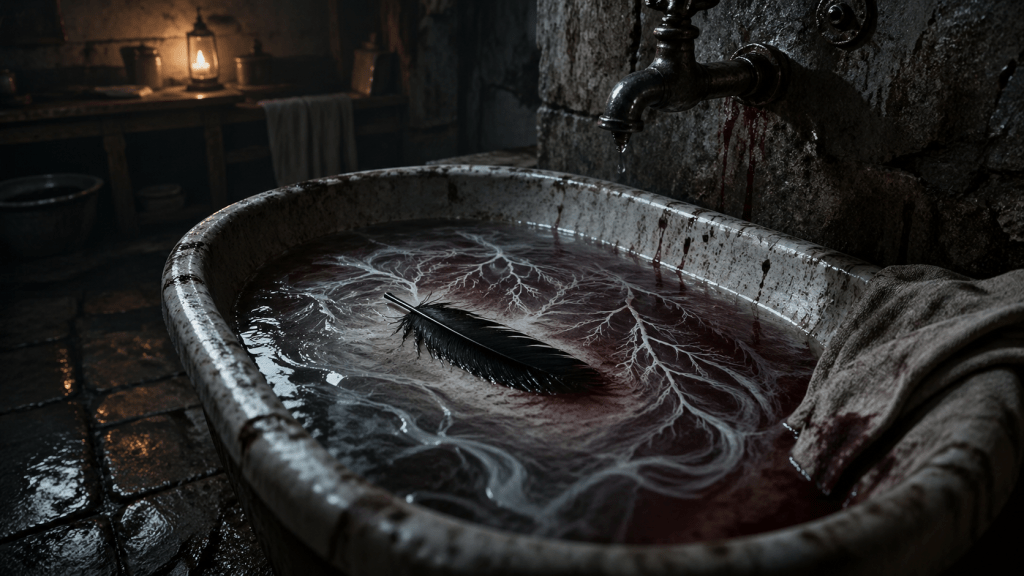
She drew her hands from the basin, wrung the cloth, and set it aside on the draining board. The next rag carried less blood, although it had been pressed hard against a split brow and had stiffened along one corner. She lowered it into the water, then hesitated. Something lay upon the surface near the basin’s far rim. At first she mistook it for a loose thread shaken from the linen, a narrow dark strip resting where the lamplight failed to reach. It turned slowly, once, then steadied, and the motion revealed the fine barbs laid along a central shaft.
A feather floated there, black and clean in shape, long enough to span half the breadth of her palm. No window opened in the lower room. The rear door had remained shut since she came in from the yard, and the tap above the basin gave only water from the house pipe, cold and faintly bitter. Edrane stared at the feather while the cloth sank slowly beneath her other hand. It rested upon the reddened surface with a stillness she disliked at once, untouched by the tremor caused by dripping water and untouched by the slow turn of the cloth beneath it.
She looked up towards the ceiling, then towards the shelves, then behind her to the dark corner where buckets stood nested beside the wall. There was no bird in the room, no open vent large enough for such a thing, no broken shutter, and no loose roof gap where it might have fallen from above. Feathers came into houses often enough. They clung to cloaks, mattress ticking, cheap trim, and the straw beneath bedding. She knew all ordinary explanations and had spent most of her life trusting them because ordinary explanations allowed work to continue. Yet the feather in the basin held itself apart from every movement around it, as if it had arrived through the water itself.
Edrane reached for it, then stopped before her fingers touched the surface. Beneath the feather, the red cloud within the basin had begun to change. At first she thought the lye had bitten into the blood strangely, loosening pale threads from the cloth and drawing them outward. Thin white lines spread beneath the water in delicate branching forms, each one moving from the feather’s shadow towards the basin’s edge. They travelled through the diluted blood with measured quiet, dividing, widening, and joining again in forms that reminded her of winter frost seen on chapel glass. The room held only the stale warmth of labour and lamp smoke.
The tap continued to drip. Each drop struck the basin close to the feather, yet the black shaft barely moved. The pale branching spread further, making a fragile web through the water, and for a moment the whole surface seemed to hold its breath. Edrane felt the skin of her arms tighten. The scratching behind the wall ceased. From the floor beneath her came a faint pressure, less sound than sensation, as though the stone below the basin had taken weight from somewhere under the room.
She backed away a single step and knocked her hip against the shelf. A jar shifted, rolled, and struck the floor with a dull crack. The sound broke through the room with such sudden force that she gasped, while above her the house continued its ordinary life through footsteps, voices, and a muffled cough from the stair. No one called down. No one entered. The basin remained where it was, the feather resting upon bloodied water while white forms grew and thinned beneath it.
Edrane forced herself forward again, with anger rising because fear had no use in a room where work still waited. She took the wooden stir stick from the shelf and plunged it into the basin. The water broke under the blow, red and white twisting together as the feather spun towards the near rim. For several heartbeats the pattern vanished into dirty turbulence. She stirred harder, striking the basin sides, dragging the cloth upward and forcing it under again until the water turned cloudy and the feather disappeared beneath the fold of linen.
When the surface settled, the feather had returned to the centre. It lay exactly where she had first seen it. The pale forms beneath it gathered again, thinner now, spreading outward in slow lines that curved around the sunken cloth and reached towards the drain hole as if seeking a route through stone. Edrane let the stick fall from her hand. The room seemed smaller than it had moments before, its ceiling lower, its walls damp with a closeness that pressed the breath in her throat. She became aware of the line beside the tap once more, the old repair mark gleaming faintly under the lantern light, and of the way the water in the basin appeared to lean towards that wall by a measure too slight for certainty and too clear for comfort.
The back door opened behind her with a groan of damp wood, and one of the younger servants entered carrying another bundle of stained cloth against her apron. She stopped when she saw Edrane standing rigid beside the basin. Her face changed as her eyes moved to the water, to the feather, and then to the pale residue spreading beneath it.
“What is it?” the girl asked.
Edrane turned her head slowly, then looked back at the water. The feather remained upon the surface, though the pale lines beneath it had already begun to loosen, dissolving into the red until only a cloudy brightness remained around the shaft.
“Stray matter,” Edrane said, because the words sounded like something a sensible woman would say in a house where walls listened poorly and rumours travelled faster than fire. “From the yard, perhaps. Bring the rest here.”
The girl came closer, lowering the cloth into the basin with visible reluctance. Her eyes fixed on the feather, then on the pale residue beneath it. Edrane opened the drain with a sharp pull and watched the water begin to turn. Red slipped away first, circling into the dark mouth beneath the basin. The feather turned with the movement, dipped once, then resisted the current as if the draining water had no claim upon it. Only when Edrane seized the wooden stick and pressed it under did it finally vanish into the drain with the last of the reddened water.
The pipe below gave a soft sound, almost like breath drawn inward. For a while, both women remained still. The basin emptied, the tap dripped, and the lower room settled into its former shape around them. The lantern flame steadied. The boards above creaked. Rainwater moved in the yard beyond the door. Edrane reached for the cloth and began again, though her hands shook enough to make the water splash against the rim when she refilled the basin.
By morning, she would tell the mistress only that the lower drain required cleaning and that lime should be rubbed again along the wall near the tap. By evening, the matter would pass into practical speech, where blood, lye, plaster, old pipes, and yard dirt could explain anything that wished to remain inside the house. Yet before the next bucket was carried in, before the floor was scrubbed and the lantern put out, Edrane looked once more into the clean water gathering beneath the tap.
For a moment, as the basin filled, a thin white branch opened silently beneath the surface and faded before the first ripple reached the stone.
Foundation Register: Lower Washing Room Basin Record
The lower washing room entered within the adjoining property plans appears as part of a rear service range set behind several occupied chambers and connected to the shared yard by a narrow threshold passage. Surviving plans describe the room in practical terms, listing a stone basin fixed beneath a lower tap, a shallow drain channel cut into the floor, and a repaired wall section where older masonry met later plaster around the water pipe.
Earlier revisions record repeated maintenance along the same wall, with lime applied across a thin vertical mark that returned after wet weather and heavy use of the tap. These entries assigned the condition to damp movement within the masonry and to pressure carried through the drainage below the rear rooms. The basin itself remained listed as serviceable, with worn stone along the rim, minor chipping near the front edge, and discolouration consistent with ordinary washing use.
During the period following disturbance in the rear ground, several household accounts began referring to irregular matter found within wash water after cloth had been cleaned below the rooms. The earliest entries speak first of darkened water, lye residue, and diluted blood from treated injuries. These descriptions remained within the language of household labour, assigning the matter to wounds received in the passage, work carried out after supper, and the late cleansing of linen, skin, and stone.
A repeated detail appears across later entries concerning a single dark feather observed upon the surface of the basin after the water had already been used. Early descriptions treat the feather as stray debris carried in from the yard, bedding, or garments handled within the house. The same accounts also record that the room held a closed rear door at the time, with the lower windowless wall offering little open passage through which such material might have entered.
Further entries describe changes in the water beneath the feather, where pale branching lines appeared within diluted blood before dispersing through the basin. These forms are entered with caution and placed beside ordinary explanations, including lye reaction, lime residue, plaster dust, and disturbed matter from the lower pipe. Several revisions reduce the detail to cloudy separation within washing water, while earlier wording preserves the description of lines spreading outward from the feather in measured form.
Additional testimony refers to a brief stillness across the basin surface while the tap continued to drip. The feather is described as remaining largely unmoved by falling water and by the turning of cloth beneath it. These observations are absent from later property copies, where the matter is condensed into a reference to contamination within the lower washing basin and unsuitable drainage conditions after rain.
A short entry made by a house servant records that the feather resisted the drain for a moment after the basin plug was pulled, then vanished only when pressed below the surface with a wooden stirring stick. The same entry refers to a soft inward sound from the pipe after the water cleared. This phrase is absent from the copied register and survives only within a loose household sheet kept among repair accounts for the rear rooms.
Several maintenance entries following the incident recommend cleansing the lower pipe, rubbing fresh lime along the marked wall, and washing the basin stone with vinegar and ash. These measures were completed during the next work period. The basin remained in use, though later household remarks refer to fresh water taking a faint pale branching for a moment beneath the tap before rippling clear.
The condition was attributed to contamination within the lower drainage, worsened by wet ground, old plaster, and bloodied cloth left to stand before washing. Repair orders list the matter as local and manageable, requiring cleaning of the basin, inspection of the pipe, and fresh sealing of the wall behind the tap. Further inquiry into the feather itself appears to have ended once the drain was cleared and the visible water ran clean.
A margin hand added beside one early copy describes the event as “water holding shape around a thing that should have sunk or gone away.” The phrase appears once, written beside the section concerning pale lines beneath the surface, and was removed from later prepared summaries of the same account.
Final entries state that the lower washing room returned to ordinary service after cleaning works were completed. The basin, tap, and drain remained listed within the property plan as stable household fixtures, while the irregular matter found in the water was accepted as residue from use, weather, and age within the rear service range. The record closes with the condition entered as resolved, leaving the room to its work beneath the house, where water continued to gather, darken, and pass below the stone.
About the Creator
The Mythic Chronicle is written and curated by Simon Phillips, a writer of mythic and speculative fantasy whose work explores the quieter edges of forgotten worlds, where buried structures, fractured records, and lingering presences continue beneath the surface of recorded history.
The accounts preserved within these Chronicles form part of a wider body of work in which cities stand upon older foundations, and events recorded as isolated disturbances are understood, in later tellings, to belong to patterns that were never fully recognised at the time.
One such account survives in a separate record, detailing an incident within a lower district where a death was first dismissed as excess, though the space in which it occurred retained a presence that resisted clearing, and where investigation revealed signs that the disturbance had not been confined to a single room.
This record is preserved in the novella Black Feathers in a Brothel, where the events surrounding that incident are followed more closely, though even there the full nature of what lay beneath the structure remains uncertain.
Readers who wish to examine that account in its fuller form may find the record below.
Explore the book:
Black Feathers in a Brothel
You can watch his YouTube channel here:
Author Simon Phillips

Continuation of the Record
What follows is drawn from later entries concerning the lower washing room and the basin fixed beneath the rear tap, where the first irregularity was entered as contamination within water used for ordinary cleansing. Early accounts describe the matter in practical terms and assign it to bloodied cloth, lye residue, damp plaster, and disturbed pipework below the rear service range, although subsequent notes refer to repeated moments in which pale branching appeared beneath the surface after the water had darkened. Each occurrence is entered briefly and held within the language of household maintenance, while several annotations refer to a dark feather remaining upon the basin water, a faint stillness around the rim, and a soft inward sound from the drain after the water cleared. In later entries, the pattern is described as gathering around the feather before loosening into the whole, as though the basin held a shape for a measured time before surrendering it to the pipe below. The cause remains assigned to local drainage, old lime, and residue carried through the washing room, and each account concludes with the basin accepted within the limits set down for it in the register.

Subscribe to continue reading
Subscribe to get access to the rest of this post and other subscriber-only content.