How a king shaped by exile rebuilt Wessex into a kingdom strong enough to endure.
After the Marshes
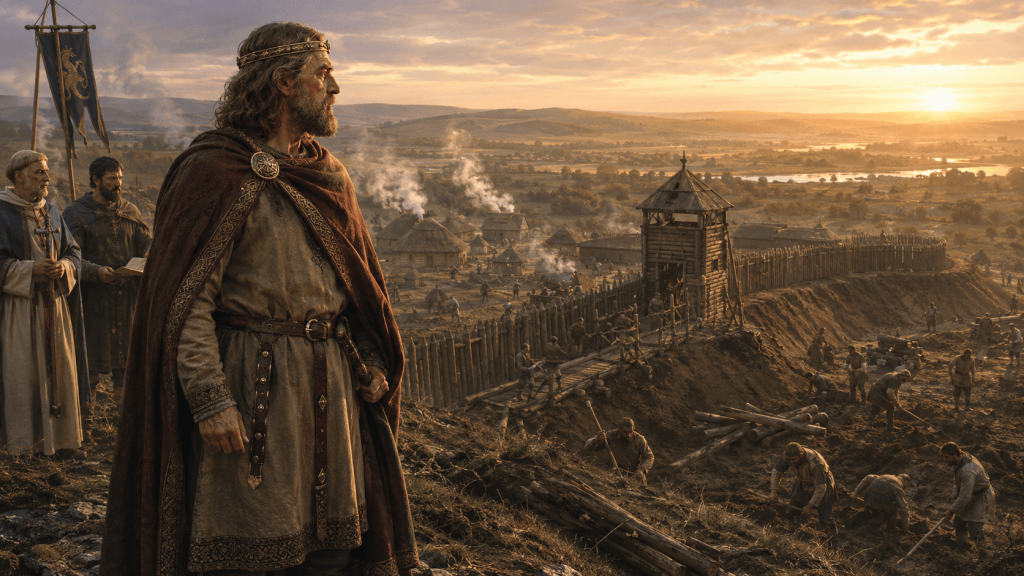
Morning settled over Wessex with the pale patience of a land that had survived too much to greet the light with ease. Across the low fields, mist clung to the grass in silver folds, and smoke rose from hearths where families had returned to homes once emptied by fear. The roads still bore the memory of war. Cart ruts cut through damp earth, fences leaned where men had torn timber for firewood, and church bells rang across villages where prayer had become a habit of endurance as much as devotion. In the distance, beyond the fields and grazing land, men worked along the line of a new defence, driving posts into the ground while others hauled stone, timber, and earth beneath the watchful eyes of royal officials.
Alfred watched from a slight rise above the settlement, his cloak drawn close against the morning chill. He had come through marsh water, hunger, secrecy, and the long shadow of defeat, and Edington had given him victory enough to breathe. Yet the king’s gaze rested less on the memory of battle than on the men below him, the labourers setting walls where open ground had once invited danger, the clerks marking supplies upon wax tablets, the priests moving between workmen with quiet words of encouragement. A kingdom could be saved by courage in a single hour, though it could only endure through labour repeated day after day until fear itself found fewer doors left open.
“My lord,” one of his companions said as he stepped closer, boots dark with wet grass. “The men ask where the next ditch should be cut.”
Alfred turned, studying the line of ground that sloped toward the road. His face carried the weariness of a man whose triumph had offered duty instead of rest.
“There,” Alfred said, lifting his hand toward the lower ridge. “The road must remain watched from the gate. A wall that guards only itself serves the enemy more than the town.”
The official bowed his head and hurried away, calling orders across the work line. Voices answered, rough and practical, and soon the dull thud of tools began again. Each strike seemed small against the wide morning, yet together they made a sound unlike battle. It was steadier, heavier, shaped by purpose instead of panic.
Beside Alfred, a priest wrapped in a plain woollen cloak looked over the settlement with tired eyes. “The people still speak of the Danes,” he said, his fingers resting upon the small cross at his breast. “They ask whether Guthrum’s baptism will hold, whether peace has truly come.”
Alfred’s expression shifted only slightly. “Peace has come for a season,” he replied, his voice low. “A season must be used wisely.”
The priest looked at him then, as though hearing the king beneath the survivor.
“And if the storm returns?”
Alfred kept his gaze on the rising timber wall, where men strained together beneath the weight of a beam. “Then it will find a kingdom with gates, roads, law, learning, ships, and men ready to answer. We have lived too long as scattered fires. It is time Wessex burned as one hearth.”
The priest said no more. Below them, the settlement continued to take shape, rough and incomplete, its future still vulnerable to weather, hunger, ambition, and the sea. Yet something had changed. The years before had taught Alfred how swiftly a kingdom could be broken. The years ahead would show whether one could be rebuilt strongly enough to stand.
Timeline of Events
878 AD – Alfred defeats Guthrum at Edington, ending the immediate Viking threat to Wessex and giving the kingdom space to recover.
878 AD – Guthrum accepts baptism after his defeat, creating a fragile peace between Alfred’s Wessex and the Viking ruler who had nearly destroyed it.
c. 879–880s AD – Alfred begins strengthening Wessex through fortified burhs, organised defence, improved administration, and renewed royal authority.
886 AD – Alfred takes control of London, restoring a major centre of trade and power while drawing wider English loyalty toward his rule.
c. 890s AD – Alfred promotes law, learning, translation, and written wisdom, shaping a kingdom built for memory as well as defence.
A Visual Chronicle
Alfred survived the Vikings, but rebuilding Wessex would help shape the future of England.
About the Creator
This Chronicle is written by Simon Phillips, author of several historical and speculative fiction works exploring forgotten worlds, myth, and the turning points of history.
You can explore his books here:
Books by Simon Phillips
You can watch his YouTube channel here:
Author Simon Phillips
Continuing the Chronicle
The account that follows moves beyond the marshes of Athelney and into the years after Edington, when Alfred turned survival into structure and began rebuilding Wessex through fortified towns, renewed law, learning, defence, and royal authority strong enough to withstand the storms that had almost broken the kingdom.
Readers supporting The Forgotten Chronicle may continue into the full record below.

Subscribe to continue reading
Subscribe to get access to the rest of this post and other subscriber-only content.
